




Abstract
Previous research suggests that political extremists have stronger convictions in their beliefs than moderates. The present research examines the relationship between political extremism and belief stability, defined as the extent to which people change their ideological beliefs over time. Studies 1 (N = 397) and 2 (N = 291) revealed that participants at the left and right extremes report more stable beliefs than political moderates. We then reanalyzed a longitudinal study that tracked actual ideological changes over time during a referendum (Study 3, N = 5812). Results indicated that for ideological orientation measured at three time points, politically extreme respondents had lower standard deviations—and hence, more stable ideologies over time—than moderates. Furthermore, the effect appeared more pronounced among people at the left than people at the right. We discuss implications of these insights for political extremism in society and the malleability of political ideology.
Many modern societies are politically polarizing, as suggested by the frequent political conflicts on news media and the Internet. European nations struggle with how to process the recent influx of refugees, and with questions about the relationship with the European Union. Abortion, gun laws, and immigration are divisive topics in the United States. Other issues, such as globalization, dissatisfaction with the status quo, and climate change also contribute to widespread political polarization. Traditional approaches within political psychology have tried to inform these debates by focusing on psychological differences between citizens at the left versus the right of the political spectrum (Jost et al., 2003). The polarized nature of modern society suggests, however, that it is equally important to study how political extremists (i.e., citizens at both ends of the political spectrum, whose convictions deviate from the norms of conduct in a given context or situation; Kruglanski et al., 2017) differ from moderates (van Prooijen et al., 2018). Accumulating research indicates that, despite their differences, there are also substantial similarities between left- and right-wing extremists (for overviews, see Greenberg & Jonas, 2003; Midlarsky, 2011; Van den Bos, 2018; Van Prooijen & Krouwel, 2019).
In this contribution, we examine the relationship between political extremism and belief stability: compared to relatively moderate beliefs, to what extent are politically extreme beliefs and ideologies subject to change over time? Belief stability has been a central focus in classic studies of political ideology. For instance, Converse (1964) found that while preferences for specific policy proposals tend to be rather unstable over time, party identification (e.g., identifying as a Republican or Democrat) is highly stable over time. Moreover, he argued that well-informed party elites with high levels of political sophistication (i.e., “ideologues”) tend to have more stable political beliefs than the less informed masses (see also Zaller, 1992). But while these insights are important, they do not answer the questions (a) whether belief stability over time is stronger at the political left or right, and (b) whether the political extremes—who are not necessarily well-informed (Van Prooijen & Krouwel, 2020)—have stronger belief stability than political moderates. The present research seeks to address these issues by combining cross-sectional evidence (Studies 1 and 2) with a longitudinal study carried out during a political referendum to track actual ideological changes over time (Study 3).
Political Ideology and Belief Stability
One line of reasoning suggests that belief stability may be stronger at the political right than left. Notably, the rigidity-of-the-right hypothesis proposes that conservative ideologies are uniquely associated with a set of psychological attributes reflecting a desire for certainty, closed-mindedness, and a preference for order and tradition (Jost et al., 2003). Consistent with this view, ample research reveals a relationship between conservative political views and dogmatism (Kemmelmeier, 2007; Toner et al., 2013), a construct characterized by an unwillingness to update one’s beliefs (Altemeyer, 2002). Moreover, conservative ideologies are associated with a preference for certainty (e.g., intolerance of ambiguity; Fibert & Ressler, 1998). This is relevant for the current purposes given that attitudes tend to be more stable over time when people experience them as more certain, and less ambiguous (Howe & Krosnick, 2017). These considerations lead us to suggest the hypothesis that right-wing ideologies are more stable over time than left-wing ideologies.
An alternative possibility, however, suggests that the political extremes—at both the left and right—have more stable ideological beliefs than political moderates. Accumulating evidence reveals that feelings of distress increase people’s extremist beliefs (e.g., Burke et al., 2013; Landau et al., 2015; van Prooijen & Krouwel, 2019; van Prooijen, Krouwel, Boiten, & Eendebak, 2015). Rapid political, social, and economic changes, negative emotions, and other factors such as poverty, political oppression, and decreased opportunities can therefore all work to increase support for relatively radical political movements. These insights are consistent with the notion that when suffering significance loss (e.g., through stigmatization, personal failure, and humiliation), people try to restore the feeling that they are respected by others by supporting a meaningful cause (Kruglanski et al., 2012, 2014, 2018; van Prooijen & Kuijper, 2020; Webber et al., 2018). People often find such a meaningful cause in a set of straightforward and clear-cut ideological goals which they pursue with zeal and conviction (see also McGregor et al., 2001).
Extremist ideologies hence offer epistemic clarity through a worldview that oversimplifies complex problems (Greenberg & Jonas, 2003; Kruglanski et al., 2006; Landau et al., 2015; Tetlock et al., 1994; Van Prooijen & Krouwel, 2019; Van Prooijen, Krouwel, Boiten, & Eendebak, 2015; Webber et al., 2018). Consistently, people with politically extreme beliefs mentally categorize their world in more homogenous and distinct clusters than political moderates (Lammers et al., 2016), and are also more likely to believe conspiracy theories to make sense of societal events (Van Prooijen, Krouwel, & Pollet, 2015). However, perceiving the world as relatively simple is likely to stimulate the feeling that one’s understanding of the world is accurate. Indeed, political extremism is associated with overconfidence in one’s own knowledge and beliefs (Van Prooijen & Krouwel, 2020). For instance, compared to moderates, political extremists display a stronger conviction in the correctness and superiority of their political beliefs (Brandt et al., 2014; Toner et al., 2013), and are more likely to reject ideological beliefs that differ from their own (Van Prooijen & Krouwel, 2017).
In sum, political extremists tend to hold their beliefs with strong conviction. What are the implications of this insight for how stable political ideologies are over time? Strong attitudes in general are resistant to change, and hence stable over time (Krosnick & Petty, 1995). Furthermore, strong attitudes influence a person’s reception and search of attitude-consistent information, hence increasing the confirmation bias and motivated reasoning (Epley & Gilovich, 2016; Howe & Krosnick, 2017). Although these insights are consistent with our line of reasoning, it is important to empirically assess such temporal stability specifically for extreme political attitudes. Previous research suggested that the psychological processes underlying political extremism do not necessarily generalize to any strong attitude (for an illustration, see van Prooijen, Krouwel, & Pollet, 2015; Study 3).
Political attitudes are more strongly related to moral concerns than most non-political attitudes, and particularly attitudes that are held with strong moral conviction (as might be expected among political extremists) are resistant to change (Skitka, 2010). Moreover, it has been noted that political extremism is associated with a “crippled epistemology,” which entails being sensitive only to arguments from one’s own ingroup while dismissing other knowledge or perspectives (Hardin, 2002). The excessive confidence that characterizes extreme political ideologies may therefore stimulate a motivated information-processing style designed to protect one’s beliefs against inconsistent information, and maintain those beliefs over time. In sum, we propose that political extremists are less likely to change their ideological beliefs over time than political moderates.
We assessed these ideas in two ways. First, in two cross-sectional studies (Study 1 and 2) we developed a novel measure to assess instability of participants’ ideological beliefs, and tested whether participants at both political extremes would display less ideological instability than participants in the political center. Second, we analyzed data from a large-scale panel study (Study 3) that included three measurement points during a political referendum and tested whether, compared to moderates, the ideology of people at both political extremes would change relatively less over time.
Study 1
Method
The present research was part of a larger study, and was conducted via the online crowdsourcing platform Clickworker. The survey was available in both English and German, and was open to participants residing in Germany and Austria.
Open Practices Statement
The three studies reported in this manuscript were not formally pre-registered. All the relevant materials are available in the Online Supplemental Material.
Participants
A total of 397 participants took part in the study, 228 (57.4%) of which were male. We performed a sensitivity power analysis, which indicated that a sample size of 397 yields 95% power to detect a relatively small effect (ƒ2 = 0.036). Participants were aged between 18–73 years (M = 36.15, SD = 13.02) and were mainly white Europeans (94.2%). Most participants completed the survey in German (95%) and were German residents (89.9%). Participants came from a varied educational background (4.5% had only completed primary education, 45.1% achieved secondary level education, 29.2% had a bachelor’s degree, and 21.2% held a graduate degree or higher).
Measures
Political orientation and political extremism
Participants’ political orientation was measured with five items. First, participants were asked to place themselves on left–right and progressive–conservative political continuums. Participants also indicated how left- or right-wing they were when it came to specifically economic, social, and safety issues (with examples provided of general left- and right-wing attitudes in these dimensions). All of these items were answered on an 11-point Likert scale (1 = very left wing / very progressive, 11 = very right-wing / very conservative). We then centered all items at the scale midpoint (making them range from -5 to +5), and combined them in a centered five-item ideology scale (α = .869). We then calculated a political extremism index by taking the absolute value of the midpoint-centered ideology scale (cf. Frimer et al., 2018).
Ideological instability
To measure instability of ideology, we developed a new scale (see Online Supplemental Material for the German translation). Participants indicated how much they agreed with the following six statements concerning the stability of their political opinions (1 = strongly disagree, 7 = strongly agree): “My opinions about political issues have changed in the last few years,” “My political opinions always stayed the same” (reverse coded), “I feel that nothing can change the political opinions that I currently hold” (reverse coded), “Certain events sometimes make my political opinion change,” “I have not always had the same opinions about politics,” and “I am often unsure about my political orientation.” The scale had good reliability (α = .772), and the items yielded a one-factor solution in a factor analysis (Eigenvalue = 2.41).
Procedure
After reading the consent form, participants’ demographic information and political orientation were assessed. Participants then responded to a range of items collected for different research purposes (e.g., perceptions of refugees). After completing the instability of ideology measure, participants were debriefed and collected their payment.
Results
We conducted a hierarchical regression with instability of ideology as dependent variable. Step 1 of the regression model included the centered ideology measure; in Step 2 we added the political extremism index; in Step 3 we added the control variables age, gender, and education. The regression results are displayed in Table 1. Step 1 was significant, R2 = .032, F(1, 395) = 13.234, p < .001. Including the extremism term (Step 2) added significantly to the regression model (ΔR2 = .042), Fchange(1, 394) = 17.840, p < .001, indicating that extremism is predictive of increased stability. Adding the control variables in Step 3 did not change the model fit significantly, (ΔR2 = .006), Fchange (3, 391) = 0.794, p = .498.
Results of hierarchical regression analyses (Study 1).
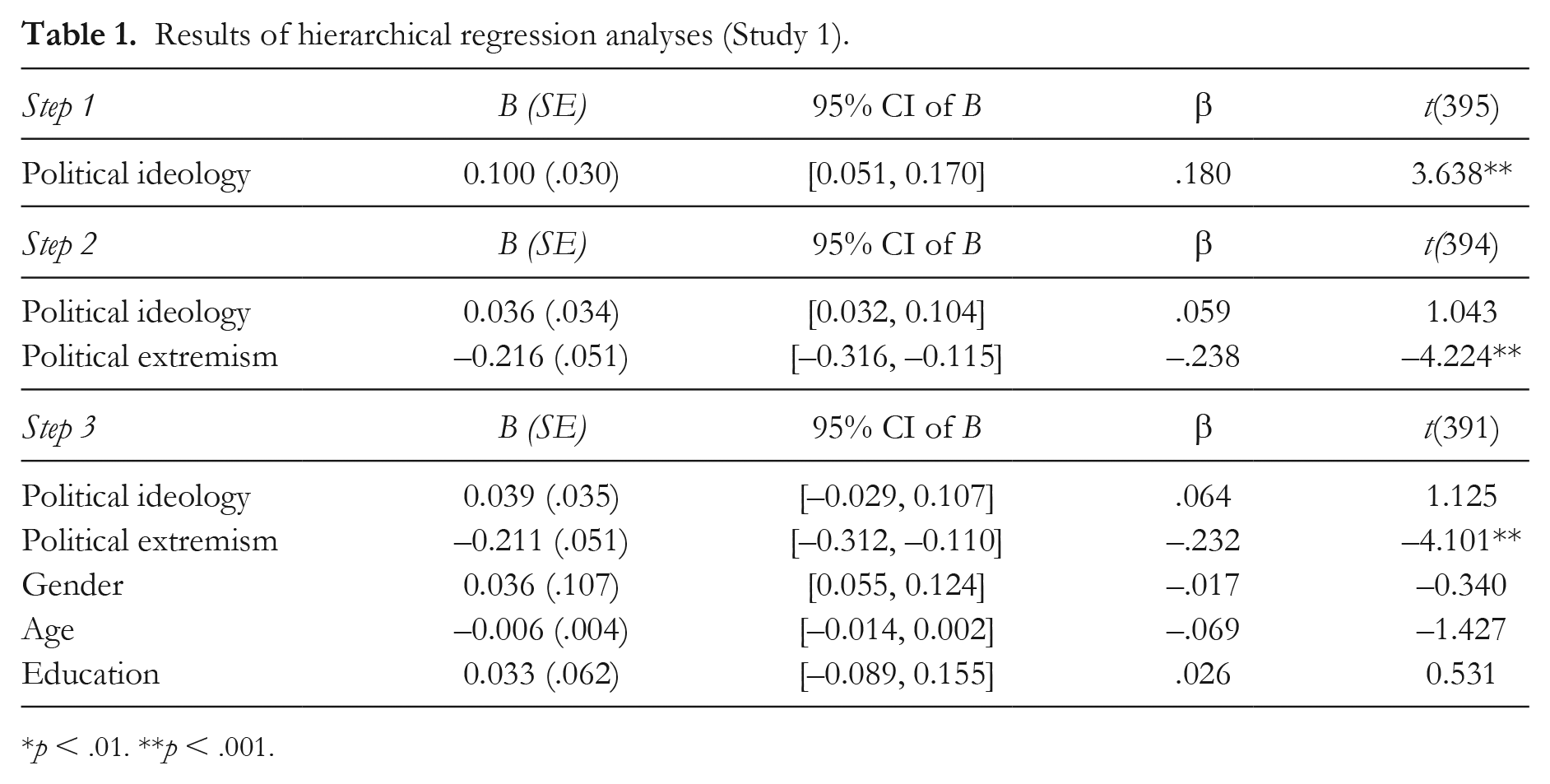
p < .01. **p < .001.
We then tested whether the observed extremism effect differed at the political left versus right. We therefore categorized participants as either left wing (-1) or right wing (1), while categorizing political neutral participants as 0. Using a regression, we then tested the main effect and possible interaction of the extremism index and political orientation (left wing, moderate, right wing) on belief instability while controlling for gender, age, and education. The regression results revealed a significant extremism term, B = -0.217, SE = .053, 95% CI [-0.322, -0.113], p < .001, while the effect of political orientation was non-significant, B = 0.053, SE = .103, 95% CI [-0.149, 0.256], p = .605. The interaction between the categorical ideology variable and extremism was not significant, B = 0.015, SE = .058, 95% CI [-0.099, 0.129], p = .799. The interrupted linear regression lines at the left and right of the political spectrum are illustrated in Figure 1. These findings suggest that, the more extreme people are, the more stable their political opinions, irrespective of their political orientation.
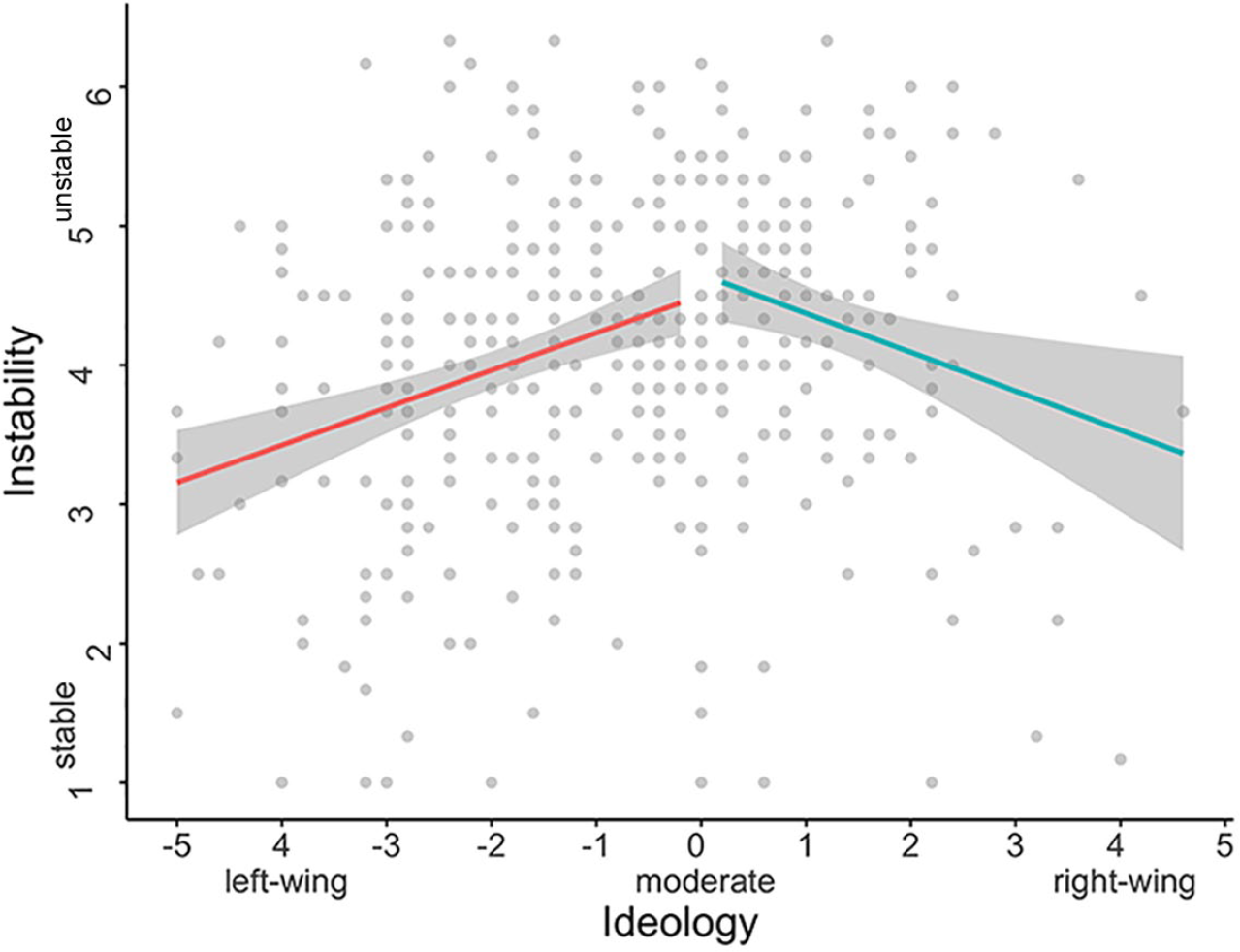
The relationship between political orientation and ideological instability in Study 1 (including 95% confidence intervals).
Study 2
To examine whether the results of Study 1 could be replicated, we conducted a direct replication study (again using the online crowdsourcing platform Clickworker). This study was also part of a larger project, and was identical to Study 1 in regard to political stability measures with the exception that the survey was only made available to German participants.
Method
Participants
Of the 291 participants, 165 (56.5%) were male, and the average age of the sample was 38.09 years (SD = 12.66), ranging from 18 to 75 years. We performed a sensitivity power analysis, which suggested that a sample size of 291 yields 93% power to replicate the extremism effect (f2 = 0.0492) found in Study 1. The sample consisted of people mainly of White European ethnicity (95.9%), most of whom completed the survey in German (97.6%). The sample came from a varied educational background (4.1% completed only primary education, 44.0% achieved secondary level education, 30.6% had a bachelor’s degree, and 21.3% held a graduate degree or higher).
Measures
The study started with demographics, directly followed by the same political orientation (α = .866) and ideological instability (α = .751) measures as in Study 1. The items of ideological instability again formed a one-factor solution (Eigenvalue = 2.26). We again centered the political orientation measure around the scale midpoint and calculated a political extremism index.
Results
As in Study 1, we conducted a hierarchical regression with instability of ideology as dependent variable. Step 1 of the regression model included the centered ideology measure; in Step 2 we added political extremism; in Step 3 we added the control variables age, gender, and education. The regression results are displayed in Table 2. Step 1 was not significant, (R2= .000), F(1, 289) = 0.066, p = .797. However, adding the extremism term in Step 2 significantly increased the fit of the model, (ΔR2 = .051), Fchange(1, 288) = 15.338, p < .001. Adding the demographic variables in Step 3 did not change the model fit significantly, (ΔR2 = .004), Fchange (3, 285) = 0.354, p = .786.
Results of hierarchical regression analyses (Study 2).
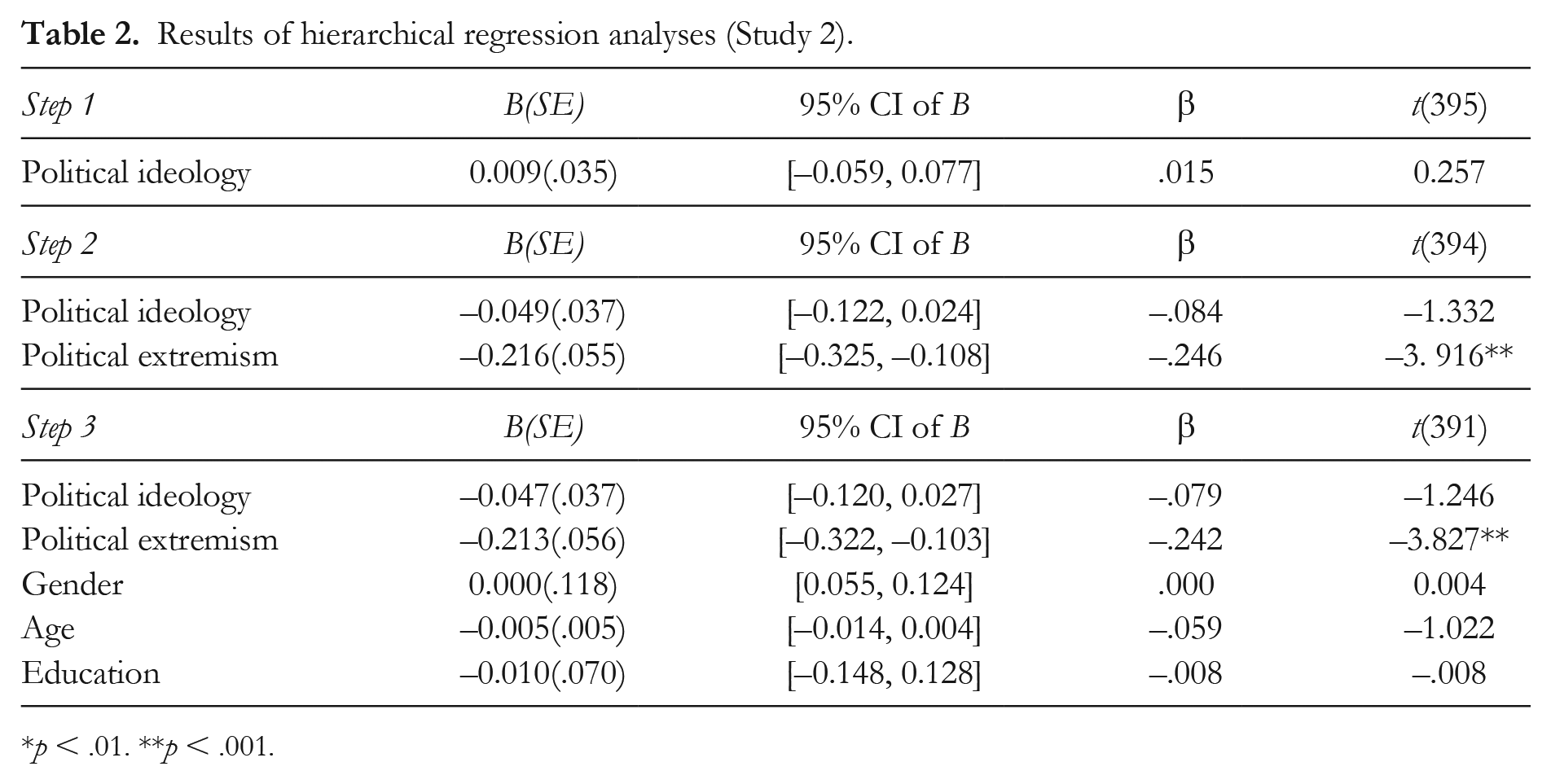
p < .01. **p < .001.
We then compared the relationship between extremism and stability at the political left and right in the same manner as the previous study, again controlling for age, gender and education. The regression results revealed a significant extremism term, B = -0.201, SE = .057, 95% CI [-0.313, -0.089], p < .001, while the effect of political orientation was non-significant, B = -0.112, SE = .110, 95% CI [-0.329, 0.105], p = .312. The interaction between the categorical ideology variable and extremism was not significant, B = 0.003, SE = .062, 95% CI [-0.119, 0.125], p = .960. This finding (illustrated in Figure 2) replicates the results from Study 1 and suggests that, regardless of political orientation, the more extreme people are, the more stable their political beliefs.
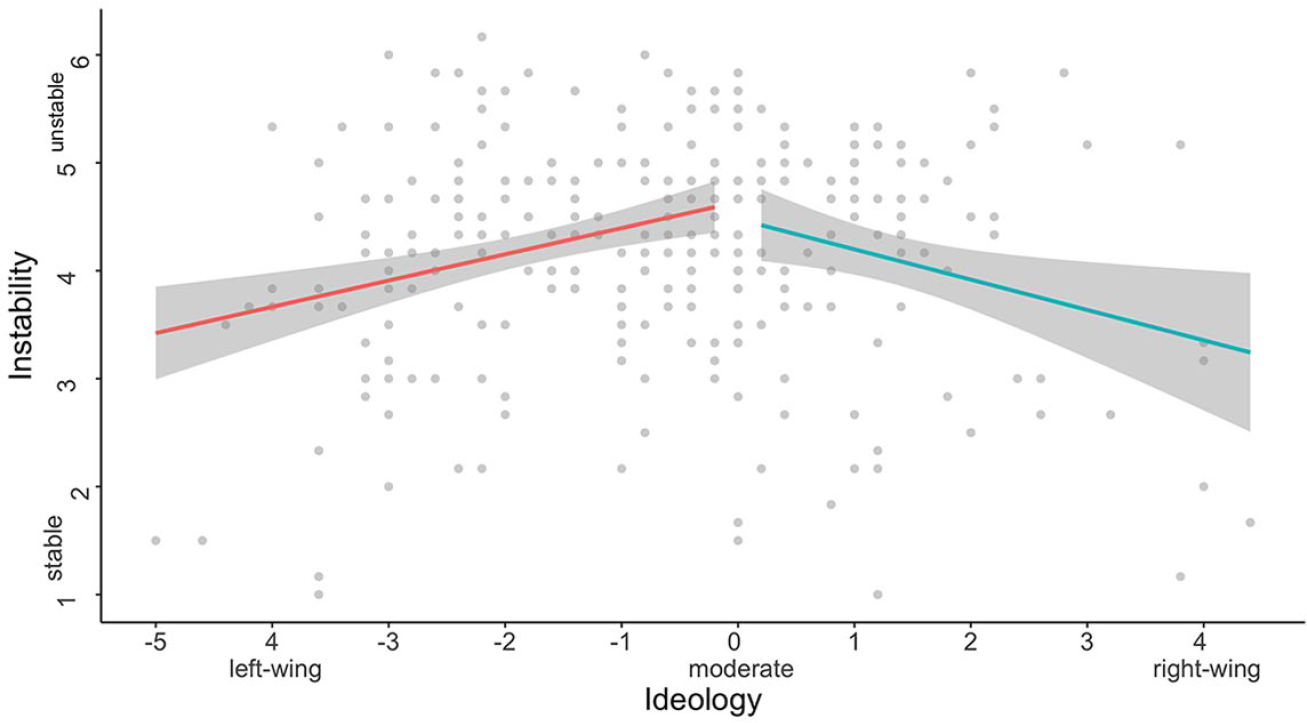
The relationship between political ideology and ideological instability in Study 2 (including 95% confidence intervals).
Discussion of Studies 1 and 2
Taken together, Studies 1 and 2 support the idea that ideological beliefs are more stable at the political extremes than in the political center, irrespective of whether people are at the left or right end of the political spectrum. These findings are inconsistent with the prediction that we derived from the rigidity-of-the-right model, based on the notions that people at the political right are less likely to update their beliefs over time, and have lower tolerance for ambiguity, than people at the political left (Jost et al., 2003). We also note, however, that there are several limitations to these findings. One is the use of Clickworker for data collection. This type of crowdsourcing website is a reliable and cost-effective source for collecting high-quality data (Peer et al., 2017) from a population that is more diverse than university samples. Nevertheless, the “workers” that are active on these crowdsourcing sites can vary greatly depending on a variety of factors (for more details, see Paolacci & Chandler, 2014). Another limitation of Studies 1 and 2 is the cross-sectional nature of the findings. In order to test changes of beliefs over time, one necessarily needs a longitudinal design. In the following, we report results of a large-scale panel study with three measurement points during a societal event in which ideological beliefs are likely to be relatively volatile—a Dutch national referendum. The fact that the data was collected from a large-scale nationwide panel through a professional research agency, rather than via a crowdsourcing platform, increases the generalizability of the results.
Study 3
Method
Participants and design
The study was part of a large, multi-wave online research panel that took place in March 2016 in the context of a Dutch national referendum (van Prooijen & Krouwel, 2020). The study was coordinated by Kieskompas (“election compass”), a political research organization that acts in line with the strict regulations set by the Dutch Authority for the Protection of Personal Information (“Autoriteit Persoonsgegevens”; registration number m1457347), and with the ethical norms of VU Amsterdam. Three of the waves contained a measure of political ideology: Wave 1, which took place 6 weeks before the referendum; Wave 2, which took place 4 weeks before the referendum; and Wave 3, which took place 3 days after the referendum. A total of 5929 Dutch respondents participated in all three waves (4585 men, 1328 women, 16 gender not reported; median age range 56–64 years). This sample yields more than 99% power to detect small effect sizes (ƒ2 = 0.02) and therefore has a very high power to detect the slightly larger effect size (f2 = 0.0492) found in Study 1.
Measures
We measured ideology in each of the three waves by asking participants to place themselves on an 11-point Likert-scale ranging from 1 = left wing to 11 = right wing. These three items had high test-retest reliability (α = .92; aggregated M = 5.42; SD = 2.04).
Results
To test the hypothesis that the political extremes have more stable ideologies than political moderates over the course of a referendum, we took the ideology measure in the first wave as “baseline” (and hence as independent variable in the analyses), and tested how much their political ideology subsequently changed during the campaign as reflected in the standard deviation over the three ideology measures. Consistent with the previous studies, we centered the ideology measure in Wave 1 around the scale midpoint, and generated an extremism term by calculating the absolute value of the midpoint-centered ideology measure (Frimer et al., 2018). Furthermore, we excluded participants with SD scores > 3.0 on the stability measure as outliers (N = 117), rendering a final sample of N = 5812 for the analyses. 1 In a hierarchical regression analysis, we entered the centered ideology measure in Step 1, the extremism term in Step 2, and the control variables in Step 3. Degrees of freedom deviate from the final sample due to missing values on the control variables. The regression results are displayed in Table 3.
Results of hierarchical regression analyses: Standard deviations over time as a function of political ideology (Study 3).
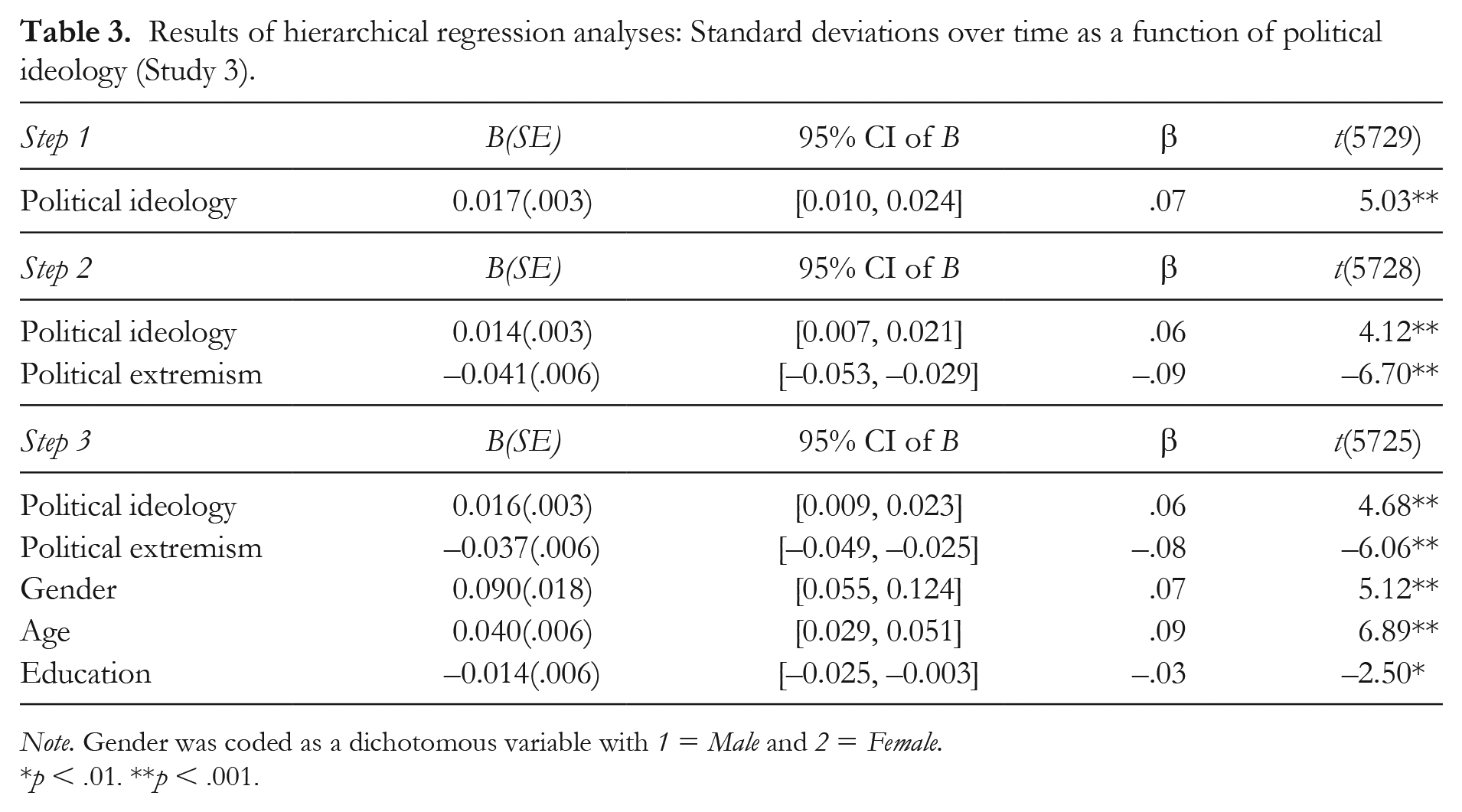
Note. Gender was coded as a dichotomous variable with 1 = Male and 2 = Female.
p < .01. **p < .001.
Step 1 was significant (R2 = .004), F(1, 5729) = 25.33, p < .001, indicating higher standard deviations (i.e., less stability) among those at the right. Step 2, including the extremism term, added significantly to the regression model (ΔR2 = .008), F(1, 5728) = 44.84, p < .001, indicating that more extreme ideologies were associated with lower standard deviations, that is, more stability. Step 3, adding the control variables, was also significant (ΔR2 = .014), F(3, 5725) = 27.22, p < .001. The results indicated that lower standard deviations (i.e., higher stability) were associated with higher education levels and younger age; moreover, ideology was less stable among women (Mean SD = 0.83) than among men (Mean SD = 0.54). Of importance, the extremism term remained significant, and in the predicted direction, also after including the control variables.
We then compared the relationship between extremism and stability at the political left and right in the same manner as the previous studies. The regression results revealed a significant extremism term, B = -0.033, SE = .006, 95% CI [-0.045, -0.021], p < .001. Unlike the previous studies, however, the interaction with the categorical ideology variable was also significant, B = 0.045, SE = .008, 95% CI [0.030, 0.060], p < .001. Political extremism significantly predicted lower standard deviations (i.e., increased stability) at the political left, B = -0.096, SE = .010, 95% CI [-0.112, -0.072], p < .001, but not at the political right, B = -0.011, SE = .012, 95% CI [-0.034, 0.012], p = .338 (see Figure 3). In the General Discussion we revisit this finding.
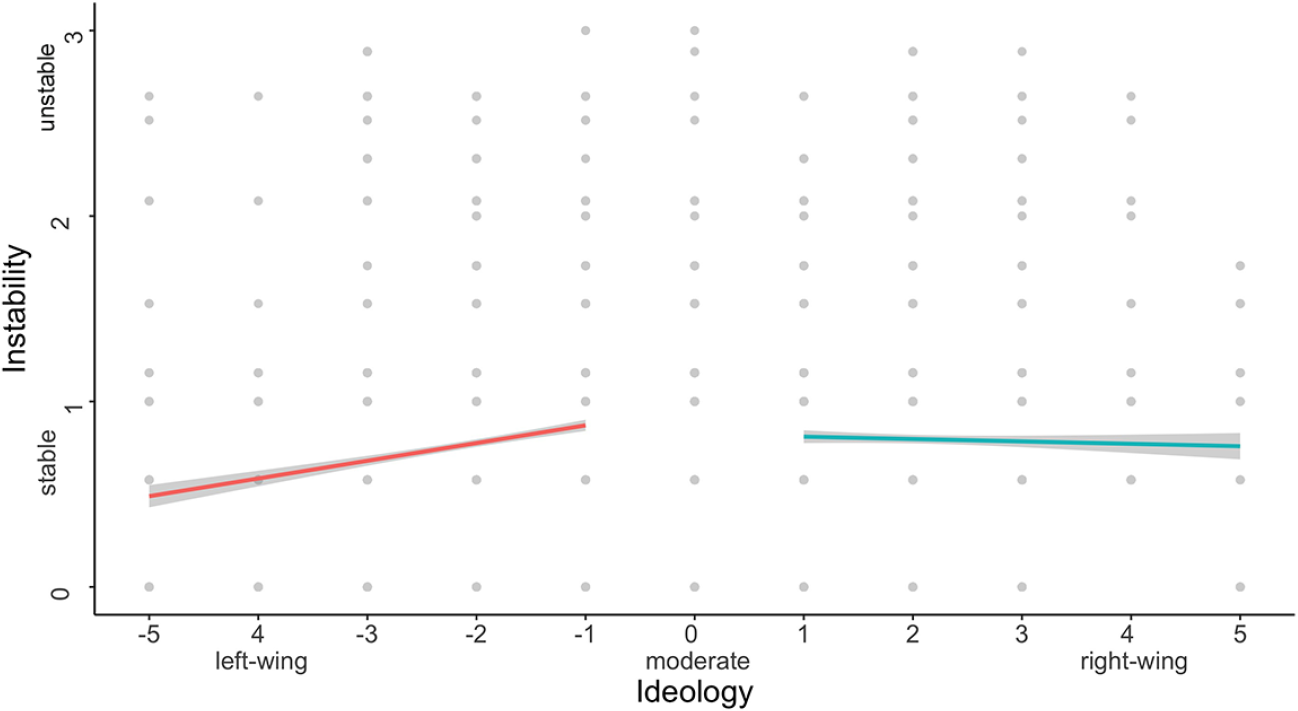
The relationship between political ideology and ideological instability in Study 3 (including 95% confidence intervals). Higher ratings reflect higher standard deviations and hence less stability over time.
In a more exploratory fashion, we then also analyzed the standard deviations (again restricted to range from 0 to 3) of the three possible combinations of two time points: T1 and T2, T1 and T3, and T2 and T3. Results revealed that the crucial extremism index in Step 3 of the regression analysis was significant for the T1–T3 combination B = -0.057, SE = .007, 95% CI [-0.070, -0.044], p < .001, and for the T2–T3 combination, B = -0.067, SE = .007, 95% CI [-0.080, -0.054], p < .001, but not for the T1–T2 combination, B = -0.004, SE = .006, 95% CI [-0.017, 0.008], p = .492. This suggests that the major shifts in ideology took place between T2 (i.e., four weeks before the referendum) and T3 (i.e., three days after the referendum) suggesting that the heavy political campaigning shortly before an election, or an election event itself, changes people’s ideological beliefs—but particularly so among moderates. This finding is compatible with our line of reasoning, and may stimulate new research on the impact of elections on people’s ideological beliefs.
General Discussion
The results indicate that people at both extremes of the political spectrum have more stable ideologies than political moderates. We found these effects using both a cross-sectional design with a novel measure of ideological instability (Studies 1 and 2) and with a longitudinal design in which participants’ political ideology was tracked over time during a political referendum campaign (Study 3). Taken together, these results support the idea that extreme political beliefs at both sides of the spectrum remain relatively stable over time.
The current research offers at least three novel contributions to the emerging literature on the psychology of political extremism. First, while belief updating is a central aspect of important constructs within political psychology (e.g., dogmatism), the present study tracked, in a high-powered sample, to what extent people actually change their beliefs over time (Study 3). Second, in Studies 1 and 2 we developed a new scale designed to measure the stability of people’s political orientation. The observation that this scale offers similar results to a longitudinal assessment suggests good construct validity of this scale. Third, this research meaningfully contributes to the idea that besides differences between the political left and right (Jost et al., 2003), there may also be important similarities between left- and right-wing extremists that distinguish them from moderates (e.g., van Prooijen & Krouwel, 2019; see also Frimer et al., 2018; Toner et al., 2013; van Prooijen et al., 2018). We specifically find that political extremists’ ideological beliefs are more stable over time than those of political moderates.
The Study 3 findings suggest, however, that these effects are particularly pronounced for left-wing extremists. Our line of reasoning was based on the notion that political extremists have relatively high confidence in their understanding of political and societies’ issues (independent of their actual knowledge; see Van Prooijen et al., 2018). While speculative (also taking into account the fact that we did not find differences between left- versus-right-wing extremists in Studies 1 and 2), one possible explanation may be that besides such high confidence, the political left extreme (compared to the political right extreme) had higher actual knowledge of the issues at stake during the referendum that formed the background of Study 3 (Van Prooijen & Krouwel, 2020). As a consequence, it is possible that the left-extreme was relatively less sensitive to all the campaign rhetoric leading up to the referendum. This explanation is consistent with the notion that political knowledge is associated with more stable beliefs over time (Converse, 1964).
A strength of the present research is that two different methodologies, notably cross-sectional (Studies 1 and 2) and longitudinal designs (Study 3), produced converging results. This, in conjunction with the fact that we collected data from three different countries (Germany and Austria in Studies 1 and 2, and the Netherlands in Study 3), suggests high ecological validity of these findings. That being said, all three studies were of correlational nature, which makes it impossible to infer causality or to know whether the relationship between political extremism and belief stability is affected by potential mediating factors. Related to this point, our new measure of belief instability in Studies 1 and 2 is at present not validated, and more research would be required to assess how well this measure captures belief instability. Another limitation of this research is that we only tested our ideas in European samples with multiparty political systems. It is unclear at present whether these results generalize to other countries with a different political system (e.g., the two-party system of the US). Furthermore, the present research only tested changes in ideological beliefs, and did not examine what specific factors may cause these changes. It would be particularly worthwhile—also from a practical perspective—for future research to test interventions that lead extremists to change their beliefs. These interventions may be based on existing knowledge about the relationship between political extremism and, for example, economic uncertainty, well-being, and societal distress (Van Prooijen & Krouwel, 2019).
One important challenge for future research is to establish the extent to which these findings generalize to other, presumably more radical ideological beliefs, such as activism or religious fundamentalism. While the present studies focused specifically on regular citizens who score relatively at the far left or far right on political ideology measures, would underground “fringe” groups (e.g., Neo-Nazis; Islamic terrorists) also have relatively stable ideologies over time? Based on the insight that such extremist beliefs are often grounded in strong moral convictions (Skitka, 2010), we speculate here that ideological stability over time may be a core feature of many different radical ideologies. At the same time, we should note that not all strong moral convictions and activist groups necessarily are destructive for society. For instance, human rights movements have stimulated important social change by consistently standing for a range of emancipatory values even when faced with adversity (see also Tetlock et al., 1994). These considerations suggest novel research areas pertaining to the scope of the findings reported here, and the positive and negative implications that ideological (in)stability may have for society.
In sum, the present research reveals that people at the political extremes are less likely to change their ideological beliefs over time compared to relatively moderate individuals. These findings are consistent with arguments that it is relatively difficult to convince political extremists of perspectives that differ from their own (Hardin, 2002; see also Toner et al., 2013; Van Prooijen & Krouwel, 2017). This could have implications for understanding how people sustain radical political beliefs, contributing to the political polarization that currently characterizes many modern societies. Trying to depolarize the political debate is an important challenge for researchers and policymakers alike, but the relatively stable ideologies at the extremes observed here suggest that this might not be an easy task in practice.
Supplemental Material
sj-pdf-1-gpi-10.1177_1368430220917753 – Supplemental material for Persistent beliefs: Political extremism predicts ideological stability over time
Supplemental material, sj-pdf-1-gpi-10.1177_1368430220917753 for Persistent beliefs: Political extremism predicts ideological stability over time by Maria V. Zwicker, Jan-Willem van Prooijen and André P. M. Krouwel in Group Processes & Intergroup Relations
Footnotes
Author Contributions
MVZ and JWVP designed and carried out Studies 1 and 2; APMK designed and carried out Study 3; MVZ and JWVP analyzed all of the data; MVZ wrote the paper; JWVP and APMK provided useful feedback on the paper.
Funding
The author(s) received no financial support for the research, authorship, and/or publication of this article.

Supplemental material
Notes
References
Supplementary Material
Please find the following supplemental material available below.
For Open Access articles published under a Creative Commons License, all supplemental material carries the same license as the article it is associated with.
For non-Open Access articles published, all supplemental material carries a non-exclusive license, and permission requests for re-use of supplemental material or any part of supplemental material shall be sent directly to the copyright owner as specified in the copyright notice associated with the article.
