



Abstract
Decision-making in organizations is often complex and involves groups, which have access to the pool of perspectives and knowledge their members hold individually. However, groups frequently fail to use their full decision-making potential. The concept of integrative complexity (IC) captures how complex decision-making profits from the differentiation and integration of diverse perspectives and knowledge. In a laboratory experiment with 4 conditions (N = 12 groups of 4 students per condition), we found that group dissent enhanced differentiation and a stepwise recapitulation of the group discussion enhanced integration, thereby raising group-level IC. Dissent groups who performed a stepwise recapitulation reached the highest levels of group IC compared to ordinary dissent groups, consent groups, and individuals working alone. They also exceeded their own best member and achieved an equal level of IC to that of the best members of nominal groups. The study contributes to the body of research identifying factors that support groups in exploiting their potential and reaching more informed decisions and judgments.
For making complex decisions and judgments in organizations, work groups are preferable to individual decision-makers. Organizations rely on groups to synthesize their members’ expertise in order to reach more informed decisions and judgments than individuals could reach alone. One of the advantages of groups is that—theoretically—they can make use of all group members’ perspectives and knowledge and thus outperform individuals (Brodbeck, Kerschreiter, Mojzisch, & Schulz-Hardt, 2007; DeChurch & Mesmer-Magnus, 2010; Hinsz, Tindale, & Vollrath, 1997; Mesmer-Magnus & DeChurch, 2009; Okhuysen & Eisenhardt, 2002; van Knippenberg, De Dreu, & Homan, 2004). However, research has shown that groups often fail to exploit their full potential (Kerr & Tindale, 2004). Instead, groups frequently suffer process losses that hamper their performance (Brodbeck & Greitemeyer, 2000). For example, process losses occur when groups experience destructive conflicts and are unable to communicate effectively in order to integrate their perspectives and knowledge (De Dreu & Weingart, 2003; De Wit, Greer, & Jehn, 2012; Kerr & Tindale, 2004; Lu, Yuan, & McLeod, 2012). The aim of this paper is to explore how group processes can be shaped to support groups in exploiting their full potential.
We built on the idea that a combination of two processes in particular helps groups exploit the diverse perspectives and knowledge available within them: groups must first differentiate the diverse perspectives and knowledge and then integrate them in order to reach a common understanding or decision. This combination of differentiation and integration is captured by concepts of complexity in general (Lord, Hannah, & Jennings, 2011; Satish, 1997; Streufert & Streufert, 1978; Suedfeld, 2010) and the concept of integrative complexity in particular (IC; Suedfeld, Tetlock, & Streufert, 1992). The latter is the focus of this paper.
Empirically, IC has been found to be indicative of the constructive resolution of differences (for a summary of this research, which was mainly conducted in the field of political relations, see Suedfeld, 2010), which is essential for groups containing diverse perspectives and knowledge. Methodologically, IC makes it possible to assess the complexity of spoken or written communication independently of its content (Baker-Brown et al., 1992), and is therefore well suited to analyzing group deliverables. Nevertheless, IC has rarely been used in research on complex group tasks and decisions (for exceptions, see Gruenfeld & Hollingshead, 1993; Park & DeShon, 2018; Wong, Ormiston, & Tetlock, 2011).
Our study adds to the body of literature devoted to enhancing group decision-making (Brodbeck et al., 2007; Hinsz et al., 1997; Kerr & Tindale, 2004; Mesmer-Magnus & DeChurch, 2009) by employing the concept of IC, thereby further establishing this concept in group research. We do this by answering the following research question: How can groups be supported in differentiating and integrating the diverse information available in the group through its members and thus achieve high levels of IC, thereby producing more informed decisions or judgments?
Integrative Complexity (IC)
Integrative complexity (IC) specifies how humans deal with multidimensional and complex matters. While a complex matter can be viewed from many alternative perspectives, people’s perceptions differ in the degree to which they actually recognize or acknowledge these different perspectives and view them in relation to each other.
IC is defined as the degree of differentiation and integration of different perspectives (Schroder, Driver, & Streufert, 1967; Suedfeld et al., 1992) with regard to any potentially complex matter where differentiation is necessary but not sufficient for integration. Addressing the structure of information (rather than its content), IC is related to frameworks such as cognitive complexity (Bieri, 1961), which deals with the act or process of knowing, and cognitive structure (Scott, Osgood, & Peterson, 1979), which addresses the mental processes individuals use to process and understand information. Whereas early theoretical approaches and empirical studies considered IC to be a stable personality trait, more recent theoretical approaches and empirical studies recognized that IC is also influenced by the environment and is thus a state variable (for more details on the history of the concept of IC, see Suedfeld et al., 1992; Tetlock, Peterson, & Berry, 1993).
Methodologically, IC is represented on a single dimension with seven levels (Suedfeld et al., 1992), which are described in Table 1. At low levels of IC (Level 1), neither differentiation nor integration are exhibited. Medium levels (Level 3) involve differentiation but no integration. High levels are characterized by both differentiation and integration (Level 5). Highest levels of IC (Level 7) are reached when an overall viewpoint is additionally considered (i.e., high-level integration). Note that Levels 2, 4, and 6 are considered intermediate levels, where the requirements of the next phase are visible but not fully developed. The actual coding of IC is always based on specific verbal utterances.
Description of the seven levels of integrative complexity.
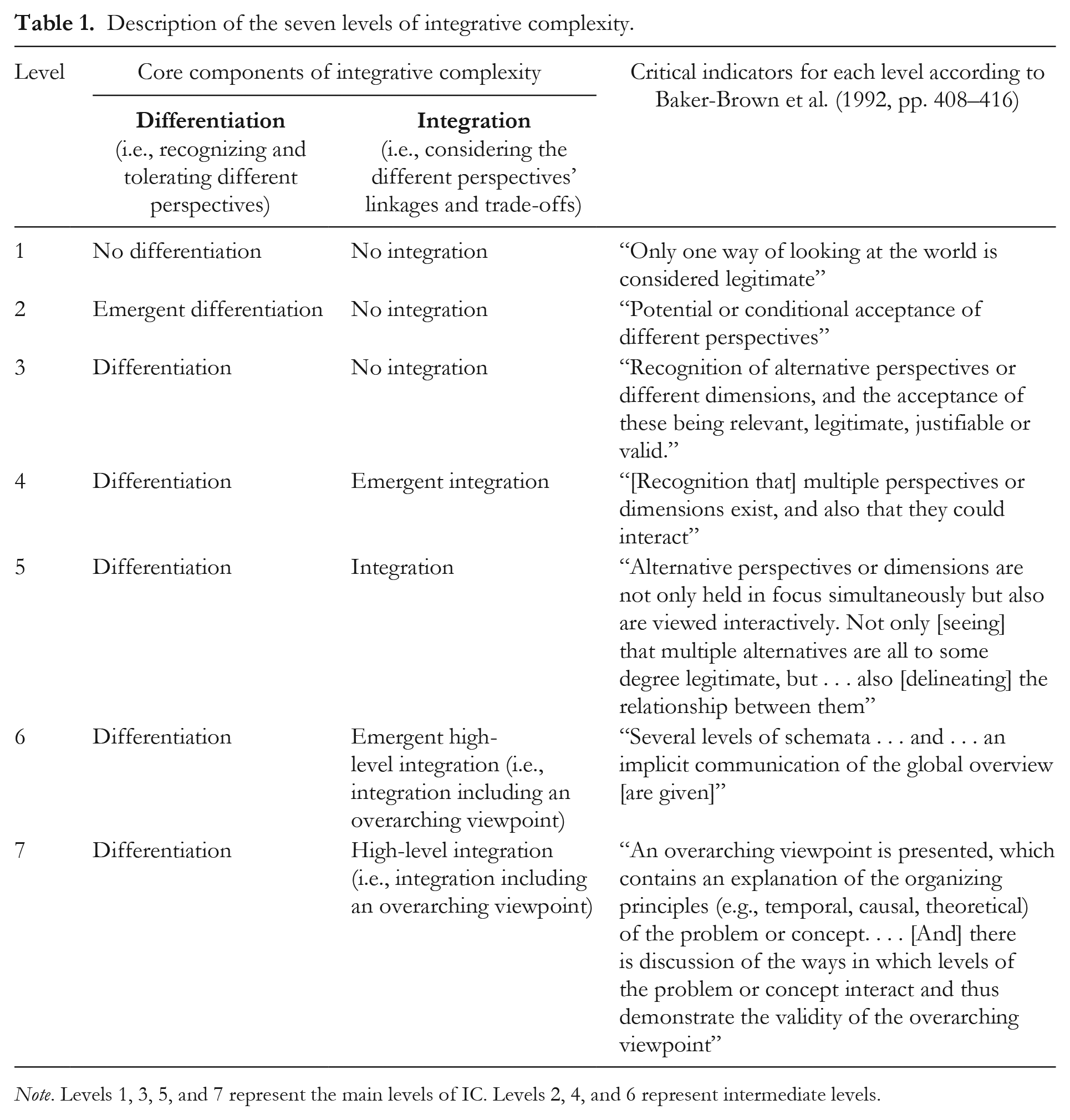
Note. Levels 1, 3, 5, and 7 represent the main levels of IC. Levels 2, 4, and 6 represent intermediate levels.
More specifically (see also Tetlock et al., 1993), ambiguity and shades of grey are not apparent at low levels of IC. Instead, potentially complex matters are expressed in terms of black-and-white categories (i.e., no differentiation and no integration, IC Level 1). Differentiation is apparent when ambiguity appears to be tolerated, as different viewpoints and perspectives are expressed on a potentially complex matter (i.e., differentiation but no integration, IC Level 3). However, these different viewpoints and perspectives are not yet synthesized. Synthesizing different viewpoints is apparent when relationships between different viewpoints and perspectives are identified and trade-offs and consequences are clearly considered (i.e., differentiation and integration, IC Level 5). When it is apparent that these linked perspectives (in the aforementioned sense) are also reflected in light of an overarching perspective or principle, the highest level of IC is reached (i.e., differentiation and high-level integration, IC Level 7). At the highest level of IC, it is apparent that the “nature” (and not only the existence) of alternative views and their relationships are considered, for example, as revealing organizing principles for (potentially antagonistic) alternatives or broader standards that might apply.
To give an example: one may strictly reject the view that people should be forced to work for the state in order to receive social welfare benefits (i.e., IC Level 1). One may also acknowledge that it is problematic to force people to work on the one hand, but on the other hand, one usually earns one’s living through working (i.e., IC Level 3). Furthermore, one may consider that it may be necessary to take into account the specific situation of each individual who receives welfare in order to determine whether forcing them to work is appropriate (i.e., IC Level 5). In addition, one may consider broader societal norms (i.e., IC Level 7).
IC was originally conceptualized as an individual-level variable representing a person’s level of differentiation and integration in information processing and decision-making behavior. Although the advantages of IC for studying the group processes underlying group performance were noted early on (Driver & Streufert, 1969), only a few studies (Gruenfeld & Hollingshead, 1993; Kugler, Coleman, & Fuchs, 2011; Park & DeShon, 2018; Wong et al., 2011) thus far have explored the construct of IC on a group level.
At a group level, IC can be viewed as the degree of differentiation and integration inherent in the social interchange (e.g., via communicative acts) that becomes manifest in the shared conceptualizations and outputs that groups develop. Group-level IC may stem from group members’ individual levels of IC, and—more importantly—it was argued that group-level IC may also arise from group members’ diverse perspectives (Gruenfeld & Hollingshead, 1993; Wong et al., 2011). Thus, group-level IC, can be seen as “reflecting the extent to which groups as a whole have adopted or elaborated on the differentiation that exists among members’ perspectives and the way in which the diversity among those perspectives has (or has not) been reconciled” (Gruenfeld & Hollingshead, 1993, p. 388). We were intrigued by the concept of IC for studying group information processing, as the process of differentiation and subsequent integration is crucial for groups to be able to deal with differences within the group and ultimately make use of group members’ diverse perspectives and knowledge to reach more informed decisions and judgments than would have been reached by individuals alone.
Previous research supports the notion that IC can be transferred to the group level and viewed as a group phenomenon. Gruenfeld and Hollingshead (1993) showed that groups developed higher levels of IC compared to individuals by combining their members’ ideas. High levels of group IC were also reported to be associated with positive aspects of (inter)group functioning and outcomes: in social dilemma games, higher levels of group IC (in comparison to lower levels) increased groups’ decisions to cooperate with other groups (Park & DeShon, 2018). In dyadic conflict interactions, higher levels of dyadic IC (in comparison to lower levels) were associated with more constructive conflict processes (Kugler et al., 2011), and the group-level IC of top management teams was found to be positively related to the consideration of multiple perspectives and ultimately to corporate social performance (Wong et al., 2011).
Besides studying group-level IC, research has examined the effects of group membership on individual-level IC. On the one hand, being part of groups with diverse members (and particularly with a minority) stimulated divergent thinking and higher levels of individual IC (especially for majority members; Antonio et al., 2004; Gruenfeld, 1995; Gruenfeld & Preston, 2000; Gruenfeld, Thomas-Hunt, & Kim, 1998). On the other hand, being part of a group undertaking groupthink was associated with lower levels of IC (Tetlock, 1979).
Positive effects of IC on dealing with differences, diversity, and conflict have been found repeatedly in the area of political relations. For example, high levels of IC were associated with progress in political negotiations (Liht, Suedfeld, & Krawczyk, 2005) and cooperative conflict resolution (Koo, Han, & Kim, 2002; Winter, 2007); low levels of IC were associated with conflict escalation (Suedfeld & Leighton, 2002; Tetlock, 1985), competition (Satterfield, 1998; Walker & Watson, 1994), and international tensions (Suedfeld & Bluck, 1988; Suedfeld et al., 1992; Wallace, Suedfeld, & Thachuk, 1993). The beneficial effects of IC on dealing with differences and dissent have also been studied in the field of organizational psychology. High levels of IC helped expatriates use their diverse experiences gathered abroad for innovative outcomes (Tadmor, Galinsky, & Maddux, 2012), and organizational cultures exhibiting high levels of IC were found to be associated with more constructive conflict management within the organization (Kugler & Brodbeck, 2014).
From the theory and research described before, we conclude that (a) IC can indeed be meaningfully transferred from the individual to the group level, and (b) high levels of IC are beneficial for dealing with diversity and differences, such as the diverse perspectives and opinions exhibited in groups when making complex decisions and judgments. These conclusions led us to the following question: How can groups be supported to reach high levels of IC? We propose that differentiation in groups can be enhanced through dissent, and integration can be enhanced by an interactive discussion structure in the form of stepwise recapitulation.
Differentiation by Dissent
Dissent in groups is a double-edged sword, as it can lead to obstructive conflict processes on the one hand, but also inspire beneficial differentiation of diverse perspectives on complex issues on the other hand (e.g., De Dreu & Weingart, 2003; De Wit et al., 2012). In a cooperative environment, dissent in groups tends to stimulate a greater consideration of alternatives as well as open-mindedness and enhances the likelihood that groups will generate novel and creative solutions (Nemeth, 1986).
Various studies showed that dissent—and especially minority dissent—enhances differentiation in groups (for a summary, see Schulz-Hardt, Mojzisch, & Vogelgesang, 2008). Minorities helped to change majorities’ attitudes towards less extreme opinions and more diverse perspectives (Nemeth, 1995; Smith, Tindale, & Dugoni, 1996; Wood, Lundgren, Ouellette, Busceme, & Blackstone, 1994). For example, in hidden-profile situations, dissent increased information obtainment and information-processing quality, as well as the consideration of unshared information (Schulz-Hardt, Brodbeck, Mojzisch, Kerschreiter, & Frey, 2006). These positive effects are generally only brought about by true dissent among group members rather than faked dissent (e.g., devil’s advocate), because faked dissent is not taken seriously (e.g., Nemeth, Brown, & Rogers, 2001; Nemeth, Connell, Rogers, & Brown, 2001). Enhanced differentiation, in turn, has been found to be related to desirable outcomes (for an overview, see Jetten & Hornsey, 2014) such as quality and quantity of solutions (e.g., Nemeth, Brown, & Rogers, 2001; Nemeth, Connell, et al., 2001), creative problem solving (e.g., Nemeth, 1986), innovativeness and learning (e.g., De Dreu & West, 2001), less escalation of commitment in group decision-making (e.g., Greitemeyer, Schulz-Hardt, & Frey, 2009), and more accurate decisions and judgments (e.g., Nemeth, 1986; Nemeth & Kwan, 1987; Sniezek & Henry, 1989).
We conclude that true dissent in groups fosters differentiation. With respect to IC, this implies that dissent allows medium levels of group IC to be reached.
Proposition 1: Dissent in groups supports the differentiation of diverse opinions and perspectives among group members; thus, dissent leads to a medium level of group IC (differentiation represents Level 3 on the IC scale; see Table 1).
Integration by Stepwise Recapitulation
In order to reach high levels of IC, differentiation is necessary but not sufficient. It has been suggested that formal structures of group processes support integration (Okhuysen & Eisenhardt, 2002; Park & DeShon, 2018). In general, the list of formal structures designed to enhance group performance is large and includes, for example, the nominal group technique (Bartunek & Murninghan, 1984), the Delphi technique (Dalkey, 1968), and brainstorming (Osborn, 1957). For our study, we sought to identify a technique that actively promoted integration while allowing for differentiation through dissent.
We chose the stepladder technique introduced by Rogelberg, Barnes-Farrell, and Lowe (1992) and modified it for our purposes. The original stepladder technique specifies that two individuals start discussing a topic and are then successively joined by a third and a fourth member who introduce their ideas into the ongoing group discussion; the final decision is purposely delayed until the group is complete. Therefore, the stepladder technique allows dissent to surface: new members are given the opportunity to express their views when entering the discussion. In order to also explicitly foster the integration of these diverse opinions, we added one crucial element: we instructed groups to recapitulate the status quo of the discussion before each new member entered the discussion, and thus encouraged the group members to talk about different members’ ideas in relation to each other (i.e., integration). This modification to the stepladder technique requires groups to alternate between differentiation on the one hand, when dissenting individuals enter the discussion, and integration on the other hand, when the discussion is collectively recapitulated. Thus, we propose that this procedure enhances group-level IC.
The stepladder technique was originally proposed to promote group engagement, communication, and knowledge extraction and to reduce social loafing. However, empirical results on the technique’s effects were heterogeneous, with both positive effects (Orpen, 1995; Rogelberg et al., 1992; Rogelberg & O’Connor, 1998; Rogelberg, O’Connor, & Sederburg, 2002) and no effects found (Winquist & Franz, 2008). Rather than entering this debate, we propose an alternative positive effect of the modified stepladder technique: by alternating differentiation and integration, the technique enhances group-level IC.
Proposition 2: Stepwise recapitulation supports the integration of diverse opinions and perspectives in groups with dissent among group members; thus, dissent in combination with stepwise recapitulation leads to high levels of group IC (differentiation and integration represent Level 5 on the IC scale; see Table 1).
Overview of the Study and Hypotheses
To test our propositions, we conducted a laboratory experiment. We asked groups to discuss a complex sociopolitical topic and reach a joint position statement. Given the nature of the topic, there was no right or wrong answer; rather, the groups could differ in the level of differentiation and integration of different perspectives included in their statement (i.e., the level of IC, our dependent variable). In order to test whether dissent supported differentiation (see Proposition 1), we compared a dissent condition to a consent condition, a common method for testing the effects of dissent (see Schulz-Hardt et al., 2008). Furthermore, we were interested in whether stepwise recapitulation fostered integration in addition to differentiation. Thus, we included a dissent-stepwise-recap condition. Whereas in the dissent and consent conditions the groups freely discussed the topic, groups in the dissent-stepwise-recap condition were asked to follow the procedure described before. From our propositions, we derive: 1
Hypothesis 1a: Regarding the level of group IC, groups in the consent condition neither fully differentiate (i.e., level of group IC < 3) nor fully integrate (i.e., level of group IC < 5); groups in the dissent condition fully differentiate (i.e., level of group IC > 2) but not fully integrate (i.e., level of group IC < 5); and groups in the dissent-stepwise-recap condition fully differentiate (i.e., level of group IC > 2) and fully integrate (i.e., level of group IC > 4).
Hypothesis 1a implicitly contains a relative order of the experimental groups on the IC scale (see Table 1).
Hypothesis 1b: The levels of group IC in each condition are expected to have the following order (listed from low to high): groups in the consent condition < groups in the dissent condition < groups in the dissent-stepwise- recap condition.
Ideally, groups differentiate and integrate their diverse perspectives and knowledge in order to reach a more informed decision or judgment than individuals acting alone (Kerr & Tindale, 2004). In our experiment, differentiation and integration is most likely for groups in the dissent-stepwise- recap condition. To test whether these groups reached higher levels of IC than individuals, we performed three comparisons. First, we were interested in whether groups in the dissent-stepwise recap condition reached higher levels of IC than their own best member by comparing their group-level IC with the initial level of individual IC of each group’s best member.
Hypothesis 2a: The group-level IC will exceed the group’s best member’s individual IC more often in the dissent-stepwise-recap condition than in the consent and the dissent conditions.
However, one could argue that this comparison fails to achieve full comparability of conditions, because group members did not receive the opportunity to fully complete the given task individually. Therefore, our second comparison was of the group-level IC in the dissent-stepwise-recap condition to that of individuals working on the task alone. Thus, we added an individual condition to our experimental design in which participants were asked to reflect in private on the sociopolitical topic and reach a position statement.
Hypothesis 2b: Groups in the dissent-stepwise-recap condition will reach a higher level of IC than individuals in the individual condition.
A more stringent analysis for comparing groups to individuals involves comparing the interacting groups to noninteracting “groups,” so-called nominal groups (e.g., Brodbeck & Greitemeyer, 2000; Laughlin, Zander, Knievel, & Tan, 2003). Thus, it is “a comparison of n groups of size m with an equivalent number of n × m individuals” (Laughlin et al., 2003, p. 684). Identifying the nominal groups’ best members is suggested as a point of reference. In our experiment, we formed nominal groups with participants from the individual condition.
Hypothesis 2c: Groups in the dissent-stepwise-recap condition will exhibit higher levels of IC than the best members of nominal groups.
Method
Participants and Sampling Procedures
We recruited 172 students at a German university (26% male; average age = 24.58 years, SD = 4.68), who received course credit and €8.00 for participation. The study was advertised in courses, via flyers, and via student email lists. Participants were invited to a laboratory session at the Department of Psychology. Before the session began, all participants signed an informed consent form; after the session, participants were fully debriefed.
Sample Size, Power, and Precision
To determine the sample size, we conducted a priori power analyses using G*Power (Faul, Erdfelder, Lang, & Buchner, 2007). We expected to obtain large effects for the following reasons: (a) We hypothesized specific differences in means on the IC scale among the three group conditions (i.e., a difference of 1 to 2 points on the 7-point IC scale; see Hypothesis 1a and Table 1). Assuming a difference in means of 1.5 points on the IC scale and a SD of 1 (SDs around 1 were found in other studies on group-level IC; e.g., Kugler et al., 2011), as well as an α-error probability of 0.05 and a power of 0.8 in a one-sided t test, 2 the suggested sample size per condition was n = 7. (b) We also reviewed effect sizes in other studies exploring group-level IC (Kugler et al., 2011), differentiation in groups (Nemeth, Connell, et al., 2001; Schulz-Hardt et al., 2006), and the effects of the stepladder technique (Orpen, 1995; Rogelberg et al., 1992; Rogelberg & O’Connor, 1998; Rogelberg et al., 2002). Of the eight effect sizes we found, three were medium to large (i.e., d = 0.5 to d = 0.8) and five were large (d > 0.8), including three effect sizes above d > 1.00 and up to d = 1.99. As the majority of studies found large effects, we assumed an effect size of d = 1, an α-error probability of 0.05 and a power of 0.8 in a one-sided t test. 2 The suggested sample size per condition was n = 14. Given these suggestions of n = 7 to n = 14 per condition, we decided to collect n = 12 groups of four people per condition.
Research Design
Conditions
Our study was an experimental laboratory study with three group conditions—dissent condition, consent condition, dissent—and one individual condition. Of the 172 participants, 144 were assigned to the three group conditions (i.e., 12 groups of four members in each of the three group conditions) and 28 participants to the individual condition.
We intended to use the data of the individuals in the individual condition in two ways: first, to compare all individuals in the individual condition to the groups in the dissent-stepwise-recap condition (see Hypothesis 2b), and second, to form nominal groups and compare their best members to the groups in the dissent-stepwise-recap condition (see Hypothesis 2c). Nominal groups were formed by assigning individuals in the individual condition to 12 groups of four individuals each. Given that, for practical reasons, the total number of individuals in the individual condition was n = 28, some individuals were assigned to the 12 groups twice. More specifically, we first assigned all individuals randomly to one of the 12 nominal groups, and then we randomly drew again from the pool of individuals without replacement until all 12 nominal groups comprised four individuals. 3 Next, we aggregated the data for each nominal group by taking the maximum individual score in order to represent the “best members of the nominal groups” (see Hypothesis 2c).
Procedure during the laboratory session
The session addressed the following sociopolitical controversy: Is it appropriate for people who receive social welfare benefits from the state to be forced to work for the state in return (e.g., in services like shoveling snow)? The topic was relevant in Germany (i.e., present in the media) at the time the experiment was conducted and important to the population of participants (i.e., students), as they would be looking for jobs soon and would be eligible for social welfare benefits in case of unemployment.
Part 1: Assignment to conditions and IC prior to the experimental task. The first part of the study was completed alone by all participants: The topic was introduced followed by the prompt to imagine being a specialist in a committee convened by the German government to discuss the topic and come up with a position statement. Then participants were asked about their opinion on the topic (pro vs. contra) and perceived importance of the topic. Next, participants were given 5 minutes to write a personal statement on the topic (participants were prompted: “Please take a moment to think about the topic and write down all the thoughts which seem to be relevant to you”; adapted from Tetlock, 1983; Tetlock, Skitka, & Boettger, 1989).
Participants’ opinions were used to determine the conditions: participants who disagreed with one another were assigned to the dissent or dissent-stepwise-recap conditions, and participants who agreed with one another to the consent condition. The dissent groups consisted of both unequally distributed (one individual disagreeing with the other three individuals) and equally distributed dissent (two individuals disagreeing with the other two individuals). While the type of distribution might matter for individual participants, effects on the group level have generally not been found (see Schulz-Hardt et al., 2008). Given that we were interested in group-level IC, we did not differentiate between equally or unequally distributed dissent, but explored potential differences in preliminary analyses. Perceived importance of the topic was used for preliminary analyses. Individual statements on the topic were coded for IC and used to assess the level of individual IC prior to the experimental task.
Part 2: Experimental task. The second part of the study was the actual experimental task, which lasted 25 minutes. The task was to come up with a position statement on the sociopolitical topic. In the three group conditions, participants discussed the topic in the group and created a joint statement; participants were prompted to come up with a statement that reflected the key conclusions of their discussions. In the individual condition, participants thought about the topic in private and reached an individual position statement; participants in this condition were instructed that due to the number of participants who had shown up that day, they were asked to address the task alone by elaborating on and giving thought to the topic in more detail and depth.
Participants in the consent and dissent conditions had 25 minutes to freely discuss as a group. In the dissent-stepwise-recap condition, two participants holding the same opinion started the discussion and summarized their discussion after 7 minutes (“Please state the current state of the discussion”). Then a third member with a different opinion entered the discussion and presented their opinion (“Outline your opinion to the others”), after which the group continued to discuss. After another 7 minutes, the discussion was summarized and a fourth member joined and presented their opinion. Subsequently, the group had 11 minutes to come up with a joint position statement (total time = 25 minutes). While waiting to join the discussion, the third and fourth members were seated in a different room. They were allowed to pass the time by reading (newspapers were provided; none of the newspapers contained an article on the topic of discussion) and were requested to not discuss the topic until they joined the group discussion.
All statements were coded for their level of IC, which formed our main dependent variable: the level of group/individual IC in the experimental task.
Part 3: Questionnaire and debrief. At the end of the session, participants answered a questionnaire concerning their satisfaction with the discussion, perceptions of group members’ engagement, and demographic questions (participants in the individual condition answered demographic questions only). Then all participants were fully debriefed.
Measures
Participants’ opinions on the topic were assessed by their choices between: “Yes, people receiving social welfare benefits should be obliged to work for the state” and “No, people receiving social welfare benefits should not be obliged to work for the state.” Furthermore, we asked: “How important is the topic for you?” (1 = not important, 5 = very important; i.e., importance of the topic).
Overall, we obtained different statements that we coded for their level of IC: individual statements by all participants before the experimental task (i.e., individual IC prior to the experimental task) and group/individual statements at the end of the experimental task in the group/individual conditions (group/individual IC in the experimental task). Each statement was taken as one “utterance” and coded by two out of six blinded and trained coders who followed the manual by Baker-Brown et al. (1992; for details on the IC coding scheme, we refer the reader to the following document available on the Internet: www2.psych.ubc.ca/~psuedfeld/MANUAL.pdf; the document contains detailed descriptions of all IC levels, instructions for coders, and examples). Table 1 summarizes the seven levels of IC. The coders’ initial interrater reliability ranged from ICC = .78 to ICC = .94; disagreements were resolved by discussion. Two examples translated from German by the authors are given next:
Example 1 (individual statement before the discussion; IC Level 1): I think it is important that recipients of social welfare benefits take on responsibility and show willingness to work. The sanction prevents that someone applies for social welfare benefits due to laziness and lives at the cost of others. Also, someone who is (momentarily) unemployed should contribute his/her share to society’s functioning and take on social tasks. It is a good possibility to find geriatric care workers.
Example 2 (group statement after the discussion; IC Level 5): Our common understanding was that it is a very controversial and difficult topic, where one has to opt between two evils. There are risks connected to each solution. One risk would be that, if one does not impose coercive mechanisms on social welfare recipients at all, the stigma of social welfare recipients might increase more. The other risks would be that first, normal jobs would disappear. And, second, there is a risk that overqualified people need to take on simple jobs, and third, people may take on social work jobs for which they are not qualified. If there are no coercive mechanisms at all, then there will always be those who feel comfortable in their situation. It is a certain percentage, this percentage will always exist.
The first example essentially presents one perspective (“individuals receiving welfare should take over responsibilities for the society and not be lazy”) on the matter. Potential alternative or even contradictory perspectives are not considered (i.e., IC Level 1; see Table 1). The second example recognizes that multiple ways of looking at the problem exist (i.e., differentiation). In addition, consequences of the different perspectives are considered (i.e., integration). Given that the different perspectives and their consequences are not structured and viewed in light of an overarching frame (e.g., broader societal norms), the second example represents IC Level 5 but not IC Level 7 (see Table 1).
A questionnaire distributed at the end of the experimental session included two scales that were used for additional analyses (only for individuals assigned to one of the group conditions): Group members’ engagement was measured with a three-item scale by Rogelberg et al. (2002; α = .80). Satisfaction with the discussion was measured with three facets of three items each: satisfaction with the process (e.g., “How fair was the conversation?”), satisfaction with the relationship (e.g., “To what extent did you feel a sense of affection for your partners in the conversation?”), and satisfaction with the outcome (e.g., “How satisfied are you with the joint statement that you generated during the conversation?”). The overall scale, which was also used by Kugler et al. (2011), was reliable (α = .89). Both group member engagement and satisfaction with the discussion were measured using a 5-point Likert scale (1 = not at all, 5 = very much).
Results
The calculations were conducted in R using the following packages: base and stats (R Core Team, 2018), MBESS (Kelley, 2018), afex (Singmann, Bolker, Westfall, & Aust, 2019), pwr (Champely, 2018), lsmeans (Lenth, 2016), gmodels (Warnes, Bolker, Lumley, & Johnson, 2018), car (Fox & Weisberg, 2011), and compute.es (Del Re, 2013). Significance levels are one-sided for testing directed hypotheses and two-sided for all other analyses.
Preliminary Analyses
The four conditions did not differ in the level of individual IC prior to the discussion, F(3, 168) = 1.67, p = .176, η2 = .03; means are included in Table 2). Opinions were equally distributed (53% proponents, 47% opponents) and the topic was important to participants (M = 3.85, SD = 0.85). Individuals’ opinions were unrelated to their level of IC prior to the discussion (r = .07, p = .336) and to the level of IC in the experimental task (r = −.03, p = .725).
Descriptive results for all experimental conditions.
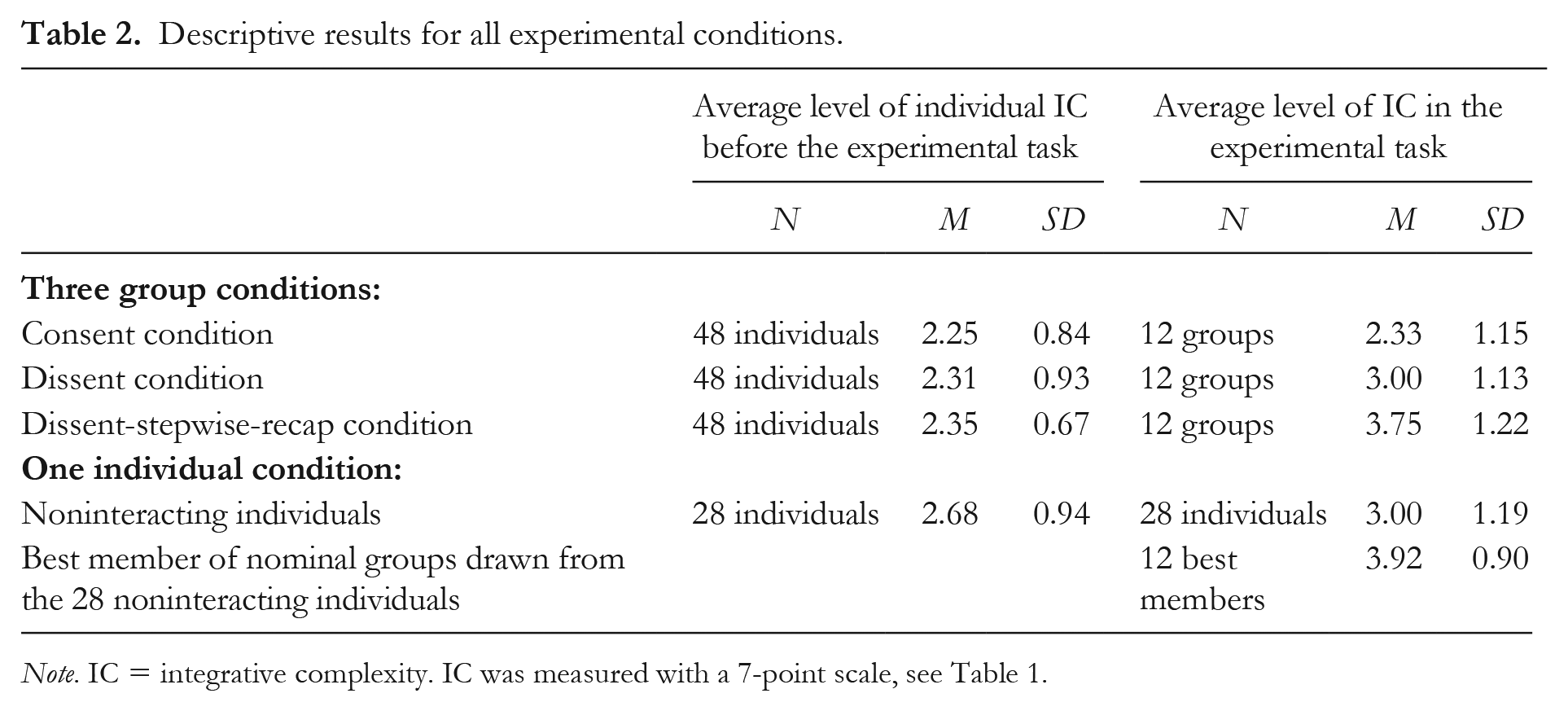
Note. IC = integrative complexity. IC was measured with a 7-point scale, see Table 1.
In the dissent condition, 10 groups had unequally distributed dissent (average group IC = 3.00, SD = 1.15) and two groups had equally distributed dissent (average group IC = 3.00, SD = 1.41). In the dissent-stepwise-recap condition, nine groups had unequally distributed dissent (average group IC = 3.67, SD = 1.41) and three groups had equally distributed dissent (average group IC = 4.00, SD = 0.00). The descriptive data do not suggest the presence of systematic differences between equally and unequally distributed dissent (difference in IC < 0.34).
Hypothesis Testing
Comparison of the levels of group IC in the different group conditions (see Table 2) with the levels of the IC scale (see Table 1) yielded the following results (see Hypothesis 1a): Groups in the consent condition did not fully differentiate, as the level of group IC was significantly below 3.00, t(11) = −2.00, p = .035, d = 0.58, and consequently also did not fully integrate, as the level of group IC was significantly below 5.00, t(11) = −8.00, p < .000, d = 2.31. The level of group IC in the dissent condition was significantly above 2, t(11) = 3.07, p = .005, d = 0.89, and below 5.00, t(11) = −6.14, p < .000, d = 1.77, which indicates that groups in the dissent condition fully differentiated but did not fully integrate. Note that the groups in the dissent condition also did not show emergent integration, as the level of group IC in the dissent condition was significantly below 4.00, t(11) = −3.07, p = .011, d = 0.89. In the dissent-stepwise-recap condition, the groups exhibited a level of IC significantly above 2, t(11) = 4.99, p < .000, d = 1.44, but not above 4, t(11) = −0.71, p = .755, d = 0.21. Note that the groups in the dissent-stepwise-recap condition showed a level of IC significantly above 3.00, t(11) = 2.14, p = .028, d = 0.62, indicating emergent integration. In sum, Hypothesis 1a was largely supported, except that the groups in the dissent-stepwise-recap condition showed only emergent integration and not full integration.
Regarding the level of group IC, Hypothesis 1b predicted: groups in the consent condition < groups in the dissent condition < groups in the dissent-stepwise-recap condition. Hypothesis 1b was supported by a univariate ANOVA; omnibus test: F(2, 33) = 4.43, p = .020, η2 = .21, with the following post hoc contrasts: consent condition = −1; dissent condition = 0; dissent-stepwise-recap condition = 1; test of contrasts: t(33) = 2.97, p = .003.
Supporting Hypothesis 2a, we found that two out of 12 groups in the consent condition, two out of 12 groups in the dissent condition, and eight out of 12 groups in the dissent-stepwise- recap condition reached higher levels of group IC than the level of their best member’s individual IC (i.e., level of individual IC prior to the task < level of group IC in the experimental task). These differences between the dissent/consent conditions and the dissent-stepwise-recap condition were statistically significant, χ2(1) = 9.00,p = .003, w = 0.50.
As predicted in Hypothesis 2b, the average level of individual IC in the individual condition was significantly below the level of group IC in the dissent-stepwise-recap condition, t(38) = 1.82, p = .038, d = 0.63 (the means are shown in Table 2). In an exploratory analysis, we compared the individual condition with the dissent condition, t(38) = 0.00, p > .999, d = 0.00, and the consent condition, t(38) = −1.64, p = .109, d = 0.57. Both comparisons did not reveal significant differences.
In Hypothesis 2c, we expected that the level of group IC in the dissent-stepwise-recap condition would be higher than the level of individual IC of the best members of nominal groups; however, we did not find a significant difference, t(22) = −0.38, p = .647, d = 0.16. Because nonequivalence does not prove equivalence, we conducted an additional analysis of equivalence following Rogers, Howard, and Vessey (1993), in which a presumed difference (i.e., H0) would need to be rejected. We chose d = 0.92 as the expected difference, which is the effect, t(34) = −2.59, p = .007, d = 0.92, when comparing the level of group IC in the dissent-stepwise-recap condition to the combined consent/dissent conditions (M = 2.67, SD = 1.17). “Normal” dissent and consent groups are typical types of groups in the real world and form a “natural” point of reference; d = 0.92 translates into ±0.98 points on the IC scale, specifying the equivalency interval [−0.98, 0.98]. Given that the 90% CI [−0.88, 0.55] is contained within the equivalency interval (for details, see Rogers et al., 1993), we conclude that the best members of the nominal groups and the groups in the dissent-stepwise-recap condition are equivalent. 4 Note that groups of the consent, t(22) = −3.75, p = .001, d = 1.53, and dissent, t(22) = −2.20, p = .039, d = 0.90, conditions had significantly lower levels of IC than the best members of nominal groups.
Post hoc power analyses of the results testing our hypotheses (exploratory analyses were not considered) showed that the average power of all significant results was satisfactory (Cohen, 1992): average 1 − β = .831. The two insignificant results had a very low power (analysis for Hypothesis 1a: 1 − β = .165; analysis for Hypothesis 2c: 1 − β = .103). Thus, the insignificant results could be due to low power.
Additional Analyses
In their research on the stepladder technique, Rogelberg et al. (2002) argued that the technique enhances member engagement. We intended to replicate their finding using the same scale by Rogelberg et al. (2002). Contrasts between the conditions—a group-level variable—served as predictor (0 = consent and dissent conditions, 1 = dissent-stepwise-recap condition). Individuals’ perceptions of member engagement—an individual-level variable—were entered as the dependent variable. The results did not support Rogelberg et al.’s (2002) proposition, γ = −.01, t(142) = −0.02, p = .873 (the coefficient shows the standardized regression weight of a hierarchical random intercepts model calculated using HLM; Raudenbush, Bryk, Cheong, Congdon, & du Toit, 2011). Perceived member engagement in the consent and dissent conditions (M = 3.83, SD = 0.72) was almost identical to perceived member engagement in the dissent-stepwise- recap condition (M = 3.81, SD = 0.77).
A second additional analysis addressed another finding reported in the literature: in situations of dissent or conflict, high levels of IC are indicative of constructive management of dissent or conflict (see the introduction to this article). As participants in both the dissent and dissent-stepwise-recap conditions experienced dissent, we were able to explore whether the level of group IC was positively related to constructive management of dissent. We used “satisfaction with the discussion” as a proxy for constructive conflict management, following Deutsch (1973), who proposes that constructive conflict processes are characterized by parties’ satisfaction with the outcomes, respectful processes, and friendly relationships. In the two dissent conditions, the level of group IC (i.e., a group-level variable) and individuals’ satisfaction with the discussion (i.e., an individual-level variable) were indeed positively related, γ = .29, t(94) = 3.00, p = .003 (the coefficient shows the standardized regression weight of a random intercepts model calculated with HLM; Raudenbush et al., 2011).
Discussion
Groups have access to rich resources held by their members, but often fail to achieve their full potential (Kerr & Tindale, 2004). We studied groups that were asked to come up with a joint position statement on a complex sociopolitical issue through discussion. We set out to explore mechanisms that support groups in reaching more informed decisions and judgments by focusing on the degree of differentiation and integration of different ideas and opinions within the group, which is captured by the concept of IC. We hypothesized and found that dissent in groups supported differentiation (whereas groups experiencing consent did not fully differentiate in their position statement). Integration combined with differentiation was proposed and found to be supported by a group discussion structure that facilitated alternating phases of differentiation, through a new dissenting member entering the discussion, and phases of integration, through collective recapitulation of the discussion. However, groups in the dissent-stepwise-recap condition only exhibited emergent and not full integration. We found a positive relationship between the conditions and the relative levels of group IC in the following order: consent < dissent < dissent-stepwise-recap. This pattern was as predicted and significant.
In addition, the group-level IC exceeded the group’s best member’s individual IC more often in the dissent-stepwise-recap condition than in the consent and the dissent conditions. Groups in the dissent-stepwise-recap condition also had higher levels of IC than individuals working on the task alone. Solely in comparison to the best member of nominal groups (i.e., best member of an equivalent number of individuals working on the task alone identified post hoc), the groups in the dissent-stepwise-recap condition reached an equivalent but not higher level of IC.
Contributions
Finding conditions under which group members’ diverse perspectives are constructively used has been an ongoing challenge for group research (Brodbeck et al., 2007; Kerr & Tindale, 2004). In this study, we highlighted one possibility by focusing on the differentiation of the diverse perspectives and knowledge within a group, and their integration in order to reach a complex understanding, which is captured by the level of group IC. Consistent with other research, we showed that dissent increased differentiation (Brodbeck, Kerschreiter, Mojzisch, Frey, & Schulz-Hardt, 2002; Brodbeck et al., 2007; Nemeth, 1986; Smith et al., 1996). In addition, we also identified a way to support integration (i.e., stepwise recapitulation), which is necessary to fully exploit dissent within a group and which has received little previous attention in group research (Okhuysen & Eisenhardt, 2002). When both mechanisms were activated in combination, groups not only reached higher levels of IC in comparison to ordinary groups (consent and dissent groups), but also exceeded their best members’ individual IC and the average level of IC among individuals working on the same task alone. They also reached the same level of IC as the best individuals from nominal groups. Given the fact that groups often suffer process losses (Kerr & Tindale, 2004), this last result is considered particularly important, because group equivalence with nominal best members is seldom found in group research.
The presented study demonstrated the utility of the IC concept in the area of group research. However, this concept has seldom been included in group research (Suedfeld, 2010; for exceptions, see Gruenfeld & Hollingshead, 1993; Kugler et al., 2011; Park & DeShon, 2018; Wong et al., 2011). The level of group IC may be used as an indicator for the quality of group information processing, which is likely to relate to indicators of group performance (DeChurch & Mesmer-Magnus, 2010; Hinsz et al., 1997). Furthermore, the study enriches theory and research on IC. The study tackles the two defining characteristics of IC (differentiation and integration) separately and shows that they are indeed distinct mechanisms. This finding is conceptually relevant because the presumed predictors of IC are multiple and complex, addressing both differentiation and integration.
In its additional analyses, the study also adds to the body of research showing a positive relation between constructive conflict management and high levels of IC. The results are congruent with other findings (Suedfeld, 2010) and contribute to the literature by highlighting a possibility for conflict processes in groups to be deliberately improved. In addition, the study offers an alternative explanation for beneficial effects of the stepladder technique. Originally, Rogelberg et al. (1992) argued that the stepladder technique enhances group member engagement, which could not be supported by our study. Note that our finding is in line with the findings of Winquist and Franz (2008). Instead, our findings indicate that the stepwise introduction of dissent alternated by phases of recapitulation helped groups gain a complex understanding of the issue (i.e., high levels of group IC).
Limitations and Future Research
A first limitation is that we did not assess performance indicators other than the level of group IC. Therefore, profound conclusions can only be drawn with respect to this concept. The level of IC could be an important mediator or precondition for various other aspects of group processes (e.g., cooperative behavior; Park & DeShon, 2018) and performance (e.g., decision quality; Schulz-Hardt et al., 2006). However, future research must explore this possibility in more detail. Furthermore, future research should investigate which types of groups, working on which types of tasks, would particularly benefit from high levels of IC. Presumably, complex tasks in complex and dynamic environments require complex thinking (Lord et al., 2011; Satish, 1997) and, as argued here, complex group interaction modes that allow for both differentiation and integration in an intertwined manner. The concept of IC also poses a methodological asset for future research, as it allows coding any kind of written or verbal statements, be they individually or collectively produced (for another example, see Kugler & Brodbeck, 2014).
Second, our findings suggest that dissenting groups that conduct stepwise recapitulations in order to integrate, performed as well as the best individuals working alone (nominal groups). Accordingly, one could advise organizations to ask their best experts (if they can be correctly identified) to work on tasks alone. However, it is difficult in practice to identify the “best” group members prior to task performance (e.g., Baumann & Bonner, 2004), in contrast to the group laboratory setting, where the best group member is identified post hoc on the basis of his/her actual performance. Furthermore, organizations often need to assign tasks to groups rather than individuals because the expertise necessary to perform the task might be distributed among several individuals, or the commitment of an entire group is important for task completion (Brodbeck et al., 2007). In such cases, our research indicates a means of ensuring that groups work at least on the level of their best member, which is not the case in ordinary dissent or consent groups. Therefore, future research on group performance in complex tasks should focus in more detail on interactive group discussion structures, which facilitate both dissent and integration in combination. Future studies could further untangle these group processes and elaborate on the question of whether a newcomer per se or a dissenting newcomer is the source of differentiation (e.g., Choi & Thompson, 2005; Nemeth & Ormiston, 2007). This study provides some indications that the combination of dissent and stepwise recapitulation is especially valuable for fostering integration, but it does not go far enough in examining all possible mechanisms (e.g., a consent-stepwise-recap condition was missing). In addition, future research should assess how participants perceive the stepwise recapitulation. For example, if the technique is functionally beneficial to groups but not acceptable to group members, it is unlikely to be used in organizational settings.
Third, the study is limited regarding its generalizability: we conducted a laboratory study with a relatively small number of groups per condition that had students engage in an activity for 25 minutes. Future research can help to confirm and generalize our promising results. It should include field studies with work groups in organizations as well as laboratory studies focusing on different group tasks under various circumstances (e.g., time pressure vs. no time pressure). Furthermore, different operationalizations of the individual condition should be considered. In our study, we cannot rule out that participants in the individual condition were less motivated to elaborate on the societal issue in the experimental task because they had to think about the issue alone instead of being able to discuss it within a group.
Implications for Practice
As diverse opinions and expertise are a widespread phenomenon in groups, it seems valuable for organizations to invest in interventions that enhance the level of group IC. A complex understanding and hence high levels of group IC are particularly desirable for teams working on complex tasks (Lord et al., 2011; Satish, 1997). Our research suggests that this might be accomplished by introducing formal structures for team decision-making meetings. Stepwise recapitulation constitutes a valuable and feasible alternative to other forms of increasing IC, such as providing group members with task-relevant information written according to the standards for high levels of IC (Kugler et al., 2011). Overall, our research stresses that information processing in work groups can be enhanced by adding new (and potentially dissenting) “voices” successively and integrating the status quo before each new “voice” is added.
Conclusion
To conclude, this study identified ways of how groups can be supported in differentiating and integrating diverse opinions and information in order to reach high levels of IC. It demonstrates the importance of offering structural support to groups when asking them to work on complex tasks. By designing appropriate formal processes, organizations can enhance groups’ IC levels and enable them to exploit their full potential to make informed decisions and judgments. Methodologically, the study highlights the utility of the concept of IC for group research. IC offers a possibility to analyze textual individual and group deliverables regarding the level of complexity that is actually considered when dealing with complex issues.
Footnotes
Acknowledgements
We would like to thank Juergen Brandl, Rebecca Anthes, Armin Granulo, and Johanna Schneider, who contributed to early phases of this study. We also want to express our gratitude to the editor and the reviewers for their valuable comments and suggestions.
Author note
Felix C. Brodbeck and Katharina G. Kugler contributed equally to this article. The research draws on a dissertation completed by Katharina G. Kugler at the Ludwig-Maximilians-Universitaet Muenchen, Munich, Germany.
Funding
The author(s) disclosed receipt of the following financial support for the research, authorship, and/or publication of this article: This research was supported by the German Research Foundation (SFB 768, TP A8).
