



Abstract
This study examined factors underlying collective action tendencies in a context of severe disadvantage and high repression. Drawing on the Social Identity Model of Collective Action (SIMCA; van Zomeren, Postmes, & Spears, 2008), we tested the roles of group-based anger, participative efficacy, group identity—SIMCA variables—but also fear. Although SIMCA has been widely used in various social contexts, little is known about how well it applies to severely disadvantaged groups in highly repressive situations. In the study of female Filipina domestic workers (N = 123) in Beirut, Lebanon, results provided partial support for SIMCA, such that identity indirectly and positively predicted collective action intentions via efficacy, but not anger. Importantly, fear modulated the paths from anger and efficacy to collective action intentions. Efficacy and anger positively predicted collective action tendencies among individuals low, but not high, in fear. These findings attest to the importance of studying political actions among underrepresented populations.
On January 25, 2015, over 300 women of more than 10 nationalities gathered to mark a historic event in Beirut (Kobaissy, 2015). They launched a trade union to represent the interests of a quarter million migrant domestic workers (MDWs) in Lebanon (HRW, 2015). This unprecedented initiative in the Arab world, home to some 30 million MDWs, was met with outrage by the Ministry of Labor, which deemed it illegal and threatened to send Internal Security Forces to end the “historic event” (Shoufi, 2015) forcefully. Since then, the still unrecognized union and other collectives have continued to engage workers and call for action, including starting petitions, organizing protests, and leading marches (e.g., Paq, 2016). Such actions are aimed at dismantling the “Kafala” (sponsorship) system, which regulates the relationship between MDWs and their Lebanese employers. This network of informal legal provisions grants the Lebanese employer the juridical power to restrict the movement of most MDWs are live-in, their communication with others outside the household, and their enjoyment of other basic human rights (Hamill, 2011). The resulting power differential has been compared to human trafficking and forced labor (KAFA, 2014), and translates into a plight documented in a number of critical reports (e.g., ILO, 2016). This plight is manifested in incidents of tremendous physical, psychological, and sexual abuse (Tayah, 2012). Despite these enormous challenges, MDWs since 2015 have arguably crossed a barrier from which “there would be no turning back” (Kobaissy, 2015, p. 109), and their collective actions, albeit still limited in numbers, are continuing.
The primary goal of the current study was to examine the factors that motivate or hinder the willingness to engage in collective action among MDWs in Beirut. Drawing on the Social Identity Model of Collective Action (SIMCA; van Zomeren, Postmes, & Spears, 2008), we tested the roles of group-based anger, efficacy, and group identification—factors proposed by SIMCA—but also fear in predicting the collective action intentions of MDWs. Although SIMCA has been widely used to explain collective action in a variety of social and political contexts, little is known about how well the model applies to contexts characterized by severe disadvantage and repression. The current research fills this gap by testing and extending this highly influential account of collective action among an under-researched, severely structurally disadvantaged, and highly repressed population. We also sought to explore the role of fear, which we argue is a highly relevant and surprisingly understudied emotion, especially in such contexts.
The Social Identity Model of Collective Action
A widely-used definition of collective action includes any act taken by a group member with the aim of improving the group’s conditions (van Zomeren, Leach, & Spears, 2012). Different approaches have advanced different motivators of such acts (van Zomeren, Postmes, & Spears, 2008). Recently, however, the literature has witnessed an “age of integration” (van Zomeren et al., 2012, p. 181), marked by attempts at combining predictors stemming from largely independent research traditions. In one such attempt, following a meta-analysis of over 180 studies investigating predictors of collective action, van Zomeren, Postmes, and Spears (2008) proposed SIMCA. They combined the roles of three key variables, namely emotional reactions to injustice, efficacy, and identification.
Research has shown that group-based injustice is a powerful predictor of collective action tendencies (Postmes, Branscombe, Spears, & Young, 1999). In line with work on group-based emotions (e.g., Mackie & Smith, 2002), this stream of research has consistently found that emotional appraisals of injustice, in particular anger, can heighten people’s willingness to engage in collective action (e.g., Smith, Cronin, & Kessler, 2008; Walker & Smith, 2002). For example, group-based anger has been shown to be an important force motivating feminist collective action (Hercus, 1999) and women’s action tendencies aimed at requesting reparations by perpetrators of sexism (Pennekamp, Doosje, Zebel, & Fischer, 2007).
A second predictor of collective action according to SIMCA is efficacy. Research on efficacy suggests that individuals are more likely to engage in collective action if they believe it is likely to achieve its goals (e.g., Hornsey et al., 2006; Kelly & Breinlinger, 1995). This literature originally distinguished between individual and collective efficacy (Fernández-Ballesteros, Díez-Nicolás, Caprara, Barbaranelli, & Bandura, 2002), and both have been shown to predict collective action tendencies. More recently, the construct of participative efficacy was formulated as a better predictor. Participative efficacy is defined as the belief that one’s personal participation in collective action will add incremental value to the overall process of achieving the group’s social change goals (van Zomeren, Saguy, & Schellhaas, 2013). This belief has been shown to be a unique predictor of collective action (van Zomeren et al., 2013), and was even shown to render the effect of collective efficacy insignificant when included in SIMCA, in contexts involving students protesting against budget cuts to higher education (van Zomeren et al., 2013) and individuals protesting climate change (Bamberg, Rees, & Seebauer, 2015).
The third element of SIMCA is social identity. Research suggests that people are more likely to engage in collective action with or on behalf of a group if they identify strongly with it (e.g., Simon et al., 1998), and social identity has long been understood to be a major driver of social change (e.g., Drury & Reicher, 2005). According to SIMCA, identification with a disadvantaged group encourages inter-group comparisons and promotes emotional reactions such as anger to group-based injustice, thereby creating an emotional path to collective action (Reicher, 2001). Simultaneously, such identification is thought to strengthen a sense of efficacy among members of the disadvantaged group, thereby creating an instrumental path to collective action (Drury & Reicher, 2009). Group identity is thus proposed to predict collective action tendencies directly and indirectly through group-based anger and efficacy (van Zomeren, Postmes, & Spears, 2008).
SIMCA has not, to the best of our knowledge, been tested in a context of severe structural disadvantage under repression. Still, neighboring disciplines, coupled with a handful of social psychological studies, offer us important insights as to how SIMCA variables might function differently in our sample. Importantly, it can be expected that additional factors might influence the willingness to participate in collective action under repression.
Collective Action in Repressive Contexts
Political scientists and sociologists have studied repression and collective dissent at the macro level, and have accumulated evidence for deterrent (Earl & Soule, 2010) and backlash (Davenport, 2007) effects. These diverging results are accounted for by different mechanisms. Briefly put, repression can be experienced as sanctions that have negative effects on collective action, or as an added injustice that further drives dissent (Opp & Roehl, 1990). At the micro level, very few studies have explored how repressive environments modulate the predictors of collective action. While the psychology of collective action has been extensively investigated (see Becker & Tausch, 2017, for a review), most of this research was undertaken in democratic Western countries, where protesters are relatively immune from state repression. One notable exception is a study by Ayanian and Tausch (2016). The authors investigated the social psychological processes underlying collective action tendencies among two samples of Egyptian activists—anti-Morsi and anti-military—during the 2013 uprising. Their study focused on the role of risk perceptions, and did not directly test all the relationships proposed by SIMCA. Still, their results suggest that predicting collective action in repressive contexts may not be a straightforward task. For instance, their measure of identification did not directly predict collective action. Furthermore, political efficacy only directly predicted collective action among the anti-military group, while anger only directly predicted it in the anti-Morsi group. Ayanian and Tausch’s (2016) findings thus provided initial evidence that SIMCA should be adapted for rather repressive contexts. In a similar vein, we proposed that the unique context of MDWs in Lebanon might influence SIMCA relationships, and warrant the consideration of other potential predictors of collective action such as fear.
We hypothesized that identity would have an indirect effect on collective action tendencies via participative efficacy and anger, but that the direct role of identification in predicting collective action might not replicate in our data. According to SIMCA, identification with the disadvantaged ingroup can directly motivate collective action when it politicizes, and channels broad identification with the disadvantaged into participation in a particular social movement (van Zomeren, Postmes, & Spears, 2008). In other words, an identity which remains non-politicized is less likely to substantially contribute to collective action tendencies. In situations characterized by a lack of hope and scope for social change, and in which collective action is not already ongoing, the politicization of identity is unlikely, and its direct relationship with collective action tendencies has been shown to be rendered null (van Zomeren, Susilani, & Berend, 2016). The case of MDWs in Lebanon exemplifies such situations, marked by the lack of a strong and visible movement. Only around 400 women are involved in the union (Kasinof, 2016), and its calls for actions are intermittent, often responding to contingent needs of support by individual MDWs or commemorating specific dates (e.g., International Labor Day). We therefore predicted that in our sample, identity would be unlikely to have a direct effect on collective action tendencies; rather, it would retain its indirect effects through the instrumental and emotional pathways.
The Role of Fear
A crucial but missing factor affecting collective action tendencies, perhaps in general, but particularly among severely disadvantaged groups in highly repressive contexts, we argue, is fear. Research investigating the role of fear in shaping collective action is extremely scarce, with only a few exceptions. For example, Miller and colleagues (2009) argued that fear, which has been shown to be associated with avoidance behavior (Mackie & Smith, 2002), might suppress collective action tendencies. In two studies, they indeed showed that fear inhibited the willingness of undergraduates to sign a petition in response to unfair treatment toward an experimentally formed ingroup (Miller et al., 2009). In line with these findings, and in a more ecologically valid context, fear was shown to be negatively related to collective action tendencies against austerity measures in Greece (Chryssochoou, Papastamou, & Prodromitis, 2013). Despite such findings, there has been little effort at integrating fear into social psychological models of collective action. We aimed to fill this gap by testing how fear would modulate the relationships between SIMCA variables. We hypothesized that fear would affect the translation of emotional and instrumental processes into collective action tendencies. Specifically, fear might moderate the effects of anger and efficacy on collective action intentions, such that the positive paths from anger and efficacy to collective action tendencies would only hold among those low in fear, but not among those high in fear.
Current Research
To summarize, the current study sought to test and extend SIMCA among a sample of MDWs in Lebanon. Specifically, we tested the roles of group-based anger, participative efficacy, group identity, and fear in predicting collective action tendencies. We believe that examining these predictors of collective action tendencies among members of an extremely marginalized group facing severe repression is of high scientific value. This under-researched population offers us the opportunity to extend the collective action literature, by 1) exploring whether the typical predictors of collective action are also relevant in a highly repressive context among group members facing severe disadvantage, and 2) investigating the role of fear in modulating the paths from anger and efficacy to collective action tendencies. We argue that fear is an extremely relevant yet under-investigated factor shaping collective action tendencies, particularly in repressive contexts.
Method
Participants
Considering the difficulties of recruiting MDWs, we set out to conduct data collection until we reached a total number of 100 women or more. Our final sample comprised 123 Filipina female migrant domestic workers (age M = 36.6, SD = 7.8, range = 22–59). A sensitivity analysis using G*power 3.1 (Faul, Erdfelder, Lang, & Buchner, 2007) indicated that this sample size provides 80% power to detect an effect as small as f2 = 0.092 in the present design, accounting for the hypothesized interactions.
Most participants indicated at least secondary school level education (91.6%), and 52.1% indicated they had a university degree (52.1%). Regarding monthly income, most participants reported earning between US$300 and US$400 per month (88.7%). Around 90% of them reported being live-in domestic workers, and only 4.9% reported being freelancers. Most participants reported not having participated in collective action previously (78%), but 15% reported that they had.
Procedure
We opted for a committee approach to translate our material from English to Tagalog, since this method was shown to protect cultural nuances (Furukawa & Driessnack, 2016). Two professional translators independently translated the survey, and a third reviewed the obtained surveys and resolved any differences.
Data collection took place on nine consecutive Sundays (15 October to 10 December 2017) in four locations in Beirut, considered typical gathering spots for MDWs. The first author and four CITI certified research assistants individually approached participants and asked if they were interested in responding to a 15-minute survey on the living and working conditions of MDWs in Lebanon. If individuals agreed, they were handed an informed consent form, followed by the survey. Finally, participants were thanked, debriefed, and provided with contact information of various non-governmental organizations involved in MDW issues.
Measures
Response options ranged from 1 (not at all) to 5 (highest extent). All items of interest are provided in the supplementary material. Items were presented in the same order as they are reported here.
Identification with MDWs
Adapted from Harb and Smith (2008), three items measured the extent to which participants were concerned with the welfare of MDWs, felt they belonged to the MDWs community, and thought their identity as MDWs was important to them (e.g., “My identity is defined by my belonging to migrant domestic workers in Lebanon,” α = 0.54). The items were combined into a heterogeneous index of identification with MDWs.
Participative efficacy
Adapted from van Zomeren, Spears, Fischer, & Leach (2004), four items measured the belief of participants that their personal contribution would add value to the process of improving MDWs’ conditions (e.g., “I believe that I, as an individual, can contribute greatly so that Migrant Domestic Workers, as a group, can change their living and working conditions for the better,” α = 0.93).
Fear
Two items assessed the participants’ level of fear of participating in collective action (e.g., “I am afraid to participate in an action to better the conditions of Migrant Domestic Workers in Lebanon,” Spearman-Brown = 0.91).
Group-based anger
Two items assessed participants’ anger at the disadvantage that MWDs face in Lebanon (“I feel angry when Migrant Domestic Workers experience unfair treatment in Lebanon,” and “I feel angry that the Lebanese government does not guarantee Migrant Domestic Workers’ rights,” Spearman-Brown = 0.88).
Collective action tendencies
Van Zomeren, Spears, & Leach’s (2008) five-item scale was adapted to assess the participants’ willingness to engage in collective action (e.g., “To which extent are you willing to participate in a future demonstration to better the living conditions of people like you?”). Also, two items assessing the willingness to become an active member of a MDWs’ group were included (e.g., “To which extent are you willing to become a member of a group of Migrant Domestic Workers that fight for the betterment of their living conditions?”). An individual collective action tendencies score was formed across all seven items (α = 0.91).
Results
Means, standard deviations, and bivariate correlations between our variables are reported in Table 1. 1
Means, standard deviations, and bivariate correlations between variables of interest.
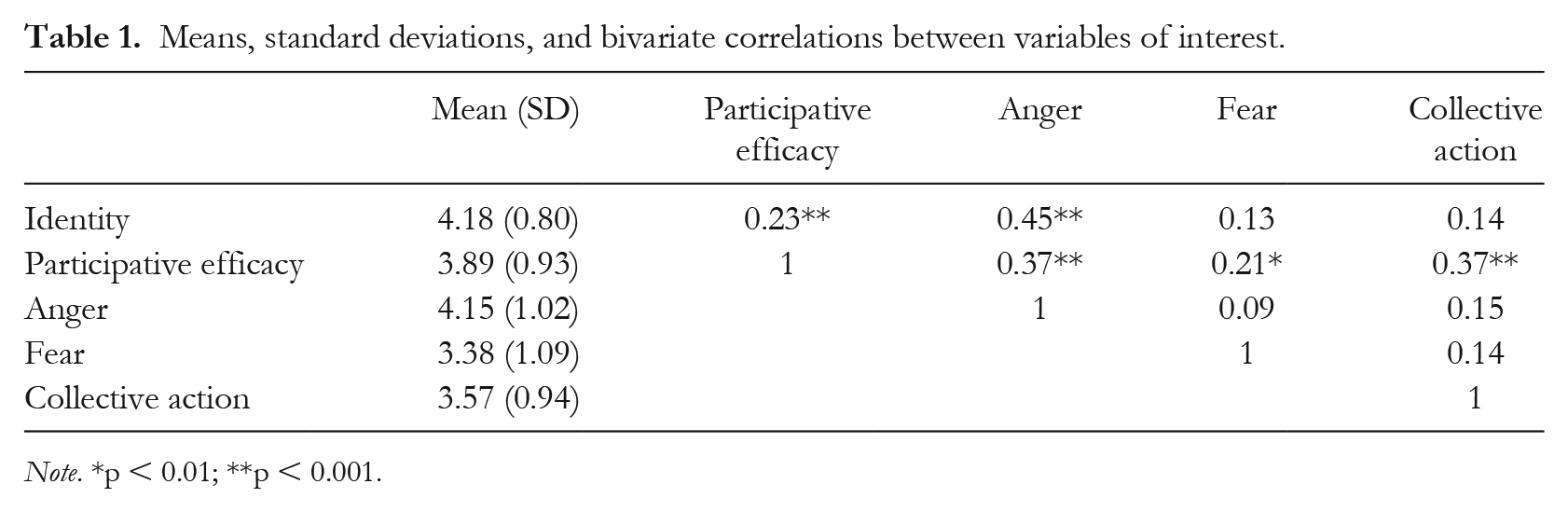
Note. *p < 0.01; **p < 0.001.
Testing SIMCA
To test how well our data were fitted by SIMCA, we conducted a path analysis using SAS 9.4. Identity was entered as the exogenous variable, participative efficacy and anger as parallel mediators, and collective action tendencies as the outcome variable. In accordance with SIMCA, efficacy and anger were not allowed to correlate (Figure 1). The overall model did not yield adequate fit, χ2(1) = 11.80, p < 0.001, CFI = 0.82, SRMR = 0.09, RMSEA = 0.30, GFI = 0.96, NFI = 0.82. To understand potential sources of misfit, we inspected the estimated regression weights. In line with SIMCA, identity positively predicted participative efficacy, ß = 0.23, SE = 0.09, p = 0.007, and anger, ß = 0.45, SE = 0.07, p < 0.001. Also in line with SIMCA, participative efficacy positively predicted collective action tendencies, ß = 0.36, SE = 0.09, p < 0.001. Surprisingly, and inconsistent with SIMCA, anger did not significantly predict collective action tendencies, ß = −0.01, SE = 0.09, p = 0.877. Also inconsistent with SIMCA, as we expected, identity did not have a direct effect on collective action tendencies, ß = 0.07, SE = 0.10, p = 0.496.
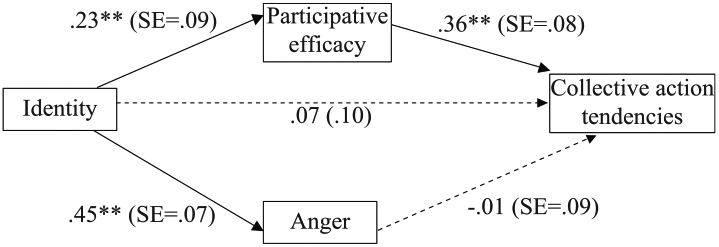
Path analysis testing SIMCA. Solid paths were significant; dashed paths were not.
We also tested the indirect effects of identity on collective action tendencies via participative efficacy and anger, in the same path analysis. Identity had a significant indirect effect on collective action tendencies via participative efficacy, ß = 0.08, SE = 0.04, p = 0.026, but not via anger, ß = −0.01, SE = 0.04, p = 0.877.
Adapted Model
Based on these results and our hypotheses, we conducted a second path analysis with modifications. We removed the direct path from identity to collective action, and the direct path from anger to collective action. We also allowed participative efficacy and anger to correlate due to their significant bivariate correlation (Figure 2). The overall model had an excellent fit, χ2(1) = 0.50, p = 0.778, CFI = 1.00, SRMR = 0.02, RMSEA < 0.01, GFI = 0.99, NFI = 0.99. Identity positively predicted participative efficacy, ß = 0.23, SE = 0.09, p = 0.007, which in turn positively predicted collective action tendencies, ß = 0.37, SE = 0.08, p < 0.001. Identity also positively predicted anger, ß = 0.45, SE = 0.07, p < 0.001, and anger and participative efficacy were positively correlated, r = 0.27, p < 0.001. Furthermore, identity had a significant indirect effect on collective action tendencies via participative efficacy, ß = 0.09 SE = 0.04, p = 0.024.
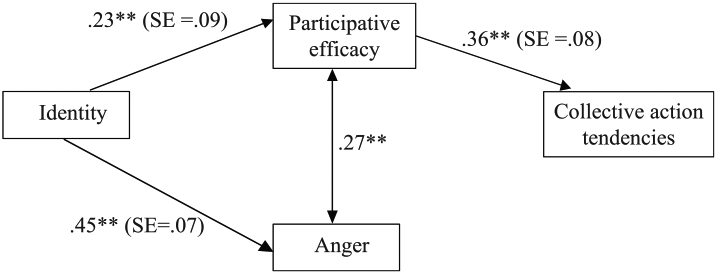
Path analysis of adapted model.
The Moderating Role of Fear
To test the moderating role of fear on the paths from participative efficacy (Figure 3a) and anger (Figure 3b), respectively, to collective action tendencies, we conducted two moderated mediation analyses 2 using PROCESS (Hayes, 2013, Model 14) with 5,000 bootstrap samples and 95% confidence intervals.
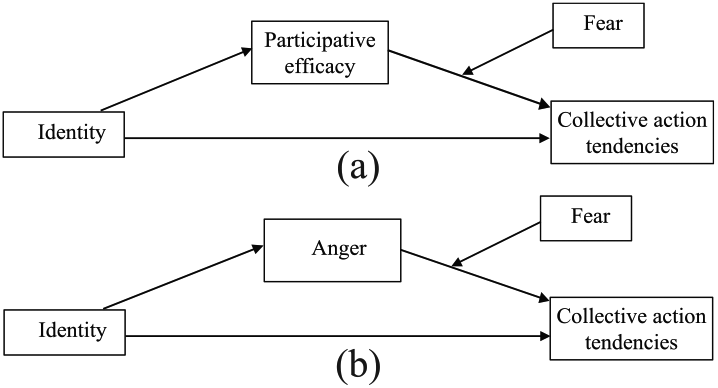
Figure 3a: Conceptual model depicting the moderating role of fear on the link between participative efficacy and collective action tendencies.
In the first analysis, we entered identity as the independent variable, participative efficacy as the mediator, collective action tendencies as the dependent variable, and fear as a moderator of the efficacy-collective action link. The overall model was significant, F (1, 120) = 6.08, p = 0.015, R2 = 0.22. First, identity positively predicted participative efficacy, B = 0.28, SE = 0.11, CI95 [0.052 0.483]. Second, there were significant conditional main effects of both participative efficacy, B = 0.88, SE = 0.21, CI95 [0.472 1.296], and fear, B = 0.79, SE = 0.26, CI95 [0.277 1.302], on collective action tendencies. The effect of identity was not significant, B = 0.06, SE = 0.10, CI95 [–0.136 0.264]. As hypothesized, there was a significant interaction between participative efficacy and fear in predicting collective action tendencies B = −0.18, SE = 0.06, CI95 [–0.299 −0.058]. As expected, participative efficacy positively predicted collective action tendencies among those low (i.e., 1 SD below the mean) in fear, B = 0.44, SE = 0.09, CI95 [0.255 0.619], but not among those high (i.e., 1 SD above the mean) in fear, B = −0.01, SE = 0.14, CI95 [–0.289 0.268]. Importantly, the overall index of moderated mediation was significant, B = −0.05, CI95 [–0.100 −0.003], suggesting that the indirect effect of identity via participative efficacy on collective action tendencies was moderated by fear (see Hayes, 2017). Indeed, identity had an indirect effect on collective action tendencies via efficacy among those low in fear, B = 0.12, SE = 0.05, CI95 [0.028 0.217], but not among those high in fear, B = −0.00, SE = 0.05, CI95 [–0.101 0.097].
In the second analysis, we entered identity as the independent variable, anger as the mediator, collective action tendencies as the dependent variable, and fear as a moderator of the anger-collective action link. The overall model was significant, F (1, 119) = 30.71, p < 0.001, R2 = 0.21. First, identity positively predicted anger, B = 0.58, SE = 0.10, CI95 [0.372 0.785]. Second, there were significant conditional main effects of both anger, B = 0.90, SE = 0.26, CI95 [0.389 1.409], and fear, B = 1.23, SE = 0.35, CI95 [0.542 1.911], on collective action tendencies. The effect of identity was not significant, B = 0.05, SE = 0.12, CI95 [–0.183 0.279]. There was a significant interaction between anger and fear in predicting collective action tendencies, B = −0.25, SE = 0.07, CI95 [–0.395 −0.101]. As expected, anger positively predicted collective action tendencies among those low in fear, B = 0.28, SE = 0.11, CI95 [0.069 0.488]. Interestingly, anger negatively predicted collective action among those high in fear, B = −0.34, SE = 0.16, CI95 [–0.656 −0.028]. The overall index of moderated mediation was significant, B = −0.14, CI95 [–0.248 −0.046], suggesting that the indirect effect of identity via anger on collective action tendencies was moderated by fear. Indeed, identity had an indirect positive effect on collective action tendencies via anger among those low in fear (B = 0.16, SE = 0.06, CI95 [0.046 0.295]. Among those high in fear, identity had an indirect negative effect on collective action, B = −0.20, SE = 0.10, CI95 [–0.394 −0.008].
Discussion
This study set out to investigate social-psychological predictors of collective action tendencies among Filipina domestic workers in Beirut. In this strongly disadvantaged and highly repressed population, we sought to test SIMCA (Zomeren, Postmes, & Spears, 2008) and to integrate the under-explored role of fear. We argue that psychological studies of collective action have been overwhelmingly conducted in liberal contexts, and that, hence, our knowledge of what predicts the tendencies of severely disadvantaged individuals living in highly repressive contexts is very limited.
In line with this observation, our analyses showed that SIMCA did not fit our data well. Instead, a model where we removed the direct paths from identity and anger respectively to collective action tendencies, and where we allowed participative efficacy and anger to correlate, showed excellent fit. Specifically, as predicted by SIMCA, there was a significant effect of identity on participative efficacy and anger, and participative efficacy significantly predicted collective action tendencies. However, inconsistent with SIMCA but as we expected, identity did not directly predict collective action tendencies; surprisingly, neither did anger. Importantly, further analyses yielded results consistent with our prediction that the link between anger and collective action was moderated by fear, such that higher anger translated into stronger collective action tendencies only among those low in fear. A similar moderation was found with participative efficacy, such that it translated into collective action tendencies only among those low in fear.
These results highlight important ways in which severe disadvantage and repression could affect collective action motivators. First, identifying with a highly disadvantaged group may not directly translate into willingness to engage in collective action. While this seems inconsistent with much of the evidence showing the importance of identity in motivating collective action, it suggests that the meaning of identifying with an aggrieved social group in such difficult contexts is potentially peculiar. In the absence of a salient movement, the politicizing effect of identity is likely to fail.
Furthermore, the direct emotional pathway to collective action seems to break down in our context. Specifically, collective anger at the ingroup’s disadvantage did not directly predict willingness to act. There are at least two noteworthy qualifications of this result. First, we found a strong positive correlation between anger and efficacy. While this relationship is not accounted for in SIMCA (van Zomeren, Postmes, & Spears, 2008), in studies informed by other models of collective action, researchers have found this link (e.g., Mackie, Devos, & Smith, 2000). Indeed, emotional appraisal theorists have long argued that to the extent that one perceives to have the resources to confront a transgressor, anger is a likely emotional reaction to the transgression (e.g., Frijda, 1986; Roseman, 1984). At the group level, this would mean that to the extent that individuals feel more efficacious, they will also feel angry toward the injustice faced by their group (Mackie et al., 2000), and we would therefore expect a positive association between the instrumental and emotional pathways.
Second, the link between anger and collective action tendencies was qualified by the level of fear, such that anger positively predicted collective action tendencies among individuals low in fear, but negatively among those high in fear. This speaks to a profound emotional impact of repression, since the action readiness that typically characterizes anger (Frijda, 1986) seems to be suppressed by fear. This highlights that it might be insufficient to examine the effects of repression by focusing on cost-benefit analyses that members of disadvantaged groups undergo (e.g., Opp & Roehl, 1990). In addition to its effect on cognitive weighing of expected costs and benefits, it seems crucial to acknowledge the importance of understanding the emotional consequences of repression. Interestingly, in line with this distinction, the role of fear in our study was quite different from the role of perceived risks in the Ayanian and Tausch (2016) paper. While their data supported the idea that higher risk assessments enhanced the effects of anger and efficacy, our data suggests that fear dilutes them. In fact, we even found that fear reverses the role of anger, such that for individuals who are high on fear, anger negatively predicts collective action. One explanation could be that, when fear about repression is very high, the measure of anger taps into anger about the repression itself, alongside anger about the injustice faced by the ingroup. The first type of anger might suppress rather than motivate collective action. Future research should further look into this speculation and clarify the conditions under which anger might hinder collective action. More generally, the diverging roles of fear and risks could potentially account for the mixed evidence found on the macro level, whereby repression has been shown to have deterrent (e.g., Earl & Soule, 2010) and backlash (Davenport, 2007) effects. In this sense, it could be that when repression engenders fear, it deters collective action, while when it engenders perceived risks, it fuels it. Future research ought to study further these diverging effects of repression, and to investigate in which contexts and through what psychological processes each is likely to occur.
Limitations and Future Directions
This study comes with a number of limitations that affect the conclusions we can draw. First, we acknowledge that selecting a convenience sample limits our ability to generalize our findings beyond MDWs who had the ability to leave the household on Sunday, and those who agreed to participate in the survey. Still, we argue that this method was appropriate for recruiting individuals from this vulnerable population with minimal risks. Second, regarding the role of identity, we acknowledge that our findings might not generalize to other severely disadvantaged groups, in the presence of a salient movement. We argue, however, that situations of dire disadvantage are often characterized by the lack of such a movement. Still, future research can build on the current findings by comparing the role of identity in predicting collective action in highly repressive situations in the presence and absence of a visible social movement.
More generally, it is important to note that the correlational nature of our data prevents us from making causal claims. Specifically, it would be useful for future research to manipulate fear experimentally, to the extent possible, and to establish its effect on the links between anger and efficacy, on the one hand, and collective action, on the other. Furthermore, our outcome variable was operationalized as action tendencies, rather than actual participation. Despite evidence suggesting that such tendencies predict behavior (e.g., Weerd & Klandermans, 1999; Webb & Sheeran, 2006), we would be cautious in assuming this link among members of a severely disadvantaged group living in a highly repressive context, and future research should attempt to measure actual behavior.
Conclusion
In sum, the present study provides a valuable contribution to the literature by highlighting potential shortcomings of SIMCA in predicting collective action tendencies among severely disadvantaged individuals in repressive contexts. It provides initial evidence for the indirect effect of group identity on collective action intentions via efficacy, but not anger. It also points to the importance of feelings of fear in modulating instrumental and emotional paths to collective action intentions, such that efficacy and anger positively predicted collective action tendencies among individuals who are low, but not high, in fear. These findings strongly attest to the importance of further testing these predictors among underrepresented populations.
Supplemental Material
Supplementary_1 – Supplemental material for Predicting collective action tendencies among Filipina domestic workers in Lebanon: Integrating the Social Identity Model of Collective Action and the role of fear
Supplemental material, Supplementary_1 for Predicting collective action tendencies among Filipina domestic workers in Lebanon: Integrating the Social Identity Model of Collective Action and the role of fear by Aya Adra, Charles Harb, Mengyao Li and Anna Baumert in Group Processes & Intergroup Relations
Footnotes

References
Supplementary Material
Please find the following supplemental material available below.
For Open Access articles published under a Creative Commons License, all supplemental material carries the same license as the article it is associated with.
For non-Open Access articles published, all supplemental material carries a non-exclusive license, and permission requests for re-use of supplemental material or any part of supplemental material shall be sent directly to the copyright owner as specified in the copyright notice associated with the article.
