



Abstract
Previous research has shown that honor culture and honor ideology enhance interpersonal and intergroup aggressiveness at the individual level. This study aimed to examine collective-level relationships among honor culture, social rewards for warriors, and intergroup conflict. To demonstrate these relationships, I used the Standard Cross-Cultural Sample, which contains data on 186 mainly preindustrial societies from all over the world. The analysis demonstrated that honor culture, which values males’ toughness and aggression, has a positive relationship with frequency of intergroup conflicts. In addition, social rewards (praise, prestige, and status) for warriors mediated the relationship between honor culture and frequency of intergroup conflict. These results imply that the collective-level processes of honor culture enhance intergroup conflicts through the social reputations of warriors who participate in war.
Previous studies have shown that honor culture increases interpersonal and intergroup aggression at the individual level. However, little is known about whether or not honor culture increases collective-level conflict, that is, warfare, and if it does, what is the social psychological mechanism thereof. Using a cross-cultural database, this study investigated the processes through which honor culture increases social reward for warriors, resulting in intergroup conflict.
The Role of Social Rewards for Warriors in Intergroup Conflict: Reputation, Status, and Prestige
Past studies in social psychology have demonstrated that there are many causes of intergroup conflict, such as enhancement or defense of social identity (Tajfel & Turner, 1979), competition for and threat over scarce resources (Sherif, Harvey, White, Hood, & Sherif, 1961; Stephan & Renfro, 2002), or social dominance orientation (Sidanius & Pratto, 2001). While these factors are not entirely incompatible, and all are important, this study adds to them by also examining intergroup conflict from the perspective of reputation, adopting the approach that social rewards for warriors, such as reputation, status, and prestige, increase intergroup conflict.
In this study, a social reward is defined as a nonmaterial reward given by group members based on reputation: intragroup praise, social status, and prestige. Many studies have pointed out that warriors receive praise or social rewards. For instance, Franco, Blau, and Zimbardo (2011) showed that the martial hero who participates actively in combat is the typical “Hero” figure. Moreover, although terrorists are undoubtedly a threat to international society, they are sometimes admired within their local group as active defenders. In fact, some studies have indicated that membership of a terrorist group can have advantages for its members, who are seen as courageous, honorable, and important people in many communities and societies (Silke, 2008). For example, interviews with jailed terrorists have shown that they can gain high social status through their membership of terrorist groups such as Hamas or Fatah (Post, Sprinzak, & Denny, 2003). Furthermore, they and their families can procure financial or material support from both the terrorist organizations to which they belong and their communities. As such, they are not called terrorists by their fellows, but “freedom fighters, rebels, the resistance,” while their suicide attacks are labelled “religious martyrdom.” They can gain the admiration and respect of their ingroup as fighters who defend the group. For example, in a survey conducted a year after the September 11 attacks, a majority in the Palestinian Authority selected Osama bin Laden as someone who would “do the right thing regarding world affairs” (Pew Research Center, 2003).
A similar phenomenon pertains to kamikaze attackers in Japan. Kamikaze attacks were military bomber suicide attacks on enemies targeted by the Imperial Japanese Army during World War II. All of the kamikaze crews died along with their aircraft. A study of the letters written by kamikaze attackers to their families before their attacks (Orbell & Morikawa, 2011) showed that they described their future deaths as “honorable” and “beautiful.” Furthermore, in survey research, Japanese participants were found to be more likely than American participants to say the image of a kamikaze attacker was beautiful (vs. ugly) and sweet (vs. bitter; Krus & Ishigaki, 1992). Thus, just as kamikaze attackers defended their actions, modern ordinary Japanese also praise and admire those attackers for protecting Japan with their lives.
As shown before, several societies give praise and prestige to warriors as social rewards. Warriors are seen as attackers of the outgroup in intergroup conflict situations. If a society gives social rewards to warriors to attack outgroups, kamikaze attackers may be willing to become warriors to gain that social reward.
Of course, intergroup aggression is also a high-cost behavior that carries a risk of death or injury from retaliation and vengeance. From the perspective of evolutionary psychology and evolutionary anthropology, high-cost behavior has evolved in humans because such behavior has had more adaptive value than its potential cost. Thus, participating in war gives warriors some reward that outweighs the risk of death. This study focuses on the role of social, nonmaterial, rewards for warriors (social status, reputation, praise, or admiration). However, studies in evolutionary psychology and evolutionary anthropology indicate that gaining social rewards increases fitness by enhancing access to resources and reproduction. For example, among the Yanomamo, a horticultural society in South America, men who have experience in killing enemies are called “Unokai” and have higher social status. Chagnon’s (1988) study showed that Unokai warriors had over 2.5 times as many wives and over 3 times as many children as non-Unokai warriors. In a further example, Glowacki and Wrangham (2015) investigated the relationship between intergroup raiding and reproductive success in the Nyangatom society of nomadic pastoralists in East Africa and showed that past intergroup raiding was positively correlated with the number of wives and children among older men. The mating advantage of male fighters has been demonstrated not only in preindustrial societies, but among gangsters in contemporary urban cities (Palmer & Tilley, 1995). Thus, in societies where warriors gain social rewards, participation in war pays off for individuals in the form of reproductive and economic rewards. It has been suggested, therefore, that gaining a strong reputation within a group as a warrior may be evolutionarily adaptive.
Overview and Hypotheses: Examining Honor Culture and Intergroup Conflict From the Perspective of Social Rewards
The aim of this study is to investigate escalating factors in intergroup conflict from the perspective of social rewards. The hypothesis of this study is as follows: Group members engage in intergroup aggression in pursuit of social rewards, resulting in increased occurrence and escalation of intergroup conflict at the collective level. Particularly in societies where warriors are highly rewarded, engaging in intergroup conflicts is an attractive option to amplify the social rewards they accrue within the group. That is, there is a high incentive to become a warrior to participate in conflict. This study hypothesized that honor cultures are societies that especially value being a warrior and give warriors considerable social rewards. Because warriors gain social rewards, and in honor cultures these may be especially pronounced, they engage in intergroup aggression in pursuit of these social rewards. In other words, the hypothesis is that honor culture increases social rewards for warriors, amplifying the frequency of intergroup conflict as a result. Hypotheses H1 to H4 are shown in Figure 1.
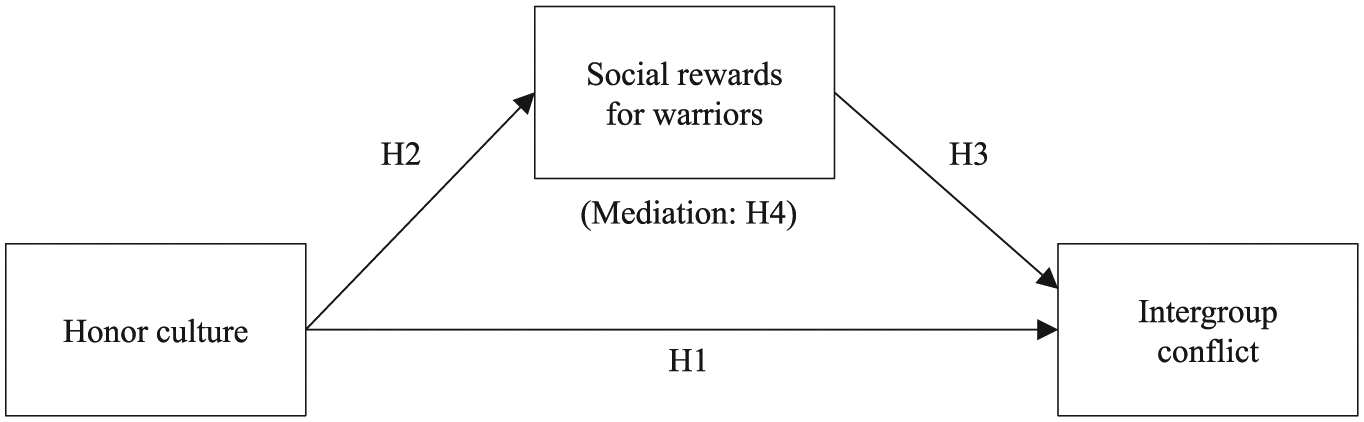
Hypotheses of this study. This study tests multiple related hypotheses about the relationship between honor cultures and intergroup conflict.
Intergroup Conflict in Honor Culture (H1)
A culture of honor is one that values toughness, masculinity, courage, physical strength, and revenge after insult in men (Nisbett, 1993; Nisbett & Cohen, 1996). Men in honor cultures become aggressive in defense of their reputations. Recent studies in social and cultural psychology have pointed out that masculine honor is related to interpersonal and intergroup aggressiveness. In honor cultures, men often carry out interpersonal aggressive retaliation, even for minor insults, to protect their reputation for masculinity. For example, White men in the Southern United States have a culture of honor of manhood. They express anger towards and attack those who insult their honor (Nisbett & Cohen, 1996). This is reflected in the high number of argument-related homicides in the Southern US (Nisbett, 1993) as well as violence in schools. High school students in states with honor cultures bring guns to school, and the frequency of shootings per capita in these states is more than twice that in nonhonor culture states (Brown, Osterman, & Barnes, 2009).
Not only is interpersonal aggression related to honor culture, but also national and intergroup aggression by individuals. Barnes, Brown, and Osterman (2012) found relationships between masculine honor ideology and support for military responses to terrorism. Their results demonstrated that, in a fictional attack on the Statue of Liberty, honor ideology predicted support for the use of extreme counterterrorism when controlling for other intergroup variables. They also found that, comparing honor states with nonhonor states in the US, university respondents in honor states were more likely to hope for the death of the terrorists responsible for 9/11 than respondents in nonhonor states. In addition, Barnes, Brown, Lenes, Bosson, and Carvallo (2014) demonstrated that honor ideology had a positive relationship with aggressive responses to illegal immigration and terrorism, which was mediated by perceptions of national threat. Furthermore, research in the Canadian Forces demonstrated that members who perceived peer honor to be important were more willing to risk their lives (Mandel & Litt, 2013). The aforementioned studies suggest that honor culture increases individuals’ interpersonal and intergroup aggression.
In a departure from previous studies, I hypothesized that honor culture would affect not only individual-level aggressiveness, but also collective-level aggressiveness, that is, intergroup conflict. There appears to be a lack of direct empirical evidence for this relationship. Dafoe and Caughey’s (2016) is one of the few studies to have examined it. In their political science study, they tested the hypothesis that honor is the motive for war, which few studies have empirically tested. According to their analysis, international conflicts in which the US has participated under presidents from the South were twice as likely to use the military, lasted twice as long, and ended in victory for the US 3 times more than under non-Southern presidents. This can be explained by the honor culture of the Southern region of the US, which, as described before, emphasizes the importance of reputation and male toughness. However, their research demonstrated the relationship between military leaders’ birthplaces and military performance, not the relationship between honor culture and actual intergroup conflict at the collective level. The current study thus adds to the literature in investigating the relationship between the frequency of intergroup conflicts and honor culture.
H1. Honor culture increases intergroup conflicts.
Social Reward for Warriors is Amplified by Honor Culture (H2)
This research notes the role of social rewards for warriors as a mediating factor in the relationship between honor culture and intergroup conflict. Past studies have demonstrated that belonging to a culture that emphasizes masculine honor elicits interpersonal or intergroup aggression in response to threats to honor, such as insults. The purpose of such aggressive behavior is to maintain and recover masculine honor through aggression (particularly in men). In a culture of honor, the reputation and status of men is very important because it is adaptive to maintain a reputation for being aggressive and tough; examples can be seen in cattle-breeding societies, for example, where resources are easily plundered and the legal judicial system does not work. Cultural studies in the United States (Nisbett & Cohen, 1996) as well as in Mexico and Costa Rica (Figueredo, Tal, McNeil, & Guillén, 2004) have demonstrated that people in cattle-breeding areas place more emphasis on honor-based aggression. Thus, people in honor cultures strongly affirm the value of resolving social problems using violence and a similar scenario will pertain in intergroup conflict situations. Honor culture places high value on the roles of warriors and soldiers to resolve intergroup conflict using violence. In other words, in honor cultures, warriors and soldiers are given high praise and status because they use violence in a culturally appropriate manner to defend their social group.
One of the most important studies on the relationship between honor culture and social reward for warriors was conducted by D. Cohen and Leung (2012), who found that martial honor was associated with the moral character of martial leaders in the Southern United States. Presidents from the Southern US were evaluated as having a good character when they actively used the military, but this effect did not hold for presidents who were not from the South. This was true not only of the president, but also of legislators and Supreme Court justices.
However, D. Cohen and Leung’s (2012) research focused on the reputation of leaders in intergroup conflicts, but did not address how honor culture functions to promote social rewards for ordinary warriors as opposed to leaders. To address this gap, in this study, I hypothesized that, in honor cultures, social rewards would be afforded to warriors seen as honorable people as well as to leaders.
H2. Honor culture increases social rewards for warriors.
Escalation of Intergroup Conflict for Social Reward (H3)
In a society where warriors gain social reward, this may be an incentive to gain praise by actively engaging in intergroup conflict. As mentioned before, descriptive and empirical studies have noted that terrorists and intergroup attackers receive praise in some cases. However, very few studies have directly demonstrated the associations between intragroup praise and intergroup conflicts or intergroup attacks. A few psychological studies using experimental laboratory research have demonstrated an association between intragroup praise and intergroup aggression. For example, Nawata and Yamaguchi’s (2013) laboratory experiments showed that expected cooperation from ingroup members led to increased praise, resulting in greater intergroup retaliation. In other words, when participants expected cooperation from their ingroup peers, they retaliated more strongly to gain praise from ingroup members. The same experiment also demonstrated that the stronger the perception that “retaliation is cooperation,” the more retaliatory motivation participants had. Likewise, Nawata and Yamaguchi (2011) demonstrated that being observed by ingroup members increased intergroup retaliation through the expectation of intragroup praise. Both studies demonstrated that the expectation of intragroup praise affected intergroup aggression in a laboratory experimental setting. However, these studies noted an individual-level relationship between praise as a social reward and intergroup aggressive behavior, not a collective-level relationship between social rewards for warriors and intergroup conflict, as will be explored in this study.
Some anthropological studies have asserted the importance of cultural incentives in warfare, like the current study (Glowacki, Wilson, & Wrangham, in press; Goldschmidt, 1988). Glowacki and Wrangham (2013) investigated the collective-level relationship between social rewards for warriors and intergroup aggressiveness. Their study demonstrated that the fatality rate in simple warfare in preindustrial societies had a positive correlation with the cultural rewards given to warriors. This implies that warriors are motivated to participate in war by social rewards (status, honor, and privilege). It also suggests that warriors may actively participate in war to obtain social rewards. However, their study used the mortality rate in war rather than actual frequency of wars as an index of intergroup conflict. Therefore, the relationship between cultural remuneration and frequency of wars was not tested directly. Moreover, the current study investigated honor culture as the antecedent of social reward for warriors as stated in H2, and the whole mediating process as established in H4. Therefore, to further advance the work of Glowacki and Wrangham (2013), in the current study, more direct and comprehensive collective processes of social reward for warriors and intergroup conflict were tested using a cross-cultural database.
H3. Social rewards for warriors increase the frequency of intergroup conflict.
Processes Through Which Honor Culture Amplifies Intergroup Conflict: The Mediating Effect of Social Rewards for Warriors (H4)
To summarize the process of H1–H3, our hypothesized process is the mediating effect of honor culture → social rewards for warriors → intergroup conflict. In other words, this study hypothesizes that there may be many intergroup conflicts in honor cultures because warriors gain social rewards by participating in war. Figure 1 shows Hypotheses 1–4.
H4. The association between honor culture and intergroup conflict (H1) is mediated by social reward for warriors.
A Collective-Level Test Using a Cross-Cultural Database
The purpose of this research is to demonstrate empirical evidence of a collective-level relationship between honor culture, social rewards for warriors, and intergroup conflict. The study will examine this relationship using a cross-cultural database.
While most of the studies introduced before examined individual-level aggressiveness, there is no empirical evidence to date that directly shows the relationship between honor culture, social rewards for warriors, and intergroup conflict at the collective level. Thus, this study aims to show this relationship directly.
To this end, I conducted a collective-level examination using a cross-cultural database commonly used in anthropology. The unit of analysis in this study is not the individual but societies or cultures. The social importance of warriors differs depending on whether intergroup conflicts occur frequently or not. Accordingly, the degree of social reward for warriors may also differ.
Methods
Sample
The Standard Cross-Cultural Sample (SCCS; Murdock & White, 1969) was used in this study for cross-cultural analysis. The SCCS contains data from 186 primarily preindustrial societies from all over the world, from sub-Saharan Africa to East Eurasia to South and Central America. It includes, for example, data on the Nama Hottentot, !Kung bushmen, Kikuyu, Masai, Egyptians, Babylonians, Romans, Fijians, Samoans, Japanese, Ainu, Maori, and Yanomamo. A total of 143 out of the 186 cultures of the SCCS were described from 1901–1950. The 186 societies were selected to avoid the so-called “Galton’s problem,” which is a statistical problem of nonindependent relationships between geographically near cultures due to contamination from cross-cultural contact.
The variables of the SCCS were coded by anthropologists, based on the Ethnographic Atlas (Murdock, 1967), which includes descriptions of 1,167 cultures throughout the world. Over 1,800 variables have been added to date. The SCCS has been used in cross-cultural analysis to examine relationships between war and other variables. Past studies have shown that intergroup conflict has a statistical relationship with ingroup loyalty (Cashdan, 2001; T. R. Cohen, Montoya, & Insko, 2006, Study 1), unpredictable natural disasters (Ember & Ember, 1992), and combative sports (Sipes, 1973).
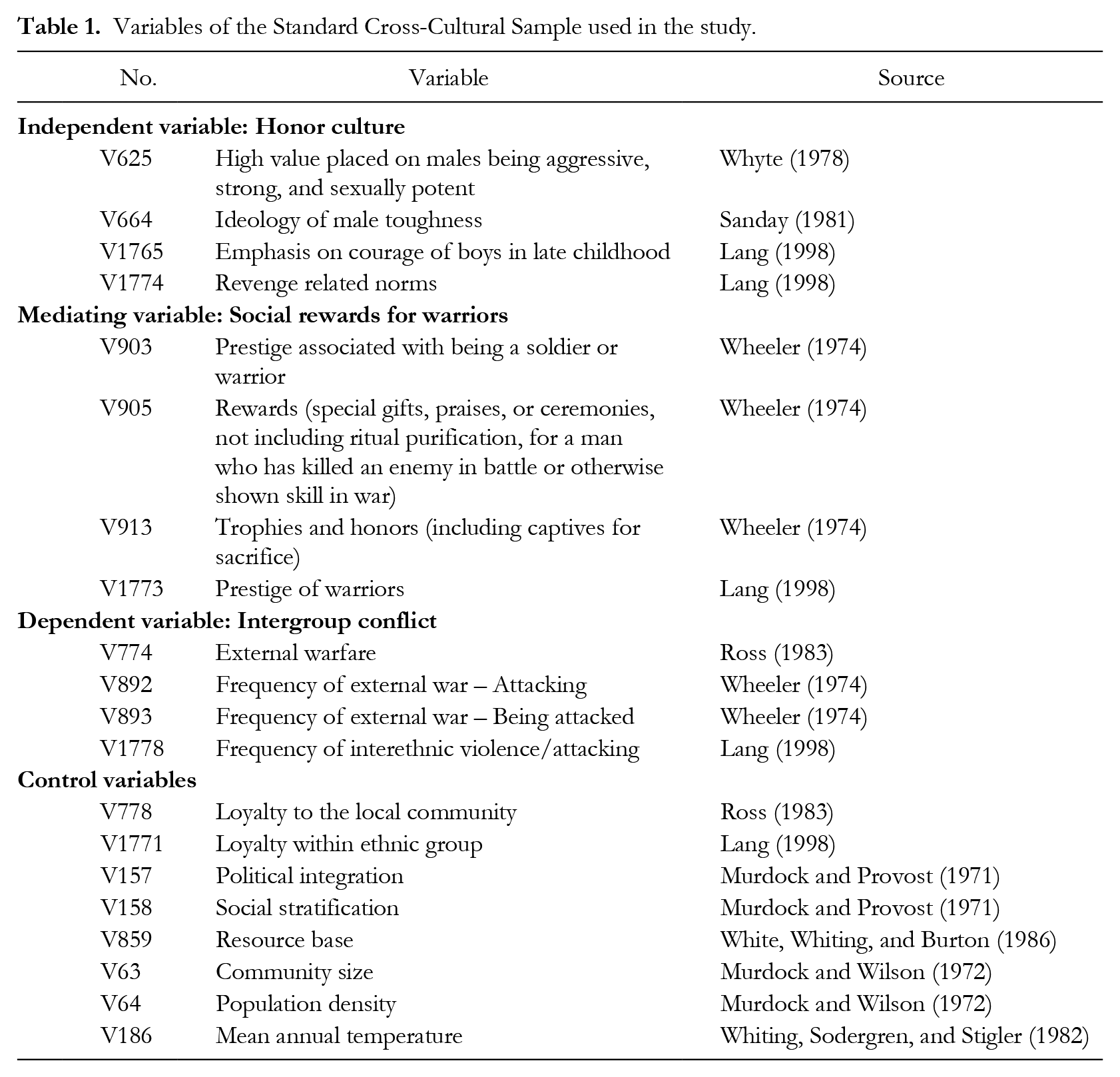
All variables used in this study are shown in Table 1 and more detailed information is shown in Appendix A in the supplemental material.
Variables of the Standard Cross-Cultural Sample used in the study.
Independent Variable: Honor Culture
Four items about honor culture were selected as a proxy for honor culture, which values toughness, masculinity, courage, physical strength, and revenge after insult in men (Nisbett, 1993; Nisbett & Cohen, 1996). Thus, the following four items were selected: “High value placed on males being aggressive, strong, and sexually potent” (V625), “Ideology of male toughness” (V664), “Emphasis on courage of boys in late childhood” (V1765), and “Revenge related norms” (V1774). Before analysis, the scores of V625 were reversed for ease of interpretation. The scoring of V1774 is not ordinal; thus, the score was recoded from “1, 2” to “1” and from “3, 4, 5” to “2.”
Mediating Variable: Social Rewards for Warriors
The following four variables were used to represent rewards for warriors: “Prestige associated with being a soldier or warrior” (V903), “Rewards (special gifts, praise, or ceremonies, not including ritual purification, for a man who has killed an enemy in battle or otherwise shown skill in war)” (V905), “Trophies and honors (including captives for sacrifice)” (V913), and “Prestige of warriors” (V1773). Before analysis, the scores of V903, V905, and V913 were reversed for ease of interpretation.
Dependent Variable: Frequency of Intergroup Conflict
Four variables were used to represent frequency of intergroup conflict: “External warfare” (V774), “Frequency of external war – Attacking” (V892), “Frequency of external war – Being attacked” (V893), and “Frequency of interethnic violence/attacking” (V1778). Before analysis, the scores of V774, V892, and V893 were reversed for ease of interpretation.
Other Control Variables
Ingroup loyalty
Two variables were used to represent ingroup loyalty: “loyalty to the local community” (V778) and “loyalty within ethnic group” (V1771), following Cashdan (2001) and T. R. Cohen et al. (2006). Before analysis, the scores of V778 were reversed for ease of interpretation.
Social system and demographics
The following variables were used to represent the social system and demographics: political integration (V157), social stratification (V158), resource base (V859), community size (V63), population density (V64), and mean annual temperature (V186). See Appendix A in the supplemental material for more detailed information about the variables used in this study.
To confirm the validity of the variables, confirmatory factor analysis was conducted and the resulting model was found to fit the data. Thus, the variables created in this study had sufficient validity. See Appendix B in the supplemental material for more information about the analysis.
Data Treatment and Analysis
Studies using the SCCS have a number of limitations. First, the SCCS dataset has some missing scores, which is an obstacle for applying advanced statistical analyses. To overcome this problem, the hypotheses were verified using the following two compensatory analyses: (a) mediation analysis based on multiple regression, (b) structural equation modeling (SEM) with latent variables using full information maximum likelihood (FIML) estimation.
Mediation analysis based on multiple regression using averaged z-score
First, a multiple regression analysis was conducted. Before analysis, the items were standardized to z-scores (M = 0, SD = 1) because each item with different degrees and variance was arranged on the same scale. Next, the variables scores (i.e., honor culture) were averaged as the z-scores of each included item. If a score was missing for some items for the culture, the average value of the other items without the missing item was calculated as the score of the culture. By using this method, the missing values at the variable level were reduced even if there were some missing data at the item level. When all included items comprised missing values, those variables were treated as missing. After creating the variables, multiple regression analysis was conducted including many other control variables. Using this method prevented another interpretation by other control variables.
Structural equation modeling with latent variables
The treatment of scores in mediation analysis may have some bias. First, average calculation ignores some items with missing scores. Second, standardization of the items was conducted for the ordinary scale. To overcome these biases, SEM was conducted. FIML estimation was used for the missing data in SEM. FIML is an effective method for data sets with large volumes of missing data because it can generate estimates without decreasing the amount of data, as the list-wise deletion method does (Enders & Bandalos, 2001). Three cultures with missing data for all variables were excluded from the analysis, and 183 cultures were thus used in the analysis. Moreover, all observed variables were treated appropriately as an ordinal scale. Weighted least squares parameter estimates were used. SEM was conducted with the latent variable from each item of the ordinal scale. However, to avoid estimation difficulties by entering too many variables, only the main variables were entered (honor culture, social reward for warriors, and intergroup conflict) and the other control variables were omitted from the SEM. A model was set up assuming the causal effects of honor culture → social rewards for warriors → intergroup conflict, and the relationships between the three latent factors were examined. Mplus Version 7 (Muthén & Muthén, 1998–2012) was used for this analysis.
Therefore, the same hypothesized processes were tested in different complementary analyses: mediation analysis and SEM. Mediation analysis showed the validity of the hypothesized processes after controlling for the other variables. Next, SEM demonstrated that although the other nonmain variables were not controlled, a more statistically appropriate analysis was conducted using the latent variable from each item on the ordinal scale and FIML for missing values. To test the hypothesis of this study in both complementary analyses, the validity of the hypothesized collective processes was shown.
Results
Correlation Analysis
First, correlation analysis was conducted for averaged z-scores for the mediation analysis. The results of the correlation analysis are shown in Table 2. As a whole, significant correlations were found among the variables of honor culture, social rewards for warriors, and frequency of intergroup conflict. In addition, Appendix C in the supplemental material shows Spearman’s rank correlation for all items used in this study.
Correlation between the variables.
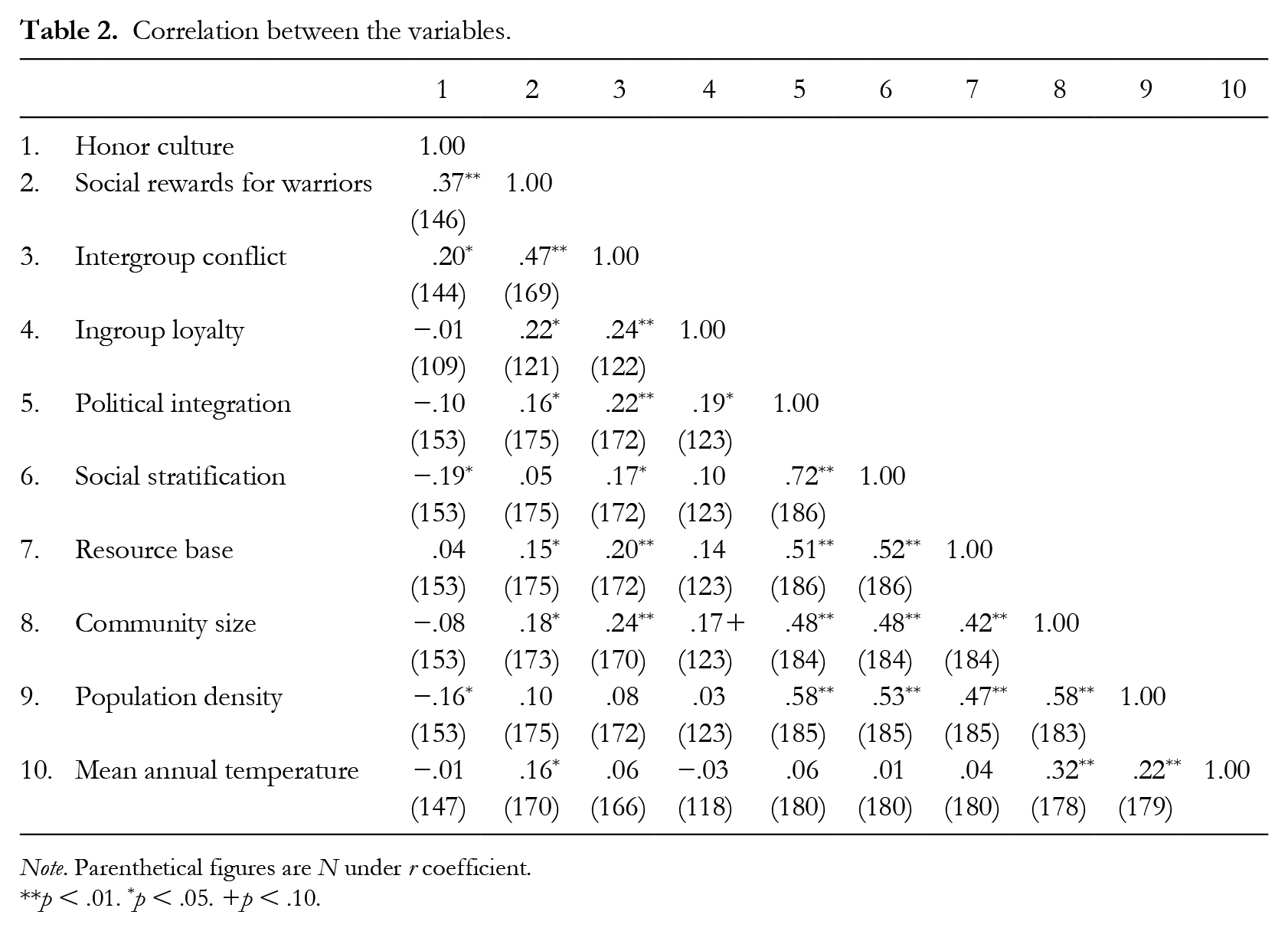
Note. Parenthetical figures are N under r coefficient.
p < .01. *p < .05. +p < .10.
Mediation Analysis
The mediating processes of honor culture (X), social rewards for warriors (M), and intergroup conflict (Y) were tested using a three-step mediation analysis following Baron and Kenny (1986). The other variables were entered as control variables. List-wise deletion was used for missing data and 104 cultures were used in the final analysis.
The results are shown in Table 3. In Step 1, the standardized path coefficient from honor culture (X) to intergroup conflict (Y) was significant, β = .26, t(95) = 2.77, p = .007. In Step 2, the standardized path coefficient from honor culture (X) to social reward for warriors (M) was significant, β = .30, t(95) = 3.39, p = .001. In Step 3, after entering X and M simultaneously, the standardized path coefficient of honor culture (X) became nonsignificant, β = .12, t(94) = 1.30, p = .20. However, social rewards for warriors (M) had a significant effect on intergroup conflict, β = .49, t(94) = 4.97, p < .001. The results of bias-corrected bootstrapping with 2,000 resamples indicate a significant full mediation, 99% CI [0.01, 0.28].
Mediation analysis of honor culture, social rewards for warriors, and intergroup conflict.
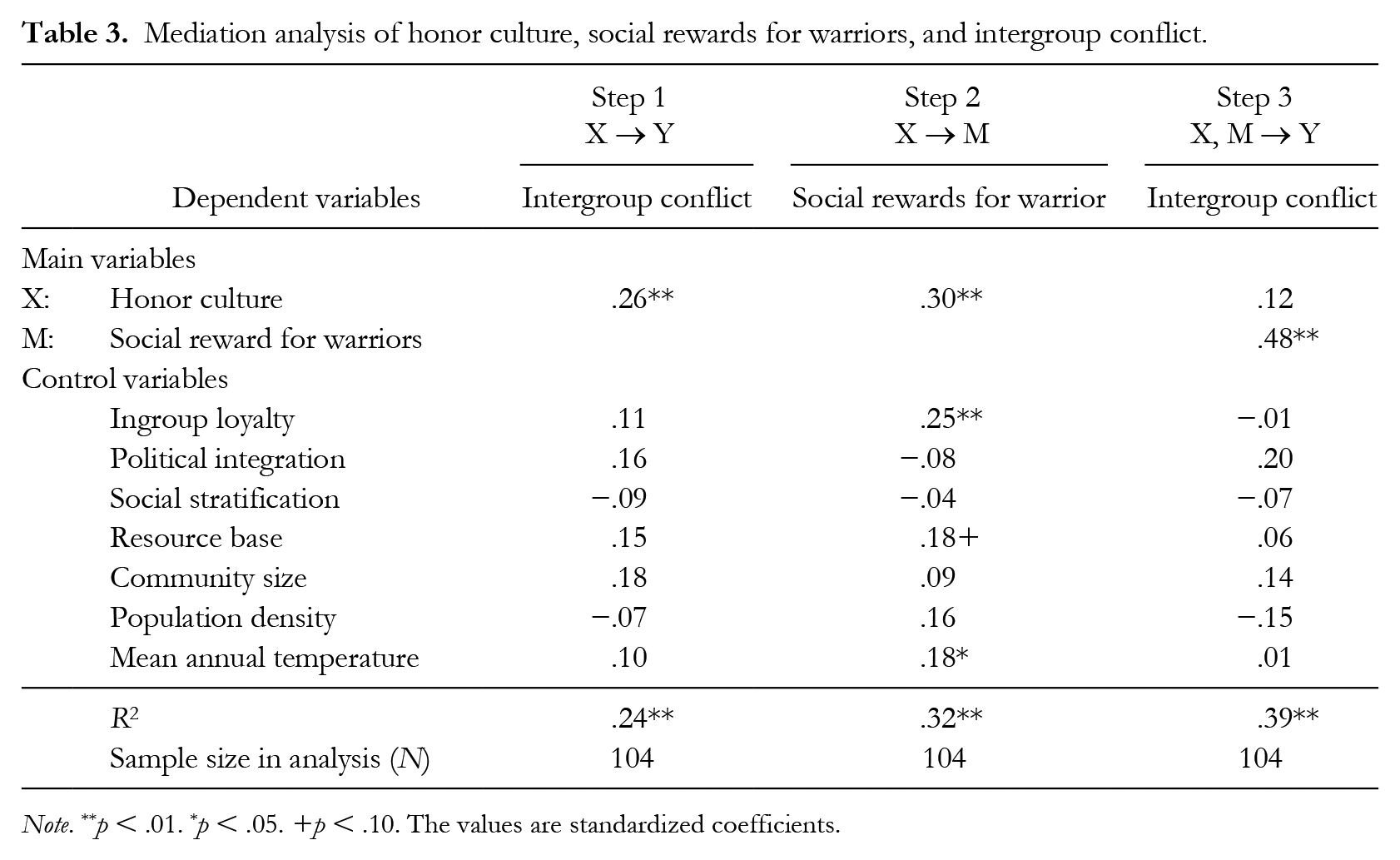
Note. **p < .01. *p < .05. +p < .10. The values are standardized coefficients.
Social rewards for warriors had a full mediating effect. In other words, social rewards for warriors accounted for most of the effect of honor culture on intergroup conflict. Therefore, the results showed the mediating processes for H1–H4.
The interaction effect of honor culture (X) and social reward (M) on intergroup conflict (Y) was also examined. However, the interaction term (X * M) was not significant, β = .04, t(93) = 0.40, p = .69. Thus, the effect of social rewards for warriors on intergroup conflict was almost the same whether or not they were in an honor culture. In other words, social rewards for warriors accounted for most of the effect on intergroup conflict of honor culture.
Structural Equation Modeling
Next, SEM was conducted to analyze the hypothesized causal relationships between latent variables. However, to avoid causing difficulty of estimation by entering too many variables, the other control variables were not entered in SEM. A model was set up assuming the causal effects of honor culture → social rewards for warriors → frequency of intergroup conflict, and the relationships between the three latent factors were examined.
All observed variables were treated as ordinal scales. Weighted least squares parameter estimates were used. There were some missing data in the SCCS for societies that have not yet been coded by anthropologists. Thus, FIML estimation was used for missing data in the analysis. Three cultures with missing data for all variables were excluded, thus giving 183 cultures for use in the analysis.
The processes of influence were investigated using SEM. The hypothesized model fit the data very well, χ2(51) = 74.637, p = .017; CFI = .976; TLI = .969; RMSEA = .050. The model estimated is presented in Figure 2. 1 The mediating effect of social rewards for warriors was examined using the procedure of Baron and Kenny (1986). First, when variables of social rewards for warriors were removed, the direct effect of honor culture on the frequency of intergroup conflict was significant, β = .59, p < .01. However, when social rewards for warriors was entered simultaneously into the equation, the effect of honor culture was rendered nonsignificant, β = .07, ns, and the indirect effect was significant, .512, p < .01, 95% CI [0.185, 0.840]. This showed the full mediating effect of social rewards for warriors, the same as the results of mediation analysis.
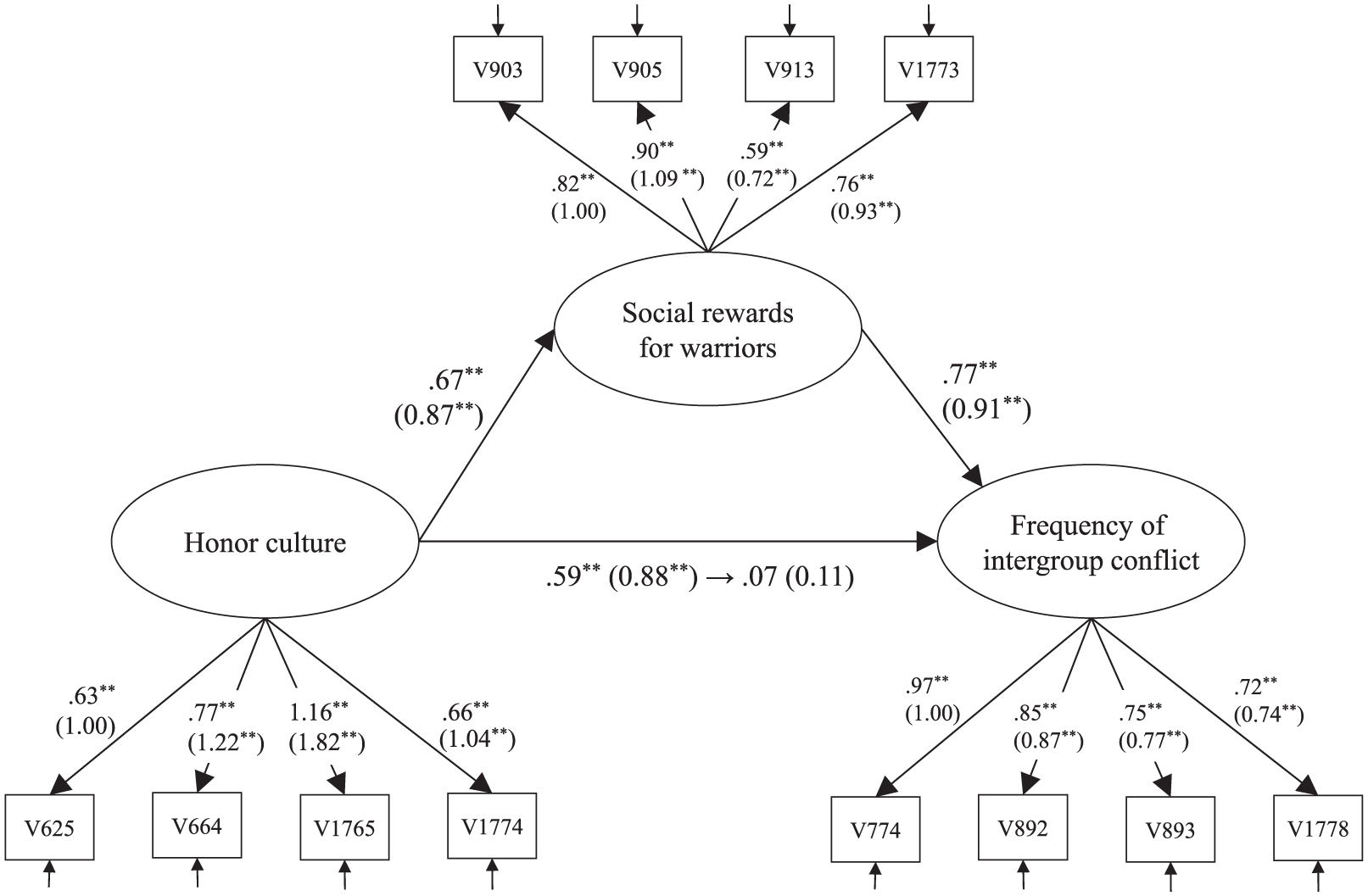
The relationships between honor culture, social rewards for warriors, and frequency of intergroup conflict using structural equation modeling.
Therefore, SEM using latent variables and FIML estimation of missing data demonstrated the same results as mediation analysis using a three-step multiple regression analysis.
Discussion
This study hypothesized that honor culture increases the social reward for warriors, amplifying the frequency of intergroup conflict as a result. I examined this hypothesis using a cross-cultural database, the Standard Cross-Cultural Sample. The results of the analysis supported all hypotheses, H1–H4. In societies that had honor cultures, the frequency of intergroup conflicts was high (support for H1) and warriors were given high levels of social rewards (support for H2). In societies in which warriors were given high levels of social rewards, the frequency of intergroup conflicts was high (support for H3). Finally, social rewards for warriors mediated the relationship between honor culture and frequency of intergroup conflicts (support for H4).
War in Honor Cultures: Social Rewards for Warriors as a Mediating Process
In honor cultures, a high value is placed on violent masculine characteristics such as toughness and strength (Nisbett, 1993; Nisbett & Cohen, 1996), and the use of violence to protect one’s reputation is not viewed negatively. Indeed, violence is an important means of enhancing one’s reputation.
However, honor culture not only increases violent behavior by individuals; this study also suggests that honor culture increases collective-level violence such as intergroup conflicts and wars. This study points out that social rewards for warriors in honor cultures is a mediating factor that increases the frequency of intergroup conflicts. Since honor cultures give high levels of social rewards to warriors, warriors actively engage in intergroup conflict to acquire these rewards, resulting in an increased frequency of intergroup conflicts.
As shown in the introduction, previous studies have demonstrated the relationships between honor culture, social rewards for warriors, and intergroup conflict using individual-level experiments or surveys. Furthermore, many survey results have shown that terrorists may be seen as heroes (e.g., Pew Research Center, 2003; Post et al., 2003). However, these studies examined individual-level behavior, not collective-level phenomena. In this study, I tested collective-level phenomena using cross-cultural data and found that a relationship also exists between honor culture, social rewards, and intergroup conflict at the collective level.
Of course, collective-level phenomena have a huge effect on individual members’ behaviors. Under the intergroup conflict situations as collective-level phenomena, individual members such as warriors or soldiers engage in intergroup attacks at the individual level. That is, these data suggest that when honor cultures give social rewards to warriors, warriors are motivated to actively participate in intergroup conflict. Initially, it is possible that a person will be killed or injured in warfare. Thus, engaging as a warrior in intergroup conflict is extremely costly behavior. Nonetheless, honor culture motivates warriors to engage in high-cost intergroup conflicts to gain larger social rewards that may outweigh the cost of death. The findings of the current study imply that dismantling honor culture may decrease soldiers’ motivation to engage in war and eventually reduce intergroup conflicts.
Limitations and Future Directions
This study has analyzed samples drawn from preindustrial societies. Compared with modern societies, preindustrial societies had more wars, and warriors’ mortality rates were higher (Keeley, 1996; Pinker, 2011). To discuss the relationship between intergroup conflict and honor culture in contemporary societies, it will also be necessary to consider whether the relationships shown in this study hold equally for modern societies.
Since this is a correlational study, it does not explain the causal relationships between variables. In this study, despite demonstrating a process of one-way influence using mediation analysis and SEM, the strict causal process was unclear. For that reason, it is necessary to carefully discuss the relevance of social rewards for warriors and intergroup conflicts. That is, which is the cause and which is the consequence? In other words, do social rewards for warriors increase intergroup conflict, as this research assumes, or does intergroup conflict increase the social rewards for warriors? It may be that this causal process is bidirectional. As social rewards for warriors increase, I hypothesize that warriors actively participate in war to gain praise from their ingroup or to maintain their own status. Simultaneously, during a war, there will be more ingroup praise for warriors fighting to defend the ingroup.
As mentioned before, if honor culture strengthens intergroup conflict, we can expect intergroup conflict to be reduced by transforming honor culture. In a culture where violence is condemned rather than condoned with social rewards, few people will engage in warfare as warriors. Furthermore, in such a culture, values that reject violence will become internalized. Care and nonharm lie at the root of human morality (Haidt, 2012), and human beings have inherently negative attitudes toward waging violence (Cushman, Gray, Gaffey, & Mendes, 2012). Thus, it is not impossible to culturally foster negative attitudes toward violence, and empirical research should be conducted to ascertain how changes in honor culture relate to the reduction of violence and intergroup conflict in the future.
Supplemental Material
Supplemental_material – Supplemental material for A glorious warrior in war: Cross-cultural evidence of honor culture, social rewards for warriors, and intergroup conflict
Supplemental material, Supplemental_material for A glorious warrior in war: Cross-cultural evidence of honor culture, social rewards for warriors, and intergroup conflict by Kengo Nawata in Group Processes & Intergroup Relations
Footnotes
Funding
The author disclosed receipt of the following financial support for the research, authorship, and/or publication of this article: JSPS KAKENHI (Grants-in-Aid for Scientific Research) 16KT0154.

Supplemental material
Supplemental material for this article is available online.
Notes
References
Supplementary Material
Please find the following supplemental material available below.
For Open Access articles published under a Creative Commons License, all supplemental material carries the same license as the article it is associated with.
For non-Open Access articles published, all supplemental material carries a non-exclusive license, and permission requests for re-use of supplemental material or any part of supplemental material shall be sent directly to the copyright owner as specified in the copyright notice associated with the article.
