



Abstract
Feminist data activism aims to safeguard the interests and rights of marginalised groups. This paper examines how feminist data activists critically and creatively engage with digital data and related technologies, thereby also contributing to grassroots technology innovation. Conceptually, it draws on the notion of data solidarity. While this concept has been mainly explored in data governance frameworks and ethics, this paper analyses civic and academic data activism – acknowledging that the lines between civic vis-à-vis academic practices are blurring. It starts from the question how data solidarity may co-shape feminist data activism. Methodologically, it pursues a cultural media studies approach and comparatively analyses three cases. The paper argues that data solidarity is insightful for understanding how the interplay, including tensions, between individual autonomy and collective control may facilitate (co-)creation of data with public value.
Introduction
Feminist data activists critically engage with digital data, applications, and devices (Amelang, 2022; Milan, 2019; Sun and Yin, 2024). They design and develop, for example, privacy-conscious health apps, critical data education, or technologically facilitated resistance. This paper examines feminist data activism, as an umbrella term for cultures of productive yet critical engagement with digital data among feminists. Respective initiatives have emerged at the intersection of feminist technology activism, data activism, and grassroots technology innovation, amidst ever more pervasive data collection through commercial devices and platforms (Dikwal-Bot, 2019; Sued et al., 2022; Toupin and Couture, 2020).
While critical perspectives on such data collection are much needed, this paper moves beyond an approach to technological cultures aiming to learn from mistakes. Instead, it starts from the argument that we also can, and should, learn from cases where technology developers may be doing things right. In terms of academic relevance, such an approach implies broadening the scope of research on data practices by further highlighting the possibilities afforded by digital technology. This perspective is notably societally relevant, as it echoes Arora's concern that a mere focus on developments gone awry fosters ‘pessimism paralysis’, thereby preventing society to approach (tech) ‘design with hope’ (Arora, 2024: 2). Academically, this approach is moreover relevant since it acknowledges feminist technology engagement as a field that tends to be undervalued when it comes to its capacity for civic and grassroots innovation (Hossain, 2018; Schrock, 2018).
Feminist data activists critically react to data-driven technology, while also proactively using or creating data and developing digital applications (Milan and van der Velden, 2016: pp. 66ff). For example, during the Covid-19 outbreak in 2020, the feminist non-profit organisation marialab published the online guide ‘Care during the pandemic: how to report domestic violence?’ (Marialab, 2020). In this resource, the Sao Paolo-based NGO provided inter alia instructions to check mobile devices for spyware collecting data without the owner's knowledge, in contexts of domestic abuse (Richterich, A., & Wyatt, 2024). At the same time, projects like SOF+IA aim at countering gender-based violence, notably technologically facilitated violence, by creating a digital data-related application (developed by the Chilean Foundation for Data Protection and Monitoring of Gender and Intersectionality Statistics). Despite differences between these approaches, such activism likewise aims to create public value in benefiting marginalised groups. Yet, the activists’ understandings of what constitutes such public value may be decisively diverse and possibly contradictory – which is also reflected in disagreements between contemporary and historic ‘feminisms’, as opposed to one allegedly unified feminism (Harnois, 2008; hooks, 1997; Showden, 2009; Steele, 2021).
I suggest that the notion of data solidarity (Braun and Hummel, 2022; De Proost, 2023; Prainsack et al. 2022; Prainsack and El-Sayed, 2023) can facilitate a better understanding of motivations and values shaping feminist data activism, thereby also providing insights into what may be needed to further foster a critical-productive engagement with data. Data solidarity refers to data-related practices that not only aim to prevent harm but emphasise ‘the public value that specific instances of data use create’ (Prainsack et al., 2022: E773). Its normative angle and focus on the collective benefits of data, moving beyond deliberations of individual autonomy, make it relevant for analysing feminist data activism too (Hummel and Braun, 2020; Prainsack and El-Sayed, 2023). This seems also apt, as solidarity more broadly has been mentioned as decisive for feminist data activism, in the limited yet growing corpus of academic works on this topic (D’Ignazio and Klein, 2020; Strohmayer et al., 2020; Sued et al., 2022; Sun and Yin, 2024). Data solidarity is instructive for analysing feminist data activism, examining if and how solidarity may foster data practices with a focus public value. Therefore, I start from the question how data solidarity may co-shape feminist data activism.
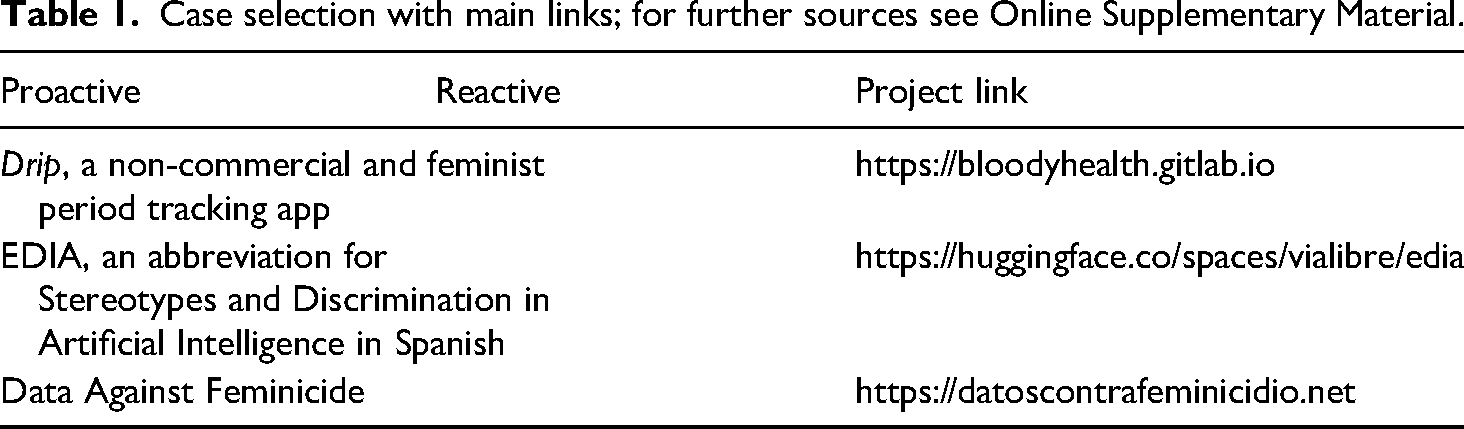
The paper is further structured as follows. Thematically, I first review key works on data activism (Baack, 2018; Milan, 2016; Renzi and Langlois, 2015; Schrock, 2016) and, as the term is closely related, on data feminism (D’Ignazio and Klein, 2020). Conceptually, I then introduce data solidarity in more detail than I have done above, notably drawing on the work by Prainsack et al. (2022) and Prainsack and El-Sayed (2023). This is followed by a brief explanation of the cultural media studies approach taken in this paper, which involves interpretatively analysing three purposively selected cases of feminist data activism (FDA) based on online sources (see Table 1 and Online Supplementary Material). Despite FDA often being examined as a civic practice, it has also become part of ‘engaged’ academic research approaches – thereby blurring the lines between civic data activism and academic ‘data feminism’ mentioned above (D’Ignazio and Klein, 2020). The following two sections will outline this research field.
Case selection with main links; for further sources see Online Supplementary Material.
Data activism
‘Data activism’ refers to initiatives dealing with means of data collection, processing, and visualisation. The term has gained traction since the early 2010s, evolving alongside debates on so-called ‘big data’ and pervasive datafication (Kitchin, 2022; van Dijck, 2014). More recent sociotechnical developments, such as the data-intensive approaches of social media platforms, have not brought about data activism as an entirely new phenomenon (see e.g., Bryan-Wilson, 2009: 173ff. on pre-digital data activism). However, they have re-intensified data activist practices, and facilitated new, digital variations of data activism (Özkula et al., 2023).
Renzi and Langlois (2015: 205) suggest data activism as a concept fostering a better understanding of ‘how data mobilizes and is mobilized in the context of activism’. Milan and van der Velden stress the relevance of power through data, and vice versa, defining data activism as a ‘range of sociotechnical practices that interrogate the fundamental paradigm shift brought about by datafication’ (Milan and van der Velden, 2016: 57; see also Milan, 2016). The authors argue that data activism may be predominantly characterised by ‘contentious attitudes such as obfuscating and resisting vs. embracing and making the most of datafication’ (Milan and van der Velden, 2016: 66). They describe this as a continuum of reactive and proactive strategies in data activism, with projects often putting emphasis on one of these, whilst possibly combining them (see also Baack, 2018; Gutiérrez, 2018, 2023).
Data activism is inextricably linked to the politics, normativities, and values driving respective activist projects. Data activists tend to stress matters of fair and societally beneficial data uses (Schrock, 2016). While there are modes of data activism emphasising the importance of resistance, many initiatives simultaneously collect, process, provide, or visualise data. It does depend on the broader political aims and values driving respective data activism to what extent such alternative modes also use or create data and how they therein differ from mainstream data approaches (see also Charitsis and Laamanen, 2024; Lehtiniemi and Ruckenstein, 2018). To highlight this point with regards to feminist approaches in particular, the next section will examine feminist data activism by emphasising its normative and political framing.
Feminist data activism and/as data feminism
Feminist data activism pursues and promotes feminist values. However, the latter are decisively diverse, reflecting the multiplicity of feminisms having evolved over time. While I do use the term ‘feminism’ in this paper, also for readability, the plural form ‘feminisms’ would in fact be more fitting. Third- and fourth-wave feminism, with (earlier) Black feminism leading the way, were/are critical towards universalising dominant (economically and educationally privileged, often predominantly white) versions and values of feminism (Showden, 2009). Debates on identity politics (Vaz and Lemons, 2012) and intersectionality (Cho et al., 2013; Crenshaw, 1989, 2017) played a key role in this development: by stressing the relevance of intersecting axes of privilege/disadvantage and opposing ‘gender’ as a main factor in feminist politics. This is also noticeable in feminist data activism, which often explicitly draws on intersectionality (Nasrin, 2023) and develops initiatives benefiting a range of marginalised groups rather than merely persons identifying as women. For example, the feminist chatbot F’xa examined sources of data and AI bias, related to users’ ethnicity, skin colour, or accent.
I have examined elsewhere that feminist tech activism still struggles with fully acknowledging intersectional issues and moving away from Western-centric and white feminist perspectives (Richterich and Wyatt, 2024). However, feminist data activists are notably engaged in South America, where initiatives such as the Feminist AI Research network are also based. It would thus be misleading to consider this phenomenon as mainly occurring and originating in the Global North – it is quite the opposite. Meanwhile, Steele (2021) has provided key insights into digital Black feminism, and Benjamin (2019) explored intersections between technological biases and race. Such research, in turn, is also feeding back into feminist data activism, and in parts overlaps with the latter. Academically and socially, this development is relevant, as it on the one hand opposes societal calls for academics to return to their allegedly neutral research, rather than engaging in ‘woke politics’; on the other hand, it contributes to research that acknowledges the importance of an active engagement with societal, ecological issues (Braidotti, 2010).
Feminist data activism being rooted in diverse feminist politics and values also has implications for activists’ positioning towards technology (Zanolli and Prado, 2022). Some feminist data activist initiatives may exclusively pursue critical-reactive approaches, i.e., stressing the importance of collective resistance; but even proactive feminist data activism always incorporates critical-reactive elements too (see e.g., Amelang, 2022; Sued et al. 2022). This is also reflected in previous works on feminist data activism, emphasising the critical technology engagement that characterises activists’ diverse practices. Milan (2019), for example, reflects on how contemporary data activism may inform a feminist theory of datafication. The author analyses projects such as Chupadados (the ‘Datasucker’), which addresses the pervasive and problematic data collection through personal technological devices, also arguing that feminist data activism echoes the technofeminist argument of technology not being inherently patriarchal (Wajcman, 2004: 8ff.). Amelang, (2022) reflect on period tracking apps mainly as a gendered technology and subject to feminist resistance. The authors suggest that ‘new forms of feminist data activism also provide a possible alternative for imagining how life with data and its power could be otherwise’ (Amelang, 2022: 317).
While the mentioned scholars consider solidarity mostly in passing, Sued and colleagues' account of Latin American activism specifically suggests that activists’ engagement with social media and data ‘presents as an entanglement between people, expressions, and shared feelings of belonging and solidarity around actual and imagined communities’ (Sued et al, 2022: 66). Conceptually, the authors frame such feminist data activism as aimed at ‘algorithmic visibility and algorithmic resistance’ (Sued et al, 2022: 62; see also Treré, 2019). Similarly, Sun and Yin's (2024) study on the Chinese ‘Archiving Sexual Violence’ is motivated by solidarity with survivors of sexual violence in China, stating that these are still being ‘silenced by gendered cultural norms’ and lacking ‘institutional and legal support’ (Sun and Yin, 2024: 2852; see also Yin and Sun, 2021). Sun and Yin's approach illustrates what I have previously described as blurring lines between civic and academic feminist data activism. While doing their research, the authors also became involved in the initiative (Sun and Yin, 2024).
The blending of civic and academic data activism is also evident in ‘data feminism’ (D’Ignazio and Klein, 2020; see also Marčetić and Nolin, 2022). In their work on data feminism, D’Ignazio and Klein (2020) stress the relevance of acknowledging power in/through data, as well as the relevance of solidarity in data work. From a feminist perspective, data are not generalised as a typically quantitative, large dataset (see e.g., Gajjala et al., 2024; Hill et al., 2016; Leurs, 2017; Nasrin, 2023). Also D’Ignazio and Klein (2000: 14) conceptualise data feminism as an intersectional approach, in turn defining data activism as ‘data feminism in action’. D’Ignazio's work also illustrates this through involvement in data activism, including the ‘Data against Feminicide’ initiative which will also be analysed below (D’Ignazio, 2024).
Feminist data activism thus blurs the line between academic and activist practices, with civic activists becoming involved in academic projects and academics joining in civic activism. This paper thus draws on the above outlined understandings of feminist data activism, notably acknowledging the overlaps with academic data feminism. Before outlining the main reasons for selecting the cases to be discussed below, I will first expand on the concept of data solidarity.
Data solidarity and social justice
Both feminist activism and theory alike have extensively drawn on and developed notions of solidarity. Solidarity has been historically crucial to feminist theory and practice, not only because different feminist strands and waves contested previously, or predominantly, highlighted inequalities and privileges, raising the question of ‘solidarity with whom?’ (Dean, 1996; Heyes, 2003; Mohanty, 2003; Tax, 2022). Conceptualisations of solidarity as such are diverse too, considering for example prominent notions such as bell hooks’ (1997) political solidarity among women. This issue has been more extensively covered by, inter alia, Littler and Rottenberg's (2021) work on feminist solidarities. To provide a general working definition for this paper, solidarity is more broadly defined as a relational social practice, focused on interpersonal recognition and attention (Jennings, 2018: 554). Solidarity is not merely understood as an acting or feeling because of directly shared interests, yet acknowledges the importance of others’ interests as such. In this sense, solidarity is not only beneficial ‘to others’ (Benhabib, 1985; Fotopoulou, 2019; Mohanty, 2003; Vaz and Lemons, 2012). Instead, it potentially changes societies overall for the better: This observation relates back to care ethics, implying that ‘[i]n a sense, the care ethic is quite selfish. Agents care in order to live in a world they find desirable’ (Koehn, 2012 [1998]: 22).
In this paper, I am specifically concerned with data solidarity, a concept that draws on solidarity as a normative benchmark for dealing with data. I selected this concept, because it appeared both empirically fitting and analytically relevant for examining how feminist data activism aims to generate public value through (an engagement with) data. This is also because ‘data solidarity’ is as such a normative concept: it aims to address power imbalances, opposing the all-too-common trend that data-driven innovations perpetuate existing inequalities, while rejecting a focus on individual autonomy. Deliberations on data solidarity are concerned with how data should be handled, i.e., collected as much as made public, in societally just and equitable ways. While considerations of solidarity have a long tradition in, for example, medical research and ethics, the notion of data solidarity is more recent in relation to developments in data science and new kinds of data, brought about by digital technologies and often controlled by technology corporations (Braun and Hummel, 2022; De Proost, 2023; Prainsack et al. 2022). In this context, the term can be traced back to two, interrelated fields: on the one hand, it has been implicitly to explicitly explored in broader debates on data rights and data justice (Dencik et al., 2019; Taylor, 2017); on the other hand, it has been explicitly suggested as key to frameworks for data governance and ethics (Prainsack et al. 2022; Prainsack and El-Sayed, 2023).
With, inter alia, Floridi suggesting ‘group privacy’ (2014) as not only moral values but human rights, debates on much needed governance frameworks for ethical data practices in digital societies emerged in the early 2000s. Group privacy, for example, implies that privacy should not merely be considered an individual right but also may be collectively as a group. Debates on group or informational privacy notably highlighted problematic power imbalances and a lack of legal oversight. This in turn has contributed to works emphasising communal and civic interests in datafied societies, with Taylor (2017) reflecting on the notion of ‘data justice’, among other concepts. The author stresses that digital data can, and should, be used to empower rather than exploit communities. Her work notably emphasises that the value of data should be measured against its collective benefit, which requires not only responsibility but also accountability (notably of technology corporations and other entities in control of large amounts of data, see also Broeders and Taylor, 2017). Related to this, Milan and Treré argue that predominant approaches of (commercial) datafication promote a ‘data universalism’ and perpetuate inequalities amounting ‘cognitive injustice’ (Milan and Treré, 2019: 329). Such works underscore (though do not explicitly call for) a solidarity-based approach to data, as they emphasise social justice through equitable access to data and related insights. In this sense, the concept of ‘data justice’ (see also Dencik et al., 2019) also aligns closely with data solidarity. In debating data commons and the relevance of frictions and resistance with regards to data, Powell (2021: 134) argues that ‘data solidarity might then emerge from the friction and contention around meaning, power, and social benefit’.
While the above works touch upon data solidarity, implicitly or explicitly, Prainsack and others foreground ‘data solidarity’ as key concepts in data governance and related (legal and ethical) frameworks (see e.g., Braun and Hummel, 2022; De Proost, 2023; Prainsack et al., 2022). These works argue for a solidarity-based governance and ethics of data – aiming to strengthen collective, civic ownership and control over digital data and related infrastructures. They stress that data-related benefits and risks alike need to be assessed in terms of their collective relevance, i.e., should have a fair impact and create public value. Prainsack et al. (2022) suggest that data governance needs to put more emphasis on ‘the public value that specific instances of data use create. Data use creates public value when it benefits people and communities without posing grave risks’ (Prainsack et al., 2022: E773). The concept was, therefore, initially proposed as a normative lens for data governance and related regulatory frameworks. Echoing debates on ‘group privacy’ (see e.g., Floridi, 2014), the authors argued that data governance frameworks need to move beyond a predominant focus on individuals’ control over data. Instead, they should pursue a ‘[s]olidarity-based data governance—by strengthening collective control and ownership of data’, thus helping ‘to ensure that the benefits and costs of digital practices are borne collectively and fairly’ (Prainsack et al., 2022: E773). While the concept has been developed and since mainly used in contexts on data governance and ethics frameworks concerning medical research and health data policies (De Proost, 2023; Kickbusch and Prainsack, 2023), its focus on the collective benefits of data make it insightful for analysing activist practices too. I am hence analytically applying the term, to facilitate a better understanding of the values driving feminist data activism and the kind of solidarity we see emerging in this context. This conceptual analysis will be based on material that I have selected and approached as follows.
Approach and case selection
This paper draws on a cultural media studies approach, taking cues from critical data studies too. Cultural studies stresses the relevance of power, with the analysis of texts, artifacts, and media being a key element and yet only means to an end (Kellner, 2009; Sterne, 1999). Critical data studies, which is methodologically interdisciplinary in drawing on, inter alia, media studies, digital humanities, and social sciences, likewise perpetuates this emphasis by highlighting the interplay of data politics and power in particular (Iliadis and Russo, 2016; Kitchin and Lauriault, 2014).
Critical data studies opposes a widespread – public and scientific – belief in the universality and objectiveness of large datasets, and their prioritisation over, for example, personal narratives and qualitative research. Instead, research in this field stresses the importance of overcoming ideologies of dataism (van Dijck, 2014) and a failure to ‘recognize nonmainstream ways of knowing the world through data’ (Milan and Treré, 2019: 329). Shedding light on a phenomenon that may otherwise be considered too niche to deserve the attention, this paper hence starts from the assumption that it is notably the underdogs and the exceptions in dealing with data that matter (De la Bellacasa, 2011; Lumsden, 2013). In this sense, I focus on feminist data activism not despite it being a niche development but because of this.
Thematically, this paper looks at cultures of feminist activism with/on data, including activist researchers working in this field. In the analysis below I will discuss the following cases:
the non-commercial period tracking app Drip EDIA, a software prototype, under development, aiming to allow persons without a technical background to audit large language models (LLM) and artificial intelligence (AI) for biases, stereotypes, and discrimination (Alemany et al., 2023) the participatory action research project and network ‘Data Against Feminicide’ (D’Ignazio, 2024; D’Ignazio et al., 2022).
I have selected these three cases purposively, that is for two main reasons. First, considering Milan and Van der Velden's (2016) continuum of proactive and reactive data activism, these examples reflect such elements in a balanced manner. It is important to note here that the authors did not suggest that data activism is either proactive or reactive, but instead that various projects include respective strategies to a different extent. I have therefore selected projects that take a more proactive vis-à-vis a reactive approach (see Table 1). While this means to signal that these projects have comparatively emphasised either proactive or reactive strategies, they may still combine these. Second, feminist data activism appears to blend civic and academic activism. This happens in different ways, with academics sometimes becoming involved in civic data activism post hoc, or academic initiatives being set up in ways aiming at broader civic involvement and empowerment. I have therefore selected cases that illustrate these different approaches and blurring lines between them. Purposive sampling has been criticised for not only being non-representative and non-generalizable due samples being small and narrow, but also because they are prone to researcher bias through participant/case selection (Higginbottom, 2004). And indeed, despite my best efforts in avoiding a biased selection, the selected cases will have inevitably been influenced by, for example, being a researcher based at a Western-European university. This will also have influenced which projects I am aware of and have hence considered as a basis for selecting the cases.
This case study approach neither aims nor allows for what some might call ‘representative’ conclusions. Instead, I aim at ‘a high level of explanatory richness’ typical for cultural studies approaches (Brydges and Sjöholm, 2019: 124). This means that I have zoomed in on selected cases, without claiming that my observations are representative, while still being able to illustrate what we may learn from outliers. To achieve this, the purposively selected cases will be interpretatively analysed and compared, by relating them to the above discussed concept of data solidarity. The analysis will be based on a corpus of sources published by and about the involved activists, with an overview provided in the Online Supplementary Material. This corpus includes online sources such as the project websites, the code sharing sites for respective projects as well as articles, reflections, and interviews published by/on the activists.
Analysis and discussion
Feminist data activists call attention to digital data and technologies as commonly disadvantaging or even discriminating, yet potentially empowering marginalised persons. In this section, I will briefly outline and then discuss the aforementioned cases, to address the research question how data solidarity may co-shape feminist data activism. When reading and comparing the sources (see the Online Supplementary Material), three main themes stood out, in that they connected as much as differentiated the included initiatives. First, I will show how data solidarity can conceptualise the interplay – including frictions − between individual autonomy, collective control, and the public value of data. Second, I illustrate how feminist data activism expands on and questions understandings of what counts as data, and what should be counted when thinking about the public value of data. Third, I will argue that beyond motivating feminist data activism and shaping respective designs (of devices or projects), data solidarity can contribute to making certain, existing data more visible, while also fostering the collective creation of data with public value.
The cases
The non-commercial app Drip allows users to track their menstruation and fertility. Developers Julia Friesel, Marie Kochsiek, and Tina Baumann launched the initiative in Germany in 2018, describing it as a ‘[f]resh, fierce, feminist!’ app that is ‘transparent in its calculations and encourages you to think for yourself’ (see Online Supplementary Material [SM], source 1). Such transparency also includes the code for the app, which is shared on platforms such as Gitlab and Github (SM, source 2). Under a GNU General Public License, the app is distributed by Heart of Code, a civic association and feminist hackspace based in Berlin, of which the developers are members. By opting for open-source, in a proactive approach to feminist data activism, the developers rejected a masculinised understanding of open-source technology [SM, source 3].
Similarly, the EDIA project publishes all code and related information on ‘Hugging Face’, a website for machine learning developers to share and collaborate on models, datasets, or applications. EDIA is an initiative by the Via Libre Foundation, an Argentinian civil society non-profit. With its reactive-proactive approach, it aims ‘to democratize technical barriers for bias assessment in Natural Language Processing (NLP)’ and ‘is a toolkit that allows people without technical expertise, but with lived experience to explore, characterize and audit biases and stereotypes in language models’ (SM, source 8). Also offering features that respond to discrimination from an intersectional point of view, the toolkit allows persons that are otherwise excluded from auditing (L)LM to create a communally built datasets on stereotypes in Argentina. In turn, such datasets could serve as input for detecting bias and discrimination in NLP. Despite having been initiated in the context of a civic non-profit, the toolkit and underlying software are being developed by, inter alia, academics based at Argentinian universities (see e.g., Alemany et al., 2023). ‘Data Against Feminicide’ (DaF) is an initiative and network coordinated by Catherine D’Ignazio from the Data+Feminism Lab at MIT, Silvana Fumega, from the Latin American Initiative for Open Data (ILDA) and Helena Suárez Val, from Feminicidio Uruguay. The coordinators describe themselves as ‘activist-researchers’, with their project aiming ‘not to collect or aggregate data, but rather to support and sustain the already existing practices of activists who care for femicide data in their own contexts’ (SM, source 11 and 12). DaF evolved as an endeavour in nurturing an international community of practice on feminicide data (see also D’Ignazio, 2024). Guided by data feminist principles, the project is openly normative and does not just collect data for research purposes: instead, it seeks to make existing data and initiatives more visible, connected, and useable for research and activist interventions. The initiative has published three ‘Editions’ so far, based on multiple events with inter alia civil society organisations, artists, and researchers addressing feminicide (SM, source 14). Such academic data activism draws on data feminist principles, such as encouraging researchers to examine and challenge data power (D’Ignazio and Klein, 2020: 21ff.), with D’Ignazio (2024) having described it as ‘Data feminism in action’. By looking at feminicide data, including material that is not commonly associated with ‘data’, as for example in artistic projects highlighted in the 2022 edition ‘Visibilities: art and feminicide data’ (SM, source 15), the project elevates experiences or emotions that are commonly excluded from ‘what gets counted or visualised’ (D’Ignazio and Klein, 2020: 97ff.). The project shows that matters of data(in-)visibility are key to feminist data activism, starting from the premise that we sometimes have access to data but that these remain structurally ignored. Thus, solidarity in feminist activism also re-values making data visible, rather than creating data from scratch, per se. This includes elevating the relevance of ‘small data’ (see also Gajjala et al., 2024).
Individual autonomy, collective control, and the public value of data
Data solidarity is relevant to these projects in subtly different ways, illustrating the interplay and tensions between individual autonomy, collective control, and public value in data solidarity. While Prainsack and El-Sayed (2023: 36) acknowledge that ‘[a]lso for data solidarity, respecting individual autonomy is an important goal’, they emphasise an urgent need to move beyond deliberations of individual autonomy in assessing the values and risks of data, rooted in Western individualism, and instead strengthen ‘data use that is likely to create significant public value’ (Prainsack and El-Sayed, 2023: 36).
The three initiatives do have in common that they are considerate of individual autonomy when it comes to data collected without users’ knowledge. However, EDIA and DaF move beyond deliberations of individual autonomy, by further facilitating and enabling users to engage with or even create data, thereby contributing to public databases and other resources. While Drip emphasises that it stores data locally only, i.e., on users’ (mobile) devices, EDIA aims to enable users to become engaged in audits and to equip them with the necessary software and knowledge. Thereby, users actively co-create data based on their lived experiences (yet without sharing data that could have been generated based on their use of the toolkit as such). Without perpetuating principles that have been described as ‘data expansionist’ (see e.g., Hurel and Couldry, 2022; Kitchin, 2022), i.e., the more data the better, EDIA fosters the collective creation of public data and resources which in turn create public value by addressing bias in LLM and AI. Promoting existing data and initiatives on feminicide, DaF likewise aims at facilitating the visibility and usability of data that shed light on, and potentially counter, feminicide.
In comparison, Drip puts yet more emphasis on individual control and selective invisibility of data. The initiative in fact starts from a rejection of data collection and processing typical for mainstream period tracking apps. While emphasising self-tracking as an insightful practice of self-care, the developers were motivated to create Drip as they were ‘regularly surprised at the amount of design and privacy issues that cycle tracking app users have to put up with’ (SM, source 4). Inspired by this, the app shows how data solidarity can take shape in form of applications that do not gather user data, while in turn being transparent about how the software is built. The developers stress the group benefit of not collecting data, i.e., enabling menstruating users to get a better understanding of their body. On the user level, therefore, Drip still emphasises individual control, that is by saving users data locally on their phone and not sharing information with third parties. On the software level however, Drip foregrounds the public and collective value of data by making the code publicly available and allowing others to become involved. EDIA arguably takes this even a step further: code and other information on the toolkit is publicly shared, and moreover the data that are actively collected by users contribute to a public, collective resources on bias in LLM and AI.
What matters and counts as data
As elaborated, feminist data activism tends to reject any latent collection of user data. At the same time, feminist data activism may also not necessarily collect new data: simply because there is so much of it already, without such data receiving the attention it requires. Notably activist researchers emphasise that data activism is not only about creating more and new data. ‘Data against feminicide’ in particular aims to show that a lot of work is being done to collect feminicide data, but that such work is being structurally ignored and underfunded, and consequentially it is not always well connected and lacks interoperability.
Thus, the project is dedicated to making data and data work on feminicide visible, rather than adding new data − while also acknowledging that certain data are indeed missing and suggesting means for overcoming such gaps. While the different DaF editions thus showcase existing projects and brought relevant actors together, the initiative also proactively explores how the network may develop tools such as the ‘Data Against Feminicide Highlighter’, a browser plugin optimised for news websites. The plugin is meant as: A tool for activists, journalists, human rights defenders and others who are manually assembling data sets by reviewing many news articles (e.g., reading news articles to log cases of feminicide and/or police violence). This browser extension speeds up data entry from news articles by auto-detecting and highlighting names, places, dates, and custom-defined words. (SM, source 13)
This plugin calls attention to sources that are not typically considered in discussions on femininicide data, enabling others to collect data based on news items and other resources. In doing so ‘Data against feminicide’, re-emphasises the importance of ‘cultivating community solidarity in data work’ earlier stressed by D’Ignazio and Klein (2020: 148). In this context, data solidarity is expressed in enhancing the visibility and networking of those actors affected by or working with/on feminicide data. Similarly to E.D.I.A, also DaF reverses common power and skills hierarchies in data related processes. In turn, both elevate and partly create data aimed at generating public value, with a focus on the interests and rights of marginalised groups: on one side, this is done by soliciting input on biases in technical systems that negatively affect exactly those people who are least likely to be involved in technology assessment; on the other side, by calling attention to feminicide as a persistently underacknowledged global issue (Barberet and Baboolal, 2020) and connecting involved actors for data-related activism.
Data solidarity as ‘the gift that keeps on giving’
The discussion above shows that data solidarity is insightful in examining feminist data activists’ efforts in creating/elevating data that generate public value, despite an emphasis on individual autonomy remaining at least to some extent. Data solidarity appears moreover relevant to describe the practices, in addition to the output, that such activism enables among wider (yet limited) audiences. Especially the cases emphasising design deliberations of collective control are notable in this regard – which in turn speaks to the concept's value for normatively assessing data practices. By involving users in the creation of a public database on bias and stereotypes in NLP and AI, EDIA encourages a mindset that acknowledges the public value of deliberately contributing data (rather than the alleged ‘sharing’ that happens routinely on commercial platforms). In supporting users, technically and in terms of skills, to become engaged in data collection on bias in AI, the project also promotes data solidarity as a value more broadly: it creates data that do require labour from users (with potential exploitation of such practices being a longstanding concern in media studies and other disciplines, see e.g., Cooper et al., 2021; Terranova, 2012), but at the same time such data are clearly dedicated to generating public value in aiming to counter biases in NLP, LLM, and AI.
Feminist data activism is therefore not only as such shaped by data solidarity in terms of motivations and designs: beyond that, it can also foster, enable, and promote data related practices driven by solidarity among their users and audiences (somewhat) more widely. This notably seems the case for initiatives combining a baseline acknowledgement of individual autonomy with possibilities for data to be collectively created, with a focus on data generating public value by benefiting marginalised groups.
Conclusion
This paper examined how data solidarity may co-shape feminist data activism. Initiatives like Drip, EDIA, and Data against Feminicide (DaF) aim to find a balance between safeguarding individual autonomy and enabling the collective creation of data with public value, i.e., benefiting marginalised groups. Drip still privileges individual autonomy when it comes to data collected by users: thereby opposing predominant approaches to data collection on women's health that remain vague about its public value or risks. At the same time, the app stresses the educational value of data minimalism and transparency alike. In comparison, EDIA and DaF also explore possibilities for users to collectively create data and for making these visible – while simultaneously refraining from collecting data without users’ knowledge, instead enabling their active engagement in data co-creation.
Data solidarity is relevant for understanding feminist data activism and tools in three main ways: First, the concepts sheds light on how activists balance between deliberations of individual autonomy and the creation of data that generate public value. All cases discussed refrained from perpetuating common power dynamics between technology creators and users, rejecting, inter alia, practices of latent, enforced ‘sharing’ of user data, while to some extent enabling conscious data co-creation instead. They moreover illustrate the potential of trans-sector collaborations and co-creation, with academic and civic data activism being productively integrated in discussed cases. Second, feminist data activism promotes data-related technologies and practices that emphasise data's public rather than commercial or individual value. Their projects, technical or discursive, have in common that they aim to counter biases and inequalities experienced by marginalised groups, notably persons identifying as women and LGTBQI+. Respective initiatives also break common understandings of what ‘counts as data’, including for example artistic projects. Third, the devices and interventions launched by feminist data activists are not only shaped by data solidarity, but also (educationally and technically) enable and foster collective data practices among users more widely (yet within the limits of feminist data activism).
With its emphasis on data that create public value, notably by prioritising the interests of marginalised groups and issues, feminist data activism demonstrates the potential for alternative data practices benefiting society. However, there are of course limitations and challenges to be considered: the most obvious one being economic hurdles, with feminist data activism still being somewhat of a niche development and cases analysed in this paper having to rely on funding from organisations like the A+ Alliance, the (German) Prototype Fund, or Mozilla's Data Futures Lab. Moreover, user participation and data co-production also tend to raise issues of exploitation and persistent power/skills imbalances withing projects and the audiences they reach. Related to this, a key challenge for feminist data activism is to steer who benefits from respective projects and data. Despite acknowledging issues such as Western-centrism and data universalism, feminist data activism still tends to be related to activists’ own experiences, e.g., due to their cultural and spatial proximity to certain issues. Thus, the question remains to what extent such activists extend data solidarity beyond the usual, well-connected, and data literate audiences.
Nevertheless, at a time when scientists worldwide are under increasing pressure to refrain from engaging with normativities and getting involved in activism (Cammaerts, 2022; Gunter, 2023), it is vital to highlight that such an engagement is crucial for instructing (technology) innovation that enhances equity and fairness. As academics, we therefore also need to continue calling attention to the fact that activism, including the data activism examined in this paper, does not exclusively imply resistance but that it is productively linked to innovation.
Supplemental Material
sj-docx-1-ics-10.1177_13678779241299438 - Supplemental material for Data solidarity in feminist technology activism and innovation
Supplemental material, sj-docx-1-ics-10.1177_13678779241299438 for Data solidarity in feminist technology activism and innovation by Annika Richterich in International Journal of Cultural Studies
Footnotes
Funding
The author received no financial support for the research, authorship, and/or publication of this article.

Supplemental material
Supplemental material for this article is available online.
Author biography
Annika Richterich is an Associate Professor in Digital Cultures at Maastricht University, Faculty of Arts & Social Sciences. Her research examines intersections of digital expertise, civic innovation, and social inequalities.
References
Supplementary Material
Please find the following supplemental material available below.
For Open Access articles published under a Creative Commons License, all supplemental material carries the same license as the article it is associated with.
For non-Open Access articles published, all supplemental material carries a non-exclusive license, and permission requests for re-use of supplemental material or any part of supplemental material shall be sent directly to the copyright owner as specified in the copyright notice associated with the article.
