




Abstract
The article examines the intersection between two key fields in which international migrants respond to displacement and negotiate a sense of home: digital media and religion. The example chosen is the vlogging strategies used by Indonesian marriage migrants to navigate complex religious relationships with their followers and weave these into wider homemaking practices. The vlog analysis and in-depth interviews with the Indonesian marriage migrants in France and Belgium show that religion is an important element in constructing a sense of home in new locations. However, the immediacy of vlogs exposes them to religious expectations from followers back in Indonesia. As a result, homemaking is shaped by a complex interplay between the feelings of belonging and alienation in relation to their followers. Using vlogs, the marriage migrants seek to maintain control over their sense of home by building a mediated form of religious tolerance with their followers through adapted religious expressions in the vlogosphere.
Keywords
Introduction
Are you Muslim? Christian? Hindu? Or Muslim and Christian at the same time? You have no commitment! It's like when your body is cut in half, the upper half is Muslim and the lower half is Christian. And I feel sorry for your children because you confuse them with your unclear religious orientation. my family follow me in engaging with Islamic teaching. But we also celebrate Christmas. Some of my followers aren’t happy because they want me to maintain an Islamic home. I’m not abandoning Islam. I simply feel that religious tolerance in my sense of home is important because my extended family members in France are not Muslims.
Another Indonesian marriage migrant who vlogs about her everyday life in the West is Julia. Julia is a Christian who migrated to Belgium upon marrying her Belgian husband. There was no religious conversion prior to their marriage as Julia and her husband share the same religion. Though Julia has been living in Belgium for decades, she regards Belgium as a temporary home as she plans to retire in Indonesia. She said in the interview that religious tolerance is important to her sense of home as it helps her to stay on good terms with her followers and reduces the amount of hate comments that may alienate her from Indonesia.
In this article, I highlight the vlogs of Lian and Julia who made religion a direct focus in the digital homemaking process. I employ the term ‘digital homemaking’ to analyse the process through which home is made by negotiating lived experiences in an abstract mediated space or the vlogosphere. More specifically, I focus on the ways they make strategic use of vlogs to navigate complex religious relationships with their followers, in order to maintain control over their sense of home. In doing so, I extend the ‘lived religion’ perspective advanced by sociologist Meredith McGuire (2008) and the notion of ‘home as lived’ by geographers Blunt and Dowling (2006). Approaching home as ‘lived’ suggests that home is ‘an idea and an imaginary that is imbued with feelings. These may be feelings of belonging, desire and intimacy, but can also be feelings of fear, violence and alienation’ (Blunt and Varley cited in Blunt and Dowling, 2006: 2). For Lian and Julia, their sense of home is mostly affected by their relationships with their followers. Therefore, home becomes relational, needing to be ‘continually created and recreated through everyday practices’ (Blunt and Dowling, 2006: 23) in the vlogosphere.
Since the notion of home for Lian and Julia extends beyond a fixed place, it is important to examine the factors that influence their sense of home. As outlined earlier, Lian and Julia explained that using vlogs to maintain religious tolerance with their followers in Indonesia is necessary to maintain control over their sense of home. The significance of religious tolerance in the digital homemaking practice shows that there are different ways in which religion may be interwoven with our everyday lives (Ammerman, 2007). Hence, I propose in this article that the Indonesian marriage migrants use vlogs to reaffirm their sense of home by building a mediated form of religious tolerance through adapted religious expressions to unite their followers.
The focus on religious tolerance in the homemaking practices involving digital media such as vlogs is somewhat unusual, but it reflects the expectation on religious adherence that is set by Indonesian law and society. According to Iswara (2020), Indonesians are recognised as one of the most religious people in the world. There are six religions officially recognised in the country: Islam, Protestantism, Catholicism, Buddhism, Hinduism, and Confucianism. Islam remains the largest religion in the country with more than 87% of the population being Muslim (Arman, 2022). It is also worth noting that in Indonesia, Catholicism and Protestantism are officially regarded as distinct religions. Catholicism was brought to Indonesia in the 1550s by the Portuguese and Protestant Christianity was brought to the country in 1600s by The Dutch East India Company (Indonesia-Investments, 2022). Indonesians are also required by law to declare their religions on their national identity cards. Arman (2022) notes that individuals who fail to comply are at risk of being labelled as godless, while those who indicate religion other than their own religious beliefs are accused of falsifying their identities. These assumptions about religion and identity are deep-rooted, continuing to affect migrants such as Lian and Julia, even after migration to the West.
This article seeks to contribute to existing literatures on digital media, migration, homemaking, and religion. It does so by demonstrating three key points. First, digital media has enabled Indonesian marriage migrants to maintain a much more active connection with their home countries than they had in the past. Second, the exposure to followers in such a mediated connection has a significant impact on homemaking practices. The notion of home for Indonesian marriage migrants becomes more fragile as the expectation on religious adherence from the followers back home disturbs the homemaking process. Third, digital homemaking does not occur in isolation but in a mediated cultural context that is shaped by the level of religious tolerance between the Indonesian marriage migrants and their followers in Indonesia.
Methodology
This research was undertaken as part of a larger project on Indonesian marriage migrants who vlog about their experiences in the West. This article focuses on the case studies of Lian and Julia, Indonesian women living in France and Belgium. These women have married Westerners, built their own families outside Indonesia and vlogged about the mundane aspects of their lives. As Heikkilä and Rauhut (2015) point out, marriage across geographical boundaries needs to be recognised as a form of migration, as it involves international displacement. Lian and Julia are identified as Indonesian marriage migrants because they have left Indonesia to join their husbands in the West. Lian is a Muslim, and her marriage was conditional on the conversion of her husband to Islam. By contrast, Julia is a Christian, sharing the same religion as her husband from the start. In the course of the research, the theme of religion often arose, particularly in relation to the frustration of the participants over comments and questions about religion left by their followers. The participants also shared their views on the importance of religion to their sense of home and how they use vlogs to foster and maintain religious tolerance with their followers in Indonesia.
The research adopted a digital ethnographic approach, using data collected through vlog analysis, including reading the comments from their followers and in-depth interviews via WhatsApp following ‘the everyday routines of digital ethnography practice’ (Postill and Pink, 2012: 126). According to Postill and Pink (2012) the practice of following the research participants in the digital ethnography of everyday life is the most crucial step in the routine. The samples in this research were identified through a YouTube search via keywords such as ‘cooking Indonesian food overseas’ and ‘life in the West’. I followed my research participants by subscribing to channels identified through these search results, and the search was broadened following YouTube's algorithmic suggestions. I used the top search results as an indicator that the Indonesian marriage migrants actively vlogged to maintain their sense of home by negotiating the tension of multiple belongings and interacting with their followers.
The vlog analysis was undertaken over three years on more than two thousand vlogs. To identify the issues faced by Lian and Julia, the vlogs were sorted from ‘latest’ to ‘oldest’ vlogs and categorised based on the most frequent themes identified while watching them. The themes that appeared frequently include sense of home, religion, tolerance, hate and followers. In addition to the vlogs, comments from the followers on each vlog were analysed to gain a deeper understanding of the complex relationship between the Indonesian marriage migrants, their supporters and haters. I divided the comments into hateful and supportive comments and categorised them following the themes on the vlogs where they were posted. In my analysis, I paid particular attention to linguistic behaviours and symbols that were visible in the comments from the followers such as the appearance of religious attire or symbols in the profile pictures, and other remarks related to religion or ethnicity. They provided a broader perspective on the motivation behind the hateful or supportive comments affecting my participants’ sense of home.
I have also taken inspiration from Maykut and Morehouse (1994) to build confidence in research findings by demonstrating that the topic has been examined from different perspectives using multiple methods of data collection. Drawing from the geographical research on home, Blunt and Dowling (2022: 45) contend that ‘interviews that are conducted within the home are seen as an important source of information’ because it provides an insight into the materiality of home. Though I am interested in a more abstract definition of home, the lack of material aspects in my research did not make interviews less relevant. I decided to combine the vlog analysis with in-depth interviews to ensure the reliability of my data.
The interviews complement the vlog analysis as they provided a deeper insight to the meaning of home for Lian and Julia, the impact that their followers have on their sense of home and the significance of practicing religious tolerance in the digital homemaking process. The Indonesian marriage migrants whose vlogs I analysed were contacted via the direct messaging feature on Instagram and interviewed through WhatsApp. The interviews were conducted in Indonesian and were later translated into English. The sample in this study was limited and would not be sufficient if the aims of the research were to generalise about the phenomenon as a whole. However, detailed attention to a relatively small number of cases allows a depth of understanding and exploration of context that would not be possible with a larger sample.
Home, religion and digital media
Research on home and homemaking practices is a rapidly expanding field. Scholars from different disciplines address the issue of home, each explaining and approaching home in a different way. Digital media have been important in this context, as they have weakened assumptions that home is always grounded in physical space. For instance, Sara Ahmed (1999) writes that home for the migrants is regarded as a place associated with their countries of origin, whereas the place of destination is ‘a strange land’. There is a clear distinction in the concept of home as it is divided between here – the migrant's home country – and there, the migrant's host country. But as the world has become more mobile, home is rarely perceived as singular or static; rather, home is becoming increasingly ambiguous.
In describing the ambiguity of home, Pink (2020: 58) suggests that home is ‘forever an incomplete project’: that cannot be fully realised materially because it exists partially in individuals’ imaginations as constantly developing dreams or plans. Similarly, Boccagni (2017: 3) describes home for displaced individuals as a ‘more of a partial and unaccomplished achievement, or of a future-elsewhere-oriented idea(l), than an orderly and natural state of things out there.’ In this case, home is what Boccagni (2017: 3) calls ‘an evolving and open-ended experience’. Rather than trying to pinpoint the definition of home, Boccagni (2017: 2) suggests that it is more useful to dynamically explore the ‘meaning of home, and the ways in which it works out as a social experience and its societal consequences, in practice’. Echoing Blunt and Dowling's (2006) argument that home is lived, Pink and Boccagni have demonstrated that home is located in a dynamic and interactive process of constructing meaning. This is to say that materiality is not the only component of home. It also includes ‘the imaginary such as feelings and meanings’ (Blunt and Dowling cited in Baxter and Brickell, 2014: 137).
Combining the tangible and intangible aspects of home, Baxter and Brickell (2014: 134) argue that ‘homemaking is a process, or action, that carves out material and/or imaginary characteristics of home …’. This argument is relevant to the notion of digital homemaking explained earlier, as Lian and Julia use vlogs to manage the ambivalence of home by negotiating, through adapted religious expressions, the values that they deem appropriate to sustain their sense of home. Since homemaking is an ongoing process that occurs throughout a lifetime, home does not always connote positive feelings. The homemaking process can also be exclusionary and divisive (Boccagni, 2017; Wilding et al., 2022). Therefore, ‘home is a political space’ (Wilding et al., 2022: 223) and homemaking is a political act as people need to maintain some sense of control over a place to call it home. Homemaking for my participants is indeed a political act because they need to secure a sense of being at home through the micro adaptations of religious expressions.
As Kong and Woods (2018) have remarked, the past 15 years has seen an increasing focus on religion as a major aspect of transnational migration. Research has unveiled different roles of religion for migrants and examined the significance of religion in relation to issues such as migrants’ identities and sense of belonging. In this context, Woods (2020) notes that religion is a salient feature in migration, providing a source of comfort and belonging for dispersed individuals. Likewise, Bonifacio and Angeles (2009) argue that religion is important to the lives of migrants as it affects their ability to integrate in their host countries. Explaining its importance, Bonifacio and Angeles contend that religion and religious traditions act as mechanisms for migrants to negotiate a sense of belonging in their host countries where the main religion is different from those of the migrants.
In the case of my participants, using certain religious expression to negotiate a sense of belonging is more challenging because it is done in a mediated space and in relation to their followers in Indonesia. This suggests that as geographical boundaries become less relevant, ‘place-based forms of belonging can be supplanted by more ideological or interest-based forms of belonging …’. (Woods, 2020: 30). It also reflects the statement from Gomes et al. (2020) that digital media construct new forms of cross-border religious connections and engagements that help migrants to anchor their identities and create a sense of belonging. Hence, vlogging for Lian and Julia is not simply a time-passing activity. It becomes a strategy for them to manage the ambiguity of home as they vlog to maintain control over their sense of home through a mediated form of religious tolerance with their followers.
What is lived religion?
Lived religion is a holistic approach that focuses on ‘how religion and spirituality are practiced, experienced and expressed by ordinary people (rather than official spokespersons) in the context of their everyday lives’ (McGuire, 2008: 12). According to McGuire (2008), the concept is useful to differentiate the actual experience of religious individuals from the beliefs and practices prescribed by official religious institutions. It offers a more nuanced perspective to the study of religion as it encourages us to critically examine how ‘people construct their religious worlds together, often sharing vivid experiences of that intersubjective reality’ (McGuire, 2008: 12). Likewise, Ammerman (2007) uses the term ‘everyday religion’ to explain that thinking about religion as lived does not ask people to neglect the importance of religious institutions, their prescribed religious practices or the influence of such institutions in their lives. But it is important to acknowledge that ‘religion is bigger than the theological ideas and religious institutions about which typical surveys have inquired’ (Ammerman, 2007: 6).
Rather than sticking with the assumption that religion is always about ‘eternal truths that divide the saved and the damned’ Ammerman (2007: 6), we are encouraged to consider what Ammerman (2007: 6) describes as ‘definitional cues from a variety of mental, physical, emotional, political and social realities that can fall inside the realm of religious experiences’. She suggests that the interests of everyday religion lie in different ways in which religion may be interwoven with the everyday lives of the people. Looking at the explanations from McGuire and Ammerman, we can observe that lived religion and everyday religion share the same logic. Despite the difference in terminology, both concepts encourage readers to adopt a more nuanced perspective in their understanding of religion in everyday life.
In the same vein, Orsi (2003: 172) states that the lived religion approach ‘situates all religious creativity within culture and approaches all religion as lived experience …’. Orsi (2003: 172) further explains that ‘rethinking religion as a form of cultural work, the study of lived religion directs attention to institutions and persons, texts and rituals, practice and theology, things and ideas - all as media of making and unmaking worlds’. Therefore, religion needs to be understood as ‘religion-in-action, religion-in-relationships between people, between the ways the world is, and the way people imagine or want it to be’ (Orsi, 2003: 172). In this article, digital homemaking becomes a form of cultural work to explore the complex interplay between religion and sense of home in relation to the tension between Indonesian marriage migrants and their followers. This resonates with the lived religion perspective that religion ‘is not about practice rather than ideas, but about ideas, gestures, imaginings, all as media of engagement with the world’ (Orsi, 2003: 172).
Combining the concept of lived religion with the idea of home as lived brings attention to the effort that my participants made to sustain their sense of home. As Ammerman has noted, the study of everyday religion emphasises the importance of individual life stories. In the same vein, Orsi (2003: 173) contends that the lived religion approach focuses most intensely on places where people are wounded or broken, amid disruptions in relationships […] in times of social upheaval, confusion, or transition, when old orders give way and what is ahead remains unclear - that we see what matters most in a religious world.
The focus on individual life stories is necessary, especially if we are to study a complex human phenomenon like international migration. In the case of my participants, it is obvious that while they are not broken or wounded, they are faced with the ambivalence of home, because their sense of home is sustained through the mediated relationship with their followers.
According to Orsi (2003: 174), the lived religion framework also suggests that while ‘we may not condone or celebrate the religious practices of others, we also cannot dismiss them as inhuman, so alien from us that they cannot be understood or approached, only contained or obliterated …’. Though my participants use various strategies in vlogging to maintain religious connection with their followers, they do not attempt to brainwash their followers to change their religious beliefs. Nor do they try to influence their followers to discount the religious patterns in Indonesia. What my participants wish to achieve is a stronger religious connection to and tolerance from their followers. Therefore, my focus in examining their vlogging practices is not so much on the authenticity of the religious practice, but on the strategies that my participants use to minimise the disruption in the digital homemaking process.
In the following sections, I refer to the examples of Lian's Eid al-Fitr vlog and Julia's Christmas vlog to illustrate how they make a strategic use of their vlogs to develop and maintain religious tolerance with their followers in order to sustain control over their sense of home. I contend that they use adapted religious expressions not only to maintain empathy from their followers, but also to attract admiration from them. A sense of home among my participants is reinforced through this mediated form of religious tolerance, as it enables them to manage the disruption in the digital homemaking process.
Come and be my ‘invisible guests’
In her first five years living in France, Lian never spent hari raya Idul Fitri (Eid al-fitr) alone. But as the world was hit by the COVID-19 pandemic, France went into lockdown. Speaking to her Indonesian followers on the morning of Eid, Lian tells them that her Eid celebration has never been so miserable before, because she is alone in her empty living room in France while her loved ones are still in bed. The vlog unfolds as she continues to say that she has not cooked a lot because ‘no one will come to my house’. At the same time, she points her camera to the table as she tells her followers that she still has some food ready (Figure 1) in case ‘people want to come to my house to celebrate Eid with me’.
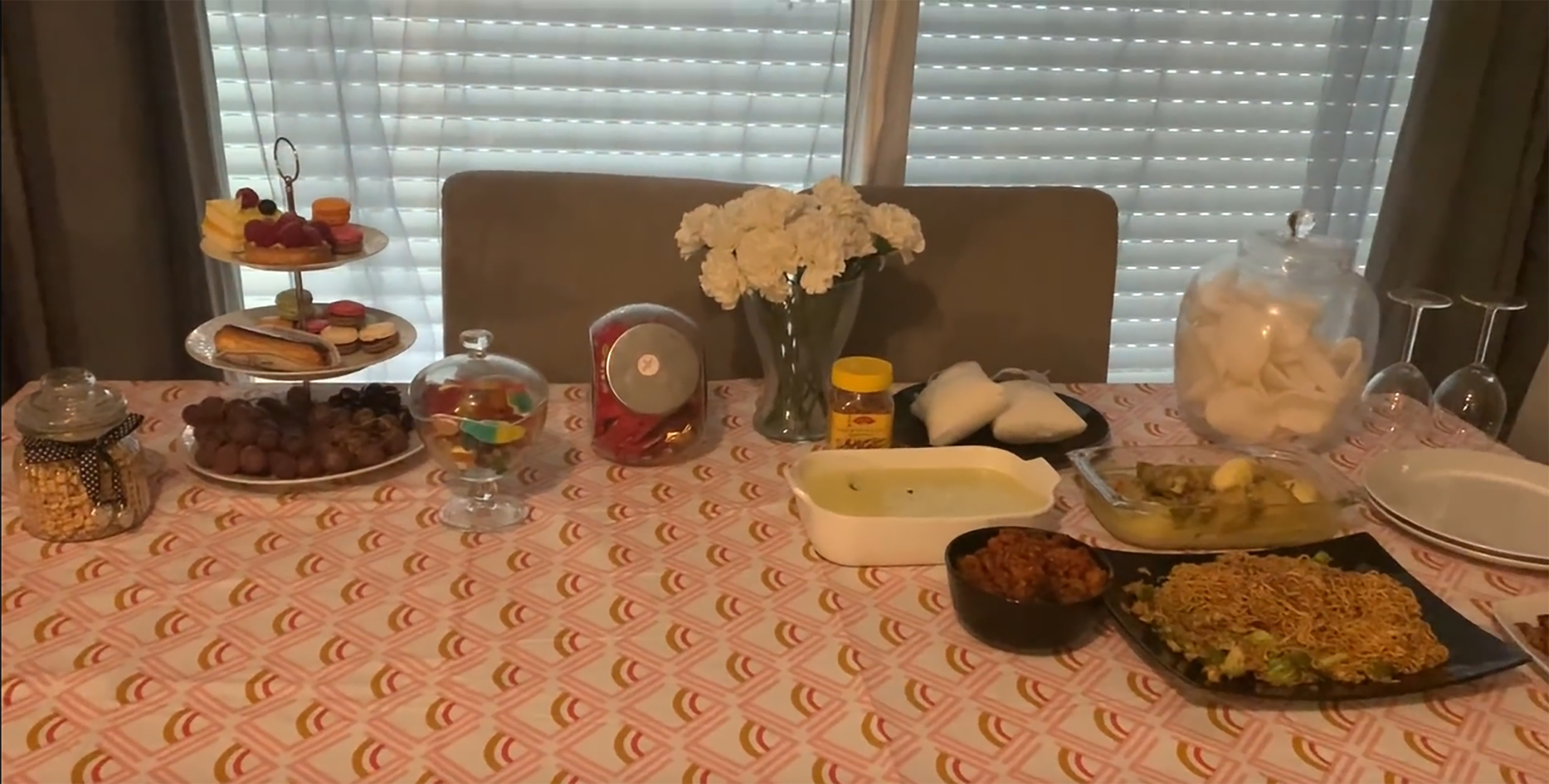
The food that Lian has prepared for her Eid celebration.
When I watched this vlog, I was curious about the ‘visitors’ that she mentioned to her followers because the lockdown had made it impossible for her to have any. As she switched her mobile phone camera to the front door of her house, we can see in Figures 2 and 3 that she pretends herself to welcome a group of ‘invisible guests’ to her house, and she asks them to enjoy her cooking and celebrate the Eid together with her.
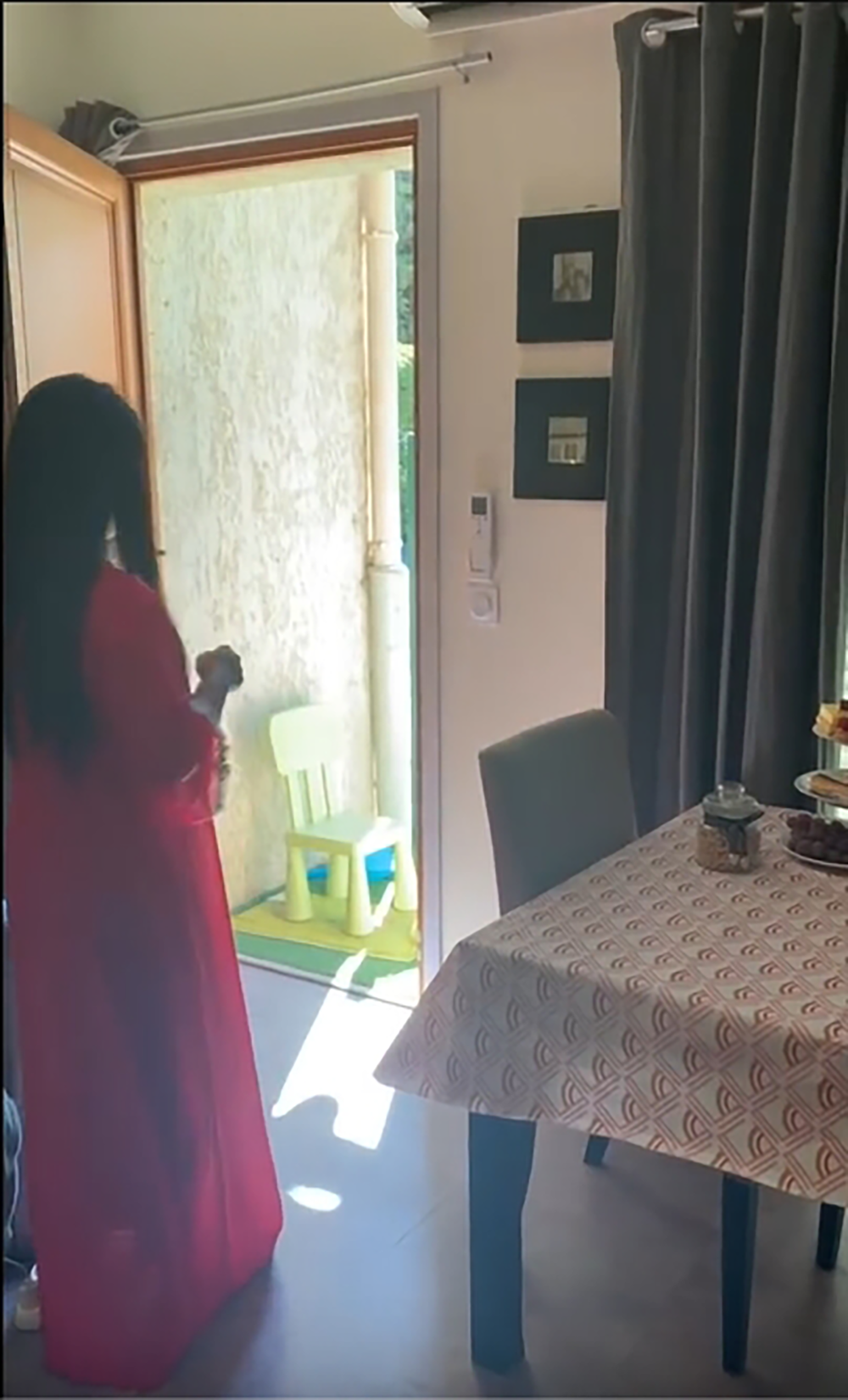
Lian vlogs about herself pretending to welcome the ‘invisible guests’ to her house.
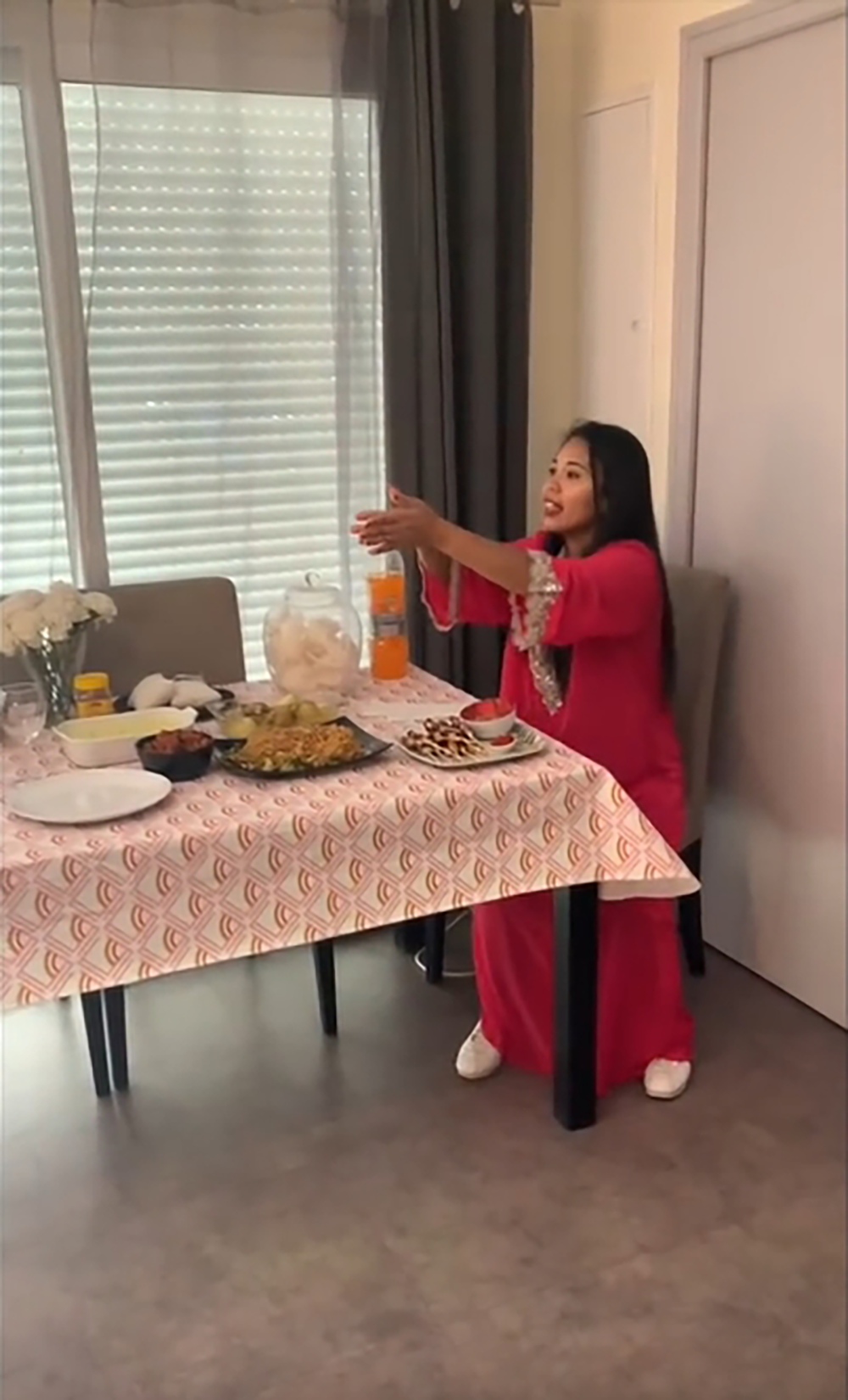
Lian is seen asking her ‘invisible guests’ to enjoy her cooking.
According to Gomes et al. (2020: 16), ‘religion moves with people, and when people move, the ways in which they engage with religion change’. Lian shows to her followers that the way she engages with the Eid celebration changed since moving to France. Back in Indonesia, Muslims would normally spend the morning praying together with their family members. In the vlog, however, Lian is by herself as her loved ones are still sleeping. Her situation demonstrates that religion in interracial married life is a complex matter. It is true that her husband has converted to Islam prior to their marriage in Indonesia, but it is difficult to know if his conversion was merely out of convenience to facilitate the marriage or more substantial.
Religion researcher MA Kevin Brice (2015) notes that there are two different types of converts who are often identified based on their reason for conversion: converts of convenience and converts of conviction. Brice highlights that there is a widespread belief among many Indonesians, though not among all, that Westerners convert to Islam only to facilitate marriage with Indonesian Muslim women. Nevertheless, Brice suggests that there is a possibility for the mualaf (Muslim new convert) to move between types of convert over a period of time. Though Lian rarely discusses her husband's commitment to Islam, he seems to fall under the category of converts of convenience. It is not clear if he continues to practise Islamic teachings other than consuming halal food whenever he is in Lian's vlog. Taking Ramadan month as an example, Lian mostly vlogs about herself having to break her fast alone in the house. But at the end of this Eid vlog, Lian attaches her mobile phone to a tripod and places it at the corner of her dining table (Figure 4) to show that she is eating together with her family to celebrate Eid in France. Her husband is not visible in the frame, but he can be glimpsed sitting behind their son, enjoying the Eid food while watching TV.
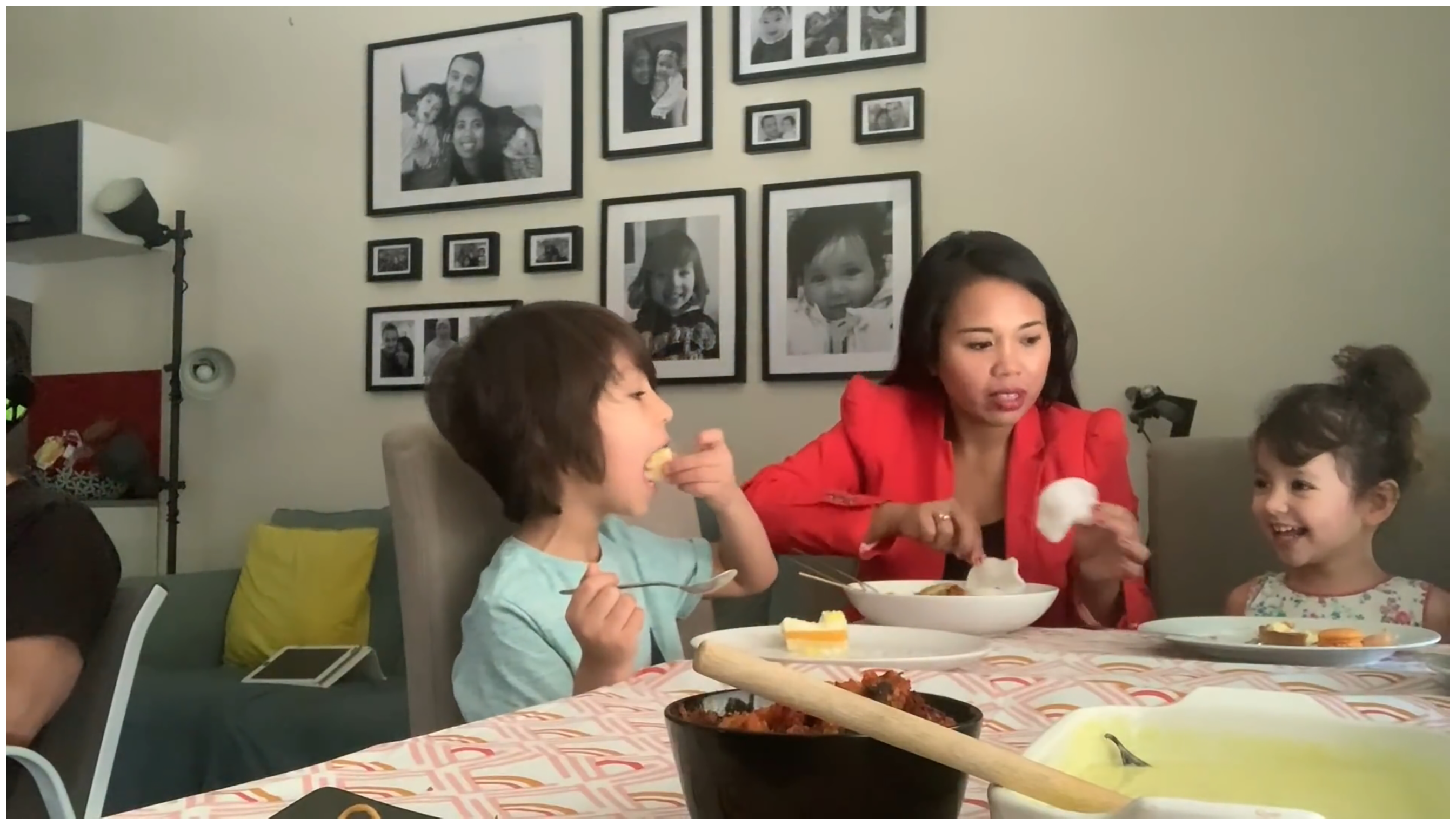
Lian is eating the Eid food with her family in France.
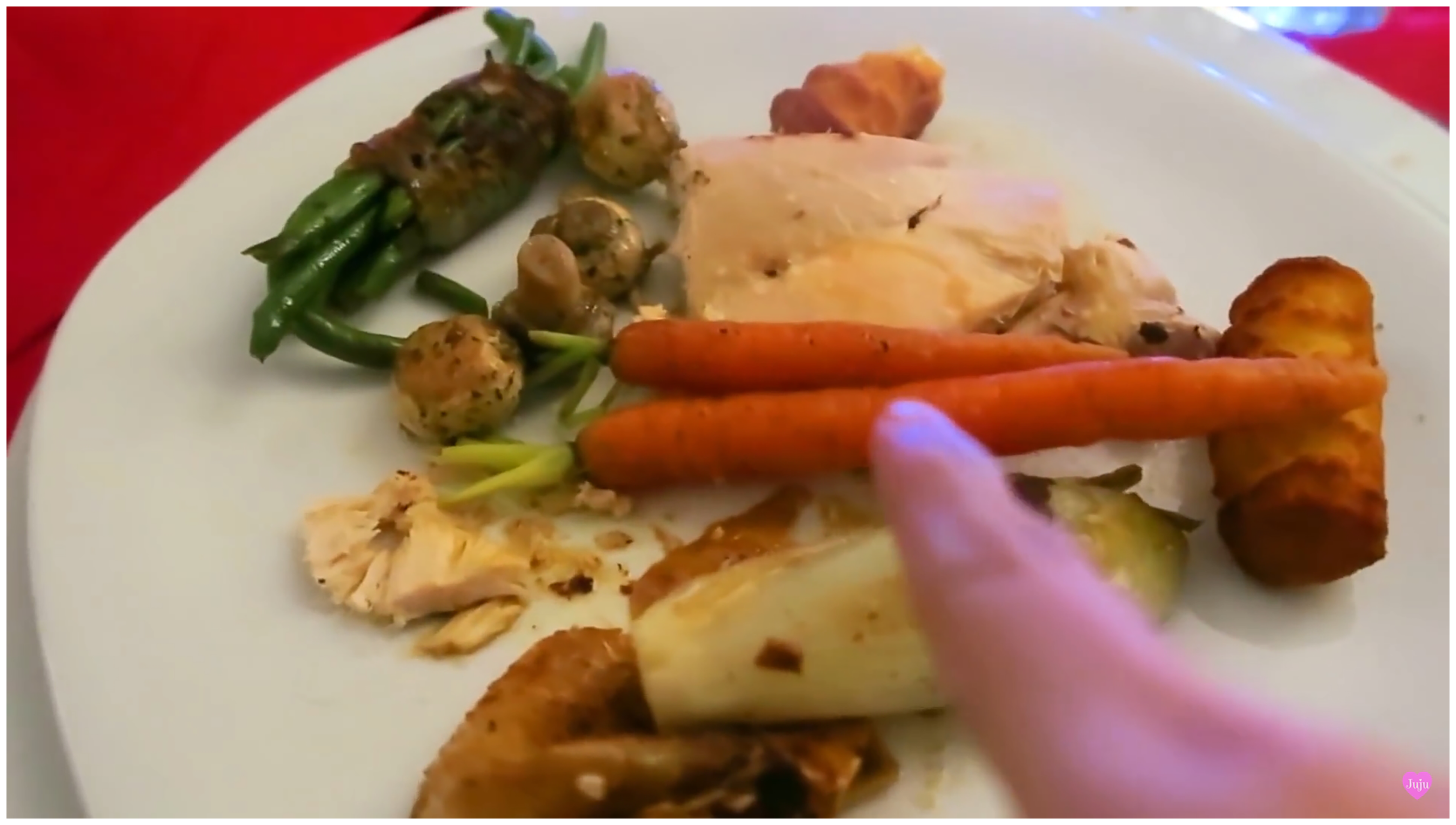
Julia is explaining the menu to her followers.
Based on the content, it is obvious that Lian is conscious of the widespread belief about converts of convenience, organising her vlogging around this assumption. If we compare Figures 2 and 3 with Figure 4, we can see from her dress that the scenes in her Eid vlog were recorded on the same day but at a different time. The contemporary dress that she wears in Figure 4 – a black tank top layered with a red blazer – is different from what she is wearing in Figures 2 and 3 – a more traditional kind of clothing (kaftan) worn by Muslim women in Indonesia, Malaysia and Singapore during Eid celebrations. Hence, her Eid vlog could be seen as a form of cultural work, purposely curated to attract sympathy from her followers by targeting the collective identity that they share as Indonesian Muslims. She deliberately vlogs about the temporary absence of her loved ones to make her followers shift their focus from criticising the religious foundation of her home to celebrating the Eid morning with her.
Revisiting Orsi's (2003: 172) earlier statement that religion needs to be understood as ‘religion-in-relationships between people’, the figures from Lian's vlog show that a religious tolerance is sustained in relation to the sympathy of her followers. Hence, she needs to use the vlogs to manoeuvre between some of the core practices in Islam and the diversity that she practices with her family in France. To reduce the threat to her sense of home, it is necessary for Lian to manage the tension around the religious expectations of her followers, as the lack of Muslim bodies in her vlogs often brings into question her Islamic faith.
The strategy that Lian used in her Eid vlog is quite successful because the vlog generated more than 50,000 views with more than four hundred comments that vary from well-wishers to those who enjoy her sense of humour. It is important to recognise that she may have deleted or hidden hateful comments, though I found no direct evidence to suggest that she has done this, but such a possibility should not be entirely dismissed. Deleting hateful comments could be one of the ways for Lian to sustain her sense of home by encouraging her followers to respect the importance of religious tolerance to her sense of home.
Expectations and stability in the digital homemaking process
It is clear that, overall, Lian has managed to evoke sympathy from her followers. Of the 50,000 views of her Eid vlog, there were more than four hundred positive comments and only one hate comment, the one outlined at the beginning of this paper. This reflects Hund and Benford's (2004: 450) conceptualisation of collective identity as people's ‘identifications of, identifications with, and attachments to some collectivity in cognitive, emotional, and moral terms.’ Hund and Benford (2004: 450) also argue that collective identities are influenced by ‘particular sociocultural contexts, produced and reproduced in ongoing interactions between allies, oppositional forces, and audiences who can be real or imagined’. In other words, they suggest that a sense of tolerance can be defined in relation to identity. By wearing the kaftan to welcome the ‘invisible guests’ (her followers), Lian sends a message to them that everyone is welcome to celebrate the Eid with her because all of them are Indonesians and they should be united when it comes to faith and religion. Her gesture resonates with Boccagni's (2017) point that familiarity is one of the basic attributes in home experience. Identifying herself with her followers helps to manage the threat to her sense of home as it creates a welcoming atmosphere for them.
From an emotional perspective, Boccagni (2017) explains that familiarity is associated with intimacy and comfort. Figures 2 and 3 show that Lian uses humour in her vlogs to invite her followers to fill the temporary absence of her husband and children in the Eid celebration. Marone (2015) explains that humour is not a trivial ornament as it helps to bond a community together and buffer their interactions. In the case of Lian, humor is one of her vlogging strategies to familiarise her followers with the significance of religious tolerance in her sense of home. The strategy reflects Orsi's argument (2003: 172) that religion should be understood in ‘the way people imagine or want it to be’ as Lian vlogs to inform her followers that if they could practice religious tolerance, they are welcome to take part in the homemaking process. The positive comments that Lian receives on her Eid vlog show that her strategy of hosting the ‘invisible guests’ through vlogging has been effective in strengthening a sense of mediated religious connection and tolerance in the digital homemaking. This connection helps to reinforce Lian's sense of home as it enables her to manage hateful comments from her followers.
The case of Julia presents both similarities and contrasts. Although she is a Christian, Julia shows an awareness that many of her followers will be Muslim. Her vlogs never contain anything that may be considered inappropriate for Indonesian Muslims, such as non-halal food. I propose that Julia vlogs strategically to minimise the disruption to her homemaking process by curating a tolerant atmosphere that is familiar to her Muslim followers. An example here is Julia's family Christmas Eve dinner vlog (Figure 5). The vlog starts with Julia showing the Christmas room and table decorations to her followers. As the vlog unfolds, Julia introduces their menus in detail, pointing to each item on her plate while explaining the food to her followers:
The vlog generated close to 55,000 views and one hundred and ninety-one comments from her Muslim and non-Muslim followers. Surprisingly, no hateful comments can be seen. Again, given the possibility of manipulating the comments, it is impossible to say whether she did not receive any hate from her followers or if she deleted the hateful comments.
In her study of computer-mediated discourse, Herring (2001: 621–623) writes that although ‘social class, race and ethnicity have also tended to be relatively invisible on the Internet […] computer users have developed a number of compensatory strategies to replace social cues normally conveyed by other channels in face-to-face interaction’. In the case of Julia's Christmas Eve vlog, some of her followers made their religious orientations obvious through their profile pictures. For example, Indonesian female Muslim followers can be seen with their hijab (head cover). Their comments – or what Herring describe as ‘linguistic behaviours’ (2001: 622) – also contain some Islamic words such as Allah or Masya Allah.
While the non-Muslim followers send Julia and her family their Christmas wishes, most of the comments from her Muslim followers are not specific to Christmas. They only write about how good-looking Julia's children are. This is probably because many Indonesian Muslims still believe that wishing someone a Merry Christmas is considered haram. One of the Islamic public figures in Indonesia, Muhammad Cholil Nafis (in Sucipto, 2021) has said that while Muslims are not allowed to join Christmas celebrations, it is not forbidden to wish Christians a Merry Christmas; but even today, not all Indonesian Muslims agree to this principle.
Nevertheless, I noticed in her vlog that there is one female Muslim follower who wishes Julia and her family a Merry Christmas. Another comment from her Muslim follower in particular writes: ‘I don’t know why but I admire you because your vlogs have no babi (pork) related content’. This follower does not disclose their faith through the profile picture or username, but it is obvious from the choice of words that the follower is an Indonesian. The friendly comments that Julia received from her Muslim followers show that her vlogging strategy has successfully encouraged them to respect the significance of religious tolerance in her homemaking practice. The visibility of halal food in her vlog helps to create an atmosphere that is familiar to her Muslim followers, thereby overcoming the threat to the homemaking process.
Her effort to eliminate the non-halal food in the vlogs further reflects Ammerman's (2007) idea that there are different ways in which religion can be woven into the fabric of everyday live. Maintaining religious tolerance with the followers in Indonesia helps to sustain Julia's sense of home as it reduces the likelihood of receiving religious hate comments that may disturb her future idea of home. She said in the interview that she feels more at home in Indonesia, and she plans to leave Belgium to retire in Indonesia once her children have built their own lives. Her statement shows that the meaning of home for Julia is not restricted to Belgium with her loved ones. Home for her is what Boccagni (2017) and Pink (2020) describe as a future-elsewhere-oriented idea that constantly develops following one's plan.
The case studies of Lian and Julia show that maintaining religious tolerance with their followers in Indonesia is central to sustaining their sense of home. Their vlogging practices demonstrate that ‘homemaking is a political act’ (Wilding et al., 2022: 223) because they need to employ different strategies to minimise the disruption to the homemaking process. The process is more complex for Lian. As an Indonesian Muslim, she is under intense scrutiny because most of her Muslim followers expect her to do the right things as a Muslim. But defining what is right is challenging because what Lian thinks is right might not appear right to her followers. By contrast, the absence of hateful comments in Julia's Christmas Eve vlog creates an impression that homemaking is less challenging for her. However, the homemaking process is not entirely straightforward for Julia. To sustain control over her sense of home, she needs to make a strategic use of her vlogs to create a bridge to her Muslim followers in Indonesia.
Conclusion
In this article, I have discussed how vlogging has become a homemaking strategy for Indonesian marriage migrants. Through the examples of Lian and Julia, I have explored the effectiveness of vlogging to sustain religious connections in different settings. In my analysis, I combined the notion of home as lived and the framework of lived religion and I found that maintaining religious tolerance with the followers in Indonesia is necessary for Lian and Julia to sustain their sense of home. Religion is central to the life of most Indonesians, and they are expected to identify themselves with one religion. However, the vlogosphere is inhabited by strangers from different faiths. Since it is difficult to anchor a sense of belonging to one religion, Julia and Lian used adapted religious expressions to encourage their followers to respect the significance of religious tolerance in their sense of home. This is important to minimise the disruption in the digital homemaking process.
My participants showed that their vlogging strategies have generally worked to maintain religious connection to their followers. However, the mixture of comments that they received revealed the complex relationship between religion and homemaking. Homemaking is more complicated for Lian. As a Muslim Indonesian marriage migrant, she needs to work harder to mediate between her Western lifestyle and her faith. She is also more exposed to unflattering judgements from the majority Muslim followers in Indonesia. However, the process is also complicated for Julia as she needs to constantly eliminate the presence of non-halal food in her vlogs, in order to maintain connection with her Muslim followers. The complexity in maintaining control over their sense of home confirmed the argument from Blunt and Dowling that home is shaped by a complex interplay between the feelings of belonging and alienation.
Footnotes
Acknowledgements
I thank Professor Mark Gibson and the reviewers for their invaluable feedback which have significantly improved the quality of this manuscript.
Funding
The author received no financial support for the research, authorship, and/or publication of this article.

Author’s biography
Dr Rita Budiman teaches at The University of Melbourne and Monash University. She recently completed a PhD from RMIT University and has research interests in vlogging, international migration and digital homemaking.