



Abstract
While the term “values” is widely invoked to construct identities, set boundaries, and justify decisions, its use has evaded systematic analysis. This is particularly intriguing in the context of social media, where the term simultaneously reflects and shapes what is cherished by people worldwide. Addressing this void, we analyzed how Instagram users from different language communities – English, German, Italian, Korean, and Japanese – frame the term. Surprisingly, we found that “values” is used not for ethical or political arguments, but as a marketing tool. Across countries, professionals promise to assist individuals in discovering their “authentic” values and leveraging them for material success and a sense of meaning. Instagram, a commercially oriented platform promoting neoliberal values, serves as a powerful agent that appears to outweigh cultural differences. We propose the “funnel” as a metaphor to depict a process where platforms direct varied interpretations of complex concepts into ones that serve their own interests.
Keywords
The concept of values looms large in society. Everywhere, from high-minded political speech to everyday discourse, values – broadly defined as core beliefs about the desirable that guide individual and collective behavior (Schwartz, 2021) – are frequently invoked as justification, explanation, or motivation. Yet a puzzling gap exists around this concept: while researchers and politicians alike perceive the term as central to social and political conduct and identity, little is known about how the term is used in daily discourse.
This article explores how users from different language communities shape the meaning of the term “values” through their Instagram posts. In theory, users can tag any post with #values and represent the concept in infinite ways. Moreover, given the cultural differences between users from different locales, one might expect significant differences in applications of the term. However, previous research on Instagram highlights that the platform's global reach and commercial ethos encourage homogeneity in the bottom-up contributions of its users (Trillò et al., 2021). Ultimately, the user-generated repertoires tagged with the word “values” are the outcome of the complex interplay between Instagram's platform politics (Gillespie, 2015), its global platform vernacular (Gibbs et al., 2015), and the local vernaculars of its users (Shifman et al., 2014).
Our investigation of the term “values” on Instagram unfolds in four parts. First, we present a review of the literature in which we reflect on the term “values” as a floating signifier that, in the context of Instagram, acquires its meaning in the interaction between top-down platform politics and the bottom-up contributions of a global user-base. Thereafter, we detail the mixed-methods approach adopted to analyze the visual features, captions, and hashtags of 1,146 posts hashtagged with the word “values” in five languages: English, German, Italian, Japanese, and Korean. Following an overview of our findings, we discuss how most of the posts in our dataset promote the sale of goods or services (particularly personal coaching) and that the word “values” is hardly ever defined or specified – an ambiguity that is commercially leveraged to encourage potential clients to pursue their own “authentic” values. Crucially, these findings hold for all the languages in our study, with only minimal cross-cultural variation coming from the Korean subset.
In the conclusions, we outline the contributions of our study. First, we advance value theory by harnessing a communication perspective and identifying similarities in the way a core concept is framed by social media users across cultures, thus challenging some of the existing notions of an East–West divide. Second, we add to the study of Instagram by highlighting how its neoliberalized platform politics leverage internal authenticity – a value pivotal to this platform's vernacular – to promote individualistic and consumeristic modes of conduct. In this process, the individual contributions of dispersed users coalesce into an overall narrative that invites “you,” the reader, to embrace your own values as a way to maximize your human capital and, ultimately, achieve financial success. Finally, reflecting on the interaction between platform politics, platform vernaculars, and local vernaculars, we propose the metaphor of a “funnel” to describe the process in which neoliberal platform politics leave the definition of abstract concepts murky while channeling their meaning towards market-oriented self-serving uses.
Literature review
The floating meaning of “values”
“Values” is a central concept in the social sciences. As pointed out by sociologist Nathalie Heinich (2020), the term has three distinct meanings: the monetary worth of an object, those objects consistently recognized as worthy (e.g. art, friendship), and the abstract principle guiding the assignment of worth (e.g. originality, equitability). Different disciplines have historically approached the different facets of the concept varyingly. Economics concentrates on how financial value is produced, sociology treats values as explanations for the influence of social structures on human behavior (Hitlin and Piliavin, 2004), psychology defines them as the criteria that individuals and groups adopt to evaluate objects and justify action (Schwartz, 2021), and anthropology views them as culturally specific conceptions of the desirable (Graeber, 2001). Large cross-cultural investigations (Hofstede, 2003; Inglehart and Welzel, 2005; Schwartz, 2021) have tackled “values” from different disciplinary angles in order to capture the context-dependent character of the concept. The picture arising from these studies is that of a cultural split between “Eastern” and “Western” countries based on strikingly different value orientations (e.g. Mueller, 1986). However, while scholars have demonstrated cross-cultural differences in the perception of specific values, a systematic study of how the term is used in daily life – to the best of our knowledge – has yet to be conducted.
Given that speakers shape and negotiate the meaning of specific keywords through discourse, comparing the use of term “values” across languages can both surface universals and highlight differences between cultures (Wierzbicka, 1997). Accordingly, we set off to investigate “values” as a transnational instance of language-in-use, suggesting that the concept gains its meaning from the social practices in which it is enacted (Gee, 2011). Previous studies of specific value-related terms – including sustainability (T. Brown, 2016) and fairness (Vertinsky et al., 2013) – have consistently found these concepts invoked as floating signifiers: terms whose literal meaning is indeterminate and thus open to being filled with any meaning (Lévi-Strauss, 1987 [1950]). Going beyond a strict focus on semantics, we are also interested in uncovering whether “values” carries a common rhetorical usage (Grimmel, 2017) in the socio-technical environment of Instagram. Hence, the overarching question driving this project is whether the content tagged with the word “values” by Instagram users across language communities assigns similar meaning to the concept and leverages it in service of similar goals.
Instagram's platform politics and the production of “authentically branded” selves
The representation of “values” (or any other term) on Instagram is influenced by its platform politics – the collection of strategic design choices, policies, and norms made by a platform's parent company that facilitate some behaviors while implicitly discouraging others (Gillespie, 2015). Instagram's platform politics simultaneously appeal to an economic understanding of value as generated in market exchange and a sociological notion of values as conceptions of what is good, proper, or desirable (Graeber, 2001). The platform aims to maximize revenue for its parent company Meta by extracting economic value from its users’ activities (Gerlitz and Helmond, 2013). The success of this operation depends on Meta's ability to compete with other parent companies for users’ attention (Davenport and Beck, 2001), maximizing the time users spend on its platforms and, in turn, their exposure to content that can be monetized (e.g. native advertisement, influencer marketing). Accordingly, Instagram's design displaces “the gaze” in favor of “the glance”: a transactional model of visuality in which users strategically craft their posts to capture the fleeting attention of others in order to achieve social recognition and reap its financial benefits (Zulli, 2018; see also Paasonen, 2016).
We interpret Instagram's commercial platform politics as an expression of neoliberal governmentality (Foucault, 2008). We follow Wendy Brown's understanding of neoliberalism as a political rationality in which “all conduct is economic conduct” and “all spheres of existence are framed and measured by economic terms and metrics” (2015: 10). We acknowledge the contested character of neoliberalism as a polysemic concept (Ferguson, 2010) that is at times invoked as a catch-all negative descriptor for all market-oriented politics (Dunn, 2017). Nonetheless, we find Brown's theorization particularly suitable to investigate social media platforms: privately owned spaces explicitly designed to generate a profit and where parent companies themselves dictate the terms of what is allowed, prohibited, encouraged, or sanctioned (Scharlach et al., 2023).
Moving within the constraints set by its platform politics, users access Instagram to share their unique perspective on the world and thus craft their preferred self-image in front of others (Miller et al., 2016). We adopt a Goffmanian understanding of the self as performatively constructed and constantly negotiated in interaction with others as well as the surrounding environment (Goffman, 1959). Hund and McGuigan (2019) theorize the duality between users’ self-expression and Instagram's commercialism as a double imperative according to which individuals ought to be “authentic” while simultaneously performing attention-grabbing and potentially monetizable versions of themselves (see also Ross, 2019). This is particularly evident in the case of influencers (Whitmer, 2021). On the one hand, influencers usually accrue and expand their follower base through performances of authenticity (Frowijn et al., 2022) such as the selective display of spontaneity, ordinariness, or imperfection (Enli, 2015). On the other hand, they have to fit their content to the presumed wants of the platform and the imagined rules of “the algorithm” in order to be commercially appealing to the brands whose products they aim to promote (Cotter, 2019). The popularity of influencers showcases how Instagram's platform politics rewards modes of showing oneself that can easily be monetized while relegating other modes of self-presentation to a subaltern status of quasi-invisibility (Skeggs, 2014).
As the tropes of the influencer industry trickle down to the level of users via participatory culture (Guerrero-Pico et al., 2019), the vocabulary of the market becomes the primary tool for “authentic” self-presentation in digital spheres (Banet-Weiser, 2012). We see this as a process of value optimization (Hallinan, 2023), in which users adopt specific communicative strategies in order to appeal to the imagined values of the platforms they inhabit (see also Gershon, 2010). We suggest that at the core of this process sits a tension typical of value expression on digital platforms: that between self-improvement and self-acceptance (Hallinan et al., 2021). Self-improvement refers to the work that individuals invest to maximize their own human capital, usually outside of work-hours, for example learning a new language (Weidner, 2009). Self-acceptance refers to the attitude of unconditional positivity typically offered by the self-help industry as a solution to the woes of present-day society, such as workplace alienation or body dysmorphia (Gill and Orgad, 2015). Ultimately, Instagram users balance narratives of self-acceptance and self-improvement as they craft “authentic” Instagram personae that nonetheless strive to be visually appealing and potentially monetizable.
Instagram's global platform vernacular and its local incarnations
The concept of platform vernacular refers to the collection of grammars and styles habitually adopted by the users of a social media platform (Gibbs et al., 2015). Instagram's platform vernacular has been described with a wealth of terms, including “Instagram-ism” (Manovich, 2016), “Instagrammable” (Tiidenberg, 2020), and “Instaworthy” (Gupta and Ray, 2022). While different in their nuances, all of these adjacent concepts suggest that Instagram's vernacular promotes individualistic and consumeristic modes of visuality that homogenize content and aestheticize daily life for public consumption (Ibrahim, 2015).
Trillò et al. (2021) argue that Instagram's regularities can be traced back to the platform's archival quality, as the platform functions both as an image repository and a stylistic paradigm favoring aesthetic standardization. The hashtag is a key feature enabling these processes. Instagram users frequently use both generic hashtags (#like4likes, #instapic) to boost post visibility (Zhang et al., 2017) and descriptive hashtags that can be reliably identified (Giannoulakis and Tsapatsoulis, 2016). Annotating their content via hashtagging, users make their posts retrievable by others and, in turn, facilitate the development of tropes, clichés, and other regularities in vernacular content (Leaver et al., 2020).
In the case of abstract terms such as “freedom,” “loyalty,” or indeed “values,” this bottom-up process of content standardization establishes, over time, narrow iconic templates that follow Instagram's marketplace logic. In turn, these crowd-sourced templates act back on the concepts they are meant to represent, constraining their meaning to individualist and consumeristic lifestyles that Trillò et al. (2021) dub “aestheticized consumption.” In what follows, we argue that the ways in which a platform's politics and logics constrain users’ vernaculars can be metaphorized as a “funneling” process in which abstract concepts are channeled toward a limited set of meanings consistent with the platform's interests. Such a trend is exemplified by practices that blur the line between user-generated content and advertisement, such as everyday users imitating the visual tropes of influencer advertorials (Guerrero-Pico et al., 2019).
Regularities notwithstanding, Instagram's platform vernacular is not monolithic, as the platform gathers a number of localized subcultures with community-specific tropes, templates, and clichés (Leaver et al., 2020). Building on Shifman et al.'s (2014) concept of user-generated globalization, we suggest that the representation of values by users from different locales simultaneously features a tendency towards transnational content homogenization and a contrasting tendency towards localization. For example, the user-generated repertoires associated with the term “values” by different language communities might resemble each other because of the transnational dominance of Anglo-American templates. However, they may also follow a particularistic logic, as users in different countries reinterpret global templates through language-specific vernaculars to increase resonance at the local level (Nissenbaum and Shifman, 2018).
Based on the notion of floating signifiers and the aforementioned tension between platform politics, platform vernacular, and local vernaculars, we ask: What meanings of “values” are invoked in user-generated repertoires? For what purposes is this term used? And to what extent do language-specific repertoires differ from each other? The first two questions aim to uncover semantic and pragmatic uses of the term “values” in Instagram images and the accompanying captions, while the third explores the above-described tensions between global platforms and local cultures.
Methods
Sites and methods of analysis
We explored data gathered from five linguistic settings: English, German, Italian, Japanese, and Korean. English was selected in light of its role as the internet's lingua franca and globalization more generally (Danet and Herring, 2007). The other languages were chosen as they serve as proxies for cultures tied to specific geographic regions (Matassi and Boczkowski, 2021) which previous large-scale cross-cultural investigations of values have depicted as divergent (Hofstede, 2003; Inglehart and Welzel, 2005; Schwartz, 2021).
We compare the equivalent of “values” in these five languages: “values” (English), “werte” (German), “valori” (Italian), “価値観” (Japanese), and “가치관” (Korean). These search terms are based on the terminology adopted by the World Values Survey (Haerpfer et al., 2022) and the Schwartz Value Survey (Schwartz, 2021). Our research team of native speakers of these five languages further confirmed these terms are the most direct way of expressing the concept of “values” in each language. This is not to say that we assume the usage of “values” to be fixed across languages, but that, in our estimation, these five terms are each other's closest equivalent.
As mentioned, we are particularly interested in investigating how users from different countries invoke the term on social media. To this end, we are also invested in an ongoing parallel study examining the use of these same five terms on Twitter (Green et al., 2022). The preliminary findings of this project highlight a divide in the framing and use of “values” on Twitter between the “Western” (English, Italian, and German) and “Eastern” (Japanese and Korean) languages. Comparing these findings to those of the Instagram-based project reported here will allow us to examine the impact of top-down platform politics and bottom-up platform vernaculars in two different settings.
Data gathering and cleaning
In light of the limitations imposed by Meta on accessing data through Instagram's application programming interface (API), our data-gathering process was fully manual. In December 2021, five research assistants (native speakers of the relevant languages) accessed Instagram at coordinated times through computer browsers, searched for the word “values” in each language (“values,” “werte,” “valori,” “価値観,” “가치관”), and manually gathered the 70 most recent posts in four rounds of search (280 per language). The research assistants manually copy-pasted each post's URL, author's username, caption, and accompanying hashtags into a spreadsheet and took a screenshot of the image. This process was repeated once per week four times, resulting in a raw dataset of 1,400 images. Thereafter, we removed all instances of multiple posts by the same account to minimize the impact of systematic hashtag spamming, resulting in a cleaned dataset of 1,146 images (English = 263, German = 255, Italian = 234, Japanese = 220, Korean = 174). Finally, the research assistants translated all hashtags, captions, and any text appearing in the images to English.
Content analysis
We developed a 12-question codebook to analyze the visual and textual components of the corpus (available upon request). Inspired by established methods for visual analysis (Kress and van Leeuwen, 1996) and a preliminary screening of the corpus, the first eight questions pertain to the content of the images and ask the coders to identify whether the image includes a photograph, illustration, text, individual human figure, groups of people, animals, objects, landmarks (Q1–7, all “yes”/“no” questions), and determine whether the picture is set indoors, outdoors, or in an unspecified space (Q8).
The remaining questions refer to broader messages embedded in the posts. Q9 asks the coders to determine whether the image features the owner of the account (“yes”/“no”). Q10 asks whether or not the post features an overt or covert invitation to purchase goods or services (“overt”/“covert”/“none”). Posts directly inviting the viewer to purchase something or financially support an institution were treated as “overt” marketing. Posts promoting a freelance professional or business without prompting the viewer to buy their products or donate money were considered “covert” forms of marketing. For this latter category, coders were instructed to take into account the presence of logos or watermarks, the username of the person posting it (e.g. @YogaWithJohnathan, @MaraSchmidtPsychologist), and their profile bio (e.g. whether they disclose promotion of their business as the goal of their profile). Q11 asks to identify the business sector in which the post author operates, based on an inductively generated list developed during preliminary analysis. Finally, Q12 asks the coders to identify whether the word “values” is used to (a) refer to a specific value (e.g. “the value of justice”); (b) denote the values of a group of people without specifying what those values are (e.g. “the values of the nation”); (c) invoke values in an “empty”, unspecified, way (e.g. “values are important and everyone should respect them”); or (d) is not used at all (i.e. “values” is solely featured as a hashtag).
After a training phase, the research assistants conducted an intercoder reliability test on a sample of 50 units from the English dataset, passing Krippendorff's alpha threshold for intercoder reliability in exploratory studies (α = .67) for all variables (α ranging from 0.721 to 1.0). Following reliability testing, the research assistants coded the data in the respective languages. Thereafter, we checked for statistically significant differences between the five subsets through Pearson's chi-square test with simulated p-value and a post-hoc analysis using Fisher's exact test, corrected for multiple testing through the Benjamini–Hochberg false discovery rate procedure.
Hashtag frequency analysis and qualitative analysis
We complemented the aforementioned manual content analysis with two methods. First, using computational tools (Python packages spaCy and NLTK) and aided by native speakers of each language, we calculated the most frequent hashtags (aside from #values) occurring in our corpus to corroborate the analysis conducted by manual coders and expose additional themes that we did not anticipate when drafting our codebook. The list of the 40 most frequent hashtags in each language appears in Appendix 1.
In addition, we conducted a close reading of representative examples of the key trends that emerged in the content and hashtag analyses, drawing schematic notes on the actors, processes, and circumstances represented in the images (Kress and van Leeuwen, 1996). For example, a picture featuring a mental coach leading a group yoga session on a grass field (left example, Figure 1) was annotated for its protagonist (mental coach), its circumstances (outdoors, in the company of trainees), and the process being represented (practicing yoga). Accounting for the intertextual character of each Instagram post, our analysis gave equal weight to images and captions, and also took into consideration the broad characteristics of the user posting them (e.g. username, bio, consistent use of specific filters on their feed).
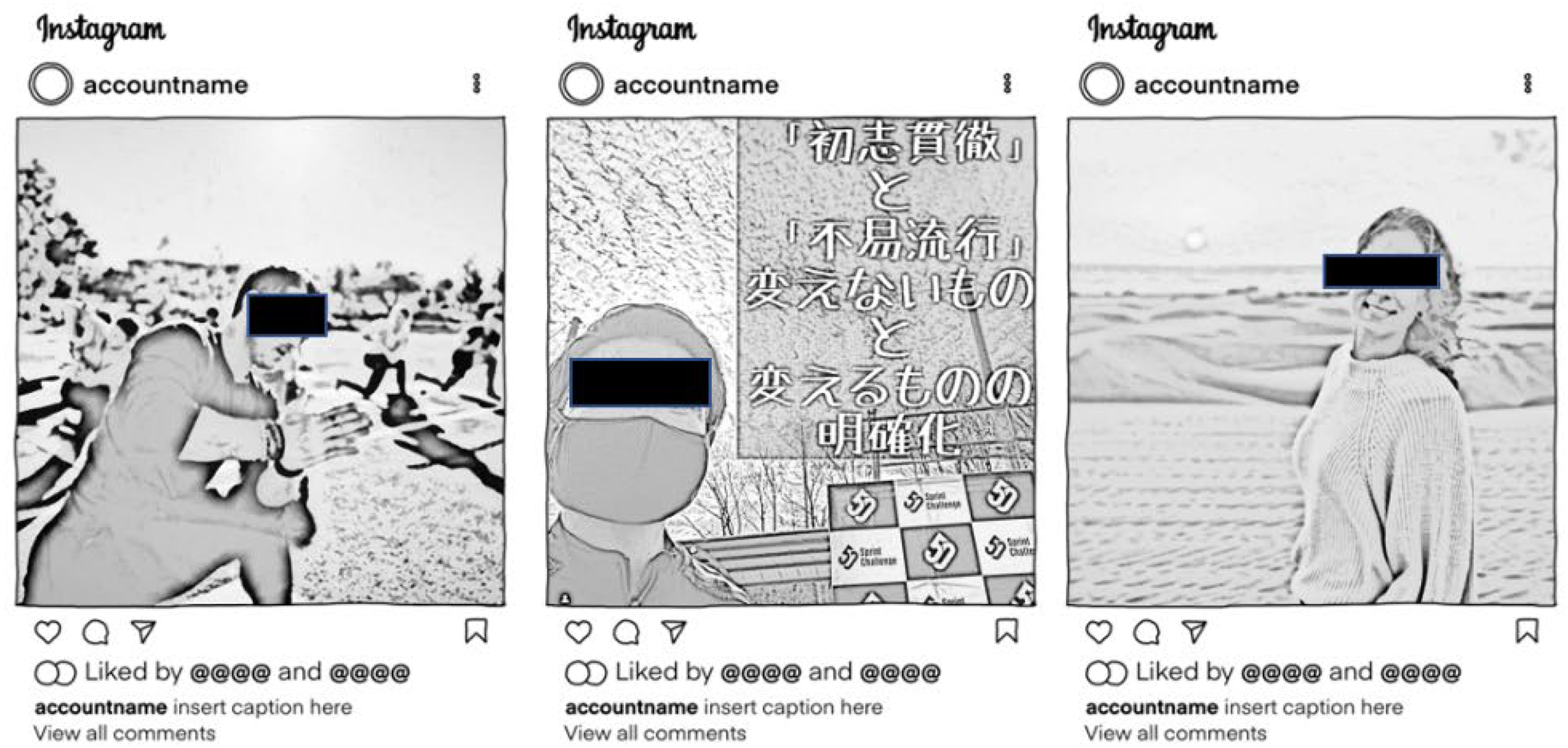
Examples featuring personal coaches advertising their services
Findings
An integrative evaluation of the data based on our quantitative, computational, and qualitative analyses led to the identification of three prominent trends: the use of #values for commercial purposes; the prominence of a specific business realm – personal coaching; and the strategic use of “values”’ as a vague term that nonetheless foregrounds authenticity as a norm that users should follow in their quest for self-acceptance and self-improvement. We show that these trends have strong cross-national resonance, with a slight variation in the Korean case.
Finding #1: Values are good for business
The first and most striking result emerging from our analysis is that, on Instagram, hashtagging a post with the term “values” is not an indication that its content relates to ethical arguments or political discourse. Rather, using the term as a hashtag “funnels” its meaning to a narrow and specific context, that of a marketing campaign. The majority of the posts in the corpus (60.5% overall) are published to “covertly” promote the sale of goods or services (72.5% overall, at least 63% in every language) by exalting the quality of an individual or product without directly inviting the viewer to buy it. In contrast, only roughly one-quarter of posts (27.5%) serve no discernible commercial purpose.
Consistent with the largely commercial character of the posts tagged with #values, the visual component of the corpus is comprised of highly edited digital flyers advertising products and services. Most images foreground individual human protagonists (26%), two or more human figures (15%), or consumer products (34%), typically cast against a computer-generated background (51%) and with a text overlay (60%). Overall, and across cultures, the design of images aligns with the strong commercial purpose embedded in these posts.
Finding #2: Hire a coach, find your values
The most commonly advertised service across our sample is personal coaching and mental health consultations (35% of all posts). Indeed, advertisements by individual coaches and therapists represent a plurality in all languages and are most frequent in English (43%, p = .005), German (44%, p = .003), and Japanese (45%, p = .002). Other business sectors are present but somewhat marginal. For example, the English subset is more likely than others to feature promotion by artists (illustrators, cartoonists; 6%, p = .004), while the German subset is more likely to feature advertisements for financial services (3%, p = .030).
These findings are echoed by the most frequently occurring hashtags in four of the five languages: half of English, more than a third of German and Japanese, and a fifth of Italian top hashtags refer to the theme of coaching. The hashtag #coaching is the fourth most popular hashtag in both Japanese and German, and also appears in Italian and English, where the hashtag #lifecoach features even more prominently.
The coaches and therapists in our sample advertise their services by foregrounding their figure, either outdoors or against a digital background, and through captions that overtly or covertly encourage the reader to book a session with them. A particularly representative example is that of an American coach whose bio describes their expertise as “help[ing] high performers & athletes breakthrough anxiety and the pressure to perform.” Visually, the post is a shot of the author leading a group of trainees during a yoga session (left example, Figure 1). The caption informs the reader that “There's value in knowing what your highest core values are!” and adds that “Core Values is a HUGE part of the work we do in my 90-Day Private Coaching Program.”
Another example comes from a Japanese mental coach describing their job as “support[ing] people who aim for self-fulfillment.” The post's image is a selfie accompanied by a text overlay stating: “things that should change and things that shouldn’t change” (middle example, Figure 1). In the caption, the author rhetorically asks “things are changing, so what does not change?” and immediately answers that “the things that don’t change are the things that are born inside yourself. Your values, your likes and dislikes, your way of being.” A closer look at the coach's profile reveals that the post is part of a self-promotional series of morning reflections.
Alongside the hashtags specifically related to coaching, we observe the prominence of hashtags gesturing towards mental health with varying degrees of explicitness. These include #motivation, #growth, and #mindset (all appearing in the top results of at least four of the languages), #personalgrowth (English, Italian), #selfdevelopment (Japanese, Korean), #personaldevelopment or #personalitydevelopment and #selflove (German, English), #psychology and #wellness (Italian), #selfcare and #mentalhealth (English).
For example, a German therapist posted an image of themselves looking at the camera in an outdoor setting (right example, Figure 1). The caption outlines their mental health journey, suggesting that the reader can follow a similar trajectory by purchasing their services: “How did I manage to turn myself by 180 degrees and stop putting myself under so much pressure? … By living according to my own values and no longer letting myself be guided by the outside world.”
Finding #3: Follow your values, find success and meaning
The third key pattern emerging from our data is that many of the posts encourage the reader to leverage their personal values to achieve a higher purpose or goal. Interestingly, however, the professionals advertising their services through the hashtag #values seem to refrain from explicitly naming what values they deem relevant. Our quantitative analysis revealed that while all the posts in our sample feature the hashtag #values, their captions use the word “values” in just a third (33%) of the cases, consistent across languages. Only a handful of posts in our sample (5%) list or define specific values (e.g. loyalty). Conversely, the word “values” is often (23%) used to vaguely describe something good that people should hold or aspire to. Out of a myriad of possible meanings, the term is “funneled” towards a specific combination of promotional function and semantic ambiguity.
Our qualitative analysis revealed that vague reference to values is commonly phrased as an invitation to identify “your values” – regardless of what those could be – and to harness them to achieve other goals, especially business success and personal meaning. This trend is partly encapsulated by the popularity of hashtags such as #business (Italian, English, German), #entrepreneur (German and English), #entrepreneurship (Japanese), and #money (German) alongside #values.
The trope is exemplified by an Italian entrepreneur's post describing their job as “help[ing] people create and administer commercial networks by learning how to monetize their daily actions.” The post's image is a selfie of its author posing with a finger up and an inquisitive look, surrounded by a computer-generated frame and text boxes, one posing the question: “SUCCESSFUL person or person of VALUE?” (left example, Figure 2). As explained in the caption, however, both goals are one and the same: “to be a successful person you have to worry about defining YOUR values first!”
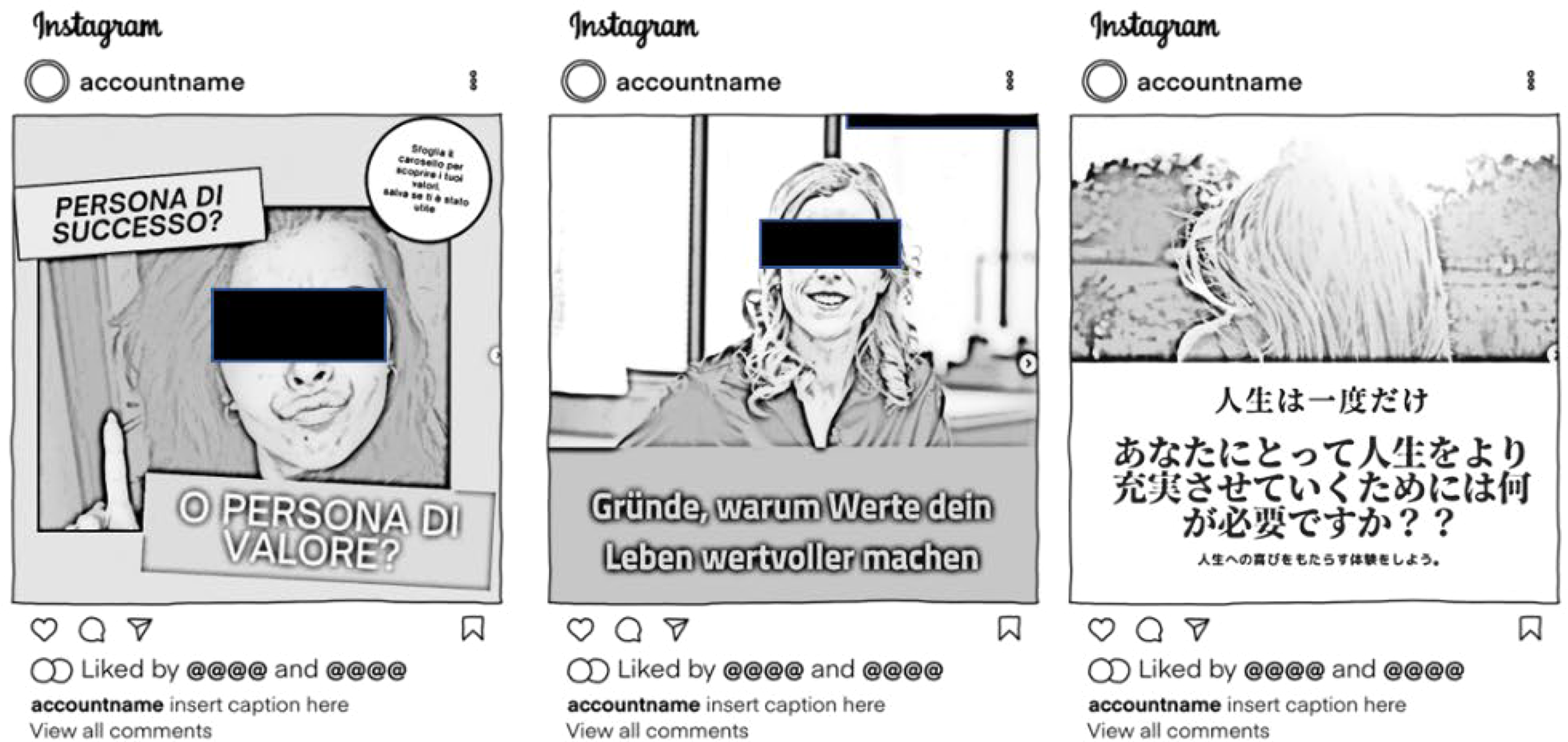
Examples featuring a range of professionals advertising their services
A similar take is offered by a German consultant whose bio foregrounds the concepts of “values | corporate culture | change.” The image features a portrait of the author against a blurred background, with a banner titled “reasons why values make your life more valuable” (middle example, Figure 2). The caption states that “Values are simple and easy and make your life worthwhile.… Maybe it's time to identify yours?” The reader is then invited to take a free “value test” through an external link to the consultant's homepage.
While the posts in our corpus favor career as the privileged domain for finding meaning, the relative prominence of hashtags like #self-enlightenment (Japanese), #spirituality (English), and #mindfulness (English, German, Japanese) revealed that such focus occasionally extends beyond the workplace. Indeed, a minority of the posts in our sample comes from spiritual guides, meditation instructors, and yoga teachers, who advertise their services by suggesting that paying close attention to one's own emotions can lead to a more fulfilled life in all fields. For example, a post by a Japanese chiropractor and tarot reader mimics the aesthetic of inspirational memes by displaying a person turned away from the viewer, walking towards the sun. The picture features a text overlay stating “you only live once / What do you need to make your life more fulfilling?” (right example, Figure 2). The accompanying caption states that “Some people have the same values / Some people change over time / Everyone is different” and covertly invites the reader to book a session by stating that they can “become a more fulfilled self by putting that thought into action.”
Finding #4: The Korean case of “read books, find success and meaning”
Our quantitative analysis shows that the Korean subset is generally aligned with the rest of the sample concerning most posts’ commercial character, the coaching industry's relative prominence, and the vague use of the term “values” in the captions. However, the hashtag analysis revealed a unique theme: book culture. This is indicated by the prominence of hashtags like #writing, #bookstagram, #poetrygram, #reading, #book, #poetry, and #lovequotes. While book reviews (Jaakkola, 2019), inspirational quotes (Rieger and Klimmt, 2019), and poetry (Pâquet, 2019) are all established Instagram content types, their association with #values seems to be specific to Korean-language content.
Our qualitative analysis revealed that, despite their uniqueness, the Korean posts referring to book culture are also consistent with our overall results, as they often leverage book-related aesthetics for commercial purposes. For example, a Korean business consultant's post covertly advertises their services with a picture of a page in a self-help book featuring an underlined sentence that states: “nothing happens after a spectacular failure, but a trivial success has the potential to lead to a small success” (left example, Figure 3).
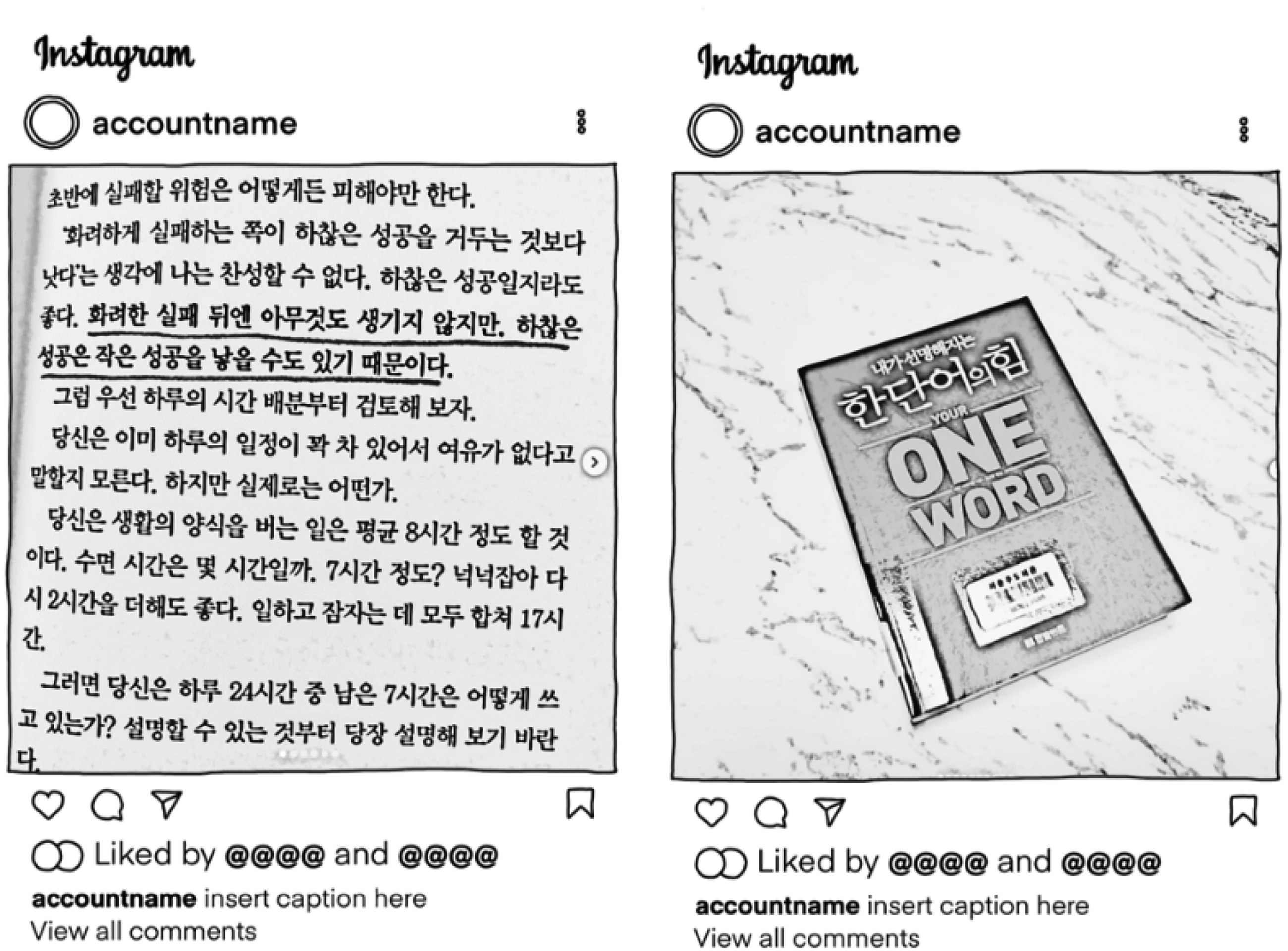
Examples representing the book-related aesthetic typical of the Korean subset
A similar example comes from a professional describing their work as “book-toring,” that is: mentoring with books. Visually, their post features the front cover of a library book resting on a white table (right example, Figure 3). The caption reveals that the book is a guide to selecting “one word that can represent me,” an exercise that the post's author describes as one that helped them “find my essence.” In their telling, choosing such a word can be crucial to effective decision-making because it “becomes a compass so that you can make the right decision without being confused,” insofar as “When values are established, it becomes easier to make decisions.”
While most Korean book-related posts do, as shown, share a tendency towards the promotion of personal coaches and career advisers, we also found a number of Korean-language posts by users who are not directly advertising their services. Examples include library goers posting their favorite inspirational quotes from their latest reads and amateur writers sharing snippets of their prose or poetry. On the one hand, the uniquely Korean association between the hashtag #values and book culture seems to encompass at least some non-commercial uses of the term. On the other hand, reading and writing could be interpreted in this context as leisure-time activities that have self-development and the cultivation of one's own human capital as their ultimate goal, further confirming the closeness between the Korean subset and the rest of the data.
Discussion
We propose three overarching observations on the bridging work performed by “values” as an abstract concept that Instagram's platform politics “funnel” towards neoliberal modes of subjectification. These pertain to the place of #values in constructing the Instagram persona of mental health professionals, the function of individual values as goods that can be purchased to reconcile professional success and self-fulfillment, and the role of authenticity as an overarching value-as-principle guiding both processes.
First, we observe that mental health professionals instrumentally use the term “values” as part of a value optimization strategy (Hallinan, 2023) that appeals to Instagram's commercial ethos by bridging the divide between their business and their persona in an attempt to overcome the tension of being “between a person and a brand” (Whitmer, 2021). This process is materialized in these professionals’ images, where they display themselves as if they were a product for sale, and in their captions, where they usually outline the process through which they discovered the paramount importance of values in their life and, by extension, the life of others. Having leveraged values to fulfill their own potential, these users present themselves as professionals qualified to help you, the customer, follow a similar path towards achievement. The range of potential meanings “values” could take are thus “funneled” towards a narrow one that is consistent with Instagram's interests. Such an understanding of values as a tool-like consumer product arguably reflects Instagram's platform politics and the broader neoliberal framework within which it is set. In the neoliberalized environment of Instagram, both the coach and their prospective clients are firm-like agents investing in “values” as a self-development strategy that has financial gain as its ultimate goal.
Our second observation is that these professionals invite “you,” the reader, to pay for their guidance in a journey to discover your values. “Values” are thus portrayed as a set of goods encapsulating the core quality of a person's brand (Gershon, 2016) that can be clearly identified and used to achieve desirable goals. More specifically, the professionals advertising their services through the hashtag #values suggest that, by purchasing a session with them, “you” can learn how to leverage “your values” to bridge the divide between your professional identity and who you really are; obtaining professional success while also experiencing a deep sense of individual meaning. The appeal of “values” thus extends beyond their ability to maximize return on investment in one's own human capital. Once qualified as “yours,” values can also be used to reconcile self-improvement and self-acceptance. While seemingly presenting the two goals as equally important, this narrative implicitly subordinates self-acceptance to self-improvement by suggesting that pursuing the former is the best way to achieve the latter. Simply put, on Instagram, to love oneself is to work on oneself. Based on a joint reading of our first two observations, we suggest that the ideal subject of Instagram's platform politics is a neoliberalized Homo oeconomicus: an individual who relates to their own self as human capital and strives to enhance their monetary and nonmonetary value across all of their endeavors (W. Brown, 2015). In the neoliberal platform politics of Instagram, the self itself is a product – and one's values are yet another selling point.
Third, we observe that, while our corpus leaves the term “values” mostly undefined, it also foregrounds the concept of internal authenticity (Shifman, 2018) as an overarching criterion for determining which values are worth pursuing. The professionals advertising their services through #values seem to agree that values are whatever you, the consumer, want them to be – as long as those values are truly yours. Further qualified as authentically yours, “values” is put to work as a vague yet positively charged signifier that sits at the center of a one-size-fits-all marketing strategy that bridges the gap between followee (coach) and a potentially diverse follower base (prospective clients), suggesting that they can all avail themselves of the professional's services regardless of the specific values they hold.
Finally, we emphasize that, while national culture does account for some diversity in the findings, our data shows a surprising degree of cross-cultural consistency. Even the most pronounced thematic variation – Korean book culture – was ultimately found to be employed in the context of commercial promotion and individual self-development, consistently with the rest of the corpus. We see this as indication that, in the interplay between Instagram's global platform politics and vernacular and the local vernaculars of its users, the platform might be the force exerting the stronger influence. In other words, while users in different locales may well have different cultural understandings of “values,” posting about values on Instagram appears to come with the assumption that one should follow the platform's orientation towards individualism and consumerism (Hund and McGuigan, 2019; Trillò et al., 2021).
While the limited character of our study does not allow us to make sweeping generalizations, our findings do gesture towards the added value that the lens of communication can bring to value theory (pun intended). Established value studies may well be correct in postulating a divergence between cultures, for example between collectivistic “Eastern” and individualistic “Western” countries (e.g. Hofstede, 2003). However, the evidence presented in this study suggests that the complex reality of communication on social media troubles such cross-cultural distinctions. In the globalized and market-like environment of Instagram, top-down and bottom-up norms of expression specific to the platform may take precedence over local vernaculars, leading to a convergence in how people think of values and represent them in the content they post.
Conclusions
Based on our analysis of posts tagged with #values in five languages, we argue that the dominant representation of “values” on Instagram follows a narrowly defined template influenced by its neoliberal platform politics. The majority of the posts in our sample treat values as mediating objects that enable users to reconcile material success with personal meaning by purchasing the guidance of a personal coach and learning how to leverage the latter in pursuit of the former. In this narrative, authenticity functions as an overarching norm that should guide the choice of what values (almost always left opaque beyond their definition as “yours”) are worth pursuing.
In light of the mostly consistent meaning-in-use of the word “values” emerging from our corpus, we conclude that the term is a positively charged signifier carrying a common rhetorical usage on Instagram: leveraging internal authenticity to encourage individuals to invest in their own human capital in the pursuit of market-based goals such as professional achievement. While the definition of “values” remains unclear, its use as an Instagram hashtag is directed to the commercially viable understandings of self-acceptance as an intermediate step towards self-improvement. Non-commercial uses of the term “values” are obviously possible, as exemplified by the “book culture” characterizing the Korean-language subset of the data. However, such posts constitute a minority of the content we scrutinized. Furthermore, our analysis points out how these posts are also not immune from the logic of individual self-improvement and the possibility to capitalize upon it. Given the cross-cultural consistency of our findings, we conclude that, in the tension between Instagram's neoliberalized platform politics and global platform vernacular on the one hand, and the local vernaculars of its users on the other, the platform seems to be exerting the stronger influence.
Moving beyond the specific concept of “values,” we suggest the metaphor of a funnel to describe the process through which the neoliberal logics infusing the platform politics of commercial social media ultimately constrain the ways in which abstract concepts are discussed on such platforms. Much as the physical tube or pipe guides liquid or powder into a small opening, social media platforms collect previously scattered uses of floating signifiers and channel them towards specific functions. While this funneling process does not consolidate the meaning of these vague terms into a singular definition, it does orient their use in the direction that most serves the financial interests of the platform's parent company.
Despite its cross-cultural character and robust methodology, our study is not without limitations. First, while our sample goes beyond a narrow Western perspective and includes two prominent East Asian languages, we only focus on countries located in the global North. Second, the generalizability of our results is constrained by the limited timespan covered by our sample (December 2021). We thus encourage future research confirming or revising our observations in light of data both emerging from the global South and gathered over longer periods of time. Furthermore, our study exclusively focused on content without directly engaging with the perspective of the users producing it or the audiences visualizing it on their Instagram feeds. Hence, we invite interview- or survey-based studies that corroborate or refute our interpretation of “values” as a neoliberalized signifier. Finally, our focus on a single platform limits the power of our insights regarding platform politics and vernacular. As mentioned earlier, we are already invested in follow-up research that investigates the use of the same keyword across platforms to make broader claims about the interplay between platform politics and vernaculars.
Limitations notwithstanding, our study represents the first attempt to map the visualization and meaning of the hashtag #values on Instagram through a cross-cultural perspective. In doing so, we have found evidence suggesting that the neoliberal governmentality as incarnated in Instagram's platform politics funnels the use of the term “values” towards individualism and consumerism, while authenticity is constructed as an overarching principle determining what values are worth pursuing. Our study provides a replicable methodology to study the visualization of abstract concepts on Instagram, including the interpretation of the accompanying texts (hashtags and captions). By highlighting the processes occurring at the intersection between platform politics, platform vernaculars, and local vernaculars, we expand our shared understanding of how platforms can influence the definition of fundamental concepts.
Footnotes
Acknowledgements
We are indebted to the anonymous reviewers for their insightful comments on this manuscript. We also thank our colleagues Limor Shifman, Paul Frosh, Shaul Shenhav, and Keren Tenenboim-Weinblatt for their valuable feedback, as well as Blake Hallinan for their comments and for providing the line-work art framing the examples in Images 1-3. Finally, we thank our team of research assistants for the meticulous coding of the material covered in this study.
Declaration of Conflicting Interests
The author(s) declared no potential conflicts of interest with respect to the research, authorship, and/or publication of this article.
Funding
The author(s) disclosed receipt of the following financial support for the research, authorship, and/or publication of this article: This project has received funding from the European Research Council (ERC) under the European Union’s Horizon 2020 research and innovation program [Grant Agreement No. 819004].
