




Abstract
About a decade ago, Turkey's television drama makers believed that streaming platforms would expand markets and create an uncensored space. Platforms did partly reform working conditions and enable drama creatives globally to produce quality shows. Yet creatives remain politically restrained because of platforms’ compliance with state regulations. Drawing on platform studies’ emphasis on how platforms have both restraining and enabling features, and extending this towards the contradictions around creative freedom and state control, I conceptualize drama creatives’ working experiences with national and global streaming platforms through platform ambiguity. Platform ambiguity allows a grasp of how platforms exert power over cultural producers by both enabling and restraining their creative work. Dewesternizing platforms and cultural production scholarship by highlighting how drama makers are not only creative but also geopolitical subjects dependent on the state, I show that their imaginaries and labour practices are always embedded in national contexts and shaped by regulatory structures.
Keywords
Introduction
When streamed on Turkey's first subscription-based streaming platform BluTV, the national hit Masum (Innocent, 2017) sparked positive imaginaries about platforms’ creative potential in a censored media environment. Drama makers imagined that platforms would enrich storytelling and liberate creative workers from the political pressures of heavy regulation and censorship. The shows’ star actors, Haluk Bilginer and Serkan Keskin, were particularly hopeful about the future of television production. ‘One of the goals in productions for streaming platforms is to be free from censorship and some rules,’ said Bilginer (Gence, 2017). His colleague Serkan Keskin stated that young directors and authors would be able to ‘dream more freely’. Especially because Masum was one of the first platform dramas that instantly became successful, both actors assumed that platforms would unshackle creativity in a field suffering from censorship and self-censorship.
In less than a decade, national and global streaming platforms operating in Turkey (BluTV, Netflix, Gain, Exxen, Disney+) produced shows, some of which (e.g. Kulup/The Club, Yedi Yuz/7 Faces, Bir Baskadir/Ethos) have truly stood apart in terms of their aesthetic quality and political content. Yet, state intervention has also persisted across platforms. Specifically, with the regulation passed in 2019, streaming platforms must now pay licensing fees to the state and remove content upon request from the government. Positioning itself as the global collaborator of local talent, Netflix has even cancelled the shooting of If Only (Si lo hubiera sabido) and produced it in Spain because the Turkish government was reported to unofficially disapprove of a gay character in the story. In 2023, the Radio and Television Supreme Council issued monetary fines to Netflix, Disney+, and BluTV for violating the country's ‘national and moral values’ and streaming productions that were against the ‘Turkish family structure’ (Birgun, 2023).
Thus, although drama creatives’ employment opportunities and global outreach have expanded, their creative freedom has not enjoyed a similar growth. In fact, because of platforms’ commercial mandate to produce content in a highly competitive global market, and the persistence of state regulations, drama creatives’ initially positive imaginaries have in time become more ambiguous, to the extent that some have even come to call platforms ‘dumpsters’ in certain ways (Seren Yüce Röportaj, 2020). Not giving up on platforms, Turkey's drama creators overlook, work around or critique platformized censorship, while collaborating with platforms as they hope to make their work nationally and globally visible.
Situated within critical media industry studies (Havens et al., 2009; Hesmondhalgh, 2002), production cultures (Caldwell, 2008; Mayer et al., 2009), critical scholarship on platforms and screen production (Rasmussen, 2022), and media anthropology from the global South (Ganti, 2012; Martin, 2012), this project attends to political-economic forces and the interplay of cultural forces and imaginaries. It shows how Turkey's economically influential but politically and creatively constrained drama producers negotiate power in their everyday working lives shaped by authoritarianism. With an ethnographically informed focus, we can better understand how regulatory contexts and national culture shape the politics of creative production, and what contradictions emerge as drama production moves to platforms.
In examining drama creatives’ imaginaries around the ambiguity of platforms, I recognize the scholarly refusal to define Netflix as a platform. 1 Here, rather than definitionally fixing what a platform is, I focus on platform imaginaries in Turkey's authoritarian context and ask: How do we interpret the ways in which Turkish drama creatives’ imaginaries have fluctuated from a moment of ‘dreaming more freely’ back in 2017 to regarding platforms as censored spaces of creative ‘dumpsters’ in a few years? What do these platform ambiguities in authoritarian contexts tell us about platforms and their power over cultural production?
Platform imaginaries, cultural production, and the state
In ethnographically responding to these questions, I draw on the notion of ‘platform imaginary’, 2 which refers to ‘the ways in which social actors understand and organize their activities in relation to platform algorithms, interfaces, data infrastructures, moderation procedures, business models, user practices, and audiences’ (van Es and Poell, 2020: 3). In my research, I found that, on the one hand, Turkey's drama creatives enjoyed the global connections enabled by platforms. On the other hand, however, these creatives have been politically restrained because of platforms’ compliance with the state's regulatory framework since 2019. Thus, in making sense of their work, creative professionals overlooked, worked around, and contextually criticized censorship across platforms, while still seeking visibility for their work that the state aimed to erase. Ambiguity was thus at the core of creatives’ platform imaginaries.
Considering how the metaphor of platform itself both obfuscates and reveals (Gillespie, 2010), I introduce platform ambiguity to show that imaginaries within drama production are ambiguous and never static, requiring us to consider the state's improvisation capacity with respect to media regulation and the enforcement of cultural norms in creative production (Larson, 2022; Zhang and Chen, 2022). Jacques Derrida, Bernard Stiegler and platform studies scholars noted that technology in general, and platforms in particular, are ambiguous spaces with enabling and restraining dimensions (Arriagada and Bishop, 2021; Bonini and Gandini, 2019; Johnson, 2007; O’Gorman, 2010; Poell et al., 2022). The ambiguity I foreground here goes beyond negotiations between platforms and cultural producers. It is directly linked with state regulations around how a platform must operate in a national context. So, in my conceptualization of platform ambiguity, I recentre the state on which both platform companies and cultural producers depend for their market operations and livelihoods. Thus, platform ambiguity, as I conceive it, is not simply technological but rather political with respect to the nature of the relationship between platforms and the state.
The state has always shaped cultural production in television and film industries (Abu-Lughod, 2005; Punathambekar, 2013), and continues to do so by regulating streaming platforms, which many tend to think are beyond the nation-states’ influence. However, this is far from the truth. As the case of Netflix and The Patriot Act in Saudi Arabia reveals, nation-states and platforms have developed a ‘symbiotic relationship’ where the state implements targeted censorship and the platform abides (Khalil and Zayani, 2021). In this relationship, the state needs platform companies for legitimacy because banning platforms altogether would damage the nation's image. But then, platforms also need the nation state's approval for business and not to be banned, which shows that cultural producers’ platform-dependence is mediated by the state.
Thus, we cannot fully understand relations of ‘platform-dependence’ (Poell et al., 2022; van Es and Poell, 2020) and cultural producers’ platform imaginaries (Arriagada and Bishop, 2021; Bucher, 2017) without considering the state, cultural norms, and practices predating platforms (Fong, 2018; Ngoshi, 2021; Parks and Mukherjee, 2017). If platform imaginaries involve ‘a complex of interrelated observations, arguments, ideas, and practices, which are generally accepted and partly contested’, as van Es and Poell (2020) rightly argue, this contestation, especially on the part of cultural producers, cannot be thought independently from the state. Put simply, cultural producers and their imaginaries are not only platform-dependent but also state-dependent, precisely because platforms must rely on the state's regulatory frameworks and existing cultural norms.
Analyses of platforms should not be limited only to technological questions because platforms are dynamic in political terms as well (Bulut, 2016b). When a writer works on his/her next drama, s/he considers more than the complex and contested interactions between a specific platform and the broader industry, because his/her work will inevitably depend on national regulatory frameworks and cultural forms. If workers are dependent not only on platforms but also the state, the implications are major: drama producers are not only creative subjects but also geopolitical subjects, operating within pre-digital production norms and practices (Larson, 2022: 4). As subjects embedded in national settings, these creative workers will constantly negotiate their work with prevalent socio-cultural norms and regulations concerning what is politically allowed for screen production. Similarly, the legal securing and the violation of creative workers’ socio-economic rights are embedded within national contexts regulated by the state. Thus, in addition to creative freedom, the state also matters with respect to how labour rights are constituted. And, obviously, workers’ creative freedom and their socio-economic rights are closely related.
The conceptual expansion of the ‘platform imaginary’, by recentring the state and ambiguity, matters because it allows for theoretically connecting platform power and creative work vis-à-vis the political question of freedom. Ambiguity enables a grasp of platform power's enabling and restraining dimensions not as opposed but interwoven. With platform ambiguity, we transcend the dualistic perception of platforms as either emancipatory or oppressive spaces, and perceive creative workers’ imaginaries in terms of control and freedom rather than control or freedom (Chun, 2008; Sopranzetti, 2017). Due to the blending of freedoms and constraints, drama creatives feel liberated as they make global connections but still simultaneously feel nationally restrained, producing ambiguities within platformized drama production.
Overall, the emphasis on the state, censorship practices, and ambiguity in understanding imaginaries contributes to dewesternizing platforms and conceiving platformized cultural production outside Euro-American contexts (Alacovska and Gill, 2019; Bulut, 2022; Davis and Xiao, 2021). Far from being universal and uniform, platform imaginaries are embedded in national contexts and informed by contestations between creative workers and the state, where the former struggle to make their work visible under authoritarian conditions. As I will show, what platforms enable or restrain is defined not simply through platforms’ infrastructures and creatives’ desires and demands, but also the nation state's own legal and political authority.
Methods and the scene of Turkish drama production
I focus on drama production because, in addition to its phenomenal global expansion, it is also a distinct venue through which the Islamist government has challenged the secular elite's power over the production of popular culture (Carney, 2018). Especially since the Gezi Uprising in 2013, the government has increased censorship in drama production and invested in making expensive neo-Ottomanist dramas to circulate resentful anti-Western narratives with populist flavours (Bulut and Ileri, 2019; Özçetin, 2019). Therefore, platforms have emerged as spaces of potentiality for drama creatives and their desire to avoid censorship.
With these concerns, this article draws on an ongoing ethnographic project, dating back to 2015. I gained access to my site through a retired communications professor and her former students’ networks. Through snowball sampling, I interviewed more than sixty professionals and conducted participant observation across four production sets and writers’ rooms. I attended industry summits, union meetings, and governmental meetings. I interviewed producers, actors, writers, cinematographers, directors, set workers, set managers, costume and make-up staff, art directors, union officials, drivers, and tea makers. We discussed working conditions, the industry's evolution, technology's impact on production cultures, the state's role in shaping creative work, as well as workers’ imaginaries around globalization and screen production in the West.
For this article, I use 13 online interviews (carried out between 2022 and 2023) with creatives who produced dramas for platforms or at least negotiated a project with platforms. Interviews focused on workers’ employment histories, how platforms impacted creativity, and how workers imagined work vis-à-vis Turkey's authoritarian climate. Lasting between 45–80 minutes, the interviews were transcribed manually. All participants have been anonymized. I used an inductive approach to develop coding categories and endorsed a grounded theory approach for coding (Glaser, 1992). Most of my analysis involves participants who worked with Netflix because this global entertainment giant has monopolized Turkey's booming drama industry. To increase viewership and revenues, the platform aimed to further globalize this market with distinct strategies, such as creating shows that feature major stars in Turkey's well-known touristic destinations. Precisely because of its global domination, and the hopes invested in it within an authoritarian atmosphere, Netflix uniquely demonstrates how creatives’ earlier aspirations to freely tell stories gradually hit the walls of national regulation.
Since 2015, I have witnessed the overlapping of industrial opportunities and constraints. On the one hand, the industry has globally expanded to the extent that Turkey is now the biggest seller of scripted shows after the US and Britain (The Economist, 2024). On the other hand, the government has not only implemented censorship but also heavily invested in producing neo-Ottomanist dramas to consolidate its cultural hegemony. Another persistent negativity concerns labour precarity. In the 2022–23 season, a total of 57 dramas were broadcast on seven channels (ATV, Fox, Kanal D, Show TV, Star, TRT 1 and TV8), and 33 of these shows were brand new. Of these 57 shows, 38 were not continued during the 2023–24 season due to low ratings, producing ample but intermittent employment opportunities across consecutive drama seasons (Bulut, 2016a, 2022; Dağsalgüler, 2023).
While BluTV's first original drama Masum was streamed in 2017, Netflix Turkey's first show The Protector was seen in 2018. In 2021, Discovery Inc. became the 35% shareholder of BluTV, and Warner Bros Discovery acquired BluTV in 2023. Disney+ entered the market in 2022 but stopped all local productions in 2023 as part of its global cost-cutting strategy. In at least one case that I am aware of, this move practically terminated the employment opportunities for those workers about to start shooting a particular show, because they had already rejected offers elsewhere. Major stars who signed exclusive agreements with Disney+ spent two years without any work and professional visibility. Moreover, the shows already produced for this platform are no longer available on Disney+ or elsewhere. For creatives, Disney+'s exit from Turkey meant one less platform to work with. So, with Exxen and Gain, four platforms currently compete for audiences in search of shows different from the traditional television markets (Ildir and Celik Rappas, 2022). As the fifth platform, Amazon recently released its first local production Düğüm, which is further proof of how platform-based production exponentially increased following the pandemic, while putting medium-sized and small production companies at a disadvantage mainly because platforms prefer to work with the industry's gatekeepers (see Table 1).
Local and global streaming platforms and their productions in Turkey (translations are from the platforms or IMDB). Amazon is not in the table as it has released only one title so far.
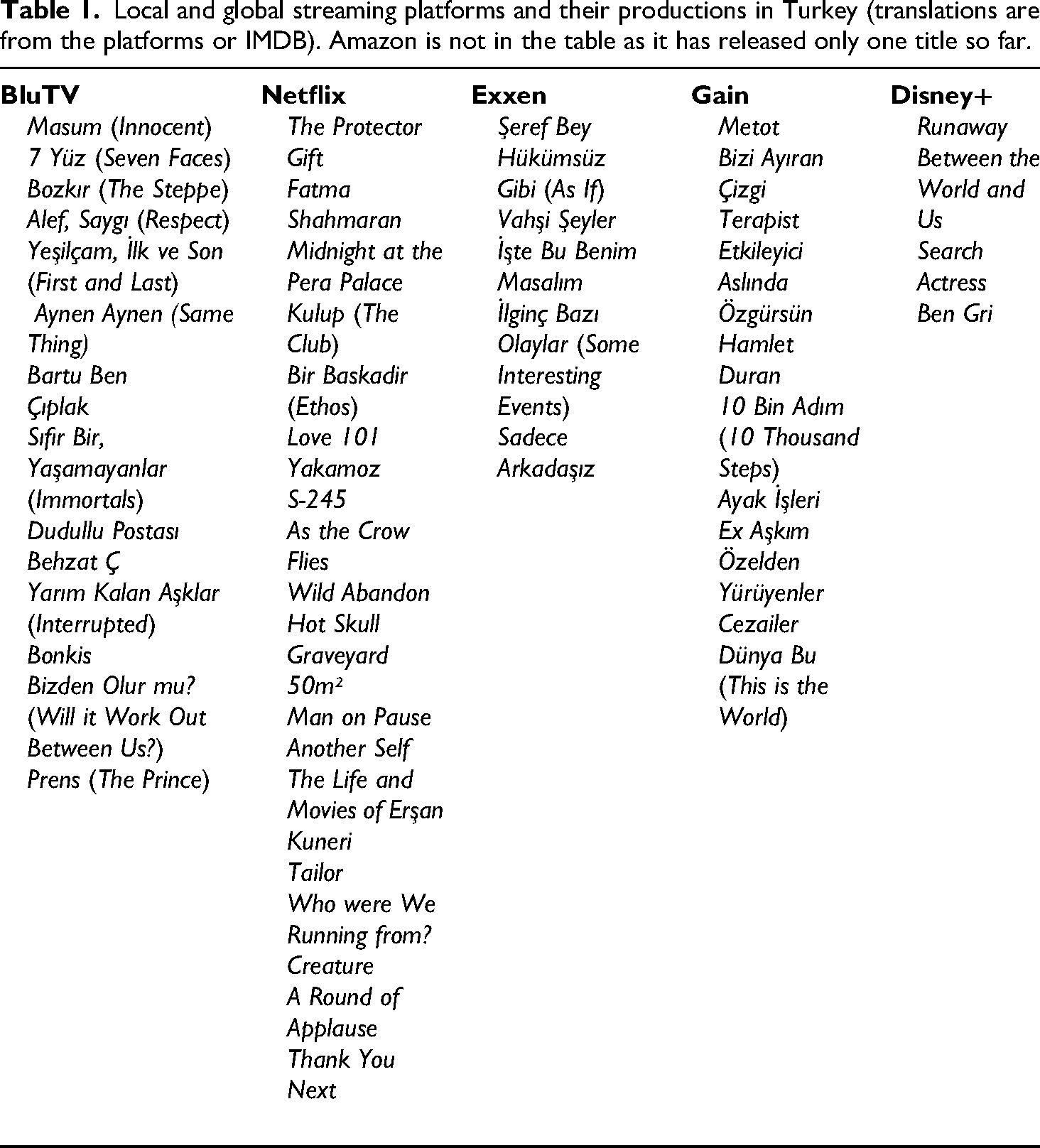
With almost 3 million subscribers, Netflix is the current market leader and has not scaled down its investments despite the government's interventions. Mobilizing localized marketing campaigns to appeal to Turkish audiences, it caters to citizens who want to stay away from traditional TV series, as well as international fans of Turkish dramas and global audiences looking for new content. Netflix's global expansion is evidenced by how it provides an English title for every drama on its interface. While Netflix presents itself as the global collaborator of local talent, BluTV has a different ‘understanding of locality’, revealed by its original hits including Masum (Innocent), 7 Yüz (7 Faces), Bozkır (The Steppe) (Vitrinel and Ildır, 2021). Some of my interviewees found BluTV to be more courageous for expanding its library to include non-scripted productions. Exxen and Gain produced quality content such as Gibi, dubbed as the Turkish Seinfeld. These platforms also invest in documentary series on Turkey's authoritarian socio-cultural landscape, as the next two sections show.
Platforms as ambiguous spaces of global connectivity and national censorship
Scholars of media globalization have long addressed the politics of technology, the politics of media flows, and how global political-economic forces shape or interact with local cultures and actors (Kraidy, 1999; Morley, 2006; Schiller, 1991). Although the debates on modernization and cultural imperialism date back to 1960s and 1970s, inquiries about the relationship between the nation state and global corporations, and how these global corporations operate at the local level, continue to appeal to scholars in the platform era (Mirrlees, 2020; Park et al., 2023).
The contentious relationship between global streaming platforms and local actors also emerged as a key trope in my research. For instance, the potential to tell their stories at a global level particularly excited drama creatives like director Orhan because he produced in an industrial context shaped by heavy censorship. As a graduate of Radio, Television and Cinema School, he has worked with one of the most important directors in screen production. This was in the 1990s, a time of media liberalization, when TRT, the only media institution in Turkey back then, was ‘opening’ itself to market forces to compete with the country's first commercial channels. Having witnessed the media liberalization during the 1990s as a director with an entrepreneurial spirit, Orhan welcomed platforms. At a content fair in London, he listened to a Netflix official, who said that they ‘wanted to change the Hollywood geography’. One third of the content would be in languages other than English. ‘As a storyteller searching for new paths in his career and tell his stories across the globe’, this was ‘an amazing invitation’, enabling him and his colleagues ‘to compete with House of Cards’. He gladly accepted this ‘major challenge’ because now creating dramas for global platforms like Netflix, Turkish producers had proven that they were no less talented than their global counterparts. 3 His creative strategy for market visibility was to feature the drama industry's globally famous faces in supernatural stories across the country's tourist destinations. These choices seemed to align with Orhan's background in advertising and his approach to screen production, which he defined as ‘too commercial for festivals but too arthouse for commercial screen production’. Thus, with platforms, he now had a new venue to create ‘crossover’ dramas that fused Western and Eastern motifs for global audiences.
Like Orhan, director Ulaş embraced the freedoms facilitated by platforms, which enabled him to globalize and bypass the market saturation in the traditional television environment. Before directing a major drama for Netflix, he had already directed one of the episodes for BluTV's 7 Yüz. Thus, he has considerable cross-platform experience. He emphasized that Netflix shows were made not for Turkish but for global audiences. ‘As a director, I need to think about how to tell this story at a global scale. How should it be pictured? Or how are similar stories narrated at the global scale?’ he asked as he reflected on globalizing storytelling. Especially because he loved producing fantastic narratives, he enjoyed undertaking such challenges and major creative responsibilities. With platforms, he was able to create supernatural stories with local flavours in multiple languages. Having directed one such drama, Ulaş regarded Netflix as an opportunity to bypass both linguistic barriers and national censorship. Feeling happy that he was contributing to a ‘global cuisine’ with what he called ‘our own cuisine’, Ulaş over and over highlighted how his supernatural story was simply designed for the entire world, not just Turkey.
The country's sought-after director Zeren echoed Orhan and Ulaş's strategy to capitalize on Turkey's local flavours for the global streaming market. She too appreciated how platforms enriched storytelling and enabled her to reflexively produce at a universal level. Thanks to ample resources during production and post-production, they no longer had to rush and were in fact able to act more reflexively. ‘Streaming our work across the globe is beautiful because then, I feel like our work is more universal,’ she said. Having time to reflect on her practice and the feeling of doing something universal made her happy.
Thus, at one level, drama producers’ imaginaries look positive, particularly because platforms have revitalized creative workers’ relationship with their practice and given them the opportunity to tell new stories for global audiences beyond the saturated national market. Considered along these lines, the production of the Netflix original Kulüp (The Club) in 2022 was a marker in Turkey's television history. With extraordinary aesthetics, Kulüp screened the political story of a racist pogrom targeting Greeks, Jews, and Armenians in the 1950s, and confirmed platforms’ potential as promising spaces of creative storytelling. However, despite shows like Kulüp, the state's regulatory involvement in drama production as a cultural field has not disappeared. On the contrary, platform censorship cases are increasing, especially following the regulation passed in 2019.
The most significant censorship case concerns the cancellation of If Only. Because a subplot had a gay character, the Ministry of Culture and Tourism neither granted Netflix the permission to shoot the drama nor provided an explanation about why the show's production was delayed. Only after writer Ece Yörenç took the gay character out did the ministry grant Netflix permission to shoot. But Netflix met RTÜK officials on 14 July 2020 and cancelled the show altogether, instead producing it in Spain. According to writer Yörenç, Netflix took this decision since making changes in the original script was against company principles. Given the previous removal of an episode of Designated Survivor, an episode of The Patriot Act in Saudi Arabia, removal of Minnoşlar (Mignonnes, 2020) from Netflix's Turkey catalogue, the administrative fine against Netflix for Jurassic World Camp Cretaceous for showing intimacy between two girls, and covering the body of Elit İşcan's in Hamlet streamed on the local platform Gain, the cancellation of If Only was not the first censorship case but the first of its kind in that the show was cancelled even before it was produced. It was also reported that, before leaving the Turkish market, Disney+ asked its Turkish translators to write a warning note when contested issues appear in their shows, including ‘critical points for Islam, Armenian Genocide, Kurdish issue, and the Cyprus problem’. Company management also wanted to be notified about productions with representations of LGBTQ+ characters or potential portrayals of the Turkish president as a dictator (Susma24, 2022).
Platforms’ censorship practices produced debates about whether platforms were censoring drama creatives and who to hold responsible for such practices. Back in 2018, Netflix denied the removal of smoking scenes in the animation film Over the Garden Wall, claiming that ‘a different distributor delivered the content in this manner’ (NTV, 2018). Giving an interview on the implications of the censorship regulation enacted by the Turkish government in 2019, Netflix Turkey's communication manager Artanç Savaş denied censorship claims, emphasizing that they ‘respected the laws’ in Turkey as elsewhere, and that they were invested in strengthening parental controls (Haberturk, 2019). Speaking to the Financial Times about Kulüp's success, Netflix's Turkey's director of original content Pelin Diştaş did not directly address censorship but highlighted that they ‘strongly believe[d] in creative freedom and artistic expression’, adding that any script with ‘authentic vision or a great story’ would get a green light. Government officials similarly denied censorship. Mahir Ünal, former vice-chairman of the ruling AKP party, expressed his belief that ‘Netflix, with more collaboration, would show more sensitivity towards Turkish culture and art’ (Gazete Duvar, 2020). For him, there was no reason for Netflix to leave Turkey. Mr Ünal's denial of censorship and insistence on collaboration hints at the government's desire to sustain economic relations with the platform, and the strategic use of global platforms for nation-branding, which could be significantly hurt were Netflix to be banned. Consequently, neither Netflix nor Turkey has directly confronted each other, which would be detrimental to their symbiotic political-economic arrangement.
Censorship imaginaries and practices: Working around, overlooking, and criticism
To evoke Stuart Hall (1996), platforms and the freedom they promise are ‘without guarantees’ mainly because mutual interests around political-economy are quite dominant. And yet drama creators are not hopeless or completely subjugated to platform power. They work with, work around, and contextually critique censorship as the negative dimension of platform ambiguity. As a creative invested in good storytelling and self-reflexivity, Zeren welcomed platforms because she had the opportunity to think about the politics and aesthetics of her own work. Because she was the director of a drama with high aesthetic quality and political content, I asked her about censorship. For Zeren, this was the main reason behind her migration from traditional television to platforms. Although she was already successful and visible in drama production for free TV, the tightening of the space within which she created gradually pushed her towards platforms. I was curious as to whether platforms gave her a list of politically sensitive issues not to screen. Such discussions had never come up in her interactions and discussions with Netflix. Zeren did acknowledge that censorship nationally bothered the entire industry, but had not given up on telling stories with political dimensions just because censorship was a major problem. In fact, her solution to censorship was the very practice of storytelling. She worked around censorship by centring ‘drama’ and ‘human stories’. ‘It's because we tell human stories. We approach all our characters from a human dimension,’ she said. When one critically views Zeren's work, it becomes clear that she can tactfully narrate politically sensitive topics by avoiding a documentary style and centring drama and family in order to work around censorship. Thus, foregrounding the human dimension behind her political stories, she had found a way not to be overconcerned about censorship and to keep producing work that still was political. For her, self-censorship was a more pressing issue. Everyone from ‘art directors to light technicians’ worked with principles about ‘what cannot be done’. I wanted to learn how self-censorship affected her creativity: Imagine that you will shoot a scene with alcohol involved. An art director will automatically put fruit juice, knowing that the scene will be blurred on television. Or your light guy will use more light, thinking that productions with dark lighting are not preferred. Self-censorship is the worst.
In our interview, director Tülay was more hesitant to discuss censorship. Although she did not defend it, she suggested how censorship could potentially spark creativity. She was particularly against polarizing views about platforms because she had worked in drama production for a long time to witness first-hand how episode durations had increased from 50 to 140 minutes. Thus, she was pleased that platforms partly reformed working conditions and enabled experimentation with different genres. Tülay indeed saw how some creatives could perceive platforms becoming television-like. But for her, platforms had invested in some major productions that otherwise would not have been made: When I look at the past six years, I see the freedom of digital platforms and how that enabled a production like The Club [Kulup]. Or fantastic narratives like The Protector, which is widely seen across the globe. We owe it to the platforms that we learned to create such productions with digital effects and infrastructure. Censorship is not new for those living in this geography. From law to education, there is censorship everywhere. Of course, I wouldn’t defend this but then consider Iranian cinema…. Enabling us to be more creative and develop ways out of this oppression.
The other creatives I interviewed were more inclined to underline how naïve it was to expect radical adventures from platforms in the first place because, for them, platforms were ultimately corporations, and they did not have to act ethically. Yet this acceptance of platforms as corporations did not prevent these creatives from developing a contextual critique of platforms’ symbiotic relationship with the government. For instance, director Orhan had no complaints about Netflix, especially because the platform worked well for him as an artist, whose movies were ‘too commercial for festivals’. But he also believed that platforms should truly be ‘novel’ and allow productions that pushed ‘the boundaries of your geography or perhaps provide diversity’. He recalled how Netflix's motto was to release productions that weren’t shown in movie theatres or on television screens. ‘So, when you set out with the promise to produce diverse stuff, you have to also extend your hand towards what is left outside the culturally hegemonic or what is banned,’ he said, to acknowledge how platforms also partly failed to deliver truly diverse content.
Writer/director Tuna created one of the first dramas for Turkey's BluTV. For him, ‘the digital’ had transformed an entire industry and platforms were the extension of this change. He thought platforms would ideally stand out from traditional television in terms of content and grammar. While decent productions existed across platforms, it was not enough for Tuna, because they simply relied on the same talent pool. Not seeing a major differentiation upset him. Given platforms’ creative reliance on current gatekeepers in the drama industry, he was also not surprised by platforms’ compliance with the state: ‘Why wouldn’t they comply? I don’t have romantic expectations from a commercial entity, like [it] coming and rescuing [the] Turkish cinema sector,’ he said. For him, it was naïve to imagine that ‘state authorities could not exert pressure on them’. ‘[People mistakenly ask] why Netflix couldn’t resist? Is Netflix the subject or object of repression?’ he asked, to underline how platforms and creative imaginaries were not independent of state regulation. But, unlike Orhan and others, his political critique extended to the state and its socio-cultural protectionism rather than approaching it as just a natural thing. I am 44 years old, and Communication Directorate has an opinion about what I should watch or not, what link I should click or not. We are now surprised when we see a bottle of wine on a national TV channel…. We are living depoliticized lives. We are living in a country where we learn what we can say, where and how. We cannot discuss the same issues in coffee shops located in different neighbourhoods in İstanbul.
Writer Uğur similarly had a substantial critique of platforms. Aware of the drama market's global expansion, Uğur was keen to protect his intellectual property when he signed deals with producers, but so far he had been unable to convince producers to make concessions. In that regard, he welcomed platforms as ‘a brand-new market’ if we considered the script ‘a commodity’ and the writer ‘a seller’. He also saw the ‘limitations’ of this market because, for him, platforms ‘have not introduced the major changes expected of them’. ‘If you ask many other creatives in the market, they will speak of platforms as a disappointment,’ he said. The expectation was that HBO would come and shoot something similar to Six Feet Under, or Curb Your Enthusiasm, here.… Apparently these expectations were misplaced. Only after the platforms entered Turkey, we recognized how key Turkish dramas were in the global market. Platforms are essentially just interested in the ‘brave’ versions of what already exists on free TV. They don’t have to have a cultural policy. Ultimately, these are international corporations. They care no more than any other international corporation.… They are not a country, a political party, an NGO. What are we expecting from who? The platform comes and declares what it does. The state comes and says, ‘OK, such and such things are not allowed here.’ There we have an intersection set. Both happily hang out there. There is a cliché in countries like ours. There is no need for that [censorship] because they [controversial topics] don’t get to be written anyway. Honestly, we don’t even write.… A friend of mine and I wrote a mini-series. A real-life adaptation. In two episodes, a gay character leads. An independent producer wanted it this way but I don’t think this could be broadcast in Turkey.… Let me say it even more openly, you don’t even [zaten] go to a platform with a gay character.
Conclusion
The creatives across the Turkish drama industry have worked with national and global platforms since 2017. At one level, platforms have relieved the Turkish drama sector by introducing relatively safer working conditions, increasing temporal and financial resources, and enhancing global distribution and marketing capacities. With platforms, creatives have been able to lift themselves up from a saturated market and compete at a global level. Thus, a quick overview could suggest that platforms have brought freedom, which was what creatives have long hoped for due to the authoritarian atmosphere in Turkey and persistent labour precarity. However, when we consider how platforms function in national markets regulated by the state, it becomes obvious that the freedoms associated with platforms are also interwoven with restraints. Since 2019, platforms have agreed to comply with Turkey's national media regulations, starkly revealing that while creative workers depend on the platforms, platforms also depend on the state. Therefore, this naturally means that drama makers are not only creative subjects but also geopolitical subjects. Their platform imaginaries and labour practices are mediated not just by the algorithms but also by the state. Given these contentious relations between cultural producers, platforms and the state in the Turkish drama industry, creatives’ imaginaries have become more ambiguous with respect to freedom and control.
Platform scholarship has overwhelmingly foregrounded workers’ negotiations with algorithms and technology companies, producing narratives around the trade-offs that creative subjects make. However, any technological or workplace trade-off is always embedded in a national context. In that regard, more comprehensive analyses of platforms and cultural production will be possible if the state is also taken into consideration because an exclusive attention to platforms’ technological dynamism will inevitably ignore how these corporate entities can also be quite dynamic in political terms. To put it simply, the boundaries of what is allowed on screens are negotiated not just with platforms, their technological infrastructures, and their creative demands and priorities, but also with the state's legal interfaces and political authority.
Ultimately, with a distinct focus on the state, I contribute to dewesternizing platform scholarship by both showing how imaginaries are far from universal and foregrounding the fact that cultural producers are geopolitical subjects. With platform ambiguity, we grasp how platforms exert power over cultural producers by both enabling and restraining their work. Therefore, platforms are understood not as either emancipatory or repressive structures but both emancipatory and repressive. It is against this ambiguous structure that creative workers constantly imagine and organize their work as they strive towards producing work that matters to them, to their audiences, and to the global industry within which they operate.
Footnotes
Funding
The author received no financial support for the research, authorship, and/or publication of this article. He would like to thank the anonymous reviewers, workshop participants, and particularly Thomas Poell and Marc Steinberg for their detailed comments.

Notes
Author Biography
Ergin Bulut researches in the areas of political economy of media and cultural industries, video game studies, and philosophy of technology. He is the author of award-winning book “A Precarious Game: The Illusion of Dream Jobs in the Video Game Industry” (Cornell UP, 2020). He is currently writing a book on the Turkish drama industry.