



Abstract
In relation to work, the term ‘platformisation’ has gained popularity to indicate the various ways in which a digital platform gets to mediate, organise, intervene in, or otherwise facilitate some work activity. Yet, the intervention of digital platforms into work today increasingly involves activities that are not immediately related to the digital sphere, where different kinds of platforms have become part and parcel of the cultures and practices of work. There is a necessity, in other words, to develop a clearer framework to identify what it means when work activity gets to be ‘platform-ised’, the conditions under which this takes place, and what the main implications are deriving from this process. Using the case of ‘neo-craft’ work in the European Union, we propose and illustrate a theoretical conceptualisation of platform-ised work, critically discussing the distinctiveness of this process and highlighting its key features.
In relation to work, the term ‘platformisation’ has gained popularity to indicate the manifold ways in which a digital platform gets to mediate, organise, intervene in, or otherwise facilitate some work activity (Gandini, 2021). This has been associated with various sectors and practices, starting from the cultural industries, where the rise of social media content creators and their professionalisation has been a landmark phenomenon (see Cunningham and Craig, 2019; Duffy, 2017; Poell et al., 2022), up to and including all those jobs whereby a platform directly oversees the capital–labour relation, such as the so-called ‘gig economy’ (Gandini, 2019; Graham and Woodcock, 2019).
From a Marxist perspective, this represents the latest advancement in the long-standing discussion on the notion of ‘digital labour’, which has animated critical media scholarship since the early 2000s (see Casilli and Posada, 2019; Fuchs, 2014; Gandini, 2021; Jarrett, 2022; Terranova, 2000). Following an early phase, when this term was primarily associated with the unpaid, free labour of social media users, the diffusion of the aforementioned gig economy – whereby paid jobs are directly managed through algorithmic systems – has extended its application more widely. This has led to the argument that the expression ‘digital labour’ has become an umbrella term with somewhat unclear meaning and boundaries, thus diminishing its original critical potential (Gandini, 2021).
It may be argued that, when applied to work, the term ‘platformisation’ is experiencing a similar trajectory. Somewhat actualising Zipcar's founder Robin Chase's prediction that ‘everything that can become a platform, will become a platform’ (Chase, 2015: np), in recent years a burgeoning amount of research has highlighted instances of ‘platformisation’ of work in a variety of contexts, ultimately stretching the application of this term to the point that it has become difficult to pin down its actual distinctiveness. There is a necessity, in other words, to develop a clearer framework to identify (a) what it means when work is ‘platform-ised’; (b) the conditions under which this takes place; and (c) what are the main dimensions of this process. This is especially important since the intervention of digital platforms into work today increasingly involves activities that are not immediately related with the digital sphere, where different kinds of platforms have nonetheless become part and parcel of the cultures and practices of work (Jarrett, 2022).
This article is chiefly concerned with this task. We argue that, at a basic definitional level, work is platform-ised whenever social relations in a given work context are re-fenced and repurposed within the socio-technical boundaries of the platform, which transforms them into relations of production. This primarily occurs through their transformation into metrified affective engagements, the acquisition of which confers legitimacy on one's work. Based on this assumption, we isolate three main dimensions of work platform-isation. First, work activity gets to be platform-ised when workers are required to abide by, or are subjected to, the platform’s logic, with varying degrees of intensity. This may range from a demand to ‘forcibly’ become professional content creators, up to direct subjection to forms of algorithmic management. Second, work values get to be platform-ised when these are contaminated – if not completely subsumed – by the socio-technical imaginary (Castoriadis, 1987) of platform cultures, resulting in the development of an entrepreneurial disposition that is instrumental to the undertaking of platform-mediated, non-traditionally waged, income-generating activity. Third, work practices get to be platform-ised when the execution, display and promotion of work is influenced by (and, in so doing, is attuned to) platform grammars and vernaculars, often in platform-specific ways (Scolere et al., 2018), affecting everyday work routines.
To illustrate this argument, we present the case of so-called ‘neo-craft’ work. This is defined as a new form of postindustrial craft work consisting in the ‘artisanalisation’ of a variety of manual jobs, traditionally considered to be working-class or low status, that are ‘resignified’ by way of an original embroidery of discursive and material elements, which represents its distinctive feature (Gandini and Gerosa, 2023). Epitomised by craft beer brewing, neo-craft work combines the materiality of craft with a sophisticated discursive production characterised by forms of ‘marginal distinction’ based on authenticity and particularisation (Gandini and Gerosa, 2023). This, we contend, represents a quintessential example of platform-isable work: while the raw matter of neo-craft work is non-digital, social media and other types of platforms have become part and parcel of the activity, organisation, practices and cultures of neo-craft work. Using data collected through a combination of digital (Rogers, 2019) and qualitative methods, concerning a set of neo-craft workers across the European Union (EU), we illustrate how neo-craft work may be considered exemplary of ‘platform-ised’ work and provide evidence of the distinctive aspects that substantiate its platform-isation process. In so doing, we reflect on the situatedness of our case study in the context of the evolution of work cultures in Western societies.
Platform work?
As said, from a Marxist perspective the debate around platform work may be seen as the latest advancement in the long-standing discussion on ‘digital labour’. Recently, through a comprehensive categorisation, Jarrett (2022) has identified three main types of digital labour. The first – which she calls user labour (Jarrett, 2022: 23) – refers to the original version of this notion, stating that users of social media platforms are engaged in an exploitative relationship with these services, as their unpaid, free activity is subject to unremunerated value extraction by way of the advertising-driven business models of these companies. The second one concerns work that is mediated by a digital platform, intended in a broad sense. This comprises three sub-categories, which are:
platform-based work (i.e. low-income service or ‘gig’ work, e.g. riders, couriers), whereby a platform directly oversees the capital–labour relation, subjecting workers to forms of algorithmic management and essentially establishing a pseudo-employee relationship between a platform and a worker (see Gandini, 2019); platform-mediated work, when a platform mediates the transactional exchange between clients and workers who are not subjected to direct forms of algorithmic management and oversight, but whose encounter with clients takes place through the platform infrastructure (e.g. freelance knowledge workers, see Gandini, 2016); platform-dependent work (i.e. professional social media content creators, including ‘influencers, cammers, beauty bloggers and live streamers’, see Jarrett, 2022: 24), that is, workers who freely engage in forms of cultural production, cultivating a professional dimension, whose income is for the most part dependent upon platform affordances and visibility (see Cunningham and Craig, 2019; Duffy, 2017).
A third type includes what Jarrett calls formal workers, referring to the salaried employees of the tech sector, who are in a relationship of formal employment with digital companies, such as software developers, project managers, and so on. These categories, as Jarrett herself underlines (2022: 27), are not strictly enclosed or mutually exclusive, and actually leave aside a wide range of work practices and activities that do not necessarily fit within them, but still maintain some kind of relation with digital media. As she states: ‘Almost all workers are digital media users at some point’ (Jarrett, 2022: 7).
For the purposes of this article, we focus primarily on the second group: platform workers, leaving aside both ‘user labourers’ and formal workers. 1 Looking more closely, while the idea of a ‘platformisation’ of work is undoubtedly distinctive regarding all sub-categories in this group, its actual grounding and boundaries differ greatly from one to another. This is also reflected in the definitions given by existing research. At a basic level, platform work has been defined as work activity that entails an engagement with some kind of digital platform (Huws et al., 2019; van Doorn, 2017). However, this definition is chiefly moulded around digitally-mediated service work – that is, gig and freelance workers – thus somewhat equating all platform work with low-income service work. Poell et al. (2022) adopt a broader framework, that is nonetheless tailored primarily to the cultural industries: this identifies work platformisation in the relationship of dependency between workers and platform affordances, resulting in emergent ‘platform precarity’. 2 Others adopt different viewpoints: Kullmann (2022), for instance, focuses on the legislative definition of platform workers, highlighting fragmentation and insecurity in employment status as key features. Fernandez-Macias et al. (2023) use the term ‘platformisation’ in relation to the adoption of digital technology in traditional workplaces, thus including remote work practices within its remit as well. Casilli and Posada (2019: 294) define the ‘platformisation’ of work as a political phenomenon concerning the replacement of pre-existing modes of economic coordination, and the renovation and re-articulation of accumulation processes by way of digital technology.
Despite the many interesting insights these studies bring to light, they also confirm the nature of platform work as a ‘moving target’ that continues to change, and highlight the difficulty in pinning down what is actually distinctive to platform-isation as a process in relation to work, beyond general trends. As argued by Jarrett (2022), potentially all work today – even that which is not directly mediated or enabled by digital platforms – is somewhat related to digital media or platforms. We therefore need greater precision in defining what is distinctive about work platform-isation, the conditions under which it takes place, and the main dimensions that characterise this process.
Platform-ised work?
Following Poell et al. (2022: 5), platforms are ‘data infrastructures that facilitate, aggregate, monetise, and govern interactions between end-users and service providers’. Platformisation, therefore, may be defined as ‘the penetration of digital platforms’ economic, infrastructural and governmental extensions into the cultural industries, as well as the organisation of cultural practices of labour, creativity and democracy’ (2022: 5). But how does this process specifically apply to work beyond the creative industries? It may be argued that the distinctive element of the platform-isation process in relation to work is the presence of one (or more) digital platform(s) taking on the role of a digital-based ‘point of production’ (Gandini, 2019), that is, fencing off the social relations involved in a given work context so as to transform them into relations of production. Put differently: work gets to be platform-ised, at an essential level, once a platform is actually able to repurpose the social relations involved in a given work context and make them productive according to its own logic – for instance, by re-mediating the exchange of labour-power into money between two parties (workers and clients/customers). But then again: how does this happen in practical terms? What are the main dimensions that characterise this process?
The actual transformation of social relations into relations of production in a given context ultimately comes down to the specific features of the type of work we are looking at. Yet, some general continuities exist when a platform becomes a digital point of production. A chief element in this regard is the metrification of affective engagements – in particular, reputation – and their conversion into monetisable assets. Importantly, this may take place notwithstanding that work is (or is not) directly enabled by, or undertaken through/on, a platform. The oversight of the exchange of labour-power for money operated by the platform ultimately actualises a process of enclosure of social relations in a given context, which subjects them to forms of metrification and datafication that create the conditions of possibility for such affective engagements to become monetisable. In so doing, building upon labour process research and, particularly, Burawoy (1983: 587), we might argue that ‘the social relations into which men and women enter as they transform raw materials into useful products with instruments of production’ get to be repurposed within the boundaries of the platform infrastructure – which, in turn, defines the politics of production. From this also derives the notion of the platform as a ‘workplace infrastructure’, elaborated by Richardson (2024), which sees the platform as a socio-technical device that ‘contingently structures’ work.
While this is certainly proper to all kinds of platform-based, -mediated, or -dependent work enlisted by Jarrett (2022), yet it potentially extends to any form of work whereby a platform can mediate the social relations between workers and other actors (most commonly clients or consumers) that are conducive to non-traditionally waged, income-generating activity. What is specific to this extended form – the platform-isation here described – is what this article is primarily concerned with.
Based on this definitional assumption, we can theorise three main dimensions of work platform-isation. First, work gets to be platform-ised when platform activity becomes part of work activity, which in turn requires workers to abide by, if not subject themselves to, the platform logic. This may have a varying degree of intensity, from a demand to forcibly engage in content creation up to the direct subjection to forms of algorithmic management. Second, work gets to be platform-ised when the socio-technical imaginary that is distinctive of platform cultures extends onto the work values of a given work context. This is typically reflected in the development of an entrepreneurial disposition by workers, which is instrumental to their successful undertaking of said non-traditionally waged, platform-mediated, income-generating activity. Third, work gets to be platform-ised when its execution, display and promotion undergo a process of attunement to platform grammars and vernaculars, which in turn affects everyday work practices. This may be also platform-specific (Scolere et al., 2018), as different types of work may be more suitable for certain (and not all) platforms. Take, for instance, the case of digital sex work, and how practices concerning this form of work have been changing in recent years in their entanglement with platforms, particularly OnlyFans (Bonifacio et al., 2023).
Interestingly, when discussing the kind of work activities and practices that operate outside, but have a close relationship with, digital platforms, Jarrett (2022: 23) mentions ‘the craftsperson whose work may be manual […] but whose income from that work is mediated by a platform […] and therefore whose work is reshaped in accordance with that platform’. Neo-craft work – a new form of craft work that combines material with discursive production in original ways (Gandini and Gerosa, 2023) – is an effective example to illustrate this process.
The case of neo-craft work
Neo-craft work is defined as a new form of postindustrial craft work whereby a craft attitude ‘concerned with the skilful production of high-quality products’ combines with ‘a post-industrial imaginary’ (Land, 2018: np; Ocejo, 2017). In practice, this consists in the ‘artisanalisation’ of a variety of manual jobs, traditionally considered to be working-class and low status, which are ‘resignified’ by way of a peculiar embroidery of discursive and material elements, which provides them with an aura of ‘cool’ work (Delgaty and Wilson, 2023; Gandini and Gerosa, 2023). Exemplary of neo-craft work is craft beer brewing; yet, while chiefly connected with the food and hospitality sector, this concerns a variety of activities, ranging from traditional craft production practices such as jewellery, ceramics, glass blowing, up to ‘artisanalised’ versions of non-craft occupations, such as bike repairer or bartender, and a number of jobs in between (e.g. coffee producer, textile designer, soap maker, etc.; see Gandini and Gerosa, 2023).
Social media platforms are central to the affirmation of neo-craft work. The ‘discursive materiality’ that characterises neo-craft work (Gandini and Gerosa, 2023) is primarily expressed through the display of craft artifacts, laboratories, workspaces, and individual workers, and the engagement in practices of ‘conspicuous production’ (Currid-Halkett, 2017) across digital platforms – which is conducive to what has been defined as a process of ‘marginal distinction’ based on authenticity and particularisation. Neo-craft workers convey at once the discursive and material value of their work by leveraging on minimal – marginal – differences with other, non-craft products. The recognition of these marginal differences by others is, in turn, status-inducing for these workers. Social media platforms offer an ideal setting for the exercise of this original form of social distinction: in particular, Instagram has become a central milieu for neo-craft industries, contributing to the popularisation of neo-craft work (Gandini and Gerosa, 2023; Gerosa, 2024).
Albeit an international phenomenon, it may be argued that neo-craft work represents the byproduct of a Western-specific, renewed quest for work meaningfulness, which has grown stronger especially following the pandemic crisis (Gandini and Gerosa, 2023). Neo-craft work represents a new form of work that is distinctively characterised by a cultural process of resignification investing different types of activities and practices, from working-class jobs to traditional craft occupations, which are restyled and ‘converted’ (Scott, 2017) to the postindustrial, digital economy. As such, it has been able to establish itself as a somewhat credible alternative to the demise of middle-class employment that has characterised Western societies in recent decades, promising to reconcile the cognitive skills that are typical of cultural work with the meaningfulness of working with raw materials and using one’s hands (Ocejo, 2017). It has been argued that neo-craft workers turn to neo-craft work to fulfil a desire for resonance (Rosa, 2013) vis-à-vis the perceived pointlessness of working in the digital knowledge economy and its ‘bullshit jobs’ (Gandini and Gerosa, 2023; Graeber, 2019). At the same time, they engage in a quest for social status through undertaking these supposedly ‘cool jobs’ by way of a process that remains anchored to the forms of social distinction that are typical of Western postindustrial societies (Delgaty and Wilson, 2023).
As an eminently Western phenomenon that taps into the emergent conversation around the meaning of work in the West, the geographic setting of the EU is particularly well-suited for the study of on neo-craft work. While most of the existing research on neo-craft work comes from the US and the UK (see Land, 2018; Ocejo, 2017), Europe represents a context whereby a heterogeneous set of craft production and cultures coexists within a common economic framework and alongside old and new forms of work. Yet, existing local and cross-national statistics and professional categorisations are unable to provide an accurate account of neo-craft work, its size, and distribution. Operational definitions of craft vary from one country to another, and it is difficult to locate neo-craft workers across different sectors or simply by employment status (as entrepreneurs, salaried, or self-employed workers). Thus, neo-craft work amounts to a peculiar case of ‘invisible work’ (Crain et al., 2016) that is emerging in the long aftermath of the 2007–8 global financial crisis (Jakob, 2013) as a result of the diminished centrality of established occupations and pathways to work, which are perceived to be unable to provide meaningful work to increasingly large numbers of (especially young) workers.
Digital platforms within this process serve both as mediators of work and resources for neo-craft workers to establish themselves professionally. Research suggests that, while contributing to the promotion of a ‘cool’ imaginary about artisanal work (Bell et al., 2018), social media enable neo-craft workers – like other types of platform workers – to pursue the goal of making a living outside established occupational trajectories and ordinary jobs. This original interplay renders neo-craft work the perfect case to observe more closely the platform-isation process here discussed, and isolate its distinctive features, while at the same time questioning the status of neo-craft work as an innovative and peculiar phenomenon of post-pandemic, ‘industrious’ Western work cultures (Arvidsson, 2019).
Methodological note
Research supporting this article originates from the CRAFTWORK project,
3
which studies neo-craft work in the EU. To supplement the aforementioned lack of specific data about neo-craft work in this setting, we turned to digital methods (Rogers, 2019). First, we collected a large set of posts containing the keywords ‘artisanal’ and/or ‘artisan’, which were published between 30 March 2021 and 30 March 2022 on five social media platforms (Instagram, Facebook, Twitter, YouTube and TikTok). After extracting the individual profiles associated with the collected posts (23,433 unique accounts), we employed ethnographic content analysis (Caliandro and Gandini, 2017) on the entire corpus of data to identify (by means of an ad-hoc designed coding sheet) those showing signs of both ‘marginal distinction’ and ‘resignification’ in the content produced. These concepts were operationalised in the coding sheet as follows:
‘Marginal distinction’: the presence of mentions of the ‘liminal’ or ‘particular’ features that distinctively characterise the ‘artisanalisation’ of a product or brand. These may include peculiar ingredients/raw materials, special techniques, processes or locations of production; ‘Resignification’: the presence of discursive elements and/or aesthetics that concur to qualify some artisanal production practice as ‘new’, in opposition to ‘old’, ‘industrial’, ‘non-craft’ or ‘mainstream’ counterparts, typically by employing markers of ‘coolness’ through consistent visuals and curated content.
The coding sheet was developed iteratively by the research team after they had familiarised themselves with the collected data, and following discussions in several meetings. This process led to the extraction of a set of 346 profiles of neo-craft work activities that fitted the adopted definition of neo-craft work (Gandini and Gerosa, 2023).
In a second phase, we employed semi-structured interviews and ethnographic research to investigate the lived experiences of neo-craft work within the 346 neo-craft activities mapped in the digital methods phase. In so doing, we focused specifically on work values and practices as well as on the relevance of digital platforms in this setting. Interviewees typically are self-employed, own a business in one of these neo-craft activities, or work as salaried employees within them. Up to the time this article is being finalised (April 2024), 60 interviews have been conducted in 15 countries: Italy (14), Germany (5), Denmark (3), Sweden (8), Malta (4), Spain (4), Greece (2), Portugal (4), Ireland (5), France (2), Estonia (2), Slovenia (2), Poland (2), Hungary (2), and Finland (1). Of the interviewees, 24 are male and 36 are female. The majority of these workers are aged between 25 and 45 years old, have a higher education degree, and turned to neo-craft work following previous work experience in other sectors, particularly the knowledge economy but also blue-collar work, service work and professional occupations, often as an ‘exit’ strategy from unsatisfactory jobs. Interviews have been fully transcribed and analysed using a thematic approach, focusing on the identification of core themes and their extraction by means of inductive, manual coding (Denzin and Lincoln, 2000), again in an iterative process that involved the entire research team.
For the purposes of this article, we present empirical evidence coming mainly from the qualitative component of the research. It is from the experiences and opinions of neo-craft workers in relation to the emergent role of platforms in their everyday work practice, we contend, that we can see more clearly how neo-craft work is getting platform-ised and, in turn, observe more closely the distinctive features of platform-isation as a process – which is the ultimate goal of this article in its conceptual contribution. In so doing, we primarily focus on the role of Instagram in this context, as interviews confirm its position as the main social media platform for the vast majority of the neo-craft activities included in our sample. Inevitably, however, these decisions also carry some important limitations. First, it must be acknowledged that, despite the abundance of digital data at our disposal, the digital methods component of our research is primarily utilised here as a methodological device to identify a sample of relevant research subjects to undertake qualitative research. The presentation and analysis of platform data is therefore limited here, as it will be the object of a separate, specific publication. Similarly, while a cross-platform analysis (Rogers, 2019) of neo-craft work is possible with the data at our disposal, we consider it beyond the remit of this specific article. In addition, it must be noted that our approach does not proceed through comparison (among European countries, or between Europe and other parts of the world), nor claims for international or global generalisability when it comes to neo-craft work and production cultures. Rather, our goal is to look for the ‘multiplicity of differentiated (repeated) outcomes’, and for ‘connection, variety, repetition’ (Robinson, 2022: 10), with the aim of identifying recurring patterns and common elements within the body of data at our disposal.
Neo-craft work as platform-ised work
In this section we illustrate how the social relations involved in the undertaking of neo-craft work are being repurposed within the infrastructure and affordances of the platform. Subsequently, we present the three main dimensions concerning its platform-isation: (1) the incorporation of platform activity into work activity, which results in the ‘forcible’ transformation of neo-craft workers into content creators; (2) the colonisation of neo-craft work imaginaries by the socio-technical imaginaries of platform cultures; (3) the key role that Instagram holds in the execution, display, and promotion of neo-craft work.
Platform-ised relations of production
For many of the neo-craft workers we interviewed, digital platforms – particularly Instagram – have become the main device to develop and maintain relationships with customers and clients. A significant part of the income they generate from their work comes from the engagement in platform activity. As M., a 45-year-old Danish woodworker, explains: Social media are an important part of my work, very important is Instagram. It's an incredible tool for me, I get a lot of clients through it. […] People contact me directly from Instagram and I sell more. Now I spend very little time knocking on doors. (M, 45, male, woodworker, Denmark)
G., who is the co-owner of a small artisanal design company in Milan, corroborates this account: I must tell you, we have always been contacted by people who found us there [on Instagram]. They all came to us saying ‘I’m a shop’, etc. and asking for our products. So yes, Instagram is the fundamental channel on which we decided to focus from the beginning … without Instagram it would have been impossible [to develop as a business]. Also intermediaries, such as influencers or marketplaces, those who have an online presence, market stores, work like this, they are catalysts: if someone sees that this profile who has 100k followers publishes our pieces, then they reach out to you, so this user base, you got it thanks to them. (G., 43, female, product designer, Italy)
This second testimony also shows how the metrification and monetisation of affective engagements (particularly reviews, ratings, likes, and followers) is a key aspect in the becoming productive of the social relations of neo-craft workers by way of platform mediation. Neo-craft producers seem to have internalised that platforms constitute a ‘classification situation’ (Fourcade and Healy, 2017) whereby metrics, ratings and reviews can be employed as monetisable assets. As C., a Venice-based glass blower, illustrates: For the algorithm, if I received 20 positive reviews a year ago and this year I received 2 reviews, one 5-star and one 1-star, they average out the last ones, which have a much greater weight. And so, if I had 5 stars everywhere until a year ago, when they gave me 1 negative review it took me from 5 stars to 2. So I had to spam [asking for positive reviews to people/friends] a lot of people … and so there are all these things that you can’t take it out on a human being … but the only thing you can do … is to spam people to put more, so your percentage goes up … but for 2 negative reviews I had to get 10 positive ones, to get back up. (C., 34, female, glassblower, Italy)
These accounts evidence how, in neo-craft work, a sizeable portion of ‘the social relations into which men and women enter as they transform raw materials into useful products with instruments of production’ (Burawoy, 1983: 587) take place within the platform infrastructure. This, in turn, contributes to define the politics of production of neo-craft work, as metrics, ratings, and platform visibility become key to the success of a neo-craft enterprise. This inevitably requires that platform activity is incorporated in one's neo-craft activity. However, digital skills are not typically included in the natural or acquired formation of neo-artisans. This results, for many, in a process of forced adaptation that unwillingly transforms them into content creators, a role for which they feel themselves comprehensively ill-equipped.
Neo-craft workers as ‘forcible’ content creators
Although it does not constitute the ‘raw matter’ of their work activity, or what has drawn them to craft work in the first place, online content creation is part and parcel of the everyday work practices of neo-craft workers. Existing research highlights the ‘relational labor’ (Baym, 2015) that digital creators are required to perform in order to create a relationship with their followers, ultimately aimed at securing financial support (Bonifacio et al., 2023; Cunningham and Craig, 2019). Neo-craft workers feel the need to do the same, and thus follow the script offered by ‘real’ content creators to engage in a variety of platform activities aimed at developing a recognisable image and generating an economic return (Duffy and Hund, 2015). Yet, unlike many ‘ordinary’ content creators or ‘platformised creative workers’ (Duffy, 2017; Glatt, 2023), all this is in addition to the actual craft work they are supposed to do, and is therefore considered as a ‘necessary evil’. Typically, neo-craft workers did not train for content creation work, nor did they ever want to engage in it in the first place. Thus, this is largely experienced as ‘a burden’, ‘a hassle’, or ‘a challenge’. P., a vintage bike maker and repairer based in the countryside of Parma, in Italy, states: So, every day on Instagram you post a picture, you do some storytelling. At the beginning it was a burden to use it [Instagram], I’m not a storyteller, I’m not good at selling myself. I kind of got used to it because I had to. I knew that social media are essential. Having social media channels means selling one bike a month, which wouldn’t happen with word-of-mouth alone. Instagram is perfect because all you have to do is post a nice picture, a nice object, a few words, a little song, and you have a huge pool, customers potentially see you from everywhere. (P., 40, male, vintage bike repairer, Italy)
Many of the neo-craft workers we interviewed feel that the skills required to act as a content creator do not suit them, but they ‘don’t have a choice’. As G., a French soap maker based in the countryside, working mainly through Facebook, explains: Social media are … important for me, fundamental I’d say…. I don’t have the choice, it's a kind of obligation, without them my business can’t survive, but I positively see these platforms, it's a big task but I’m sure that today there's no choice knowing that … today everything revolves around social media platforms, there are things I can’t do if I don’t have them … who would come to my soap-making workshop if I didn’t advertise it on Facebook? No one! (G., 46, female, soap maker, France).
Similar to ‘ordinary’ content creators, sometimes platform affordances are not always immediately intelligible to neo-craft workers, or helpful, as these can put arbitrary limitations on their activity. C., the 34-year-old glass blower from Venice, has experienced this directly: My problems with social media are censorship and algorithms. […] I get censored all the time. Not for the posts, but for the advertising. […] Because for censorship, Facebook hides behind algorithms. It's not that there's a guy behind it who says: ‘you fit in, and you don’t’. There's an algorithm that recognises ‘nipples’, so it censors you because it sees that. (C., 34, female, glassblower, Italy)
However, it may happen that this content creation work is noticed even by the platforms themselves. This is the case for J., a 34-year-old ceramicist based in Berlin: since his Instagram page was having some success, he was contacted directly by Meta who wanted to give him advice on how to make the most out of his platform activity: One day an employee of Meta sent me an e-mail, saying: ‘Hi, you’re doing great … can we have a chat?’ Of course, I’ve never spoken to anyone from Instagram before…. She [the Meta representative] was staying in Ireland and dealing with content creators in Germany. So, we started talking and then she said: ‘OK, you’re doing great, and we have some tips for you to do even better in the future.’ She basically told me: your potential is high, so we want you to do more…. And she described all the things I just told you, for example: ‘if you want to be even more successful you have to use the music we suggest, and you’ll see that it will have a big impact […]’. I said: ‘I don’t know, I’m not sure if I want a makeover.’ But one day I experimented, I chose the first song I found on their list, which wasn’t that bad, and I thought: ‘Wow, I used that song and the views really went crazy.’ (J., 34, male, ceramicist, Germany)
These excerpts show how neo-craft work and platform cultures become contiguous in the process of platform-isation of the former. This is further reflected in the formation of beliefs and values about one's work, ultimately orienting their professional disposition in an entrepreneurial direction. We explore this aspect in the next section.
Socio-technical imaginaries of neo-craft work
Neo-craft workers see a strong alliance between them and digital platforms: many believe that the internet represents a place that nurtures dreams of a more democratic and more accessible economy and is an enabler of meritocracy. G., a Milanese product designer, maintains that: It's true that anyone can create an Instagram page, but then there is a meritocracy, what really works, that has substantial content, then stands out. (G., 43, female, product designer, Italy)
C., our Milanese jeweller, confirms: We certainly thank the fact that we were born in the age of communication and have access to all these free platforms that are certainly super important for us, the Instagram page where you can show your stuff, link to the website, and everything for free! You can have your nice page that is an important tool, and also a tool that puts you in communication, because you can also observe how the other artisans work. (C., 30, female, jeweller, Italy)
These excerpts reveal a clear understanding of platforms as enablers of professional status and talent. Interestingly, this also justifies the preference of many for Instagram, as a platform that allows them to be recognised as ‘real’ neo-craft workers vis-à-vis hobbyists – as opposed to Etsy, which is commonly associated with the latter. Many of the neo-craft workers we interviewed consider Etsy as a ‘catch-all’ platform where professional artisans become indistinguishable from those selling artisanal goods as a leisure and pastime. In contrast, Instagram allows for a more professional environment, has a lot more functionalities – even without an in-platform e-shop – and offers them the possibility to develop an aesthetically pleasing, polished image which grants them a certain return in terms of visibility, status and legitimacy.
This specific set of beliefs translates into a particular entrepreneurial disposition. While an entrepreneurial attitude has always been integral to small-scale artisanal production (Bell et al., 2018), here it takes on the semblance of what Jarrett (2022: 151) defines an ‘assetisation’ of the workers – thus fostering a ‘startup mentality’ of sorts (see Neff, 2012). According to Jarrett, assetisation consists in a worker becoming both investor and investee in their labouring subjectivity. This not only demands a constant upgrade of their professional skills, it also invades the realm of character, ‘making good humour, passions, affections and cordiality a competitive advantage over the others’ (Lorusso, 2019: 18). C., our Milanese jeweller, explains: You have to learn to be an entrepreneur, you know … so I feel like an artisan, I feel creative, I don’t feel like an entrepreneur, but I had to bend to this aspect, because obviously selling is a very important part of the game and this makes me struggle a lot. You have to find your strategies without, however, how can I say it, completely eradicat[ing] your value structure, and in any case sell a product that is not the product you imagine … you are a trader, you are an entrepreneur, but in reality you are born as a craftsman and this thing is sometimes difficult. (C., 30, female, jeweller, Italy)
Accepting risks and investing in their own subjectivity represents the quintessence of this entrepreneurial disposition. M., the founder of an artisanal leather production company in Germany, illustrates this process quite clearly: I am a one-woman company … I’ve learned loads of things in the last years by doing everything by yourself and without having a partner you can talk to you or [to ask] oh, can you do this today? I have to do everything, I have to be a social media manager, marketing manager, salesperson, production. And I have to buy all the material. I have to do the finances and taxes and everything. That is challenging. (M.38, female, artisanal leather producer, Germany)
This set of instances further intersects with the idea that neo-craft work is about the resignification of manual, labour-intensive, traditionally low-status activity into ‘cool’ work (Delgaty and Wilson, 2023). Platforms, as has been said, are key to this process: this extends beyond ‘forcible’ content creation and the development of an entrepreneurial attitude into the craftspeople’s actual work practices, which must be attuned to the ways in which craft artifacts and workspaces, as well as the production process and individual identities, are displayed within platforms. We explore this fourth and last dimension, in the next section.
Work practices: The execution, display, and promotion of neo-craft work
Platforms provide workers with the space and the affordances to develop the particular embroidery of discursive and material aspects that is distinctive to neo-craft work. This is largely a platform-specific process: Instagram, as said, represents the main setting for the execution, display, and promotion of neo-craft work. This, in turn, affects the everyday practices of work by neo-craft workers. M., the Berlin-based artisanal leather producer we encountered earlier, explains: So, normally I come to the studio and I first take care of Instagram. I try to see what's trending at the moment, what's good. And then I look at my phone and look through my pictures, if I have content for a nice picture. Or video or whatever. So, I try to do something almost every day, because this is the main […] this is my main marketing tool. (M., 38, female, artisanal leather producer, Germany)
C., the Milanese jeweller and designer, describes how much the visual component of her Instagram account is reflected in her work: Presenting my work nicely and taking care of the aesthetic aspect is something I like to do; I’m a craftswoman and I like beauty. I make jewellery, so certainly the presentation, the ornamentation, the aesthetics, are an important part of my work and I like that it can be cared for and that it [her social media profile] reflects what I want to communicate. (C., 30, female, jeweller, Italy)
C., the Venetian glass blower, directly links this aspect to Instagram affordances: On Instagram, the symmetry of the last 9 posts is important because when you open it, there is the visual impact and people say, ‘Look how well structured this page is!’ (C., 34, F, glassblower, Italy).
These statements show how Instagram, more than other social media, helps neo-craft workers project their coolness (Delgaty and Wilson, 2023) and perform the argued resignification of their artisanal work. Nonetheless, a paradoxical aspect emerges: although authenticity is supposedly a central value in neo-craft work, a high degree of aesthetic homogenisation characterises these activities, regardless of their geographic location and business type. Overall, the Instagram profiles of our participants look very similar to one another, with the same set of colours and tropes. Images of laboratories, studios or workspaces are presented with a common visual style and a visible recurrence of symbolic components. Looking at these profiles, one might argue that they could easily belong to the same activity, as we can see from the screenshots of two different jewellery feeds in Figure 1.
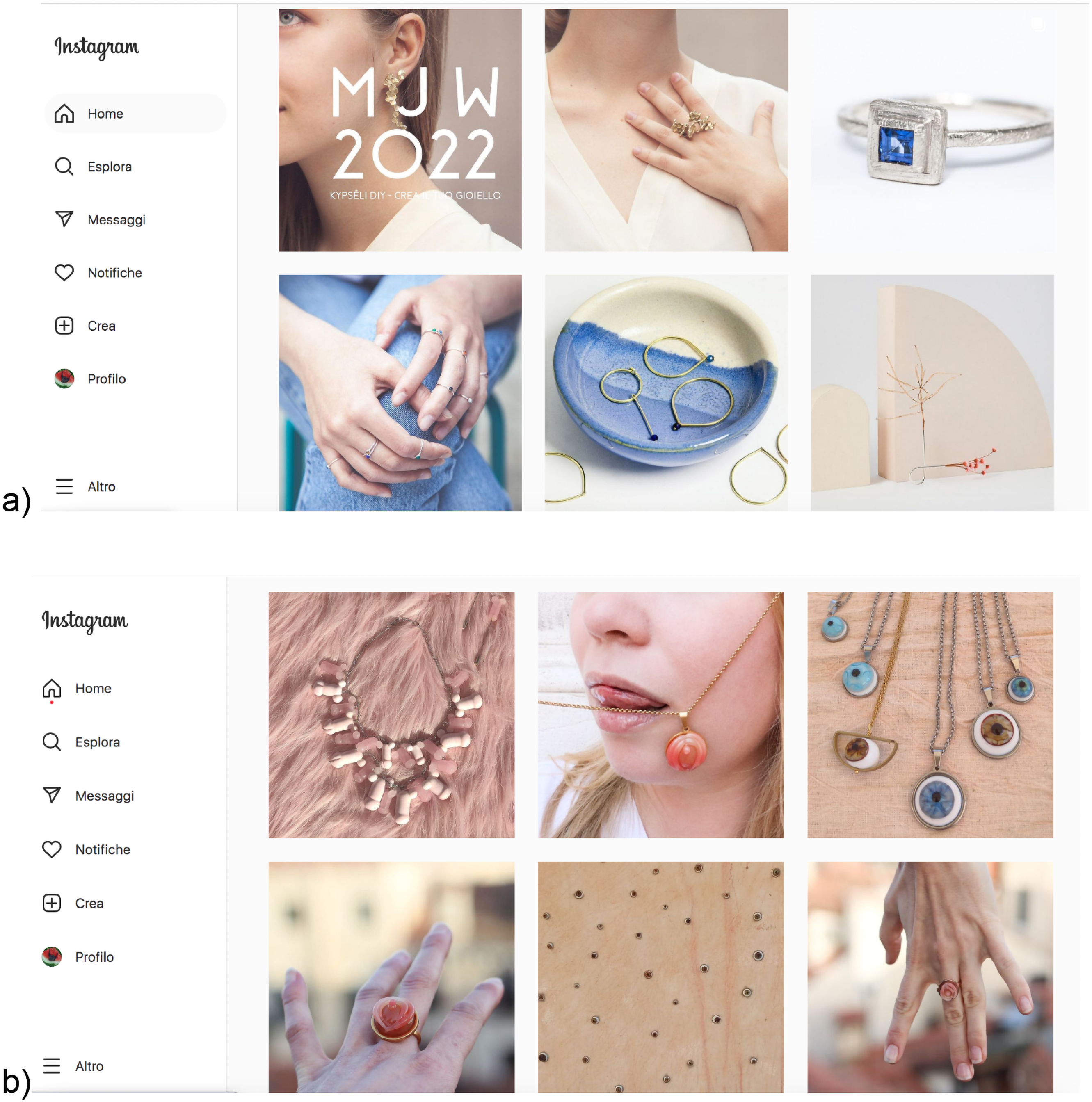
Screenshots of two neo-craft jewellery Instagram feeds, taken by the authors.
It may be argued that this aesthetic homogenisation is a direct reflection of the standardisation logics that are distinctive of platform-isation as a process, which are reflected here in the display and execution of neo-craft work. Instagram's affordances ultimately contribute to define the politics of production of neo-craft work, and thus ‘contingently structure’ – to use Richardson's (2024) definition – the execution of this type of work. Contextually, this confirms the performative role of Instagram representations in societal settings, as they contribute to shaping the social environment in which the platform becomes implicated and thereby acquires a relevant role (Boy and Uitermark, 2023).
Concluding discussion
Through the case of neo-craft work, this article has developed a conceptual framework that sought to identify what is distinctive about the process of the platform-isation of work. We have argued that work gets to be platform-ised once social relations in a given context are repurposed, in part or in full, by way of platform intermediation – thus becoming relations of production. We have discussed the conditions under which this might take place, and looked at the main dimensions that constitute this process. It must be underlined that this inevitably remains an initial and partial effort: many other types of work besides neo-craft could fit this definition in different (and perhaps partial) ways. Also, many areas of theoretical inquiry have remained unaddressed and deserve further attention, particularly the relationship between platform-isation, (self-)entrepreneurship, and ‘user labour’ (Jarrett, 2022) or ‘creator labour’ (Cunningham and Craig, 2019); the ways in which platform-isation, as a process, intersects with workers’ existing social, cultural and economic capital; and the relationship between global platform cultures and local work practices. Also, the primary focus on the European setting inevitably leaves out other geographic areas of possible inquiry beyond the West, where (old and new) forms of craft work and cultural production are differently entangled in the socio-economic and socio-cultural context they inhabit.
Nonetheless, despite its inevitable limitations, this article provides further evidence for the claim that platforms represent new kinds of institutions that vertically integrate the processes of creation, distribution, marketing, and monetisation of (in this case, neo-craft) work (Poell et al., 2022: 68–74). As a result, two main aspects stand out from our analysis. First, platforms concur to standardise the processes of commodification and display of work across geographical boundaries. The practices of discursive production that are integral to neo-craft work – which, as seen, are essential to these workers’ professional affirmation – are very homogeneous, despite the different geographical contexts taken into consideration. The locality that is typical of craft production as traditionally intended is therefore diluted (if not entirely lost!) in the transnational grammars and vernaculars of platform-based cultural production around neo-craft work. Second, while the platform logic penetrates into neo-craft activities in such a significant manner, not all neo-craft workers may be platform-ised in the same way. It may be argued that the platform-isation process here discussed actually harbours a potential new division of labour in relation to craftsmanship, which sets apart neo-craft producers from traditional ones, creating new (platform-generated) hierarchies: take for instance the case of a neo-craft ceramicist with a successful Instagram profile, vis-à-vis one who refuses to engage with social media. More generally, it will be interesting to explore the evolution of neo-craft work as a phenomenon particular to declining postindustrial Western societies, and its intricate relationship with platforms in the coming years, and to look at other settings – Asia, for instance – where we might observe the emergence of different, yet equally original platform and craft cultures.
Footnotes
Acknowledgements
This article is part of the CRAFTWORK project, which has received funding from the European Research Council (ERC) under the European Union's Horizon 2020 research and innovation programme (Grant agreement No. 948982).
Funding
The authors disclosed receipt of the following financial support for the research, authorship, and/or publication of this article: This work was supported by the H2020 European Research Council – ERC Starting Grants 2020 (grant number 948982).

Notes
Author biographies
Alessandro Gandini is associate professor of cultural sociology at the University of Milan, Department of Social and Political Sciences, and is the Principal Investigator of the CRAFTWORK project (2021–2025), funded by ERC Starting Grants 2020.
Gaia Casagrande is a postdoctoral researcher at the University of Milan, Department of Social and Political Sciences.
Giulia Giorgi is a postdoctoral researcher at the University of Milan, Department of Social and Political Sciences.
Gianmarco Peterlongo is a postdoctoral researcher at the University of Milan, Department of Social and Political Sciences.
Marta Tonetta is a postdoctoral researcher at the University of Milan, Department of Social and Political Sciences.