




Abstract
Transmedia storytelling is a strategy adopted by media franchises and brands to create participatory story-worlds for their consumers; it incorporates a range of forms, actors, and texts, all of which have varying degrees of narrative authority in determining the events that occur. This article focuses on tabletop role-playing game Dungeons & Dragons to show how play cultures in Singapore are shaped by transmedia storytelling techniques. In doing so, it makes two contributions to existing research: first, it shifts scholarly focus from game texts to player practice, showing how communities of play are created through players’ emergent usage of transmedia storytelling techniques. Second, it describes a player practice of soft canon, which I theorise as an approach to shared world-making that prioritises the emotional resonance of narrative details over a positivist accounting of narrative events. The concept of soft canon reveals a new perspective on how communities create and sustain intersubjectively imagined worlds.
Keywords
Introduction
The Dungeons & Dragons (D&D) transmedia empire has been rapidly expanding over the past ten years, bolstered by the release of blockbuster film Dungeons & Dragons: Honour Among Thieves (2023), highly successful video game Baldur's Gate 3 (2023), hit Netflix series Stranger Things (2016), and popular streamed live plays on Twitch such as Critical Role, which netted its cast US$9.6 million in profit between 2019 and 2021 (Hutchinson, 2022). This once-niche activity of tabletop role-playing games (TTRPGs) has broached the mainstream as TTRPGs experience a contemporary resurgence (Sidhu and Carter, 2020). D&D in particular is the dominant game in the hobby, estimated to have attracted over 50 million players worldwide (Wieland, 2021), and is a prime example of transmedia storytelling (Jenkins, 2007): instead of a story told in a singular form, D&D's characters, monsters, and fantastical settings are extrapolated in loosely connected texts ranging from the big screen to the graphic novel (Deterding and Zagal, 2018).
What is unique about D&D is that its primary text is in the form of a TTRPG, a structured conversation between a small group of players that develops a story, with rules in place to mediate players’ actions within an imagined world. Unlike a traditional videogame, its shared fantasy world is not a persistent environment that a player interacts with through a computer or a phone; it is instead imagined into being by the act of talking in small groups of players. Each player plays a single character who explores the story-world and makes decisions that develop the plot and their character's growth. When players encounter obstacles, the game-master – who narrates the world and its events – asks them to roll dice to determine their outcome. A game text published by D&D's official publisher, Wizards of the Coast, may suggest rules, settings, plots, and characters that players can interact with. However, the game itself as a form does not lie in interacting with the text as a reader; it is instead realised through the act of playing with the text as players, and players and game-masters (GMs) have considerable flexibility in interpreting and making the game world for their own use. Viewing the game merely as a textual artifact does not account for how the player becomes a co-creator of meaning through interacting with and transforming the game as a form of media; instead, games can be more sharply analysed as ludo-textual constructs: both as textual objects and as systems of interaction (Booth, 2021). Because the narrative stability of these game texts collapses and then is rewritten through play, players have a great deal of latitude to decide on how authoritative they consider the ‘official’ fictional universes of D&D to be. Bringing games into the picture adds a new angle to our consideration of transmedia story-worlds as the province of brands (du Plessis, 2019) or media franchises (Fast and Örnebring, 2017).
Considerable research has surfaced rich analyses of the transmedial texts of D&D and how they frame gameplay for players (e.g. Stang and Trammell, 2020). However, this article moves beyond D&D's texts and turns its attention to dynamic player practice; that is, how the game is actually played by communities of play, and how the players themselves participate in their own transmedial authorship of the game texts. Based on a 20-month ethnography of TTRPG play cultures between 2021 to 2023, I show how players at a play studio in Singapore create their own complex story-world by drawing from techniques of transmedia storytelling. At this play studio – a specialised space to play TTRPGs that is run by professional, paid GMs – players are motivated by the desire to expand their shared world from a table of 5–6 players to encompass a community of nearly 30 players. I explore the primary tension that players face, which derives from the need to balance narrative stability for the game to proceed with the desire for transmedial extrapolation to extend gameplay outward into a broader play community. I frame this need for narrative stability through the theoretical lens of a ‘canon’ and develop this by suggesting that players’ transmedia extrapolation can be seen as the creation of ‘soft canon’. I show how players are invested in creating a world that mimics the texture of reality by emphasising the counterfactual nature of what could have been. Players are especially interested in exploring narrative possibility as much as narrative actualisation through their practices of play.
Players’ relationship to textual authority is, in this way, very similar to the way fandoms receive and relate to products of popular culture. Fans engage with a canonical central text, while players have no authoritative central Dungeons & Dragons to draw from. However, like fans, players experience the game's events within specific contexts of reception, produce particular forms of culture in response, debate and evaluate the game's meanings, and – as Jenkins (1992: 18) describes fan participatory culture in his ethnography of television fans – ‘raid mass culture, claiming its materials for their own use, reworking them as the basis for their own cultural creations and social interactions’. Through developing this idea of soft canon, I extend the definition of fans as individuals who practise a creative, appropriative, and even irreverent attitude towards authoritative textual artifacts, rather than as individuals positioned in relation to a specific cultural product (Booth, 2021)
Literature review
From narratives to (transmedia) story-worlds
D&D originated in 1974 in America from a subculture of wargames and players who facilitated the creation and dissemination of role-play as a form of gaming (Peterson, 2012). In D&D, players dwell in a fantastical world where they play adventurers gifted with powerful abilities; they explore strange terrains, kill monsters, and find treasure. Long-term campaigns are made up of episodic game sessions that unravel an extensive plot and give characters a chance to develop in power. TTRPGs like D&D have been examined as literary forms (Cover, 2010), as drivers of social and psychological transformation (Causo and Quinlan, 2021), as socio-cultural phenomena (Fine, 2002), and as playful social practices that generate outcomes both positive and negative (Trammell, 2023). While this glimpse of TTRPG research is partial, I want to move away from considering D&D games as shared narratives, which over-emphasises a cause-and-effect linearity, and instead think of them as dynamic and unfinished worlds, which in turn emphasises the texture and quality of the intersubjective world-making of players (Mizer, 2019). This perspective brings studies of D&D closer in line with how media scholars now conceptualise transmedia storytelling as story-worlds rather than narratives (Fast and Örnebring, 2017).
Acknowledging the transmediality of D&D as a set of texts contextualises how its fictional universe can be interacted with across a multitude of platforms. While the popularisation and digitisation of TTRPGs has lent analyses of TTRPGs as transmedia narratives considerable momentum, research on TTRPGs still tends to emphasise an analysis of the texts of the game rather than the game as a ludo-textual artifact, a combination of player decisions and material components (Booth, 2021). The study of games as texts (that is, written rules), though productive, has tended to occupy ‘an outsize place both in lay understanding of what games are and in scholarly research about them’ (Malaby, 2022: 110–11). Instead, as Malaby argues, games exist only in their playing; therefore, focusing solely on written texts in the study of games is akin to mistaking the score for Brahms’ second symphony for the symphony itself. How players use transmediality as a game technique and, more specifically, as an epistemological approach to the shared fantasy world of the game, is a practice that remains under-researched, possibly because work on contemporary play culture in the wake of the digitisation of D&D is still developing.
The constitution of canon in TTRPGs
Narrative stability is important in shared fantasy (Fine, 2002): for a game of D&D to proceed, players have to agree with each other that a certain set of narrative events took place, because this account becomes a resource for further action within the game. A player wishing to use a magical key to unlock a door has to have obtained said key in an earlier part of the game. This series of events takes on an air of authority and is known in some play communities as the game's ‘canon’ (Alberto, 2021). Players use this term in relation to fan parlance, where ‘canon’ refers to texts created by primary authors, that is, ‘the events presented in the media source that provide the universe, setting, and characters’ (Busse and Hellekson, 2006: 9). In most cases, transmedia stories produce ‘a consolidated canon of “official” texts that frequently discourage or discredit unauthorised expansion or speculation by fans’ (Scott, 2012: 43).
Initially used to indicate sacred scripture in religious contexts, the meaning of ‘canon’ has been broadened by fan communities to refer to a collection of central texts within a particular popular culture narrative which are seen by fans as authentic, authoritative, and reliable (Alberto, 2021). Maria Alberto applies this notion of canon to TTRPGs by arguing that even the foundational texts of D&D, such as rulebooks or manuals, are not canonical, because they are made to be adapted by players and GMs at the table. She draws from her own experiences of playing D&D online with her friends to propose that digital platforms make canon possible: in sending messages to one another during the game, players create irrefutable and searchable traces of play, thus establishing canonicity for their shared story through virtual play affordances. As Alberto sums up: By telling each other ‘I want to make this canon,’ we are asking our fellow co-creative participants to see and ratify thoughts, words, and motivations alongside actions, reactions, and dialogue. We are saying not only I want to try this, but also that whatever the result, I want this detail to be recorded as what actually happened. Thus, canon in TRPGs can be both evidence and celebration of narrative events in all available detail. (Alberto, 2021: 121)
Alberto's notion of canon is already a step removed from the idea of ‘canon’ as seen through the lens of fandom; game canons are collaboratively constructed by its players, not TV producers or writers, though they both share the characteristics of being authoritative, evidential texts. In contrast, at this play studio in Singapore, the idea of canon is yet another step removed: players are not interested in a singular accounting of the narrative events of the game: play, for them, resides in the fact that the game consists of multiple and branching narrative possibilities which can be simultaneously inhabited. Accounting for a ‘canon’ of a game's events in D&D is possible for a single table of 5–6 players, where, for example, post-gameplay notes help players to agree on the occurrences that took place, but in attempting to incorporate over 30 players playing in six different games into the same story-world, players do not fortify a ‘canon’ of narrative events; this implies that there are hierarchies of authorship at play, where the narratives produced by certain groups have authority over others.
Instead, to resolve this tension between needing and rejecting canon, players follow the logic of what they call ‘soft canon’, where multiple and simultaneous narrative possibilities coexist. This shared fantasy story-world is made possible through the manipulation and replication of transmedia storytelling techniques that blend shared material locations and virtual space. These techniques of reality-crafting incorporate a deft combination of analogue and digital tools into the playing of D&D and a style of play that draws from how contemporary stories in popular culture are told and experienced through transmedia techniques, then further transformed through fans’ practices of textual poaching (Jenkins, 1992). For example, a player may narrate a gift given by a character at a table during a game session, which in turn becomes text in an online role-play forum, which then again is transformed by being crafted into a material object in reality – all of which are rich texts that relate to each other in making a transmedial world which draws together players in multiple and nested layers of relation and meaning.
I would thereby define soft canon as an approach to shared world-making that prioritises the emotional resonance of narrative details over a more positivist accounting of narrative events. Soft canon accommodates an understanding of shared, simultaneous, and multiple world-making. It conveys an intersubjective world that is fixed enough to play in, but unfinished enough for players to significantly remake. It recognises that narrative events, and their interpretation, are contingent on arrangements of circumstance and relation between the player-character and the non-player-character. In other words, soft canon highlights that perceptions of a shared world are highly perspectival. Soft canon captures players’ epistemologies towards their shared story-worlds; transmedia storytelling encompasses the tools that players use to express and explore this notion. Soft canon also gives the counterfactual weight. As one of the players said to me in an interview: ‘Everything is soft canon. It's all canon, but how? It's canon to you when it needs to be.’
The symphony, not the score: a methodological overview
The data for this article draws from 20 months of ethnographic research spanning 2021 to 2023, where I record participating in at least 245 public and private gaming sessions while adopting a methodology of playing alongside gamers (Boellstorff, 2008) in Singapore. The length of each play session was generally between 3 and 4 hours. During these sessions, I took scratch notes during play, which I then wrote up into an ongoing fieldwork diary after sessions were concluded. I corroborated my observations with players through conversations conducted before and after the games, and during more casual social hangouts. I also spent time hanging out in these spaces, participating in activities such as painting miniature figurines used in gameplay, sharing meals, and chatting about dice. In narrative spaces, the ‘small-talk and the hang-out are means to share and enrich the stories, but also to turn them into stable elements of the spaces – memories, micro-history, customs’ (Florea, 2010: 12); I was therefore attentive to how these elements became part of the spaces I inhabited. Recognising that the online and offline blur into a blended field site (Bluteau, 2021), these hang-out sessions also included spending time chatting on Discord, Telegram, WhatsApp, and Instagram, alternating between sharing memes and delving into heartfelt conversations. I also conducted 38 in-depth semi-structured qualitative interviews ranging between 1.5 and 4 hours in length, where I invited players to talk about their game experiences.
A large part of my ethnography took place in what I call ‘play studios’ in Singapore. While public arenas for D&D play in Singapore have existed since the 1980s, these were primarily commercial spaces, selling play-related products, that occasionally hosted gaming sessions for players. On the other hand, play studios – which rose to prominence in 2020 and 2021 following the Covid-19 pandemic and the rise in popularity of actual play – focus on delivering the experience of D&D games over the sale of D&D-related merchandise. These studios are differentiated from their predecessors by the elaborate material constitution of their spaces, which are geared towards delivering immersive play experiences through GM-designed lighting, sound, and the availability of maps, minis, and terrain. GMs are focused on cultivating atmospheres of narrative immersion, with role-play generally taking on more importance than combat. Many GMs come from acting backgrounds, utilise embodied techniques like postures, movements and shifts in vocal performances to portray different characters, and are experts in constantly rearranging assemblages of music, lighting, and physical objects to evoke narrative moods and tonal shifts. At these studios, players pay GMs premium rates to run games for them.
Singapore, as a site of play, has its unique history. Colonised by the British in 1819, it is now a highly efficient, globalised, and wealthy nation-state that packs 5.7 million individuals into 283.5 square miles: the entire densely populated country can be driven across in an hour or less. The vast majority of Singapore's inhabitants – most of whom are the descendants of Chinese, Indian and other Southeast Asian migrants who came to the island city in the 1800s – are English-speaking, highly educated, and up-to-date with Western mass media, including recent popular fantasy and sci-fi franchises that give players a depth of genre knowledge needed for games like D&D. Singapore's authoritarian government scripts large parts of Singaporeans’ everyday lives, with state institutions playing a major role in areas ranging from public housing to marriage, from media censorship to the development of creative industries, from religious and racial formations to language use within the city-state. A survivalist ideology (Heng and Devan, 1995) and deliberate strategies of depoliticisation through the deployment of state media (Leo and Lee, 2004) has inculcated an attunement to economic productivity above all else; play is perceived as a wasteful activity. Singapore's arts and culture sector is closely watched over and funded by the state, which in turn often uses the arts as an ideological instrument to inculcate a specific national identity (Chong, 2010). Within this context, this study of a flowering of vernacular forms of creativity, community, and collaborative storytelling reveals how Singaporean citizens respond to authoritative institutions – by refusing the impulses of a ‘hard’, factual, and objectivist canon and instead embracing, within the semi-privacy of their story-worlds, a ‘softer’ mode of knowledge-making.
One of the studios I played in for this study, called TableMinis, had a game focused on the official D&D setting of Strixhaven, a magical college where players play young adult students who must balance their academic endeavours, burgeoning love lives, and the unravelling of an evil plot against the school. While in more open-ended D&D campaigns players could conceivably expect to comprehensively experience the world set out in the game's texts, in Strixhaven as it was played at TableMinis, players can only choose a set number of classes to experience within the confines of a school year. Within this narrow selection of classes, players could then interact with and deepen their relationships with specific non-player-characters (NPCs) played by the GM, a 30-year-old improv actor named Mellow. These NPCs range from archetypes such as the jock with a heart of gold to the anxious do-gooder. As time passed and word-of-mouth about the Strixhaven game spread, a community began to form that developed an emergent play style (Pearce and Artemesia, 2009). Eventually Strixhaven expanded to 27 players across six separate groups in 2022, all of whom played characters experiencing their first year in college.
Play techniques that make Strixhaven a story-world
Spectating and reporting: encounters across worlds
Strixhaven initially started with a single group of five players – a normal size for a D&D game group at TableMinis. Mellow then began running the same game with the second and third group of players, where something unusual happened: some of the earlier players began to carry out a ritual of what they called ‘spectating’. Players would thus sit in and watch the current group play through the same storyline that they had already experienced. However, because the subsequent groups chose different classes, the spectators were able to observe an alternate-world iteration of NPCs and in-world plot developments, made different due to players’ decisions. Players experienced the pleasure of re-playing the game through spectating as well as the experience of the counterfactual life (Irving, 2018): the ‘what if’ of possibilities had their own characters made different choices within the game. The practice of spectating picked up momentum with every subsequent class of players until, when I joined to play in the sixth and final batch of the Strixhaven first years in November 2022, there were fourteen spectators in the crowd, far outnumbering my table of four players.
During my first game, we were illuminated by bright overhead lights as we sat at the studio's table, but in the darkness, outside of the pool of the lights, a crowd sat cross-legged on the ground. Some of them were leaning casually on the shoulders of their friends, others tried to eat instant noodles as quietly as they could, and many of them had their faces lit up like pale moons by the phones and laptops they were holding. I assumed initially that they were messaging friends or scrolling idly through social media feeds while listening in, but it turned out that they were actually using the studio's instant messaging platform – a Discord channel accessible only to Strixhaven players at TableMinis – to carry out a practice they called ‘reporting’.
‘Reporting’ meant that players watching our game would type out what was going on in the games they were spectating in real-time. This included descriptions of player actions, direct quotes, dice rolls, gifs, reacts, and commentary, and were similar to ‘live tweets’ of ongoing TV shows and streams (Schirra et al., 2014). Discord channels became spaces where spectating players could commentate on ongoing games without speaking and interrupting the gameplay. They also permitted players who were unable to attend in person to keep up with whatever was happening. Both spectating and reporting were attempts to allow the world of Strixhaven to dissipate and drift beyond the conversation of the table, and formed the basis of the soft canon approach that players later took to be their epistemology of the game world. The choice of this form introduced a ‘liveness’ and temporal immediacy to the events of the game world; more importantly, it enabled simultaneous reactions from other players and created a searchable archive of the game's occurrences.
A typical report might look like the following screenshot, where Pi and Ilyanna are following a scene taking place at the table. A character, Pascal, is telling his dormmate Arielle about an arranged marriage his parents have organised for him, and announcing that – in defiance of his parents’ wishes – he is going on an unauthorised date. Arielle is concerned and exasperated, but wants to return to her studying. This scene plays out many typical college tropes, including parental expectations, the pressure of examinations, and young romance (Figure 1).
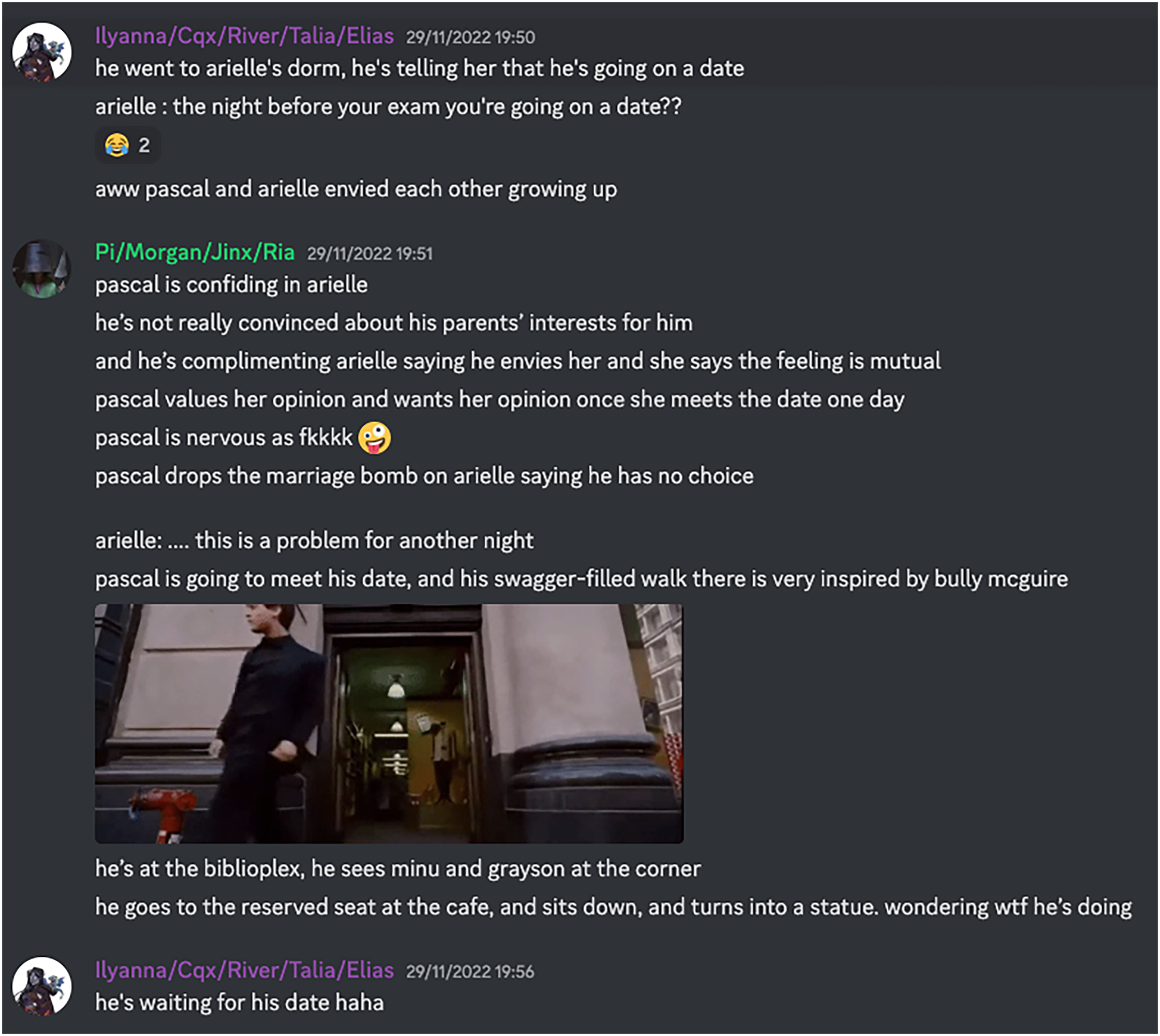
Ilyanna and Pi reporting in real-time while spectating a game.
Translating the conversation at the table into this series of posts transforms gameplay into another kind of text, one that strays from and tells the story differently. Ilyanna's commentary (‘aww pascal and arielle envied each other growing up’) reflects the watcher's emotional response to the unfolding story. Pi's usage of the cheeky ;P emoji and lapse into casual language (‘pascal is nervous as fkkkk’) shows Pi's interpretation of the player's performance of Pascal. Ilyanna's final line picks up the reporting by offering context to Pi's final post. Emoji reacts to Ilyanna's direct quoting of Arielle's statement at the table reveal spectators following along in the chat. In other examples within the server, spectators also often speculate on potential connections surfaced by the role-playing at the table, such as the parentage of a character, an ongoing conspiracy, or the possibilities of future player actions.
Spectating not only drew players into the Discord channel but also into the same space in real life, where spectators and players would mingle before, between, and after games. It opened up the possibility of relationships built between players coming from different game tables, with the commonality of the game world offering access to a shared experience. The conviviality and sociality created by the encounters that this engendered turned a gathering into a happening (Tsing, 2021). Players eventually grew interested enough in each other's characters that they set up a text role-play channel in the Discord server, where people would play out meeting each other's characters across game worlds.
Meet me at #archway-commons: text role-play as transmedia extrapolation
The role-play channel on Discord is a further extrapolation of a transmedial approach to the shared fantasy of the Strixhaven world. In the text role-play channel, known as #archway-commons, players from different tables (which generally represent sealed fantasy worlds) write about their characters meeting each other in hallways, classes, and schoolyards. These character encounters – which echo players’ own interstitial encounters in real life at the play studio – challenge and fortify the stability of fictional reality, because the characters all technically exist in parallel and separate fantastical universes.
With the development of #archway-commons, Taylor (2006)'s notion of ‘play space’ expands to multiple layers of literal and metaphorical space: the space of the table, the space of the text and its play (in how the GM and the players choose to interpret and negotiate with the game rules and the setting of Strixhaven); the space beyond the table (where players dwell together between games); and finally the space online. By doing so, players ‘slip in and out of complex networks that cross … online and offline space’ (Taylor, 2006: 18). I would add to Taylor's concept of play space the element of play time; in meeting each other online via a text channel, players no longer had to role-play simultaneously, but could instead stretch out their interactions asynchronously, allowing themselves to slip into this shared world throughout the course of their everyday lives.
In the following example, the characters Myre and Minu are played by players from different tables. According to the broad plotline of Strixhaven, both Myre and Minu have fought off cauldron monsters, stolen an artifact from the professors and bet in a frog race with their dorm-mates. They might have encountered the same NPCs, but would have built different relationships with them; the NPCs, in turn, would have grown and developed differently in each world. Myre and Minu exist in parallel universes and there is little narrative rationale for how they could encounter each other. Yet in the space of #archway-commons, Myre and Minu can meet in the gardens and play out a budding friendship (Figure 2).
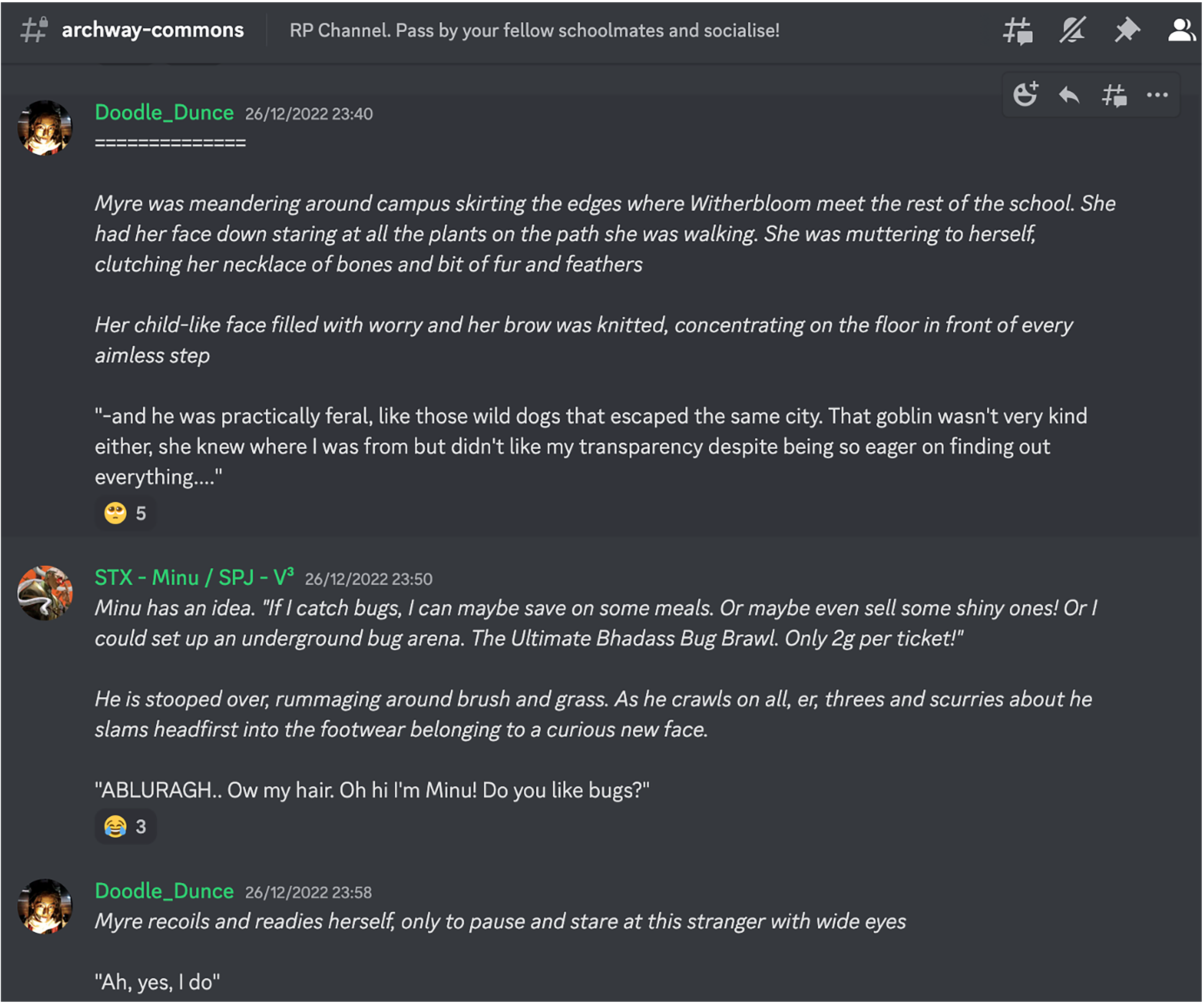
Screenshot showing an encounter in #archway-commons, a text role-play Discord channel for Strixhaven players.
With the development of this transmedial approach to storytelling, two layers of game ‘reality’, as the players see it, exist: the conversation at the play studio's large conference table, which is watched over, commentated on, and turned into a rogue archive (de Kosnik, 2016) by spectators; and #archway-commons, where characters can rise from the time and space of their tables and encounter each other in a liminal garden. At first glance, each layer has different temporalities and varying weights of ‘realness’ or canonicity. #archway-commons is a place for people to paint together, celebrate festivals, or meet in the Strixhaven version of rage rooms. Canon here is apparently ‘lighter’ (‘light’ being a term that players at the studio interchange with the term ‘soft’), the encounters passing. For example, Naomi, an exuberant 27-year-old regular at TableMinis, says that #archway-commons is for ‘light RP’ (‘light role-play’): The analogy for it is like the Marvel cinematic universe, or as we call it, the Mellow cinematic universe. Light RP is close to when Disney Plus released Marvel's What If? Like short clips, comic strips, that's what #archway-commons is mostly for: really light-hearted, inconsequential things that could be represented not as a TV series but the nonsense 15-min shit instead … it's insignificant but sentimental and memorable.
Winni, a 26-year-old software engineer who began as a player at TableMinis and eventually became a GM working at the studio, is the player who originated #archway-commons as a channel. She now moderates it. Winni comments on how she has to help players modulate the role-play that takes place in the channel, encouraging them to save character-defining moments ‘for the table’: My idea at first was just to come online and say, ‘hi, my name is so-and-so, nice to meet you, what are you doing?’ I specifically wrote that I didn’t want it to have too dramatic, canon-establishing things. Like, don’t write your character development here. Do it at the table! Don’t expend your story arcs here. But of course, people like to – they RP, and they go on, and I have to tell them, eh, stop that!’
From these remarks, one might assume that what happens at the table is ‘realer’ than what happens on #archway-commons, and that the events that occur at the table eclipse whatever fleeting encounters may take place on the Discord. However, tracking how objects travel through these layers and sites shows that this is not necessarily the case, and that the logic of the soft canon persists across platforms. The next section follows the journeys of paint brushes and jackets to reveal how gifts pass from site to site in the realisation of relationships in this fantasy world.
Object reality: The passage of gifts through universes
Objects can emerge in ‘inconsequential’ encounters in #archway-commons and then take on character-defining, canon-establishing moments at the table. In a role-play session between Naomi and Winni in the Discord chat, Naomi's character Pi gives Winni's character Ilyanna a set of customised paint brushes. The paint brushes cross from #archway-commons into reality when, at the table during a game session, Ilyanna shatters her arcane focus – the object that permits her to cast spells – in a rage. She then narrates pulling out Pi's gift and turning those items into her new arcane focus: a treasured item that becomes a character-defining trademark. #archway-commons can produce imagined objects that are enduring and tightly bound to the world that Strixhaven players dwell in. Digital traceability, in some instances, results in greater attention to the canonical (Alberto, 2021); however, digital traceability in this case allows players to mess about with fictional reality in the spirit of soft canon.
Objects also travel in both directions of reality and are fluid in their material and textual constitution. In a game I played in, one character, Ollie, uses magic to transform her dormmate Minu's tattered clothes into a school letterman jacket with his name on the back, capturing Minu's development from social outcast to a beloved member of the school's community. Ollie's player narrates this transformation at the table, and one of the reporters captures the moment in the Discord server, writing: ‘Ollie altered Minu's straitjacket, and it is now a letterman jacket / looks great! It has his name on it, last name, the number 6 …’
Ollie's player is a young student who also crafts jewellery. As she narrates this scene, she reaches into her bag and pulls out a handmade ring to interjections of shock and admiration from the table. She explains to Minu's player that she wanted to make him a jacket to represent the gift but was unable to do so to her satisfaction; therefore, though her words conjure a jacket, her hands give him a snake-shaped ring. A day later, Minu's player enters the virtual space of #archway-commons wearing the jacket. In this game he does not interact with Ollie or any of the players he encountered at the table last night. Instead, in this multiversal interstitial space he shows off his jacket to players from other game worlds (Figure 3).
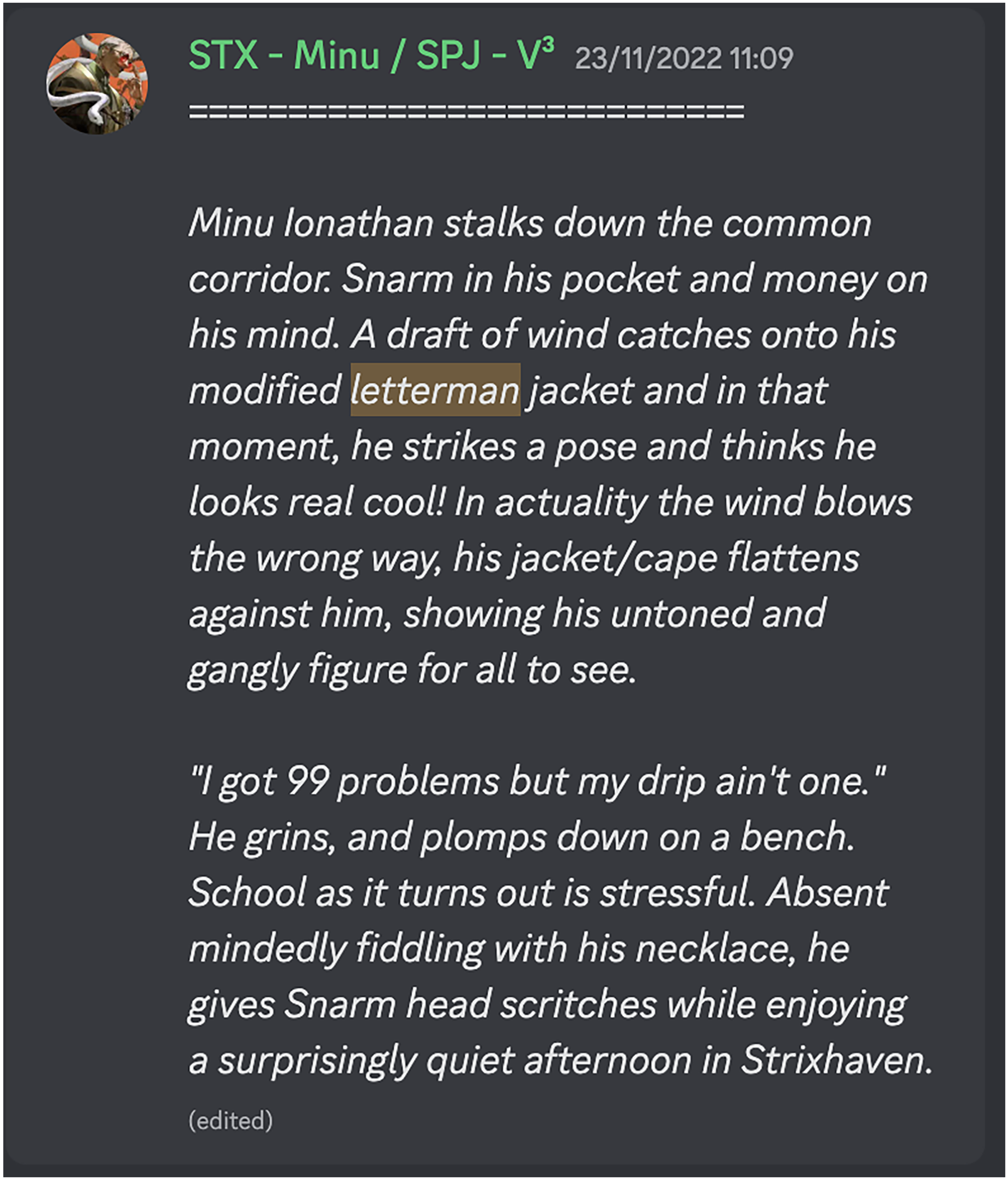
Screenshot showing Minu's entrance into #archway-commons wearing the letterman jacket Ollie had given him at the table the night before.
Though Minu's player wears the ring when he plays, it is the jacket that crosses from the table into the server. During this role-play scene in #archway-commons another player asks in the general chat: ‘btw what colour is your letterman jacket’, and Minu's player further crafts the material quality of the object through text: ‘beige sleeves, red middle, Lorehold colours’. A month or so later, Minu's player sends me an image of the letterman jacket, which he had commissioned in real life. He wears it casually while he is in the studio; the character's name, the colours, and the jacket itself is a highly referential item that will only make full sense to those who witnessed its exchange(s) between players and platforms (Figure 4).
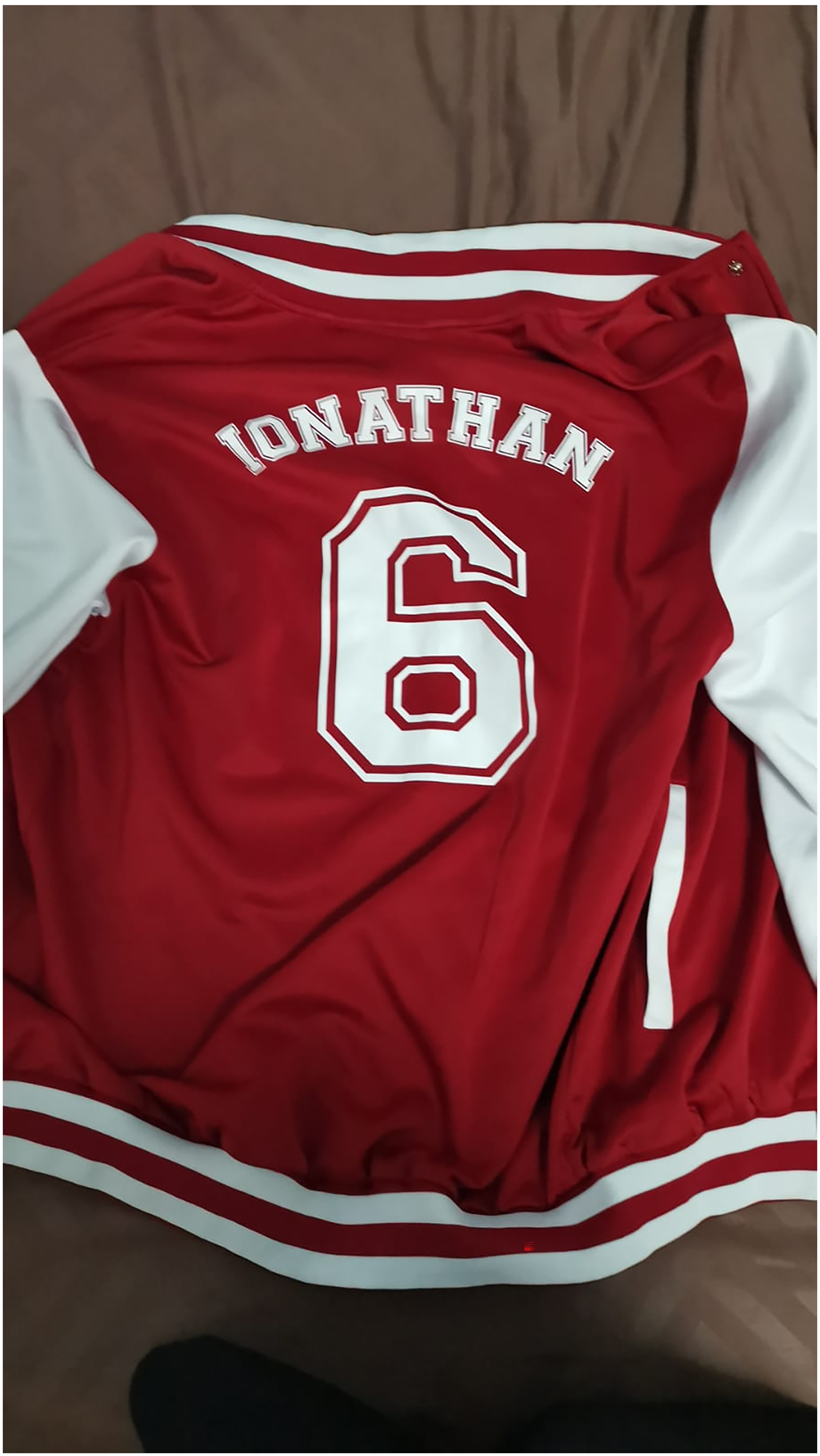
Image of the jacket Minu's player made.
The way that this object was evoked through speech at the table, confused by the physical gift that accompanied it, described in Discord, and then materialised in reality demonstrates how things are made real through (transmedial) crossings (Boellstorff, 2008). Objects do not have to be consistent in form and materiality; their importance lies in how many times they cross from table to table through layers of online and offline life, accruing relationships and meanings. Minu's jacket reveals how pliable canon is: that things can shapeshift as they pass between characters from different realities reflects a player practice of soft canon as epistemology. While these objects are the product of transmedial techniques, another less tangible but equally important aspect of this world are its NPCs. Through playing a key role in the development and observation of NPCs in a range of alternate universes, players introduce texture and vitality to their shared reality.
Non-player-characters: how multiple identities texturise reality
Through spectating, Strixhaven players are able to observe how NPCs emerge not merely as characters but also as selves in relation to different sets of circumstances and people. In most D&D games, NPCs often serve a utilitarian purpose. Played by GMs to interact with the party of adventurers, NPCs can be quest-givers, antagonists, tavern-keepers, travelling merchants, and so on. The characterisation of an NPC usually only develops in relation to a group's decisions and actions. Unlike in digital games, NPCs do not follow a circumscribed number of narrative pathways but often surprise players by making unpredictable developments in in-game encounters between the GM and the players. By spectating the development of NPCs across different games, NPCs achieve an interiority that players find both appealing and generative. For example, an NPC named Grayson Wildermere – a reserved young man with an aristocratic background – was in my game a minor antagonist. Another player made Grayson her beloved elder brother; through her interactions with him, his identity as the golden child of the family, and thus someone dealing with the burden of parental expectations, came to the forefront. A third player pursued Grayson as a love interest with the pleasure of genre-farming (Underwood, 2009) a teenage romance: as she said, ‘immediately when I first met Grayson, I saw the enemies-to-lovers path that our characters could take, and it was too tempting to not do it!’ These aspects of Grayson are hotly debated between players in-person and on the Discord as players recount games and plot what to do next, but conversations that revolve around him never focus on who is ‘right’, because the understanding is that all of us are. Most of the time, these conversations soften into a sense of compassion of the NPC as a realised and complex individual.
In these sparks of relation, NPCs too take on the quality of soft canon: that is, it becomes a truth to players of the game that multiple, kaleidoscopic iterations of the self are possible; that these selves can be and are all true at once; and that their actual figuration depends on their relationships and encounters with player-characters. Anthropologist Sökefeld (1999) argues that the enactment of a plurality of identities depends on the experience of the self as continuous. While a narrative self may be composited through discourse, Sökefeld shows that it is only through observing a social actor muddle through conflicts in social interaction that a person's often-contradictory identities can be grasped. This is the process that NPCs of the game undergo. Through spectating, players witness NPCs acting in situations of social conflict. They observe their multiple identities and, in a retrospective act that arcs back over Sökefeld's articulation, it is through this observation of multiple identities that a continuous self is detected. In other words, the NPC's narrative self – the self made in discourse, the NPC's backstory – fades in importance, and instead NPCs grow to become lively, contradictory figures that take on the texture of ‘realness’.
Conclusion
This play community engaged in a game of Strixhaven at a play studio in Singapore is an example of how play practices in TTRPGs are constantly evolving to accommodate the needs of differently embedded communities. These techniques reflect the players’ absorption and deployment of transmedia approaches to narrative and storytelling. While previous research has focused on how shared fantasy worlds in TTRPGs are stabilised through acts of persistence, binding, and canonisation, I develop the idea of ‘soft canon’ as applied in TTRPGs to show how players dwell in worlds that focus more on the consistency and texture of meaningful relation than narrative accounting. Practices such as spectating and reporting, drawn from media and fan practices elsewhere, help players to encounter each other meaningfully both in-person and online. Text role-play results in the expansion of play space and play time. Tracing how objects traverse through online and offline life, as well as how NPCs’ selves are revealed, show how particular things take on the weight of ‘realness’ to the players of Strixhaven through crossing from one table to another. I am unable to describe the full extent of players’ transmedia storytelling due to space constraints, but players not only role-play through text and speech: they also draw comics of the game's occurrences, run a fictitious school newspaper, create playlists for their characters, suggest fancasts for Strixhaven's NPCs, and write and record jingles for their game groups.
I return now to a conversation with Mellow, the GM who runs Strixhaven. I was trying to understand how he kept the narrative details of the universe straight, to ensure that the world would not collapse under the weight of logical inconsistency. In response, Mellow questioned the point of a canon: How do I make everything make sense? How do I make sense that six classes fought the same mimic? … In my mind, we think of canon like there's this central thing. But if I take a step back and look at it, what is the canon for? Who is the canon for? Well, it can be for the players, but another aspect of it is that it's also for the audience … at the end, I think the emotion of it comes through. If it's very important, it will show up. The players will hold it dear. And if it's held dear, then it will always be a consistent thing that keeps getting pushed through.
Players therefore ‘push through’ what is ‘held dear’ into the world. This is in line with how, in Mizer's (2019) study, D&D players ‘bind’ specific details to their shared worlds by bringing repeated focus to particular experiences. But ‘pushing through’ does not necessitate canonical accuracy. Nor does it require an assertion that their projected world is the only world that exists. Rings can turn into Discord posts that can turn into jackets. Characters can be beleaguered older brothers but also snooty bullies and also combative love interests. Fighting off a monster can take place six times in six different ways. Narrative realities diffuse across time and space, escaping the boundaries of the table. In a way, the act of making soft canon is another act of fixing in place; this anchoring is simply motivated by an impulse that centres on emotional resonance and meaning, as opposed to accounting for a series of narrative events. Soft canon also focuses heavily on the pleasurable experience of the counterfactual, which in turn makes their creation and inhabitation of a fantasy more ‘real’. Alternative, imagined lives give us a schematic for understanding our own (Irving, 2018). Players feel out the limitations of their own experience by spectating each other's games; they witness the range of ‘what ifs’ that could have unfurled had they made different decisions or been with different people.
In this way, the emotional and affective logic of player practices is aligned with that of transformative fan practices, even though at first glance there is little relation between fan fiction and D&D games. In an article about Russian Harry Potter fan fiction, Samutina (2016) writes about how fanfic writers characterise their treatment of canon as a ‘game’: writers are motivated to create a universe that feels realised, emotionally coherent, inventive, and fluid beyond simply ‘filling in the gaps’ left by a set of canonical texts. Among my interlocuters, both Winni and Naomi talk about their own past participation in fandom and how they bring a similar logic to their gameplay and community organisation as D&D players. This contemporary cultural mode of reading, reception, and transmedial invention, particularly in a place like Singapore, shows how everyday citizens are authors that in their own way creatively critique and undo a hierarchy of authoritative institutions and texts. It is unfortunately beyond the scope of this article to fully depict how important the experience of Strixhaven has been to the young people in its community as a public sphere of imagination (Saler, 2011), many of whom are queer, trans, neurodivergent, or otherwise marginalised and alienated from Singapore's overriding ethos of economic productivity above all else. This approach of soft canon – not merely in the telling of specific types of stories but in players’ relationship to textual authority – is particularly salient in authoritarian Singapore, where alternative viewpoints are tightly suppressed through state censorship and the regime-legitimising Singapore Story is overpowering (Tan, 2016). Players at this studio have separately recounted to me an intense disaffection with the narrative of the Singapore Story when discussing the pleasure of playing in Strixhaven.
The study of TTRPGs helps us to understand how people perceive, imagine, and enact shared imaginative worlds through transmedia narratives in emergent ways. Digital games are tightly bound to the mediation of infrastructure, but the looseness inherent to the nature of TTRPGs permits players to wield greater autonomy in determining how they choose to interact with and create the world collectively. Looking beyond the realm of games, the application of soft canon in other sites of social action can reveal how communities engage, inflect, and transform what is commonly seen as ‘canonical’ or authoritative. For example, an edutainment initiative that invites Latinx youth in the United States to explore teen pregnancy and reproductive health through a transmedia story-world found that similar qualities of immersion, participation and exchange were crucial in bringing about changes in the lives of its viewers (Wang et al., 2019), and cross-platform and participatory world-making is evident in immigrant rights movements, where organisers create media that cross online and offline realms to enable action (Costanza-Chock, 2014). Principles of soft canon allow us to foreground the fact that everyday consumers of texts are also producers of texts; it helps us understand what people find important when they relate to and remake authoritative forms of discourse, particularly in societies where free expression is hampered. Continued research on play cultures, especially around a form as flexible and changeable as TTRPGs – which require players to exert considerable creativity in creating an intersubjectively imagined world – can help to reveal how communities leverage contemporary forms of transmedia storytelling to imagine together.
Footnotes
Acknowledgements
The author would like to thank Daniel Miller and Maria Alberto for key comments on this article. She would also like to thank members of her UCL reading group and the attendees at the Association of Social Anthropologists’ 2023 conference ‘An Unwell World? Anthropology in a Speculative Mode’ for remarks that helped refine this work.
Funding
The author received no financial support for the research, authorship, and/or publication of this article.

Author biography
Kellynn Wee is a PhD candidate in Anthropology at University College London. Her research examines play cultures, agency, consequence, materiality, and shared imagination in tabletop role-playing game communities in Singapore. She also designs games that imagine bittersweet utopias in Southeast Asian climate futures. Her previous research interests include precarious work in low-waged labour migration and the debt-financed migration of domestic workers from Indonesia to Singapore.