




Abstract
On 7 November 2020, strange things were happening in the comments to @realDonaldTrump's tweet erroneously arguing that he had won the US presidential election, ‘BY A LOT’. Posting quote tweets and replies in Armenian in tandem with ‘cursed images’, memes, and creepypasta, users engaged in a spam-like trollish intervention, even as Twitter kept removing the said content in real time. Exploring this online incident through various analytical techniques, this article first attends to absurdity and ephemerality within the polarized social media event. Second, it makes an argument for the productivity of digital methods in cultural studies inquiry aiming to understand the temporal, contextual, and infrastructural aspects of memetic commenting. Third, by focusing on the social (media) theatre of Armenian curses, we make a case for the analytical importance of studying materials deemed niche and anomalous in networked exchanges.
Introduction: Armenian curses and @realDonaldTrump
In a reply to @realDonaldTrump's tweet erroneously arguing that he won the election once the results of the US presidential race had been called on 7 November 2020, a Twitter (currently X) user combines a text in the non-Latin alphabet – Armenian, as it turns out – with an edited photo of a naked woman thrusting her pelvis towards the camera, the lower part of her body replaced with a toothy, open mouth. Another user quotes Trump by adding the same text and a photo of someone in a Pikachu suit pushing their arm through the mouth hole to strangle a woman. In yet another comment, the seemingly same text, translating as a curse, is accompanied by a picture of a plate of fruit oddly textured like pale human skin sprouting hair. The effect is both striking and absurd, making these sneers, jinxes, and spells stand out from the mass of responses that Trump's tweet quickly garnered.
Our article explores a sample of ‘Armenian curses’ posted in response to Trump's declaration of presidential victory as part of Twitter's networked commenting culture using reply and quote tweet features and building on fringe online vernacular content. Some of these responses combined so-called cursed images with seemingly random lines of text written in Armenian, while others recycled literal Armenian curses alongside memes. As KnowYourMeme aptly explains, Armenian curses are ‘copypastas […] generally written […] using the Armenian alphabet’ and paired with a variety of ‘cursed’ or disturbing images that exhibit abnormal or illogical content (KnowYourMeme, 2023). In what follows, we examine Armenian curses as composite memetic exchanges that disrupted the otherwise polarized dynamics of both deep disappointment and intense joy (or Schadenfreude) triggered by the electoral outcome. We trace how cursed comments juxtaposing images and text in quote tweets and replies to ‘I WON THIS ELECTION, BY A LOT’ evolved into a vibrant improvisational social theatre (Sundén and Paasonen, 2021). While this social theatre involved rejoicing over Trump's loss, it was also steeped in ambiguity in terms of meanings and intentions alike. Using the quote tweet feature, the curses were, on the one hand, literal in that they retweeted Trump's original announcement with an added cursed image captioned accordingly. On the other hand, improvisational replies afforded affective releases of a more ambiguous kind unfolding as playful ex tempore performances through horizontal adaptations of content shared by others.
Scraped as part of a larger set of 63,558 posts from 61,858 users, our condensed research material includes 16,103 quote tweets and replies containing both images and text, 522 of which were selected for further analysis. The selection was made based on users deploying text in Armenian in combination with images (both ‘cursed’ and not). As the scraping was ongoing, Twitter kept hiding and removing this material from public view due to the spam-like rhythm of repeated multiple postings. At the same time, users kept riffing off on each other's content, reusing previously shared images and text, and switching between Twitter's commenting functions. As modes of quantification and conversation-making (Reagle, 2015), both replies and quote tweets afford playful uses, yet they equally entail different logics of content placement and distribution (Tripti, 2022). While replies to Trump facilitated the accumulation of interactions appearing exclusively in the thread of his original tweet, quote tweets also showed up in users’ timelines, fulfilling two functions: on top of exposing Trump's tweet to new audiences, they reframed, and possibly re-signified it through added text, images, videos, and animated GIFs.
Exploring Armenian curses through a cultural studies lens, this article uses mixed visual and digital methods (Burgess et al., 2021; Colombo and Niederer, 2021; Rogers, 2021; Rose, 2022) to account for the composition of layers – temporal, contextual, and infrastructural – involved in the event. Our interest lies in developing two arguments. First, in making sense of the absurdity and ephemerality of ‘cursing’, we showcase how its improvised yet formalized dynamics inspired the social media theatre of Trump's false electoral victory declaration. Second, we draw attention to the productivity of digital methods in and for cultural studies inquiry aiming to understand networked commenting cultures (Abidin, 2020; Barnes, 2018; Murthy and Sharma, 2018) deemed spammy, trollish, or, indeed, ‘cursed’. We argue that the cursing event resists simple demarcation as either critique, mockery, trolling, or spam, since it is rife with ambiguity. Conversely, it is our suggestion that cultural studies inquiry attentive to contextual nuance is key to more fully understanding social media events beyond their polarizing and general quantifiable logics. Attuned to the memetic aspect of commenting, the approach introduced below sidesteps analytical strategies centred on the most visible content. Tapping into the platform-mediated relations between cursed images and text, it elevates the curses’ unruliness, mess, and multiplicity instead (see also Paasonen, 2023: 98–100).
By discussing the vernacular dynamics (Burgess, 2006; Gibbs et al., 2015; Tuters, 2021) of attention-hijacking and nonsense-making (Katz and Shifman, 2017; Pentzold et al., 2022) in users’ responses to Trump, the following sections first address the Twitter event's context and its specific performative aspects. We then unpack our methods in order to make sense of the relations between Armenian curses and ‘cursed images’. We conclude by addressing the images’ distribution across the web and their ambiguous yet compelling affective punch.
Context: Cursed images and the social theatre of Trump's deselection
Trump's political career was much boosted by his uses of Twitter – from his nativist attacks on Barack Obama to vitriol against other politicians and celebrities, and to first announcing political decisions on the platform (e.g. Coe and Griffin, 2020; Francia, 2018; Gross and Johnson, 2016; Ott and Dickinson, 2019). As ‘the 140-character president’ (Ingram, 2017), later expanded to 280, Trump cultivated an aggressive communicative style rife with capital letters and exclamation marks, garnering 88.9 million followers before his account was suspended on 7 January 2021, for violating platform content policies on the glorification of violence in the aftermath of his supporters storming the US Capitol. By this time, Trump had tweeted or retweeted 59,553 times, garnering a total of 390 million retweets and 1.66 billion likes since 2009 (Tweetbinder, 2021).
On 7 November 2020, as the main US news channels declared Joe Biden the winner of the presidential election that had taken place four days prior, Trump predictably turned to his then favourite platform in a string of outraged tweets loudly declaring the opposite in all caps: I WON THIS ELECTION, BY A LOT! THE OBSERVERS WERE NOT ALLOWED INTO THE COUNTING ROOMS. I WON THE ELECTION, GOT 71,000,000 LEGAL VOTES. BAD THINGS HAPPENED WHICH OUR OBSERVERS WERE NOT ALLOWED TO SEE. NEVER HAPPENED BEFORE. MILLIONS OF MAIL-IN BALLOTS WERE SENT TO PEOPLE WHO NEVER ASKED FOR THEM! 71,000,000 Legal Votes. The most EVER for a sitting president!
At this point, Trump had been pre-emptively suggesting the possibility of vote fraud connected to mail-in ballots for months. Two of these tweets were soon flagged with ‘Official sources may not have called the race when this was tweeted’. Later, these formulations grew stronger, and Twitter made it impossible to reply to, retweet, or like these tweets. Even though the suspended @realDonaldTrump account was restored in November 2022, the engagements that once spurred much commotion remain largely inaccessible, with only some scattered records embedded in Trump's quotes and replies (Figure 1).
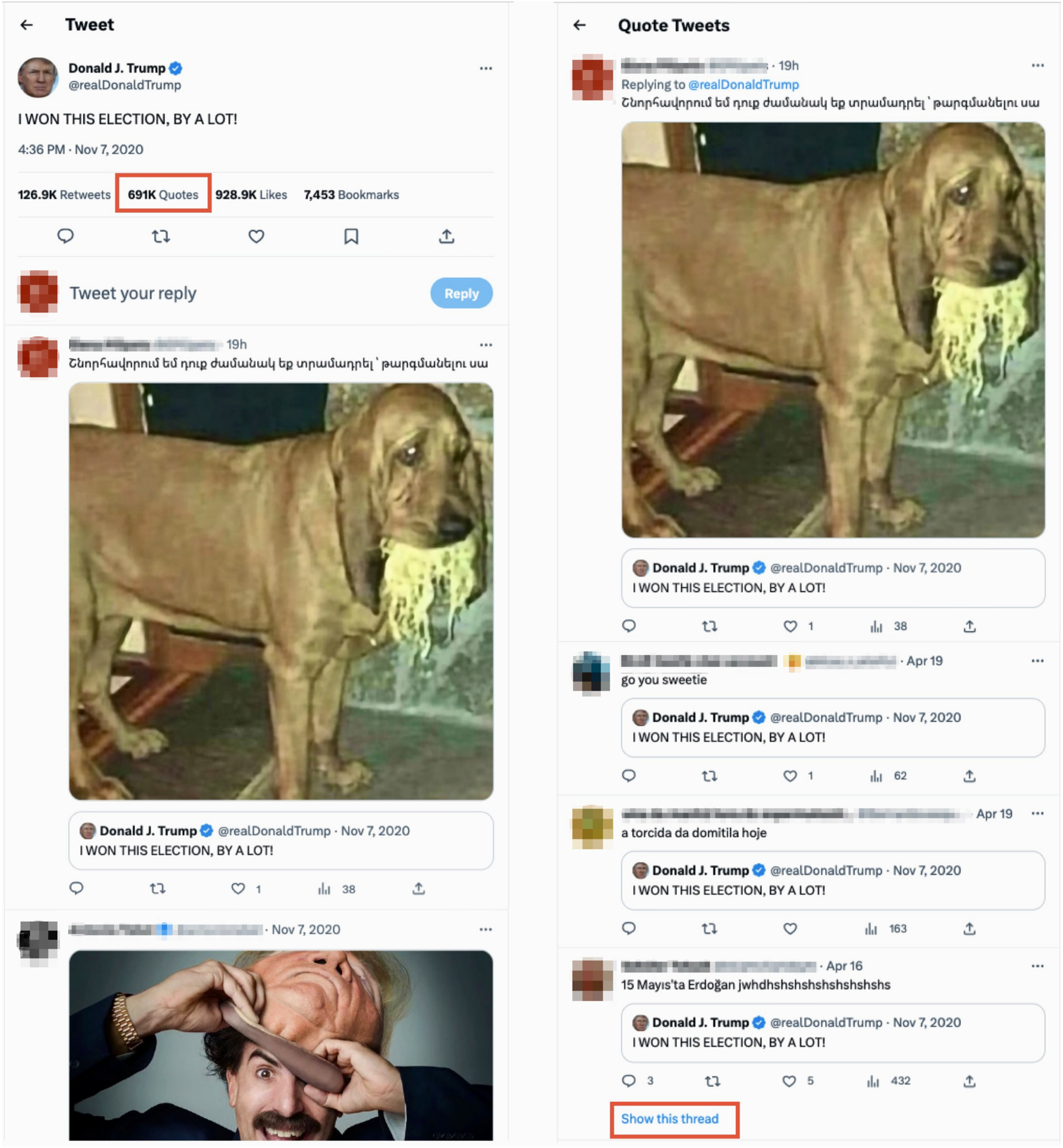
Screenshots capturing the thread of replies (left) and the thread of quote tweets (right) to Trump's tweet in April 2023. Note that the ‘Armenian curse’ incorporating Trump's original tweet recently and experimentally posted by Author appears in both threads, imitating the tactic of quoting in replies frequently deployed on the day Trump published his false announcement
Of Trump's tweets on 7 November, ‘I WON THIS ELECTION, BY A LOT!’ gained particular visibility through some 980K replies, 1269K retweets, 691K quote tweets, 9289K likes, and much public commentary: our dataset consists of replies and quote tweets to this particular post. As we have previously shown, befitting the highly antagonistic, affective, and polarized nature of debates surrounding the 2020 elections, responses to the tweet were highly partisan in tone as ones of either for or against (Pilipets and Paasonen, 2021). Some supported Trump's unfounded claims and declared their enduring support with ‘you won, sir’ replies expressing disappointment and ire over the results. Others jumped in to ridicule ‘the loser’ and to vent their utter delight. Within the 16,103 comments with images, users deployed a range of popular memes and reaction GIFs, from ‘Blinking white guy’ emoting tired disbelief to temper tantrum GIFs and those repurposed from televised presidential debates. Election maps showing both accurate and inaccurate outcomes were in frequent use, as were screen grabs from the online multiplayer game Among Us combining the text ‘orange was ejected’ with a stylized image of Trump cast out into space. While all this was predictable enough, Armenian curses featuring absurd, creepy, and bizarre ‘cursed images’ stood out as a disruptive wave of imitation, making us wonder: Is this all just copypasta? Or, if not, what on earth is it?
Originating from the popular genre of early 2010s creepypasta toying with scary stories, and so-called haunted digital content (Balanzategui, 2019; Henriksen, 2018), cursed images were first classified as such on the Tumblr account cursedimages and have since enjoyed a cross-platform existence on Reddit, Twitter, Instagram, and TikTok. While cursed images have been circulating for a while, criticism of appropriating and othering non-Latin alphabets as ‘demonic copypasta’ in connection to them emerged during the 2020 US presidential election (Sung, 2020), rendering the practice contextually specific. When the then-president tweeted about his positive Covid-19 status on 2 October 2020, the commenting on his thread ‘evolved from pairing Amharic with demonic or Satanic images […] to using surreal and humorous ones’ (Sung, 2020). In the responses to ‘I WON THIS ELECTION, BY A LOT!’, elaborate curses and bizarre comments spelled in Armenian were combined with cursed images, as well as with a range of things beyond. Circulating uncanny photos, mainstream memes, and distorted images of Trump's face, Armenian quotes and replies simultaneously anchored the visuals in pertinent threads and obscured their potential meanings. In semiotic terms, these acts of sharing were inherently polysemic in combining images and text with a range of potentially discordant connotations (Katz and Shifman, 2017). In terms of their embeddedness in Trump's comments, Amharic and Armenian alphabets were used for the purposes of attention capture so as to add exotic eeriness to the curses in a predominantly Anglophone, US context.
A feeling of nonsense that these contributions shared was intensified by both seemingly cryptic messages and the unruly use of Twitter commenting features. In allowing users to retweet with their own comments, quote tweets made it possible for Armenian curses to turn into a networked public performance beyond the boundaries of Trump's thread. Similarly, yet not identically, improvisational replies in Armenian also frequently appropriated quotes, using the link to Trump's tweet to incorporate his own words within the curse (Figure 1). The specificity of how Twitter embeds comments, therefore, does not imply differences in the content of Armenian curses, but rather in their possible outreach. As users kept adding their own and reusing each other's material, cursing extended into online contexts where the functions of distinct platform artifacts ‘become indistinct in the flow of […] memetic riffing’ (Pilipets, 2023: 111–12). Here, ‘curse quoting’ Trump might have been a means of throwing his own fake news back at him, just as it might have been a deliberate attempt at spamming (Parikka and Sampson, 2009), a tactic of affective reversal (Griffin, 2021), an act of political jamming (Pentzold et al., 2022), or a form of trollish amusement ‘for the lulz’ (Phillips, 2015). As we argue below, it is against this background that Trump's faux announcement gave rise to social theatre where users performed wit and flair, improvising and rerouting each others’ comments in surprising directions as they went along.
Methods: Online images, memeification, and the value of outliers
The following sections investigate Armenian curses as drivers of trollish, spam-like engagement grounded in both Twitter-specific and web-distributed vernacular online cultures. Since some of the cursed replies and quote tweets were removed as our research data were scraped, and as there are platform-specific limitations to scraping to start with (Marres and Weltevrede, 2012), our data are partial in capturing the content then in circulation. Reflecting on the curses’ irregular rhythms and composite nature, we trace users’ memetic interventions through the entanglements of textual, pictorial, and numeric elements in networked image sharing (Colombo, 2018; Hochman, 2014). These rhythms wove in and out of a long tail of political memes, animated GIFs, and electoral maps, creating an uncanny disruption in the event's polarizing logic.
Our curated dataset captures 522 replies and quote tweets derailing the thread through puzzling cursed images, creepypasta faces, Trump memes, demonic jinxes, and other nonsensical text-image combinations. Filtered from a set of 16,103 visual contributions, the dataset zeros in on the outliers using added text in Armenian and potentially violating Twitter's spam policy due to their repetitive posting. Assembled through Twitter Standard Search API and scraped through Phantombuster Twitter search module, it represents only a minor share of engagements that kept disappearing under Twitter's warning labels shortly after their publication. Fully acknowledging the data's ephemerality and partiality, we argue that such dynamics speak of both the regulatory ecology of platforms and events that disrupt standard patterns of social media exchange. We also argue that the different expressive layers assembled by Armenian curses not only underline the importance of looking beyond polarization but also require methods open to plural ways of contextualizing data (D’Ignazio and Klein, 2020; Parry, 2022).
By remixing and re-embedding different data points (text, time of posting, image URLs, engagement metrics), we experiment with two analytical techniques. The first of these pertains to the capacities of vernacular visual material to intervene in and adapt to platform contexts (Gibbs et al., 2015). In order to address the curses’ memetic patterns, we pay attention to the relations of visual and textual content, as well as to how Twitter-specific commenting features shaped user interactions within the thread. To conceptualize the semantic richness of Armenian curses, we executed a co-occurrence analysis of translated word pairs (Danowski, 2013), which allows for investigating patterns of repetition-with-variation in the image captions (see Figure 2). By using Armenian text as the main entry point into memetic dynamics, we not only show that cursing is inherently relational, and thus contextual (Reagle, 2015: 18–19), but also that the associations it affects are multi-faceted and open-ended. A collage of cursed replies and quotes screenshotted shortly after Trump's account was suspended (Figure 3) provides a situated insight into the conditions of multimodal memetic play (Katz and Shifman, 2017).
Our second technique further develops visual methodologies attuned to the contextual embeddedness of images across the web. By using the Google Vision API web detection feature for image annotation, we repurpose ‘web entities’ or references obtained from the content of pages with matching images (Google Cloud Vision API Documentation, 2021). Comparable to a reverse image search, the feature processes the information across images and associated text using metadata embedded in the images’ current online locations. By leveraging the capabilities of the Google Knowledge Graph (Burkhardt and Rogers, 2022; Omena et al., 2021), the method provides contextual clues to each of the images in terms of their literal content (e.g. ‘forehead’, ‘clothing’, ‘muscle’), their associated web locations (e.g. ‘KnowYourMeme’, ‘Reddit’), and commonly found image captions (e.g. ‘cursed image’, ‘creepypasta’, ‘Among Us’). That is, if copies of an image are found on multiple pages displayed with specific references, such as proper nouns, Google Cloud web detection will use these references for image annotation (Hasty, 2017). Within its limitations, this method provides a means of studying vernacular styles of cursing and allows for the grouping of images by their shared memetic properties.
The resulting analytical artifacts guide our interpretation in two steps. In order to explore the temporal dynamics of memetic riffing, Figures 4 and 5 first situate the 522 Armenian curses in relation to all other simultaneously published, predominantly Anglophone text-image responses to Trump's comments (n = 4768). A visual analysis of these responses performed with the aid of detected web entities highlights both unique and shared expressive styles adapted during the intervention. In Figure 6, the analysis of pages with matching cursed images becomes central to our exploration of their vernacular characteristics. Since images exist as multi-situated collectives across the web (Gibbs et al., 2015; Tuters, 2021), it is important to note that this method is less about studying image circulation in the common sense of ‘following the object’ (see also Dieter et al., 2019). Instead, we look at the ability of web detection to match each cursed image against its copies – ‘compressed, reproduced, ripped, remixed, as well as copied and pasted into other channels of distribution’ (Steyerl, 2009). Exploring how memetic styles common elsewhere emerge as outliers within Trump's quotes and replies, we present a relational account of cursed images defined by the medium of Twitter as well as by online engagements extending scholarly attention beyond platform-centric ecosystems.
‘Congratulations on taking the time to translate this’: Spamming, cursing, riffing off
The unpredictable visibility – or ephemerality – of cursed tweets had to do mainly with their resemblance to spam. As a means of amplifying disruptive messages through repetition, a spam attack is a turbulent example of ‘environmental noise’ (Brunton, 2013; Parikka and Sampson, 2009: 2–3). Early definitions of spammy social media comments were largely concerned with bots deployed for automated traffic manipulation, often with promotional intent (Reagle, 2015). As malicious utilization of comments intensified over the past decade through trolling and targeted disinformation, platforms adjusted their guidelines and introduced stricter regulations (Paßmann et al., 2022). We nevertheless consider the ‘spamminess’ evident in the Armenian curses as a driving force in tactical memetic commenting.
Twitter/X before, during, and after Trump's reign has not been just broadly framed as a space of ad hoc publics (Bruns and Burgess, 2011) and political debate, it has also fostered a culture of sick burns, hateful trolling, and meme wars spreading across platforms through both strategic and improvisational engagement – from pro-Trump ‘memetic frenzy’ (Hagen, 2020) in the wake of Cambridge Analytica's Facebook data breach to the emergence of Q-Anon in an era of ‘Post-Truth’ (McIntyre, 2018; Pybus, 2019; Sismondo, 2017) and the mobilization of domestic terrorism on Parler (Kydd, 2021; Munn, 2021). According to X's (2023) current manipulation and spam policy, ‘bulk […] activity that misleads others and/or disrupts their experience’ becomes subject to moderation without necessarily being amplified through automation. The policy came into full force during the 2020 US elections, when Trump's tweets flagged by the platform with warning labels received more engagement than his unlabelled posts (Sanderson et al., 2021), provoking both affective forms of public expression and targeted interventions. Disruptive enough in their rhythm to be removed, Armenian curses provide one such example, directing our attention to seemingly cryptic, repetitive comment structures. Instead of simply demarcating noise, in Figure 2, a network analysis of translated curses makes evident repetitions within the data along with semantic heterogeneity ranging from ‘killer beast’ and ‘cowardly fairy’ to ‘joy macarena’. Tracing the emergence of novel adaptations, we understand these relations in terms of ‘vernacular language games’ (Peeters et al., 2021) characteristic of fringe online cultures.
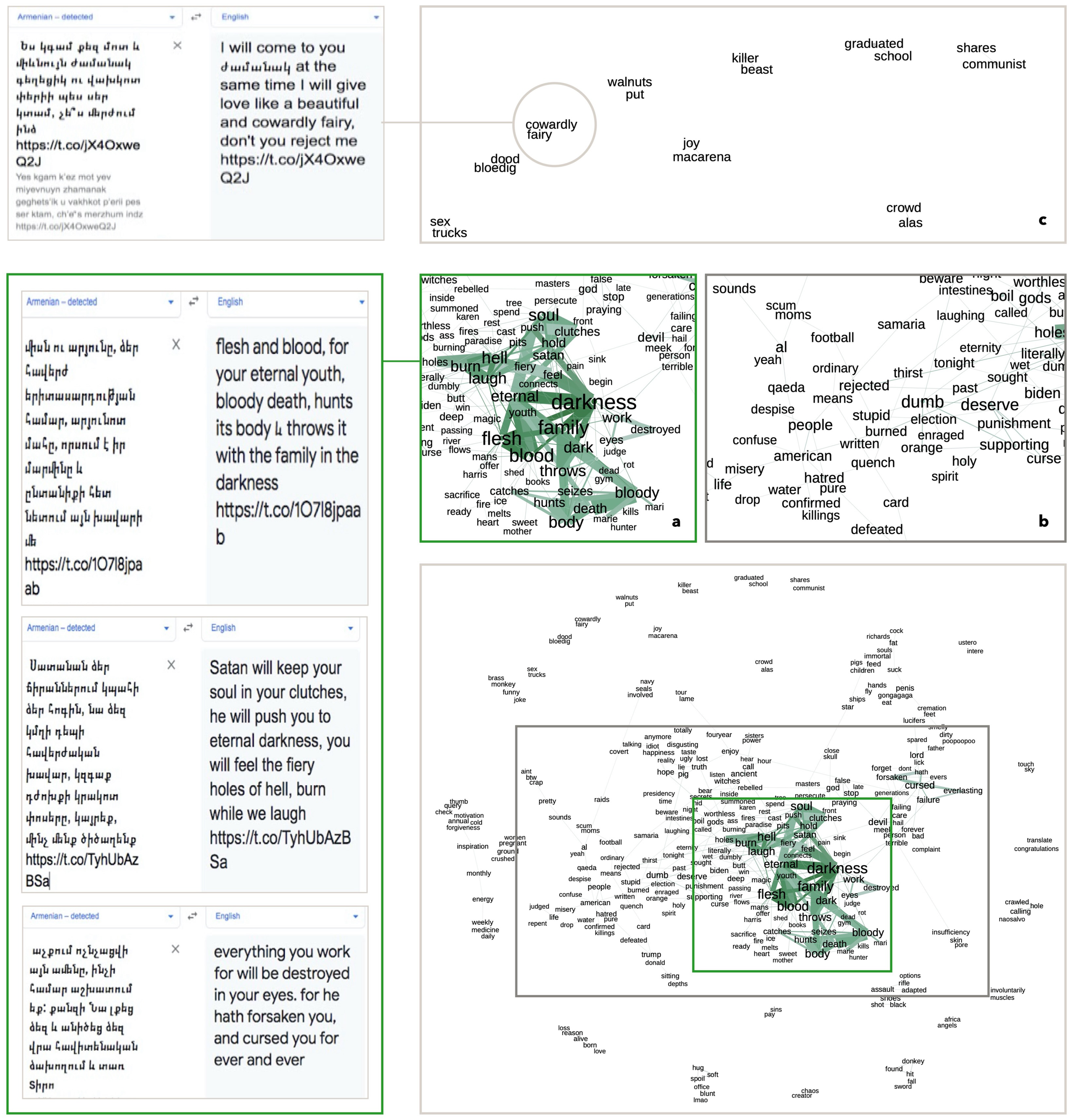
A Gephi network of word associations extracted from 552 translated Armenian curses. The size of words and the thickness of edges are based on the frequency of word pair repetitions
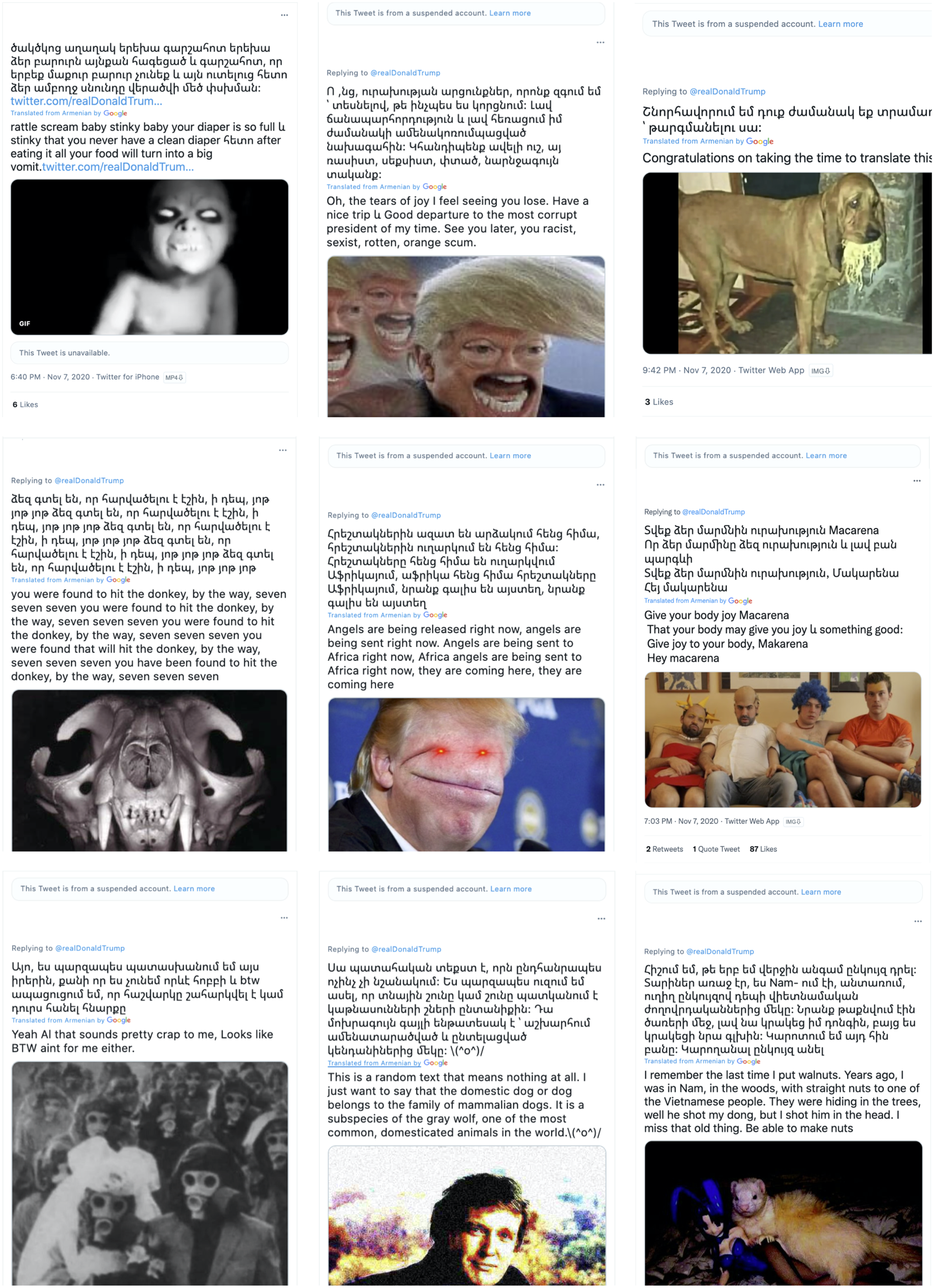
A selection of Armenian replies and quote tweets combining text in Armenian with black-and-white creepypasta, grotesque Trump faces, and cursed images. Retweet count range: 0 < 4. Like count range: 1 < 165. Screenshots were made after Trump's account was suspended
The connections between words presented in Figure 2 derive from 552 Armenian comments published by 430 unique users. We used a force-directed visualization layout (Jacomy et al., 2014) to explore semantic neighbourhoods where words appear either closer together or further apart on the basis of the frequency of their co-occurrence (Danowski, 2013). Following this logic, the position of nodes and the thickness of edges in the network can be interpreted as indicators of frequently repeating content and deviations thereof. The analysis, as emphasized through word size and density of connections does not therefore suggest a monolithic curse pattern but rather points to varying intensities of textual riffing. This includes, but is not limited to, three types of copypasta condemning Trump's ‘flesh and blood’ to darkness (n = 167), his soul to ‘the fiery holes of hell’(n = 117), and his work to destruction (n = 50).
While dense connections between word clusters suggest an degree of similarity (a), spells positioned further away from the network's core point to a different kind of imitation. Alongside more or less predictable references to ‘dumb orange man’ (n = 6), ‘ancient witches’ (n = 8), and ‘everlasting failure’ (n = 24) in the mid area of the network (b), word pairs at the margins (c) point to disconnected outliers. Adding more interference to seemingly homogeneous noise, the quote tweets and replies cited belowtp show that, however continuous it may appear, the curse-spamming of Trump with copypasta evolved into a playful dynamic of variation and translation. As a memetic intervention where a message is never transmitted unaltered, the harvesting of attention with the aid of the Armenian alphabet fuelled novel and absurd associations: I remember the last time I put walnuts. Years ago, I was in Nam, in the woods, with straight nuts to one of the Vietnamese people. They were hiding in the trees, well he shot my dong, but I shot him in the head. I miss that old thing. Be able to make nuts Give your body joy Macarena That your body may bring you joy և something good: Give joy to your body, Makarena Hey macarena Congratulations on taking the time to translate this
Such perplexing adaptations coin a sense of ‘viral anomaly’ (Parikka and Sampson, 2009) in networked commenting practices unfolding at the crossroads of authorial intentions, user perceptions, and the posts’ literal content. On the one hand, the iteration of curses in tandem with images of black-and-white demons and photoshopped photos of Trump resulted in something like a double curse as a relatively straightforward tactic of critique and expression of negative sentiment. On the other hand, disjointed variations – the ‘hey macarenas’ – of the Armenian curses offered something much more ambiguous (Figure 3).
Blending memetic intervention with spamming, the curses comprised an impromptu social theatre built on absurd, quirky thrills and spontaneous fun that refused to quite make sense. Given the thick ambiguities involved in individual comments published for fellow curser-casters, other meme-creators, commentators, and lurkers, it is not warranted to identify the acts of cursing unequivocally as a form of resistance (to Trump), even as its disruptive dynamic freely lent itself to such ends. Repetitive, obscure in their references, and striking in their overall aesthetics, cursed replies and quotes stood out as a transient ‘memetic formula’ (Hagen and Venturini, 2022) with its own ephemeral structure and engaging style.
The rhythms, styles, and web ecologies of visual ephemera
Iterating the same or similar text alongside images that were both newly added and borrowed from other comments, acts of cursing gained momentum in a surge of disruptive imitation, their rhythm becoming more pronounced around 11 p.m. Explaining why this was the case involves a discussion of the dominant commenting styles that Armenian curses were intervening in, along with a cross-reading of the main memetic references they appropriated.
Rhythms: Density and intensity
Using a composite visualization technique, Figure 4 situates the curses in the context of memetic play with other replies’ and quote tweets’ visual content. To account for their multimodal relations, it locates the intervention in the flow of temporally co-occurring posts with images that did not contain Armenian text (n = 4768). Prompting sequential adaptations, Armenian curses gave rise to a spam-like memetic invasion, which Twitter took action against with warning notifications and temporary account restrictions. As a result, the spike of cursing at 11 p.m., as depicted in Figure 4, can be attributed to various factors, including its close proximity to the moment we activated the scraper and a notable increase in cursing with mainstream memes and electoral prediction maps derived from other contributions. Focusing on the rhythms of posting, the Figure 4 assembles replies and quote tweets (both cursed and not) in the same temporally situated charts for a better comparison of the comments’ memetic styles.
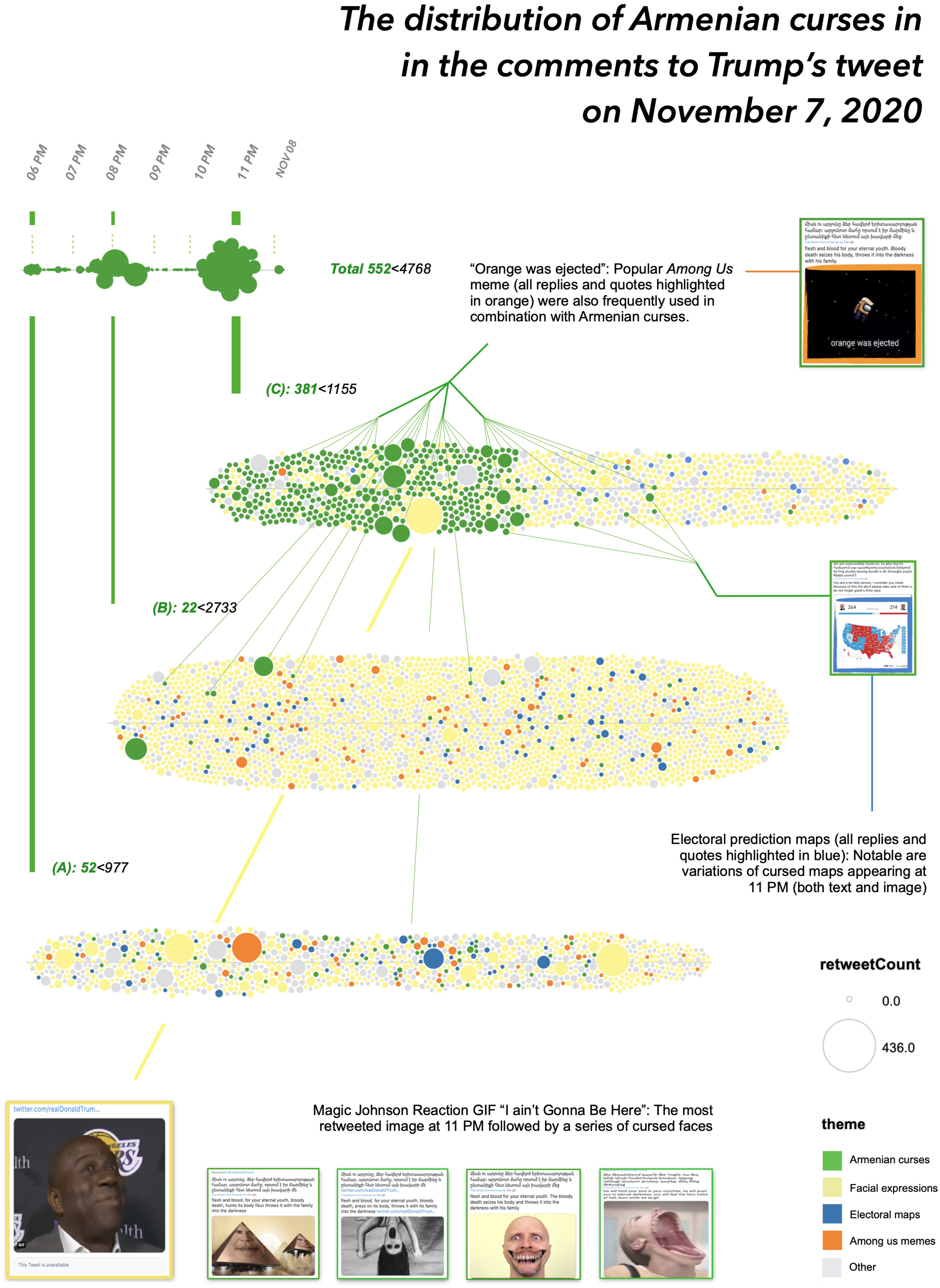
The rhythm of 552 Armenian curses and temporally co-occurring comments sized by the number of retweets and coloured by shared memetic styles; visualized with RawGraphs (Mauri et al., 2017). Data visualisations in color are available online
The composition of visual, textual, and temporal engagement was captured by using platform-native metadata (post captions, timestamps, and retweets) in combination with the automated detection of memetic styles through web entities. By translating replies and quote tweets into data points, and arranging them in accordance with the time of posting, the figure outlines the distribution of Armenian curses (marked in green) in relation to other simultaneously published comments. The visual analysis of styles detected in the latter points to the widespread utilization of facial expressions – as in popular memes and reaction GIFs (yellow) – screenshots and modifications of electoral prediction maps (blue), and Among Us images with references to Trump in the embedded text ‘orange was ejected’ (orange). The colour combinations – as in the green and orange or green and blue of the lines framing images shared on repeat – stand for the multiplication of curses incorporating these memetic entities. Here, the viral image mocking Trump as a fictional Among Us character or ‘impostor’ cast out in space (Stanfill et al., 2021) became the main memetic driver along with the cursed electoral maps derailing the alternating celebrations of Trump or Biden, respectively.
Based on the colour patterns of the charts and the size of individual units, Figure 4 allows for a comparative reading of the commenting rhythms in different memetic ‘style spaces’ (Manovich, 2011; Rogers, 2021) and the intensities of engagement with individual contributions measured in retweets. Analysing the intervention over time, sections (A), (B), and (C) in Figure 4 suggest an ephemeral logic that manifested itself in memetic riffing at 6, 8, and 11 p.m. By copying and modifying each other's (oftentimes only briefly appearing) messages, people joined an improv of sorts, one main feature of which was the addition of novel content, rather than its amplification through mutual retweeting. The changes in the charts’ proportions also show how the density of cursing fades away, dissolving into the linearity of comments scraped in real time and owing to Twitter's attempts to remove spammy posts. The varying scales and styles of engagement, therefore, not only highlight the fleeting nature of cursing but also demonstrate how, in line with Wendy Hui Kyong Chun's notion of ephemerality (2008), disappearing comments were ‘made to endure’ through imitation. Despite their ongoing removal, Armenian curses gave rise to an engaging dynamic where each post provided material for the subsequent one to replicate and remix.
Styles: Adaptation and memetic riffing
The persistence of Armenian curses published by multiple users indicates a pattern of adaptation specified in Figure 5, operating in the following ways. First, characterized by its capacity to mobilize interactive encounters, a meme requires both repetition and variation in response to its contending engagements. Second, users’ recurrent attempts to ‘curse’ the flow of polarized responses – reaction GIFs pro and contra Trump; facial expressions of joy and anger – were equally embedded in a battle over eyeballs. By multiplying cursed comments instead of liking or retweeting previous contributions, the intervention invites a plural reading that puts emphasis on the references shared within and across different memetic styles. Attending to these relations, our analysis below compares web entities detected in the visual layer of Armenian curses to web entities associated with facial expressions, Among Us memes, and electoral maps.
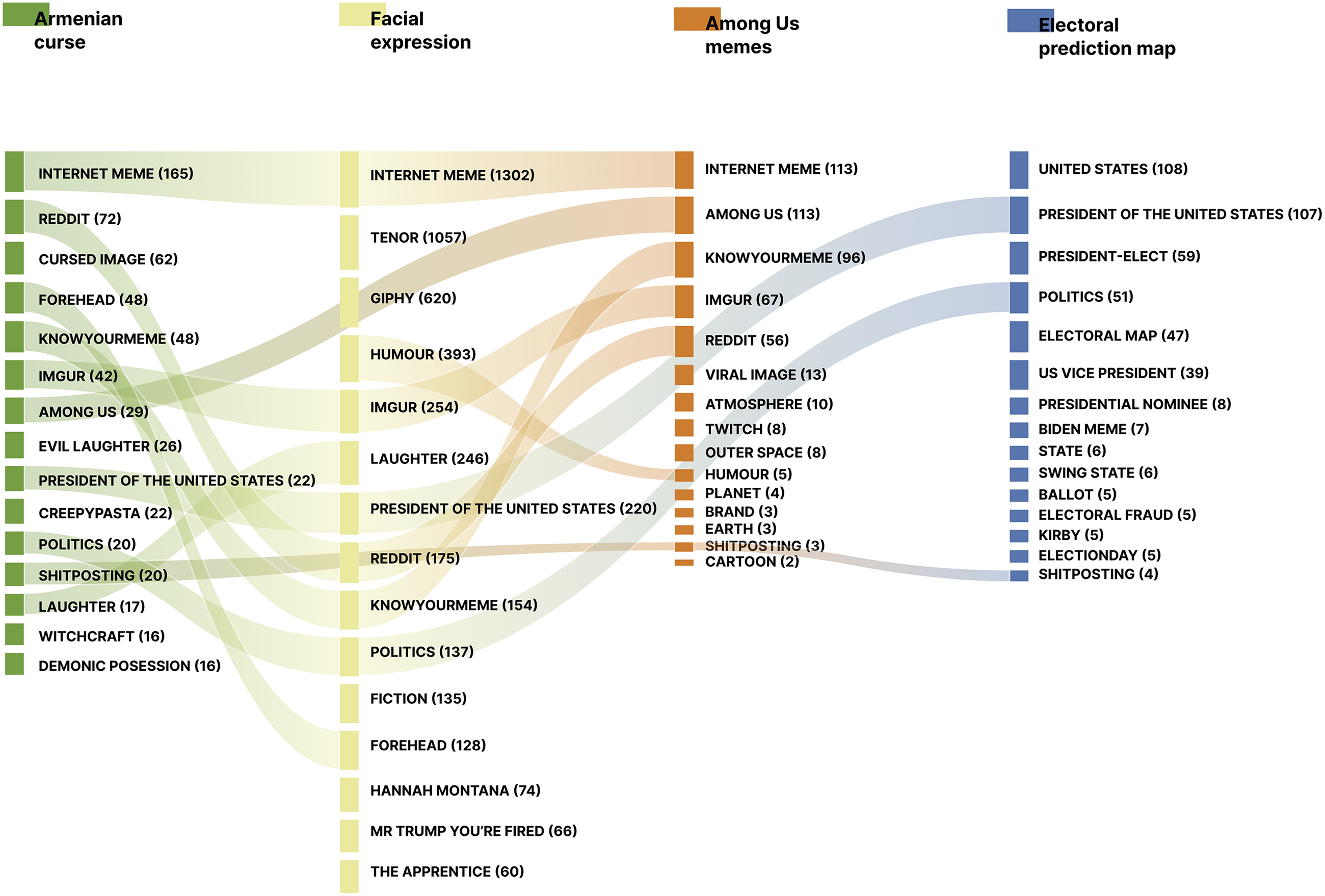
Web entities frequently associated with the images of 522 Armenian curses and three temporally co-occurring memetic styles; visualized with RankFlow (Rieder, 2015)
As web-aggregated keywords derived from the images’ online environments, web entities are characterized by two central aspects: the diversity of cultural references intertwined with matching images and the ability to trace these images back to their contexts. Comparing different memetic styles in the visual layer of comments to Trump, it is important to point out that the references captured through web entities in Figure 5 are not mutually exclusive; laughing faces, for example, ranged from the teen sitcom Hannah Montana to the ‘President of the United States’. The co-occurrence of the latter with Trump's reality show The Apprentice is not surprising in this context, nor are Tenor and Giphy web entities – reaction GIFs being, after all, vernacular affective shorthand for the sharing and amplification of sentiment. In other adaptations, ambiguous expressions of ‘laughter’ through memes and reaction GIFs turned into the ‘evil laughter’ of Armenian curses. Electoral prediction maps demonstrating the victory of either Trump or Biden, in connection with the Armenian alphabet, further amplified this ambiguity through ‘shitposting’ as a form of relating and possible bonding across memetic styles. Meanwhile, web entities ‘cursed images’ and ‘creepypasta’ associated with ‘demonic possession’ were unique to the use of the Armenian alphabet (see also Figure 3), shifting our focus from the analysis of visual content to the exploration of its vernacular characteristics.
Contexts: Web ecologies and subcultural milieus
An important analytical affordance (but also limitation) of studying fringe memetic formations through web detection lies in the identification of contextual references connected to the online locations of identical (or similar) images. As a meme becomes more established, particularly when it involves multiple copies and adaptations dispersed across the web, its vernacular associations grow more diverse than those associated with less well-known memes. Yet ‘cursed images’ – a Tumblr-originating genre well documented on KnowYourMeme and continuously curated on Reddit – lacks visual consistency, thus largely escaping both human and computer-generated categorizations. As we argue in this section, it is not just the content of ‘cursed images’ that shapes the specificity of Armenian curses: there is a complexity to the curses’ appeal arising from the contextual embeddedness of images in different online milieus (Gibbs et al., 2015).
Extended detection of web pages containing images identical to the ten most distributed cursed images in our dataset points to a range of mainstream and alternative platforms supported by meme generators, lifestyle news sources, and internet folklore sites. Focusing on the images’ multi-situatedness (Dieter et al., 2019), Figure 6 suggests that they entail different cultures of use located on Reddit, KnowYourMeme, Amino Apps, 4chan's political discussion board /pol/, and a range of online locations beyond. Within meme research, Reddit and 4chan are characterized as the ‘deep vernacular web’ (Tuters, 2021) in reference to subcultural image boards that transgress more mainstream conventions of social media exchange. Cursed images play an important part in these fringe communities where the appeal of cursing derives less from its intended meaning than from its ‘spirit’. As r/cursedimages (2023) suggests, ‘if the image causes confusion, eeriness, or dread, the spirit of an image is fulfilled’. Beyond these unsettling characteristics, however, our analysis of Armenian Twitter curses shows that the images’ affective force largely derives from incongruities between text, image, and context. Putting forward surprising recombinations, cursed comments render visible the dynamics of collective play moving from Trump-cursing to memetic nonsense, and back again.
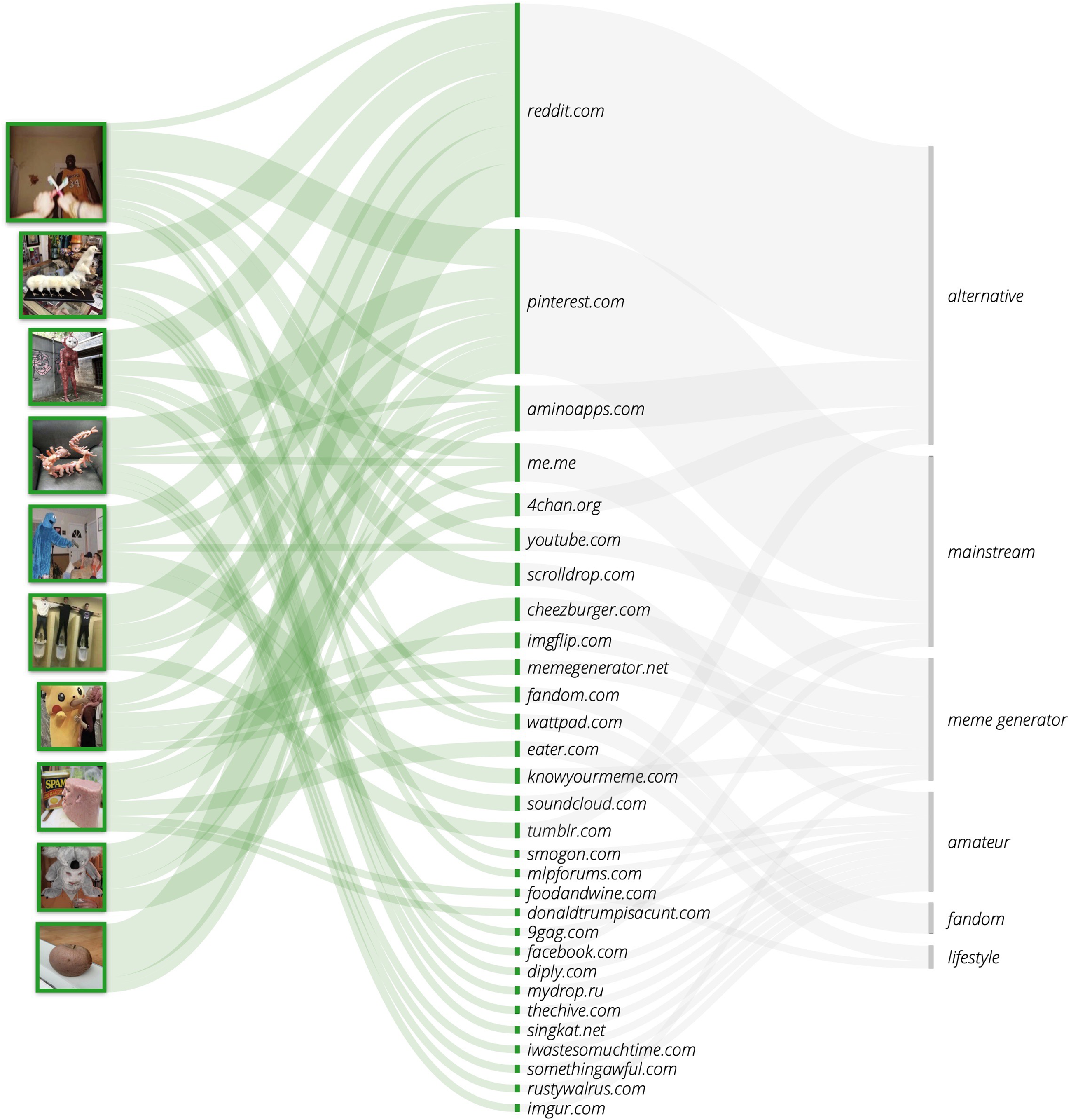
A selection of 10 most circulated cursed images and 30 manually coded web pages hosting full matching visual objects according to Google Vision API. Flow size corresponds with the number of matching images per page (range: 1–5). Google Vision API accessed through Memespector GUI (Chao, 2021); visualized with RawGraphs (Mauri et al., 2017)
The capacity of this visual vernacular to simultaneously find its way into meme generators, image curation platforms such as Pinterest or Amino, and event-specific creations such as donaldtrumpisacunt.com, then, speaks of its appeal as attention-grabbing content. Connections between somethingawful.com – a cornerstone of the vernacular internet and the birthplace of creepypasta – and amateur clickbait sources further indicate how folklore-driven memetic styles fuel transformations in communicative codes. Difficult to capture in large-scale analyses of online interactions due to the content's polysemy and ephemerality, such transformations contribute to ways of hijacking networked attention in social media events.
Conclusion: Memetic commentary and play
The ‘Armenian curses’ – involving both actual curses and random riff-offs, cursed images and broadly circulated memes alike – draw attention to how Twitter's commenting systems of replies and quote tweets assembled collective forms of semiotic disturbance addressed in this article. The styles, rhythms, and scales of cursing, as visualized in Figures 2, 3, 4, and 6, suggest a participatory model of commenting (Barnes, 2018) where people got pulled in to not just copy and paste but to play with translated content and creepy visuals involving both imitation and absurd fun. Ephemeral and unruly in their engaging potential, the Armenian curses can be understood as horizontal forms of commenting on comments, which allow researchers to address Twitter/X's different expressive modalities and cultures of use. Seizing some of the global attention produced by Trump's tweet, the curious case of cursing not only exemplifies the emergence of ad hoc social media theatre specific to the platform but also invites cultural studies scholars to consider what constitutes the driving force of comments in social media exchanges. As we have shown, even as the overall tug of cursed comments was anti-Trump (as in literally cursing ‘the orange man’), their flow grew into a vernacular space of memetic play and improvisation resistant to unifying readings.
Circulating through sharing and appropriation, memes offer spaces for resistance and critique but also for incongruous, ridiculous, and irrational commentary that eschews the overall logic of the exchanges in which they intervene (Sundén and Paasonen, 2021). In the context of polarized political exchanges laden with affect to start with, memes communicate and register intensities of feeling (Griffin, 2021) that tap into and impact users’ capacities to act and be acted upon, both on-platform and off. As platform-situated and web-distributed vernacular materials, Armenian curses and cursed images help to map these dynamics as play both reliant on repeatable patterns and open to contextual variation. The rhythms and styles of cursing, therefore, invite methodological combinations that respond to the heterogeneity of participatory cultures, raising questions about the aggregation of user affect and data that online image sharing entails (Paasonen, 2023; Pilipets, 2023). To understand replies and quote tweets as drivers of memetic engagement, then, means to acknowledge how they animate networked encounters of varied reach and intensity, as well as how they assemble feeds, images, text, metrics, and linking practices comprising Twitter/X's communicative scenes.
The analytical techniques deployed above help in tracing the dynamics of memetic commenting on X while accounting for the embeddedness of memes in wider visual social media ecologies. In this sense, they can be equally productive in studying other online phenomena that involve manifold subcultural references and forms of expression. As is the case with any methods embracing pluralism (D’Ignazio and Klein, 2020; Parry, 2022), ours come with limitations tied to the partiality of perspectives inherent to multimodal analysis. By augmenting web detection of memetic references with qualitative close-looking and critical interpretation of platform metadata, our approach nevertheless accounts for the dynamic nature of vernacular content and shows how Twitter's social theatre of Trump's deselection entangled with both memeification and spamming. In analytical terms, such plural readings can help generate thicker descriptions of visual social media events by accounting for the multiplicity of contexts and practices at play.
The contextual and temporal qualities of memetic commenting characteristic of social media, and those of Twitter/X in particular, offer a compelling methodological path for researchers to study the fleeting constellations of vernacular content. In line with the scholarship addressing the composite nature and multi-situatedness of online cultures (Colombo and Niederer, 2021; Dieter et al., 2019), we have demonstrated that memetic exchanges entail various trajectories of sense-making that defy rigid categorizations. To deploy digital and visual techniques as cultural studies methods, as has been the rationale of this article, is then a means of expanding contextual care to networked forms of diversion, creativity, sociality, and fun that easily escape both rational analyses of political discourse and computational methods relying on systems of counting and classification; in both instances, the Armenian curses would represent noise, and be excluded from analysis as such. Our analysis shows that the Armenian curses’ short-lived affective pull opened room for improvisational play, the ad hoc rules of which were shaped in an unpredictable manner by both Twitter's spam filtering policy and users’ remixing. Driven by absurd, eye-grabbing content, the curse waves broke away from the polarized logic of the thread initiated by Trump by coining its own improvisational principles, trading in subcultural memetic capital, and catering unsettling affective releases.
Footnotes
Acknowledgements
With special thanks to Aikaterini Mniestri and the anonymous reviewers for the valuable feedback. We would also like to thank the participants of our project during the SMART Data Sprint 2021, out of which this paper emerged.
Funding
The author(s) disclosed receipt of the following financial support for the research, authorship, and/or publication of this article: This work has been funded by the Deutsche Forschungsgemeinschaft (DFG, German ResearchFoundation) – Project-ID 262513311 – SFB 1187 as well as by The Reserch Council of Finland, 352520.

Author biographies
Elena Pilipets is a postdoc researcher in Digital Media and Methods at the Department of Media Studies, University of Siegen, Germany. Her work explores social media (sub)cultures, with particular attention to the study of platforms through combinations of visual and digital methods.
Susanna Paasonen is Professor of Media Studies at the University of Turku, Finland. With an interest in studies of sexuality, networked media, and affect, she is the PI of the Academy of Finland research project, Sexuality and Play in Media Culture and the Strategic Research Council consortium, Intimacy in Data-driven Culture. She is most recently the author of Dependent, Distracted, Bored: Affective Formations in Networked Media (MITP 2021) and Who's Laughing Now? Feminist Tactics in Social Media (MITP 2020, with Jenny Sundén).