



Abstract
This article considers how house-sharing – sharing a home with other, usually unrelated people – is mediated by digital technologies. Drawing on academic literature on house-sharing and self-(re)presentation in digital cultures, interviews with share-house residents in Melbourne, Australia, and user posts in house-sharing groups on Facebook, we identify a sequence of steps and stages integral to the process of (re)forming a share-house in the competitive private rental market. These include advertising, screening, vetting, digital interactions, interviews and house tours. Considering this multi-stage process from the dual perspective of ‘home-seekers’ (applicants) and ‘housemate-seekers’ (existing household), we analyse how both parties deploy representational and communicative strategies, explore the conventions and complexities underpinning these interactions, and present a conceptual framework that explicates the process. The article contributes to scholarly debates about mediated practices of self-(re)presentations, and about house-sharing as a significant practice in a housing market that renders home ownership increasingly unaffordable.
Introduction
House-sharing is a practice covering a variety of accommodation arrangements sited within a single dwelling. The term ‘house-sharing’ commonly denotes two or more people sharing a house or apartment. While cultural norms and practices vary, in Australia it generally describes shared living situations that extend beyond the immediate family unit. Shared households can comprise strangers, groups of friends, couples and singles, a single parent and child sharing with unrelated adults, a homeowner living with a tenant, or a mix of relatives, friends, partners and acquaintances living together. Most housemates share a rented property under a co-tenancy or subletting arrangement.
House-sharing has become increasingly common in developed economies. Contributing factors include declining housing affordability, decreasing home ownership rates, population growth, and changing social norms, including a shift away from living arrangements based on traditional nuclear family structures (Druta et al., 2021; Maalsen, 2020, 2022; McNamara and Connell, 2007; Raynor and Panza, 2021). The process of finding a suitable share-house/new housemate is increasingly mediated by digital technologies and platforms (Maalsen, 2020; Maalsen and Gurran, 2021). Despite this significant trend, there are limited conceptual models that seek to explicate these mediated processes. Our article targets this gap by developing a novel theoretical framework conceptualising how these mediated exchanges unfold.
This article focuses on mediated house-sharing practices in Melbourne, Australia, a country that tracks in line with these broad patterns around the coinciding rise of both digitally mediated exchanges and shared living. Housing affordability has been declining for 25 years. Outright home ownership fell by one quarter in the two decades spanning 1998–2018, dropping from 40% to 30% (AIHW, 2021). Despite the market disruptions of the Covid-19 pandemic, house prices continued soaring to extraordinary heights (Pawson et al., 2021), before dipping in 2022. However, this downturn has not improved housing affordability, and both rents and interest rates have risen steeply (Wind, 2022).
Over one quarter of Australians live in private rental properties, with another 3% renting government-owned public housing (ABS, 2017). Nationally, the proportion of ‘group households’ increased 10.56% over the five-year period 2011–16 (ABS, 2017). However, these figures likely underestimate the actual prevalence of house-sharing, as they are based on cohabitation by ‘unrelated people’, omitting a range of other scenarios (McNamara and Connell, 2007: 76). These trends contribute to the emergence of what has been dubbed ‘Generation Share’, characterised by a decline in living alone, longer periods of renting, and increasingly diverse renter demographics (Burke et al., 2014; Maalsen, 2019: 320). As one housing policy expert remarked, ‘The great Australian dream has been about home ownership. It's now become a lot of people's nightmare’ (ABC, 2021).
Australia's fastest-growing city, Melbourne, has around 5 million residents. Its rental market is expensive and highly competitive: housing affordability has tracked downward for a decade, and rental stress, overcrowding and homelessness are increasing (SPHC, 2020). Renters seeking to establish or join a Melbourne share-house are entering a highly pressurised market. In 2022, popular inner-city suburb Fitzroy had 87 applicants for every share-house room listed (Cary, 2022), while a house containing six ‘space shuttle’ pods, each comprising a single bed for up to AU$900 a month, was reportedly fully rented out (Kelly, 2022).
This study examines how shared households are (re)formed in this context, and how this process is digitally mediated, particularly via online platforms. Based on our analysis, we develop a conceptual framework that construes mediated share-house formation as a three-stage process, which includes the in-person housemate interview/house tour, a practice that has received scant critical attention – and which also has a mediated and self-promotional dimension. We draw on unpublished empirical data from qualitative interviews conducted in 2017–18 with 19 Melbourne-based house-sharers, and a second data set derived from user-generated posts in six publicly accessible house-sharing groups on social media platform Facebook in 2018. Interviewees were primarily Australian-born professionals, with a median age of 32.
To frame and interpret our findings, we engage with two strands of academic literature: scholarly work on (1) house-sharing and (2) mediated practices of self-(re)presentation and self-promotion. Our study seeks to complement the house-sharing scholarship in sociology and human geography by homing in on the cultural, communicative and social role of digital media in establishing shared households. Our analysis also extends the cultural and media studies literature by analysing the dynamics of share-house formation, adding to a substantial scholarship on mediated social relations that has primarily focused on networked communication between friends, family members, jobseekers/employers, or online dating participants. Unlike familial units or existing friendship groups, forming shared households typically involves mediated – and staged – interactions between strangers – more akin to job-hunting (Gershon, 2017) or online dating processes (Ellison et al., 2006, 2012; Ramirez et al., 2015; Tong et al., 2020). For example, house-sharing similarly involves a level of fast-tracked intimacy, as successful applicants are often expected to move in swiftly.
Focusing on mediated share-house formation, we consider how these intimate social groupings are forged through purposeful practices of online and offline self-representation, interpretation and communication. We identify key stages and steps in this process – from advertising for a new housemate/home, to screening, vetting and interviewing candidates, to inspecting/showing the home itself. As our analysis reveals, success is predicated on participants’ ability to adeptly navigate context-specific communicative and social norms. We also explore how participation in share-house formation intersects with social and cultural capital, and how inequalities can manifest in this process.
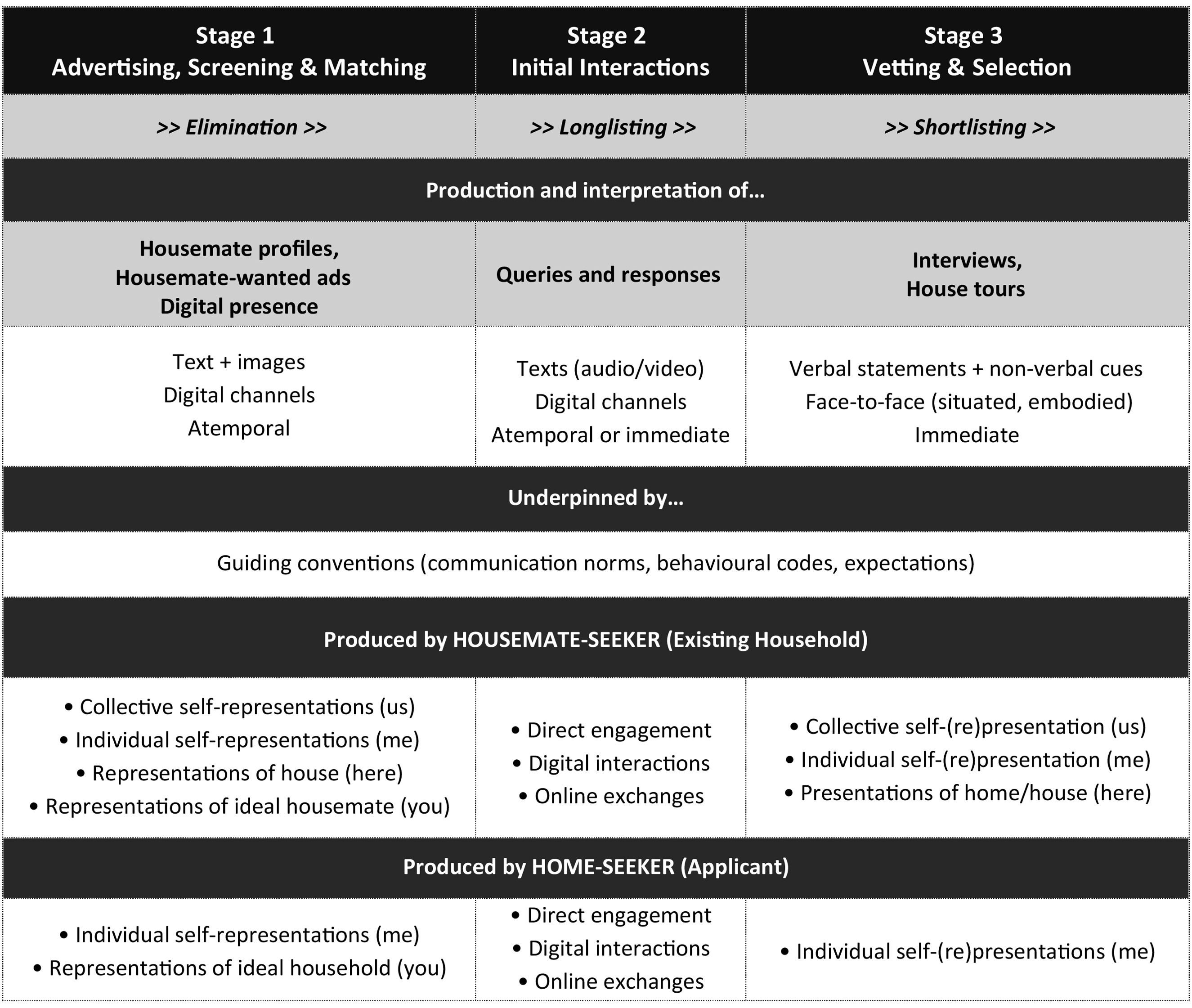
Framework for digitally mediated share-house formation: stages, steps, modalities.
Theoretical context: Share-house practices, digital mediation and self-representation
Research examining the cultural and media aspects of house-sharing remains scant, but scholarly interest is growing – for example, Social & Cultural Geography devoted a special issue to the topic in 2021. The multidisciplinary literature makes important contributions that help situate our research.
Acknowledging the traditional dominance of macro perspectives in scholarly understandings of housing and housing markets, McNamara and Connell (2007), and recently Maalsen (2019, 2020), advocate using micro perspectives to explore the everyday dynamics, experiences and meanings of house-sharing. This emphasis has yielded research capturing different share-house actors and formats in diverse socio-cultural and economic contexts. Examples include empirical studies from Sydney, Australia, exploring how housemates negotiate socio-spatial relations (McNamara and Connell, 2007) and house-sharers’ changing motivations in light of demographic shifts (Maalsen, 2019; Nasreen and Ruming, 2021); studies investigating home-making practices in commercial share-houses (shea-hausu) in Japan (Druta and Ronald, 2021), in organised collective housing in Buenos Aires, Argentina (Procupez, 2008), and as a popular choice by the young in China (Wang and Otsuki, 2016).
The share-house literature offers useful analytical concepts, including a focus on motivations, a negotiated (or contested) sense of social connection, the relationships between private and public spaces, and house-sharers’ identities and meanings of home (Druta et al., 2021). Countering common negative characterisations of house-sharing as chaotic, dysfunctional, inferior to family living, or a merely transitional, youth-centric phenomenon (Heath et al., 2017; Maalsen, 2020; McNamara and Connell, 2007: 75), this literature reconceptualises it as an increasingly mainstream, expanding and demographically diverse practice, one occasionally positioned as ‘desirable’ (Druta and Ronald, 2021: 1233).
Current scholarship also explores the impacts of digital technologies and platforms on rental markets and house-sharing arrangements (Maalsen, 2020; Maalsen and Gurran, 2021; Parkinson et al., 2021; Zhang and Gurran, 2021). Sophia Maalsen's work is particularly relevant here. Maalsen (2022: 3, 15) discusses how digital technologies are used across three stages of house-sharing – to ‘access’ and ‘manage’ households, and ‘form and maintain household relationships’ – and recognises how housemates use digital technologies in ‘performative, opportunistic, subversive and caring ways’.
Despite this, there is consensus that more research is needed to explore the digitisation of house-sharing, including the ‘actual labour’ involved in ‘finding accommodation or potential flatmates online’ (Maalsen, 2022: 8). Focusing on Melbourne, we extend the focus of Australian research beyond extant Sydney-based studies (but see Raynor and Panza, 2021), and the low-income/student demographics that have been the deserved focus of much housing studies scholarship (but see Maalsen's [2019, 2020] study of young professionals). This article offers a detailed elaboration of the process of (re)forming a share-house, and analysing how it is mediated. We outline and theorise the strategies of representation and communication deployed across three identified stages of mediated share-house formation: (1) advertising (of self and home) and preliminary screening/matching; (2) initial interactions; and (3) vetting and interviewing candidates (including house tours).
Our analysis is anchored in a rich cultural and media studies literature exploring digital media's role in widespread practices of online self-representation and communication (Marwick, 2013; Shulman, 2022; Thumim, 2012, 2017). Discussing people's self-representations across professional media (e.g. the UK broadcaster) and social media (Facebook), cultural scholar Nancy Thumim (2012: 6) defined ‘self-representation’ as the production of a ‘bounded text’ – distinct from ‘performance of self’, which unfolds more continuously and unconsciously. While all these mediated practices ‘co-exist’, Thumim reads them as ‘conceptually different’ (2012: 6): once produced, a self-representation ‘becomes a text that has the potential for subsequent engagement’. This conceptualisation aligns with Ellison et al.'s (2012) notion of ‘profile as promise’ in online dating. Unpacking the institutional and cultural mediation of these processes, Thumim highlights the multiple factors that shape how people represent themselves online, including: technological/platform affordances; representational/framing choices, strategies and techniques; context-specific expectations, conventions and media literacy; and individual experiences and ideas (2012: 54, 145).
To make sense of how would-be house-sharers engage online, we also draw on relevant cultural and media studies literature discussing self-(re)presentations in the competitive job-seeking and online dating contexts. Akin to searching for a new housemate, appointing a new employee requires screening and evaluating candidates’ suitability for a specific role within a specific workplace. As Alana Gershon (2017: 11) documents, jobseekers must market themselves through the time-consuming practice of crafting tailored resumés, updating online professional profiles and pursuing social networking to ‘enter an alliance’ with employers, while Karaoglu et al. (2022) demonstrate how jobseekers’ digital skills and socio-economic backgrounds manifest in different practices when job-hunting online.
Scholarship examining online presence and self-presentation in online dating cultures usefully captures the dynamics of matchmaking processes whereby participants progress from online to offline meetings in seeking intimate relationships (Ellison et al., 2006, 2012; Ramirez et al., 2015). Competing successfully for romantic attention demands a set of skills and strategies for performing identity online; these capabilities are anchored in an understanding of online dating rules and norms, including narrative style and techniques, and expected response times. Ellison and colleagues observe (2012: 46) that online profiles act as a ‘gateway’ to expected face-to-face engagement, and describe how participants perceive and interpret ‘discrepancies’ between ‘static self-presentational portfolios’ and the ‘embodied self’. While the specifics differ, forming a shared household involves a comparable array of dynamics, processes and navigation skills.
Our analysis is also inspired by conceptions of ‘media as practice’, which look beyond the traditional focus on content and reception to capture how media ‘order other practices in the social world’ (Couldry, 2004: 115). Practice-oriented perspectives allow us to consider various meanings, purposes and uses of media in a context-attuned, empirically informed way (Thumim, 2012: 53–4). Thumim (2012: 12) insightfully surmised that today's digital cultures should be understood as encompassing a diversity of practices, including both access to and exclusion from digital technologies (see also Gershon, 2017). Building on those perspectives, we reflect on the ‘many realities’ (Wajcman, 2014: 58) of share-house formation by exploring how house-sharers’ personal circumstances and social and cultural capital shape their (variously mediated) house-sharing practices and experiences.
More broadly, we draw on Pierre Bourdieu's (1986) conceptualisations of social and cultural capital, and Erving Goffman's (1959: 15) seminal theorisation of ‘self presentation’/‘impression management’, both of which have been influential to the scholarly literature on self-representation/promotion in digital cultures (Bullingham and Vasconcelos, 2013; Ellison et al., 2006; Gershon, 2017; Marwick, 2013; Serpa and Ferreira, 2018; Shulman 2022; Thumim 2012; Williams, 2018). This includes empirical studies exploring how work colleagues create a ‘third cognitive space’ to rehearse their ‘front stage’ online self-representations (Richey et al., 2018), how online dating participants represent their personal attributes as forms of capital (Wada et al., 2019), and how different forms of capital (digital, social, cultural, economic) can reinforce each other, amplifying social inequalities (Calderon Gomez, 2021).
Methodology
This study draws on empirical data from 60–90-minute telephone interviews conducted in 2017 and 2018 with adult participants (n = 19) who had lived in a Melbourne share-house anytime over the preceding five years. Participants (10 female, 9 male) were recruited via the researchers’ own networks, using snowball sampling. Demographics reflect this sampling method: ages ranged from 20 to 44, with a median age of 32. Occupation categories (ISCO) were Professionals (8); Technicians and Associate Professionals (7); and Service and Sales (4).
Most of our interviewees were Australian-born, with five born overseas. The duration of their house-sharing experiences ranged from 16 months (the youngest participant) to 21 years, with most having a share-house history of between 6 and 12 years. Five participants had lived in share-houses elsewhere in Australia, and five had done so overseas. Mobility varied widely: one person had lived in the same share-house for eight years, with 16 housemates revolving through; another had lived in six different share-houses over six years. Interview material was de-identified, coded and analysed to identify key themes, particularly pertaining to experiences and strategies people use to find a suitable housemate/share-house, and how – and to what degree – the process is digitally mediated.
We also analysed user posts from six public Facebook groups dedicated to connecting prospective housemates in Melbourne. This social media data was collected via screenshots at fortnightly intervals over three months (February–May 2018), and coded and analysed for key themes, conventions, practices and framings. Group sizes ranged from 4000 to 148,000 members; most had between 23,400 and 32,000 members. One group had a sustainability focus, and one primarily catered for young international visitors. This data reveals general patterns of user posts, communication norms and behavioural expectations, and advertising/self-representation strategies. Some of these groups have since ceased to exist, become dormant, or altered their profiles, guidelines, and/or privacy settings.
Findings
Our findings confirm that share-house formation in Australia is a staged, mediated and socially regulated process. In using the term ‘staged’, we seek to emphasise both its sequential and performative dimensions.
Most participants (n = 17) had used dedicated online platforms to seek a new housemate or shared household. These platforms included free house-sharing groups on Facebook, along with subscription-based commercial websites (such as FlatmateFinders.com.au). Interestingly, some interviewees had never (n = 2) or seldom (n = 3) used dedicated online platforms for share-house formation, relying instead on ‘word of mouth’ or family/social connections. Nevertheless, this subgroup had connected with potential housemates more informally through their existing online networks, including via friends and family. We explore some implications of this finding in relation to social capital in the Discussion.
This study draws on social media data gathered from public user-moderated house-sharing groups on Facebook. While we did not collect data from commercial house-sharing websites, the process we articulate broadly applies to these paid platforms, the main exception being that interactions are not publicly visible to other users.
We conceptualise mediated share-house formation as a three-stage process, involving a series of steps. Our findings are structured as a framework (Figure 1, see below) that explicates how this process unfolds:
Stage 1: Advertising and Screening: self and home are promoted, evaluated and interpreted through online self-representations. Stage 2: Initial Interactions: housemate-seekers and home-seekers interact directly via digital technologies. Stage 3: Vetting and Selection: self and household are performed in situ during housemate interviews/house tours.
While this process is sequential, there can be overlaps between steps and stages. This reflects Thumim's (2012: 13, 51–2) points about acknowledging ‘the sense of movement between sites of production, text and reception’ and interconnections (or ‘bridges’) between technologically mediated and face-to-face communication.
Underpinning this process was a fairly consistent set of expectations, rules, norms and behavioural codes, applicable to both parties – prospective incoming tenants (referred to here as ‘applicants’ or ‘home-seekers’) and current residents (described as ‘housemate-seekers’ or ‘existing household’). Success was predicated on knowing and navigating these guiding conventions; understanding the sequential process itself; and producing self-representations that outshone other candidates’ efforts, and were ultimately deemed mutually appealing.
Stage 1: Advertising, screening and matching: Housemate profiles and housemate-wanted ads
Home-seekers (applicants) advertise themselves online by producing and sharing ‘housemate profiles’ – self-representations intended to align with ideas of a ‘good housemate’ – while housemate-seekers (existing households) market their own attributes via housemate-wanted advertisements (self-representations of the existing household/house as a desirable home) (see also Maalsen and Gurran, 2021). Following Thumim (2012: 5), these self-representations can be understood as ‘bounded texts’ that serve as a ‘condition of participation’ in the process of digitally mediated share-house formation.
Advertising: Representing self and home
Home-seekers primarily advertise themselves online through text-based housemate profiles, although a small minority include a photograph. In these self-representations people typically disclose their age, occupation, hobbies and interests, and promote their personal attributes or positive traits, framed to emphasise their desirability as a housemate (for example, using descriptors such as reliable, clean, tidy, easy-going, respectful). Most home-seekers also specify the kind of home they’re seeking, including preferred location(s) and ideal household culture (for example, sociable, quiet, harmonious, safe haven, queer-friendly).
In housemate-wanted advertisements, housemate-seekers deploy a mix of textual and photographic techniques to promote the existing home and household. Most also describe their ‘ideal’ candidate (for example, mature, positive, vegetarian, proactive, cat-lover, not easily offended) (see also Maalsen and Gurran, 2021). Text-based representations typically promote the home's characteristics, its location, the neighbourhood and nearby amenities, and the bedroom for rent. Collective self-representations describe the existing household culture (common values, lifestyle preferences, house rules, degree of privacy/sociability, sharing practices, communal activities), and often include brief profiles of existing residents.
One interviewee described this promotional work as a ‘spiel of sorts’ (see below), suggesting an active crafting of the projected persona through the content and style of a post. We noted a range of techniques for effective self-representation, including posting a carefully composed, reasonably concise text with minimal grammatical or spelling errors, maintaining a positive tone, and using light-hearted humour.
Home-seekers tended to post more detailed self-representations than did existing households; the latter were more collectively framed, with any resident profiles comparatively brief. This likely reflects the competitive milieu of Melbourne's house-sharing economy, which one informant described as ‘a seller's market’, with applicants outnumbering available rooms. This places a particular onus on home-seekers to represent themselves appealingly. However, housemate-seekers also admitted to ‘working really hard on the profile’. Maalsen's Sydney-based study (2022: 9) also highlights this dynamic, recognising ‘the affective labour of identity performance’, whereby ‘performing a good flatmate [is] key to the work of finding home online’.
Self-representations seek to make a positive initial impression, and representations of houses are designed to be equally appealing. Housemate-wanted advertisements are ripe with positive descriptions that reflect both online norms for a concise but engaging narrative, and the argot of commercial real estate listings (welcoming, sun-filled home, close to shops, tram and vibrant Fitzroy). Despite a shared expectation of accuracy, participants also faced the imperative to depict the house/household as an attractive option, which sometimes posed framing and representational challenges.
Photographic representations typically depict the bedroom for rent, communal living areas, kitchen, bathroom, and gardens/outdoor spaces. Resident pets are often represented via both text and image, but human residents are rarely pictured. During our data collection, one house-sharing group introduced a ban on all images of people, citing a need to minimise ‘increasing levels of discrimination and harassment’, a reference to unwelcome private messages and derogatory or prejudiced comments targeting certain user groups.
Alongside positive self-portrayals, representations of ‘non-ideal’ housemates were common. While overtly discriminatory posts typically attracted opprobrium from other users, posts that explicitly excluded specific types of applicants were prevalent, and elicited varying responses. (For example, no couples, no pets, no drug users, no travellers, English must be a first language, no night owls, no hermit crabs, no energy drainers.) In proscribing both specific groups and character traits, these various framings of ‘unwelcome’ candidates highlight the barriers faced by particular cohorts of home-seekers, and illustrate how digital processes can both mirror and reproduce existing inequalities.
In representing self and home, interviewees emphasised the need to strike a balance between honesty and overstatement. This echoes Ellison et al.'s (2006: 430) observation about online dating environments, whereby participants must strive to ‘balance their desire for self-promotion with their need for accurate self-presentation’, while Gershon (2017: 9) describes a ‘strategy of omission’ in jobseekers’ self-marketing. In the similarly competitive process of share-house formation, where ‘people are trying to put themselves in the best light’ and ‘trying to make [houses] sound like a place someone would live’, this resonates strongly. Striking this balance was particularly important where a living situation had potential downsides – for example, when a house was in poor repair, or the lease was short-term. As we discuss below, this strategy – ‘not saying too much’ initially – recurred in subsequent stages, whereby residents opted not to disclose specific household dynamics to applicants. One interviewee elaborated: [My current house] is a bit of a hard sell. [It's] a really freezing cold house with rising damp … it's hard to sell that to people and be honest. We’ve made it really lovely, but it's cold, and the walls have got cracks…. You have to be honest [when advertising], but you can’t say too much about it. Otherwise, people won’t come over and look.
Screening and matching: Reviewing and interpreting self-representations
Candidates on both sides must review, interpret and assess each other's representations. The intensity of this process was aptly summarised by Fabian Kong, founder of popular house-sharing Facebook group, Fairy Floss Real Estate, who noted that ‘Everyone is competing to get people's attention now’, and that success hinges on ‘trying to get really creative about getting attention and trying to express what they’re like as housemates’ (in Sadler, 2017). One interviewee observed that both parties are essentially ‘judge[d] on their message’, while another highlighted interpretive efforts to discern stylistic and visual nuances: I got a lot more responses when I changed my picture to one where I was smiling, for example, and I guess subconsciously I look for that as well. I want to see a person's face before I meet them. Interviewee: [During] the screening process online, I look for humility. For someone who isn’t ‘Me, me, me, me, me, me’ in their profile. [It's similar to] internet dating actually. You’re putting up a profile and it feels like they are putting up an essay … [I prefer] someone who doesn’t use up too much space. And [I consider] the size of the sort of spiel. Researcher: Do you think there's a parallel between using a lot of space in an online spiel about yourself, and perhaps using a lot of space in a share-house situation? Interviewee: Yeah, or at least a lot of personal space or headspace.
Participants mentioned another important screening strategy: gleaning additional information from candidates’ social media profiles and digital presence. Accessing this extended volume of networked information was seen as a valuable risk-mitigation measure (see also Parkinson et al., 2021): Not only can you search for the place that you want to live in, and the suburb you want to live in, and the price you want, but you can also get a sense of the personal lives of the [residents] based upon the [social media] channels they put up. Politics is really important [to me], so if someone has a lot of right-wing propaganda on their Facebook [profile] then obviously [I know] they’re not going to be a good fit right away.
While privacy settings determined visibility, the additional data helped in assessing whether a candidate's tailored self-representations aligned with their broader online profile. Other scholars have noted the potentially corrupted sense of privacy when information ‘travel[s] outside [the] envisioned boundary’ in social media contexts (Marwick and boyd, 2014: 1058), and how maintaining multiple online profiles can pose a challenge for effective impression management (after Goffman; see Richey et al., 2018). However, in the house-sharing context, this online boundary-crossing can also facilitate both welcome scrutiny and indirect validation through visible networks of ‘shared friends’. This can be helpful, especially where safety is a potential concern: [On] Facebook, you can see if you know people mutually. It's not just 100 per cent random.… It takes out that scary mystery. Particularly when you’re a female and getting people to come and look at your place, it can be a bit awkward and weird.
Stage 2: Initial interactions: Testing the waters
In the next stage, the two parties begin to interact directly using digital technologies and platforms. These initial interactions can unfold as semi-public online exchanges within a house-sharing group (e.g. comments below a profile) or more privately via digital messaging apps, SMS, or email. Phone, VOIP, or video calls are only rarely used. Typically, one existing household member acts as the primary contact point for applicants.
These mediated interactions are governed by conventions, comprising norms and behavioural codes. Both parties are expected to respond promptly and politely to enquiries, keep appointments, and communicate honestly about practical considerations (expected move-in dates, bond payments, bill-sharing) and their intended participation in the household (financially, socially, or via domestic labour). In general, breaching these implicit codes precludes progressing to the next step: In that first initial contact … if people didn’t write anything about themselves, we just wouldn’t bother pursuing them. Because we’ve already seen that this person is not able to communicate [in the way we do].
Such initial exchanges essentially comprise a bridging phase – an extension of the previous screening/matching process, and a precursor to the ensuing vetting process. The focus shifts from the ‘bounded text’ – whereby ‘people are fixed, at least in the moment of the self-representation’ (Thumim, 2012: 180) – to the more immediate and reciprocal terrain of interpersonal communication. Applicants who create a good impression and confirm their interest are invited to progress to the next stage.
Stage 3: Housemate interviews and house tours: Negotiating personal spaces
Housemate interviews build upon the preceding stages, and typically lead to shortlisting decisions. They are seen as an opportunity to ‘bring people in to have a talk’, enabling both parties to better assess a potential match through complex, embodied and highly consequential interpersonal communications. Housemate interviews occur alongside house inspection tours, with participants engaging in concerted ‘informative showings’ (Licoppe, 2017: 72) as the host(s) shows the applicant the home's features and the room for rent.
While asynchronous online communication unfolds at a distance, and is characterised by ‘reduced cues’ (Ellison et al., 2012: 47), housemate interviews require participants to enter/host and interact within the intimate and situated space of the home. Following Thumim (2012), we understand face-to-face housemate interviews as mediated and shaped by technology: candidates are selected based on their online self-representations and subsequent mediated exchanges, and interviews are organised via digital channels. Only in rare circumstances (discussed below) were housemate interviews conducted using digital technologies. Crucially, the way people (re)present themselves offline is ‘inevitably mediate[d]’ by communication styles and by ‘bringing to bear certain assumptions, attitudes and understandings of what a self-representation to an audience should entail’ (Thumim, 2012: 50), albeit in a less ‘conscious’ or ‘bounded’ way than it occurs in online self-presentations (2012: 6). This distinction resonates with Goffman's (1959) ideas about impression making, whereby signals about the self are communicated both intentionally and unintentionally (in Tong et al., 2020: 876).
Participants typically framed housemate interviews as ‘informal conversations’ – although some mentioned scripting a list of questions, taking notes, or requesting written/telephone references from candidates’ previous housemates. During interviews, both parties seek and disclose select personal information, and discuss preferred living arrangements and the household's existing culture. The overarching purpose, in one participant's words, is to ‘suss each other out’. Another explained: Usually, you sit down and have a cup of tea or a coffee or a beer … and just talk about each other. It's kind of like going on a speed date. You’re trying to give these people enough information, and if they like the place, they’re obviously trying to impress you. If you like them, you’re trying to get them to move in. You might [infer] something from someone's face-to-face interview that discounts [them], but that information is not [available] to originally screen people.
The subtleties and complexities of interpreting face-to-face interpersonal communication rival those required for decoding online profiles and advertisements. However, housemate interviews/house tours include the added dimension of occurring in an embodied social space of the home – one that yields multiple points of information: You’re trying to assess things like the décor, and how clean it is, and where it is located, and how much noise there is … [while] also trying to navigate the interpersonal stuff. How are the housemates talking to each other? How are the questions phrased to me? People having different accents, where are they from?
Alluding to the challenges of interpreting these contextual clues, one interviewee described the housemate interview/house tour as a ‘sensory overload’, while another characterised it as ‘on-the-fly adaptation’ that can be ‘quite overwhelming’. Given the potentially taxing nature of these repeated interactions, usually condensed into a week or two, both parties strive to screen candidates as effectively as possible before interviewing.
The interpretation of subtle tonal and visual information includes efforts to discern candidates’ financial capacity and socio-economic status based on physical appearance and presentation. Our interviewees emphasised the need to confirm that candidates were employed and could pay bills on time, but some applicants who were visibly ‘rich’ were perceived to be a poor fit with the existing household culture. Such revealed mismatches resonate with the notion of ‘communal common ground’, invoked by Ellison et al. (2012: 48) to describe ‘the facts, norms, procedures, and lexicons that can be assumed to be known by any member of a community’ in online dating. While house-sharing cultures are diverse, interviewees felt that shared households tend to work best when members share values and dispositions (e.g. political views, cultural interests, education level). This confirms Maalsen and Gurran's (2021: 13) findings about desirably similar backgrounds and expectations among housemates, including around timely payments. During housemate interviews, participants glean clues that help them assess mutual fit. Here, mismatches gesture toward discrepancies between selectively framed online profiles and offline presentations (Ellison et al., 2012; Tong et al., 2020). They also highlight how the three stages sequentially add to the picture of a candidate, and underline the potential appearance-engendered and/or prejudice-based inequalities across the process. One interviewee noted how physical appearance was entangled with bias, stating: ‘The emphasis on appearance, I don’t think [it] works for everyone.’
Housemate interviews were routinely conducted in-person, but video communication tools enabled mediated house tours and remote interviews in some situations (as when one housemate was travelling overseas, or an applicant lived interstate). Two participants had used Skype for this purpose. Both noted some initial hesitancy about this application's suitability, but found that it produced a sense of authenticity and openness that mimicked social expectations of how in-person communication can unfold: [The applicant] was relaxed and able to communicate with pauses in a way that was like, ‘Hey, I’m relaxed, this is me, and I’m really trying to connect with you.’ And there was eye contact on Skype…. It can be quite difficult to get that in real life, so [they] really came across quite powerfully. To make the share-house work, everyone needs to have some kind of an interest towards the other [residents]. If the person doesn’t have [that] interest, and is just living their own life and minding their own business, doesn’t want to contribute, then it's just different.
Discussion: Self-spieling, inequality, and social and cultural capital
We have documented how shared households in Melbourne are (re)formed through a complex sequence of mediated stages and steps. To succeed in this process, participants must produce effective (re)presentations of self and home, and interpret and evaluate others’ representations. They must also proficiently navigate housemate interviews and house tours. Context-specific norms and expectations are important, with participants assessing whether candidates navigated them effectively in their online profiles, initial interactions, and face-to-face interviews.
Our interviewees experienced a tension between the sense of empowerment arising from access to digital information, and the simultaneous challenges of screening and vetting multiple candidates, composing labour-intensive responses, sifting through candidates’ other online profiles, and feeling ‘overwhelmed’ by ‘so many choices’. Other studies reflect this finding (Maalsen, 2022; Parkinson et al., 2021). Housemate interviews also demand a significant commitment of both time and mental energy.
In this context, social and cultural capital comprise valuable resources. Goldthorpe defines ‘social capital’, after Bourdieu, as ‘informal and formal networks of acquaintance and recognition that give returns via ‘contacts’, support and representation’ (2007: 4). In our study, even the most avid users of online house-sharing platforms acknowledged that being able to draw on ‘networks through friends’ – strong ties – and ‘word of mouth’ (including via their own social media channels) can be a convenient and highly effective shortcut in the filtering and matchmaking process. A minority had never, or seldom, used online house-sharing platforms/groups. Significantly, these participants were all born and raised in Melbourne. They reported securing new share-house arrangements more informally through friends and family already living in the city, thus bypassing the need for digitally mediated interactions with strangers.
In discussing the importance of disciplined, continuous networking and connections to ‘the right people’ in order to be noticed, Gershon (2017: 108, 118) mentions how networking-reliant job-hunting can perpetuate forms of exclusion based on people's backgrounds. In forming share-houses, people with established (and crucially, localised) social networks have an important competitive advantage. Their high social capital enables them to bypass online house-sharing platforms, while people with lower social capital must cast a wider net, making them more reliant on these platforms. This finding aligns with research on digital inequality and online job-hunting, whereby racial minorities in the US, for example, were more likely to job-search online than people who could rely on supportive, ‘immediate social networks’ to secure employment (Karaoglu et al., 2022: 1838).
Through housemate profiles and housemate-wanted ads, candidates communicate signals about cultural and social capital, including cues about class, taste and status, which are then interpreted. Maalsen (2022: 10) documents how some participants exercised ‘agency’ in representing themselves – for example, to avoid potential ethnic stereotyping or discrimination – and conversely, how some demographics (underemployed people, parents with children, or ‘older singles’) find it particularly difficult to succeed in the competitive ‘networked’ rental market, when they fail to fit or ‘perform’ as a ‘good tenant’ (Maalsen and Gurran, 2021: 14; Parkinson et al., 2021: 1281).
Our analysis also reveals how mediated share-house formation can reinforce or mirror existing inequalities. It also underscores the way that social capital is entangled with economic/financial capital: several participants, for example, had lived in share-house rentals owned by a family friend, or their own parents. That said, privileged social status may not translate into easy access. Some highly educated, securely employed interviewees who had recently moved to Melbourne found the house-hunting process incredibly onerous, despite their high cultural capital and strong social networks back home. This data also hints at the potentially tenuous line between being securely and insecurely housed: despite our participant cohort skewing toward professionals, two interviewees disclosed experiences of housing precarity. Several home-seekers also disclosed situations of homelessness or housing precarity in their public Facebook group posts.
These findings reinforce that share-house formation is a varied experience, and illustrates how inequalities can be embedded in this process. Prior scholarship on house-sharing has emphasised the importance of informal practices, ‘reciprocal social networks’ and digital inclusion for participation, focusing primarily on people from lower socio-economic backgrounds (Parkinson et al., 2021: 1278), and noted how platform affordances, algorithms and settings can enable bias and discrimination (Maalsen, 2022: 9). Our study shows that not using online platforms is a choice-driven practice, one associated with higher social capital.
Discussing self-presentation in digital cultures, David Shulman (2022: 27) applies Goffman's ideas to a job interview context, and notes that success hinges less on authentic characteristics than ‘how convincingly’ a candidate performs ‘an ideal recruit’, which is evaluated in social interaction. The notion of a ‘spiel’, as our interviewee phrased it, elegantly captures the way would-be housemates used self-representation techniques for persuasive communication. Suggesting playful, plural or changeable aspects of self-representations (Thumim, 2012: 150), the term ‘spiel’ (meaning ‘play’ or ‘game’ in German) harks back to both Goffman's (1959: 15) dramaturgical theory of impression management and Bourdieu's (1990: 9) account of ‘generative habitus’ – whereby, over time, social actors acquire a ‘feel for the game’, learning a flexible repertoire of approaches that can be deployed to social advantage. This resonates with participants’ reports of learning proficiency in housemate interviews as they gained experience over time.
Scholars have noted the importance of being familiar with ‘“the game” of finding housing online’ (Maalsen, 2022: 9–10) and the learning it entails (Parkinson et al., 2021: 1285–6). We have discussed how would-be housemates’ self-representations and interactions are underpinned by a set of social norms and behavioural expectations, including context-specific online conventions. These expectations were both publicly modelled and explicitly discussed by Facebook users in self-organised house-sharing groups, and reinforced/policed via feedback from group members (e.g. comments below posts where someone's post had breached a norm, or references to poor behaviour experienced in a face-to-face housemate interview). Knowing and adeptly navigating these conventions represents not only a ‘condition of participation’ in the share-house formation process, but also a valuable form of cultural capital, bestowing a competitive advantage on some candidates, and resulting in unequal outcomes for those less well-versed or skilful. Cultural differences, for example, could potentially place some recent migrants on unequal footing here.
Our analysis further suggests that house-sharing outcomes are shaped by people's capacity to experience and demonstrate ‘interest toward others’, as one participant put it. Forms of self-(re)presentation and communication that signal genuine attentiveness, commitment and consideration were perceived as socially desirable, constituting another ‘condition of participation’ (Thumim, 2012: 5) in a shared household.
Conclusion
This article contributes a comprehensive analysis and articulation of the complex mediated processes through which shared households are (re)formed. We approach this from a cultural and media studies perspective, albeit contextualised in dialogue with key literature in sociology and geography. We document and translate this rich terrain of mediated self-presentation, interpretation and interaction practices into a conceptual framework that helps explain how the processes of house-share formation unfold through a series of stages and steps, and how participants navigate them.
With the growing significance of shared living in Australia and internationally, and the growing prevalence of digital technologies and platforms in mediating everyday practices, we suggest that our framework can be tested and applied beyond the specific case of Melbourne. In drawing out the nuances of mediated share-house formation, the framework offers scope for further elucidation through comparative studies of house-sharing practices in different cultural, socio-economic and geographic contexts. For example, we have noted that experiences of (re)forming a share-house differ, depending on people's socio-cultural, economic (and changing) circumstances. These differences can manifest in varying use patterns and degrees of reliance on online platforms and, more broadly, through the reproduction of existing inequalities. These inequalities are in turn being exacerbated by the housing crisis and its context-specific manifestations in Australia and elsewhere.
Our data was collected before the Covid-19 pandemic, which has impacted house-sharing dynamics and experiences – the shift toward working-from-home being just one example (Druta et al., 2021). Future work could examine mediated house-sharing practices since the emergence of Covid-19, including whether and how the pandemic has influenced how people form and join shared households. In addition, there is potential for our framework to inform the analysis of other types of mediated exchanges beyond the share-house milieu.
Footnotes
Acknowledgements
We would like to thank all the research participants for generously sharing with us their experiences and insights. Many thanks also to former colleagues, Wendy Stone, Terry Burke, Liss Ralston, for the early conversations about the house-sharing topic. Finally, we acknowledge blind reviewers' valuable feedback on the paper.
Funding
The authors disclosed receipt of the following financial support for the research, authorship, and/or publication of this article: This research was supported by an internal grant by the Monash University.

Author's biographies
Aneta Podkalicka teaches and researches in the School of Media, Film and Journalism, Monash University, Melbourne, Australia. Aneta's research focuses on everyday uses of media and digital technologies, consumption practices and environmental communication.
Meg Mundell is an author, researcher, and cultural geographer. Her research explores place, spatial justice, homelessness, cities, and nature. Meg is a casual Senior Research Fellow with the HOME Strategic Research and Innovation Centre, Deakin University, Melbourne, Australia.