



Abstract
Korean video culture has changed from a broadcast-focused culture into a diversified experience that includes a variety of videos from both domestic and global streaming services. Contrary to the mainstream view that Netflix is at the centre of all changes, this study positions the domestic streamers’ original content as not necessarily a direct response to Netflix but indicative of the many changes that were already occurring in the local media landscape. Their content has adapted to fit viewers’ changing lifestyles and desire for stories not seen on television. Efficient everyday storytelling fits into viewers’ busy commuter lifestyles and features mundane topics that they can easily identify with. Also, the domestic streamers cater to small, underserved audiences with regard to specific topics avoided by traditional media. Thus, the original content of domestic streamers indicates that they offer different value propositions than formulaic romance stories by broadcasters and the high-end, large-scale original dramas of subscription video on demand (SVOD).
The South Korean (hereafter Korea) media landscape has experienced drastic changes since the turn of the century, especially in the 2010s. Until the early 2000s, broadcast networks had a prominent role in shaping industrial norms and reception of television, as they held more than half of the audience and advertising market shares. Their status as powerful distribution channels gave them authority over the television content production process as well. However, this is no longer case; as of 2022, Korea maintained a pay television penetration rate of 97% and boasted one of the highest standard internet connection speeds in the world. This highly developed infrastructure enables Koreans to enjoy various types of content, from big budget dramas to short-form, web-original dramas in and out of the home. The market for video streaming in Korea is changing rapidly as both global and domestic video platforms compete for audience attention.
Until 1995, the typical Korean viewer was limited to content produced for three broadcast television channels, but in general seemed satisfied as primetime dramas enjoyed extraordinary ratings of 50–60% of viewers well into the 2000s (Kang and Park, 2018). Drama in particular has had a central place in Korean media history. There were assorted offerings of stories, but the most popular and dominant form that the broadcasters favoured in primetime were the miniseries (minisirijeu) drama that were predominantly romance-focused stories (Yu, 2014). This article focuses on these romance dramas as being influenced by various conditions of the time. The fast turnaround from writing to filming to broadcasting limited intricate storylines and plotline twists (Oh, 2018). Also, devices such as long scenery shots and ‘splitting’ one episode in two, were used to extend the narrative so as to get around policies that prohibited broadcasters from airing mid-programme commercials. Then, new forms of distribution challenged this status quo.
Affordable pay television services like cable television and IPTV (Internet Protocol television) became available in 1995 and 2008, respectively. Audience viewing practices started to change with their adoption. IPTV's VOD (video on demand) capabilities enabled time-shifting viewing, and cable offered provocative dramas, with more graphic and vivid scenes that were not regulated by broadcast television policies. Home-grown SVODs (subscription-based video on demand) came later, in the 2010s, but were not a major part of the video experience; when used at all, they were mostly used as a catch-up service for popular broadcast drama. Foreign streamers were also insignificant until comparatively late, circa 2019. The popularity of Netflix Korea Originals like Kingdom (2019–20) and Squid Game (2021) demonstrated the audience’s appetite for original content different from the romance-focused stories that Korean television typically offered.
Often overlooked in this history of Korean drama is how Korean video culture has fragmented into a diversified experience that includes both domestic and global streaming services that offer a greater range of content. Netflix receives a lot attention and certainly has been important to the Korean media industry, but focusing just on this service flattens the complexities that exist in the rapidly evolving video market. There is a growing body of work on Netflix Korea's content strategy (see Ju, 2021; T. Kim, 2022b; Y Kim 2022), but little on domestic streamers like Tving or Wavve.
This article takes a both/and approach to the video culture in Korea by examining the various types of stories available to local viewers because constructing platforms/services as in direct competition with each other overlooks their diverse business models and different video offering (Lobato, 2019; Lotz, 2022). This approach contrasts with journalistic accounts of Korean video culture, as it highlights the coexistence of service providers and their stories for viewers. Journalistic framing consistently analyses business strategies relative to Netflix. For example, the press framed the recent merger between two domestic streamers as a ‘move to challenge Netflix’ (Baek, 2022), and questioned whether new original series will ‘equal Netflix's success’ (Lee, 2022). Local Korean industrial and journalistic accounts overdetermine a frame of competition in their emphasis on the operating losses of domestic streamers in their imagined ‘quest’ to compete with Netflix Korea, while academic work also rarely considers domestic streamers (Jie, 2022; Park, 2022).
Framing the video service ecosystem as a ‘zero-sum space of direct competition’, that is, to focus just on Netflix Korea as much analysis does, reduces the complexity and complementarity that exists in this space (Lobato and Lotz, 2021: 90). All streamers may ‘compete’ for audience attention, but this does not translate into the same content strategies, business priorities and socio-cultural functions (see Lotz and Eklund, in this issue). Domestic streamers Wavve and Tving have ties to established multichannel businesses that provide industrial advantages, while Kakao TV operates as one of the many ancillary businesses that its parent company, the tech giant Kakao, runs. Watcha's access to audience data accumulated through its origin as a recommendation app enables it to cater to more specialized tastes. Korean streaming services might not have a large subscriber base compared to Netflix Korea, but they are indicative of how video markets are constantly being made and remade through shifts in industrial norms and practices. 1 Assuming that the only way to succeed is to be like Netflix obscures how the domestic services’ affordances enable them to differentiate themselves from television and challenge our expectations of industrial priorities (Lotz and Lobato, 2023).
Contemporary Korean video culture is increasingly dispersed across an ecosystem where domestic streamers coexist with broadcast, pay television and global streaming services. Rather than centring on Netflix, this article inserts domestic streamers – Wavve, Watcha, Tving and Kakao TV 2 – and their original content into conversations about Korean streaming video culture to uncover less considered adjustments. Domestic streamer content is indicative of the changes in industrial expectations and practices that precipitated streaming. Tracing the genealogy of how domestic streamers offer original content that includes efficient storytelling and niche stories catering to underserved interests, complicates the Netflix-centric account of Korean video culture that reproduces the US streaming experience.
Establishing Korean dramas: Romance stories produced by live filming
To understand the pre-digital video culture in Korea, it is important to begin with the typical viewing experience prior to the 2000s. As in many other countries, broadcast television was the dominant mode of early video culture in Korea. Korean television became a staple of everyday lives by the 1980s when the television penetration rate reached 78.5% in 1979 – a later point than many countries because of military regime controls and the high price of television sets (SG Lee, 2019). Primetime schedules were filled with dramas in the 1970s, as the three broadcast channels (the public channel KBS and commercial channels MBC and TBC) competitively aired dramas, many of which featured traditional female characters who sacrificed their lives for their families. Broadcasters increased the number of their dramas to capture mass audiences, but the military regime limited the airing of dramas to three or four per day, claiming that excessive drama scheduling lowered the quality of television programming (Chung, 1978; Josun Daily, 1974).
By 1991, the modern broadcasting system was finally established with three broadcast networks, KBS, MBC and SBS. TBC merged with KBS in 1980, and the commercial channel SBS launched in 1991. The three broadcasters dominated the media landscape in terms of resources, content, and access. They enjoyed an oligopolistic status built upon decades of influence accumulated during the military regimes from the 1960s to the 1980s. The barriers to entry in the media industry were extremely high during this time because the regimes permitted only a few operators so as to ensure easier control over media. The military regime strongly censored content that challenged their legitimacy and any content that they considered to be inappropriate for citizens. Because of the arbitrary standards of censorship, broadcasters emphasized topics supported by the regime, such as themes of anti-communism and modernization (HP Kim, 2012). This started to change in 1993 when the first civilian government was elected. Censorship rules were relaxed and audiences could enjoy stories that were not controlled by the authoritarian regimes.
The broadcast networks offered various forms of serialized stories, such as historical dramas (daeha deurama) that were more factual than fictional, and these dramas commonly ran for up to a hundred episodes, airing two episodes on weekends. Daily dramas (ilil deurama) that aired on weekdays and usually featured improbable and sensational plotlines were another common form. These also aired over a hundred episodes but were shorter than the hour-long historical or romance dramas, at around 30 minutes per episode. However, the most prioritized stories in primetime were the miniseries (minisirijeu), which were the serial stories that often were romance stories (Yu, 2014). By the late 1990s, the three broadcasters’ primetime dramas were filled with romance-centred stories that moved away from tragic female characters and instead emphasized love between young professionals in urban settings. Certainly, other types of topics were covered in the miniseries format, but romance stories were far more commonly scheduled. Conservative broadcasters – conservative after decades of censorship – believed that such stories were most desirable to both advertisers and audiences. The romance melodramas were extremely popular with local audiences and later became the backbone of a significant export business in the 2000s.
The drama Jealousy (1992) marked a turning point in Korean drama history as it did not focus on traditional female roles like previous dramas but reflected modern lifestyles of the time (Whang, 1999). It traced the story of two childhood friends who fall in love as young adults and showed the latest fashions and professional careers that were coveted by the younger generation. The drama was well received by audiences; it reached over 56.1% in ratings at the time of its airing (Korean Culture and Information Service, 2016). Romance stories like Jealousy repeated features of trendy dramas from Japan like Tokyo Love Story (1991) that swept across East Asia, yet were unavailable in Korea due to a cultural ban of all Japanese cultural content until 1998. 3 As a result, Korean audiences first watched domestic dramas that blended features of the popular Japanese drama format with traditional Korean values and norms to emphasize urban, youthful lifestyles, the pressure of family obligations, and innocent, non-physical romantic relationships (J Kim, 2012; Lee, 2001). Ratings winners combined a conservative fantasy of characters experiencing true love while fulfilling family expectations as dutiful sons and daughters. For example, the drama Trap of Youth (SBS, 1999) earned a record rating of 53.1%. It was a revenge story of a jilted woman, and it included scenes about how the protagonists maintain a close relationship with their extended families after marriage.
As broadcast television depends on advertising revenue, the three broadcasters usually featured stories that could be enjoyed by the largest group of people in primetime. High audience ratings led to high advertisement rates, and broadcasters and producers replicated the romance story archetype that proved popular to maximize their advertising income (Oh, 2018). Channels did little to cater to subgroups of viewers, though it was assumed that romance stories were preferred by women, while historical period dramas were favoured by men. But dramas that were extremely popular overcame such assumptions; there were historical dramas that featured strong women figures that were well received by female viewers, as well as melodramas emphasizing familial love with which male audiences identified. Broadcasters considered melodrama to be the most economic choice because in their perception, historical dramas were too long and expensive to produce, while sitcoms and single-act dramas were too short to gather a significant mass audience (Lee et al., 2014).
Highly formulaic romance dramas were also well-suited to the industrial pressures facing Korean drama productions. It was typical for Korean dramas to operate on a live filming system, where only a couple episodes are completed by the first airing date and the rest of the episodes are filmed as the drama airs. The miniseries dramas were typically formulated as a limited single season composed of 16, 20, or 50 hour-long episodes that aired at a rate of two episodes a week. The length of a single drama episode was standardized across all broadcasters according to network agreements (72 minutes in 2008, 67 minutes in 2013). But a consequence of having to provide roughly two hours of story weekly in a compressed time frame, was bloated narratives that struggled to fill the required running time. Another factor discouraging narrative complexity was that production companies had to secure a commission from a broadcast channel to get access to a production budget, and it was too risky to proceed with filming before such agreements were complete. The period from securing a broadcast channel to the airing date is short, so the filming and post-production process are done in real time. Stories that need long post-production periods, like sci-fi and fantasy, were consequently difficult to produce under this system. Live production also allows scripts to be extremely sensitive to audience response – if a drama is not performing well, the script can be revised by the next episode; if a drama is doing well, then the season can be extended to keep the momentum going. This strategy of responding to viewer reaction makes it difficult to plan out intricate narrative devices like arcs and plot twists which also leads stories to suffer from poor writing and hasty production.
This live filming system became the industrial norm because Korean television drama production was partially funded by the distribution channel (usually the broadcast network, typically around 70% of the budget), with remaining costs financed by product placement, sponsorship, and licensing sales (HJ Kim, 2019). The heavy reliance on advertisements and product placements led to storylines being adapted to fit the needs of the sponsorships – scenes that had nothing to with the overall plotline were often inserted to integrate product placement. Advertisers were not in favour of crime procedurals, thrillers, fantasy, and dramas presenting serious social issues because they thought these genres were poorly suited for product placements (Oh, 2018), which led broadcasters to avoid them. Broadcasters also considered these genres as not cost-effective because of the expenses special effects required.
Despite industrial norms that limited the Korean audiences’ viewing choices – both in terms of channels and types of stories – high audience ratings indicated general satisfaction with domestic content provided by the broadcasters. There definitely were variations in dramas, such as the unrealistic and over-the-top makjang drama (see T Kim, 2022a) and teen dramas focusing on coming-of-age plotlines (see Kang, 2023), but the romance stories remained the focus in primetime miniseries drama. This suggests the mass audience persisted longer than markets such as the US that already demonstrated considerable fragmentation by the early 21st century. In addition, romance dramas were the driving force of the Korean Wave (a term used to describe the popularity of Korean content around the world in the 2000s), which further solidified the broadcasters’ reliance on romance (Chung, 2009). Domestic ratings strongly influence global buyers’ decisions, so the industry continued to produce dramas that had already proven to be successful.
Cable television and IPTV introduce audience fragmentation
The viewing experience established by broadcasters and the notion of mass audiences remained the dominant mode until the 2000s. However, there was a clear erosion to the broadcasters’ status by the early 2010s. In 2002, the three broadcasters held 85% of audience share, while pay television was 15%, but this dropped significantly to broadcasters attracting 62% and pay television 38% by 2011 (Korea Communications Commission, 2012). Cable television started to gather attention with innovative stories that departed from broadcast drama norms and IPTV services made time-shifting easier for audiences.
Audiences started to experience more choices with cable television by 1995. Democratic governments continuously introduced new media players into the industry to ensure competition in the market, because of the history of state-enforced censorship during the military regimes. Bringing in new players was expected to diversify choices and bring higher quality content to the audience. In reality, the ‘diversity’ that audiences enjoyed until the early 2000s was merely just more ways to access broadcast content as pay TV created little original content. Initially, cable TV schedules were heavily regulated; they were prohibited from producing news and adhered to a must-carry rule of terrestrial content because the government was concerned cable had the potential to provide politically skewed, and sexual and violent content to audiences (Nam, 2008). Moreover, low subscription fees and the fact that the established broadcast industry was strongly vertically integrated, with more than 80% of content produced in-house, further contributed to pay TV's difficulties as they were unable to buy original content from production companies (Nam, 2008). Due to these financial difficulties, the government loosened the regulations to allow cable operators to set their own prices with various channel tiers, and there was less prohibition on content by 2004 (Schejter and Lee, 2007). But the effect of these changed circumstances was not felt immediately, and thus, until the late 2000s, pay TV primarily just offered additional access to popular broadcast content.
Cable television experienced major changes in the 2010s – particularly due the influx of capital by media conglomerates and news media companies, as well as changes to the regulations. Many of the nascent, struggling cable services were acquired by giants like On Media (later acquired by CJ) and CJ ENM, which enabled cable to challenge the broadcast networks’ position. Mergers like these meant that cable channels had access to efficient production systems that managed all aspects of content production through their larger parent companies. Also, the news media companies established cable channels (JTBC, TV Chosun, Channel A and MBN) in 2011, which further encouraged competition to gather audience numbers. In order to compete with broadcasters for advertising money, cable television invested in content that offered an alternative to the broadcast romance dramas. They offered drama forms such as multiple season series and topics (e.g. supernatural, fantasy, crime procedurals) that diverged from the typical broadcast melodrama (Chung, 2019). They also offered more variation in story length, providing viewers with new levels of choice. Cable channels were free from the content regulations that restricted broadcast channels from showing certain topics and scenes, 4 so they were able to provide different content to fragmented audiences. After deregulation on cable took place, cable operators engaged in price-cutting wars and competitively offered cheap tier pricing to gather more subscribers (Schejter and Lee, 2007). Korean cable television has consequently come to rely on advertisements as their main source of revenue because the cable subscriptions produce so little revenue compared to other countries (SM Kim and JH Kim, 2018). 5
The strategy of cable targeting fragmented audiences is especially evident with the media conglomerate CJ ENM. This company became a media production and distribution giant in 2011 through a series of mergers and acquisitions (Park, 2018). In 2016, CJ ENM established the production company Studio Dragon and recruited star creators away from the broadcast networks. Armed with key talent and capital, CJ ENM targeted viewers in their 20s to 30s with stories that catered to their life stage; as an example, the hit series Reply 1997 (2012) is about the lives of a group of friends that shifts between their high school lives in the 1990s and their current lives as 33-year-olds. The drama was well received by younger viewers who grew up in this time, and was credited for accurately representing 1990s culture. Such targeting enabled cable to further fragment the diminishing mass broadcast television audience.
Another important change in the Korean environment resulted from the widespread availability and take up of IPTV services from 2008. IPTV provided video on demand to subscribers through pay-per-view and monthly subscriptions that enabled viewers to time-shift television content. IPTV subscribers increased rapidly from 2.4 million in 2009 to 10.9 million in 2014 (Sung and Kwack, 2016). The affordable bundling packages that included other telecom services like telephone, internet, and television, along with cable television's hesitancy to digitize CATV networks contributed to the high level of IPTV adoption. VOD was easily accessible through the IPTV service interface, so viewers could watch broadcast, cable, and film content in real time or later. Streaming was not yet a common service for Korean viewers, but it was clear that television viewing had already become a different experience for each viewer and broadcasters no longer controlled the dominant viewing culture. These changes arrived as early stages of streaming experimentation occurred in other countries.
Dispersed video cultures
After the 2010s, there was even less of a common video culture as non-broadcast services became significant competitors to broadcasters. Cable television's original content was often more popular than broadcast shows. The high penetration of pay television (97.7% by 2020) and smartphones (89% by 2019), along with the introduction of SVOD and AVOD (advertising-based video on demand), offered additional viewing options. Changed industrial practices (business models, pre-filming production, and foreign streamer investments) further adjusted the video culture.
The stories available to audiences became more diverse as the types of services and the business models supporting them expanded. The audience for ‘mass’ hits diminished significantly from when broadcast dramas reached at their peak (40–50% on average) as viewers had more options. Broadcast television tried to appeal to changing audience tastes by introducing variations to the typical romance stories, such as adding supernatural and procedural elements, but broadcasters could not deviate too far from the characteristics expected for ‘mass’ audience appeal (Chung, 2019). As for cable television, the cheap pricing tiers expanded their subscription base and early cable content was racy and provocative, to attract audience attention on a tight budget (Chung, 2019). This slowly changed as fresh capital was introduced into cable drama production via the media and news companies in 2011, and cable content started to target broader audiences with more generalized shows, though not so general as to lose their distinctness from broadcast drama norms. For example, cable channel tvN's Stranger (2017) was a crime thriller that did not have romance plotlines, while JTBC's SKY Castle (2018–19) was a dark comedy that criticized the greed and materialistic lives of the upper class. Such stories solidified cable's reputation as a provider of atypical stories compared to broadcast drama. In addition, drama production budgets continued to rise, so cable got the first pick of stories, rather than the broadcasters who could not afford the high budgets (Park, 2018). It is well known that SBS turned down the historical fantasy Mr Sunshine (2018), which eventually became a $40 billion hit produced by tvN and Netflix.
Broadcast television channels experienced financial difficulties once they could no longer deliver mass audiences to advertisers. Broadcasters first attempted to make their diminishing revenue go further by interrupting narratives with commercials in 2017. Mid-show commercials are the norm in many other countries, but this was not a feature of Korean broadcasting television until this time. Broadcaster channels started to divide a single drama episode into separate ‘shows’ to introduce mid-show commercial breaks to maximize advertising slots. The networks did this to get around the regulations that prohibited broadcasters from airing mid-show commercials (Park, 2017). 6 Korean audiences started to experience extended narratives that included repetitive features like recaps and mini-cliffhangers that further prolonged the narratives of broadcast dramas but allowed more commercials.
Apart from linear television, viewers also had the choice of original content from streaming services. Although domestic streamers had existed since 2010, they operated as catch-up services for linear television. Domestic streamers like Tving and Waave started to ramp up their original content production after Netflix Korea started services in 2016. Indeed, Netflix brought significant adjustment to Korean industrial dynamics. In 2017, cable channel JTBC was the first to enter an agreement with Netflix to license their original dramas to the global streamer, and both JTBC and CJ ENM subsequently partnered with Netflix via arrangements that introduced large foreign investments into the media industry and in turn made it possible for productions to provide audiences with high-budget stories (Ramos, 2019). Netflix's investment was timely as Chinese distributors had been the key overseas investors in Korean drama production. However, a political dispute between Korea and China in 2016 resulted in the Chinese government declaring an unofficial ban on all Korean content. Netflix fortuitously filled in the gap among international investors left by the Chinese investors and introduced stories that were outside both broadcast and cable television norms, with content enabled by its full reliance on subscriber funding and not being subject to television content regulations. Extremely violent, gruesome dramas like zombie thrillers (e.g. the Kingdom series, 2019–20) and death games (e.g. Squid Game, 2021) became part of Korean video culture.
The arrival of foreign streamers also brought changes to the existing production practices. The live production system was no longer a viable practice given streamers’ strategy of releasing full seasons simultaneously. Global services like Netflix offered sufficient production budgets upfront, so production companies did not have to depend on the broadcast networks, nor did they have to wait until the last minute to start the filming process. Also, the Labor Standards Act, which restricted employees’ maximum work hours to 52 hours per week, went into full effect in 2020. Under the live production system, media workers routinely worked excessive hours to meet tight deadlines, but the Act prohibited such practices by production companies. The pandemic further discouraged live filming, because entire productions could be shut down unexpectedly. All of these factors normalized the planning of production schedules and filming well ahead of airing.
These various platforms and their content offerings provide audiences with a variety of choices in terms of stories and ways to access them. As seen in Figure 1, the average daily time spent on broadcast channels was 70 minutes, pay television 119 minutes, streaming platforms 182 minutes, and VOD platforms 168 minutes (Korea Communications Commission, 2020). 7 Just eight years earlier, in 2012, broadcast television was the most used with a daily average of 108 minutes, followed by pay television 82 minutes (no data available for streaming and VOD).
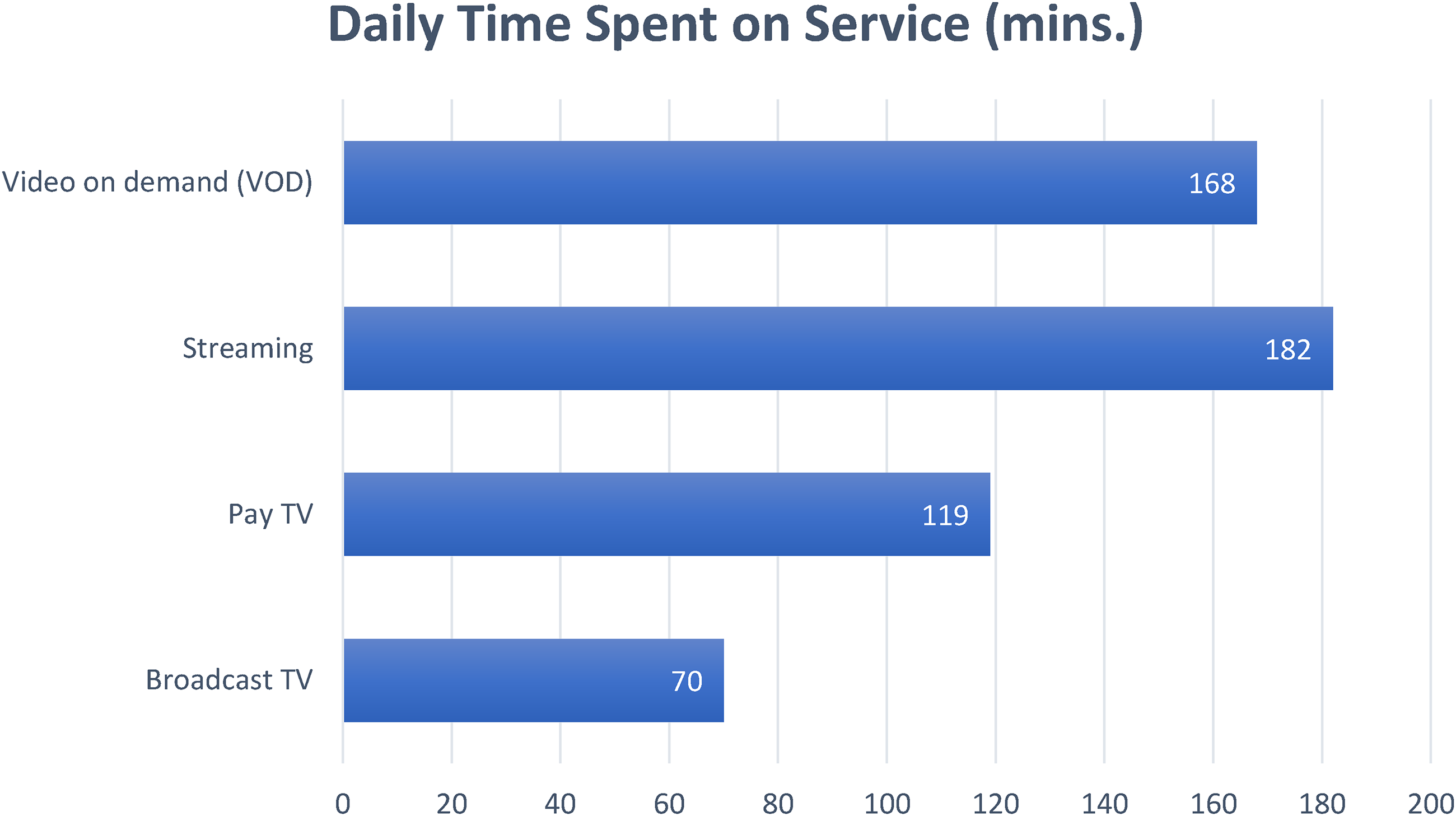
Daily average time spent on services
There are limitations to this data set because the study used self-reported data from a sample population and does not specify by age group, but it does indicate how diversified the media landscape had become. The audience expectations of video moved even further away from the broadcast-centric experiences of the past.
The value of domestic streamers’ original titles
The shift from a broadcast-focused video culture to a dispersed experience of widely varied video consumed across different services set the conditions for the video culture in the 2020s. Korean audiences increasingly consumed a wide array of stories in their own time, and they were aware of the possibility of stories that were not the formulaic melodramatic broadcast dramas. The domestic streamers emerged at a point where the industry was already aware of the erosion of the broadcast experience, and they adapted to the changing expectations of the audience. With multi-country services like Netflix already providing high-budget dramas to local subscribers, the domestic streamers aimed to provide original content that served sensibilities not being sufficiently served by existing media. This section examines the emergence of compressed stories of web drama and provocative stories in the domestic streamers’ original content to show how their value proposition is the specificity or relevance of the stories they offer. The compressed stories of web drama contain only the most essential scenes to fit in with people's busy lifestyles, and the streamers’ originals feature topics that are too specific and controversial to be seen on legacy media.
Efficient everyday stories in web dramas
‘Web drama’ is a term that is used commonly in Korea, and it refers to the original serialized stories intended to be watched on the small mobile screen. The surge of smartphone ownership after 2009 (93.4% by 2021) led to production of mobile original content meant to be consumed on smartphones at much higher levels than in other countries (Jin, 2015; Korea Communications Commission, 2022a). Web dramas are part of the industry's effort to reach smartphone users, along with webtoons and web novels, which were typically shorter than those of traditional media, and to target specific taste segments of audiences (e.g. mystery, teen life, fantasy) (Jin, 2015).
As with other mobile original content, the intended audience for web drama is perceived to be easily distracted due to the size of the screen and noisy viewing environments outside of the home. So, web dramas are shorter than television dramas, and they feature concise storylines. An episode of web drama can be anywhere from a few minutes to 20 minutes, although there is no limit on how short web dramas should be. Typically, an entire web drama season is less than a single episode of television drama. The seasons can be released all at once or can be watched on a week-by-week basis; there is no fixed standard for distribution scheduling.
Web dramas built upon the industrial norm of utilizing shorter lengths to maintain the audience attention (Jung, 2016; Park, 2009). But what set web dramas apart from television dramas was not only the short running times, but the types of stories being told. Web dramas feature everyday topics that audiences could easily identify with, saving time for world building. For instance, the web drama Love Playlist (2017–19) is about the ups and downs of romantic relationships among a group of college students and mundane events like getting jealous of their friends and making up after a fight. Web drama narratives are vastly different from the fantastic television romances; as a comparison, tvN cable drama Crash Landing on You (2019-20) is about the romance between a North Korean army captain and South Korean heiress, who fall in love after the female lead lands in North Korea due to a paragliding accident. In brief, web dramas are stories that closer to quotidian life than the unusual events that occur in television plotlines.
Web dramas contrast with the broadcast dramas through efficiently constructing concise narratives rather than needlessly extending narrative time to generate revenue from the increased time for commercials. It has become a common practice for audiences to fast-forward or watch summarized YouTube videos of television content because of bloated narratives (Heo, 2023).
Web dramas consequently use faster pacing than television dramas, and their short running times mean that they can only keep the most crucial elements in storytelling and must remove excess scenes. In contrast, one of the defining features of television dramas is their ‘high-budget visuals that consistently include mesmerizing scenes of the Korean landscape’, that represents the Korean-ness of the story (An, 2022: 143). These lingering landscape shots are utilized to capture the international audiences’ curiosity, and to boost the nationalistic pride of the domestic audiences, but they are rarely important to moving the story forward. For example, the first episode of TV drama Crash Landing on You opens with beautiful shots of the mountains and fields of North Korea. The camera takes a bird’s-eye view to capture North Korean soldiers patrolling the border, pans to the Korean Demilitarized Zone (DMZ), and South Korean guard posts at the DMZ. After shots of clouds in the sky, we see the cityscape of skyscrapers of Seoul before finally ending with a close-up of the main character Seri. In comparison, the first episode of the web drama Love Playlist begins by immediately introducing the main character, Jiwon. She receives a text message from her friends and finds out that her boyfriend is hanging out at a bar with another girl. Jiwon becomes jealous and she rushes to the bar to confront him. Web dramas’ fast pacing caters to audience desire to get around unnecessary scenes and go straight to the key storyline.
The industry perceives the web drama audience to be watching web dramas on their smartphones when they are in transit. Nearly half of the population lives in the capital Seoul and in this highly dense metropolitan setting, Seoul commuters spend an average of two hours daily just on commuting (Lee, 2019b). The telecommunication operators in Korea are constantly competing to provide access to high-speed internet to users anytime, anywhere, and free Wi-Fi services are available on public transportation services. With this easy access to the internet, people are on their phones to pass the time during their commute and mobile original content – including web dramas – is aimed to be consumed in this environment. In a 2021 survey by the Korea Communications Commission (KCC), the most used device for watching videos was the smartphone (92.2%) and YouTube was the most popular platform for these users (65.5%) (Korea Communications Commission, 2021). ‘Video’ in Korean is dongyeongsang, a term that is used to refer to all types of videos viewed on digital devices, so this can include user-generated content, television content highlights, Netflix originals, and commercial clips. In other words, Koreans spend a lot of time watching various videos on their smartphones, and web dramas are concise and fast-paced, reflecting these viewing habits and busy commuter schedules.
The Korean platform Kakao TV, has particularly targeted this specific audience, seeking efficient everyday stories. Initially a platform for live broadcast streaming of user-generated content, Kakao TV rebranded in 2020 to position itself as a platform for professionally produced original mobile content. It initially releases its titles for free (with advertisements) for a couple weeks, and then it reverts to a pay-per-view system. Kakao TV's content not only includes web dramas, but also reality and entertainment shows. For example, its original entertainment show Shall We Chat? (2020–21) was a talk show where the host and guest ‘spoke’ to each other through a messenger application. The show was meant for the smartphone screen, as it was filmed in a vertical ratio and displayed the messages of the cast members on the screen, the same way a messenger app does. Each episode was about 20 minutes long and episodes were released on Tuesdays at 7 a.m., with the intention of capturing the commuter viewership. As another example, the web drama Lovestruck in the City (2020–21) took on a mockumentary format, where three couples are each ‘interviewed’ about their romantic relationships. This interview format was intentionally chosen to efficiently move the narrative forward by conveying the inner thoughts of the characters to the viewer (JH Kim, 2021). The director found it difficult to use the same narrative arc structure as an hour-long TV drama in a 30-minute web drama, so he chose to blend melodrama and mockumentary forms in this original series.
The rise of short, efficient storytelling contrasts with what was available to viewers on television. Unlike the fantastical stories with spectacular visuals on television, web dramas featured stories that general viewers could easily identify with. Stories about realistic, mundane problems like jealousy among friends, bad haircuts, and paying off bank loans became part of the video culture. Web dramas removed narrative devices like recaps and lingering scenery shots, so stories have become compressed in the Korean context, as the industry imagines their potential viewers being accustomed to watching short videos on their mobile phones in busy environments. Web dramas, with their everyday topics in short form, served the viewers’ need for different stories outside of television.
More niche and sensational originals on streaming services
The major Korean streaming services have thus far prioritized the domestic market; they do not offer their services to overseas audiences. Within the domestic market, the affordable price of pay television services, along with the strong presence of Netflix, has made it difficult for domestic streamers to grow their subscription base. Thus, domestic streamers have instead invested in catering to specific viewer tastes to differentiate them from the high-profile, big budget, and patriarchal romances often seen in television and global streamers. This is because prioritizing small, underserved audiences with specific stories is considered by the industry to be a more cost-effective strategy than producing large-scale dramas (Jang et al., 2022).
The original stories of domestic Korean streamers are sensational, in the sense that the topics are unlikely to be seen on television, and niche, attracting a very narrow audience segment, even more so than cable television was ever able to do. Cable television dramas were certainly different from the broadcasters’ shows, but cable stories still had to appeal to a large audience because they depended on advertising to make up for the cheap subscription prices in revenue (SM Kim and JH Kim, 2018). But domestic streaming services are free from the expectations of pay television, and instead cater to particular sensibilities that cable or broadcast channels were unable to serve. This is not to say that domestic streaming services do not produce dramas targeted at larger audiences, but that there is more emphasis on targeted stories. 8
Tving's original series Work Later, Drink Now (2021) and reality show Transit Love (2021–22) demonstrate characteristics of niche storytelling. Work Later, Drink Now focuses on three women who meet up after work to drink. The drama series shows how the protagonists come together to talk about their everyday life, like their careers and romantic relationships. Each episode features a different type of alcohol that the women enjoy at their gatherings. Such scenes are unlikely to be broadcast on television because the KCC regulates scenes that promote and glamorize excessive drinking (Jang, 2021). The premise of Transit Love is four ex-couples living together in a Big Brother-style house and deciding whether to rekindle romances with their ex or find a new partner. The format itself (a dating reality show) is not new, but previous dating shows tended to be about people meeting strangers and getting to know them while Transit Love diverges from this format by having ex-couples as participants. At the time of its release, the show was criticized for being too sensational – the idea of ex-lovers living together – but it has become the most popular show on Tving.
The platforms Wavve and Watcha also offer more narrowly targeted original series. Wavve's original content production concentrates on variety and entertainment rather than drama. The platform is a joint venture between the three broadcasters and SK Telecom, and has access to their broadcast dramas. Wavve has produced reality shows geared towards K-pop fans, such Mtopia (2021), which features the group Super M, and iKON's Type (2021), about the boy band iKON. More recently, Wavve has offered shows that feature LGBTQ romances – mostly notably the reality shows His Man (2022) and Marry Queer (2022). The former is a reality dating show with gay men and the latter features the everyday lives of gay, lesbian, and transgender couples. Homosexuality continues to be controversial on Korean television and is treated as a topic that needs ‘careful monitoring, censuring or occasional outright censoring’ by official powers (Glynn and Kim, 2017). While Wavve's shows did receive pushback from conservative civic groups, this did not lead to any action because Wavve was not subject to television regulations.
Watcha's well-known original drama Semantic Error (2022) is targeted towards the BL (Boys’ Love) subculture. This subculture consists of mostly straight women consuming male–male romance stories because they are dissatisfied with heterosexual romances that reproduce gender hierarchies and sexist social structures (Kwon, 2021). The drama is based on the BL web novel of the same name, a melodrama of two male college students falling in love. It remained the most viewed series on Watcha for eight consecutive weeks and is credited for tripling Watcha Japan's subscribers in less than a year (Nam, 2022). Watcha initially started as a recommendation service (Watchapedia) in 2012 and has accumulated vast data on audience preferences. The platform saw that despite the demand for BL genre content, broadcasters and cable channels avoided this topic, so they decided to produce Semantic Error (Nam, 2022). Watcha continues to cater to the BL fandom, as they released a second BL drama in late 2022.
Domestic streamers Tving, Wavve, and Watcha offer different viewing experiences that are not as resource-intensive, high-end, and centred on big impact stories, a strategy that differentiates them from global SVODs (Pearson, 2020; Smith, 2018). SVODs are often credited with accelerating cord-cutting in other places, but this is not the case for Korea. The telecom companies that operate IPTV (KT, SK Broadband, and LG U+) have agreements with streaming services, by offering bundled packages that include SVOD subscriptions and having a streaming section on their IPTV interfaces (Yoon, 2022). These partnerships, along with the different types of stories available on the services, suggest that Korean viewers perceive domestic streamers as a complementary service to television – not a replacement (Korea Communications Commission, 2022b).
Experiencing video in a rapidly changing environment
The Korean video landscape continues to be dynamic, with domestic services and platforms experimenting to best cater to their audiences. The FTC (Fair Trade Commission) recently approved a merger between Tving and Seezn (a SVOD operated by the telecom company KT), which made them the second largest platform in the market, replacing Wavve (Park, 2022). Watcha expanded their operations into webtoon and music streaming, and rebranded themselves as an entertainment platform in 2022. Wavve established an in-house production company, Studio Wavve, and plans to bulk up their original content library in the upcoming years. In addition, broadcast television has responded to the changing media landscape by airing dramas that depart from the formulaic melodrama, as seen with the recent drama Doctor Lawyer (MBC, 2022), a legal thriller series that has no romance narratives.
Focusing on original content, this article has demonstrated how industrial practices and expectations that stemmed from broadcast television have evolved and adapted to shape video in Korea today. In particular, the domestic streamers’ original content has adapted to fit the viewers’ changing lifestyles and desire for stories not seen on television. There is growing concern about how multinational SVODs like Netflix threaten the Korean media industry with their aggressive investments and acquisition of Korean content. However, the original content of domestic streamers indicates that they are not trying to be just like Netflix but offer different value propositions.
The distinction between the content found on linear television, streaming services, and platforms is becoming more blurred than ever. The Netflix original reality show Physical: 100 (2023) was produced by the broadcast network MBC. Many of Kakao TV's original shows are non-exclusive and are distributed in various places, including Wavve and Netflix. Watcha original Damn Good Company (2021–22) was initially a YouTube show created by an individual creator. Understanding Korea's shifting and expanding video cultures requires including domestic SVODs in discussions on Korean media. It is likely that further adaptation and additional or reconfigured video cultures will emerge, and domestic streamers certainly will be part of future conversations.
Footnotes
Funding
The author received no financial support for the research, authorship, and/or publication of this article.

Notes
Author biography
Jennifer M Kang is a postdoctoral research fellow at the Digital Media Research Centre, Queensland University of Technology. She received her doctorate degree from the Department of Radio-Television-Film (RTF) at the University of Texas at Austin. Her research interests are global media, media industries, and television studies, with an emphasis on the South Korean media industry. Her work has been published in International Journal of Communication, International Journal of Cultural Studies, and Media, Culture & Society.