



Abstract
This article explores and clarifies the usage of social and symbolic capital as applied to fan studies. It illustrates the author's definitions with a case study from the neglected arena of dark fandom. I argue that ‘social capital’ should be used to refer to the network of friends and associates agents possess within a subculture, whether dyadic, triadic or multidirectional, but that to qualify as social capital, there must be mutual recognition of the tie. I illustrate this argument through a case study of the online presence and persona of Taylor James, the owner and proprietor of leading murderabilia auction site CultCollectibles.org. ‘Murderabilia’ refers to items formerly possessed by or associated with celebrity criminals, particularly serial killers. I further establish that contra Thornton, we do not observe mainstream condemnation generating subcultural capital within this sphere, but rather, mainstream media attention can be negotiated by appeals to traditional forms of expertise.
Introduction
Bourdieu's theories of cultural capital have exerted a profound and lasting influence on the field of cultural studies, and fan studies in particular. Yet as early as 2002, Matt Hills questioned why fan studies academics have been largely neglectful of the related concept of social capital, calling for future analyses to pay it equal attention. He also drew attention to the related absence in fan theory regarding ‘symbolic capital’, which he defined with reference to MacDonald's observation that fans at the top of fan hierarchies act as spokespeople or representatives for their subcultures (Hills, 2002: 30; MacDonald, 1998: 138–9). Some academics have heeded this call (Chin, 2018; Shefrin, 2004; Williams, 2010), but the concepts of social and symbolic capital are still relatively neglected in fan studies, with some academics mentioning them briefly but not explaining their usage, and others lumping them in with the much more studied ‘cultural capital’, as though all three concepts were the same thing. This is worth correction, because the lenses of social and symbolic capital provide insight into socioeconomic processes and negotiations of hierarchies, not only within the field of fan studies, but within subcultures more broadly. In conducting the research for my forthcoming book on serial killer fans, I was struck by the unexpected emergence of what are sometimes called ‘subcultural celebrities’ or ‘Big Name Fans’ (Chin, 2018; Hills, 2003) within this subculture, despite its taboo objects of fandom. These individuals built and maintained high levels of social and symbolic capital within the dark-fannish sphere. This article explores how social and symbolic capital accrues to a specific persona within a neglected field, despite the taboo nature of the topic.
Our case study will be the online presence of Taylor James, also known as Robert Applewhite, the owner and operator of the true crime memorabilia website Cult Collectibles. Such memorabilia is known within the subculture as ‘murderabilia’, that is, items formerly owned by or other otherwise related to individuals who have committed murder. James is described by true crime YouTuber Jake Webber as a ‘legend’ within the ‘true crime community’ (Webber, 2022a), suggesting a degree of reputational power and credibility that cannot be explained via theories of (sub)cultural capital alone. In this article, I demonstrate that the relational work figures like James undertake to negotiate positions as both as fans and professional dealers of artefacts is better understood through the more neglected aspects of Bourdieu's theory, that is, social and symbolic capital. These underutilized lenses could be more productively employed, by cultural studies scholars in general and fan studies scholars in particular, to understand how individuals gather status and prestige within subcultures, including their relation to economic capital.
First, I will define my usage of the terms ‘social’ and ‘symbolic’ capital, with reference to the fan studies literature that has covered this work so far. An important contribution of this article is the clarification of these terms, by developing the insights of Hills (2002, 2003) and Chin (2010, 2018). I will then introduce the field of our case study, which is the dark fandom of murderabilia collectors and exhibitors. I will go on to explore James's online presence, persona and activities, to discover how social and symbolic capital accrue to an individual in this sphere, and how they relate to the economic exchange that underpins murderabilia items. For James is not just a hobbyist: Cult Collectibles and related ventures are now his fulltime job, and the exchanges he brokers can be worth hundreds of thousands of Canadian dollars in value (though, as he frequently stresses, he is not making hundreds of thousands of dollars per item – he merely brokers the transactions through his business). James also fulfils the role of media spokesperson for this fandom. In speaking to more mainstream media, I noted that he makes frequent appeals to traditional markers of cultural capital, such as education and museums. This contrasts with the more informal persona he uses to communicate with fellow collectors, and is contrary to Thornton's (1995) observation that mainstream condemnation serves as a marker of subcultural capital in niche areas. This, in turn, provokes questions for future studies of dark(er) fandoms and other taboo subcultures, regarding the relation of subcultural capital to mainstream media interest, as I will discuss in the conclusion.
Definitions and literature review
Cultural capital (Bourdieu, 1984) is well understood within sociology generally and fan studies specifically, as the abstract, knowledge and skill-based resources that grant a person status and opportunity within a particular field. To gain cultural capital in an official sense, one might enrol in traditionally respected university courses or undertake a personal education in bourgeois forms of ‘official’ culture (theatre, art, certain forms of film). Under certain circumstances, cultural capital can be exchanged for economic resources (though in other circumstances, economic gain can deplete it: Bourdieu called this the ‘autonomous’ pole of dominant culture, wherein exchanging cultural capital for money is considered ‘selling out’). Fiske (1992), Thornton (1995) and Hills (2002) drew attention to how subcultural capital operates within specific fan cultures, as certain fans gain respect and admiration for their knowledge of the object of fandom, their possession of objects connected to it, their closeness to media producers, and so on. Social capital is different, but connected, so it is quite surprising that Fiske and Thornton neglected it (cf. Hills, 2002: 29). According to Bourdieu, social capital is ‘the aggregate of the actual or potential resources, which are linked to possession of a durable network of more or less institutionalized relationships of mutual acquaintance or recognition’ (Bourdieu, 1986: 248). That is to say: social capital is relevant recognition, recognition by the relevant agents in one's field. Within academia, it might take the form of an endorsement from a senior professor, or in the world of film, a positive review from a respected director. Matt Hills and Bertha Chin have done the most authoritative work to date in applying the concept to fan studies. Chin (2010: 78) argues that: Within fan fiction fandom, a beta reader or veteran author who already possesses a certain amount of fan social and symbolic capital within the fan fiction community can invest in new up-and-coming authors, promoting their works of fiction to their fan audience, acting as a mentor – an advocate for quality, as well as taste.
Hills suggests that ‘fan social capital’ could be defined as ‘the network of fan friends and acquaintances that a fan possesses, as well as their access to media producers and professional personnel linked with the object of fandom’ (Hills, 2002: 30). Naturally, fans with social capital will likely have high subcultural capital as well, but the reverse need not be true, as ‘extremely knowledgeable fans may also “lurk” or refuse to participate in organised fandom’ (2003: 30). Such fans would be high in subcultural capital but low in social capital. Hills also uses Bourdieu's work to draw attention to the possibility of symbolic capital in fan studies. Bourdieu's own definitions of symbolic capital are quite vague. In Language and Power, he writes of ‘symbolic capital, commonly called prestige, reputation, fame, etc., which is the form assumed by these different kinds of capital when they are perceived and recognised as legitimate’ (Bourdieu, 1991: 230). So is it a capital in itself, or merely the recognition of the other forms? Or both? Hills suggests it could be usefully employed to describe Andrea MacDonald's example of particular fans who are nominated as public spokespeople for their fandom, selected to speak to journalists or the press. I agree, and also have another use for it.
Recall the use of ‘mutual recognition’ in Bourdieu's description of social capital. This raises the question of how ‘mutual’ the recognition must be. If I post a YouTube video aimed at a specific fandom, and receive 100 comments, I do not ‘recognize’ every commenter as an individual, but I do recognize them collectively, as members of the subculture which I am addressing. We could try to formulate this a little differently, as ‘subcultural celebrity capital’, where celebrity capital is granted by the ‘mass’ of observers without the celebrity knowing each individual who recognizes them (cf. Driessens, 2013, on celebrity capital). But I think this is unnecessarily complicated when speaking of a relatively small subculture. Rather, I think that ‘general’ recognition and respect from ‘the culture’, as it were, could best be described as symbolic capital, based in reputation and prestige. Taking the example of film, if social capital is granted by a single acknowledgement from a prestigious director, symbolic capital might be granted by a series of positive reviews from fans and critics, none of whom in themselves might be particularly respected and some of whom might even be anonymous: symbolic capital, as reputation, is bestowed through the combined weight of their endorsement. These lenses provide more precise insights into capital building within fandoms and other subcultures than that of ‘cultural capital’ alone.
This understanding also aligns with Shefrin's (2004) and Williams’s (2010) view of fans as potential ‘consecrating agents’, who are able to collectively grant symbolic capital to those media producers they perceive as in harmony with their interests and dispositions. The term ‘social capital’ can then be reserved for the networks of mutual respect, recognition and collaborative creation and labour that fans establish with other specific fans, usually fans who also have high symbolic and subcultural capital in that field. These sorts of collaboration can be mutually reinforcing. Chin notes that: High status fans, or fans who possess higher-level social, cultural and symbolic capitals receive special treatment in fan communities […] These fans are the community leaders, the subcultural celebrities, who through their high quality gifts of fan fiction, videos and artworks, have accumulated high amounts of fan social capital, subcultural capital and symbolic capital. (2010: 69)
Chin is speaking of fannish gift cultures here, which the exchange and auction of murderabilia is usually not. It mostly runs on a traditional economic model and can even involve institutional players, such as museums, as well as private collectors. It can, however, involve gifting, both of artefacts and of labour, and these acts can be understood through the lenses of social and symbolic capital building, the accumulation of which might later be converted to economic capital in further exchanges.
In the 2010s, the internet in general, and fan cultures specifically, underwent certain structural changes related to the dominance of social media. Chin suggests that on platforms such as Tumblr and Twitter, the ‘accumulation of likes and retweets/reblogs builds on fans’ reputations, elevating their status’ (2018: 244). I would call this symbolic capital accumulation, as opposed to a visible long-form conversation or exchange with a similarly respected fan, which would come under the heading of social capital. Specific skills and knowledge are required, not merely regarding the object of fandom but the judicious use of technology, the timing of social media engagement, and, where applicable, engagement with media producers and companies.
I do think, then, that the terms ‘social’ and ‘symbolic’ capital have their uses and can offer insight with regard to contemporary fan cultures and to subcultures in general. We can use them to observe the methods and practices by which particular fans and/or subculturalists gain special status, which in some cases may be traded on for economic gain. Hills and Chin have provided the best definitions so far, and I have further drawn out these definitions with reference to Bourdieu's concept of mutual recognition. Unfortunately, when these terms are used by other academics, they are sometimes quite confused. Veale writes: Fans spend a great deal of money on merchandise within their fandom, and this investment of market capital has a social capital within the audience, while at the same time there is sharing and reciprocity with resources. (2013: 3.1)
This is inaccurate. The investment itself doesn’t ‘have’ social capital. It might earn it, but the capital is in the endorsement from other fans. Veale seems to recognize this later, in the same article, writing ‘fans can demonstrate their allegiance to [the object of fandom] by purchasing commercial products, and in doing so, they can gain social capital within the community’ (2013: 4.9, my emphasis). Discussing a Reddit community devoted to the K-pop group BTS, Lynch writes that the group moderators ‘gain unlimited social capital and use it to control the content seen by the rest of the /r/bangtan community, much like a traditional news gatekeeper’ (2022: 105). This ‘social capital comes from their ability to control community discourse and their ability to appear unbiased to the community’ (2022: 109). There are two quite separate operations in this sentence, concealed by the conjunction ‘and’. The ‘ability to control community discourse’ is ultimately force: that is, moderator fiat. That is not social capital: a moderator could be strongly disliked and still maintain the ability to delete posts. If all the moderators were disliked, the community would probably flounder, because capitals operate relationally. But it is not social capital itself that grants the ability to delete posts. That is a technical affordance.
1
Regarding the ‘ability to control community discourse’, Lynch goes on: Remaining a well-liked moderator does not involve creating or maintaining individual social connections. In fact, almost all of the moderators I interviewed mentioned that they felt like they could not participate in the community like they did before becoming a moderator, thereby stunting their ability to accrue traditional social capital […] Instead of personal social connections like in social capital, the important thing for a moderator is having the interpersonal skills to act or at least appear unbiased to the community. (2022: 113)
I do not understand why the term ‘social capital’ is being employed here. Symbolic capital might be more applicable, if one could make an argument for the appearance of impartiality being the key to in-group credibility.
Similarly, we should not confuse the categories of social and symbolic capital with celebrity capital, in referring to subcultural celebrities. Celebrity capital, according to Driessens, ‘is conceptualized as accumulated media visibility that results from recurrent media representations’ (2013: 543). Obviously this is more applicable to mainstream celebrities than subcultural ones, though subcultural celebrities may accumulate recurrent representations within specific niche media, as Taylor James does. The reason I find it an inappropriate term for the study of a subculture is that, as Driessens says, celebrity capital has a high degree of interchangeability with other forms of power. For example, celebrities can exchange their celebrity capital for political influence: ‘consequently, whereas symbolic capital is usually field-specific capital, celebrity capital can work across social fields’ (Driessens, 2013: 551). A high-status fan in some more mainstream fandoms might have both symbolic capital within their fandom and a degree of celebrity capital, but that does not mean they are the same thing. Haborak (2020) describes the online visibility achieved by popular Instagram cosplayers as both an activity by which fans gain social capital and a means of obtaining celebrity via viral fame. A skilled, relatively wealthy, and popular cosplayer might well attract both kinds of capital, as the hobby is increasingly professionalized and publicized in mainstream media outlets, but the conceptual definition should be clear. Social and symbolic capital require mutual recognition within a field, either by individuals in the former case, or by the fandom as a culture in the latter. Celebrity capital requires no mutual recognition on the part of the celebrity.
Other writers have employed the concepts of social and symbolic capital more clearly, further demonstrating their utility. Reporting on how fans use social media to display photographs and reports from fan-tourist journeys, Thelen and Kim write: Thanks to the rise of online social media in the twenty-first century, fan symbolic capital has become more recognized and pervasive than ever before through the medium of easily countable data of ‘views’ and ‘likes’ […] Four interviewees shared photographs on their social media accounts including Facebook, Twitter, and Instagram. All four were surprised by the huge attention they have received not only by followers or friends but more importantly by unknown users, generating up to ten times more views than usual. (2023: 13, 14–15)
This aligns with my understanding of fan social capital as gained by visible, mutual exchange with high-status fans, while symbolic capital is granted by the weight of multiple likes and shares etc. from the subculture at large. Chen has another good example. Discussing the ‘social dimensions of expertise in World of Warcraft players’, he writes, ‘expertise development depends greatly on a player’s use of social skills to gain access to expert player groups and accrue social and cultural capital’ (2009: 0.1). I would omit ‘and cultural’ from this excerpt, reserving ‘cultural capital’ for game-related knowledge and skills, but this is largely how Chen's article pans out. He writes that while skills and knowledge of gameplay are needed to advance in the lower levels, ‘at higher levels, monsters and quests are not easy enough to overcome alone. This, in turn, depends on successful networking and possessing a high enough reputation’ (Chen, 2009: 1.7). Cultural capital is needed to succeed at the lower levels; social and symbolic at the higher, where ‘skill was not the only factor […] as it was clear that preference was also often given to players who were friends with or had established relationships with other members’ (Chen, 2009: 3.6). The display of cultural capital is one means to gain social capital, but it is not the only one: sociability, online presence and communication skills all matter.
Finally, D’Amato (2014) has a chapter on the conversion of fannish social capital to economic capital. Writing on fan funding of independent music projects, he observes that, ‘the reference to the notion of social capital is implied in fan funding logic and is sometimes explicitly formulated by web-services’ (D’Amato, 2014: 136). Independent musicians build and leverage social networks via such platforms in order to finance their projects: Social capital is founded on the rhetoric of empowering fans as gatekeepers and as the support infrastructure of artists in difficulty, on the equity of the return to fans as investors and […] the offering of intangible values, such as acknowledgment and reputation, participation and privileged relationships with the artists. (D’Amato, 2014: 140)
As a visible relationship with an artist grants social capital, fans are able in these personal interactions to both earn and grant it. Fans reported that important factors in their choice of who to be supported included perceiving the ‘presence of artists on the website and interacting with them, their openness and the time they devote to them’ (D’Amato, 2014: 142) as well as musical taste. Artists can convert this social capital directly to financial investment.
Social and symbolic capital applied: Murderabilia, Cult Collectibles, and the legend of Taylor James
No prior studies have been conducted into the accumulation of social and symbolic capital in dark fandoms. Broll defines dark fandoms as ‘communities of fans who identify with or otherwise celebrate those who have committed heinous acts, such as mass or serial murderers’ (2020: 795). The definition of ‘celebrate’ is a point of contention here: the precise point at which interest and fascination becomes celebration is probably indefinable, but there are certainly widespread online communities of individuals who engage in fannish activity related to serial killers and other criminals (see Fathallah, forthcoming). For this article's case study, we take the example of collection of murderabilia, that is, objects and artefacts connected to murder and true crime. In some form, this is probably an ancient practice, but can be reliably dated to at least the 1700s. Ruth Penfold-Mounce, a senior lecturer in criminology at the University of York, reports a fashion for keeping the fingerbones of executed criminals as a charm against running out of money (in Damon and Fiennes, 2019a: Episode 6). True crime ‘museums’ of varying degrees of respectability have existed since the Victorian era. 2 Modern murderabilia exchange takes place primarily over the internet, with specialist sites increasing in popularity and visibility when eBay banned the sale of murderabilia in 2001.
Cult Collectibles, founded in 2018, is based in Canada and operates and collaborates internationally. Owned, founded and operated by Taylor James, who also goes by the name Robert Applewhite, it is now one of the largest sites in the world dedicated to the archiving, display and sale of artefacts related to murder and crime. James's original interest was primarily in cults: ‘Applewhite’ is a reference to Marshall Applewhite, co-leader of the American cult Heaven's Gate, which committed mass suicide in 1997. As James himself has noted, his site differs from others in the sense that it is quite ‘personality-based’ (James and Dodge, 2023a), and this was a key factor in my selection of his persona as a case study. James has a strong social media presence on YouTube, Patreon and TikTok, and Instagram, though his accounts are intermittently banned and he is then forced to regroup his followers. He also co-hosts a podcast, titled ‘Murderabila exposed’, with Andrew Dodge, the proprietor of True Crime Auction House. Dodge has much less of a personal brand than James, and has stated in several episodes that he is looking to leave the murderabilia business in the near future. James also fulfils the role of ‘fan-spokesman’ for the true crime community, as Hills (2002) observed was typical of fans high in symbolic capital, listing interviews with small and medium-sized news outlets on his website.
James's distinctive appearance is a hallmark of his personal brand. His logo, which he uses both on social media and on merchandise such as stickers, features a cartoon of his face surrounded by a circular design with skulls. He has the words ‘Away’ and ‘Team’ tattooed on either side of his nose: this is another reference to the Heaven's Gate cult, as the members wore armband patches reading ‘Heaven's Gate Away Team’ at the time of their mass suicide. He also has a pentagram tattooed on his forehead. In this way, he displays both in-group knowledge (people unaware of cult history might associate the phrase ‘Away Team’ either with sports or with Star Trek, which the Heaven's Gate group itself was referencing) and commitment to dark fandom: his facial tattoos may limit his employability outside of certain niche cultures, but he is successful enough as a fan-entrepreneur to work for himself. This is an example of the non-convertibility of symbolic capital: James is a respected figure within his field, and able to trade on his symbolic capital for economic gain within it, but he cultivates an appearance that would bar him from traditional prestige occupations. He also utilizes a second logo, based on a cartoon of Jeffrey Dahmer's face, and his choice of font and logo style unites all his social media.
Social and symbolic capital 1: Networking, collaborating, and consulting
James's Instagram and TikTok function primarily in a broadcast mode. They are used to display the objects in his collection, impart information about them, and exhibit brand merchandise for sale. This is primarily a display of subcultural (and related economic) capital. He does, however, utilize these accounts for networking and collaborating to a certain extent. For example, Figure 1 displays an Instagram post advertising a giveaway competition. The winner will receive a hoody designed by James in collaboration with the alternative clothing brand wetwired UK: to participate, fans must share the post and tag both accounts. James both builds and displays social capital via his relationship with the brand, and gathers symbolic capital by inviting his followers to increase his media reach.
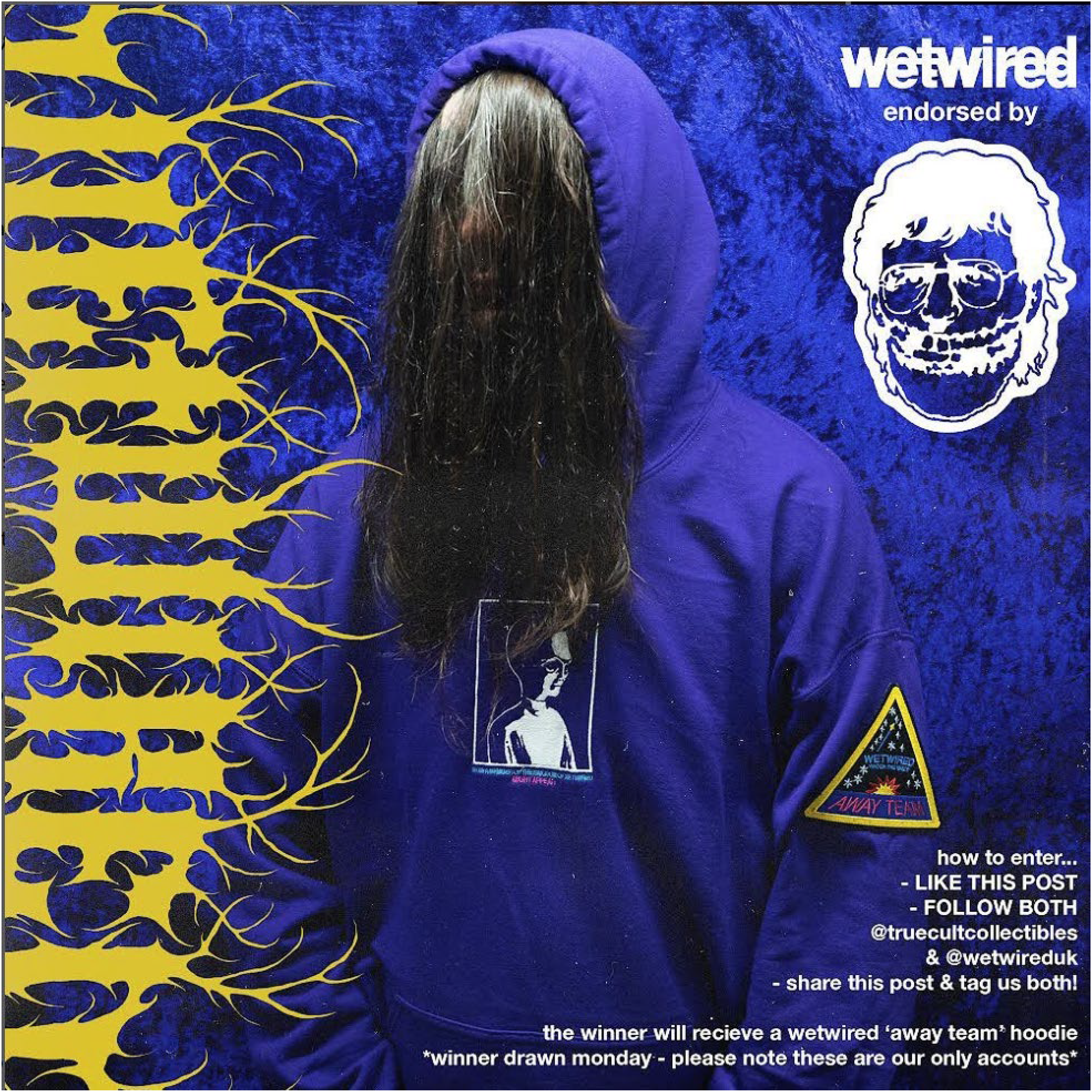
Instagram post by truecultcollectibles, 2023
Symbolic capital is also displayed via the appreciative responses of his followers on displays of his wares: short comments such as ‘fire’, ‘awesome’, ‘sweet’ and ‘dope’ are common on both platforms. These comments build symbolic capital rather than social, as James does not have a personal relationship with each follower. He does, however, make a point of publicly acknowledging fans who send him high-effort communications, such as a cartoon of his face. This sort of emotional labour is key to networking and building social capital, as it was for D’Amato's musicians. However, the somewhat taboo nature of this fandom also creates barriers to cultivation. ‘Every time our socials go down I lose a few thousand followers’, one post acknowledges, ‘and months later people find the new page and say they were looking for where they went’ (truecultcollectibles, 2023a). He advises people to sign up to his website's mailing list in order to keep track of him.
James's Instagram and TikTok, then, primarily display symbolic capital, though social capital is evident to some degree. He does also make YouTube videos in this broadcast/showcase mode, but his YouTube collaborations and his podcast are more oriented towards the accumulation and display of social capital. Recall Hills' definition of fan social capital as ‘the network of fan friends and acquaintances that a fan possesses, as well as their access to media producers and professional personnel linked with the object of fandom’ (2002: 30). ‘Access to media producers’ might seem unlikely in true crime fandom, but, on the contrary, James has and has had regular correspondence with several convicted murderers, as well as survivors of mass shootings. Both have appeared as podcast guests. James has described in various places his process of writing to killers in prison. YouTuber Uneasy Terrain is enthused by James's success in this, praising him for having a particular ‘craft or psychological skill [to get them respond]’, noting that convicted serial killers can receive hundreds of letters, and admitting that he has been unsuccessful in getting responses himself (Uneasy Terrain Explorers Club, 2022a). As James presents it, this skill is entirely a socio-cultural one, rather than an exchange of his existing capital. He writes to criminals he finds interesting in the hope of beginning an engaging conversation and creating a relationship (Uneasy Terrain Explorers Club, 2022a). He neither hides his business nor explicitly requests items for it. He attributes his success in securing responses to ‘regular conversational skills’, ‘genuineness’ and willingness to ‘speak to them like a normal regular person’ rather than simply requesting murderabilia or details of their crimes (Uneasy Terrain Explorers Club, 2022a). This skill in accessing the voices of convicted murderers and eventually the objects he brokers (a sort of media in themselves) are clearly important factors in James’ accumulation of social capital. In terms of accessing murderabilia, the social and symbolic capital he has gained is now self-reinforcing: as he explains in a YouTube collaboration video, now that he is ‘a bigger name in dealing in this kind of stuff’ (Bizarre Bazaar, 2022), people looking to sell it will contact him directly. His website currently hosts a collection of personal items formerly belonging to and related to Jeffrey Dahmer, including the urn in which his ashes were temporarily stored before they were scattered.
Despite his self-reported ‘imposter syndrome’ (Uneasy Terrain Explorers Club, 2022b), other true crime YouTubers frequently express excitement at being acknowledged by James, or at having him appear in their videos. YouTube personality Jake Webber has posted several ‘unboxing’ videos, in which he unpacks murderabilia he has purchased via James, which typically come with friendly personal notes of acknowledgement and guidance. James also gives a certain amount of items away for free, as a form of self-promotion and relationship building. ‘This is a pack of True Crime Trading Cards by Eclipse’, one note to Webber reads, ‘These were made in the early 90 s […] the first one is going to be a friend of yours, Nico Claux!’ (in Webber, 2021). Observing this, Webber exclaims, ‘Oh my God, he knows I’m chill with Nico!’ Nico Claux is a French murderer, author, publisher and artist who has completed his prison sentence, and a mutual acquaintance of Webber and James. James's acknowledgement and recognition of this tie legitimates it as social capital, illustrating one of Bourdieu's uses of ‘symbolic capital’ as ‘the form assumed by […] different kinds of capital when they are perceived and recognized as legitimate’ (Bourdieu, 1991: 230). This touches on James's role as a consecrating agent within the true crime fandom, as Williams (2010) and Shefrin (2004) argued fans can be for media figures. In theory derived from Bourdieu, consecrating agents are those individuals or organizations who, by virtue of their field position, have the authority to legitimate the capital of others. Both James himself and the Cult Collectibles brand serve this function.
James frequently appears in YouTube videos as a sort of consulting expert, particularly with regard to Jeffrey Dahmer. Sometimes he makes these collaboration videos with YouTubers whose sphere is related to murderabilia, but whose particular expertise is slightly different, such as the underground horror and gore filmmaker Jonathan Doe. James's role in these videos is typically to showcase and discuss the history behind various artefacts of murderabilia and provide information on the killers related. The acknowledgement of these social ties is important to maintain them: ‘Here's a couple cool DVDs released by my good friend Jonathan Doe’, reads a note addressed to Webber in a different video (Webber, 2022b). He also encloses a hand-signed copy of one of his own books, a collection of letters written to Jeffrey Dahmer, published through Claux's publishing house ‘I put out this book with Nico!’ reads the inscription: ‘What a collab, hey?’ (in Webber, 2022b).
In spite of James's self-effacing persona, then, the building and maintenance of his social and symbolic capital within the true crime community exhibits a strong investment of time, effort and interpersonal skill, including the notable ability to engage productively with both criminals and their victims. As James himself has noted in a discussion on the authentication and of murderabilia, the maintenance of his business depends on his reputation (in Webber, 2022c). His buyers ultimately trust that the items he brokers are authentic – while most come with contextual evidence of historical veracity, some of this could theoretically be counterfeited. James states that any minor financial gain he might make from falsifying such documents for a single item would hardly be worth potential reputational ruin, which is undoubtedly true, but his business equally depends on the interpersonal and social skills he uses to cultivate relationships with the broader true crime community. This relational labour builds both social capital (via dyadic and triadic networks) and symbolic capital (via reputational gain and the appreciation and acknowledgement of his broader social media following). However, there is also another aspect to symbolic capital building, as Hills pointed out: the function of fandom spokesperson, or representative to the media.
Symbolic capital 2: James as media spokesman
True crime is a perennially popular media genre. Murderabilia, somewhat hypocritically, tends to be viewed as an at-best eccentric and at-worst immoral subfield of the interest, intermittently picked up by news channels and online outlets. The popularity of Cult Collectibles means that James has been contacted for comment fairly frequently, though he states that he is becoming more selective regarding which outlets he will speak to (James and Dodge, 2023b). Some of these stories are archived on the website, under ‘media’. As one would expect, the tone he uses here is different to the intimate, cheerful exclamations he writes for the unboxings of his friends’ videos, or the jokes he might crack on Instagram. He presents himself as a scholar and an archivist, which he is, though the fannish face tattoos would likely bar him from more traditional roles as such. On the negotiation of the different aspects of his role, he states that he refuses interviews that seem to be heading towards being a ‘hit piece’, and comments that he is not attempting to ‘convince the mainstream’ on the legitimacy of the hobby, but speaking primarily to other enthusiasts (James and Dodge, 2023b). Yet he then states that he has published two books and is working on three more, as well as some documentary projects: Something that I’m looking forward to is that once these other books are out, and I have these documentary credits, I can say hey, as well as dealing in these antiquities I’m also a bit of a historian and I think that's going to alleviate some people's worries about ‘Oh, this is a controversial guy’ or whatever. I’m hoping that just kind of settles it down a little bit. Even though I don’t get too much hate or too much flak it's still nice to have a little bit of reassurance from the public that I’m not doing the worst thing ever. (James and Dodge, 2023b)
This extract illustrates a tension between wishing to be perceived in terms of traditional cultural legitimacy and maintaining the difference or distinction of the subculture. Thornton has argued that condemnation by the mainstream media often translates to subcultural capital within niche interests (1995: 198–210), but clearly the case is a different here, not least because James straddles hobbyist and professional spheres. Mainstream US and Candian outlets he has been featured in include TMZ, the NY Post, and Fox23, as well as lesser-known outlets such as the Daily Hive and outlets local to him in Vancouver, Canada. Interestingly, he sometimes uses his Applewhite alias for these interviews, and I did not see any commentator pick up on the reference. Thornton (1995) believed that mainstream condemnation produced subcultural capital. The media James engages with are not are outwardly condemnatory, which may testify to his skill in selecting interviews. They tend to depict both James and the hobby as eccentric but ultimately harmless, and comprehensible in terms of collecting culture more broadly: Applewhite developed the fascination as a ‘hardcore goth kid’ in high school but he didn’t sell murderabilia at first. Applewhite instead sold standard collectibles like sports cards, Pokemon cards, action figures and retro games. It was when he started to follow his natural fascination with U.S. cults like Jonestown and Heaven's Gate that he started another collection. (in Thompson, 2021)
He typically describes his processes of locating, categorizing, and valuing items, utilizing a professional tone. When discussing items related to particularly notorious killers, he tends to hedge his statements: ‘I have a few John Wayne Gacy paintings right now that I think are really neat, because he did quite a few paintings when he was in prison,’ Applewhite said. ‘They’re not the rarest thing in the world but they’ve kind of transcended beyond a true crime subculture into more of a pop culture thing.’ (in Thompson, 2021)
Presenting Gacy paintings as having ‘transcended’ true crime into general popular consciousness presents the hobby as rationally understandable, rather than particularly obsessive with regard to dark subjects. Indeed, it is true that John Wayne Gacy's ‘Pogo the Clown’ alias has entered popular consciousness in connection with the figure of a ‘killer clown’, though in reality Gacy did not carry out any of his murders in this costume. James again appeals to reason, logic and consistency when asked about the moral implications of the subculture, pointing out that war memorabilia collectors ‘deal in similar items yet receive a fraction of the flak’, and highlighting the profitability of true crime media and the relative respect afforded to other forms of collecting related to violence: ‘I can almost guarantee that a producer who makes a series about Ted Bundy on Netflix will make more money from that series than I will ever make my entire life selling this stuff and buying this stuff,’ Applewhite said.
‘A lot of people kind of say that the documentaries and books have an educational aspect to it. And I totally understand that but so does this stuff in a way.’
As his collection has grown Applewhite has been in talks with a private true crime museum in the U.S. who may feature some of his pieces. (Thompson, 2021)
Here again are two appeals to traditional cultural capital, in the form of education and museums. James is quite consistent in the way he addresses the press: here are similar statements made elsewhere: ‘There is a lot more money in true crime documentaries, books and magazines than there will ever be in murderabilia,’ he maintains.
‘I don’t see why someone would be fine with Netflix making money off a true crime case but be mad that someone is selling a painting by that same criminal.’ (The Crime Report, 2021)
The symbolic capital that James accumulates within the subculture, then, positions him as a spokesman who presents murderabilia collecting in its most respectable guise. This is not necessarily the way he describes his items to his Instagram followers, where he is drier and more humorous: ‘Hey you should try getting stoned and listening to Sabbath!’
Solid advice from a letter to Dahmer in prison. New batch of letters up for sale on the site later today! (truecultcollectibles, 2023b)
The maintenance of this symbolic capital is a delicate work of relational and emotional labour: James must be fannish enough to maintain his authentic standing within the subculture, yet traditionally respectable enough to maintain a professional business. 3 This is quite different to Thornton's argument that mainstream condemnation equals subcultural credibility. It is a question for future study how far this tendency applies in what we might call ‘darker’ fandoms, such as extreme far-right or Neo-Nazi interest groups. 4 Would any sort of negotiation with traditional cultural capital be possible, or would mainstream condemnation simply have to be revalued as subcultural authenticity?
Conclusions
This article has clarified the usage of social and symbolic capital as applied to fan studies, before illustrating with a case study from the neglected arena of dark fandom. I have argued that ‘social capital’ should be used to refer to the network of friends and associates agents possess within a subculture, whether dyadic, triadic or multidirectional, but that to qualify as social capital, there must be mutual recognition of the tie. This includes media ‘producers’, which in the case of murderabilia, can be expanded to include both criminals themselves and the victims of violence. If the recognition is one way, as demonstrated by a high follower count on social media, the capital is better defined as symbolic, in the form of reputation and respect from the subculture as a whole. Fans with high symbolic capital often fulfil the role of spokesperson for the fandom to the media, which, in the case of murderabilia, entails a negotiation between markers of institutional cultural capital, including respectability and connections with institutions such as museums, and the display of fannish capital, which may be exhibited upon the fan's body (such as in tattoos) and in their modes of address to other fans. These refined concepts provide more accurate lenses for studying the accumulation, negotiation and exchange of capitals within fan cultures, and indeed (sub)cultural studies more broadly, than that of cultural capital alone.
The building and maintenance of this capital is delicate relational work for murderabilia fans, particularly for fan-entrepreneurs. Of course, a case study, however significant, cannot be generalized automatically and this limitation should be borne in mind. But murderabilia is a relatively small and close-knit sphere of influence wherein James's ‘legendary’ status provides an exemplary figure for other would-be fan-entrepreneurs. Moreover, it is logical that successful murderabilia brokers must maintain both a professional reputation and a high degree of fannish capital, negotiate access to individuals connected to crime, whether perpetrators or victims, and balance promotional giveaways and gift exchanges with the need to turn a profit. High-status fans in more mainstream fandoms may find symbolic capital easier to gather, as they could be less selective in the media they choose to address (having less need to avoid ‘hit pieces’). They may also find it more easily exchangeable with other forms of capital outside of the fannish sphere: indeed, some high-status fans in mainstream fandoms, such as cosplayers, may now be accumulating ‘celebrity capital’, which is more easily convertible than symbolic capital. On the other hand, the large size and disparate locations of more mainstream fandoms may make it harder for any one individual to rise to prominence. The conversational, interpersonal and networking skills employed to gain social capital seem quite generalizable, and easily convertible to other fandoms or indeed other cultural fields. Utilizing the lenses of social and symbolic capital can give us a better understanding of how these capitals are built within subcultures, and exchanged and/or constrained beyond them.
Perhaps surprisingly, our case study did not bear out Thornton's observation that subculturalists derive subcultural capital from mainstream media condemnation. On the contrary, the mainstream media was cautiously engaged, via appeals to traditional cultural capital. The lack of overt condemnation may testify to skill of the subject of our case study in selecting interviews. It is a question for future studies how this negotiation might play out in what we might refer to darker fandoms, such as Nazi memorabilia collectors and fans of far-right alternative commentators. Will mainstream condemnation be more easily converted to subcultural capital in those spaces, or must some appeal to traditional markers of capital be maintained? How can they be? As fan studies scholars begin to explore the arenas of dark fandom, we should bear these questions in mind.
Footnotes
Author Note
While I would ordinarily seek permission to cite fannish material, I consider that the public-facing, professional nature of this material rendered it unnecessary in this case.
Funding
The author received no financial support for the research, authorship, and/or publication of this article.

Notes
Author biography
Judith Fathallah, PhD, is a Research and Outreach Associate at Lancaster University and Research Fellow at Coventry University. Her previous works include Fanfiction and the Author: How Fanfic Changes Popular Cultural Texts (Amsterdam University Press, 2017) and Emo: How Fans Defined a Subculture (Iowa University Press, 2020). Her next book, Killer Fandom: Fan Studies and the Celebrity Serial Killer is forthcoming from mediastudies.press.