




Abstract
‘Bella ciao’ is one of the best-known partisan songs of the Italian anti-fascist Resistance (1943–5) and is part of the repertoire of protest of many movements across the globe. In 2018, the song was revived by its use in the popular TV series La casa de papel. This article examines how ‘Bella ciao’ is adopted by activists worldwide. It does so by analyzing the song through the concept of ‘portability’: the capacity of a cultural artifact to be a model that can be adapted to different contexts. After an examination of ‘Bella ciao’'s historical uses, the article focuses on the song's feminist versions for supporting different causes and in particular abortion rights. The reuses of the song speak of memory in terms of not only a product – what we remember – but also a process: the creative use of the cultural legacy of past movements for the shaping of new stories.
Keywords
Wrocław (Poland), 23 October 2020: braving the rain, thousands of people crowded a large square to voice their anger against the Constitutional Tribunal that had banned abortion rights, allowing it only in exceptional cases (Walker, 2020). Led by a protester with a microphone and holding print-outs with lyrics, the activists began singing: ‘Pewnego czwartku polski trybunał próbował przejąć moje ciało, twoje ciało, ciało, ciało, ciało’ (‘One Thursday, the Polish Tribunal tried to take over my body, your body, body, body, body!’).
Buenos Aires (Argentina), 30 December 2020: in the summer heat, activists encircled the building of the Argentinean Congress, which was about to vote on a bill legalizing abortion after years of political struggles by the abortion rights movement. Activists began singing and dancing: ‘Este sistema que nos oprime/caerá, caerá, caerá’ (‘This system that oppresses us/will fall, fall, fall’).
The music of the Polish and Argentinean songs recalled the Italian anti-fascist song ‘Bella ciao’: its music, prosody, and narrative served as a model for a new song that gave voice to the grievances, claims, and hopes of both the Argentinean and Polish activists. The direct reference of these reuses was not just the anti-fascist struggle, however, but also a media product: the TV series La casa de papel. Since 2018, the series has revived the use of ‘Bella ciao’, making it a popular protest song worldwide: from the Chilean ‘estallido social’ (2019) to the 2020–21 Indian farmers’ protests; from the Yellow Vests movement in France and the environmental appropriation by Extinction Rebellion to feminist protests in Spain. How and why has ‘Bella ciao’ been adopted and adapted by activists worldwide, for such different causes?
‘Bella ciao’ is always placed in a ‘universally portable state’: it has been expanded and shortened, and mixed with other songs, ‘where verses or melodies have been replaced for the sole purpose of making the song useful and effective in highly particular situations’ (Spaziante, 2013: 352). In this article, we aim to unpack the notion of ‘portability’ and adopt it as a lens through which to explain the recent appropriation of ‘Bella ciao’ by different protest movements.
In memory studies, portability has been explored in particular by Ann Rigney (2012), who uses it to analyze novels acting as cultural models for the creation of new stories. To analyze ‘Bella ciao’ through a similar lens of portability means to acknowledge its double nature. On the one hand, it symbolizes the anti-fascist struggle of the partisans; on the other hand, it is continuously rewritten, reused, and relocated in different and new contexts and media, and for a range of causes. To study ‘Bella ciao’ as a portable monument, then, means to study the extent to which its musical and textual forms are adapted to new contexts of use.
In this article, we draw on recent research on the role of memory in activism to consider the context, music, and lyrics of the song – a methodological choice that we elaborate on in the opening section of this article, where we present a literature review on the interplay between protest, memory and music. Then, we analyze the notion of portability, before moving to a reconstruction of the song's history – from its use in the Italian Resistance between 1943 and 1945 to the broadcasting of La casa de papel (2018–21) – and an analysis of some of its recent versions. In doing so, we pay special attention to one branch of its contemporary reuse, which is discussed in the last section: feminist adaptations in 2018–20, with a focus on transnational abortion rights movements in Argentina and Poland.
The sound of protest
In Maurice Halbwachs' seminal essay ‘La mémoire collective chez les musiciens’ (1939), three levels of connection between memory, music and identity are identified: the cognitive capacity of a member of a social group to learn and (re)produce music as a language; music as a product of social activities and contexts of use; and music, and rhythm, as a semiotic support that helps users to organize linguistic and narrative contents as well as to retrieve them. Halbwachs acknowledges the use of song genres in specific social activities and/or by specific social groups, and he focuses on the production of in-group solidarity and group identity.
In his essay, Halbwachs describes the importance of languages in creating collective and individual identities. He argues that without the language of music there is no society of musicians, just as without the language of law no city (in the sense of the Latin civitas) and citizen is possible (Halbwachs, 1939: 190). Following a Durkheimian approach, which is focused on the production of social solidarity, Halbwachs emphasizes the use of music for building the internal cohesion of the group. But he does not explore the use of music for marking differences with other groups and values, or even against them, in an agonistic perspective. This emphasis on the for rather than on the against has marked the field. The aural dimension of memory in social conflict and in the repertoires of contentious politics is still an understudied issue, with only a few exceptions.
Alessandro Portelli has collected and analyzed protest songs for decades. In particular, in a study of the typology of the industrial folk song, Portelli (1991) analyzed the adaptation of the rural folk songs of the oral world for a new, industrialized urban context dominated by writing and electronic media. Adapting rural folk songs, the new urban working class mobilized past traditions for the purpose of protesting, connecting the rural past to the industrial present. In a similar vein, Anna Reading (2015) has explored how songs can move from the ‘analogic’ private archives or the ‘embodied memories’ of the activists themselves to digital platforms, where they can be downloaded to be reassembled in original ways for new protests, oftentimes being adapted. Both Portelli and Reading focus on lyrics and their adaptation. One such type of textual adaptation is the contrafactum: the substitution of one text for another without substantial changes being made to the music. Contrafacta can be regarded as artistic expressions of the mobilization of tradition: a past genre and tradition are used to shape a (new) source of collective identity.
Contrafacta in protests thus show the double function of songs in group identity-making. On the one hand, songs help social groups build a recognizable identity and an internal cohesion. Activists forge a culture and a language of their own (in what Fine (1979) calls ‘idioculture’) by adapting and recombining available and usable aural material. On the other hand, in protest songs, this identity emerges above all agonistically, that is, as opposition against someone or something. Protest songs’ contrafacta can be considered, in Chantal Mouffe's critical terminology (2007), as ‘artistico-activist’ practices that foment dissensus and enter what she calls agonistic confrontation in public spaces.
According to Eyerman and Jamison (1998), social movements continuously remake and mobilize musical traditions. Traditions of protest matter when they are revitalized by new social movements, something that mostly happens because they have become objectified as cultural artifacts – in songs, or in other representations. A song of protest created in very particular contexts and in support of very specific causes can thus travel and be adopted within a different social framework (Rigney, 2022).
An exemplary case study is offered in Eric Drot's (2012) investigation of the use of music in the French events of May 1968. Drot highlights the importance of genres in mediating political expressions: ‘[T]he norms, ideologies, and discourses that govern different genres play a decisive role in determining what can or cannot be said through music, what uses a song can or cannot afford’ (2012: 33). In 1968, the anthem ‘L’Internationale’ helped a new generation of demonstrators to fashion themselves as revolutionary subjects, connecting their causes to the memory of the Paris Commune and to past class struggle.
The circulation, transformation, and revitalization of songs like ‘L’Internationale’ speak of their portability. Songs of protest are carried into new contexts and adopted in the repertoires of later movements. Activists can use the original text and music, but the meanings of the song change according to the new contexts of use; alternatively, activists can create contrafacta, which may still evoke past contexts of use. Hence, reuses of the song may create connections between past and present movements. Rigney (2018) has identified three levels on which such connections might play out, brought together in the so-called ‘memory–activism nexus’: memory in activism, memory of activism and memory activism.
First, through songs, earlier struggles – in the case of ‘L’Internationale’, the Commune and class struggles since the 19th century – may inspire new movements in the present (memory in activism). Second, the performances and transformation of past songs may support the active recollection of past struggles in the present in view of their future transmission (memory of activism). In the case of contrafacta, a past song is used as a textual and aural template for forging a new story – the narrative of an ongoing struggle – which may be passed on to later generations. This speaks of the third level in the nexus: memory activism. As Drot argues, the norms, ideologies, and discourses that govern different musical genres lend themselves to be used as cultural forms (i.e. as templates or as rhetorical, narrative, and musical models) for activists and militants in the production of cultural memory and for steering remembrance for the future.
In the next sections we will unpack the portability of ‘Bella ciao’ and analyze how it allows activists to tap into the past for their present struggles.
Unpacking the portability of ‘Bella ciao’
Following Rigney (2012), portability is the capacity of a cultural artifact to be both a stable point of reference and a story that can be ‘re-written, appropriated and transformed’, and turned into a portable ‘memory site that could be carried over into new locations’ (2012: 19–20). In what follows, we study ‘Bella ciao’ through the concept of the ‘portable monument’. As we showcase, the movement between persistent monumentality and transforming mobility is exactly what marks the use of ‘Bella ciao’ throughout history, from Southern European oral traditions via the Italian Resistance in the 1940s to, among others, feminist movements in the digital world of the 2020s. To understand the portability of ‘Bella ciao’ means to investigate what elements of this song are adapted and rewritten in new locations – hence, to recognize it in its new renditions.
In order to do this, we adopt an interpretative approach in memory-making (Salerno, 2021). On the one hand, we analyse how memory is organized into a recognizable cultural form (i.e. music and song genres) always within a given context; on the other hand, we investigate how memory breaks away from that very context in order to be transmitted across time and space, generating new meanings and allowing people to create and give a semiotic shape to new memories for their further transmission. As Abel Gilbert (2021) writes, drawing on Lawrence Kramer's (2010) interpretative approach to music, ‘interpretation does not add a meaning to an object that would otherwise lack it. Meaning is ‘what the object gives back’’ (Gilbert, 2021: 16, our translation). Interpretation, then, is the point of intersection between historically specific subjectivities and the circumstances for the use of past music and songs in the present. Such use fosters the emergence of new configurations of meaning in the changing relationship between music, lyrics, and context. From this perspective, we can analyze the different meanings of ‘Bella ciao’ as transnational portable monument for activism only and always by comparing its different contexts of use (Szulc, 2023).
We argue that, in the study of the political mobilization of songs, not only lyrical or musical adaptation must be taken into consideration. Dario Martinelli (2017) raises this point in his analysis of protest music, opting for a threefold approach that can inform an understanding of the song as a carrier of memory. In Martinelli's approach to protest music, context (i.e. the relationship between the song and the context within which it is generated and performed), music (i.e. songs of protest as a musical genre, songwriting, and performative strategies), and lyrics (i.e. songs as related to their lyrical content, types of discourse, and rhetorical solutions) are organic and equally important elements of a protest song. Drawing on Martinelli's approach, we argue that the portability of a song depends on its capacity to act as a narrative and musical matrix in new contexts and through/for new media ecologies.
Oral origin and written encoding: lyrics, music and context-dependent reuses
Research on the origins of ‘Bella ciao’ is complex and composed of a long list of hypotheses (Bermani, 2020; Flores, 2020; Leydi, 1973; Pestelli, 2016). Nowadays, scholars mostly agree that ‘Bella ciao’ was born in the central Italian region of Abruzzo, where it was created by a Republican partisan brigade as a contrafactum of the popular song ‘Fior di tomba’ (‘Grave flower’) – a folk song of love and death widely sung in northern Italy and southern France. It existed in different versions and likely dates back to the 16th century (Bermani, 2020). From Abruzzo, ‘Bella ciao’ was adopted by other partisan brigades, with some local variations.
Hence, ‘Bella ciao’ belongs to the oral and folk world, where songs travelled ‘on the legs’ of migrants, (seasonal) workers and soldiers, who learned them by heart and without written text or music notations. People used to sing them while travelling, marching and working, often producing variations of the same song as a result of errors or intentional adaptations. Texts were often simple, with many repetitions, and archetypal narrations; rhythmic structures were consistent; melodies were easy to memorize, perform, reproduce, and adapt.
Orality is another element that explains the volatility of these authorless texts – which travel through adaptations and across different locations – and, thus, the absence of an ‘original’ song. In other words, the structure of these songs is a matrix made for creative reuse. After the Second World War, ‘Bella ciao’ was included in the canzonieri (collections of songs) and encoded in written culture through the production of more or less stabilized versions. The first transcription of ‘Bella ciao’ dates back to 1954 (Castelli et al., 2005: 426), and it clearly maintains its oral structure:
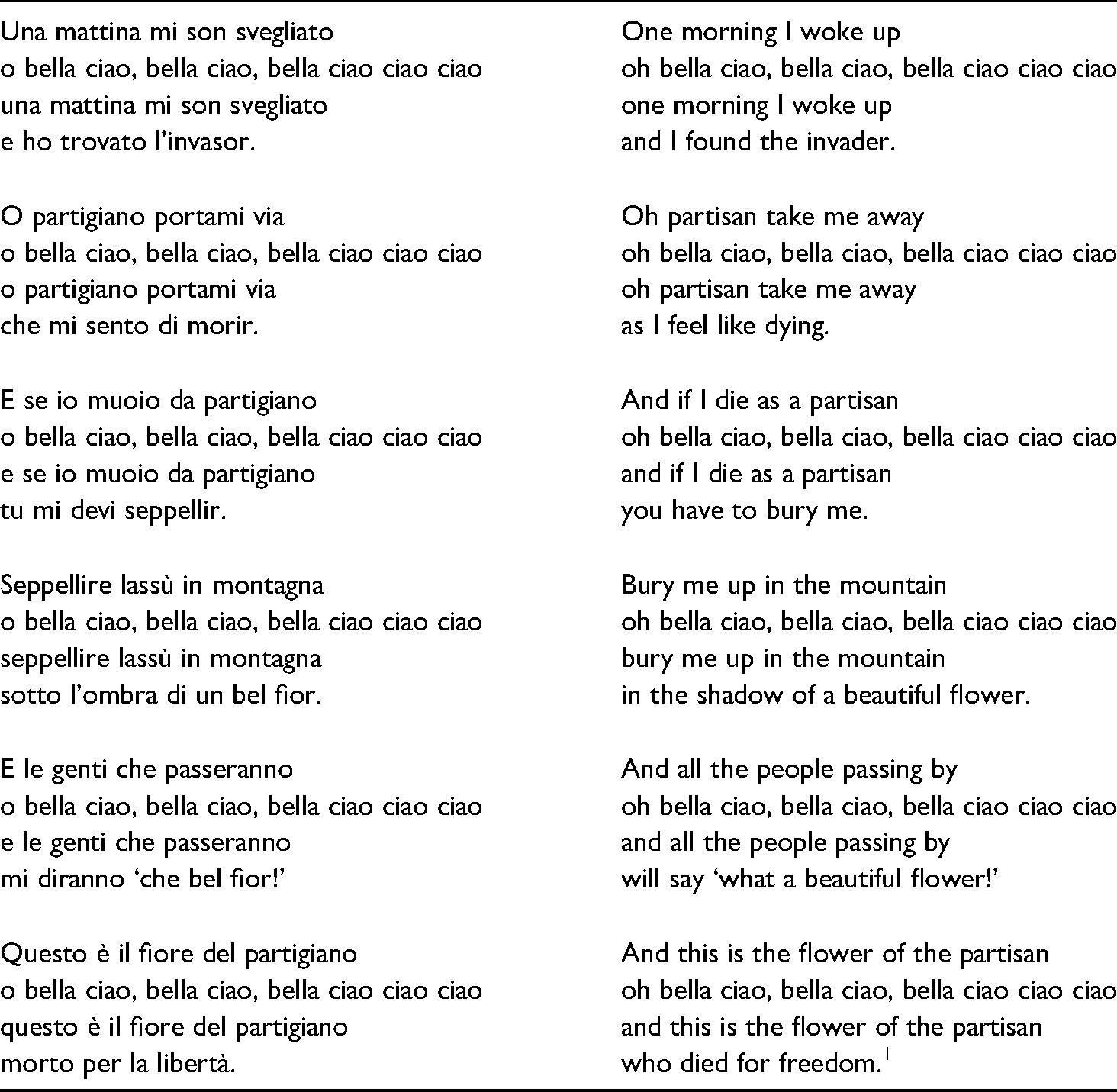
The repetition in the song's lyrics is reflected in its musical structure. The rhythm is extremely regular, with repetitive meters and the accents of each strophe falling on the same syllables. Likewise, the melody has a clear structure: there is a melodic repetition – with only slight variations in tone – of the first and third lines of every strophe, which are interspersed with the motif ‘Bella ciao, bella ciao, bella ciao, ciao, ciao’, thus creating the following pattern: A/motif/A/B.
The rhythm has a constant and easy-to-follow 4/4 structure (quadruple meter). The rhythm of ‘Bella ciao’ is essentially a march: a strong and repetitive percussive beat reminiscent of military field drums. Considering that ‘Bella ciao’ is often sung by large groups that keep a similar pace, its rhythm has a clear function; march rhythms have historically been used for the purpose of allowing soldiers to walk in close ranks, the pace usually being a multiplication of the average heartbeat (116 to 120 beats per minute).
The simplicity of the rhythmic structure of ‘Bella ciao’ is reiterated in its melody. The two ‘A’ parts vary only slightly and the motif is a fixed pattern of repetition. The motif is a key aspect of the song that, as we shall see later, facilitates the song's adaptation and recirculation. What is striking about it is the way its melody and particular chord progression support the original textual content. First, the song's verses all start and end with the same chord, therefore creating a circular narrative. After a climax is reached with the motif and the second ‘A’, the song returns to the opening melody in the final word of the last line. Consequently, each strophe comes across – not only lyrically but also musically – as a short story in itself. Second, the chord progression supports the song's lyrics. ‘Bella ciao’ is set in harmonic minor, meaning that it uses chords from a minor scale with the exception of one major chord. Although the perception of melodies and chords is ultimately subjective and context-dependent, minor chords are usually said to evoke a sense of sadness, whereas major chords carry a brightness often associated with happiness and light-heartedness (Bakker and Martin, 2015). ‘Bella ciao’ mostly incorporates minor chords, but the second ‘A’ is often set to a major chord. This addition gives a hopeful touch to the tragic tone of the rest of the song.
When taking a closer look at the lyrics, we can see that ‘Bella ciao’ – while drawing on the theme of love and death, as in ‘Fior di tomba’ – primarily emphasizes the struggle for freedom against an invader. The song has a clear narrative arc, consisting of a punctual moment of ‘disruption of order’, subsequent struggle, and the sacrifice of a hero in an attempt to gain freedom, liberation, and future remembrance. The hero anticipates his own death, envisions victory, and establishes how and where he is to be buried and remembered by his beloved and by the liberated community. The topos of the hero who frees his people from oppression but does not enter the ‘promised land’ and is buried on a mountain, which establishes a ‘duty to remember’, is almost biblical in nature (e.g. Moses). The temporality of memory is figuratively anchored to the undisturbed natural cycle of flowers through a narrative function that is very similar to the timeless closing line of fairy tales: ‘they lived happily ever after’.
Hence, the semantic of the song transfigures the historical struggle against fascism in an almost mythical manner, using themes typical of the oral folk song (e.g. love, death, freedom, heroism) that are more anthropological than ideological in nature; they talk of universal human experiences more than of a specific historical event. The musical, semantic, and narrative features can therefore be used as a matrix for multiple reuses, in particular offering:
a narrative opposition: ‘I’ vs. the ‘invader’; a communication axis: ‘I’ addressing a ‘you’; a narrative template: disruption due to the invader's arrival, the hero's struggle against the invader, the hero's sacrifice, liberation of the community; a temporal schema: past (disruption), present (struggle), future (sacrifice and liberation); a musical structure: minor chord vs. major chord, supporting the different narrative and emotional features, from the invasion and death of the partisan to the hero's liberation and celebration; a rhythmic and succinct memorable feature, namely the ‘bella ciao’ motif.
An example of the way in which these features allow for different narrative reconfigurations is the adaptation of the song during the Cuban Revolution of the 1950s, one of the earliest international reuses of ‘Bella ciao’. On one hand, the Cuban version keeps the word ‘invasore’ (‘invader’, ‘invasor’ in Spanish), as in many other later renditions, because it is used as an indexical word that, as such, is entirely context-dependent. In other terms, the word ‘invader’ – like ‘I’ and ‘you’ – plays a narrative role that only the context of use disambiguates: in 1940s Italy, the invader equals Nazi-fascist forces, whereas it refers to the government and capitalists in 1968, and so on. On the other hand, the Cuban version translates the Italian word ‘battaglia’ (‘battle’) with the Spanish word ‘guerrilla’, while the last repetition of ‘partisan’ is replaced by the word ‘guerrillero’; what people say, looking at the tomb, is not ‘what a wonderful flower!’ – as in the Italian text – but ‘revolución’ (‘revolution’). In the context of 1950s Cuba, ‘Bella ciao’ is therefore used as a matrix of narrative, temporal, and musical structures which allows for a new story, adapted to local historical circumstances for its future remembrance: ‘the story of a guerrillero’, as the contrafactum says.
Canonization and feminist use: the Spoleto concert and La casa de papel as triggering media events
Cesare Bermani (2020) has shown that ‘Bella ciao’ was far from being the only symbol of the partisan struggle; other songs – notably the communist ‘Fischia il vento’ (‘The wind whistles’) – enjoyed much more success in the decades after the war. A turning point occurred only in 1964, thanks to the concert ‘Bella ciao: Una raccolta di canti popolari’ (a collection of folk songs) performed in the city of Spoleto by the Nuovo Canzoniere Italiano group. As described by Flores (2020), the concert became a highly politicized case and attracted much media attention: because of its anti-militarist repertoire, the performance was contested by a part of the public and harshly criticized by right-wing parties and the military. However, the polemics gave ‘Bella ciao’ new media visibility and pushed left-wing militants to adopt the song as the aural symbol of anti-fascism, as the country – and the world – entered a decade of unprecedented mass demonstrations.
Since the late 1940s, ‘Bella ciao’ has been translated into different languages, performed with new musical arrangements, and recorded by professional singers, musicians and activists worldwide, and nowadays also circulates on digital platforms; its remediation (Bolter and Grusin, 2000; Erll and Rigney, 2009) seems to build on and enhance the song's portability.
Almost fifty years after the Spoleto concert, another media event catalyzed and accelerated the song's activist reuse, opening a new phase in its afterlife: the TV series La casa de papel. The series tells the story of a gang who, dressed in red and hiding behind Salvador Dalí-masks, attacks prominent symbols of Spain's economic power. The gang is led by el Professor. As one of the characters explains, ‘[t]he life of the Professor revolved around a single idea: resistance. His grandfather, who had fought against fascists in Italy, taught him [‘Bella ciao’], and he taught it to us.’ The song re-signifies and politicizes the heists committed by the robbers as an act of rebellion against an oppressive system.
The TV series evokes the Spanish movement of the Indignados, which in 2011, still in the aftermath of the 2008 financial crash, joined a global mobilization kickstarted by the Arab Spring in Northern Africa. In the late 2010s, it in turn inspired demonstrators worldwide: in 2018, the mask of Salvador Dalí and ‘Bella ciao’ made their appearance at demonstrations in Spanish-speaking countries and, when Netflix started distributing the TV series, they entered protest repertoires worldwide. Like the Spoleto concert, La casa de papel triggered a new cycle of reuses of the song, but this time mostly outside of Italy. Another important element of the reinterpretation and remediation of ‘Bella ciao’ that La casa de papel and the Spoleto concert have in common is its feminist appropriation and reuse.
The Spoleto concert was memorable not only because it marked the canonization of ‘Bella ciao’ in Italy, but also for the fact that it popularized and mediatized two versions of the song: the ‘Bella ciao’ of the mondine, and the ‘Bella ciao’ of the partisans. The Nuovo Canzoniere Italiano endorsed the hypothesis that the song was created by seasonal female rice paddy workers in the north of Italy – the so-called mondine – as a protest song against poor working conditions, and was only later appropriated by (male) partisans.
Mondine protest songs were widely known (Garvin, 2016), because from the late 19th-century until the 1950s, the mondine coalesced into an important and very visible social movement for better wages and working conditions (Zappi, 1991). Although the suggestion that ‘Bella ciao’ was originally a song by the mondine has been disproven, this version of its origin paved the way for feminist interpretations of the song in Italy, with performances by iconic singers like Milva and Giovanna Marini.
The feminist appropriation of the song is, to some degree, renewed in La casa de papel. In the series, the competition between male gang member Berlin and female member Nairobi over the control of the gang is defined in terms of patriarchy against matriarchy. When Nairobi takes the control of the gang, she defines her act with the statement ‘Here starts the matriarchy’, in response to Berlin's earlier comment: ‘I do decide, because here patriarchy rules.’ From this moment onwards, the way ‘Bella ciao’ is used in the plot emphasizes the shift – narrated in the first season – from a male transmission of memory between the partisans and el Professor, via his grandfather, to a female appropriation of the song in the fourth season. This happens in particular in the version performed by the actress Najwa in memory of Nairobi, the ‘matriarchal’ leader of the gang who is killed in the fourth season: the fallen rebel is not a man anymore, but a woman. 2
This matriarchal interpretation of ‘Bella ciao’ immediately inspired feminist movements, spurring them to reuse it in their protests. One of the first and most popular reuses of ‘Bella ciao’ that builds on La casa de papel's imaginary occurred during the marches for the 2018 Day of Memory, Justice and Truth in Argentina, when human rights activists used ‘Bella ciao’ as a protest song against the centre-right government. Activists produced several contrafacta of the song, titled ‘Macri chau’, inviting President Macri to resign. A YouTube-video shows the demonstrators marching and singing one of the song's contrafacta, while in the background we can hear versions of ‘Bella ciao’ taken from La casa de papel. 3 ‘Macri chau’ lists the reasons for which the president should resign and introduces the expression ‘memoria, verdad y justicia’ (memory, truth, and justice): the motto of post-dictatorship movements in Argentina. Along with the human rights motto, we can repeatedly hear the expression ‘empieza el matriarcado’ (‘here starts matriarchy’), which in the TV series is pronounced by Nairobi. As this expression is pronounced, we see the Grandmothers of Plaza de Mayo marching together with other women wearing iconic white headscarves, while newer generations of women wear green headscarves – the symbol of the feminist movements’ struggle for the legalization of abortion in Argentina (Jelin and Sutton, 2021). In this way, the video evokes and supports different causes that all revolve around a feminist, or matriarchal, leadership. The use of ‘Bella ciao’ in the video connects these different causes narratively and, by referring to La casa de papel, makes the feminist use of the song readable by a general audience.
In the last part of this article, we analyze how contemporary feminist movements in Argentina and Spain, on the one hand, and Poland, on the other, have appropriated ‘Bella ciao’ to build their repertoire of protest against femicide and in favor of abortion rights.
‘Bella ciao’ for abortion rights: Argentina (via Spain)
Two months after the 2018 Day of Memory in Argentina, La Nación – the country's most important conservative newspaper – published an article titled ‘Actresses and women musicians have revisited the hit “Bella ciao”, the song from La casa de papel, to ask for the legalization of abortion’. 4 It featured the lyrics of a new contrafactum:
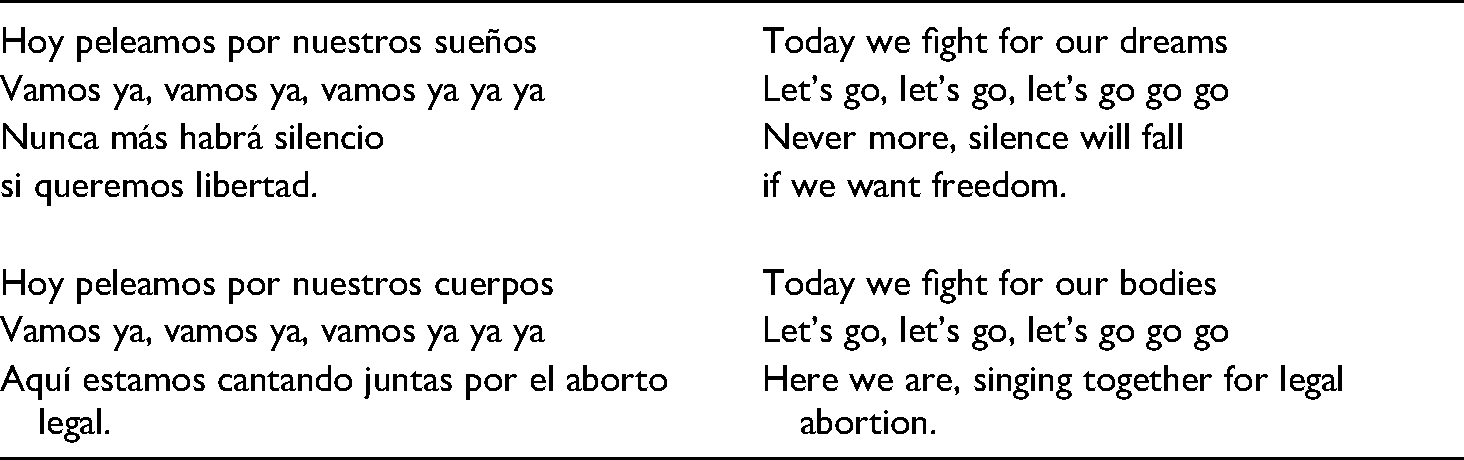
This version was performed during public demonstrations for abortion rights in 2018, which were organized while the parliamentary discussions of a bill that would legalize abortion were ongoing. The song was adapted not only for public gatherings, but also with the aim of being shared on social networks. The motif ‘vamos ya’ – which replaces the expression ‘bella ciao’ (with ‘ya’ phonetically evoking the ‘-ia-’ of ‘ciao’) – worked well as a hashtag. However, though the original reference to fighting for freedom is kept, the narrative structure of ‘Bella ciao’ is partially abandoned; the result is a song that is much easier to remember and sing during marches.
Initially, the Argentinean Congress rejected the bill legalizing abortion, and the abortion rights movement continued to organize massive demonstrations until the end of 2020, when the bill was eventually approved. New contrafacta of ‘Bella ciao’ were thus created. In December 2020, when a new bill was about to be voted in Congress, a more complex version of ‘Bella ciao’ started to circulate:
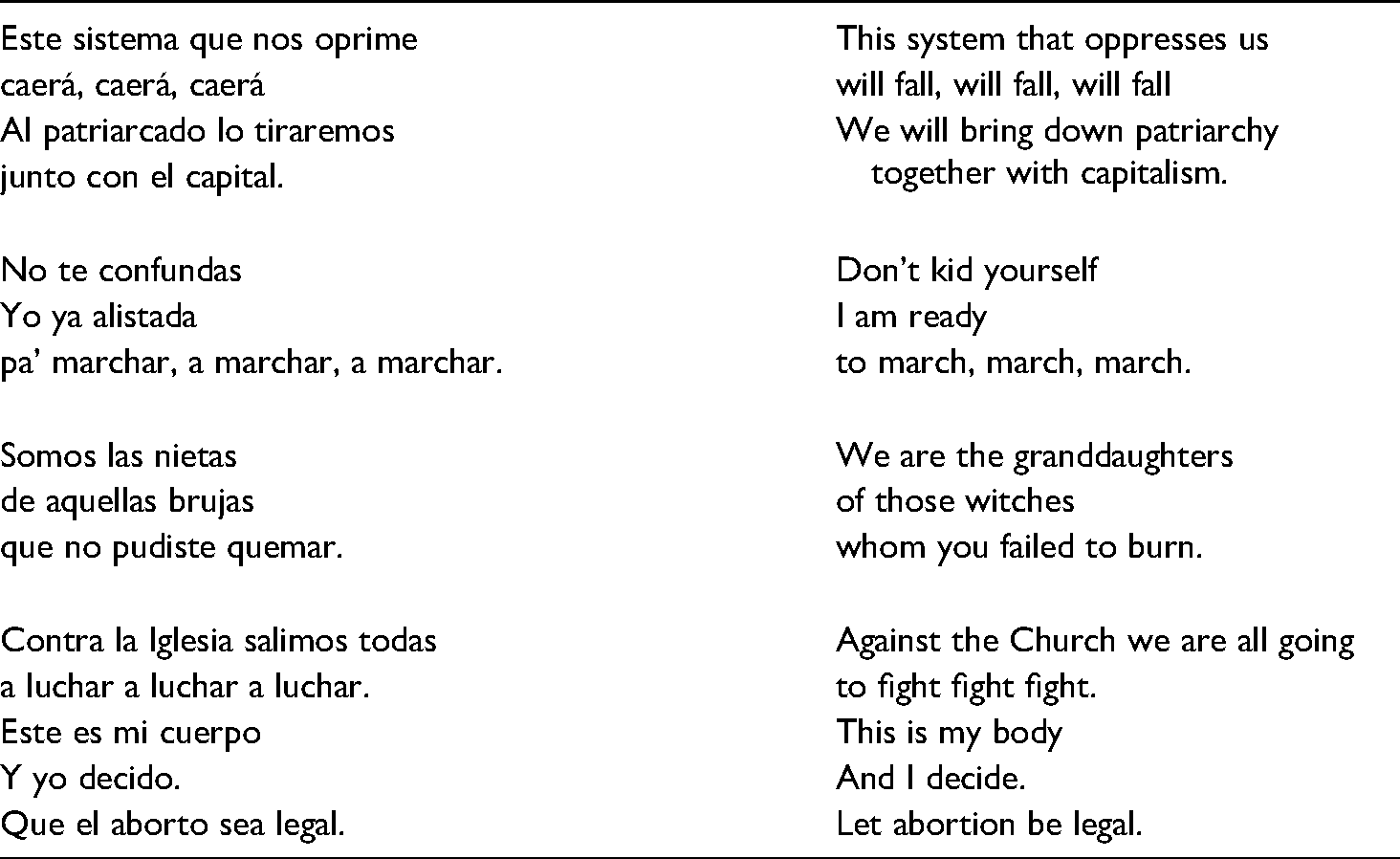
The music in this adaptation 5 reveals particular local influences that recall traditional South American music. Although the traditional march rhythm of the original is still present, the adaptation is notable for its syncopation – rhythmic stresses in places typical of jazz music. This rhythmic style, influenced by European march rhythms as much as by West African grooves, is commonly found in South American and Caribbean regions. While the verb ‘luchar’, in the refrain, replaces – yet phonetically evokes – the original ‘ciao’ (‘cha’ being phonetically equivalent to the ‘cia-’ of ‘ciao’), the struggle for legal abortion is narrated as just a chapter in a longer story. This chapter connects witches – considered ante litteram figures of feminist rebellion – to the contemporary fight against patriarchy and capitalism in the articulation between short- and long-term memory horizons (Cusicanqui, 1987), that is, between the recent past and historical fights again structural inequalities. Drawings displayed in the streets surrounding the Argentine Congress show how the structure of ‘Bella ciao’ is used to collect and ‘sew’ together expressions and slogans forged by the movement; for example, the expression ‘somos las nietas de las brujas que no pudiste quemar’ (Figure 1), which has circulated worldwide after passing from English-speaking to Spanish-speaking countries, was integrated into the song.
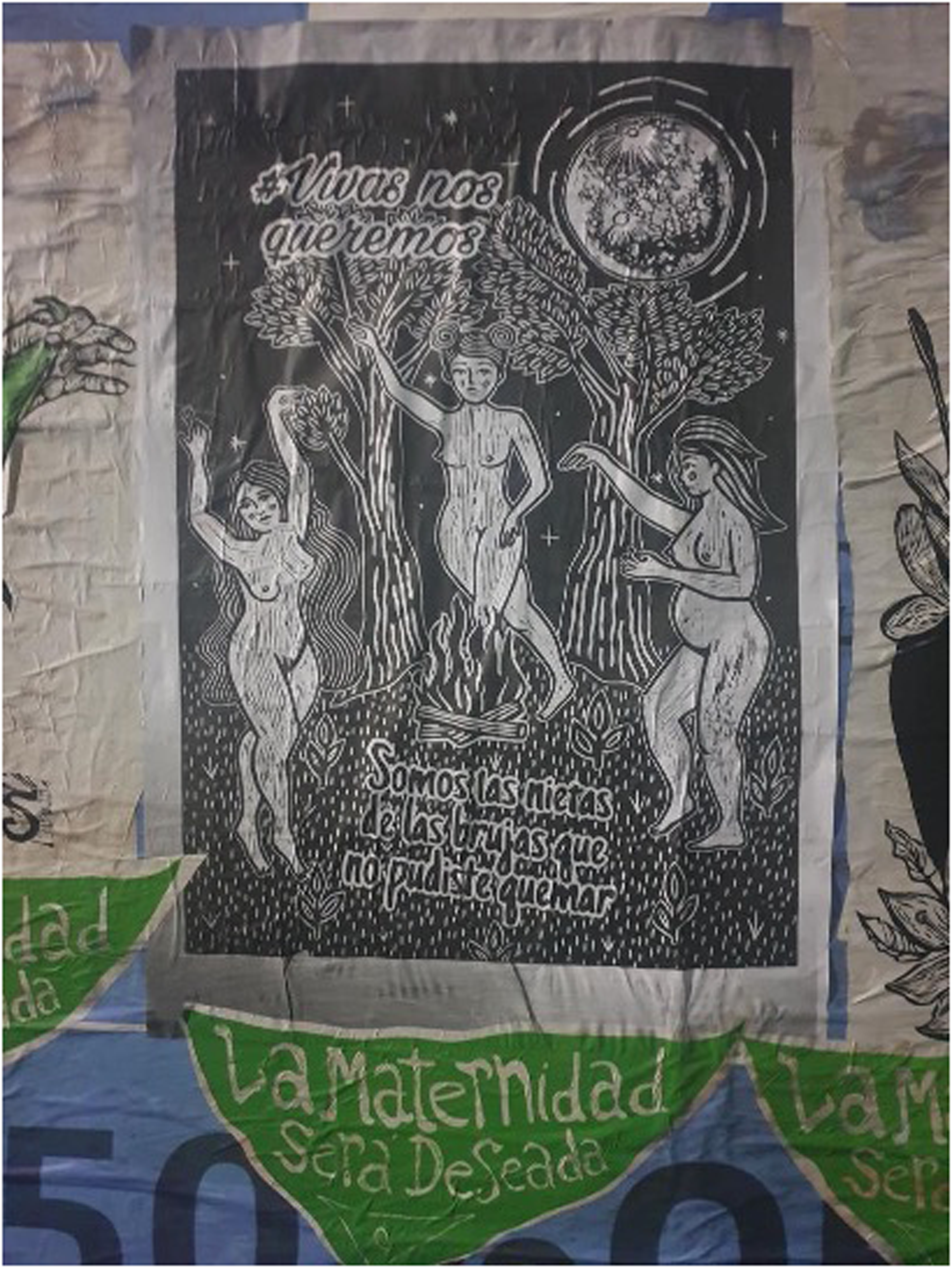
Plaza del Congreso, Buenos Aires, 30 December 2020
Hence, ‘Bella ciao’ provides a matrix made up of narrative sequences that are rewritten with elements taken from local stories and contemporary causes. This process is hardly new: as demonstrated by Portelli (1991), folk songs that are organized in narratively independent strophes (as in ‘Bella ciao’) are used in synergy with other folk genres, like graffiti, slogans, aphorisms, proverbs and – in the present day – hashtags, which demonstrators can assemble by adapting texts and music to different media and semiotic forms, and – content-wise – causes and socio-political contexts.
It should be noted, though, that the Argentinean adaptation of ‘Bella ciao’ in 2020 seems to draw on a 2019 version of the song, created in Spain for feminist protests on International Women's Day. Further still, the Spanish version re-elaborates an even earlier contrafactum: a 2015 adaptation to remember and celebrate Egyptian and Kurdish women fighting against Al Sisi's regime in Egypt and ISIS, respectively. Let us take a closer look at each of these transformations.
In January 2019, feminist groups across Spain marched against the far-right movement Vox, after it had announced its veto on a law against gender-based violence. A feminist version of ‘Bella ciao’ made its appearance in the marches, as testified by newspapers, digital pamphlet, and YouTube videos. One of these 6 published the following lyrics:
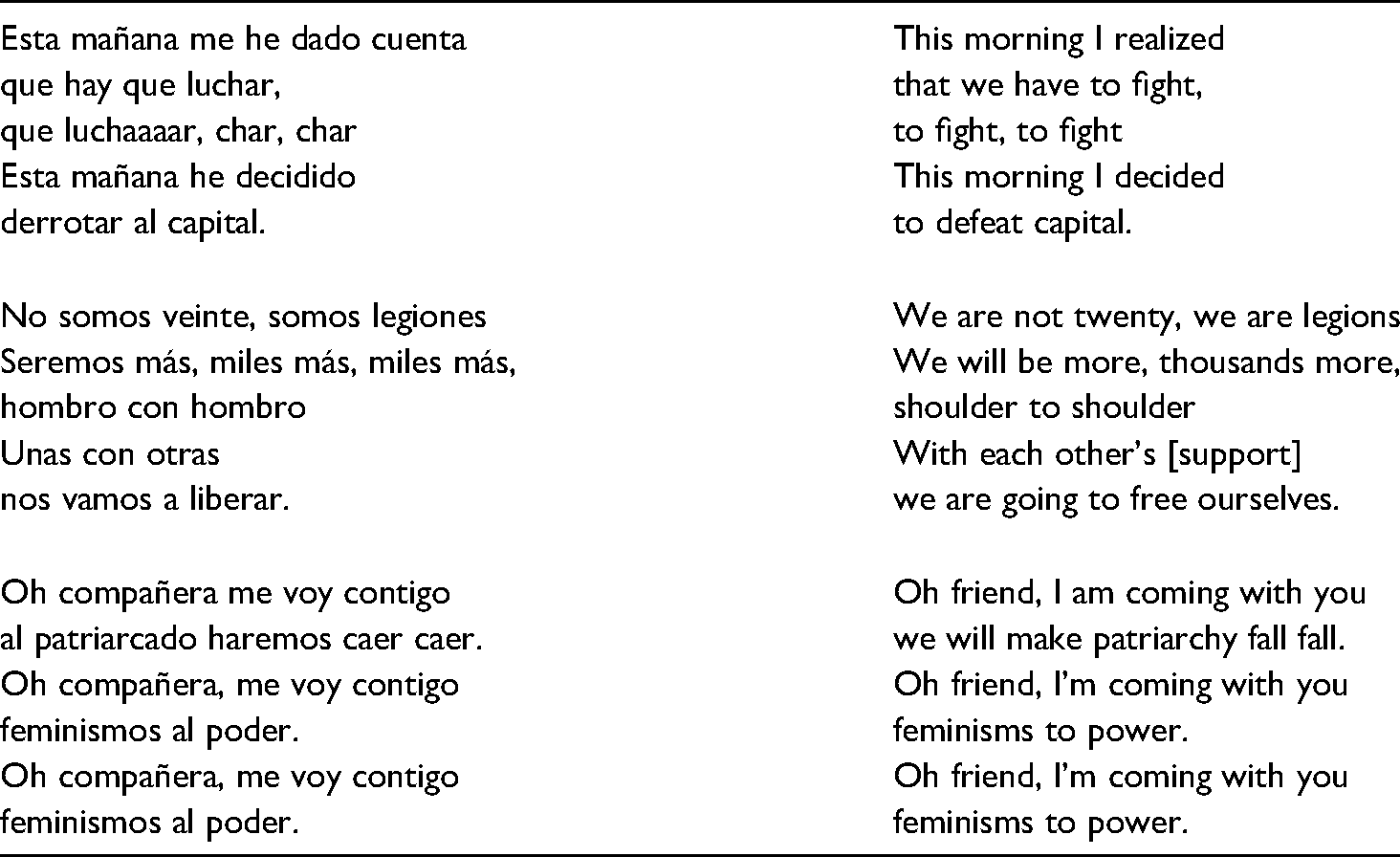
In reality, this version was written four years earlier, to celebrate the Kurdish female soldiers’ liberation of Kobane from ISIS and to commemorate two Egyptian feminist activists killed in those same days by Al Sisi's regime in Egypt. 7 As the song travelled from the 2015 version honouring Kurdish and Egyptian women to the Argentinean version of 2020, via its popularization in La casa de papel and the anti-Vox demonstration in Spain, the fight against capitalism and patriarchy maintained its relevance, while references to the abortion rights campaign and witches were added. Other elements were left out, such as the militarist reference to the ‘legions’ of the Kurdish female soldiers, probably because it would have sounded out of place in the anti-military context of present-day (post-dictatorship) Argentina. These versions therefore show that a song like ‘Bella ciao’ – although created and recorded for a specific purpose – is available for later transformations and appropriations.
‘Bella ciao’ for abortion rights: Poland
At the end of 2020, Polish feminist movements took to the streets to demonstrate for abortion rights. Their protests were triggered by the Constitutional Tribunal's decision to impose a near-total ban on abortion. Poland and Argentina were simultaneously overwhelmed by huge demonstrations that entered into a dialogue with one another: as Rachel Harris (2021) and Ximena Casas (2021) have observed, the Argentinean green headscarf was adopted by Polish activists after the victory of the abortion rights movement in the Latin American country. Along with the green headscarves, ‘Bella ciao’ also made its appearance in Polish streets and squares, in the fight against the prohibition of abortion.
Through an analysis of newspaper reports, YouTube videos and social network content, we identified at least two versions of the song, which were sung during the protests of the Polish feminist movements. The first is Goran Bregović's version. 8 Although he stuck to the Italian original lyrics, Bregović adapted the music to the polyphonic Balkan traditions that mix East Mediterranean, Romani, and Slavic musical genres. This particular choice confirms our observations on other cases mentioned in this article: the activist use of the song often implies a musical adaptation to regional musical traditions.
A second strategy applied during the protests was again that of the contrafactum. The musician Łaja Szkło 9 created a Polish version of ‘Bella ciao’ that was expressly tailored to the abortion rights movement. The version is titled ‘Torturi ciało’ (‘Body torture’). As in the contrafacta we have analyzed above, this contrafactum phonetically plays with the Italian word ‘ciao’ by translating it with the similar sounding Polish word ‘ciało’, meaning ‘body’. However, the song also features the Italian word ‘ciao’ in its Italian meaning of ‘goodbye’. Thus, by alternating ‘ciało’ and ‘ciao’, Szkło seems to want to tell women that, if they do not rise up, they can say goodbye to any form of self-determination over their body.
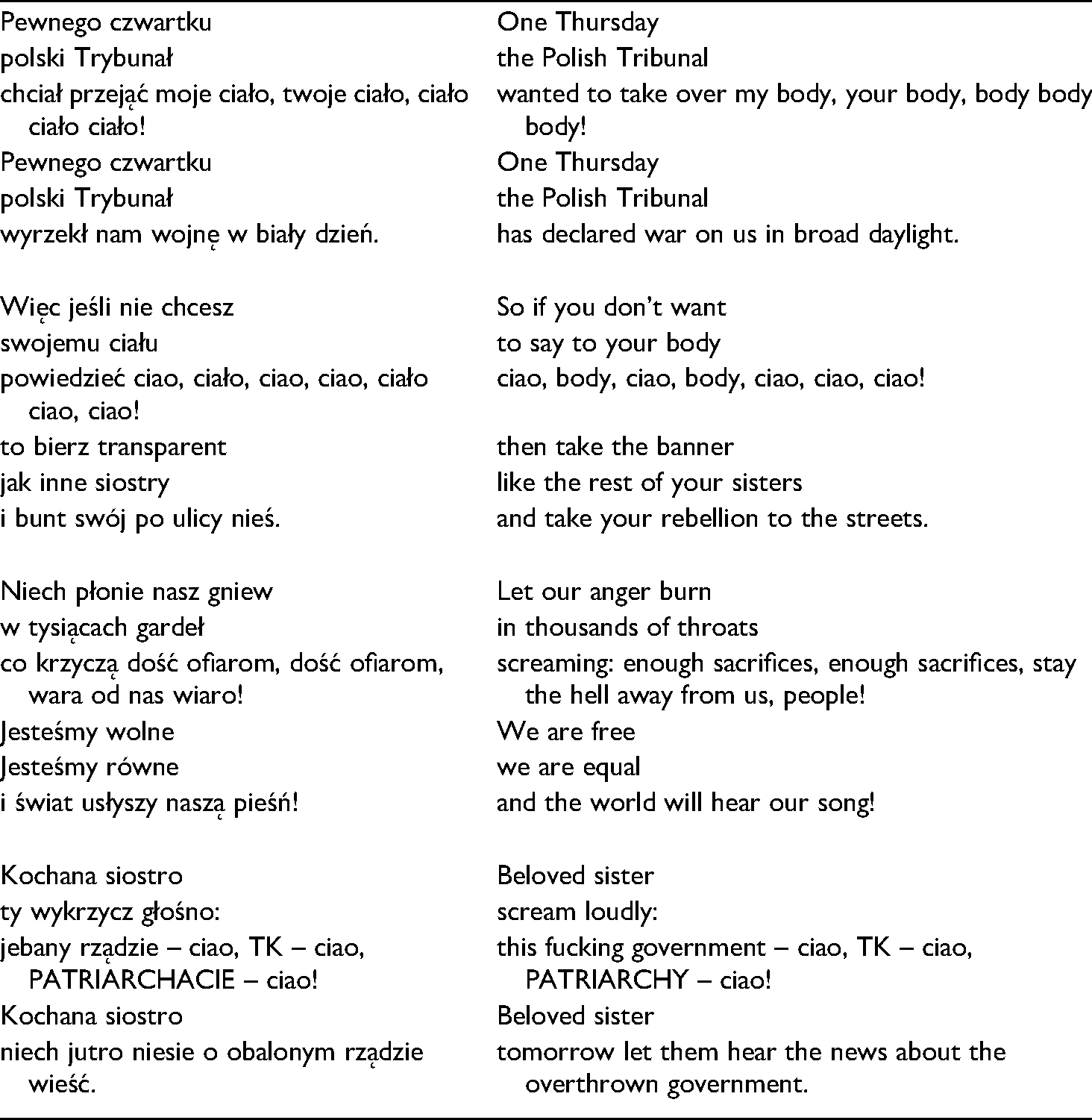
The story forged by Szkło follows the narrative sequence of ‘Bella ciao’: it clearly states a moment in which an injustice is discovered and an ‘invader’ is identified and fought against. Additionally, the future outlook – symbolized by the sentence ‘tomorrow let them hear the news about the overthrown government’ – reiterates the idea of hope and the approaching victory obtained in the story of the partisan.
Conclusions
Anti-fascist activists and left-wing newspapers do not always welcome the new versions of ‘Bella ciao’ with enthusiasm. Contrafacta of the song were at times considered questionable or even an insult to anti-fascism and the partisans. 10 Although it is true that the song has also been used by movements that are far from – or even at the opposite spectrum of – anti-fascism, the history of ‘Bella ciao’ tells us that its origins lie in a much older folk song, and that it lives on in its countless contrafacta, which likely started with the feminist version of the mondine. The new feminist versions clearly enhance the song's oral affordances: as Portelli (1991) demonstrated, folk songs belonging to the oral tradition are meant to be continuously reused, disassembled and reassembled, mixed, remade, rewritten, and recontextualized. The contrafacta of ‘Bella ciao’ respect this cultural tradition.
Textual affordances and media ecologies undoubtedly play a key role in the circulation of ‘Bella ciao' in and for feminist activism. The song's portability in the digital world is enhanced by its oral structure, by its cultural and even legal availability (given that the presence of a song in the public domain significantly fosters its appropriation and free reuse), but also by its canonized status. In this sense, the case of ‘Bella ciao’ shows us how the media logics that regulate orality, literacy, and the digital are not mutually exclusive or contrasting, marking different stages in media history (see for example Hoskins, 2018: 12–14). Rather, they coexist and act synergically. The canonization in written culture of ‘Bella ciao’ did not cancel its oral portability; its subsequent popularization in La casa de papel strengthened its canonical status in historical memory; and its digital circulation depends both on its being part of the anti-fascist (written) canon and on its oral affordances.
In this way, ‘Bella ciao’ acts as a matrix that helps feminist activists to organize and give voice – and melody – to their protests, emotions, and expectations. This recalls Halbwachs’ (1939) conceptualization of music as a language and a semiotic support in collective memory- and identity-making. In particular, the reuse of ‘Bella ciao’ demonstrates that cultural memory is a process more than a product: what is at stake is not simply what we remember when we sing ‘Bella ciao’, but how we (will) remember, by using stories and music from the past as a model for the shaping of new stories in the present and the immortalization of feminist struggles for the future.
Hence, ‘Bella ciao’ epitomizes the memory–activism nexus as developed by Rigney (2018) in three ways. First, the song is used as a model for producing feminist cultural memory. Second, as we saw in the shift from the ‘Bella ciao’ in memory of Egyptian and Kurdish activists via that of the Spanish anti-Vox protests to the version used by the Argentinean abortion rights movement, every contrafactum becomes a new story of feminist activism that is available for later reuse and memory transmission. Finally, the song allows activists to link their protests to past events and figures, and also to propose new and different interpretations of history, as in the case of the figure of the witch.
‘Bella ciao’ is an exemplary case of how songs and music travel globally by being locally adapted in support of different political causes and activist traditions. We believe that the notion of portability is a promising interpretative lens through which to understand the role of songs in the transmission of memories of protest, and in contentious politics at large.
Footnotes
Acknowledgements
We would like to thank, for their insightful comments, the anonymous reviewers, the participants of the masterclass ‘Working transmedially: a semiotic approach’ (Memory Studies Association conference 2021) and the Remembering Activism project team: Ann Rigney, Tashina Blom, Duygu Erbil, Stefan Poland, Emilia Salvanou, Thomas Smits, Sophie van den Elzen and Clara Vlessing.
Funding
The author(s) disclosed receipt of the following financial support for the research, authorship, and/or publication of this article: Research for this article was financially supported by the European Research Council (ERC) under grant agreement 788572: ReAct - Remembering Activism: The Cultural Memory of Protest in Europe; and by the Marie Sklodowska-Curie Actions under grant agreement 840302: MemoRights - Cultural Memory in LGBT Activism for Rights.

Notes
Author biographies
Daniele Salerno is Marie Skłodowska-Curie Global Fellow at Utrecht University for the project “MemoRights - Cultural Memory in LGBT Activism for Rights”. He is member of the Utrecht Forum for Memory Studies and associate member in the ERC project “ReAct - Remembering Activism: The Cultural Memory of Protest in Europe” (PI: prof. Ann Rigney).
Marit van de Warenburg is a PhD candidate at Utrecht University (funded by the NWO program PhDs in the Humanities). Her project is titled “Between Adaptation and Appropriation: When Heritage Becomes Contested”.