




Abstract
This article examines a pattern of popular US audiovisual media depictions of post-apartheid South Africa, which portray SA as harbouring latent danger. I use these depictions as an entry point into a broader web of articulation that connects various theoretical lenses (including Othering and theories of fear), empirical data, and historical context in order to tell a conjunctural story about the precarity of US exceptionalism and Whiteness. Rather than reading these depictions as a suggestion that SA is a tangible threat of danger to the world, I argue that the strategic formation of these depictions reveals how the US experiences the uncanny (familiar unfamiliar) in SA, another significantly White settler-colonial state, and thus perceives a discursive threat of SA democracy to US exceptionalism on the global stage. This conjuncture, I suggest, reveals a discursive struggle over multicultural global futures and who gets to define democracy in the popular imagination.
Keywords
Several years ago, one of my guilty viewing pleasures was the NBC show Blindspot (Gero, 2015), a crime procedural featuring an FBI team saving New York City from terrorist threats. However, in the second season the show inspired my analytic intrigue upon the revelation that protagonist Jane was actually the orphan of South African (SA) apartheid activists. Being both South African and a media scholar, I was curious to try and understand this narrative decision. Apparently, after the apartheid government executed her parents, Jane and other orphans were raised to be fearless child soldiers by the apartheid regime until US forces rescued them. I watched aghast as an implausible flashback scene unfolded, complete with terrible attempts at a SA accent, but while I was indignant at the blatant historical inaccuracies, I was not entirely surprised. Around the same time, I began to notice an unsettling pattern in popular US visual media depictions of post-apartheid SA in which movies, television shows, or video games tended to portray the new democratic SA as harbouring some form of latent danger.
After the Blindspot incident, I more intentionally began to track and collect similar media examples. My initial assumption was that I was seeing a form of colonial Othering in which the colonial figure (now and historically) identifies themselves through the construction of an oppositional, highly stereotyped identity of the Other in popular media. In other words, Europe, and subsequently the US, builds an identity on not being ‘exotic’, not being ‘savage’, not being ‘primitive’ – to name just a few of the supposed identities generally pinned upon the formerly colonized world. In this dynamic, the colonizer constructs the colonial subject as someone unstable or dangerous that needs to be saved, tamed, and rehabilitated in the image of the hegemonic Western individual. Thus, in this case, I anticipated a dynamic in which US media depictions of SA would both reflect and fuel a fear that SA, as part of the broader African continent, poses some direct threat to Western civilization due to the continent's stereotyped primitivity and instability. Such depictions might also reinforce the necessity of US intervention and aid towards Africa and other regions of the Global South.
However, as I began to work through the material and contextualize it, I started to identify other factors at play, for instance, that the figure of latent danger was frequently associated with Whiteness. In the pattern I observed, SA is associated with themes of latent danger in roughly three ways. First, by locating latent danger physically within the borders of the nation; second, by locating the latent danger within the body of a White South African, that is, using the individual metonymically to signify the nation; and third, through a similar metonymic process in which an alien being within SA contains the latent danger but is yet to be ‘awoken’. In this final case, the alien Other 1 is either an organic extra-terrestrial being or an inorganic artificially intelligent being, but neither is human.
Based on my findings, I contend that the lens of Othering is insufficient to help us make full sense of the US–SA dynamic, particularly in how it frames questions of difference. Instead, I suggest that in conjunctures such as these, it benefits us to also consider questions of similarity. In addition to theories of Othering, I propose an uncanny lens through which to understand the US imagination of SA, another settler-colonial state with a significant White population, which could act as an aspirational and compelling democratic bridge between Global North and South and thus function as a discursive threat to US exceptionalism on the global stage.
Process of analysis
The US media depictions of SA that I analyse are not my primary object of study but serve as an entry point into a broader web of articulation that connects various theoretical lenses, empirical data, and historical context to understand this conjuncture. I use articulation in the Cultural Studies sense to mean ‘a process of creating connections’ with an understanding that we, as scholars, ‘engage the concrete in order to change it or re-articulate it’ (Slack, 1996: 115). Grossberg (2018) describes this practice as building a ‘conjunctural story’ in which one locates any event ‘in the context constructed by a complex set of relations and determinations. Any event exists as but one crystallization of, one way into, a broader and more complicated context’ (2018: 42). Here, I use media depictions as my event through which to recast the way in which we perceive US discursive orientations toward other postcolonial nation states, such as SA. As such, I begin this article with empirical observations and then connect these findings with historical evidence and analytical insights from theories of Othering, Freud's notion of the uncanny – the familiar unfamiliar – and the concept of the postcolonial uncanny. I conclude by mapping Whiteness and US exceptionalism onto this web of articulation.
For the empirical work, I used IMDB, TVTropes, Letterboxd, Reddit, word-of-mouth, and academic databases to locate audiovisual texts (focusing on movies, TVs, and video games) where SA serves as the setting (either explicitly in the story or implicitly through depicted landscape) or where SA characters play a key role. Furthermore, characters could not be identified generally as just African but had to be specifically described or coded (e.g. through accent) as South African. Because my focus is on contemporary sociopolitical imaginaries and how the new democratic SA is perceived, I limited the texts examined to those produced and released within the US entertainment industry 2 during the post-apartheid era (1994 and later).
I used a focused discourse analysis on these filtered texts to identify and analyse depictions of fear and uncertainty. As the potential visual archive is dynamic and constantly changed during the course of research, a fixed proportion of representative texts to total texts featuring SA wasn’t possible to calculate. Nevertheless, the quantity of US-produced media texts featuring SA is a small population, so the analysed texts reflect a significant trend among existing representations and were not cherry-picked for the study.
This range of media depictions is also by no means a conclusive list, especially as the dynamic in question is not easily searched for in a database. But the range need not be conclusive to provide us with an overarching sense of an existing pattern in which SA or metonymically SA characters function symbolically as figures of uncertainty and latent danger. By identifying this pattern, I also do not suggest that US media makers are intentionally trying to encode certain perspectives into the popular imaginary. Rather, this pattern is indicative of what Said (2003) calls ‘strategic formation … a way of analyzing the relationship between texts and the way in which groups of texts, types of texts, even textual genres, acquire mass, density, and referential power among themselves and thereafter in the culture at large’ (2003: 20). In my web of articulation, I map out the discursive power that I perceive underlying this US–SA strategic formation, but this is not intended to fully explain the significance of the identified depictions, nor is it an attempt to conclusively describe a set of relations between the nations of the US and SA. While it is based concretely on my empirical observations along with my instinct as a White South African who has lived in the US for over a decade, the lens I propose is necessarily still speculative. I offer this informed speculation as one more item to add to our scholarly toolkit for studying how the US positions itself discursively. I also encourage others to examine whether a similar pattern exists between the US and other postcolonial nations.
Mediating latent danger from below
All three motifs of latent danger in SA can be identified within Neill Blomkamp's science fiction blockbuster District 9 (2009). The film introduces audiences to a near-future SA in which apartheid dynamics are played out once more – but with aliens. After a large extra-terrestrial vessel appears over the Johannesburg skyline but makes no contact with humanity, SA military forces invade the ship and discover it holds strange crustacean-like creatures, starving and living in their own filth. The occupants are evacuated and placed in informal settlements on the outskirts of the city, but the film properly begins 28 years later when the SA government decides that the ‘Prawns’, as they are disparagingly called, must be removed even further from proximity with ‘civilized’ South Africans. Protagonist, Wikus van de Merwe, a bumbling and naive White Afrikaner, is placed in charge of the dubiously legal, forced removal and, while fulfilling his duties, is accidentally exposed to an extra-terrestrial liquid that catalyses his transformation into one of the non-humans.
The figure of the extra-terrestrial spaceship hovering over the city (Figure 1) demonstrates the first motif of latent danger in its visceral depiction of uncertainty and impending disaster looming over SA itself. Why of all places did the spaceship stop here?
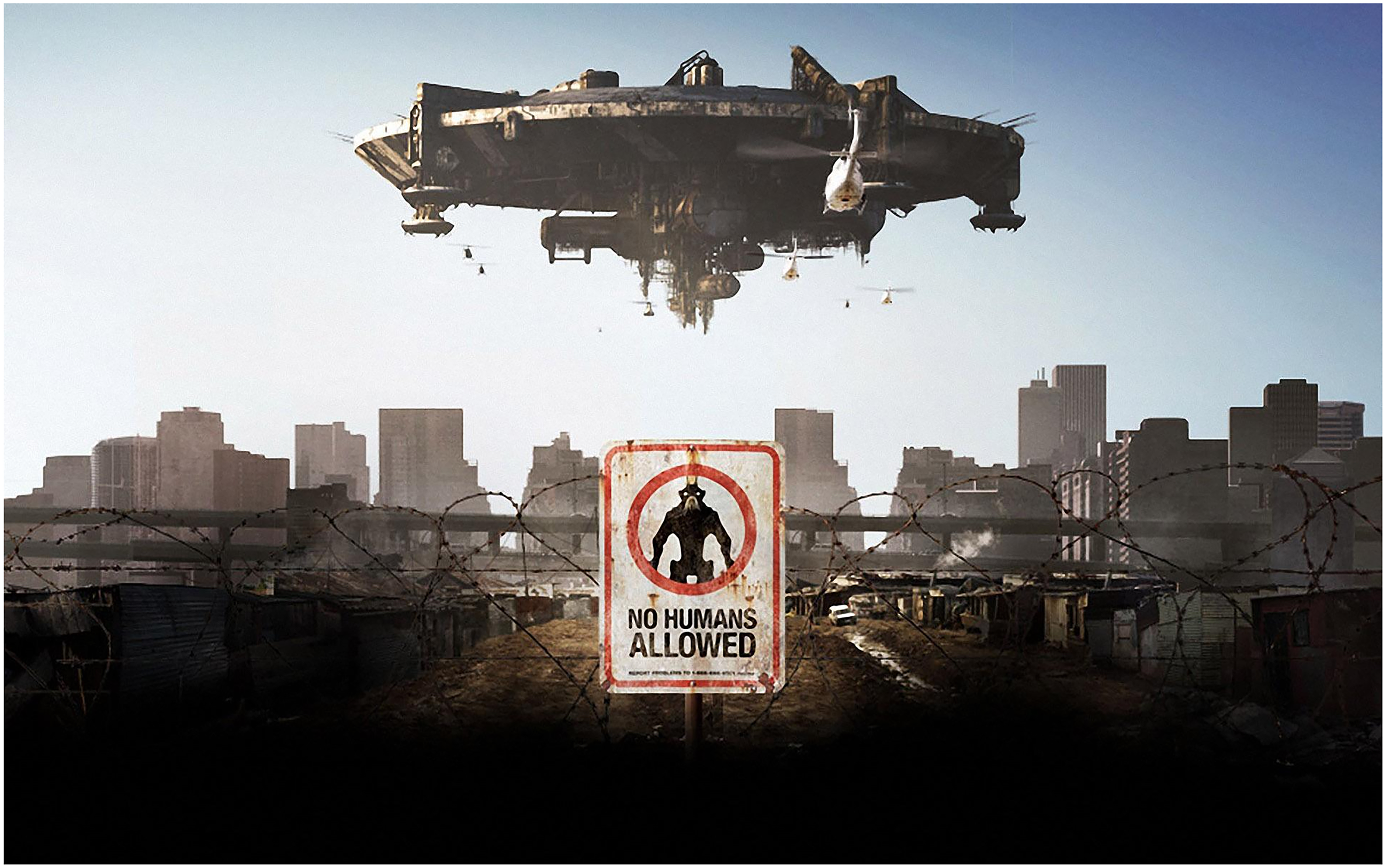
The extra-terrestrial spaceship motionless above the Johannesburg skyline in District 9 (2009).
What the spaceship contains within points to the second motif: the presently non-threatening alien Other with dangerous potential. Though the beings do not pose an immediate threat in their emaciated state, their very otherness, along with their tough carapaces and strong claws, evoke fear of what future threat they may pose to the nation.
Ironically, such fears overlook the true intelligence of these beings, and the more likely threat they could pose, which is revealed towards the end of the film. The beings are more advanced scientifically and technologically than humans and have hidden a high-tech laboratory and spaceship beneath the surface of the city (more latent danger). The extra-terrestrials hope to send somebody to their home world for help, and this potential rescue mission serves as another source of latent danger because we are not sure if the rescuers will return to simply extract their fellow beings, or if they will arrive in a spirit of vengeance.
Wikus himself demonstrates the third motif of latent danger in that his White body now harbours a substance capable of chemically altering his DNA – a change that remains dormant at first, before slowly manifesting externally on his body (Figure 2). At the end of the film, Wikus is trapped in a liminal space between human and ‘Prawn’ society, potentially a danger to both communities because it is unclear as to where his identity and allegiances lie.
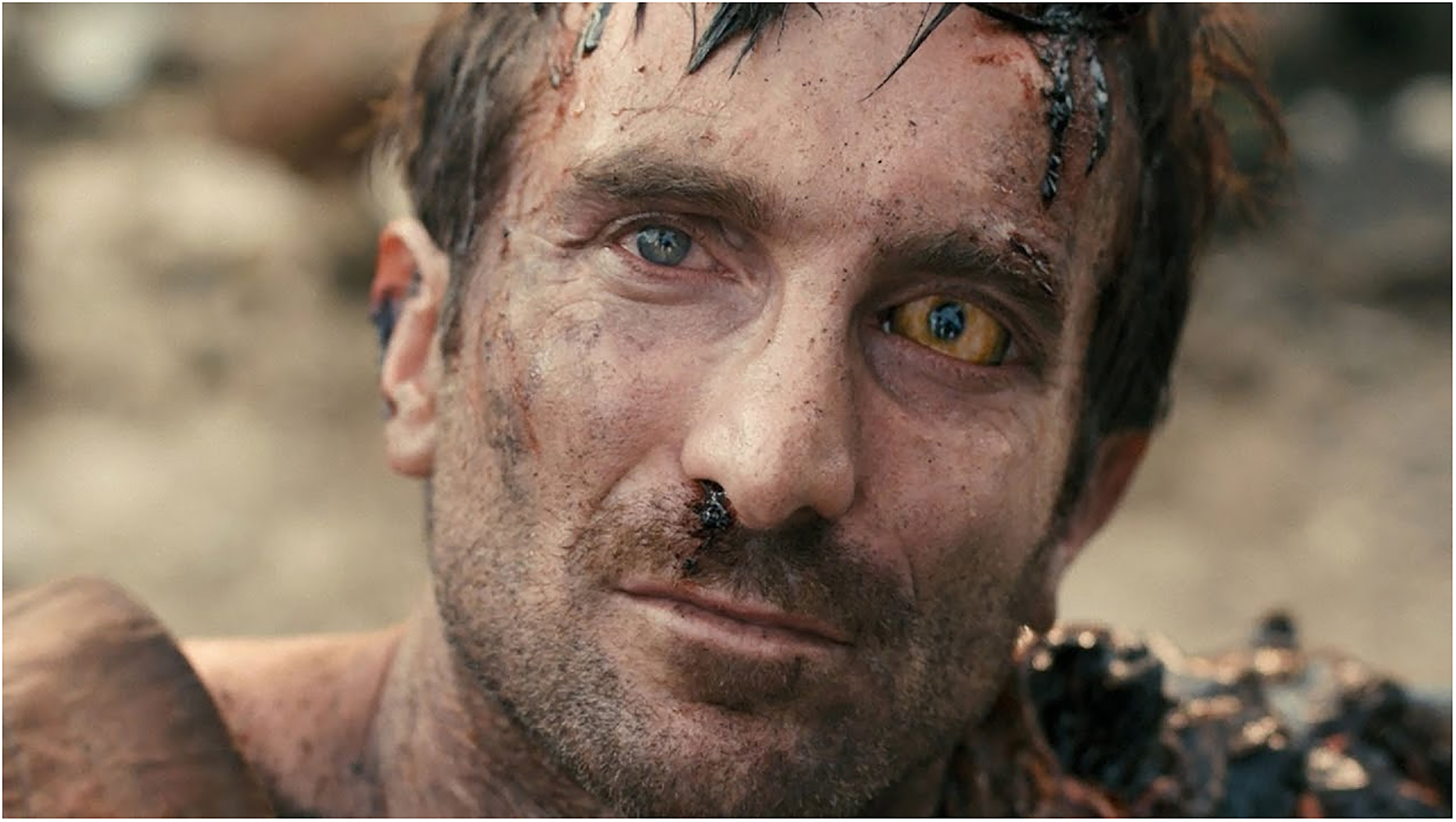
Wikus van de Merwe begins his transformation into one of the extra-terrestrial beings in District 9 (2009).
The aforementioned TV show Blindspot displays two of the three motifs. In the pilot, FBI agents find White SA protagonist Jane in a mysterious bag in Times Square, covered in fresh tattoos, unconscious, and amnesiac 3 – a literal sleeper agent planted by domestic terrorist forces. As her memories slowly return, the constant question of the show is what kind of person Jane will be? Will she be the violent terrorist Jane with a traumatic SA childhood, or will her loss of memories allow her to reinvent herself anew on US soil? In contrast, SA is depicted as the source of her potential violence.
The following texts also position SA itself as dangerous: Safe House (Espinosa, 2012) follows CIA agents in a supposedly ‘safe’ house, located in Cape Town, who are attacked by terrorist mercenaries and forced to flee through a city in which they are never sure who to trust and when danger might appear. Prey (Roodt, 2007) tells of a White US family on vacation in SA who also find themselves on the run, in this case, from man-eating lions. In video game Tom Clancy’s Rainbow Six: Lockdown (dev. Red Storm Entertainment, 2005), the first mission takes place in Pretoria, where the player tracks down a hidden, that is, latent, team of international terrorists. Most recently, Maze Runner: The Death Cure (Ball, 2018), the finale to the blockbuster dystopian zombie trilogy, was shot in a visibly recognizable Cape Town.
Two other texts depict alien beings awaking to their full potential, in this case, inorganic AI coming to sentience. Blomkamp’s Chappie (2015), a film about a law enforcement robot, that is, an inorganic alien, coming to sentience in Johannesburg. In Marvel's Avengers: Age of Ultron (Whedon, 2015), the malicious AI android Ultron comes to sentience in SA and goes on his first violent rampage on the streets of Johannesburg.
But the most common depiction of latent danger is in the figure of the White Afrikaner SA corrupt businessman and/or mercenary. In the video game Uncharted 4: A Thief’s End (dev. Naughty Dog, 2016) an SA mercenary named Nadine is the antagonist to the Indiana Jones-like hero Nathan Drake. While Nadine herself is depicted as dark-skinned, 4 she is accompanied by White Afrikaner mercenaries who race against the player to steal historic treasures. They have a disturbing tendency to suddenly appear in pristine, previously idyllic, natural landscapes and threaten Nathan Drake and his posse. Nadine appears again as a main, yet non-playable, character in the next instalment of the franchise, Uncharted: Lost Legacy (dev. Naughty Dog, 2017), after being ousted from leadership of the mercenary group. This game portrays her more positively, but she remains an uncertain wildcard throughout the game. Since you cannot control her character, you cannot anticipate what she might do and where her current allegiances lie.
An SA mercenary helicopter pilot shows up in Wes Anderson's (2009) Fantastic Mr Fox, and an SA mercenary, Colonel Coetzee, features with his fellow private military contractors in Blood Diamond (Zwick, 2006), a film about the atrocities surrounding the diamond industry. Blomkamp’s Elysium (2013) villainizes SA Agent Kruger, a UN government agent-turned-mercenary. Ulysses Klaue, in Marvel's Avengers: Age of Ultron and Black Panther (Coogler, 2019), is technically Belgian of Dutch descent but is played by an SA actor and depicted as operating out of SA. SA mercenaries are also featured in shows like Dark Angel (Cameron and Eglee, 2000), Burn Notice (Nix, 2007), NUMB3RS (Falacci and Heuton, 2005), and DC’s Legends of Tomorrow (Berlanti et al., 2016). Spy drama Strike Back (Various, 2010), centres its third season on a misguided SA businessman arming his own personal militia, supposedly to empower the country. Here we see SA depicted not only as a source of mercenaries but also as a producer and supplier of illegal weaponry. Less militant but embodying similar themes is the Disney animated character Flintheart Glomgold, nemesis of Scrooge McDuck (Disney Wiki, 2021). Glomgold was originally portrayed as a greedy and corrupt Afrikaner diamond miner. The 1987 version of DuckTales (Magon) recast Flintheart as Scottish to avoid controversy and minimize tensions with the then-apartheid state, but the 2017 DuckTales (Angones and Youngberg) reboot subsequently merged these two depictions: ‘This incarnation of Glomgold outwardly appears Scottish, but is really South African, affecting the Scottish persona as a way of outdoing Scrooge by being “more Scottish” than him.’ (Disney Wiki, 2021). The contemporary expression of Flintheart literally frames his South Africanness as ‘latent’.
Associating danger with White South Africans is not a recent media phenomenon. Using substantial crowdsourced material, ‘Tropers’ on the popular fan wiki site, TV Tropes (2022), identify the ‘Amoral Afrikaner’ as a trope that traces back to apartheid-era South Africa, for example Lethal Weapon 2 in 1989. They explain, ‘Fiction would have you believe that South Africa isn’t much more than a spawn point for big-game poachers, mercenaries, and bloodthirsty military types, who are probably Politically Incorrect Villains to boot’ (2022: n.p). They further point out the racialized nature of this trope, which distinguishes it from how non-White South Africans might be portrayed stereotypically, tropes such as the ‘Badass Native’ and ‘Angry Black Man’. While grounded in the historical and present existence of characters such as this, the trope implies and perpetuates a troubling stereotype that all White South Africans cannot be trusted.
However, the depictions I identify take place in a post-apartheid South Africa where the political, economic, and social situation has since changed significantly. Since 1994, the Republic of South Africa has been governed by a democratically elected, multi-racial government and, while White South Africans remain a significant demographic in the population, they are nevertheless a minority (7.8% according to the CIA World Factbook [CIA, 2022]) no longer in political control. Why then does the White South African continue to evoke such strong associations with fear and uncertainty?
Making sense of this fear
Theories regarding Othering help us to understand why marginalized individuals become associated with feelings of fear and uncertainty, but these same theories also demonstrate how hegemonic identities are constructed and maintained. In this section, I introduce Said's concept of Orientalism and connect it to similar patterns in how Africa has been portrayed by the Global North. I then address the particular dynamics of the US and SA in which (1) we have one settler-colonial nation representing another settler-colonial nation wherein (2) the representational decision-makers in the US are for the most part White Euro-Americans themselves (Ledwidge and Parmar, 2017). This is where Freud's notion of the uncanny proves useful, especially through the concept of the postcolonial uncanny.
A variety of theorists have written about the fraught relation between colonizer and colonized, in which the colonizer constructs his subjectivity and identity in exploitative relation to the colonized (Césaire, 2000; Fanon, 2008; Memmi, 1991). Said (2003), in particular, mapped out the conjunctures between culture and Othering with his concept Orientalism, which he defines as ‘a distribution of geopolitical awareness into aesthetic, scholarly, economic, sociological, historical, and philological texts’ (2003: 12). He further argues that the colonizers’ own identity formation is enacted through a negation of the Other, that which one is Not. In other words, he suggests that ‘the Orient’ is just as much, if not more so, a construction of the idea of Europe as it was a construction of what it meant to be ‘Oriental’, or ‘not-European’. Thus, Europe is signified through the absence of an exoticized and untamed Other.
Orientalism focused on the construction of British, French, and American imperial identities in relation to the so-called Orient, but Said (1993) later extended his thesis to the broader imperial world. In both texts, he demonstrates the central role that media, like literature and art, play in the process of colonial Othering. Other scholars extend this type of analysis across a diverse range of media, for example, Shohat (2006) and Kaplan (1997) use it to examine film.
In addition to scholars who use Said's interventions to analyse depictions of Africa (Andreasson, 2005; Shohat, 2006), other scholarship addresses a specific dynamic of Othering between the hegemonic West and Africa. Mudimbe (1988) describes the Western invention of Africa through epistemic strategies of assigning alterity to the continent and its people. Similarly, Mbembe (2001: 2) argues that ‘Africa still constitutes one of the metaphors through which the West represents the origin of its own norms, develops a self-image, and integrates this image into the set of signifiers asserting what it supposes to be its identity’. He claims that ‘more than any other region, Africa thus stands out as the supreme receptacle of the West's obsession with, and circular discourse about, the facts of “absence”, “lack”, and “non-being”, of identity and difference, of negativeness – in short, of nothingness’ (2001: 4). For example, Africa has long been described as the Dark Continent, especially since Henry Stanley, the explorer who went searching for David Livingstone, published his book entitled Through the Dark Continent in 1878. Those of African descent have been characterized as savage and uncivilized – ideas that Western society deployed to justify colonialism and slavery. During the 20th century, many of these ideas were reified through Hollywood's depictions of the continent (Davis, 1996), and through sensationalized or cherry-picked news coverage that locates Africa as the backdrop to ongoing crisis (Domatob, 1994; Fair, 1993). Most recently, former US president Donald Trump described Haiti and African nations as ‘shithole countries’.
Amy Kaplan (1994) draws attention specifically to the US empire's orientation toward Africa in her account of the birth of American Studies, which was catalysed during historian Perry Miller's visit to the Congo: ‘Miller implicitly distinguishes the narrative of American history from the unnarratable African setting’ (1994: 6) and Kaplan notes how: ‘This implicit differentiation from black Africa is as crucial to the ascription of American uniqueness as is the more common opposition to Old World empires’ (1994: 9). In making this argument, Kaplan aptly demonstrates for us the existence of Africa as ‘a foil or shadow for the Puritan “city on the hill”’ (1994: 5). The United States is not Europe, but it is also not Africa. In this sense, Africa serves as the opposition or negation to US identity, while Europe signifies a past failed experiment in democracy and liberty that the US will now perfect and fulfil.
Fear and Othering
Along with identity formation, fear is a central component of Othering – and of the depictions of latent danger in SA. One way to think about this is that Othering works by producing fears, or by producing objects/ideas to be feared, that is, the ‘Orient’ or the Dark Continent are constructions we are taught to fear. I further suggest that these constructions channel already-existing but ambiguous fear – what Heidegger calls angst, a ‘danger [that] is nowhere in particular and yet everywhere’ (Asma, 2011: 185) or that Bauman (2001: 3) would call secondary or derivative fear: ‘a steady frame of mind that is best described as the sentiment of being susceptible to danger, a feeling of insecurity and vulnerability’. Bauman identifies a correlation between the steady historical move towards modern globalization and a rise in this type of fear: It is the insecurity of the present and uncertainty about the future that hatch and breed the most awesome and least bearable of our fears. The insecurity and uncertainty, in their turn, are born of a sense of impotence: we seem no longer to be in control, whether singly, severally or collectively, of the affairs of our communities, just as we are not in control of the affairs of the planet. (2001: 128) We, men and women living in the ‘developed’ part of the world (that is the world’s richest, most modernized and still most keenly modernizing part), are ‘objectively’ the most secure people in the history of humanity.… And yet it has been precisely in that unprecedentedly secure and comfortable part of the world … that the addiction to fear and the securitarian obsession have made the most spectacular careers in the recent years. (2001: 129)
The fears that grip the so-called modern, Western society and individual are largely abstract and ideological, rooted not in tangible threats but rather in discursive uncertainties and the sombre realization (for some) that, despite our increased technological prowess, humanity is not and can never be ‘in control’. Othering discursively channels these fears into identifiable (though largely unrelated) objects and potential threats.
The postcolonial uncanny
Does not SA then fit into this Othering dynamic as one component of the African continent? To a degree, but to limit our understanding of the US–SA dynamic to this lens is to overlook some significant facets. As I note above, it's important to recognize that both countries are postcolonial states formed through settler colonialism, that is, their contemporary political identities were constructed through and in response to these historical forces. Despite the multi-racial demographics of the US, Ledwidge and Parmar (2017) demonstrate that the ‘US Founding Fathers’ racial and British identity’ has shaped an Anglo-centric hegemonic lens through which ‘the American socialpolitical and economic order’ is organised (2017: 309). Their research further reveals a largely White power elite who hold leadership positions in key US institutions.
Here the uncanny helps us think through not just alterity in postcolonial Othering but also similarity. Freud (1955) describes the uncanny as fear towards something that appears strange and foreign, but is, in reality, your repressed double; ‘familiar and old-established in the mind and which has become alienated from it only through the process of repression’ (1955: 241). The familiar (the Heimlich) and the unfamiliar or uncanny (the Unheimlich) ‘are neither opposites nor the same. The doppelgänger is neither self nor other’ (Schlipphacke, 2015: 169). Or as Miéville (2012: 378) puts it, the two, ‘while opposites, also bleed into each other’. Thus, the experience of an uncanny Other centres on an uncomfortable moment of self-recognition.
Said (2003) also takes up the language of Heimlich and Unhemlich to explain Orientalism: ‘the difference between the familiar (Europe, the West, “us”) and the strange (the Orient, the East, “them”)’ (2003: 43; my italics). But it is Gopal (2015) who explicitly connects the dots and presents postcoloniality as uncanny: where the colonizer's ‘order of signs and norms … the markers of civilization, development, progress’ (2015: 198) arrives in the postcolony at spatiotemporal distance, where the postcolonial must now reckon with making the strange familiar. Meanwhile the colonizer experiences the familiar take on a new ‘strangeness’. Cooppan (2009) makes a similar argument, proposing Fanon's conceptualization of Othering in Black Skin, White Masks as an instantiation of the uncanny. Bhabha (1990) connects the postcolonial uncanny with national identity, in which the modern (usually postcolonial) nation finds itself in an uncanny dynamic with a generic global Other: ‘the heimlich pleasures of the hearth, the unheimlich terror of the space or race of the Other’ (1990: 2). In other words, Bhabha argues that the process of constructing national identity is constituted on a relationship of the nation establishing itself as familiar in terms of its ‘nationness’ but necessarily also as a safe haven apart from the Other, whether colonial empire and/or the neighbouring state.
Returning to the case at hand, we see two former British settler-colonies, both determined to model thriving modern and diverse democracies to the world. Using the uncanny, I propose we consider SA as the US’s doppelgänger or repressed double (or at least one of them). 5 While the mediated fears of latent danger seem centred on SA's unclear future, it appears that SA itself is not the true object of fear. Building upon Bauman, Furedi, and the uncanny, I argue that, though fears may be displaced onto SA, the true object of fear is located in anxieties around the unclear future of the US. But why, then, displace fears onto SA?
Experiencing the uncanny in South Africa
While SA belongs to the African continent and shares a significant history with the region, along with mutual economic, political, and cultural interests, it should also be considered in the ways that it differs from its neighbours. Long after much of the continent had decolonized, SA still found itself under an extension of colonial rule at the end of the 20th century. The White Nationalist Party ruled the country politically and culturally, and the White minority maintained economic dominance. Even now, after the end of apartheid and the first democratic elections in 1994, SA is home to the largest percentage of European-descent citizens on the continent, and these White citizens still possess a significant economic advantage. On a national level, SA's relative wealth has also resulted in it playing a colonial role in the region and exploiting its neighbours. SA is a country that feels somewhat Western, somewhat not, somewhat "First World", and somewhat "Third World". It occupies a liminal space between the cultures of Africa and Europe, fraught with uncertainty as to what its future will hold. I often hear fellow South Africans fret over whether SA might become ‘another Zimbabwe’, destined to meet the unfortunate fate of a dictator-led postcolonial African country, or they imagine that SA could become the ‘rainbow nation’ that Nelson Mandela envisioned, an aspirational decolonized nation state modelling social, economic, and political justice to the world.
SA and the US are not necessarily thought of as similar nations, but the resemblance is striking. Both nations were settled and colonized by the British, Dutch, French, and Germans. Both were settled by White populations who fought to free themselves from British tyranny. Both countries experienced bloody civil wars, though for SA revolutionary and civil wars manifested simultaneously in the Anglo-Boer War. Both nations were culturally shaped by a Protestant Calvinist tradition that later developed into a form of civil religion. Both nations experienced an era of White settler mass migration from the coastal, more-populated, regions into the less colonized inland frontiers. Both migrations had political and economic causes and implications, meaning those who moved often harboured resentment toward the ‘coastal elites’. Both migrations had a significant impact on the wellbeing of indigenous communities, who were pushed out of their homelands to make space for White settlers. These demographic migrations would set precedents for inter-regional dynamics for decades following.
Most significantly, both nations practised slavery and legalized racial segregation under White supremacist systems and governments. Both went through tumultuous seasons of resistance in which segregation and racial discrimination were actively challenged through protests and through the courts. Both nations witnessed passionate disagreements on whether the process to establish justice should be done through violence or peace. Both nations sought to establish liberal democracies committed to embracing human rights and liberty for all and that would serve as aspirational paradigms for the rest of the world. For the US, aspirational democracy is exemplified in the Declaration of Independence, the Constitution, and ongoing rhetoric about ‘America as a city on a hill’. For SA, these values are associated with their own widely praised Constitution, the pivotal Truth and Reconciliation Commission hearings, and with rhetoric about a ‘Rainbow Nation’, reflected in the new colourful flag and multi-lingual national anthem.
As Rakove (2013) notes, the nations have even shared close alliances in the past. During the Cold War, apartheid-era SA played a key role to the US as an anti-Communist ally in the region, and the US was historically sympathetic to SA: ‘another independent-minded settler nation. Americans had cheered the Afrikaners against the British during the Boer War. Southern defenders of segregation saw apartheid as an analogous program’ (Rakove, 2013: 320). This close relationship only changed when it was no longer politically advisable for the US to support apartheid, and again when SA's first democratically elected president, Mandela, raised concerns for the US government because of his apartheid-era connections with the SA Communist Party and his ongoing dialogues with prominent Communist leaders, like Fidel Castro (Rakove, 2013).
Brothers from another mother
Thus, despite US-originating journalistic 6 or popular media depictions that focus on the ‘otherness’ of SA, the nation states share a significant number of historical and political similarities. Intriguingly, I found this observation shared by comedian and fellow South African Trevor Noah. Before several hours watching segments from his late-night satire news show, The Daily Show (created by Smithberg and Winstead, 1996), I expected to find more evidence of popular media depicting SA as a source of latent danger. Indeed, he does report on many such events, such as a fistfight in SA parliament (‘SA shows the U.S. Senate how to duke it out’, 2017) and absurd government corruption (‘SA's president faces more corruption charges’, 2016). However, as I continued to watch, I realized that that is not all Trevor Noah reports. In each segment, before and often after he makes fun of SA, he depicts a parallel event that occurred within the US political system. For instance, before depicting the fistfight, he critiques US Congress and Mitch McConnell's silencing of Elizabeth Warren. After showing footage of parliamentary mayhem in SA, Noah revisits McConnell and the state of US politics, presenting it as equally unstable as SA politics, though less honest about its internal strife and inefficacy.
This same pattern plays out again and again, most poignantly captured in Noah's comparison of then-SA president Jacob Zuma to Donald Trump, who he calls ‘brothers from another mother’ (‘How South Africa could prepare the U.S. for President Trump’, 2016). He ends this segment remarking: ‘Now look, there are many similarities and many differences here, and I’m not saying it's going to be the same here as it would in a third world country. Of course not. I’m saying, it could be much worse.’ Now, several years later, we experience Noah's prognostication as compelling: the advent of the Trump presidency shattered any illusion that the US models an evolved and aspirational form of democratic politics to the rest of the world.
While I cannot substantiate Noah's claim that ‘Trump's US could be much worse than a third world country’, I do want to consider our shared observation of the value in examining the US–SA dynamic from the perspective of similarity, not merely contrast. The emergence of SA as a unique and compelling democratic bridge between the West and ‘the Rest’ serves as a potential threat to US exceptionalism. Thinking not in terms of intentionality but rather through Said's concept of strategic formation, I suggest that tacit US perceptions of the uncanny similarities between itself and SA, particularly in terms of Whiteness, might drive the representations of latent danger that emerge in recent popular media.
US exceptionalism can be defined as ‘the American providential mission to provide order to the world, the justifications for conquering and occupying territories, and the racial hierarchy that prioritizes Anglo-Saxons’ (Nayak and Malone, 2009: 254). It is rooted in ‘an unwavering belief in the uniqueness of the US’ and a ‘superiority that is self-evident and beyond reproach’ (2009: 260). Furthermore, Szpunar (2021) argues that US exceptionalism is framed as ‘a promise, a perpetually unfinished project’ (2021: 1273) and that the ‘the myth functions not to affirm empirical reality but to reassure Americans in spite of empirical reality’ (2021: 1274). As such, US exceptionalism works to maintain a certain sense of national identity and pride, in addition to justifying its foreign policy and interventions abroad.
Navak and Malone argue that to fully understand US exceptionalism we should consider it as a type of Orientalism. While Orientalism specifically reflects how Western countries Other the non-West to construct their identities, the US has also had to set itself apart from Europe. In order to produce the idea of ‘America’ (geographically and politically inaccurate though that term may be), the US has had to discursively construct itself in opposition to both ‘the non-West’ and any other expression of ‘the West’. Thus, a SA that occupies a liminal space between West and non-West, Europe and Africa, serves as a double-barrelled threat to US exceptionalism.
Furthermore, it is impossible to examine any expression of Orientalism, including US exceptionalism, without addressing race. As Ledwidge and Parmar (2017) note above, ‘the bedrock’ of US ‘socialpolitical and economic order’ – and I would extrapolate US exceptionalism – is its Whiteness (2017: 309). From its inception, US exceptionalism has relied upon colonial and racist practices: ‘how could the United States establish itself as more humane and more successfully liberal than Europe yet subdue and conquer Amerindians and eventually others in the name of Western civilization?’ ask Nayak and Malone (2009: 260). The Declaration of Independence and Constitution, documents supposed to signal a new era of enlightened liberal democracy, named all men as equal while many of the men who signed the document owned slaves. ‘This anxious desire to be both a beneficiary of centuries of Western civilization but to set a separate, unique course in the world’, write Navak and Malone, ‘has continued since the American Revolution and explains the endurance of the need of the United States, even recently with the Bush administration, to continuously assert Exceptionalism and Orientalism’ (2009: 260). In other words, to become the ‘city on a hill’, the US has practised the type of behaviour it would otherwise denounce as barbaric. The discursive moves of exceptionalism and Orientalism, in attempting to set the US apart, must thus necessarily obscure any sordid histories that identify ‘America’ with the uncivilized (or failed European) Other. This is the US’s repressed self. The existence of a country like SA, therefore, destabilizes these discursive moves by serving as a mirror that reflects the heretofore hidden and repressed self.
The empirical findings above also suggest that, in the case of SA (and perhaps in representations of other settler-colonial states with significant White populations), there is another discursive move in which non-US White people are framed as a sort of other. The White South African is not like the US White person; their Whiteness is somehow suspect, somehow corrupted, perhaps from its proximity to the latent danger of the nation itself. The so-called Amoral Afrikaner may be White but is coded explicitly through clothing, accent, and actions etc. as different and dangerous.
In proposing that SA might discursively undermine US exceptionalism, my argument is not to suggest that SA presents itself as doing ‘better’ than the US. At the time that Trevor Noah made his claim about ‘brothers from another mother’, the nation was under the leadership of Jacob Zuma, who has since been charged with corruption. In addition, most South Africans will point out the plethora of social, racial, and economic inequities that plague the population. Nobody is trying to suggest that SA is an aspirational democracy for the 21st century (yet), but the significance of SA for my argument lies in its occupation of this liminal state of the never or perhaps not-yet. In holding these tensions of being a democracy both aspirationally admirable (e.g. its Constitution) and profoundly flawed, SA in its liminality can mirror back to the US both that which it discursively is trying to distance itself from and that which deep down the US knows to be true of itself too. For all its global power, the US is just another postcolonial nation state, tragically informed by the racist logics of European modernity and colonialism.
Conclusion
In conclusion, I argue that this conjuncture reveals a struggle over multicultural global futures and who gets to define democracy. From its inception, the US has discursively established itself as an exceptional and unique liberal democracy that deserves to function as the ‘leader of the Free World’. In recent years, following increasing globalization, the US has had to establish itself further as a multicultural and inclusive liberal democracy in order to substantiate its identity as truly democratic. However, the historical and geopolitical reality is that the US is not and never has been multiculturally inclusive and equitable. Thus, it must rely on ideological discourse to construct and protect a national heritage that indicates otherwise. Fundamental to this discursive practice is a form of Othering in which the US distinguishes itself from the European, non-Western, and White South African Other. But the performance of difference obscures the presence of similitude.
The popular media representations of SA discussed in the article, made after apartheid ended, operate within the strategic discursive formation that is the US’s attempt to repress the reality of its anti-democratic self. The US is no less corrupt or unstable than SA, and it harbours its own latent dangers within – it would just rather not acknowledge them. By positioning SA as a container of subversive and latent danger, it fixes SA as ‘Other’, obscures any similarity between the two nations, and thus reifies its own national imaginary as an aspirational and exceptional multicultural democracy.
This argument is aptly illustrated if we return to the amnesiac and freshly tattooed Jane Doe, zipped into an untagged bag in Times Square. Like a ticking bomb, she is stashed at the busiest intersection in the US, clearly intended to signify danger. Jane is a White woman of SA origin, but she doesn’t know that – nor does the viewer initially. As a White woman, it is (problematically) implied that she can pass more easily as either SA or ‘American’, so she occupies this liminal space between worlds. The SA element signifies the danger that is trying to infiltrate the US and destabilize the world, while the US element represents liberty and justice not only for its own citizenry but also the globe. The show is careful to associate her potential danger with racist expressions of SA Whiteness – stereotyped apartheid militants – while SA's multicultural and multi-racial identity is obscured here. In contrast, the US is framed as interventionist and exceptional. It is the US military that saves Jane and her brother from the apartheid regime, and it is implied that the US is responsible for confronting the injustice of SA apartheid. Nevertheless, US multiculturalism or multi-racialism is also largely sidestepped.
The rising tension of the show rests on revisionist history of US–SA relations and the FBI protagonists’ ability to keep Jane's violent past repressed. Initially, Jane's body functions as a focal point upon which US exceptionalism can be demonstrated. Her tattoos continually mark her as an Other (not unlike the role that racially associated appearance frequently plays in Othering), but with every tattoo mystery solved, her body is tamed and understood. Ironically and perhaps intentionally, with each tattoo, the FBI squad also uncovers growing corruption and misuse of federal funds within a wide network of government agencies. The initial seemingly binary narrative of US exceptionalism and SA Othering is disrupted. As we come to learn, Jane was intentionally placed by her ‘terrorist group’ so that she would be found by the FBI, leading to their investigation of her tattoos that would expose the hypocrisy of the agency and broader governmental corruption. By the time Jane's repressed SA identity is discovered, we as viewers have already begun to seriously question the virtue of the US government. Jane is thus a literal embodiment of the uncanny double, mirroring back to the US its ugly anti-democratic and White supremacist reality. The true threat to US democracy is not an invasion from without, but rather a long-incubated disease from within.
Footnotes
Declaration of Conflicting Interests
The author(s) declared no potential conflicts of interest with respect to the research, authorship, and/or publication of this article.
Funding
The author(s) received no financial support for the research, authorship, and/or publication of this article.

Supplemental material
Supplemental material for this article is available online.
Notes
Author biography
Rachel Lara van der Merwe is an assistant professor of media studies at the Centre for Media and Journalism Studies at the University of Groningen and a Research Fellow at the Center for Media, Religion, and Culture at the University of Colorado, Boulder. Her research explores the intersection of digital and screen media, national identity, and coloniality. She recently published an article titled ‘Imperial play’ in Communication, Culture & Critique (2021), and two book chapters about South African digital media. The first titled "Africa on demand: The production and distribution of African narratives through podcasting" was published in the Routledge Handbook of African Media and Communication Studies (ed. W. Mano & viola c. milton, 2021), and the second, "From Global to National: Mapping the Trajectory of the South African Video Game Industry" was published in Palgrave Macmillan's Re-imagining Communication in Africa and the Caribbean: Global South Issues in Media, Culture and Technology (ed. H. S. Dunn, D. Moyo, W. O. Lesitaokana, & S. B. Barnabas, 2021).
References
Supplementary Material
Please find the following supplemental material available below.
For Open Access articles published under a Creative Commons License, all supplemental material carries the same license as the article it is associated with.
For non-Open Access articles published, all supplemental material carries a non-exclusive license, and permission requests for re-use of supplemental material or any part of supplemental material shall be sent directly to the copyright owner as specified in the copyright notice associated with the article.
