




Abstract
This article develops an experimental ethnographic investigation into defacement as a popular modality of historical redress. It takes as its point of departure artistic remediations of archival materials pertaining to the commission, transport, and defacement of the statue of Harry S. Truman in Athens, Greece. At the forefront of the analysis is a consideration of such artistic remediations as extensions of the acts of defacement they (re)present. A political aesthetics of defacement is then elaborated through an experimental ethnography of Cold War historical redress centered around a crime scene investigation into the whereabouts and status of Harry S. Truman in present-day Athens. The experiment involves shifting the terms of historical redress from a focus on the statue of Harry S. Truman as a historiographical object of analytical study to the phantasmagoric modes of its ongoing defacement and (re)presentations in and from post-war Greece.
With his 2009 multimedia video installation, Lost Monument (Figures 1–3), Stefanos Tsivopoulos reanimates the story of the commission, transport, erection, and defacement of the statue of Harry S. Truman in Athens, Greece. Combining photographic archives with original film documentaries to produce a new kind of film, Tsivopoulos casts Truman as an itinerant statue that variably: falls from the sky into a mansion’s swimming pool; is unearthed by two perplexed farmers; retrieved from the sea by a Turkish fisherman; and confronted by African immigrants after washing up on shore (see Figure 2). The juxtaposition of these strange encounters stages a reflexive commentary on the enduring and entangled legacies of the Truman Doctrine in and from post-war Greece. For example, Dimitris Antoniou (2015: 16) hones in on the encounter between the immigrants and Truman in the film to elaborate how ‘different aspects of Greek modernity here collide’: On the one hand we see the lifeless representation of an American president whose policies had undoubtedly a long-term impact on the country and on the other hand, the living metonymies of a cheap, unregistered, and dispensable workforce that was used to sustain fragile economic development over the last several decades.
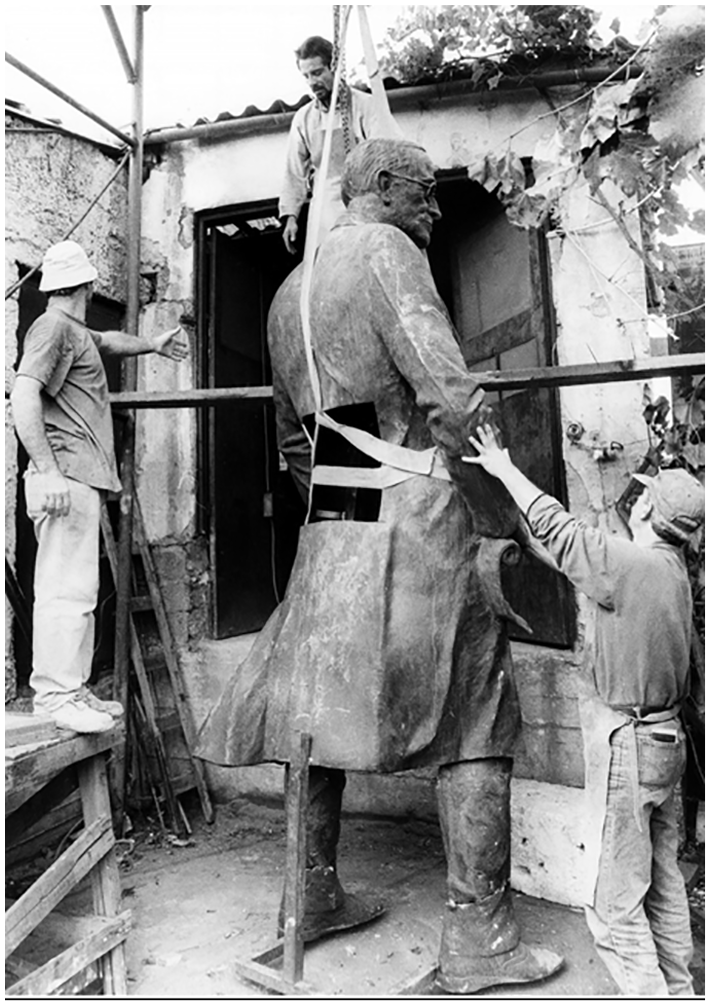
Stefanos Tsivopoulos, Lost Monument (2009). Series of 22 b&w archival photographs each 19 × 19 cm
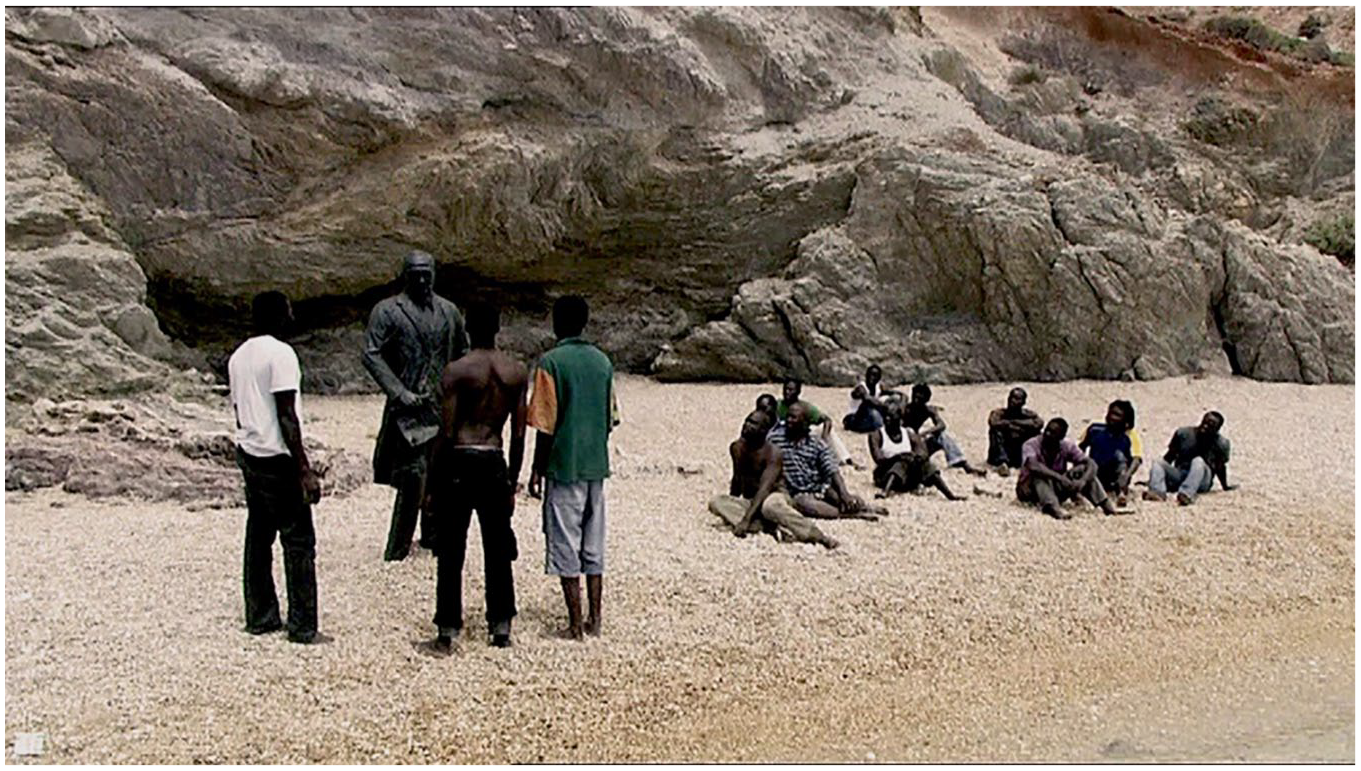
Stefanos Tsivopoulos, Lost Monument (2009). Single-channel video, HD cam transferred to Blu-ray, 16:9 Color, stereo. Duration 27 min.
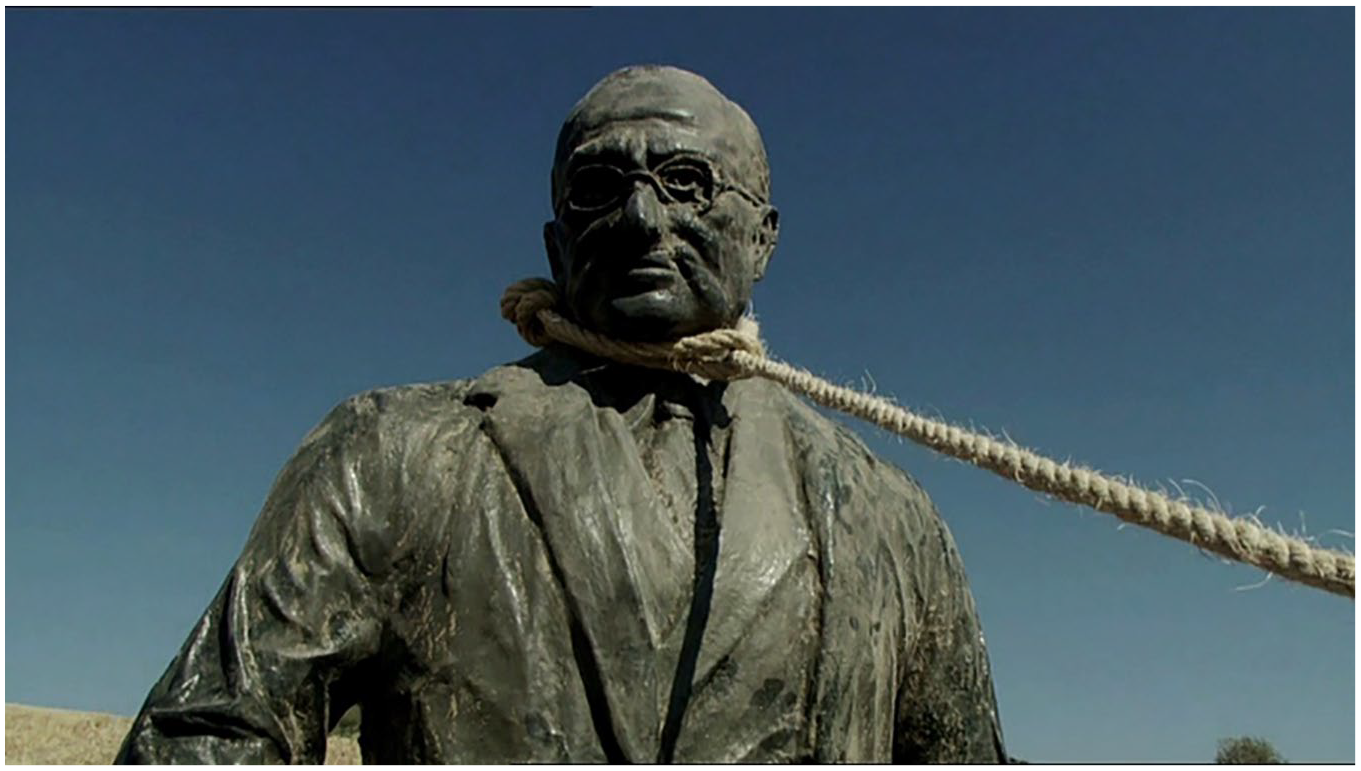
Stefanos Tsivopoulos, Lost Monument (2009). Single-channel video, HD cam transferred to Blu-ray, 16:9 Color, stereo. Duration 27 min.
By intervening in the (re)presentation of media archives from the recent past Lost Monument conjures Truman as a specter of foreign intervention still haunting Greece, where the Truman Doctrine funded the decisive defeat of the left during the Civil War (1946–9) and ushered in a state-led campaign of anti-communist repression that prevailed until the fall of the CIA-backed 1 military junta in 1974. Tsivopoulos’ artistic appropriations and rearrangements of documentary film and photography update both as alternative historiographical media for (re)viewing this recent past as an archival work of creative non-fiction. As the online précis for the film proclaims: ‘History retreats in favor of an allegoric narrative woven around an unpleasant material discovery’ (Tsivopoulos, 2009). In effect, by reanimating the seemingly inert statue of one of the Cold War’s central protagonists, Tsivopoulos’ multimedia installation calls renewed attention to the political aesthetics of historiographical practice and the materiality of collective memory. In what follows, I draw inspiration from a preliminary consideration of the political aesthetics of Tsivopoulos’ work in order to develop an experimental ethnographic investigation into the status of Harry S. Truman in contemporary Athens.
Defacement and/as historical redress
Defacement is central to this political aesthetics. The multiple episodes of violent protest directed against the statue since its erection in Athens in 1964 invites a meditation on defacement as a popular and timely modality of historical redress. As the recent wave of attacks against Confederate and colonial-era statues throughout the US and around the world attests, acts of defacement can conspire with the materiality of seemingly bygone historical relations of oppression to redress the nature of their persistence in the present. And so, more important than the identity of the personage a statue depicts, are the historical relations it landmarks in the uneven geographies of present struggles.
Consider this: iconic public statues are like antennae in virtual infrastructures of historical reckoning. They congeal and relay the distribution of what is taken to be sensible and thinkable – that is, what goes without saying – within a cultural field. As such, a public statue can serve as a discrete, abbreviated codex for the fraternal desires, national values, civilizational conceits, and/or common sense of the dominant cultures in relation to which they stand in some sort of representational affinity. On the other hand, differential relationships to such monuments (e.g. defacement, worship, disregard, etc.) reveal how ritual, political, and/or technological mediations don’t just reflect but intervene in the enactment and transmission of different capacities of historical dwelling in the present.
As a form of political protest, a statue’s defacement is tantamount to a gesture of unmasking. The violence discharged against a statue fleshes out the still ongoing relations of violence that belie its inert presence as a material relic of an ostensibly bygone past. Defacement can thus work as an exposition of a society’s open wounds; it works to the extent that it betrays public secrets (Taussig, 1999).
If we view Lost Monument with these preliminary propositions about defacement in mind, a methodological question arises: Does Tsivopoulos’ own disfiguring and refiguring of found and produced archival media sources about the statue of Harry S. Truman qualify his labor as a mimetic extension of the act of defacement? That is, is it this shift in the terms of historical redress – from the object of historiographical analysis to its mode of (re)presentation – that marks the crux of a political aesthetics of defacement? It would seem that defacement, conceived thus as a mode of immanent critique, names the type of embodied or ‘applied’ knowledge that Taussig (1992) has been at pains to elaborate as a kind of Benjaminian endowment for social analysis, where: the focus of worry shifted from the object of scrutiny to the mode of its presentation, for it is there, in the medium of presentation, that social theory and cultural practice rub against and inform the other such that there is a chance, however small it may be, of what I call ‘redeeming’ the object – giving it another lease on life by breaking through the shell of its conceptualizations so as to change life itself. (Taussig, 1992: 6)
Taussig is unequivocal about the implication of this shift: ‘[T]hus all social analysis is revealed as montage’ (1992: 6).
In what follows, I draw inspiration from the political aesthetics of Tsivopoulos’ work to ‘redeem’ my own ethnographic investigation into the status of Harry S. Truman in contemporary Athens. Venturing a response to the question I put to Tsivopoulos’ technique, namely, whether/how it embraces defacement as a political aesthetic, this article will elaborate a speculative crime scene ethnography of defacement, political recrimination, and Cold War historical redress centered around an investigation into the whereabouts of Harry S. Truman in Athens. To do so I cast my informant, Tassos, into the role of ‘sidekick’, while allowing myself to get carried away by the nagging suspicion that, oftentimes, it seems as though the ethnographer amounts to little more than a hopeless kind of detective.
Reframing my field site in terms of a crime scene investigation pays homage to the resurgent popularity of detective crime fiction – and crime noir, in particular – in Greece, thereby allowing me to experimentally engage a key genre through which moral imaginaries of political recrimination and financial corruption are being actively negotiated between history and literature as adjudicating discourses about the recent past in the present. 2 The genre’s popularity in contemporary Greece is not, of course, a national peculiarity. It in fact speaks to a broader anthropological context regarding the crime genre’s contemporary relevance. In elaborating a ‘criminal anthropology of late modernity’, for instance, anthropologists Jean Comaroff and John Comaroff (2016: xii) posit the global popularity of crime new noir as a ‘ironic counternarrative’ to the forensic fantasies of CSI-style 3 fictions. Both generic formations constitute increasingly central cultural vernaculars through which ‘ethnosociological truths about a universe that is growing increasingly inscrutable can be identified and tracked’ (Comaroff and Comaroff, 2016: xiii–xiv).
Accordingly, in recasting the crime scene as a trope of anthropological inquiry into cultures of historical redress, this article underscores the ways ongoing attacks against the statue of Harry S. Truman in Athens challenge official periodizations and linear chronologies that posit the Cold War as over and done with. Along these lines, the Cold War is to be understood henceforth as more of a ‘cold case’ than a closed one. 4 What is speculative about this crime scene ethnography is how it articulates a spectral politics of defacement: that is, a politics dedicated to uncovering how Truman is still at large in the world today. Like Tsivopoulos’ aesthetic practice then, the experiment that follows lies precisely in shifting the terms of critical intervention from a focus on the statue of Harry S. Truman as a historiographical object of analytical study to the phantasmagoric modes of his (re)presentations in Athens. In so doing, cause-and-effect historicist thinking retreats in favor of ‘an allegoric narrative woven around an unpleasant material discovery’ (Tsivopoulos, 2009).
A monument at large
The people here become one with the stone they strike the stone and tear their own guts are surprised the stone doesn’t even know how to cry. (Sachtouris, 2006 [1945]: 14)
Athens, late July 2018. Waiting for Tassos on the front lawn of the National Hellenic Research Institute, I watch with belabored breathing as another day smolders in no great haste. Overhead, wind-swept dust from the Sahara mingles with the ashen soot of the forest fires still burning in Rafina, Mati, and Kokkino to the north. At 91 dead and counting, this is already the second-deadliest forest fire event of the 21st century. Boarding strong winds, the fires have been staggering like drunkards across the Attic basin for days, slurping up vast tracks of pine forest as they stumble through the unsanctioned settlements interspersed therein.
The inferno had reached the city skyline with eerie stealth, cresting the horizon and dirtying the sky. The sparse whirring of a helicopter fetching water occasionally passed through one ear and out the other, condemned to its Sisyphean task by the first or second or third Memorandum of Understanding (MoU), 5 something along the lines of: Ye Shall Not Put Out Fires But Suffer In Them the Wrath and Justice of God, signed, In Solidarity, Your Creditor, Europe. It’s all there in print: €110 million in austerity-mandated cuts to the national fire services over the last five years (Ovenden, 2018). Here I was, then, idly documenting ‘negative evidence’ 6 of austerity overhead, facing off with Vassileos Constantinou Avenue: a main artery that links Syntagma Square to the US embassy, alpha and omega of all major protest routes, and recently the scene of a crime involving the attempted toppling of the thirty-third president of the United States, Harry S. Truman.
On 16 April 2018, a contingent of KKE (Communist Party of Greece) supporters had broken off from a main protest group heading for the US embassy to protest recent US, French, and British airstrikes on Syria. Wielding a metal grinder and rope, the assailants attempted to topple Harry S. Truman from his mount before being dispersed by riot police. According to Yorgos Perros, a member of the communist-affiliated labor union PAME, the Truman statue is ‘a symbol of imperialism and the United States in Greece’, claiming the attack as ‘a symbolic move against the U.S. and the war in Syria’ (Reuters, 2018).
In 1963 the Order of AHEPA (Greek Organization of Americans of Hellenic Descent) had commissioned Felix de Weldon, the sculptor of the iconic Iwo Jima memorial in Arlington, Virginia, to sculpt a statue of Harry S. Truman as a gift to the Greek state in commemoration of the Truman Doctrine and the defeat of Communism in Greece. Since its installation in Athens in 1964, the 12-foot bronze statue has been repeatedly vandalized, bombed, and toppled, becoming an anti-imperialist effigy; an antenna in an extant Cold War infrastructure of historical reckoning. Bombs, paint, metal grinders, and rope have likewise become broadcast media in the spectral politics of its ongoing defacement.
For all that, and despite being the largest statue in Athens, Harry S. Truman proved to be a most elusive figure. I had been looking for him for months. Family, friends, informants: none seemed to know what I was talking about when I inquired into his whereabouts. It was as Robert Musil (2006 [1927]: 64) insisted, ‘[T]he remarkable thing about monuments is that one does not notice them. There is nothing in this world as invisible as a monument.’ As my search continued however, I found myself moving towards the inverse proposition, also Musil’s, that, ‘one cannot say we do not notice them [monuments], one would have to say they “de-notice” us’ (2006 [1927]: 65). What a fascinating proposition: that monuments implicate us, at least as historical subjects, in mutual conditions of manifestation and endurance; they can and do withdraw in ‘plain sight’. Could this be why they are the perfect targets for historical redress? Is it that, being so ‘conspicuously inconspicuous’ (Musil, 2006 [1927]: 64), they can completely embody the obstinacy of history, where the inertness of a statue’s alloy/stone flesh works as a metonym reifying a people’s subjection to the obstinacy of history’s facticity? But how to hit a target you cannot (un)see; that is, one that hides in plain sight?
One approach might be to play the tourist and join a protest riot.
False starts: defacement and the power of falsehood
The true path is along a rope, not a rope suspended way up in the air, but rather only just over the ground. It seems more like a tripwire than a tightrope. (Kafka, 2006: 3)
To play the tourist and join a protest riot is to wager an entrance into a haecceity where bomb, paint, stone, hammer, rope is to statue what wasp is to orchid. Like ‘a cloud of locusts carried in by the wind at five in the evening’ (Deleuze and Guattari, 1987: 262) the point was to get carried away as a participant observer; that is, to be led to the scene of the crime by becoming implicated in it. It was a long shot, but with the window of my ethnographic fieldwork closing – I was mere weeks away from my departure – I fashioned out of my desperation a pseudo-ethnographic directive: to make a pact with ‘that improbable time that can no longer look to the clock for support [. . .] where the hands claw at one another on the clock face of man’ (Char, 2014 [1946]: 11). In the end, joining the mass anniversary protest commemorating the 1973 student uprisings against the CIA-backed military junta put me within stone’s throw of the US embassy. This was 17 November 2017. If Truman was there, I could not see him. Pressed between a column of riot police buses and a group of protesters I staggered blindly through a landscape of mist, choking on tear gas.
But why dwell on this ill-conceived and self-compromising tactic? I do so because it foregrounds the framing motif of my investigation: the ethnographer cast in the role of a hopeless crime noir detective, who, by tampering with the evidence, implicates himself within the scene of a crime, the scope of which he can barely fathom. After all, in playing the rioting protest ‘tourist’ I subjected myself to an elective affinity with what in Greek are known as the gnostoi-agnostoi (known-unknowns), a euphemism reserved for masked rioters who are agents provocateurs planted by the police (Panourgiá, 2009). The utter failure of this approach is precisely the point. As Deleuze explains in ‘The philosophy of crime novels’ (2004 [1966]), against the singular inductive or deductive genius of the classic hardboiled detective story, where insight and truth prevail as mechanisms of resolution, the crime noir narrative takes place ‘at the heights of the power of falsehood’. Deleuze (2004 [1966]: 83) elaborates: The reader is shocked in the end by so many errors committed on both sides. [. . .] This is because truth is in no way the ambient element of the investigation: not for a moment does one believe that this compensation of errors aims for the discovery of truth. On the contrary, this compensation has its own dimension [. . .] a process of restitution that allows a society, at the limits of cynicism, to hide what it wants to hide, reveal what it wants to reveal, deny all evidence, and champion the improbable.
Read against the grain of Durkheim’s insistence that crime serves society as a prism through which it can ‘measure itself against its own ideal self-image’, a criminal anthropology of late modernity posits that, given the erosion of the liberal democratic social contract and the increasing obfuscations of global finance capital, it is the very absence of a ‘discernible order of shared truths and the technical means of producing them’ that has rendered crime ‘inscrutable, mysterious and explosive’ (Comaroff and Comaroff, 2016: 5, 123). I contend that it is precisely within such a ‘post-truth’ milieu that crime noir’s power of falsehood becomes instructive as a register for this absence of discernible order. Evocative of what the Comaroffs (2016) describe as a ‘metaphysics of disorder’, crime noir fiction concerns itself with the impossibility of neat resolutions by ‘exposing the vulnerability of distinctions between the criminal and non-criminal worlds’ and by tarrying in the ‘mysterious intransigence of past transgressions’ (Kaisidou, 2017: 119).
Deputizing informants: an ethnographic case file
Detectives who stare at Their open palms [. . .] While the hands of the clock Travelled feebly through Infinite night. (Bolaño, 2013: 45, 47)
Back on the front lawn of the National Hellenic Research Institute I’m still waiting for Tassos, a long-time friend and informant to whom I had been introduced by a mutual acquaintance back in 2015 when I arrived in Athens for preliminary fieldwork. If anyone could help me find Truman it was Tassos. No one I knew was as well connected, or as endearingly sardonic, for that matter.
His response to my introductory prodding about what he does for a living went something like this: ‘For now, I’m working in the malakia [jerk-off] special accounts for research and funding at the National and Capodistrian University of Athens, coming up with ways to get “Merkel money”.’ Asked about the precarious status of the social economy in the country – something he’s invested in through eco-tourism schemes he’s concocting in his natal city of Trikala – Tassos recommended: ‘If you have any proposals email them to the Greek government– masturbation goes Cloud here’ (a reference to the launch of an online government platform soliciting citizen input).
For as long as I have known him, and before any talk of a national financial crisis, Tassos has cultivated a way of churning disappointments into his very own misanthropic brand of easy-goingness, one that is typified by a sense of humor that shades from lowbrow to lewd to black and spares no one; fascist and refugee alike are equally eligible subjects for ridicule and criticism, causing him to come off as a ‘troll’ in online forums (including on my own Facebook page from time to time). Yet Tassos commands a pathos of indifference only ever verging on resignation, possessed by a generosity of spirit which, however unassuming, he dedicates to others (e.g. volunteering as a Greek language teacher for immigrants in the evenings, collaborating with local farmers and entrepreneurs in the founding of a social cooperative enterprise, networking access to various archives on behalf of visiting students and scholars, etc.).
Tassos is also a certified tour guide, offering his services to tour groups from as far off as China (a rapidly growing demographic in the Greek tourism sector). His tours are completely unorthodox for the way they eschew choosing between the two dominant circuit genres: either the typical gawking extravaganza over antiquities centered around the Acropolis, or the urban circuit that caters to a ‘crisis tourism’ – lambasted in some circles as ‘austerity porn’ – showcasing how the contemporary city is changing (or not) through the incursions of global finance capital. Instead, Tassos anachronistically collapses the two genres into a single tour that focuses on Classical Antiquity in order to draw out parallels with the contemporary political and economic situation of the country.
I once listened in amusement as he explained to a group of elderly German and British tourists that Pericles was the Papandreou (populist socialist leader of Greece, 1981–9) of that time: Populist, but he used the experiment for the city’s sake. There were also allegations that he [Pericles, like Papandreou] took some money from the construction businesses, or that he favored granting building contracts to the two artists that designed the Parthenon. The case was that the vast majority of the people who fought against the Persians, especially the oarsmen, belonged to the lower social strata. These people were given political rights but after the war they were left unemployed so there was a need for something that could keep them occupied. Pericles used the money of the Athenian Alliance – the EU cohesion funds of that time – to build many of the public buildings you now see in ruins. He did this to stabilize the democratic regime. This is what Tsipras should do, but he has no knowledge of anything . . . I’ll send you articles.
The resulting juxtaposition works as an evocative exposition of historical time as both untimely and contemporaneous vis-à-vis the lived present, calling to mind Georges Didi-Huberman’s (2018: 125) insight that: ‘[t]o think the montage alongside the anachronism is to recognize that there is no more “decadence” than there is “progress” in history; there are only heterochronies and anachronies of processes with multiple directions and speeds.’
Finally, here he was, approaching along Vassileos Constantinou Avenue, an unlit cigarette clenched in the corner of his mouth. Making his way against the ruddy ashen sky Tassos resembled an old cargo steamer returning to harbor after years at sea. In fact, against that skyline of ethereal rust the enigma of his charm came into perfect relief: the way he always appeared weathered and for this very reason indomitable. As though he had long ago discovered that fatigue is not a life raft to cling to but a door to walk or fall through; that fatigue too opened to another side: a side not of reprieve but of steady inebriation. His eyes were these life rafts, these doors only ever half-opened, his lids always at half-mast, somehow held open by the arc of a smirk that belonged more to his face than to his mouth.
He greeted me in his typical fashion: Πώς τα βλέπεις τα πράγματα, δάσκαλε; (lit. ‘How do you see the things, teacher?’). Finally lighting the cigarette that was clenched in one corner of his mouth, he spoke to me through the other: ‘So you want to know where Truman is hiding, eh? Come, I’ll show you.. . . He’s hiding in plain sight.’ And just like that his back was turned to me, a chuckle barely visible in the rumbling of his stout body, his cigarette smoke forming a trail for me to follow.
Hemorrhaging crime scenes: an itinerary of historical redress
Objectivity serves as the highest form of diversion; montage appears culturally as the highest form of eerie intermittence above diversion. (Bloch, 1991 [1962]: 203)
What followed was a most bizarre venture: something between a haunted-house tour and a crime scene investigation. We spent the day traversing the city by train, bus, and on foot, stopping at one former crime scene after another. All crime scenes culminated in nondescript patches of road or suburban plots in the middle of nowhere, street corners, a shop front, and once even a trash bin. Standing in the middle of a residential street in the suburb of Palaio Psychiko, impervious to traffic, Tassos pointed at a patch of pavement leading up to a house once belonging to Richard Welch, the former CIA Station Chief in Greece. Welch was assassinated on this very spot by 17N on 23 December 1975. On Kiffisia Avenue, in the district of Filothei, we stood on a grassy island between two lanes of traffic as he described the assassination of the industrialist Alexandros Athanasiades-Bodosakis on 1 March 1988, also at the hands of 17N. Elsewhere in Filothei, peering into a trash bin, Tassos related a failed assassination attempt on US official George Karos (then-head of the DEA [Drug Enforcement Administration] in Athens), on 21 January 1988. A tip-off to a newspaper had led police to the trash bin where they found and disarmed a remote-controlled explosive device. On Kiffisia Avenue, now standing by a utility pole on a street corner adjacent to a wall of shrubbery buffering a freeway, Tassos picked out another anomalous spot on the pavement and related the assassination of George Tsantes, the Deputy Chief of the US Military Assistance Mission (JUSMAGG), on 15 November 1983. Before we were through, we had visited eight former crime scenes. Apparently, there were another 15(!) on Tassos’ itinerary, all pertaining to assassination attempts carried out by 17N, Europe’s last Marxist-Leninist terrorist organization.
November 17, or N17 (sometimes 17N) for short, is often referred to in Greece as an organossi phantasma: phantom organization (Kassimeris, 2007). It was formed in 1975 in retaliation to what became popularly perceived in Greece as a historic compromise between elements of the overthrown military junta (1967–74) and the liberal democratic regime that superseded it. Its formation underscores a critical periodization in modern Greek historiography known as metapolitefsi (‘democratic regime change’) (Lekea, 2014). By failing to pursue the collaborators of the military dictatorship in any comprehensive judicial and public forum (instead limiting prosecution to the protaitious; trans. the main culprits), the post-junta government of Kostas Karamanlis reaffirmed the Greek state’s complicity with the post-Civil War status quo (Panourgiá, 2009: 151). The emphasis in official state discourse was placed on the national need for a forward-looking approach to the recent past, resulting in the incineration of thousands of security files kept on citizens during and before the military dictatorship, a political ritual of effacement carried out at an Athenian steel plant in August 1989 under the mandate of a coalition government of national unity (Papailias, 2005).
N17 intended to keep the wounds of recent history wide open, building on the momentum of the anti-dictatorship mass uprisings of November 1973 (which their name recalls) in order to incite revolutionary societal change. They did so primarily through assassinations of iconic figures that represented a persistence of what Michael Herzfeld (2002) has described as a ‘crypto-colonial’ identity between a system of Western imperialist patronage and a domestic ruling class who, after 1974, found political cover behind a Eurocentric bourgeois myth of nationwide socioeconomic prosperity and political equality. With metapolitefsi, modernization and Europeanization became the twin crucibles into which extant fratricidal cleavages between right and left were officially relocated, subsuming rather than addressing the still-hemorrhaging local and personal significations of these cleavages within an ostensibly more encompassing geopolitical and cultural contest, i.e. the Cold War.
National historiography, especially as it is reflected in high-school textbooks and curricula, evinces the totalizing scope of this ideological subsumption. Many friends maturing through the Greek public high-school system as recently as the early 2000s recall the Civil War (1946–9) as something they encountered for the first time as literature, not history: for example, in the poetry of Manolis Anagnostakis and Yiannis Ritsos.
7
Moreover, as a subject of bourgeois national historiography, until very recently, the military dictatorship has been registered primarily through the analytical prism of kitsch, pre-empting a more serious political recrimination of its legacy through fixations on the farcical and anachronistic political aesthetics of its (inept) rule.
8
The dictatorship’s legacy: deportations, mass internment, rumors of torture and executions. And more, as the leftist critical theorist William V. Spanos (1973: 372) has testified, ‘hovering subliminally in the background, the foreign power – the United States – whose real presence in this world is intimated by casual but recurrent references to “American dollars,” “American cigarette lighters,” “the United Tomato Company,” and more overtly, “the CIA”’. Regarding the culpability of the US, perhaps no better testimony can be offered here than N17’s official communiqué from December 1975, following their assassination of the CIA Station Chief in Athens, Richard Welch: Enough is enough. [. . .] The main slogan of the 1973 Polytechnic uprising ‘out with the Americans’ remains today unfulfilled. The Americans are not out and what is worse, the government allows even more to come on national soil: multinational monopolies have moved here from Lebanon and the CIA moved its Middle East headquarters from Beirut to Athens. For the Americans, Greece continues to be a [. . .] Latin American Banana Republic in the Southern Mediterranean. (quoted in Kassimeris, 2007: 131–2)
Where the eye grasps at what the hand cannot touch, t/Thing-like and godly
The miraculous moment is the moment when anticipation dissolves into nothing. (Bataille, 1997 [1976]: 308)
My patience finally wore thin. ‘What does any of this have to do with Truman?’
Tassos’ retort: ‘As much as Truman has anything to do with Syria . . . Look, what I have shown you is just as much about how as about where Truman hides in plain sight. To see him you must see these things obliquely, in παράλλαξις (parallax).’
Parallax describes a displacement in the apparent position of an object viewed along different lines of sight where the angle of inclination between these lines yields the object’s actual position. Parallax explains the apparent movement of objects when viewed from different positions in motion. A common example of parallax is when driving along a highway, utility poles appear to flit by quickly while foliage in the distance appears to drift slowly by. Understood through this lens, to catch a glimpse of Truman amounted to sighting – or perhaps, citing – him at each former crime scene. As such, this feat involved extending one line of sight through all of the N17 crime scenes – to ‘skewer the dots’, as Tassos put it – in order to draw out another line of sight: the culpability of US imperialism, the desire to have this culpability brought into a different kind of historical reckoning in and from Greece today.
It is precisely along such lines of parallax that Gerhard Richter (2011: 17), building upon Benjamin’s formulation of Nachleben as a kind of living on, an afterlife, calls for a thinking of afterness capable of contending with ‘the moment of arrival of something that has already passed.’ In Richter’s words (2011: 21): The after will be shown to have kept itself open, as the site of competing significations and claims that have the capacity to surprise us in their idiomatic singularity and in their refusal to be absorbed without remainder into the master narratives of causal and linear unfolding.
Richter here takes aim at the hegemonic clutch of historicist ideologies of supersession. What afterness registers, in contrast to this supersession, is Benjamin’s methodological instruction that, ‘historical “understanding” is to be grasped, fundamentally, as an afterlife of that which is understood’ (Benjamin, Das Passagen-Werk, 574–5, quoted in Richter, 2011: 3). And so, it is along parallax lines of sight that Tassos’ tour and Truman’s defacement can be apprehended as part of a continuing struggle over still-powerful epistemological, geopolitical, and historiographical Cold War formations.
Drawing on Lisa Yoneyama’s (2016) formulation of ‘Cold War ruins’ in her study of Trans-Pacific historical redress cultures, I suggest that what is being charted across these crime scenes can be similarly apprehended as ‘the specter of the postwar arrangements that came into existence during the Cold War years, while signaling the possibilities of moving beyond its recalcitrant legacies’ (Yoneyama, 2016: 8). Indeed, Tassos’ insistence that parallax can help us (un)see plain sight qualifies his crime scene tour as what Yoneyama calls a conjunctive cultural critique, where ‘deeply entangled geohistories of violence are revealed in their shared yet localized genealogies’ (2016: 17). The entanglements that make up a conjunctive cultural critique can crosscut genres of citation and documentation. Regarding such power(s) of evocation, Richter argues that a thinking of afterness is also always a matter of remembrance, where remembrance designates not the preservation of past events in memory, but rather their re-actualization in present experience: Who are [sic] terrorized by the just execution of the chief of staff of the criminal and terrorizing Central Intelligence Agency (CIA) in Athens? . . . The same applies to some operations that were used post-war by the liberation movements and have such a similar nature, e.g. the bombs put by the Liberation Front of Algeria against French colonels, in coffee shops or other spaces frequented by French. And they did this as a response and retaliation against the bombs that French colonels detonated in Muslim neighborhoods. (17N, Proclamation of April 1977, quoted in Lekea, 2014: 44)
At stake here is what Derrida describes as the affirmation of an uncertain inheritance, one that wagers a relationship to a time ‘without certain joining of determinable conjunction’ (2006 [1994]: 20). As Derrida elaborates: An inheritance is never gathered together, it is never one with itself. Its presumed unity, if there is one, can consist only in the injunction to reaffirm by choosing . . . one must flit, sift, criticize, one must sort out several different possibles that inhabit the same injunction. (2006 [1994]: 18)
To reaffirm by choosing: this is the crux of a conjunctive cultural critique that, when pushed to its limits in making use of occluded, repressed, and/or fabricated historical fragments in experimental rearrangements, recalls Brecht’s dramaturgical use of montage. Cutting into episodes, framing, interruption, suspense, all are techniques that realize Derrida’s insistence on the need to flit, sift, and criticize what is, and what is to be, inherited. To reaffirm by choosing then is to fashion a montage of ‘immanent historicity’ whose elements, taken from reality, ‘induce a new effect of knowledge that is found neither in timeless fiction nor in the chronological facts of reality’ (Didi-Huberman, 2018: 55). This knowledge-effect corresponds to an allegorical force; a relation to a kind of (un)knowing that situates what is comprehensible but not yet understood. 9 Such an allegorical force is expounded in Richter’s (2011:16) discussion of the secret of afterness: a secret that ‘will always call upon us to “inherit” it one more time, place it in a tradition of other afters and other secrets, even as we attempt to learn to respect its idiomatic singularity’. Apprehended in these terms the allegorical force of a conjunctive cultural critique bears a responsibility that imposes itself on us, if we let it, to ‘learn to inherit a legacy that is at odds with itself and that shows itself to us only in the form of elusive specters’ (Richter, 2011: 15).
This then is how Tassos proposed to read the Truman Doctrine ‘in Greek’: that is, between the lines (of sight), following an oblique inclination of displacement from N17’s criminality (itself a cipher for the criminality of Communism in post-war Greece) into a recrimination of the longue durée of US imperialism itself. The elliptical incline of this displacement across all these skewered crime scenes traces out the physiognomy of Truman’s face in each one of them, where the victims can now be (un)seen in plain sight, in their absent presence, there now as base matter, negative evidence for a crime that they did and did not commit, precisely because the crime they belong to – the one that claimed their lives – has not taken place; it is still taking place.
Relevant to this kind of crime scene physiognomy is Deleuze and Guattari’s insistence that, ‘it is not the individuality of the face that counts but the efficacy of the ciphering it makes possible’ (1987: 194). What would it mean, then, to read the Truman Doctrine as the name of – or, one of the proper names for – an abstract Cold War machine of faciality, what Deleuze and Guattari describe as ‘a black hole/white wall system that is not a face but an abstract machine that produces faces according to the changeable combination of its cogwheels’? (1987: 187). Where the gaze is secondary to the ‘black hole of faciality’, wouldn’t we need to consider not only the fragmented body – that is, the correlation of part-objects: each crime scene with its victim and timestamp – but also the spectral realism of the ‘body without organs’ (Deleuze and Guattari, 1987: 150) moving in plain sight. 10 Along this line of reasoning, plain sight cannot be localized as a place of identification but should be apprehended as an itinerant mode of habitation, a wayfaring of and for gazeless eyes. Notice how eerily near this rumination on plain sight, and on what moves in plain sight, brings us to that Thing that ‘like an elusive specter engineers a habitation without proper inhabiting, call it a haunting, of both memory and translation’ (Derrida, 2006 [1994]: 21).
Truman is one proper name for this Thing, this Ur-crime, this quasi-event: that is, a form of occurring ‘that never punctures the horizon of here and now and there and then and yet forms the basis for forms of existence to stay in place or alter their place’ (Povinelli, 2016: 21). Nor does one see in flesh and blood this t/Thing that hides in plain sight; ‘this thing that is invisible between its apparitions, when it reappears. This Thing meanwhile looks at us and sees us not see it even when it is here. A spectral asymmetry . . . it de-synchronizes, it recalls us to anachrony’ (Derrida, 2006 [1994]: 6).
Carried away on this speculative line of flight, I find myself stuck in an orbit around and around the evacuated crime scenes, possessed by the suspicion that in his absent presence, Truman, the Lost Monument, a monument still on the move, is a Cold War image-myth. I begin to imagine this Cold War image-myth much like Haraway’s (1985) cyborg. It refuses to match its realism with the realism of historicist analysis. Its spectral asymmetry returns me ceaselessly, and as if always for the first time, to the undecidability of the Thing and of the Crime that is its jurisdiction. Faced with the awful shadow of some unseen power where can the investigation go from here? If montage, deployed in and as a conjunctive cultural critique, designates a method of detection, how do I avoid conjuring up the very Thing I am looking for?
It needs to be emphasized just how much such a self-compromising procedure, when/if passed off as method, comes to resemble a mode of criticism that is indistinguishable from defacement itself. As Taussig (1999) suggests, conceiving criticism as a sort of defacement: would seem to get something right about the nature of the complicity between the critic and the object, because defacement succeeds to the degree that it engages internally with the object defaced, enters into its being, we might say, no matter how crude or offensive, subtle or witty, the defacement might be. (1999: 43)
Implied here is the notion that the critique supplied by defacement is somehow immanent to its object. The labor specific to the act of defacement works through a generative kind of negation, whereby the destructive act doubles as a reanimating force, blurring the distinction between the representation (e.g. a statue of Harry S. Truman) and that which the representation ciphers (Truman himself, whoever and whatever that will come to mean). Consecrating in defilement the fetish character of its target, defacement works by unmasking what this fetish character conceals: a glaring absence, what Taussig describes as, ‘a void with a halo encircling it’ (1999: 56).
The arcane language of defacement
What manifests itself in the first place is a specter, this first paternal character, as powerful as it is unreal, a hallucination or simulacrum that is virtually more actual than what is so blithely called a living presence. (Derrida, 2004 [1994]: 13)
After all that we headed back toward our rendezvous point. Not more than a couple of blocks east from where we set off, Tassos led me into a small byway right off the main road. Suddenly, as if out of nowhere, I found myself facing off with a 12-foot tall Harry S. Truman! After all that! Still clutching a parchment (the Truman Doctrine) in his right hand, this Truman seemed to be teetering under his own weight, as if precariously suspended over some sort of purgatorial void awaiting final judgment in the court of public opinion. Instinctively, compulsively, I made a fist and began rapping at his leg with increasing force until my knuckles bruised. As I did so, I listened to him fill-up with the resonances of my touch. It was like revving a stalled motorcycle engine to get it going again– the sputtering animation rebounded into me, coming to the surface as gooseflesh. A Frankenstein moment.
A truly monstrous Thing, Truman’s alloy flesh still bore the scars of previous assaults: a dented nose from his fall in 2006 during a protest against the Israeli bombing of Lebanon; a limp, betrayed by his slightly lop-sided posture, presumably incurred when dynamited off his pedestal just days ahead of an official state visit by US Secretary of State George P. Shultz in 1986 (the attack was carried out by the Christos Cassimis Revolutionary Organization, named after a man killed in a 1978 shootout with police while trying to blow up a West German factory on the outskirts of Athens [The New York Times, 1987]); red smudges caked into the bronze on his chest from a 2013 vandal attack. As I craned my neck back to inspect his face, it struck me that his body could be read like a manifesto, or like a barometer, yielding the state of anti-imperialist sentiment in the country.
Meanwhile Tassos was pressed up against the adjoining dedication plaque, pencil in hand, furiously scribbling away at a sheet of paper he had placed over the engraving. With his face hovering inches away from his labor, his cigarette about to set the paper ablaze, he called me over. Peeling the paper from the wall, he held it up for inspection. Misquoting Benjamin he pronounced, ‘I give you a document of civilization: a document of barbarism. . .. Take it, it’s a souvenir.’ He winked as he passed me the paper that under his frenetic hand had been transformed into a work of frottage, a transcription of the engraving underneath. But the thing was I couldn’t make out any script save for a few linear indents that disappeared into craters of stippled grey zone. I looked over to the piece of plaque he had transcribed. It was mangled by what looked like hammer blows!
Tassos had, in effect, created a graphite fossil record of the arcane language of defacement. His frottage was by extension a labor of the negative, emptying out a void rather than filling it up, recalling Taussig’s formulation of the relationship between defacement and public secrecy: ‘the reconfiguration of repression in which depth becomes surface so as to remain depth, I call this the public secret [. . .] This then is the breath of empty space’ (Taussig, 1999: 8, 12). Just like his crime scene tour, what Tassos provided was a reading of the Truman Doctrine ‘in Greek’; that is, between the lines of sight: a parallax view afforded by relations of relative similitude between disparate historical protagonists who are nowhere to be seen . . . or, perhaps, precisely where they must be (un)seen, in plain sight, regarded again and as if for the first time in their localized Cold War genealogies.
Such was the allegorical force of Tassos’ frottage: his transcription of the defaced plaque was a way of drawing out the object of critique by pressing up against it in a mimetic gesture that extended it into a new space: the page-turned-graphite-fossil record. Tassos’ gesture unmasked Truman as a Cold War image-myth, proffering a critical iconography of the Truman Doctrine, exposed now in its localized genealogy as a handmade document of civilization and barbarism: a void haloed by hammer blows and pencil marks.
Footnotes
Acknowledgements
My deep gratitude goes to Rachel Levine, Penelope Papailias, Naisargi N. Dave, Jesook Song, and Behzad Molavi for their valuable comments and enduring support. And a special thanks to Kostas Chalkias, who showed me the way.
Declaration of Conflicting Interests
The author declares no potential conflicts of interest with respect to the research, authorship, and/or publication of this article.
Funding
The author(s) disclosed receipt of the following financial support for the research, authorship, and/or publication of this article: This research was partly supported by an Ontario Graduate Scholarship made available through the Department of Anthropology at the University of Toronto.
