




Abstract
Across the globe, human experiences of death, dying, and grief are now shaped by digital technologies and, increasingly, by robotic technologies. This article explores how practices of care for the dead are transformed by the participation of non-human, mechanised agents. We ask what makes a particular robot engagement with death a breach or an affirmation of care for the dead by examining recent entanglements between humans, death, and robotics. In particular, we consider telepresence robots for remote attendance of funerals; semi-humanoid robots officiating in a religious capacity at memorial services; and the conduct of memorial services by robots, for robots. Using the activities of robots to ground our discussion, this article speaks to broader cultural anxieties emerging in an era of high-tech life and high-tech death, which involve tensions between human affect and technological effect, machinic work and artisanal work, humans and non-humans, and subjects and objects.
From the earliest stages of their imagination and development, automated systems, robots, and artificial intelligence systems have been bound up in moral questions about human agency, capabilities and shortcomings, wellbeing and, ultimately, mortality. Popular visions of robotic techno-futures in science fiction are split between apocalypse and utopia, between narratives of a future annihilation of the human species and a future transcendence of human frailties. As Don DeLillo describes in his 1985 novel White Noise: This is the whole point of technology. It creates an appetite for immortality on the one hand. It threatens universal extinction on the other. Technology is lust removed from nature.
Death by robot is not a new phenomenon. Although this article is concerned with how robots are deployed in the production of a so-called ‘good death’, we must begin by acknowledging that robots are often associated with human deaths that are violent or ‘bad’. The first recorded incident of ‘death by robot’ occurred in 1979, when Ford assembly-line worker Robert Williams was hit in the head and killed by a heavy-duty robotic arm (Stowers et al., 2016: 18). Robot-assisted surgery has aided millions, but a 2016 study found that mechanical malfunction was linked to the deaths of nearly 150 people between 2008 and 2013 (Alemzadeh et al., 2016). In 2018 a woman in Tempe, Arizona became the first recorded death caused by a self-driving car (ABC News, 2018). These much-reported though relatively rare events are a long way from DeLillo’s threat of extinction and the press around them masks more systematic occurrences of death by robot. To date, military unmanned combat aerial vehicles or drones operated by the United States of America are estimated to be responsible for between 8,469 to 12,105 deaths worldwide (Bureau of Investigative Journalism, 2019). Although land-mines and automatically triggered rifles are relatively simple autonomous killing machines, the most sophisticated robots active in the theatre of war remain ‘humans-in-the-loop’ (HITL) systems, remotely controlled by people who are responsible for target selection and decisions about lethal force (Sharkey, 2011). It is technically possible to deploy entirely autonomous robots in war, and this would reduce response delays and human errors, however international governments have had mixed policies on this deployment, stemming from technical, safety, and moral concerns (Scharre, 2018). Further, that the US military currently favours HITL systems can be understood as an application of the principle of human exceptionalism. Human exceptionalism demands that only a human has the capacity to ‘care’ about, and thus, ironically, to make the decision to kill another human. A non-human being, comparatively, is not trusted to kill independently. In the use of military drones, while humans are still in the killing loop, that involvement is generally from a great physical distance, and this distance has consequence. Noel Sharkey argues that drone warfare has created ‘moral disengagement’, whereby the remoteness of drone operators alleviates both their fear of being killed and resistance to killing, encouraging a ‘PlayStation mentality’ of soldiers disengaged from the lethal results of their actions (2011: 145). Robots are killing humans and the humans in the loop are becoming robotic.
Standing in sharp contrast to these examples and their apocalyptic forewarnings are techno-salvationist narratives. In the 19th and 20th centuries, semi-automated and automated production systems were imagined to supplement communities with non-human labourers, delivering humans a society of wealth without work. In more recent times, the ‘transhumanism’ or ‘posthumanism’ movements have espoused the potential of technologies like cybernetic implants to ‘radically transform [. . .] human beings or artificial beings by means of engineering’ (Coenen, 2007: 142; O’Connell, 2017) and, in many cases, to make humanity, in some form, immortal. From the dream of digital immortality found in visions of uploading your brain to a computer (Moravec, 1988), to more prosaic digital services that maintain an ongoing social presence of the dead through a Twitter bot or virtual avatar (Meese et al., 2015), projects of this kind propose to append or enhance human capabilities with technological grafts. However, robots have also found favour in recent transhumanist visions as companions, labourers, and even rulers, working together to create a perfected multi-species society, if not a perfected human (this vision and its downfall are famously discussed in Čapek, 2001 [1921]). The very promise of the transhumanist project is the transcendence of human limits via the victory of ingenuity or technology over nature.
This article puts to one side visions of robots as harbingers of, or resolutions to, human mortality, to consider more ordinary, present-day entanglements between robots and the expressions of care ritualised in the funeral service. As we have previously demonstrated, across the globe, experiences of death, dying, disposition (disposal of the body), and grief are increasingly inflected by digital technologies (Arnold et al., 2018). Today, automated and semi-automated systems are an emerging feature of people’s encounters with the funeral industry, although their existence goes largely unnoticed, as these technologies are most often employed in ‘backstage’ functions. Examples include the business management and logistics systems employed by many funeral directors and cemeteries, and the high-tech cremators employed in most crematoriums that automate the temperature and length of incineration. Some emerging robots, however, have been specifically designed to occupy public roles within the funeral rite, as attendees, religious specialists, or celebrants. Through their performances within these rituals of care, we argue that robots may help to secure a ‘good death’ for human subjects by contributing to a commemoration that conforms with cultural norms and expectations. At the same time, the participation of non-humans in death rituals can generate feelings of discomfort or of the uncanny. They further challenge the monopoly that humans have claimed over death, as the sole beings truly capable of knowing and experiencing death, and thus of caring for the dying and dead. By participating in funerals, might robots one day become integral to human experiences of death?
There is evidence that mourning extends to the animal kingdom (King, 2013), but practices of care surrounding death, including the affective labour of expressing grief through organised ritual and the respectful disposition of the body, are frequently cited as uniquely distinguishing characteristics of the human species. In his ambitious recent volume, The Work of the Dead, Thomas Laqueur takes this apparent universal as his starting point; dead bodies matter ‘everywhere and across time’ and that they do so is a sign of humanity’s ‘emergence from the order of nature into culture’ (Laqueur, 2015: 8). Transgressions of care for the dead are not only understood to be disrespectful of the deceased, but arguably, are a dehumanising rupture that diminishes us all (Butler, 2009; Laqueur, 2015: 4, 8). Ironically, those who perform these humanising labours have often been ostracised for their association with death and its perceived pollutions (e.g. Carden, 2001; Howarth, 1996). Those who work with dead bodies in medical and mortuary contexts can feel ‘less than human’ and their profession generates a certain social stigma (Carden, 2001: 79–80). Those who care for the dead thus appear caught in a paradox: through their labours they defend what it is to be human, while at the same time, they are socially tarnished by that labour. But what happens when already not-quite-human robots occupy this ambivalent role?
This article focuses on robots that participate in death rituals to exemplify broader cultural anxieties emerging in an era in which ‘high tech’ permeates life and, increasingly, death. These anxieties are often expressed in binaries that frame discourses of death care, such as the sacred and the profane, respect and disrespect, dignity and indecency, industrialised technologies and handcrafted labours, affect and effect, nature and culture, humans and non-humans, subjects and objects. We consider specific recent case studies of intersections between robots and death from the United States of America and Japan to ask what makes a particular robot engagement both a breach of care and an affirmation of care. This article emerges from ongoing work conducted by the interdisciplinary DeathTech Research Team, and draws on fieldwork conducted between 2016 and 2019 in Japan and the USA, 1 including interviews with robot developers, religious figures, death care professionals; observations at funeral industry trade shows; and analysis of popular media reaction to new products.
But what do we mean by ‘robot’? Like ‘artificial intelligence’, the term is broadly applied in popular use and contested in scholarship. The English term originated from Karel Čapek’s science fiction play R.U.R. (2001 [1921]), from the Slavic robota (forced labourer). Japanese roboticist Morishita Mori once commented that ‘[r]obots are like Mt. Fuji. It’s hard to separate what is a robot from what is not’ (in Kageki, 2012). In a contrary move, other scholars draw analogy to the infamous definition of pornography given by US Supreme Court Justice Potter Stewart: ‘I know it when I see it’ (see Turner, 2019: 8). We cast a wide net in this article, exceeding the definitional boundaries given by roboticists (see Winfield, 2012) to discuss programmed, (largely) self-controlled devices that our informants in the funeral industry and mass media have identified as ‘robots’. Worldwide, there are currently few robots that are commercially available for domestic use and/or deployed within the funeral industry. The examples we discuss here exist primarily as experimental deployments, presented at funeral industry trade shows, but with uncertain future deployment at a mass scale. The realisation of robotic techno-futures is not fuelled by imagination alone, but requires financial, social, and institutional energies to sustain it, which in a risk-averse and conservative funeral industry, have been difficult to muster. These new technologies, therefore, speak to contemporary concerns as well as futures (van Ryn et al., 2019). This article looks out across the precipice of a near-future robotic revolution in the funeral industry, to consider its implications for how we might care, or fail to care, for the dead.
CARL: presence, affect, and effort at the funeral
Several years ago, when the father of Steve Gray, President of ORBIS Robotics, was diagnosed with dementia, Steve found himself living at a distance, unable to care for his father and unable to teach him to how to Skype or convince him to pick up the phone. As the head of a California-based robotics start-up, Steve developed a unique solution to the problem in the form of a telepresence robot named CARL (Figure 1). Telepresence robots, which provide the functionality of a video conference system mounted to a mobile platform, have primarily been deployed in offices, factories, and at conferences. The robot enables the remote operator to see and hear, and to move around among people. People interacting with the robot can also see and hear the operator. Our research team first encountered CARL at the 2015 International Cemetery, Cremation, and Funeral Association (ICCFA) trade show in San Antonio, and the technology has been displayed at funeral trade fairs since. Like so many exhibits at the show, this innovation originated from a company external to the funeral industry, seeking to make a lateral move into this US $10 billion per annum economic sector. Such moves have had mixed success, and at the time of publication, CARL remains an interesting vision of future possibilities, but one that remains a trade show novelty and a service offered by some early adopters in the US funeral industry.
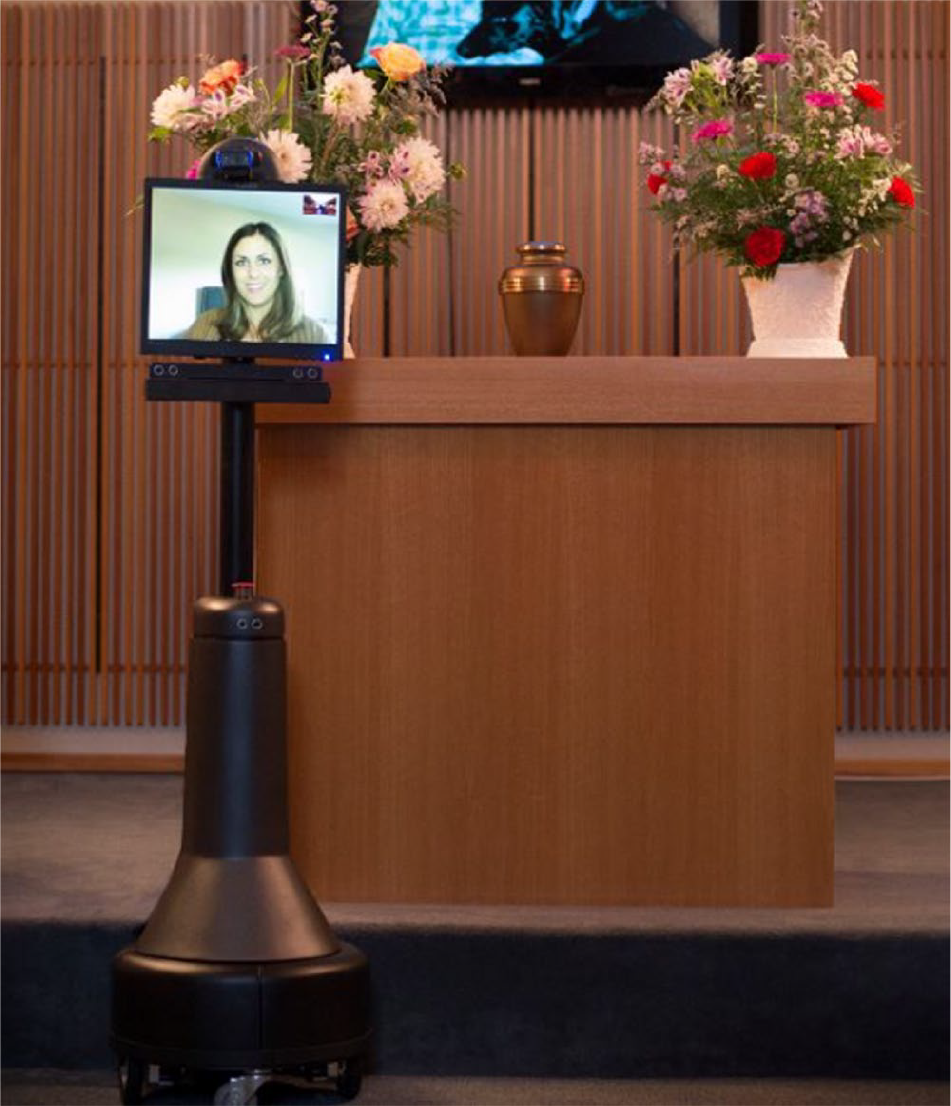
Promotional image of CARL, positioned at a funeral pulpit
CARL, named for Steve’s father, has a high-definition 17-inch LCD monitor equipped with a camera, microphone, and speaker for a ‘head’ that is mounted to a pedestal ‘body’, powered by an electric motor. CARL’s extendable ‘neck’ can be raised or lowered, so as to maintain line of sight with somebody who is sitting or standing. CARL follows in the footsteps of other telepresencing technologies that have been deployed at funerals in recent years to overcome the challenges of distance, expense, and disability. Many large commercial funeral homes now offer video recording or live-streaming of services, with cameras located within the main ceremony hall. The uptake of this service by the industry has been sufficient to make it commonplace, though some conservative companies resist facilitating disembodied presence, interpreting it as a sacrilege against the profound rite of the funeral (Arnold et al., 2018: 113–14).
Although there is a strong social imperative to make the effort to attend a funeral service, the global dispersion of friends and relations can place impractical demands on people’s time and finances. Work and family commitments, military deployment, disability and illness can also limit attendance, especially for funerals that occur at short notice. Some religious traditions hold funerals in the period immediately following a death, making it difficult for many to make the journey. Finally, for the environmentally conscious, travel to funerals adds to the negative environmental impact generated by death events in the form of carbon emissions (Keijzer, 2017). In an age where disembodied screened experience is commonplace, robots like CARL provide a useful means for overcoming the hurdles of cost and distance. Up to six people can log into a single CARL machine and converse with one another as well as guests, as one nominated operator drives CARL around the funeral.
The affordance of telepresence that CARL and other technologies offer is important as an expression of care, because as Tara Bailey and Tony Walter argue (2016) in the white, Christian tradition, the presence of a congregation of those who have known the deceased is one of the most important factors determining the success or moral value of a funeral. Bailey and Walter argue that a well-attended funeral acts as a kind of ‘configurational eulogy’ that symbolically conquers death; it offers an opportunity for people to challenge the annihilation of a person’s identity, producing what they call ‘relationships against death’ (Bailey and Walter, 2016: 149). Where death is understood in the anthropological tradition to be not only an individual crisis but also a challenge to the continuity of the society, Bailey and Walter (2016: 149) suggest that it is this ‘congregation of intimates’ that ‘protect the community from the threat of death’. In her work in Scotland, Glenys Caswell (2011) further affirms that dwelling in the presence of the dead is central to the creation of a meaningful and cathartic funeral experience.
To the extent that CARL facilitates this gathering of funeral participants in the presence of the deceased, it contributes not only to individuals’ experience, but also adds to the communal production of the funeral as an act of care. Unlike video conference calls or static live streams of funeral services, which only capture the formal proceedings, the mobility of CARL enables remote guests to engage in an array of interactive relations and spaces, including informal interactions between guests outside the ceremony proper. These interactions serve a key phatic function of bonding guests into a ‘congregation’ of the bereaved. With its adjustable height and mobility, CARL can deliver eulogies from the pulpit, engage in gossip with a select group of attendees, and sit down to dinner with other guests. ORBIS Robotics President Steve Gray suggests that the unit even allows people to drive it up to the casket and spend time alone with the deceased.
Whether this telepresence is in any way a satisfactory substitute for embodied presence is, of course, debatable. But as our research team has described elsewhere (Arnold et al., 2018) there are examples where CARL has been used to create meaningful encounters for the bereaved. At the 2014 ICCFA event, Andrew Philips, a funeral director at Farnstrom Mortuary related one story of how effective and affective telepresence participation can be: The most meaningful use of CARL that I have experienced was the time it allowed me to offer a grieving sister the opportunity to remotely attend a private viewing for her brother. She had been considering a last-minute 1,500-mile flight in order to spend a few minutes with him, but cost and logistics were prohibitive, and she was facing not being able to say goodbye. Through CARL, we were able to give her the opportunity to attend the viewing remotely and spend some time with him. Her tears, words of love spoken to her brother and gratitude toward our funeral home were evidence enough for me that we were able to give her the tools she needed in order to walk through her loss.
Clearly, in some cases, telepresence robots like CARL provide an experience of ‘being there’ that extends the boundaries of care to convey intimacy at a distance. The efficacy and ubiquitous presence of the screen in the daily lives of so many people – in interactions with friends and family, news of the world and current events, sports and entertainment, education – makes this an unremarkable claim. Given this norm, it is no wonder that studies of a screen presence have found that ‘robots often take on the apparent agency of the remote operator’ such that telepresence robots become ‘invisible-in-use’ (Takayama, 2015: 162). However, the limitations of telepresencing technologies in delivering embodied, expressive communication across distance have also been noted, particularly concerning the visual field, touch, and felicitous conversation (e.g. Tsui et al., 2012). Questions of intimacy and affect are central to scholarship on social and care robotics, the capacity of robots to connect meaningfully (or not) with humans, and experiences of the uncanny (e.g. Arnold and Scheutz, 2017; Stevens, 2011). Given the moral stakes of a funeral, the cost of robotics failing to adequately mediate emotional connections is great, and there has been negative reaction to the deployment of CARL within the death space. For example, shortly after CARL was released, one opinion piece rallied against ‘webcast funerals’ (Leadbetter, 2011), arguing that: The comfort and intimacy of a human touch, especially in times of suffering and grief, is essential. . .. It seems to me that virtual reality is taking over reality itself. A warm encounter cannot be felt through a 12-inch screen in cyberspace.
Other instances of robotic telepresence in the context of death and dying have also courted controversy. Early in 2019, the international press widely reported on the case of Ernest Quintana, who during a stay at Kaiser Permanente Medical Centre, Fremont, California, was reportedly informed via a telepresencing robot that his lung disease was terminal and that he would die within a few days. The incident was critiqued by Quintana’s family as cold and uncaring, although the Chief of Palliative Medicine at the University of California was quick to defend the use of robots in this arena, noting that many video meetings are warm and welcomed, while in-person discussions can lack empathy (The Guardian, 2019). According to reporting, the hospital in question also stressed that the incident was a ‘follow-up’ visit, not an initial delivery of the diagnosis, for which a human doctor would always be deployed. Hospital policy is to always have a healthcare professional in the room at the time of remote consultations, a policy which suggests the organisation’s own distrust in the capacity of telepresence robots to act as interface. For members of the funeral industry, who regularly contend with accusations of profiteering in the face of personal tragedy (e.g. Mitford, 1963), cultivating a caring persona is vital to softening their public image and part of how workers understand their role (Bailey, 2010).
The clumsy deployment of technologies, whether they be robotic or digital, can threaten the reputation for care that is important to funeral professionals (Nansen et al., 2017). In this medical case, Catherine Quintana, the patient’s daughter, told The Guardian (2019) that: If you’re coming to tell us normal news, that’s fine, but if you’re coming to tell us there’s no lung left and we want to put you on a morphine drip until you die, it should be done by a human being and not a machine
The daughter’s critique goes beyond denouncing the capabilities of a telepresence robot to adequately convey affect, to question the deployment of ‘machines’ in the context of death care as a dehumanising move. From motorised excavators to automated cremation retorts, industrialised instruments of modern death rites are pervasive, and arguably necessary for the efficient disposal of the dead on the mass scale demanded by the contemporary city.
In contrast, the equation of care with human-to-human interaction and human labour runs throughout critiques of the commercial funeral industry. Advocates of natural death and home funerals call for a return to pre-modern traditions of death care and the labours it encompasses, including community members hand-digging graves and washing and dressing the dead. In his study of North American natural death advocates, Philip Olson (2018: 204) describes the emphasis that practitioners place on ‘the personal, intimate skill of practiced hands rather than skill with instruments’. Within this community, skin-to-skin contact is held up as a route to a ‘deeper and more fulfilling form of grief’ and a compassionate means to usher the dying towards death (Olson, 2018: 204). Some interventions, such as embalming, are eschewed, however not all technologies are dismissed, with low-fi methods such as dry ice, refrigeration plates, and absorbent sheeting often employed to preserve and present the body. Notably, the natural death care movement follows in the footsteps on the home-birth movement of the 1970s, and forwards a feminist argument that the professionalisation and medicalisation of death has devalued women’s knowledge and labours. By extension, then, industrialised mortuary instruments stand as potent symbols of patriarchal take-over of death care. As Rosemary McKechnie and Tamara Kohn (1999: 7–8) note, the value awarded to caring labours, and those empowered to make these valuations, can marginalise or even romanticise certain populations as caring agents, just as new technologies can force us to rethink the ‘boundaries’ of this caring population. Where hand-labour and toil around death is valorised, the affordance of convenience offered by robots like CARL can be unappealing. As extreme examples of high tech, robots like CARL thus prompt us to rethink how values of care and convenience might intersect or diverge within the funeral experience.
Pepper: eulogy, culture, and the performativity of robots
At the 2017 Life Ending Industry Expo (henceforth ‘ENDEX’) in Tokyo, the premier event for Japan’s funeral industry, one of the country’s most advanced semi-humanoid robots, Pepper, was presented to the world in a new role: Buddhist priest. Dressed in formal silk robes with a mallet strapped to each arm, Pepper (Figure 2) performed excerpts from the Heart Sutra in a strange artificial voice, as it struck a wooden glockenspiel and bell in time with the chant. In Japan, the recitation of sutras is a central element of funerals and memorial services, which are performed at regular intervals after a death, to comfort the dead and facilitate their maturation into ancestors (Suzuki, 2013). Pepper was manufactured by Softbank Robotics but brought to ENDEX by Nissei Eco, a large research and development conglomerate. Pepper’s performance occurred multiple times a day during the trade fair and consistently drew large crowds of professionals, the public, and media.
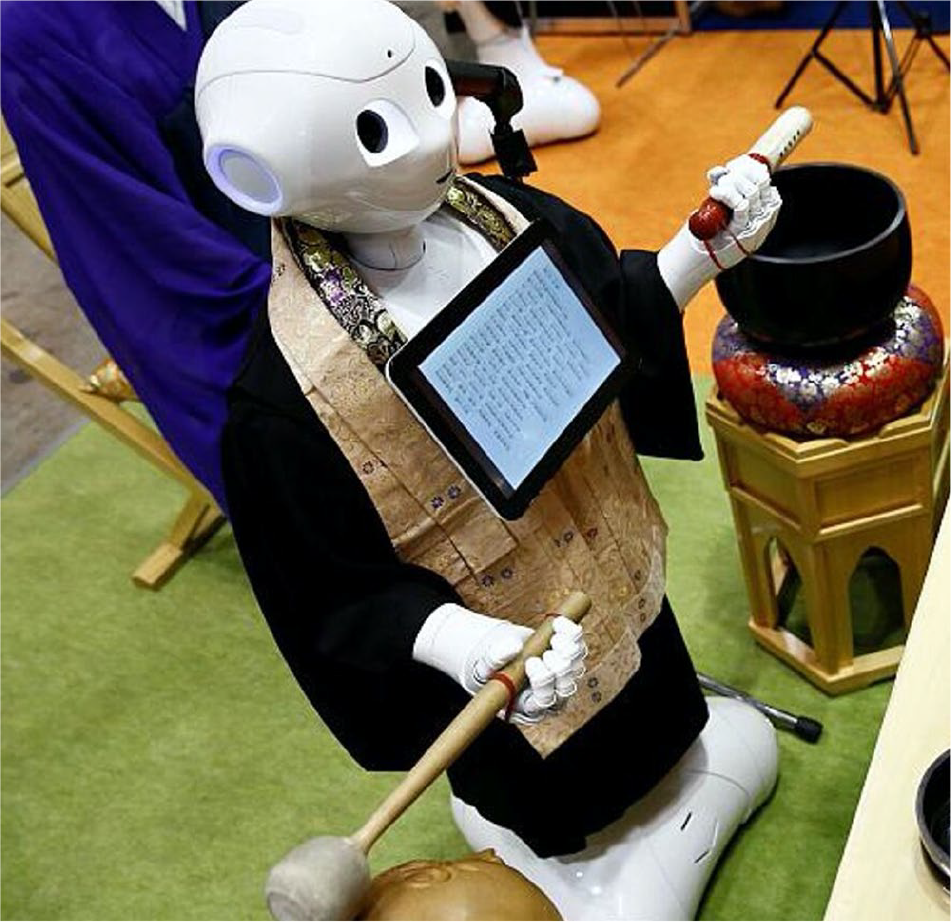
Pepper performs portions of the memorial service at ENDEX, 2017
Performing rituals as a Buddhist priest is a novel application of Pepper’s substantial capabilities. Pepper stands at approximately 1.2 metres, weights 28 kilograms, and has a head equipped with four microphones, two HD cameras, and a 3D depth sensor. Pepper is especially known for its advanced ability to read human emotions by detecting vocal tones and facial expressions. After its public release in 2015, it has primarily been deployed in domestic settings as a companion robot, at train stations to direct visitors, and in Softbank’s mobile phone stores as a concierge. Robotic entanglements with death have progressed in some locations more than others, and in Japan, one of the world’s most roboticised countries (Robertson, 2018a), many sites of caring for the dying and dead are now populated by mechanised systems. Mechanised retrieval systems are used to manage the storage and display of tens of thousands of cremated remains at high-rise facilities known as automatic conveyor-belt columbaria (Uriu et al., 2018). Robots are also deployed for elder care, where they perform both physical labour (such as moving patients) and inter-personal tasks, such as talking to residents (Robertson, 2018a: 60).
In their analysis of funeral services in the UK, Bailey and Walter (2016) propose that alongside the presence of intimates, the delivery of a powerful eulogy, what they term ‘words against death’, is central to a satisfying funeral experience. Whereas an impersonal eulogy performed by an industry professional may feel disturbingly inauthentic, stilted, informal, or stumbling speeches delivered by intimates of the deceased are largely read as ‘authentic expressions of grief’ (Bailey and Walter, 2016: 149). Analysed in these terms, the capacity of robots like Pepper to perform a good funeral and hence contribute to the community’s experience of a ‘good death’ appears doubtful. During the ENDEX demonstration, a human priest was positioned next to Pepper to observe the performance. He later commented to media that he was there to check whether Pepper could ‘impart the “heart” aspect, despite being a machine, because I believe that the “heart” is the foundation of religion’ (in Gibbs, 2017). In response to the lead author’s follow-up questions, he affirmed that Pepper did, in fact, pass this bar, although he was otherwise taciturn regarding his feelings on robotics. At ENDEX one year later, members of our research team met the same priest, this time spruiking a home speaker device that connects users to priests for live counselling services. The presence of the human priest in both cases suggests that the company was aware of the potential discomfort created by the entry of robots into the funeral space and was willing to use a human priest as both guarantor and dramatic prop to smooth the waters.
The majority of contemporary Japanese funerals are markedly different to British, Christian funerals in both structure and purpose, and so too are the conditions for felicitous performance. As we have argued elsewhere (Gould et al., 2019) greater cultural particularity and a de-centring of Western cultural norms in the study of high-tech death is long overdue. Selma Šabanović powerfully makes this argument in her study of the invention of Japan’s ‘robot culture’, which she uses to argue for a ‘culturally situated understanding of technology and a multicultural view of science’, while also rejecting cultural essentialism (Šabanović, 2014: 342). Her ethnographically situated work shows how Japanese scientists contend with the ‘dominant culture-neutral language of science’ to make robots make sense within particular cultural lineages (2014: 359). The socio-religious context of Japan helps explain why robot-led funerals make sense, at least to some. Despite the American funeral industry’s comedic, mock warning that funeral directors might be one day ‘replaced by machines’ in response to the Pepper story (Connecting Directors, 2017), this is not the role Buddhists priests – human or robot – play within a Japanese funeral. The majority of Japanese funerals centre on the recitation of Buddhist sutras and the offering incense. Very little time is given to personal eulogies outside of non-religious or ‘music funerals’, which remain a minority (Suzuki, 2013: 11–12). Instead, funerals are largely organised by funeral directors, who hire Buddhist priests as ritual specialists to perform a short sutra recitation. The delivery of an authentic euology, as Bailey and Walter (2016) suggest, is thus not an appropriate measure of a satisfying funeral experience in Japan. After 18 months of fieldwork in the Japanese deathcare industry, the first-named author found that instead, a ‘short-and-sweet’ but dramatic sutra performance (with variations in tone, energetic enunciation, and exaggerated body movements) is most frequently cited by laypersons as determining the quality of funerals.
In Japan, necrosociality is founded on the performance of physical, material acts of care for the dead. Beyond the initial funeral, the regular performance of memorial services at increasingly distant intervals from a death (49 days, 1 year, 3 years, etc.) enable the living to care for the dead, maturing these spirits into ancestors, who, in turn, protect and care for the living. Between these formal services, the dead also receive regular offerings of incense, fruit, and flowers from the living. Notably, scholars have long remarked on the orthopraxic nature of Japanese religious practice, whereby the performance of certain actions is often more highly valued than internal states of the belief. As Japanese religion scholars Ian Reader and George Tanabe argue ‘human understanding of the teachings is not necessary to produce an efficacious result’ (1998: 127). Beyond the funeral service, Japanese Buddhism has a long history of mechanising or automating ritual performance, in ways that are often perceived to increase, not diminish, its spiritual efficacy (Rambelli, 2018: 58). From block-printed sutras, to rotating sutra storage units, and automatic-turning prayer wheels, new technologies have successively been put to use to materialise teachings, cultivate mindfulness, and spread Buddhism. For example, in 2019, an ‘Android Kannon’ named Minda, with an anthropomorphic face and mechanised body was developed to deliver Buddhist teachings at Kodaji Temple, in collaboration with Ishiguro Hiroshi, Professor of Intelligent Robotics, Osaka University. Placed within this history, Pepper appears the latest innovation in a long line of mechanised religious practice.
Japanese families rely on religious and funeral professionals to care for the dead, and the use of robots within funerals can be interpreted as an extension of this care by proxy, one that additionally addresses growing deficiencies in the social structure that has historically been relied upon to secure a ‘good death’. Japan’s ageing population and declining birth rate mean that there are fewer living people to care for the growing numbers of dead, and more childless couples who cannot rely on future descendants to peform rites of ancestor veneration. Nissei Esso explicitly presented Pepper to gathered press as filling a deficit in the number of Buddhist priests available to perform funerals. This, they argued, is a particular challenge for an increasingly isolated and ageing rural population. In her recent work, anthropologist Jennifer Robertson diagnoses the deployment of robots to fill demographic gaps as part of a ‘techno-utopian solution to problems facing Japanese society today’ (2018a: 160). She argues that rather than purusue migration policies to replenish a diminished labour force, the post-war Japanese state has pursued technological innovation and automation, in ways that suggest that robots can become not only efficacious religious actors, but also efficacious Japanese subjects, even if they are not viewed as ‘human’ (Robertson, 2018a: 159).
Despite the company’s promotional materials, however, the Pepper/priest service has significant drawbacks. The proposed fee for hiring out Pepper for a service, ¥50,000 overnight, is far greater than that for a human priest (particularly in contrast to new budget offerings such as the Amazon ‘rent-a-monk’ service). Pepper is also cumbersome and thus difficult to transport, is prone to overheating, and difficult to operate without specialised training and human attendants. The robot has limited capacity to modulate its vocal tone when chanting, or to grasp objects, and so the implements for striking the bell in time with the sutra must be lashed to its arms. Pepper is thus unable to perform the significant physical labours of other caring robots deployed in Japan. Interestingly, these shortcomings are financial and technical, not shortcomings that are inherent in Pepper as a non-human, and Pepper was received in a charged atmosphere of intrigue at the Tokyo funeral industry conference.
This atmosphere is important, because efficacy in delivering a good death was not necessarily the primary function of the Pepper/priest at ENDEX. Robots are still valuable sources of novelty and intrigue, even when they fail in their primary mission or cause offence. Although the number of potential customers has expanded, thanks to an ageing popular and rising death rates, in recent years that Japanese funeral industry has faced a series of existential challenges, from secularisation to pressures on urban space for columbaria and economic downturn. Expos are heavily publicised events that bring together professionals from across the country for self-promotion and networking, as well as potential disruption and innovation. Yuji Sone’s (2017: 22) dramaturgical account of Japanese robotics presents industry conventions as ‘spectacularised robot events’, in which robots emerge as ‘emblems of futurity’ for an awaiting audience. It might be, as David Noble argues (1997), that the doctrine of technological progress derives its strength from its future-orientated character, which directs attention away from the weaknesses of the present moment. The novelty of the Pepper priest presentation attracted significant floor traffic to Nissei Eco’s booth, and to its other, less outlandish, services, including software for live-streaming memorial services and an e-commerce portal for funeral homes. Through Pepper, the future of a good death and profitable funeral industry in Japan appears rosy, even as its present or near-future adoption appears uncertain.
AIBO and Boomer: robots as subjects of death care
The entwinement of robots in human deaths raises the question about what duty of care humans owe to robots at the end of their lives. In May 2018, Kōfukuji, a 450-year-old Buddhist temple located in Chiba Prefecture, Japan, held a memorial service for over one hundred companion robots, known as AIBO (short for ‘Artifical Intelligence Robot’ and a homonym for the Japanese ‘pal’). AIBO is a companion robot, often taking the appearance of a dog, that was designed and manufactured by Sony between 1999 and 2006. Before AIBO was re-released in 2018, it sold over 150,000 units (Burch, 2018). The latest iterations of AIBO are promoted for their ‘lifelike expressions’ and ‘dynamic array of movement’, as well as an ability to learn from their environment and develop relationships with human others via a progressive revelation of their personality (see aibo.com). Despite gaining a cult following after its initial release in the early 2000s, AIBO never became commercially viable. As Jennifer Robertson explains (2018b), the eventual ‘death’ of AIBO appeared imminent from 2014, when Sony stopped producing replacement parts for the early models, and many AIBO fell into disrepair. Despite attempts by fans to crowdsource parts from ‘donor’ dogs, the remaining robots became less and less functional. As the final nail in the coffin, in 2014, Sony announced that early generation AIBO would not receive the latest software updates.
At the May 2018 funeral service, rows of AIBO were arranged before the main altar of the temple. Members of Sony and associated companies attended the funeral, taking up the roles of chief mourners and family members. The ceremony progressed along the lines of Buddhist memorial service – similar to that performed by Pepper – with acts of ritual cleansing, the recitation of sutras, and offerings of incense. Indeed, at the Kōfukuji ceremony, the head priest deployed another, later-generation robot made by Sony to participate in the ceremony and chant sutras for its deceased robotic kin. Where robots are performing funeral rites for other robots, a human monopoly on the funeral service must surely be brought into question, and where ritual care is performative rather than emotive, a human monopoly on care is brought into question. The 2018 event was not the first service for robots that this temple had performed and, once again, an understanding of the specific position of robots within the Japanese context is required to make sense of this case.
Japan has a long history of Buddhist memorial rites, known as kuyō, being performed for inanimate objects that are decayed, disused, or otherwise ‘dead’ (Kretschmer, 2000). Historically, the list of entities deemed to require such veneration has fluctuated, but has included objects that have acquired significance through intense use and intimate human contact, such as professional tools (needles, scissors, eyeglasses), or quasi-humanoid objects, like dolls and certain animals (whales, laboratory monkeys). Robertson (2018b) reports that Banshō-ji, a Buddhist temple founded in the mid-16th century, staged the first ‘computer kuyō’ (also described as a memorial service for an electric brain) in May 2002. More recently, individual temples have performed memorial services for Tamagotchi 2 and iPhones. As with the recent AIBO service, these rites are often sponsored by the manufacturing companies and become public relations opportunities and visible forms of public patronage of the local temple and community. Indeed, during a great period of economic growth in the 1980s, Japan experienced a ‘kuyō boom’ (Kretschmer, 2000), with commercial organisations sponsoring rites as karmic repayment for their recent good fortune. As with the Pepper exhibition, members of the press, local and international, were invited to attend the AIBO funeral, and images of the Sony staff members with their heads bowed and hand folded in prayer before rows of robot dogs have been used in AIBO’s promotional materials since. Most kuyō services for spent objects end with the physical destruction of the bodies, largely via cremation but sometimes also through submersion in a body of water. However, being made from plastic and metal, AIBO could not be disposed of in this manner, and were instead carted away by the company after the service to some unknown end.
In Japan, where the boundaries between humans and objects are often breached, it appears that humans owe our robotic companions quite a lot. Within Japanese religious studies, there is energetic debate regarding people’s motivation for performing kuyō rites for non-human entities. Perhaps most pertinent to the case of Pepper is the thought of pioneering Japanese roboticist, Masahiro Mori, who in his 1981 manuscript, The Buddha in the Robot, declared that ‘robots have the buddha-nature within them’ (1981: 1). In Mori’s Buddhism, both the human condition of suffering and the capacity to overcome this condition and achieve enlightenment are shared by human and robot alike. Robot life is thus grievable and demands a ritual response. More ethnographic studies of kuyō rites in Japan have proposed a relational framework, whereby people’s performance of funerals for objects is motivated by feelings of kinship and concern, in particular, concern toward objects that have ‘looked after’ the human during their lifetime (Gould, 2019). In the case of companion robots like AIBO, intimate links emerge as the robot adapts to its environment, the humans train the robot, and in turn, the robot trains the humans.
A tradition of funerals for inanimate objects is a distinctive part of Japanese culture, however, speaking mor eglobally, the sense of kinship that can develop between robots and humans, in life and in death, is not unique to Japan. Attention to the cultural specificities of thano-technology is required, but at the same time, reporting which examines robot funerals as exemplary of ‘whacky’ or ‘bizarre’ Japanese culture is essentialising and exoticising. American soldiers stationed in Iraq in 2013 were, for example, reported having held an elaborate funeral, including a 21-gun salute, for their fallen comrade, Boomer, who was a MARCbot, a low-cost robot designed to seek out and disarm explosives (Garber, 2013). The MARCbot looks like a small toy truck, with a video camera mounted on an elevated mast that can be remotely manoeuvred to fit underneath cars and check for explosives. Boomer has none of the humanoid or animal-like features of Pepper or AIBO, but Boomer ‘took one for the team’, by saving a soldier and dying in the process.
Similarly, in 2011, a team of scientists at NASA held a funeral for the Mars rover Spirit, which was active collecting geological data on Mars between 2004 and 2010 (20 times the original lifespan planned by scientists) (Vertesi, 2015). Janet Vertesi (2015: 18) reports that rather than being a large press event, attendance at the funeral was limited to those with a deep personal connection with the robot during its service. The death of Spirit in 2011, and later, its twin system Opportunity in 2019, was announced via the NASA official Twitter account for the rovers, with a ‘Rest in Peace’ message, which included a ‘selfie’ taken by the rover and a message with hashtag ‘#ThanksOppy’ (Figure 3). The message was followed up with a full in memoriam video produced by NASA. The original message prompted a flood of responses from scientists and social media users, including GIFs of military salutes and people weeping. For Judith Butler (2009: 14–15), grievability is ‘a presupposition for the life that matters’. It is premised on the realisation of the precarity of life itself, of social life as an interdependence between human and non-human agents. Although it does not reach the level of formality of religious funeral ceremonies, the popular reaction to Oppy suggests that it is possible for robotic life to be both grievable and grieved, even when it is (exceedingly) remotely located and refracted through layers of mediation. The affordances of the robotic device, the nature and intensity of the engagement with human others, and the broader cultural context all shape the feelings and practices in which this grief is expressed. However, by grieving for robots we jettison human exceptionalism and accept these companions in mortality, that are subject to the same rules of engagement with life and death.
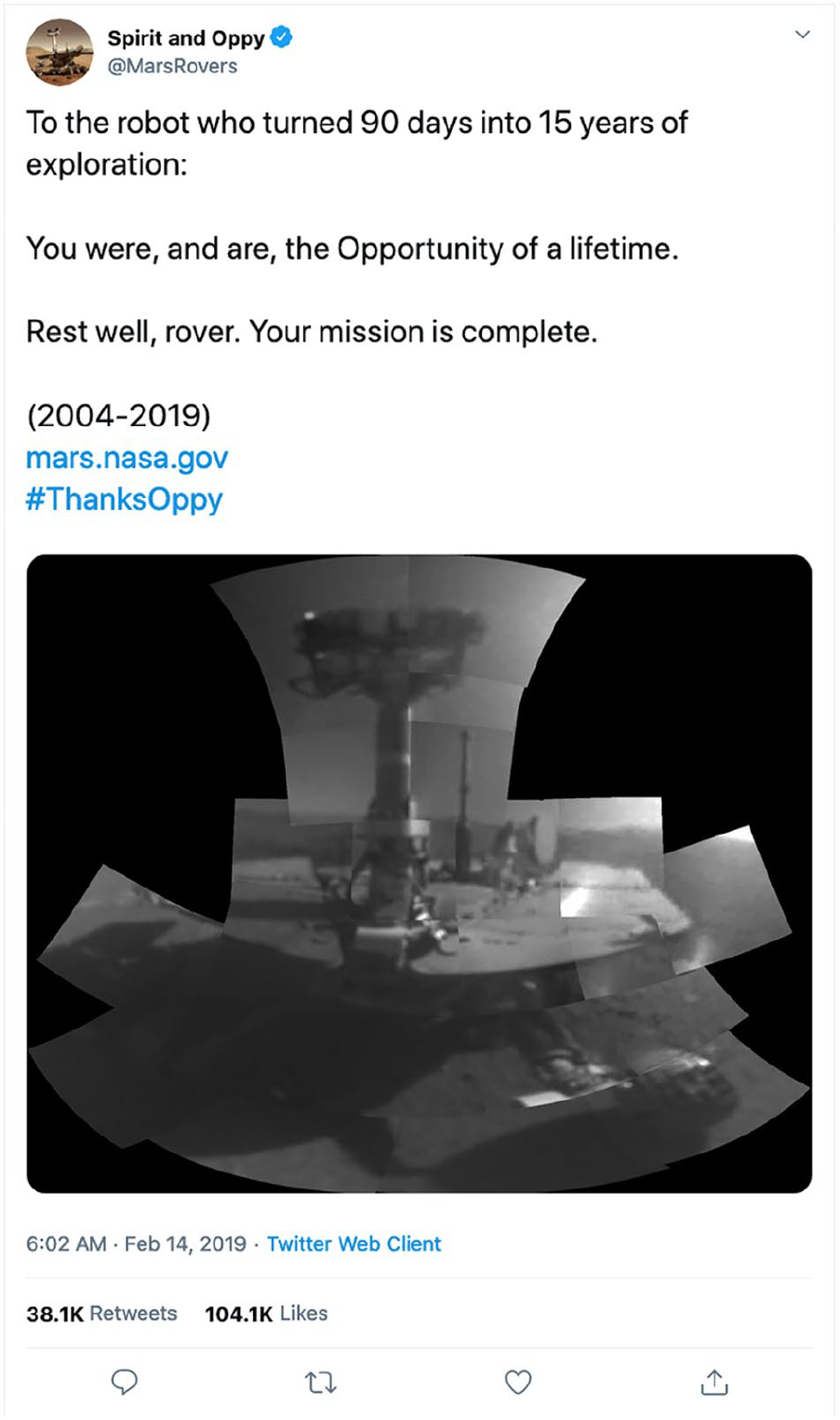
The original #ThanksOppy tweet announcing the death of the Opportunity rover (captured December 2019)
Robots and the ethics of deathcare
As robots are designed and appropriated to occupy public roles within the funeral rite, as attendees, religious specialists or celebrants, and as the dead themselves, questions are raised about the moral and ontological status of these non-humans in what is presumed to be a very human context. Perhaps more than any other activity for which robots are put to use, death and its ritualisation are a space in which the personhood status of robots, along with their ability to sustain authentic moral and social relations, are tested. We argue that robots are capable of playing a role in relations of care with human subjects in the significant context of the funeral. CARL achieves this to the extent that it has use-value and provides utility for humans in our experience of the funeral, and in our expression of care for the dead. Pepper the Buddhist priest achieves this to the extent that its performance of the religious rite is accepted as authentic and efficacious. In each case humans remain central; it is notable that these are remotely controlled not autonomous devices. That being said, through utility in the case of CARL and performance in the case of Pepper, the robots are contributing to human care for our dead. The third case, of robots as subjects of care, is a much more radical move that challenges humans self-proclaimed exceptional position. This exceptional position has been challanged before, by Copernicus, Darwin, and Freud, and now by machines (Mazlish, 1993). As subjects and objects of care, machines are positioned not as beings with use-value, but as beings with inherent-value, warranting a duty of care. At the funerals of the near-future, we find that it is not only we humans that care and are cared for, it is also non-humans.
Footnotes
Funding
The author(s) disclosed receipt of the following financial support for the research, authorship, and/or publication of this article: The authors receive funding from the Australian Research Council’s Discovery Projects Scheme (GA2257) and the Linkage Funding Scheme (LP180100757) with the Greater Metropolitan Cemetery Trust as Linkage Partner.