




Abstract
Our article explores how diasporic journeys and identities are remembered and represented through the visual narratives of DiasporaTürk, a Turkish diasporic media presence consisting of a Twitter account, an Instagram page, and two books. These engagements revive past (dis)affects and highlight the contemporary relevance of nostalgia, sorrow and victimization as key themes in the migration experience of ‘guest-workers’ from Turkey. The evidentiary force of the index, inhabiting fictional characters while looking like factual and archival material, seems thus to both acknowledge and validate migrated ‘guest-workers’, who, as subaltern groups, have otherwise received little praise or recognition in Turkey or ‘host’ countries. At the same time, while converging past and present (dis)affects associated with Turkish migration, DiasporaTürk contributes to reaffirming the reduction and homogenization of official/normative collective memories of migration via concrete visibilities/presences and invisibilities/absences.
Media practices have historically shaped the imagining of forgotten past and possible futures. Old letters in shoeboxes, fading black-and-white images of distant histories, and long-distance telephone calls with crackly connections have given way to new media platforms and affordances, which now constitute the transformed epistolary base and the communication infrastructure of the migrant experience (Hedge, 2016: 3).
The focus of this article is to inquire into the role of photographs and accompanying narratives of be(longing) and migration. Under the auspices of Gökhan Duman, 1 diaspora, politics, and (dis)affect are entangled in and through the visual narratives of DiasporaTürk, a ‘polymediation’ (Tyma et al., 2015) primarily manifested through social media, exhibitions, books and book-signing events. Novel media and their affordances (Fajen et al., 2008: 1) are used to disseminate old photographs alongside contemporary annotations, and other traditional media – books and exhibitions. The ‘roots’ more than the ‘routes’ of the diasporic journeys of ‘guest-workers’ (Clifford, 1997; Georgiou and Silverstone, 2006: 34) are framed by (dis)affects with political implications.
The photographs featured by DiasporaTürk are mostly old black-and-white photographs portraying work and home scenes that demonstrate sad stories of ‘guest-workers’, mostly those who left Turkey for Germany and other European countries beginning in 1961. Photographs have been part of the communication infrastructure of migrants. DiasporaTürk capitalizes upon, and arguably reclaims, the extraordinary kind of photograph related to ‘guest-worker’ migration, while contextualizing it within a common past. The plethora of voices throughout the project – invited commentators, engaged prosumers 2 and Gökhan Duman himself – attempts to create a sense of community, while the indexical nature of the photographs provides ‘undeniable’ evidence of a common past. The dissemination of photographs by DiasporaTürk provides a point of contact (Barthes, 1980; Villi, 2014) between the departed and those who remain, as well as between the past and present. This allows for experiences and memories to be shared. The photographs thus precipitate a mode of action whereby actors engage with each other and mobilize tact and (dis)affect. 3 Together with the evidentiary force of the index, an emotional trace, or a (dis)affective dimension (Edwards, 2009, 2012), prompts users/prosumers 4 to treat photographs ‘as if they were alive’ (Lehmuskallio, 2012: 164). The dissemination of photographs via social media allows for experiences of emplaced migration to be extended in time and space (Rose, 2003). ‘Third places’ 5 of (dis)affect thus emerge, providing a suitable environment for individuals to socialize in spontaneous, congenial and playful engagements (Lobinger and Schreiber, 2017) by mirroring co-presence in everyday environments. Socialization encompasses both interpersonal interaction and interactivity with physical and symbolic objects. Expressions of (dis)affect form places where collective identity is constructed through belonging as something that matters.
DiasporaTürk could be considered as a growing collection of networked images (Gómez-Cruz, 2013), which transforms indexicality into an affordance activated through practice (Rose, 2010: 29), such as comments, likes and re-tweets. Value and meaning are ascribed to the images temporarily and contextually. Photographs become a form of (dis)affective currency (Ahmed, 2004). The personal experiences evoked by the social media posts, books and exhibitions of DiasporaTürk, may awake both affection and disaffection in users. One could even talk about DiasporaTürk being a platform of (dis)affect. The strong element of remediation (Grusin and Bolter, 2000) in DiasporaTürk allows for affections and disaffections to be attached to the images in the present and future (Hirsch, 2008), and it responds to the need for continuously calling (dis)affective relationships into question (Gabb, 2008: 16–17, 64–5; Jamieson, 1998). The emotional challenge posed by migration – permanent and temporary absence – is partially mitigated through the sharing of images in DiasporaTürk. These engagements revive past (dis)affects and highlight the contemporary relevance of nostalgia, sorrow and victimization as key themes in the migration experience of ‘guest-workers’ from Turkey. The evidentiary force of the index thus both acknowledges and validates migrated ‘guest-workers’, who, as subaltern groups, have otherwise received little praise or recognition in Turkey or their ‘host’ countries. Vernacular language has shown their particular experiences, especially via the terms 6 ‘gurbet’ and ‘Alamancı’ or ‘Almancı’.
Methodologically, the article employs a texto-visual analysis of the DiasporaTürk books Göçüp Kalanlar (Duman, 2016) and 11. Peron (Duman, 2018), as well as the DiasporaTürk Twitter and Instagram accounts. Acknowledging 7 the limitations of semiotics in considering photographs as the result of complex practices and power relationships (Gómez-Cruz and Thornham, 2015; Rose, 2010: 11–18), the visual analysis undertaken prioritizes the contextual conditions of the dissemination and reception of photographs in DiasporaTürk. As a ‘socio-technical practice’ (Gómez-Cruz, 2013: 10–11), photography in DiasporaTürk works as an intensity modulator/regulator. It has the power to mobilize (dis)affect, leave deep traces and store the past in individual and collective memories (Sontag, 2003, 2004). The disseminated photographs allow for the memorialization of ‘guest-worker’ experiences and for them to be presently inhabited and incorporated into the ‘Funktiongedächtnis’ (cultural memory) (Assmann, 2001, 2008) of contemporary Turkey. DiasporaTürk enables remembrance and representation of a collective, diasporic past – but it is necessary to ask whose past is remembered and represented.
This article investigates the potential of shared images to visualize emotional experiences of migration and mobilization from ‘roots’ to ‘routes’, reducing distance and facilitating traffic around the world (Clifford, 1997), from sedentary to nomadic (Morley, 2017). For Morley (2017: 61–2), both sedentarist and nomadic views are problematic; while sedentarist logic praises authentic and rooted culture and negates others as socially unfunctional, threatening or pathological, the nomadic approach romanticizes the cosmopolitan character of the movement without seeing the continuities of the old elements and inequalities. After reviewing the literature on transnational mobilities using transnational media, such as the work of Aksoy and Robins (2000) on migrant communities living in London, UK, Morley invites us to be cautious of announcing a ‘mobile lifestyle’ opposed to sedentarism. He proposes empirical investigation rather than abstract speculations (Morley, 2017: 139). Our analysis explores how the diasporic journey and identities are represented in the photographs in DiasporaTürk. The analysis, explorations and reflections are necessarily of an interdisciplinary nature as they pertain to migration, digital media, photography and politics. As such, they contribute to current debates on the ontology of photography – memory vs. connectedness – as well as to acutely relevant discussions of emotions and politics.
Migration and photo-sharing
By building on Madianou’s (2011) concept of polymedia 8 and addressing research gaps in Information Communication Technologies (ICT), and migration and media practices (Oiarzabal and Reips, 2012) scholarship, recent studies have highlighted the impact of ubiquitous and pervasive technologies (software and hardware) for migrants (Leurs and Prabhakar, 2018). The technologies for migrants and the media practices consequently developed fulfil three different goals: monitoring and surveillance (top-down or self-imposed) (Budarick, 2015); mediation of presence (Cabalquinto, 2018; Prieto Blanco, 2016); and transfer of resources (Aker, 2018; Batista and Narciso, 2013). Although migrants have long created and kept visual records of their life experiences (Alpagu, 2019), and some have also been collected by institutional repositories such as archives, the scale and frequency of visual production and dissemination of images of/about migration is relatively new. Media practices associated with the production and dissemination of photographs and videos among migrant communities respond to a very specific logic, namely the desire to breach time and space in an almost immediate manner, enabled and ingrained in the culture of prosumerism. The private character of these visual practices among migrants allows for connectivity to be stressed, and for social relationships and bonds to be confirmed. Photo-sharing creates a space for proximity and visual intimacy among participants (Lobinger, 2015; Prieto Blanco, 2016; Villi, 2015). In summary, we argue that media practices associated with the production and dissemination of images among migrant communities allow for (a) (inter)action and shared experiences to take place in spite of long distances and being apart, and (b) collapsing time via intimately emplaced and collective remembering. At the same time, contemporary public visual representations of migration, whether in newspapers or archives, respond to socio-cultural notions of the Other (Said, 1978), as well as to place-specific politics of remembrance/memory (Vogel et al., 2006). The use of the photographic medium also grants these images an evidential status (Vogel et al., 2006: 59).
In her study of Turkish guest-worker migration in Austria, Alpagu (2015, 2019) uses photographs to emphasize migration as ongoing and everlasting. Her systematic and detailed weaving of biography and visual analysis effectively elicits latent meanings and presents migration as a complex phenomenon. Alpagu’s work examines historical and contemporary discourses of migration via the case study of guest-workers in Austria. She defines guest-workers as a distinctly visible collective with salient qualities, originating in the context of the recruitment agreements of the 1960s and the Turkish military coup of 1980 (2019: 47–8). Besides Germany and Austria, France and the Netherlands have become destinations for many migrant workers from Turkey. ‘Turkey is among the top 10 emigration countries in the world with more than 5 million citizens living abroad and almost 4 million concentrated in Western European countries, constituting 5–7% of the homeland population’ (Mencutek and Başer, 2018: 87). Alpagu approaches the subject matter empirically from a visual and biographical tradition, emphasizing the latent and ever-evolving meanings of migration to overcome reductions and generalizations (2019: 49–50). She argues that contemporary discourses in receiving countries, such as Austria, blame guest-workers for their inability to integrate, while integration was not an issue before (Alpagu, 2019: 71). As argued later in this article, circulation of visual narratives of past migration in projects such as DiasporaTürk responds to this discursive development by commodifying the visibility and collective appeal of guest-workers. Photographs are employed as idealized traces of past everyday life, and, in their display and circulation, enable present recognition of guest-workers in the Turkish imaginary/ national identity.
Whose memories, whose past?
DiasporaTürk as a whole project including the books and social media, portrays mostly male workers, while women are less represented and mainly in relation to their hetero-patriarchial roles in the family, as wives or mothers. LGBT (lesbian, gay, bisexual, transgender) communities and identities remain invisible. Religious Sunni Muslims are featured in the context of narratives about mosques, Ramadan and prayer, while the Muslim Alevi community remains invisible (their prayers at Cemevi and their festivals are never mentioned). The ethnic groups represented are Turkish, while the Kurds are not mentioned. Indeed, Janroj Yılmaz Keleş (2015), in highlighting the diversity of the Turkish diaspora, rightly challenges the conflation of Kurds with Turks and requests ‘the dissolution of the “homogeneous” Turkish nation’ (Keleş, 2015: 4). This homogeneity also refers to motifs of migration, as the label of ‘guest-workers’ renders political migration invisible. The military coups of the 1980s and later oppressive periods forced many into exile. Starting in the 1960s, these diasporic journeys have recently been on the increase as a result of President Recep Tayyip Erdoğan’s authoritarianism in Turkey. Migrants of this new phase are very heterogeneouss seen in their digital space: Kurds, leftists, civic rights defenders, peace advocates, academics, journalists and even those not so politically engaged but wanting to raise their children in a relatively safe, stable and secular country (Gencel Bek, 2020).
Traces of invisibility can be found throughout DiasporaTürk. They are evident on the cover of Göçüp Kalanlar (that is, Migrated and Remained, our translation). Although the wives and wives-to-be of male ‘guest-workers’ joined them in diaspora, 9 or came independently, their stories, herstories, remain in the privacy of the domestic space. A content analysis of the photographs included in Göçüp Kalanlar revealed that women were mostly photographed at home and in family settings with men and children, or just the latter. Remarkably, of the 61 photographs featured in Göçüp Kalanlar, only four depicted women (two of these at home doing housework). The representation of Turkish, Sunni Muslim men rather than others (women, LGBT+, Alevi, Kurdish) is consistent with the hegemonic power of the conservative, Islamist, populist and increasingly authoritarian Adalet ve Kalkınma Partisi (AKP, Justice and Development Party) which has been the ruling party in Turkey since 2002. Against this backdrop, it becomes clear that ‘Turkishness’ is an ever-evolving and contested term, which DiasporaTürk seeks to represent in concrete ways.
Visual polymediation of Turkish ‘guest-worker’ migration
Diaspora, politics and dis(affect) in DiasporaTürk are traced in the books Göçüp Kalanlar (Duman, 2016) and 11. Peron (Duman, 2018). 11. Peron (2018) refers to platform 11 at Munich train station, which signifies the end or arrival of the majority of the migration of journeys of ‘guest-workers’, journeys which started from Istanbul Sirkeci station and lasted three days in the 1960s. Polymediation (Tyma et al., 2015) is enabled through a Twitter account, Instagram page and several exhibitions 10 and book-signing events. Readers are invited to participate on platforms with their photographs and stories as migrants, as well as liking and sharing as social media users.
Göçüp Kalanlar and 11. Peron
The cover page of the book Göçüp Kalanlar features a group of men – some standing, some sitting – dressed in dark suits, all looking at the camera. The photograph must have been taken in a photographic studio as no corners or texture are apparent on either the background or floor. The men are bunched together. The black of their blazers gives the illusion of their bodies fusing into one another. Hands emerge over shoulders and rest on legs, and feet are seen between legs and stools. Their gazes are similar. The photograph presents the men as a collective – leaning on each other, they look like they belong together, like partners who support one another. This image does not reveal their status as workers, yet the context of its dissemination points to this conclusion. Edited in 2016, the book Göçüp Kalanlar summarizes and even digests the values otherwise summoned via the DiasporaTürk Twitter and Instagram accounts. It is almost like an imperative: ‘Look! Over here! These are men who migrated and remained.’ They are signifiers of the Turkish migration (his)story, his story in fact, as men led and paved the way and their journeys were, and are, visible – their stories conform to national collective expectations.
Inside its pages, Göçüp Kalanlar contains 60 photos accompanied by stories regarding Turkish migration to Germany, the Netherlands and Denmark from 1961 onwards, authored by different writers. The images included in the book work mostly at a symbolic level: trains, train stations and luggage are prominently featured and offer rich information on the routines, experiences and mobilities of migrants. Generally, images and text included in the book bear close relation to reciprocity (Pauwels, 2012). However, here what we see is the absence of contextualization throughout the book. Most photographs lack details of dates and places of production, as well as authorship.
In relation to the material obtained through archives, museums and artistic productions, however, Gökhan Duman ensures adequate provision of institutional information and copyright to acknowledge collaboration and show gratitude. This is a clear sign of the way the project capitalizes on the migrant experience – possibly to the point of abuse – for purposes which our analysis elicits below. Notably, this practice of rendering the vernacular invisible while strongly endorsing the institutional memorialization of the Turkish diaspora is present throughout the entire DiasporaTürk media project. Furthermore, in the larger DiasporaTürk polymediation, the same photograph is presented twice on several occasions, accompanied by very divergent texts. The affordance of indexicality is used to confer on the messenger and message a certain rigor, perhaps even to legitimize any story attached to the photograph, as long as it conforms to normative understandings of Turkish ‘guest-worker’ migration. Unlike the plausibly poetic narratives that Campt (2016, 2017) constructs via archival images in DiasporaTürk, out-of-context photographs are used to spark popular commentary on the migration experience and its remembrance.
Remarkably, the narratives featured in Göçüp Kalanlar, edited by Duman (2016), have been written by both academic writers and writers of fiction. In the latest instalment of DiasporaTürk – 11. Peron, Bir Yanı Memleket, Bir Yanı Gurbet (11. Platform, One Side is Homeland and the Other is Gurbet) – one cannot, at times, discern where Gökhan Duman is the author and where other sources are employed/misused. Although, Göçüp Kalanlar – and DiasporaTürk as a whole – could be considered expressive works in progress (Pauwels, 2012), there is a lack of critical engagement with the migration experience of ‘guest-workers’. Indeed, the opposite is the case: diasporic journeys are romanticized and idealized, rendered through a strong nostalgic lens that invokes longing for times past. For example, in ‘Train Stations and Tears’, Saadet Oruç makes a connection between trains and crying: ‘[t]rain stations have also become objects, acquire personality. Tears and train stations are an integral twin in many stories. Train stations in migration stories are often the starting point of immigration’ (2016: 35–6, our translation). In ‘Ours was a Life in Shift’, Fatma Barbarosoğlu (2016: 43–4) relies on the photo taken in Munich in 1973 of ‘shift mode’ life in a tiny room – two men sharing the same bed – and comments that ‘gurbetçi’ do not fit in where they were born or where they live. They are experiencing life in shift mode. The narrative predominantly focuses on elements of sadness, even the photo showing the smiling faces of migrant men. For example, in ‘Gurbet Station’, Mete Çamdereli (2016: 11–12) states that festival will leave its place to sorrow because ‘sıla [a place being left, their home – our translation] will hit the hearts, so is being Alamancı: twice alienation’.
11. Peron begins with departure stories of migrants and ends with their return to Turkey. With the exception of one story (‘Tante’, which depicts a Turkish child being helped to improve their German), the content is full of negative experiences, such as discrimination and racist attacks. Although these are certainly experienced, they do not represent the changing and multiple experiences of migrants. The picture presented is of an ultimate destiny which cannot be changed in the face of political struggles. The book, published in 2018, its cover showing eight working men of different ages, is clearly inspired by A Seventh Man
11
(Berger and Mohr, 1975), in which the narratives belong to photographs taken by co-author Jean Mohr over a period of years. The book, 11. Peron refers to other texts, as well as photos. It does not have a list of references at the end of the book. It ends with a story of returning home for good as ‘the journey . . . dreamed for years’ (Duman, 2018: 198). However, it incorporates Berger and Mohr’s (1975: 217) paragraph stating that return is a myth: The final return is mythic. It gives meaning to what might otherwise be meaningless. It is larger than life. It is the stuff of longing and prayers. But it is also mythic in the sense that, as imagined, it never happens. There is no final return.
This citation is the last paragraph of the book (Duman, 2018: 198). In Duman’s work, the return, which is linked to increasing discrimination and unemployment in Germany, appears as aspirational – a target. In Berger and Mohr’s writing, we know that the village has changed. We do not know much of what happened afterwards in the case of 11. Peron. Some have not returned, and live. We do not know about the lives of the second and third generations, which have taken more than two routes, and have multiple origins and arrival points. To an extent, Duman’s narratives and images portray diaspora in a more rooted way, rather than tracing it or giving a hint of dynamism or nomadic status.
@diaspora_turk and @diasporaturk: mediating migration in social media
The Twitter account of DiasporaTürk (@diaspora_turk) has been active since 2014, with 11,000 followers and 1868 visuals as of 10 June 2019. On the same date, @diasporaturk Instagram account had 21,531 followers and includes 737 published posts. The visuals posted on those accounts have been compared to the 54 annotated photographs featured in the later book, 11. Peron.
The purpose of this comparative, cross-referencing exercise was to question the relevance of affordance and engagement. The analysis revealed issues of authenticity and factualness. The practice of annotating photographs anchors DiasporaTürk’s posts to legitimized/institutionalized forms of media reporting, such as documentary photography and photo-journalism (Becker, 1995). The indexical nature of the photography thus plays a fundamental role, not only because it is evidentiary (it is taken as evidence of the referent), but also because it mobilizes (dis)affect. Photographs are indeed treated ‘as if they were alive’ (Lehmuskallio, 2012: 164). The accompanying text contextualizes solitary/‘inconclusive’ (photographic) evidence in a (dis)affective discourse of Turkish migration. The synergy of text and picture allows for the stories to be flexible, and thus for the narrator, Gökhan Duman, to fictionalize the Turkish diaspora. For example, a photograph of a man working is used in the book to support the narrative that Turkish workers work harder and more efficiently than Germans (Duman, 2018: 82). However, on Twitter, the same photograph is featured alongside the following text (DiasporaTürk, 2017a): I went in 1973 and came back in 1975. 40 years passed but my name in the village is still Almancı. Even my wife when [she] gets angry at me calls me Almancı. I am afraid they will write Almancı to my grave as well.
This fictionalization also happens across the two social media accounts of DiasporaTürk – Twitter and Instagram. In many cases, the same photos are used with different stories: there were two instances of this in 2016, ten in 2017, five in 2018 and four in 2019 (January to July). We have highlighted examples below.
In one instance, according to the Instagram story, the source is the Milliyet newspaper, dated 21 October 1964 (DiasporaTürk, 2018a). This news text exists in the Milliyet archive: ‘The woman from Adana put marijuana in his suitcase to prevent her husband from going to Germany’ (21 October 1964). On Twitter, however, the story is completely different: ‘His colleague said farewell to the police officer who resigned to go to Germany because his salary was not enough’ (DiasporaTürk, 2016a) (see Figure 1). This story could not be found in the news archive of Hürriyet as was being claimed. To an extent, some posts have fictional characters but appear factual and archival.
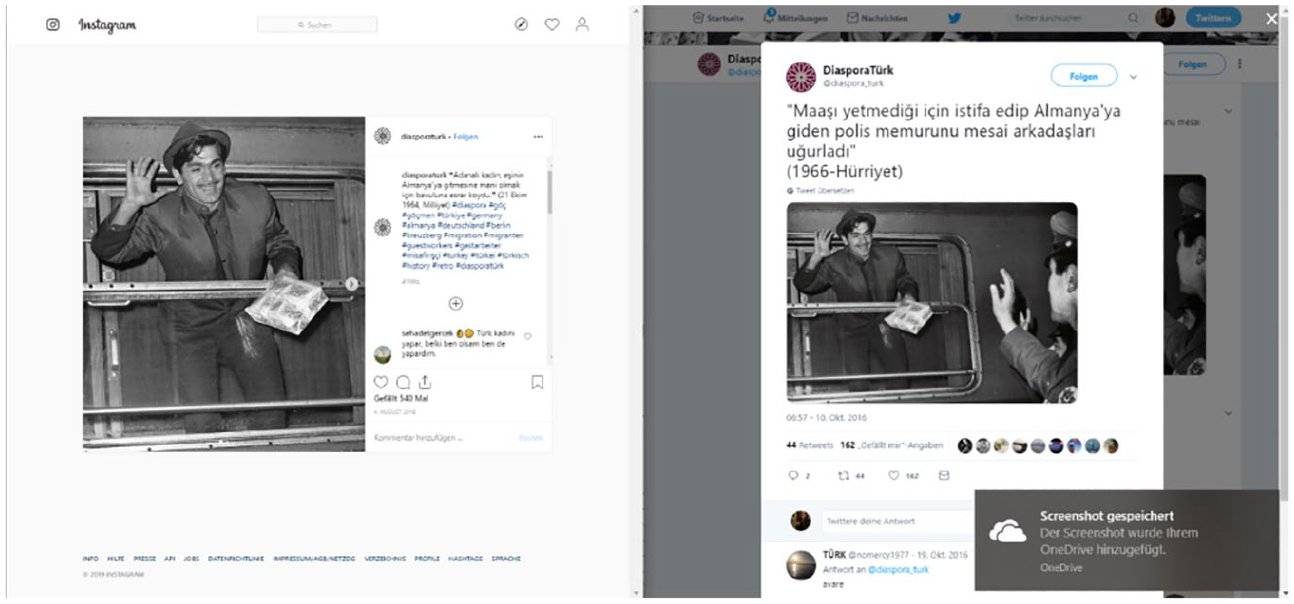
Men on train.
The aim of comparing the Twitter and Instagram posts was to examine how different media employ affordances differently. However, the analysis clearly reveals another confirmation of the construction of a male-dominated Turkish diaspora. Visually, this manifests itself through prominence of public spaces, focusing on normative masculine interests such as cars, with repeated contextualization of women as dependent beings (as mentioned earlier, they appear almost exclusively with other people). The 2017 posts highlighted above demonstrate this gendered discourse as well as the practice of fictionalization.
In another example, a story on Instagram is about a Turkish worker showing his new Opel car to his friends (1962, Germany) (DiasporaTürk, 2016b), while, on Twitter, the same story occurs at a different time on Instagram in 2014 (DiasporaTürk, 2014). The photograph is also contextualized differently via the following text in 2017 (DiasporaTürk, 2017c): ‘When I accidentally scratch[ed] a German’s car, a bill of 650 marks came. My Opel is worth 700 marks. I wrote a note and left the car at his door: Keep the change’ (see Figure 2). To an extent, the workers and producers of such cars are proud to be able to consume. Ownership could increase workers’ status in their homeland, as well as providing a feeling of being equal to ‘native’ Germans.
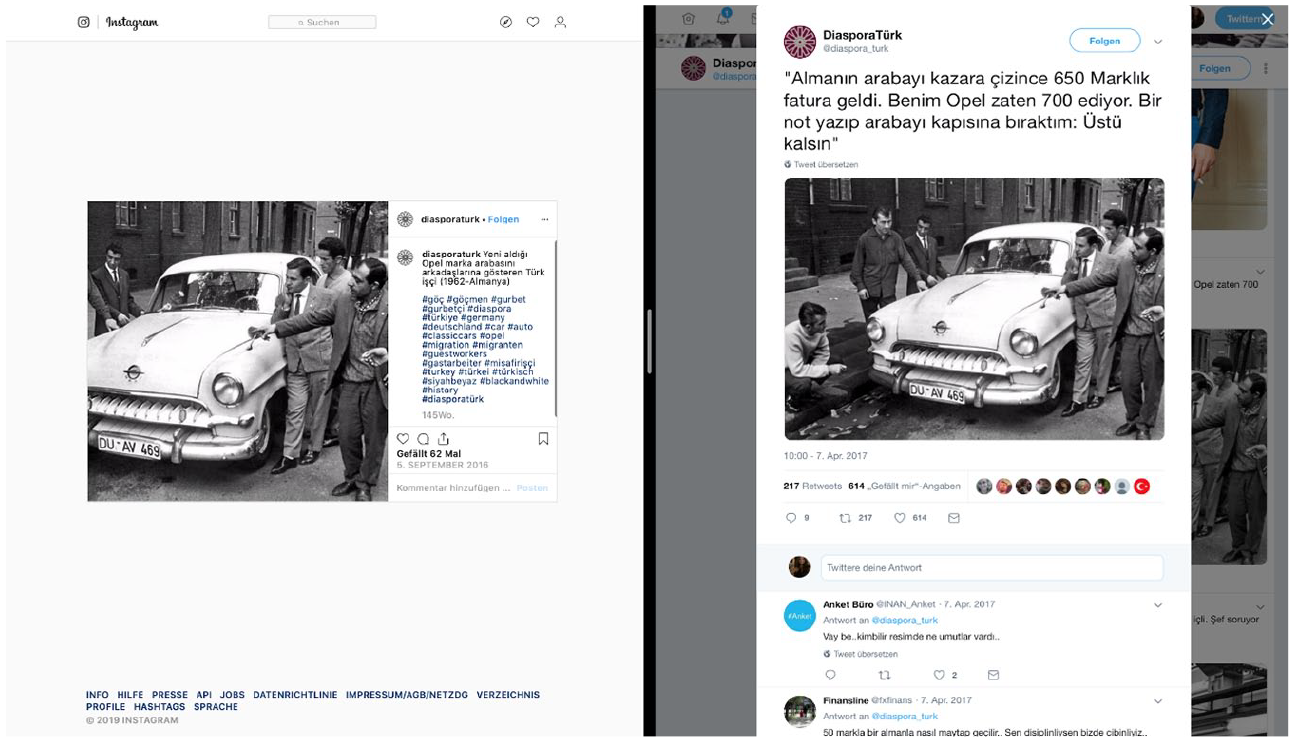
Men with a car.
In an example from 2018, cars are featured again. On Instagram, the text tells a story about a day in 1973 when a man decided to migrate to Germany after seeing several people coming back to his village with gifts and cars after working there (DiasporaTürk, 2018b). On Twitter, however, the same photograph is used to talk about the meaning of encountering a Turkish teapot while living abroad. The encounter with the object is described as a meaningful moment in which cherished memories of time spent with his family (his wife and his daughter) in their village in Turkey are re-visited (DiasporaTürk, 2018c). With regard to the affordances of social media, the comparison revealed that the same photos and stories are re-used/re-posted, not only across different social media platforms, but across several years. In addition, the same photograph can be circulated more than once on social media accounts over a period of years. 12
Prosumerism in @diasporaturk and @diaspora_turk
The home is indeed a powerful instrument of objectification. [. . .] Hardly ever is the result a clear reflection of the intentions of the human actor. (Miller, 2010: 108).
As discussed, migrant readers are invited to participate on platforms with their photographs and stories. However, the ways in which their participation is represented are problematic as we do not necessarily know each time whose photographs and stories are used. There is no guarantee that photographs and stories belong to the same stories. Readers, as social media users, are invited to participate beyond liking and sharing as social media users.
One of the most commented-on Twitter posts is entitled ‘what could be said about this poor room of a migrant worker?’ (DiasporaTürk, 2016d). On the Instagram version, the photo is accompanied by the text: ‘The room of a migrant worker. . . . The tie will remain for a long time on the wall. One cannot ask a tie from a miner’ (DiasporaTürk, 2016c) (see Figure 3).
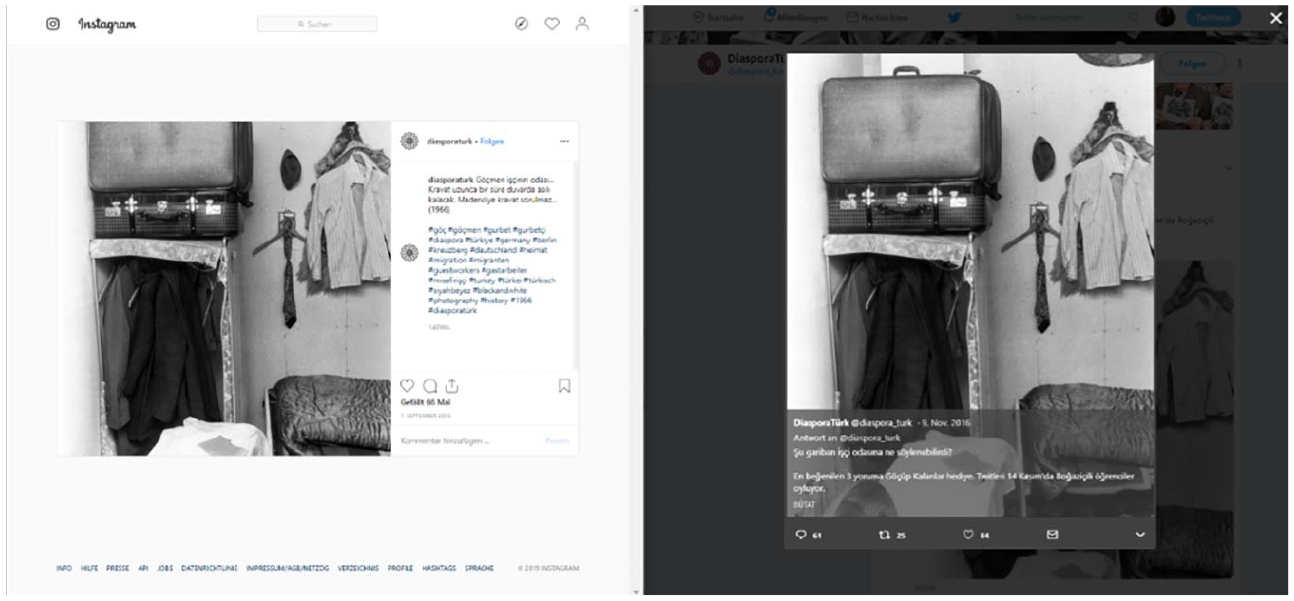
The room of a male migrant worker.
On Twitter, readers are invited to create a story for this photo by asking what can be said about it as a migrant worker’s room. Although no face is depicted in this photograph, its content mobilizes (dis)affect very well because it is commonplace, relatable and ordinary for migrants and their families. The image shows the vulnerability and precariousness of the lives of ‘guest-workers’. The statements in these comments parallel the existing narratives in DiasporaTürk. Readers were encouraged to write comments and offered the potential reward of the book Göçüp Kalanlar (voted for by university students). From 9 to 13 November 2016, 49 comments were made on the post. Some are quoted here as examples:
13
Hopes fit in 4 metres squared. Dreams and duvet from the homeland. ‘Greetings to the homeland’. The clothes are hugging each other because of loneliness. They are ready and excited as if there could be a journey to ‘sıla’ any moment. The hardship given to the heart by the expatriate (‘gurbet’) was also reflected in the room; suitcases are neither thrown nor hidden, [they] will be returned to the ‘sıla’ [at] the first opportunity. ‘Gurbet’ is that the presence of those scattered from suitcases to life; that the self being squeezed with a tie. The suitcase carried the hope of return; heavy load, ready to go. A suitcase full of longing .. a tired bed .. an ‘Alamancı’ team waiting to go to the homeland .. and they all smell of labor. That embroidered duvet. . . either smells the lover or the village . . . Dreams in the suitcase, hopes in bed, nobility in the shirt-tie hanging on the wall Our homeland would not fit into our room, if our hearts had not been as wide as the homeland.
Almost all of these were written by men (as far as the pictures and/or names have been chosen to show), except one identifiable woman’s name. The comments are mostly sad, talking of ‘gurbet’ and ‘sıla’, longing and a final return to the homeland of Turkey. Meanwhile, ‘sıla’, the longed-for home, is represented by dreams and love, and embodied in the words ‘duvet’ and ‘gurbet’, constructed as longing, loneliness, poverty, suffering and hardship. The suitcase represents a means of hope, but only hope to return. None of the narratives contains a narrative which writes a happy ending or evolution for that story in the migrated land – in the form of, for example, a bigger house, a secure future for children or a happier life. That room is constructed as a temporary place to earn some money and get back to the original place. This sedentarist understanding was, to an extent, consistent with the edited narratives of DiasporaTürk’s social media pages and books.
Conclusion
Attempting to eliminate ambiguity and open-endedness, the narratives analysed here appear to overcome the limits of time and space and imply that the shared images were not only relevant then – in the past – but also in the here and now of the Turkish diaspora. DiasporaTürk arguably attempts to obliterate the abyss between the moments of capture and reception (Berger and Mohr, 2007: 79), as well as offering an opportunity for introspection and reflection characteristic of the dilated mode of production of analogue photography, and of a documentarist approach (Scott, 1999). What is argued here is not that the subjective narratives constructed through the juxtaposition of text and image spoil or curtail the ‘‘objectivity’ of the photographs, but rather that a very particular discourse emerges through the anchoring of meaning to the text, not to the image itself. The analysis of DiasporaTürk has revealed that distinct affordances, as well as particular experiences thereby recalled, drive prosumers’ choices. In DiasporaTürk, the immediacy and polymediation of digital modes of engagement are employed to both freeze and generalize moments from the past, so that these are stripped of their potential for polysemy (Sontag, 2004: 38) and enter the Turkish ‘Funktiongedächtniss’ (Assmann, 2001) uncontested. DiasporaTürk is an attempt to remind us of the stories of ‘Turkish’ ‘guest-workers’ of the Sunni Islam religion, mainly in Germany and other European countries. It does not refer to Kurdish or Alevite identity, nor to left-wing or Kurdish migrants who migrated for political reasons after the coup of 12 September 1980. Generational diversity is not very visible, and neither are women, while LGBT identities are not represented. DiasporaTürk represents migration stories as ‘sedentarist’, freezing the moment without tracing the developing heterogeneous narratives. It does this not only by circulating old photos of guest-workers but through the accompanying text. Yet contextual information is absent, so it is hard to know which countries are represented in which years. Even when routes exist, they are represented only through departure from Turkey, arrival in Europe and the ideal return ‘home’. This representation does not account for the experiences of second- and third-generation Turkish migrants, who undergo very different processes of dis-/em-placement and dis(affection).
Family photographs, cassette players, carpets, mosques and prayers (at home and in the workplace) are featured in DiasporaTürk, and demonstrate the efforts of ‘guest-workers’ to domesticate (Morley, 2007) and accommodate (Miller, 2010) spaces and technologies. Gökçen Karanfil’s (2009) exploration of furniture and designs of migrants’ homes is illuminating in this respect, because it provides evidence of the evolution of the Turkish diaspora. In DiasporaTürk, however, time stands still. Migration is represented as a project defined by adversity, temporariness, lack of prospects and an ever-present nostalgia for ‘home’. DiasporaTürk mobilizes the hardships of early ‘guest-workers’ – many of whom had no access to proper housing and often ‘hot bunked’ – not only to construct a reductionistic representation focused on the ordeal but also to elevate that concrete period of time and those who lived through it to a status of martyrdom. In doing so, the potential for DiasporaTürk to raise issues of citizenship is lost because of the discursive focus on victimization. Representations of ‘guest-workers’ as victims might continue to strengthen populist conservative Turkish politics while failing to challenge right-wing European discourses. Indeed, the focus on the ordeal of the Turkish diaspora reinforces right-wing discourses surrounding migration – in both cases, the emphasis is on othering, either by highlighting the hardships of diaspora or by drawing attention to migrants’ failures to ‘integrate’ and to their status as ‘guests’ who will return ‘home’ at some point. Moreover, the reductionist representation of DiasporaTürk may already feed into the rise of populist nationalist politics in Turkey, not only diasporic nationalism, as Georgiou and Silverstone (2006: 43) argue, but also ‘mainland’ Turkey’s nationalism. Indeed, votes for the authoritarian leader Erdoğan reached more than 60% among Turks living in Europe. 14
In the case of DiasporaTürk, the affordance of indexicality legitimizes shared experiences, while the affordance of propinquity – typical of social media platforms – allows digitally connected migrants to feel a sense of togetherness, even if this is fleeting. The sense of placelessness, absence and distance is momentarily and repeatedly dissolved through comments, likes and re-sharing. In DiasporaTürk, the mediation of presence and transfer of resources characteristic of pervasive and ubiquitous technologies results in commodification of the complexities of the guest-worker migration experience. While the project builds what could be called ‘participatory Funktiongedächtnis’, this mainly occurs through reduction and stereotypes. DiasporaTürk resonates with many because it creates a significant other and a place to establish common ground. In the lives of digitally connected migrants, (dis)affection is mediated because spatial borders must be overcome. The need to mediate presence increases and DiasporaTürk successfully mobilizes the characteristic affordances of social media platforms to create this. Although DiasporaTürk is an open project that evolves continuously, the invisibility of the different identities of Turkey remains. Future work can deepen the analysis and could involve research with migrant readers from diverse communities.
Footnotes
Funding
The author(s) disclosed receipt of the following financial support for the research, authorship, and/or publication of this article: The researchers wish to thank DFG support at Locating Media, University of Siegen and the School of Media at University of Brighton for providing a platform for collaboration and short study visits. Supported by the German Research Foundation (DFG) through the Research Training Group ‘Locating Media’ (GRK 1769).