




Abstract
This article reflects on the concept of ‘queer generations’ as developed in the context of an ongoing study about belonging and sexual citizenship among two social generations of gender and sexual minority youth in Australia. We define the concepts ‘queer’ and ‘generations’ in the context of recent theoretical interest in temporality in childhood and youth studies in an attempt to think differently about gender and sexual difference. The main theoretical tension that lies at the heart of this article is how to take seriously the shared experience of growing up LGBT without insisting on a uniform narrative that is inherent to it. Drawing on an archival fragment from an HIV campaign produced in Australia and distributed in the 1990s and targeted at young gay and bisexual men, we consider the shifting conditions through which visibility has featured as a key problem for the deployment of sexual citizenship. This archival fragment is valuable because of the way that it problematizes the in/out, visible/invisible, gay/straight binaries that have dogged attempts to grapple with the at once individual and collective experience of growing up LGBT. The concept of ‘queer generations’ suggests critical insights into the limits and affordances of the production of generations as containers for generalized experience.
Keywords
Introduction: considering queer approaches to ‘social generations’
Engagement with the concept of ‘generations’ in social theory has offered productive vantage points on the collective experiences of people born and living at about the same time. The Baby Boomer generation (1946–64) (Jones, 1980), Generation X (1961–81) (Ulrich and Harris, 2003), Generation Y (mid-1980s–mid-1990s) (Howe and Strauss, 2000) and Generation Z (late 1990s and into the new millennium) (McCrindle, 2014) have each emerged in turn as prominent in popular and scholarly discussion about growing up. This interest has surfaced in discussion of the distinctive features of other cultural ‘generations’ too, including academic research about the MTV generation (Greenberg, 2009), and popular discussion of Generation Me (Twenge, 2007), the Peter Pan Generation (Shaputis, 2004) and the iGeneration (Rosen, 2010).
The starting point for many social theorists working on ‘generations’ can be traced to the work of Karl Mannheim, whose 1923 essay ‘The problem of generations’ laid the foundations for theorization of the concept, critiquing earlier accounts as either romantic-historical or as slavishly chronological. Mannheim identified the centrality of the impact of social change on youth as critical to the formation of generations. At times of rapid change, age cohorts rub up against one another and develop a relatively cohesive sense of shared identity. According to Mannheim, not only do those who belong to the same generation share the same year of birth, but also a ‘common location in the historical dimension of the social process’ (1952 [1928]: 290). Crucially, for Mannheim, impressions in youth coalesce to form a natural view that remains influential for the manner in which later experiences are evaluated (Mannheim, 1952 [1928]: 298). Mannheim seeks to capture the way that generations come to see themselves and others as naturally sharing certain unique characteristics encapsulating both the spirit of the times and responses to it.
Traumatic events, such as war, forced migration or civil conflict, shape generational consciousness in relatively clear ways (Eyerman and Turner, 1998). Such collectively experienced events can leave lasting impressions – transcending other social differences to produce strong ties between people who may never come into personal contact with one another at all (1998: 103). So too may unemployment, lack of opportunity and social rejection all contribute to a profound sense of generational difference among young people. Historically, these issues have been considered in terms of how class, gender and race influence subcultural identities and style (Hall and Jefferson, 1975; Clarke, 1975; Hebdige, 1975; McRobbie and Garber, 1979; Gilroy, 1987). The contribution of sexuality to the development of a youthful sense of ‘self’ remained a largely unexplored but implicit aspect of research in this field until the 1990s and early 2000s (Skelton and Valentine, 1998 and McNamee, Valentine, Skelton and Butler, 2002). Since then, scholars have produced ethnographic accounts of youth and sexuality in the context of specific times and places, recalling and recasting earlier interest in performance and style (e.g. Taylor, 2012 and Pascoe, 2007). Each of these accounts emphasizes generation as a cultural rather than naturally occurring phenomenon. For example, in contrast to enduring understandings of the concept of generation as referencing ‘transitions’ from youth to adulthood using psycho- and bio-medical models, Wyn and Woodman (2006) articulate their understanding of generations in terms of ‘distinctive, defining experiences of successive generations of young people’ (2006: 496–7). This article contributes to this broader characterization of generations in cultural terms, rather than as normativities theorized in relation to psychological, biological and transitional development.
The key analytic tension that we wish to animate lies in our use of the concepts ‘queer’ and ‘generation’. ‘Queer’ is a critical tradition built, in part, on the problematization or defamiliarization of generalizations. Recall, for example, Sedgwick’s founding axiom that ‘people are different to each other’ (1991: 22). ‘Generations’ is usually deployed as a concept that refers, in one way or another, to people in general. ‘Queer generations’ is useful if it questions the knowledge claims that bolster generational thinking, without abandoning an understanding that there are particular features which characterize a given generational moment.
This article asks how the concept of generations facilitates a constructive consideration of historical gender and sexual difference. The article makes a move that is at once conceptual and theoretical, drawing upon an archival example of advocacy and action to illustrate the affordances that a generational account of sexuality, gender and difference offers (Figure 1). The archival fragment presented here is an Australian HIV prevention poster which hails its audience to recognize themselves as part of an imagined audience made up of ‘gay or bisexual young guys’. Our queer reading of the poster highlights the tensions inherent in engaging with the concept of generations. While the poster is oriented towards an audience of gay and bisexual-identified young men, it also forms an instructive example through which to resist seeing gender and sexuality as inevitably parsed along inevitable lines of difference. The normative masculinity that the image evokes facilitates a certain crossing of gay and bisexual young men into a generalized construction of the Australian youth population historically preserved for heterosexuals (especially men). At the same time, the poster demonstrates how a persistent discourse of visibility interpellated sexual citizenship in the early 1990s, offering a snapshot of generational transformations in the way that the state ‘sees’ subjects through the recognition of (diverse) sexualities. We interpret the discourse of visibility in the archival fragment as characterizing a 1990s generation in three ways. First, the poster links LGBT youth to forms of sexual citizenship associated with HIV, displacing the morality of the 1980s for an emphasis on peer education and ‘feeling good’. Second, it flags shifting power structures, in which LGBT people were more involved in the production of material concerning them. HIV organizations produced this poster, and as such the campaign addresses people as a ‘you’ who can join ‘us’ rather than using an othering language that characterized earlier modes of address. 1 Third, it reflects a splintering of categories along individual modes of identification – not to homosexuals but to ‘young guys’ who are ‘gay or bisexual’ – who are as much individuals as they all ‘feel the same’. This article develops these three points in relation to the ‘Which one of us is gay?’ poster as a window on the broader conditions under which the sexual citizenship of LGBT youth becomes possible as a product of individual and collective forms of difference. This, we suggest, extends beyond the framing of the poster as intended solely for ‘gay’ or ‘bisexual’ audiences in metropolitan cities in Australia. Queer generations thus offers a vantage point for understanding the conditions for and exclusions from sexual citizenship established at this historical and cultural moment in the 1990s in Australia. 2
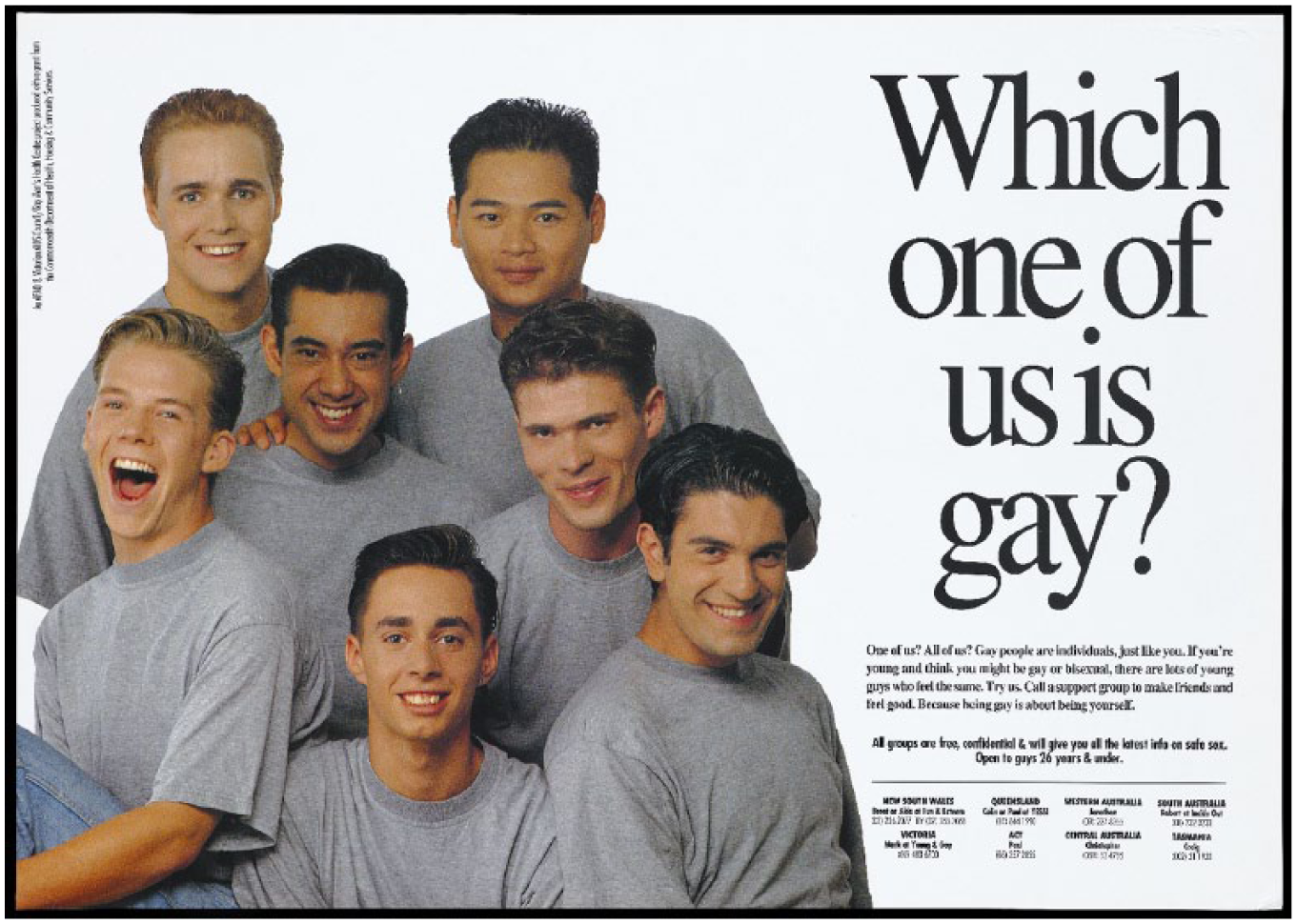
‘Which one of us is gay?’ poster.
Our approach to social generations insists on the centrality of difference as a way to problematize the homogenous application of a generational label to a population of individuals. Highlighting LGBT people in generational terms as a way to generalize experiences is important because of rapid and unprecedented transformations in a range of fields affecting those so identified. Thus understood, the notion of queer generations offers a way to further grapple with the relationship between social, cultural and economic shifts and gender and sexual difference. A hallmark of queer subjectivity is that it sustains practices that may not adhere to normative temporal scripts, informing a perspective that generational understandings of queer life are potentially unstable. Moreover, this enables us to take seriously the experiences of living through particular moments in time for LGBT individuals – as well as the way in which its constituent forms of identification are brought together and separated to political ends. An acknowledgment of the uneasy relationship between discrete historical moments and people’s lived experiences of them generates a productive understanding of generations which retrieves the concept from awkward universalisms.
Queer youth and sexual citizenship over time
Theorists since Mannheim have grappled with the way in which generations usually proceed on the basis of recognitions via an exercise of making connections across time. This is illustrated in histories of different generations of migrant communities which rely on efforts to identify and retrace patterns of travel, citizenship and kinship. Similarly, generations of sexual and gender difference – or ‘queer generations’ – emerge through the assertion of certain commonalities across time. Long-standing perspectives on queer subjectivities have complicated earlier transhistorical and essentialist views of homosexual, bisexual and transgender difference (e.g. Epstein, 1987). In particular, a body of historical research about LGBT individuals and politics since the 1970s constantly demands reconsideration of the terms under which we might link pasts to presents without replicating errors of anachronism (e.g. Weeks, 1977). An historical approach offers productive insights into the ways that a focus on generational moments might be productive, without reproducing simplistic or universalizing tendencies (e.g. Caramagno, 2002). 3 Since Gay Liberation, the context for growing up as an LGBT young person has been reshaped by discursive shifts that span a range of institutions and forms of knowledge. These include most notably the law, policing practices, the therapeutic sciences, educational curricula, anti-discrimination employment policies, understandings of family, changes within institutional religion, personal access to information via social and internet technologies, sexual health crises and campaigns, and popular representations. Given that many of these and other realms of life operate through the broader imaginary of the state, these changes have facilitated shifting forms of exclusion and inclusion of LGBT youth across a range of spatial scales – ranging from the nation to the community – across different historical periods.
The sexual citizenship of young people has been framed along a number of lines. For example, a discourse of suicidality uses data about LGBT young peoples’ mental health to describe them as vulnerable victims who require adult and state intervention (Cover, 2013; Marshall, 2010). Alternatively, LGBT young people have recently come to embody the values associated with the neoliberal and multicultural state of diversity, progress and cosmopolitanism (Nash and Gorman-Murray, 2014). While such binarized modes of inclusion essentialize LGBT youth, they also rest on new forms of exclusion. It is possible to anticipate that LGBT young people in non-metropolitan settings, for example, may be unable to establish citizenship claims within the frame of such a discourse. A dominant framing of LGBT youth identity as cosmopolitan and urban may sit at odds, for example, with the experiences of both working class and non-metropolitan LGBT young people. These citizenship claims are further confounded by the complex distribution of cosmopolitanism in Australia, given its geographical size and economic transformations that include a shift away from manufacturing industries and a trend towards precarious employment (Waitt and Gorman-Murray, 2011).
Growing up as an LGBT young person, and the contexts for acquiring sexual citizenship that such identification brings, have changed in stark ways over the past four decades. However, we have been struck by the enduring ahistoricity which often characterizes popular, professional, policy and scholarly discussion about LGBT youth. It is these concerns that bring us to consider how growing up LGBT might be placed in conversation with the concept of generations. In particular, we wish to consider how queer generations intersects with notions of sexual citizenship. Doing so serves as an opportunity to ask whether considering sexual and gender difference in terms of ‘generations’ offers a way to both counter a prevailing ahistoricism but also to develop a critical approach that acknowledges the limits of organizing historical subjects into more or less homogenizing and conclusive generational categories. Thus, we turn to the notion of generations to fashion it as a critical space at the intersection of two key concerns: first, to think about sexuality, gender, difference and youth in historical terms; and second, to critically reflect on the terms of recognition that we deploy to identify and stabilize the past for the purposes of being able to produce generational knowledge in the service of a present need.
Since the 1990s, scholarship about gender and sexual diversity among young people has identified the difficulties that young people thus defined confront (e.g. Cover, 2012; Driver, 2008; Marshall, 2010; Rasmussen, 2006). More recently, there has been a sharpened focus on positive attributes of LGBT youth experience (e.g. Rasmussen et al., 2004), reflecting the growing influence of the critique of historically dominant pathologizing and deficit-oriented studies. The waning dominance of such framings of LGBT youth are linked to a variety of material changes concerning gender and sexuality, including the softening of legal prohibitions and social attitudes (e.g. Johnson et al., 2011; Offord, 2001), the growth of inclusive policy and practice in schools and youth service settings (e.g. Ferfolja, 2013; Robinson et al., 2014), and the diversification of representations in popular culture and through social media (e.g. Clarke, 2013; Lipton, 2008: 171–2; Padva, 2004).
This introduction to historical shifts in the legal, institutional and cultural meanings of LGBT youth serves to illustrate that there are striking differences between, for example, people born in the 1970s and those born in the 1990s. It is also clear, however, that splitting people into overly uniform generational groupings is of only limited use. The shortcomings of a simple application of the concept of social generations are well rehearsed: chiefly, that generational ways of theorizing individuals can problematically homogenize experience and lead to uncritical adoption of methods which compare and contrast different generations as uniform wholes. Too often, thinking in generational terms tends to yield a straightforwardly sequential or developmental analysis. Experiences of life in general, and perhaps of growing up in particular, are neither homogenous nor uniform (Talburt, 2004). Our heuristic deployment of generations maintains a queer perspective on growing up, in doing so facilitating further critical perspectives on the false stabilities which the concept of generations might otherwise encourage.
For over a decade, queer scholarship has attended to how chronological and developmental understandings of time reproduce sexual and gender normativity (Freeman, 2010; Probyn, 1995). In her work on coming out narratives, Elspeth Probyn critiqued the emergence of homogenous narratives of homosexual difference in the 1990s, cautioning against the ‘flattening’ of difference that accompanies the increasing production and dissemination of stories about gay and lesbian youth (e.g. Cover and Prosser, 2013). This and other research suggests that placing too great an emphasis on idealized narratives of growing up LGBT both fails to account for lived experiences or acknowledge how time can be experienced in non-developmental ways (Gordon, 1999; Stockton, 2009). A properly queer engagement with the concept of generations thus needs to avoid the homogenizing, disciplining tendency common in narratives of sexual and gender difference.
Queer generations and the demand of/for visibility
Queer scholarship on childhood and youth provides a helpful guide for us in our engagement with the promise of ‘queer generations’. The homogenizing tendency in extant theorization of ‘generations’ may stem from the implicit assumption that ideas, concepts and events shape a sense of consciousness that is broadly applicable to people in general. Examples of this include laws, economic developments, mainstream media representations, widely-observed social practices, and certain historical events. It is difficult to separate an understanding of the Woodstock generation from the Vietnam War, or Generation X from developments in commodity popular culture, such as blockbuster teen cinema or MTV. Growing up LGBT is also shaped by a parallel set of discourses – such as government policy that defines LGBT young people as vulnerable or as resilient – and which provides the terms through which gender and sexual subjectivity is harnessed to forms of citizenship.
A series of rapid, high-profile changes impacting on LGBT people in general since the 1990s has encouraged a generational way of thinking about sexuality, gender and difference. For example, this can be observed in the Australian context in the distinction that gay men who came of age in a period when homosexuality was criminalized see themselves as distinct from post-decriminalization generations. 4 Other examples that bear a relationship to this view include the expression of sexuality and gender in terms of ‘post-lesbian and post-gay’ (Altman, 2013) and ‘post-AIDS’ (Dowsett and McInnes, 1996) generational moments. These examples gesture to the ways that diffuse subjective experiences often eschew uniform experience of generational time. This is because key moments or influences which characterize a generation are experienced at the individual level, and often unevenly. While decriminalization can be understood as a specific moment in time in each Australian jurisdiction, the rate and type of change with regard to related practices such as local policing and social, economic, formal and informal punishment are varied. For example, this is indicated by the differing age of consent laws for sex between men and subsequent legal reform over successive decades. This demonstrates the uneven ways that historical changes that are ostensibly generational can shape individual lives. Thus, generations – insofar as they are fashioned out of cultural experiences – are not phenomena that occur naturally in time. As socially experienced phenomena, generations are made up of discrete understandings and practices experienced by people at different points in historical time and in different ways. When drawn together, these can characterize an abstract sense of belonging in time, even while the temporal sequencing of these experiences can vary wildly among a group of people who might all claim belonging to that generational moment.
Another example can be found in the mainstream representation of LGBT characters on television: this is often described as a defining characteristic of generational change in relation to sexuality and gender since the 1990s. However, individual participation within the generation-marking practice of consuming mass LGBT popular culture varies in wide-ranging ways, including in how it is structured by location, wealth and household structure. It also differs in terms of how the representation of LGBT characters intersects with other markers of identity and identification, such as race, class and nationality. Thus individuals may share certain generation-marking experiences, like watching LGBT characters on TV, although they often do this out of synch with others, further illustrating how queer generations can be experienced out of uniform sequence.
Thus understood, growing up LGBT is a cultural experience mediated by experiences of time that make it difficult to draw self-evident lines between generations. The fact that LGBT subjects sometimes grow in non-homogenous, non-chronological and non-developmental ways has offered rich insights to queer cultural studies (Halberstam, 2005). However, these insights are yet to fully explore the various ways in which a queer cultural experience of generations becomes meaningful to individuals within a particular historical milieu. For example, when a middle-aged man who lives in remote Australia claims a queer sense of self after seeing for the first time an audio-visual text routinely consumed by middle class LGBT teenagers in the city this provides an example of a shared generational moment experienced out of chrono-developmental sequence. In short, it evidences the lived matter of queer generations.
However different individuals may be from one another, there are, nevertheless, observable patterns in how gender and sexuality have been thought about at different historical moments in time, and from place to place. Throughout the 20th century, the ‘closet’ has been a key concept for thinking about sexuality, gender and difference. Moreover, much historical scholarship about gender and sexual experience has been structured by ‘the drama of the closet’, as well as by efforts to eschew such dramatic constraints. 5 Early gay and lesbian history in the 1970s sought to ‘out’ hitherto closeted figures from heteronormative historical narratives in the hope of freeing such difference from the constraints of straight history. Even as some of this work naturalized the notion of sexuality as an individualized and even psychologized experience, much of this scholarship also fostered a critical approach to the idea of the ‘closet’ itself by encouraging analysis of the material and discursive conditions sustaining regulatory mechanisms like the closet. 6 An important aspect of these critical approaches is that they demonstrated how invisibility and visibility (being out of the closet or still inside it) are most properly understood not simply as the self-evident terms, goals or limits of a politics or scholarship of gender and sexual diversity but, rather, as powerful products themselves of modern, Western ideas about gender and sexuality.
In the decades since the foundational gay and lesbian studies of the 1970s, much queer scholarship has elaborated how the politics and scholarship of gender and sexuality studies is structured by the invisibility/visibility and in/out binaries. Indeed, a great deal of activism and scholarship connected to sexual and gender diversity has centred on the conflicts which accompany efforts to move from one binary position to the other, from invisibility→visibility (and vice versa), and from in→out (and vice versa). Our study of queer generations follows this constructionist work of the 1970s and 1980s (e.g. Katz, 1976; Rubin, 1992; Weeks, 1977), to examine how the drama of invisibility/visibility and of being in and out shapes generational understandings of sexuality, gender and difference.
‘Outness’ and ‘visibility’ have been promoted as requirements for the achievement of a popular idea of freedom for LGBT subjects. This formulation of a linear temporal progression towards freedom in successive generations demonstrates why visibility is a key analytic for understanding generations and sexual citizenship in Australia. An historical reflection on sexual citizenship in Australia reveals visibility as a crucial vehicle for recognition. On the other hand, the complex role of visibility also suggests the fraught process through which LGBT people have been interpellated as citizens. In describing the specific historical, social, cultural and economic conditions through which sexual citizens are asked to become visible and thus eligible for recognition, these practices can be better seen as the products of distinct generational moments, rather than as universal, inevitable or natural features of LGBT life and politics.
From this perspective, becoming more visible, more ‘out’ and thus more free is not an end goal of a purportedly universal cultural politics of sexuality, gender and difference. Rather, it can be seen as a much more culturally and historically specific alternative generated by an overly simplified system of values constrained by the binary structure of in/out, invisible/visible and oppressed/liberated. Thus, the study of generations and sexual and gender difference must not limit itself to investigating the degree to which people are more or less out, visible and free. Instead, it should study how these things have come to play such central roles in characterizing LGBT subjects as sexual citizens and as citizens more generally at different points in generational time. It also underlines the need to keep returning to the historicizing and collective impulse at the core of the concept of generations even while it might seem like a hopelessly compromised conceptual tool. Despite its limitations, thinking generationally can foster a historical perspective within queer youth cultural studies, even as the contingency of generational thinking comes into view.
Seeing queer generations: visibility and historical sexual citizenship
Our archival example of the shifting arrangements of the cultural politics of visibility serves to illuminate the relationship between sexual citizenship and generations. In 1993, a national safe sex ‘gay education campaign’ (Wilding, 1998, 110) was launched in Australia. The campaign prominently featured a series of images that were circulated as posters and advertisements in commercial magazines, including the provocative ‘Which one of us is gay?’ image. The posters were produced by the Victorian AIDS Council (VAC) and the Australian Federation of AIDS Organisations (AFAO), and funded by a grant from the Australian Commonwealth Government’s Department of Health, Housing and Community Services (VAC and AFAO, 1992a). The poster includes a group of young men of various physical appearance smiling at the camera, all wearing grey t-shirts. The fine print on the poster elaborates its rationale: Which one of us is gay? One of us? All of us? Gay people are individuals, just like you. If you’re young and think you might be gay or bisexual, there are lots of young guys who feel the same. Try us. Call a support group to make friends and feel good. Because being gay is about being yourself. All groups are free, confidential & will give you all the latest info on safe sex. Open to guys 26 years & under.
The poster then lists contact details for people and support groups in different parts of the country. The poster emerged in the early 1990s at a moment of flux associated with sexuality during that period in Australia: it appears only a few years after activists successfully demanded access to anti-retroviral therapy in Australia (Ariss, 1993), and a moment of unprecedented visibility of representations of certain aspects of gay male culture in particular (the Sydney Gay and Lesbian Mardi Gras first screened on the ABC in 1994) (Searle, 1995). The poster emerged in a series which aimed to promote support groups for young gay and bisexual men. Another in the series questions its readers, presenting a muscular young man with his arms crossed and reversing an anticipated hostile response by saying to the reader: ‘Yeah I’m gay. Got a problem with that?’ (VAC and AFAO, 1992b).
This is not to say that this was a particularly permissive period in Australian history: indeed, only two years earlier in 1990, an HIV prevention poster portraying two men kissing was banned from mainstream circulation on the basis that it was seen to be ‘encouraging homosexuality’ (Leonard, 2012). Rather, the ‘Which one of us is gay? poster perhaps reflects how the period from the 1990s onwards was one in which the Australian government was increasingly responsive to community-based forms of activism around AIDS (Ariss, 1993; Dowsett, 1996; Race and Stephenson, 2016). Partnering with community AIDS organizations from the 1980s onwards proved a widely celebrated strategy; the Australian government developed prevention strategies on the basis that gay men in particular were at risk of contracting HIV (Ballard, 1998). This meant engaging with forms of minority identity which often emphasized identitarian understandings of sexual and gender difference, strengthening the practice of ‘coming out’ as a privileged way to achieve political legitimacy and accomplish a shared interest in public health.
As a high-profile national media campaign, these posters provide an influential example of representations of homosexuality in Australia in the early 1990s, when those born in the 1970s were coming of age as sexual citizens. As such, this archival fragment provides us with an example of what young gay men’s visibility looked like in the early 1990s, both in terms of the way that the fragment itself looks, as well as what it reveals about the cultural politics of homosexual visibility made observable by the production, circulation and reception of the representation. In particular, the poster destabilizes dominant forms of government engagement with ‘high risk groups’ by ‘governing at a distance’ that characterized Australian HIV prevention programs in the 1980s and 1990s (Ballard, 1998). Rather, in suggesting that being gay is not necessarily something that can be identified through appearance, the poster cuts across dominant minoritizing logics and presents LGBT young people within a wider, national community of belonging. This indication of discourses of visibility as a necessary aspect of sexual citizenship is worth considering in light of the federal funding that supported the production of the poster. The tacit state endorsement implied by funding suggests how the poster campaign functioned to interpellate gay and bisexual young men in terms of an emergent model of sexual citizenship. Indeed, it was precisely this connection between the discourses of visibility necessary to establishing sexual citizenship and gay sexuality that generated anti-gay criticism of the campaign (Wilding, 1998, 110–11).
Negative responses to the possible extension of sexual citizenship to ‘gay and bisexual’ youth through the campaign suggests a historically specific discourse of visibility in the early 1990s. These negative responses added to shifting discourses of what and who could be visible in the context of sexual citizenship. For example, the mainstream popular culture magazine TV Week refused to run the advertisements. Its editor released the following statement: TV Week is not going to publish any of a series of three advertisements which the Victorian AIDS Council has sought to place with the magazine. While I respect the rights of gay people or any individuals to live however they see fit, I don’t believe it is their right to use the pages of TV Week to conduct what – when you read the smaller type – appears to be a recruiting program. Young people who think they might be gay obviously are faced with profound and deeply personal decisions. TV Week does not wish to be used to influence that decision-making process in any way. TV Week is certainly not anti-gay. If that were the case, the magazine would be precluded from covering a significant percentage of people in the showbusiness industry, and we have never discriminated on those grounds (Masterson, 1993).
Another story in the tabloid press similarly raised concerns about LGBT visibility, questioning the meaning of the implicit approval granted by the state funding used to create the poster: And if you thought only irresponsible unions and misguided socialist politicians were behind turning Victoria into a fantasyland, let us introduce the latest advertising campaign of the Victorian AIDS Council. It does not warn of the hazards of sexually-transmitted disease; it does not promote safe sex. Instead, at our expense, it promotes homosexuality. Described by its out-of-touch originators as a campaign to build self-esteem in young homosexual men, it looks much more like a recruitment drive. As such, it should not have the backing of public funds earmarked for health issues (Herald Sun, 1993).
While approaching the poster as a text that grants sexual citizenship, critiques of the campaign frame it as ‘a recruiting program’ or as ‘promot[ing] homosexuality.’ These statements reference both long-standing suspicions about the recruitment of the young into LGBT lives and the excessive influence that popular culture has over young people’s ‘decision-making process’. Together, the campaign and responses to it played a role in shifting the framework through which gay and bisexual youth might be made visible. The contestation over LGBT sexual citizenship that characterizes the 1990s is thus in part reflected in this discourse of visibility itself. Recalling our earlier discussion of the closet, the refusal by TV Week to publish the images offers a specific moment of the push-and-pull conflict between visibility and invisibility that has been central to the cultural politics of sexual citizenship for much of the time since Gay Liberation. This surfaces in the TV Week editor’s anxiety about the ability of the poster to reform understandings of acceptable limits of citizenship and, thus, the nation itself. In casting gay or bisexual youth as sexual citizens, the poster reflects a generational shift in how and in what ways sexuality is both interpellated and elided by the state.
However, this archival fragment also suggests a less clear-cut and more diffuse form of address that destabilizes simple identitiarian analyses. This is because the poster plays with the drama of the closet by emphasizing the very terms of visibility that have featured in investments in sexuality, gender and difference at least since Gay Liberation. Indeed, the poster suggests the ways that a person might not appear to be gay but in fact be gay, gesturing at queer potential beyond the disciplinary limits of visibility and recognition. This queer potential is, however, framed by the emergent neoliberal parameters of Australian citizenship in general in the 1990s. In this sense the poster’s claim that ‘gay people are individuals’ both resists a collectivizing politics of difference and indexes the common emphasis on self-governance and responsibility in the forms of sexual citizenship deployed in HIV prevention campaigns. The call to join a support group in order to obtain a form of visibility linked to self-actualization might appear to suggest a less individualizing form of neoliberal governance than might otherwise be expected. However, the possibility that anybody might be gay reflects a neoliberal model of citizenship realized through the subject’s active management of the self; here appearing as a project structured by influential formulations of state-sanctioned social models of LGBT sexual citizenship and inclusion.
The question, ‘Which one of us is gay?’ illustrates the ongoing difficulties of state recognition of sexual and gender difference in Australia. The poster serves to highlight how generational difference is about actively engaging in processes of identification, recognition and demarcation. It compels the viewer to guess which young man is gay based on their appearance. This, of course, is intended as a playful endeavour that leaves the viewer ruminating on the limits of such an enterprise while leading them to reflect on what it might mean to look gay and their own potential relation to such a form of visibility. It draws on the historical association of sexual and gender difference with what is visible and the vagaries of recognition. Similar to how this archival image troubles the certainty that the viewer might seek when trying to identify the gay person in the picture, it also raises questions about the way in which recognition works more generally. Which one of the men in the poster can be recognized as gay? How does gender and sexual difference manifest as visible within a given generation? And how is a discourse of visibility structured by the politics of sexual citizenship of the historical moment?
Taken at face value, the image depicts (male) homosexuality and bisexuality as both ambiguous and ubiquitous. The poster positions the reader in an active stance of reflection and inclusion. ‘One of us? All of us?’ In one sense the image underscores diversity within the gay community as individualized trait, deploying and recasting Sedgwick’s axiomatic queer emphasis on difference. Rather than suggesting that this sets up individuals as inalienably different from one another, the response invites belonging: Gay people are everywhere, they can look just like you. The image depicts gay life in positive terms. Laughter and smiles accompany a confident claim that being gay can ‘feel good’, both drawing on and recasting the affirmative messages of Gay Liberation (‘gay is good’). The simultaneous ambiguity and ubiquity of LGBT experience conveyed by the image produces a queer effect; the audience includes gay people not only because it is addressed to gay people, but because gay people can be anywhere and look like anybody. It addresses itself to a national audience which includes gay and bisexual young men. This address rests on a discourse of queer visibility that actively incorporates individualized identity as the dominant model of sexual citizenship. Indeed, ‘there are lots’ of ‘us’. All of these young people are invited to take up the role of sexual citizen: by glancing at the poster; by recognizing oneself as an audience of such a text and electing to join a state-sanctioned social whole, as suggested here by the invitation to join the funded group; or by identifying queerly with the poster even while not identifying as a young gay or bisexual man, or even as otherwise LGBT. In asking the reader ‘which one of us is gay?’ the poster hints at the leakiness of sexual citizenship as it moves about within public culture. Visibility emerges as an unreliable marker of LGBT youth, suggesting how forms of recognition often exceed that which is intended by the state’s address.
Anti-gay responses to the campaign provide an historical example of a familiar style of moral panic, and of how it rests on concerns about what can and cannot be seen. As mentioned, the 1990s had seen an increase in representations of LGBT individuals. When moral panics rest heavily on responding to a politics of visibility – as is the case here – the shifting meanings of visibility can reshape the terms of the moral panic. Expanded forms of visibility of LGBT people in the 1990s – and the claim that gay people are ‘just like you’ – created a more challenging climate for the would-be censor than was the case only a few years earlier when the poster that depicts two men kissing caused such an uproar. Indeed, we see as much by returning to the words of the TV Week editor: TV Week is certainly not anti-gay. If that were the case, the magazine would be precluded from covering a significant percentage of people in the showbusiness industry, and we have never discriminated on those grounds. (Masterson, 1993)
One can appreciate the editor’s dilemma. In a context of increased visibility of LGBT representations, a total ban on homosexuality in a mainstream publication reliant on advertising was not sustainable. The editor’s effort to express support for LGBT visibility on some grounds but not others suggests how the moral panic of the 1990s about LGBT youth visibility is specific to the conditions and shifting depictions of that period. In this way, it also offers some indication that subsequent moral panics would need to recalibrate their focus in order to gain purchase in the shifting cultural landscape if for no other reason than the call for censorship had been overrun by the sheer volume of LGBT representation since the 1990s. The relationship between LGBT subjects, visibility and sexual citizenship had changed starkly, characterizing the 1990s as a distinct generational moment. The ‘Which one of us is gay?’ poster and its reception suggests how this moment is characterized by these changes in sexuality, gender, youth, recognition and the state. The queer circulation of the poster image suggests that individual experiences of it are varied and diffuse across time and with regard to how they are understood. This is suggestive of how experiences of the generational moment denoted by the poster are as numerous as there are individual interpretive experiences of the poster, demonstrating how the 1990s as a generational moment cannot be neatly tethered to the 1990s as lived chronological historical time.
Conclusion
Karl Mannheim’s perspective offers an understanding of generations in which individuals see themselves and others as sharing unique characteristics which encapsulate the spirit of the times. A queer approach offers new ways to theorize generations by drawing attention to the individual and collective experiences of generational time out of historical sequence. Growing up LGBT is a cultural experience mediated by experiences of time that make it difficult to bind generations to historical time, in stable, straightforward ways. This is not to say, however, that there are no generation-marking experiences. Moments which we characterize as generation-marking are experienced out of synch among individuals – they may share certain generation-marking experiences, but in markedly different historical, temporal, spatial and cultural contexts. This disarticulation of the experience of queer generations from chrono-developmental sequence is one of the major insights afforded by a ‘queer generations’ approach, and is the first of two key arguments which we have put forward to theorize queer generations in this article.
The second key argument has centred on the archival case of the 1990s poster. Two critical points about the poster illustrate our argument about the queerness of generations. First, we have demonstrated how it materializes and visualizes an understanding of the 1990s generational moment through its depiction of a contested politics of visibility which we have argued characterizes the1990s as a generational moment. Through our critical discussion of the archival fragment we have demonstrated how it is linked to discourses of visibility in relation to sexuality characteristic of the 1990s (e.g. through our discussion of the closet). The poster has been read as an artefact of a particular generational moment, one characterized by a discourse of LGBT visibility much more focused on sexual identity (e.g. Altman, 2013) than other periods (such as the early 2000s), which are characterized by a different type of cultural politics of visibility which foregrounds gender difference much more explicitly. This has arisen recently in the moral panics over gender difference and youth produced in response to campaigns for things like same-sex marriage and LGBT-inclusive curriculum by groups such as Safe Schools Coalition Victoria.
We have also used the poster to illustrate our theoretical argument about queer generations by showing not only how the poster characterizes a particular generational moment, but also by showing how the archival fragment prompts a critical reflection on normative understandings of what generations means. The poster foregrounds a moment of ambiguity in discourses of visibility in the 1990s, requiring reflection on how the generational experiences of LGBT people emerge. It cheekily encourages us to look closely at the young men in the image in an attempt to recognize a sign that we might identify with. It asks us to look for what we are able to recognize, and in the process encourages us to see the limits of our own practices of recognition, resting as they so often do on our desire for what we recognize – or, in other words, our desire for the same.
This article has been an article of split sympathies brought together through our desire for difference. On the one hand, we have agreed with Sedgwick that ‘people are different to each other’, meaning that an understanding of generations as a concept which contains and constrains people as generalizable generational populations does not suffice. On the other hand, we have not been prepared to dismiss the profound impact of things like engaging with an influential LGBT text for the first time, decriminalization or the advent of the internet. History matters shaping the conditions of life for groups of people on a scale beyond that of the individual. We have theorized ‘queer generations’ as a way to hold these split sympathies together. Through a study of the poster from the 1990s, we have identified both the production of generational difference (through its focus on a visibility centred on sexual but not gender diversity) as well as the non-homogeneous experience of this generational difference (through our discussion of how people experience generation-marking experiences at different moments in historical time). ‘Queer generations’ accommodates the significance of both individual difference and the shared significance of historical experiences of LGBT people.
Through the question the poster raises – ‘Which one of us is gay?’ – This queries the technologies of recognition so central to the dramas of visibility and sexual citizenship so characteristic of the 1990s generational moment, and, more broadly, to the identification and demarcation of LGBT generations in general. In these ways, it encourages a critical reflection on normative understandings of generations and questions the viability of stable generational knowledge. ‘Which one of us is gay?’ The question reverberates between its 1990s inception and its current landing place in the interpretive moment convened within this article. The instability or uncertainty of the response draws our attention to the limits of stabilizing and generalizing recognitions based on sexuality and gender. By foregrounding the problems between visibility, sexuality and gender, the archival fragment exhorts us to query the false stabilities which are often put in place when people speak of LGBT generations in straightforward ways. This encourages us always to keep room open in our analysis for different experiences of the historical in time, and thus continually to preserve the importance of historical study in examining queer life by unhinging the lived experience of the historical from a straight narrative of history’s unfolding. ‘Which one of us is gay?’ This is a question which echoes over time, refusing to allow the past to settle within one historical frame.
Footnotes
Acknowledgements
We express our gratitude to those who contributed to the Belonging and Sexual Citizenship among Gender and Sexual Minority Youth (‘Queer Generations’) research project as study participants. We thank Kyra Clarke, Geraldine Fela, Jess Gilbert, Kirsty Herbert, Max Hopwood, Toby Lee and Clare Southerton, who worked as research associates on the project.
Funding
The author(s) disclosed receipt of the following financial support for the research, authorship, and/or publication of this article: The research described in this article was undertaken as part of the Belonging and Sexual Citizenship among Gender and Sexual Minority Youth (‘Queer Generations’) research project, funded under the Australian Research Council’s Discovery Projects funding scheme (project DP150101292). The views expressed are those of the authors, and are not necessarily those of the Australian government or the Australian Research Council.