




Abstract
This article analyses a selection of Russian digital remix videos that are put together to argue for a sympathetic and affectionate memory of childhood in the late Soviet period and then posted online. In their imaginative and deliberate structuring of images these videos are meant to evoke resonant nostalgic recollections among viewers. Three themes emerge in these videos to suggest that this phase of life in the late Soviet Union had positive attributes: sociality and healthy preoccupations, the endurance and accessibility of things, and the historical specificity (in other words, the Sovietness) of that experience. The videos, with the comments below, constitute an emotional memory site where nostalgia is the paramount mode, but it must enter into a dialogue with other competing emotions about the Soviet past in the mnemonic space of video-sharing platforms. As a result, the emotional work online of remembering childhood becomes contested and deeply political.
The official staging and foregrounding in Russian popular culture of select episodes in Soviet history has been simultaneously accompanied by diverse performances of memory across digital media platforms for several years. Digital media spaces offer much room for participatory memory practices that excavate hidden histories or reframe established histories in creative and imaginative ways. This article is an analysis of digital remix videos that plot and narrate what it was like to be a Soviet child, in performances shared with and commented upon by others who frequent these media spaces. These videos can be called memory texts (Kuhn, 2010); however, the interactivity of the video-sharing platforms makes the comments as vital as the video, and turns the texts further into performances of memory. Central to the analysis that follows is the question of how childhood is imaginatively constituted in these videos through a combination of images (coupled with text and sound), and how the practice of posting and sharing creates circuits of emotional memory, where that memory work is dialogic, contentious and political.
Posted on popular social platforms such as YouTube, Odnoklassniki and Vkontakte 1 the selected childhood memory videos exemplify the visual turn that remembering has taken in recent years. The kinds of digital video that are the focus of this chapter are digital mash-ups – a remix of assorted images (both public and personal) combined to tell a particular story of childhood. These videos are compilations of stills and moving images from personal archives but also mass-circulated images that ostensibly help recall late Soviet childhood. The images of people, things and places in the videos serve as biographical objects or carriers of life stories, anchoring people’s personal stories in a larger collective memory.
The purpose of remix videos such as these is to generate new meaning through the montage of separate images; they may therefore be called a digital argument, drawing on visual, aural and textual vocabularies to alter established memory discourses (Davisson, 2016). Replete with the suggestion that the moral and social underpinnings of life in the past were vastly superior to that of the present, the videos foreground the perceived essence of late Soviet childhood in post-Soviet mnemonic imagination. In such work, imagination creatively restages the past, recombines ‘ideas, objects, practices and experiences’ in a process through which new communities of memory emerge (Pickering and Keightley, 2012: 122).
These videos convey an emotional memory that seeks to decentre more dominant memory narratives. It is emotional in that it is less concerned with presenting a factual narrative and more invested in conveying the moral and emotional landscapes of remembered childhood. The videos are an argument for remembering late Soviet history as a template for normality, rather than adversity. Yet they also go on to provoke responses that give voice to competing feelings, experiences and desires, triggered by the imaginatively mounted images of everyday Soviet life.
Social media and memory: methodology
Social media have augmented popular memory practices by allowing a greater number of people to participate in such remembrance practices by sharing their memories in online memory communities (Hoskins 2001; van Dijck 2007). This digital memory is contingent on people wanting to share their memories and choosing to frame these memories in a deliberate sequence and narrative. Jan Assmann has the most pertinent description of memory work on digital media when he writes of ‘communicative memory’, which takes the form of everyday communication, is highly informal, encompasses a variety of themes, spans the recollections of three or four generations and is generated by a diffuse group of participants (Assmann, 2008: 117).
Scholarship on post-socialist memory acknowledges its networked and communicative manifestation online; however, such research has predominantly centred on the use of digital media for the remembering of disputed and controversial historical events such as wars and displacement, where the memory in question is fraught with trauma and anger about perceived incorrect, unjust and skewed official memory practices (Rutten and Zvereva, 2013). There is a paucity of research on communicative memory with regard to the Soviet banal, even though most memory practices on the Russian-language internet tend to be engaged with Soviet ‘slice of life’ narratives. The reconstruction of late Soviet childhood, performed on widely accessed social media platforms, is just such a communicative memory practice, distinctive from the more organized forms of cultural memory. The memory work analysed in this article is also a response to the contemporary social milieu and a prime example of the diffuse and performative nature of memory work on the Russian internet.
Using a keyword search for videos on YouTube, Odnoklassniki, VKontakte and Mail.ru, the last three being the main Russian social networking sites, this chapter studies the content of a selection of the most watched and commented upon videos that exemplify the childhood memory work that is of interest to us. Odnoklassniki, VKontakte and Mail.ru present intersections of cultural flows, media producers and their reflexive audiences, who then co-produce the meaning of these media texts. While a search for videos with the phrase ‘Soviet childhood’ (sovetskoe detstvo) in their metadata pulled up 38,300 odd videos on YouTube alone, ‘childhood in the Soviet Union’ (detstvo v sovetskom soiuze) pulls up 45,000 videos, and a narrower search for ‘our Soviet childhood’ (nashe sovetskoe detstvo) showed 6320 videos in its findings, ‘my Soviet childhood’ (moe sovetskoe detstvo) generated 5310 results, and ‘my Soviet school’ (moia sovetskaia shkola) found 15,100 videos. Across these lists of search results, I made a selection of videos that were amateur and not professional as part of a strategy of purposive sampling. I did not select videos made by a production company for television, videos that were documentaries or videos that were simply footage of old movies or TV shows reminiscent of childhood days. The chosen videos were the most viewed and commented upon personal videos at the time of research (January–March 2017). 2 Because of cross-platform usage and posting, the videos appear on more than one platform on occasion. Video 1 ‘Our Soviet childhood 70–80s’ (Nashe sovetskoe detstvo 70–80s), posted by Eto interesno!, is the most viewed personal video on YouTube, but also appears on VKontakte and Odnoklassniki. The second video is ‘Childhood and youth 70s, 80s, 90s’ (detstvo i iunost’ 70 80 90x), posted by elen19782008. For the search query ‘childhood in the USSR’, ‘Let’s remember childhood. From the 70s–90s’ (vspomnim detstvo), posted by YKRAINOJKA, has the most comments and is the second most viewed personal video (video 3 here). On Odnoklassniki, the video ‘Soviet childhood – the happiest childhood’ (Sovetskoe detstvo – samoe schastlivoe detstvo), posted by Tatiana Vladimir Zatrubshikova (Lazarenko), has 14,113 views, and 102 comments (video 4).
These videos are memory texts in which neither linearity, nor causality are necessary or desired features. Annette Kuhn deconstructs the memory text to suggest its defining characteristics:
The memory text is typically a montage of vignettes, anecdotes, fragments, ‘snapshots’ and flashes that can generate a feeling of synchrony: remembered events seem to be outside any linear time frame or may refuse to be easily anchored to ‘historical’ time. In the memory text, events often appear to have been plucked at random from a paradigm of memories and assembled in a mode of narration in which causality is not, if apparent at all, a prominent feature. (Kuhn, 2010: 305)
Memory texts present time not in a sequential and chronological way but in a ‘collagist, fragmentary’ and ‘timeless’ way (Kuhn, 2010: 305). The videos also lack a clear autobiographical ‘I’ as the images used are not only personal but also draw from a wide spectrum of mass-circulated photographs; as such, this personal memory text feeds easily into social memory because it tries to speak for many. The absence of clear causality in the images remembered means viewers will either identify with it or use the opening the videos offer to articulate alternative vignettes of memory.
Lastly, these memory texts go on to become performative in the way they act as a reflexive form of communication meant for an audience. To suggest this video memory sharing is performative is to indicate that social identities and experiences are constructed through the act of mounting and sharing videos; it is to convey that meanings and desires generated are contested, and also read in multiple ways in this memory work (Langellier, 1999: 129). Posted online, the videos become performances of memory – a communicative event open to the many ways in which the audience online may respond to, augment, refute or perpetuate the message of the videos’ authors.
Nostalgia for childhood
Moments of transition, with all the drama of change that they involve, invariably engender a culture of remembering simpler, seemingly uncomplicated years gone by. Often it is the childhood/youth theme that best embodies the sense of the simplicity of the past because it is remembered as a phase of life as yet untouched by political events, although we know this to be untrue. Psychological studies have come to suggest that adult understandings of childhood or memories thereof are the bedrock of adult identity (Scourfield et al., 2006: 1).
In Russia, the monumental social and political transformation of the 1990s created fertile ground for a quest for a symbolic vocabulary that could articulate and underpin post-Soviet identity. This quest has meant delving into history and excavating a past befitting people’s lives and choices today. Recalling the simplicity of late Soviet childhood is one of many such patterns of remembering that characterize this mnemonic quest for a suitable history (Kalinina, 2014). The idea that childhood was idyllic and non-materialistic earlier had already surfaced in memoirs in the 1980s (Kelly, 2007: 590). This feeling is now compounded by the rupture of the Soviet state and system and the struggle over what constitutes a good legitimate history and what no longer qualifies as such. Childhood, especially, becomes a potential prism for this battle for history. Because it is erroneously thought to be an apolitical phase, memories of being very young and growing up emphasize the emotion and sense of being happy, better off and secure. In nostalgic memories of childhood, typically, considerations of the objective external conditions of childhood such as education, housing and facilities for play have also been known to take a back seat to subjective, personally felt childhood experiences (Netland, 2012).
In the Soviet Union, as in many other societies, childhood was never isolated from ideology but a prime site for ideological intervention. It had routine encounters with politics because the state attempted to raise children as political subjects. The discursive construct of Soviet childhood carried specific themes that included that of the ‘happy childhood’ (Knight, 2009: 790), which was a goal and a significant value, linked to the ‘destiny of the nation and the responsibilities of the state’ (Rose, 1999: 123). Soviet children were said to be the happiest in the world and the values conveyed in school and at home were expected to overlap (O’Dell, 1978: 49). The personal life space was governed by the state so it was meant to be a reflection of how the state acted in the interests of its children. Childhood thus became a specific site for ideological work and, as post-Soviet Russians recall their personal and social histories, childhood once again becomes the prism through which Soviet life is remembered and reconstructed.
Memory work dedicated to excavating the late Soviet everyday has become more pervasive since the millennium, representing an alternative to the ‘rupture narrative’ of memories in the 1990s that emphasized the significantly repressive events of the past. The rupture narrative of remembering is most common when referring to the Stalinist period and the Second World War, while the emphasis on normality and continuity is most likely to occur with reference to late socialism (Grünberg, 2009: 149). The discourse of the ‘normal’ 1970s and 1980s draws attention, instead, to the seemingly unperturbed ebb and flow of daily life as a child. Those doing the remembering often seem to possess ‘a warm but irony-laden relationship with the society of the late Soviet period’ (Nadkarni and Shevchenko, 2004: 500–1). The everyday, and childhood within it, can be a way to do justice to a past experience ‘without glorifying or belittling a complex history’ (Bach, 2015: 138). Recollections of an idyllic childhood serve to secure for individuals a sense of legitimacy of their own personal histories. The negative discourse of ‘rupture’ and the positive discourse that emphasizes ‘normality’ have found ways of coexisting and should not be seen as competing or mutually exclusive.
The video compilations analysed here suggest the ‘structures of feeling’ that are seen to best embody the values and spirit of late Soviet childhood. Articulated by Raymond Williams, structures of feeling are the ‘experiences, beliefs, consciousnesses, and sensibilities’ that emerge in an ‘articulation of presence’ in artistic practices (Williams, 1977: 135). In the case of these videos, these latent ‘thought-feelings’ (Podalsky, 2003: 287) emerge through a combination of words, sounds and visuals in these videos. Structures of feeling have also been usefully defined as a ‘shared set of ways of thinking and feeling which … form and are formed by the “whole way of life” which comprises the “lived culture” of a particular epoch, class or group’ (Bennett, 1981: 26). Other theorists have argued that people draw upon structures of feeling, or a shared set of feelings, thoughts and emotions, to underpin individual and group identity (Hetherington, 1998).
In the videos analysed, the emotional memory of being a child in the late Soviet period draws on shared feelings of loss and regret that may be called nostalgia. Nostalgia may often feature in conservative political agendas, but whatever purpose it is deemed to serve, it is always a form of identity articulation. An ‘act of nostalgia can guarantee self-identity, which history, with its continual changes, cannot’ (Smirnov, 2005: 5). This nostalgia is not a plea to return to the past or a restorative nostalgia (Boym, 2001: xvii). It is, rather, a comment on the present and as such it feeds identity work today (Straughn, 2009). This is a reflective nostalgia that conveys a non-linear history, ‘cherishes shattered fragments of memory and temporalises space’ (Boym, 2001: xviii). Jeremy Morris says on the basis of his ethnographic work that post-socialist memory and nostalgia here should be understood ‘less in terms of political economy (views in favour of the socialist system) and more in terms of an enduring … understanding of social justice and responsibilities’ (2014: 19). Those who are nostalgic are often mourning the loss of a moral and cultural regime, the disappearance of a social pact or contract between state and society, rather than the demise of the socialist system. It is crucial to note, however, that in the performance of memory that the videos and their posting constitute, nostalgia becomes only one of several emotions that contest each other and find expression in the battle for remembering everyday life in the late Soviet era.
Childhood as a regime of values
Images in the childhood memory videos selected for this analysis fall into the following categories: institutional iconography both spatial and material, school paraphernalia (including yearbooks and textbooks), leisure-time artefacts such as toys and, lastly, mass-circulated and popular culture imagery (clips from TV series and commercials). Content analysis unpacks three themes that emerge as predominant patterns in the videos. These are (a) conviviality and healthy pursuits, usually interwoven in chosen images, (b) endurance and accessibility of the ‘stuff of memory’, and c) the historical specificity, or the Sovietness, of remembered childhood. It must be noted that these themes emerge in the videos, but comments on the videos further augment the repertoire of themes evoked to describe remembered history (this will be discussed at length later in this article).
The videos are helped along in their digital argument by the soundtrack. Video 1 is overlaid with the song ‘Where is the city of my childhood?’ by Robert Rozhdestvenski, a famous Soviet bard of the 1970s. Video 2 uses the song re-rendered by Via Slivki, ‘Where does childhood go?’ Video 3 uses the recent hit ‘White roses’ about the longing for the summer, by Yurii Shatalin. Video 4 has a sound track that is the song all Pioneer children sang: ‘Childhood is laughter and joy’. This analysis, however, will not address the aural dimensions in depth, concentrating instead on the visual and textual aspects of the videos.
Sociality and healthy preoccupations
The first emotional attribute of childhood in these videos is the association of childhood with conviviality and proximity to nature. For those remembering these appear to be inextricably linked, where Soviet-style sociality is remembered as being conducive to both the physical and emotional wellbeing of its citizens. For this memory to be visually represented, video posters select images from the past that are usually set in the school, in the Soviet courtyard or in a pioneer camp. All three were also discursively constructed by the state as spaces that facilitated the socialization of Soviet child subjects (O’Dell, 1978).
School photos are common in these montages, with the school being one of the primary loci of childhood and its memories. Social solidarity and community are first forged by school. In other work on memories of socialist schooling, scholars have noticed a constant emphasis on the importance of a druzhnyi klas (friendly, cohesive class) in memories of Soviet schools (Kelly, 2006: 145), and less emphasis on individual friendships. In the videos, too, there is little shared about friendships, relationships, whether platonic or non-platonic, during the school years. Childhood memories online remain focused on the collective and shy away from memories that dwell on individual pursuits (Figure 1), perhaps because this would have been at odds with the collective spirit and puritanical nature of official school culture (and perhaps also because the videos draw often on impersonal stock images that circulate online).
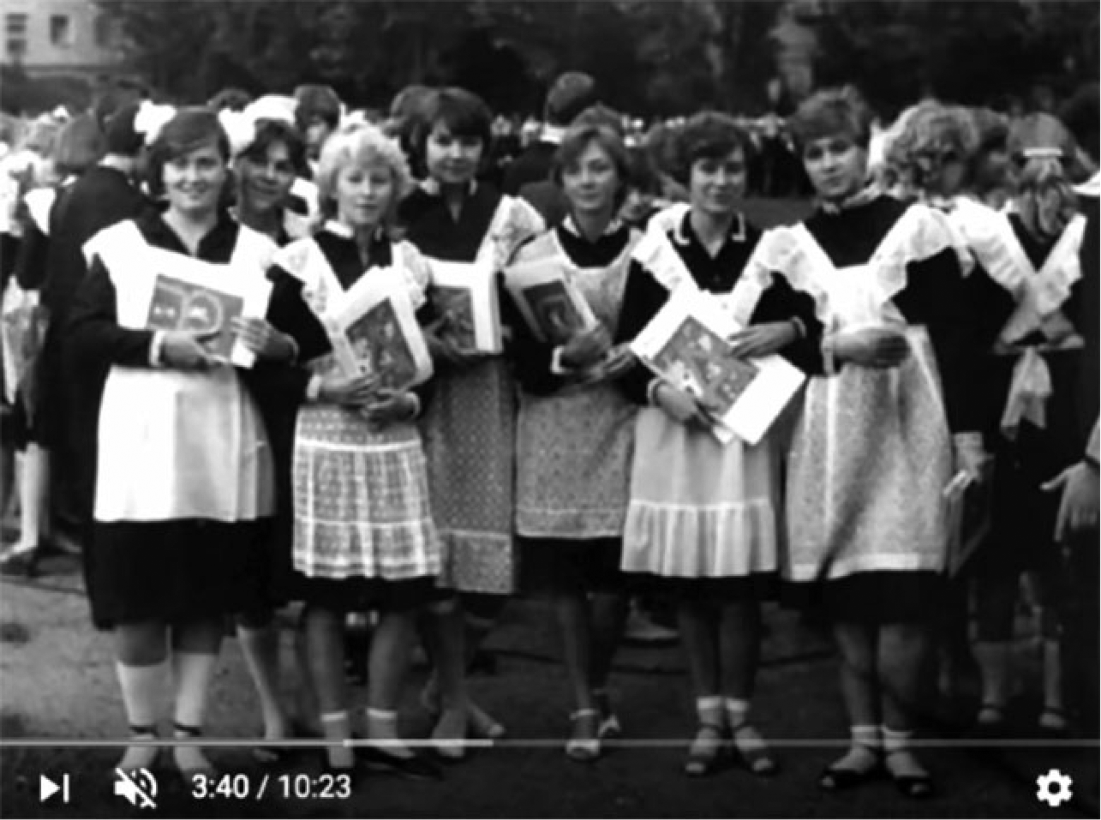
Girls in their school pinafore aprons (video 2, “childhood and youth 70s, 80s, 90s”, posted by elen19782008).
In Figure 1, the girls in white aprons worn in secondary school are holding pamphlets of some sort. The fact that they are posing but that in the background others seem to be milling about lends this photo a more casual note. It seems to be a personal photo, rather than a stock pioneer image from a magazine or postcard.
Images of eating together convey an activity that reinforces the spirit of community and many photos dwell on this aspect of childhood. Photos of children lining up in the school café buttress this idea of collective care, as in Figures 2 and 3.
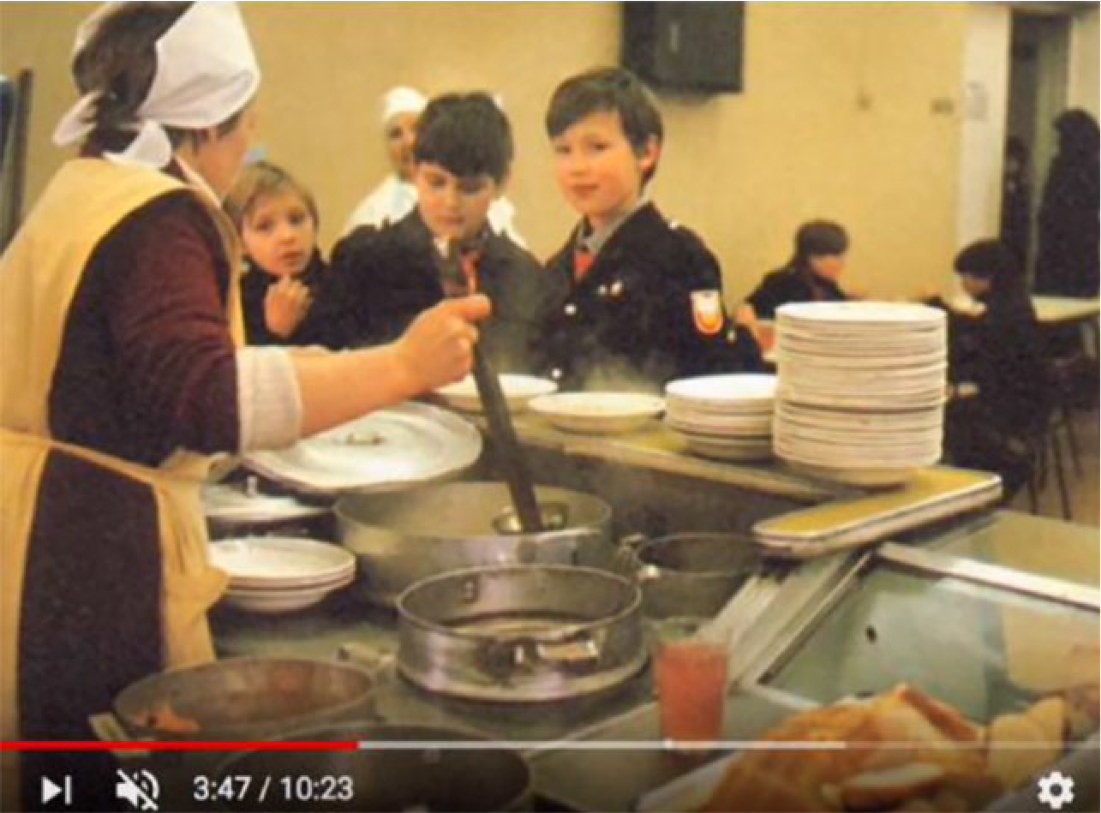
standing in line for school lunch (video 2, “childhood and youth 70s, 80s, 90s”, posted by elen19782008).
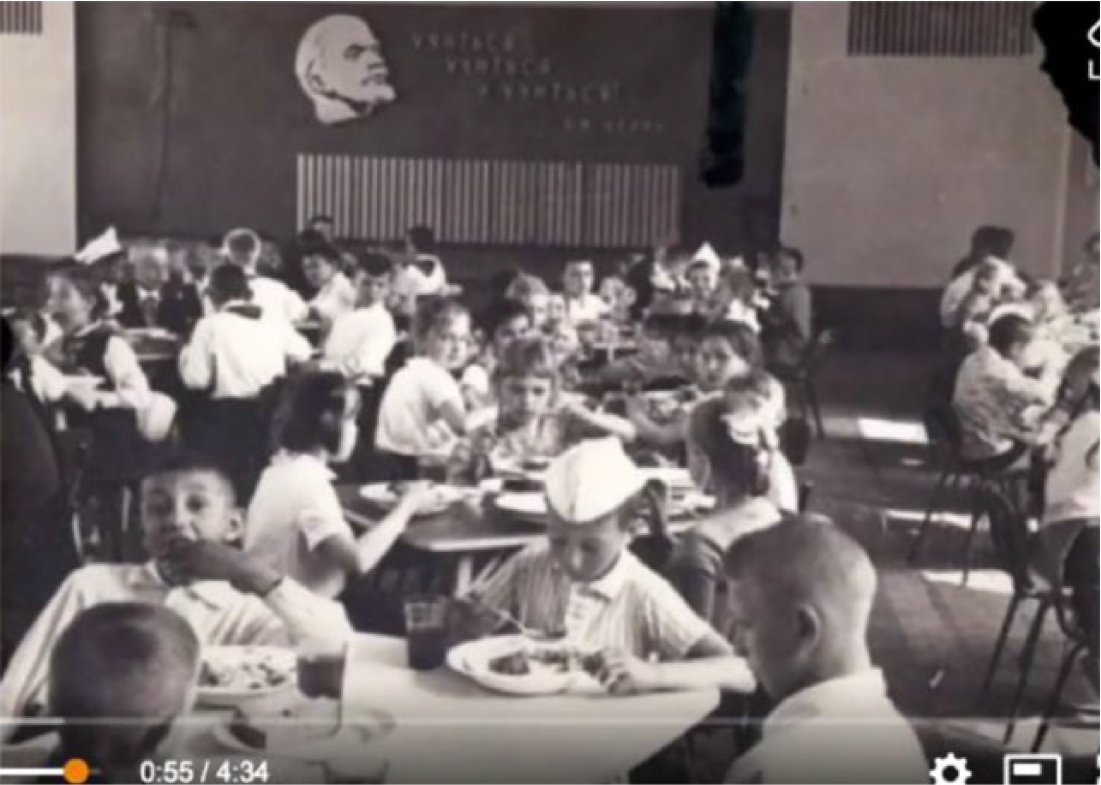
sharing meals in the school cafeteria (video 4, “Soviet childhood - the happiest childhood”, posted by Tatiana Zatrubshchikovy).
Images of children in school activities, learning and playing together, are coupled with multiple photos of children playing outdoors. That childhood in the Soviet era is so often framed in the outdoors speaks of a greater anxiety about the death of childhood, its commodification and the loss of contact with nature and the physical world, as Russia finds itself in the throes of late capitalism. Implicit in the videos and explicit in the positive comments is the suggestion that childhood back then was replete with healthy practices that involved a great dose of proximity to nature. The background of the Russian woods is a common feature in these videos. Nature, untouched and untarnished by efforts of engineering, is the perfect backdrop for many such images of an innocent childhood seemingly unaffected by life and its technologies.
By far the most common setting for childhood memories in these videos is the pioneer camp (Figure 4). The camps were meant to inculcate communist ideals in young children and their activities were centred on the outdoors. In the Soviet period, the pioneer organization was a space to shape young Soviet citizens, not only to be politically conscientious but also to imbibe values of collective effort and solidarity; it was a tool of socialization. However, pioneer memories are often framed as apolitical, emphasizing not ideology but a sense of togetherness and solidarity, situated in the bracing outdoors. This is reinforced in other work on post-Soviet autobiography; Irena Stonkuviene quotes her informants as saying that they loved being pioneers because it was not an ideological exercise, but one of sociality and organized play (Stonkuviene, 2014).
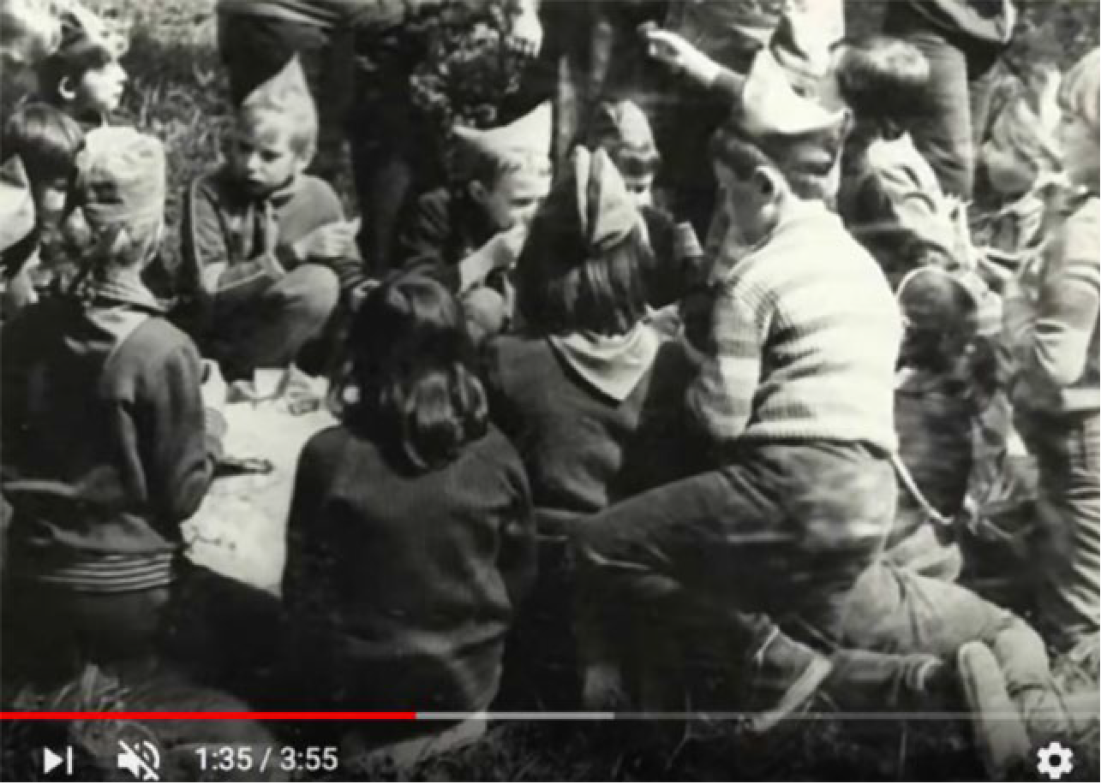
Children in pioneer camp (video 1, “Our Soviet childhood 70-80s”, posted by Eto interesno!).
In Figures 5 and 6, images are testimony to both the perceived conviviality and the healthy physical exertion of pioneer moments (video 4). Common motifs of pioneer memories include the games, the bonfire, and snapshots of children in customary pioneer uniforms and scarves.
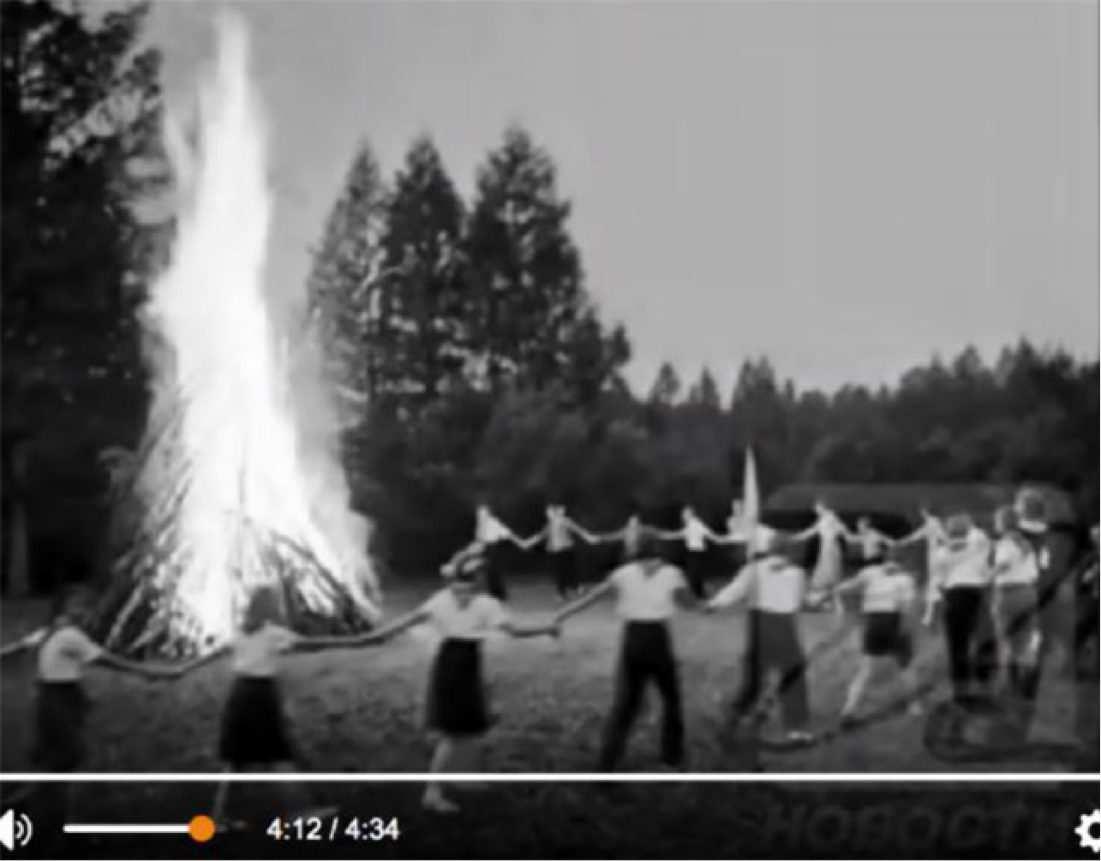
circling a bonfire at a pioneer camp (video 4, “Soviet childhood - the happiest childhood”, posted by Tatiana Zatrubshchikovy).
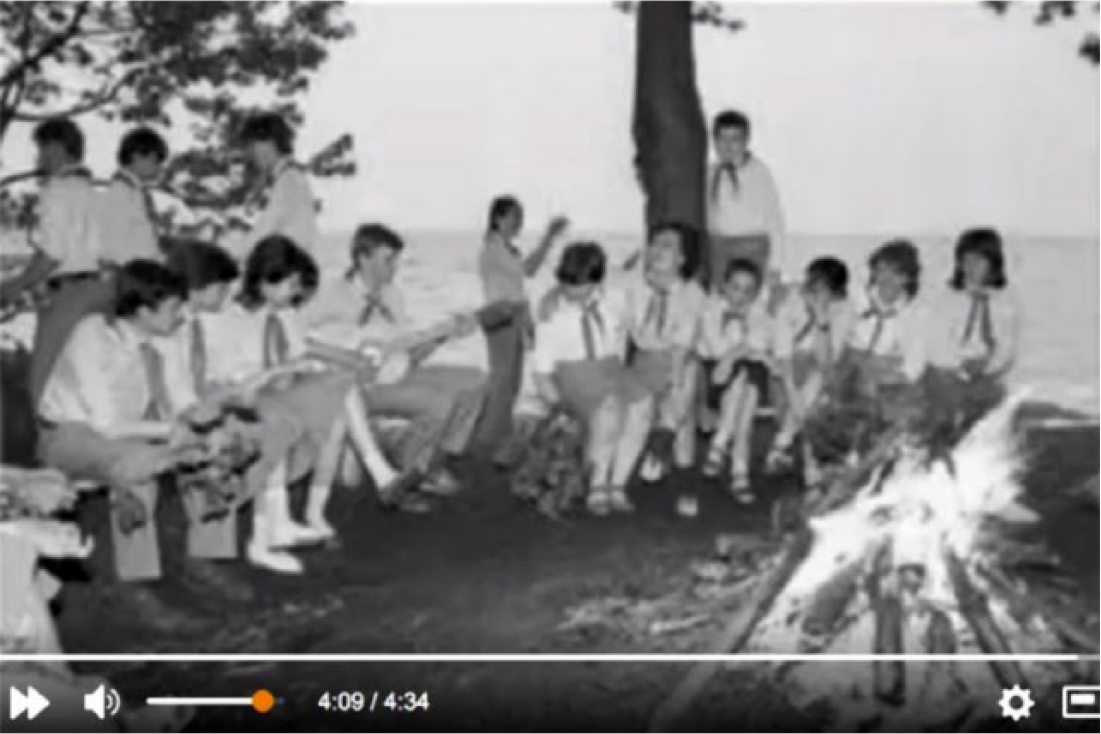
making music around a campfire at a pioneer camp (video 4, “Soviet childhood - the happiest childhood”, posted by Tatiana Zatrubshchikovy).
In stills from video 4 (Figures 5 and 6), pioneer memories that are playful are the main focus. The valorization of an earlier proximity to nature is seen in Figures 7 and 8. In the first image you see young pioneer children trudging through the woods; physical activity, the unfettered freedom of the spatial setting and sociality define the visual. Another still from the same video shows boys and girls at a camp swimming together (Figure 8). These recollections reinforce the strain of memories elsewhere, which have been shown to focus on pioneer experiences as fun and playful and far removed from the ideological.
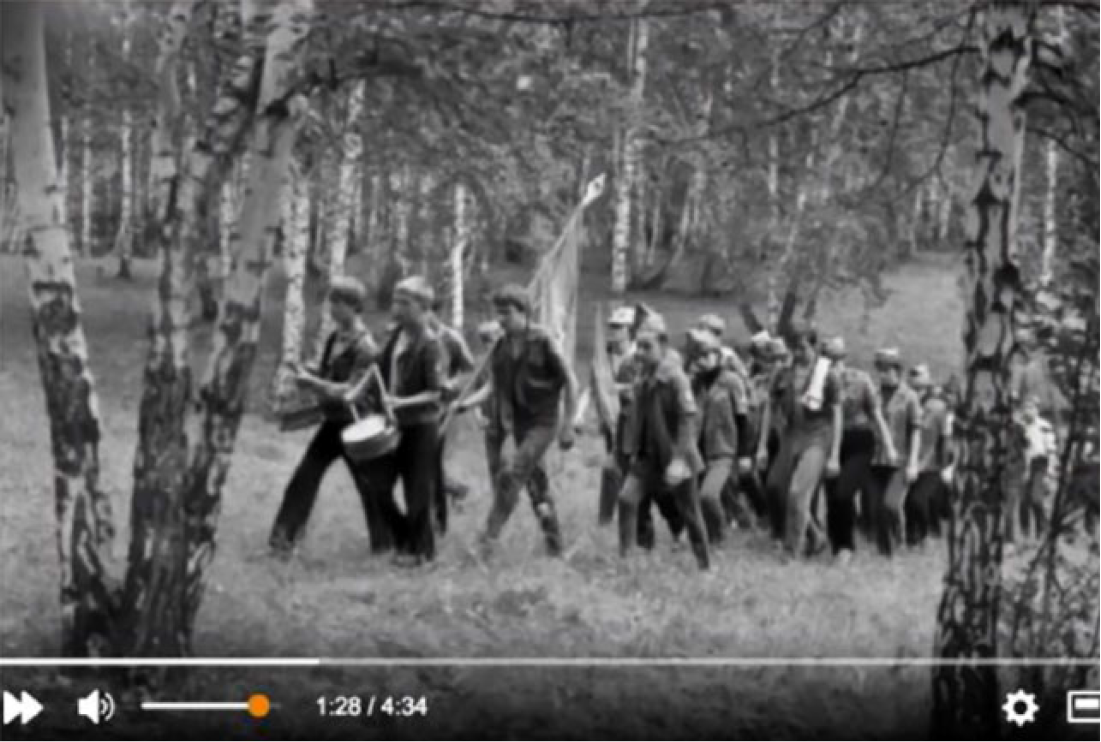
trudging through the woods at camp (video 4, “Soviet childhood - the happiest childhood”, posted by Tatiana Zatrubshchikovy).
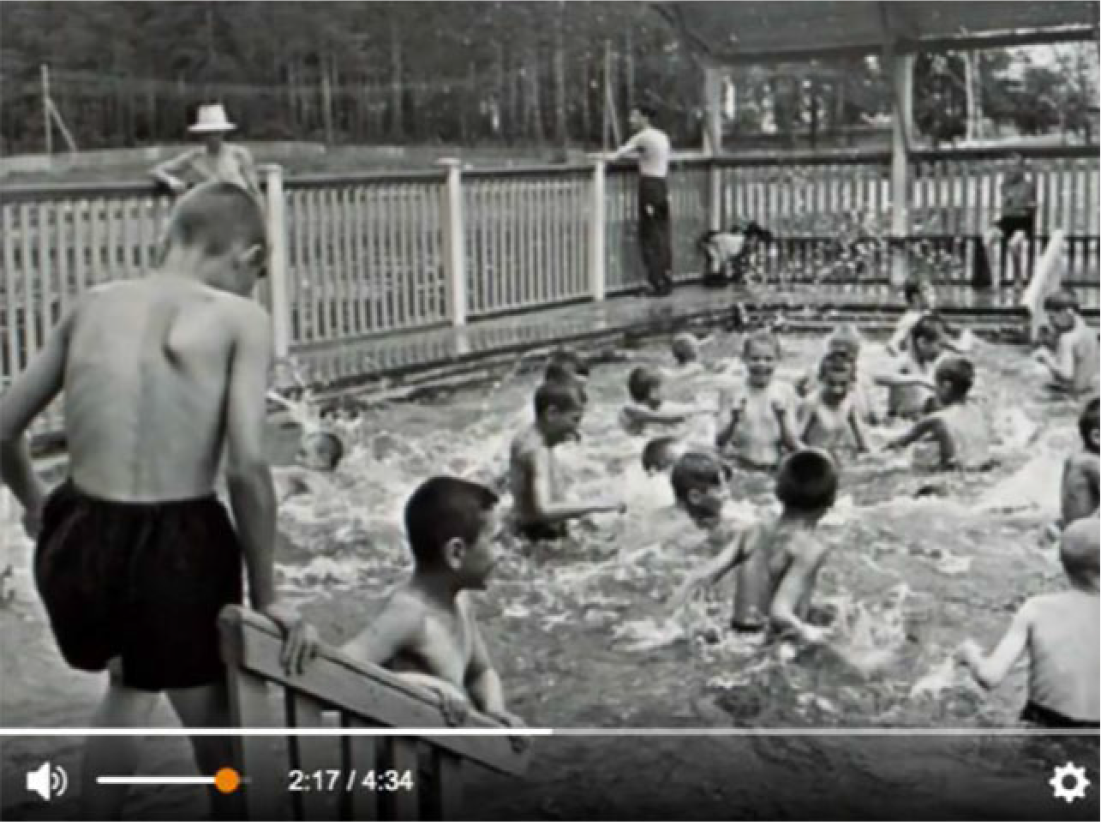
pool frolics (video 4, “Soviet childhood - the happiest childhood”, posted by Tatiana Zatrubshchikovy).
The outdoors in these images are not only the woods but also the courtyard or the dvor, envisioned by Soviet planners as a space for fostering community as well as lateral surveillance. In memories of the dvor, too, it is conviviality and playful activities that are paramount. This courtyard space that bound a community together in a shared, lived environment of a neighbourhood is the setting for memories of a healthy childhood, where physical exertion was common and made for a more robust upbringing. The dvor, being adjacent to the home, had the association of one’s own community and was seen as the extension of the home. In Figure 9 from video 3, you see a group of children playing hopscotch in the dvor, its significance often implied in the commonly used phrase ‘We were raised in the courtyard’ (dvor ons vospital).
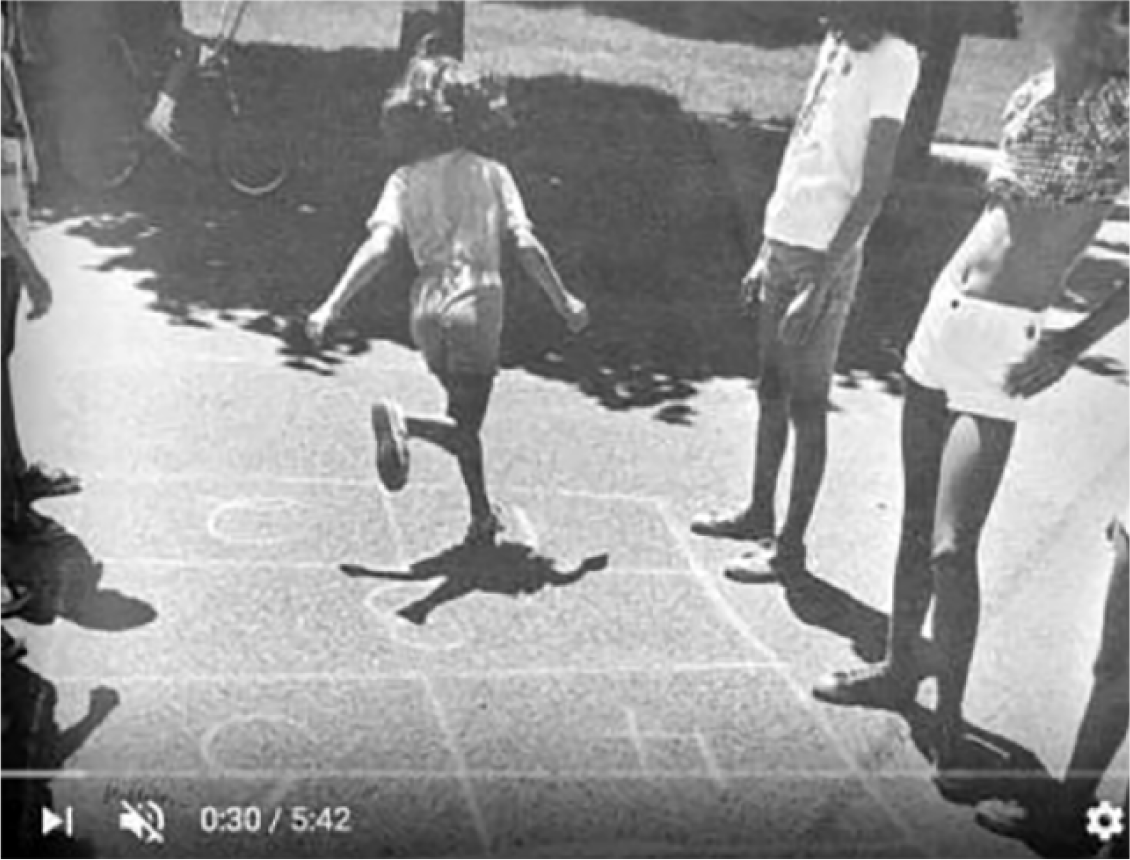
playing in the dvor (video 3, “Let’s remember childhood. From the 70s-80s”, posted by YKRAINOJKA).
The pervasiveness of the dvor as a cultural trope that best evokes the playfulness and freedom of being a Soviet child in present-day memories owes much to the ways that it has changed in post-Soviet times. Anthropologists have documented its diminished social and communal value in cities today (Skvirskaja, 2010). Implicit in these memories of playing in the dvor is the comparison with children’s current preoccupation with technology. The videos suggest that, in contrast with the expansive outdoors of childhood memory, children are now confined in a media bubble. Sometimes this comparison is made evident through the use of an inter-title or a caption as in Figure 10 from video 3: ‘No mobiles, no players, no computers.’ And then in smaller letters: ‘Only snow. White and pure. That blinded us with its brilliance. That is what we loved. All of us.’
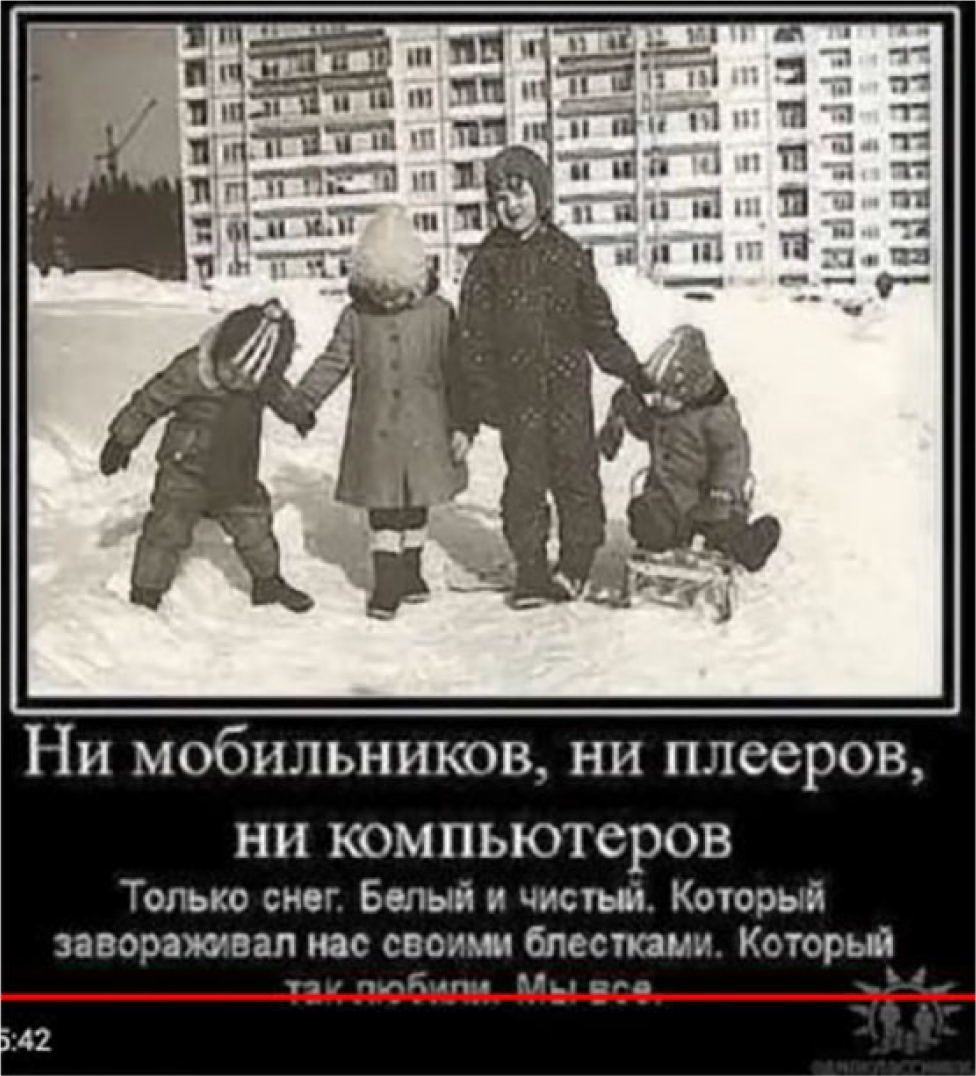
Carefree and device free in the snow (video 3, “Let’s remember childhood. From the 70s-80s”, posted by YKRAINOJKA).
Photos of children on sleds, jumping on a row of car tyres, around a campfire, in snowy landscapes, at camp and playing outside also pervade video 3. Everywhere the implication is the same: childhood was carefree and it unfolded largely in the outdoors, completing the image of a wholesome, idyllic phase of life. The emotional associations of playful togetherness, good cheer and physical exertion that one gleans from these stills also stem from the title of the video and the occasional inter-title. Other such images of children outdoors, being unafraid to get wet, dirty or hurt, all testify to a memory of a childhood that is supposed to be read as carefree and unbound by material preoccupations. The comparison with the present is frequently implicit.
The stuff of childhood memories: endurance and accessibility
Post-socialist nostalgia has strains of moral anxiety about the commodification of culture, a pattern of thought also evident in other late modern societies. This is nostalgia triggered by a culture or an ideology that privileges our identities as consumers. But, paradoxically, there is also nostalgia for the things of earlier times, which are supposed to convey a more sustainable and healthier relationship with the environment. Soviet children ‘needed’ no material things (the videos imply); yet it is material things, related and unrelated, that often figure in videos and give form to their intangible memories. It is common practice for nostalgia to invest objects that have endured with values considered lost (Baker and Kennedy, 1994).
While the images in the camp, the school, the dvor and the woods anchor childhood memory in the outdoors, videos consist equally of images of artefacts that situate childhood indoors. For instance, in the videos it is common to remember school paraphernalia that usually include school props and supplies such as story books and textbooks, both common elements in videos (Figure 11).
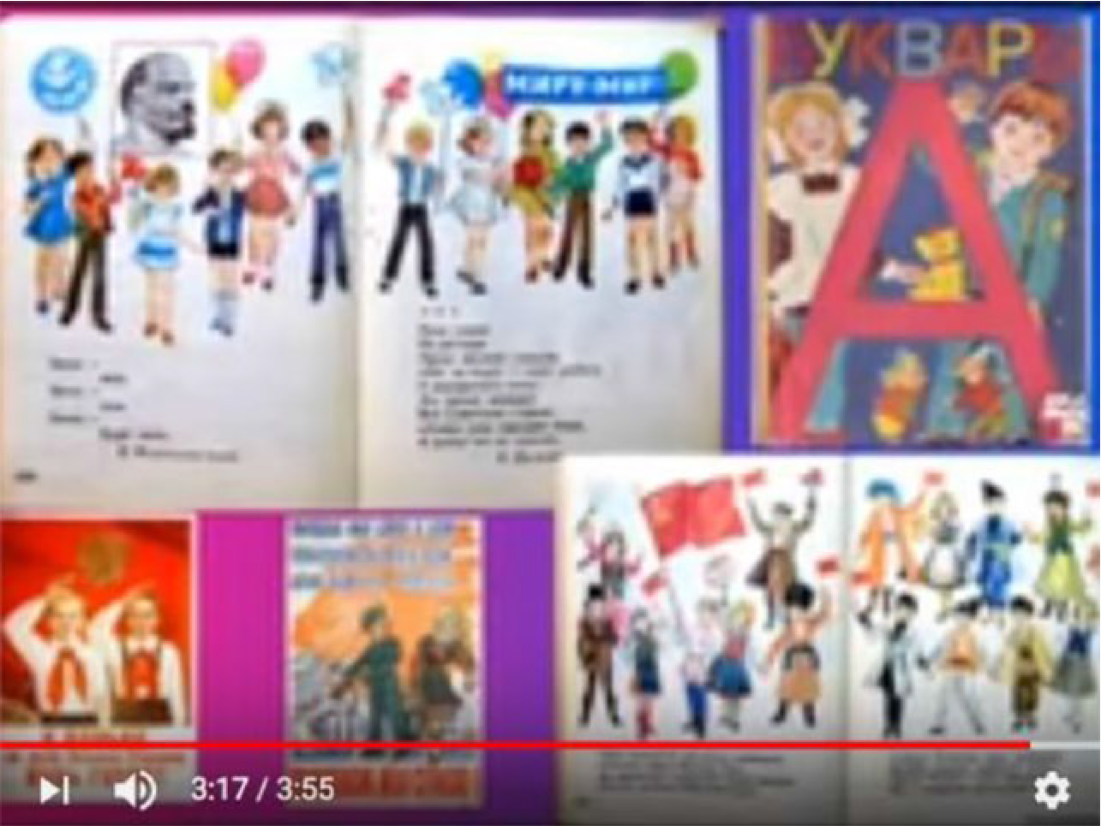
Pages in schoolbooks (video 1, “Our Soviet childhood 70-80s”, posted by Eto interesno!).
In video 1, the images are often collages of assorted objects of childhood: chewing gum packets, toys, blocks, Rubik’s cubes, table-top hockey, paints, Konstruktor (a building set), play-doh, children’s books, an alarm clock, a phone, a tape recorder, perfume and a milk bottle (Figures 12 and 13). These miscellaneous objects, particularly the household artefacts, situate the childhood memory in the home.

a favourite childhood comestible – chewing gum (video 1, “Our Soviet childhood 70-80s”, posted by Eto interesno!).
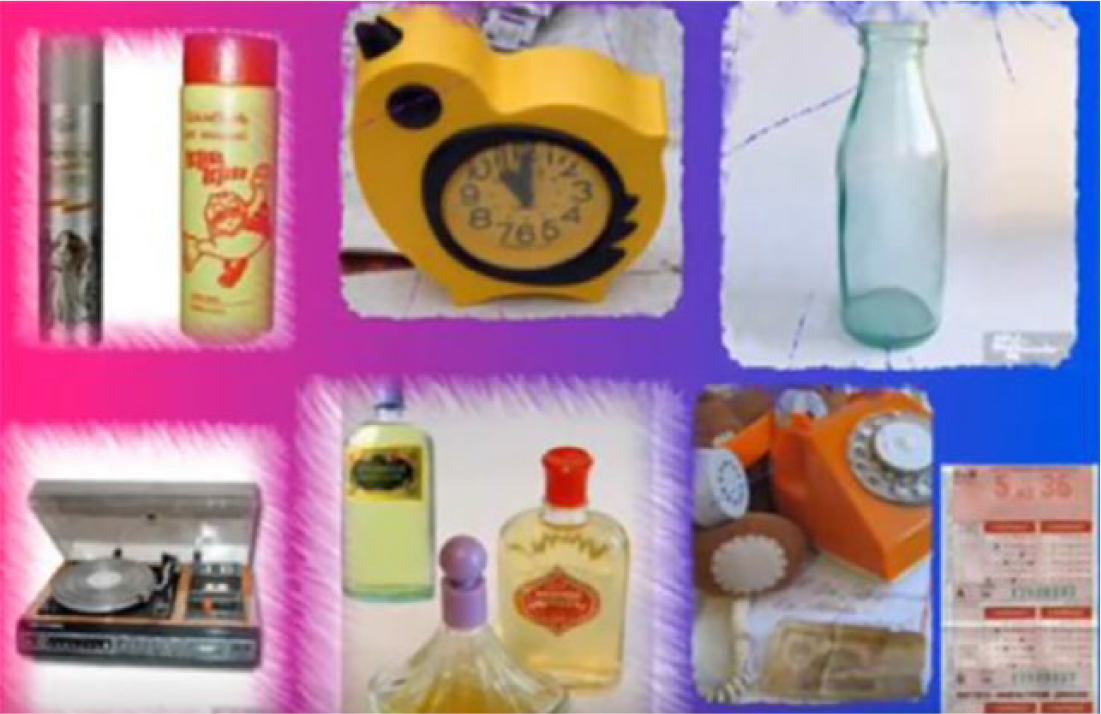
assorted household objects (video 1, “Our Soviet childhood 70-80s”, posted by Eto interesno!).
For those remembering childhood, toys are a natural trigger for memories, as are other objects associated with that life-phase (Figures 14 and 15). Elizabeth Wood refers to these childhood objects, to which we now attribute values we claim to miss in the present, as ‘toys of agency’; these toys build conceptual bridges between personal identity and collective history (Wood, 2009: 119).
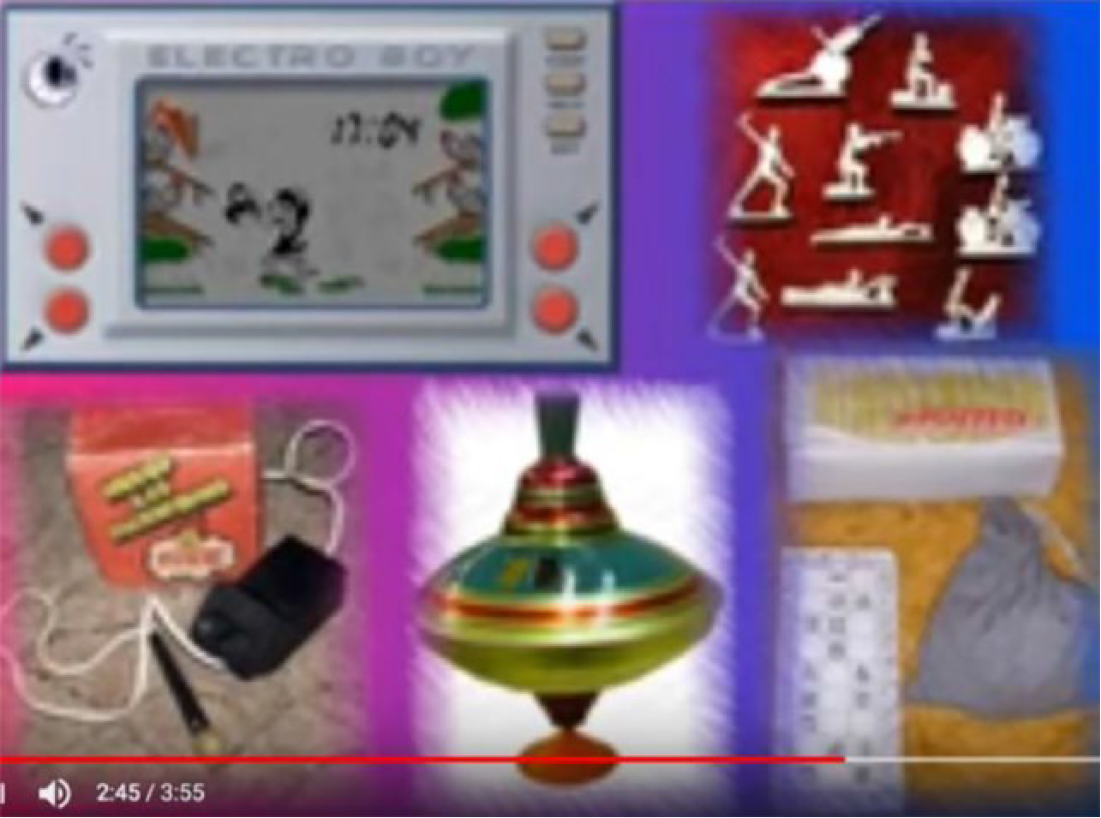
assemblage of iconic toys and games (video 1, “Our Soviet childhood 70-80s”, posted by Eto interesno!).
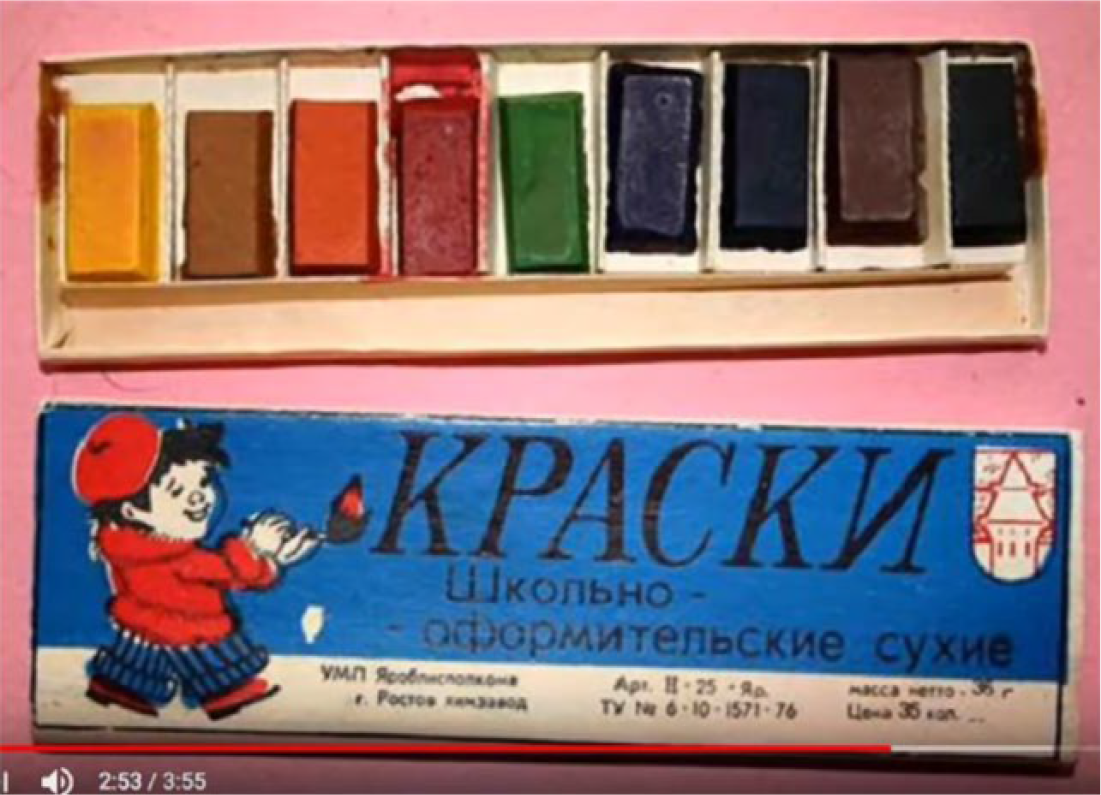
a much-used box of paints (video 1, “Our Soviet childhood 70-80s”, posted by Eto interesno!).
Some video montages have textual interpellations that explicitly proclaim the superior quality and durability of past things. Video 2 has inter-titles and captions such as ‘Every Soviet girl had a doll like this’, ‘And by the way these machines didn’t sew too badly’ and ‘They don’t make cars like these any more’ to accompany the images (Figures 16, 17 and 18).
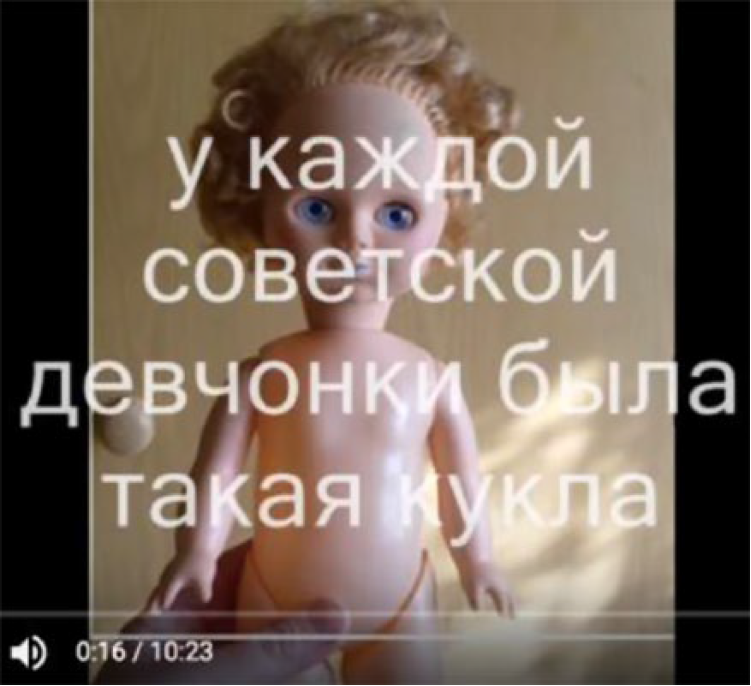
doll with superimposed text ‘Every Soviet girl had such a doll’ (video 2, “childhood and youth 70s, 80s, 90s”, posted by elen19782008).
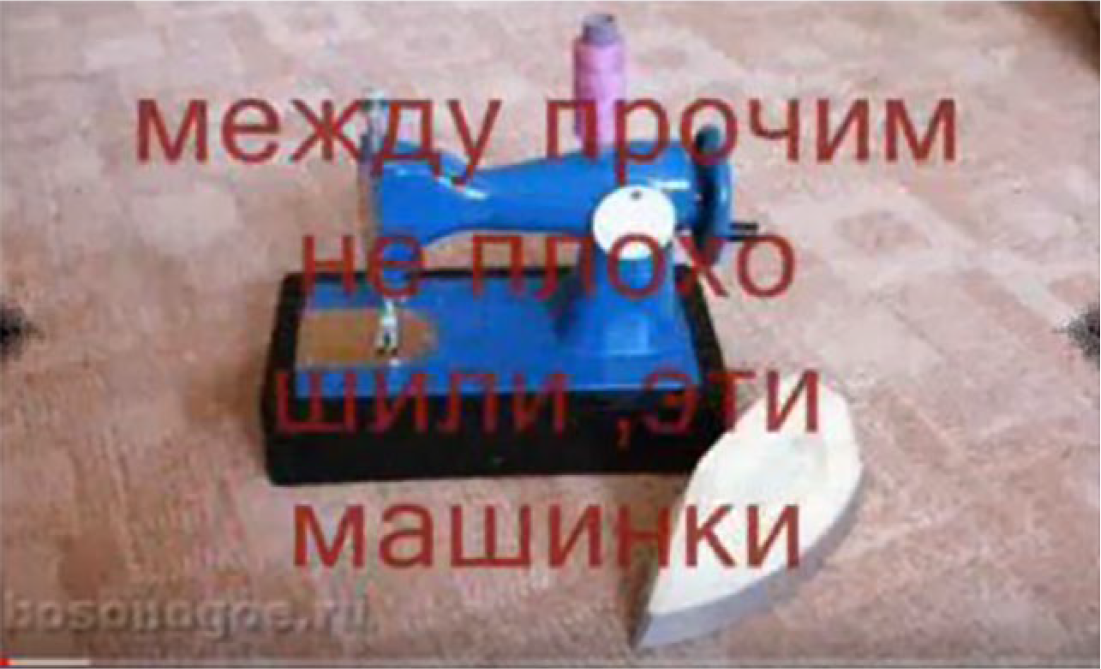
a sewing machine (video 2, “childhood and youth 70s, 80s, 90s”, posted by elen19782008).
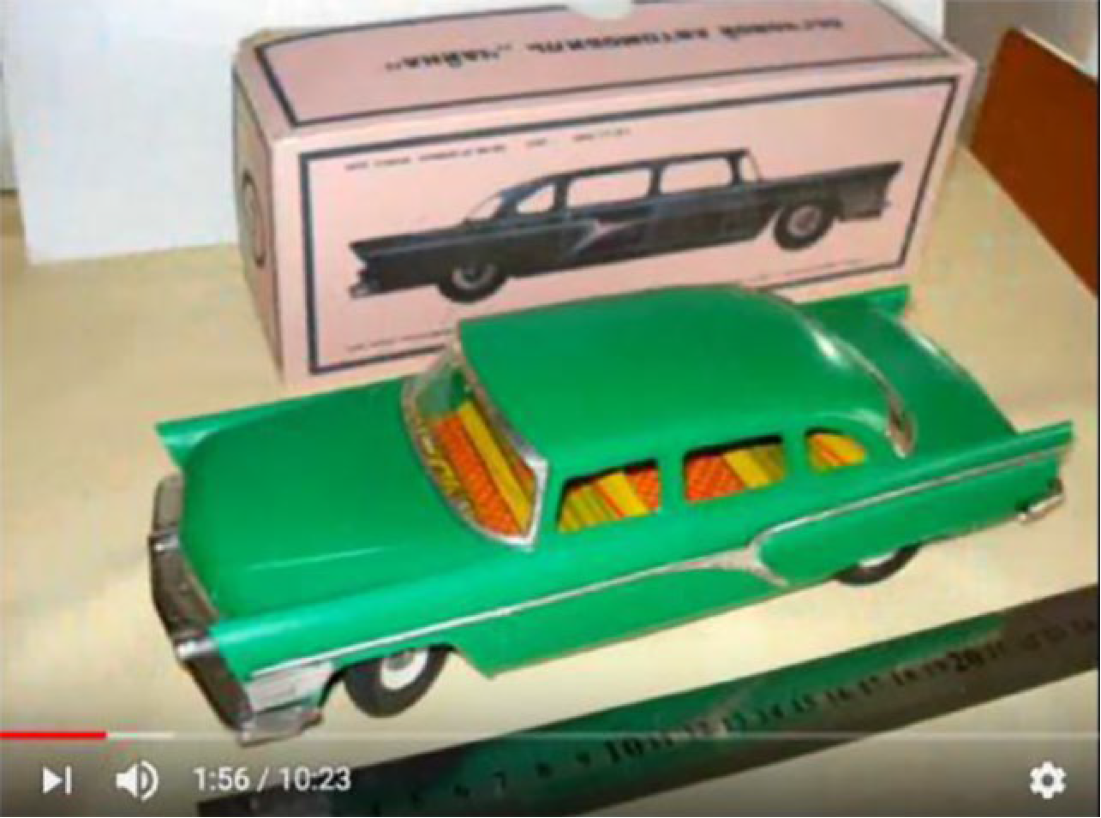
car models preceded by text ‘They don’t make cars like these anymore’ (video 2, “childhood and youth 70s, 80s, 90s”, posted by elen19782008).
In such videos it is clear that the purpose is to document something that has been irretrievably lost, and replaced by something less than ideal. The fact that they ‘don’t make cars like these any more’ indicates a greater longevity and durability of not only things in the past, but also the intangibles, such as the pleasure and conviviality that those toys evoked. ‘Boys do you remember your pistols?’ is the next text that introduces a series of images of toy rifles (Figures 19 and 20), cannons, tin soldiers and a Konstruktor (famous Soviet toy brand) helicopter.
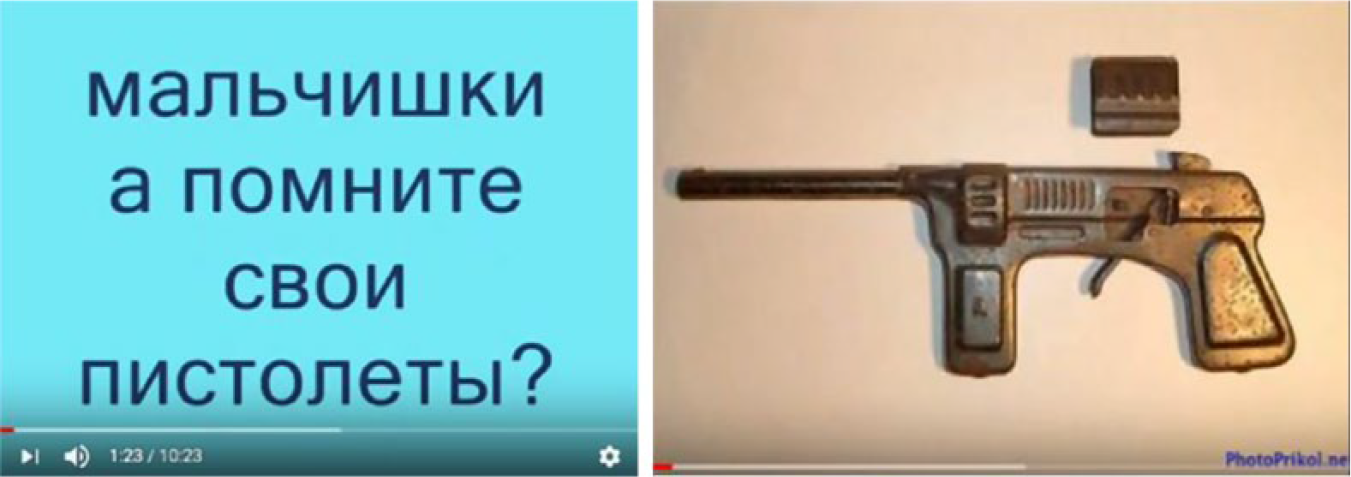
‘boys, do you remember your pistols?’;
Shots of digital games, table-top hockey and the Rubik’s cube are juxtaposed with the text ‘This is what we played with instead of computers’ (see Figures 21 and 22).
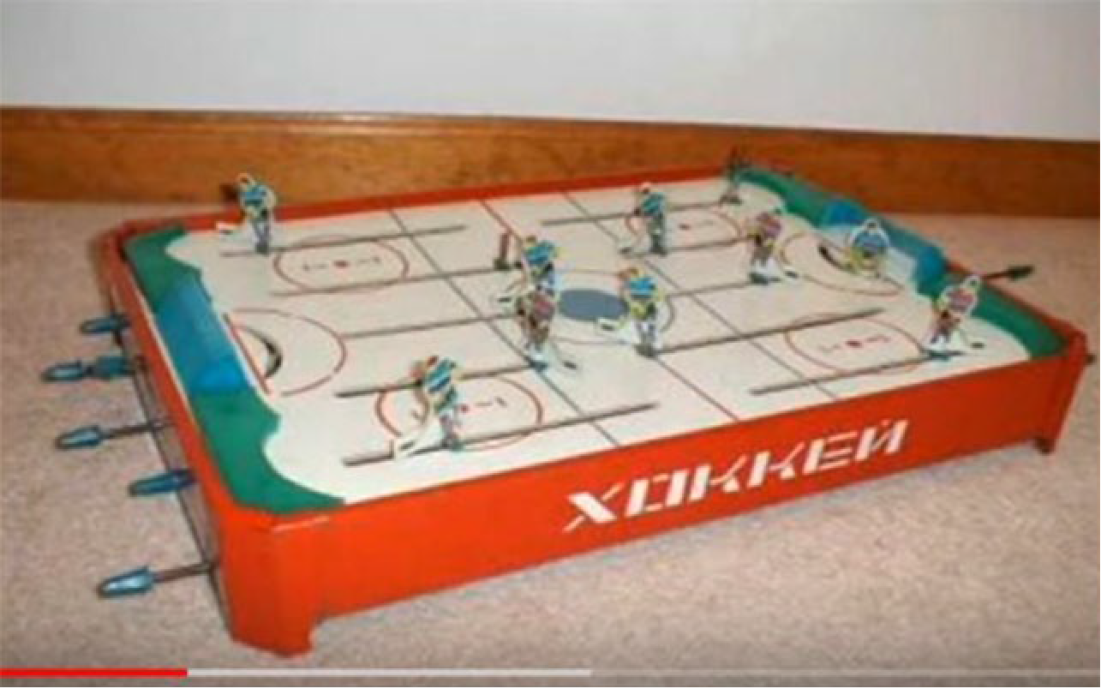
Tabletop hockey game (video 2, “childhood and youth 70s, 80s, 90s”, posted by elen19782008).
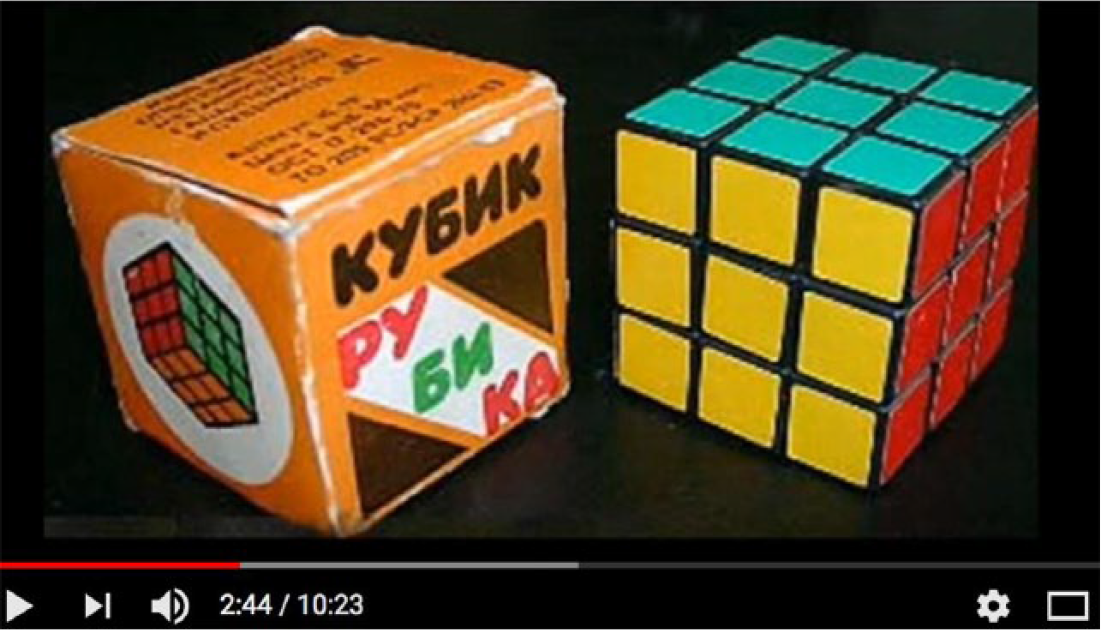
A Rubik’s cube (video 2, “childhood and youth 70s, 80s, 90s”, posted by elen19782008).
In their work on post-socialist nostalgia, writing about the nostalgia for socialist goods, Nadkarni and Shevchenko suggest that these socialist things come to embody new significance and value in a time when past utopian dreams of an idealized West have been crushed and the illusion that under capitalism abundance would be the norm (and not a privilege) appears to be just that – an illusion. The objects associated with childhood are special because everyone had them, as the inter-titles routinely tell us. It is not so much the aesthetic and functional value that makes them memorable now, as the communality, sociality and general accessibility with which they have come to be associated.
Sovietness
Finally, childhood videos emphasize the Sovietness of that experience, where Sovietness refers to this childhood’s rootedness in the Soviet political and symbolic milieu and the routine performances of one’s relationship with the Soviet state during childhood. Although childhood memories are considered apolitical, images believed to suggest an idyllic phase of life are casually interspersed with images of Soviet political icons that peppered the Soviet landscape. It is difficult to evaluate, on the basis of the videos alone, whether these patrons are seen as pivotal to the existence of that moral regime that is now missed or simply its incidental purveyors. Nevertheless, the references to this larger politico-historical context and its institutional markers make these memory texts ‘personal cultural memories’, in which personal memories are always articulated in relation to existing cultural memory frameworks (van Dijck, 2007).
Countering detractors’ assumptions that these nostalgic recollections of childhood are a simple, universally shared template of childhood memory, video montages stress this memory’s historical contingency. They mount their visual recollections of Soviet childhood between several frames that commemorate Soviet public spaces and political icons as part of their symbolic vocabulary. Sovietness is visually conveyed through a spectrum of images of everything from institutional icons to street scenes that clearly mark the setting as socialist and Soviet. In Figures 23 and 24 we see two positive associations that school and Pioneer memories evoke: discipline and solidarity in the performance of Sovietness. The two images show children engaging in forms of official and disciplinary exercises.
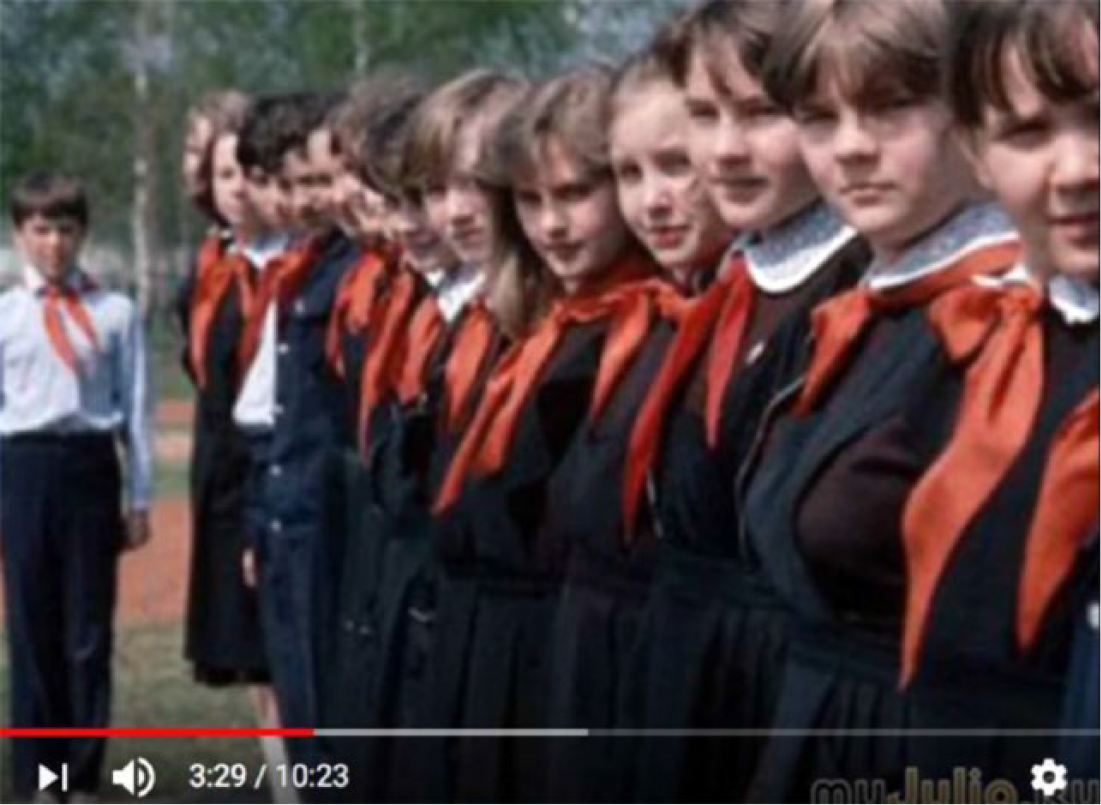
Children with pioneer scarves on, lining up in school (video 2, “childhood and youth 70s, 80s, 90s”, posted by elen19782008).
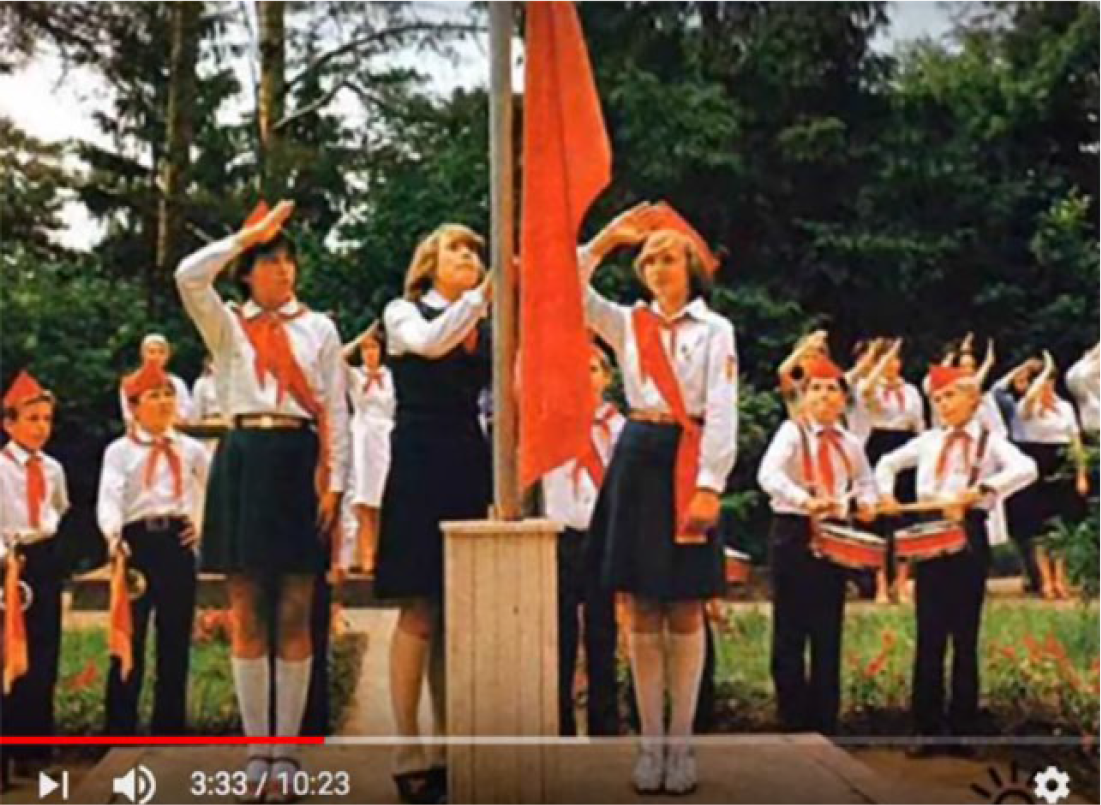
hoisting and saluting the Soviet flag (video 2, “childhood and youth 70s, 80s, 90s”, posted by elen19782008).
Childhood was replete with such gestures that formed the basis of a patriotic education and the video makers select such moments as markers of the Sovietness of childhood. In all the videos, one of the opening shots is invariably of the Soviet map and/or the flag. Images used often tend to be of school plays or other events under the watchful eye of either Lenin or Brezhnev (Figure 25).
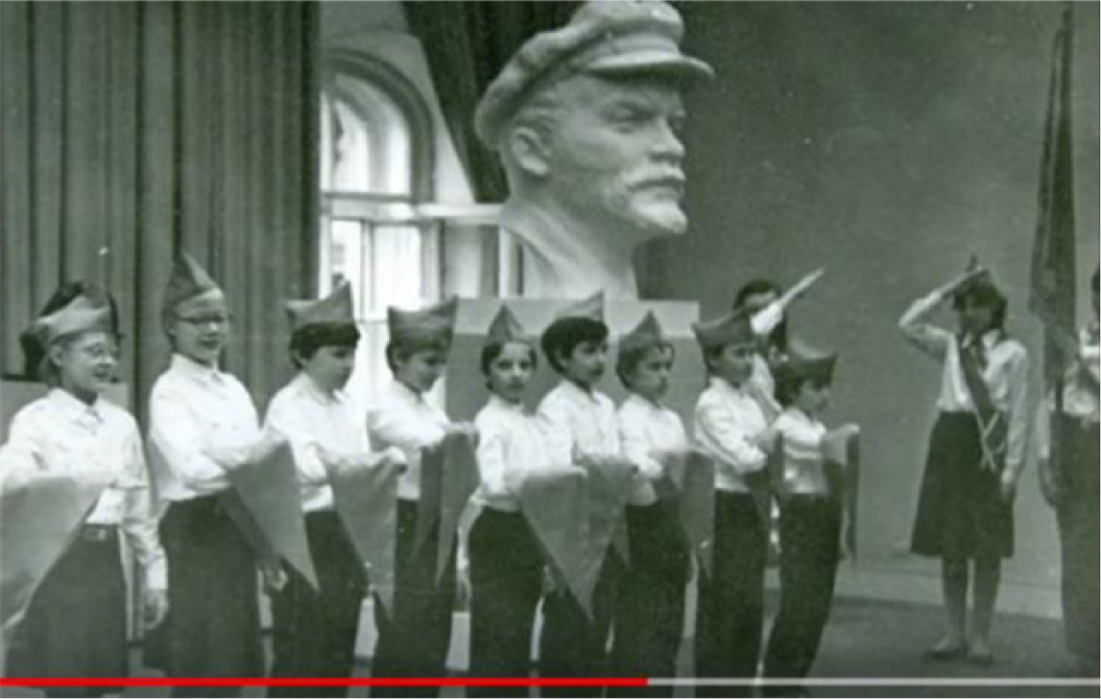
hinitiation ceremony for young pioneers, with older pioneers looking on. A prominent Lenin bust is also witness (video 1, “Our Soviet childhood 70-80s”, posted by Eto interesno!).
Childhood, remembered this way, had the ultimate patron in the leader of the state. The video memories of the political moorings of socialist childhood also include commemorations of pivotal historical events, such as the victory in the Second World War. The presence of war poster images is striking considering that those doing the remembering now did not actually live through the war, but this is not unusual. ‘Nostalgia is not only evoked by the personally experienced past, but it may also be evoked by collective understandings of the past, a past which even may have occurred before an individual was born’ (Baker and Kennedy, 1994; Stern, 1992). The inclusion of war photos in memories of late Soviet childhood represents inherited memories linking personal and collective identities, and connecting intergenerational experiences in memory. It is also quite common to see a series of postcards that commemorate Soviet leaders. These would have been ubiquitous images during their childhood and, for those remembering, an intrinsic part of their memories of growing up.
Other memories of childhood become associated with events that placed the USSR on a global stage, such as the Olympics mascot Misha (video 1). Photos of newspaper headlines that mark that historical time also pervade these memory videos. The ubiquitous passport image, an odd thing to remember in a video about childhood, also defines the child’s identity as Soviet (Figure 26).
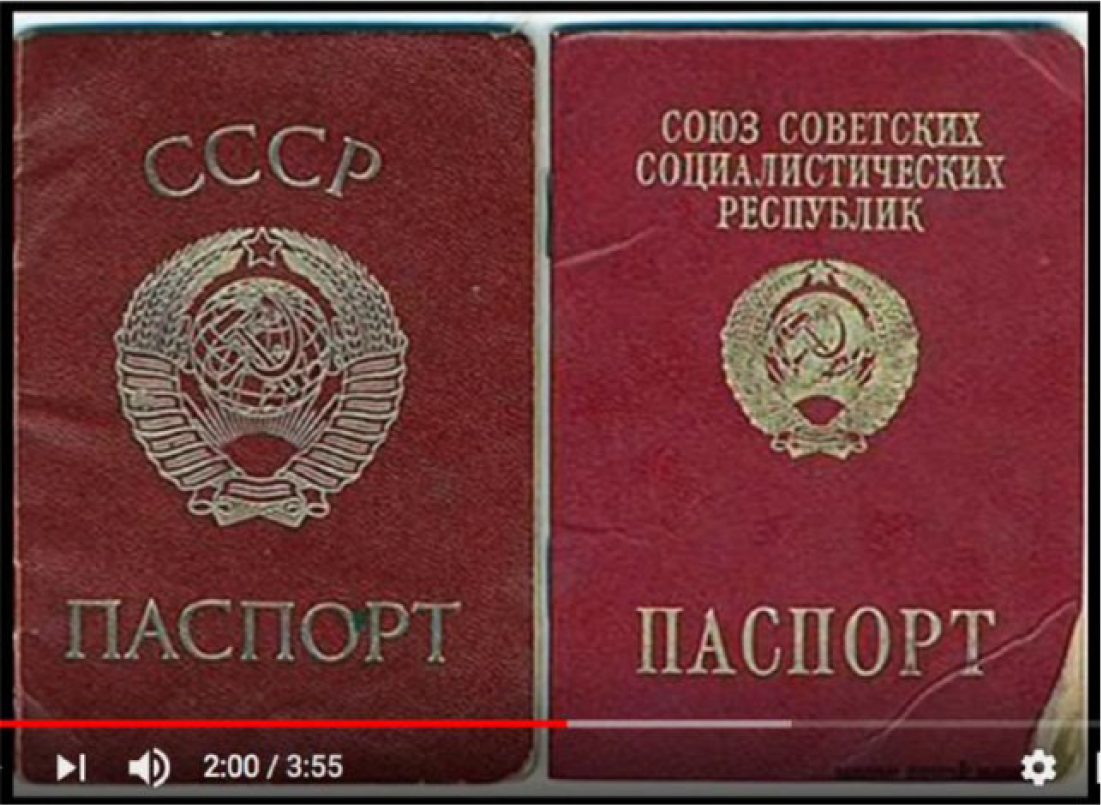
Soviet passport (video 1, “Our Soviet childhood 70-80s”, posted by Eto interesno!).
Sovietness also resides in the banal objects of everyday life that populate urbanscapes during a socialist childhood. Unlike the personal objects of childhood, here I refer to images of Soviet public spaces. One of the most widespread images in these videos is that of the famous soda water dispensers that made up the architecture of the Soviet cityscape. In video 1 there are photos of some of the countless such water dispensers that appear in childhood memory videos.
One such image is followed immediately by a photograph of Brezhnev and then, shortly afterwards, a postcard of pioneer children saluting the flag. The succession of images in Figures 27–30, tie in the banal and the stately with childhood, rendering a childhood bound to the state in its values and discipline in the final photo of the Pioneers.
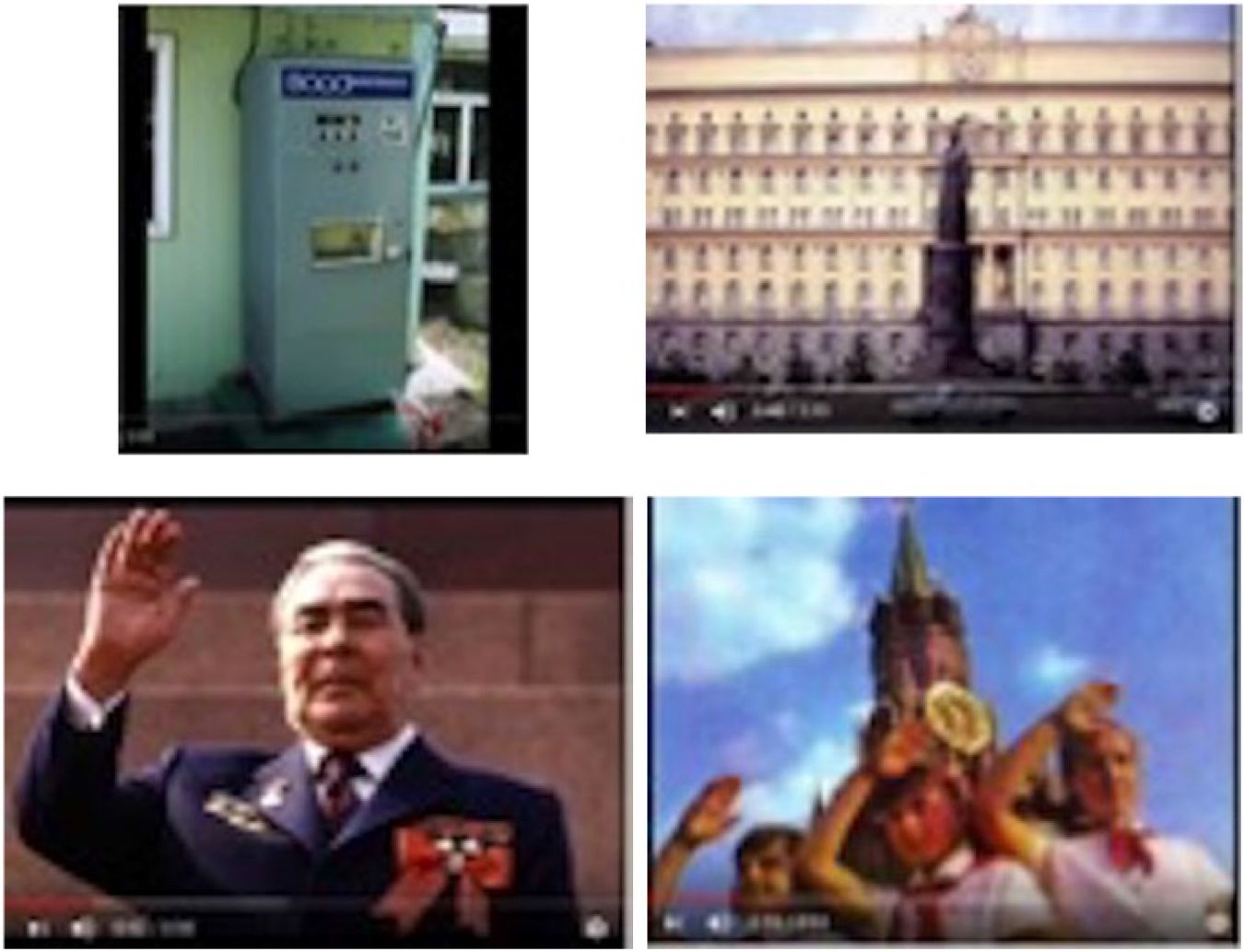
Successive images of a soda water dispenser, Lubyanka square with the monument to Feliks Dzerzhinsky, Brezhnev, and a Pioneer postcard (video 1), “Our Soviet childhood 70-80s”, posted by Eto interesno!).
Video 3 similarly begins with a shot of queues, that all-too-common image of life under socialism (Figure 31). Where shortages have become iconic of the system for those harbouring negative perceptions of socialist experiences, the creative project of combining these photographs of queues with images of personal importance and value diminishes the negative significance of shortages in the overall cultural memory of the past. It is one of many memories, and the positive ones balance or outweigh these memories of waiting in line.
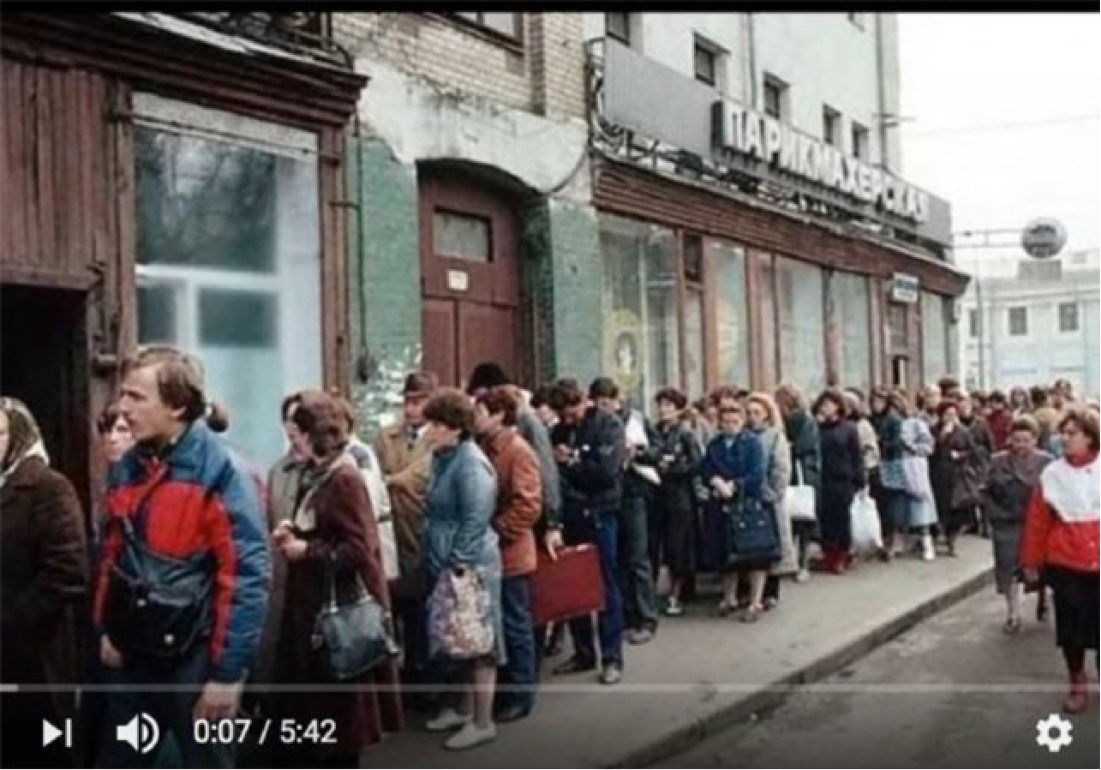
a serpentine queue (unclear what it is for) (video 3, “Let’s remember childhood. From the 70s-80s”, posted by YKRAINOJKA).
Images of people queuing up to acquire provisions follow other pictures of women selling everyday wares. Visuals of what was commonly witnessed in public spaces are combined with stills from TV; the routine snapshots of everyday life, both mediatized and unmediatized, become associated with that time of being a child. The image of two men playing chess (Figure 32), a common sight in courtyards and parks, is also a memory of the seemingly unhurried pace of life in the past, unhampered by anxiety of any kind. Together with images of children playing, these banal images of childhood illustrate an emotional memory that offsets the paternalistic connotations of the looming statues of Soviet leaders in the same montages.
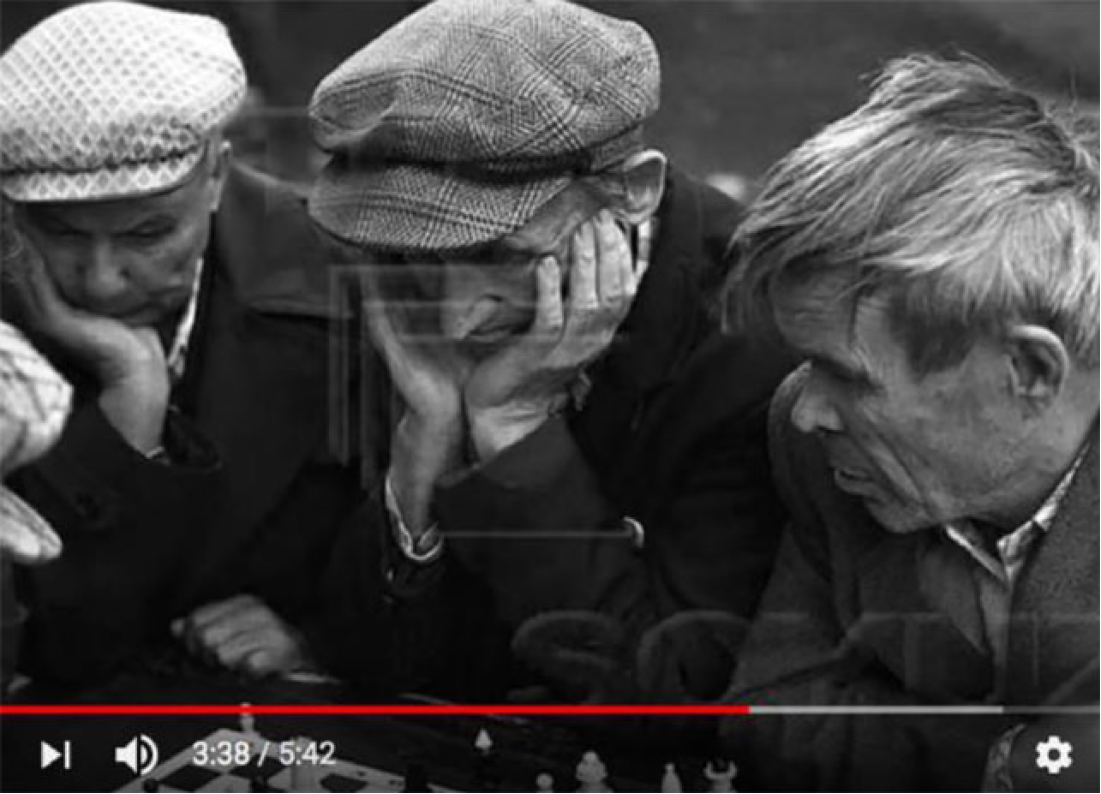
men slouched over a game of chess (video 3, “Let’s remember childhood. From the 70s-80s”, posted by YKRAINOJKA).
The role of the audience in the performances of emotional memory
Like other performances of popular memory, the memory work in the videos is ongoing and also routinely contested, making it personal, collaborative and part of identity work. This popular memory work relies on ‘voluntary participation of ordinary people in selecting, producing, or performing interpretations of distant or recent historical events’ (Haskins, 2015: 2). Different ways of remembering mean that the collaborative project of memory work is also a negotiation and contestation of what is remembered and how things are remembered. As Kuhn argues, because visual memory texts are not autobiographical and do not embody a singular point of view, the interstices in the text offer room for those commenting to offer alternative views of the past. ‘Personal, memory-images and memory-stories’ are drawn ‘into a broader seam of collective, shared remembering’ (Kuhn, 2010: 303).
While childhood may be framed as an apolitical memory, those who read and respond to the videos read them politically; they interpret the explicit and implicit claim to the superiority of childhood in the past as a generally positive assessment of Soviet life and respond accordingly. Discussions below the videos veer from comments on the themes or objects and settings in the videos to other contentious issues in personal and collective memory. Comments segue from childhood to touch upon the state of the Soviet economy, leadership and bureaucracy in the past and present. Spanning several years, the comments below laud the videos and generally suggest that their emotional memory work has resonance among many. However, the forum also sees contestations between appreciative viewers and others who insist such memories are short-sighted or incomplete and counter them with ‘factual’ information about the inadequacies of the Soviet past. Such memory work is ‘marked by the affective state of the participants, in a state of becoming’ (i.e. always open for new inscriptions), and ‘dissensual’ by definition (Knudsen and Stage, 2012: 429). For instance, the comments posted under video 1 begin by commending the author of the video for sharing such touching memories. One comment reads:
We lived well, worked hard…. We are united in our memories of good times, quality food, medicine, housing, stability and confidence in life, and everything free for people! If only that scum Gorbachev would die. (Golubevod68rus, November 2016)
Responses to this comment and the video contest these emotions with the presentation of purportedly ‘objective truths’. Emotions in the video memory only tell half the story, others imply. In the following exchange the presentation of a counter-memory of shortages, deficits, triggers a discussion that compares material and political circumstances then and now. See this interaction between Vera Dubkova, Red Tom and julia77458: 3
Red Tom which period are you talking about when you talk of the abundance of sausages, and where were you living? I lived in Gor’kii, by the way, which was shut off to foreigners, and we didn’t have sausages or butter in the stores from 1978 onwards, and neither did we get pickles, which was only available for diabetics on a token basis …
But where we lived, Verochka, we had everything. Maybe not five sorts of sausages, but two to three. And cheese and sour cream. Everything depends on who is the regional director.
Gorkii was closed, so it was possible to starve the people at will. Stores were not uniformly stocked across the USSR; they were not stocked according to the principle of those who contribute more will be provided with more, but some other principle, as one person said in a Soviet comedy: Learn, student, only those who do not work exist.
If childhood in the video is cast in national frames, viewers undermine that attempt by pointing to the vast diversity in the lived experience of late socialism across this massive country. Responding to the same childhood memory (video 1), Sergey Eglitis uses it to compare Western capitalism unfavourably (a standard discursive strategy when faced with critique of the Soviet system). He then adds that in the past everyone had access to basic resources, the kind of which people in the West only dreamed about or still can only aspire to. Tamara Dark continues this thread in a retort to a more sceptical Bryan Robson, by emphasizing the Soviet guarantee of employment, the absence of age discrimination at the work place, ‘free’ housing, paid vacations, and three-storeyed cottages. This gets her plenty of gratitude from other posters, until Viktorios Shevshenko ends the discussion with a crushing comment that the nostalgia the video triggered was for one’s youth, and had little to do with the actual reality of socialism then or later. And so the back and forth of memory work continues, enabled by one person’s video argument about Soviet childhood.
It is evident that in the comments the preferred memory of the video has more takers than alternative memory scenarios. Personal challenges to the memory in the videos are seen as adversarial in that comments space, as it appears a consensual memory discourse must prevail within this mnemonic community of posters and viewers. Posted as an apolitical memory of Soviet childhood, the nature of the digital platform transforms this memory text into a contested performance, whose audience then goes on to make it deeply political memory work.
Conclusion
In the videos explored here, visual icons of the past, such as photos of material objects, people and places back then are integrated to create and share multimedia memories of childhood. These memories that emerge in the communicative circuit of social media destabilize the boundaries of what is acceptable history and what is history to be rejected; the history that makes you who you are today becomes a personal negotiation. To those who post, and to many who reinforce their nostalgia in comments below, the sheer objective detail or the external conditions of life in Soviet society are not relevant beyond a certain point. The structure of feeling that the videos embody, the latent emotions that they unveil, supersedes any factual information offered to offset that emotional memory. The remix videos and the comments they generate together constitute memory work, rife with emotional contestations of what it meant to be a Soviet child. Embodying the mnemonic imagination, this restaging of childhood helps articulate a position that is perceived to be subsumed, or simply absent, in cultural memory narratives. The memory work in the videos uses people, objects and places to foreground remembered attributes of late Soviet childhood – conviviality, a healthy outdoors life, the simplicity and durability of Soviet things, and the historical contingency of that experience. The videos suggest that late Soviet childhood was happy and the post-Stalin era of Soviet history was, quite simply, normal. The remembering of their seemingly apolitical childhood renders the participants on these sites ‘coherent subjects’, with a history that is centred rather than ruptured. In this sense, their performances of emotional memory are essentially political performances.
However, since nostalgia is not intrinsic to what is remembered but is articulated in the ways people relate to what is remembered, videos meant to be read nostalgically also meet with other responses. The digital videos recalling childhood in the socialist era are thus conduits of emotional memories (in their video form and in the comments below), coming to embody a network of memories that act upon each other. Nostalgia is never alone in this memory work; it must always jostle with other emotional responses in public memory sites such as these video-sharing platforms. In this space of conflicting emotions, the memory of childhood leads to deeply political contestations about factual and remembered history.
Finally, emotional memory work in the video sites renders the Soviet era itself as ‘a childhood’, a period of political innocence and stability, defined by the simplicity of its ideological certitudes. Everything since then is experienced as a coming-of-age moment.
Footnotes
Declaration of conflicting interests
The author(s) declared no potential conflicts of interest with respect to the research, authorship, and/or publication of this article.
Funding
The author(s) received no financial support for the research, authorship, and/or publication of this article.