




Abstract
Celebrity advocacy has become an important part of the way in which development non-governmental organizations (NGOs), and charities more generally, try to achieve social and political change. Yet research into how different audiences respond to such advocacy is parlous. This article presents findings from two large surveys (1111 and 1999), focus groups (9) and interviews across the charitable sector and celebrity industries to explore those responses. These data suggest that celebrity advocacy is not a particularly popular phenomenon, but it is widely believed to be so. Celebrity advocacy is thus firmly entrenched in post-democratic politics and part of the public alienation from politics that term describes. Nevertheless, because celebrity advocacy also works well with political and business elites it may still be a good vehicle for pursuing some of the goals of development advocates.
There has been a quiet revolution in charities’ approach to relationships with celebrity supporters in the last 15 years. They have become much more organized and systematically arranged. Most of the larger charities employ full-time celebrity liaison officers (with titles like ‘high-profile personality liaison’, ‘artist liaison’, etc.) since 2000. 1 Development charities and non-governmental organizations (NGOs) have been prominent in this change, with many setting up celebrity ambassador programmes (Table 1). Charities’ celebrity liaison officers meet monthly in London and have been doing so since the mid-2000s. They subscribe to professional celebrity contact databases. Celebrity is now part of the way that most major charities, and particularly development charities, go about raising funds, raising awareness and lobbying for their causes. Support for charities is an established part of the celebrity industries. Most celebrities, and the vast majority of the most famous celebrities, support good causes of some description. 2
Major development NGOs engagement with celebrity.
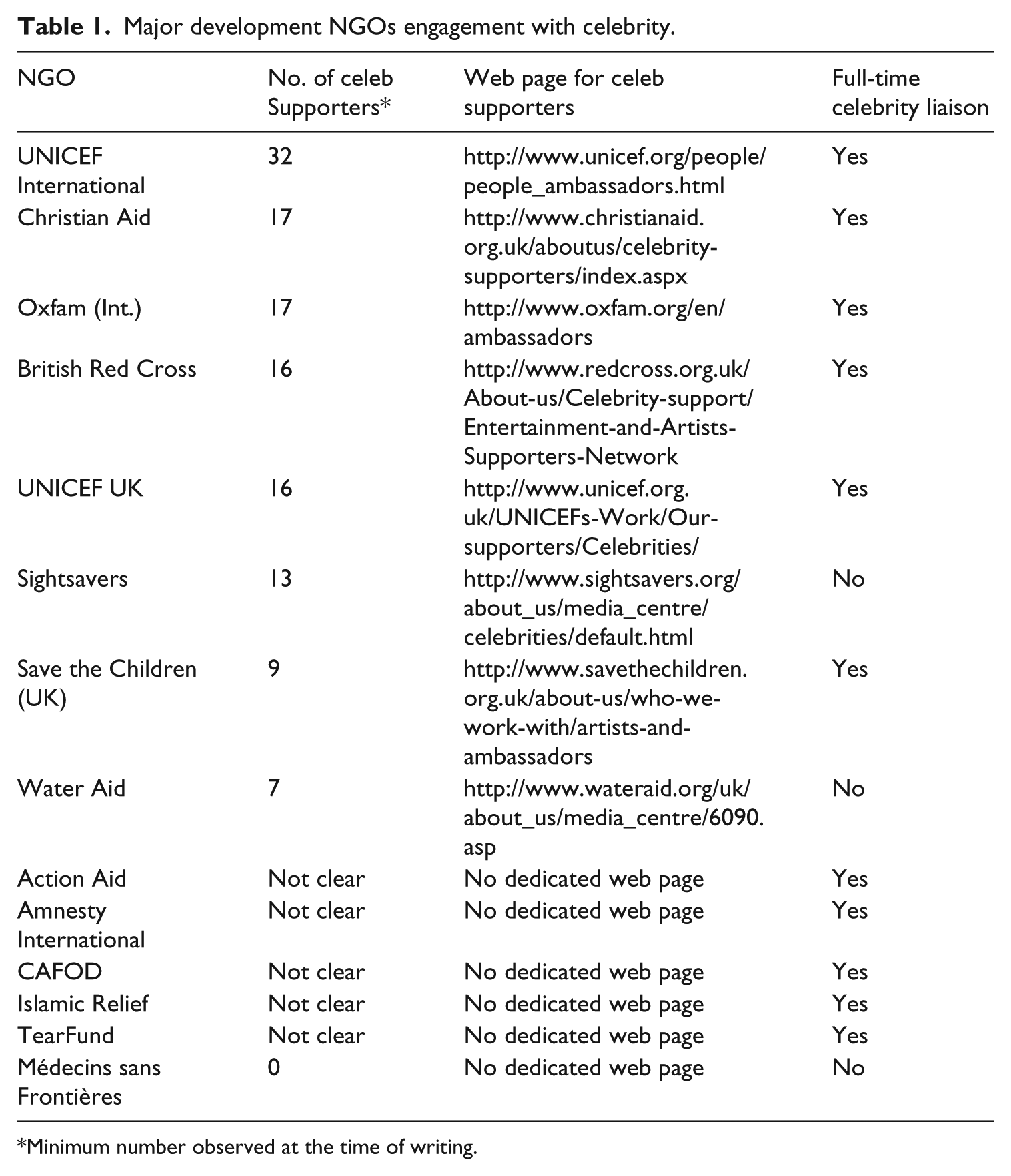
Minimum number observed at the time of writing.
We call the activities undertaken by celebrities in pursuit of causes ‘celebrity advocacy’. It is a catholic term. It can involve fund-raising, making films, writing articles, meeting supporters, attending rallies, signing petitions or donating recipes to cook books. It can also involve less visible work behind the scenes, meeting politicians or policy makers, or arranging such meetings between them and the organizations they support. ‘Advocacy’, then, refers not just to speaking out and literally advocating for something, but also any activities which support the work of a cause or other advocates of that cause.
Celebrity advocacy has become an important entity in its own right and is recognized as such by the British public and by NGOs. It was so thoroughly engrained into the Make Poverty History campaign of 2005 and the Save Darfur Campaign, and both were so prominent in the news that Time Magazine declared 2005 to be the ‘year of charitainment’ (Poniewozik, 2005). In his analysis of development campaigns from 1991 to 2011, Cox (2011) included a special section on the impact of celebrity because he said that ‘every single one of the case studies mentioned celebrity as a core element of their influencing strategy’. 3
Celebrity advocacy matters because it is a way of doing politics – of effecting change, of lobbying, of raising money for change-making organizations and participating in political issues. It is important therefore to consider how publics are responding to the opportunities for political participation which celebrity advocates present to them. It is, however, difficult to find out what publics think about celebrity advocacy. For all too often audience reactions are presumed: celebrity is all over the media, therefore it is popular; everyone is interested in it. 4 In fact the evidence we present below suggests that this is not the case. Part of our argument in this article is that celebrity advocacy is not as popular as its populist appeal suggests.
This, then, is a departure from much of what scholarship about celebrity normally does. Quite reasonably celebrity studies is concerned with how celebrity is constructed and consumed, how celebrity texts are read, how fans behave and so on. It is about the use of celebrity. That pre-occupation makes it difficult to consider the non-use of celebrity – but that is precisely what we have to consider when dealing with celebrity advocacy. For the whole purpose of the advocacy is to invite response and action. We have therefore first to consider whether it invokes any response at all.
This will required following the ‘practice approach’ for which Nick Couldry (following Bourdieu) has advocated in media studies research. To explain the power of the media in society, Couldry argues that we need to understand ‘what are people doing in relation to media [and] how is people’s media-related practice related in turn, to their wider agency’ (2012: 37, emphasis removed). This proves to be particularly useful advice where the attention-seeking activity may be incorrectly presumed to be attention-gaining.
The other part of the argument is that we can better understand the public disconnection with celebrity advocacy by using the lens of post-democracy as developed in the work of Colin Crouch (2004). Post-democracy refers to a form of politics which is marked by public disengagement and elite dominance. Celebrity can be part of that elite domination, but it is often conceived as a means of public engagement. The data we present here suggest a twist to that argument, for celebrity advocacy, conceived as a means of involving the public, is in fact a means of its alienation. The fact that it works well with elites means that pragmatic charities seeking to implement change in post-democratic societies may nonetheless be well advised to work closely with celebrity.
We proceed as follows. We first examine recent writings on the politics of celebrity advocacy, and reflect on the political implications of broader changes in the media of which it is part. We then present the survey methods and focus groups we used to explore responses to celebrity advocacy. In the fourth section we discuss the findings of those methods. Finally, we discuss their implications in the light of Crouch’s work on post-democracy. We draw here primarily upon the work of celebrity advocacy for international development because these are the organizations on which my research has focused. We set these activities in the context of the broader charitable sector.
The politics of celebrity advocacy
In the main, most academic critics are unimpressed with celebrity advocacy for development causes. Cooper (2008) provides the exception with a receptive account of the achievements of Bono, Jolie and Geldof as celebrity advocates, but few are that positive. Authors like Yrjölä and Kapoor condemn the inequality with which it is structurally associated and which they deem it to perpetuate (Kapoor, 2012: 179; Repo and Yrjölä, 2011; Yrjölä, 2009, 2011a, 2011b). For Yrjölä celebrity humanitarianism is tainted too by the injustices of the humanitarian movement. Kapoor goes further and speculates that celebrity advocates might in fact be ‘sadists’ delighting in their own good fortune in an unequal world order. For him the essential problem is that only a Marxist revolution can solve the problems of inequality and economic injustice. Without that it would be best to do nothing, all else will simply prop up an unfair system.
Other authors are less sweepingly condemning but are still concerned that celebrity advocacy will divert attention from the fundamental causes of inequality. Goodman notes that celebrity support for Fair Trade goods risks missing the fundamental point of the fair trade movement – namely that it is the processes leading to the products, not the face endorsing the product which matters (Goodman, 2010). Richey and Ponte note a similar lack of attention to process in Product (Red) (Ponte et al., 2009; Richey and Ponte, 2008, 2011). This they find promotes a weaker form of corporate social responsibility, and does not give sufficient attention to the complexities of anti-retroviral treatments. Littler (2008) too notes that there are important economic inequalities in which celebrities are themselves bound up, which are not accorded adequate attention by celebrity advocates.
I have some sympathy with many of these complaints. The basic problems of development are caused by economic and political inequality, which distribute fortune and misfortune unequally and unfairly. But, while recognizing the value of this work we want here to propose that we need a different approach. Much of the debate (for or against celebrity) has thus far has been concerned with symbols, ideas and images and their role in reinforcing structural inequality. This is useful, but we cannot leave it there. We have to consider what work celebrity advocacy actually accomplishes in terms of audience response, and what that might portend for those structural inequalities.
One way forward here is to examine in detail the texts of NGO publicity and its celebrity advocates. This has been pursued in Lilie Chouliaraki’s work (2010, 2012). She conducted a comparative analysis of the Audrey Hepburn’s work for UNICEF and Angelina Jolie’s for the UNHCR (UN High Commission for Refugees). She found that Hepburn’s performances highlighted the needs of poor people in poor countries, whereas Jolie’s work draws attention to personal responses to the suffering she has witnessed, to herself. This mattered because focusing attention on the celebrity’s emotions brings attention also onto our (parasocial) relations with and connections to her, and less to the cause (Chouliaraki, 2012: 17). This will not necessarily facilitate the action for which celebrity advocates call.
Some British development NGOs are themselves concerned about the sorts of response and political engagement that celebrified advocacy may promote but they bring a slightly different theoretical perspective to it. Drawing on Crompton’s work on values and the unsatisfactory experience of Make Poverty History (where a great deal of media attention resulted in very little long-term change in attitudes to development), Darnton and Kirk argued that development campaigns needed to move away from ‘transactional’ engagements (buying things for development), unless these were part of encouraging supporters to embark on personal journeys that would promote greater awareness and understanding of development issues (Crompton, 2010; Darnton and Kirk, 2011). In particular they want to combat a tendency by Britons to approach development problems within a charitable frame – that is, thinking that problems of structural economic injustice could be solved by donating money to charity, when in fact it required intensive political lobbying. They were specifically wary of NGOs working with celebrity ‘given the strong links between celebrity culture, consumer culture and the values of self-interest’ (Darnton and Kirk, 2011: 10).
Across this corpus two common critical threads develop. The first is that celebrity advocacy with respect to development issues is not up to the job required of it. It cannot tackle the injustices that lie at the heart of development problems. But before we can dismiss the possibilities of celebrity advocacy we need to understand better how it works with different audiences. Thus far in the literature on celebrity advocacy and humanitarianism (and this is the second thread) there is insufficient attention to how audiences themselves respond to the work of celebrity advocates. This is problem exemplified in the (otherwise excellent) collection of essays about celebrity activism included in Commodity Activism (Mukherjee and Banet-Weiser, 2012). In all of them the subject discussed was what celebrities were offering, and not how audiences were reading or reacting to those offerings. But, as Scott (2011) points out, we also need to know how well audience readings of these texts conform to our own readings of them.
It is in fact rather hard to find out what the diversity of responses to celebrity affairs of any description generally produce. For reasons we have already given, the full diversity of responses (including ignoring celebrity) is not the normal fare of celebrity studies. We have only been able to find one survey of the British public which considers the popularity of celebrity. Couldry and Markham’s (2007) public connection project surveyed consumption of different sorts of media by Britons in 2005 and from a cluster analysis concluded that 14% of the population were interested in celebrity affairs. Breaking that down by different sectors of the population revealed that these were mostly young women. There was no difference in interest in celebrity according to socio-economic status.
Furthermore when Couldry and Markham examined media diaries to explore why people were engaging with the media and celebrity affairs they suggested that celebrity was popular precisely because it was not about politics. Those who turned to it were looking to escape from the more serious media affairs. This meant that celebrity might be a poor vehicle for promoting political advocacy.
Thrall and colleagues’ (2008) survey of celebrity advocacy in the New York Times suggests another limitation: celebrity advocacy might simply not be a good vehicle for getting issues into the broadcast media. They note that while some celebrities were able to get hundreds of articles about their causes, others, including leading A-listers, were not. Celebrity, they concluded did not guarantee media attention. Rather it might be better used in narrow-casting – reaching out through more specialized media (websites, YouTube videos) to reach more specialized and targeted audiences.
Surveys of audience response to celebrity advocacy are few – we have found just three. Perhaps the most significant is van den Bulk et al.’s (2011) article which examined responses to campaigns with and without celebrity among nearly 8000 Belgian citizens. They found that celebrity was not necessary for good recognition (the most recognized of the six campaigns they studied had no celebrity). However, celebrity was useful to NGOs: the two celebrity-endorsed campaigns enjoyed the highest level of NGO recognition. A smaller study was conducted by Robert Wheeler among 930 US college students. He found that celebrities who were deemed to be closely linked to the charities they supported did increase these students’ intentions to act (Wheeler, 2009). There has also been a study of 100 commuters in Dublin which concluded that most people were aware of at least one celebrity advocate (and this was mostly either the actress Angelina Jolie or musician Bono; Samman et al., 2009). Few commuters, however, declared themselves to be much influenced by this behaviour.
On the basis of the evidence above, then, it is safe to conclude that the nature of public responses to celebrity advocacy for development is not well explored. Part of the purpose of this article is to address this gap and explore these reactions in more detail. We turn now to the methods we used to do so.
Methods
To explore public attitudes to celebrity we designed two surveys for the Public Opinion Monitor. The Monitor is a panel database maintained by the Institute of Development Studies, by whom regular surveys are administered every six weeks on the internet. We first replicated Couldry and Markham’s 2005 survey (n = 1111), presenting our questions in October 2011. We then conducted another survey specifically on responses to celebrity news and advocacy (n = 1999) in April 2012. 5 Note that actual totals differ in the tables according to completion rates of specific questions.
A panel database differs from a random sample in that successive surveys are posed repeatedly to the same group of people. This allows comparisons between what the same people say in response to the different surveys. This is its great advantage. However it has three disadvantages. First this particular survey can only be administered to people who are connected to the internet, and thus is only representative of the 80% of Britons who are net-connected. Second, that panel members chose whether or not they take part. In the main most of those who take part tend to be older and male, and thus answers have to be weighted by gender and age. Third, in this panel, no socio-economic data are available for panellists. It is thus impossible to weight answers by socio-economic status. Since celebrity consumption did not appear to be affected by socio-economic status according to Couldry and Markham’s work this is not such an issue in this instance. The questions asked in those surveys, and the composition of the respondents are available on the research website of this project. 6 Survey data were analysed using SPSS and more details of those analyses, especially cluster analyses, are also available at that site.
We have complemented those quantitative surveys with qualitative work on nine focus groups, four in London and five in Manchester, of different ages, socio-economic status, ethnic identity, gender composition and attitudes to development. In using the focus group data below we have drawn out opinions and ideas that were typical across all the groups, or else stood out as being unusual compared with all the other participants. We have not tried to associate views with particular gender, age, socio-economic or racial groups. The sample sizes do not allow that. Further details of the focus groups are also available on the research website mentioned earlier.
Finally, in parallel, with this activity Brockington also conducted a large number of interviews (over 120) with employees of NGOs who worked with the media and celebrity, with journalists and in the celebrity industries. We have not presented much of that information here, but they have helped to contextualize findings presented.
There is an important caveat to these findings. Celebrity cultures, and politics, vary from country to country and it is a mistake to try to extrapolate internationally from findings in one country. 7 Our research was conducted in Britain and its conclusions refer primarily to that country. Extrapolating to other countries and other celebrity cultures will require care.
Findings
The belief in celebrity advocacy
The 2012 survey data suggest that engagement in celebrity news is mostly shallow and brief. Our survey found that only 22% of people spend more than five minutes reading about celebrity every week, and only 17% spend more than five minutes a week talking about it; 32% claimed not to read celebrity news at all. Of those who were engaging with it only 17% of people were trying to find out about celebrity. More than 70% encountered it only incidentally, while reading about other news.
There is little surprising about those findings. One of the main conclusions of Hermes’ (1995) study of the readers of women’s gossip magazines was that they were read intermittently and fleetingly – indeed they were written with those consumption patterns in mind – to be ‘put-downable’. If the more devoted followers of celebrity-oriented products treat the writing in this way then we should expect similar behaviour among the less devoted.
When asked specifically about responses to celebrity advocacy, replies were consistent with those to questions about celebrity news. Most people (75%) claim not to have responded in any way. 8 But note that almost everyone was able to talk about celebrity advocacy in the focus groups. Clearly light encounters do not mean that we ignore it. But this was possible in part because focus groups referred to the same set of events: Comic Relief and Sports Relief, Children in Need and particularly famous advocates (musicians such as Geldof, Bono, and actors like Jolie, Lumley and Clooney).
Another way of saying this is that, despite all the variety of celebrity advocacy out there, people were not aware of very much of it. If, as we saw from Thrall et al. (2008, above), 90% of the most prominent celebrities and 60% of celebrities more generally are involved in celebrity advocacy, then surprisingly few of those celebrities are prominent in the discussions. Indeed, our survey found that while awareness of major NGO brands was high, awareness of celebrity advocates for those brands was low (Table 2). This was true even for NGOs with strong celebrity ambassador programmes (Red Cross, Oxfam and UNICEF).
Awareness of famous people working with development organizations.
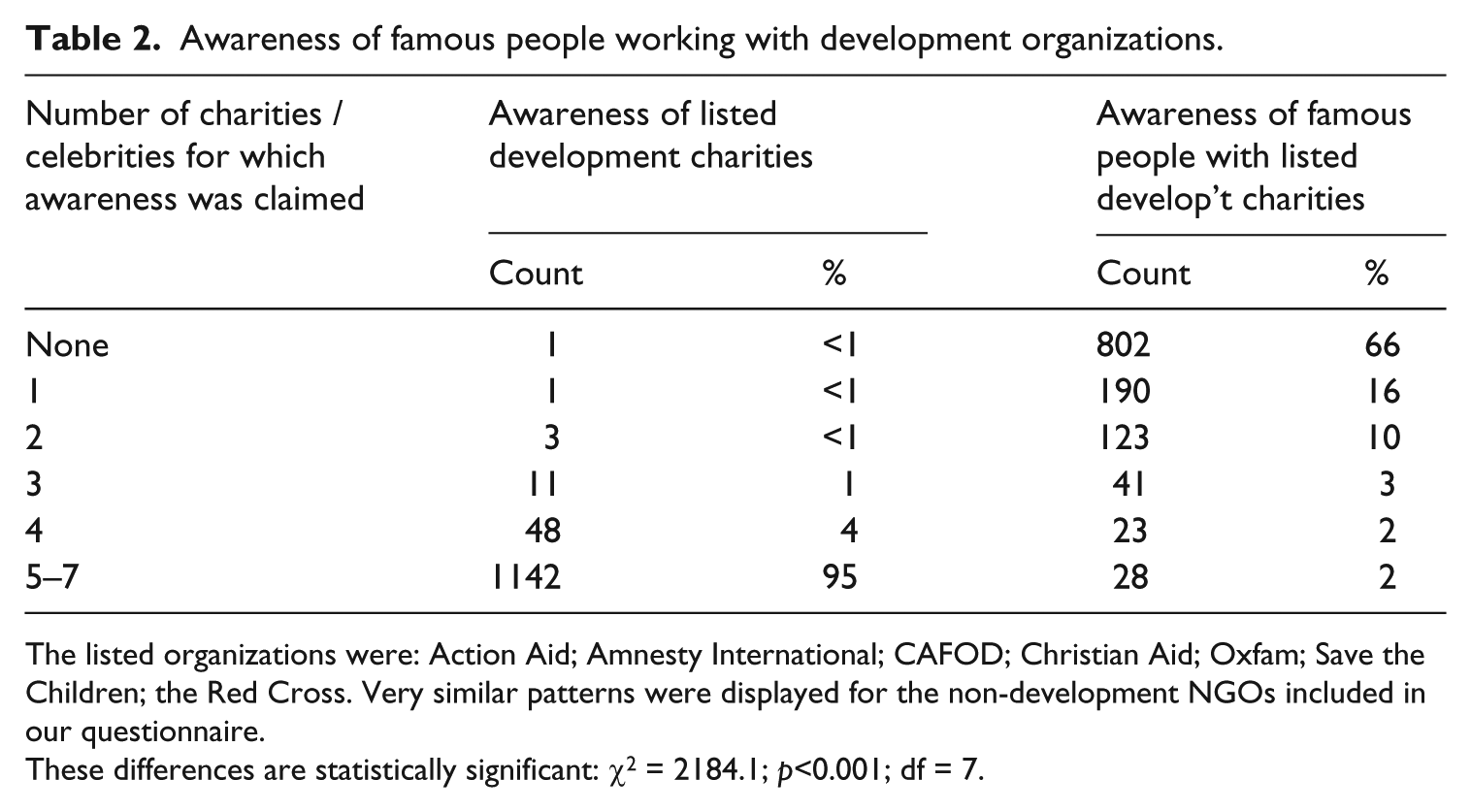
The listed organizations were: Action Aid; Amnesty International; CAFOD; Christian Aid; Oxfam; Save the Children; the Red Cross. Very similar patterns were displayed for the non-development NGOs included in our questionnaire.
These differences are statistically significant: χ2 = 2184.1; p<0.001; df = 7.
Instead it was plain from the focus groups that most people supported the charities that they supported because of personal connections in their lives and families which made these causes important, not because of the celebrities. There were cases where people had got involved in charities and causes because of celebrity endorsements – we met five incidents of this across the focus groups – but they were rare.
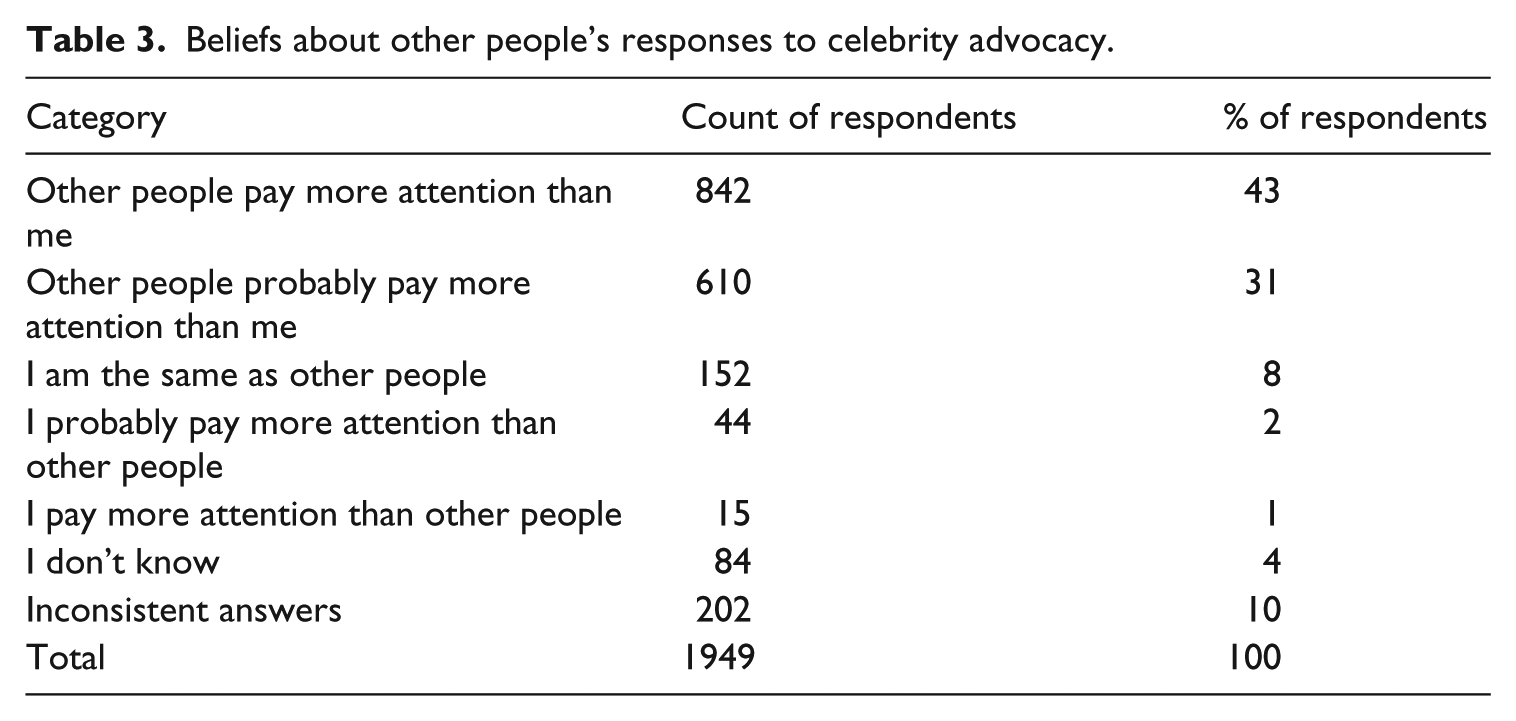
The evidence suggests, therefore, that the ability of celebrity advocacy to reach people is limited, and dominated (in Britain) by some extremely prominent telethons and the work of a few stars. Yet in the focus groups and survey data there is clearly a widespread belief in the power of celebrity advocacy. Most people think that most other people are swayed by celebrity (Table 3). They think their own lack of interest is unusual. Indeed Table 3 supports a stronger version of this same point. Note that only 3% of respondents thought that they might pay more attention than other people. The rest (87% subtracting the incoherent answers) thought it unlikely that anyone could pay less attention to celebrity advocacy than they did. And yet they (we) believe that other people are engaging in it more. There is a false, but popular belief, that celebrity is popular.
Beliefs about other people’s responses to celebrity advocacy.
All the groups seemed imbued with this faith in the power of celebrity to command media coverage.
No matter who the celebrity is and what their reasons behind it are I just think they are … making everyone aware of that particular charity so I think that has got to be a good thing.
This corroborates Couldry’s (2001) observations about the extent and influence of popular thinking about the ‘media world’. The media world is, by definition, attractive, glamorous and important. It is noticed. Celebrity belongs to the media world, charities, associating with celebrity, must experience some of that glamour.
In fact, despite this firm belief, the survey evidence and focus groups suggest that celebrity is less universally appealing. Rather we can divide public responses to it into several categories. We conducted three cluster analyses of responses to celebrity news and celebrity advocacy. The first just examined patterns of news consumption. There were three basic groups here. Two who showed varying degrees of interest (30%) and lack of interest (49%) in celebrity news. The third group, which we call the ambivalent consumers group, professed not to like celebrity matters but consumed a good deal of it
These groups were visible among some of the people attending the focus groups. Here, for example, is an ambivalent consumer, disliking the celebrity-rich television he is watching:
I watch Comic Relief and Sport Relief and I get angry with it and think why am I watching it.
Others, in the same households, could separately display both appreciation and hostility:
My girlfriend sits and watches that Keeping up with the Kardashians. I just sit there and fall asleep.
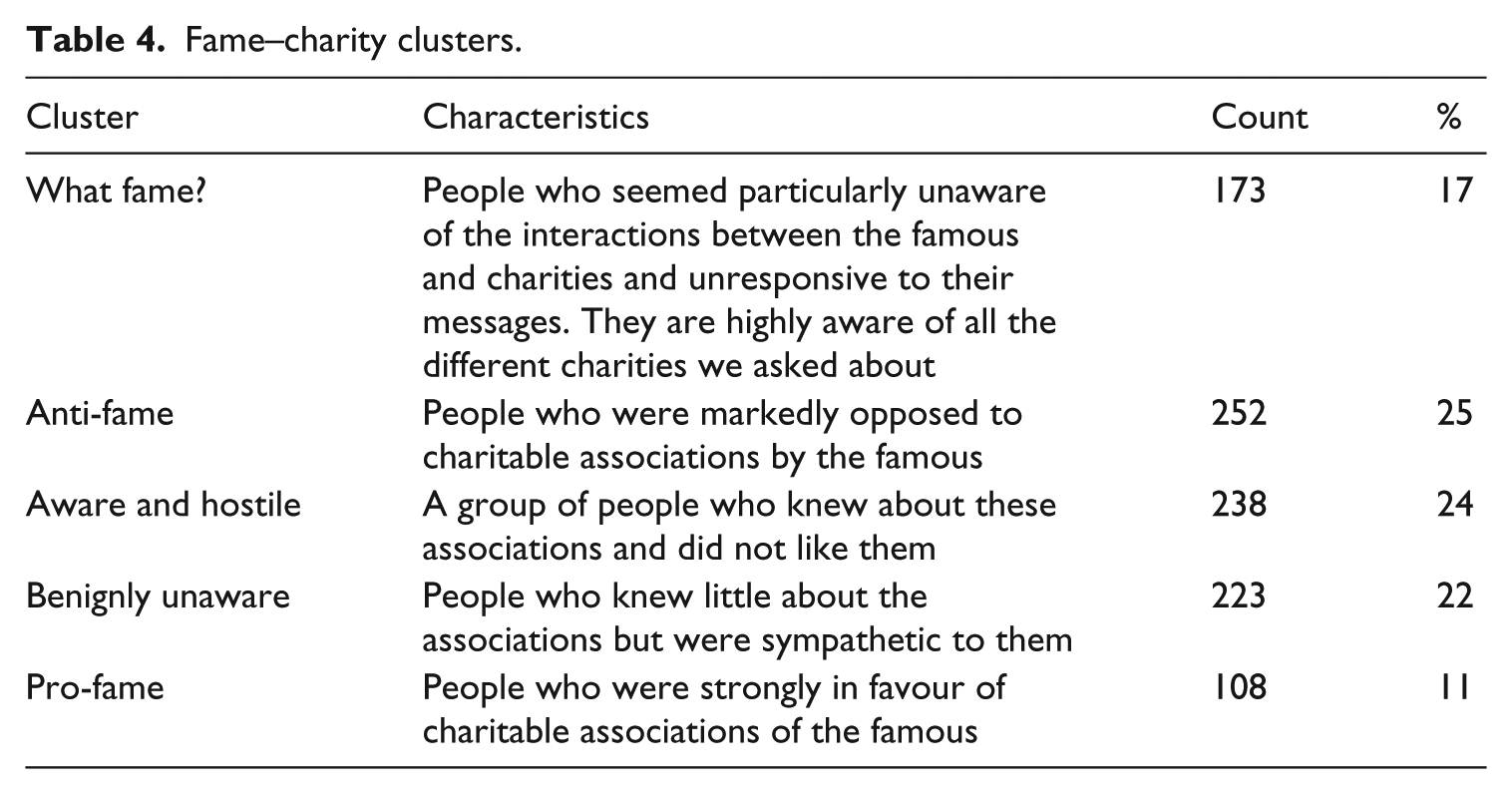
We then conducted two cluster analyses on celebrity advocacy. One examined general associations between fame and charities (fame–charity clusters), the other specific responses to associations between the famous and development issues (Table 4 and Table 5). Results were broadly similar in that positive responses characterize between 25% and 33% of the population. Negative responses vary from people who claim not to know about these associations to those who do not like them, to those who know a fair bit about them and do not like them.
Fame–charity clusters.
Fame–development clusters.
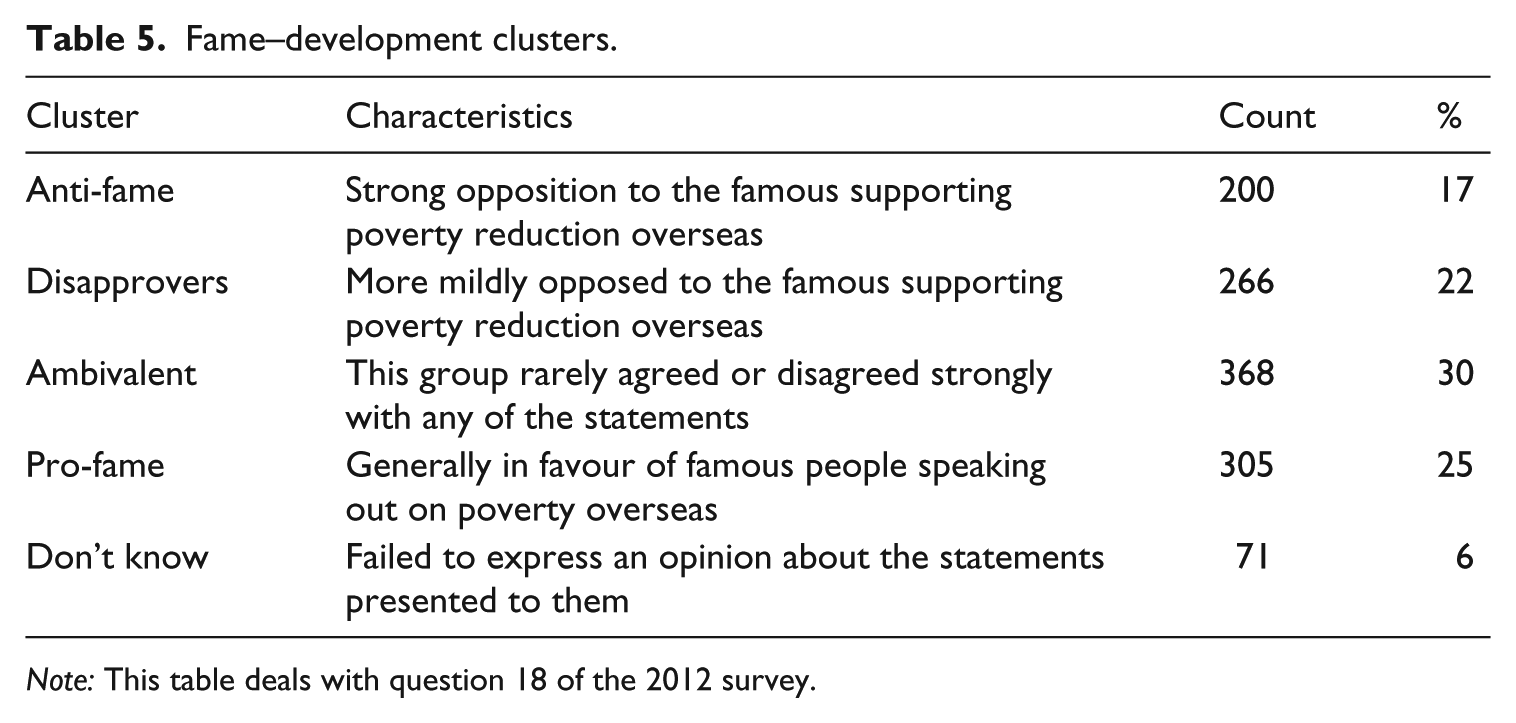
Note: This table deals with question 18 of the 2012 survey.
It would be reasonable to expect that these clusters of responses to fame and charity would map well onto the clusters of responses to celebrity news, that is, that those hostile to celebrity news would also be hostile to interactions between the famous and charities, and between the famous and overseas poverty. Equally we should expect that those who like celebrity appreciate what celebrities do for charity.
However things are not that simple. There are two key differences. First, interest in and approval of celebrity affairs is normally associated with youth. That was clear from Couldry and Markham’s survey, and our repetition of it. However in these clusters it is clear that older groups tended to approve of associations between charities and the famous more than younger groups. Of the ‘pro-fame’ group in the fame–charity cluster, 61% is over 45 years old. This suggests that those people who are interested in celebrity as celebrities may not be so interested in their charitable work.
The second, related, difference is that an interest in celebrity news did not necessarily coincide with approval of celebrity advocacy for poverty overseas, and vice versa. This is shown in Table 6, and in the bottom row of that table. This shows that of those who are sympathetic to associations between fame and international development, more of them are hostile to celebrity news generally than are sympathetic (119 compared to 105). One would expect people who approved of the work of the famous for development might be quite likely also to be interested in the famous. But they are not, quite the reverse in fact. The point here is not that these different proportions are statistically significant. It is simply that the trend is the opposite of what is expected. Likewise the last column of Table 6 shows us that of those who are interested in celebrity news only a minority (105 compared to 143) are plainly sympathetic to the work of the famous in development. Once again, this is not significant because of any statistical difference but simply because the pattern is the opposite of what one might expect. Receptiveness to celebrity news, and receptiveness to celebrity advocacy for development are not particularly complementary mindsets.
Comparing cluster responses to celebrity news and fame and overseas poverty clusters.
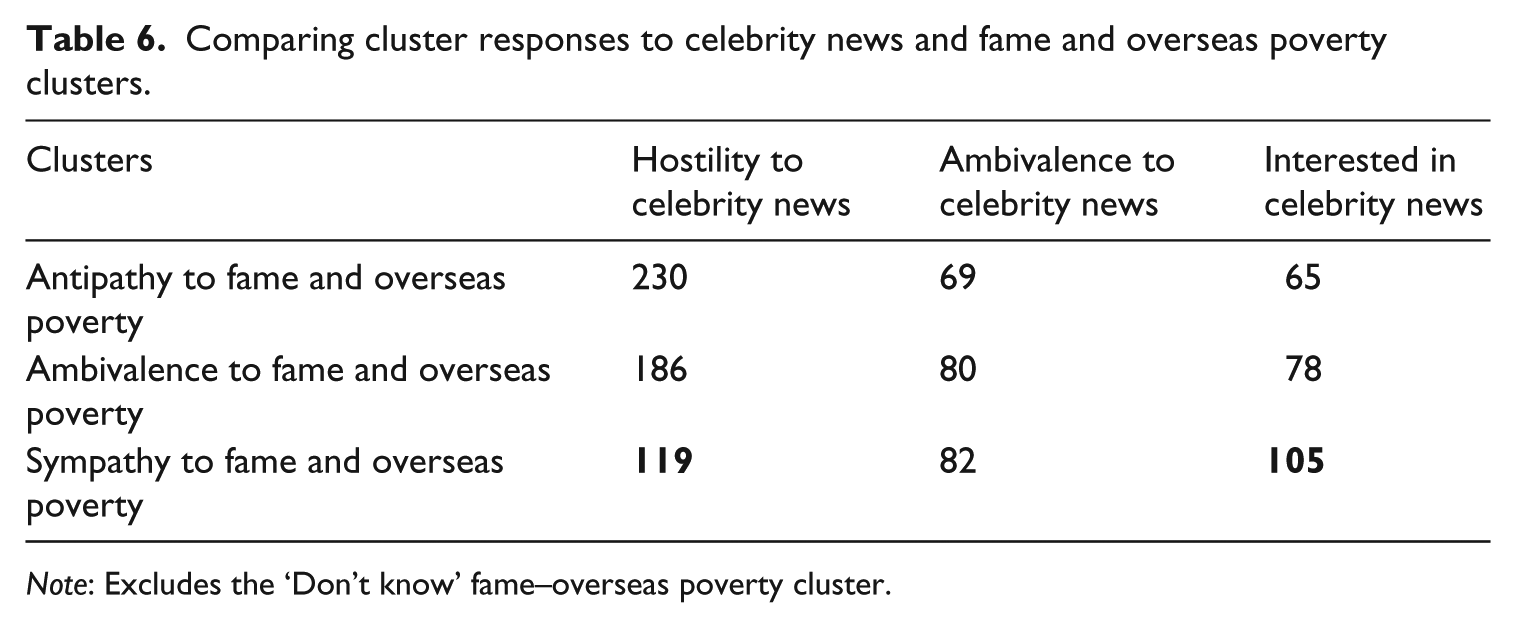
Note: Excludes the ‘Don’t know’ fame–overseas poverty cluster.
The archetypal example in the focus groups of the disconnection between interest in celebrity culture and interest in celebrity advocacy was Rachel. Rachel was very much into her celebrity culture, and a big Peter Andre fan. But in a discussion about Bono, she kept quiet. On being invited to join in she responded:
To be honest I’m quite lost in all of this cause I don’t really keep up to date with anything. I don’t even know who Bono is. I felt kind of stupid not knowing who that is, but to be honest I’m living a life where I don’t care. Most of my friends are ooh yeah Peter André, that’s nice, he looks quite fit. I know it’s quite shallow right now but –
But would you support something if Peter André was involved?
If I was totally honest I’d think that’s quite good, but it would be gone like that. [] For me celebrities and charities don’t mix very well.
Reasons for the belief in celebrity advocacy
Whatever the sociological realities of celebrity advocacy consumption actually are, perhaps the more important point remains that it is believed in. It is important to understand why, and consider the implications for that for the broader politics of celebrity advocacy. Here the evidence from the focus groups is useful.
One of the main reasons underpinning that belief that media coverage (that any celebrity is believed to provide) is good is that it will raise money. This explains the general benevolent reception of celebrity advocacy in the focus groups (negative attitudes were few):
At the end of the day that [money] is it isn’t it? That is the important thing. You can watch somebody and admire them – does that matter at the end of the day you are not giving them the money which is the whole point of them spending that money paying that celebrity to do that thing. 9
After groups had disagreed about the integrity of celebrity advocacy participants could still conclude that ‘at the end of the day they are raising money for a good cause’. Opposition to them was most clearly expressed by not giving money:
(With respect to Angelina Jolie’s visits overseas) It’s all staged, and because of that I wouldn’t give her money.
Note that underpinning all these discussions is the belief that charitable action is about giving and receiving money. Only once, among 60 participants, did we come across someone taking another form of action. Needless to say this will pose problems for organizations that are trying to achieve political change through more agonistic politics, through lobbying or popular action (Darnton and Kirk, 2011; Mouffe, 2005).
Charities therefore benefit from the money and media spotlight celebrities will bring to them, but it was also apparent that celebrities were not necessarily good at directing attention to the substance of their charities’ causes – but rather, if inadvertently, towards themselves. This was apparent because so many participants were more ready to talk about the celebrity than the cause supported. This exchange about Soccer Aid is typical:
What is the cause for Soccer Aid?
I think they are raising money for Africa and that but I watch it because I’m a big Robbie Williams fan and he is the main organizer. It works well in our house because my husband and sons love the football part of it and I’m interested in the celebrity side of it.
Conversely it was clear that audiences were picking up much more information about the celebrities themselves, and sometimes changing their mind about them in the process. This could change, sometimes dramatically, people’s relationships with these celebrities:
I wasn’t a David Walliams fan at first but I am now. How can you do something like that and not be liked? His personality shone through and now he is one of my favourite people.
So did you think John Bishop was genuine and committed and someone with integrity before Sport Relief?
No, absolutely no.
My point here is not the rather tired argument that celebrities support charities because they need the publicity. In many cases this is plainly false. Rather, regardless of what celebrities may want in terms of publicity (and the interviews suggest that many would seek to maximize the attention given to their cause not to them), it is clear from these exchanges that the celebrity can often do better out of this attention than their causes. This suggests a twist to the belief in the power of celebrity advocacy: to the extent that celebrity advocacy does get people’s attention it is the celebrity that gets it more than the cause for which they are advocating.
Celebrity advocacy and post-democratic politics
In summary, the data above suggest the following:
Celebrity affairs, and celebrity advocacy, are not populist. They are a minority interest.
Awareness of celebrity involvement in development organizations is low.
Interest in celebrity news and celebrity advocacy are not well correlated. Interest in one is a poor predictor of interest in the other.
There is widespread belief in the power of celebrity advocacy that belies the evidence of its actual reach and influence.
Celebrity advocacy in the media does little to promote active involvement in causes other than by giving money. It promotes more engagement with the celebrities than it does with the causes they are supporting.
It is important to recognize too that the limits of celebrity reach are recognized by insiders within the media industries and campaigning. Dan Brockington has spoken to magazine editors, television researchers and executive producers all of whom have offered cautionary tales against presuming the popularity of celebrity. As a television executive (who was keen on promoting celebrity stories) put it:
Mostly I’ve found that a lot of communities who really take their cause seriously don’t really care about the celebrity angle … which really puts things into perspective from showbiz point of view and you think wow we might all be kissing the ground that these people walk on day and night because that’s what the industry is used to but when it actually comes to real people’s lives and their experiences it makes no difference. (Interview 98)
Nevertheless these limits are clearly not widely known. It would be an interesting and important task to consider what sustains such a widespread confusion – but that is beyond the scope of this aricle. Instead we wish to consider the implications of these findings for the politics of celebrity advocacy. To do so we need to turn to thinking about ‘post-democracy’.
According to Crouch post-democracy describes situations where:
boredom, frustration and disillusion have settled in after a democratic moment; when powerful minority interests have become far more active than the mass of ordinary people in making the political system work for them, where political elites have learned to manage and manipulate popular demands, where people have to be persuaded to vote by top-down publicity campaigns. (2004: 19–20)
More than that, post-democracy is also characterized as a particular alliance between capitalist elites and government elites such that the task of government is to manage societies and economies in the interests of corporate power – and they do so with at least the passive consent (little more is possible) of most of the electorate (Rancière, 1998).
As Brockington explains elsewhere, post-democracy is useful for helping to explain the rise of celebrity advocacy – for it is driven by corporate interest in getting access to celebrity and NGOs’ desire to use celebrity to build better relationships with corporate partners (Brockington, 2014). It also provides a useful framework for understanding the results reported here. Crouch observes a growing distance between the rulers and the ruled, and lack of interest by citizens in their own governance. These data suggest that this disconnection includes the celebrity interventions that are generally presumed to be so entertaining and enthralling for publics. Celebrity advocacy is not broadly noticed, despite widespread belief in its power for attracting attention. Moreover, when people do notice it, they tend to concentrate on the celebrity rather than the cause that the celebrity is trying to draw attention to.
But, paradoxically, the same framework of post-democracy may well explain why, despite its lack of public connection, celebrity advocacy may well be a particularly effective means of supporting development causes in the north. The key here is that post-democratic politics are dominated by elites, and, that, correspondingly, international development is pre-eminently an area of elite policy formation (Hudson and van Heerde-Hudson, 2012; Olsen, 2001). Lobbying and policy making that concentrates on working with elites, as international development does, may in fact be well adapted to post-democracies.
Celebrity advocacy works in international development partly because political and corporate elites want to meet celebrities. They often provide a good way into elite-dominated policy making circles which are so dominant in development. This was confirmed across almost all my interviews. 10 Personal access to figures one would normally only encounter in the media is one of the rewards of political and corporate success. It is a prize which is readily, if not eagerly, claimed by the victors.
More than that, however, political and celebrity elites are fervent believers in celebrity power. Cox, in his assessment of the role of celebrity in development campaigning writes that:
Engaging celebrities is particularly valuable in short-term campaigns that want to simulate mass public support but do not have the time to build it in key countries. (2011: 55)
In other words, even though the public are not engaged by a campaign, or even by the celebrities involved in a campaign, politicians will think that they are because of those celebrities. Celebrities signify the public. As Cox clarified to me later:
Celebrity is a proxy for public engagement even though in pretty much all cases they, the public, were not engaged initially. (Brendan Cox, personal communication, 8 January 2013)
There is, then, a rather rich irony in celebrity advocacy. It is not just that its actual popular reach is different from popular belief about that reach. It is that its very influence hinges upon that difference. If it were not misrecognized, it could not exist. As it is, most people believe in the power of celebrity to work on other people, even as they demonstrate that it does not work on themselves.
Conclusion
This research both confirms and challenges the findings of previous authors on the topic. It challenges those who presume celebrity to be interesting and absorbing to most people. The evidence here, confirming Couldry and Markham’s (2007) earlier survey work, and their insistence on demographic precision when talking about the appeals of celebrity, is that it does not. It confirms Couldry and Markham’s suggestion that celebrity advocacy is not necessarily a particularly effective way of reaching out to a celebrity-interested audience. Rather, those who are tolerant or interested in celebrity advocacy may be a different sort of audience altogether and may be sympathetic to the causes for which the celebrities are advocating already. Celebrity advocacy may best be directed at existing supporters rather than new ones. 11
This research also confirms fears that celebrity advocacy is not challenging the charitable frame of reference with which most Britons approach development issues. Effective action was almost universally equated with giving money. Celebrity advocacy is thus bound up in, if not actively promoting, a post-democratic form of politics, with minimal actual involvement of citizens.
This article presents, however, a twist to these established findings. For it is plain that most people strongly believe in the power of celebrity advocacy. That belief is shared by the general public, and particularly by elites. The power of celebrity advocacy is thus an extension of media power but not a reflection of popular endorsement (Couldry, 2001). Celebrity advocacy then is emblematic, and constitutive, of post-democratic politics in action. For it is a means by which citizens disengage from agonistic politics, at the same time as political elites perceive them to be engaged in politics.
Please recall the caveats with which we began, namely that this work has been conducted among British audiences, and its conclusions may be restricted to this country. The post-democratic character of celebrity advocacy in Britain might appear rather different from that which prevails in the US, or other parts of Europe, and very different again in, for example, Japan (which uses celebrity in advertisements far more frequently than the US). We cannot say how far this theory can be extended.
Nonetheless, despite this restriction, the work of celebrity with respect to NGOs and development issues may require a modification of Crouch’s thesis with respect to the inegalitarian consequences of post-democracy. Corporate elites may well be anti-egalitarian, but what about the NGO-led development elites? Even if they do not contribute to civic vigour, might their influence be more benign and genial (Crouch, 2004: 117)? Another way of putting this is that, while celebrity elites may be very much part of ‘the system’, could they not be progressively used within it? Or even used, more oppositionally, to challenge it? As Gotham (2012) observes with respect to the activism of actor Brad Pitt, the convening power of celebrity increases the possibilities of networking elite influence being required to effect change.
This is a pragmatic conclusion with respect to development affairs. It risks abandoning attempts to build a more vigorous civic culture and active agonistic politics. It settles for the fact that it might be possible to win changes in development policy with an elite-oriented approach. It is an approach endorsed by Crouch himself, who recommends that politically engaged causes must find ways of working effectively within elite-dominated lobbies. But it is not the call of an idealist.
Footnotes
Funding
I would like to thank the ESRC for sponsoring this research (through a fellowship RES 070-27-0035).