




Abstract
This article examines how Internet memes about graffiti are used to negotiate cultural meanings of aging within a youth-coded subculture. Memes are approached as affordances for performances of selfhood and negotiations of subcultural identities and group boundaries. The article investigates how memes represent and address tensions between ideals of subversive subcultural life and lived experience. While graffiti is associated with youth and risk-taking, many graffiti writers are now adults with families and work-related obligations. Memes about graffiti construct ironic narratives in which aging writers are placed in environments, situations, and roles that appear anomalous relative to graffiti’s cultural meanings. Women and aging bodies are represented as blocking characters that conflict with claims to authenticity, threaten subcultural boundaries, and disrupt collective solidarity among graffiti writers. These representations negotiate how aging challenges symbolic binaries between what is constructed as sacred and profane. The study demonstrates the analytical and methodological value of studying memes as sites of subcultural meaning-making. It suggests that memes may offer a means for individuals to reconcile with the dilemma of aging in a youth-coded subculture.
Introduction
When I began the present study, one of the first memes that caught my attention depicted a graffitied life course in condensed form (Figure 1). The meme constructed a drama in which the setting was a cross-section of the earth’s crust with a sinkhole opening in the center. The hole represented graffiti, as was spelled out in big letters at the bottom. The horizontal representation of the earth’s surface constructed a timeline along which the protagonist “Me” moved from the left toward future “Life Goals” on the right. A successful life course was symbolically represented by a loving partner, a house, a car, and money. The meme drew on a heterosexual matrix, as the future partner was represented as an inactive woman. In contrast to this, the running figure represented an active man. The sole protagonist on the left started without possessions or attachments to family and material goods. In the plot of this drama, the transition to a successful and adult life was threatened by graffiti, as the protagonist might fall into the traps of graffiti represented by the sinkhole. As I will show, this is an example of how memes represent subcultural graffiti as incompatible with an adult lifestyle symbolically constructed as conventional.
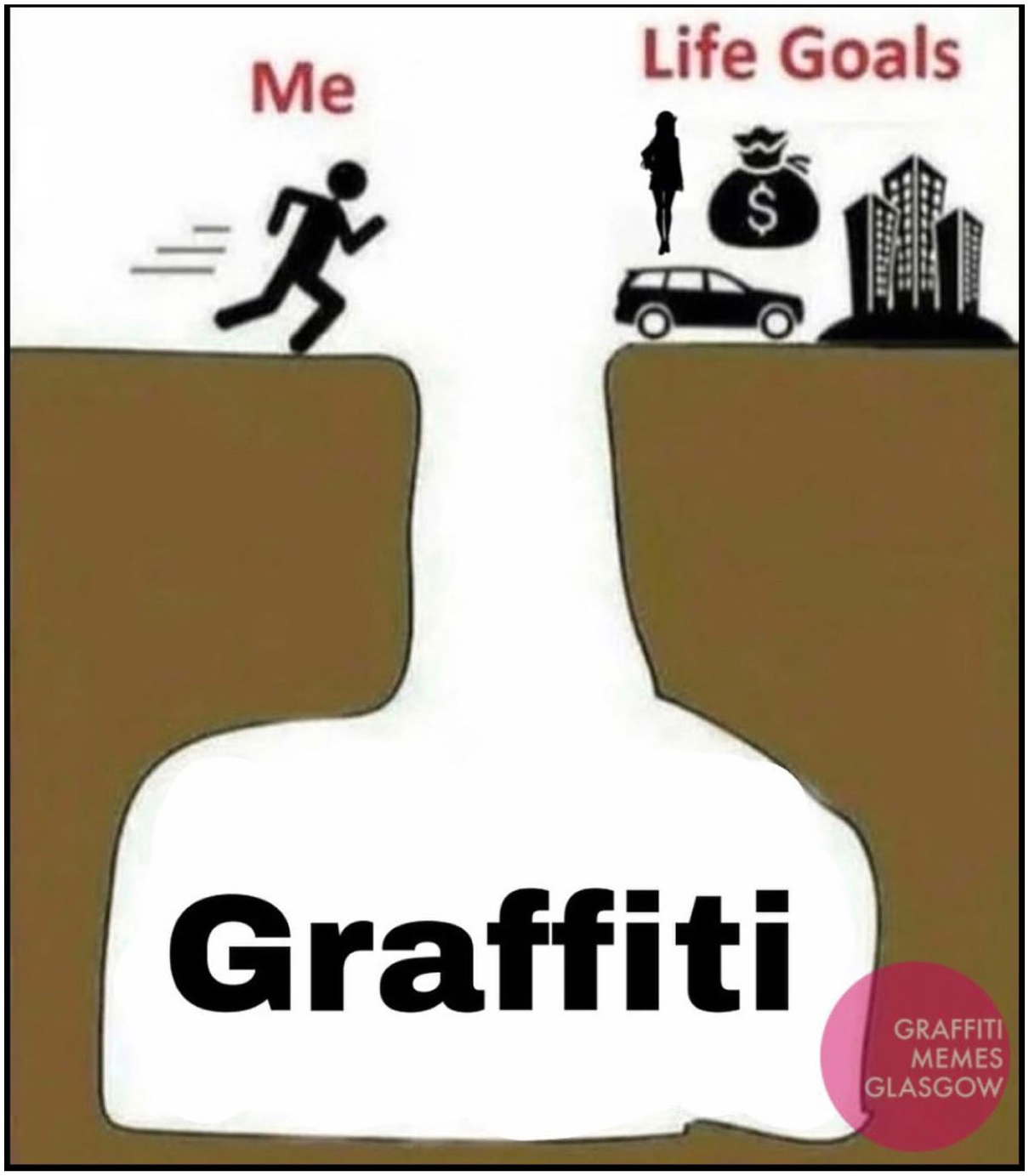
Life goals-meme.
This meme was published on an Instagram account dedicated to subcultural graffiti memes. In a non-subcultural reading of the narrative’s face value, graffiti threatens future life prospects. But a subcultural reading turns the moral of the story upside down. Being committed to the graffiti community means one should reject conventional success (Macdonald, 2001). Representing oneself as different from the conventional is central to subcultural identity work and group cohesion (Hannerz, 2015). A pattern running through memes about graffiti is that conventional life is a threat to authentic subcultural participants. This threat is represented as increasing with age.
Internet memes paint moral stories about how to live; they utilize humor and provoke chains of reactions, adaptations, reappropriations, and remixes (Shifman, 2014). Memes use templates that are easy to fill with culture-specific meanings. Dilemmas of aging and identities challenge members of a wide array of youth cultures that have transformed into multi-generational cultures, for example, punk, goth, and skateboarding (Bennett, 2018; Hodkinson, 2012; Willing et al., 2019). Subcultural graffiti writers who began doing graffiti in the late 20th century are now middle-aged and have obligations to families and work (Andersen and Krogstad, 2019).
The present article examines how Internet humor is used to negotiate cultural meanings and tensions surrounding aging. I ask: How do memes about graffiti represent aging in a youth-coded subculture? This will be answered through a close reading of memes about subcultural graffiti. The article helps us understand how the meanings of an aging subculture can be negotiated through online affordances.
The following section reviews subcultural research on graffiti, aging, and gender, alongside scholarship on online constructions of selfhood. This is followed by an outline of the study’s cultural sociological approach, which conceptualizes irony as a narrative form through which cultural meanings are constructed, displayed, and negotiated. The materials and methods are then presented. The findings offer insights into representations of tensions between subcultural ideals and adult life. The concluding remarks discuss how humor may facilitate acceptance of aging within youth-coded culture and suggest directions for future research.
Subcultural identities, boundaries, and media
Subcultural graffiti originated during the late 1960s and early 1970s on streets and public transportation in the United States (Snyder, 2009). Performers of this form of graffiti called themselves writers and developed systems of symbolic meanings, including aesthetics, techniques, rules, and vocabulary. During the 1980s, both mainstream and subcultural media contributed to the global diffusion of graffiti (Hannerz and Kimvall, 2024). Today, Instagram is the most common media used by writers (MacDowall, 2019). Graffiti was initially done by adolescent boys, and its cultural meanings are continuously associated with generational conflicts (Kimvall, 2015).
The concept of subculture was developed to describe bounded groups whose practices and values were labeled deviant by the majority population. Functionalist interpretations of subcultures viewed them as responses to the lack of resources for achieving social status through legitimate means (Cohen, 1955). In contrast, researchers at the Centre for Contemporary Cultural Studies (CCCS) understood subcultures as products of working-class youth’s resistance to consumer-capitalist hegemony. The CCCS analyzed the semiotics of “spectacular youth styles” among subcultures such as punks, mods, and skinheads (Hebdige, 1979). Style, as symbolic communication and a means of achieving status through fashion, music, art, language, tastes, and actions, has remained a central concept in subcultural analysis (Hannerz, 2015; Hodkinson, 2002).
More recent research rejects CCCS’ analysis for its unfounded assumptions of homogeneity within subcultural groups and for interpreting subcultures as reactions or resistance to a homogeneous mainstream culture (Thornton, 1995). Further critique has targeted CCCS’ failure to consider the meaning-making of subcultural participants themselves and the assumption of the solidity and stability of group boundaries (Bennett and Kahn-Harris, 2004; Hodkinson, 2002). “Post-subcultural” researchers render the concept of subculture obsolete because it is burdened by unfounded assumptions about distinct, class-based social groups. Alternative concepts such as neo-tribes and scenes have been proposed to better capture the fluidity of group boundaries and individuals’ agency (Bennett and Kahn-Harris, 2004). Other researchers retain the subculture concept to analyze how relatively persistent group boundaries and subcultural identities are negotiated.
According to Hodkinson (2002: 28–33), subcultures exhibit (1) consistent distinctiveness through shared ideals and tastes that differentiate them from other groups and remain relatively stable among participants over time and across space. Participants experience a sense of (2) identity with one another as members of a distinct group and share a (3) commitment to investing substantial amounts of time. Furthermore, subcultures are characterized by (4) autonomy, manifested in a relatively high degree of independence from socio-economic structures, political contexts, profit-oriented commerce, and non-subcultural media.
Subcultural participants construct simplified notions of “the mainstream” to represent everything the subculture is not, thereby defining what the subculture is (Macdonald, 2001; Thornton, 1995). This boundary work is often articulated through binaries that align the subcultural with Youth, Deviance, Urban, and Leisure, while the mainstream is associated with Adult, Conformity, Domesticity, and Work (Hannerz, 2015; Thornton, 1995). Subcultural styles are outward signs of these symbolic distinctions; however, as Hannerz (2015) points out, these expressions are plural and contested, with different styles mobilized in struggles over authenticity and status within the subculture.
Subcultures dominated by men are often gender-neutral in theory, yet in practice, women rarely participate on equal terms (Kidder, 2017; Macdonald, 2001; Mullaney, 2007). Although the number of women graffiti writers has increased, ideals associated with masculinity have persisted. For example, women are often excluded from subcultural media, and storytelling often relies on macho narratives (Fransberg, 2021). Subcultures such as graffiti, parkour, and skateboarding use urban environments to enact adventures in which risk-taking is coded as masculine (Kidder, 2017: 69; Willing et al., 2019). Macdonald (2001) finds that illegal graffiti, by putting masculine-coded skills to the test, serves as a rite of passage in boys’ transition to manhood.
In many (sub)cultures, aging individuals continue to invest both practically and emotionally in styles and communities they were attached to in youth. There is a lack of in-depth research on graffiti writing in midlife. For a long time, it was assumed that writers would grow up and adopt more mature identities; nevertheless, significant numbers of writers continue to engage in graffiti in midlife (Andersen and Krogstad, 2019). Many adult members of youth-coded cultures assimilate values and lifestyles previously rejected (Bennett, 2018; Hodkinson, 2012). However, aging bodies and adult responsibilities, such as parenting and work, can change how participants engage in (sub)cultures (Willing et al., 2019). Furthermore, style can serve as a means of performing symbolic “youthfulness” (Bennett and Kahn-Harris, 2004).
The fluidity of social network sites may challenge the boundaries necessary for the formation of distinct subcultural groups (Robards and Bennett, 2011). However, Hodkinson (2003) concludes that this is context-dependent and varies across groups, and that online platforms can also strengthen subcultural boundaries. Subcultural media use is crucial for negotiating identification, status, and style (Hodkinson, 2002; Thornton, 1995). It extends beyond mere representation, for example, MacDowall (2019: 21) finds that Instagram reframes and reshapes graffiti and its meanings.
Online media has revolutionized how individuals across cultures investigate, construct, and discover who they are (Lagerkvist, 2017; Uimonen, 2013). For example, posting photos online has become a means for performing rites of passage from one life stage to another (Orzech et al., 2017). Self-representations are selective and can be idealized (Orzech et al., 2017; Turkle, 2011: 192). However, selfhood is a social construction and need not be treated as false (Uimonen, 2013: 126). But while the Internet offers control over self-presentation, platforms controlled by multinational companies are given agency over individuals’ identity-work (Turkle, 2011; van Dijck, 2013). Still, online spaces may offer support and community (Lagerkvist, 2017).
Internet memes constitute a narrative genre that has become very important for constructing identities and disseminating cultural information (Shifman, 2014). Memes are digital images, texts, and videos that rapidly spread ideas by imitating and remixing each other’s content, form, and tone (Shifman, 2014). While their creation and distribution are structured by technology and social norms, their participatory, communicative, and emotional character is shaped by individual agency (Shifman, 2014).
This article examines image macros, one of the most common genres of Internet memes. They use generic stock photos and popular-culture images, overlaid with short, often ironic text (Lee and Hoh, 2023). They juxtapose contrasting ideas and elements to evoke laughter, using humor to reflect serious matters and existential questions (Joshua, 2020). Like other humor genres, memes construct social boundaries and reflect group norms, symbols, and interests (Tuters and Hagen, 2020).
Using humor as an analytical lens offers a productive way to examine negotiations around aging. Humor can serve as a resource for understanding what is at stake within a given culture (Lund, 2024), yet the role of humor has received little attention in subcultural research.
Cultural age, ironic narratives, and symbolic binaries
Age is not merely a biological condition but a cultural classification that organizes identities, norms, and social positions, frequently through binaries such as young–old (Heikkinen, 2021). The meanings individuals ascribe to their life courses depend on which narrative resources are available in different contexts. “Normative timetables” construct expectations for when individuals are expected to undergo important life transitions (Elder et al., 2004). Master narratives in a youth-centered Western culture often portray aging negatively (Heikkinen, 2021). Cultural narratives that enable experiences of late life as dignified and meaningful are limited (Laceulle and Baars, 2014). Such ageism is closely linked to ableism, in which old bodies are assumed to have limited functionality. According to Garland-Thomson (1997: 6), “able-bodiedness” is an institutionalized normative way of thinking about complete functionality. Furthermore, processes of age and gender classification intersect as grounds for discrimination and identity construction (Krekula, 2021). In the present article, I approach gender identities as plural, context-dependent, and culture-specific (Connell, 2005). Furthermore, I approach memes as a case of how media and popular culture represent dispositions that are interpreted as masculine or feminine (Pascoe and Bridges, 2016). Like other humor genres, memes construct group boundaries and reflect group norms, symbols, and interests (Tuters and Hagen, 2020). Through humor, members of a group might exercise social control, reinforce stereotypes, and express the superiority of their group or behavior over another group (Fine, 1984). But humor is also used to critique hierarchies, challenge dominant values, and transgress social boundaries and taboos (Brusila, 2021; Kuipers, 2006).
Irony is a humor trope used in memes in which things are viewed from their opposite (Watson, 2015). In irony, actual or underlying meanings are concealed or contradicted (Joshua, 2020: 80). In ironic narratives, it is common for a protagonist to encounter obstacles to his desires in the form of antagonistic “blocking characters” represented, for example, by a conflict between a son’s and a father’s will (Frye, 1957: 164). Ironic narratives enable reflexivity that may foster self-aware cultures and societies (Jacobs and Smith, 1997). Self-ironic humor could be a means for minority communities to preserve themselves. This might be done through jokes about a “doubly articulated subject” that, on the one hand, is a figure of fun or abuse and, on the other hand, evokes compassion and becomes a subject for which a community takes responsibility (Brusila, 2021: 31). Furthermore, self-deprecating humor gives others an opportunity to laugh at individuals’ public identities without attacking their “core self,” meaning it is not the self that is being ridiculed but a role, the teller’s “situated identity” (Fine, 1984: 93). Consequently, a group can laugh together and thus feel solidarity, not over the failures of one of their members—which would entail rejecting that member—but over the absurdity of the role performed in a specific situation.
Things and individuals depicted in images can be understood as representations of cultural codes laden with symbolic meanings and culture-specific moral values (Alexander, 2004). The addition of written texts can “anchor” specific meanings for images (Barthes, 1977: 39). The present article follows a theoretical strategy based on Jeffrey C. Alexander and Philip Smith’s (2003: 21) Structural Hermeneutics, according to which dramatic narratives are “structured by constraining cultural codes relating to plot and character.” Such codes represent symbolic binaries of what is sacred and profane in a culture, used in social performances that reflect, reproduce, and reconfigure cultural ideals and behaviors (Alexander, 2004). For example, in graffiti and other subcultures, subversive lifestyles are sacred while conventional life is considered profane (Baldini, 2018). Douglas (1966) defines profane actions and things as symbolic pollution that challenges a symbolic system. Behaviors that are not ideal within the system are perceived as anomalies that require intervention. Such anomalies may be handled through physical avoidance or elimination, though they may also be symbolically managed through storytelling. Applying binary oppositions identified in scholarship on graffiti and other subcultures (Macdonald, 2001; Thornton, 1995), this theoretical perspective enabled my analysis of cultural codes as building blocks in meme narratives.
Methodology
The present study is part of a larger project conducted between 2018 and 2024 that includes online and offline fieldwork (see Jacobson, 2019; Jacobson, 2024). To understand the meanings of aging, I followed a group of men in midlife whose life courses had been shaped by subcultural graffiti. I noticed that they were highly amused by image macros related to graffiti (henceforth “memes” or “graffiti memes”).
In October 2021, the two most frequently used hashtags for graffiti memes on Instagram were #graffitimemes (10,500 posts) and #graffitimeme (9700 posts). Thirty-six public accounts worldwide had used these hashtags. Employing purposeful sampling (Patton, 2015), I selected six accounts where memes illuminating issues of aging were particularly abundant. In December 2021, I took screenshots of all 3000 posts from these six accounts. I identified one account as Swedish and another as Australian; the remaining accounts lacked indicators of nationality, but used English.
The analysis used an abductive approach, moving back and forth between deduction and induction (Timmermans and Tavory, 2012). In an initial coding cycle, all memes were coded inductively and thematically organized (Braun and Clarke, 2006). The sample was then refined into six themes particularly rich in information about aging (Patton, 2015: 440). This yielded 351 image macros, which were further coded in a second cycle.
This study is delimited to the visual meanings at “the site of the images themselves” (Rose, 2016: 32–34). Hence, the producers’ intentions and the audience’s responses are beyond the scope of this article. I approached the memes as symbolic stages for social performances in which narratives are constructed through visual representations of scenery, actors, and props, combined into plots and sequences (Alexander, 2004). The meme described in the introduction serves as an example; it featured a scenery including a sinkhole and a house, an active protagonist coded as a man and a passive antagonist, coded as a woman, a sequence of actions, and props in the form of a car and a bag of money.
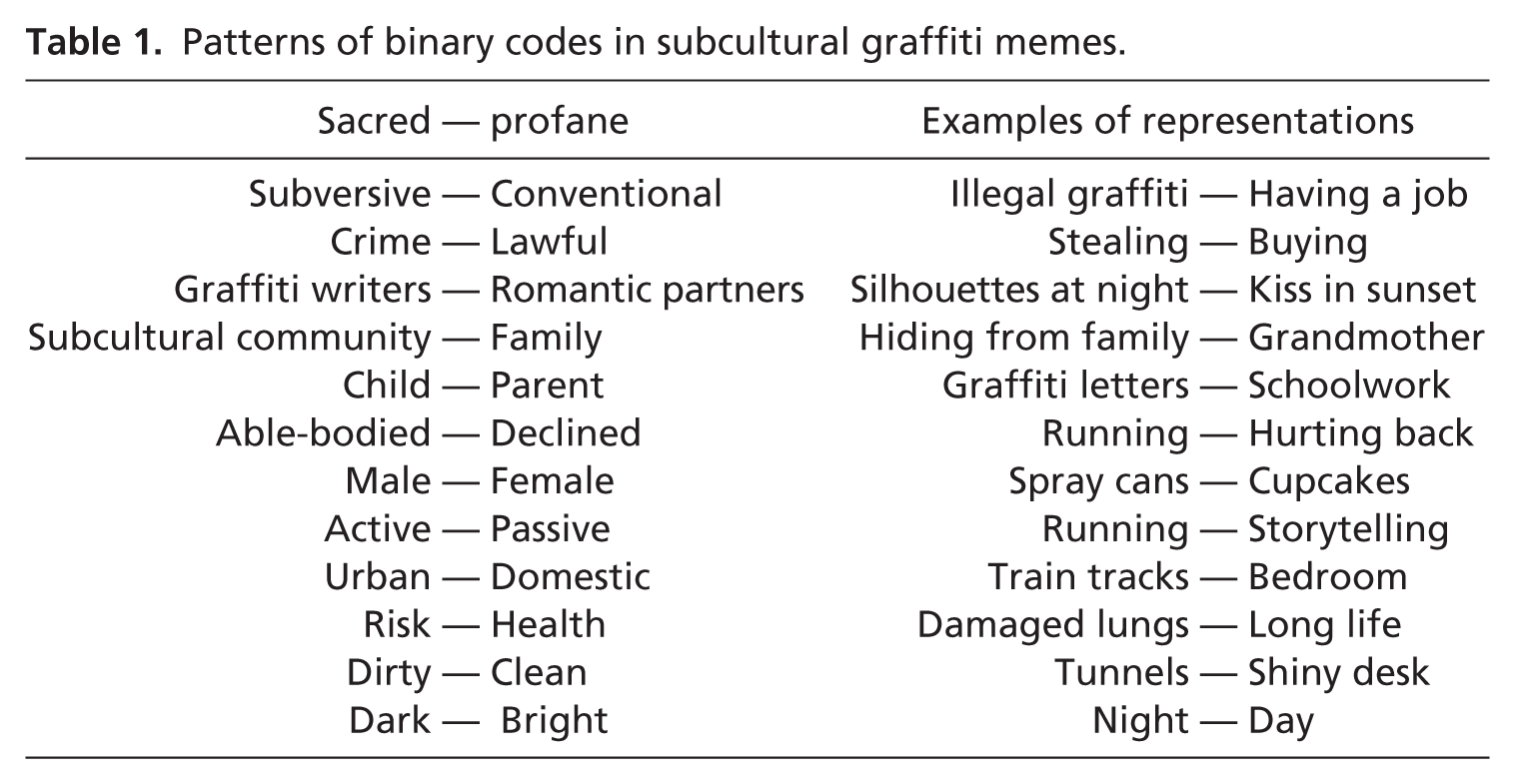
Following Alexander and Smith (2003), I conducted a close inspection of binary codes that constitute symbolic systems. I anchored my analysis in previously identified patterns of meaning from research on graffiti (see above). In the findings, I have typographically marked binary pairs of sacred—profane constructions with an em dash (—), separating sacred meanings on the left from profane meanings on the right. As will be demonstrated in the analysis, I found that, in graffiti memes, sacred—profane binaries were represented visually and in text through several culture-specific combinations, for example; subversive—conventional, crime—lawful, active—passive, young—old, man—woman, urban—domestic, dirty—clean, and risk—safety (see Table 1). Table 1 presents examples of symbolic codes recurring throughout the material, along with examples of props and actions used to represent them.
Patterns of binary codes in subcultural graffiti memes.
Findings: the anomalies of aging graffiti writers
Since its formation, a generational conflict between youth and adults has been central to the cultural meanings of graffiti (Kimvall, 2015). Even though an increasing number of graffiti writers are adults, this culture is continuously associated with youth (Andersen and Krogstad, 2019). Consequently, being a no-longer-young writer could appear as an anomaly that needs to be dealt with (Douglas, 1966). An increase in graffiti writers in midlife coincides with the emergence of Internet memes as a means of exploring and constructing identities. In the following, I identify two modes in which aging graffiti writers are represented as anomalies: Conventional Life and Passive Bodies. Then, before discussing the findings, I conclude by pointing out how this is done through the use of Doubly Articulated Subjects.
Anomaly one: conventional life
In the studied memes, no-longer-young graffiti writers are predominantly represented as individuals who fail to make graffiti their main priority because they encounter “blocking characters” associated with adult life (Frye, 1957: 164). As a result, their commitment to the subculture is questioned, as is their authenticity as graffiti writers (Hodkinson, 2002). This section identifies four ways in which Conventional Life is represented as anomalous to graffiti: (1) by prioritizing family life over graffiti writing, (2) by role reversal, (3) by domestic places coded as feminine, and (4) by leisure activities.
Family life
The All Alone meme (Figure 2) exemplifies patterns observed in representations of family life. It uses a meme template known as Fresh Prince Empty House, based on an image of the TV series character, the Fresh Prince, standing alone in an empty room. A caption has been added that spells out that “relations and having kids” lead to “no time to paint.” From this, we may conclude that the antagonist is a graffiti writer whose “painting partners” prioritize family life over graffiti, as the text makes clear. The empty room where the Fresh Prince stands “all alone” visually represents the absence of graffiti-writing peers, the message being that family life threatens subcultural community.
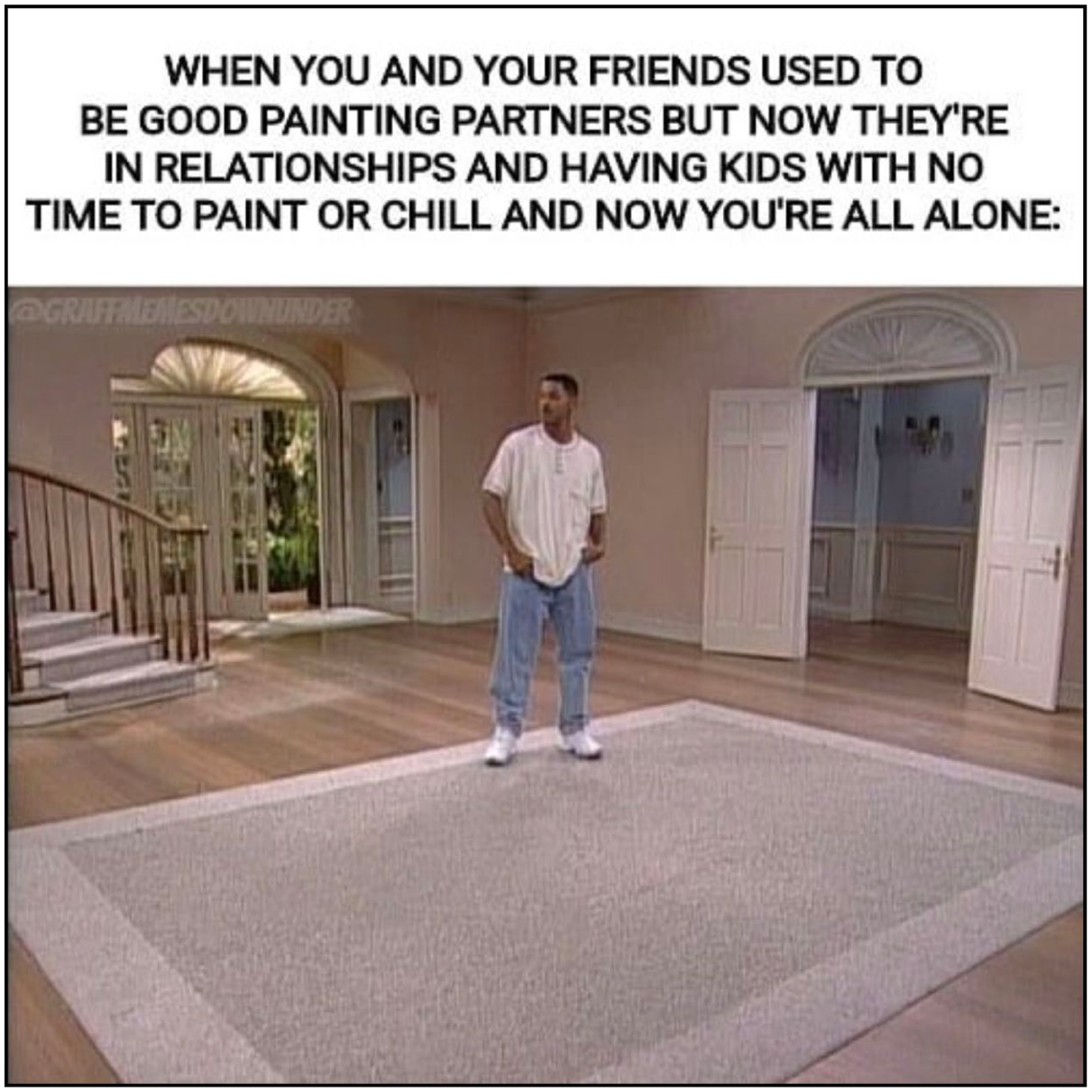
All alone-meme.
The All Alone meme can be read against the backdrop of graffiti as a youth-coded culture. In the studied memes, adult obligations are represented as conflicting with the graffiti community. Writers in midlife have undergone a role change and encounter blocking characters who impede graffiti writing; in this example, family members; in others, work colleagues, students, older relatives, or other individuals in roles associated with conventional non-subcultural life (Macdonald, 2001).
This example illustrates how memes use preexisting age classifications to construct identities and assign social positions (Heikkinen, 2021). In this meme, a peers—family binary is bundled with a youth—adult binary. Like in many other subcultures, youth is sacred, while family life and adults are considered profane (Thornton, 1995). The moral of these stories is that, in the lives of authentic graffiti writers, family life is an anomaly and thus “matter out of place” (Douglas, 1966: 41). Similar tropes are constructed in memes that represent higher education and work life as anomalies writers encounter as they age, for example, in memes where artistic skills learned through graffiti are “sold out” for career and money (Macdonald, 2001: 173–174).
Role reversal
A recurring narrative in graffiti memes holds that aging entails failing to maintain boundaries between subcultural and “mainstream” life (Hannerz, 2015). In this way, adult writers appear on the wrong side of a sacred—profane binary (Alexander, 2004). Memes are a narrative genre ready to be filled with culture-specific codes that display and negotiate cultural meanings (Shifman, 2014). Typically, narratives in graffiti memes are constructed through the following structure: (1) a generic image depicting an environment symbolizing conventional life, (2) a text added to the image that turns the character in the scene into a graffiti writer, and (3) the combination of environment and role appears as contradictory, which constructs humorous effects (Joshua, 2020: 80, 92).
The Parenting meme (Figure 3) exemplifies how this narrative structure generates intertextual meanings that suggest family life pollutes the sacred values of graffiti. The meme juxtaposes graffiti with parenting and schoolwork. In the image, an adult man leans over a boy as if to explain something; the calculator on the table makes the most obvious reading of the image a scene of a father helping his son with homework. But the added text makes the father say: “Don’t forget the swirl.” In graffiti vocabulary, a swirl designates an aesthetic ornament. Accordingly, the text transforms the visual meanings by “anchoring” a particular reading of the image (Barthes, 1977: 39). Here, the father comes to represent a graffiti writer teaching his son to draw graffiti. This turns expectations of age categories on their heads. Subcultures have been considered expressions of generational conflict in which the young rebel against the old (Hodkinson, 2012). For example, graffiti used to be kept secret from the writers’ parents (Macdonald, 2001). Role reversal between the child and adult is a common script through which humor is constructed (Kuipers, 2006). The ironic narrative in the Parenting meme is constructed by introducing graffiti on the profane side of the subversive—conventional binary and linking this to the graffiti writer appearing on the profane side of the youth—adult binary.
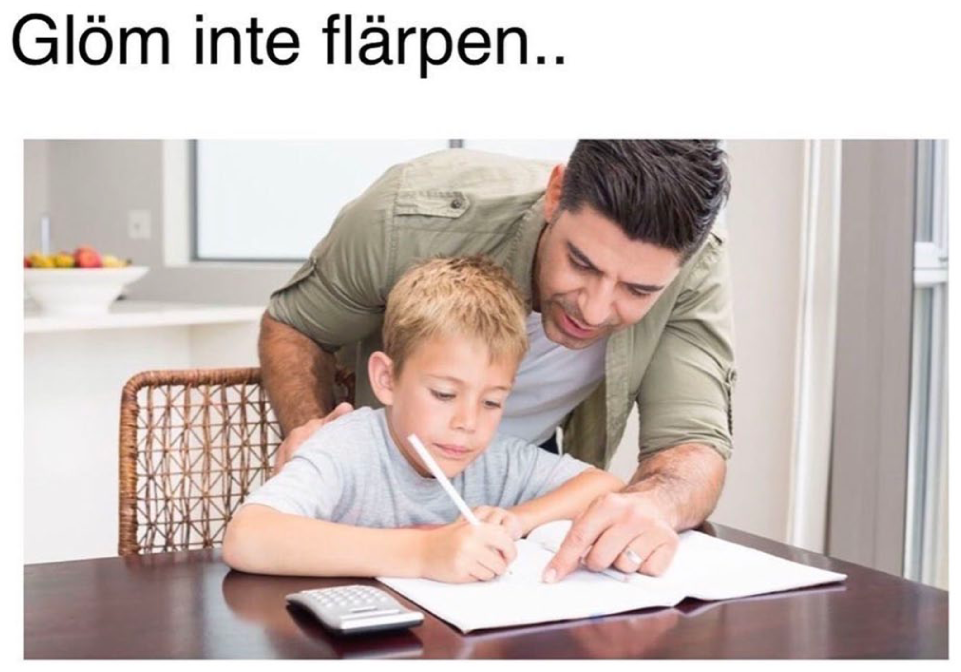
“Parenting-meme,” the Swedish caption reads: “don’t forget to add the swirl” (translation by author).
To understand humor, one needs to know culture-specific symbols and norms (Tuters and Hagen, 2020). In the formation of graffiti, the subculture was constructed as a separate world free from “real-life” settings such as school, family, and home (Macdonald, 2001: 182). To construct identities legitimized by other writers, it was expected to prioritize graffiti over schoolwork (Macdonald, 2001). Read against this backdrop, the scene in the Parenting meme appears absurd, casting doubt on its surface meaning (Watson, 2015). Research on contemporary graffiti shows that many writers combine graffiti and family life (Andersen and Krogstad, 2019). Still, many memes construct humor by drawing on a symbolic system that represents this combination as anomalous.
Feminine homes
The peers—family binary intersects with a pattern that represents domestic environments as feminine spaces. The investigated memes are saturated with heteronormative gender performances. Women are represented as conventional non-writers who do not understand graffiti and appear uninterested and dismissive. This representation is linked to becoming an adult and settling in a shared household with a woman. During graffiti’s formation in the early 1970s and its global diffusion in the 1980s, most writers were adolescent boys (Snyder, 2009). Graffiti’s symbolic meanings continue to serve as a resource for constructing masculine identities (Fransberg, 2021).
The Thinking About Someone Else meme (Figure 4) exemplifies heteronormative boundary work by visually representing a masculine—feminine binary through the breach between a couple lying back-to-back in bed, their faces expressing discomfort. The woman looks over her shoulder, and as the caption spells out, she suspects her partner is “thinking about someone else.” But as the caption continues, we learn that he is not fantasizing about women, but about graffiti tools, that is, spray “cans” and “caps” (spray can nozzles). In this example of a domestic drama, the woman has reasons to be jealous, yet she does not realize that her rival is graffiti. A plausible reading is that graffiti is the primary love of authentic writers and that they should not be home at night, but rather be outside in urban environments, writing graffiti. Here, a masculine—feminine binary intersects with an urban—domestic binary; these dichotomies are visually emphasized by the lack of attraction between the couple, as the image communicates that there will be no lovemaking, neither between the couple nor with graffiti. Accordingly, the writer is prevented from performing masculinity in either way and becomes emasculated, as the combination of bedroom, home, and girlfriend renders the domestic space feminine and the graffiti writers coded as men as matter out of place. This symbolically represents the men as being domesticated, and adult writers as failing to be committed to the sacredness of a subversive subcultural life (Baldini, 2018). Many graffiti memes employ gender binaries to represent challenges aging men encounter rather than challenging gender constructions as such. We can understand this as one way in which graffiti culture adopts a “master narrative” of a “binary, heterosexist framework” that structures gender in Western societies (Alexander, 2004: 549; Butler, 1990: 66).
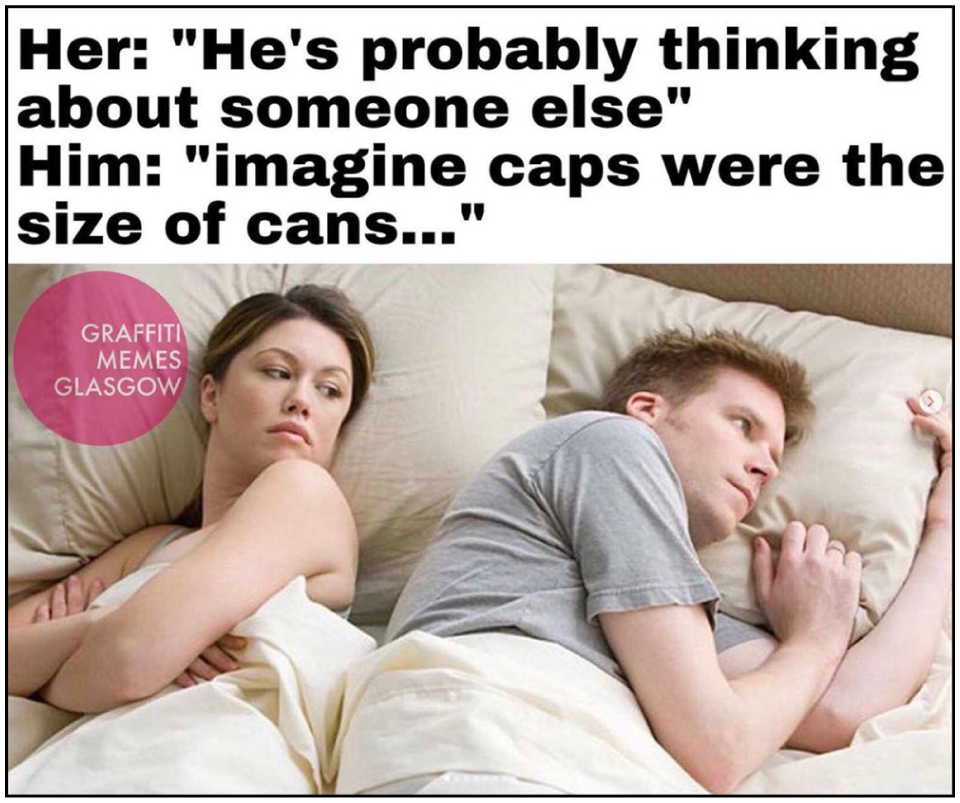
Thinking about someone else-meme.
As analyzed above, memes about aging bundle the binary code subversive—conventional with the binaries: youth—adult, peers—family, urban—domestic, and masculine—feminine. In addition, these intersect with the binaries dirty—clean and dark—bright. Just as family life represents an absence of writing peers, bright and clean houses may represent an absence of graffiti. Bright walls, shiny tables, and clean textiles in the memes discussed above can be interpreted as symbolic opposites to the dirty and dark urban environments in which graffiti belongs, according to its symbolic system (Macdonald, 2001: 100). Douglas (1966: 41) conceptualizes taboo things as symbolic “dirt” that members of a culture are to avoid. Ironically, according to the cultural meanings of graffiti, it is clean environments that pollute its sacred values. This is an example of how ironic humor is created by combining contrasting ideas and things (Joshua, 2020: 80, 92).
Leisure activities
The sacredness of subversive life can be further understood through memes that represent conventional leisure activities. Like previous memes, the Pike meme (Figure 5) uses role reversal; a brief text, here only one word, twists the meaning of a photo of a recreational fisherman. The added word suggests an analogy between landing a huge pike and painting a “wholecar,” that is, painting the entire side of a train car. In graffiti, painting a wholecar represents a major achievement and a key source of subcultural status (Macdonald, 2001: 84). The meme draws on the fact that catching a big fish shares similarities with writing graffiti on trains; to succeed, you need to know good spots and invest hours of waiting for the right occasion, often in early mornings (Fransberg, 2021). Then there is the thrill of succeeding. However, there may be intertextual messages implying that graffiti cannot be compared to fishing. Graffiti is symbolically associated with voluntary exposure to risks to freedom, economy, and health (Macdonald, 2001: 102). This constructs a raw “edge” that is a basis for subcultural authenticity and boundaries (Lyng, 1990). Yet, in fishing, there is nothing to lose, no risk of getting caught and punished, and the risk of being severely harmed is limited. Hence, suggesting that graffiti is equivalent to fishing is absurd and comic.

Pike-meme.
In ironic narratives, underlying meanings are concealed beneath surface representations (Joshua, 2020: 80). Irony turns ideals upside down and presents things from the viewpoint of their opposite (Watson, 2015). Accordingly, the images used in the studied memes rarely show graffiti; instead, they make analogies between the subcultural and the conventional by visually displaying symbolic opposites to graffiti. In the studied memes, generic images represent actions and settings coded as profane; added text introduces graffiti’s sacred values, as in the Pike meme, where the word “wholecar” connotes underlying meanings for those who know the cultural codes (Joshua, 2020: 80).
In the themes analyzed thus far, writers have been represented as able-bodied men who could write graffiti if they did not prioritize family life and conventional leisure activities. Below, the analysis will turn to another pattern in which aging writers are represented by bodies with declining functionality.
Anomaly two: passive bodies
As described, the cultural boundaries of graffiti have been constructed through a binary between youth and adults. In graffiti and other subcultures, this is done by contrasting subcultural members with antagonists such as parents, teachers, and law enforcement agents (Hannerz, 2015). Today, however, many writers are adults (Andersen and Krogstad, 2019), at odds with a symbolic system formed five decades ago. In the analysis so far, aging has been rather implicit, often represented as the absence of youth. The following theme illuminates how images of bodies with deteriorating functionality represent no-longer-young writers as anomalies.
No action, just talk
Graffiti is an activity-based subculture in which status is achieved through a commitment to investing substantial time and prioritizing graffiti writing over other aspects of life (Hodkinson, 2002). As bodies age, questions arise about their ability to do graffiti in ideal ways, typically without permission (Macdonald, 2001). Graffiti memes often use images of seniors to represent adult writers as passive. The Pub meme (Figure 6) depicts two senior men sitting in a pub. The caption reveals that they are discussing the history of graffiti, thereby constructing the seniors as graffiti writers. But their lack of movement and subcultural style breaks with expectations of how writers should look and behave (Hannerz, 2015; Hodkinson, 2002). Subcultural graffiti is both a visual and an oral culture in which status depends on circulating stories of action and achievements (Fransberg, 2021). Accordingly, storytelling per se is not problematic, but talk detached from present-day activity is rendered profane.
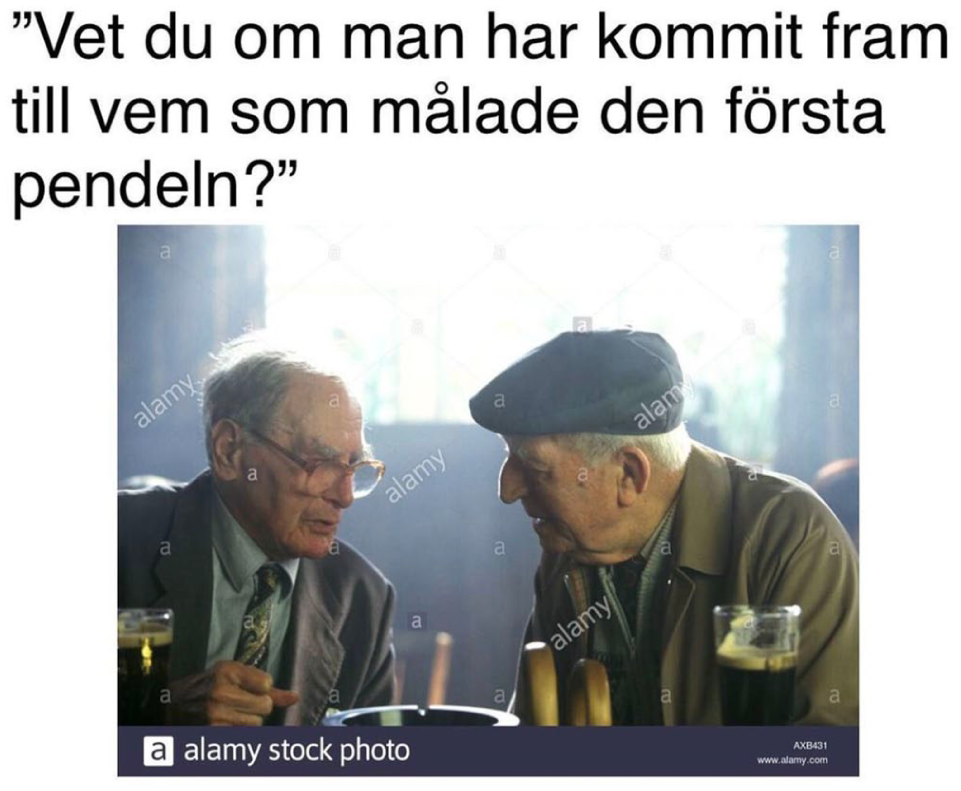
“Pub-meme,” the Swedish caption reads: “do you know if it has been established who was first to paint a commuter train?” (translation by author).
Memes like the Pub meme represent the notion that age may position writers on the profane side of an active—passive binary that overlaps with a young—old binary. The represented bodies are caricatures that build on ageist stereotypes (Garland-Thomson, 1997). No-longer-young writers are contrasted with young individuals, the latter being given the social role of “normates” and represented as “definitive human beings” (Garland-Thomson, 1997: 8). In contrast, no-longer-young individuals are represented as having deficit functionality.
Unable bodies
Graffiti is a practice that requires using the whole body and all its senses. A common trope in how graffiti memes represent passivity and the absence of youth involves bodies failing to perform physical tasks. For example, the King in Distress meme (Figure 7) depicts a man in flamboyant clothes lying down while a second man leans over him to check how he is doing, addressing someone out of sight with: “Man down! King in distress!” The meme uses a still image from the movie “Friday After Next.” In its original context, “Man down!” indicates that the man is a gangster who has been shot. But the added text twists the meaning of the image into representing an aging writer, suggesting that old writers—“old heads”—break their backs when trying to carry spray cans. The man’s position represents an unable body and the inability to do graffiti. The added word “king” designates a title earned through superior performance of subcultural style and sustained activity, conferring high status (Macdonald, 2001). Achieving this requires a body with a steady hand, and the ability to move swiftly through the city, including jumping fences, climbing ladders, balancing on roofs, and outrunning the police (Macdonald, 2001). These are necessary to overcome the risks of painting without permission which are associated with the sacredness of the young and “able-bodied” (Garland-Thomson, 1997: 6). However, graffiti can be made in many ways and by a plurality of body types, yet the symbolic system of graffiti rests on limited notions of what an able body is (Hannerz, 2017); typically assumed to be a young man. Status is tied to sustained commitment, but within this drama, the king has been forced to realize his mortality, and is now facing the threat all kings fear most: dethronement.
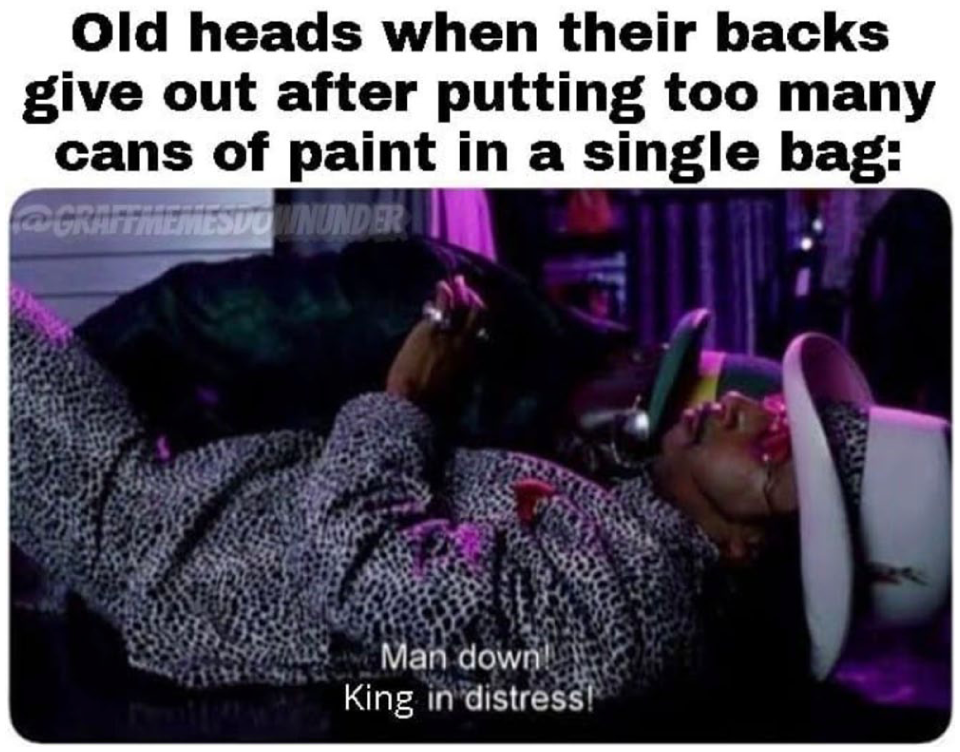
King in distress-meme.
The memes that depict old bodies construct a narrative in which unsanctioned graffiti is remembered rather than painted in urban environments, which is likened to the way their young bodies are just memories. Hence, these memes bundle the binaries subversive—conventional and young—old with able-bodied—disabled and active—passive. As described in the first section of the analysis, the studied memes place the bodies of writers in environments where they appear to be matter out of place, but in most memes representing old bodies, the protagonists are rather trapped inside bodies that appear alien to their identity as part of a youth-coded culture (Garland-Thomson, 1997). Consequently, writers are represented as embodying an alien age category (Heikkinen, 2021). In these representations, the blocking characters are not external actors outside the subculture, such as girlfriends, but the writers’ own bodies, which are represented as impeding their continued enactment of subcultural commitment (Hodkinson, 2002).
Like the previously analyzed Parenting meme, in memes representing old bodies, the young—old binary is typically turned upside down, constructing ironic dramas in which no-longer-young writers appear as jesters (Jacobs and Smith, 1997: 76). In this way, memes may function as ritual-like social performances, in which old bodies become scapegoats, symbolically sacrificed for the narrative treatment of cultural decay (Alexander, 2004; Turner, 1982). Graffiti memes perform scapegoating in several ways, including representations of old bodies and girlfriends as blocking characters.
Doubly articulated subjects
Ironic narratives are constructed by the juxtaposition of perspectives, which can unsettle common understandings and spark critique (Jacobs and Smith, 1997). Taken together, the two ways to represent aging writers analyzed above – Conventional Life and Passive Bodies – share that writers are represented in environments, activities, and roles that appear absurd in relation to understandings of graffiti as a youth-coded culture. Writers appear as jesters in carnivalesque dramas in which narratives of stability and disruption are “promoted by the same lived text” (Jacobs and Smith, 1997: 75–76). Symbolic systems that govern social interaction prescribe their subjects to be consistent, and, as a consequence, hybrid and ambiguous subjects are typically rejected (Douglas, 1966). But humor is produced by breaking with this through the use of incongruities and contradictory identities (Watson, 2015).
Drawing on Douglas (1966: 41), we may understand memes as dramatic narratives that address anomalies by incorporating “goodness” and “evil” into a single system. Through exaggerated enactments, parody can challenge stereotypes (Alexander, 2004; Butler, 1990). Humor has the potential to pollute and thus rework boundaries between the sacred and profane (Lund, 2024). The narratives examined do so by using “doubly articulated subjects” that represent two ways of being a graffiti writer (Brusila, 2021: 31), one ideal associated with distant youth, and another, closer to the mundane life of no-longer-young writers. In the discussion, I will develop how the construction of such contradictory and multiple identities might facilitate identity and boundary work.
Discussion
This article has examined how Internet memes are used to negotiate cultural meanings and tensions related to aging. I asked: How do memes about graffiti represent aging in a youth-coded subculture? Memes were approached as a narrative genre that displays, (re)constructs, and negotiates cultural meanings through ironic dramas. Graffiti, like many other subcultures, is symbolically associated with youth and masculinity (Macdonald, 2001); hence, this study provides valuable insights into the intersections of subcultural identity, age, and gender. The analysis showed that the studied memes represented no-longer-young graffiti writers in situations and social roles constructed as conventional and consequently anomalous to the meanings of graffiti. This was achieved by drawing on stereotypical age classifications, heteronormative gender performances, and expectations of able-bodiedness.
A recurring trope was that aging leads to the symbolic pollution of the meanings that define graffiti (Douglas, 1966), thereby threatening the collective solidarity within the subculture. As I have shown, the environments and individuals depicted in the memes represented many versions of a subversive—conventional binary that previous research has found to be foundational for boundary work in graffiti (Baldini, 2018; Macdonald, 2001). I find that memes about aging predominantly draw on meanings that have defined graffiti since its early days. This can be understood as “consistent distinctiveness” of ideals and tastes, which Hodkinson (2002: 28) finds to be defining for subcultures, in contrast to more fluid groupings. However, even if the same meanings were in effect, they were represented in novel ways.
The existence of the studied memes reflects that graffiti has become an intergenerational culture. During data collection, I observed that many viewers commented on the memes by posting laughing emoticons and remarks expressing identification with the narratives’ antagonists. While this study is analytically delimited to the visual representations at the site of the images themselves (Rose, 2016: 32–34), such expressions of identification nonetheless suggest that the memes resonate with male writers in midlife.
Even though this study does not capture the lived lives of graffiti writers through ethnography or interviews, it offers valuable insights into their meaning-making. As previous research has shown, media are important for negotiating subcultural style in its broadest sense, including taste, actions, and status (Hodkinson, 2002). Representations in images and texts are not mere depictions of the world; here, they are considered as social performances in the negotiation of cultural meanings. Ergo, memes are understood as means for individual agency that both reproduce and challenge group ideals and norms (Alexander, 2004; Shifman, 2014). Drawing on humor studies, I suggest ways in which memes may serve as online affordances for performances of selfhood and (re)construction of subcultural boundaries (Hannerz, 2015; Uimonen, 2013).
The memes were posted on Instagram accounts focused on graffiti, using culture-specific language and symbols that require particular cultural competence. Consequently, they may be understood as internal negotiations of challenges to graffiti writers’ cultural identification. Memes can function as distorting mirrors, allowing group members to laugh self-ironically while reflecting on cultural ideals that are hard to live up to. This could offer levity and relief; hence, memes have the potential to serve as a coping strategy for identity crises (Lund, 2024).
One way to handle cultural anomalies is to represent them as dangers to avoid (Douglas, 1966). Danger offers a thrill, and humor often draws on the risk of falling and losing face, literally or metaphorically (Mead, 1934). But self-deprecating humor allows others to laugh at one of an individual’s public identities without attacking their “core self” (Fine, 1984: 93). We can see this in that the memes did not critique failures of specific group members but rather the failures of stereotypical social roles. While comedy often includes rituals in which a community expels an irreconcilable character, exposure and disgrace may also elicit pity (Frye, 1957). Ronglan and Aggerholm (2014: 39) find that humor has the potential to “facilitate more fluent shifts between role commitment and role distance.” The studied memes represented two temporal versions of the self; the young and ideal, and the no-longer-young, and inauthentic. Such a “doubly articulated subject” is a figure of fun or abuse, but through jokes, it can evoke compassion and become a subject for which a community takes responsibility (Brusila, 2021: 31). Accordingly, graffiti memes could help preserve collective solidarity. Even though memes are not experienced in embodied co-presence, as a practice of sharing, viewing, and commenting, they can be a form of laughing together that may strengthen group boundaries and dismantle hierarchies (Fine, 1984).
It has been argued that, when (sub)cultural participants age, “mainstream” values previously rejected, such as family life, are assimilated (Bennett, 2018; Hodkinson, 2012). But the present study has identified a way in which social media may be used to accept the dilemma of aging in a youth-coded culture while being consistent with subcultural boundaries to conventional (adult) life. I conclude that memes do not prescribe solutions to identity conflicts; rather, irony might foster tolerance for differences (Jacobs and Smith, 1997). Subsequently, memes may be understood as means of inscribing anomalies into a symbolic system without resolving them (Fine, 1984). Thus, the cultural meanings that are foundational for graffiti culture’s consistency and its boundaries can be maintained (Hodkinson, 2002). Potentially, individuals may accept their own and their peers’ failures in living up to their ideals, or rather, reject these failures as failures, and accept them as facts of existence (de Beauvoir, 1976).
Irony is a mode of reflexivity that can facilitate change in norms and behaviors (Jacobs and Smith, 1997). However, we also need to consider that memes express moral positions and exercise social control; hence, humor could limit the range of imaginable actions and identities (Fine, 1984). A pattern observed in the material was the reproduction of heteronormative ideals alongside normative assumptions about bodily functionality. Graffiti memes about aging confine reflexivity to aging while remaining conventional in their gender representations, underscoring how a culture that understands itself as nonconformist may nonetheless conform to dominant norms. Consequently, conservative gendered performances and body ideals remain unchallenged, and the exclusion of women and expectations of able-bodiedness previously identified in graffiti culture are reproduced (Fransberg, 2021).
This study contributes to research on how (sub)cultural meanings are negotiated across the life course. Although previous research has shown that these negotiations are context-dependent (Hodkinson, 2003), comparatively little attention has been paid to how aging is negotiated within graffiti culture. As graffiti culture has become intergenerational and more gender-diverse, plural meanings have increased (Fransberg, 2021). Future research should examine the tensions younger and women writers negotiate through online humor, as well as how memes are produced and used in graffiti and other subcultures. Equally important is to examine additional tensions older graffiti writers may negotiate. Given the polysemic nature of humor and visual representations (Brusila, 2021), the material analyzed here may contain further underlying meanings that could be brought to the fore by posing other questions to the material, including those related to class, ethnicity, and race. This study also contributes to research on how the fluidity of online media influences the construction of cultural meanings. In doing so, it contributes to debates about the processes through which individuals who share a preference for style form closely bounded groups or more fluid coalitions (Robards and Bennett, 2011).
Irony does not resolve contradictions between subcultural ideals and lived life, but it may enable writers to live with them. Memes offer to transform the crisis of aging into a compassionate, collectively meaningful experience. Through memes, individuals may look at their aging selves with compassion, and laugh.
Footnotes
Acknowledgements
I would like to thank Erik Hannerz and Anna Lund for their invaluable comments on this article. I am also grateful to the anonymous reviewers and journal editors for their constructive feedback, which substantially strengthened this article.

Ethical considerations
Not applicable; as there were no human participants in this article informed consent were not required.
Consent to participate
Not applicable; as there were no human participants in this article informed consent were not required.
Consent for publication
I hereby confirm that I have obtained written informed consent to publish the figures included in the manuscript.
Funding
The author received no financial support for the research, authorship, and/or publication of this article.
Declaration of conflicting interests
The author declared no potential conflicts of interest with respect to the research, authorship, and/or publication of this article.
Data availability statement
The datasets analyzed during the current study are not publicly available due to the inclusion of copyrighted material, but are available from the corresponding author upon reasonable request.
Copyrights
The producers of reproduced images have granted their permission for their reproduction free of charge.