




Abstract
This article develops a novel methodological approach to mapping the autonomous logics of cultural fields in an era of algorithmic consumer culture. Focusing on Australian art music, it draws on the material logic of the field – the sociological schemas inscribed in the acoustic properties of the music – to model how producers perceive the relational positioning of their peers. Using a survey of composers (N = 86) to train a computational model of acoustic features, we visualise the field’s latent structure. The analysis reveals dimensions that map specific struggles over innovation (form) and diversity (content) – such as modernism vs jazz and spiritualism vs serialism. We argue that these producer-defined logics constitute the field’s relational infrastructure, demonstrating how field analysis can move beyond discursive text to engage with the materiality of the art object itself. This material logic is of existential importance in sustaining autonomy against the homogenising, heteronomous logics of global platforms. The article thus offers a tool for empirically visualising the specific principles that are at risk of being displaced by generic algorithmic classification.
Introduction
Our perception of the similarities and differences between artists and their creative output is fundamental to our experience of specific styles and genres. In music, for example, curatorial practices actively shape this perception by grouping artists for a concert programme or playlist, while editorial practices draw connections of influence and stylistic relationships in reviews or programme notes. By drawing artists together in particular relational constellations, these acts reinforce perceived similarities and define the boundaries of cultural practices.
In contemporary digital environments, however, such processes of association are increasingly codified within algorithmic logics. As Airoldi and Rokka (2022) argue, we have entered an era of ‘algorithmic consumer culture’, whereby the embedded representations of relational similarity that inform recommendations on platforms like Spotify actively shape the perceived structure of the cultural space. This shift raises a question of existential importance for specialised, ‘restricted’ fields of practice (Bourdieu, 1983): how can they sustain their specific, autonomous logics against the homogenising, heteronomous pressures of global platforms?
For specific niches of cultural practice – such as hyperpop, progressive house, or free improvisation – the capacity to sustain the logics specific to their practice is closely linked to identity. For Bourdieu (1983), this link between specific logics and identity is underpinned by the concept of a field’s autonomy and the ‘degree of specific consecration’ by which a field can ‘suspend or reverse the dominant principle of hierarchisation’ (p. 320). While various logics may shape how a field is understood, Bourdieu highlights the privileged role afforded to producer perspectives in fields of restricted production, where ‘producers produce for other producers’ (p. 320). If the specific logics by which producers define their cultural practice cannot be sustained, this represents an existential threat for the practice to be understood as such.
Sapiro (2010) demonstrates that this struggle for autonomy often manifests in the field’s material output. In the literary field, the autonomous pole resists market hegemony by producing a specific material output: a high diversity of translated works. This article proposes that a similar dynamic exists in the music field, but at the level of the sound itself. To maintain their autonomy, niche musical practices must sustain a specific relational infrastructure – a constellation of producer-defined values – that we can observe as encoded in the music’s acoustic properties.
This article engages with these issues through a case study of Australian art music. It is guided by the research question: What are the latent relational logics employed by producers that constitute the internal structure of Australian art music, thereby forming the basis for the field’s autonomy? To investigate this, the article develops a novel method to empirically map these producer-defined logics. We term this the field’s ‘material logic’: the sociological classificatory schemas used by producers that become inscribed in, and are reproducible through, the acoustic properties of the cultural objects themselves. By visualising the specific, often implicit, organising principles that establish the field’s internal relations, we can identify the classificatory schemes – the ‘grid of identities and similitudes’ (Foucault, 2005: xxi) – that are at risk of being overridden by generic algorithmic models.
Literature review
The very notion of a ‘field of cultural production’ can be traced to Bourdieu’s (1983) eponymous work, which also formed the title for his collected edition (Bourdieu, 1993) on the French literary and artistic fields. For Bourdieu, field constitutes a conceptual approach in which our understanding of the whole emerges from the relationality between its parts (Bourdieu, 2020: 234–235). In contrasting field from interaction, Bourdieu emphasises the significance of positions and ‘the fact that it is by constructing the positions that we establish the space, and it is by constructing the space that the positions are established’ (Bourdieu, 2020: 250). It follows, therefore, that Bourdieu’s interest was in the objective relations as ‘dormant forces’ that construct and sustain spaces, thereby constituting the ‘space of possibles’ that defines the structure of a field (Bourdieu, 1993: 176). These logics not only project the space of position-taking but also form the implicit principles and classificatory schemes through which we engage with and make sense of a field.
Within the space of possibles defined by these structuring logics, field analysis often focuses on the position-takings through which producers navigate the field. Bourdieu (1993: 34) advocated this focus to transcend explanations rooted solely in internal textual analysis (‘tautegorical’) or external social determinism (‘allegorical’, e.g. the work of Adorno (1973) and McClary (1991)). Position-takings represent the manifest strategies – aesthetic choices, affiliations, declarations – employed by producers as they engage with the field’s possibilities and constraints. Examining these strategies provides insights into the dynamic struggles over prestige, legitimacy and the very definition of value that characterise cultural fields (e.g. De Nooy, 2002). Importantly, these actions are guided by, and simultaneously shape, the field’s specific relational logics. For instance, analysing practices such as artistic referencing can reveal producers’ attempts to demonstrate cultural capital and align with evolving peer recognition standards, thereby illuminating the operative logics at play. While the capacity to enact certain position-takings is conceptually linked to the possession of various forms of capital (Bourdieu, 1993: 30) a focus on the position-takings in and of themselves allows for an analysis of how the field’s structure and meanings are actively constructed and contested through the strategic actions of its key participants, particularly its producers.
Through this emphasis on relational struggles and power dynamics, Bourdieu highlights the crucial link between a field’s autonomy – its capacity to impose its own principles of hierarchisation, potentially suspending or reversing dominant external logics (Bourdieu, 1993: 38) – and its capacity to exist as an identifiable, discrete practice. Autonomy signifies the power of the field to define value ‘on its own terms’, refracting external demands through its specific internal structure, history and operative logics. This autonomy is especially critical for fields of restricted production (Bourdieu, 1983: 320), such as the Australian art music scene analysed here. In these fields, production is oriented primarily towards peers – other producers equipped with the specific dispositions and knowledge to appreciate the work according to the field’s internal standards. Here, the relational logics employed and recognised by the producers themselves hold exceptional symbolic power, defining the rules of the game. The field’s very identity and its coherence depend on its capacity to generate, reproduce and enforce these specific, producer-centric relational logics against the homogenising pressures of the broader market or dominant cultural norms.
Research applying these concepts illustrates the stakes involved in maintaining such autonomy. For example, Dubois et al. (2016) detail this precariousness in their study of French wind bands, showing how their threatened capacity to follow an autonomous logic, independent of dominant musical conventions tied to ‘serious’ music or amateur provincialism, constitutes an existential crisis for the practice. Significantly, this autonomy is not a fixed state, but is continuously negotiated against external constraints. As Dowd (2000) demonstrated in the US recording industry, external market conditions like concentration interact with internal production structures and aesthetic logics to shape cultural outcomes, specifically musical diversity. Bellavance (2008) also notes that fields like Australian art music often navigate an under-acknowledged structuring principle of old/new: a connection to art music’s historical lineage against its need to espouse its contemporary edge and relevance, which draws further attention to the precarious place of this practice within the broader fields of art and music.
Analysing these often-implicit relational logics empirically poses significant challenges. Bourdieu utilised methods like correspondence analysis and historical sociology, accessing the deep structure of the field and its operative logics benefits by engaging directly with the practices and, crucially, the products through which these logics are enacted and materialised. This resonates with calls within cultural sociology to address the specificity of artistic works and the ‘missing materials’ (Ingold, 2021) in the analysis of culture, and to move beyond treating cultural objects as mere ‘arbitrary stakes’ in social games (Hennion, 2015: 2). Rather than viewing an engagement with cultural objects as antithetical to field analysis, attention to the materiality of culture – the specific forms, features and properties of cultural objects themselves – can be understood as an empirical pathway to revealing the principles of vision and division, the very logics that operate within particular fields (Rawlings and Childress, 2019).
While Bourdieu’s foundational concepts of field and autonomy remain central, Hesmondhalgh (2006) has famously critiqued the framework for analysing restricted production in isolation, often neglecting large-scale cultural industries. This limitation is particularly acute today, as the heteronomous logics of large-scale production – embedded in global algorithmic systems – increasingly permeate restricted fields. Contemporary revisions of field theory offer additional tools for analysing these dynamics in a contemporary globalised context. Buchholz (2022), for example, argues that the autonomy of a national field – such as Australian art music – cannot be understood in isolation but must be situated in relation to the multi-scalar logics of a transnational field. She proposes a model of vertical autonomy, where national fields develop specific, hierarchical logics that operate relatively independently of the global field’s dominant poles. This structural autonomy often manifests through specific strategies of resistance. As Sapiro (2010) demonstrates in the literary field, the autonomous pole frequently resists the homogenising forces of the large-scale global market by championing cultural diversity, a strategy that relies on maintaining alternative, non-commercial principles of hierarchisation. Following Hilgers and Mangez (2015), this dynamic can be conceptualised as a struggle between the field’s autonomous pole, structured by internal, field-specific values, and a heteronomous pole increasingly defined by external, commercial and algorithmic logics. The definitive test of a field’s autonomy, then, is its capacity to ‘refract’ these external pressures through its own internal structure.
To operationalise these theoretical insights, this article develops the concept of ‘material logic’. Drawing on Hilgers and Mangez’s (2015) notion of the refraction effect, we define material logic as the sociological classificatory schemas used by producers that have become inscribed in, and are reproducible through, the acoustic properties of the cultural objects themselves. While Hilgers and Mangez caution against the substantialist fallacy of treating objects via their intrinsic properties, our approach avoids this by strictly deriving the significance of these acoustic features from the relational structure of producer perceptions, rather than analysing the sounds in isolation. This concept, therefore, provides an empirical bridge between the producers’ internal ‘principles of vision and division’ (Bourdieu, 1993) and the tangible reality of the music. Adopting Airoldi’s (2021) approach, we treat these acoustic properties not merely as aesthetic features, but as digital traces of social practice. By aggregating these traces, we can model the field’s underlying structure – its material logic – and visualise the specific, autonomous principles that the field uses to distinguish itself from the heteronomous logic of the broader market.
Music presents particular challenges for empirical analysis within this field-theoretic framework due to its perceived intangibility and resistance to purely discursive analysis. Bourdieu (1984: 80) regarded music as the most ‘spiritual’ and ‘pure’ art form, with the corollary that it is ‘below words’ in a manner which disrupts attempts at the discursive articulation of its properties and their bodily effects. Hennion (2012) similarly highlights this elusiveness, noting that music has ‘nothing but mediations to show’. To overcome this challenge, we turn to computational methods developed in fields such as music information retrieval (MIR) and music psychology. These tools allow us to systematically analyse the ‘material’ acoustic properties of recorded music (Siedenburg et al., 2016) by quantifying perceptible features related to melody, rhythm, harmony and timbre (e.g. Dean et al., 2011; Leung and Dean, 2018), offering a rigorous way to operationalise aspects of musical style and difference.
For cultural sociology, this computational approach enables a ‘return to the work’ at scale (Manovich, 2020), allowing analyses to connect field dynamics to the specific content of cultural products. Such methods provide opportunities to empirically investigate the relational logics structuring a field as they manifest in the acoustic properties of the music itself. Sociological studies have already demonstrated the potential of analysing material or relational patterns within cultural outputs, to provide insights into field structures and logics. Dowd (2000), for instance, examined relationships between market structure and musical diversity based on sonic characteristics; Silver et al. (2016) mapped genre spaces using co-classification data reflecting perceived similarities; and Burgdorf (2024) traced patterns of influence and recognition through cinematic references. These examples, alongside work analysing audience encounters with algorithmically recommended music based on perceptual qualities (Chambers, 2024), demonstrate the value of analysing patterns within cultural outputs to gain empirical access to the underlying logics, structures and evolving standards of cultural fields.
While powerful for operationalising aspects of musical style and difference, it is acknowledged that these computational methods face critique, potentially representing new forms of reductionist approaches that seek meaning solely in isolated acoustic elements. Such critiques, often emphasising the importance of social context, use and embodied experience (e.g. DeNora, 2000; Frith, 1996), caution against overlooking the qualitative interpretations central to sociological and musicological understanding when relying primarily on quantitative analysis. While acknowledging these concerns, the current study seeks to mitigate the risk of pure structural reductionism by specifically leveraging computational analysis of acoustic features not merely to identify objective patterns, but to explicitly model the relational logics inherent in producer perceptions of the field, as captured through survey data. This approach aims to ground the acoustic analysis within the subjective framework of the field’s key actors, thereby linking the material properties of the music back to the social logic of the field and overcoming some of the challenges posed by music’s perceived intangibility.
This theoretical and methodological background forms the departure point for the current study. Focusing on Australian art music as a case study of a field of restricted production, the article introduces a novel approach to empirically investigate the relational logics underpinning its autonomy. Integrating the computational analysis of acoustic materiality with producer perspectives of the field, it develops a model trained explicitly on the field’s producer perceptions to capture the field’s internal logic. By doing so it reveals Australian art music’s specific, producer-defined logics and classificatory schemas. Identifying these core principles is crucial, as their persistence is fundamental to the field’s autonomy and its capacity to be recognised as a distinct practice.
The field of Australian art music
The selected field which is analysed in this article, Australian art music, encompasses genres spanning contemporary classical, improvisation, sound art, and particular styles of jazz and algorithmic music. It draws on a lineage which is commonly associated with elite ‘highbrow’ or ‘legitimate’ forms of classical music, yet simultaneously proclaims its connections to contemporary time and place. In seeking to map this space of practice, the current research becomes unavoidably implicated in the work of what Beer (2012) refers to as the ‘classificatory imagination’ and boundary-drawing practices.
To define the boundaries of this practice, the article anchors the field in an institutional definition, using the musical scope of the Australian Music Centre (AMC). As Australia’s national service organisation for art music, significantly supported by government funding, the AMC’s role extends beyond that of a simple repository; it actively curates, promotes and catalogues the works it deems representative of the field. From the perspective of Bourdieu’s (1992) theorisation of the structure of artistic fields, the AMC is taken to represent an instance of institutional consecration, which seeks to systematise and normalise a doxic, or ‘orthodox’, understanding of the field. While this orthodoxy inevitably exists alongside competing possibilities which pursue their own framings of what constitutes Australian art music, the AMC’s central role in distributing recognition (through awards and bestowing representation on composers) solidifies its status as the arbiter of the legitimate field.
It is important to note, however, that this institutional ‘orthodoxy’ is itself a sociological object of study. By defining the field through the AMC’s consecrating mechanisms, our approach necessarily excludes or marginalises practices not represented by this institution, such as many forms of community-based work, and experimental scenes operating outside institutional funding structures. Thus, the resulting map is not of all Australian music, but rather a map of the dominant, institutionalised field, revealing the very boundaries this orthodoxy constructs.
Material and method
This study adopts a methodological framework of ‘augmented taste research’ (Airoldi, 2021) which leverages the specific affordances of digital data to investigate cultural fields. Rather than relying solely on traditional surveys or purely computational analysis, we employ a two-step approach that bridges the subjective and the material. First, we use survey data to establish a ‘ground truth’ of producer perceptions – specifically, how composers perceive similarity and difference among their peers. Second, we use this perceptual data to train a computational model of the field’s material output: the objective acoustic features of the music itself. By treating these acoustic properties as digital traces of the field’s underlying logic (Airoldi, 2021), we can move from individual producer perceptions to a map of the field’s relational structure. This allows us to visualise the latent organising principles – the material logic – that would otherwise remain invisible to purely qualitative or quantitative observation.
Establishing ground truth for the producer perspective on the field
Acoustic models have a long history of application in the field of music information retrieval, solving problems such as genre classification (Scaringella et al., 2006) and recommendation (Van Den Oord et al., 2013). In these examples, supervised learning models can be developed and fine-tuned using readily available data on what constitutes the ground truth that the models are aiming to reproduce. Genre labels, for example, can be taken from a platform such as Spotify; or user ratings of music can train the accuracy of recommendation algorithms. In the case of training a model to reproduce the relative proximities among Australian composers, however, no such ground truth is readily available.
To address this gap, the article draws on a survey of Australian composers specifically designed to generate data for training a model of relational proximity. Composers whose music is featured in the collection of the Australian Music Centre (AMC) were invited by email to participate in an online survey. The survey asked respondents to ordinally rank a list of five pre-selected composers in order of how similar they regarded each composer’s overall musical practice to their own. The list of composers was customised for each potential respondent and was selected from among fellow AMC composers who had at least some acoustic similarity to the respondent (as selected using a variety of candidate acoustic models). The aim was not to generate a list of the five most similar composers, but for the candidate composers to have sufficient similarity to increase the likelihood that participants would be familiar with the options presented.
A total of 86 responses were received, reflecting a survey response rate of 35% and representing 11% of all AMC represented composers. Of these responses, 63 (26% of invited participants; 8% of all composers) completed all five rankings and a further four respondents completed partial rankings. Having full data for over one-quarter of the potential candidate composers is considered a strong foundation from which to train a model reflecting how producers conceive of the field.
Modelling the field
The modelling approach sought to identify a parsimonious set of acoustic features capable of representing the relative positions of producers as reflected in the survey data. We extracted a comprehensive set of audio descriptors from the AMC’s digital library (11,053 recordings) using Essentia software (Bogdanov et al., 2013). This initial set of acoustic descriptors was subjected to dimension reduction to identify candidate features suitable for modelling. We then evaluated unique combinations of these features to assess their capacity to reproduce the ground truth composer similarity rankings from the survey. Full details of the modelling procedure are available in Chambers (2021).
Mapping the field
To consider how this model can be applied to inform our understanding of the structure field, the analysis first draws upon clustering techniques to consider how the field divides into genres. Despite research pointing to the fluidity (Vlegels and Lievens, 2017) and ambiguity (Van Venrooij and Schmutz, 2018) of musical genres, they nevertheless retain significant power as structuring forces and classificatory schemes through which people make sense of their musical environment (Beer, 2012). In the context of mapping a space of cultural practice, genres reflect the between-group separation and within-group cohesion that partition the practice into distinct schools, traditions or sub-genres. This division is fractal in nature: just as separate genres of art music, folk or house might be identified within the broader field of music, each of these can also be more narrowly partitioned – such as the distinctions between ballroom, progressive and ghetto within house music.
The division of a field into clusters involves transforming proximities among actors into a classificatory delineation. The identification of groupings emerges from the relative cohesiveness of its members and the nature of the resulting groups provides the data for analysis. In Bourdieu’s analysis of fields and Foucault’s interest in classification, however, they both show a greater interest in the underlying forces which give rise to their respective objects of investigation. Foucault (2005: xxi), for example, emphasises the ‘system of elements through which resemblance and difference can be shown’ – a system which exists as ‘the blank spaces of the grid’ against which order manifests itself. Rather than analysing the classificatory labels which emerge, it instead points to the need for techniques which can identify the latent organising principles against which we can understand both the relational positioning of actors and its accompanying scheme of perception.
The quantitative method of multi-dimensional scaling (MDS) offers one such approach for analysing the organising principles which give structure to a field and produce its distinctions. MDS takes a square dissimilarity matrix as its input and seeks to plot each item in n-dimensional space by selecting a set of coordinates which minimises a ‘stress’ function. Just as cluster analysis can partition a space into any number of clusters, MDS can be used to identify any number of latent dimensions. While a higher number of dimensions will more accurately reflect the set of distances between composers, it does so at the cost of being less easily interpreted. This trade-off between accuracy and interpretability is reflected in the stress score, with lower scores reflecting improved goodness of fit between the input data and the fitted model. R’s vegan package (Oksanen et al., 2019) was used to calculate distances using non-metric scaling to reflect the underlying non-linear nature of the ordinal ranking data.
Results
Ground truth survey: producer perceptions
The survey results demonstrate a clear bias, whereby composers disproportionately perceived themselves as similar to peers who had achieved higher levels of critical and commercial success. When candidate composers were ranked by success, participants most frequently selected the highest-ranked options as ‘most similar’ to themselves (see Figure 1). This finding suggests that the ground truth upon which our model is based is not a neutral map of the field, but rather is skewed towards the perceptions of its established, more successful members. Consequently, the resulting acoustic model likely maps the dominant or hegemonic producer logic: compressing the distance between legitimate styles and pushing non-consecrated practices to the periphery.
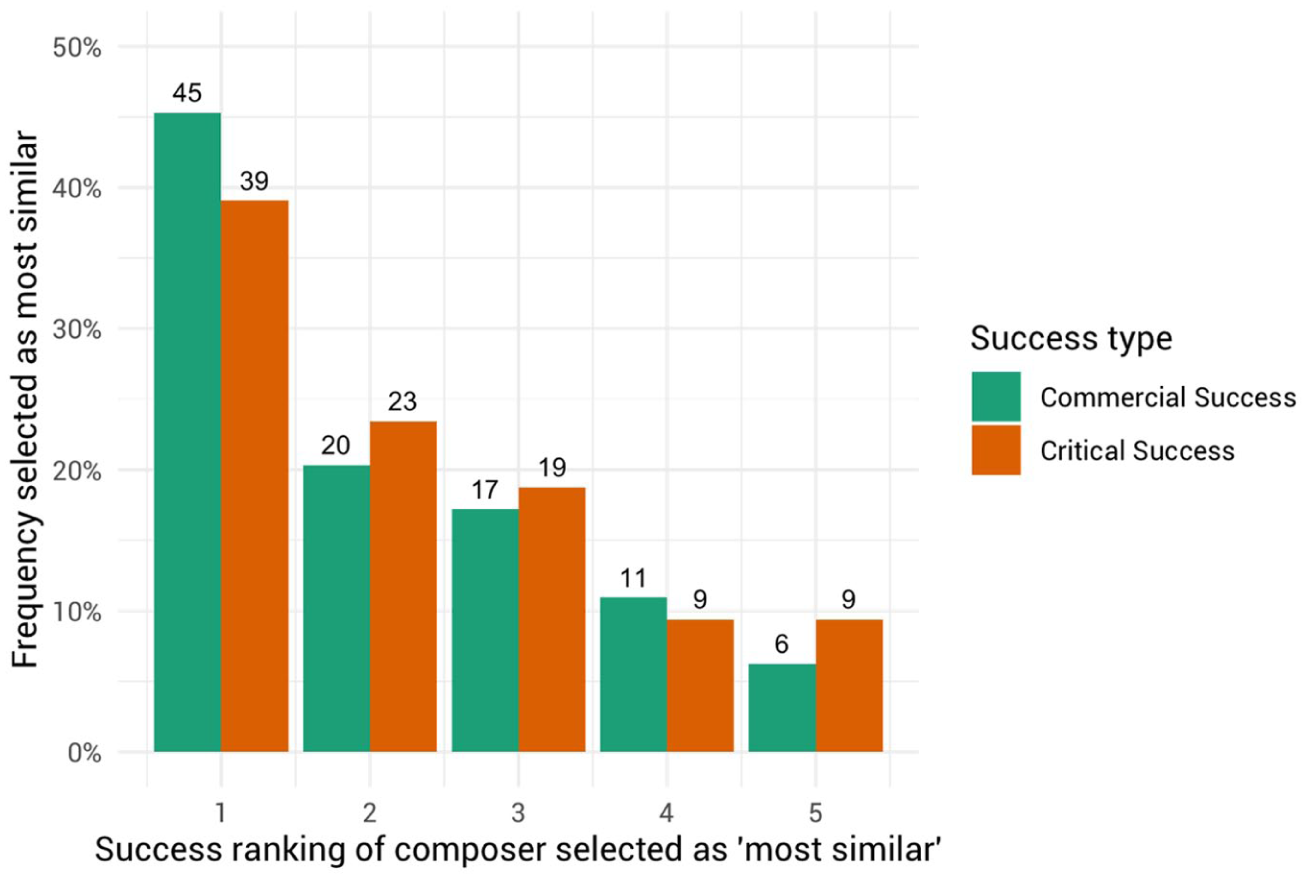
Commercial and critical success bias in self-reported composer similarity responses.
Separate to considerations of success, a gender homophily trend was also observed. The lists of candidate composers had a very similar gender mix for both men (74% of candidates were men) and women participants (72% of candidates were men). Women composers, however, were significantly more likely than their male counterparts to select another woman composer as the option most similar to themselves. As shown in Table 1, women composers were over twice as likely as men to select a woman as most similar to themselves.
Cross-tabulation of composer gender and the gender of the composer selected as most similar.
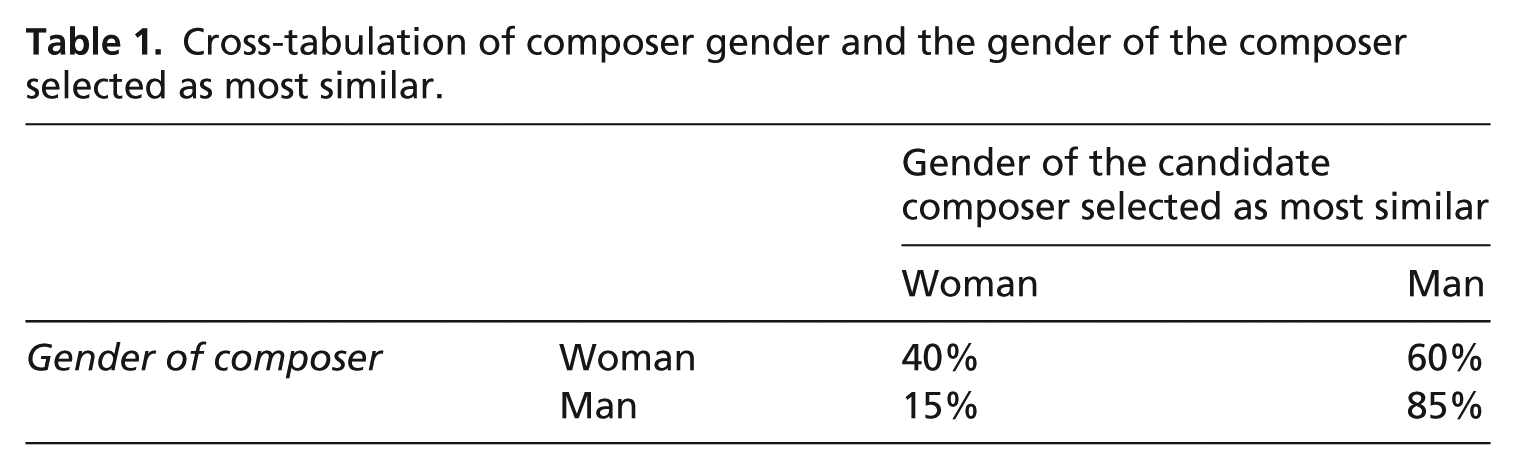
The prevalence of these trends serves to emphasise that a producer-oriented perspective of the field is not purely aesthetic but deeply relational. The observed gender homophily, in particular, points to the gendered structuring of the field. Given the well-documented under-representation and marginalisation of women in contemporary classical music (Bakare, 2019; Macarthur, 2014) this finding should not be dismissed as mere ‘bias’. Instead, following Bourdieu’s (2001) analysis of masculine domination and Born’s (2010) work on the gendered nature of aesthetic mediation, it can be interpreted as sociological evidence of a gendered field dynamic. Women composers may be forming distinct networks of recognition or strategically aligning themselves with other women to generate symbolic capital in a field where, as Born argues, the dominant definitions of aesthetic value often remain implicitly coded as male. This relational logic, grounded in social positioning, co-exists with and complicates the purely acoustic logics we model, highlighting how the ‘autonomous’ aesthetic space is nonetheless structured by social hierarchies.
Optimal acoustic model: identifying salient features
The ground-truth of composer similarity rankings was then used to identify an optimal model for reproducing the observed perceived relations among composers based on acoustic features. Both ordinal- and distance-based goodness of fit measures identified the same set of 13 acoustic features as producing the optimal model. The 13-feature model achieved an ordinal (monotonic) fit score of 4.3. This can be interpreted as a well-performing model given that (i) a random model would be expected to achieve a score of 8 (lower scores indicate better performance) and (ii) the non-random assignment of candidate composers in the survey likely increased the complexity of the modelling task.
The acoustic features which make up the optimal model include a balanced mix of tonal, rhythmic and low-level descriptors of the energy in the underlying audio signal. Relative to other feature sets, such as the MPEG-7 standard and broader research in MIR and music perception, tonal features are strongly represented. This suggests that distinctions based on tonality (e.g. complexity, stability) form a particularly salient aspect of the acoustic dimension of the field’s relational logic through which producers differentiate practices within Australian art music.
Contrary to what might be expected, increasing the information available to the model – by including a larger number of acoustic features – did not result in a corresponding increase in model performance. This finding, that ‘too much’ information leads to degraded model performance, offers sociological, rather than purely technical, insight. It suggests that the field’s autonomy relies on a specific, restricted set of material codes. If Australian art music was merely a generic subset of global music production, we might expect a broader range of standard acoustic features to capture its structure. Instead, the model shows that the field operates by filtering out generic acoustic information, relying instead on a narrow, field-specific logic of distinction. Identifying these specific relevant features allows us to understand the basis of the field’s autonomous logic – its specific rules of the game – allowing it to be understood on its own terms rather than through the generic algorithms of global platforms.
Partitioning the field: clustering and hybridity
A cluster analysis of the 13-feature acoustic model resulted in a three-cluster solution (Figure 2). The analysis reveals broad stylistic divisions: Cluster 1 identifies a large cohort working within traditional tonality; Cluster 2 groups composers influenced by European modernism; and Cluster 3 includes a smaller set working in jazz-influenced idioms. The relatively weak statistical cohesiveness of these clusters (average silhouette width of 0.2) points to a field marked by high isomorphism and hybridity. This suggests that the struggle for autonomy in Australian art music occurs along continuous dimensions, rather than within discrete, isolated sub-genres. This challenges simple categorical partitions, and highlights the need for techniques capable of identifying latent organising principles, such as multi-dimensional scaling (MDS).
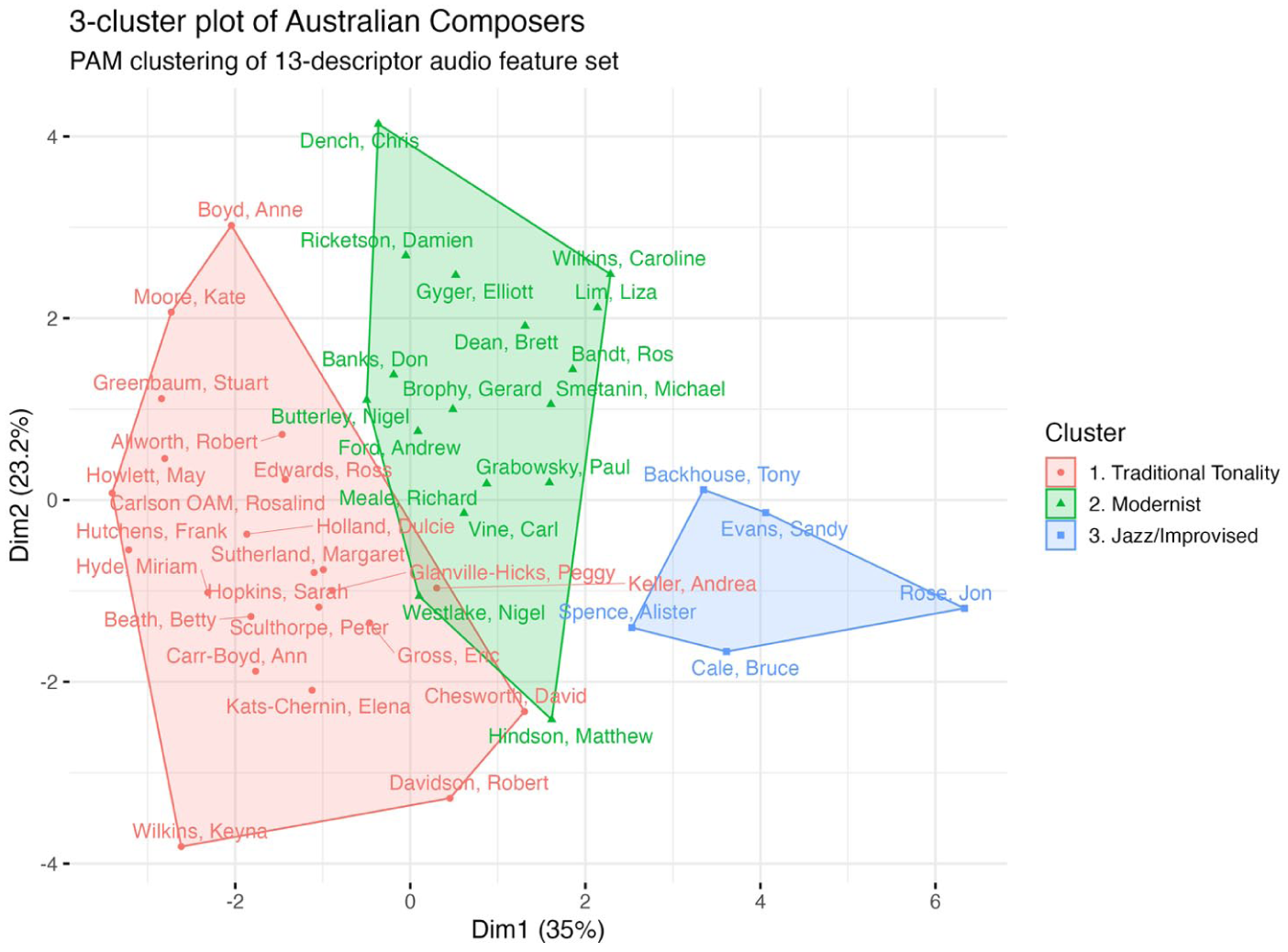
Acoustic-based clustering of a sample of Australian composers.
Organising the field: latent dimensions and structuring logics
To further explore the underlying structure, multi-dimensional scaling (MDS) was applied to the acoustic model’s matrix of perceived acoustic relations. The resulting two- and three-dimensional configurations were evaluated for goodness of fit. The two-dimensional solution yielded a stress value of 20% and an R-squared value (based on the squared correlation between observed proximities and fitted distances) of 0.85. Adding a third dimension (shown in Figures 3 and 4) improved the fit considerably, reducing the stress value to 13% and increasing the R-squared value to 0.92. Lower stress values indicate a better representation of the original dissimilarities in the reduced dimensional space, while higher R-squared values also signify a better fit. Based on established evaluation benchmarks for stress (Sturrock and Rocha, 2000) and R-squared (Hair, 2019), both configurations, particularly the three-dimensional one, can be interpreted as good fits that effectively capture the underlying structure. The MDS analysis thus reveals latent dimensions that can be interpreted as the core organising principles or relational logics structuring the field from the producers’ perspective (summarised in Table 2). These dimensions represent the key axes along which composers are relationally positioned according to the acoustic logics captured by the model.
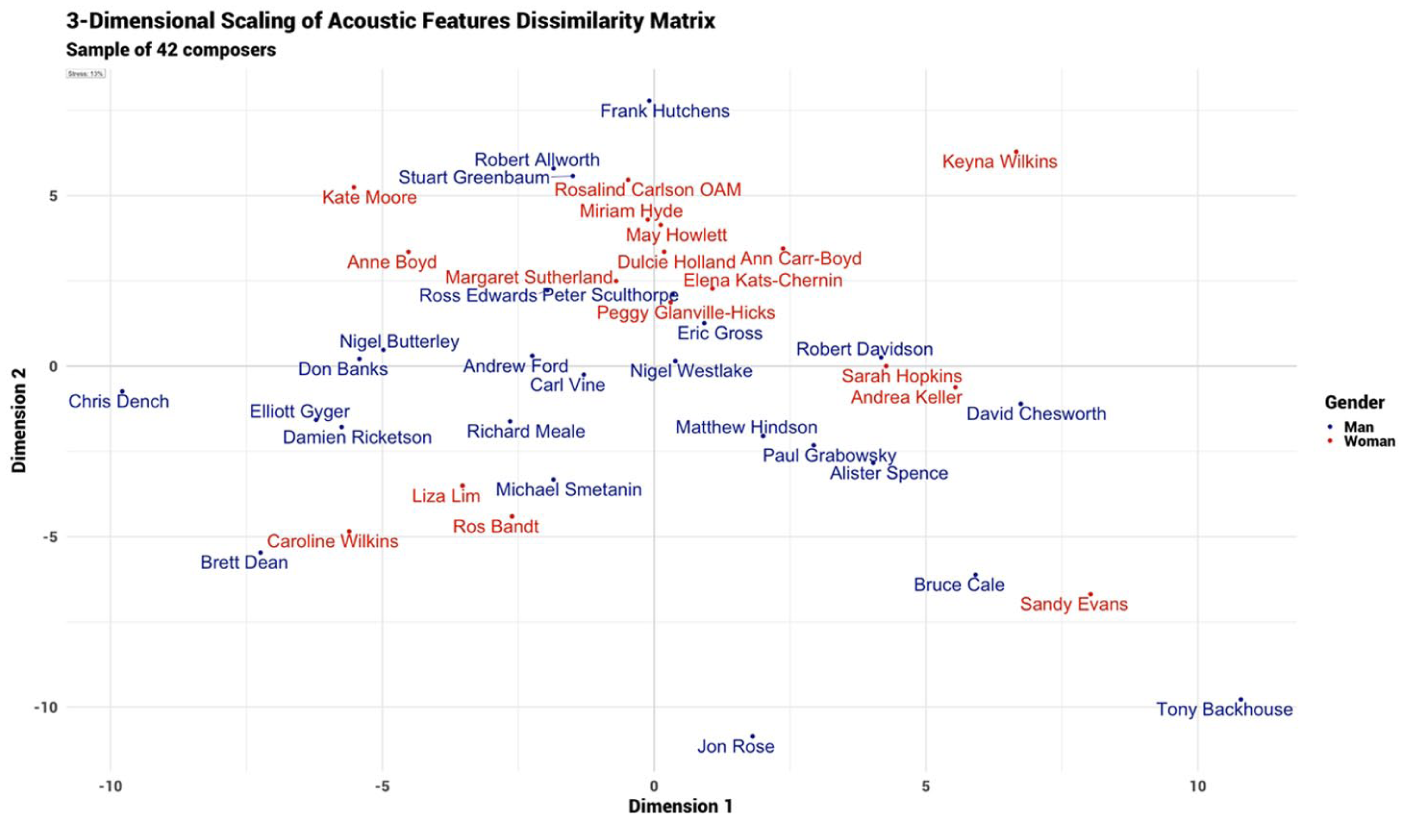
3-dimensional MDS map (dimensions 1 and 2) of selected Australian composers, based on acoustic feature-based dissimilarity matrix.
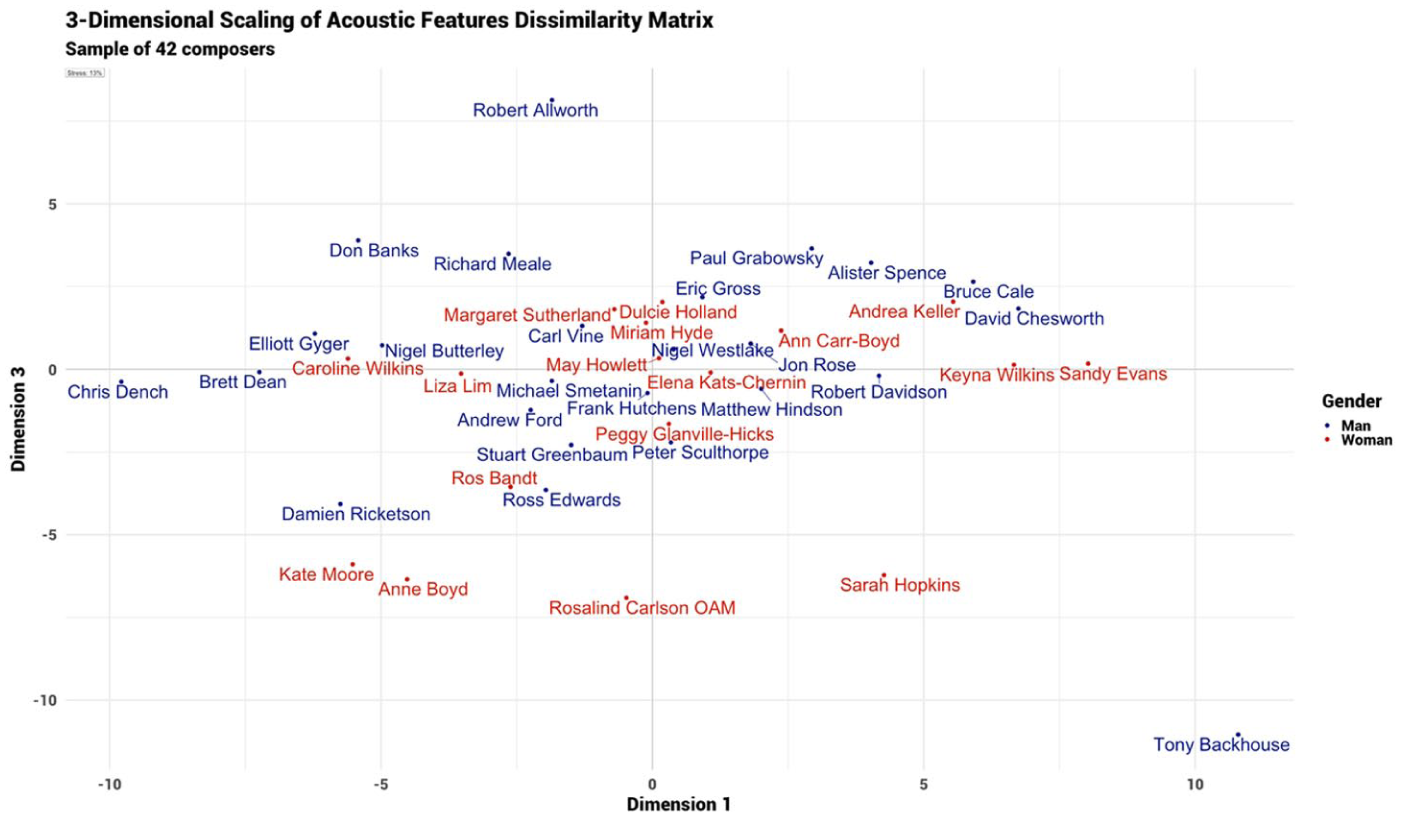
3-dimensional MDS map (dimensions 1 and 3) of selected Australian composers, based on acoustic feature-based dissimilarity matrix.
Summary of dimensions in 3-dimensional MDS.
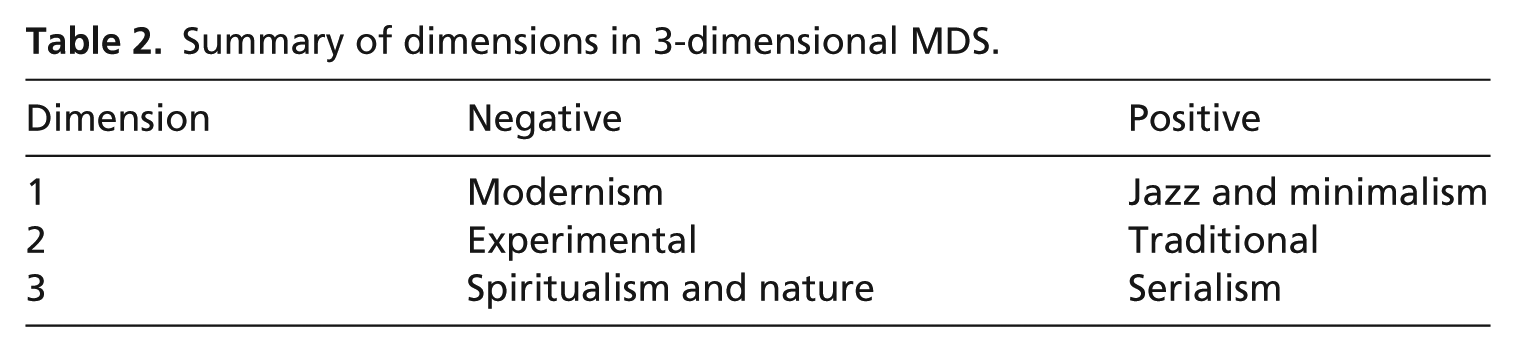
The first dimension captures a readily identifiable organisation of the field, opposing modernism (negative pole, exemplified by Chris Dench) against jazz and minimalist influences (positive pole). This aligns with the finding from the cluster analysis regarding modernist influences, but positions this principle in direct contrast to specific alternative idioms. The second dimension also reflects a familiar structuring principle, contrasting traditional (positive pole) versus experimental (negative pole) approaches. Examining composers at similar positions on Dimension 1 but divergent on Dimension 2 (e.g. Keyna Wilkins vs Sandy Evans; Stuart Greenbaum vs Liza Lim) reveals this contrast clearly, with the traditional pole also correlating with earlier average birth years (1940 vs 1957).
Extending the analysis to a third dimension reveals a structuring logic less immediately obvious than the first two, highlighting the method’s capacity to uncover latent principles. A closer analysis of the composers in the lower half of Figure 4 – representing the negative pole of the third dimension – reveals a group of composers whose work is characterised by themes of spiritualism and nature, descriptors referring to music that draws explicitly on environmental themes or meditative states, often employing consonant, repetitive, or lyrical structures to evoke these associations. Composers such as Ross Edwards, Sarah Hopkins, Kate Moore, Ros Bandt and Rosalind Carlson, for example, have all been said to fit this description of nature and environmental influences. This interpretation is further supported by cataloguing terms used to describe works in the Australian Music Centre’s library catalogue, in which the labels ‘Environmental themes’ and ‘Spiritual and sacred music’ are both overwhelmingly more common among works by composers closer to the negative pole (71% and 80% respectively).
Conversely, the positive pole of this third dimension bears an association with serialism. This term refers to a highly formal, modernist compositional technique, most famously associated with Arnold Schoenberg, which avoids traditional tonality by organising music around a fixed series of all twelve chromatic notes. The composers positioned at this extreme, such as Robert Allworth, Don Banks and Richard Meale, have acknowledged or been described as strongly influenced by Schoenberg. This interpretation is reinforced acoustically, demonstrating how the sociological opposition between nature and serialism is materially encoded in the objective acoustic feature of tonal stability. Analysis reveals a significant negative correlation between a composer’s score on Dimension 3 and the mean key strength found in recordings of their works (Pearson correlation ≈ –0.68), indicating that the serialist position-taking is acoustically manifested through unstable tonal structures. Interestingly, this pole appears less represented in readily available discursive descriptions compared to the nature/spiritualism pole, suggesting an asymmetry where the technical or musicological aspects associated with serialism achieve less dominant discursive expression within the field’s broader commentary.
Significantly, this aesthetic dimension appears to map onto the gendered dynamics observed in the composer survey data. As illustrated in Figure 4, the pole defined by ‘spiritualism and nature’ features a distinct concentration of women composers (e.g. Sarah Hopkins, Anne Boyd, Kate Moore, Ros Bandt), whereas the opposing serialist pole is dominated by men (e.g. Don Banks, Richard Meale). This suggests that the gender homophily observed in producer selection is not merely social but is homologous with specific material-aesthetic position-takings. The ‘nature-logic’ thus operates as a specific subspace in which women composers have established a distinct voice, contrasting with the male-dominated orthodoxy of the serialist tradition.
The capacity of the material analysis to surface such latent structuring principles allows us to categorise the different types of capital at stake in the field. To interpret these findings systematically, we adopt De Laat’s (2014) distinction between struggles over innovation (new musical forms or genres) and diversity (new thematic or aesthetic content). Dimensions 1 and 2 clearly map the field’s key struggles over form and innovation. The opposition between Modernism and Jazz/Minimalism (Dimension 1), and between Experimental and Traditional (Dimension 2), reflects deep-seated institutional divides regarding legitimate compositional technique and the boundaries of the avant-garde. These dimensions capture the field’s internal debate over how music should be constructed.
Dimension 3 (spiritualism and nature vs serialism), on the other hand, maps a crucial axis of thematic content and diversity. Here, the struggle is not just about technique but about meaning – opposing a spiritual, nature-inspired aesthetic (often associated with a specific Australian national identity) against a rigorous, abstract internationalist modernism. This dimension reveals how producers differentiate themselves not just through technical innovation, but also through the specific content of their artistic identity. This tension exemplifies what Buchholz (2022) describes as vertical autonomy. In this dynamic, the field defines itself not just through internal difference, but by establishing a specific logic (here, a nature-inspired ‘Australian’ aesthetic) that asserts independence from the dominant, transnational pole of the global avant-garde (represented here by serialism). In this specific historical context, serialism functions as an imported orthodoxy where legitimacy is derived from adherence to European modernism. In contrast, the nature-logic represents a claim to national autonomy, asserting a local value system that refuses to be subordinated to that global standard.
Discussion
Bourdieu’s analysis of the structure of fields focussed on revealing the generative organising principles which emerge from ‘the relatively autonomous system of relations of production and circulation of symbolic goods’ (Bourdieu, 1993: 132). Extending this framework to the material domain, the method presented here uses the material perceptual properties of a field’s cultural output as an empirical pathway, to access and model these Bourdieusian organising principles, specifically the relational logics guiding producer position-takings. This study successfully identified key dimensions of these logics within Australian art music by linking producer perceptions to acoustic features.
When applied to the exemplar of Australian art music, the modelling of composer understandings of the field using acoustic features enabled mapping of the field in terms of its classificatory partitions and latent dimensions. The cluster analysis, while only exhibiting moderate statistical coherence, suggests that particular sub-genres, namely jazz, have been able to maintain their distinct identity, whereas only broad divisions were otherwise observed in art music practice. The dimensions produced through MDS supported interpretations along stylistic and generational approaches. That the latent dimensions revealed through MDS analysis readily lend themselves to such interpretation demonstrates the capacity for the analysis of acoustic features to reproduce the relational structure based on perceived similarities and differences among the field’s composers, reflecting the field’s underlying logics.
Importantly, these mappings are more than simply interpretative aids. By surfacing the latent dimensions (i.e. the specific relational logics) which sustain the relative proximities among producers, they provide insights into what makes Australian art music a distinctive, identifiable and autonomous domain of creative practice. We conceptualise this link as a structural homology between producer perceptions and acoustic output, distinct from the explicit intent of the composer. Rather than relying on ethnographic verification, the strong statistical alignment between the survey rankings and the acoustic model validates these sonic features as reliable material proxies for the field’s sociological structure.
We recognise, however, that this producer-centric model only represents one projection of the space; there is not a singular map of relations through which we comprehend and know a cultural field. Different perspectives produce different maps, which intersect and compete with each other. Work by Chambers (2021), for example, has demonstrated how the proximities among composers which emerge from a producer-oriented perspective are variously reconfigured in alternate mappings which emerge from how the curators and consumers of culture perceive Australian art music practice. In the case of the curators who mediate Australian art music to audiences, relational differences are minimised, with highly prominent composers utilised to cohere otherwise more distinctive (i.e. relationally dissimilar) communities of artistic practice. Mappings based on audiences, in contrast, produce far more stylistically heterogeneous juxtapositions of composers. As distance from the locus of production increases – in this case from composers to consumers – so too does the challenge of maintaining the logics through which producers conceive of their field of restricted production.
Questions relating to the autonomy of niche fields are particularly relevant in the current era of what Airoldi and Rokka (2022) term algorithmic consumer culture. In this context, the field’s autonomy is threatened not just by commercial pressures, but by the heteronomous logic of algorithmic articulation – the automated process by which platforms classify and recommend content based on generic, global standards. The trend for global standards like MPEG-7 to be embedded in these algorithms represents a form of ‘technological unconscious’ (Beer, 2009) that risks overriding the specific, historically- situated logics of the field.
Against this backdrop, the method presented here serves a dual purpose: it both measures the field’s autonomy and visualises the precise mechanisms of its potential displacement. By empirically mapping the material logic of Australian art music – such as the specific tension between spiritualism and serialism – we render visible the specific autonomous principles of vision and division that are salient to producers but which remain opaque to generic algorithmic models. These dimensions represent the field’s specific form of cultural diversity (Sapiro, 2010), a diversity that exists not merely in the number of works, but in the structure of relations that gives them meaning. Significantly, this diversity is also gendered. As the results demonstrate, the ‘nature-logic’ operates as a distinct subspace where women composers have established a voice independent of the male-dominated serialist orthodoxy. This highlights a gendered strategy of resistance: by embracing an alternative aesthetic logic, these composers circumvent the patriarchal lineage of European modernism. Consequently, the algorithmic erasure of these specific local logics risks disproportionately silencing female creative expression, flattening a gendered strategy of resistance into a generic global category.
Mapping this material logic provides a critical empirical toolkit for the field’s defence. In an environment where algorithmic articulation threatens to flatten specific cultural geographies into generic global categories, visualising the field’s internal relational infrastructure is a necessary step in resisting its erasure. It allows us to identify exactly what is at risk: not just individual composers, but the very system of meaning that makes their work intelligible as a distinct cultural practice. As Hesmondhalgh (2019) cautions, the datafication of culture risks reducing the complex social values of music to mere user engagement. By mapping the field’s material logic, we render visible the specific forms of cultural value that such datafication threatens to erase.
The digital and algorithmic environments in which audiences engage with music are also those which eschew the contextual cues which traditionally form part of the meanings we attach to musical sounds. These extra-musical meanings encompass both the structural homologies Bourdieu (1984) identified between culture and class power, and the non-musical sources – from friends to magazines – which influence how we perceive musical sounds (Martin, 2006: 62–63). The digital listening environment, however, is often without these cues. While the acoustic modelling approach used in this artpaper is inevitably reductionist, it reveals structures that qualitative depth alone cannot capture. The digital environments in which the perceptual material qualities of music must increasingly speak for themselves point to the relevance of considering how the field is configured when stripped back to its audio signal alone.
The approach to mapping fields of cultural practice presented here points to a significant avenue for future research: the need to capture the field’s inherently dynamic nature. While this study provides a synchronic map of the field’s material logic, Bourdieu, (1983: 58) emphasises that fields undergo ongoing reconfigurations, whereby the structure of relations is displaced by ‘all sorts of changes in the position-takings of occupants’. These shifts may occur in response to external interventions – such as the advent of digital music streaming or generative artificial intelligence – but also reflect the regular renewal that occurs as new generations of producers enter the field.
A diachronic analysis would provide insights into how the trajectories and position-takings of composers evolve over time. This would support investigating not only how individual composers shift their relative positions, but crucially, how the underlying material principles that structure the field’s relational space adapt to the algorithmic pressures of the contemporary moment.
Footnotes
Acknowledgements
I wish to thank Professor Roger Dean and Emeritus Professor Greg Noble at Western Sydney University, and Professor Liam Magee at the University of Illinois, for their feedback on earlier drafts of this article. I also thank the anonymous peer reviewers for their constructive comments.

Ethical considerations
This research was approved by the Human Research Ethics Committee at Western Sydney University. The ethics reference number is H12046.
Funding
The author received no financial support for the research, authorship and/or publication of this article.
Declaration of conflicting interests
The author declared no potential conflicts of interest with respect to the research, authorship and/or publication of this article.
Data availability statement
Composer survey data generated as part of the current study is not publicly available due to privacy assurances provided to participants. The nature of the data is such that any de-identification would compromise its analytical utility and render it non-viable for meaningful secondary analysis.