




Abstract
Despite extensive research on inequalities in music, it remains unclear how power is conceptualised and analysed within musical contexts. The purpose of this study is to explore contemporary academic research on power in musical practices and institutions. Through a scoping literature review of peer-reviewed articles published between 2013 and 2023, the study examines how inequalities in music are framed and explored. Our findings reveal a strong emphasis on gender, race and social justice, with music education emerging as the most studied context. Despite frequent references to power, the concept is often left undefined, and research primarily highlights marginalised groups’ experiences rather than the mechanisms through which power operates, limiting the ability to address structural inequities. We suggest that future research should further engage with how power operates, is maintained and contested in musical institutions and practices, with particular attention to dominant groups, material power and institutional mechanisms shaping inequalities.
Introduction
Social, political and economic inequalities are linked to and shape who gets to make, listen to and access music in different ways. These unequal conditions and structural biases between groups can be understood through the concept of power. While previous research has addressed various forms of inequality – such as access to opportunities, recognition, representation, gatekeeping, censorship and economic disparities – it remains unclear if or how these studies approach inequality through the lens of power. Moreover, some forms of inequality may attract more or less scholarly attention, rendering some conceptualisations or issues invisible. This suggests that the power dynamics researchers choose to study may themselves be influenced by broader power structures, whether through global knowledge production or by prioritising certain forms of inequalities or inequities. 1
In traditional musicology, power has not typically been a topic of discussion or analysis. Rather, the discipline has tended to focus on historical and aesthetic dimensions of music, often treating music as an autonomous art form disconnected from the social and political contexts in which it was produced and consumed (Goehr, 2007). A critical turn emerged during the 1980s, when scholars influenced by critical theory, gender studies and postcolonial studies began questioning traditional approaches to music (Bloechl et al., 2014). Similarly, ethnomusicology has been critiqued for its colonial and Eurocentric approaches, often positioning Western music as the norm (Nettl, 2015). At the same time, music academia is complex, and studies on music as cultural and social phenomena are also pursued in a variety of branches and adjacent fields, including, for example, music education research, sociology, cultural studies, sound studies and popular music studies. Taken together, there has been a growing awareness of music’s embeddedness in social and political forces. Our study builds on this trajectory by examining how contemporary research engages with questions of power across musical practices and institutions.
The purpose of this study is to explore contemporary academic research on power in musical practices and institutions. Through a scoping literature review, we examine articles addressing inequ(al)ities related to various aspects of music, including music-making, listening, consumption and the laws and policies governing music-related activities. Three research questions guide our study: (1) How have studies on inequ(al)ities in musical practices and institutions been framed in contemporary academic research? (2) What scope and rationale inform the focus on specific groups and contexts? And (3) what are the implications of current research trends for understanding power relations? By addressing these questions, we aim to highlight the dominant issues, theoretical approaches and methodological frameworks prevalent in the interdisciplinary field of research on music and power. Furthermore, this article provides a summary of the research landscape, identifying overlooked questions and perspectives to guide future studies.
While this article considers scholarly studies on power in musical practices and institutions, it intentionally excludes psychological research on music’s influence on (or ‘power over’) individuals, as well as textual or work-based analyses where power is examined in relation to a single text, artist or work. This narrowing of scope reflects our focus on the contextual dimensions of power, rather than on the internal, individual responses typically explored in psychological research. Our primary concern is how power operates within and across musical practices and institutions – how power relations shape these activities – rather than how music affects individual experiences or how theorists interpret power in relation to specific musical works. This perspective allows for an examination of the structural forces at play in the world of music.
Methodology
The rationale for using a scoping literature review in this study extends beyond simply giving an overview of findings within a particular body of literature or identifying gaps in terms of populations and topics that have been underexplored (i.e. ‘gap-spotting’). While important, our approach also aims to map out broader trends in how research questions have been framed and how issues of power and inequ(al)ities in music are construed. In doing so, our method serves a critical purpose: to illuminate the underlying assumptions, frameworks and discourses that shape the scope of research and to suggest possible avenues for theoretical and empirical development.
By identifying patterns and trends, we can critically assess the dominant perspectives and taken-for-granted assumptions in the literature, ultimately contributing to a deeper understanding of the ways in which power relations are embedded in musical practices and institutions. This aligns with calls for more reflexive approaches to literature reviews, as outlined by scholars such as Levac et al. (2010), who emphasise that scoping reviews are particularly useful for addressing complex or contested fields of research, where the goal is not simply to summarise existing knowledge but to interrogate how that knowledge has been produced (Munn et al., 2018).
Search strategy
We searched for English-language articles available as full texts in the Web of Science (Arts & Humanities Citation Index), a widely regarded international database that provides access to peer-reviewed academic articles. Web of Science presents a broad range of articles on music, inequities, inequalities and power across the world. However, using Web of Science as the primary database for our review also introduces ethical considerations. Chief among these concerns is the potential underrepresentation of non-Western literature, leading to a lack of diversity, biases and a narrowed spectrum of perspectives within the research. This reflects a broader issue: indexing and citation metrics are not neutral instruments but systems that reproduce hierarchies of knowledge production and dissemination (Asubiaro and Onaolapo, 2023; Bol et al., 2023). We, therefore, approach the material retrieved via Web of Science with an awareness of its partiality, recognising that it is shaped by broader dynamics of academic visibility and exclusion. Still, given its global reach and relevance to our research focus, we determined that it provided a sufficiently robust foundation for our literature review. Moreover, our search yielded a substantial number of articles spanning a variety of disciplines, which allowed us to capture diverse perspectives within the scope of this study.
We used the screening and data extraction tool Covidence for our literature review as it provides a platform for collaboration on various stages of the process, including study selection, data extraction and quality assessment. This facilitated communication, ensured that all team members worked from the same data set and promoted transparency with a clear audit trail of decisions. A team of four researchers reviewed the entire corpus, held regular meetings to discuss the progress of the analysis, before each researcher took responsibility for between 35 and 42 articles each on specific forms of inequ(al)ities (e.g. gender, education, race and ethnicity). As such we took extensive measures to ensure no significant studies were excluded.
In the general search, we searched for the following terms in all searchable fields in Web of Science, meaning the terms could appear anywhere in the article title, abstract, keywords or other indexed metadata:
Music AND Power
OR Music AND Equity/ies
OR Music AND Inequity/ies
OR Music AND Equality/ies
OR Music AND Inequality/ies
OR Music AND Hegemony
The search was limited to open access articles published in English between 2013 and March 2024, ensuring a contemporary focus while capturing a decade of research.
We chose to include both the terms inequality and inequity, recognising the ongoing debate about how power relates to questions of exclusion, inclusion and the appropriate terminology to describe these dynamics (see Note 1). We also acknowledge the significance of social justice as a central concept – particularly in music education research (e.g. Benedict et al., 2015; Hess, 2017; Palmer, 2018). Although it was not part of our initial search terms, we conducted a post hoc check to verify that all relevant studies using social justice were included in the corpus and that none were overlooked due to the omission of this term.
Screening and selection procedures
Step 1: Our search initially identified 1469 studies, which were exported to Covidence for screening. Three authors independently reviewed the titles and abstracts, filtering out articles irrelevant to our study or not specifically focused on music. For example, several articles were related to disciplines like astrophysics, technology and neurology, where music appeared only in the title, but the studies themselves addressed topics such as music’s role in pain relief, brain mapping or the relationship between linguistic and musical rhythm. Review articles, book chapters and articles not available as open access were also excluded. All screening decisions were reviewed and approved by the co-authors before proceeding.
Step 2: After narrowing the initial selection to 206 titles, two authors conducted a full-text review, taking detailed notes in Covidence. Each author independently voted for inclusion or exclusion based on predefined eligibility criteria, which emphasised our study’s focus on peer-reviewed articles exploring inequ(al)ities in people’s interaction with music across various contexts. During this phase, 52 articles were excluded, primarily because they did not align with the study’s purpose. In addition, some articles with English abstracts lacked open access or full-text versions in English, leading to their exclusion. These decisions were reviewed and confirmed by all co-authors, resulting in 154 articles for data extraction.
Step 3: A qualitative assessment template was created in Covidence for data extraction, enabling the systematic recording of key information such as article title, discipline, geographical location, study context, applied theories, specific power dynamics explored, methodology and study rationale. The authors involved in step 2 performed the initial extraction, which was followed by thorough discussions among all co-authors to ensure accuracy and consistency.
Step 4: The data analysis began with one author categorising the types of power relations discussed and the settings in which the studies were conducted. This provided a quantitative overview of the issues and contexts addressed, which were subsequently reviewed by the other researchers. Next, each researcher was assigned 35–42 articles based on their expertise in specific areas and independently made extensive notes on key themes in each article. The research team then met several times to compare perspectives, discuss similarities and differences and refine the structure of the review. These discussions shaped the final structure of our study.
Findings
Landscape
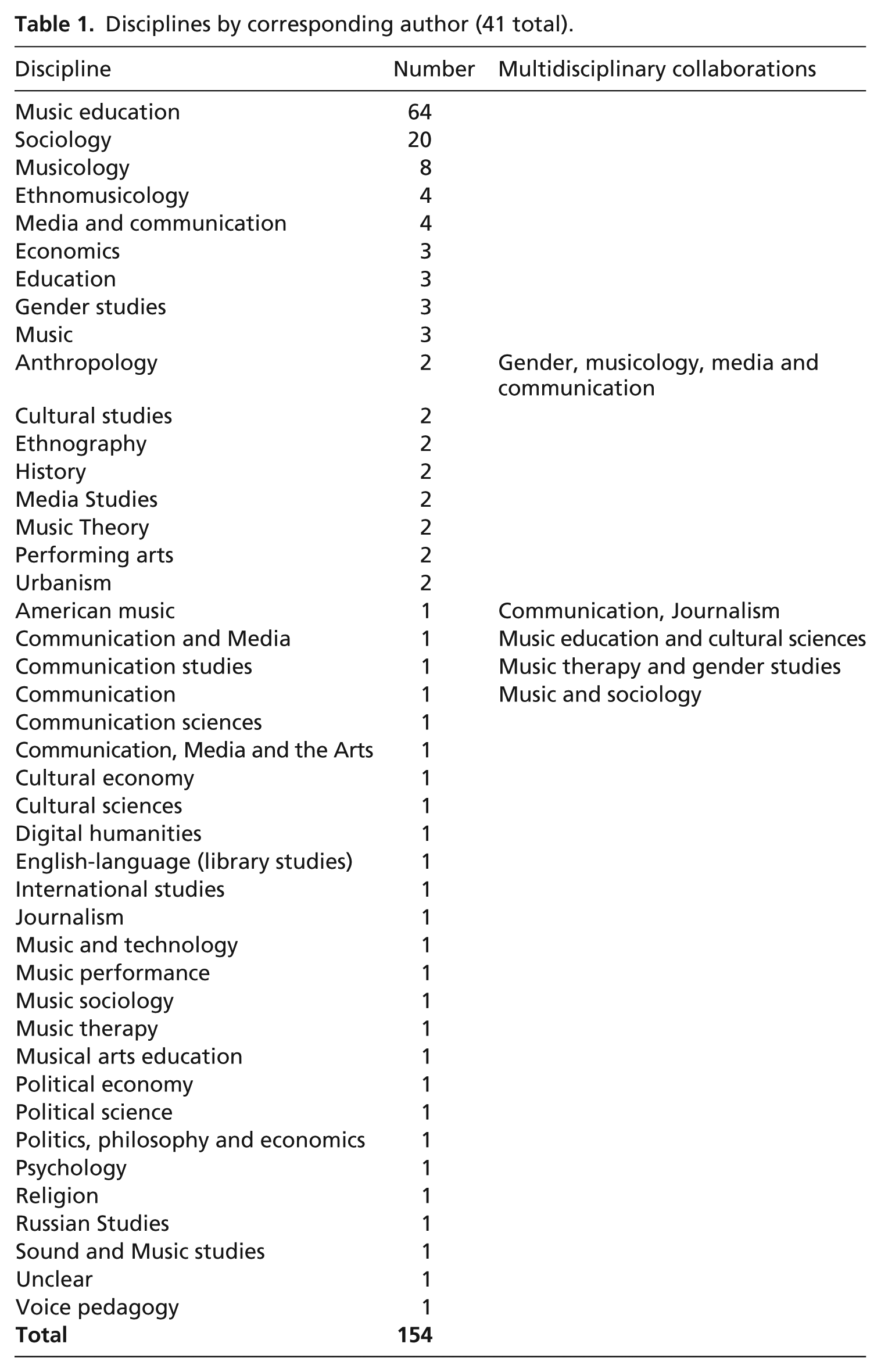
The 154 articles span 38 countries and 43 disciplines, across a total of 82 journals. The most frequently represented discipline (i.e. of corresponding authors) is music education, followed by sociology, musicology (including ethnomusicology) and media and communication (see Table 1). The remaining disciplines include other music-related disciplines (e.g. music performance, music and technology, music sociology, music therapy, sound and music studies), economics, education, anthropology/ethnography, gender studies, cultural studies, history, performing arts, international studies, Russian studies, psychology, English language, religion, digital humanities and urban studies. This highlights that discussions around power and inequ(al)ity are widespread across diverse fields, rather than being confined to the music research community, indicating that these conversations are far-reaching and cross-disciplinary.
Disciplines by corresponding author (41 total).
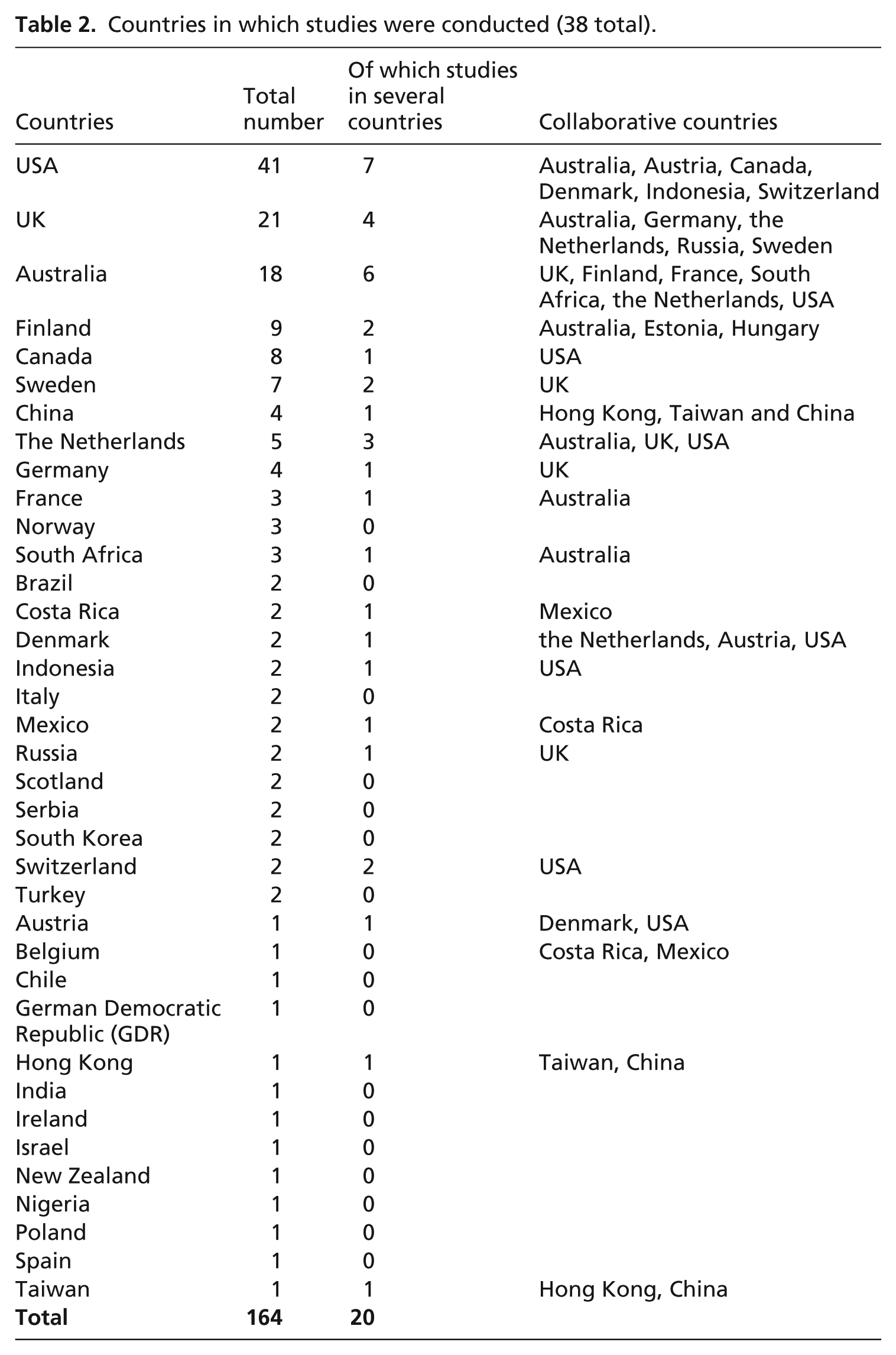
Geographically, the five most common countries in which studies have been conducted are the United States, followed by the United Kingdom, Australia, Finland and then Canada, with 38 countries studied in total. As several studies were conducted across more than one country (20 in total), the number of country occurrences in the table (164) exceeds the number of articles (154); see Table 2. While authors did not always publish data from countries in which they were based, most did, denoting an epistemic skew towards knowledge generation as based on frameworks developed within a fairly narrow range of countries, based predominantly in the global North.
Countries in which studies were conducted (38 total).
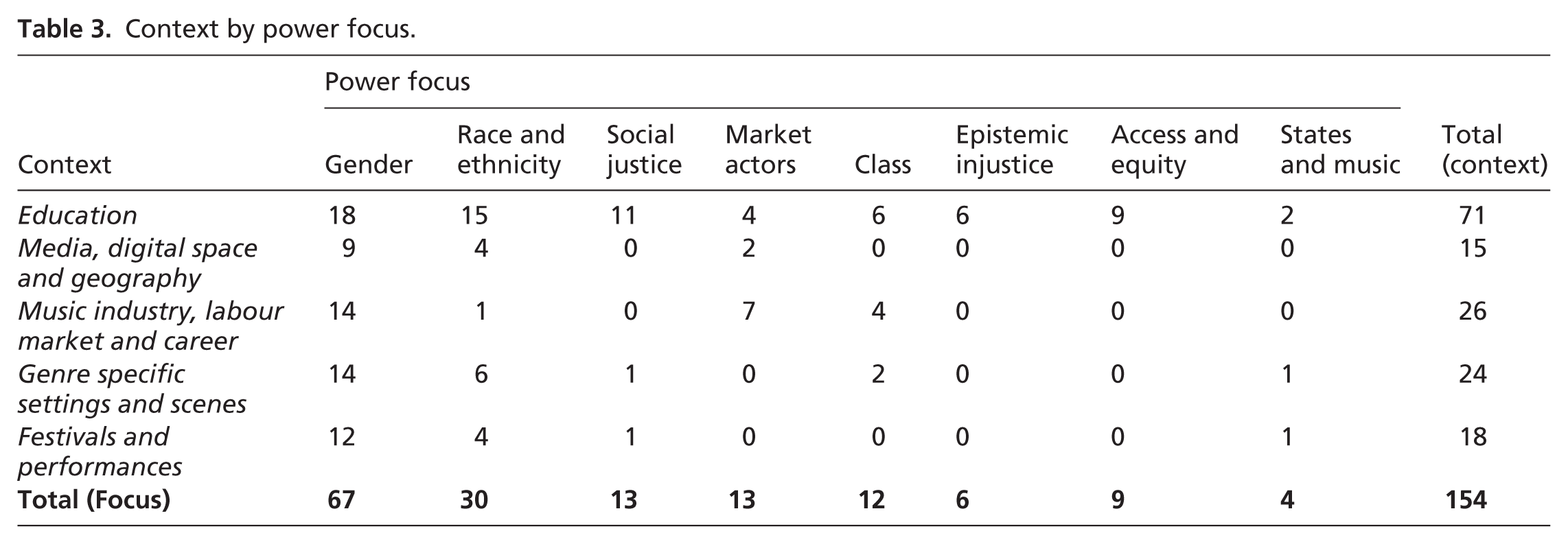
Regarding research contexts, we identify the following categories: Education; Music industry, labour market and career; Genre-specific settings and scenes; Festivals and performances; and Media, digital space and geography (see Table 3). Education emerges as the most studied context, followed by the other categories in decreasing order of occurrence (see Table 3). The studies typically investigate how power operates in concrete, physical settings – such as classrooms, music studios or festivals – although some explore more abstract, genre-based or online practices.
Context by power focus.
Crucially, while some studies focus on power at the macro or meso levels, most emphasise micro-level dynamics, exploring how power manifests in individual actions and interactions. For instance, many studies describe the experiences of marginalised groups in specific institutional (e.g. career, educational) settings, including studies that focus on strategies for navigating inequ(al)ities at an individual level. Multiple studies within music educational contexts examine teachers’ classroom practices aimed at challenging inequities. While such studies tend to theorise power and inequity at a structural level, the focus remains on praxis at a micro level, for example, teachers being made conscious of macro structures of power and how this awareness can influence individual interactions with students.
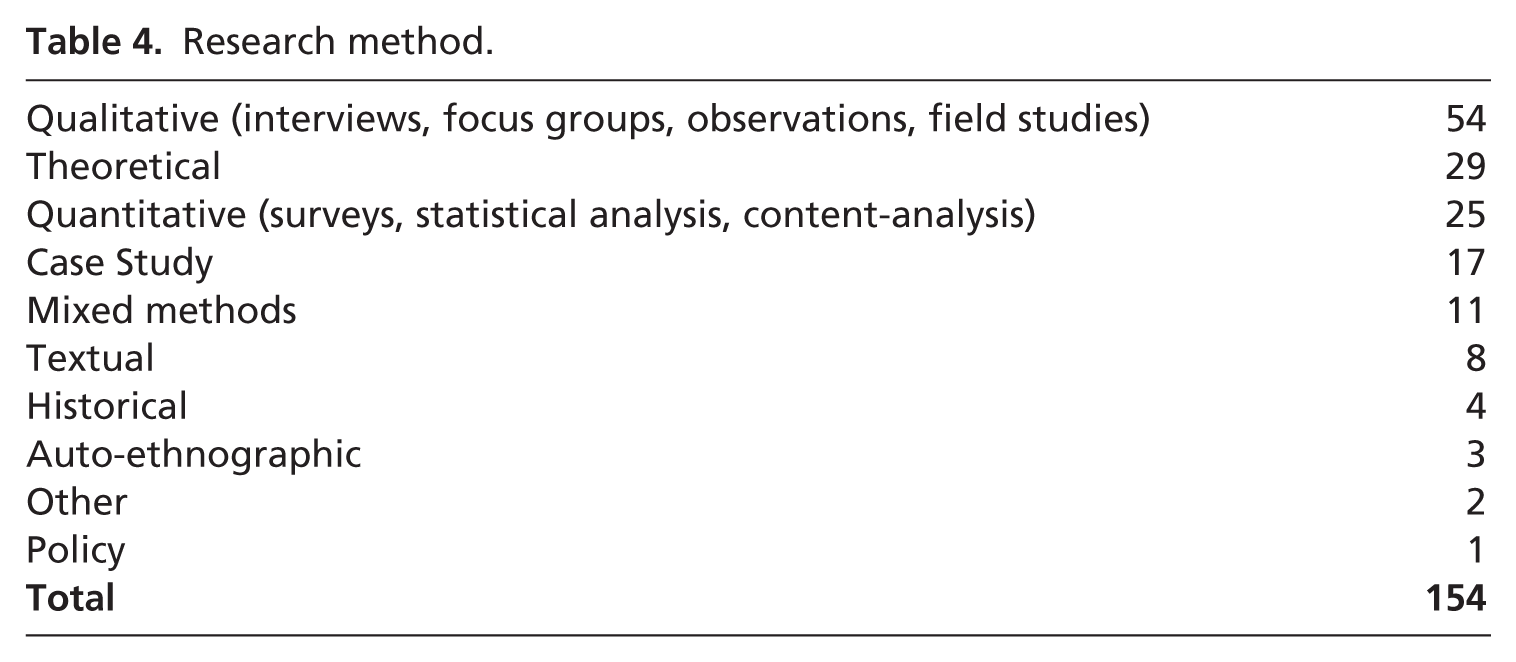
The research methods used are predominantly qualitative, reflecting an emphasis on capturing personal experiences and social dynamics through interviews, ethnographies and focus groups. Quantitative approaches are also employed, mainly analyses of survey responses (e.g. Moscardini et al., 2013; Shouldice, 2024), but also content analyses and statistical analyses, such as studies on music consumption patterns or demographic representation in music institutions (e.g. De Boise, 2018; Miller, 2024). In addition, text analysis and some mixed methods are used, although to a much lesser extent (see Table 4).
Research method.
The inequalities addressed in the studies reveal a strong focus on gender – especially women – followed by race and ethnicity, social justice and the impact of market actors like streaming platforms and record labels. Class, issues of general access and equity, epistemic injustice and state-level interactions with music policy are also areas of focus in a small number of studies (see Table 3). In terms of where different forms of inequalities are studied, gender is studied almost evenly across all contexts, although music education is more prominent in most. Studies on race and ethnicity are represented in all contexts except for Music industry, labour market and career. Class is much more likely to be studied in relation to education and issues of labour market and employability. Issues of epistemic injustice are studied exclusively in relation to educational contexts and social justice was, also, mostly focused on educational contexts.
Framings
The studies on inequ(al)ities in musical practices and institutions are framed in various ways, including how power is conceptualised within the studies. Our analysis focuses on how such conceptualisations of power shape (and are reflected by) the ways in which the studies select and apply theoretical concepts. In turn, we therefore seek to understand how these theoretical concepts impact on how authors formulate research objectives and interpret their findings.
Our analysis reveals a diversity of approaches in the studies. The majority of studies are empirical, with very few studies aimed at developing theory. Moreover, there is limited in-depth engagement with the concept of power itself and how it operates within musical practices and institutions. Power is typically addressed indirectly, with its meaning assumed rather than explicitly defined. Only one study, Burwell (2023), delves into more detailed theoretical discussions of what power is, including a taxonomy of the different ways in which power can operate, noting that it is commonly concerned with issues of control and dominance, as well as questions around autonomy of decision making.
Power is, instead, implicitly conceptualised in several ways in the studies, ranging from teachers’ interpretations of socially just music education in relation to their practice (Abril and Robinson, 2019) to conflicts between artists and streaming platforms (Siles et al., 2022) and the exercise of control over music policy in authoritarian states in a handful (Biasioli, 2023; Grüning, 2023). We argue that the way power is understood in these studies generally aligns with two out of the three ‘classical’ political science conceptualisations (for definitions of these, see Parietti, 2021). They are primarily concerned with either an ignorance about or lack of representation of marginalised groups and individuals’ interests (Bachrach and Baratz, 1962) or the ability of dominant groups to shape how marginalised groups think (Gramsci, 1971; Lukes, 2001). Almost none are concerned with the third notion, which relates to issues of coercion or threats which lead to individuals or groups acting against their own consciously articulated interests (Dahl, 1957; Weber, 1946).
In most studies, power is, therefore, understood as repressive and restrictive rather than, for instance, productive in the discursive sense (see Foucault, 2008), influencing differences in access, opportunities and treatment within physical spaces. For instance, Wilson et al. (2020) suggest that a dominance of middle-class ideologies in music education limits access for children from working-class backgrounds, whereas Clauhs and Pigott (2021) highlight barriers for Black children in US summer music camps due to a lack of cultural inclusivity. This understanding of power entails power differentials between individuals at the micro level because of inequalities at the macro level, which work to prohibit participation. Power is thus conceptualised more as informal barriers expressed at the level of attitudes, operating due to ideological dominance or majority ignorance, rather than something enforced through force or threat.
Like power, the concept of inequality, too, is often left undefined, with the term used as though its meaning were self-evident when used in conjunction with a noun (i.e. class inequality, gender inequality, racial inequality etc.), though most point to issues of quantitative underrepresentation or differential treatment as constituting inequality. While 107 studies use the frame of (in)equality/ies, a much smaller number (62) use the term (in)equity/ies (23 use both). Inequity, by contrast, is more commonly mentioned in relation to issues of race and ethnicity, potentially owing to the fact that it is more commonly used in relation to the US context, influenced by debates around social justice and racial inequalities.
What we see in our analysis is that studies are largely focused on the behaviours, experiences and attitudes of marginalised groups, with power expressed through the ability to shape ideas and erect informal barriers to access expressed at the level of ideology among empirically absent, dominant groups. This is significant given that there is a lack of attention to how dominant groups and elites both understand and use their own position; something which is reflected in the theoretical concepts and frameworks employed. With regards to class, for instance, many studies reveal a robust engagement with sociological and cultural theories, predominantly drawing on Pierre Bourdieu’s (1984) concepts of cultural and social capital which foreground the way in which group interests are psychologically internalised as a means of ensuring cultural domination. Similarly, studies on gender also utilise concepts of habitus and cultural capital to explain reasons for men’s dominance. While issues of, for instance, sexual harassment and gender-based bullying are certainly raised (see Shouldice, 2024), comparatively significantly more attention is paid to issues of ‘unconscious bias’ resulting from socialisation into gendered norms.
Across studies on different forms of inequality/ies – gender, race, class, market power and social justice – certain common patterns emerge. Research on gender often centres on women’s underrepresentation in leadership roles within the music industry and their symbolic exclusion from specific genre-based spaces such as gig venues. Similarly, studies on race and ethnicity, particularly in the US context, examine the systemic barriers that marginalised groups face in educational and performance spaces. Studies on class, meanwhile, predominantly explore how economic and social capital influence access to music education and professional participation. Class-focused studies provide an example of this overarching focus on marginalisation. Here, the primary attention is on the exclusion of the working class from music education (Koskela, 2022; Wilson et al., 2020) and the ‘alienating environment’ fostered by institutional structures (Bates, 2021), while the privileges of cultural elites receive no attention. When the middle class is considered (Bates, 2021; Bull and Scharff, 2017), the focus often remains on the acquisition of cultural capital, originally understood as a form of symbolic violence (Bourdieu, 1984: 358). This, again, relies on a model of exclusion where discrimination is manifest symbolically and largely unconsciously. The interplay of cultural and economic privileges – which together reinforce upper-class advantages over the working class – therefore remains underexplored.
Rationales
There are a range of rationales used by authors to justify their studies. While the role of power in shaping access to and participation in music may seem self-evident, the justifications authors provide are critical for framing the broader issue and the role that knowledge-building plays in addressing inequ(al)ities. Across the literature, some studies are primarily concerned with ‘gap spotting’ (see Sandberg and Alvesson, 2011) or are framed around the need to ‘increase knowledge’ in specific areas. However, a significant portion of the research is driven by ethical considerations, with a clear focus on challenging existing inequalities. Such studies are justified by their potential to contribute to social transformation, positioning research as a tool for advocating change and promoting social justice. How these potential social transformations are framed is itself intricately tied to framings of power and inequality as discussed above.
Studies on gender inequality/ies frequently emphasise the underrepresentation of women in leadership roles or music-related professions. The aim is typically to highlight experiences of women musicians in order to foreground the experiences of marginalised voices within different music-related professions such as conductors or bandleaders. In some of these studies, an additional aim is to examine the strategies women musicians use to navigate or overcome discrimination, with the goal of making these strategies replicable (see, for instance, Fitzpatrick and Sweet, 2024; Green and Mitchell, 2023; Hennekam et al., 2019). Studies that address mediated representations (e.g. in textbooks and magazines) of women in music-related professions use the rationale that negative representation (or the lack of representation) in media and educational materials can itself be a factor that deters women from entering these professions and can exacerbate gender-based discrimination (see, for instance, Del Mar Bernabé-Villodre and Martínez-Bello, 2018; Kruse et al., 2015; Mangani, 2021).
The rationales for studies on class inequities are similarly framed around societal and educational gaps in three ways: addressing inequality, marginalised cultural expressions or the transformative impact of digital technologies on cultural production and consumption (e.g. Morris, 2015; Watson et al., 2024); advocating for theoretical or empirical contributions in order to keep pace with societal changes, or for the need for empirical data to support or challenge existing theories and practices (e.g. Peiser and Stanley, 2020); and claiming socio-cultural or policy relevance so as to influence policy-making or practical implications for the development of practices (e.g. Mann, 2016; Moscardini et al., 2013). In summary, the justifications across studies on class inequities are deeply interwoven with societal challenges, what authors see as theoretical gaps and the potential for educational and policy reform. The power relations explored are often intersected with discussions on social justice, equity and the potential for educational and cultural settings to either challenge or reinforce existing power structures.
Studies on music education, while sharing concerns about inequalities, tend to emphasise the unique role of music in social transformation and reproduction, highlighting practical strategies for inclusion within educational settings (Salvador et al., 2020). Therefore, many studies explore music teachers’ strategies to become more inclusive, responsive and equitable as part of the broader notion that music education itself contributes to decreasing inequalities. For instance, research in New Zealand explores how studio teachers address challenges when teaching European music traditions (Rakena et al., 2016).
Although rationales vary across studies, some patterns emerge from the above overview. For example, there is a tendency for justifications to be ultimately about making steps towards inclusion of marginalised groups, whether it be by means of increasing knowledge of the experiences of marginalised voices in order to build a better understanding of the barriers they face or identifying ways to include populations that are often excluded in musical professions, education and practices. While some studies are directed towards influencing policy change, many of the rationales tend towards implicating individual actions, whether it be behavioural changes brought about by awareness raising or ‘strategies’ by which individuals can take agency, either to include others or to enter and navigate the (broken) systems that exclude and marginalise them. The overview also makes clear what is largely missing from studies on power in musical practices and institutions, which we turn to now.
Discussion
As outlined above, there are various studies that address forms of inequ(al)ities and approach them through the lens of power. Yet, even in instances where the concept of power is explicitly referenced, it is rarely defined, nor is there an in-depth discussion of how it functions within these various contexts. Furthermore, most of the research focuses on marginalised groups and individuals, which, while well-intentioned, does not adequately address or render visible the structural problems underlying these inequalities.
The lack of critical analysis of how power operates to perpetuate inequality leads to what we consider to be three fundamental issues which are important to elaborate on further: (1) Power is often implicitly conceptualised without considering the relationships through which it is manifest; (2) inequality and inequity are frequently understood as being rooted in unequal representation arising from conscious or unconscious attitudes rather than in the unequal distribution of resources; and (3) there are barriers to understanding how power mechanisms operate, which are further reinforced by epistemic inequalities within academic work on inequality and inequity.
Power without relationships
Based on our review, an obvious point is that there are different notions of power that span a range of contexts, even if there is a tendency to favour the notion of power as the ability to ignore or to shape interests. One particular aspect that stands out, however, is that almost all of the studies focus only on the experiences of those groups which are marginalised by its effects (for exceptions see Bull and Scharff, 2021; Varriale, 2016). While it is undoubtedly important to foreground these experiences, the tendency towards looking at conscious experiences of marginalisation has two main implications: first, it conceptualises power as unipolar without understanding how the mechanisms operate relationally. Power is exercised by individuals, groups and institutions in relation to others. Power is also the dynamic that manifests between different individuals or distinct groups where there is an asymmetry between their positions and/or resources (Georgii-Hemming and Moberg, 2024). Power may operate through coercion, conscious decisions, historical legacies, economic and social resources, recognition, acceptance or cultural values and norms. Regardless of whether power is imposed forcefully or gained through consensus, it is crucial to understand how power relations function. The distribution of power shapes every aspect of society, making it essential to analyse how power is structured and maintained across different contexts, lest we overlook the broader structural mechanisms at play.
Second, a fundamental, yet often overlooked reality, is that inequalities are not caused by marginalised individuals. Our review reveals that studies rarely examine how dominant groups – such as cultural and economic elites, decision-makers, men and racial majorities – exercise their hold on power. This power extends beyond individual acts to include the ability to shape norms, values and decisions regarding access, treatment and representation. Analysing marginalised groups alone cannot fully explain marginalisation without also examining how dominant groups enforce and maintain their power within these relationships. Elite groups have a vested interest in preserving their authority and privilege, and as Lukes (2001) and others have pointed out, collective interests are often shaped by hegemonic patterns of dominance and subordination. Group interests are not always consciously articulated by individuals, and the desire for inclusion among those already engaged in music often overlooks the fact that a much larger population is systematically excluded. This exclusion stems from deeply ingrained societal norms, leading many to internalise the belief that music participation is not for people ‘like them’, effectively closing off opportunities before they are even considered. Therefore, we argue that developing research focused on elite and dominant groups, who are privileged within specific contexts, is also a crucial avenue of research which should be developed further. Such research is a necessary precondition for transforming power relations, rather than focusing solely on the interpersonal experiences of those whose opportunities are marginalised in specific settings. By doing so, researchers can better understand how inequality is perpetuated on multiple levels.
A focus on oppressed, marginalised or discriminated groups also poses an ethical dilemma with regard to how to effect change as the emphasis is placed on changing attitudes instead of systems. Scharff (2021), for instance, critically illustrates how ‘gender equality talk’ – the performative discourse around gender equality – can, in fact, become a barrier to real progress. Rather than addressing structural barriers to implementation, this talk tends to focus on raising awareness, which ultimately results in limited action or, at worst, inaction. Unlike other studies, Scharff emphasises that the internalisation of gender equality rhetoric is problematic because it limits its effectiveness; it becomes all talk and no action. Consequently, disparities in access and treatment persist despite a perceived commitment to change. Moreover, we argue that this performative approach shifts the responsibility for change onto the marginalised gender, placing the burden of action on those affected by inequality, as with criticisms of neoliberal feminism (Fraser, 2013: 223), rather than challenging the structures that perpetuate it (exclusionary social networks, disparities in funding and a critical look at the institutions themselves over a call for greater representation). A focus on one does not have to prohibit the other but, currently, the latter is far less of a concern in the literature.
Representation, recognition, resources
Research on music practices has increasingly focused on representational aspects of inequality, emphasising the need to recognise and include marginalised voices in traditionally exclusive spaces, such as music classrooms and concert stages. This is vital. However, this focus often overlooks deeper structural factors that contribute to inequality, such as the unequal distribution of material resources and the inherent exclusivity of these spaces.
While representation is important, treating it as an end in itself can obscure the broader issues of economic and social resource allocation that shape access to music. As Fraser (2000) argues, feminist politics of recognition were originally intended to accompany radical resource redistribution (see also Fraser, 2013). However, there has increasingly been an emphasis in public and academic discourse on visibility and inclusion alone, aligning with neoliberal values of individual empowerment rather than addressing underlying inequities. This is perhaps most evident in the way an underlying concept of social mobility permeates numerous studies on class within the current corpus. Here, social mobility is concerned with the inclusion and greater representation of individuals from a marginalised group into spaces which overlooks the inherently exclusive nature of those same spaces. At worst, as Kolbe (2021), in her analysis of how diversity is operationalised within elite classical institutions in Germany, notes: Rather than reviewing institutional structures of exclusion, the pressure to fit in, to be part of it, to belong is externalised onto the individual other who needs to assimilate while also having to perform difference for the sake of the institution. (p. 8)
Put simply, it is not only attitudes and ideas that keep people out of musical spaces but, in the case of conservatoires, years of disproportionate access to musical training based on a long history of musical elitism. This is integral to how those spaces function; discrimination is, therefore, not a bug but a feature.
The problem is that increasing representation within elite spaces does not necessarily alter the institutions themselves. It is essential to consider how these environments influence those who enter them, rather than assuming that diverse representation will drive structural change. As historical materialists have consistently shown, material conditions affect consciousness. Thus, while the entry of marginalised groups into elite spaces undoubtedly shapes those spaces, the reverse is also true in that as individuals from groups are included in elite spaces, this may also affect a desire to maintain the prestige of those spaces. In addition, material conditions, such as socioeconomic background and access to training, education and space to develop musically significantly affect one’s ability to participate. Nevertheless, in the current corpus, an exploration of material inequities is often overlooked in favour of focusing on attitudinal changes or individual experiences of discrimination.
Ultimately, we propose a shift in focus from individual representation to the structural dynamics that enable or hinder access. This would involve examining how resources are allocated and understanding the role of informal and formal networks in shaping opportunities within music. By acknowledging the material and structural foundations of inequity, research can move beyond immediate solutions and address the root causes of marginalisation.
Barriers to knowledge
Building on our argument to shift the focus from individual representation to structural dynamics, it becomes crucial to consider how systemic barriers to knowledge sustain inequities in music practices. Epistemic injustice, which concerns the exclusion and marginalisation of certain knowledge systems and voices, offers a valuable lens for understanding these barriers. As highlighted in a few studies (see Table 1), educators, activists and critics play pivotal roles in shaping canonical knowledge about music, often in ways that unintentionally reinforce existing hierarchies and exclusions. These dynamics underscore how structural factors – not just individual agency – shape access to knowledge and opportunities in music.
By recognising inequalities as deeply embedded within ethical considerations, injustice and prejudice (Fricker, 2007), we can further contextualise efforts aimed at increasing inclusion. For instance, studies that advocate for the integration of minority perspectives in music classrooms, amplify women’s voices in the industry or critique diversity initiatives rooted in Western European and North American paradigms, can be seen as addressing key aspects of epistemic injustice. Addressing these barriers requires moving beyond surface-level interventions to interrogate the deeper structures that determine whose knowledge is valued and legitimised in music education and the industry at large.
While some studies examine how knowledge is framed and valued, there remains a significant gap in addressing the ethical dimensions of knowledge development, particularly in relation to power dynamics within musical practices. Unequal conditions in music are not merely natural differences; they are actively shaped and sustained by systemic discrimination and exploitation. For individuals from marginalised groups, this translates into navigating a world largely constructed by others – materially and epistemically. The question of whose knowledge is recognised as valuable, whose perspectives are legitimised, and who has the authority to define key concepts is central to understanding how epistemic injustices persist. Researchers and educators actively participate in this process – our choices in what knowledge we convey, whose voices we amplify, and how we frame our inquiries contribute to reinforcing or challenging existing power structures.
Epistemic injustice extends beyond individual interactions; it is embedded in societal structures determining whose knowledge is legitimised. Epistemic injustice is not merely about questioning someone’s credibility – it is about doing so based on ingrained biases and systemic prejudices that shape the perception of knowledge. While localised and national studies are crucial for addressing different forms of inequality, a broader structural approach is essential to contextualise and effectively tackle these challenges on a global scale.
Applying the lens of epistemic injustice reveals power dynamics shaping not only individual experiences but also institutional frameworks governing musical practices. A deeper examination of these ethical dimensions would significantly enrich research, offering new perspectives on how knowledge production perpetuates or challenges inequities.
Our analysis shows that research on power and inequ(al)ities within music is itself shaped by epistemic injustices. A significant concern is the disproportionate representation of empirical studies from English-speaking and Global Northern contexts, which dominate scholarly discourse. For instance, South Africa – being an economic and cultural leader in Africa – receives disproportionate attention in studies addressing the Global South, while Brazil occupies a similar position in South America (see Table 2). This geographic imbalance limits the diversity of perspectives and reinforces existing hierarchies in knowledge production. The dominance of English-language journals – often highly ranked according to widely accepted metrics – exacerbates disparities, influencing research funding, academic prestige and research priorities. Although alternative journals exist in other languages, catering to national and regional audiences – such as French, German and Spanish publications in formerly colonised regions – the global academic landscape nevertheless remains largely shaped by English-language hegemony (Sugiharto, 2021).
Admittedly, our own reliance on English-language publications indexed in the Web of Science inevitably reflects these dynamics.
This imbalance has significant implications, as policy recommendations for addressing inequ(al)ities in musical practices and institutions risk relying on narrow, Western-centric understandings. For example, assuming that jazz education holds a central role in a US school context without considering the specific historical and economic factors shaping US music education overlooks valuable insights that could be gained from other cultural settings. This dynamic reinforces the perception that knowledge flows unidirectionally from the so-called ‘global centers’ to the ‘peripheries’ (Malherbe et al., 2021), rather than fostering reciprocal learning and integrating diverse perspectives from the Global South (see also Hess, 2023).
Epistemic injustice in this context is not only an issue of empirical and analytical bias; it also influences the conceptual frameworks used to define and address inequ(al)ities. As scholars such as Mbembe (2001), Ratele (2020) and Spivak (1988) argue, the concentration of epistemic authority in the Global North affects which inequalities are studied, which theories dominate, and the ways in which subjectivity and agency are conceptualised. Consequently, strategies designed to address inequ(al)ities cannot be universally applied without considering the specific socio-cultural, historical and policy contexts in which they operate. Addressing these challenges requires an awareness of how privilege, historical legacies and structural inequities intersect to shape the possibilities for meaningful change (Malherbe et al., 2021).
Conclusion
This review has demonstrated the need for a more nuanced understanding of power and inequ(al)ity in music research. Although much of the existing literature addresses issues of inequ(al)ity, it often focuses on interpersonal dynamics and attitudes, particularly towards marginalised groups, while largely overlooking how dominant groups maintain their influence. Crucially, such groups are not monolithic. Depending on the context, they may include institutional leaders, elite performers, funding agencies, gatekeepers within professional networks, commercial platform owners, or even algorithm designers. Their power operates through varied means – formal authority, control over resources and discourse and the legitimacy to define musical value. To address this, we suggest that future research should shift its emphasis towards the relational mechanisms that enable elites to reproduce cultural, economic and political dominance, which ultimately reinforces inequalities in music spaces. Approaches that take seriously the durability of structural inequalities – while remaining attentive to how these are reproduced in specific contexts – may offer productive directions for future research.
In addition, our analysis highlights the limitations of focusing solely on representation. While increasing visibility of marginalised groups within music is important, it is insufficient if it fails to address the structural inequities embedded within music institutions and spaces. Rather than viewing representation as an end in itself, we argue that research should critically assess how these spaces perpetuate privilege and consider strategies for fundamental institutional change.
Finally, the overrepresentation of studies from English-speaking and Global Northern contexts points to a broader issue of epistemic privilege, where Anglo- and Eurocentric frameworks dominate discussions of inequality. This limits the diversity of perspectives and solutions available to address inequities globally. Engaging with theoretical and empirical work from the Global South and marginalised regions can offer invaluable insights and challenge prevailing assumptions about the universality of Western approaches.
In summary, advancing research on power in musical practices and institutions requires a commitment to examining power as a relational force, expanding our focus beyond representational concerns and embracing a contextually grounded and globally aware understanding of inequities. By addressing these gaps, music research can move towards a more comprehensive understanding of how structural forces shape access, opportunity and participation across diverse contexts.
Footnotes

Funding
The authors received no financial support for the research, authorship and/or publication of this article.
Declaration of conflicting interests
The authors declared no potential conflicts of interest with respect to the research, authorship and/or publication of this article.
Data availability statement
Data sharing is not applicable to this article as no datasets were generated or analysed during the current study.