




Abstract
The article offers an appreciation of the Intellectual achievements of the formidable German scholar, Hermann Bausinger whose work, regrettably, remains little known in the Anglo-speaking world. As early as the 1960s he was already exploring the continued existence of folk cultures in the contemporary technological world. In his anlyses of the interfaces of ritual, science and magic, he foreshadowed (by several decades) the later work (in anthropology and technology studies) of scholars such as Alfred Gell and Bruno Latour. In a world in which our smartphone technologies have turned out to be particularly suitable to the widespread transmission of serial forms of fake/post truth and irrational rumours, Bausinger offers us a marvellously coherent and incisive anbysis of such phenomena.
Hermann Bausinger was Professor, and for many years Head, of the Ludwig Uhland Institute for Empirical Cultural Science at the University of Tubingen. His work ranged widely, from everyday popular cultures, to regional and national identities, 1 local history, children’s literature and fairytales. Unfortunately, little of his work was translated into English during his lifetime, apart from his prescient magnum opus ‘Folk Culture in a World of Technology’ (Bausinger, 1990). Even then, while the book had been originally published in Germany in 1961, it was not translated and published in English until 1990 (Indiana University Press; then subsequently translated into Hungarian, Italian, Greek, Japanese and Chinese). For many years, only one or two of his many articles and book chapters were readily available in English. 2 His significance for ethnographically inclined forms of media and cultural studies (and in particular, for audience studies) largely rested on one short, but tremendously influential and agenda-setting article: ‘Media, Technology and Everyday Life’ (Bausinger, 1984). In later years, there were attempts to organise an English translation of a book of his essays, but the funding was never found.
Since first meeting him at a conference about audience studies in Tubingen in 1986, Hermann Bausinger became quite a hero figure to me. I found everything about him entrancing: his vast intellectual range, including unfashionable interests in ethnology and folk culture; his proud immersion in Schwabian localism and his principled indifference to the lack of recognition of his formidable intellectual achievements in the international Anglosphere. On the methodological front, while he championed the use of ethnography as a way of carefully grounding analyses of the use and significance of technologies in their social contexts, he nonetheless followed Wilhelm Reihl in recognising that, by themselves, micro-studies may be, as he brusquely put it ‘complete rubbish’, if not properly integrated into macro perspectives on the issues at stake (Bausinger, 1990: 1). Thus, while firmly committed to ‘Empirische Kulturwissenscahft’, rather than the abstracted cultural theory more commonly associated with the German academy, his position, far from being anti-theoretical was, very close to Michel Serres’ (1995) proposition that theoretical elegance consists in being able to make the maximum number of deductions from the minimum number of presumptions. In all of this, his approach was also close to that of Stuart Hall (2007), in recognising the importance of the applications of cultural theory for analytical purposes, in particular circumstances, without ever being seduced by the (widespread, if simplistic) presumption that Theory (with its capital letter) necessarily belongs at the top of the academic tree.
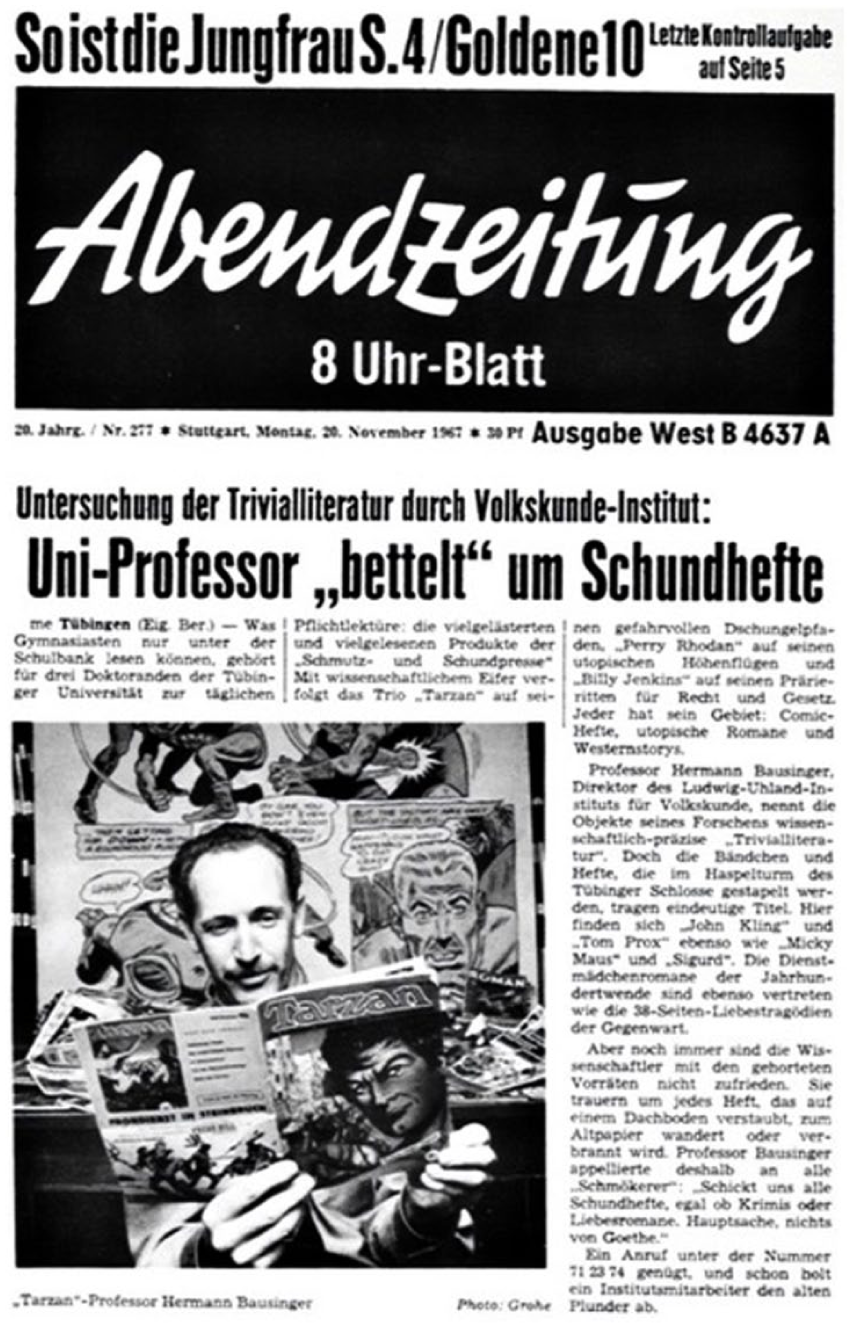
Within Germany, Bausinger was notable for his refusal of the kind of high-minded disavowal of popular culture characteristic of the Frankfurt School tradition, which had remained dominant in German Leftist intellectual circles for many years. In this respect, his intellectual trajectory paralleled that of the type of cultural studies initially developed in Birmingham by Richard Hoggart and Stuart Hall. They later recalled being mocked in the staff room at Birmingham University by those who scorned their close attention to forms of popular culture such as comic books. Similarly, Bausinger was pilloried in the German popular press in the 1960s, as the ‘Tarzan Professor’ for his temerity (and supposedly self-evident foolishness) in arguing for the cultural importance of the comic book narratives of popular heroes to be found in the scandalous world of modern ‘trivialliteratur’, as the Stuttgart ‘Abendzeitung’ described it at the time (Morley and Hartmann, 2023: 75)
Sadly, ‘Folk Culture in an Age of Technology’ still remains a largely undiscovered gem, despite the fact that it was extraordinarily prescient, in respect of Bausinger’s early recognition that folk cultures, symbolic rituals and irrational beliefs continue to thrive in the world of contemporary technology. In that respect it foreshadowed, by several decades, the work of later scholars like Alfred Gell (1993 [1992]) on the ambiguous borderline between technology, magic, ritual and science. It also quite eerily pre-echoes Bruno Latour’s (1993) much-lauded recognition that ‘we have never been modern’ and his understanding that we all still, necessarily, live in a world of hybrid technologies and beliefs from different eras.
In his book, Bausinger rightly argued that folk culture, rather than being specific to rural/agricultural forms of social life, is still alive and well in modern technological society. Thus, he argues, what is needed is a ‘Volkskunde’ of the present, if we are to avoid the deeply misleading binary division in which much cultural theory remains trapped to this day, whereby the rational, secular, fast-changing technological world of modernity is supposed to have eliminated the ritualistic, static, irrational world of traditional society. As an early reviewer of his work noted, Bausinger refused to identify folk culture with a ‘timeless’ world of static tradition. Thus, he was able to transcend any romantic conceptions of the ‘Volk’ as some kind of enduring essence – and to recognise the contemporary manifestations of folk cultures as ongoing processes within the world of modernity itself. The crucial recognition here was that the technological world gives rise to its own folk tales, myths and rituals. As we are now coming to recognise, digital technologies such as the ubiquitous smart phones on which we all now depend, are particularly well-suited for the rapid transmission of surreal forms of fake/post-truths and irrational rumours. In the field of cultural production we might think here of how all these issues have been developed in works on the contemporary technologised forms of rumour and mythology by artists such as Jeremy Deller in the United Kingdom (Deller and Kane 2005); or consider the work of the ‘magical realist’ novelists of the megaslums of the poor South, such as the urban fairytales of Latife Tekin (1996) in Turkey or the work of Gabriel Garcia Marquez (1967) in Latin America.
Bausinger’s exemplary and farsighted protocols for work in this area included the early recognition that our focus should be on what he called the ‘inconspicuous omnipresence of the technical’ in our contemporary world – a methodological emphasis in line with the approach later advocated so effectively by Georges Perec (1999). His argument was that we should not focus on individual technologies – however spectacular – in isolation from each other, but rather, on what he called the ‘ensembles’ of different media and technologies which frame the menu of choices routinely orchestrated within any individual or household lifeworld.
My own first encounter with Bausinger’s work had been occasioned by the fact that in the 1980s, he was among the first German scholars to recognise the importance of the kind of audience studies then being developed by researchers such as Ien Ang and Ellen Seiter. He quickly grasped that their work on the international popularity of American television fictions such as Dallas and Dynasty, was worthy of serious attention. This put him at odds with the condescending neglect espoused towards work of that sort by the ‘radical’ political economists of the Left, who still simply dismissed these phenomena as depressing but uninteresting confirmatory evidence of the lamentable ‘false consciousness’ of the European working class. It was in that context that Bausinger had the foresight to collaborate with Ellen Seiter in hosting a crucial conference on audience studies at his (traditionally conservative) home university in Tubingen. The proceedings of that conference later appeared under the title ‘Remote Control’ (Seiter et al., 1987) which went on to become a canonical text in international audience studies for many years.
At that same time, I had begun to try and move the focus of my own audience work towards the household, on the grounds that that is where the practice of television viewing was predominantly conducted. It was then that I discovered Bausinger’s extraordinary article ‘Media, Technology and Everyday Life’ referred to earlier, where, in a few short pages, he succeeded in overturning many of the unexamined foundations and presumptions of television audience research up to that date.
To give but one example from that article of the significance of his approach to studying media technologies, Bausinger reports coming across a woman who tells him how much she dislikes sport on television, only to subsequently find her sitting happily on the sofa, watching football on television with her teenage son. Asked about the seemingly contradictory nature of her behaviour, she scornfully disabuses him of any unthinking presumption that ‘watching television’ necessarily has anything at all to do with the particular content on the screen. As she makes plain, in her role as mother, she is simply using joint television viewing as a pretext for spending intimate time in her son’s company, as otherwise, she rarely gets to see him alone. Once examined closely, in the context of the fine grain of everyday practices, it soon becomes evident that our lives and relationships are closely intertwined with a variety of communication technologies. Thus, what can look like simple choices of media content are often profoundly influenced by the relationships within a household, as people use various technologies to both connect (and in other instances, disconnect) themselves to and from each other. This perspective was crucial in formulating the intellectual agenda of the project on the ‘Household Uses of Information and Communication Technologies’ in which I was involved at Brunel University in the late 1980s (Morley and Silverstone 1990). The further point is that this principle – concerning how the members of different households use TV for complex purposes – applies every bit as much in the world of contemporary streaming as it did in the world of broadcast television that Bausinger was researching in the 1980s.
At another point in that article, Bausinger reminds us of Hegel’s proposition that reading the newspaper was a constitutive part of the ritual of breakfast in the life of any bourgeois family in the 19th century. Thus, he argued that, were it to be absent on any given day, that would constitute a crisis – not simply in respect of the absence/lack of its informational or entertainment content. More fundamentally, he argues that it would constitute a breakdown in one of the key rituals which constitute our domestic lives. The observation evidently finds a clear parallel in the technological rituals of our own day: we compulsively check our phones, in a way that is not explicable simply by reference to any practical need for the information that they may or may not contain. Rather, it is best understood as one of the constitutive techno-rituals through which we sustain our sense of ontological security in our private and public lives. Again, the unforeseen (if only temporary) absence or withdrawal of this facility similarly often provokes a crisis far beyond anything which is rationally explicable in terms of our practical needs. To point to a further parallel, here we might also consider the work of Cathy Johnson et al. (2022) on how the Covid crisis produced new domestic viewing rituals – which ‘returned’ many households from streaming to broadcast models of media consumption – as a way of dealing with the sense of isolation and social anomie produced by the pandemic.
Only a short while before Bausinger died, aged 94 in 2021, I found a wonderful video of him online, doing a lecture titled ‘Dwelling and Dwindling’ on the ethnography of ageing, for a socio-medical conference. His main objective in the lecture, was to critique presumptions that in some notional ‘Golden Age’, the old were treated so much better than in the comparatively ‘heartless’ world of today. By way of demonstrating the negative attitudes to ageing in previous eras, he included the ancient, regretful, Schwabian saying ‘Time passes, the light goes out and grandfather STILL hasn’t died . . .’. As ever, his attention to the telling detail of the everyday – and on how that could lead you to radically counterintuitive conclusions – was exemplary. His procedure, focussing on the overlooked banalities of everyday life practices, was exactly the same as that used in his media research – which had shown how domestic/familial contexts often structure practices of media consumption in unexpected ways. In the lecture, his main practical point was to critique the taken-for-granted notion that elderly people should be moved out of any house with an old-fashioned bathroom, in order to live somewhere with an ergonomically-designed washing space of a more ‘modern’ style. However, his point was that, in actual fact, the statistical evidence was that on being moved into such purpose-built environments, old people were much more likely to have a fatal fall. That, of course, he explained by reference to the fact that although their own, old-fashioned bathrooms might have been criticised on ergonomic grounds, the old people concerned knew their way around every inch of those bathrooms by feel – and the removal of that familiarity was often fatal to them. The further we move towards an AI dominated world, the more his recognition of the continuing importance of those kinds of sensual, contextually sensitive forms of local knowledge and intelligence needs to be celebrated – and treasured.
Having first met in 1986, Bausinger and I stayed in touch over the years, and I was invited to Tubingen to speak at his retirement ceremony in 2002. That was a lovely occasion, and his students clearly adored him. At the ceremonial dinner that night, he told me a story about how sometimes, towards the end of his courses, students would come up to him and complain that they had worked hard, attended all the seminars and done all the reading, but were frustrated to find that they were still confused. He said that he usually replied by explaining that they should realise that they were now confused at a higher level, and that was the best they could ever expect! In subsequent years, I adopted Hermann’s riposte to his students as the basis of my own pedagogic credo and I still smile to think of the wry expression on his face, as he told me that story over dinner that night.
Footnotes
Funding
The author received no financial support for the research, authorship and/or publication of this article.
Declaration of conflicting interests
The author declared no potential conflicts of interest with respect to the research, authorship and/or publication of this article.