




Abstract
This short article examines the depiction of emotional and hermeneutic labour in the Netflix series Adolescence, which has sparked widespread cultural discourse around youth, masculinity and the mainstreaming of manosphere ideologies – what I term ‘manosphere creep’. These forms of labour are disproportionately performed by women across paid, ‘professional’ domains and unpaid, ‘private’ contexts. The analysis foregrounds not only the emotionally depleting nature of this labour in the series but also the exploitative dynamics it reveals, particularly within heterosexual and gendered relationships, where men often benefit from women’s labour without acknowledgement or reciprocity. Adolescence is valuable for the way it makes these gendered inequalities visible. Yet, it is remarkable how little cultural commentary has unpacked these glaring depictions. By tracing these patterns in Adolescence, the article addresses a gap in media analyses regarding the gendered allocation of emotional and hermeneutic labour in popular media texts. It further posits that this unequal distribution constitutes a pressing feminist issue that warrants deeper cultural and theoretical engagement.
Introduction
The Netflix series Adolescence, which premiered all four of its episodes on 13 March 2025, has sparked stunning media attention, invigorating laudable conversations about youth, masculinity, social media, and sexual- and gender-based violence. The series also portrays what I call ‘manosphere creep’, a term illustrating how manosphere sensibilities, from anti-feminist sentiments to overtly violent behaviours, have moved out of the shadowy manosphere where they are fertilized to take form in ‘mainstream’ spaces, including school classrooms (Westcott et al., 2024). Communications scholar Debbie Ging (2025) has described the series as ‘a call to liberate boys from toxic gender scripts’, and some reports suggest the series has sparked meaningful conversations between boys and their parents about its central themes (Lamche, 2025).
However, analyses have not yet focused on the show’s depiction of emotional labour. This lack of attention is concerning, as it indicates that perhaps this labour is being overlooked as ‘natural’ and ‘inevitable’, a framing that I problematize. Emotional labour refers to the work of managing one’s emotions and the emotions of others, either by inducing or suppressing emotions in oneself (Hochschild, 1983). The founding theorist of this concept, Arlie Russell Hochschild (1983), argues that this labour takes shape through surface acting and deep acting. Surface acting involves faking the expression of a normatively mandated disposition, for instance, a flight attendant putting on a cheery persona despite dealing with a rude passenger. Conversely, deep acting occurs when an actor genuinely feels the emotions they are expected to portray. In this case, the flight attendant no longer pretends to be cheery; she is a bundle of good spirits, commanding the aircraft with a genuine (albeit induced) smile. Hochschild (1983) contends that feeling rules are the informal, culturally prescribed norms through which gendered actors understand the ‘correct’ emotional expressions they are expected to embody in each situation.
Since Hochschild’s (1983) foundational account, researchers across academic disciplines have studied how emotional labour operates in various contexts and the toll it takes on its undertakers. Some of the most fascinating research on emotional labour comes from the field of cultural studies. In 2023, Kaisa Tiusanen found that social media wellness spaces for women covertly enforce feeling rules that regulate the permissibility of certain feelings and expressions, ultimately constraining how women make sense of themselves and their circumstances and discuss these topics with other women online. Rosalind Gill (2017) has similarly argued that the affective life of postfeminism operates through feeling rules that avow women’s positive expressions and renounce their negative ones. Two years later, Rosalind Gill and Akane Kanai (2019) coined ‘neoliberal feeling rules’ to describe the rules that govern how actors are impelled to comport themselves in neoliberal societies emphasizing self-enhancement. Still others have explored the presence of emotional labour on television, particularly in reality TV (see Wood et al., 2008). Gender has been central to all these accounts.
Despite the obvious displays of emotional labour in Netflix’s Adolescence, most of the conversation around the series has attended to the manosphere and its impact on boys. Without taking away from these conversations, this article focuses on a less-examined yet equally important theme: emotional labour and hermeneutic labour. While related to emotional labour, the latter has three defining characteristics (Anderson, 2023). First, it requires a person to cognitively grasp and articulate their feelings, desires, and motivations. Second, it involves interpreting the emotions of others, often through astutely navigating nonverbal cues. Finally, it demands creative problem-solving to navigate interpersonal conflicts. Feminist philosopher Ellie Anderson, who coined the term in 2023, suggests this labour is not gender-neutral but inordinately demanded of women. Moreover, such labour produces negative consequences for all genders: women report being emotionally drained from providing this unreciprocated labour (Hackman, 2015), and men are rendered emotionally illiterate and unable to care for themselves (McDermott, 2025). Adolescence features myriad examples of emotional and hermeneutic labour, the majority of which is shouldered by women. Episodes three and four contain numerous examples of such labour; hence, they are the central focus of this article.
Paid emotional and hermeneutic labour in Adolescence
In episode three, viewers follow clinical psychologist Briony Ariston as she meets Jamie Miller, the 13-year-old protagonist, for their final psychological assessment of Jamie, who is housed in a youth detention facility. He is there awaiting trial for murdering his female classmate, Katie, in a vile act of femicide: ‘an intentional killing with a gender-related motivation’ (UN Women, 2024). While Jamie is initially emotionally subdued, exhibiting confusion, fear, and dismay in the first episode when he is arrested and corralled by the police into the local station, by the third, he is emotionally unpredictable. At the episode’s outset, Jamie nicely thanks Briony for bringing him hot chocolate, but shortly thereafter, Jamie aggressively swipes the hot chocolate from the table in a fit of rage, screaming at Briony, ‘You do not get to tell me when to sit down!’
From the episode’s outset, viewers understand that Briony enters the facility with a mission: to conduct and complete her assessment. To achieve her goals, Briony prepares questions to discuss with Jamie and deploys preemptive tactics to put him in a receptive mood. Before diving into the particulars of their discussion, Briony steers Jamie towards cooperation by priming him with the hot chocolate he enjoys – complete with his preferred ‘sprinkles’, which, as Jamie notices, ‘[she] remembered’. The pair discuss what Briony calls her grandfather and laugh about Jamie describing bread as ‘a slice’. Briony allows these tangential topics before asking, ‘So, can we talk a bit about you?’.
If hermeneutic labour is the ability to express one’s motivations (as part of her job, Briony desires to conduct the assessment), ascertain those of others (Jamie desires to keep Briony’s probing at bay), and creatively respond to the conflicts between them (Briony continuously attempts to put Jamie in a ‘good mood’), then Briony is legible as a paid and professional hermeneutic labourer. Indeed, watching the episode feels like observing a fight sequence: Briony skillfully navigates Jamie’s disruptions to maintain the conversation’s rhythm just as Neo, the protagonist of The Matrix (1999) – the film from which manosphere personalities have appropriated the ‘red pill/blue pill’ trope – dodges the bullets of Agent Smith’s henchman in the famous rooftop scene.
A noteworthy exchange in the episode occurs when they discuss how Jamie’s father, Eddie, reacts to Jamie’s poor football (i.e. soccer) skills on the pitch. After disclosing that he believes his father is ashamed of him, Briony asks Jamie how that shame feels. Jamie suddenly turns on her, insisting, ‘You’re supposed to say he wasn’t [ashamed]’. One reading of Jamie’s anger is that it stems from his perception of Briony as having failed to provide the emotional and hermeneutic labour he expects of her (i.e. to assure Jamie his father is not ashamed of him). Jamie’s reliance on Briony’s emotional labour reflects his broader belief that women are meant to manage men’s ‘feelings’. By transgressing the role Jamie has assigned her, Briony provokes a vitriolic display of dominance where Jamie aggressively asserts that she holds no authority over him, instructing her to ‘get that in that fucking little head of yours!’.
A similar moment arises when Jamie describes himself as ugly. When Briony does not contradict him, Jamie turns aggressive. To calm him, Briony performs hermeneutic labour by explaining her reason for not providing her opinion: ‘I am interested in [your perception] because what you think is more important than what is true, okay?’ Placated by this response, Jamie allows Briony to ask about his motivations for posting on Instagram. Briony has interest in uncovering why Jamie posts because viewers previously learned that Jamie is not popular in school and has received comments (and many likes to these comments) on his posts suggesting he is an incel. Meadhbh Park, a researcher of the manosphere and far-right, contends that these comments labelling Jamie an incel serve the purpose of identifying him as sexually undesirable and a misogynist (PoliticsJOE, 2025). The incel label, then, far from its original meaning, is reappropriated as an insult against men who are not active incels but may subscribe to some aspects of incel ideology. Jamie, for instance, describes to Briony the ‘80/20 rule’, where ‘80 percent of women are attracted to 20 percent of men’, and of this rule he says, ‘I do think [incels] are right about that one’. Hence, even though Jamie is not an incel, manosphere creep has suffused him with manosphere-supportive beliefs.
Regarding his intentions for posting on Instagram (Figure 1), Briony offers Jamie some suggestions. Does Jamie post so his bullies can see him having fun with his friends (Figure 2)? Or perhaps, does Jamie post to catch the attention of a potential friend or girl who thinks he looks alright (Figure 3)? Jamie dismisses these suggestions as absurd, indicating either that Briony is hitting the nail on the head, but Jamie is too embarrassed to admit it, or that Jamie himself isn’t quite sure why he posts. Such is often the case for heterosexual boys and men, Anderson (2023) and McDermott (2025) argue; the emotional and hermeneutic labour that the women in their lives are required to perform has rendered men emotionally and cognitively challenged, out of touch with their motivations and desires. Put differently, this means Jamie may genuinely have no clue why he posts. Briony, however, has clearly considered why and offers these suggestions to Jamie as both an olive branch and otherwise a means through which he can consider his actions in a new light. Briony’s offerings constitute another example of hermeneutic labour, where women are compelled to share their interpretations of men’s feelings and their relationships with them for men’s benefit (Afifi et al., 2012, cited in Anderson, 2023).
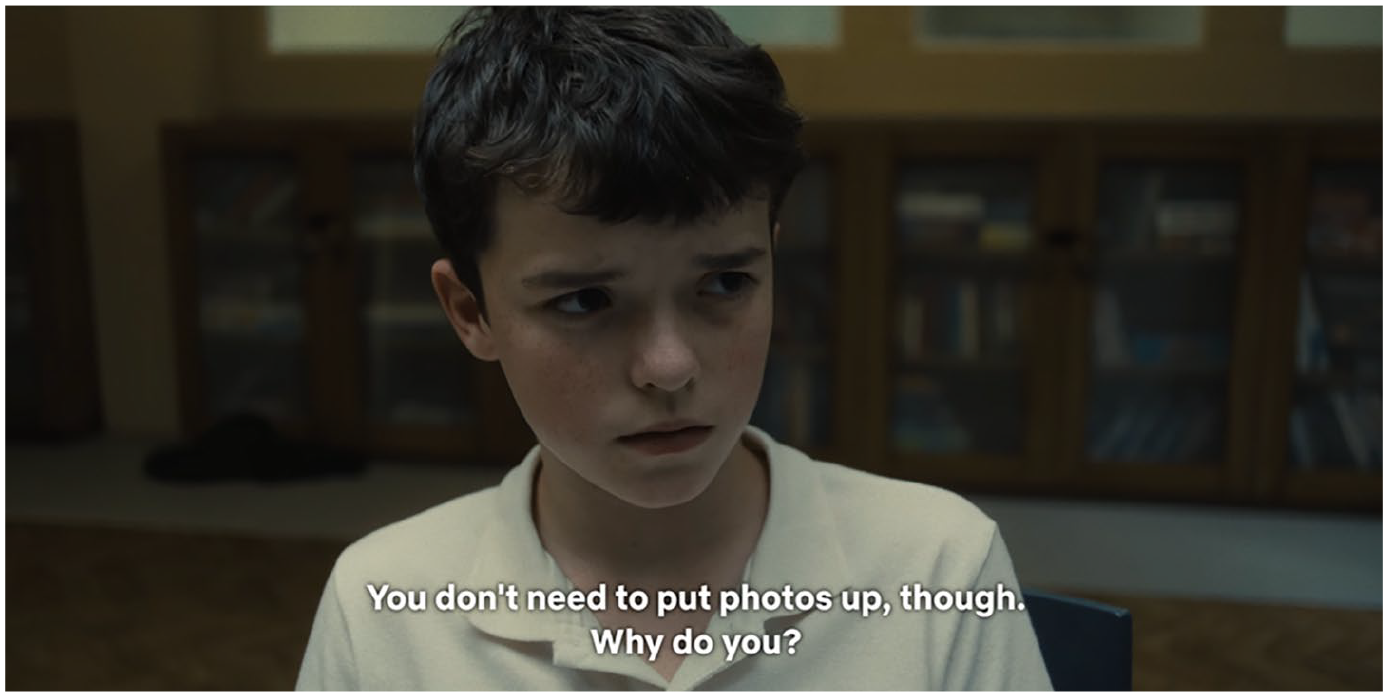
Jamie is asked why he posts on Instagram (Adolescence).
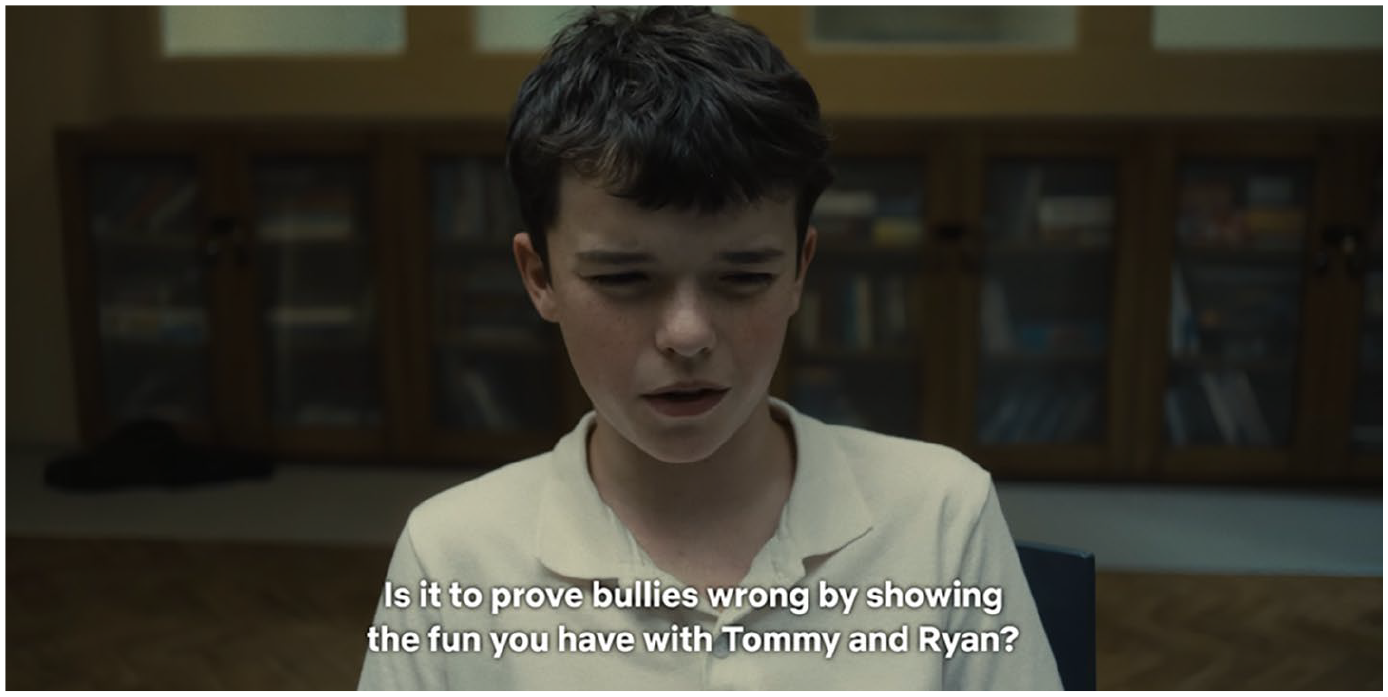
Jamie makes a face when asked if he posts to ‘prove the bullies wrong’ (Adolescence).
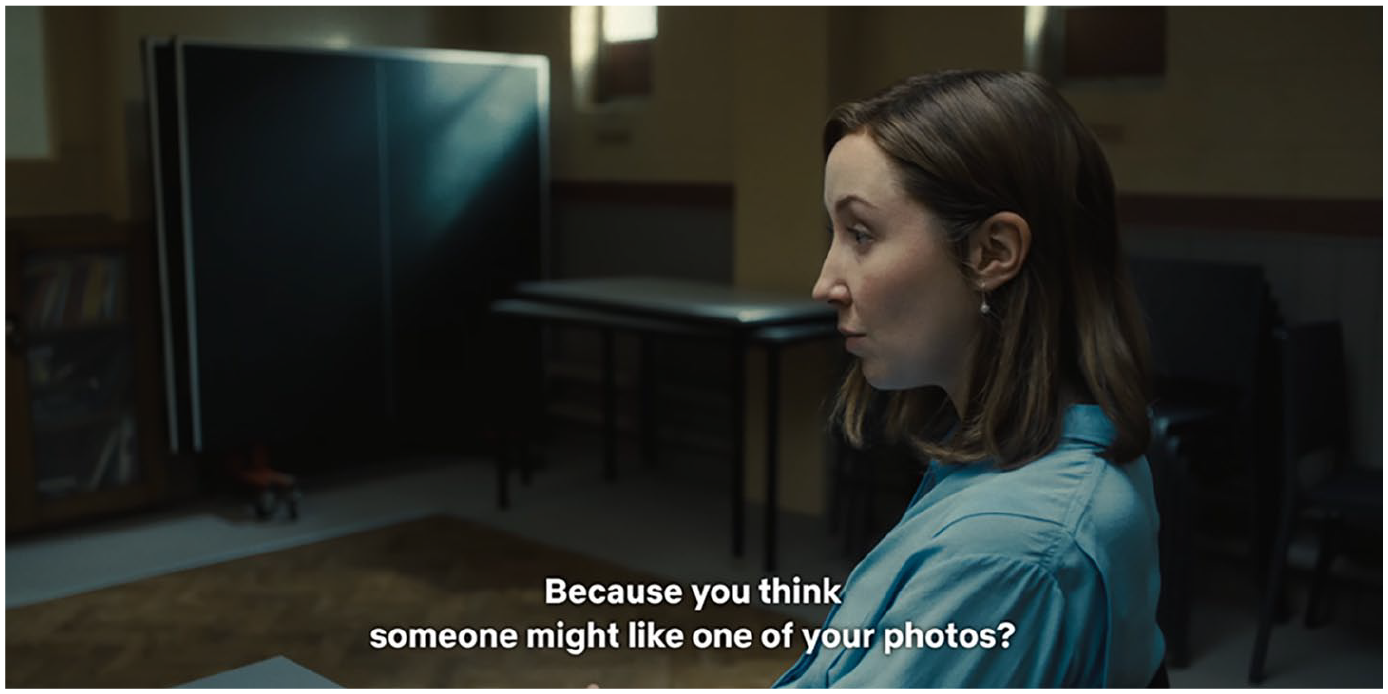
Briony asks Jamie if he posts in hopes of making friends (Adolescence).
In the episode’s conclusion, Briony turns to clean up the sandwich that a departed Jamie had barely touched. However, upon picking up the sandwich, Briony groans and moves it away, wiping her hand on her slacks and putting her fist to her mouth as her breath shudders. In this reaction, viewers understand that despite her calm exterior during her interactions with Jamie, Briony is greatly emotionally affected by the work her job entails – and she is disgusted on a more personal level. With Jamie departed and her assessment completed, Briony reels in the demands of her emotional labour.
Unpaid emotional and hermeneutic labour in Adolescence
The emotional and hermeneutic labour performed by the women of Adolescence is not always paid. Episode four, set 13 months after Jamie’s arrest, reveals this labour within the Miller family, who are struggling to cope with their shattered lives. Early in the episode, Jamie’s mother, Manda, attempts to discuss the family’s future and whether they should move, as they are now gawked at by the town. Eddie immediately shuts her down: ‘Please, love, don’t start. Don’t say anything. [. . .] We’re not having this conversation again’. Eddie and Detective Inspector Bascombe, the male officer assigned to Jamie’s case, do ultimately come to accept and embody emotional vulnerability (Bascombe via a reconnection with his son, and Eddie by placing Jamie’s teddy bear in his bed, lamenting, ‘Sorry, son. I should’ve done better’). However, most of the “show’s” emotional and hermeneutic labour is carried out by women. Manda, for instance, attempts to initiate a second difficult conversation with Eddie, only to be dismissed once again. ‘Please, let’s not do all this again’, Eddie replies to her inquiry, prompting Manda’s pointed observation: ‘That’s becoming your catchphrase, isn’t it?’.
Anderson’s (2023) articulation of hermeneutic labour draws on the work of David L. Vogel et al. (1999), who describe the ‘female-demand/male-withdraw’ pattern. This dynamic occurs in heterosexual relationships when a woman repeatedly initiates important discussions, only for the masculine partner to avoid, terminate, or decide when an appropriate time is for the conversation. Anderson (2023) regards this pattern as a core tenet of contemporary heteroculture that leaves women feeling disempowered. Eddie’s and Manda’s exchanges exemplify this pattern. Throughout the fourth episode, Manda walks on eggshells, carefully interpreting Eddie’s mood and choosing actions to minimize tension, especially after Eddie finds his truck vandalized. Struck by a sense of helplessness, Eddie abruptly insists that the family leave for Wainwright’s (a home hardware store). Although Manda wishes to wait until after breakfast, she recognizes that heeding Eddie’s demand is the path of least resistance. She also takes on the responsibility of reframing the day positively. ‘We’ll get the day back’, she offers. Eddie clings to this phrase, repeating it obsessively on the drive to the hardware store.
Manda is rarely offered the space to grieve. In one powerful juncture, Manda is shown walking into the family’s house alone. She looks up the staircase – presumably to check if Eddie or her daughter are around – before hanging up Eddie’s jacket and taking off her own. She starts to sob quietly, burying her face in her jacket. But knowing she must put on a brave face and console Eddie, Manda steadies her breath, wipes away her tears, and climbs the stairs to their bedroom where Eddie awaits. Moreover, it is only when Eddie begins to shed the male armour he has been socialized to wear do the beginnings of a more caring and reciprocal relationship emerge. During their conversation in the bedroom, Eddie tells Manda how his father used to ‘batter’ him. This abuse, Eddie says, made him promise that he would ‘be better [than his father]’. ‘But am I?’ he wonders, recalling how he was ashamed of Jamie for being a dismal footballer. He engages in this reflection mostly without Manda’s prompts, indicating that Eddie is taking on hermeneutic labour to understand and articulate his emotions and to communicate them to Manda.
This article argues that Adolescence is a pertinent media text representing the toll of paid and unpaid emotional and hermeneutic labour on its mostly feminine undertakers. Adolescence’s creators have faced some heat from the media about centering the masculine perpetrator’s perspective and not the feminine victim’s story (Keating, 2025); however, the show has successfully emphasized the overwhelmingly feminine victims of under-recognized and under-valued forms of labour that leave women emotionally drained. These portrayals of emotional and hermeneutic labour occur so visibly in the series yet remain under-explored in media analysis. With this article, I seek to provoke a cultural reckoning with the demanding and invisible forms of labour routinely expected of women, so normalized that their unequal distribution appears benign, even unremarkable. Yet, this labour is remarkable, and its unequal distribution is a pressing feminist issue that demands wider acknowledgement and deliberation. Rather than taking the current distribution of emotional and hermeneutic labour for granted, this article builds on feminist scholarship, most recently The Care Collective’s (2020) manifesto, contending that the unequal division of all labour should be a site of feminist struggle. In making these disparities visible, Adolescence serves as a powerful media text beyond its thoughtful engagement with youth, masculinity, and manosphere creep. As feminist audiences, we should invest in and demand more shows of this attentive, compassionate quality.
Footnotes
Acknowledgements
The author would like to thank Jilly Boyce Kay and Kaitlynn Mendes for their thoughtful feedback on earlier drafts of this article.

Funding
The author received no financial support for the research, authorship, and/or publication of this article.
Declaration of conflicting interests
The author declared no potential conflicts of interest with respect to the research, authorship, and/or publication of this article.
Data availability statement
Data sharing is not applicable to this article as no datasets were generated or analyzed during the current study.