




Abstract
Against a backdrop of the growing crisis in higher education, the economic fallout of the COVID-19 pandemic and a longer-term precaritisation of the youth and graduate labour market, the last 2 years have witnessed an increased visibility and promotion of flexible, entrepreneurial and often digitally mediated forms of self-employment addressed at young women, including the ‘side hustle’. With media declarations such as ‘the university side hustle has come of age’, universities themselves have begun embedding initiatives that seemingly help students launch a ‘student side hustle’ as they turn passions into entrepreneurial projects. The student side hustle has been advocated as a feasible way of not only supplementing income while studying but also investing in one’s future employability in the context of increasingly uncertain graduate outcomes. In this article we connect the emergence of the student side hustle to a broader postfeminist landscape in which (young) women are invited to engage in entrepreneurial self-employment through the promise of ‘passionate work’, financial autonomy and time-freedom. We demonstrate that in the context of higher education, where women outnumber men and dominate the degree subjects increasingly badged as ‘low value’ due to declining graduate outcomes, institutional incitements to engage in the student side hustle are distinctly gendered. Crucially, we contend that this framing and promotion of the student side hustle – in which women become the ‘poster girls’ of entrepreneurialism – works to facilitate and sustain the myths and ideals of postfeminist success while masking the ongoing crises and gendered inequalities that underpin contemporary higher education and the graduate labour market.
Introduction
With 25% of adults side-hustling today, there is no way back. The genie is let out of the bottle. Those who are underwhelmed and under-financed by their work, but have the appetite, if not the confidence, to go it all alone as an entrepreneur, will not let the chance slip. (Henley Business School, 2018) Boss Babe! Stuck at home and bored in lockdown . . . Isobel Perl turned her growing side hustle into a full-time business. (Wilson, 2021)
In recent years, there has been increased visibility and promotion of flexible, entrepreneurial and sometimes digitally mediated forms of self-employment addressed at young women. This gendered entrepreneurialism has manifested in multiple forms, many of which are interrogated in this special issue and elsewhere (see Gill, 2014; Idriss, 2022; Littler, 2018; Scharff, 2016). As we examine here, one such space in which this is crystallised is the ‘side hustle’, commonly understood as income-generating activity pursued either alongside primary employment or study and often in areas of the informal ‘gig’ economy. Examples include selling crafted goods on digital platforms such as Etsy, online cosmetics businesses and baking bread for sale. The side hustle has been enthusiastically embraced by many economists and journalists as the ‘new normal’ – allowing workers flexibility, financial autonomy and creative fulfilment. Nonetheless, it might be better understood as part of what McMillan Cottom (2020) calls the ‘hustle economy’; a product of longer-term transformations under neoliberalism, including the rise of precarious and insecure work, falling wages and declining state protections for the low paid and unemployed.
University students have become strongly associated with the side hustle. In the UK, the student side hustle (hereafter SSH) has received increasing attention, especially in the context of the pandemic when students, locked down and locked out of part-time jobs in hospitality and retail (Henehan, 2021), had to find new ways to make money. This has since been exacerbated by the cost-of-living crisis, in which students are particularly vulnerable to rising living costs as well as declining government support (NUS, 2022; Waltmann, 2022). It is against this backdrop that the Telegraph newspaper declared that ‘the university side hustle has come of age’ (Moore, 2020). Indeed, the spirit of entrepreneurialism is constructed as distinctly youthful and generational (see Holdsworth and Mendonça, 2020), with claims that generation Z students 1 are ‘driving the side-hustle revolution’ (Henley Business School, 2018: 5) and embodying ‘generation hustle’ (Beltrao, 2021). Quantitative evidence to support claims that students are setting up side hustles en masse is somewhat scant however. For example, the annual National Student Money Survey suggests that 31 percent of students have their own business or side hustle (Brown, 2022), while Santander UK (2020) claims that 27 percent of students currently run or plan to run a business while at university. Our interest, however, is not in identifying the statistical truth of levels of engagement in the SSH. Rather, we are concerned with how and why the SSH has come to receive such attention, and – as indicated by the second quote that opens this article – why young women have become central figures within its promotion.
Students engaging in paid work alongside their studies is nothing new. Over the past few decades, student employment has become increasingly commonplace in the UK and globally. In England, over half of full-time students do paid work, with rates of participation in paid work higher among female students (Department for Education, 2018). This upwards trend corresponds with the ramping up of student fees and simultaneous reduction of financial support through government loans, maintenance grants and scholarships (Hordósy et al., 2018). Not only are more students working, they are also working longer hours than previously; consequently, for some students, the degree itself is ‘literally pushed to the side’ as paid work becomes ‘a necessity for survival’ (Simpson, 2020: 71). Emerging data in the UK suggest that the current cost-of-living crisis is exacerbating these trends (Office for National Statistics, 2023; The Sutton Trust, 2023). However, the SSH is a distinct phenomenon which both predates and is likely to outlive the current economic moment, as it is mobilised to positively reframe student employment not as a necessity for survival within increasingly hostile conditions but as a site for cultivating entrepreneurialism and employability.
The article proceeds with an overview of the ways the massification and feminisation of higher education (HE) has positioned young women as subjects of success; ‘top girls’ (McRobbie, 2007) who are encouraged to pursue professional careers and develop an ‘entrepreneurial mind-set’ (Ikonen, 2020). We reflect on the fragility of this discourse, considering the multiple converging crises that together have weakened the ‘graduate premium’ and intensified persistent inequalities in graduate outcomes. After outlining our methods, we analyse data from a sample of UK news media articles, student-facing websites and university webpages to critically interrogate the SSH. We start by evidencing the emergence of the SSH and outlining the distinctly gendered mode of entrepreneurialism invoked within this discourse. Finally, we examine the ways in which universities have become complicit actors in the endorsement of the SSH under the guise of ostensibly noble equality, diversity and inclusion (EDI) initiatives.
Young women, postfeminism and the gendering of HE
Scholarship on postfeminism has identified how young women are increasingly positioned as subjects of capacity, ambition and success. Variously theorised by feminist scholars as the ‘can do’ (Harris, 2004), ‘successful’ (Ringrose, 2007) or ‘top girl’ (McRobbie, 2007), young women are invited to invest in themselves as aspirational and entrepreneurial subjects, underpinned by an assertion that gender equality has been achieved. While postfeminist logics and incitements can be traced across a range of arenas, education and work have become key sites for claims about young women’s ‘success’, and purportedly unconstrained freedom, to be asserted. McRobbie (2007: 718) locates this as part of the new sexual contract that promises young women freedom and autonomy in return for their investment in education and a career. As McRobbie (2007) notes, in the UK, the ‘top girl’ became a particularly powerful figure under the New Labour government of the late 1990s and early 2000s:
Within the language of Britain’s New Labour government, the girl who has benefited from the equal opportunities now available to her, can be mobilised as the embodiment of the values of the new meritocracy. This term has become an abbreviation for the more individualistic and competitive values promoted by New Labour particularly within education. Nowadays the young woman’s success seems to promise economic prosperity on the basis of her enthusiasm for work and having a career . . . The result is that the young woman comes to be widely understood as a bearer of qualifications, she is an active and aspirational subject of the education system. (pp. 721–728)
HE has occupied a particularly luminous space within this postfeminist landscape, as young women – particularly working-class women and women of colour – have been encouraged to aspire towards and engage in HE as a path to ‘self-betterment’ (Archer and Hutchings, 2000) and a professional career. Positioned as the key beneficiaries of the expansion of HE, globally, young women are participating in HE in greater numbers than ever before and now outnumber men in many countries (Parvazian et al., 2017). Consistent with global trends, in the UK young women have higher participation rates than men, making up 57 percent of the UK student population in 2020 (HESA, 2023). They are also more likely to complete their studies and gain a first or upper second-class degree (Office for Students, 2019).
Despite claims that such shifts mark a ‘gender revolution’ in HE, the increasing entry of women into HE has not necessarily equated with enhanced career opportunities or improved gender parity in the labour market. Challenging the overly-celebratory and homogenising narratives of young female success, research demonstrates persistent and systematic inequalities in young women’s education and labour market experiences and outcomes, especially for those disadvantaged by social class and ethnicity (Allen, 2016; Leathwood and Read, 2008; Ringrose, 2007). Indeed, although women and ethnic minority graduates often report greater levels of skill development from their degree, they do not always see better employment outcomes in either work satisfaction or pay (Wilton, 2011) and can expect significant earnings gaps, compared to their male peers, years after graduation (Cornell et al., 2020). In the UK, the lifetime increase in gross earnings as a result of attending HE is estimated to be £240k for men but only £140k for women (Britton et al., 2020). Moreover, ‘first-in-family’ women graduates are subject to an additional class penalty (around 7.4%) that is not evidenced for their male counterparts (Adamecz-Völgyi et al., 2022).
These sustained gendered inequalities within the graduate labour market cast doubt on the ‘top girl’ narratives of neoliberal postfeminism. Workforce segregation goes some way to explaining why women graduates are routinely paid less; pockets of underemployment (and, hence, lower earnings) are higher in occupations dominated by women and in the public sector (Kamerāde and Richardson, 2018) where women graduates enter in large numbers as health care professionals and teachers (HESA, 2023). Subject choice and the perceived status of different HE institutions also create unequal graduate outcomes (de Vries, 2014; Walker and Zhu, 2017). Data on UK HE subject enrolment show that women dominate seemingly ‘lower value’ degrees such as the creative arts, nursing, English and teaching, while men outnumber women on computing and engineering courses (HESA, 2023). Nevertheless, even when women graduate from ‘higher value’ STEM disciplines, they are less likely than men to go on to work in STEM occupations (White and Smith, 2021), which can then lead to a wage penalty.
The expansion and marketisation of the HE sector is, of course, another contributing factor. Indeed, it is important to reflect on how the project of widening participation, which contributed to women’s increased entry to the sector, has coincided with the privatisation of funding for university study (Jones et al., 2020), the removal of grants and bursaries for subjects and careers in which women and minorities dominate (i.e. social work), and the gradual decline of the ‘graduate premium’ (Boero et al., 2019). Thus, as HE has become increasingly feminised, it has also become more precarious, uncertain and financialised (Farrugia et al., 2022), with women bearing the burden of rising and unequal student debt levels in the UK (Yarrow and Davies, 2020). With the forecast average debt among students starting in 2021/2022 standing at £45,800 (Bolton, 2022), it is perhaps unsurprising that questions about value for money (VFM; Cook et al., 2019; Wilkinson and Wilkinson, 2023) and the neat transition from HE to the labour market (Tholen and Brown, 2017) continue to intensify. It is in this context, and against the backdrop of the Global Financial Crisis, the COVID-19 pandemic and the unfolding cost of living crisis, that universities have become ever more focused on employability and graduate outcomes. 2
As the employability agenda ramps up, and in the absence of acknowledging the structural failings of the sector, universities have turned increasingly towards cultivating and rewarding a ‘depoliticised, workable, entrepreneurial mind-set’ (Ikonen, 2020), particularly among women, working-class students and students of colour. As we show here, this institutional call for ‘optimism’ and the proactive cultivation of an enterprising self is most often addressed at groups who have been hardest hit by the pandemic and cost-of-living crisis. More than this, however, the supplanting of traditional career guidance with the promotion of the SSH operates to mask the ongoing crises that overshadow UK universities (Jones, 2022) and the entrenched gendered and racialised inequalities that persist within the graduate labour market.
Researching the SSH
We locate the SSH as not simply a set of working practices or labour conditions, but also as a contemporary sociocultural formation, that involves a range of actors and practices and is promoted across multiple sites, including news media, popular culture, student and graduate-facing websites and university policies and initiatives. Our objective is not simply to trace the emergence and growth of the SSH but to understand its underpinning logics and the ideological work that it performs. We therefore draw on data collected from a variety of sources.
First, we conducted an analysis of UK national newspaper reporting, collected via the online database LexisNexis. Data were generated from a news search of ‘Student’ + ‘Side Hustle’, limiting our search to the previous 2 years (September 2020–September 2022) to generate a manageable corpus of data. This period also covered key economic events impacting students and graduates including the pandemic and an unprecedented cost-of-living crisis. As we discuss, these events provided a backdrop to many of the news articles about the SSH, albeit in complex ways. To ensure relevance, we removed duplicates and any results returned from foreign editions, resulting in 80 articles. Twenty-five of these were subjected to in-depth analysis, allowing us to include a range of articles from across a diversity of publications including broadsheet and tabloid newspapers across the political spectrum. Second, we analysed external-facing websites of UK universities, searching for content related to the ‘side hustle’. This included university careers pages, news pages and content on particular employability initiatives. The SSH features across a range of institutional webpages, from new (‘post-92’and ‘MillionPlus’ universities) to the ostensibly more elite Russell Group universities. Finally, we analysed the content on key external student- and graduate-facing websites oriented to providing advice and guidance to students and graduates about careers and student finances, including Milkround, Prospects and Save the Student.
We draw on a poststructuralist framework concerned with the constitutive nature of language as a social practice (Gill, 2018). Using approaches we have employed elsewhere to interrogate constructions of the ‘ideal’ student-graduate (Ingram and Allen, 2019), our analysis considered how the SSH is constructed in relation to wider agendas and crises associated with student outcomes and employability; what logics, norms and rationalities it expresses (particularly in relation to work, employability and entrepreneurialism); and what student-subject emerges as the ideal side hustler. We paid particular attention to the significance and presence of gender in how the SSH is displayed and constructed across these sites. As we demonstrate, the SSH is distinctly feminised. Shot through with postfeminist and neoliberal logics of entrepreneurialism, empowerment and ‘passionate work’, we argue that young women emerge as the poster girls of the SSH.
‘The university side hustle comes of age!’: Making sense of the SSH
It is within the context of converging economic crises – notably the Global Financial Crisis, austerity, the pandemic and the cost-of-living crisis – that most media articles locate the emergence of the SSH, noting that spiralling living costs are leading students to seek ‘new ways to earn money’ (Jones, 2021). However, despite explicit references to wider structural issues and challenges, the SSH is overwhelmingly framed in celebratory ways. An article in The Guardian, entitled ‘The Rise of the Side Hustle’ is a prime example of this:
Gen Z grew up witnessing the harsh realities of austerity, the housing crisis and spiralling personal debt – and had to be the first to navigate social media as children. Rather than be broken by all of this, many have found creative ways to turn their digital nativism to their advantage. Gen Z entrepreneurs are turning their backs on office 9-5s and promoting their personal passions into full-time jobs . . . . In record numbers, they are also mobilising to establish incomes that don’t rely on their elders. They’re drop shipping, Amazon reselling, flipping designer sneakers, spread betting, investing in crypto and NFTs. They’re inventing their own cosmetic lines for TikTok, or selling homemade teeth grills on Instagram. They want to be famous on social media not just because it feels good but because they can monetise it in shrewd ways. (Parker, 2022)
Here, the multiple crises bearing down on students’ financial and personal wellbeing are at once recognised and then swiftly obscured and individualised. Rather than dwelling on the harsh structural realities that this generation must contend with – rising living costs, spiralling student debt and declining opportunities in the traditional labour market – the article optimistically endorses the SSH as a ‘savvy’, ‘shrewd’ and distinctly entrepreneurial response through which young people are seizing opportunities to make money in the digital economy. Indeed, the SSH emerges as part of a broader package of entrepreneurial and ‘thrifty’ practices through which students must individually manage and adapt to wider economic insecurity. Thus, in media articles and student websites that provide ‘clever ways to beat the cost of university’ (Jones, 2021) and manage their finances, the SSH is endorsed alongside various thrifty and frugal ‘life hacks’ for cutting costs.
Emerging as an alluring form of entrepreneurial self-employment, the SSH is endorsed as offering time-freedom, fun and flexibility not found in the kinds of part-time employment traditionally undertaken by students (the seemingly mundane, ‘8-hour shifts’ of retail or bar work):
Lots of students turn to side-hustles to help cover the living costs of being in uni instead of getting a traditional part-time job as it can be more flexible and you can work on your own schedule . . . . The best part about side-hustles is they can normally be pretty fun and something you enjoy doing and a good way to get cash fast if you really need it. While having a part-time job might require you to work a couple of 8 hour shifts a week, a side-hustle might only be a few hours a week or less but you can still earn money from it and sometimes it can be super easy to do it . . . side-hustles can be done from home too so it doesn’t take a huge amount of effort . . . perfect for busy students. (Kah-Pavlou, 2022) A student has revealed how she helps pay off her college fees by pocketing £4,200 a month through a side hustle. Mia Salas claims she brings in stacks of cash every week by picking up freelance writing jobs . . . . ‘If you enjoy writing, even the slightest bit, try out freelance writing. Flexible hours, remote work, and it pays really well’. (Davis, 2022)
As we glimpse in these examples, the SSH is commonly constructed through an emphasis on ease, enjoyment and accessibility. As students are encouraged to monetise their hobbies and leisure time (and social media) through the SSH, work itself is re-constituted as a site of fun, leisure and sociality, so much so that it no longer feels like work. As one article stated, ‘if you enjoy doing it, then it doesn’t really feel like a chore’ (McVinnie, 2022). We can understand the SSH as rooted in an ideology of ‘passionate work’ (McRobbie, 2016) or ‘aspirational labour’ (Duffy, 2019). This not only circulates in the cultural industries, where ‘a vocabulary of love’ (Gill and Pratt, 2008: 15) helps sustain attachments to forms of labour that are exploitative or low paid, but is increasingly present across other areas of the labour market (Hong, 2022). As we show in the next section, the discourses of passionate work that underpin the SSH have a distinctly gendered dimension.
Gendering the SSH: #BossBabes, ‘savvy businesswomen’ and the monestisation of ‘bedroom culture’
Although often framed through the notion of hustling as a generational instinct, more obvious in our data is that the SSH is constituted as a distinctly gendered mode of entrepreneurialism. This manifests in numerous ways. As discussed in the previous section, the SSH is shot through with discourses of passionate work, where the side hustle is presented as a way for students to make money while ‘doing what they love’. This takes on a particularly gendered dimension through the highly feminised nature of the hobbies and ‘passions’ that are monetised in the SSH. In numerous examples, we find young women creating SSHs based around fashion, cosmetics and beauty products, wellness culture and cooking – or as one journalist writes, ‘knitting, baking, meditating or making’ (Mullender, 2022). Moreover, media reporting on the SSH locates these not only as feminised interests but, in many cases, as those developed out of young women’s homes – and specifically – their bedrooms:
An Irish teen launched an activewear business with her communion and confirmation money – and it has made her six figures. Shannon Conlon started Gym Chic in her bedroom in December 2020 as a project to keep her busy during lockdown. Now the student has netted 100,000 euros in sales thanks to her hard work, trendy design ideas and clever promotion on TikTok. (Anderson, 2022) A savvy businesswoman set up a side hustle making tops at university to pay off her student loans and now has a successful clothes business with her own London studio. Millie Smith launched Millie Jane from her student accommodation in 2016 when she was just 18 years old. She wanted to earn enough from the side hustle to pay off her overdraft, but then it completely took off. (Windle, 2022)
In the 1970s, McRobbie and Garber (1977) first coined ‘bedroom culture’ to theorise girls’ cultural practices within the domestic domain of the home as an alternative to boys’ subcultures. Here, bedrooms were located as sites of identity formation, friendship, fantasy and consumer culture. We argue that in the SSH, young women’s ‘bedroom culture’ is transformed by neoliberal capitalism into sites of entrepreneurial labour, facilitated through digital platforms that increasingly mediate young people’s leisure time (Lincoln, 2014). In summary, in the SSH, young women’s private passions and spaces are transformed into sites for entrepreneurialism and monetisation, as the boundaries between work and leisure become increasingly blurred.
Media articles overwhelmingly include first-person ‘success stories’, and these gender the SSH in other ways. In our sample, there were many examples to draw on in which young women are centred in the success narrative, having launched lucrative side hustles during university, mining their ‘obsessions’ and engaging in ostensibly gendered work (cleaning and clearing):
A savvy student has revealed how she can earn up to £500 per month sorting out strangers’ messy wardrobes. Ella McMahon, 19, from Leicester, spends three to nine hours decluttering and colour coordinating wardrobes. The fashion buying and design student . . . said: ‘I could do it all day every day because I am obsessed with organizing . . . . I love fashion and looking at clothes so it is fun for me’ . . . . Ella’s side hustle called ‘Cinderella’s Closet’ means she can save for a house to buy whilst studying at university. (Summers, 2022) A former Cardiff student has revealed how she went from living on 19p pasta to earning a six-figure salary through selling old clothes . . . . In 2014, the then 18-year-old decided to start clearing her wardrobe and put old outfits on Depop to sell in a bid to make some spare cash . . . she now nets her a six-figure salary after becoming a top seller. (Fenton, 2022)
The stark contrast between the 19p pasta (strongly associated with penniless students) and ‘six-figure salary’ works as a rhetorical flourish to emphasise the extreme wealth potential of the SSH. Variously celebrated as ‘savvy businesswomen’ and ‘boss babes’, the SSH gains legitimacy through postfeminist discourses of individual empowerment and agency (Banet-Weiser, 2018; Rottenberg, 2018) and the grammar of neoliberal meritocracy (Littler, 2018). As such, we argue that young women have come to figure as the ‘poster girls’ of the SSH. Perhaps unsurprisingly, these success stories – or ‘popular parables’ (Littler, 2018) – predominantly focus on white women, with a small minority of young black women featuring in news reporting, illustrative of what Banet-Weiser (2018) calls an ‘economy of visibility’ which privileges white, middle-class and cis-gendered young women.
The embrace of freelance, entrepreneurial forms of income-generation alongside study is located as an agentic and savvy solution to achieving financial independence and temporal autonomy – including paying off student debt and saving for a house. Moreover, the SSH not only promises economic security in the here and now but also offers the potential for a career outside the conventional graduate route. In doing so, the SSH apparently offers greater control for young women, for whom the spectre of motherhood – and the motherhood penalty within the traditional graduate labour market – looms. However, this representation of the SSH is only secured through stories of extreme wealth and pleasure in and through work. These celebratory stories not only obscure the many instances when side hustles fail or are poorly renumerated, but also mask the gendered – as well as classed and raced – risks, insecurities and hardships that mediate experiences and opportunities for ‘success’ within hustle culture and the ‘gig economy’ more broadly (Cohen et al., 2019; James, 2022; McMillan Cottom, 2020). We also note how some side hustles are completely absent in these celebratory narratives, most notably students engaging in sex work as strippers, dancers (Simpson, 2020) or on digital platforms such as OnlyFans. Such absences reveal the enduring hierarchies of respectability that mediate young women’s working lives and what counts as legitimate entrepreneurialism.
Higher Education’s passion-preneurs
So far, we have outlined the ways in which the SSH is presented a savvy ‘hack’ to contend with the prohibitive costs of university and the more general economic insecurity attached to HE. In addition, the SSH is framed as not only essential for everyday financial survival but also, crucially, as a desirable strategy towards a successful future. Again, through a discourse of private passions and hobbies, the SSH emerges first as an apparently more meaningful substitute for the traditional part-time job and also as a rewarding, self-determined career pathway in the absence of more structured and accessible options.
The focus on what students do when they graduate is by no means new; employability has been a key pillar within the UK HE strategy for some time now (Boden and Nedeva, 2010). Notwithstanding, our analysis reveals how the SSH is given ever greater space within the careers pages of university websites and is vaunted as a desirable way for students to enhance their future prospects. This is achieved through a repeated emphasis on the SSH as providing the chance to ‘do what you love’ and transform passions into enterprising projects. Although the squeezed and uncertain graduate labour market is (occasionally) acknowledged, notions of ‘freedom’ are discursively constructed through invocations to ‘be your own boss’. Thus, precarity is repackaged as a welcome opportunity to develop resilience and entrepreneurialism:
We all want to love the job we do. Now, thanks to a rapidly changing job market, that dream is becoming a reality for many. It’s never been easier to turn the things you do in your free time into a financially viable business. That’s why so many people are turning their hobbies into jobs, and you can too. Whether you have your heart set on becoming a full-time entrepreneur or you just want a little extra spending money for your studies, take a look through these tips to get started. (The University of Sunderland, in London
3
)
Discussions of the SSH are deeply intertwined with the structural changes underpinning contemporary HE and the declining graduate premium. Within the media articles in our sample, the SSH is offered as a response to a new economic context in which it’s ‘no longer enough to just do your degree’, and thus, students must ‘create their own opportunities’ to get a ‘head start in the career market’ (Moore, 2020). Indeed, the SSH was present in articles that directly discuss VFM and university costs, with The Times newspaper stating,
Students have always had to manage on tight budgets, but increasing numbers are questioning whether an expensive qualification from a middling institution will add up to a higher salary later in life. Those who have already taken the plunge are being ever more innovative about saving money – or finding a ‘side hustle’ to raise more. (Boztas, 2021)
In some cases, the SSH is presented as an alternative to conventional and ‘successful’ HE pathways and a means to circumnavigate credentialised routes to graduate work that necessitate significant personal debt and, relatedly, delay important lifecourse transitions such as buying a house, as indicated in the previous section.
If you’re worried about grades, don’t panic – aged 21, Millie Goodwin is proof being an A-star student isn’t everything. Despite being in the bottom sets at school, then quitting college, she now turns over £200,000 a year from her make-up business which she built up in her bedroom from the age of 14. [. . .] ‘Friends I went to school with are leaving university with around £24,000 debt and can’t get a job. I know people working in Tesco after three years at university’. (Driver and Dunwell, 2022)
Although the SSH appears in ways that serve to mask the crisis in HE, it has a dual role in undoing the value of HE, challenging ‘human capital’ thinking and reproducing wider discourses around VFM and the diminishing worth of a degree. In these instances, the SSH is positioned as offering an alternative to the conventional education-employment pathway, including a rejection of university as risky, debt-ridden and potentially leading to unfulfilling, mundane work (e.g. 3 years working at a supermarket). This is a significant departure from prepandemic arguments that suggested young people see HE as a ‘less risky option’ (Harrison, 2019). It seems that in the context of multiple, converging crises, the relative security of HE – its associated debts and protracted temporal horizons – is far less seductive than the promise of passionate work. Certainly, inviting students to see themselves as ‘insurers’ (Harrison, 2019) lacks the seductive power inherent in asking them to follow their passions and develop a side hustle. Of course, the extent to which all SSH projects constitute ‘passionate work’ or allow students to ‘do what they love’ is debatable, and this becomes clearer when the SSH becomes a means of financial survival. In thinking this through, we follow Hong (2022: 7) who points to the ‘elasticity’ of passionate work, noting that it is now allowed to ‘tinge and enter a variety of contexts’ that shape thinking about work and the self. For Hong (2022), passion is a broad ‘affective structure’ that can represent a ‘means of endurance, a way of cobbling a veneer of normalcy amid protracted economic disenchantment’ (p. 6). It is through this ‘veneer of normalcy’, and the need to sustain the myth of the ‘top girl’, that universities have become active promoters of the SSH.
‘POWER HER UP!’: Institutional complicity and diversity agendas
Alongside sector-wide schemes such as the Student Side Hustle Awards 4 which encourage students to compete for funding to help push their SSH enterprise forward, many universities have actively encouraged and enabled students’ entrepreneurial side hustle projects through, for example, teaming up with corporate partners, providing ‘booster’ and ‘accelerator’ grants (e.g. Newcastle University ‘Start Up Grants’ 5 ), or building in capstone credentials 6 through a side hustle eCourse (e.g. City, University of London 7 ). Many others simply ‘run workshops, competitions and events to help students develop their skills, networks and confidence’ (‘Enterprise & Start Up’, Cardiff University 8 ). The growth of these initiatives across the sector frames the debate around student success in ways that downplay the precarity and insecurity of student livelihoods and the graduate labour market. In this process, the SSH emerges as a site for students to develop ‘optimism’, resilience and entrepreneurial zeal.
Through the schemes outlined above, universities become complicit actors in the normalisation of the SSH to the extent that it now features as a key facet of university support for everyday wellbeing and as a part of career guidance, as the following example demonstrates:
The Open University study has identified the next generation of ‘Passion-preneurs’ – students inspired to undertake a degree and pursue a side hustle or career that is inspired by the interests they love. Revealing that the hustle generation, or Gen H, is alive and kicking despite the pandemic – whether it’s money on their mind, a need-to-work and study ethic, or the desire to get ahead fast – the results highlight a goal-driven generation who want flexibility to juggle their student lives with their career ambitions. (The Open University
9
)
Again, a focus on ‘passion’ in these discourses is essential in creating a space for subjects to develop resilience in the face of precarity, ‘where excluded subjects can yet experience a semblance of what it might feel to be a valued passionate worker – while bypassing the challenging politics needed to truly engineer fairer conditions of livelihoods’ (Hong, 2022: 8). Indeed, rather than creating the conditions to allow students to speak to, if not push back against, the harsh economic context, universities typically couch the SSH in the noble and positive language of ‘opportunity’. The SSH thus becomes absorbed into EDI initiatives and tied to broader widening participation policy agendas. This is perhaps most explicit in CityVentures, an SSH scheme promoted by City, University of London, in collaboration with Santander Universities. Here, the SSH is deliberately and explicitly addressed at young women and women of colour and combines two aims: to help students to navigate tough economic times and to promote the discourse of ‘can-do’, freelance entrepreneurialism. The promotional webpage claims emphatically that CityVentures is ‘on a mission to diversify the entrepreneurship ecosystem with more female and Black and Minority Ethnic (BAME) involvement’, 10 and the directing of this ‘call to hustle’ to young women, including women of colour, is made visible on their webpages (Image 1).

CityVentures Side Hustle e-course.
Universities position the SSH as an important strand of their EDI work through initiatives explicitly addressed at ‘empowering’ women and students of colour by supporting them to build entrepreneurial capital through ‘breaking down limiting beliefs’ (Power Her Up, University of Edinburgh, 11 Image 2).
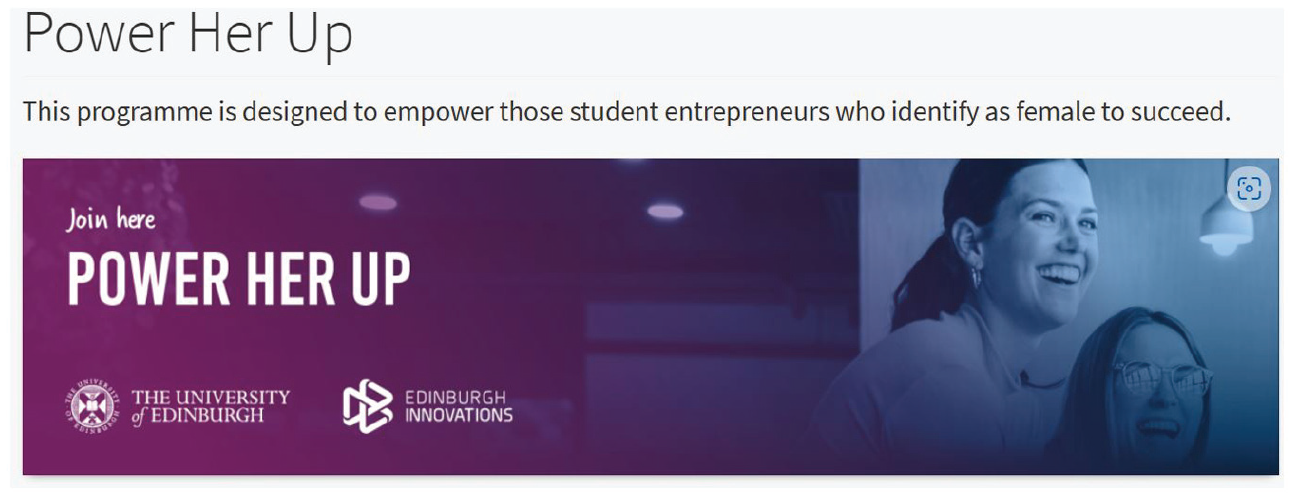
Power Her Up, University of Edinburgh.
Echoing this distinctly neoliberal framing of women’s empowerment as a site for institutional diversity work is Ulster University’s ‘So She Did’ scheme (Image 3), a ‘free programme that helps female students identify business opportunities, validate their ideas and start a side hustle or new venture’. 12
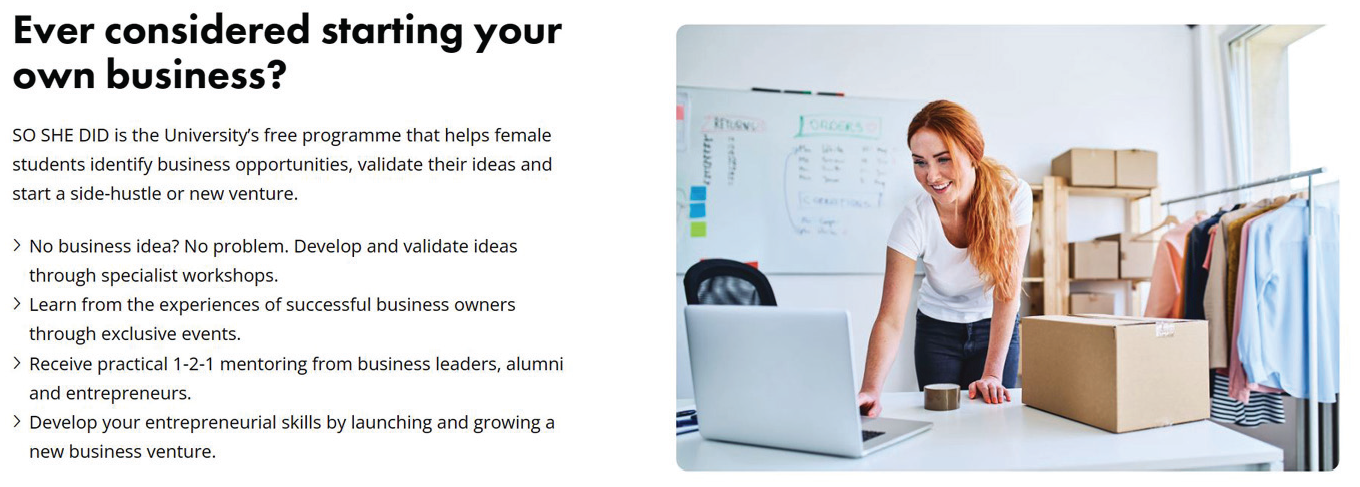
So She Did, Ulster University.
What is striking in these initiatives is not simply their gendered address but also the emphasis on developing young women’s confidence and self-belief as a way of solving the so-called ‘gender entrepreneur gap’. The webpage for the Power Her Up scheme states,
Women are less likely to believe they possess entrepreneurial skills: Only 39% of women are confident in their capabilities to start a business compared to 55% of men. This is a perceived gap in ability, rather than a gap in skill sets.
13
These discourses closely echo the ‘confidence imperative’ which Orgad and Gill (2022) meticulously trace across a range of domains – including the workplace – in which women’s supposed ‘confidence deficit’ is located as the cause of gendered inequalities. Or, as Banet-Weiser (2018: 96) argues elsewhere, ‘a lack of self-confidence is offered as the key reason for inequality within neoliberal capitalism, not patriarchy’. Hence, university initiatives oriented to promoting the SSH are squarely located on addressing this ‘confidence gap’, which then becomes a ‘fix’ for inequalities in student experiences and uneven graduate outcomes.
Conclusion
In this article, we have argued that just like the ‘top girls’ of HE, young women have come to figure as the ‘poster girls’ for the SSH, celebrated for turning their passions – clothes, beauty, wellness – into enterprising projects honed within their bedrooms. As a form of gendered entrepreneurialism, the SSH is shored up by postfeminist and neoliberal logics and rationalities of empowerment, passionate work and confidence. We have shown, however, that these success stories and the optimistic and uncritical promotion of the SSH by universities themselves mask the darker side of the side hustle and self-employment more generally. As McMillan Cottom (2020) states, ‘the word “entrepreneurial” has served as a shield against inquiry into the work arrangements that are organised beneath that banner’. These include the risks and vulnerabilities of precarious work that fall most harshly on women, and in particular, women of colour. Yet, as Shereen Idriss (2022) reminds us in her research with migrant young women in Australia, investments in ‘hustling’ more broadly may also be understood as an agentic and strategic response to racialised forms of precarity faced by migrant communities, even if these ‘solutions’ are themselves rife with insecurity and risk.
In the SSH, the uncertainty, precarity and (often) low paid nature of freelance work in the gig economy is rebadged as ‘savvy’, ‘can-do’ and ‘glamorous’ entrepreneurial labour. It also lays the responsibility for graduate success squarely onto the individual student-graduate and depoliticises the structural failings of HE and the graduate labour market. Thus, the SSH serves as shield for a HE sector in crisis and under increasing pressure to evidence the economic value of a degree in a context of rising fees and diminishing returns. Freelance, entrepreneurial activities – crystallised in the SSH – are thus promoted to sustain the myths of postfeminist success. Ironically, we see that the very same discourses and logics that exhorted young women to invest in HE are now deployed to mask the uneven outcomes women and students of colour can expect. The circularity of these arguments in the context of diminishing returns represents a cruel optimism (Berlant, 2011), in which the same students who are tasked with embodying the ‘meritocratic university’ must now individually manage and hustle their way through increasingly precarious and uncertain times.
Although our analysis has focussed specifically on the emergence and promotion of the SSH within the UK HE and media landscape, our research suggests that this phenomenon is by no means unique to the UK. It was perhaps no surprise that articles returned in our news and web search suggest that the SSH has life in other neoliberal capitalist economies, including Australia and the US. Further research is therefore needed to unpick how the SSH manifests within different national contexts and to interrogate the gendered, racialised and classed dimensions that these entrepreneurial imperatives take on.
Footnotes
Funding
The author(s) received no financial support for the research, authorship, and/or publication of this article.
