




Abstract
This article adds to existing scholarship on music and migration by presenting and reflecting on the work undertaken in the project ‘Mapping the Music of Migration’ (2019–2021, www.mamumi.eu), which comprised partners from seven European countries and focused on storytelling about music and its potential to enable intercultural exchange and counter negative stereotypes. The key activities of the project involved the collection of migrants’ ‘Song Stories’ – personal stories about music – which were made publicly available through an interactive app. The article outlines the background and findings of the project and presents critical reflections on the various circumstances that shaped our process and results. The main objective is to give readers an insight into the key challenges and outcomes of the project, thereby calling attention to a range of themes and tensions that are of relevance to future studies of music and migration.
Introduction
Mobility and movement have long been central aspects of human life. People traverse national borders for incredibly varied reasons, out of choice or necessity. During the second decade of the 21st century, the total number of international migrants increased by approximately 23 percent (World Migration Report, 2020). Inevitably, large-scale migration has far-reaching cultural and social implications that, on some level or other, transform the conditions for community, creativity and (co-)existence in local and regional contexts around the world. Music plays a key role in these processes, serving myriad functions for people on the move and affecting the sociocultural circumstances of a given place in any number of diffuse but significant ways.
This article adds to the existing scholarship on music and migration (e.g. Scheding, 2018; Stratton, 2014; Western, 2020) by presenting and reflecting on the work undertaken in the project ‘Mapping the Music of Migration’ (MaMuMi), 1 which ran from 2019 to 2021. The project comprised partners from seven European countries and focused on storytelling about music and its potential to enable intercultural exchange and counter negative stereotypes. The key activities of the project involved the collection of migrants’ ‘song stories’ – personal stories about music – which were made publicly available through an interactive app. 2 These stories revolved around a song or a piece of music that held some personal significance for the participants, who had all migrated into and/or across Europe. The project was geared towards offering spaces where migrants and staff working in development and migration might share emotional, personal and cultural stories. Previous research with non-governmental organizations (NGOs) across Europe had made it apparent that there was an unmet need for initiatives that centred on talking about music as a method to open up such spaces. As illustrated by experiences and results from the project, talking about music can be at once trivial and hugely constructive.
Drawing on perspectives from popular music studies, sound studies, cultural studies, and cultural geography, we consider some of the possibilities and limitations generated by the MaMuMi project and its ambition to introduce ways of talking about music as memory trigger (see Van Dijck, 2009: 107) to participants (the migrants and NGO staff working with them) and as a conduit towards some form of listening space that offered opportunities to be heard (LaBelle, 2018: 4) and to ‘open creative engagements’ (Western, 2020: 293). Our main objective is to give readers an insight into the key outcomes and challenges of the project, thereby calling attention to a range of themes and tensions that are of relevance to future studies of music and migration. After outlining the background of the project and presenting an overview of our process, we discuss the implications of approaching issues concerning music and migration through the conceptual framework of ‘mapping’ (Deleuze and Guattari, 1987; Sweers and Ross, 2020). This prepares the ground for critical reflection on the various circumstances that shaped our process and the project results, and we raise a series of questions concerning the motivations, conditions and (potentially ambiguous) effects of research centred on people’s migratory experiences. Given that the project commenced mere months before the outbreak of the COVID-19 pandemic, we also consider the impact of this global event on our work and results. This opens up discussions about the changeable conditions for transnational movement and connection, and about the role of music and sound in informing our experiences during times of uncertainty and upheaval. Ultimately, we hope to add to ongoing debates about migration by shedding new light on the diverse ways in which music matters in people’s lives and by exploring vocabularies for discussing migratory experiences in ways that de-exceptionalize displacement.
The project: provenance and process
‘Mapping the Music of Migration’ was a 2-year pan-European musical inheritance project focused on talking about music and song as a tool for intercultural competency. It was funded through the Erasmus+ Strategic Partnerships programme and had seven partners. Two of these were higher education institutions: the University of Gloucestershire (UK) and the Inland Norway University of Applied Sciences (Norway). The others were NGOs working in the fields of development, sustainability and arts education: Centro Sviluppo Creativo Danilo Dolci (Italy), KMOP – Social Action and Innovation Centre (Greece), Know and Can Association (Bulgaria), the Center for Social Innovation (Cyprus) and Caminos (Spain).
The four stages of the project consisted of (1) a review of theory and practice in the field of music as a tool for integration, with a focus on using music as a prop to facilitate discussions; (2) the development of a user guide for trainers working with migrants across Europe to offer guidance on how to run a ‘Song Story’ workshop; (3) interviews and workshops conducted by project partners leading to the creation of an audio collection of migrants’ stories about music. Audio recordings from interviews and workshops were edited by Julia Hayball, an audio expert and BBC producer, who produced the final ‘song stories’ by mixing migrants’ stories together with excerpts from the music they spoke of; and (4) these ‘song stories’ were then added to a mobile app developed by computing academics and students at the University of Gloucestershire (more on the app to follow). The current article represents an additional post-stage of the project: a critical reflection on its process and outcomes.
The idea for the MaMuMi project developed from research led by popular music scholars Sara Cohen, Line Grenier and Ros Jennings, which drew on Jennings’ academic use of methods used in the UK BBC Radio 4 programme Inheritance Tracks. This long-running show invites guests to discuss pieces of music they ‘cherish and want to bestow on future generations’ (BBC, 2021). Moving the exercise into the field of aging studies, Jennings first used this simple format as a qualitative research methodology in workshops at the ‘Women, Ageing and Media’ research summer school, which takes place annually at the University of Gloucestershire. Here, participants were asked in advance of the workshop to choose two pieces of music, one inherited from somebody and one bequeathed to another. The workshop then encouraged the participants to speak about those pieces of music and the stories attached to them. This resulted in conversations over inheritance, family and identity. Jennings began to notice that the workshops often pivoted around the complexity of such inheritances and the idea of ‘passing on’, which lies at the core of the edited collection Troubling Inheritances (Cohen et al., 2022). These academic essays describe eight ‘Inheritance Tracks’ workshops in the United Kingdom, Italy, Australia, Canada, The United States and Finland, which used the same methodology with a wide range of different participants. For example, Cohen’s workshop was with residents of a care home in Liverpool and Grenier’s was with deaf teenagers in Montreal.
The workshops carried out as part of the MaMuMi project used the same qualitative methodology as these ‘Inheritance Tracks’ workshops, largely because the project leader, Abigail Gardner, had contributed to the aforementioned collection, conducting a workshop with NGO workers in Palermo, Sicily in 2018, and had realized how they facilitated effective discussions and opened up spaces for dialogue about a variety of topics. The Palermo workshop had focused on storytelling prompted by song choices, on affective selves revealed in confessional ‘moments’ (Lefebvre, 2004; Radstone, 2007) . . . José van Dijck (2009), who works on the intersection of music, media and memory, talks about the ‘inter-generational transfer of personal and collective heritage, not only by sharing music, but also by sharing stories’ (p. 111). (Gardner, 2022: 83)
In the MaMuMi project, we were keen to gauge how the storytelling and the sharing that had characterized these academic research projects might work in the different spaces where our NGO partners were working, what potential there might be for conversations prompted by music and whether these moments of exchange and sharing might be applied as a tool for fostering intercultural exchange and furthering integration. Acknowledging Scheding’s (2018) point that ‘migrants might be in the nation, but not be fully part of the nation’ (p. 442), we wanted to explore the potential of music to alleviate this situation on some level.
In pursuit of the necessary funding to undertake such an endeavour, we used the language of European funding bids, which is qualitatively different from an academic register, to argue that our project was driven by the principle that innovative training spaces could form part of broader integration strategies that can actively help tackle issues of diversity and social inclusion common across the European Union (EU). These ‘spaces’ would be the ‘Song Story’ workshops where migrants and NGO workers would be talking about the music in their lives and the stories attached to them. We argued in the bid that storytelling about music can open up enabling enunciative spaces and is a positive mechanism to counter negative stereotypes (Salazar, 2010). Another rationale for the development of the workshops is provided by Les Back’s argument that spaces for listening offer ‘quiet transformations and fleeting moments in which living with and through difference, are realized’ (Back, 2013: 52), which ties in with the project’s broader ambition to highlight diversity and stimulate new cultural connections. The decision to include an app as one of the project outcomes also responds to expectations from funding bodies to deliver tangible results while also providing a means for making migrants’ stories about music publicly available.
There was a degree of flexibility built into the project at a number of levels. We set no barriers to who could take part and so have collected ‘song stories’ from both recent and long-established migrants. Our team was made up from participating organizations with very different primary roles, remits and access to the target group. Staff working in teams as part of an NGO organization (such as KMOP or Danilo Dolci) had long-established relationships with migrants and could conduct interviews easily. Most of these were done online via Skype or Zoom due to COVID-19 restrictions across Europe. Due to the diverse effects of the pandemic, we had to downsize the number of interviews we could do, from 70 to 30. We also accommodated our partners in Bulgaria who, after the team contracted COVID-19, were significantly delayed and only able to record two interviews.
As a national organization, KMOP had staff numbers in place to be able to conduct three workshops that involved participants from different locations, including a Greek government facility called ‘ELEFSINAS’ Hospitality Structure, at the School of Merchant Marine of the Municipality of Elefsina of the Regional Unit of Western Attica of the Attica, 3 and the Accommodation Centre Refugee Eleonas (Κέντρο Φιλοξενίας Προσφύγων Ελαιώνα) in central Athens. This meant that the staff ‘on the ground’ were not those who were core members of the MaMuMi team. For the academics in Norway and the United Kingdom, access to interviewees involved going through local mediators, such as refugee charities or interest organizations, and then conducting the interviews themselves. This meant that across the project, interviewers had a variable level of awareness of the project’s aims and objectives, and equally varied experience of conducting interviews or workshops and how to encourage participants to speak. Interviews carried out by staff of NGOs in camps with no prior acquaintance with the development of the project, its methodology, and its objectives are very much shorter than, say, the ones from Norway, where the interviewer did have such knowledge. Modal shifts can also take place within the workshop, and there can be emotional responses that may not be foreseen. In Cyprus, our project team partner reported that one of their participants used the workshop as a safe therapeutic space within which to discuss domestic abuse. Our partner was not prepared nor qualified to hear this, and noted later that having a psychologist on hand would have been beneficial.
For academic project team members, issues of research ethics were also of primary concern, as they were part of institutions whose research ethics committees needed oversight of all research being carried out under their institutional name. The team had a number of discussions over consent and use of voice with regard to EU-wide General Data Protection Regulation (GDPR) rules. Our consent and release form underwent several revisions as we grappled with these issues. All our participants consented to the use of audio recordings from the interviews and workshops in the MaMuMi app and audio archive. The names of participants are generally left out of the stories recorded in Cyprus, Greece, Norway and the United Kingdom. Most of these participants chose, prior to recording, not to disclose their names. Two participants in Cyprus chose to have their names withheld after recording, which involved remixing the audio to delete any reference to their identity. All of the final mixed ‘song stories’ had to be transcribed in order to be translated into all the partner languages, and this meant revising the original transcripts taken after the interview in light of the final mix that had gone through post-production.
The development of the mobile app ran in parallel to the interviews, their transcription and translation. It was led by Dr. Thiago Viana and Dr. Zayd Dawood at the University of Gloucestershire as a live brief for their second-year Creative Computing and Computing students. The latter were in charge of building the ‘back end’ of the app, with the Creative Computing students in charge of the design. Ideas were exchanged between the app team and the MaMuMi team at regular meetings. One of the reasons for setting the development of the app as a live brief was to expose the students to applied research and to introduce them to the negotiations and challenges of working with a ‘client’. Notably, the development of the app served educational purposes that were distinct from the app’s function as a tool for publicizing the ‘song stories’ collected in the project. The design and functionality of the app are therefore shaped both by the needs of project partners and by the input of the development team (lecturers and students).
The app has pin icons placed in different locations on a map of the globe, each of which represents a migrant’s journey and ‘song story’. The Google map has been subverted and route maps with estimated travel times are replaced by stories by those whose narratives are often pre-mapped in dominant public discourses. When you click an icon, the selected ‘song story’ plays and the pin moves from its starting point (where the participant travelled from) and traces a journey into and/or across Europe to where the story was recorded. As an example, as we hear the story a Syrian participant told to an NGO worker from the Greek organization KMOP, the pin starts in the south of Syria, moves to Darraa in the north of the country, and proceeds from there to Kos, Greece. By providing a visual representation of this journey and coupling it with the participant’s ‘song story’, the app aspires to ‘map’ the distinct musical experiences of migrants in a way that opens up new avenues for connection, empathy and cultural exchange. As such, the app and the decisions that went into its development warrant consideration of the implications of undertaking the act of mapping as a means of creating visual representations of migratory journeys and musical connections.
Mapping
The notion of ‘mapping’ has gained traction as a conceptual framework across a range of disciplines over the past few decades, especially in the humanities and social sciences. Following Deleuze and Guattari’s work, which focused on multiple non-hierarchical interconnections and relations, a map can be understood as ‘open and connectable in all of its dimensions; it is detachable, reversible, susceptible to constant modification. It can be torn, reversed, adapted to any kind of mounting, reworked by an individual, group, or social formation’ (Deleuze and Guattari, 1987: 12). Maps have multiple entryways and exit points (Deleuze and Guattari, 1987: 13), and they thus accommodate the unfixed and ever-changing complexities that characterize most human endeavours and experiences. The act of mapping provides a starting point for uncovering new ways of understanding or interpreting people’s cultures, communities and relationships.
For the purposes of the MaMuMi project, mapping served as a means for making visible varied migratory journeys, musical experiences and affective memories – as well as for probing the relations between these. By mapping project participants’ ‘song stories’ onto an interactive app, the project aimed to uncover and preserve cultural diversity and intangible cultural heritage (see Sweers and Ross, 2020: 4; Ross, 2020: 175–176). The MaMuMi app was designed to bring migrants’ personal experiences and memories into the public sphere, thus evidencing migrants’ stories – as told in their own words – and seeking to enable new, transnational assemblages of solidarity. This reflects a belief in the capacity of music, listening and storytelling to be ‘conducive to empathy and compassion’ (LaBelle, 2018: 4) and indicates an interest in the multiple layers of meaning and meaningfulness intrinsic to everyday activities and experiences. Granted that ‘[s]ound is an access point to the agency of people on the move’ (Western, 2020: 295), collecting and publicizing migrants’ stories about music and sounds, and their meaningful relations to them, spur new ways of thinking about and acting upon representations of place and displacement.
Such lofty ambitions prompt questions concerning the reconciliation between theoretical conceptions and real-life circumstances. Given that any research project involves choices (both deliberate and inadvertent) that regulate inclusion and exclusion on numerous levels, there is a risk that the acts of mapping undertaken as part of the MaMuMi project end up further diminishing those very experiences and stories it intended to evidence and preserve. Deleuze and Guattari (1987) asked, ‘[w]hat map are you in the process of making or rearranging? What abstract line will you draw, and at what price, for yourself and for others?’ (p. 203). For the purpose of reflecting on our work in the MaMuMi project, we might ask, ‘How did the general research design or the individual project partners’ strategies for recruiting participants impact what kind of migrant experiences we gained access to?’; ‘To what extent did the process of editing participants’ stories intervene in their own narration of their experiences?’; or ‘Which aspects of migrants’ literal and figurative journeys are obscured by the lines drawn up in the MaMuMi app?’ As a starting point for approaching such questions, it is helpful to further consider some of the key aspects of the process of interviewing participants and discuss some of the issues that arose from this part of the project.
Critical reflections on our process and results
A key objective of the MaMuMi project concerned the creation of listening and storytelling spaces – the workshops – which were intended to stimulate intercultural exchange, on the one hand, and facilitate the collection of ‘song stories’, on the other. The seven project partners were each scheduled to organize two workshops, with five participants for each workshop. Because of complications related to the COVID-19 pandemic, which affected the entire world from early 2020 onwards, the project partners were unable to follow through on this plan. Strict restrictions for social gatherings in most European countries made it difficult or impossible to carry out in-person workshops during the project period, and additional challenges included difficulties recruiting participants and maintaining working relationships with necessary collaborators (e.g. NGOs, community centres and interest organizations).
The seven project partners adapted different strategies in order to collect ‘song stories’ for the MaMuMi app, which speaks to the variation in partners’ circumstances, contact networks and skill sets. For example, the Greek project partner, KMOP, organized three online workshops with a total of 10 participants – seven of whom participated online from a refugee camp. For comparison, the Norwegian project partner, Inland Norway University of Applied Sciences (INN), had problems recruiting participants for online workshops and ended up scheduling individual interviews with the few people who did sign up to participate in the project, conducting four interviews in total over a period of six weeks. The immigration situations differ greatly between Greece and Norway, with the former having received increasingly large numbers of migrants and refugees, especially by sea, over the course of the 2010s. The different profiles of KMOP (an NGO in the field of social action and innovation) and INN (a higher education institution) also afforded access to different migrant populations. Whereas the participants recruited by KMOP comprised 70 percent refugees (seven out of 10), the participants recruited by INN comprised 75 percent international students (three out of four). This cursory comparison illustrates how the recruitment of participants for the project was impacted by local circumstances and the institutional profiles of project partners. It should be noted that representativeness was not a criterion for the recruitment of participants for the project, and we offer no attempt to generalize from our small sample to assumptions about larger populations. Quite the opposite, workshops and interviews were open to any migrant who wished to participate and focused exactly on migrants’ individual and personal experiences. The point about the impact of partner profile and locality for the recruitment of participants is still significant in how it affected the collection of ‘song stories’, however, which in turn had an impact on the types of migrant experiences that ended up being presented in the app.
A principal ambition of the Music Migration Map (app) is to document migratory journeys and offer migrants the opportunity to narrate their musical-migratory experiences in their own words. Focusing on the role of sound and music in migratory experiences holds the potential to decenter spatiality as the key dimension of migration and provides a counternarrative to reductive representations of migration that exceptionalize displacement (see Cabot, 2019: 269–270; Western, 2020: 296). At the same time, our efforts to collect and disseminate migrants’ stories about music risk playing into the problematic notion of ‘giving voice to the voiceless’ (Western, 2020: 304), which might obscure, rather than confront, the political struggles and various barriers that migrants are forced to contend with. As Heath Cabot (2016: 654–656) has argued in relation to advocacy and ethnographic work on refugees, there is a fine line between carving out space for marginalized voices and further marginalizing these same voices by perpetuating ‘tragic tropes’. This is a precarious landscape: ‘tragic representational forms’ risk limiting the agency of participants by presenting them primarily as victims, but at the same time tragedy can serve as a powerful tool for reshaping political or social commitments or transforming law and policy (Cabot, 2016: 655). Certain groups of migrants (e.g. refugees) have more at stake in this respect than others, even if public, political and scholarly discourses on migration affect the lives and experiences of all migrants in more or less obvious ways.
While the MaMuMi project did not focus explicitly on refugees, the initiation of the project can hardly be seen as completely separate from the European ‘refugee crisis’ of 2015–2016. As refugees and migrants ‘flowed’ across borders in increasing numbers, Cabot (2019) suggests, scholarship started ‘flowing toward the study of border crossers themselves’ (p. 261). This might be explained, at least partly, by the heightened visibility of topics related to migration in EU funding streams, which could encourage academics in the region to pursue research in these areas (Cabot, 2019: 263). As Cabot (2019: 264) puts it, the European refugee crisis produced a new scholarly market for studying refugees and migration in the late 2010s. Conversely, there are good reasons for scholars to attend to topical challenges. And large-scale issues, such as migration, do demand the attention of all available intellectual and cultural resources. This does not negate the importance of approaching any topic through a close engagement with existing research and critical reflection, however, which provides part of the impetus for the current article.
The stories collected in the MaMuMi project were from people whose status as ‘migrant’ had been precipitated by a variety of reasons. Some were international students. Others were retired and had sought the sun of a Spanish coastal town. Some had travelled, found love and settled down in a new place. Some had been forced to emigrate to escape war or persecution. Others fled poverty and crossed the Sahara to find a ‘better life’. This variety illustrates how displacement has many causes. By presenting vastly different migrational experiences alongside each other within the confines of the MaMuMi app, we hope to contribute to the de-exceptionalization of displacement (Cabot, 2019; Western, 2020). Placing music at the centre of the project and the stories enables such a move by centering the participants’ relationship with music rather than their status as a migrant (even if the two are intricately connected, at least in some instances).
The range of experiences recounted by MaMuMi participants include passing a driving test, dancing around a table and hearing rock ‘n’ roll for the first time. Some reflect on places that they left, some reminisce about family occasions and there are others who tell stories about their current situation. Only a few of them discuss their ‘journey’ as such. What has come through in this small collection is the importance of places and people missed and times treasured. It is the people and events that are being recalled, which is clearly not confined to the experience of migration. There are stories about family car journeys and other shared family experiences, such as weddings or a special festival day (UK participant 1 talks about the Iranian festival of Nowruz, the first day of spring; Safa in Palermo chose to discuss a piece of music that reminds her of Ramadan in Tunisia). There are stories about resilience and songs that have soundtracked challenging transitions that resolve individuals to find success in new places (Glykeria, recorded in Cyprus; Pien, recorded in Cyprus).
One participant discussed the song ‘This Town’ (2020), by Kygo featuring Sasha Sloan. The song simultaneously reminded her of friends and life ‘back home’ and was associated with new opportunities. The participant described listening to the song while driving and gaining a sense of freedom from imagining driving off without a clear destination or purpose in mind. In this instance, music represents an access point for fantasies about willed displacement that, on some level, serve the purpose of finding one’s place within one’s current circumstances. Another participant, a musician and songwriter currently residing in Cyprus, expressed a similar view of music’s capacity to serve aspirational purposes or further self-realization. He detailed the inspiration for one of his own songs, ‘Jesus Did It’, describing it as a reflection of his journey and an expression of his religious faith. In this instance, music (or the creation thereof) seems to be approached intentionally as a tool for maintaining a positive mentality and regulating ‘who one can be’ in a new context.
In contrast, some of the participants shared memories of journeys that were dramatic and traumatic. For example, a young Syrian boy, whose story was recorded in a refugee camp in Greece in 2021, tells of murder and war in Syria. This participant, we were informed by the KMOP lead, had fled from Syria and recently arrived in Greece. He recalls a song by Samih Choukeir and describes how it makes him sad. The song, ‘Ya Hef’ (Shame on You), is a baleful, mournful ballad about the Syrian civil war. Through his recollection of his relationship with the song, the boy speaks to the horrific effects of war and the trauma of being forced to leave one’s home. While we might risk perpetuating tragic tropes about migrants by including this boy’s story in the MaMuMi app, we would arguably risk more by shying away from discussing the uncomfortable actualities it reveals. This story was one that had to be told; that was pressing.
In light of Western’s (2020) argument that migrants’ voicings of their experiences of and responses to displacement ‘contain the many different strategies and socialities that develop in life crossing and contained by borders’ (p. 304), we hope that the MaMuMi project and app have contributed to making visible the diverse ways in which music can hold significance for people who have migrated. Regardless of their content, all the stories collected as part of the MaMuMi project represent some insight into the narrator’s experiences. As such, the handling of these stories by project partners and their collaborators raises a number of issues. The many people involved in preparing the collected stories for the app held some degree of power over how the story was presented. Audio recordings of participants narrating their experiences were edited together with excerpts of the music they discussed, which might emphasize or alter the emotional content of the stories. The completed ‘song stories’ were translated into the languages of each partner country, with these translations appearing in the MaMuMi app. The app provides a visual-aesthetic framework for listeners’ encounters with the participants’ accounts, and users who choose to read the translated versions of the stories will have their understanding of the migrants’ experiences mediated through the translation. This all means that those of us involved in conducting interviews, editing recordings, translating transcriptions, and creating the app became co-narrators of the participants’ stories, at least to some extent, as the choices we made inevitably intervened in some way or other in the content of the stories and how they were presented (and in turn perceived, interpreted and understood).
Here we arrive at one of the primary issues that we encountered over the course of the project, namely, the difficulty of reconciling two of its key objectives: (1) creating a space for intercultural exchange by providing participants with an opportunity to narrate and share their experiences, and (2) collecting stories that were suitable for presentation in the app. The difficulty of negotiating the potential contradictions and tensions between these two objectives was exacerbated by the COVID-19 pandemic, which forced many project partners to cancel their in-person workshops and replace them with individual, online interviews. This meant that participants’ opportunity to interact with each other and representatives of the project partners was greatly limited in some cases.
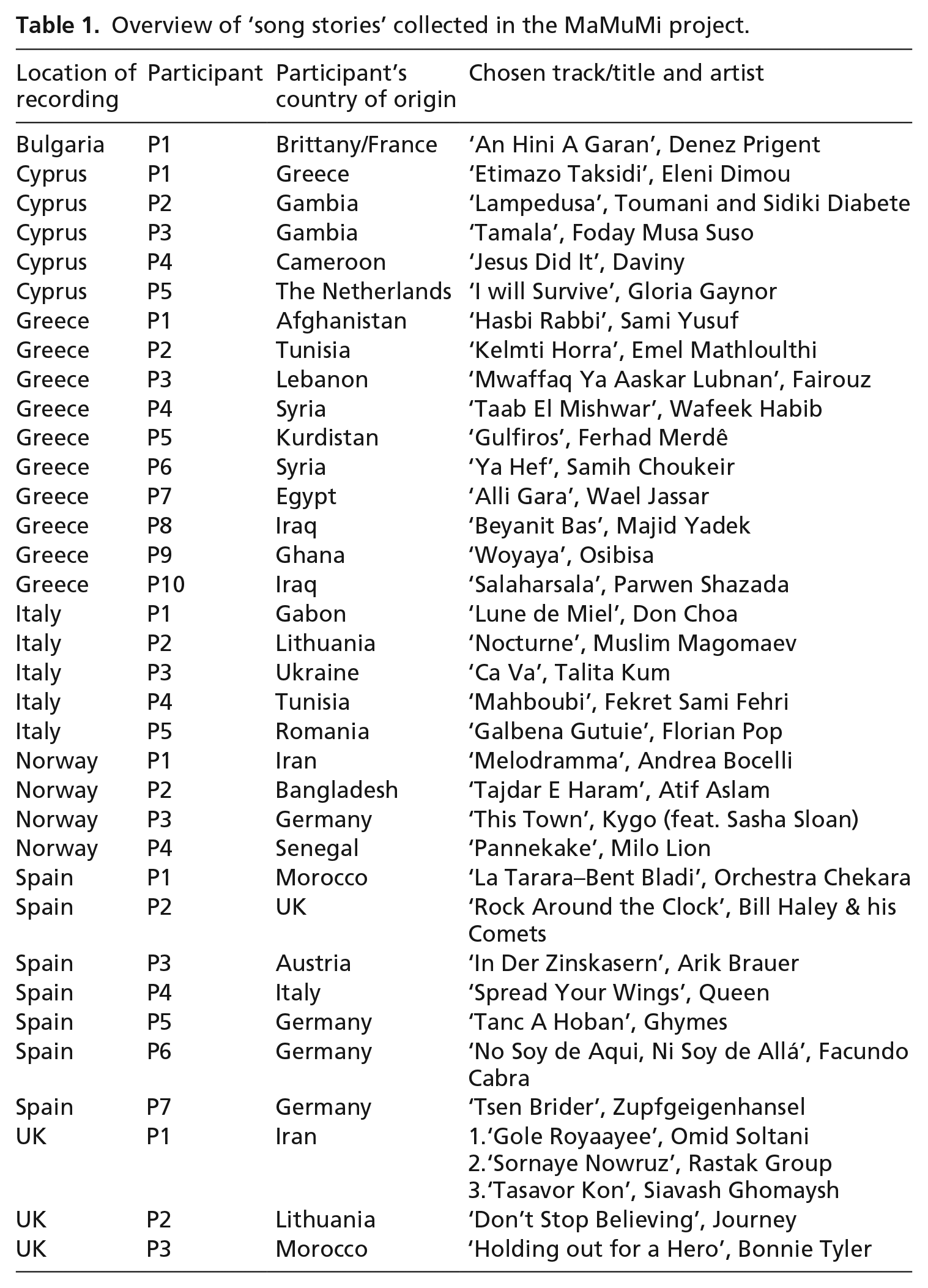
As the pandemic made it more difficult to organize workshops, schedule interviews and recruit participants, project partners came under increasing pressure to meet project goals. We had initially intended to collect a minimum of 70 stories, but we scaled this down to a minimum of 30 stories after the challenges introduced by the pandemic became clear. 4 This turn of events might in hindsight have led to a slight shift in project activities, inconceivable at the time, towards prioritizing the more tangible project goals (collecting stories, developing the app) over the more diffuse ones (facilitating intercultural exchange, creating spaces for interaction and to be heard). Whereas the project methodology was designed for person-to-person interaction and story-sharing in real time, the emphasis shifted to the stories themselves (see Table 1 for an overview of the ‘song stories’ collected in the project).
Overview of ‘song stories’ collected in the MaMuMi project.
Not discounting the meaningful engagements and dialogues that did occur during workshops and interviews, it seems reasonable to regard the app as the primary, lasting contribution of the MaMuMi project. The app represents an archival practice that documents diverse dimensions of music’s significance for migratory experiences. This does not simply entail showcasing migrants’ different relationships with and uses of music. In line with Scheding’s (2018: 445) argument that music research can widen the debate on migration by exploring ‘the impact of highly creative migrants and migrant communities’ on local and regional cultures, some of the stories presented in the app offer opportunities for understanding how migration facilitates transnational musical flows and transformative creativities.
A final example from our collection of ‘song stories’ can shed some light on these issues. One of the participants in the project identifies as a griot, as part of a tradition of West African storytellers, and is currently living in Norway, where he has found new ways to tell stories and impact society around him. Working with children, he uses music to cross cultural divides and enable new connections. His song ‘Pannekake’ [Pancake], written and sung in Norwegian, is a playful and energetic narration of how to make and enjoy what the participant himself originally knew as crêpes. This evidences Scheding’s (2018: 445) point that migrants bring their music and cultures with them to new places, thereby diversifying local cultural contexts and exploring new hybrid musical expressions. Through his music, the participant suggests, he passes down his knowledge about life in the present day and preserves it for future generations. In the process, he makes an impression both on the musical communities in which he partakes and on the people surrounding him. The MaMuMi app documents at least some aspects of these processes and opens up new avenues for music and storytelling to impact those who sing, play, tell, and listen.
Conclusion
This article has sought to outline the rationale for and the challenges of undertaking a pan-European project on the subject of music and migration. Building on previous research into cultural inheritance and its complexities, the goal of the MaMuMi project was to develop workshops that would offer a chance for the exchange of stories triggered by one chosen piece of music. Our initial bid had lofty aims, not all of them achievable within the timeframe of the project and with the impact that COVID-19 had on it. And as with most research projects, the results that came in necessitated a review of initial expectations and motives, and our initial aims of engineering enculturation had to be scaled back, but in a positive and ultimately useful way. That is to say that a key finding from our work is that the project did offer its participants a small time and place where they were listened to, enabling their stories to be witnessed and documented.
The stories we encountered were small, human ones about weddings, car journeys and driving tests. They were more existential ones about religious faith or experiencing war. Simply put, the stories were all by people with migration histories but they were not generally about migration. This was as we expected from the start, given our previous experiences with the ‘Inheritance Tracks’ workshops. Collectively, the stories have shown, in miniature perhaps, that the word ‘migrant’, associated as it is with travel, movement and loss, is disconnected from the shared experiences of the stuff of human life that we came to hear in the MaMuMi ‘song stories’.
Our work in collecting, editing and ultimately distributing migrants’ stories about music can itself be understood in a variety of ways. Especially during a time when migration is most often discussed in relation to refugees and regional crises, there is a risk that scholarship on migration replicates unproductive ideas about migrants by participating in a hierarchization of which people, situations and experiences are the most deserving of attention (Cabot, 2019: 262). Through the MaMuMi project, we have attempted to do the opposite – namely, to encourage a discourse on migration that is not ‘restricted solely to economic, legal, and narrow political concerns’ (Scheding, 2018: 445). By placing music at the centre of our engagement with migrants’ stories, we have sought to broaden common understandings of migratory experiences, direct attention to cultural heterogeneity, and de-exceptionalize displacement. Even if our work has inevitably drawn up lines that might not fully encompass the rich experiences they seek to represent, it is our hope that it simultaneously contributes to a broader and more nuanced discourse on displacement and migration.
Footnotes
Funding
The author(s) disclosed receipt of the following financial support for the research, authorship, and/or publication of this article: This work was supported by the Erasmus+ Strategic Partnerships programme [grant number 2019-1-UK01-KA204-061966].
