




Abstract
This article enquires into the discursive and affective texture of the intersections of popular culture and left/feminist politics in the current Anglo-American context. It does this primarily via a contextual reading of the recent work of Welsh/Greek pop singer Marina Diamandis (who performs under the mononym ‘Marina’), especially her 2021 single entitled ‘Purge the Poison’. Building on Sarah Banet-Weiser’s work on popular feminism, I suggest that recent years have seen the emergence within popular and commercial culture of a ‘popular left politics’ which includes – but is not limited to – popular feminism. I argue that Marina’s work – as well as its reception from fans and critics – can help us identify several constitutive features of what I call the cultural grammar of popular left politics. These include, first, a conception of knowledge as linked to the revelation of truth grounded in identity and experience; second, a projection of purity and perfectionism of self and, third, a projection of complicity onto others. I further suggest – drawing in particular on Akane Kanai’s recent work – that these features of the cultural grammar of popular left politics are testament to the centrality of neoliberalism in shaping the discursive, affective and subjective character of even ostensibly anti-neoliberal forms of politics and culture. Furthermore, in contrast to the familiar argument that neoliberalism blunts or co-opts oppositional discourses, I suggest that, in the current conjuncture, explicitly and overtly anti-neoliberal discourses are sometimes afforded a certain cachet and visibility, so long as the cultural grammar they adopt aligns with the competitive and individualistic logics of neoliberal hegemony.
In 2021, the pop singer Marina Diamandis – who goes by the mononym Marina (and formerly went by the stage name Marina and the Diamonds) – released ‘Purge the Poison’, the second single from her fifth studio album, entitled Ancient Dreams in a Modern Land. In ‘Purge the Poison’, Marina admonishes humanity for its complicity with climate catastrophe, war, capitalism, racism and misogyny. In so doing, she offers a bold and energising call to arms, exhorting her listeners to challenge multiple forms of oppression and injustice by ‘purging’ the various ‘poisons’ that preclude the cultivation of a more just and liveable world. Although Marina’s back catalogue contains numerous instances of socially conscious lyrics, concerning issues such as gender, fame, identity and sexuality, her Ancient Dreams in a Modern World album marked an adoption of a more explicitly political stance than had been the case hitherto.
Marina’s embrace of explicitly political themes reflects a broader cultural shift (particularly prominent in the United Kingdom and the United States, but by no means restricted to these contexts) whereby various forms of left and progressive political discourse – including, but not limited to, feminism, anti-racism, anti-capitalism and queer politics – have, in various and often uneven ways, permeated into wider commercial and cultural life. And this has not gone unnoticed within cultural studies and adjacent fields. Recent work has made use of categories such as ‘woke capitalism’ (Kanai and Gill, 2020), ‘commodity activism’ (Repo, 2020), ‘popular leftism’ (Dean, 2020) and ‘popular feminism’ (Banet-Weiser, 2018a) to try to make sense of the various ways in which discourses traditionally associated with the left have seeped into popular and commercial culture.
This article intervenes in these debates, using Marina as an exemplar through which to examine the ways in which left discourses are articulated in and through popular music (and wider popular culture) in the current conjuncture. In the first instance, I suggest that the most useful work on left politics and popular culture thus far has tended to come from within feminist cultural studies, and that insights about the relationship between feminism and popular culture can, in principle, be broadened to encompass multiple forms of left politics including, but certainly not limited to, feminism. However, to do so requires a partial reorientation of the existing literature. For one, we require a more precise sense of the concrete ways in which specific instances of left and progressive voices manifest in contemporary popular culture. To draw this out, I map, via a close reading of Marina’s recent work, what I call the cultural grammar of popular left politics. Drawing primarily on a series of recent interventions by Akane Kanai, I suggest that Marina typifies a tendency towards purity and perfectionism in the cultural landscape of popular left politics. This manifests through a conception of knowledge linked to the revelation of truth as grounded in identity and experience, a depiction of the self as pure and/or perfect, and a projection of complicity onto others. What is more, these dynamics necessitate a reconsideration of the relationship between neoliberalism and (popular) left politics. I suggest that the neoliberalism of popular left politics arises not from an explicit defence of neoliberal values but, in contrast, from the ways in which, under certain circumstances, ostensibly anti-neoliberal sensibilities are, paradoxically, afforded a certain status, cachet and visibility within digitally mediated neoliberal culture.
My focus is primarily the United Kingdom and the United States, in part due to the visibility of popular left/feminist politics in these contexts in recent years. However, the dynamics analysed here are not limited to English-speaking contexts. Indeed, many of Marina’s more passionate fans are from South America: for instance, the more active members of the main Marina fan pages on Facebook are often drawn from Brazil, Argentina and Chile. As such, many of the cultural and political processes analysed in this article are shaped by complex transnational flows of primarily fan-driven discourse and affect which exceed any clearly defined geographical space. 1
In pursuing these arguments, my approach is firmly situated within the tradition of conjunctural analysis associated with Stuart Hall. Methodologically, I offer a close contextual analysis of several of Marina’s recent songs – especially ‘Purge the Poison’ – focussing primarily on their lyrical content, as well as the wider reception of her work from fans and critics. In so doing, I treat Marina as an exemplary case: while specific and unusual in many ways, her work – and its reception – distils, exemplifies and makes visible a range of wider cultural and political dynamics. In line with Jeremy Gilbert’s (2019) characterisation of Angela McRobbie’s famous conjunctural reading of Bridget Jones’ Diary, Marina is selected for her ‘ability to index certain changes in public moods, priorities and desires’ (p. 13) that might otherwise prove difficult to pin down. Consequently, I analyse Marina here because her work and its reception typifies, and thus sheds light on, specific features of the dynamics of ‘containment and resistance’ – to use Stuart Hall’s (1998 [1981]) famous phrase – that shape the politics of popular culture in the current conjuncture (p. 433). In pursuing a conjunctural analysis of Marina – and the wider logics of popular feminist/left politics she represents – I therefore aim to, as Jeremy Gilbert (2019) puts it, map ‘the specificity of the present, situating current developments historically, [and] looking out for political threats and opportunities’ (p. 5).
Against this backdrop, the article begins with some further contextualisation of Marina’s recent work. I then go on to outline more precisely what I mean by ‘popular left politics’, drawing primarily on recent work by Sarah Banet-Weiser and Akane Kanai on popular feminism. Thereafter, I explore the cultural grammar of popular left politics in more detail, using Marina’s recent work as my central case study. The final section then examines the implications of my argument for how we understand the intersections of neoliberalism and left politics in the current Anglo-American conjuncture.
Situating Marina
Born in 1985 to a Greek father and Welsh mother, Marina Diamandis first came to prominence in the late 2000s, and released her critically acclaimed debut album The Family Jewels, under the stage name Marina and the Diamonds, in 2010. Since then, she has released a further four studio albums, all of which have been critical and commercial successes in the United Kingdom. She dropped the epithet ‘Marina and the Diamonds’ in 2018, and has performed under the mononym ‘Marina’ since. Stylistically, her music adopts an unashamedly pop sensibility, and much of her best work arises from her capacity to craft infectious pop ditties. However, her iteration of pop music is inflected with influences from electronica, indie music and even cabaret. Consequently, her relationship with pop has never been straightforward: her pop trappings belie a critical and subversive sensibility that puts her at a distance from the mainstream.
What is more, Diamandis is known for her unusually devoted and loyal fanbase (of which I am myself a part, albeit considerably less zealous and committed than some!). Her lyrics – which deal with themes such as sexuality, identity and alienation – often have a deep affective resonance for her fans, many of whom are ‘alternative’ or in some way distanced from dominant cultural norms. Indeed, she commands a particularly passionate gay male following, and she is on record as speculating that around 60 percent of her concert audience consists of gay men (Azzopardi, 2012). Her stylistic distance from mainstream pop is also manifested in part via her long-standing engagement with socially conscious themes in her lyrics, particularly in relation to gender and sexuality. Songs such as ‘Girls’ (2010), ‘Sex Yeah’ (2012) and ‘You Can’t Pin Me Down’ (2015) all offer engaging ruminations on dynamics of gender, sex and femininity. What is more, her 2012 album Electra Heart is essentially a concept album in which the title character assumes various different feminine archetypes over the course of the album. Her orientation towards the more highbrow end of pop is also manifest in, for example, the reflective blog posts she used to write early in her career, and the fact that she gave a lecture to the Oxford Union in 2016 on the travails of the pop music industry. However, as indicated, the politics of her work prior to 2020 was usually implied rather than explicit, and linked to a micropolitics of sexuality, identity and so on. Recent singles such as ‘Man’s World’ and ‘Purge the Poison’, in contrast, evince an explicit political stance. The former is a bold feminist call to arms, while the latter offers an even more assertive embrace of feminist and wider left politics, explicitly name-checking capitalism, racism, misogyny, war, #MeToo and the imprisonment of Harvey Weinstein. 2
The more explicit politics of Marina’s recent work has been enthusiastically endorsed, and to some extent enhanced, by her fanbase. ‘Purge the Poison’ was met with unbridled enthusiasm from some of the more politicised sections of her fan community, often in rather creative ways. For instance, within days of ‘Purge the Poison’s release, fans began playfully affirming the song’s radical credentials, in part by making humorous comparisons between Marina and Marx. A popular Twitter meme emerged among Marina fans in which they wrote ‘rip karl marx you would’ve loved purge the poison by marina’. A further Twitter meme saw Marina fans wryly comment on her anti-capitalist credentials by claiming that ‘Marina could have written The Communist Manifesto, but Karl Marx could never have written Purge the Poison’, sometimes amended to refer to Capital rather than The Communist Manifesto. The most widely tweeted instance – and, as far as I can gather, the first instance of this being tweeted in English (by Twitter user @nynagermanotta) – was also accompanied by a mock-up of Marina’s face next to the faces of Lenin, Engels and Marx, in the style of a Soviet-era propaganda poster (see Figure 1). 3 The politicisation of Marina’s work has also been felt at her concerts. At her performance at the 2022 Lollapalooza festival in Brazil, she made an impassioned plea to her fans about the importance of sometimes bringing politics into pop, before shouting ‘fuck Putin and fuck Bolsonaro!’, to the rapturous delight of her anti-Bolsonaro audience, who proceeded to chant ‘Fora Bolsonaro’ (‘Bolsonaro Out’) in response. The incident was one of several incidents of anti-Bolsonaro sentiment at the festival, which prompted Bolsonaro’s political party, Partido Liberal, to lobby the supreme court to issue a ruling prohibiting ‘“ostentatious and extemporaneous” electioneering from musicians performing at Lollapalooza’ (Phillips, 2022). Marina then responded on her Twitter account by suggesting that ‘censorship is alive and well’. Her engagement with Brazilian politics continued with the recent presidential elections, in which left-wing former President Luiz Inácio Lula da Silva defeated Bolsonaro. Marina responded by tweeting simply ‘Thank God’ alongside a link to a report on the election in The Guardian, much to the delight of her Brazilian fanbase.
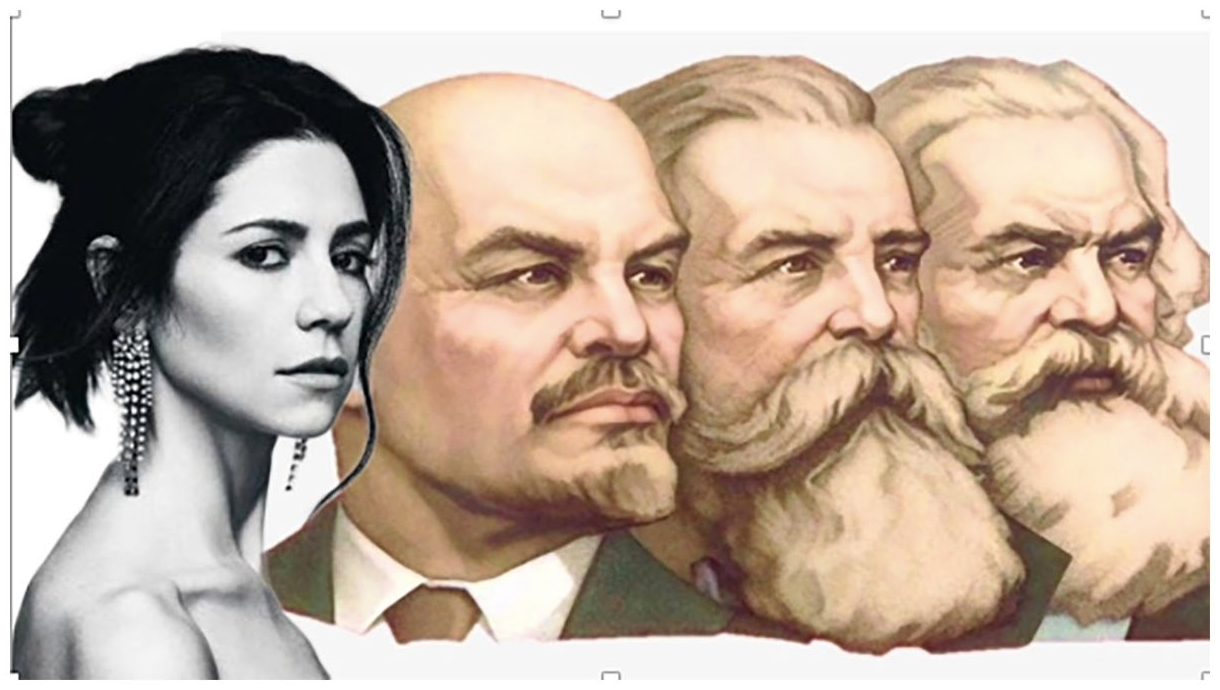
Marina, Lenin, Engels and Marx, posted by @nynagermanotta, 15/04/21. Used with permission.
Popular feminism and popular left politics
The politicisation of Marina’s recent work reflects a broader trend in contemporary popular culture, whereby popstars and other cultural figures have increasingly embraced feminist, anti-racist and even socialist themes, either in their work or, more usually, in their public pronouncements. Consider, for example, Beyoncé, whose 2016 Lemonade album has given rise to several pieces of work examining its politics and reception (Edgar and Toone, 2019; Olutola, 2019). In addition, Taylor Swift’s ‘political awakening’ around 2018, which saw her align politically with the Democrats in the United States while also voicing support for feminism and anti-racism, has been subject to a timely scholarly analysis from Simone Driessen (2022). What makes the respective politicisations of Beyoncé and Taylor Swift notable is that prior to the mid-2010s, both had consciously sought to distance themselves from politics, projecting a relatively ‘safe’ and apolitical image. From the mid-2010s onwards, however, in the context of Black Lives Matter, #MeToo and Trump’s electoral success, the tide began to turn.
A comparable left politicisation of popular celebrity culture has also occurred, to a certain extent at least, in the United Kingdom. Left-winger Jeremy Corbyn’s leadership of the Labour Party from 2015–2020 drew sustenance from the support he enjoyed from several high-profile pop stars, including Stormzy, Rag ‘n’ Bone Man, Dua Lipa, Ed Sheeran and Clean Bandit (the latter of whom collaborated with Marina on their 2018 hit ‘Baby’). But this partial-left politicisation of popular culture has not been restricted to popular music: it also manifests in feminist, anti-racist and left-wing themes appearing in, for example, popular television series such as Squid Game or Doctor Who, mainstream sport (witness, for example, the controversies surrounding the England team in the Euro 2020 soccer championships) and in socially mediated online spaces, such as, for example, the rise of so-called ‘influencer activism’ (Abidin and Cover, 2019).
These various developments suggest that Marina’s recent output should be read in the context of a wider conjuncture in which there has been something of a convergence between popular culture and left politics, the latter conceived broadly to include feminism, anti-racism, queer politics and socialism/anti-capitalism. But this begs the question of how to make sense, conceptually, of these developments. Fortunately, there is already much interesting work within cultural studies and adjacent fields seeking to tackle these questions. Jemima Repo (2020), for instance, has documented the contradictory logics through which the aesthetic and cultural practices of feminist activism have become subject to commodification. Similarly, Kanai and Gill (2020) have offered a persuasive assessment of the affective dynamics of what they call ‘woke capitalism’, the process through which a ‘seeming embrace of left-wing identity politics’ in fact entails the ‘corporate extraction of value from the struggles for recognition led by historically marginalised groups’ (Kanai and Gill, 2020: 11).
Kanai and Gill’s work is part of an ongoing effort in feminist cultural studies to read the peculiar fortunes of feminism – and adjacent forms of progressive politics – in a broadly neoliberal terrain. Particularly helpful in this regard is the concept of ‘popular feminism’, exemplified by Sarah Banet-Weiser’s recent work, which seeks to make sense of the newfound ubiquity of feminist discourse in the current conjuncture. For Banet-Weiser (2018a), popular feminism evinces three key features. The first she lifts from Stuart Hall’s (1998 [1981]) famous essay ‘Notes on Deconstructing the Popular’: namely that popular feminism is a terrain of struggle in which different articulations and forms of feminism compete for hegemony. However, some forms of feminism fare better in this struggle than others: ‘most of the time’, writes Banet-Weiser (2018a), ‘the popular feminism that is most visible is that which is white, middle-class, cis-gendered and heterosexual’ (p. 13). Consequently, the critique offered by popular feminism is typically ‘expressed in a friendly, safe way’ (Banet-Weiser, 2018a: 15), while more overtly critical or oppositional feminisms, such as those emanating from black, queer or intersectional perspectives, are subject to exclusion and marginalisation. The other two features of popular feminism are explained thus (Banet-Weiser and Portwood-Stacer, 2017: 884):
[second], contemporary feminism is circulated in mainstream and commercial media where masses of people can consume it. We see feminism represented and practiced in digital spaces such as blogs, Instagram, and Twitter, in addition to broadcast media and film (the record-breaking opening weekend of the Hollywood film Wonder Woman is merely the latest iteration of this). We also need to contend with a third expression of the popular: popularity, a condition of being liked or admired by like-minded people and groups. As many of us remember from high school, this kind of popularity brings out cliques, exclusions, and backlash, which brings us back to the popular as a terrain of struggle for power.
This account of popular feminism is highly instructive. Indeed, I would suggest it can be taken further than Banet-Weiser herself takes it: in the age of what Kanai and Gill (2020) call ‘woke capitalism’, Banet-Weiser’s analysis of popular feminism can be usefully stretched to encompass left politics more generally. As indicated earlier, many of the features which Banet-Weiser and Portwood-Stacer ascribe to popular feminism – hypervisibility, contestation and popularity/exclusion – also pertain to adjacent forms of left, progressive and radical politics (Dean, 2020). Thus, it makes sense to speak of ‘popular left politics’ as a distinctive cultural and political landscape which includes popular feminism while also encompassing new forms of popular anti-racist, queer, and socialist/anti-capitalist politics. In mapping the contours of ‘popular left politics’, I use feminist cultural studies primarily as a framework for understanding the broader logics through which various strands of left, progressive and radical discourse has seeped into contemporary commercial and celebrity culture. However, in so doing I recognise that the concrete relationships between feminism and adjacent forms of left politics are uneven and contested. For instance, while it is the case that the age of popular feminism has brought about a heightened familiarity and fluency with feminist discourse among many on the socialist left, feminism is still often subject to various techniques of dismissal and marginalisation (Craddock, 2020), while the well-documented tensions between feminist and anti-racist politics endure (Phipps, 2020). Thus, while feminist cultural studies is essential in helping understand the broad phenomenon of popular left politics, the latter must be seen – as Banet-Weiser suggests – as a contested terrain in which socialist, queer, feminist and anti-racist politics co-exist in a manner that is frequently fraught and conflictual.
This article builds on this burgeoning literature, in feminist cultural studies on the intersections of feminist resistance and popular culture, in three main ways. For one, in offering a close engagement with Marina’s recent work, it seeks to cultivate a more granular analysis of the ways in which popular feminism and popular left politics are expressed and articulated. Banet-Weiser’s analysis, for instance, while hugely valuable, is rather broad brush in scope, and invites further consideration of the precise texture of concrete manifestations of popular forms of feminist and left politics. Second, my analysis in the following sections builds on work by Angela McRobbie (2015) and Akane Kanai (2020, 2021), both of whom have stressed the vital role that logics of perfectionism play in shaping the contours of popular feminist politics and, indeed, contemporary cultural life more broadly. I suggest that the specific way in which Marina embodies a popular feminist/left politics reflects a common tendency towards purity and perfectionism in politicised forms of contemporary culture. And, finally, my reading of Marina’s work has several implications for how one conceptualises the relationship between popular feminist/left politics and neoliberalism. More precisely: my worry is that existing work on popular feminism risks under-appreciating the ways in which the expression of ostensibly radical and anti-neoliberal politics may itself be subject to neoliberal logics of competition, perfectionism and individualisation. In pursuing these arguments, the following section offers a close reading of Marina’s recent work – especially the ‘Purge the Poison’ single – alongside other examples, to offer a more precise account of the cultural grammar – that is, the specific discursive and affective textures – that popular feminist/left politics assumes in the current conjuncture.
‘Purge the poison’ and the cultural grammar of popular left politics
In this section I want to suggest that a consideration of Marina’s recent output, and especially ‘Purge the Poison’, can be instructive in helping us identify the precise discursive, affective and – to some extent – epistemic shape of popular left politics, amid a conjuncture in which certain strands of contemporary popular music – and indeed pop culture more broadly – are subject to a left politicisation of sorts. Indeed, Diamandis herself has conceded as much. In an interview with New Musical Express around the time of the release of Ancient Dreams in a Modern Land, she noted that there had been a cultural shift over the course of her career, such that current audiences would be more receptive to explicitly political pop songs such as ‘Man’s World’ and ‘Purge the Poison’ than they would have been 10 years previously (Levine, 2021). As such, Marina’s work affords us the opportunity to study more precisely the contours of the cultural grammar through which popular feminist/leftist politics are expressed.
Against this backdrop, let us now examine ‘Purge the Poison’ in a little more detail. ‘Purge the Poison’ is a driving, catchy pop tune with an incessant beat: although much of the instrumentation is guitar-based, the song’s structure – like much of Marina’s work – has a style and feel somewhat reminiscent of 80s-style electropop, a feeling enhanced by the synthwave-style aesthetics in the song’s promotional music video. The song’s lyrical content can be organised into three key themes, each of which, I suggest, exemplify the wider cultural grammar of popular left/feminist politics. These themes relate to, first, a distinctive conception of knowledge, identity/experience and affect; second, a specific kind of representation of the self and, third, a particular way of representing the other. I discuss each of these in turn.
Knowledge, experience and affect
First, the song relies heavily on a conception of knowledge grounded in the revelation of truth which is – as I will describe in more detail shortly – grounded in a foundationalist conception of identity and experience. Marina casts herself as an almost prophet-like character who takes it upon herself to disclose to the world the nature and extent of various harms and injustices. Indeed, she begins the song by noting that ‘all my friends are witches’ and that she and her friends are ‘mystical bitches making our own sisterhood’. The song thus mobilises an essentialised, otherworldly conception of feminine identity as a basis for Marina and her friends’ privileged insights into the impacts of the various ‘poisons’ the song describes. Against this backdrop, the present moment is depicted as one in which a hitherto concealed truth concerning the nature of injustice has finally been revealed. Just prior to the first chorus, Marina hurriedly intones
Need to purge the poison, show us our humanity All the bad and good, racism and misogyny Nothing’s hidden anymore, capitalism made us poor God forgive America for every single war
A little later, Marina implicitly contrasts the revelations of the current moment with the ignorance that characterised the recent past. She does this via a particularly vivid evocation of Britney Spears – whom she has cited as a key influence – alongside a mention of Harvey Weinstein and #MeToo:
2007 when size zero was the rage Britney shaved her head and all we did was call her crazed Harvey Weinstein, gone to jail, Me Too went on to unveil Truth in all its glory The ending of a story
Here, an implicit distinction is drawn between 2007 and the present: the opprobrium meted out to Britney upon shaving her head in 2007 is contrasted with our supposedly more enlightened times in the age of #MeToo. Indeed, the line ‘Harvey Weinstein gone to jail’ is delivered with celebratory aplomb, as Diamandis revels in the face of Weinstein’s punishment. More important still, however, is the characterisation of #MeToo: it is cast not so much as a political struggle against sexism as a structure of power embedded in gendered patterns of everyday behaviour (see Mendes et al., 2019). Instead, it is presented as a revelatory epistemic exercise: a literal unveiling of a previously hidden truth. This vision of knowledge and social change as tied to the revelation of truth recurs throughout the song: ‘it’s a new world order, everything just falls away’. In so doing, the song presents the disclosure of hitherto unacknowledged truths as a necessary starting point for social transformation. To put it in Foucaultian terms, it invokes a ‘repressive hypothesis’ (Foucault, 1978) in which power might conceal or reveal knowledge, but is not constitutive of knowledge as such.
Importantly, the emphasis on the revelation of truth within the cultural grammar of popular left politics is sustained by two related elements. First, truth is explicitly linked to a somewhat foundationalist conception of personal identity and experience. In Marina’s case, this manifests via the dramatisation of an essentialised feminine identity. Crucially, this invocation of personal identity and experience as a basis for political claims is in keeping with the wider political and epistemological contours of the current conjuncture. There is an extensive literature in political communications and cultural studies which points to the increasing personalisation of contemporary political life. This consists in large part of the increasing centrality of personal branding, the projection of self, and the cultivation of authenticity in contemporary political culture. In a dissection of the core features of ‘the cultural logic of digital capitalism’, Törnberg and Uitermark (2021) note that ‘political discourse is couched in the language of self-presentation, meaning that we engage with politics through the expression of personal identity’ (pp. 9–10).
Thus, it is not simply that personal identity has become a prominent feature in contemporary political and cultural life. Rather, personal identity and experience come to be seen as the ground upon which contemporary political discourse rests. In an analysis of the changing shape of truth claims in politics and popular culture, Liesbet van Zoonen (2012) has identified a phenomenon she dubs ‘I-pistemology’, in which identity, authenticity and personal experience as the basis for truth claims have displaced more traditional sites of epistemic authority. Implicit in van Zoonen’s account is a particular depiction of the relationship between politics and knowledge. For her, I-pistemology – which can underpin such ostensibly different political positions as left-wing feminism and right-wing nativism – is about the insurgency of (what are perceived to be) repressed knowledges against official discourse, in which hitherto repressed personalised ‘truths’ are asserted and disclosed across the public sphere. As such, the main relationship between politics and truth/knowledge is not – as Foucault would have it – over truth as such, but over whose specific ‘truths’ are revealed/disclosed within the public sphere. Using the terminology offered in Shelley Budgeon’s (2021) recent analysis of feminist epistemology in the age of ‘post-truth’, one could say that Marina’s work reflects a turn in popular feminist discourse towards foundationalist understandings of feminist claim-making.
As indicated, this foundationalist turn is prevalent within much popular left discourse. For example, Olúfẹ́mi O. Táíwò, in a powerful recent critique of identity politics on the anti-racist left, has identified a return of a rather reductive iteration of standpoint epistemology. The laudable standpoint epistemological emphasis on the value and importance of knowledge generated from marginalised groups’ lived experience has, argues Táíwò, mutated into a widespread presumption that political positions and epistemic insights flow, in a straightforward and unidirectional way, from the social position and identity categories specific individuals occupy (Táíwò, 2022). In Táíwò’s (2022) assessment, this has two negative consequences: first, it leads to an identity-based mode of politics which is reductive and essentialist, while also diverting attention away from the ‘actions of the corporations and algorithms that much more powerfully distribute attention’ (p. 72).
Second, the invocation of identity and experience as a basis for truth also impacts upon the affective tenor of contemporary political culture. The intensification of the presumed link between identity, experience, knowledge and politics creates a discursive terrain marked by a certain seriousness, earnestness even. For McRobbie (2009), the cultural logics of post-feminism in the 1990s and 2000s were marked by a degree of playfulness, in which a retrenchment of sexism was legitimised by playfully invoking – so as to disavow – a feminist critique of sexist cultural representations. 4 Popular feminism and ‘woke capitalism’ – as well was the phenomena I call ‘popular left politics’ – are all marked, by contrast, by a straight-talking seriousness. Popular feminism, as Banet-Weiser (2018b) observes, is marked by a shift away from the playful yet vague ‘“girl power” slogans of postfeminism’ towards a ‘recognition of the vulnerability of women in a sexist context’ (p. 134). As such, the seriousness of issues such as racism, poverty and sexual violence – coupled with a widespread emphasis on listening to marginal voices (inherited from standpoint epistemology but often refracted through the commercial imperatives of ‘woke capitalism’) – affords popular left politics an earnest affective tenor, in which playfulness and polysemy are often noticeable by their absence.
These shifts are clearly apparent in the trajectory of Marina’s work over the course of her career. Consider, for example, ‘Oh No’ from her 2010 debut album, The Family Jewels. ‘Oh No’ is a somewhat snarky, self-deprecating piece that describes, often to comic effect, Marina’s entanglement with logics of self-promotion and success-seeking. It begins with Marina saying ‘don’t do love, don’t do friends, I’m only after success’, before later conceding that her pursuit of success has robbed her of her humanity: ‘I know exactly what I want and who I want to be, I know exactly why I walk and talk like a machine’. She also concedes that her pursuit of success has led her to ‘feel like I’m the worst, so I always act like I’m the best’. In so doing, ‘Oh No’ is a darkly humorous account of Marina’s entanglement with the neoliberal injunction to self-promotion and success-seeking, in which she is simultaneously seduced and repulsed.
The playfulness and self-deprecation of ‘Oh No’ is in stark contrast to the earnestness and seriousness of much of the Ancient Dreams in a Modern Land album. The song ‘Man’s World’ exemplifies this particularly strongly. At face value, ‘Man’s World’ is a compelling and unapologetic feminist call to arms. However, notable for the analysis offered here is the way in which it dramatises a particular set of epistemic/political assumptions, and deploys a distinctive affective tenor. In the song, Marina – as on ‘Purge the Poison’ – casts herself as an otherworldly, almost Goddess-like figure, furthered by the use of imagery and aesthetics associated with Greek mythology in the song’s video. She posits herself as a prophet warning of humanity’s impending demise at the hands of the rapacious, patriarchal degradation of the natural world: ‘Mother Nature’s dying, nobody’s keeping score, I don’t want to live in a Man’s World anymore’, warns the pre-chorus. The chorus goes on to suggest:
If you have a mother, daughter or a friend Maybe it is time, time you comprehend The world that you live in ain’t the same one as them So don’t punish me for not being a man
In so doing, the song is implicitly addressed to a male listener who is complicit with the patriarchal ravages the song narrates. But, crucially, this complicity is framed as an epistemic failure: the male listener is assumed to have been unwilling or unable to understand the knowledge gleaned from the standpoint of his imagined mother, daughter or friend. Marina’s lyrics invoke an implied epistemic and political chasm between men and women – they inhabit different ‘worlds’ – a chasm implicitly resulting from men and women’s very different life experiences and knowledges, which in turn reflect the different social positionings of men in a patriarchal society.
In so doing, the contrast between ‘Oh No’ and ‘Man’s World’ could not be more striking. And while this contrast reflects broader shifts in Marina’s style over the course of her career, it also indexes wider shifts in the ways in which feminism and wider left politics are narrated within the terrain of popular culture. ‘Oh No’ is riddled with angst and self-doubt verging on self-loathing, in which Marina humorously works through her complicity with neoliberal imperatives which she knows are harmful and dehumanising, but from which she is unable to extricate herself. ‘Man’s World’ (as well as ‘Purge the Poison’), by contrast, conveys mastery and transcendence. 5 The song typifies the wider tendency in contemporary popular feminism and left politics to presume an organic and unidirectional connection between identity, experience, knowledge and politics. This, in turn, is compounded by the affective tenor of the song, which – in contrast to ‘Oh No’ – is earnest, serious and straight talking. 6
Purity and perfectionism
Marina’s mobilisation of a revelatory conception of knowledge linked to a specifically feminine standpoint leads to the second feature of the cultural grammar of popular left politics, namely an emphasis on purity and perfection. ‘Purge the Poison’ is – unsurprisingly, given the song’s title – replete with metaphors concerning poison and impurity. It envisions the transformation towards a more just and liveable world as a casting out of poisonous impurities contaminating the body politic. According to the song, Marina and her ‘sisterhood of witches’ are ‘protecting the planet, healing our own damage’ in the face of ‘the virus’, climate change, racism, misogyny, capitalism and war. Marina, assuming a role akin to Mother Nature, implores the listener to join in purging the poison from our system. In the chorus, she further enjoins: ‘It’s your own decision, but your home is now your prison, you forgot that without me you won’t go far’: humans are chided for their callous disregard for the health of their own home. However, she affirms the possibility that ‘we can now regenerate’, a claim given further impetus in the second half of the song by linking said regeneration with, again, a rather essentialised conception of femininity. After bemoaning women’s under-representation in positions of formal decision-making – ‘I just want a world where I can see the feminine, we only make up one quarter of the government’ – Marina compares Earth to a White Rose, before asserting that ‘the feminine is born as new, started with a diamond dew’.
As such, the song’s imagery repeatedly trades in metaphors relating to purity and perfection, which in turn invoke traditional associations of femininity with purity and renewal. The song’s emphasis on purity and perfection is, arguably, reflective of the broader cultural grammar of popular left politics. Indeed, Angela McRobbie (2015) has argued that ‘the perfect’ has come to function as a key structuring principle in shaping feminism and feminine subjectivity in the current conjuncture. She suggests that contemporary culture is marked by a myriad of technologies of self premised upon the denial or transcendence of various perceived imperfections relating to, for instance, employment, embodiment and health. However, the horizon of ‘the perfect’ also shapes contemporary political culture. As Akane Kanai (2020) observes, ‘popular feminist digital cultures’ are constituted by a horizon of perfectionism in which young feminists strive to perfect what they perceive to be an ideal of a ‘good feminist’. This means that the cultural landscape of popular feminism – and, I would argue, popular left politics more broadly – is shaped by an emphasis on individuals seeking to project an image, often digitally mediated, of the perfect feminist or perfect activist. In contemporary digital culture, projecting an image as a ‘perfect’ activist, radical, feminist or leftist can easily become a modality through which to enhance one’s reputation by cultivating a distinctive online persona or ‘brand’. In so doing, leftist or feminist discourses and identities can become subject to the very logics of competition and individualism they ostensibly oppose, as knowledge (of feminist/leftist theory or history), radicalism or political insight become forms of capital that can be deployed to enhance one’s value, status or reputation.
In ‘Purge the Poison’, Marina arguably replicates this logic in part by casting herself as a purifying force untainted by the poisoning tendencies of capitalism, racism, and climate catastrophe. Indeed, her purity is such that she assumes an almost mythical, Goddess-like persona. Consequently, rather than grappling with one’s entanglement or complicity with, say, capitalism, racism or patriarchy, Marina – in keeping with the perfectionist grammar of the current conjuncture – casts herself as purified, having successfully purged the various poisons to which the song alludes.
Complicity and otherness
The third element of the cultural grammar of popular left politics epitomised by the song is, in many respects, the obverse of Marina’s emphasis on purity and perfectionism in her self-representation. Put simply: to emphasise purity and perfection in oneself is often to posit the other as complicit, impure and imperfect in a way that the self is not. As ‘Purge the Poison’s chorus puts it, ‘[we] need to purge the poison from our system until human beings listen, tell me, who do you think you are?’. In so doing, Marina casts herself as exceptional and pure, in contrast to other human beings, who stand accused of being unable or unwilling to listen. This implicit contrast between self and other again reflects the perfectionist logic of popular feminism and popular left politics more broadly. As Akane Kanai (2020) again observes in a discussion of intersectionality and feminist identity, ‘the pursuit of an intersectional feminist identity may be entangled with desires and demands for authenticity and individual perfection’ (p. 26). This functions in part by demarcating specific feminist celebrities – such as Taylor Swift or Lena Dunham – as problematic on account of (what is perceived to be) their inability or unwillingness to cultivate a sufficiently intersectional feminist praxis. This tendency to attribute problematic characteristics to celebritised others functions, as Akane Kanai (2020) observes, to channel feminist and anti-racist energies into individualistic ‘attachments to goodness, non-complicity and sophistication’ (p. 32), rather than collective solidarity and transformation.
As such, the perfectionist grammar that underpins Marina’s popular leftist articulation of feminism, anti-racism and anti-capitalism functions largely through casting oneself as pure, authentic and perfect, while casting others as problematic or complicit. This has the consequence that one’s own complicity with, or entanglement in, sexism/capitalism/racism and so on goes unacknowledged. The cultural landscape of popular left politics is constituted in large part by the disavowal of one’s own complicity: to acknowledge one’s own complicity would compromise the aspiration to perfection that shapes popular feminist/leftist practice. As such, complicity can only be attributed to others and not to the self.
Crucially, this disavowal of complicity emerges not solely from high profile individuals such as Marina, but is also sustained by specific forms of celebrity–fan interaction. As literature in the subfield of fan studies has powerfully argued, fandom is becoming an increasingly prevalent mode of engagement across contemporary cultural and political life (Dean, 2017; Wahl-Jorgensen, 2019). Frequently – as is the case for many Marina fans – one’s sense of identity and distinctiveness is cultivated in and through identification with a fan object, and the cultivation of solidarity with an imagined community of fellow fans. As such, the image of Marina as an embodiment of purity and virtue is sustained not only in her lyrics and videos, but also by her enthusiastic fanbase, who frequently label her a ‘queen’ or a ‘goddess’ in, for example, YouTube comments or social media posts. As such, within a deeply affectively charged and mutually reinforcing set of relationships between Marina as fan object, and her fan community, impurity and complicity are always, and can only be, projected onto those outside the Marina fandom.
Neoliberalism and popular left politics
The above analysis begs the question of why, precisely, the grammar of Marina’s embrace of left/feminist politics assumes the shape that it does. A possible answer can, perhaps, be found through an engagement with the rich body of work on the relationship between left politics and neoliberalism. Most of this work approaches neoliberalism as a critical object from a left perspective (see, for example, Hall, 2011), often implicitly or explicitly assuming that opposition to neoliberalism is a key constitutive feature of any self-respecting left politics (Lepori, 2020). However, much existing research on the cultural politics of neoliberalism suggests that certain forms of left, feminist and anti-racist politics do not stand unambiguously in opposition to neoliberalism, but in fact serve to consolidate its dominance. Indeed, this is now a familiar argument in cultural studies, although it is framed slightly differently by different authors.
Paul Gilroy, for instance, has powerfully documented how principles of empowerment and self-determination drawn from traditions of black radicalism have come to underpin what he calls a ‘black vernacular neoliberalism’, such that anti-racist sensibilities have, in some instances, come to actively promote and consolidate neoliberal values (Gilroy, 2013). Similarly, Catherine Rottenberg (2018) has written extensively about the rise of a specifically neoliberal modality of feminism – epitomised by the ‘lean-in’ ethos of former Facebook CEO Sheryl Sandberg – which seeks to empower ambitious women in the workplace, but at the expense of a collective struggle against patriarchal relations of domination. Banet-Weiser’s work – referred to earlier – casts the rise of popular feminism, in part, as a story of the displacement and marginalisation of more radical politics by forms of feminist culture that accommodate, rather than challenge, the neoliberal status quo. Political theorist Nancy Fraser has put it even more polemically, casting feminism as the ‘handmaiden’ of neoliberal capitalism through its valorisation of women’s participation in the capitalist labour market (Fraser, 2009).
A related argument – but made from a slightly different perspective – can be found in the late Mark Fisher’s (in)famous essay ‘Exiting the Vampire’s Castle’, a searing critique of the cultural norms prevalent on what he calls ‘Left Twitter’ (Fisher, 2013). Although Fisher does not mention ‘neoliberalism’ by name, he does, nonetheless, accuse ‘Left Twitter’ of adopting a competitive liberal individualist approach to politics, which he likens to a ‘Vampire’s Castle’. He claims that the latter is characterised by three main modes of desire: ‘a priest’s desire to excommunicate and condemn, an academic-pedant’s desire to be the first to be seen to spot a mistake, and a hipster’s desire to be one of the in-crowd’ (Fisher, 2013, no pagination, my italics). As a result, Fisher paints a grim picture of a left politics in which narcissism has trumped solidarity, and in which individual left activists compete – largely on Twitter – for status and attention largely by highlighting perceived faults in others.
Although the above narratives about the relationship between left/feminist politics and neoliberalism are in many respects quite different, they share a certain logic. They all juxtapose a normatively good, radical feminist/left politics alongside a bad, complicit, neoliberalised iteration of feminist/left politics (see Eschle and Maiguashca, 2018). The precise content afforded to each of these varies: for Fraser, the ‘good’ is very much linked to a revitalised socialist feminism; for Banet-Weiser, it is to be found in black, queer and intersectional feminisms; for Fisher, it is to be found in a rejuvenated politics of class unburdened by (what he perceives to be) the distractions of liberal identity politics.
However, my analysis of Marina’s recent work suggests that these implicit distinctions between ‘good’ (anti-neoliberal) and ‘bad’ (co-opted, neoliberal) left/feminist politics are difficult to sustain: even ostensibly anti-neoliberal forms of politicised popular culture can and do adopt a grammar that aligns with the imperatives of neoliberal culture. Another way of putting it would be to say that a discourse which is anti-neoliberal in content need not necessarily trouble the wider logics of neoliberal culture if that discourse assumes a formal grammar in tune with neoliberalism. Akane Kanai has noted a similar dynamic in a discussion about the relationship between intersectional and neoliberal modes of feminist subjectivity. She cautions against reading ‘the rise of intersectionality as a straightforward “corrective” to the neoliberal feminist landscape’ (Kanai, 2020: 28), given that attachments to (an ostensibly anti-neoliberal vision of) intersectionality can and do circulate as part of a public presentation of self that accords with neoliberal logics of individualism, perfectionism and self-promotion.
As such, if it is indeed the case that politicised cultural figures such as Marina are ‘neoliberal’ in some way, this is not because they themselves espouse explicitly neoliberal discourse. What needs further analysis, then, is precisely the visibility and currency afforded to ostensibly radical and anti-neoliberal forms of discourse within relatively mainstream cultural spaces. Marina’s uncompromising critiques of patriarchy, militarism, capitalism and climate catastrophe are one example. But one could also consider the ways in which Beyoncé’s lyrics and aesthetic (particularly around the time of the Lemonade album) explicitly mobilise a radical anti-racist politics that draws on the political traditions of Black feminism and Black Power (Olutola, 2019). We now inhabit a cultural landscape in which Taylor Swift writes Instagram posts critiquing ‘structural racism’ and songs that reference a ‘fuck the patriarchy’ keychain (see Driessen, 2022), while Ariana Grande tweets that ‘it ain’t feminism if it ain’t intersectional’. This serves, I would argue, to complicate Banet-Weiser’s suggestion that ‘spectacular, media-friendly expressions such as celebrity feminism and corporate feminism achieve more visibility, and expressions that critique patriarchal structure and systems of racism and violence are obscured’ (Banet-Weiser et al., 2020: 7).
Contra Banet-Weiser, the current conjuncture is precisely one in which feminist and wider left expressions that critique patriarchy, racism and structural violence can and often do assume a ‘spectacular’, media-friendly form. This in turn means that if there is a co-optation or blunting of left/feminist radicalism by neoliberalism, it occurs not only primarily by rendering anti-neoliberal discourse marginal but also, paradoxically, by actively sanctioning certain anti-neoliberal discourses, so long as the formal grammar they assume accords with the competitive and individualistic logic of digitally mediated neoliberal culture. Another way of putting it would be to say that projecting an image of left/feminist radicalism can become a modality of digitally mediated self-branding, in which one’s radical politics become part of one’s unique online persona, a way of differentiating oneself from others in a crowded market for attention. This is perhaps most obvious in the context of so-called ‘influencer activism’ (Abidin and Cover, 2019; Sarkar, 2021), but the logic of digital capitalism is such that the distinction between social-media influencer and ‘ordinary’ politically engaged citizen becomes increasingly blurry (Khamis et al., 2017; Törnberg and Uitermark, 2021).
It should, therefore, come as no surprise that the landscape of popular left politics is, as Akane Kanai (2020) has suggested, premised upon an outward projection of perfectionism, purity and innocence, alongside a disavowal of one’s own complicity, for to acknowledge one’s own complicity would be to potentially risk jeopardising one’s reputation and market value. This might explain why it is that politicised pop culture figures such as Marina tend to project a public image of purity and perfection, an image which is often further compounded by the reverence that such figures are afforded by their fanbase. To be clear, I am not attributing an intentionality to Marina or any other cultural figure: I am not suggesting that the purity and perfectionism she projects in songs such as ‘Purge the Poison’ is in any way cynical, calculating or inauthentic. Rather, I simply want to suggest that Marina’s work is symptomatic of broader tendencies within the cultural and political landscape she inhabits.
To end this section, I will aim to clarify the political stakes of the analysis offered thus far. The line of argument pursued might suggest an endorsement of what Eschle and Maiguashca (2018) call a ‘strong co-optation’ thesis when characterising the relationship between feminism/left and politics and neoliberalism. That is to say: my analysis can be read as a pessimistic account of the capacity for neoliberal logics to domesticate and contain even those discourses and cultural processes that are, ostensibly, in opposition to neoliberal hegemony. And, to a large extent, that is an accurate reading. To use Stuart Hall’s parlance, my account has emphasised the ways in which logics of containment have tended to take precedence over possibilities for resistance. This has happened in two main ways. First, Marina and her fans invoke a vision of feminist/left politics which is purist to the point of being otherworldly, such that the possibility of impurity, complicity or entanglement is subject to sustained disavowal. This is then compounded by the logics of competitive individualism that shape the digital public sphere, such that the projection of a certain kind of left/feminist purism or perfectionism becomes a modality through which to cultivate a distinctive personal brand and accrue value, status and reputation (Davies, 2021).
Second, the case of Marina potentially also highlights the limitations of a progressive politics mediated by fandom and celebrity culture. As Kanai (2020) correctly notes, much popular feminist and popular leftist discourse is sustained by ordinary citizens staking out their political positions by either aligning with, or rejecting, the pronouncements of high profile politicised celebrities. This has the consequence of, first, sustaining a hierarchical relationship between the celebrity and the fan, potentially foreclosing possibilities for more horizontal, grassroots forms of solidarity and, second, attenuating our collective political imagination by affording disproportionate attention to the utterances and practices of celebrities. One recent example of the latter concerned the accusation of fatphobia levelled at Taylor Swift for her video for the 2022 single, ‘Anti-Hero’. Rather than give rise to a discussion of the wider gender and race politics of food consumption, body image and so on, the incident soon descended into a fractious and highly personalised debate involving Taylor Swift fans (‘Swifties’) about whether or not Swift herself was in the wrong (see D’Souza, 2022, for further background and context).
However, my emphasis on logics of containment should not be overstated. The case of Marina – as well as other politicised fandoms – also demonstrates the possibilities for left politicisation that can emerge out of the passionate affective attachments that sustain relationships between fans and their fan object, as well as within the fan community (see Hinck, 2019). Consider, for example, the ways in which queer and left-wing Marina fans in Brazil have integrated Marina’s image and aesthetic into their shared cultural reference points. This became apparent following the recent presidential elections in Brazil, which several Marina fans celebrated by sharing on social media a photoshopped image of Marina wearing a ‘PT’ T-shirt (PT = Partido dos Trabalhadores = Workers’ Party, i.e. Lula’s political party). So although the case of Marina is testament to the ways in which politicised celebrity/fan relationships can and do contain or attenuate possibilities for collective left politics, we should not lose sight of how, under certain circumstances, celebrities and their fandoms can enable, rather than foreclose, various modalities of anti-neoliberal resistance.
Conclusion: anti-neoliberal culture in neoliberal times
The aim of this article has been to intervene into ongoing debates about the relationship between feminism, left politics and popular culture, offering a conjunctural analysis of a moment in which there has been something of a left/feminist politicisation of several strands of contemporary popular culture in predominantly Anglo-American contexts. In particular, I suggested that Marina’s work – as well as its reception from fans and audiences – can help us identify several constitutive features of what I have called the cultural grammar of popular left politics, that is to say, the precise discursive and affective contours that recent left/feminist politicisations of popular culture assume. These include, first, a conception of knowledge as linked to the revelation of truth grounded in identity and experience; second, a projection of purity and perfectionism of self and, third, a projection of complicity onto others. I further suggested – again drawing in particular on Akane Kanai’s recent work – that these features of the cultural grammar of popular left politics are testament to the impact of neoliberal culture on the discursive, affective and subjective character of even ostensibly anti-neoliberal forms of politics and culture. This in turn means that the distinction between a ‘bad’, co-opted, neoliberal feminist/left politics and a ‘good’, radical, anti-neoliberal feminist/left politics is increasingly difficult to sustain. The paradox of the current conjuncture, then, is that even ostensibly anti-neoliberal political and cultural discourses can – in large part thanks to the logics of reputation, competition and individualisation that shape socially mediated political engagement – become subject to the imperatives of a neoliberal public sphere. Much contemporary left activist and academic discourse – including within cultural studies – implicitly assumes the possibility of a political and cultural space – or personal identity – that sits unambiguously outside neoliberalism. The perhaps rather pessimistic conclusion of this article, however, is to cast doubt on the viability of such a position. That is not to suggest that neoliberalism cannot be resisted. Rather, it is to suggest that any resistance to neoliberalism must start, rather like Marina does in ‘Oh No’, from a sustained and honest analysis of our own complicities with, and entanglements within, the logics of neoliberal culture.
Footnotes
Acknowledgements
The author wishes to thank Maria do Mar Pereira for the discussions that ultimately led to the writing of this paper, and for her helpful suggestions on an earlier draft. The author also wishes to thank the anonymous reviewers, whose suggestions were helpful and generous. Finally, the author also wishes to thank Marina Diamandis and her fandom, whose humour and creativity helped spark the arguments pursued in the paper.
Funding
The author(s) received no financial support for the research, authorship and/or publication of this article.
