




Abstract
The 21st century has seen the rise of a new phenomenon – the creation of statues and monuments celebrating the lives of entertainers. Drawing on debates about popular culture, placemaking and heritage, and in the context of recent controversies about the politics of statues and memorials, this paper examines a manifestation of this phenomenon as represented by statues of comedians erected in the towns of Northern England. The paper begins by sketching the characteristics of the statues and their subjects. It proceeds by reflecting on their emergence in the context of debates about the contested place of nostalgia in social and cultural theory. The paper uses a strategically selected sub-set of the statues to reflect on the emerging cultural and political imaginary of towns as sites of contemporary political struggles. It concludes by asserting that the significant affective investment into statues projects and the progressive potential of popular cultural nostalgia offer an important corrective to crude assumptions about the cultural lives of towns.
Introduction
This paper concerns an emerging phenomenon of the early 21st century – the creation of statues dedicated to celebrating the lives of figures from the popular culture of the mid to late 20th century. By focussing on a specific sub-set of these statues, the paper reflects on why they are important to debates about nostalgia, heritage, and identity in English towns, understood as significant sites of contemporary political struggle. Statues were headline news at various moments throughout the summer of 2020 and maintain a key element of the ‘culture wars’ that characterise contemporary politics in the Global North. The murder of George Floyd in Minneapolis, United States, in May of that year renewed the momentum of the Black Lives Matter movement and generated a wave of demonstrations across North America and Europe that once again shed light on the symbolic meanings of civic spaces. In the United Kingdom, this was exemplified by the toppling of a deeply divisive statue of the 18th century civic grandee and slave trader Edward Colston in Bristol. The long-standing concerns of the Rhodes Must Fall movement (Newsinger, 2016) with the problematic politics of colonial-era statuary for the previous decade or more, were, for a time at least, central to a national conversation in the United Kingdom about the role of statues in narrating national and regional identities. These debates have resonances with those concerning the treatment of the monuments of the communist era in post-Soviet Eastern Europe (Boym, 2001; Trilupaityte, 2021). This paper’s focus is on a less apparently urgent manifestation of contemporary memorial culture – namely statues to entertainers from the commercial popular cultures of the mid-20th centuries and, specifically, comedians. These have been sited, primarily in English towns, beginning with a statue to the comedian Eric Morecambe unveiled in Morecambe, a coastal town in the Northwest of England in 1999 and culminating in, at time of writing, over 20 equivalent statues distributed across the United Kingdom, primarily in England. The paper attempts to place this phenomenon within the specific conjunctural moment of the early 21st century United Kingdom. Following Hall’s (2019) description of ‘the conjuncture’ as reflecting new ruling alliances formed in response to emergent crises, this period is informed by several fissures and tensions. These include the end of the post 1979 neo-liberal economic consensus in the light of the 2008 economic crisis and its ripple effects on the deepening economic, social and regional inequalities within the United Kingdom. These divides have also been manifested in this period by the re-assertion of a conservative, English, political hegemony in the United Kingdom at the expense of the ‘globalising’, cosmopolitan variant of economic management that characterised the turn of the century and, in more recent years, the reassertion and revival of an English ‘nativism’ in response to a perceived dominant urban multiculturalism. The ‘town’ – and in particular the Northern English town – has been given a particular stake in this tension, being identified, through the ‘Red Wall’ epithet used to describe the political shifts towards the Conservative party around the United Kingdom’s 2019 general election, as a site for an apparently new alliance between the residents of these places, which had previously tended to return Labour MPs, and the Tory English elites of the South-East. It is an electoral alliance which was arguably responsible for the victory of the Leave campaign in the 2016 referendum on the United Kingdom’s membership of the European Union (Dorling and Tomlinson, 2019) and of Boris Johnson’s Conservative party in the general election of 2019. Evoking ‘nostalgia’ – for empire, for the past certainties of various forms of working-class community and the labour that sustained them, and in the United Kingdom’s case in particular, its role in the Second World War – has been central to this project in ways which might echo and have continuities with previous cultural resurgences of English conservatism (Hall, 2019). This paper uses the emergence of a specific cultural phenomenon that spans this conjunctural period to suggest how the concept of nostalgia, focussed on popular cultural figures, including those whose work critiques, ironizes and reveals the tensions implicated in regional inequality and social change, might complicate assumptions about the cultural lives of towns. To understand how the narratives of regional and local inequality that underpin this political imaginary are shaped, it looks at official UK government data regarding inequality, electoral data, and demographic data relating to the changing populations of the towns where identified statues are located. To see how the statues are received it draws from a range of forms of evidence, including analysis of local press and media coverage relating to their unveilings. This includes official footage taken from broadcasts and subsequently posted in social media sites, as well as footage taken by ‘fans’ of the identified performers or residents recording significant civic occasions. These media analyses were also informed by visits to and observations of the statues in situ – including participant observation of the unveiling ceremony of the statue to Victoria Wood in Bury in 2018.
While statuary and memorials have a long history in human culture, they have a more specific role in the forms of political expression and organisation associated with the ‘invention of tradition’ (Hobsbawm and Ranger, 1983) that was fundamental to the creation of civic identities in the 19th century when the material fabric of cities became fundamental to the display and maintenance of various forms of state power (Bennett, 1988). In this context, statues were expected to commemorate exemplary lives as physical manifestations of gratitude or tribute to significant political, civic, or military leaders. Cultural figures – artists, writers, composers – were also included in this category of the memorialisable, as Priscilla Parkhurst Clarke articulates in her account of the role of memorials and monuments to significant writers in the creation of France as a ‘literary nation’ (Parkhurst Clarke, 1987). The presence of monuments to cultural figures represents a process of consecration – a reflection of what constitutes legitimate, official forms of culture expressed in the material world. What Parkhurst Clarke also points out, though, is that these forms of monument reflect an element of negotiation between national, state and city authorities and their populations (see also Trilupaityte, 2021 in Lithuania and, in the Australian context, Gibson and Besley, 2004).
The addition of popular culture to the category of the memorialisable indicates how these negotiations have developed and reflect the career of commercial popular cultural production itself, from the ‘mass culture’ of the post-war cultural critics to the more dynamic and diffuse resource for identity work imagined by scholars from the Cultural Studies tradition (Edensor, 2002). In this tradition, the concept of ‘mass’ culture itself is critiqued as a crude reduction of the complex ways in which the open-ness and polysemy of popular cultural texts can be used to reflect and give meaning to people’s lives. Bringing these complexities to bear on processes of commemoration raises the tantalising prospect of ‘heritage from below’ (Robertson, 2012) characterised by practices which do more than celebrate ‘official’ accounts of the past but re-claim quotidian aspects of the lives of people in specific places – and work to make them ‘official’ or recognised as valuable and worthy of celebration. As Robertson suggests, such ‘counter hegemonic landmarks can be written into the landscape in support and expression of certain local identities and thereby both galvanise and cohere local communities around alternative constructions of identity and narratives of place’ (Robertson, 2012: 10). While scholars of popular culture have been keen to identify elements of it as inherently transgressive or explicitly ‘resistant’, as Medhurst points out, there are other kinds of politics at play too. Writing specifically about popular comedy, he identifies the significance of a politics ‘of defence not attack, of refusal not uprising, of embracing your own, of consolidation against condescension’ (Medhurst, 2007: 69). These complexities of heritage and these forms of politics are at play in the examples explored below. They are evident in the figures commemorated themselves as exemplifying the processes of ‘de-massification’ of cultural forms across the 20th century, acknowledging the meaningful affective relations that audiences can have with such figures and re-embedding them in the communities from which they emerge. They are also visible in the careful local negotiation and persuasion that underpin the processes of commemoration.
The British case
Appendix 1 lists the 21 statues or monuments to 17 comedians identified in the United Kingdom. Apart from statues of the 1930s film star Gracie Fields and of Victoria Wood the statues of comedians are all of men, all are of European heritage, and all were born in the United Kingdom, except Oliver Hardy (who was born in Chicago, US) and Spike Milligan (who was born in India). The overwhelming majority have been unveiled in the 21st century – a process that was given impetus by the unveiling of a statue of Eric Morecambe in the North-Western seaside town of Morecambe in 1999. The wide national and international coverage given to the unveiling of that statue, reflecting the enduring popularity of the Morecambe and Wise 1 double-act in the United Kingdom, some 15 years since the death of Morecambe and enhanced by the ceremonial presence of HRH Queen Elizabeth, gave momentum to contemporary processes of memorialisation, at least within the north of England. I’ll return to this aspect of the case below.
Within this small sample it is possible to identify at least three groups of people who are being commemorated, albeit with some overlap between them. The first group can be characterised as reflecting the ‘birth’ of commercial cultural production in the United Kingdom, associated with early 20th century and pre-World War II forms of ‘mass’ entertainment, especially film. In this group are Charlie Chaplin, Stan Laurel and Oliver Hardy, Gracie Fields, George Formby, and Max Miller. These figures share careers which straddle the dominance of the music hall/variety theatre forms of popular entertainment with the development of cinema and radio. This group can be summarised as reflecting the early history of popular commercial cultures, largely enjoyed in performance or theatrical venues away from the domestic setting.
The second, group – exemplified by Tony Hancock, Spike Milligan but also including Morecambe and Wise and Ken Dodd – include performers whose performing careers were augmented by and enabled through the development of domestic media technologies – first radio and then television. Hancock and Milligan exemplify this group. Milligan was a jobbing jazz musician before his work as a writer and performer on The Goon Show broadcast by the BBC from 1951 to 1960. Hancock was a performer on the popular Educating Archie radio-ventriloquism comedy in 1950 before featuring in his own eponymous radio show, Hancock’s Half Hour, broadcast from 1954 to 1961. This inspired an early variant of the genre of TV sit-com, which ran from 1956 to 1960. The careers of these performers, then, overlapped with the establishment of domestic broadcast systems in the United Kingdom and the rise to national prominence of the BBC.
The final group, including Les Dawson, Tommy Cooper, Ronnie Barker, Victoria Wood, and Frank Sidebottom most closely reflect a ‘golden age’ of British comedy broadcasts from the 1970s to the mid-1980s enabled less by any inherent aesthetic qualities of their work itself, necessarily, but more through the relative dominance of television as the cultural technology through which this work was distributed. For most of this period, this meant three television channels, being broadcast at selected times of the day, and the development of comedy and associated genres, such as the sit-com, the sketch show, and the gameshow as key ‘content’. This technological dominance allowed these performers to gain levels of public attention which were both unprecedented, at least within the domestic setting, and which have, with the end of this ‘broadcast’ era and the rise of multi-channel, multi-media modes of production and circulation, been in subsequent decline. A later section will focus on a specific selection of these statues and the places they are sited within the northern English towns that have been the subject of recent political struggle. In the following section, I contextualise this analysis within theoretical debates about nostalgia.
Nostalgia and/as popular culture
Nostalgia is a recurring subject of popular commercial culture, whether identified through revivals of the music scenes of the past and the associated retro-reclamations of historical subcultures or the aesthetic ‘hauntings’ of the styles and motifs of the music, TV and film of the past which have been a feature of late/postmodern cultural criticism and theory since the millennium (Reynolds, 2012). The aspiration to memorialise the figures that are the subject of this paper reflects this centrality. One indication to note in relation to this point, as the table in Appendix 1 reveals, is the length of time between the subject’s death and the institution of a statue to commemorate and celebrate their life. The Liverpudlian comedian Ken Dodd, who died in March 2018, had a statue unveiled in 2009, the only one among these monuments inaugurated within the subject’s lifetime. Of the others, the longest time between the subject’s death and the siting of a statue is 46 years (for George Formby). Charlie Chaplin and Victoria Wood were memorialised only 2 years after their deaths, Frank Sidebottom (the alter-ego of the performance artist & comic musician Chris Sievey) being memorialised after 3 years and Ronnie Barker after 5 years. 2 A final significant element, particularly linked to some of the subjects of these statues (but notably Laurel and Hardy, Morecambe and Wise, Norman Wisdom and George Formby) is that popular memory of them is also shaped by their lives beyond their actual careers, facilitated by repeat showings of their films or television shows as relatively cost-effective content in expanding television schedules across the mid to late 20th century. These repeats also mean that in many cases these are figures who exist, if only in mediated form, in the ‘living memory’ of people in the places where their statues are sited, with consequences for the affective relations they engender.
Nostalgia has an ambivalent place in social and cultural theory more generally. As Stauth and Turner outline, it is an implicit presence in much theorising that emerges from the 19th and early 20th centuries that attempts to narrate and understand social change of various kinds. This includes within critical theory where, they suggest, nostalgia underpins ‘an anti-modern critique of mass culture, the cultural industry and modern forms of consumerism’ (Stauth and Turner, 1988: 511). Radical critiques of social life continue to identify nostalgia as a specific barrier to progressive social change. Owen Hatherley’s (2015) critique of the Keep Calm and Carry On ‘austerity’ nostalgia of post-2008 financial crisis exemplifies a contemporary version of this strand of thought but it has echoes with earlier critiques of the politics of belonging (Gilroy, 2004; Hall, 1996) and their relation to a national story characterised by a perception of the loss of the solidities of race, class and nation and the need to ‘get back to the place or moment before the country lost its moral and cultural bearings’ (Gilroy, 2004: 97). Such themes are central to the current conjuncture in which notions of empire and the United Kingdom’s role in the Second World War have been repeatedly invoked in the pre and post Brexit ‘culture wars’ and in which critical commentators in the struggles have been able to invoke the role of nostalgia, as offering ‘a panacea that worked to dupe the masses’ (Smith and Campbell, 2017: 615).
These critical accounts of nostalgia belie the extent to which, as Bonnet (2010) has argued, leftist critiques, within their radical social historical and post/anti-colonialist modes, themselves exhibit elements of nostalgia. This includes EP Thompson’s celebrated conception of the rescue of the working people of the pre-industrial past from ‘the enormous condescension of posterity’ (Thompson, quoted in Bonnet, 2010: 41) and the equivalent celebration of English radicalism as not simply concerned with ‘progress’ but also resistance to certain types of change and the defence of ways of life in the light of it. This type of critique might well incorporate other seminal accounts from the Cultural Studies tradition in which an imagined working-class community of the past, either in Hoggart’s Uses of Literacy (1958) or Williams’ The Country and the City (1973), falls victim to or is threatened by the advance of capitalist modernity. This latter perspective reminds us that the experience of change and the interpretation of the meanings of nostalgia in response to it are not simply imposed by the powerful but negotiated and struggled over by the inhabitants of these places in their symbolic practices. Relatedly, Bonnet identifies an important distinction between a public and personal or private nostalgia. While analysts and theorists may be hesitant towards and critical of public forms of nostalgia, we do not expect the treasured objects, the valued images that we use to personalise our homes and ‘workstations’ to be sneered at. Indeed, modern etiquette demands that these tokens of attachment are beyond criticism. For, however sentimental they may appear to others they speak not only of a shared humanity but also of a shared vulnerability, an emotional range that includes love, loss, and loyalty. (Bonnet, 2010: 6)
This is a space, troubling the distinction between public and private, which a perspective on nostalgia, for popular commercial cultures experienced for the most part domestically thorough broadcast media but expressed through public monuments, can inhabit.
In attempting to do so, I further draw from a range of researchers who have attempted to problematise the inherent conservatism of nostalgia and to open up a definition of it which acknowledges its hopeful dimension. These include Boym’s distinction, drawn from analysis of post-Communist Europe, between a ‘restorative’ nostalgia which claims access to an undeniable truths from history (a form useful to states engaged in transformative re-imagining of the past to serve the future that perhaps fits closely with the United Kingdom’s culture and statues wars of recent years) and the ‘reflective’ nostalgia which instead, ‘dwells on the ambivalences of human longing and belonging and does not shy away from the contradictions of modernity’ (Boym, 2001: xviii). Pickering and Keightley (2006) also seek to rehabilitate nostalgia from being an inevitably ‘defeatist’ mode of interpreting the past in the light of the present or future by emphasising its role in interrupting the assumed velocity of modern temporality. In doing so, nostalgia, ‘attempts a form of dialogue with the past and recognizes the value of continuities in counterpart to what is fleeting, transitory and contingent”. (Pickering and Keightley, 2006: 923). Moreover, such a dialogue can reveal the extent to which nostalgia is ‘driven by utopian impulses – the desire for re-enchantment – as well as melancholic responses to disenchantment’ (Pickering and Keightley, 2006: 936, my emphasis)
Similarly, Tannock (1995) concentrates on the forms of the continuity and discontinuity identified by the evocation of nostalgia and the extent to which the things from the past which are being valued in the nostalgic practices or rhetorics are things which are impossible to locate in the present – in which case nostalgia is a form of retreat – or whether such things have been temporarily lost and might be reconstructed, in which case nostalgia can be seen as a route to retrieval. In the latter case, for Tannock (1995), in ‘invoking the past, the nostalgic subject may be involved in escaping or evading, in critiquing, or in mobilizing to overcome the present experience of loss of identity, lack of agency, or absence of community’ (p. 454). This distinction is again crucial to questions of heritage and memory, especially those concerning popular culture. Smith and Campbell (2017) consider this in relation to the emergence of heritage sites commemorating lost industries in the United Kingdom (p. 612). They outline the risks of critical dismissal of such heritage in cementing contemporary political divisions, where, nostalgia associated with a loss of work and deindustrialisation are today popularly linked to anti-immigration debates and the rise of ultra-reactionary politics in Australia, the United States and Europe. . . Perceptions such as these, however, make it all the more important for critical work with industrial heritage and working-class communities to reveal the complexities and the diverse politics of the ways in which heritage is used in these contexts. (Smith and Campbell, 2017: 617).
This point connects to the final key concern with nostalgia for this paper. Most theorising of the concept begins with some acknowledgement of its etymology as a form of medical pathology associated with homesickness, normally attributed to the Swiss military in the 18th century (see, for example, Davies, 1979). While this point of origin is perhaps now less manifest in the broader understanding of nostalgia as an affective response to the past, the concept of place and its symbolic re-imagining is important to it relevance. As Davies points out, in his own deconstruction of this etymology, chosen or forced mobility away from certain places and towards others been a key feature of how modern life has developed, weakening, for significant numbers of people at least, attachments to home, region and nation with disorienting effects.
There are important contrasts here which feed into to the ‘spatial’ politics of towns and the abjectified political imaginary of their inhabitants as ‘left behind’ by the forces of globalisation. Such claims are elided with more general and historical regional patterns of inequality emerging from longer term processes of de-industrialisation and dis-investment. Political commentators – and indeed Prime Ministers–have characterised these distinctions as reflecting a division between the ‘somewheres’ and the ‘anywheres’ (Goodhart, 2017) or between networked, cosmopolitan, mobile, and educated people and ‘proper people’ (Runciman, 2016) who are more anxious about, or who live in places that have been more subject to, the negative consequences of globalisation. This distinction between the imaginaries of the ‘mobile’ and the ‘static’ – also a key opposition in articulating contemporary class divisions (Skeggs, 2004)–is useful in articulating the contemporary relations between nostalgia and place, as the different kinds of place and the different kinds of people who are assumed to inhabit them is so central to the geographical and political alliance building of the contemporary conjuncture. The next section brings these issues to bear on a specific subset of the places where these statues are located.
Putting statues in their places
This section presents some more detail about the places where these statues are located. The selection of these places for this paper is strategic, in that they exemplify some general trends that underpin the political imaginary of towns in the northern England, including of economic decline, the recent shift in political affiliation and shifting demographics. Blackpool, Morecambe, and Lytham St-Annes (‘the Lancashire riviera’), for example, had a prosperous early 20th century peak as the key holiday destinations for the urban working classes of Northern England and Scotland but now score highly in the United Kingdom’s rankings of ‘deprivation’. 3 The Blackpool Morecambe and Wise statue is in the single most deprived local authority in the United Kingdom by these measures, while the Eric Morecambe statue in Morecambe is in one of the 10 percent of most deprived neighbourhoods, as is the Gracie Fields statue in Rochdale. Victoria Wood in Bury and Les Dawson in Lytham are in neighbourhoods classified within the 20 percent most deprived neighbourhoods. Indeed, of these selected statues only Frank Sidebottom, the alter-ego of the musician and performance artist Chris Sievey, is in a neighbourhood characterised as within the least deprived in the United Kingdom in the relatively affluent village of Timperley which was the focus of much of his work.
Political representation of these places adds to the picture of relation to the emerging political imaginary of northern towns. In the 2019 general election in the United Kingdom, the fall of the ‘red wall’ of previous Labour voting areas has been interpreted as fundamental to the success of Boris Johnson’s Conservative party. Bishop Auckland, home to one of the statues to Stan Laurel, perhaps exemplifies this phenomenon, returning a Conservative Member of Parliament in that election for the first time since 1935. Ulverston, in the North West of England (and home to another Stan Laurel statue) near the Cumbrian coast, has similarly returned a Conservative MP in 2019 for the first time since 1987 and prior to that had been predominantly Labour territory since the 1950s. A similar change can be seen in Blackpool South, the constituency in which the Winter Gardens statue to Morecambe and Wise is located, which had been a Conservative seat since the 1940s until the New Labour election victory in 1997 and remained Labour until 2019. Nearby Morecambe was similarly held by the Conservatives until 1997 and then by Labour up to 2010 before returning to the Conservatives. Bury North, the location of the statue to Victoria Wood, is another ‘New Labour’ swing seat, being exclusively Conservative since its formation as a constituency in 1983 until 1997, returning to the Conservatives in 2010, changing back to Labour briefly in 2017 before returning to the Conservatives again in 2019. There are also safe Conservative seats in Lytham (where the statue to Les Dawson is located) and in Altrincham, now incorporating the village of Timperley, the home of the statue to Frank Sidebottom.
One final interesting demographic feature, which all these towns where data are available share, relates to age. In each case in these towns, where figures are available, there has been a decrease in the population of 16- to 24-year-olds across this decade and in some cases – notably Ulverston, Bishop Auckland, Wigan, and Altrincham these decreases are over 20 percent. Over the same period, there were in all but two of these towns a corresponding increase in the percentage of the populations over the age of 65, including, in Ulverston and Bishop Auckland, increases of over 30 percent, and in Bury, Altringham and Wigan increases of at or over 20 percent. Even in the two areas without the marked change in population (reflecting perhaps a more stable, but more aged level of population in UK coastal towns, as described by Centre of Towns data) the old age dependency ratio, that is, the number of people over the age of 65 per number of people of working age within the population is 30.8 in Blackpool and 38.5 in Morecambe (above a 2011 UK average of 25). Overall, then, these are places which reflect a general tendency in the United Kingdom’s demographics for towns to be aging, at faster rates than cities (Centre for Towns (CFT), 2018). While these social and demographic data might cement a view of at least some of the venues for these statues as ‘left behind’, in the contemporary language, it is also possible to discern evidence of more reflective forms of nostalgia implicated in the retrieval of forms of belonging, visibility and claims for pride and recognition involving local communities and interest groups and a role for nostalgia and popular culture in the negotiation of and response to these changes.
Figure 1 shows the geographical spread of these statues, across northern England, predominantly in the Northwest with two of three statues of Stan Laurel located in the Northeast, in Bishop Auckland and in North Shields. 4
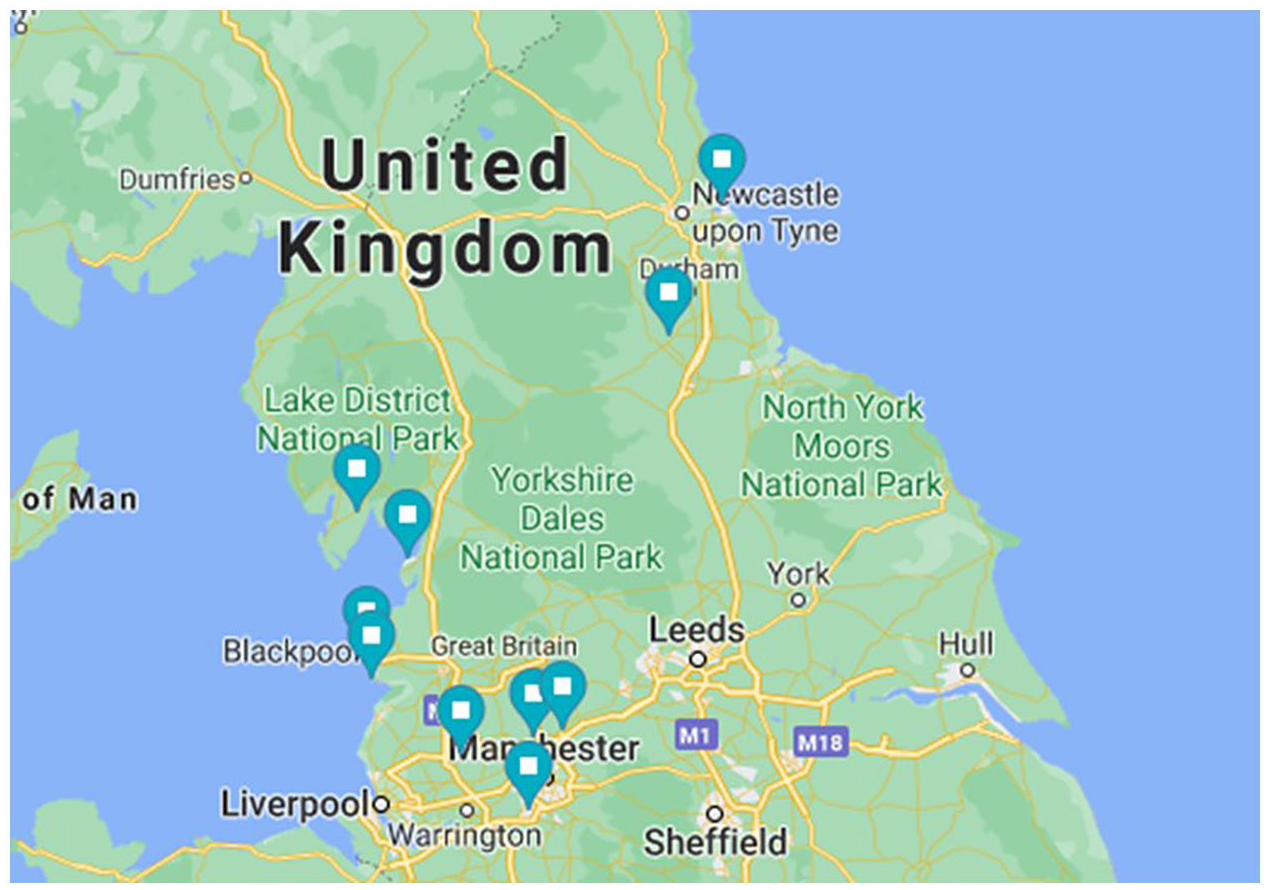
The location of the chosen statues. https://goo.gl/maps/xkN9h8QQYjq28W6h6.
The preponderance of such figures within the north of England also reflects the geography of popular cultural production in the United Kingdom and in particular the prominence of northern England – and the northwest with its powerhouses of Manchester and Liverpool – in making British popular commercial culture in the United Kingdom across the 20th century. In this selection, this can be seen in figures like the Lancastrians George Formby (Wigan) and Gracie Fields (Rochdale) who were respectively the highest grossing male and female cinema starts of the pre-war 1930s but also in the figure of Frank Sidebottom in Timperley, near Manchester, an exemplar of the insurgent post-punk counterculture that emerged from this region from the late 1970s.
The first of these statues, which heralded this phenomenon, was unveiled in Morecambe in 1999 (Figure 2). This statue depicts Eric Morecambe, born in the town in 1926, in the iconic pose associated with the recurring dance to the closing musical number of the long-running Morecambe and Wise show, ‘Bring Me Sunshine’. Morecambe is also wearing binoculars, reflecting the place of the sculpture in a broader public art project (the TERN project) which was part of a significant UK national lottery-funded regeneration of the seawalls of the town – that included decorating them with sculptures of seabirds. The relative success of this initiative – at least in terms of national and global attention for a pro-active local government – is a significant contribution to the cluster of statues located in neighbouring towns in the northwest. The use of the same sculptor (the self-styled ‘People’s Sculptor’ Graham Ibbeson (Threlkeld and Ibbeson, 2011), for several of these statues (Les Dawson, Victoria Wood, Laurel and Hardy and Morecambe and Wise) cements this impression, as does the explicit reference in local media coverage of new statues to this foundational example and its ability to ‘do for’ Bury, Rochdale or Ulverston what Eric Morecambe did for Morecambe. Here, we perhaps see an elision between the possibilities of nostalgia and economic boosterism enabled by alliances between local government appetite to deploy public forms or art in place-making (a policy strategy for making places liveable and visitable that emerged in the 1980s (see Dicks, 2003)) and local enthusiasts for the statue subject. The acknowledgement from such authorities that figures from popular commercial culture can be used to do that work, and their prominent place in longer term strategies of local and regional re-development, is significant.
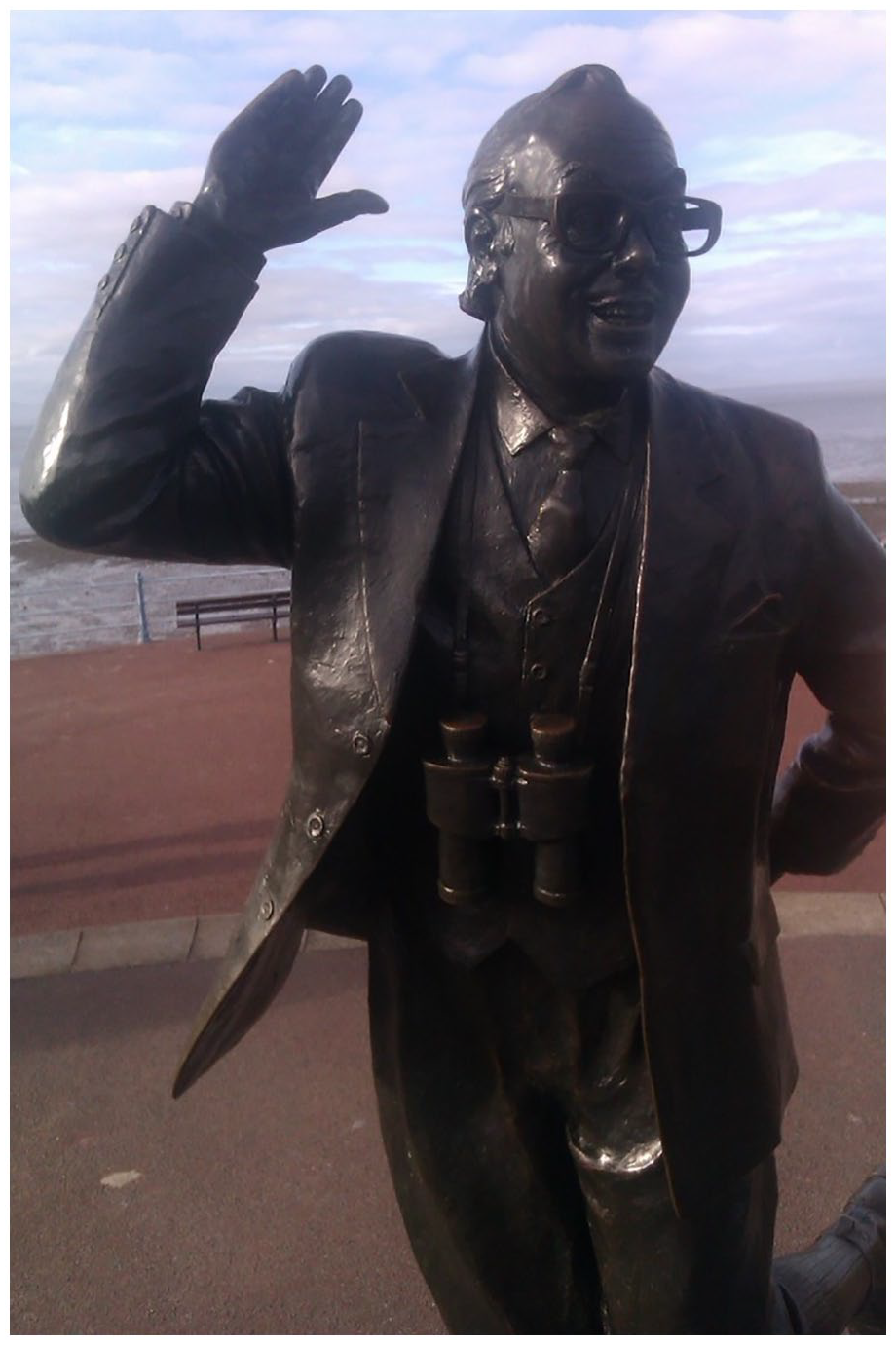
Eric Morecambe statue, Morecambe (artist Graham Ibbeson).
This can be seen in the siting of the statues themselves, which place these popular cultural figures with global and national reach at the heart of local civic life. In Ulverston, Morecambe, Lytham, Bury and Rochdale the statues are placed close to prominent local buildings and institutions, and they are the centrepieces of local strategies for civic regeneration (e.g. in front of the refurbished Coronation Hall in Ulverston, opposite the town’s museum in Bury, as a centrepiece of the redeveloped promenade in Morecambe, or on a plinth in the grand civic square in front of the town hall in Rochdale). These locations serve to emphasise personal connections with the place of origin that allow such figures to be claimed for local identity work, claims which are explicitly made in the civic ceremonies that accompany their unveiling and which feature prominently in local and national media coverage of these statues.
In the case of Eric Morecambe, this included unveiling by the Queen, and in the case of Les Dawson the ceremony was broadcast live on The One Show, the BBC’s flagship early evening magazine programme. In the case of Gracie Fields, the statue’s unveiling is a culmination of a longer campaign to recognise and acknowledge Fields’ relation in the town. The unveiling also acts as the launch of a ‘heritage trail’ identifying key sites in the town associated with Fields’ life there, including a plaque on the site of the chip-shop above which she was born, just 10 minutes’ walk from where the statue now stands. At the unveiling ceremony
5
in 2016 the historian, biographer and representative of the Gracie Fields Appreciation Society, Seb Lassandro, who had been instrumental in the campaign to fund and site the statue, alluded precisely to this in his speech, referencing the lyrics of Fields’ hit In a Little Lancashire Town. Here, he suggests, Fields was already expressing nostalgia for an imagined past. The lyrics refer to familiar tropes of welcoming doors left unlocked and the ‘ordinary folk’ that made up the community, as well as decrying the ‘chrome and neon lights’ that had transformed the local pub. Moreover, as Lassandro ironically notes, they also declare how ‘they’ve mucked up my Lancashire home. Where t’rubbish pit once used to be, they’ve bunged up a statue to me!’ Such self-deprecating ‘salt-of-the-earth’ positioning is central to the making of a national and global figure like Fields. Scholars of British film, for example (Mather, 2006; Richards, 1994) have argued for a significant role for the films of Fields and her contemporary George Formby in articulating a unifying sense of Englishness which transcended class or regional divisions. This was politically expedient, especially at a time of national crisis surrounding the Second World War. Fields and Formby, though, were also rather ambiguous figures, resolutely working-class and northern in their origins, whose films fore-grounded rather than denied the regional and class divisions of UK society. Featherstone (1995) suggests they epitomized the working-class sense of fun and capacity to mock and deflate pretentiousness. They had a strong sense of community and loyalty to place, and the retention of a local accent showed their unwillingness to lose their roots, and reinforced their apparent ‘naturalness’, which made them forever seem a Lancashire lad and lass at heart. (p. 104)
Evoking the social change of the past, in this light, acknowledges and ironizes the experience of the present. Such positioning explicitly re-connects the contemporary local with the national story and, in the case of Fields acts, as the leader of Rochdale council declares in response to the global reporting of the unveiling, as a significant reminder of the town’s significant cultural contribution.
I’m thrilled that our plans to honour Gracie Fields have captured the imagination in this way. Gracie was an international star, known and loved across the globe, and we’re so proud that it all started here in Rochdale. She’s an important figure in the history our town and it’s about time we honoured her properly in a prominent central location where everyone can see. (Sammon, 2014)
This sense of local connection is also evident in the case of the Victoria Wood statue in Bury, located at the heart of the town on a street that her brother – and key protagonist in the campaign for the statue – confirms at the unveiling she used to walk down on the way to school, and across the road from the library where, the speech from minister of the Unitarian church confirms, the young Wood stole books that she was too shy to borrow. The leader of Bury Council, Cllr Rishi Shori’s, speech
6
includes explicit reference to the local hospital in which Wood was born, the addresses where she lived and the schools she attended. Such details, along with her journey to university (in Birmingham) and then to London and stardom, in Wood’s case through appearances on the TV talent show New Faces, cement her place as a ‘real’ local figure and a resource for substantial civic pride, both in her origins in the town and her journey away from it. He describes an encounter with a resident in these terms, I was passing the site the other day and a lady stopped me to ask what is going on here. I told her about Victoria Wood’s statue, and she said, with real warmth, ‘Good. Victoria was one of ours’. That warmth was something that Victoria created universally, and she was one of ours, universally.
While claims to ownership of significant local figures have been a feature of memorial cultures down the ages, in these more contemporary projects it is the ‘ordinariness’ of the person and their origins as much as their celebrity that is mythologised and acts to re-enchant and include.
Such claims are heightened by the role of fundraising in local campaigns to site statues that allow local authorities to minimise the ideological risks of ‘tax-payer’ investment in public art, while demonstrating local democratic mandates for the identified tributes. The case of Frank Sidebottom (Figure 3) is especially instructive in this regard. As the councillor Neil Taylor, who was instrumental in the campaign to raise the statue, describes When the idea for a statue came about, we looked at a number of ways to fund it and thought, do we go for a Lottery grant, do we go for a grant from art foundations or whatever but we actually made a bit of a conscious decision to try and get the fans to pay for this, so one of the very unusual things for a piece of what will be “public art” is that it has been funded 100% by all the fans. (Quoted in Diffenthal, 2013)
Other figures commemorated in this way were of national and sometimes global regard. While Frank Sidebottom briefly reached these heights (with regular appearances on Saturday morning children’s TV and his own national TV show in the 1990s and a longer, regional broadcasting life) the career of his alter ego Chris Sievey was more ‘cultish’, including periods of relative musical success but also, as the Manchester exhibition dedicated to his life and work, Bobbins (2019) revealed, significant subsequent periods of unemployment and uncertainty. His life and persona then reflect a more complex narrative that is both edgy and counter-cultural (given his association with the independent music scene of the 1980s) as well as innocent, naïve and child-like.
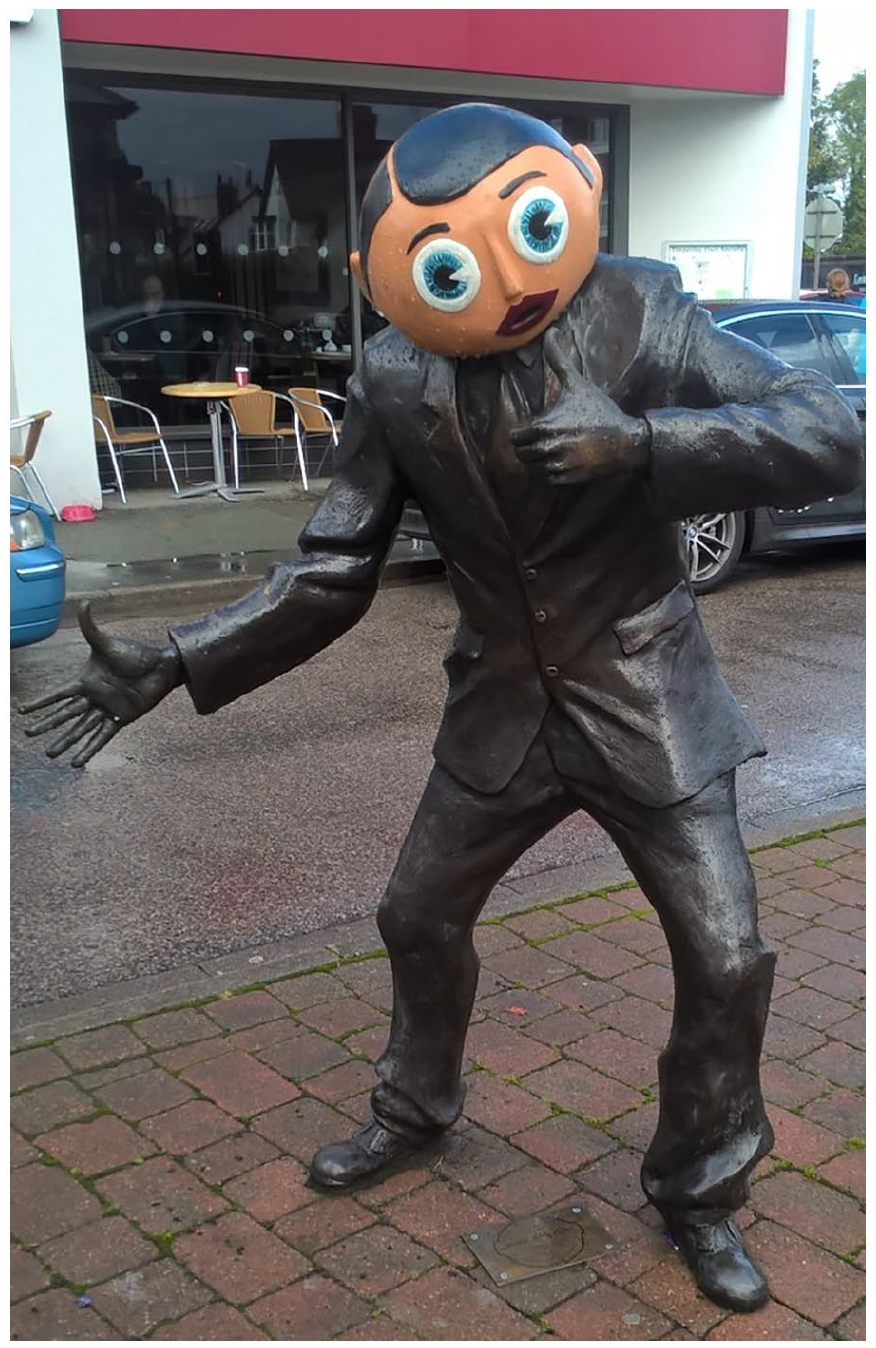
Frank Sidebottom, Timperley (sculpture by Pauline Skavova based on a cast from Colin Spoffey).
The Hollywood film inspired by his life, Frank (2014), is a parable of the risks of obsessive dedication to the purity of an artistic vision. These kinds of association perhaps marginalise simplistic instrumental economic motivations for a statue of this kind as an attraction for tourists or as an expression of an ‘official’ exemplary life. Instead, they allow for forms of celebration and recognition from a community that is aware of and comfortable with ambivalence. It also highlights the forms of negotiation required to have such a relatively obscure figure commemorated. As Taylor again describes, Unfortunately, trying to get a statue in place is a very tedious and boring process. A lot of the excitement went as we had to have meeting after meeting. You have to have a constitution. You have to write minutes and there are certain procedures that you have to follow. If you put a statue on public land, it has to be covered by the local authority. There are all kinds of legal loopholes. Who owns it? Who insures it? Would it cause danger on the roads? All kinds of stuff and, even for a councillor like me, it was a hugely tedious process. (Quoted in Muddles, 2014: 293)
This indicates a long-term commitment to the cause of getting Timperley ‘on the map’ through shepherding a project through the complexities of local and regional government. Navigating statues projects to success requires significant time and affective investment on behalf of local campaigners, as well as the persuasion of local authorities that the commemoration of such figures will bring some kind of social or economic benefit.
Conclusion
The addition of comedians–and other figures from popular commercial cultures–within an expanded category of the ‘memorialisable’ in the 20th and 21st centuries reflects a contested democratisation of culture in which such figures, embodying a previously illegitimate ‘mass culture’, can join the civic leaders of the past in articulating more inclusive, and celebratory senses of shared values and continuity. Such a move is really made possible by the development of media technologies which allow such figures to be present and significant in the daily lives of large audiences, and the aspiration to commemorate also reflects the historical passing of, and nostalgia for, the various cultural and media forms and the ways of life with which they were associated.
In the places where they are located, and in the specific context of a contemporary United Kingdom in which the political struggles over such places are characterised by their variously understood and produced ‘decline’, these statues importantly trouble an analytic distinction between public and private nostalgia. Figures like Les Dawson, Victoria Wood and Frank Sidebottom made great play of their northern-ness in the characters and caricatures that they produced, reflecting both the persistence myths of northern, working-class industrial or suburban life but also the role of humour in challenging and revealing the entrenched, and still broadly regionally patterned, class inequalities of English life. The play of language and humour in such work brought the ordinary and everyday onto the national stage in the context of the apparently unified audience of ‘mass’ commercial broadcasting. Comedy, as Medhurst describes it, is well placed to capture and narrate the tensions between belonging and division, in providing ‘a point of wholeness in a maelstrom of fragmentation, a chance to affirm that you exist and that you matter’ (Medhurst, 2007: 19). The emergence and rise of comedy within the popular commercial cultures of the United Kingdom across the 20th century also reflects movement from the ‘regions’ to the symbolic centre, and from towns to cities and to the metropolis which the careers and biographies of figures of this kind exemplify.
These are people with whom audiences have intimate affective relations by virtue of decades long appearances within their domestic spaces, appearances which are in some cases on-going. In the places where these figures were born and lived, and where their families have been directly involved in the campaigns to site statues (as in the cases of Frank Sidebottom, Victoria Wood, or Les Dawson) these relations can be augmented by memories of actual experiences of the people themselves, as school friends, neighbours, customers, facilitating recognition and claims to shared experience and ownership. In the contemporary political imaginary in which towns and their inhabitants are abjectified or caricatured as victims of inevitable change, the celebrations of the journeys of these figures indicates a reflexive claim for continuity and retrieval, acknowledging what has been lost as a basis for on-going solidarity, and recognising that such figures are a reminder that these places and the people within them, too crudely understood as ‘left behind’, have a place at the heart of the United Kingdom’s national story.
Footnotes
Appendix
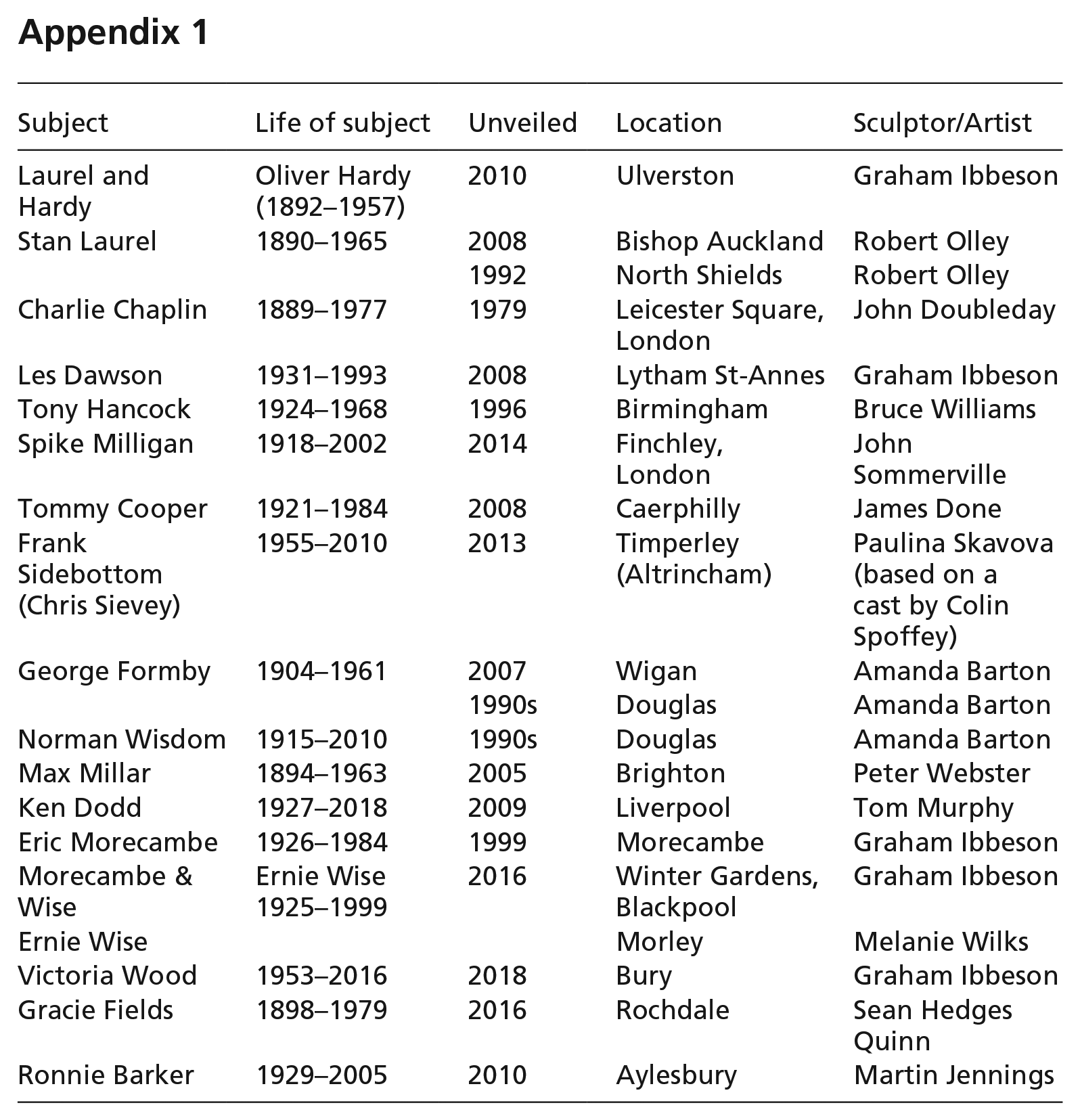
| Subject | Life of subject | Unveiled | Location | Sculptor/Artist |
|---|---|---|---|---|
| Laurel and Hardy | Oliver Hardy (1892–1957) | 2010 | Ulverston | Graham Ibbeson |
| Stan Laurel | 1890–1965 | 2008 | Bishop Auckland | Robert Olley |
| 1992 | North Shields | Robert Olley | ||
| Charlie Chaplin | 1889–1977 | 1979 | Leicester Square, London | John Doubleday |
| Les Dawson | 1931–1993 | 2008 | Lytham St-Annes | Graham Ibbeson |
| Tony Hancock | 1924–1968 | 1996 | Birmingham | Bruce Williams |
| Spike Milligan | 1918–2002 | 2014 | Finchley, London | John Sommerville |
| Tommy Cooper | 1921–1984 | 2008 | Caerphilly | James Done |
| Frank Sidebottom (Chris Sievey) | 1955–2010 | 2013 | Timperley (Altrincham) | Paulina Skavova (based on a cast by Colin Spoffey) |
| George Formby | 1904–1961 | 2007 | Wigan | Amanda Barton |
| 1990s | Douglas | Amanda Barton | ||
| Norman Wisdom | 1915–2010 | 1990s | Douglas | Amanda Barton |
| Max Millar | 1894–1963 | 2005 | Brighton | Peter Webster |
| Ken Dodd | 1927–2018 | 2009 | Liverpool | Tom Murphy |
| Eric Morecambe | 1926–1984 | 1999 | Morecambe | Graham Ibbeson |
| Morecambe & Wise | Ernie Wise |
2016 | Winter Gardens, Blackpool | Graham Ibbeson |
| Ernie Wise | Morley | Melanie Wilks | ||
| Victoria Wood | 1953–2016 | 2018 | Bury | Graham Ibbeson |
| Gracie Fields | 1898–1979 | 2016 | Rochdale | Sean Hedges Quinn |
| Ronnie Barker | 1929–2005 | 2010 | Aylesbury | Martin Jennings |
Funding
The author(s) received no financial support for the research, authorship, and/or publication of this article.
