




Abstract
This article aims to widen the discussion on destination images and imaginaries circulated via fictional movies and TV series. In particular, it analyzes how people living in film locations interpret media portrayals of their place of residence, which is an uncommon approach in the research conducted to date. To this end, an exploratory qualitative study was carried out in the city of Seville, Spain, which has appeared in multiple movies and TV series. Interviews were conducted with a heterogenous group of 23 residents and the data were assessed using a thematic analysis. The results illustrate the pivotal role of personal experiences of a place, or an absence thereof, in the decoding processes undertaken, as exemplified by the ways in which the interviewees interpreted the portrayal of local social issues and marginal areas of the city. The findings also uncover a desire to see a more diverse and accurate depiction of Seville on screen.
Introduction
The production and artistic team behind Game of Thrones (David Benioff and D.B. Weiss, 2011-2019) traveled to Seville in 2014 to film in the Real Alcázar. Residents and fans were excited to have the opportunity to observe and meet the actors, and even take a selfie with some of them (Marcos, 2014). Seeing the place where you live feature in cultural products can produce special memories and is often a source of pride. However, if a creator manipulates social realities and iconic elements, the opposite reaction may emerge. In his novel Digital Fortress (1998), the American author Dan Brown not only wrote that Seville’s ‘Clínica de Salud Pública [. . .] smelled of urine’, but also replaced the iconic 35 ramps up to La Giralda with a set of macabre stairs where tourists have supposedly fallen and died. Although the municipality knew the novel was a work of fiction, it nonetheless invited Brown to visit the city to ‘renew his knowledge and revise his opinion’ (Nash, 2012). This example not only demonstrates the importance to residents of media representations of where they live, but also their possible reactions to these depictions.
Media representations can shape perceptions of an area, its residents and the local culture, and the views of non-residents on destination images and imaginaries. This is an important issue because of the potential these portrayals have to influence decisions about travel and strengthen existing opinions about a particular place (see, e.g. Iwashita, 2006; Josiam et al., 2014; Loureiro and de Araújo, 2015; Rodríguez-Campo et al., 2011). Although tourists’ perceptions have been explored extensively in the literature, little is known about residents’ interpretations of how the place where they live is represented in fictional films and TV series (e.g. Parker, 2016; Wagemakers, 2017), even though it is they who must live ‘with the consequences of what image has been portrayed, and to whom the image has been portrayed’ (Heitmann, 2010: 39). Media representations of a place can have a transformative effect on its residents’ lives, whether by increasing the number of tourists, thus leading to overcrowding, or due to the commodification of the local culture (Kim and Park, 2021). Their views therefore merit investigation, especially in relation to cities that feature consistently in national and international productions, thereby attracting tourists who arrive searching for the locations they see portrayed on screen.
This article is a contribution to filling this research lacuna. Its focus is on Seville, which is typically represented in popular culture as a joyful and sunny place where there are regular celebrations of traditional events (Toscano et al., 2021). Moreover, Seville was named Lonely Planet’s Best City for 2018, and film tourism has been actively promoted via the project launched by the Andalucía Film Commission the same year: ‘Andalucía Destino de Cine’.
The goal of the study upon which the article is based was to explore qualitatively how the residents of Seville interpret media representations of the city in fictional movies and TV series. In delving into residents’ meaning-making processes, this article provides a double contribution. Firstly, it draws inspiration from and expands upon Liebes and Katz’s categorization of referential and critical readings (1990) by explicitly invoking the concept of self-referential readings to emphasize the impact of the residents’ subjective experiences of a place on their decoding processes. Secondly, the study applies the same concept empirically to uncover how some residents of Seville interpret media portrayals of the city.
Residents’ reactions to media representations of where they live
There has been some research into how the residents of a city or country interpret representations thereof in popular culture. Examples are Banaji’s (2010) comparison of the readings of those living both in and outside an area portrayed on screen and the anecdotal examinations of residents’ perceptions of film-tourism development and its effects by Chen and Mele (2017) and Mordue (2001). Unsurprisingly, these studies report that some residents do not appreciate portrayals of either decadent periods from the past, or stereotypical and idealized representations. These reactions are partly explained by this group’s awareness of the effects that media depictions can have on a destination’s image and the expectations of tourists seeking out film locations.
A literature review also revealed that analyses of how people perceive under-and misrepresentations of certain social groups can shed light on residents’ interpretations of media portrayals. A study conducted among members of London’s South Asian and Greek Cypriot communities revealed their frustration with mainstream broadcasting in Britain. According to Tsagarousianou (2001: 170), some residents believed their community was underrepresented and excluded and their ‘particular contribution to Britishness’ was unrecognized. In Brazil, La Pastina et al. (2014) described resentment toward the absence of some racial groups and socioeconomic classes in highly consumed cultural products, while members of Catalonia’s Roma community denounced how TV series represent them as problematic or prone to criminality (Tortajada, 2009). The relevance of these studies concerns the roles these kinds of media representations play in promoting othering discourses (‘us’ versus ‘them’) that may have a ‘spatial counterpart’ (Reijnders, 2016). Accordingly, those living in a city’s wealthy areas (e.g. the center in Seville) may regard a marginal area as part of the territory of the ‘other’ (e.g. Las 3000 viviendas) when watching movies located narratively in peripheric neighborhoods.
Despite these valuable contributions, there is a paucity of research that explicitly analyzes how residents interpret and react to portrayals of their place of residence in fictional movies and TV series. In one such study, contextualized in the Netherlands, Wagemakers (2017) noted the enthusiasm of Tilburg’s residents when the city appeared in a TV series that was broadcast nationally. Also documented were residents’ reactions to spatial discontinuities (bloopers; Torchin, 2002): although these had a detrimental effect on the viewing experience of some, others took pleasure in identifying these issues from their ‘privileged position of “being in the know”’ (Wagemakers, 2017: 95). The language used by a character or their accent also generated contrasting opinions: some appreciated the use of ‘Brabantish’, arguing that it made the series ‘more authentic’, but others ‘judged’ several of these attempts and thought they ‘missed the typical Tilburgian dialect’ mark (p. 92).
Finally, an interesting study of how residents decode media representations was conducted by Parker (2016) in Johannesburg. This not only analyzed how residents received movies shot in the city, but also how these representations influenced their everyday practices. While noting that having an in-depth knowledge of a place ‘can shatter the illusion of a simplified reality into an entirely fictional account’ (p. 203), Parker also referred to the process of viewing as an ‘act of exploration’ (p. 202) through which some residents travel to locations they had not previously visited in person (e.g. neighborhoods on the city’s margins).
In summary, while residents may react enthusiastically to media representations of where they live, resentment and frustration are also possible. Their awareness of the effects of these portrayals on tourism helps us to comprehend the importance assigned by some residents to media representations and, linked to this, the interest of some in participating in the creative processes involved in producing fictional movies and TV series (e.g. Póvoa et al., 2019). If we are to appreciate these decoding processes better, it is crucial to emphasize the role-played by residents’ experiences of place in how they understand media portrayals. Accordingly, the next sub-section introduces the concept employed in this empirical study, that is, self-referential readings.
Self-referential readings
Cultural and media studies’ scholars have both theorized and documented how individuals, in their role as active readers interpreting polysemic texts, can produce a wide (but limited) range of interpretations (e.g. Eco, 1987 [1979); Fiske, 1986; Hall, 2013; Livingstone, 2004; Morley, 1980, 2006; Thompson, 1998 [1995]). Factors like someone’s socioeconomic and cultural status, gender, ethnic group, knowledge of film-genre conventions and the reading context are all pivotal to understanding how they decode media representations (see, e.g. Livingstone, 1990, 2004; Thompson, 1998 [1995]). The Export of Meaning by Liebes and Katz (1990) is regarded as one of the landmark studies on meaning-making processes in media and cultural research. In it, the authors demonstrate empirically how the TV series Dallas was decoded by members of different sub-cultures, including the program’s target audience (i.e. viewers in the United States). Their use of the concepts critical reading/framing and referential reading/framing are important for understanding how those living where a movie or TV show is filmed decipher the location’s portrayals in the media. The book describes how residents discussed the show as an aesthetic project when they engaged in critical reading, with their focus on their awareness of, for example, genre conventions and the themes being treated. These critical thoughts required the readers to maintain a certain ‘distance’ from a text (p. 101). However, when they engaged in referential reading, they related the text to their real world, that is, their focus was on their own lives or those of other real people who were close to them. In this sense, referential readings can be linked to the concept of external perceived realism, which refers to perceived matches between what is represented and the actual world inhabited (Bilandzic and Busselle, 2011). Drawing from this, external perceived realism is therefore violated when a representation of a place is ‘inconsistent’ with a resident’s expectations and real experiences of it.
One of the arguments evoked by the notions of referential reading and external perceived realism in studies of how representations of place are decoded concerns the interactions between the ‘real’ place, its media portrayals, and someone’s experiences of it. However, the ‘authenticity’ of the actual world and a location differs per individual and, consequently, there is no ‘single, coherent’ reality and place ‘waiting out there to be filmed’ (Aitken and Dixon, 2006: 327). Similarly, those living where a movie or TV show is filmed may interpret media representations of the location differently to someone who has never been there and has no personal experiences of it. Likewise, even people who live in the same city might decode such representations differently based on, for example, the contrasting emotional relationships they have formed with various neighborhoods. Consequently, it is important to emphasize the role played by residents’ subjective experiences of the place they inhabit in how they decode media representations of it. To this end, the study expands on the categorizations of Liebes and Katz referred to above. This is achieved via the explicit use of the notion of self-referential reading, which is a kind of referential reading framed by an individual’s personal experiences in a place, as well as their formal and informal knowledge of and emotional responses toward it.
Unpicking the self-referential readings of residents involves revealing the ways they produce place, defined here as a ‘meaningful’ location (Cresswell, 2004: 7). In his seminal exploration, Lefebvre (1991) explains the notion of producing space by conceptualizing three types of interconnected dimensions: those that are perceived, conceived and lived. 1 In his own introduction to Lefebvre, Elden (2004) defines (1) the perceived or physical space as the real space generated, used and experienced through the senses; (2) the conceived or mental construct of space as the space of formal knowledge and logic; and (3) the lived or social space as the space of more informal and more local kinds of knowledge. The current study draws on Agnew’s conceptualization of place (1987; see Agnew and Livingstone, 2011; Cresswell, 2004) to argue that the lived space is also defined by the individual’s subjective experiences of and emotional attachment to it.
The three dimensions of space/place highlight how individuals decode media portrayals of their places of residence. Consequently, unpicking their self-referential readings means paying attention to their knowledge of the physical space, how they conceive it and live it, and how, based on all this, they decode the text presented to them. It also means identifying and examining the ways engagement with the physical place can change (or not) based on how the self-referential framings shape the readings. This requires a discussion of why residents decide to (re)visit or avoid a location after seeing it portrayed in a fictional text, and how these decisions might transform the three spheres of space/place mentioned above.
Methods
Any analysis of the ways in which the residents of a place interpret and value how it is portrayed requires a thorough understanding of how they think, why they do so in a particular way, and how they act, both individually and as part of a social group. A qualitative research method fit for this purpose is the group interview, which aims to stimulate discussions in order to help people to express themselves openly about complex issues and ‘bridge social and cultural differences’ (Morgan, 2011).
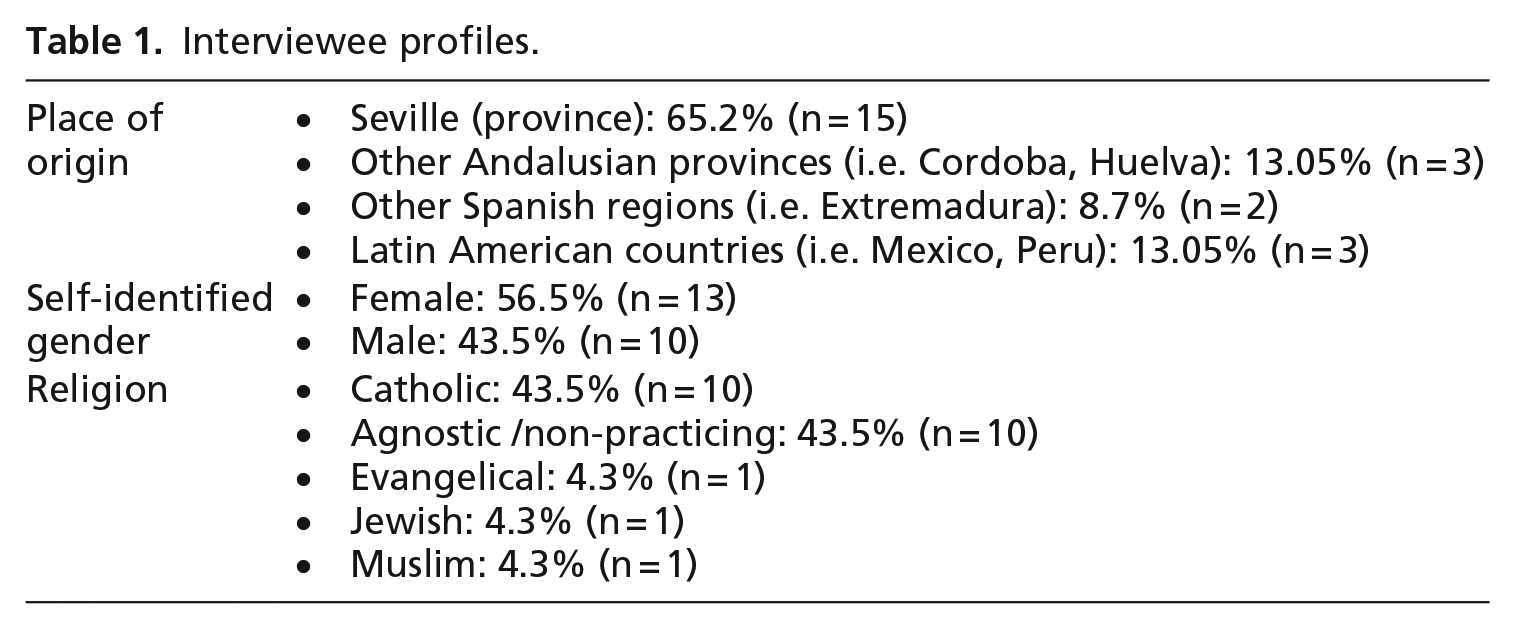
The multicultural nature of Seville, the relationship between ethnicity and socioeconomic status that exists there, and the ways these factors can shape an individual’s decoding processes meant that people of different genders and ages and from a variety of sociocultural backgrounds (e.g. ethnicity, nationality, religion) were invited to participate in the study. These interviewees were part of a group of more than 400 people who had been recruited for a broader research project, and had been invited to leave their contact details if they wanted to participate in future phases of the research. This mailing list was the starting point of the recruitment process, which involved a combination of purposive and snowball sampling. Different religious/social organizations were also contacted to ensure the diversity of the sample. This helped in the illustration of how critical, referential and self-referential framings shape our interpretations of media texts. From the initial group of 400, 23 people agreed to contribute to this part of the project. Table 1 contains some of the relevant data on these 23 interviewees, who ranged in age from 22 to 53 and were employed in a variety of occupations (e.g. call-center operator, tour guide, hotel receptionist, master’s engineering student). It is also worth noting that one of the interviewees self-identified with the Roma ethnic group, while the rest described themselves as Hispanic or as not belonging to any particular ethnic group.
Interviewee profiles.
All the interviewees met the following inclusion criteria: (1) they lived in Seville, (2) they were over the age of 18, (3) they had watched at least three movies or TV series shot in Seville before participating in the study, and (4) they were willing to (re)watch at least one of the following movies: Ocho apellidos vascos (Emilio Martínez-Lázaro, 2014), El autor (Manuel Martín Cuenca, 2017), or Adiós (Paco Cabezas, 2019). These were chosen due to their different narratives and locations. After watching at least one of them, the interviewees had to answer questions like: What do you think about the image of Seville as represented in these movies? Their responses contained an average of 377 words per interviewee (the total was more than 8,600 words) and were returned to the researcher for analysis via email. Along with the results of a literature review (e.g. Parker, 2016; Wagemakers, 2017), the insights gained from this material informed the creation of an interview guide that was used to prevent any unnecessary digressions.
There were six online group interviews (an average of 3.3 interviewees per group), as well as three one-to-one online interviews with those who were unable to join the group discussions. All the interviews were performed using the same interview guide. The responses to the questions produced data concerning: the residents’ opinions about the presence/absence of major landmarks in movies/TV series filmed in the city, stereotypical portrayals of residents; the perceived impact of genre conventions, and the potential of the representations to broaden residents’ experiences of the city. This knowledge was constructed through both interviewer–interviewee and interviewee–interviewee interactions, and was an important step in the process of reflecting on interpretations and identities.
The interviews were held in Spanish, had an average duration of 90 minutes, and allowed the interviewees to discuss matters other than the issues arising from the three movies referenced above. All the interviews were held on Zoom, save for one of the one-to-one discussions that took place on Whatsapp due to technical problems. In this case, the interviewee was informed of the need to provide detailed answers to the questions posed. Furthermore, and in order to stimulate the discussion in the three one-to-one interviews, the interviewees were asked to react to the opinions of their group-interview counterparts (e.g. ‘In another meeting, a resident said “.”.. What do you think?’). All the interviewees took part in the video calls from the comfort of home (e.g. sitting room, home-office). This not only enabled them to relax, but also provided the researcher with additional lifestyle information (e.g. whether there were observable decorations for local celebrations).
The information collected was examined via a qualitative thematic analysis consisting of six main steps, as proposed by Braun and Clarke (2006). The researcher familiarized herself with the data through multiple rounds of intense viewings of all the video files. The notes taken during this process allowed the direction of the analysis to be identified. Initial codes were then generated; for example, discussions on spatial representations of Seville were coded descriptively as: ‘landmarks: satisfaction’, ‘other locations: residents’ suggestions’, and ‘other locations: residents’ reasons’. These preliminary codes were reviewed to remove any potential repetitions, with those that remained clustered into possible sub-themes (e.g. ‘incorporating new filming locations’), which were later grouped into thematic patterns. For example, the sub-theme above and ‘recognizing residents’ diversity’ were clustered into the theme ‘A diverse image of Seville’. The resulting thematic structure was reviewed rigorously to refine the specificities of each theme and adjust the names assigned to them. Overall, the thematic analysis proved to be a ‘flexible’ and ‘useful’ methodology, with the potential to produce a ‘rich’, ‘detailed’ and ‘complex’ report on the data (Braun and Clarke, 2006: 78). To further understand the interviewees’ meaning-making processes, the statements in which they engaged in critical and self-referential readings were explored qualitatively. Critical was initially operationalized as the ‘ability to discuss programs as constructions’, with an awareness of aspects like genres, conventions and narrative schemes (Liebes and Katz, 1990: 115). Meanwhile, self-referential was used to refer to how the interviewees discussed the texts in relation to their own experiences of place.
Finally, it should be noted that reflexivity was employed throughout the research process (Guba and Lincoln, 1982), for example, by critically reflecting on the questions included in the interview guide, the ways the discussions were moderated and how the data were interpreted. Creating a social identity map, as proposed by Jacobson and Mustafa (2019), was valuable. In retrospect, it is clear that my identity as someone from north-west Spain was useful for distancing myself from the place and community under study, which I have never inhabited or belonged to. My identity also enabled me to relate to the discourses on the misrepresentations and/or stereotypical portrayals of Seville. Ethically, measures to protect the interviewees’ identities included the use of pseudonyms, as seen in the next section. Finally, the thematic analysis revealed two main overarching themes: ‘A diverse image of Seville’ and ‘The value of precision’, and these are elaborated on in what follows.
A diverse image of Seville
None of the interviewees expected to see a nuanced and holistic portrayal of Seville in a single text. However, based on their own experiences with place, most believed in the potential to diversify the city’s current image by incorporating new filming locations and expanding how residents are represented. To substantiate their views, the interviewees engaged in both critical and self-referential reading, as illustrated below.
Incorporating new filming locations
La Giralda, Puente de Triana and Plaza de España often appear in fictional movies and TV series filmed in Seville. Despite the satisfaction of many interviewees at seeing their city on screen, most emphasized that ‘Seville is more than that’. This conclusive statement demonstrated the connection made between the media representations and the interviewees’ experiences with and knowledge of the city. In fact, the comment led to suggestions of locations they would love to see on the screen because of the personal meanings they have at an individual (e.g. childhood memories) or a collective level (e.g. historical value of the proposed location).
These self-referential readings co-existed with critical statements whereby the interviewees reflected on the strategic use made of landmarks by movies and TV series. For example, some expressed their awareness of how La Giralda could help foreign viewers to locate a story in Seville. However, others, like Raquel, also criticized the distracting effect on how a movie is perceived of the use of landmarks to solely convey a conventional ‘coding of locale’ (Murphy, 2014: 39). To illustrate her point, she explained that the beauty of a scene shot below the Puente de Triana in El autor could divert the attention of viewers from a conversation taking place between two police officers. In other words, from her point of view, a movie’s settings should make a meaningful contribution to the narrative.
Other critical readings emerged from a more complex framing whereby the interviewees not only discussed the text as an aesthetic project, but also revealed an awareness of the convergent relationship between the audiovisual and tourism industries. In this vein, some, like Paula, argued that incorporating novel filming locations could contribute to the creation of ‘new symbols of the city’, while others, like Nadia and Daniel, proposed also presenting an image of Seville that goes beyond the current touristic version. Interestingly, the use of less common filming locations also fostered physical ‘acts of exploration’ (Parker, 2016: 202) among some interviewees. Lorena, for example, who was born in Seville, recalled visiting Plaza del Cabildo only after seeing it in El autor, describing how her memories of the movie are now intertwined with her own physical experiences of the place. This evokes the role played by media representations in the production of place and in contributing to the experiences that populate an individual’s self-referential framings.
Recognizing the diversity of residents
‘Cinema has done a lot of damage to our region. Cinema has given the rest of Spain clichés about us’, said Fernando. The interviewees in general indicated that, Sevillians, as well as Andalucians, are usually, and homogeneously, presented as lazy, poor, ignorant and dumb. They also emphasized their depiction as people who have mastered the Sevillana dance and have an unconditional love for the Semana Santa and La Feria festivities, even though the ways these are actually experienced are, unsurprisingly, conditioned by factors like the neighborhood lived in and residents’ places of origin. In reality, fictional movies and TV series barely acknowledge these differences, making the text unrelatable to some of the interviewees, as they highlighted when discussing the portrayals in relation to their self-referential framings.
Discussions on stereotypical representations of Andalucians and Sevillians (e.g. everyone takes a siesta) emerged naturally. It was possible to organize the interviewees into two main groups based on the type of statement they made. First, some described being ‘very tired’ and ‘fed up’ of stereotypical representations, no matter the genre of the production. These interviewees have, thus, prioritized their self-referential over their critical framings. The second group includes those whose awareness of genre conventions (e.g. comedy programs) made them more accepting of ‘exaggerated’ depictions and even laughed about them. Samuel, originally from Seville, felt ‘comfortable’ with stereotypes, because of how he engages in both critical and self-referential readings (e.g. having firsthand confirmation that not every resident likes bullfighting) when decoding such representations of the city and its inhabitants. Moreover, decoding a text from the self-referential and critical framing perspectives even added to the enjoyment of some. Raquel, Lucía, Samuel and Natalia, for example, discussed how 8 apellidos vascos portrays Sevillian characters humorously in ways that resemble or ‘characterize’ people they actually know or see around them, which was a source of amusement: Snob cortijero [the owner of a country house], with the chalequito [a jumper] covering the shoulders, the tight and colorful pants and the nautical shoes. I have friends like that! I think that’s why seeing it in a movie makes me laugh. (Lucía)
However, the impact of the lack of experiences of a place during the decoding process was what drove some, like Fernando and Paula, to request less stereotypical representations to mitigate the risk of some clichés becoming fixed in the minds of non-resident viewers or those with limited contact with the city. This concern echoes the findings of several studies which conclude that TV effects are more significant when those watching have limited access to direct information about a social group (see, e.g. Fujioka, 1999). Interestingly, Nadia, who originates from a neighboring region, harbored such a media-induced stereotype, describing how movies caused her to believe that Sevillians are always partying. Her perception changed after she had lived in different areas of the city.
The value of precision
As the name of this theme suggests, the interviewees overall expected that what they saw on screen would be largely consistent with their personal experiences and expectations. The relevance of this expectation is supported by, on the one hand, the contribution made by external perceived realism (i.e. the perceived match with the actual world) to the enjoyment of viewers (Bilandzic and Busselle, 2011) and, on the other, to the interviewees’ concerns about film tourists who seek out a reality that does not or no longer exists (see, e.g. Chen and Mele, 2017). The data analysis revealed that the interviewees not only decoded media representations based on their self-referential and critical framings, but also engaged in non-self-referential readings. As will be seen, this type of reading emerges when interviewees discuss representations of places they have never experienced directly (e.g. they know about them through word-of-mouth).
Congruence between diegetic and non-diegetic spaces
Most of the interviewees decoded the mobility of characters within a diegetic space (the space seen on screen) in relation to their personal experiences of it. In contrast to the enjoyment of some of Wagemakers’ (2017) interviewees when identifying what they knew to be bloopers (Torchin, 2002), the interviewees from Seville expressed their dissatisfaction with such manipulations of place. This is reflected in Paula’s complaint: ‘I need to relocate myself continuously’. In other words, they want topographical coherence (Penz, 2008). The mismatch between the socioeconomic background of the characters and where they have been located in the city had a similar distracting effect. Sara and Natalia, for example, said it was difficult for them to believe that the characters in El autor could afford to live at Plaza del Cabildo, which is a somewhat expensive area of Seville.
Another call for congruence came from the interviewees who had personal experiences of the city’s peripheric and marginal neighborhoods. Adiós, for example, which tells the story of a Roma prisoner involved in drug trafficking in Las 3000 viviendas, was criticized for misrepresenting the area and projecting a more decadent image. The filmmakers had achieved this by including locations that are actually situated in other parts of the city.
I had mixed feelings when I saw the neighborhood portrayed this way. [ . . . ] As for the story [of Adiós], the creator hit the nail on the head. We aren’t fooled: what the story reflects unfortunately exists. But, as for the movie’s locations, no. If you tell the story of a neighborhood, why don’t you only film it there, instead of in different places? (Manuel)
Two points must be made about how Manuel, who had lived in Las 3000 viviendas, decoded Adiós. First, his interpretation highlighted the role played by personal experiences of filming locations–the rest of the interviewees, who had mostly never visited the neighborhood, decoded the movie using non-self-referential framing based on media discourses and word-of-mouth. Second, Manuel engaged in critical reading by expressing his concerns about how these types of filming practice could reinforce the already negative image of Las 3000 viviendas. This again demonstrates how critical readings are able to go beyond discussions of texts as constructions (Liebes and Katz, 1990), incorporating reflections on the impact of cultural products on residents’ perceptions of parts of an area they inhabit and their mobility around the physical space.
In summary, most of the interviewees, particularly those who showed strong spatial awareness (e.g. those who took pleasure from wandering around the city or worked as tour guides) called for congruence between diegetic and non-diegetic spaces. However, it is worth noting that some also engaged in critical readings, illustrating their awareness of the dynamics of the audiovisual industry. Lucía, for example, hypothesized that the reason why the creative team for 8 apellidos vascos put a fake tablao (a place for flamenco shows) next to the River Guadalquivir was to enable them to include the landmark, and start and end the movie with impressive images of the city.
Accurate representation of local culture and the Sevillian accent
The interviewees who were born in and/or expressed a strong connection to Seville found it to be jarring when movies or TV series portrayed traditions from other Spanish regions as Sevillian. An example discussed was the Hollywood production Knight and Day (James Mangold, 2010), where Cameron Diaz and Tom Cruise drive their motorbike through the streets of Seville and Cádiz followed by a group of bulls and San Fermín bull runners, which is in fact a festivity celebrated in Pamplona (Navarra), a city almost 900 km away.
It’s nonsense, because it’s got nothing to do with reality. I think it reduces the movie’s value. Whether you want to tell one or another story, being faithful to where the movie is shot is fundamental. (Sara)
As this demonstrates, the interviewees’ self-referential framings were used as antecedents to their critical reading, through which the value of the movie was questioned due to the identified mismatch between the place lived and the place represented. A similar interaction between self-referential and critical framings was observed in the discussions about accents. Most of the interviewees who were born in Seville or other Andalusian provinces, or who felt very attached to the city despite being born elsewhere, emphasized how much they disliked hearing actors ‘forcing’ the local accent. These reactions align with Méndez’s (2009: 246) observation that the use of the Andalusian language by people from outside the community has always been experienced as an ‘offence’ in the area’s social context. In the present study, this type of objection primarily arose in relation to actors from other Spanish regions. Nonetheless, interviewees like Beatriz and Lucía also complained about performers from other Andalusian provinces who played Sevillian characters. As Natalia, who grew up in another Spanish region, emphasized: ‘People think that the Andalusian language has a neutral accent, and it’s not true’. This reasoning was why many of the other interviewees also stated that Sevillian roles should be given to Sevillian actors: It’s not that difficult to find Sevillian or Andalusian actors who can represent Seville. It seems like they underestimate the natural accent for fear that it won’t be understood, and they prefer to choose someone from outside who imitates it. I think it’s shabby and should be completely changed. (Lorena)
According to some interviewees, avoiding ‘exaggerations’ and treating the Sevillian accent with respect would increase how much local viewers identify with characters (this was especially the case for the interviewees who had lived in the area for a long period). It would also both improve the realism of the topics treated in text and prevent, as Mercedes highlighted, the ironic frustration of not being able to understand what a Sevillian character is saying. This, added Beatriz, could even cause viewers like her to just stop watching.
Finally, and expanding on the findings of La Pastina et al. (2014), who documented residents’ complaints about the underrepresentation of some socioeconomic classes in Brazilian cultural products, interviewees like Estefanía engaged in critical reading to request a greater presence of Sevillian actors from diverse ethnic groups like the Roma community: In Adiós, I don’t understand why they gave the main role to an actor who isn’t Andalusian and who, on top of that, isn’t even Roma [as the character is]. That’s even more shocking. Are there no good Andalusian Roma actors? Why aren’t they hiring them? (Estefanía)
Social issues on the screen
Critical readings also involve the dissection of the themes treated in movies and TV series (Liebes and Katz, 1990). In this vein, some of the interviewees believe that the portrayal of Sevillian social issues in such cultural products could not only increase public awareness of these problems (Henderson, 2007), but would also encourage people to reflect on the place where they reside. Consequently, critical framings in these circumstances would, at least to some extent, act as an antecedent for non-self-referential and self-referential readings. In other words, identification of the theme is then contrasted with people’s perceptions of reality and their personal experiences. The interviewees who expressed admiration for movies and TV series that portray depressed areas were primarily those who had experience of such neighborhoods in Seville and/or felt responsible for how the city as a whole is portrayed: The reality of Las 3000 viviendas is a reality that’s been stigmatized and subjected to interventions by countless NGOs that have tried to subvert the effects of this stigma (marginalization, exclusion, poverty. . .). But we need to include that reality as part of the society of Seville, otherwise we’ll also be a part of that stigma. (Carlos)
However, as represented by Susana’s view, the opposition of some interviewees to how social issues are depicted may be explained by their awareness of the role that media productions play in ‘selling the name’ of the city and attracting tourists. ‘Further highlighting’ the negative reputation of certain areas was another worry. Originally from Las 3000 viviendas and self-identifying as Roma, Manuel believed that these types of stories could reinforce residents’ negative views about places in Seville they have never visited, thus undermining their appeal. His concern was actually exemplified by a significant proportion of the interviewees who had rarely or never visited Las 3000 viviendas. As a result, they did not employ self-referential readings when decoding Adiós, but instead regarded the neighborhood negatively, as Manuel feared.
It depends on how real we see it as being. Because even if I haven’t seen myself in a situation like that, I can believe it (. . .) But I also believe that this is related to the prejudices we have. (Natalia)
As noted previously, TV not only has a significant impact on those who have limited direct knowledge of the people or places represented (see Fujioka, 1999), but can also play a pivotal role in a viewer’s informal learning processes. This is particularly the case when the content is perceived to be realistic (Buckingham and Bragg, 2004), as illustrated in Natalia’s comment above. The interviewees were also more likely to engage in othering discourses when a movie or TV series narrated a story that was alien to them socially, i.e. when they could only employ non-self-referential framings due to their lack of personal experience of that place. Beatriz, Mercedes and Daniel, for example, used Adiós’s focus on a Roma family from Las 3000 viviendas to establish a distance between ‘us’ and ‘them’, even though the neighborhood is not inhabited exclusively by members of the Roma community. Here, therefore, the space became an important element of the othering discourse (Reijnders, 2016): I don’t see this movie as representing Seville or its residents. Actually, the movie portrays a Roma ethnic group that lives in Las 3000 viviendas and may represent this neighborhood. I don’t understand why they included images from other parts of Seville that have nothing to do with Las 3000 viviendas. (Beatriz) I don’t think that this [what appears in Adiós] is Seville. (Daniel)
Like Beatriz, Sara agreed that Adiós does not represent the entire city of Seville. However, she appreciated the reference to a reality that, at the time of the interview, existed in Las 3000 viviendas. Originally from a peripheric working-class neighborhood, she acknowledged that the movie had piqued her interest in visiting Las 3000 viviendas, illustrating the role-played by media representations in motivating people to explore physically parts of the places where they reside that are unknown to them: [Adiós] made me wonder about this area [that was] so unknown to me and, if it wasn’t for how dangerous it is, I’d love to know if all the rumors are true. I really appreciate it a lot that they’ve depicted a reality that all of us know, but intentionally ignore. (Sara)
The interviewees’ sensitivity and firsthand experiences of Las 3000 viviendas became evident in the way some reacted to the representation of social issues on screen. Moreover, Sara’s comment highlights the effect fictional movies and TV series can have on the production of place by, for instance, sparking an interest in expanding their encounters with the physical place.
Conclusions
This study aimed to explore how the residents of Seville interpret how the city is depicted in fictional movies and TV series. Qualitative interviews were deemed to be effective to this end, with six online focus groups and three online one-to-one interviews conducted with a diverse group of 23 residents of Seville. The relevance of this issue is emphasized by both the multifaceted impacts of media representations on people’s lives (see Kim and Park, 2021), as well as the importance of involving residents in the academic debate about the destination-images presented in popular culture. The main findings are reported below.
First, the discussions on how to broaden the image of Seville revealed how the interviewees engaged in critical readings when referring to the role played by media representations in both helping foreigners to situate a story and attracting visitors. However, they criticized the sometimes superficial use of only the city’s major landmarks by content producers when creating a narrative (Murphy, 2014); instead, they believe that the addition of novel locations could improve the destination-image of Seville and contribute to the construction of new symbols. These arguments illustrate how critical framing goes beyond debating text as an aesthetic project; it also involves residents’ discussions of the convergence between the tourism sector and the movie and TV industries. Self-referential readings (which stress personal experiences with and feelings toward a place) emerged in the suggestions made about filming in locations the interviewees consider to be ‘unknown’ and unrepresented, but nonetheless worthy of exploration because of the historical and personal value(s) that they ascribe to them (e.g. through childhood memories).
Second, it became clear that, in their management of stereotypical representations of Seville, several interviewees took some comfort from the interactive process between their self-referential (e.g. where the interviewees contrasted the media portrayals with their own experiences), non-self-referential (e.g. contrasting the depictions with word-of-mouth knowledge) and critical framings (e.g. their awareness of genre conventions). Nevertheless, all the interviewees emphasized the importance of going beyond stereotypes and diversifying the ways residents are depicted on screen, thereby, at least according to them, reducing the risk of clichés about Seville becoming engrained in the minds of non-residents. Some interviewees reflected on their willingness to collaborate with creators to prevent the perpetuation of stereotypes (see Póvoa et al., 2019), with several making the suggestion that a diverse group of residents could advise production teams.
Third, the act of viewing became an ‘act of exploration’ (Parker, 2016: 202), through which some interviewees experienced virtually parts of their city they had not visited before. When this virtual exploration was driven by a fictional movie or TV series shot in a stigmatized area of Seville, they generally reacted in two ways. Some used the text to reinforce their negative opinions, which they constructed based on the media and word-of-mouth narratives that populate their non-self-referential framings. This was particularly common among the interviewees who (1) had never actually been to these stigmatized neighborhoods and had no interest in doing so, (2) engaged in an othering discourse, and (3) assigned (greater) importance to the impact that movies and TV series have on destination-images and travel decision-making. In contrast, other interviewees agreed that that these productions have the potential to both raise awareness of where they reside and spark curiosity about physical exploration. This point of view was common among those who (had) lived in peripheric neighborhoods or expressed a sense of responsibility toward Seville. Circumstances in which this curiosity leads to real explorative acts demonstrate the potential of cultural products to expand how people construct self-referential framings. These real explorative acts may also highlight the interconnected relationships between three levels of place: the physical, the mediatized and the lived.
Fourth, screen characters’ mobility within a diegetic space, the treatment of the local accent (cf., Wagemakers, 2017) and the representation of local traditions were primarily decoded in relation to the interviewees’ self-referential framings. The sense of misalignment between these and the media depictions they observed threatened the levels of enjoyment of some and even caused them to stop watching. These reactions were more common among the interviewees who had a strong emotional attachment to Seville and/or those with in-depth knowledge of the city.
This article has developed what is understood of how people discuss media representations of their place of residence, which has rarely been the subject of research in Spain. Placing residents at the heart of the study also widens the debate about destination-images and imaginaries circulated via fictional movies and TV series set in urban tourist cities. Given the role played by popular culture in travel decisions, film commissions should actively promote the use of new filming locations within an area and involve local communities in these discussions. Following Martin-Fuentes et al. (2020), such diversification could improve the flow of tourists in overcrowded destinations. At a conceptual level, applying Liebes and Katz’s (1990) categorizations to how media representations of place are decoded highlighted the importance of differentiating between two referential-reading levels: self-referential and non-self-referential. These, though evoked by Liebes and Katz, are not employed explicitly in their analysis. Nonetheless, utilizing these concepts was valuable when decoding how my interviewees interpreted representations of place, for example how they read the portrayal of Las 3000 viviendas in the movie Adiós. Those with personal experience of the neighborhood were more critical of the movie and more sensitive to how the area was depicted. Conversely, the interviewees without such personal experiences were more inclined to take the movie at face value (see Fujioka, 1999) and engage in othering discourses ( ‘us’ vs ‘them’) about locations they had not, or had rarely, visited. Furthermore, in order to validate their interpretations, most of these interviewees turned to the secondhand experiences that populate their non-self-referential framings (e.g. word-of-mouth). The results of the thematic analysis of the interview data also helped to expand the notion of critical framing by incorporating discussions on the convergence between the movie and TV industries and the tourism sector.
Finally, despite the richness of the data obtained from a diverse group of interviewees and, as a consequence, the contribution the study makes to the field, it is acknowledged that the use of certain qualitative approaches runs the risk that ‘the vividness’ of the anecdotes and examples is mistaken ‘for their general applicability’ (Morley, 2006: 106). Accordingly, further research is required to validate the findings. This future work could replicate the study in other Spanish cities or even other countries. The issues raised could also be explored by interviewing individuals who were born in a study’s setting but now live elsewhere, thereby enabling further refinement of the concept of self-referential framing.
Footnotes
Acknowledgements
I am grateful to Stijn Reijnders, Teresa de la Hera, Amanda Alencar, Lothar Mikos, Deepesh Toshniwal and other colleagues at ESHCC for their feedback on an earlier draft of this article. Thanks also to the participants for the time and energy that they put in this research project.
Funding
The author(s) disclosed receipt of the following financial support for the research, authorship, and/or publication of this article: This investigation was funded by the European Commission through the H2020 Marie Skłodowska-Curie Actions. Grant number 843473.
