




Abstract
Marxist feminist Silvia Federici has identified the figure of the witch as exemplifying a non-capitalist worldview. While Federici’s analysis has significantly nuanced understandings of primitive accumulation, its significance for traditions of magical healing remains to be studied. While Federici focuses on the violent campaign against witchcraft in Western Europe, she does not deal with those people who still practice ways of healing glossed as ‘witchcraft’ or ‘magic’ in the present, which have been largely subsumed by the academic discipline of folklore. As the Ottoman Empire was exempt from the early-modern witch craze, the ongoing practices of magical healing found in Serbia and Macedonia provide a particularly rich site for such an investigation. Grounded in ethnographic research on incantation-based healing practices in the Balkan region, this article reveals the contemporary significance of vernacular healing practices in cultivating a relational view of the body. While folklorists have anticipated the death of these practices since the 19th century, the continuation of these practices in the Balkan region tells us that these premonitions of cultural death did not come to fruition. By revealing the false distinction between the social body, the physical body and the mind, healers recognize the body as not only a sack of organs, but as a historical subject embedded in a specific set of material relations. Health is constituted not only by the absence of disease, but by intersubjective relations with the natural world and an ongoing obligation to act ethically toward the dead, toward one’s neighbors and toward future generations. Refusing to accept a vision of time and history that regards incantations as archaic, the dead as foreign and the village as the site of the past, the healing practices discussed in this article provide a fertile agenda for revolutionary planning.
‘Above all, magic seemed a form of refusal of work, of insubordination, and an instrument of grassroots resistance to power’. ‘Comradeship creates a shield against the witch hunters who will try to catch us one by one, but who will never destroy the whole set of alliances that make up the Great Sorcery International’.
The body’s inclination to be among other bodies renders us all vulnerable. This vulnerability, however, is constituted in degrees and the gulf between degrees of vulnerability constitutes a significant mortal boundary. While we can all transmit and contract diseases, the mortality of disease is dictated by what Judith Butler (2015) has called the body’s vulnerability ‘to economics and to history’ (p. 148). The social construction of immunity and health is not just theorized, but starkly felt. While our bare bodies may be equally vulnerable to novel viruses, the bare body exists only as an abstraction. Real bodies have organs, varying access to capital, and are subject to varying degrees of exploitation.
The sociality of illness and health is not news to much of the world. Knowledge systems around the world recognize disease as not merely pathogens discovered in labs, but also as the betrayal of social bonds. In this article, I take up the issue of the political life of health and sickness by looking at the practice of vernacular, incantation-based forms of healing in rural villages in Serbia and Macedonia. Across the entire Balkan region, one can find women and men – usually elderly – who use incantations to heal people. In Bosnia, Macedonia and Serbia, these practices are known variously as bajanje, baenje, vračanje, gatanje and čaranje. These healers treat problems ranging from evil eye to skin infections to difficulty finding a lover. In addition to performing incantations, healers also offer services including lead melting, bathing rituals, plant medicines, seeing into the future and communicating with the dead. While there is a whole repertoire of terms for magical and incantation-based healing in Bosnian-Croatian-Serbian (BCS) and Macedonian, I use the term ‘bajanje’ in this article to encompass all incantation-based healing practices in the region, including certain actions that may not be incantation-based, but which healers view as contiguous with their incantation-based work. 1 Bajanje healers practice according to healing frameworks they either inherited from a grandmother or mother-in-law, or which they received through dreams. In addition to these basic parameters, the only other stable element of bajanje is that there is no fixed price for services. Each guest that comes to receive healing gives however much money they want or are able to. Beyond this, each healer’s practice is unique. Some healers are well-known and earn a good living by practicing bajanje, while others may only perform bajanje informally for family members and neighbors.
People have been practicing these forms of healing as far back as the written record goes. Since the turn of the 20th century, however, these healing practices have been publicly written off as superstition. By using the term ‘bajanje’ to refer to a repertoire of practices that are usually taxonomized separately into divination, incantations, and magic, I seek to build an analysis of what Macarena Gómez-Barris (2017) calls ‘submerged perspectives’ (p. 1), which lie beneath the capitalist modern worldview. Pushing back against the gendered stereotyping of vernacular cultural practices as ‘superstition’, I demonstrate how bajanje practitioners negotiate narratives of erasure and irrelevance. I specifically examine how healers resuscitate the historicized folk healer in order to carve out new modes of relatedness through a technique that I refer to as ‘palpating history’. In discussing the practices of these healers, I recognize bajanje as a revolutionary practice of care, which maintains communities’ relationships to local plants and animals, strengthens social bonds among members of the community – including ancestors and future generations – and validates women and elders in rural communities as expert keepers and producers of knowledge.
Producing and consuming the folk
As an object of study, bajanje has traditionally belonged to the discipline of folklore. We can trace this disciplinary genealogy back to one of the first published references to bajanje, which was made by Vuk Stefanović Karadžić in the early-19th century. 2 Known popularly as the ‘father of the study of Serbian folklore’, Karadžić came of age during Serbia’s struggle for independence from the Ottoman Empire and he has since stood as a central figure in Serbian nationalist mythology. His earliest references to bajanje are in his Srpski rječnik (Serbian Dictionary), published in 1818. In this dictionary, which was part of Karadžić’s project to create a standardized Serbian orthography, we find entries for ‘bajanje’ as well as associated terminology (‘bajalica’, meaning conjurer; ‘vračanje’, meaning divination; ‘vračar’, a term for a diviner; ‘gatanje’, listed as a synonym of vračanje, etc.). In the entry for ‘bajalica’, Karadžić (1818: 17) defines the term in German (die Zauberin) and in Latin (incantrix) and then provides an example of a bajanje ritual for weddings, which involves cabbage, bacon and an accompanying incantation. Karadžić treats bajanje as a very minor folklore tradition within his oeuvre, which includes 10 volumes of folk poetry, two volumes of short stories, an anthology of proverbs, among many other linguistic and ethnological publications. His most sustained attention to incantations is in his posthumously published Život i običaji naroda srpskoga (Customs of the Serbian People), where he devotes the final chapter to ‘djevojačka vračanje’ (girls’ divination) in the Srijem (Syrmia) region (Karadžić, 1867). In this chapter, Karadžić documents the nine-step process of using magic to find one’s soul mate, including prayers and ritual actions that must be performed on certain days of the week at certain times of day and in accord with certain phases of the moon. While Karadžić was much more interested in epic poetry than in healers and their incantations, his inclusion of bajanje reveals the compatibility of bajanje-as-folklore with the early Serbian nationalist movement.
Karadžić’s nationalist folklore project was heavily influenced by German Romantic thought. In accordance with the writings of Johann Gottfried von Herder a half-century earlier and in dialogue with his contemporary Jacob Grimm in Germany, Karadžić promoted the peasant as the ultimate symbol of the nation. His dictionaries and poetry anthologies became extremely popular both within Serbia as part of the budding nationalist mythology (now a hegemonic narrative) and abroad. With translations of Karadžić’s oral narratives published by Grimm, Johann Wolfgang von Goethe, Alexander Pushkin and others during the 19th century, European intellectuals developed an appetite for the folklore of the Balkans (Ćorović, 1938: 673; Kropej, 2013: 224; Pavlović and Atanasovski, 2016: 361; Wachtel, 1998: 32). As this oral literature stimulated the palates of the European literati, Karadžić’s work also earned the study of Serbian folklore a special place within European and American universities. The 20th-century cornerstone of Karadžić’s influence is Albert Bates Lord’s (1960) ‘Oral Formulaic Hypothesis’, which he based on Milman Parry’s view of the Balkan guslar 3 as the last living descendent of the Homeric epic poet (Foley, 1988, 1990). Their theory of oral composition has been formative for not only the study of Balkan oral poetry, but also the study of bajanje incantations by US scholars (Foley, 1992, 1995, 2002; Foley and Kerewsky-Halpern, 1976; Kerewsky-Halpern, 1983, 1985, 1989; Kerewsky-Halpern and Foley, 1978, 1979) and the study of oral charms on an international scale. 4 The darling of the Serbian nationalist imagination and the Euro-American study of oral composition, Karadžić initiated two centuries of scholarship on the oral traditions of the Balkans.
The popularity of Karadžić’s anthologies of oral poetry among not only scholars, but also among the intelligentsia and urban bourgeoisie more broadly can be explained by what Richard Bauman and Charles Briggs call folklore’s invention of the ‘Great Divide’. Dating back to the work of Jacob and Wilhelm Grimm, the Great Divide designates an insurmountable epistemological border between the folk subject and the modern subject (Bauman and Briggs, 2003: 222). In the training and refinement of modern subjectivity, the modern subject was encouraged to travel from the metropole to the countryside by reading folklore and travel literature (Pratt, 1992; Todorova, 2009; Wolff, 1994). We see this logic at work in Karadžić’s anthologies, which circulated throughout Europe as folk poetry, and we later see this same logic governing the publication of bajanje anthologies throughout the last century.
The turn of the 20th century witnesses the first sustained wave of scholarship on bajanje.
Starting in the 1880s, the Bulgarian journal Folklore and Ethnography Collection (Sbornik za narodni umotvorenija nauka i kniževnina, or SbNU) began to regularly publish scholarship on bajanje practices in Macedonia. Articles published in this journal in the 1880s and 1890s include transcriptions of incantations as well as herbal and magical remedies for both humans and animals. A number of articles were also published in the journal Zbornik za narodna život i običaje južnih slavena in Croatia (Horvat, 1896; Strohal, 1910; Zorić, 1896), Glasnik Zemaljskog muzeja and Bosanska vila (Trifković, 1886, 1897) in Bosnia and Herzegovina (Grðić-Bjelokosić, 1896; Marković, 1892). Shortly thereafter, monographs on bajanje began to be published by scholars across the region including Stanoje Milatović (1909), Josip Matasović (1918) and Tihomir Ðorðević (1938). Rather than analyses of the practices, these monographs and articles primarily document and taxonomize folk sicknesses, remedies and incantations as they were observed in Bosnia, Croatia, Macedonia and Serbia at the time.
This documentarian approach would persist into the next century of scholarship on bajanje and its correlate practices, but with increased attention given to symbolic and linguistic analysis. Ljubinko Radenković (1973, 1982, 1983, 1996), the most well-known contemporary Serbian scholar of bajanje, has transcribed thousands of incantations in his anthologies, which, while serving as fascinating oeuvres, too-often omit information about bajanje’s performative and humanist elements, and alienate bajanje’s linguistic content from the lives and bodies of bajanje practitioners. Radenković’s work paved the way for sustained collections of bajanje incantations and catalogs of folk beliefs throughout the 1980s, 1990s and early 2000s, which utilize linguistic and symbolic analysis to explain bajanje’s significance (e.g. Durlić, 1987; Gacović, 1986, 2002; Radovanović, 1997; Stanimirović, 1993; Zlatanović, 1982).
Epistemic violence and the status of the witch
The linguistic study of bajanje situates incantations alongside the genre of oral epic poetry, offering an esteemed, if provisional, status to the practice of bajanje. However, the linguistic focus of most bajanje scholarship has also resulted in the practice’s objectification and fetishization. In her article on vernacular lead pouring in postsocialist Bosnia, Larisa Jašarević (2012) critiques scholars’ excessive ‘[concern] with signification’ (p. 915), because it occludes bajanje’s practical medical – not only magical – function. By textualizing incantations and cleaving them away from the people who continue to facilitate and participate in the practice, the folkloric treatment of bajanje becomes about consuming bajanje as a text. As publishers promote bajanje anthologies as an exotic folk fetish to the urban intelligentsia, they deny the contemporaneity and vitality of the folk worldview and further cement the epistemological gulf between the village and the metropole (Bauman and Briggs, 2003: 222).
Johannes Fabian (2014) has defined this epistemological gulf as the ‘denial of coevalness’ (p. 31). As the village is affirmed as the geographic periphery of Balkan metropoles, that periphery is also represented as the space of the past. We see this temporal distancing in analyses of bajanje that employ phrases such as ‘ancient’ (Lilek, 1894), ‘ageless and timeless’ (Kerewsky-Halpern, 1983: 312), ‘archaic’ (Petreska, 2008: 40; Risteski, 2005: 141), and with some surprisingly ‘“modern” elements’ (Vivod, 2009: 241). By the 1890s, scholars were already classifying bajanje, gatanje, vračanje and čaranje as ‘ancient beliefs’ (Lilek, 1894). All of these temporal signifiers are intimately connected to claims about bajanje’s value and veracity. In his book on Macedonian folklore and myth, Kiril Penushliski (1996) has written that the power of bajanje is only recognized ‘in the eyes of the ignorant, superstitious man’ (p. 137). In scholarship on bajanje, ‘superstition’ serves as the foremost mechanism for denying coevalness to bajanje practitioners and participants.
The dismissal of bajanje as superstition automatically privileges the subject position of the scholar above the position of the healer, invalidating the healer as a producer of knowledge. While bajanje can be recognized for its aesthetic contributions to oral tradition, it cannot be accepted on its own terms. By defining bajanje as simultaneously ignorant, primitive, timeless and sometimes surprisingly modern, these scholars execute a chronopolitical maneuver which denies epistemic sovereignty to vernacular healers. I do not highlight these examples to invite their condemnation, but rather to demonstrate that this type of temporal and evaluative language is ubiquitous. Although some recent scholarship departs from this temporal framing or from the folkloric paradigms of decoding incantations’ and healing actions’ symbolic meanings, 5 one could open practically any book or article written on bajanje over the last 150 years and find this type of Great Divide rhetoric with varying degrees of evolutionist qualification.
The figure of the woman healer and the figure of the witch have intimately intertwined – and sometimes indistinguishable – histories. The bajanje healer occupies a middle zone between these two categories, with her plant medicines typifying the ‘healer’ and her incantations and rituals typifying the ‘witch’. In her book Caliban and the Witch, Marxist feminist Silvia Federici has sought to explain the logic behind the progressive disqualification of the knowledge of traditional healers and witches in Europe since the early-modern period. Her foremost conclusion is that the dispossession of women healers under the guise of the witch trials constitutes a major example of primitive accumulation during the transition to capitalism. The plundering of the natural world and the violent exploitation of workers is irreconcilable with the healer’s more animistic worldview. Thus, Federici argues that the conflict between these two worldviews resulted in the violent campaigns waged against women in Europe known as the ‘witch craze’, which she argues also informed the genocidal violence committed against Indigenous people and enslaved African people during the conquest of the Americas. While Federici’s argument has been critiqued for using inaccurate casualty figures from the witch craze, 6 there remains a significant historical correlation between the effort to invalidate women’s healing and magical knowledge in Europe and the campaigns of epistemic violence in the Americas (and eventually the majority of the world outside Europe), as demonstrated by the arguments of Patrick Wolfe, Johannes Fabian and others. 7
In the Yugoslav region, witch trials formally began in Croatia in 1360. The witch hunts in this region were known as being particularly brutal. Accused women were regularly tortured and burnt at the stake (Vukanović, 1989: 9). Article Ten of the 1609 Croatian Assembly ‘empowered all citizens of Croatia to search for witches and to hand them over [. . .] for punishment’. Those accused of witchcraft were charged with making pacts with the devil, provoking weather events, causing ‘sickness and deaths in human beings and in animals’, and magically stealing milk from other people’s cows. A woman could even be accused of witchcraft for cursing at thieves who stole from her, if they later became ill (Vukanović, 1989: 10). Despite the brutality of these witch hunts, magical healing practices can still be found in Slovenia and Croatia, as illustrated by the excellent ethnographic scholarship of Mirjam Mencej. On the other side of the Habsburg imperial boundary, the Ottoman Balkans did not participate in the European witch craze. Perhaps because of this, the practice of bajanje remains somewhat more common in rural villages in the region, though witchcraft, divination, herbalism and associated healing practices still came to be invalidated as superstition and treated as curiosities by folklorists in universities and museums.
Recently, bajanje and related magico-healing practices have come under increased scrutiny by the state. In 2016, Serbia passed a law banning ‘superstitious’ practices. Anyone found to be dealing with ‘vračanje (divination), fortune-telling, dream interpretation and similar deceptions’ is subject to fines from 10,000 to 50,000 dinars or penalties of up to 120 hours of community service (Radio Television Serbia, 2016). No doubt, this law was passed primarily to criminalize Roma women. Roma women have long been subjected to negative stereotypes about magic and witchcraft (Pop-Curşeu, 2014). 8 Maintaining magical lineages – after forced migration and/or in isolation – marks the people who practice it, in the case of Roma healers, and in the cases of the Vlach and Bosniak healers in this study. 9 This article exposes how the normalization of ‘superstition’ as a descriptor of magical practice denies epistemic sovereignty to those people who have practiced these forms of healing and divination for centuries.
Federici argues that women healers were targeted for eradication during the transition to capitalism, because the irrationality of magical practice conflicted with the rationality of waged labor. Having close, non-extractive relations to natural elements, access to power that could not be acquired by will or force, and the ability to be in multiple places and times at once all interfere with processes of primitive accumulation and the rationalization of the work process. Oxana Timofeeva (2019) describes the criminalization of traditional healing knowledge as an attack on epistemic sovereignty, which ‘chased out magic, queer, female, and animistic lifestyles, just as, in Foucault’s analysis, it excluded madness’. In the next section of the article, I will present three case studies, which demonstrate the healing and epistemic strategies of bajanje healers in Serbia and Macedonia. In their practices, healers palpate and transform violent modern or colonial histories and conceptions of nature in order to resuscitate bajanje’s social model of sickness and healers’ intimate relations to plants, minerals and ancestors.
Case study #1: Selma
For a total of 18 months from 2016 to the end of 2019, I conducted interviews and participant-observation research with bajanje healers in Macedonia and Eastern Serbia. 10 Research participants’ ages range from 20 years old to nearly 90 years, though the majority are at least 50 years old. These healers come from Vlach, Macedonian and Bosniak ethnic backgrounds, from both Orthodox Christian and Muslim religious backgrounds, and they all live in rural villages. Each healer’s practice incorporates incantations in some way, though they each have a different repertoire of remedies that they perform and prescribe.
To understand how bajanje healers cultivate relationships with natural elements, such as lead, water, coals and plants, I will first share a healing practice from Macedonia. Selma 11 is a Bosniak healer originally from a city in northern Bosnia who moved to a village in the Petrovec municipality of Macedonia when she married her husband in the early 1980s. A fourth-generation healer, Selma has practiced bajanje since she was 20 years old. Today, she sees around 20 people per day and up to 70 people on weekends, some of whom travel from other countries to visit her.
Selma specializes in salivanje strave – literally translating to ‘melting the fear’ – a lead melting divination practice known across the Balkan region from Bosnia to Turkey. In her practice, Selma melts lead in a small outdoor stove. As the lead begins to melt, Selma cuts through it with a hand sickle. She says she has to use this sickle, because it can cut through everything bad (Figure 1). She then pours the molten lead into a pot of cold water, where it freezes into a solid form. She proceeds to read the figures in the lead similarly to how one would read coffee grounds or tea leaves. Chaotic, protruding shapes in the lead indicate the presence of strah, or fear, while flat, compressed images indicate the presence of uroci, or evil eye. 12 After pouring the lead two times, a piece breaks off in the water. Selma wraps up this piece of lead in newspaper and gives it to her guest to keep under their pillow. She then instructs them to wash themselves twice a day with the water that was used during the reading, which she pours into an empty soda bottle. When the bottle of water is empty, the guest must throw the lead piece into a moving body of water.
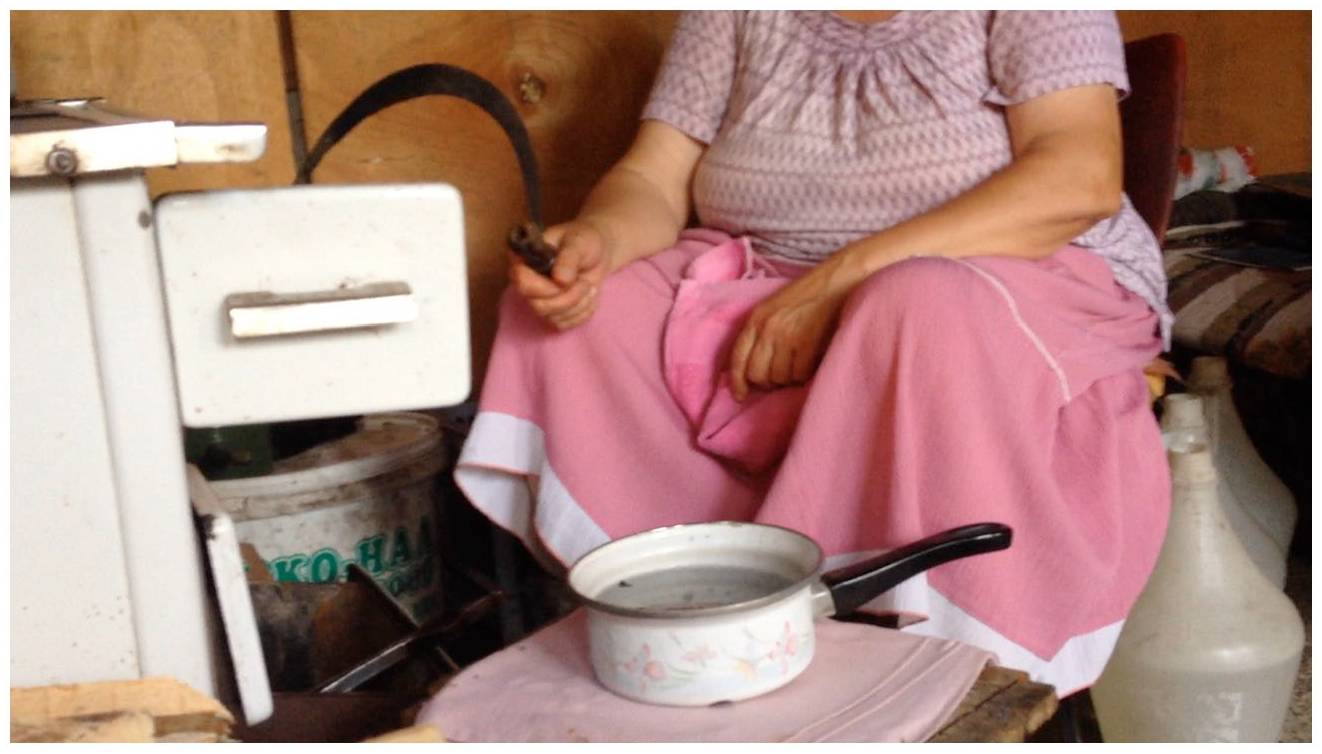
Selma uses a sickle to cut up molten lead in the stove.
Salivanje strave healing is a critical example of the body’s ‘irrational’ relation to natural elements within the bajanje worldview. As Selma melts the leads, freezes it and ultimately watches a piece break off, the unpredictable nature of the process is what yields its insights. Selma never forces the lead to melt in a particular way nor does she break pieces off of the lead manually. Rather, she observes, listens to and speaks with the lead. Before beginning the melting process, Selma first asks her guest to blow on the metal, because she says breath allows her to ‘feels what you have inside’. By relating to lead, Selma is able to establish social relations with both the lead and her guests. These social relations extend also to the coals and water. Before Selma says which problems afflict her guest, she drops some burning embers into a pot of water. Watching the way that the embers fall in the water and the quality of the steam produced, Selma engages with the raw knowledge that she received through her guest’s breath. She refers to this phase as ‘learning’. None of the words that Selma uses to describe her salivanje strave practice ever suggest relations of producer–consumer, commodity production or even property ownership. Rather, by using the language of ‘feeling’ and ‘learning’, Selma demonstrates a mutable and contingent relationship between herself and the natural materials that she uses to heal.
During a salivanje strave session in 2016, Selma reads lead for a young person and tells her guest that they are suffering from uroci and strah. The uroci, Selma says, is causing headaches and problems with the legs, while the strah is causing uneasiness, nervousness and stomach problems. She attributes strah to stress. Selma tells her guest that they have a good soul. She tells them that they think of everyone else first and put their own needs last; they give a lot to people and do not receive enough in return. She tells them that they need to put themselves first. Selma lights some paper on fire and puts the burning paper inside the stove. She tells the guest that they have a lot of luck in life, because the moment she placed the paper in the stove a huge fire erupted.
By giving physical and emotional problems a name, Selma validates the body as a complex social site. She tells her guests what she learns about them through their breath, the lead and the embers. This knowledge does not end with the naming of physical and emotional pains, but extends to social pain. Selma recognizes the imbalance of generosity as a site of social pain. By telling her guest that they give people more than they receive in return, she names a lack of reciprocity, which contributes to ill-health. To heal the social self, she tells her guest to prioritize their own needs. By placing self-preservation within the paradigm of social reciprocity, Selma enables the guest to shift from viewing self-care as selfish to viewing self-care as contributing to personal health, and by extension the health of the community.
Case study #2: Jovan
I encountered a related social and corporeal approach to healing and care in the practice of the Vlach healer Jovan in 2017. Jovan lives at the bottom of a treacherously steep dirt road in the village of Luka in eastern Serbia. Blind and almost 90 years old, he lives alone and works as a cowherd. Still out with the cows when a friend and I arrive, we wait in the shade of some oak trees for half an hour before Jovan emerges from the woods, following one cow and leading another, cursing at them. After putting the animals away, Jovan invites us into his home. My friend asks him for help with her love life, explaining that since her last breakup she has been unable to develop romantic interest in anyone. Jovan tells us to go gather water from three sources and then to return to his house. We walk up the hill to some neighbors’ houses to retrieve water from their wells.
When we return, Jovan asks us to combine the three waters in a single bottle, which my friend does before handing the bottle to Jovan. Jovan opens the bottle, dips a dried basil flower inside and holds it at the top of the bottle. Then, he begins his incantation. Speaking in a low voice at a quick pace, Jovan produces a verbal rhythm in tune with dipping the basil. Periodically, he pauses to lock and unlock an ordinary padlock several times before resuming his focus on the basil. About halfway through the incantation, his cell phone rings. He answers the phone – a local woman is calling who wants to visit him, because her child is several years old and still unable to speak. Jovan gives the woman vague directions to his house, tells her to visit him tomorrow and then hangs up the phone. Without any recognition of the interruption, Jovan resumes the incantation.
As he concludes his incantation, Jovan performs a final manipulation of the padlock and then tells my friend that she needs to take the water with the basil to finish the healing process. He instructs my friend to go somewhere secluded, remove her clothes and wash herself with the water. Jovan tells my friend that she will need to take a sip of the water and then brush her chest, abdomen and back with the soaked basil blossom. After performing this choreography three times, she must dump the rest of the bottle’s contents into a moving body of water. At this point, she will be free from what binds her against love. Jovan tells my friend that her future lover will not be able to sleep or eat again until they find her, and that she will not be able to sleep or eat again until she finds them.
Jovan does not categorically distinguish this love healing from the healings he performs to treat cancer. In the bajanje context, sickness encompasses both what is typically labeled as disease and what is commonly identified as misfortune. I utilize ‘sickness’, rather than ‘illness’ or ‘disease’, to separate the conditions addressed in bajanje from clinical definitions of disease as an organ or system abnormality. Bajanje healers such as Jovan broaden our conceptions of sickness and health by insisting upon the sociality of sickness. Speaking with a colleague that summer, we discussed how the most common reasons that people visit bajanje healers are problems with love, disease, money, death and having children. Each of these problems – whether biomedical or not – impedes the successful engagement of a person with their broader social environment. In my field notes, I note my colleague saying, ‘These are everyday problems, and bajanje is the appropriate everyday answer. It’s not an existential crisis’ (5 August 2017). The biomedical model defines disease as primarily a biological or physical abnormality. In bajanje, however, the physical body is indivisible from the social, the psychological and the emotional body.
Case study #3: Maja
Where Jovan’s practice foregrounds the bodily-centered practice of bathing, another nearby healer foregrounds the voice. Not too far from Jovan’s house is the home of Maja, a Vlach healer in her mid-80s who lives in the nearby village of Tanda. I visit her on a hot day in the middle of summer. She lives in a single room within a larger house that used to belong to her husband. Twice widowed, Maja’s late-husband’s children took possession of the house after he died and left her with one small room to live in. She cooks on a fire outside, which is smoldering when I arrive. Lacking a dining room or a living room, we sit on logs in the garden adjacent to the smoldering fire. The smoke periodically whips up in our faces while we sit in heat.
In anticipation of my arrival, Maja has baked some plašinte, a pancake made with egg and cheese, and bought some cookies and juices. She repeatedly tells me to eat more, and I am happy to oblige. I ask Maja about her relationship with her village. She responds saying that she gets along with everyone and that everyone comes to her for healing. Part of a social landscape where people are constantly concerned about black magic and the possibility of being cursed by other people, Maja says that people often visit her to either tell her that they hate someone or that someone else hates them. In response, she warns them that people who hate throw rocks. Instead of throwing rocks, you need to give the object of your hate some bread. Maja enjoys healing people in her village with her bajanje work and she says that she gets great satisfaction out of being able to help.
Paun, the son of a healer from a nearby village, joins us. He begins humming the melody of a Vlach song that is used to bring the dead back down to earth. After first saying that she has forgotten the song, Maja also begins to sing. Our attention fixates on her and the song makes all the hairs on my arms stand on end. Maja’s voice is piercing and rough. The song is emotional. She is singing to invite her dead husband and his brother to sit with us. She invites them to spend some time with us, eating, drinking and smoking. During her singing, which lasts for 5–10 minutes, the wind furiously picks up at moments, flinging leaves across the area where we are sitting. At the end of the song everyone says ‘bog da prosti’, meaning ‘may God forgive [us]’.
Maja has an intimate relationship with death. In her song to call the dead, Maja recognizes a permeable separation of the living and the dead. While she does not make her dead relatives materialize before our eyes, Maja appears to slice through time in order to open up another real space in which the dead and the living maintain ongoing relations – a space where the dead still like to drink and smoke cigarettes. In this space of the dead, Maja also deals with those who are perched on the border of the two worlds. She is known for her ability to treat living vampires, people who have lost consciousness and are suspended between life and death. Most commonly afflicting people who are very old, but also those who fall into comas at any age, when people stop eating and lose consciousness for a prolonged period of time, they need bajanje. The indecision of people who are close to death presents a threat to the community, because while they are in this vampire state, they will eat their neighbors’ sheep and other livestock through their dreams in order to stay alive. The healer must encourage the dying person to choose either death or life.
After discussing work, bajanje and Maja’s performance, we begin to talk about Jovan. Both Jovan and Maja visit each other for help when they cannot heal themselves. Maja tells us that someone visited Jovan a few months ago, claiming that they needed healing, and then stole 6000 dinars from him. Around €50, this is a significant amount of money for older people in this part of Serbia. Maja then tells us that someone also stole 50 L of gasoline from her car. She visited Jovan for help finding whoever took the gasoline and he told her that the person who stole her gasoline would come to her and that that thief would end up having an ‘accident’. A few weeks later, Maja’s bull impaled the woman who stole her gas, and the thief ended up in the hospital.
In Maja and Jovan’s relationship, we witness the exchange of practice. Through her stories, Maja assigns significant power to Jovan. She comments on the things that Jovan can do that she cannot, such as see into the future. She also shows the literal transformation of the body through bajanje when she describes the culmination of Jovan’s vision of reciprocity. While Jovan did not necessarily curse the woman who stole gas from Maja, he sees what will happen to the thief and sees the material transformation of the woman’s body. Maja uses this story as an example of Jovan’s strength, tying the efficacy of bajanje to the lasting transformation of the body. She mentions, gleefully, that the woman who stole her gas had to spend a long time in the hospital as a result of the bull’s attack. Both the story of the wounding and the physical wound endure.
As we talk about Jovan’s power as a healer, we also indirectly talk about how powerful Maja is. Maja tells us that when she was very young and married to her first husband, her in-laws’ cow fell ill. While her mother-in-law did not believe in bajanje, her father-in-law did, and so he asked for her help. Maja mixed some plant medicines together with frankincense, gave the mixture to the bull and recited an incantation. After this, the bull stood up and was healthy again. While telling this story, Maja starts laughing as she recalls how easily she healed this bull. Rebuffing any spectacular representation of her own healing practice, Maja concludes her story by saying that the bull just got up and acted normal once her healing was finished. We all start laughing. Maja’s commonsensical attitude toward the efficacy of bajanje pokes fun at her skeptics, while simultaneously refusing to orient her perspective according those skeptics.
The issue of belief: transforming superstition through history
In her narratives, Maja regularly introduces the muted presence of suspicion against bajanje. Throughout my conversations with Maja, she obliquely addresses people’s distrust in magical healing. In the story recounted above with the sick bull, Maja deflates negative attitudes toward bajanje by making her mother-in-law’s disbelief appear ridiculous and, in fact, irrational. By recounting past narratives of confounded skepticism, Maja both asserts the successful application of her knowledge in the past and creates a vivid present for bajanje today. When Maja tells us about how she healed the bull, she transforms her relationship to that past event of disbelief while also sharing with us the mixture of plants and incense which brought about the animal’s healing. In doing so, Maja transmits knowledge about plant medicine, while also underscoring the important relationship between the bajanje worldview and these specific remedies.
Through the practice of palpating history, healers like Maja evade commonplace narratives of bajanje’s past temporality. Bajanje healers embed the contemporaneity and endurance of the practice into daily conversation and the bodies of the people who practice and receive bajanje. Selma, for example, demonstrates an enduring vision of bajanje when she affirms that knowledge and interest in these practices are increasing among the younger generation. Referring to the treatment of colic, she says, [Young people] believe more and more . . . Before, only the old people believed in bajanje, but now most young people believe . . . when one person comes and brings her baby for bajanje, and they see I helped, she will tell others. And the others, you know . . . they have confidence in me that I will help them too if they come to visit me. And when they come, they usually say, ‘that person visited you and she sent us, because you made that for their baby, so you can do the same for ours’. And you know, confidence [in bajanje] grows when I help you. You will tell the others that it helped you, and that’s it. Now there are more and more young people who believe in bajanje.
13
Selma’s practice supports growing confidence in bajanje by requiring her guests to catalyze their healing in two secondary sites. Similarly, Selma and Jovan prepare guests for healing during their initial meeting, but the transformation of the sick body can only culminate when guests materially invest in their own healing. When I underwent salivanje strave with Selma, I had to spend 4 weeks working on my own body before the culmination of the ritual. During these 4 weeks, I inscribed a new relationship not only with my body but also with bajanje as a healing practice equipped to heal my sicknesses. Twice a day, every day, for 4 weeks, I had to think about bajanje as I bathed myself. For Selma, the future of bajanje will not be built solely by a community of healers, but also through healers’ collaborations with communities of young people who choose to seek out bajanje.
A final aspect of bajanje that resists characterization as archaic, endangered or dying off is healers’ use of everyday objects. Rather than requiring an arsenal of antique talismans and esoteric texts, bajanje uses oral transmission and ordinary objects that can be found outdoors or in a typical kiosk or grocery store. During his incantation to heal love sickness, Jovan uses an ordinary padlock to accompany his voice. His rhythmic locking and unlocking provides his guest with a way to visually and aurally invest their concentration in his performance. In Selma’s salivanje strave practice, she uses lead that her guests bring from local shops, junkyards and industrial sites. Empty soda and water bottles are common vessels in all of these healers’ practices, sometimes with some soda still remaining in them (Jašarević, 2012: 934). Talking about how bajanje fits into her daily life, Selma situates her practice among the rest of her housework. Usually performed at kitchen tables or adjacent to agricultural supplies, bajanje healers do not attempt to create a lavish ritual atmosphere for their guests, but rather demonstrate how bajanje sits on a continuum with their everyday lives.
The body, as the locus of our vulnerability, is the site where life and death are negotiated. Bajanje healers are intimately familiar with this truth. As careworkers, they recognize sickness and health not as a relationship between a disease and an afflicted body, but as a more expansive analytic that connects the physical body to social, discursive, historical and political bodies. By recognizing the subject’s material embeddedness, bajanje healers do not confine themselves to fixing the ailments of the physical body (leg pain, nervousness, impotency, etc.). Rather, those physical ailments form part of a larger sensible network, in which the healing of physical and mental pain depend upon the healing of historical and epistemic violences.
By revealing the false distinction between the social body, the physical body and the mind, bajanje healers demonstrate a vision of the related body. In settler discussions of Indigenous ways of knowing, ‘spiritual’, ‘superstitious’ and ‘belief’ often arise as qualifiers that gloss the close relationship between humans and other-than-human persons, including plants, animals and minerals. Indigenous studies scholars have critiqued the ways that these descriptors reproduce stereotypes of the ‘noble savage’ (Aldred, 2000). In response to the over-spiritualization of Indigenous religion and ways of knowing, David Shorter (2016) has proposed ‘related’ as a more accurate term than ‘spiritual’ for describing practices of maintaining types of social bonds that exceed the narrow confines of human–human social relations. Although distinct, the stereotyped ‘spiritual’ Native person and the ‘superstitious’ Balkan grandmother are allied in the struggle against Euro-American epistemic violence. When applied to the context of bajanje, Shorter’s theorization of relatedness makes space for epistemic difference and provides a nuanced alternative to rote characterizations of bajanje as archaic superstition.
The related body requires that we recognize the body as not only a sack of organs, but also a historical subject embedded in a specific set of material relations and a specific ecology. Health is constituted not only by the absence of disease, but also by the maintenance of intersubjective relations with the natural world and an ongoing obligation to act ethically toward the dead, toward one’s neighbors and toward future generations. Ultimately, considering subjectivity as embedded within this relational web reveals a type of sociality that Fred Moten (2010), drawing on the words of Edouard Glissant, refers to as the ‘consent not to be a single being’.
The bajanje healer palpates history as they eschew the epistemic regime of capitalist modernity. This process is a two-pronged engagement with historiography: first, a contestation of the historicization of bajanje and second, a disassembled and re-membered history of survival by other means. The bajanje healer is a marginal subject of history, infrequently represented in its annals. Whenever the bajanje healer is represented it is as a dead subject – a historical relic. The first palpation of that history is therefore a resuscitation, a firm rhythmic pressure applied to the chest of the taxidermied healer (Rony, 1996). Now-resuscitated, the bajanje healer remembers her or his relations to a type of nature and a type of time that do not abide by modern or colonial epistemology. This is the second palpation, a palpation of nature where the healer melts lead, burns coals, and splashes water and a palpation of time where the healer carves a heterotopia through which to reach the dead and the future. This process of palpating history through performance allows the bajanje healer to see a guest, someone afflicted with fear and evil eye, as someone who is not only sad and in pain, but as someone whose sadness and pain is also inextricable from their being written out of non-modern relatedness. Healers define the success of their strategies themselves. Talking to Selma (2017) about the vitality of bajanje as a tradition, she confidently comments that even biomedical doctors come to her for healing, ‘because they can’t heal it all. For fear and evil eye there is no doctor for that, my dear. Only bajanje’.
A postsocialist intervention
The significance of bajanje healers’ engagement with history and modernity has gained new significance in the postsocialist period, when subjects across Eastern and Southeastern Europe and Western and Central Asia have been asked to forget their socialist pasts and to recover their pre-socialist capitalist trajectories (Groys, 2008: 155). While a rural exodus took place throughout the socialist era, social protections scaffolded rural populations against a crude transformation into bare life – against becoming a completely disposable workforce. Since the collapse of socialism in the 1990s, global finance has rapidly dismantled socialist welfare infrastructure and rural populations have been left without guarantees of housing, healthcare and basic human necessities. As socialist projects were conceived of as decisive breaks from capitalist history, postsocialist neoliberalism has sought to invalidate those projects as failed experiments and to force civilians and political leaders to ‘catch up’ to the hegemonic timeline of capitalism. This rhetoric of ‘catching up’ is pervasive in discourses on subjects ranging from the economy to contemporary art (Bryzgel, 2017: 298–337; Čvoro, 2016; Ditchev, 2016; Kunst, 2012).
For people from the former Yugoslavia, we are told there is not only the need to catch up to Western capitalist time, but also to ‘civilized’ time. During the 1990s war, Western media latched onto the Balkanist narrative of ‘ancient ethnic hatreds’ as a way to distance themselves from the ethno-nationalist violence of the ‘primitive’ Balkans (Todorova, 2009). Milica Bakić-Hayden (1992) has critiqued this narrative as ‘a rhetorical screen that obscures the inherent modernity of conflict based on contested notions of state, nation, national identity and sovereignty’ (p. 929). Narrating the Balkans as embroiled in a primordial ethnic struggle for power occludes how ethno-nationalisms are actually foundational to the modern category of the ‘nation’. In the West, where Sylvia Wynter’s (2003) ‘ethno-class of Man’ maintains absolute power, ethnic struggle and racial violence is individualized and occluded as incidental violence, rather than as part of the structure of the modern nation. Denying the modernity of ‘turbo-fascism’ during the Yugoslav Wars is a particularly hysterical example of modernity as a ‘hegemonic narrative of Western civilization’, which is predicated upon the overrepresentation of the white modern man’s innocence (Mignolo, 2011; Papić, 2002). Serbia’s turbo-fascism is written off by pundits as an element foreign to Europe, a consequence of the Balkans having not achieved sufficient modernity, despite the fact that the modern nation as an ethnically homogeneous political body is a Romantic European invention of the 18th century. If anything, the wars firmly establish the Yugoslav region’s modern inheritance.
The postsocialist as a middle zone, as a transitional time, provides an opportunity to change direction. Out of the ‘transition’, whose devastating external consequences have been aptly defined as ‘shock therapy’, a fortuitous encounter with Foucault’s heterotopia emerges (Buyandelgeriyn, 2008: 237–238). In the bleak present context, where political leaders of postsocialist post-war states fail to take responsibility for war crimes, fail to make cooperative transnational agreements, fail to care for their own citizens’ basic needs and actively infringe on the human rights of anyone outside the narrow definition of the normative ethno-national subject, theorizing the practices of bajanje healers and their larger rural or ‘folk’ contexts gives us the opportunity to re-evaluate what Susan Buck-Morss (2006: 498) calls the ‘inadequacies’ of modernity, including a re-evaluation of time and history altogether. Through palpating history, bajanje healers seize the opportunity to forge a different mode of time-keeping and history-making, which does not write off embodied practices like bajanje as archaic, anachronistic or dying out.
Looking at the abundance of bajanje healers in the Balkan region, we know that premonitions of cultural death did not come to fruition. Global capitalism and explicit criminalization failed to replace and destroy all non-modern forms of cultural practice and social relating. While vernacular practices such as bajanje of course entered into relation with socialist modernity, and then neoliberal capitalism, these practices did not completely change form to solely serve the social reproduction of the male worker, as autonomist feminists like Leopoldina Fortunati (1995) and Mariarosa Dalla Costa and Selma James (1973) have theorized in regard to the subject positions of the sex worker and the house worker. Rather, bajanje exists in compounded relation to capitalist re/production, supporting the reproduction of the waged worker (both men and women), while also continuing to refuse a strictly capitalist axiology by stigmatizing wealth hoarding, envy and limitless desire and pointing to those antisocial behaviors as sources of sickness (see, for example, the wounding of Maja’s gasoline thief).
In an article offering notes toward a political theory of witchcraft, Oxana Timofeeva (2019) writes that the potency of the magician lies in their ability to see injustices and imbalances and to intervene: If a personal who becomes a magician has learned that something is fundamentally wrong – the world is unjust, and this order of things can, in fact, be changed miraculously. A magician challenges the order of things dictated by God and nature. if the essential injustice of this reality – the domination of the rich over the poor, the strong over the weak, the living over the dead – is a law, she wants to transgress this law and impose her own will in its place.
Timofeeva relates the inherent transgression of the witch to Lenin’s (1965) theorization that ‘revolution is a miracle’. Drawing on Ronald Boer’s (2013) Lenin, Religion, and Theology, Timofeeva relates ‘political magic’ to the dialectical opposition of organization and spontaneity, whose synthesis ‘appears miraculous’. It is this sense of the political and the miraculous that I witness in the vernacular practice of bajanje, as well as other magico-healing practices.
Bajanje is miraculous in that it provides a window into an alternate way of relating to the body, to history, to the dead and to nature. Refusing to accept a vision of time and history that regards bajanje as archaic, the dead as foreign and the village as the site of the past, the healing practices discussed in this article can provide a critical agenda for revolutionary planning. They allow us to admit the taboo truth that our worth extends beyond our status as workers. Vernacular healing practices reveal people’s power to transform their place in the world, and healers demonstrate that once one becomes aware of this power, there is an obligation to share that with others. Returning to the article’s epigraphs, we may enter the bajanje relation as healer and guest, but we can leave as comrades. As comrades, we share a secret in common: to heal each other is to practice revolution.
Footnotes
Funding
The author(s) disclosed receipt of the following financial support for the research, authorship, and/ or publication of this article: The author(s) received partial funding for field research from the Center for European and Russian Studies, the International Institute, and the Department of World Arts and Cultures/Dance at the University of California, Los Angeles.

Notes
Biographical note
Christina Novakov-Ritchey is a PhD Candidate in Culture and Performance at the University of California, Los Angeles and the co-organiser of the (Post)Socialist Studies Group funded by the University of California Humanities Research Institute. She teaches courses on postsocialism, revolutionary art, feminism, critical folklore, and global colonialisms.