




Abstract
This article considers the cultural significance of a body type that has been largely overlooked in contemporary masculinities scholarship: the ‘Dadbod’. Defying popular culture’s typical preference for midlife invisibility, the paunchy physique of the Dadbod (often with ‘love handles’) centres a split discourse in being the object of both celebration and opprobrium. Prevalent in both celebrity and lifestyle discourse (often in contradictory ways), we interpret the Dadbod as key to a certain kind of narrative of male retreatism from the increasingly anxious ethos of bodily regulation and age transcendence. The Dadbod suggests an alternate, possibly more radical, incarnation of the ‘body positivity’ which more commonly serves as a regulation-by-another-name discourse for women.
Keywords
Contemporary research on masculinities has proved adept at delineating emergent models, types, and norms in relation to a fluctuating gender field (Hakim, 2019; Hamad, 2013). Yet this research has not touched on an Anglo-Western paradigm recognised in popular parlance in recent years, proliferating as a widely used corporeal colloquialism: the ‘Dadbod’. 1 The designation defies popular culture’s typical preference for midlife invisibility, spotlighting a (symbolically) paternal body which shows signs of health and fitness but also has ‘love handles’ and is a little paunchy. It thus displays its failure to achieve the kind of committed ‘built-ness’ that is a key signifier of neoliberal male citizenship and operates in defiance of the attendant obligation of adherence to an ongoing program of physical training.
The Dadbod is paradoxical in being both authentic and (un)desirable and it typically provokes differently gendered responses. In outlets like the magazine Men’s Health, it is held up in cautionary terms as an incentive to renew commitments to fitness; however, a significant strand of press discourse on the Dadbod emphasises its attractiveness to women (Ellen, 2020). In its associations to domesticity and relatability, the Dadbod conforms to the supposed feminine desire for warmth and commitment, as individuals often perceive this corporeal type as indicative of an increased paternal investment (McPherson et al., 2018). However, in some quarters the Dadbod provokes criticism for being out of compliance with attributed masculine desires for physical dominance. In this sense, the Dadbod centres a split discourse, being sometimes deployed as a term of judgment and sometimes of approbation.
It is apparent that the Dadbod resonates within the neoliberal shift away from public health to personal wellness and the rise of the fit body as a showcase of social capital. As Hannele Harjunen (2017) has argued, ‘the bodies neoliberal culture produces through discourses and discursive practice are not just the preferred ones’ (p. 100). In some respects, the Dadbod is a sign of a failed fitness program (the Urban Dictionary conjures ‘Dadbodding’ as a verb designating sedentary leisure accompanied by the overconsumption of beer and junk food). But the Dadbod might also be understood as an evasion of the disciplinary power of healthist discourses aligned with neoliberalism; there are subversive potentialities associated with the image of a man who has ‘let himself go’, and who is unapologetically at home in his own imperfect body (the Dadbod is most often glimpsed in both celebrity and non-celebrity contexts in scenes of leisure). In this sense, the Dadbod is intermittently associated with an enviable comfort and ease and contrasts markedly with the escalating pressures documented by Jamie Hakim (2016) for young men to attempt to symbolically assert power through their bodies in a social media economy that favors ‘body-work as a means of rendering oneself legible in contemporary culture’ (p. 87).
The Dadbod also stands in opposition to the idea of abnegation strongly associated with the building of a fit, desirable, and legible body. Hakim and Winch (2016) state that young men who work toward muscled physiques ‘experience their bodies as sites of regulation, scrutiny, competition and value’ (p. 42) and as such participate in laborious acts of sacrifice in order to successfully build them. The denial of pleasure is most consistently staged in relation to food, with one of the participants in Hakim and Winch’s study couching healthy eating as a ‘sacrifice’ of pleasurable foods, while another describes eating as a generally pleasurable act which when managed and measured in accordance with the demands of building a fit body becomes ‘boring . . . awful . . . and unsatisfying’ (p. 48). If meal-planning turns the act of eating into labour, then what the Dadbod showcases is an unwillingness to regulate pleasure for the sake of fitness. As a sign of the refusal to sacrifice, the Dadbod is positioned outside or beyond male body neoliberalisation. Importantly, the performance of male food denial in service of the built body has come to be associated with technocratic icons such as Twitter CEO Jack Dorsey who dramatically restricts his food intake, eating a codified evening meal most of the time, but in between those meals committing himself to fasting (as recently reported on CNBC’s aspirational ‘Make It’ blog). 2 In 2020, men’s rights guru Jordan Peterson suffered a health collapse several years after having made headlines for the decision to restrict his diet to beef, salt and water. 3
Dadbod origins
Originating in a 500-word blog post by a US female undergraduate ( ‘Why Girls Love the Dad Bod’) that went viral in March 2015 (Pearson, 2015), the term Dadbod quickly drew the attention of high-profile domestic and international media outlets such as The New York Times, GQ and The Guardian and has since become a mainstay in the cultural lexicon. 4 The rapid and extensive proliferation of the word suggests that the Dadbod had achieved significant cultural purchase in a variety of popular cultural fora prior to its naming in 2015.
One genealogy of the Dadbod can be traced through the protagonists of Judd Apatow-produced comedies from the mid 2000s on such as Knocked Up (2007), Forgetting Sarah Marshall (2008), The Five-Year Engagement (2012) and This is 40 (2012). 5 The genial slacker with responsibility thrust upon him who centres many of these narratives is corporeally signified through the Dadbod’s suggestion of both paternal responsibility and youthful joie de vivre. In these films the beer belly, that traditional marker of male entry into middle age, paradoxically suggests boyishness (see Figure 1). Hamad’s (2013) assertion that this prototypical protagonist is a ‘simultaneously valorised and derogated cultural figure’ (p. 93) aligns him further with the Dadbod’s positionality in popular culture. For the youthful male subjects interpellated by corporeal mandates of neoliberalised self-care and display, the Dadbod’s signification of contentment and middle-aged personal acceptance can perhaps read as an enviable position. That the trappings of middle-class existence are increasingly out of reach for this precaritised youth cohort, further suggests that the Dadbod, with its connotations of suburban domesticity is a highly ambivalent body-type.
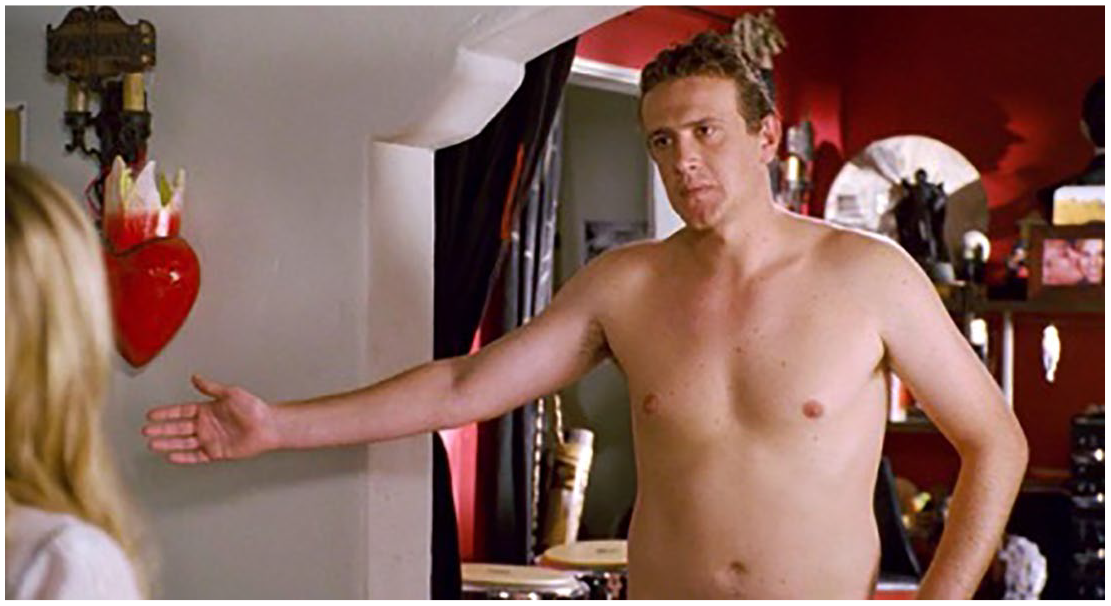
Through his regular casting in films produced/directed by Judd Apatow, actor Jason Segal has come to be known for having a prototypical Dadbod (Forgetting Sarah Marshall, 2008, Apatow Productions/Universal Pictures).
Dadbods and stardom/celebrity
One further means of tracing the signification of the Dadbod is through its discursive deployment in the realm of stardom and celebrity and contextualising it alongside other corporeal shifts in celebrity culture. In the period in which the Dadbod has entered popular parlance, major male stars such as Dwayne ‘The Rock’ Johnson and John Cena demonstrate the ability to monetise the built body on a grand scale and thereby help to motivate the efforts of individuals to craft their bodies even in the face of more immediate evidence that this kind of corporeal aspirationalism leads nowhere for the vast majority. Johnson and Cena’s constant invocation of ‘the hustle’ and of the necessity of sacrifice in order for human capital to appreciate through the building of the body, marks something like the Dadbod as a ‘before body’, a body that must be jettisoned through labour. 6 In presenting themselves as icons of bodily appreciation, both stars ‘physically resemble the images used in the promotional cultures of contemporary consumer capitalism’ (Hakim, 2016: 88) and use this to sell the built body as a remedy to financial and social precarity. As such, the Dadbod becomes a body to be shamed in order for the built body (and the gym memberships, specialised meal plans, and branded gear that go with it) to cultivate social desirability and economic prospects.
Myra Mendible (2016) observes that ‘Shame as commodity spectacle is most productive (and profitable) when projected on media-worthy objects, on bodies that matter enough to merit attention’ (p. 3). The Dadbod is most regularly visualised in paparazzi photography and in these contexts operates as a complex sign ‘of how celebrities relate to the publicity-privacy tension inherent’ (McNamara, 2016: 195) in such regimes. In a shame culture, the tabloid press routinely pinpoints the body type as a sign of celebrity failure and sloth, but this shaming feels mild and of a much lower stakes variety than the kind of body shaming directed at female celebrities. This is evident in the fact that male celebrities will often self-identify with the Dadbod in a humorous manner, as when Chris O’Dowd accused a fellow actor of ‘cultural appropriation’ when the New York Post printed pictures of a shirtless (and physically fit) Zac Efron, claiming that his ‘Dadbod . . . shock(ed) fans’ (Akingbade, 2020). When paparazzi photographs of Aquaman star Jason Momoa on holiday in Italy appeared in US Weekly in 2019, considerable pushback from fans and media commentary arose in relation to the tabloid’s labelling of the star’s physique as a Dadbod. The actor’s subsequent dismissal of the label by nonchalantly pushing out his stomach at a press gathering was celebrated, and the incident even provoked media consideration of the unsustainability of the physical changes demanded of actors for the superhero and action roles with which Momoa is associated (see Kirkland, 2019). Needless to say, it is rare for the labeling of female celebrities to provoke such cultural rumination.
In tandem with a demographic shift in which affluent professional class men (particularly in the finance industries) ‘cash out’ in their 40s/50s into early retirement, the Dadbod can also signify a certain withdrawal from the field, the finding of an escape route from the exigencies of neoliberal capitalism. 7 While this is, of course, an impossibility for the vast majority of workers, for media scholar Sarah Sharma (2017), narratives of this kind constitute a ‘male fantasy of exit [that] is linked to the rising structure of feeling that relates to male disposability’. Critically, the Dadbod has emerged as a legible body type at a time when ‘the affective rhythms and embodied impulses of desire are being taken over by the machinations of an economic system that privileges capital acquisitions over all else’ (O’Neill, 2018: 44). It is sometimes associated with men perceived to have gained early success who now have nothing left to prove. To push the point further some of the most high-profile Dadbods are associated with men positioned as having transcended the punishing imperatives of the capitalist order. Academy Award-winner and former child star Leonardo DiCaprio is a frequent target of Dadbod discourse (see Figure 2), while the body type is summoned as a marker of male retreatism in the eponymous song by rapper Logic who released ‘Dadbod’, a triumphalist anthem of self-becoming on his 2020 album No Pressure while announcing his (early) retirement. 8 In a culture of self-improvement, in which the body is a site of capital which must always be enterprising and accumulating, the ability to be perceived as both sedentary and successful presents to the precariat a dream of leisure.
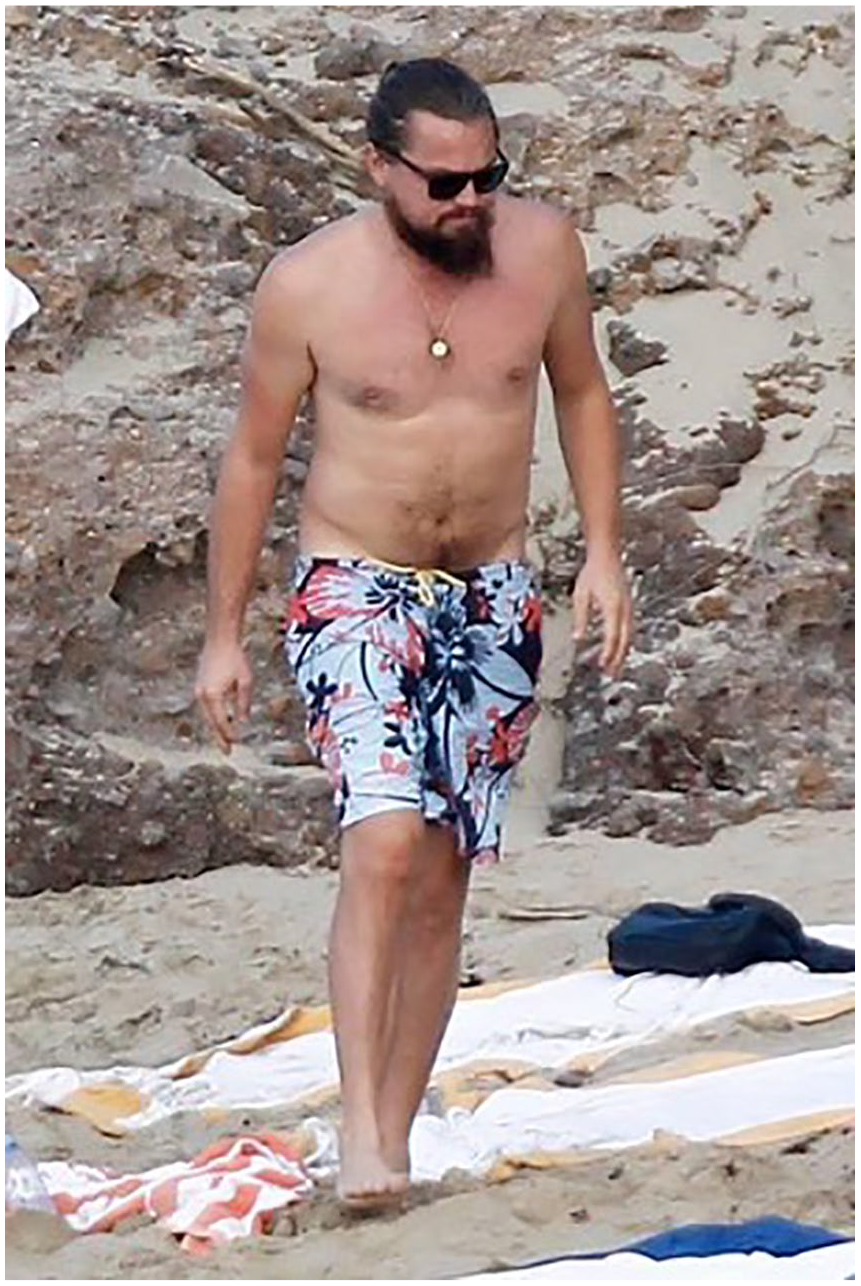
Leonardo DiCaprio’s Dadbod, seen here captured in a paparazzi photograph, might be read both as indexing his transition out of youthful leading roles and as a symbolic withdrawal from the vicissitudes of public life from a position of wealth (INFPHOTO.COM).
Dadbods and Cultural Fracture-Points
At a time of growing mistrust of white masculinity and increasing fractiousness in contemporary ‘body politics’ discourse, the Dadbod seems to function as a benign incarnation whose most critical signifier is its non-threateningness. Richard Dyer’s (1997) assertion that bodybuilding ‘articulates white masculinity’ (p. 148) implies that a non-built body can exist outside of the discourse surrounding the white body as simultaneously threatening and inept. With this in mind, we may note how the Dadbod formulates an alternative to the proliferating American masculinities associated with what Rebecca Solnit (2020) calls ‘radical selfishness’. Moreover, the term marks out a zone of safety in a gendered landscape of commitment-phobes, pick-up artists and flagrant misogynists. It locates itself as an alternative to what Jilly Boyce Kay (forthcoming) identifies as a ‘broader structure of feeling, wherein white men’s anger and humiliation at being “left behind” increasingly operate as a propulsive affective force in contemporary politics and culture’. The body type epitomises and situates the desire for a reprieve from the toxicity and grievance politics of white masculinity, whose lethal effects have become spectacularly apparent in the Covid crisis. As Harsin (2020) observes, ‘a particularly white, masculinist genre of political “truth-telling” has assisted the confusion, false belief and casualties of COVID-19’ (p. 1061). In this context, the Dadbod’s reconfiguration of fathers not as problematic authority figures or a disaffected and reactionary grouping but ‘as soft, lovable doofuses’ (Kornhaber, 2015) assists in the cultural recuperation of a white heterosexual masculinity newly beleaguered in the post-#MeToo era.
That said, the Dadbod cannot entirely escape the cultural tensions that shape any public intervention into contemporary corporeality. While most commentators acknowledge that the increased scrutiny of male bodies that the term signifies is but a modest measure of the bodily surveillance experienced by women, occasionally critiques have emerged of its usage that have sought to utilise the term as evidence of a culturally pervasive male victimisation. British actor Martin Clunes, famous for his central role in Men Behaving Badly (1992–1998), the television sitcom that best epitomised 1990s ‘lad culture’ in the United Kingdom, publicly decried usage of the term as evidence of it being ‘open season on men’. While this was an off-the-cuff remark made on a daytime chat-show, the comment was duly taken up by British tabloid the Daily Mail, epitomising the Janus-faced approach of that publication as one of the foremost purveyors of celebrity bodily surveillance pieces (Rusk, 2020).
It is also important to note the masculine insecurity which occasionally manifests in invocations of the Dadbod. In a society in which images of fit, built bodies are omnipresent the Dadbod can reference a somewhat reactionary masculinity which must denounce the fit male body as preening and effeminate. The phase often used in this defensive formulation of the Dadbod is ‘this is what a real man looks like’. Kyle Sandilands, former Australian X-Factor judge and ‘shock jock’ radio host, removed his shirt on The Morning Show (2007–present) on 13 August 2015, revealing a Dadbod, and asserted his body’s masculinity in response to the physically fit host of the show, Kevin Emdur, making jibes about his weight. ‘That there is a fake man’ he claimed while pointing at Emdur, before gesturing to his own protruding stomach and saying, ‘this is an Australian man’. This moment was followed by Sandilands’ assertion that he has been fat shamed by the media in the past (the day of the incident The Daily Telegraph posted an article describing his body as ‘bulging’ (The Daily Telegraph Staff, 2015) and, in that light this bodily display can be read as a moment of self-acceptance acting against the stringent confines of celebrity embodiment. However, Sandilands’ apparent need to denigrate and feminise the fit body in order to masculinise his own is indicative of the masculine imperative to dominate or be dominated.
In pointing to this exchange on an Australian talk show we highlight (although space constraints prevent us from elaborating on) the ways in which the Dadbod can be selectively nationalised, but we are most interested in the work the term does to point toward a recognisable form of midlife masculinity. It may be unusual in identifying male domesticity (even obliquely). The term’s existence points at the way that all bodies are now to be scrutinised, and how age and gender invisibility protocols are in active decline. And yet, the Dadbod is frequently held up as a sign of healthy male self-acceptance, as in an advertisement for the grooming products company Dollar Shave Club, featuring a dance routine enthusiastically carried out by a group of towel-clad, pot-bellied men (see Weisholtz, 2019), or popular t-shirts celebrating the body shape (‘it’s not a Dadbod, it’s a father figure’).
Conclusion
Taking a cue from Kevin White (2012) who contends that ‘bodies are the front-line of the micro-politics of the social structure and of our experiences of inequality’, we have considered the Dadbod as key to a certain kind of narrative of male retreatism from the increasingly anxious ethos of bodily regulation and age transcendence, noting how it figures in divergent discourses of medical concern, celebration and consternation. With respect to midlife male stars like Ben Affleck and Leonardo DiCaprio, who are so often the focus of paparazzi lenses, the display of a Dadbod invites decoding as a sign of professional uncertainty and emotional travails. In non-celebrity discourse, the term seems more likely to express fondness and validation; Twitter’s #dadbod gleefully curates the body type but with no apparent venom (see Kornhaber, 2015). Perhaps the most critical function of the Dadbod is its (mild) refutation of the entanglement of physical fitness and moral worth. In this way, it articulates resistance to the norms of neoliberal embodiment.
An exemption to judgment directed at the Dadbod may have emerged in the pandemic as it is re-classified as displaying the signs of lockdown stress. More obliquely, as we have suggested, it may be coming to function as a form of oppositional response to the severe, punitive regimes of technocratic body shapers like Jack Dorsey and the diminishing moral authority of Silicon Valley. The Dadbod may provide an alternate, possibly more radical, incarnation of the body positivity which more commonly serves as a regulation-by-another-name discourse for women. What is apparent to us is that the Dadbod represents an important nodal point in the increasingly fraught cultural terrain of male wellness.
Footnotes
Funding
The author(s) received no financial support for the research, authorship and/or publication of this article.
