



Abstract
This article examines the proliferation of alt. health influencers during the COVID-19 pandemic. I analyse the self-presentation strategies used by four alt. health influencers to achieve visibility and status on Instagram over a 12-month period from 11 March 2020, when the pandemic was declared by the World Health Organisation. My analysis reveals the ways in which these influencers appeal to the utopian discourses of early web culture and the underlying principles of wellness culture to build and sustain an online following. While early accounts of micro-celebrity treat participatory culture as democratising and progressive, this article demonstrates how the participatory affordances of social media have been exploited to spread misinformation, conspiratorial thinking and far-right extremism. These findings develop previous work on ‘conspirituality’ by demonstrating how wellness culture and web culture can coalesce for authoritarian ends.
Keywords
Introduction
Wellness influencer and celebrity chef, Pete Evans, caused controversy in November 2020 for posting an image on Instagram featuring the black sun, a neo-Nazi symbol associated with the Christchurch gunman. He shared a post on Instagram the following day of a rainbow heart apologising ‘to anyone who misinterpreted’ his post and ‘perceived that [he] was promoting hatred’. It is not the first time that Evans has caused controversy during the pandemic. In April 2020, he was fined $25,200AUD by the Therapeutic Goods Association for advertising a bio charger for $14,900AUD, which he falsely claimed could be used to treat the ‘Wuhan coronavirus’. He has also posted anti-vaccine, anti-mask and anti-lockdown messages on social media, while endorsing pro-Trump, MAGA and QAnon conspiracy theories. Evans is not alone in this type of messaging. During the pandemic, a series of individuals have accumulated large online followings by exploiting the participatory affordances of social media and the underlying principles of wellness culture to spread misinformation, conspiracy theories and far-right discourse.
This article examines this phenomenon; analysing how the democratic and countercultural ideals of web and wellness culture enable authoritarianism. For the past seven years I have studied wellness culture, focusing in particular on how lifestyle and wellness influencers achieve authority and influence online (Baker and Rojek, 2019a, 2019b). The wellness movement emerged in California in the 60s and 70s as part of the counterculture (Ingram, 2020), fusing together ideals of freedom, experimentation and equality (Baker, 2022). Self-care in this context meant equal access to health care, especially for those populations typically overlooked by the medical establishment due to their race, class, gender and sexuality (Nelson, 2015). Part of the popular appeal of wellness practitioners is the way they respond to people’s unmet health and medical needs. For the founders of the wellness movement, wellness was not about treating a particular disease. What Halbert L. Dunn (1959) termed “high-level wellness” included emotional, physical and spiritual growth, using a holistic approach to achieve one’s ‘full potential’. Today, wellness culture has given rise to an industry of self-appointed lifestyle and wellness gurus who combine nutritional advice and exercise tips with self-development and new age spirituality (see Baker and Rojek, 2019a, 2019b). These content creators are referred to as influencers when they build an online following on social media in exchange for social, economic or political gain (see Baker, 2021). At the start of the pandemic, I noticed that many of the techniques used by lifestyle and wellness influencers to achieve visibility and attention were being used by influential online users to spread false and misleading scientific and medical advice (see Baker in Lee, 2020). I began to track a series of these influencers across various social media platforms, exploring the techniques they used to spread misinformation and conspiratorial thinking.
The wellness industry is a highly unregulated space that relies heavily on personal testimonials, anecdotal evidence, intuition and positive thinking (Baker and Rojek, 2019b, 2020). This emphasis on subjective experience and intuitive ways of knowing makes wellness culture susceptible to unsubstantiated health claims, misinformation and conspiracism as personal truths are elevated over expert opinion, resulting in compelling stories of self-transformation standing in for professional expertise. What made the wellness influencers I followed during the pandemic stand out is that many combined New Age and wellness discourse with far-right politics. In May 2020, a series of lifestyle and wellness influencers contributed the viral spread of the conspiracy theory video, Plandemic (2020), amplifying the video to mainstream audiences on social media together with pro-Trump, conspiracy theory groups (Baker, 2020). Several journalists commented on this trend of wellness influencers spreading QAnon conspiracy theories (Breland, 2020; Greenspan, 2020). The association between QAnon and wellness culture became so significant that leading figures of the wellness community publicly distanced themselves from the group. In September 2020, the international yoga teacher, Sean Corn, released a joint statement on Instagram in collaboration with other leaders from the wellness community rejecting the principles of QAnon: I do not support QAnon and their underlying message of hate, fear and division. They are an alt-right movement of conspiracy theorists working to spread misinformation, confusion and paranoia. . .  #revolutionofthesoul #unite2stopq (Corn, 2020).
Although it is not the first time that alternative health practices have been associated with fascism (Goodrick-Clarke, 1992; Proctor, 1988; Ward and Voas, 2011), questions emerged as to how QAnon, which originated as a far-right, fringe phenomenon, populated by pro-Trump, conspiracy theorists, was able to infiltrate the wellness community, which originated as a progressive, countercultural movement. A similar convergence is found between far-right and wellness communities when examining 5G and anti-vaccine narratives on social media. Wellness influencers may not share QAnon’s far-right extremism, but both groups are bound by distrust of institutional authority – the government, the pharmaceutical and vaccine industry – which they see as promoting obedience, compliance and surveillance (see Baker, 2020 ). Many have genuine concerns about authoritarian control and fears about the government’s attempt to curtail civil liberties via mandatory vaccine programmes, lockdowns and mask wearing, which commonly transpire into conspiratorial thinking.
The pursuit of wellness is also conceived in terms of health optimisation (‘peak wellness’) and human potentiality (Dunn, 1959), which resonates with the New Age movement’s emphasis on self-actualisation and spiritual awakening. Both purport to provide personal solutions to the hidden agendas and nefarious politics presented by conspiratorial worldviews. Ward and Voas (2011) call the fusion between conspiracism and New Age spirituality, ‘conspirituality’. The term is used to describe an ideological movement characterised by two core convictions, the first conspiratorial, the second rooted in the New Age: 1) a secret group covertly controls, or is trying to control, the political and social order, and 2) humanity is undergoing a ‘paradigm shift’ in consciousness that requires action in accordance with an awakened ‘new paradigm’ worldview. While some argue that the confluence of alternative spirituality with conspiracy theories is neither new nor surprising (Asprem and Dyrendal, 2015), the internet is central to the importation of this political and spiritual ideology into the mainstream (Ward and Voas, 2011: 116). Despite the relevance of conspirituality to the current ‘infodemic’, the dynamics of this ‘web movement’, as Ward and Voas (2011) indicate, is unexplored by scholars, yet it is clear that internet culture facilitates its diffusion.
This article examines the techniques used by some wellness influencers to achieve visibility and status online by disseminating misinformation and conspirituality during the COVID-19 pandemic. Drawing on a series of case studies, I examine the presentation strategies used by these wellness influencers to appeal to alternative health and wellness communities and make conspiratorial thinking more mainstream. I introduce the term ‘alt. health influencers’ to describe this phenomenon, noting how these internet users employ wellness discourse to spread conspiratorial thinking and far-right politics. The aim of this article is neither to conflate all wellness influencers with the alt. right, nor to differentiate between well-intentioned and unscrupulous influencers (many of whom exist on a spectrum – see Image 4). Rather this article seeks to show how ‘alt. health influencers’ strategically turn the democratic ideals of wellness culture and web culture into vulnerabilities by promoting misinformation, conspiracies and authoritarianism. I conclude by discussing the implications of this framing in terms of trust and public health messaging.
Methodology
In this study I use a qualitative case study approach to analyse the self-presentation strategies employed by four internet users to establish influence in the alternative health and wellness space during the pandemic. I refer to these individuals as ‘alt. health influencers’ as they monetise their audiences by appealing to alternative health and wellness modalities instead of conventional medical practices. For some, their brand is monetised through products, courses and supplements marketed as improving nutritional and emotional well-being. For others, wellness is monetised through blogs, books, films, retreats and festivals promoted as tools for self-actualisation, expanded consciousness and spiritual awakening. All are framed as alternative modes of knowledge and practice driven towards self-improvement, holistic health and self-optimisation, thereby resonating with the tenets of wellness culture.
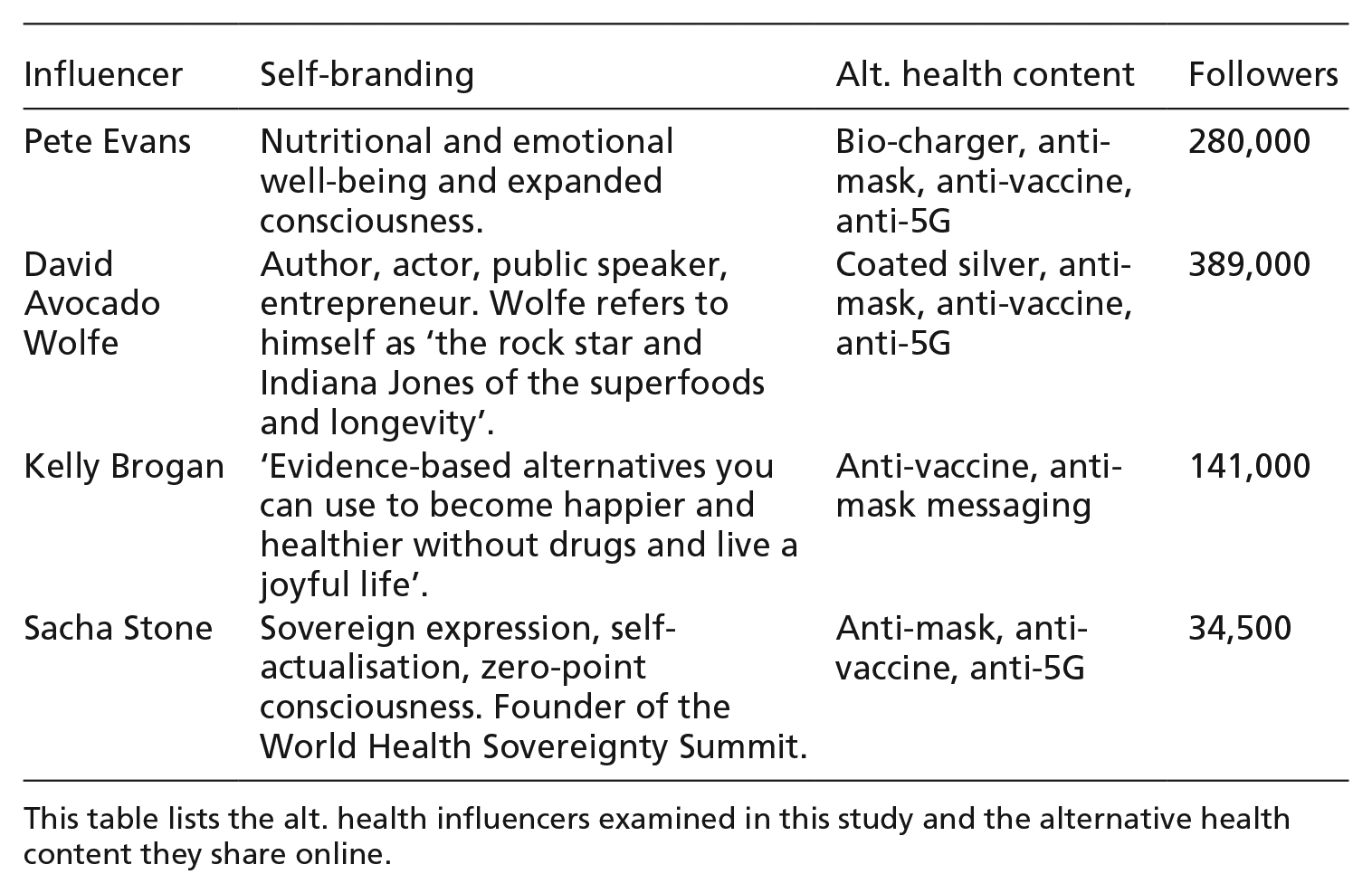
This table lists the alt. health influencers examined in this study and the alternative health content they share online.
These accounts were selected on the basis of the micro-celebrity status they achieved in the alternative health and wellness space during the pandemic, which enabled them to self-brand as alt. health influencers. Although their online followings are significantly smaller than mainstream celebrities, I was interested in how these micro and macro influencers use their personae for social, economic and political gain (see Baker, 2021). Indeed, as will be discussed, it is the micro-celebrity self-presentation techniques these influencers use to appeal to a niche community that makes them appear more “authentic”, relatable and trustworthy than mainstream celebrities and public health authorities (see Baker and Rojek, 2019b; Marwick, 2013). Second, I was interested in how these four influencers revealed the vulnerabilities of wellness culture and web culture to misinformation, conspirituality and political extremism. The alt. health influencers examined in this paper form part of an industry of anti-vaccine advocates and COVID deniers who profit from spreading medical misinformation (CCDH, 2021). The analysis took place primarily on Instagram given that most of the activity involving these influencers occurred on the platform. This was, in part, a result of more stringent content moderation practices and suspensions introduced by mainstream social media platforms during the pandemic (see Baker et al., 2020). While many of the major technology companies updated their harm policies in 2020 to combat fraud and misinformation about the virus, these policies were inconsistently applied. For example, YouTube removed Sacha Stone and David Avocado Wolfe’s accounts while Twitter and Instagram allowed them to remain on their sites. Facebook suspended Stone in January 2021 and permanently suspended Pete Evans’ account in December 2020 for breaching the company’s COVID-19 misinformation policy, while Instagram did not (despite being owned by Facebook). As a result, Instagram was the main site used for data collection. Data was collected for 12 months from 11 March 2020, when the pandemic was declared. After analysing all of the content shared by these influencers on Instagram over a 12-month period (including videos and interviews they shared on the site), content was then inductively coded using thematic analysis (Braun and Clarke, 2006) to identify the key techniques these influencers used to establish and sustain visibility and status online. From these codes, three overlapping themes were identified: 1) micro-celebrity, 2) the persecuted hero, 3) calls to participate in the journey through the moral matrix.
The theme of micro-celebrity was coded when the influencers examined in this study used informal modes of address (e.g. friends, family, folks, guys, emojis); shared personal updates and anecdotes; self-described as “authentic” and an independent alternative to mainstream media; and posted content purporting to give their followers access to their private lives (e.g. images and videos of their homes, pets, friends, family, morning rituals, daily meals). Posts of this kind give the impression of authenticity, autonomy and accessibility that sets them apart from the professional boundaries typically required of medical professionals and the perception of scientific institutions as offering technocratic solutions to personal issues. The persecuted hero theme incorporated a series of codes: powerful and corrupt elites are using COVID-19 to control society (e.g. control, suppress, Deep State, agenda, plandemic, scamdemic, transhumanism, 5G, fake news, mainstream media corruption, medical tyranny, scientism, propaganda, media programming, fiction, lies, distrust, experts, elites, Anthony Fauci, Bill Gates); heroic references about bravery, combat and exposing the truth (e.g. influencers self-describing as rebels, martyrs, whistle blowers, Truthers, messiahs); claims of censorship on social media for deviating from the mainstream narrative (e.g. criticisms of the ‘MSM’ and Big Tech, comparisons of social media CEOs as Nazis, fascists, Stasi). Together, these codes comprise the persecuted hero narrative illustrated in Image 1. The final theme – calls to participate in the journey through the moral matrix – included a series of codes: invitations to commence a personal journey of self-discovery, self-improvement and self-transformation (e.g. products and services to help consumers awaken, evolve, improve, transform, reset their life, and be their best self); the body, intuition and Nature as superior and trustworthy to experts and corporations (e.g. body sovereignty, clean, pure, toxins, chemicals, GMOs); the quest for spiritual awakening (e.g. wake up, asleep, normies, sheep, sheeple, muggles, red pill); there is a higher order, everything is connected and justice will be served (e.g. trust the plan, join the dots, down the rabbit hole, The Great Awakening, WWG1WGA, the Storm, spiritual warfare, saviour, Save the Children, Medical Apartheid); collective calls to defend Truth, Freedom and Justice (e.g. civil liberties, revolution, anti-lockdown, anti-mask, anti-vaccine posts). What bound these codes under a common theme was their emphasis on purity and right moral action as articulated by posts promoting “clean” eating, cleanses, detoxes, spiritual awakening and calls to participate in a cosmic battle and new world order (e.g. voting for Trump as a “light worker” against the Deep State to “Drain the Swamp”). In some cases, this quest for purity subscribed to narratives of biological and moral superiority (e.g. anti-Semitic associations depicting Sabbateans as evil elites; the unvaccinated cast as “purebloods” – see Image 4). I have incorporated these codes in a series of images. Image 3 shows how calls to participate in the journey through the moral matrix replicates the standard conversion story employed by wellness influencers on social media (Baker and Rojek, 2019b). Image 4 of ‘the purity paradigm’ illustrates why the moral dimensions of wellness culture are susceptible to misinformation, conspiracism and political extremism.
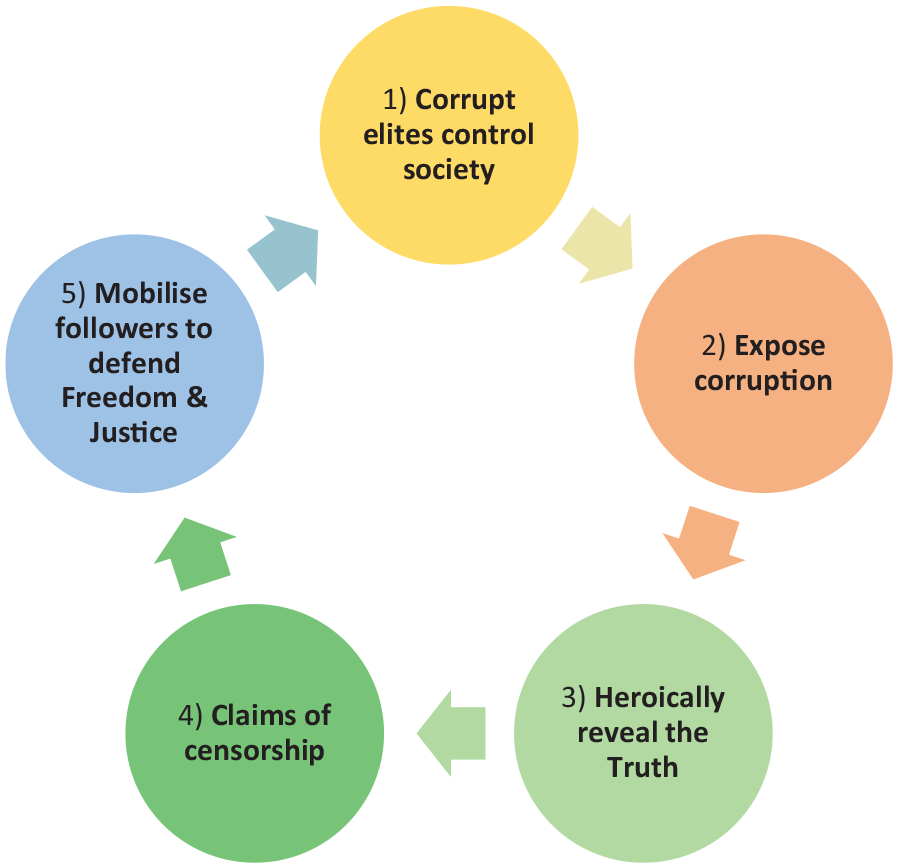
The Persecuted Hero Narrative.
Fostering intimacy and connection through micro-celebrity
All of the influencers examined in this study are considered micro-celebrities in the alternative health and wellness space. Micro-celebrity is a way of achieving celebrity status online, with a niche community of followers. The term was coined by Theresa Senft in her study of Camgirls (2008) to describe ‘a new style of online performance that involves people “amping up” their popularity over the Web using technologies like video, blogs and social networking sites’ (Senft, 2008: 25). The term has since been applied to examine how visibility and status is achieved through self-broadcasting on social media in a variety of contexts including tech startups (Marwick, 2013), fashion (Duffy, 2016), health and wellness (Baker and Rojek, 2019a, 2019b) and politics (Marwick and Lewis, 2017; Lewis, 2020). While many achieve fame and commercial success, unlike mainstream celebrities, who remain remote in their extraordinary skills and abilities, micro-celebrities emphasise their ordinariness through publicising their everyday lives on social media (see Abidin, 2018). By virtue of using social media technologies widely accessible to the public, micro-celebrities present themselves as equals with their followers, many of whom occupy the same online spaces. There is a performative dimension to this understanding with micro-celebrity both a noun describing a category of people, and a verb used to describe the practices through which social media users convey the appearance of intimate, authentic exchange to build an online following (Marwick, 2013).
Part of the appeal of micro-celebrities is the way in which their fame is bound up with utopian ideals of democratic participation. Just as the internet was originally perceived to be ‘the great equaliser’ (boyd, 2014), social media has largely been considered a democratic force in so far as these technologies facilitate ‘participatory culture’ (Jenkins, 2006). Accessibility is a key attribute of micro-celebrity. These platforms present themselves as democratic and egalitarian precisely because they are accessible to the public and afford users the capacity to self-broadcast online (Gillespie, 2010). The low barrier to entry required to achieve micro-celebrity status not only distinguishes micro-celebrities from mainstream celebrities, it demarcates them from the top-down hierarchies that characterise the mainstream media. In this regard, micro-celebrity is conceived as part of the ‘demotic turn’ (Turner, 2010), continuing the increasing visibility of ‘ordinary’ people in the media facilitated by talk-back radio and reality television in the late-twentieth century (Hearn, 2008).
While in principle social media enables ordinary users to be seen and heard, micro-celebrity is not inherently a democratising force. Despite conjuring images of ‘the people’, Graham Turner (2004) highlights that the ‘demotic’ gives the appearance of democratic participation rather than providing equal opportunity for ordinary citizens to achieve fame. Celebrity still remains a ‘hierarchical and exclusive phenomenon, no matter how much it proliferates’ (Turner, 2004: 93), and digital technologies can reinforce social stratification around race, class and gender rather than contesting social inequalities (Marwick, 2013; Duffy, 2016). Researchers highlight that the same commercial and corporate hierarchies that characterise the mainstream media persist on these platforms (Fuchs, 2014). Micro-celebrities are now part of a commercialised production system. They have more in common with media personalities than they do with Senft’s camgirls (Usher, 2018: 15). Moreover, despite social media’s role in giving publicity and momentum to various protest movements (e.g. #metoo, #BLM), the idea that micro-celebrity is an inherently progressive force has been subject to criticisism with micro-celebrity practices used to spread health misinformation (Baker, 2020; 2021; Baker and Rojek, 2019a, 2019b), anti-progressive politics (Lewis, 2020) and far-right extremism (Marwick and Lewis, 2017). This article extends these critiques by demonstrating how the principles of wellness culture and the techniques of participatory culture have been exploited by certain users during the pandemic to establish influence in the alternative health and wellness space, monetise conspiratorial thinking and disseminate far-right ideologies.
Micro-celebrities earn their followers’ trust by distancing themselves from institutional media. The fact that these influential figures build their followings in these supposedly democratic online spaces, in contrast to the mainstream media, feeds into their performative displays of authenticity and autonomy – their perception of being outside of the system – both of which are instrumental in their appearance as trustworthy, credible alternatives to institutional authority (Baker and Rojek, 2019b). In the context of health, social media presents these users as an alternative source of knowledge to mainstream science and medicine. In so doing, they attract followers disillusioned with institutionalised politics and public health authorities, including international health organisations, government healthcare agencies and pharmaceutical companies (see Baker and Rojek, 2019a). During the pandemic, alt. health influencers employed micro-celebrity practices to appeal to alternative health and wellness groups to promote conspiracy theories and political extremism. In addition to highlighting their autonomy from the system they purport to critique, they engage in performances of authenticity to connect with their audiences. For example, when asked during an interview how to navigate the pandemic, Sacha Stone reminded his audience to access their ‘authentic’ self: Authenticity is the key word here. Each of us who are serious about the question: how am I to navigate this pandemonium, this chaos, this apocalypse? How am I to navigate this turbulence this tribulation as an individual. . .? The only way to do it is if each of us step into our authenticity and start to really look at our own lives and strip away the fiction of our lives move back into that state of authenticity (Stone in Apollo, 2020).
This statement positions the speaker as an omnipotent authority; the implication being that Stone possesses the qualities of authenticity to which his audience aspire.
One of the affordances enabled by the shift from broadcast to participatory media is the capacity for micro-celebrities to establish direct relationships with their audience. Instead of communicating via an editor or journalist, individual users can communicate directly with their followers, which gives the impression of accessibility. Alt. health influencers enact the appearance of accessibility to connect with their followers. Nutritional and spiritual guidance is shared in conjunction with personalised messages to their followers, whom they address as friends and equals. There are references to their followers as “friends”, “family”, “folks”, “us” and “we”, the use of inclusive pronouns and the first person plural bringing their audience into being as a united group bound by their pursuit of Truth. In addition to purporting to reveal the “Truth”, alt. health influencers discuss “love” and “energy”, encouraging their followers to embark on a journey of self-actualisation as though they were a supportive friend. Alt. health influencers typically end their posts with hearts, kisses and emojis to facilitate the impression of intimate exchange. These performative displays are all examples of what Horton and Wohl (1956) termed ‘para-social relationships’: imaginary relationships audiences form with media personalities that give the illusion of a face-to-face relationship despite being ‘non-dialogical’ and ‘one-sided’. Social media is highly effective in establishing para-social relationships of trust and intimacy because these online spaces are ‘structured and communicated as an exchange between equals’ (Baker and Rojek, 2019a). Through direct modes of communication, they create the impression of accessibility. Selfies, blogs and vlogs were also used by the influencers examined in this study to create a sense of familiarity with their followers. Despite being highly curated, content of this kind creates a feeling of intimacy through the perception of “backstage access” to their personal lives. Importantly, these micro-celebrity practices distinguish alt. health influencers from the professional distance required of qualified doctors, therapists and medical professionals.
The persecuted hero: political positioning against the mainstream
In addition to using micro-celebrity techniques to foster intimacy and connection with their followers, alt. health influencers use micro-celebrity practices to appear more trustworthy than public health authorities. Alt. health influencers are commonly bound by a lack of trust in institutional authority. In the context of health, distrust is typically felt towards the government and mainstream medicine, both of which are perceived to be domineering and compromised by vested interests – what Kelly Brogan commonly refers to as “Mummy medical system” and “Daddy government”. This lack of institutional trust in mainstream politics, science and medicine extends towards a deep distrust of the mainstream media. Often referred to pejoratively as #MSM, the mainstream media is portrayed as biased, sensationalised and corrupt. In contrast to journalism, which has traditionally derived credibility from institutional reputation and ideals of objectivity (Maras, 2013), influencers do not proclaim to be neutral. Instead, they profess to share their experiences and opinions, using micro-celebrity practices to earn their followers’ trust by positioning themselves as friends and equals. Micro-celebrity gives the impression of intimate exchange. Personal confessions, inside scoops and revelations purporting to expose the Truth are strategically used by influencers to appear more authentic and trustworthy than the mainstream media. This is not because the media is believed to be ignorant to these issues, but because the media is perceived to be instrumental in concealing the truth from the public. Claims of this kind convey the mainstream media as a homogenous group using COVID-19 to drive a ‘hidden agenda’; Evans asking his followers, ‘Could the mainstream media be the one’s [sic] spreading conspiracy theories?’ #mainstreammediaisthevirus The influencers analysed in this study repeatedly made reference to the “fake news”, “lies”, “fiction” and “programming” perpetuated by the mainstream media as ways to dismiss mainstream journalism and those commentators critical of the conspiratorial content they share online. In many respects, these influencers are following the precedent set by former US President, Donald Trump, who uses the term “fake news” to describe any content that contradicts his messaging (Hirst, 2017). In this regard, social media is conceived as both an alternative to, and rejection of, the mainstream media. It enables these influencers to position themselves as outside of the corrupt system and mainstream narrative they critique. As the pop-up on the homepage of Pete Evans’ (2021) personal website explains: We’re challenging the mainstream paradigm, to create a space to share vision and views, to create long term sustainable health solutions. To express without censorship and restriction. To allow freedom of speech and interest in ideas that will allow humanity to evolve. . .Become part of the solution.
When interviewed on Evans’ (2020f) podcast, Sacha Stone, reiterated this political positioning against the mainstream: The beautiful thing is that people are now paying attention to alt. media voices and influencers and no longer paying attention to the mainstream narrative so much, so I think we are also on that beautiful fulcrum or pivot point of a reconvention with truth and with logic and with reason, which is coming again through grassroots through alternative pundits and journalists and researchers and influencers, like yourself.
This symbolic positioning against the mainstream is an intrinsic part of how alt. health influencers build a loyal online audience. Their intentions may vary, but the underlying persecuted hero narrative they promote is consistent: 1) Society is controlled by a secret group of corrupt elites; 2) Expose this corruption to sow a narrative of distrust about institutionalised authority; 3) Depict oneself as a heroic force for good by revealing the “Truth”, which the mainstream media purportedly seek to conceal from the public; 4) Use allegations of censorship to imply that one is being unjustly vilified for speaking the Truth and upholding sacred principles, such as Freedom and Justice; 5) Present oneself as a persecuted hero to establish a loyal online following driven to uphold these principles and participate in a collective movement towards spiritual awakening.
This same formula applies as much to lifestyle and wellness gurus exposing the corruption of the food and pharmaceutical industry as it does to conspiracy theorists exposing the Deep State’s hidden agenda. It is one of the reasons why alternative health and wellness communities are susceptible to conspiracy theories and political extremism. Their subject matter may vary, but the underlying logic of constructing an evil enemy and heroically seeking to restore Truth, Freedom and Justice is remarkably similar.
Take, for example, the wellness influencers Pete Evans and David Avocado Wolfe. Both have built successful online businesses disseminating wellness advice and healthy recipes on their blogs and social media, which they monetise through podcasts, affiliate links, cookbooks, meal plans, “superfoods”, supplements, cleanses, detox programmes, essential oils, online courses and wellness retreats. Part of their appeal as wellness gurus is in offering “natural” and organic alternatives to mainstream products containing additives, GMOs, toxins and chemicals, which are marketed as improving emotional, physical and spiritual health and well-being. Evans and Wolfe have promoted controversial health products during the pandemic: Evans selling the ‘BioCharger’ for $14,900AUD to treat the “Wuhan coronavirus” and Wolfe selling coated silver for $150USD a bottle, which ‘under the current level of flu threat’, he recommends consumers ‘take 1 drop of Coated Silver with water daily’ (Wolfe, 2020d). Both intersperse wellness advice with conspiratorial content about nefarious governments and public health authorities seeking to control the population. Conspiracist ideation is endemic to wellness culture with less controversial wellness influencers, such as the self-proclaimed ‘Wellness Advocate’, Therese Kerr, sharing her fears on Instagram that Bill Gates and Dr Anthony Fauci plan to run a ‘Brave New World’; purporting that Gates seeks to vaccinate people with microchips for surveillance and transhumanism using #5G. Claims of this kind appear on her Instagram profile alongside posts featuring empowering quotes by Ram Dass and photographs of organic smoothies, chia puddings and salad bowls. Evans and Wolfe similarly combine generic wellness posts promoting ‘Immune System Tips and Strategies’, longevity and dietary advice together with false and misleading claims about 5G, mask-wearing, vaccines and the severity of the virus. Health misinformation of this kind seeks to undermine the legitimacy of public health authorities by invoking claims of scientism to accuse elites of using science to silence voices that deviate from the mainstream narrative: The elite (control freaks) of the world are using the tyranny of scientism to attack our freedoms worldwide. Scientism is a collection of pseudoscientific materialistic belief systems that attempt to circumvent The Scientific Method by using catch phrases such as “scientific consensus” and “settled science” and calling everybody else “pseudoscientists” and “anti-science” — all in the spirit of shaming those who oppose their theories, sold to us as “facts” and “science”. . .The track record of mainstream medicine being the 3rd leading cause of death for 18 years straight running in the United States and providing non-stop doomsday reports to innocent people should immediately cause us to stop believing in ANY supposed “medical professional”.
  (Wolfe, 2020b)
Part of the reason Wolfe’s attack on medical professionals is able to sow a narrative of distrust about the legitimacy of these elites is because he is speaking to an audience already largely disillusioned with mainstream science and medicine (see Image 2). Distrust of medical experts, pharmaceutical corporations and the food industry has encouraged many wellness devotees to seek alternative health solutions. It enables these influencers to position themselves as alt. health influencers espousing “the Truth” to their followers while advising them how to “awaken”, “evolve” and lead a “better” life. It is why Wolfe’s posts about ‘8 AMAZING DETOX INGREDIENTS YOU CAN ADD TO WATER’, ‘8 PROBIOTIC FOODS (TO) IMPROVE DIGESTION, REDUCE DEPRESSION AND PROMOTE HEART HEALTH!’ and ‘GINGER VEGGIE WRAPS WITH LEMON TAHINI’, Brogan’s ‘5 Rules For Eating Away Your Depression’ and Evans’ paleo recipes are able to sit alongside anti-lockdown, anti-mask and anti-vaccine messaging. Their followers are largely distrusting of public health authorities and look to these influencers to provide trustworthy alternative advice about how to achieve spiritual, nutritional and emotional well-being.
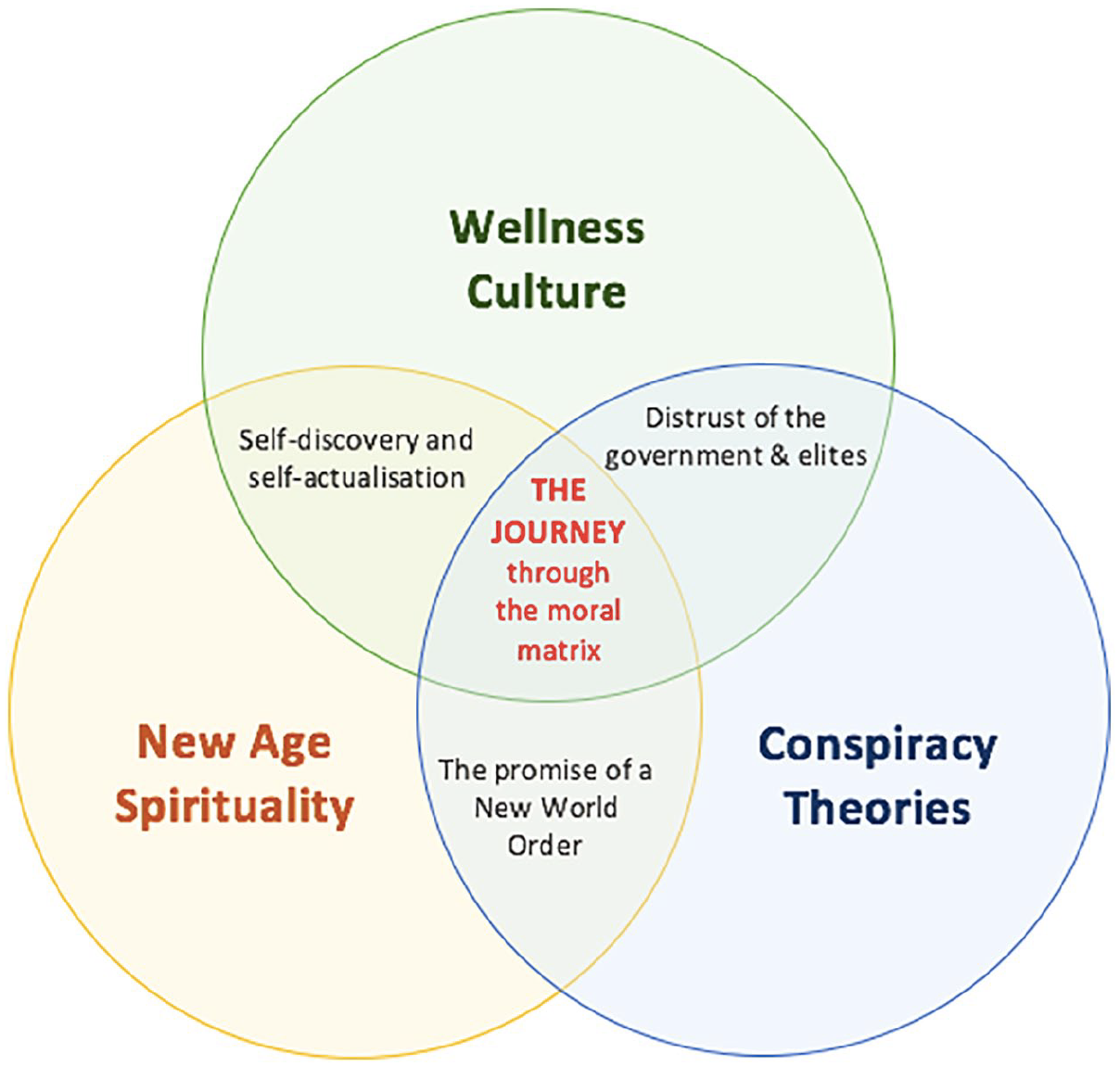
The intersection between wellness culture, conspiracy theories and New Age spirituality.
Although some of the posts shared by alt. health influencers are controversial, the majority of information they disseminate online draws on common sense knowledge, folk wisdom and lived experience; what is referred to as ‘native expertise’ (Baker and Rojek, 2019a, 2019b). They espouse a back to basics approach which privileges the body and intuitive forms of knowledge. Brogan (2021) highlights the importance of ‘trusting our bodies’, Evans (2020a) encourages his followers to ‘trust your intuition’, Wolfe (2020c) informs his followers to ‘Use your instincts and intuition’ and Stone reminds his audience that we are born with the capacity to ‘intuit’: ‘If you want to get to truth, to the real throne of self, get into the gut’ (Stone in Apollo, 2020). An integral part of their discourse is that State and corporate interests are contrary to the natural, embodied wisdom they promote. As Wolfe (2020a) explains: Corporate Media is not useful and is not wise. Please get back into Nature and experience this Wisdom. . . Drink water from the spring where the horse drinks. . .
  Go to sleep and wake up with the chickens and you will reap the golden grain of the day.
  Eat more green vegetables, and you will have strong legs and an enduring heart.
Stone employs a similar type of messaging: Start to re-engender a relationship with the trees, with the flowers, with the running water, with the clouds. Start to re-engage at the elemental level with who you are and what you be in the now that’s how you navigate out of the apocalypse (Stone in Apollo, 2020).
By aligning themselves with what is “natural” and “pure”, untainted by greed and corruption, alt. health influencers are able to position themselves as more enlightened than the general public and therefore able to help their followers to “see the light” as they embark on a personal journey of self-actualisation and spiritual awakening. In this regard, alt. health influencers are conforming to the same marketing logic described by Ward and Voas’s (2011) concept, ‘conspirituality’: the belief that a secret group covertly controls the social and political order and that humanity ‘is undergoing a “paradigm shift” in consciousness’. What is new is how these internet users exploit the participatory dynamics of web culture to self-brand as micro-celebrities and build an online following. With social media companies, such as Instagram, in their nascency when the term ‘conspirituality’ was coined, the term does not account for the ways in which the participatory culture of the internet facilitates mis-and disinformation. Social media affords these micro-celebrities access to global public audiences and the capacity to cross-pollinate their ideas in like-minded communities online. These technologies also enable conspiritual content to be produced and shared online at an unprecedented speed and scale with attempts by governments and tech companies to limit the spread of misinformation via content moderation often assisting these influencers in building and sustaining a loyal online following by presenting them as martyrs.
Many of the influencers examined in this study had their posts or accounts removed from YouTube, Instagram, Facebook and Twitter for violating their COVID-19 misinformation policies. Alt. health influencers typically respond to content moderation by claiming that their voices are “censored” for deviating from the mainstream narrative. Claims of censorship, suspensions and shadow banning 1 on social media are then used as evidence that the major technology companies are trying to suppress the truth and control the population. Following his suspension on Facebook, Stone described the company’s community guidelines as ‘totalitarian edicts’, ‘forcing consensus’ and ‘mutating the truth at all costs’ (Stone, 2021a). Wolfe (2020a) similarly warning, ‘I’m telling you that IG, FB and all these social media platforms are descending into censorship, control and power struggles’.
Accusations of censorship are crucial to the self-branding of alt. health influencers. Each time their controversial posts are removed from social media, it frames those alleging to be censored as messiahs for defending freedom of speech and daring to question the “mainstream narrative”. In an interview filmed during the pandemic entitled, Freedom and Truth with Sacha Stone, Stone is introduced as an ‘activator of truth consciousness’, to which he replies: I’m glad you are emphasising truth because that is..the creature that is being harmed the most right now at every level of our matrix model that the greatest casualty is pure truth (Stone in Apollo, 2020).
In this regard, the information war is framed as part of a greater cosmic battle between good and evil. These concerns are visually expressed in a series of videos and memes, which use evocative imagery and satire to compare tech companies to authoritarian regimes, such as “Stasis”, “Nazis” and “fascists”; a misplaced comparison commonly used online given the Holocaust’s power to illustrate right versus wrong. For example, following his suspension from Facebook, Evans shared a meme on Instagram featuring the CEOs of Facebook and Twitter, Mark Zuckerberg and Jack Dorsey, dressed as Nazi soldiers with Facebook and Twitter armbands on their uniform. Stone regularly refers to the major tech companies as the ‘Google gestapo’ and the ‘YouTube censors’. In this regard, the harm policies introduced by mainstream social media platforms to combat the spread of misinformation related to COVID-19 symbolically fuses the major tech companies with the mainstream media as a common enemy of Truth and Freedom. As a result, many influencers use these platforms, and the micro-celebrity practices they afford, to encourage a ‘Pied Piper Effect’ by building large audiences, which they then direct towards personal websites and less regulated platforms, such as Gab, Parler, MEWE and Telegram. Pete Evans (2021) regularly leads his Instagram followers to his channel, Evolve Network, for ‘uncensored information’; David Avocado Wolfe urges his followers to download Telegram – ‘one of the last bastions of Freedom’ – or to visit his website for ‘Uncensored’ and ‘Unfiltered’ information with ‘No Algorithm’ (Wolfe, 2020a) and Kelly Brogan (2020b) invites her followers to Telegram to avoid ‘social engineering’ and ‘medical tyranny’. By depicting themselves as unjustly persecuted for heroically upholding principles of Truth and Freedom, alt. health influencers are able to exploit content moderation to create a community of loyal followers willing to defend these fundamental belief systems.
Gamification: calls to participate in the journey through the moral matrix
The participatory affordances of social media facilitate brand loyalty by encouraging users to invest emotionally in the issues and individuals they are exposed to online. One of the key affordances of social media is that it enables direct modes of communication between influencers and their followers. Communication may not be reciprocated, yet the appearance of accessibility creates a feeling of proximity and intimate exchange. Lifestyle and wellness influencers typically use the appearance of accessibility to call on their followers to participate in a ‘journey’ of self-discovery, self-transformation and spiritual awakening (Baker and Rojek, 2019a). This includes taking ‘the decisive act’ to ‘reset’ their lives through a conscious reversal of poor diet and lifestyle, and negative thinking (Baker and Rojek, 2019b). Embarking on the journey also involves finding a worthy guru to be their guide. The underlying promise of self-help discourse resonates with the neo-liberal ethos of personal responsibility: you can choose to awaken; you can choose to be free, if only you shift your mindset. Wellness discourse assumes an overtly moral undertone as exemplified by the symbolic idealisation of certain foods as ‘pure’ and others as ‘impure’ and defiled (Baker and Walsh, 2018, 2020; Walsh and Baker, 2020). This emphasis on corporal purification is easily weaponised by alt. health influencers to spread beliefs about spiritual and ethnic superiority. Just as many wellness devotees share their conversion stories about eschewing ‘nasty chemicals’, toxins and unhealthy diets in favour of clean eating and a healthy lifestyle, alt. health influencers speak of “waking up” and being red-pilled into a state of enlightenment. Much of the underlying messaging of wellness culture also centres around the injustices perpetuated by institutional health authorities, especially with regard to vaccines and Big Pharma.
Justice is similarly a powerful mobilising force used by alt. health influencers to build and sustain a loyal online following. Sacha Stone and David Avocado Wolfe explicitly self-brand as advocates for justice (Wolfe and Stone, 2021). Stone’s personal website describes him as ‘an outspoken advocate of human rights and natural justice’. He has founded many organisations, most of which explicitly align themselves with justice, including Humanitad, New Earth Project and the International Tribunal for Natural Justice (ITNJ); which launched Judicial Commissions of Inquiry into ‘Human Trafficking and Child Sex Abuse’ and into the ‘Weaponisation of the Biosphere’. By self-branding as an advocate for environmental and criminal justice, Stone is able to attract followers driven to protect innocent children and the environment. A similar strategy was employed by QAnon in mid-2020 when the movement hijacked the ‘Save the Children’ in person protests and hashtags on social media to broaden their public appeal. The strategy is said to have created a form of ‘QAnon Lite’ – whose far-right origins were largely unnoticed – by reframing outlandish claims of child sacrifice led by Democrats and Hollywood elites as part of the charity’s legitimate campaign against child trafficking and exploitation (Rose, 2020). The QAnon conspiracy highlights how the participatory dynamics of web culture have been exploited to attract individuals embarking on a journey of personal responsibility to feel a sense of agency as co-creators working towards a collective endeavour. The mode of communication characteristic of QAnon is inherently participatory: cryptic messages are left by an anonymous user called Q, a pseudonym employed by a person claiming to be a high-level US military intelligence official; Q’s followers (“bakers”) wait for posts (“Q drops”) that contain clues (“breadcrumbs”), which they actively dissect and decode into a meaningful narrative (“baking”), collaboratively working together in their perceived fight for Truth, Justice and Spiritual Awakening.
One of the reasons that QAnon conspiracy theories are so effective is because they involve a process of gamification. Gamification is ‘the use of game design elements in non-game contexts’ (Deterding et al., 2011). Akin to playing a video game, individuals become invested in the story via ludic participation. Users are rewarded for actively detecting and decoding the symbols that comprise the narrative like pieces of a puzzle. This process of ‘playful interaction’ is afforded by the participatory dynamics of social media. Followers are invited to embark on a journey of spiritual awakening via references to taking the “red pill”, “following the white rabbit” and “doing their own research”. Gamification was evident in the accounts examined in this study. Pete Evans (2020b) asks his followers on Instagram, ‘Who wants to go down the rabbit hole?’, encouraging them to ‘keep joining the dots’ and join him ‘as we go deeper’ in a post featuring a white rabbit (Evans, 2020c). There are references to the Matrix – ‘Wake up Neo. . .’ (Evans, 2020d) – and questions about whether his followers have ‘red pilled’ their friends and family (Evans, 2020e); Brogan (2020a) sharing a video on Instagram describing the ‘Red Pill’ as a movement designed to reclaim our ‘power’ and ‘feel for our own truth’. Consequently, although the alt. health influencers examined in this study did not explicitly endorse QAnon, they integrated QAnon’s symbolic codes in their messaging. The invitation to participate in the journey is further expressed on their websites. Brogan invites her followers to join her online membership community, Vital Life Project, for ‘health reclamation’, Wolfe invites his followers to join his ‘inner circle experience’, Evans invites his followers to ‘Become part of the solution’ and Stone summons his followers to ‘Arise Homosapiens!’ – a rallying cry, which became the basis of the ‘Arise Freedom Tour’ that he participated in across America in 2021. The journey towards sovereignty and self-actualisation is depicted as a personal choice, yet their messaging simultaneously succumbs to a type of fatalism that presents our actions as part of a pre-ordained plan waiting to unfold:  Buckle up folks. Truths are getting Unsealed. . .Today is The Best Day Ever!! (Wolfe, 2020c); ‘Someone pass the popcorn please I’m not leaving my seat!
  ’ (Stone, 2020b), ‘Everyday more and more is coming to light.
  ’ (Evans, 2020g).
There is a strong parallel here between the ways in which wellness influencers and alt. health influencers construct their online personas. While wellness influencers typically base their credentials on a heroic narrative of self-transformation from a state of pain and misery to one of success and well-being (Baker and Rojek, 2019b), alt. health influencers are using the pandemic to depict their moral authority. Instead of extolling their virtues though clean eating and eschewing so-called “dirty” foods, their moral virtue is manifest in their “global detox” of the Deep State and other powerful elites, which is integrated into a compelling heroic narrative of an individual motivated to cleanse the world of injustice and evil; Brogan (2020c), who sells ‘The Vital Mind Reset Program’, explaining, ‘We are, now, in a spiritual war, and your body is the battlefield’. Just as today’s lifestyle and wellness gurus take ‘the decisive act’ to ‘reset’ their lives through a conscious reversal of negative thinking (Baker and Rojek, 2019b – see Image 3), those who have used the current pandemic to spread conspiratorial thinking commonly talk of “waking up” and being “red pilled” to describe their personal enlightenment. This metaphor implies that non-believers are asleep – referred to pejoratively as “normies”, “sheep” or “muggles”. In this context, influencers spreading conspiracy theories often refer to themselves as ‘Truthers’ (Richey, 2017), spreading what Stone describes as ‘pure Truth’ to their followers.
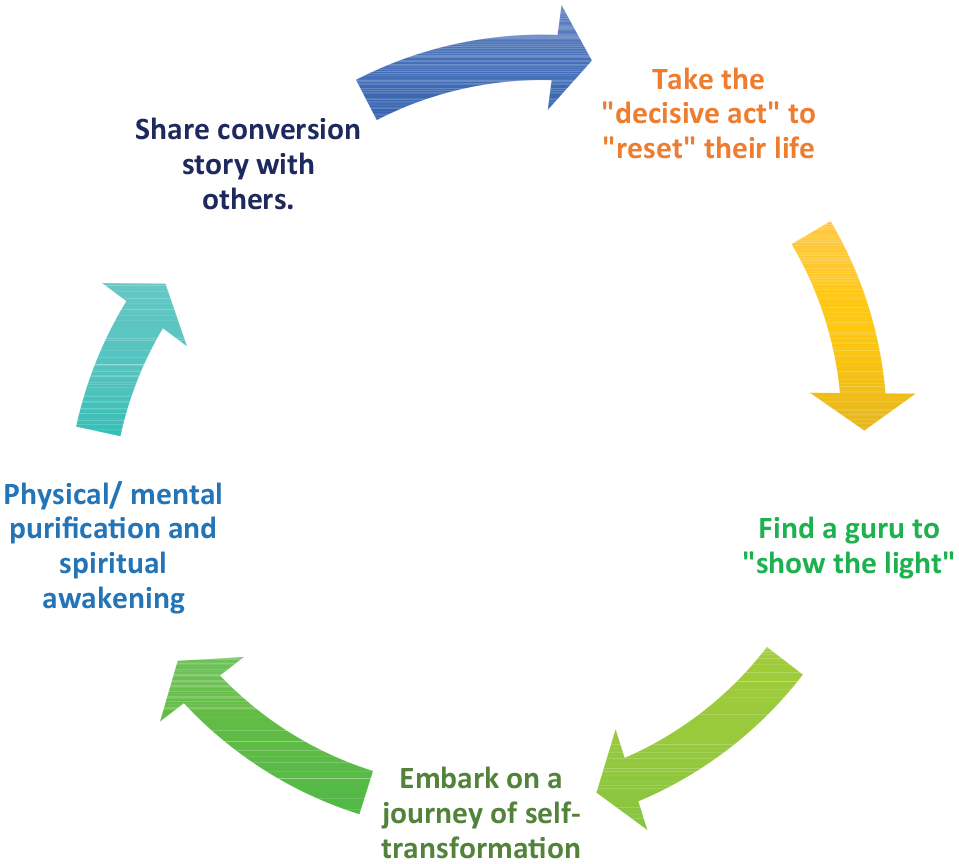
A typical wellness guru’s conversion story and personal journey towards spiritual ascension (Baker and Rojek, 2019b).
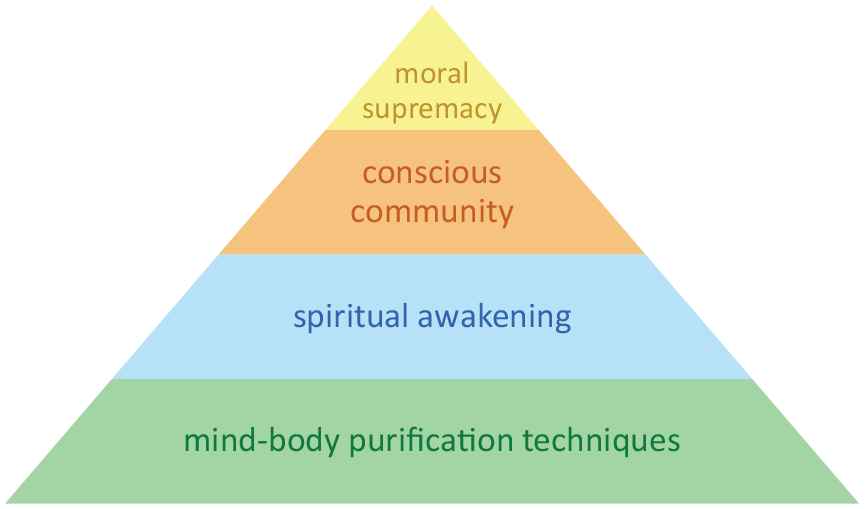
The Purity Paradigm.
By drawing public awareness to the injustices perpetuated by evil elites, alt. health influencers give their followers a reason to believe in their cause and embark on a personal journey of spiritual awakening. Influencers may publicly reject their guru status, but despite their disavowals, their self-branding as wellness and spiritual elites presents them as having privileged access to secret knowledge and being in ‘service of raising awareness and consciousness’ (Stone, 2021b) from darkness to light, which they often monetise through podcasts, products, books, online courses and wellness retreats. By aligning themselves with what is Just and True, alt. health influencers establish their authority as guides in their followers’ journey towards spiritual ascension. This hero motif of responding to a higher calling and embarking on a spiritual journey is one of the reasons that many alt. health influencers were able to publicly endorse former US President, Donald Trump, during the 2020 US Presidential Election without undermining their brand. Trump’s anti-establishment rhetoric, his irreverence for institutional authority and promise to “Make America Great Again”, resonates with their anti-establishment ethos and desire to enact a “better” body, self and society; Wolfe claiming that ‘the only thing between us and total tyranny is, strangely enough, Donald Trump’ and Stone (2020a) encouraging his followers to vote for Trump in the 2020 US Presidential Election to ‘help the eradication of human trafficking, mainstream media cult-programming, censorship, pedophilia and high-street Satanism’. While Wolfe, Stone and Evans publicly endorse Trump, Stone conveys a particularly authoritarian view of the world. In an interview entitled, Who Runs the World? (2021), Stone describes Russian President, Vladimir Putin, as ‘the greatest political hero today’, declaring that Trump ‘will help Americans to awaken from their dream’ (Stone in Lel, 2021). Invoking the spiritual language of resurrection, ascension and awakening, Stone prophesises that Trump and Putin will liberate humanity, framing his anti-globalist narrative as a battle between ‘good, light, benevolent forces’ against the globalist Satanic, Deep State Sabbatean elites.
What is overlooked in these generic wellness references to “love and light” are the darker, exclusionary practices used by alt. health influencers to promote a type of illiberal, far-right politics. Despite using micro-celebrity practices to present themselves as friends and equals, the rhetoric put forward by Stone, Evans and Wolfe highlights how easily the epistemic absolutism of wellness and spiritual culture can merge with the participatory dynamics of web culture to facilitate authoritarianism. Participants may be encouraged to “do their own research”, but the process of meaning making that underpins their journey is absolute. Coincidences are never coincidences and even incongruous information or predictions that turn out to be false are described as part of “the plan”. In addition to helping these influencers build and sustain an online following, the participatory dynamics of social media act as a call to action with the alt. health influencers examined in this study encouraging their followers to resist government coronavirus guidelines and refuse vaccines, masks, quarantine and social distancing measures; Stone signing off his Instagram posts with the phrase, ‘Arise Sapiens!’ The irony is that in critiquing institutional authority, these alt. health influencers often seek to become authorities, using performative displays of autonomy, authenticity and accessibility on social media to promote a type of authoritarianism and spiritual elitism. The exclusionary politics endorsed by these alt. health influencers reveals that the democratic potential of social media to decentraliase power and facilitate online participation paradoxically has the potential to enable ‘charismatic, personality-centered modes of authoritarianism’ in which the expression of individuality online can serve authoritarian ends (Turner, 2018: 144).
From a public health perspective, there are other concerning consequences of the influence exercised by alt. health influencers in the context of COVID-19. Researchers can assess the power of alt. health influencers online by analysing user engagement (e.g. likes, shares, comments) and mapping how they produce and amplify false or misleading advice. What remains unknown is what happens offline. Did their posts change someone’s mind about government COVID-19 guidelines? How many of their followers experienced serious illness or death as a consequence of following their content and defying public health advice? These issues are accentuated by the fact that alt. health influencers tend to be white and middle class, statistically less vulnerable to the virus than certain socio-economic and ethnic groups (Boseley and Mohdin, 2021). Most have access to healthcare and the means to support themselves should they become seriously ill. These considerations make the influence that alt. health influencers wield culturally significant. As individual internet users these micro-celebrities may occupy the same online spaces as their followers, but what this symbolic positioning obscures are the structural inequalities that distinguish them from their followers.
Conclusion
In this article I have explored how wellness culture and web culture have been weaponised by certain internet users during the pandemic to self-brand as alt. health influencers. Analysing the Instagram posts of four alt. health influencers over a 12-month period, I note three key techniques they use to achieve visibility and status online. First, alt. health influencers use micro-celebrity to foster trust and intimacy with their followers. Second, by presenting themselves as unjustly “censored” by mainstream and institutional authorities, alt. health influencers depict themselves as persecuted heroes upholding Truth, Freedom and Justice. Third, alt. health influencers exploit the participatory affordances of social media to mobilise followers willing to defend these principles through a ludic journey of self-discovery, self-actualisation and spiritual awakening to give the illusion of agency and collaboration in the fight against evil and corruption.
These findings make several significant contributions to the study of culture. First, they build on critiques questioning the democratising effects of web culture by examining how digital technologies have been used to spread misinformation, conspiracy theories and political extremism during the pandemic. While social media can be used to expose corruption and oppression by giving publicity and momentum to minority views, these tools can also be used to facilitate political extremism (Marwick and Lewis, 2017; Lewis, 2020) and ‘charismatic, personality-centered modes of authoritarianism’ (Turner, 2018: 144). This study also provides insights into the ways in which wellness culture has been used to undermine public health messaging. Social media companies sought to combat misinformation about COVID-19 by updating their harm policies and elevating ‘authoritative content’ from government healthcare agencies (Baker et al., 2020). One of the primary ways that alt. health influencers establish authority in the wellness space is by critiquing the mainstream media, politics, science and medicine. Their micro-celebrity status on social media is not simply presented as an alternative to the mainstream media, but a rejection of it; ‘challenging the mainstream paradigm’ in all its forms (Evans, 2021). This is why the current approach used by governments and technology companies to elevate authoritative content on social media is unlikely to be effective in targeting their followers. Alt. health influencers strategically target wellness communities by appealing to their distrust of the government and their interest in pursuing alternative health solutions. While wellness culture is characterised by personalised solutions, health optimisation, independent thinking, truth–seeking and alternative beliefs and practices, it is these very preoccupations that alt. health influencers have weaponised to promote misinformation, conspiratorial thinking and illiberal politics. Paradoxically, a movement originally intended to empower marginalised groups risks disempowering those already disproportionately at risk of severe illness from the virus.
Footnotes
Acknowledgements
Parts of this work were originally delivered as a keynote presentation on 16 November 2020 at the conference: Lockdown: Mental Illness, Wellness, and COVID-19. I am grateful to the conference organisers and participants for the opportunity to share these ideas. I am also thankful to the editors of the European Journal of Cultural Studies for their constructive feedback. An original version of this manuscript was submitted and made publicly available on the pre-print server, SocArXiv, on 14 May 2021. Excerpts were also included as written evidence for the UK Parliament’s Select Inquiry into Influencer Culture with the former title: Influencing the infodemic: the intersection between wellness, conspirituality and far-right extremism.
Funding
The author received no financial support for the research, authorship, and/or publication of this article.
