




Abstract
The category of the ‘everyday’ has been relatively un-theorised in studies of digital food culture. Drawing on theories that the everyday is not just a backdrop but through which race, class and gender are constituted, and the cultural production of whiteness, I analyse digital photographs from the Welcome Dinner Project’s webpages and social media. The Welcome Dinner Project is an Australian food hospitality activism charity, which organises and facilitates one-off dinners to bring ‘newly arrived’ and ‘established Australians’ together over potluck hospitality to address isolation and racism. My overall argument is that Welcome Dinner Project representations and media representations of Welcome Dinner Project are underscored by conflicting representations of race, diversity and privilege. Despite the good intentions of the Welcome Dinner Project, the formal images it disseminates work to service the status quo by enacting and reinforcing dominant notions of middle-class whiteness in Australia, moderating the transgressive potential of its activism. However, these processes are subverted by less formal and unruly images depicting people outside, in mess, in non-hierarchical groups and migrant hosting. Such imagery can be understood as a form of visual activism which challenges the iconographies of whiteness in digital food culture and normative ideals of race-neutral domesticity and everydayness.
Introduction
It’s a sunny day and we’re all seated in a circle in a training room of a small charity in Sydney. We’re being trained by the Welcome Dinner Project (WDP), a charity which brings together ‘established Australians’ with ‘newly arrived Australians’ – new migrants, refugees and international students – to get to know each other in potluck-style hospitality to ameliorate isolation and alienation. Events are hosted in the homes of volunteer hosts and facilitated by trained WDP volunteers. The training emphasises that hosts and their homes need to be vetted before the events by the WDP. On the day of the dinner, the host’s home needs to be tidied up, their pets should be put away and any alcohol hidden, to make the event more homely for everyone.
In these ways, the WDP aims to create hospitable practices to help guests, and especially refugees, feel comfortable and safe. In our training, we learned how welcoming needed to take a particular form to create the right kinds of hosts, homes and hospitality. People learn about the WDP on its website, and it is here they can offer to host or attend dinners and that is why images from the WDP website are explored and analysed in this article.
This glimpse into the WDP training through the website underlines the significance of hosts and homes. During the time of my research from 2013 to 2015, the WDP grew rapidly across Australian states and territories, in a context of, and response to, intensely racist government policies and media reporting towards refugees and asylum seekers, and a resurgence of white supremacist anti-immigration politics in the country (Flowers and Swan, 2017, 2018). Since its start in 2013, the WDP has organised over 200 dinners in homes and community spaces across Australia with over 5000 people attending. Yet the WDP is not a one-off Australian approach but part of a growing international movement of feeding hospitality, aimed at refugees, migrants and asylum seekers, which addresses social injustice and racism – what I call ‘food hospitality activism’ (See Caldwell, 2021; Flowers and Swan, 2017, 2018).
The WDP believes that hospitality in homes breaks down cultural barriers and offers intimate, embodied and meaningful encounters to challenge national inhospitality towards racially minoritised groups. For the WDP, the home dinner enables newly arrived Australians to experience the ‘Australian’ everyday to which they do not ordinarily have access. For the WDP, the food hospitality of the home dinner represents a microcosm of a welcoming multicultural nation. As one white Anglo Celtic Australian guest announced, ‘this is how Australia should be’. These ideas draw on the ‘desired story of a “good Australia”’ in which cosmopolitan Anglo Celtic Australians are ‘exemplary hosts to all cultures’ (Elder, 2007: 135).
In this article, rather than studying the actual dinners, which I explore elsewhere (Flowers and Swan, 2017, 2018), I examine digital photographs of hosted dinners from WDP webpages and social media. My focus is not on the representation of food per se because the WDP tends not to depict food without people. This is in contrast to news media, which depict the WDP largely through classic digital ‘food porn’ shots often highlighting food multiculturalism, ‘world on a plate’ motifs. In addition, my aim is not to discount the work of the WDP or the volunteers, but to explore how conventionalised semiotic resources in these images link to ‘whiteness as the normative mode of belonging’, ideals about white Australian’s ‘neighbourliness’, hospitality and national symbolics (Due and Riggs, 2008: 1; Elder, 2007; Hage, 1998; Ramsay, 2017; Stratton, 2021 [2020]). My argument is that WDP’s representations and media representations of WDP are undergirded by conflicting representations of race, diversity and privilege. Although the WDP tries to bring people together in practice, its formal images reproduce the racial status quo with white people, their wealth, products and homes never recognised as privileged but rather as good and generous. However, this process is subverted through less formal and more unruly images which show participants being outside, in mess, in non-hierarchical groups and hosted by racialised migrants. Despite the good intentions of the WDP, the formal images it disseminates work in service of the status quo and conventional notions of race that tend to privilege whiteness as ‘normal’ and as host of the nation (Ahmed, 2012).
To make my argument, I problematise the notion of the everyday through the lens of whiteness. The category of the ‘everyday’ has been relatively un-theorised in studies of digital food culture, even though frequently invoked. Feminists and critical race theorists argue that the everyday cannot be understood simply as background context in a self-evident sense but as an analytic category through which race, class and gender are constituted (Felski, 2000; Smith, 1987: A. Smith, 2015, 2016). Although feminists have attended to the gendering and classing of the everyday, much less attention has been given to race. As Andrew Smith (2016) writes, ‘race weaves into and out of our understandings of the quotidian, the ordinary and the mundane, including how these terms are used by sociologists’ (p. 26).
This means in studying digital food cultures, we need to examine what we mean by the everyday and how it gets mediated, represented and racialised. Visual culture maintains the hegemony of whiteness, and racist colonial-era tropes are ‘alive and well today, packaged in a 21st-century digital culture form’ (Gambert and Linné, 2018: 129). Whiteness is ‘manifested’ and ‘normalised’ in digital media and accrues power through ‘cultural scripts’, for instance, those that associate whiteness with progress, goodness and benevolence (Zhang et al., 2012: 114
The unfamiliarity of the everyday
There is now an established canon on the everyday which feminists critique for being male-dominated, ignoring women’s intellectual contributions and lacking attention to everyday’s gendered, cultural and classed hierarchies and their political potential (inter alia, Felski, 2000; Smith, 1987). Although a contested term, the everyday is culturally associated with home and domesticity, a sequestered, gendered space linked to the mundane, repetitive, familiar, domestic and routine, and opposed to its ‘others’: the event, catastrophic, exceptional (Felski, 2000; Gibson and Rodan, 2005; Smith, 1987). The everyday cannot be understood just as background context or a given but as, Rita Felski (2000) insists, an analytic category that is invented. Indeed, feminists have long researched the everyday, the trivial and the taken-for-granted, and been interested in studying the labour of making home as a ‘material site and a symbolic site of belonging’ (Dyck, 2005: 240).
Feminist and mainstream theory on the everyday, however, neglects race: something which Smith (2015, 2016) addresses. His main project is to show how theories of everyday life are often complicit with how racialisation is made ordinary. The everyday in the concept of ‘everyday racism’ underlines the everyday as context for racialisation and racism. But Smith, acknowledging the work of 20th-century pioneering black scholars such as W.E.B. Du Bois, bell hooks and C. L. R. James, whom he calls theorists of the everyday, argues that the mundane, ordinary and habitual are normatively white. What this means is that ‘everyday experience is not just what both “black” and “white” are subsumed within; it is a significant part of the means by which that distinction is itself made real’ (Smith, 2015: 1148). Being included or excluded from the ‘condition of everydayness’ and being ‘part of a merely mundane world’ are how racialisation happens (Smith, 2015: 1145).
Race and the everyday emerged together from specific historical processes in the United Kingdom during the 19th and 20th centuries based on the domestic (Smith, 2015, 2016). Key to this is that ‘the ascription of everydayness itself plays a constitutive role in the making or sustaining of the boundaries of presumed or perceived difference’ in which empire was central (Smith, 2015: 1149, 2016). Empire and the exotic were written into ordinary British life in mundane and homely spaces through commodities, advertising and postcards which set up a distinction between the distant and exotic and the everyday and domestic. Imperial exhibitions reproduced the notion that white British lives were normal and familiar through exhibiting ‘native villages’ in which ‘ordinary lives’ of those exhibited were acted out. The white British visited these sites and then returned from the exotic, and it was different from their own ‘domestic ordinariness’ and ‘everydayness’. Smith (2016) argues that these differentiations ‘served to reconfirm the “humble living room” as a space of belonging, as a home whose homeliness could be appreciated all the more clearly by being juxtaposed with a distant and exotic other world’ (p. 18). At this time, whiteness becomes less aristocratic and associated with Imperial leadership and more about the normal, mundane and familiar.
Through these ideas and practices, the ‘not like us’ could be racialised and the impossibility of ‘everydayness’ established for racially minoritised groups. As Smith (2015) explains, given the centrality of racism in black people’s lives, there is no routine, taken-for-granted mundane experience for them, such that they experience ‘the unimaginable everyday’. Everyday life can never be routine, habitual or living in the moment for black people because, as James argues, their ordinary practices are ‘violently regulated’ (Smith, 2015: 1145). For instance, for hooks, the street is full of ‘racial terror’ for black people and is not an exciting, unpredictable space of encounter as seen by the highly influential French philosopher of the everyday, Henri Lefebvre. Through these processes, race is not only common and familiar but made through notions of ‘familiarity and ordinariness’, such that ‘whiteness comes to epitomise the everyday quality of taken-for-grantedness, the norm, the mundane, the self-evident (Smith, 2016: 62). As Chris Prentice and Vijay Devadas (2008) write, ‘against the notion of “the everyday,” then, emerges the vital question: whose everyday?’ (p. 13).
Mediated everyday
The above view of the everyday is based primarily on racialised practices, rather than representations. Here, I therefore want to take home as a primary site of the everyday, and ask how whiteness runs through media representations of the home and its ‘everydayness’. Broadly speaking, studies of media such as property TV, advertising, domestic advice manuals, house brochures and social media show that home is underpinned by the visual culture of whiteness while also being linked to the nation (Connellan, 2006, 2007; Harris, 2013; Heinz, 2015, forthcoming; Heneghan, 2003; Wilson, 2021). Authors stress that depictions of home reflect a multiplicity of meanings and feelings, ‘from the homely, unhomely, comforting to constricting’, and represent wider ideas about the nation, gender, sexuality, family and politics (Harper and Price, 2017: 1). For instance, writing about homes in 19th-century domestic advice literature, historian Grace Lees-Maffei (2016) argues that ‘domestic advice forms a rich resource for understanding the macro “home” of nation state via the microcosm of the physical family home’ (p. 205). This happens because designed domestic ‘commodities are associated with particular nations, carrying mythic associations that connote particular qualities and forms of expertise’ (Edensor, 2002, cited in Lees-Maffei and Fallan, 2016: 9). Designed objects function as national identity markers materially and symbolically.
Race, gender and ethnicity are embodied in the domestic through design, white goods, domestic objects, food and even fitted kitchens (Connellan, 2006, 2007; Harris, 2013; Heinz, 2015, forthcoming; Heneghan, 2003; Wilson, 2021). For example, architectural historian Dianne Harris (2013) shows how normative whiteness has been encoded visually and verbally in aesthetic norms in North American postwar kitchen magazines, trade brochures, marketing materials, models, TV programmes and physical internal geography of homes. Whiteness is represented through the home catalogues in ‘words such as informality, casual lifestyle, leisure, individuality, privacy, uncluttered, and even clean’ and visually through the crispness of drawings, aesthetic norms, spatial forms and aerial perspectives in domestic design drawings (p. 60). The semiotic construction of normative whiteness can be found in the banal everyday imagery of the home. Operating as a ‘euphemistic code’, the representation of whiteness was culturally invisible but everywhere. White aesthetic norms constructed ideals about what an ideal should look like and what type of people should live in it. Harris argues this iconography still resonates today.
But it is not simply the encoding of whiteness in domestic objects but the relation to these objects that matters for literary scholar Bridget Heneghan (2003). In 19th-century North America, ‘white things radiated refinement, order, discipline: but in doing so, they also radiated race’ (Heneghan, 2003: xiv). The purchase of the whitened commodity was ‘a constitutive agent’ of concepts of ‘race, class, and gender’ and defined the meaning of whiteness (Heneghan, 2003: xxiv). Whiteness was to be in possession of refined nice ‘white things’, but also a relation of care to these. This meant having the right bodily capacities to properly use objects, for instance teacups or corsets. In these ways, objects become agents in the construction of a materially based whiteness and the care practices which symbolised the imagined discipline, civility, purity, rationality, expertise, and moral and spiritual superiority of white people.
These 19th- and early 20th-century practices and representations about discipline and whiteness underpinned colonial civilising missions around cleanliness used to promote racist constructions of others as unhygienic and immoral (Bashford, 2003; Berthold, 2010; Bobrow-Strain, 2012; Connellan, 2006, 2007; Domosh, 2003). A transnational colonial archive of missionaries’ advice, magazines and advertising created racialised and classed hierarchies, and constructions of bodies, races and citizenship related to cleanliness, hygiene, goodness and purity, and penetrated everyday intimacy and family relations (Lombardi-Diop, 2011). In Australia more specifically, Victorian colonial hygiene practices reinforced the racial hierarchisation of white Anglo Celtic people in relation to Indigenous and Chinese people (Bashford, 2003).
In 20th-century America, the meaning of whiteness, purity and hygiene extended to many aspects of domestic everyday life from domestic design, food production, clothing, kitchens, appliances, water closets and smooth white surfaces (Bobrow-Strain, 2008, 2012). As historian Aaron Bobrow-Strain (2008) explains, ‘by the 1930s, the design of everyday objects reflected and advanced the ideology of social eugenics, with the visual ideals of streamlined objects, dirt-free environments, and racial hygiene continually overlapping and reinforcing each other’ (p. 31). Others point to the significance of domestic modernist design in encoding whiteness and class across various depictions in advertising, advice manuals and material furnishings. For Kristina Wilson (2021), ‘race and gender were inscribed into objects manufactured’, producing specific forms of comportment (p. 117). Modernist design became a sign of privilege and ‘taste’, saturated with colonial connotations of order, purity and goodness, all of which symbolically and materially constrained racially minoritised groups (Connellan, 2006, 2007; Wilson, 2021).
To turn to contemporary media, makeover and property TV perform fantasies ‘rooted in ordinariness and life’ (Ryan, 2018). TV publicises the usually private spaces of homes to reveal how everyday life is reproduced (Ryan, 2018). But what’s critical for Maureen Ryan (2018) is that lifestyle TV garners its ideological power through presenting the ordinary it performs and curates as ‘real’, staged selectively through normative heterosexual, middle-class white family life. Ruth McElroy (2008) argues that property TV produces whiteness through ‘narrativising and performing home-making as an everyday activity in the public sphere’ and bringing together ‘aestheticised shapings of home with scenes of national life’ (McElroy, 2008: 44). In this way, the ‘making of home’ is tied to ‘the making of the nation’ or ‘national domesticity’ through which ‘classed and raced meanings of the nation space’ are normalised (McElroy, 2008: 55).
Because home is political and shaped by normative conventions in cultural practices, it becomes a ‘focal point for whitely practices’ (Heinz, forthcoming: 1). Literary and TV theorist Sarah Heinz (2019) argues that whiteness and the ‘good home’ are performed through decorum, and taste. Drawing on Alison Bailey’s idea of ‘whitely scripts’ – ideals and practices which have to be performed to sustain white privilege – Heinz argues that the mediated domestic is an important site through which white domestic practices are linked to national politics. Such whitely scripts include certain kinds of table manners, dietary rules, hygiene, domestic arrangements and food which are performative of idealised classed whiteness and racialised citizenship. Other ways of behaving in the home are seen as improper, deviant or excessive (Heinz, 2015). In this way, ‘home is tied to notions of whiteness as the norm and connected with the role of taste and ideas about class and national belonging’ (Heinz, 2015: 77). Only middle-class white people are seen as capable of proper home-making and national belonging and doing what’s good, normal and proper in Western society.
Home and settler-colonialism
The above literature review focused on representations of homes and whiteness across a range of media, disciplines and historical and national contexts. As the WDP operates in Australia, it is important to trace how home is understood in relation to settler-colonialism and multiculturalism. Home is profoundly ‘unsettled’ in Australia because of the invasion, theft, colonisation and appropriation of Indigenous lands, murder, forced removal and re-territorialization of Indigenous peoples, histories of migration and asylum seeking, and brutal detention policies (Slater, 2018). As Indigenous Australian scholar Aileen Moreton-Robinson insists, ‘the colonials did not go home’, and so the ‘postcolonial remains based on whiteness’ (Haggis, 2005: 54). The nation, Moreton-Robinson (2015) argues, is socially and culturally constructed as a white possession with foundations in Britishness and colonisation and built on the disavowal of Indigenous sovereignty. But upholding this narrative, Moreton-Robinson insists, takes a great deal of cultural, political and legal work, and as Willow Allen (2020) puts it, ongoing white settler socialisation processes.
Historically, the home-making practices of the early colonialists involved remaking the land through agriculture underpinned by ‘colonial frontier wars, blackbirding (forced labour), unfree labour and mass dispossession’ (Mayes, 2018: 51), a process in which white bodies transformed ‘from being an alien presence to a natural and innocent belong’ (p. 67) and feeling ‘comfortably at home’ on stolen land (p. 70). Such histories have been whitewashed, recast into romantic narratives, songs and founding Australian stories about farmers, pioneering heroism and the pastoral life. Indeed, ‘the dominant narratives of Australian history service to reinforce Australia as a white possession, a home and a place of belonging’ (Mayes, 2018: 50).
In the early 20th century, after the formation of a ‘white’ Australian nation for British migrants through the white Australia policy, other migrants were needed for population and economic reasons. White or nearly white Christian people were targeted. In the 1970s, multiculturalism was officially embraced as Australian policy to ‘manage’ cultural difference, which appeared to support cultural pluralism and ethnicised ‘needs’ but which in fact consolidated a white national fantasy of ownership, and with its culturalist focus erased race and Indigenous unique claims (Hage, 1998; Stratton, 2021 [2020]). Individuals enjoy ‘differential modalities of national belonging’ (Hage, 1998: 51), with Anglo Celtic whites ‘a priori taken as belonging within the Australian nation’ (Due and Riggs, 2008; Ramsay, 2017).
White sovereignty which legitimated colonial invasion underpins ‘the organisation and structuring of everyday life’ (Ramsay, 2017). Institutions dominated by white Anglo Australians intervene in the everyday lives of Indigenous and racialised minorities, ‘national objects to be moved or removed according to a White national will’, often in the name of ‘civilising’ (Hage, 1998: 18; Ramsay, 2017). Even Australia’s much vaunted multiculturalism in its official form is a power relation of white toleration and regulation, structured by the legacies of Empire and through which Anglo white Australians can indulge their fantasies of egalitarianism, neighbourliness and being ‘exemplary hosts’ (Elder, 2007: 135). But at the same time, as Clemence Due and Damian Riggs (2008) write, ‘notions of home are very much contested, especially in terms of Indigenous sovereignty and non-white immigration, both of which question the legitimacy of a normatively white Australia’, although many white people want Australia to be a white nation and adjudicate who doesn’t belong (p. 211). Being at home and everydayness are secured by denying histories of racialised violence and resistance.
Questions of whose home Australia is, who belongs and who decides have been debated intensely. The Australian right wing has mobilised home as a privileged form of ‘representational space’ in government and media discourse to articulate White national belonging (Caluya, 2011). As Gilbert Caluya (2011) details, right wing ex-politician Pauline Hanson re-articulated ‘White national belonging’ through ideas about the ‘White domestic sphere’ and the ‘nation as a White home’, ‘ordinary’ Australia and domestic settings of the family dinner table or barbecue. The home as figure and space was deployed to articulate anti-Indigenous sovereignty and multiculturalism views, and anti-Aboriginal and anti-Asian racism. In this form of nationalism, the nation was reconfigured as a White Home. The coloured (sic) migrants appear only as guests in opposition to the White Family. Against this ‘homely imaginary of White national belonging’, Aboriginal and Asian Australian homes are excluded from the nation. Asian homes were invoked as signifiers of White Australian feelings of not feeling ‘at home’. In this view, Caluya (2011) argues that ‘Others may enter the intimate space of the family home and, depending on their intentions, they are either intruders or guests, but it never becomes their home’ (p. 206). This invocation of the homely nation re-privileges White national belonging within multicultural Australia.
In summary, the literature reviewed presents and analyses the cultural production of whiteness through representations of domestic practices, taste, good manners and ideas about belonging at home in the nation. Through these processes, whiteness becomes seen as the everyday, the normal and the familiar. Smith (2016) is at pains to stress that not only is the everyday where race happens, but that race is also made out of the everyday, and the literature reviewed suggests ways in which whiteness may be made through the domestic and ideas of home, and how this may take specific forms in the settler context of Australia. It raises questions about how or whose everydayness figures in the WDP images of hospitality; who is seen able to host the home and the nation.
Methodology
The study presented here is a small part of a 3-year in-depth, multi-method, qualitative study undertaken with Rick Flowers which included participant observation at Welcome Dinners run in homes and also in community contexts; training courses; facilitator workshops; media and documentary analysis; and focus groups and interviews with facilitators and guests. Our media analysis was based on the question of how the WDP and different media represent their food hospitality activism. We created a data set of selected texts after viewing WDP web pages and online media coverage hyperlinked on these pages. We took screenshots that we labelled, stored digitally and printed. We then noted our first impressions and points of interest in relation to images of food, commensality and people to develop preliminary codes.
We undertook a staged approach using tried and tested methods in social semiotics from which we analysed how food was represented by the WDP and the media on WDP. In the second analysis, which is the basis of this article, I focused on how the WDP represented homes. As I viewed our data set, I was struck that the WDP uploaded digital photographs of a whole range of differently classed, racialised and ethnicised rooms to its Facebook and Instagram pages, at variance with the domestic spaces represented on the webpages and in the media. At this stage, I chose a sample of webpage and Facebook photos to code more closely. I already had a good understanding of the webpage, its function and appearance and how its verbal and visual texts reproduced ideas about food, multiculturalism and whiteness.
My criteria for selecting the images were that they were visually striking, best illustrated the themes in the academic literature such as everydayness, whiteness and home, and had been reposted and repurposed and so were of significance to the WDP. My focus was on the meaning-making potential of the images, and not on their production or reception (Kress and van Leeuwen, 2006; Swan, 2017). In this article, I do not draw on my interviews or participant observations except as a backdrop of sense-making. Digital studies scholars debate whether semiotic analyses of single digital images are useful given the affordances of platforms; the malleability and volume of images; and how image mobility affects image production and reception (Lewis, 2020; Rose, 2014). But scholars argue that analysing fewer images with a textual or social semiotic approaches has a place, especially for those interested in visual cultures of race and the cultural production of whiteness and how it becomes the centre of social and culture life.
As I coded the images through several stages, I drew on Theo van Leeuwen’s (2008) social semiotics of othering, which includes identifying and interpreting representational conventions of visual ‘Othering’: asking how people are depicted, whether they are homogenised as generic types of concrete individuals, negatively or positively evaluated, objectified or stereotyped, and how preferred readings and implied viewers are set up (see, for instance, Estera and Shahjahan, 2019; Flowers and Swan, 2017; Swan, 2017). Social semiotic approaches are not rigid maps but frameworks that help constitute descriptions of analytic categories which then require other theoretical approaches to enable wider interpretations (Jewitt and Oyama, 2001). Hence, my analytical strategies drew on social semiotics, cultural production of whiteness, and theories of home and the everyday (for instance, Dyer, 2017; Harris, 2013; Smith, 2015, 2016; Swan, 2017; Wilkes, 2021; Zhang et al., 2012).
What’s important for social semiotic scholars is that people make active decisions about the images on their websites and blogs, although they may not be conscious of wider connotations (Kress and van Leeuwen, 2006). They ‘choose forms for the expression of what they have in mind, forms which they see as most apt and plausible in the given context’ (Kress and van Leeuwen, 2006: 13). This is true for the WDP which chose to photograph certain spaces, people, scenes, and objects and upload, edit, re-post, and repurpose these images. The WDP relies on its own webpages and accounts on Facebook, Instagram and Twitter for marketing and public communications, and to find hosts, guests and donations. In social semiotics, images do not have autonomous meaning-making potential but cite historic and circulating visual conventions which make them culturally intelligible and persistent. Hence, the WDP choices are infused by ideologies, identities, ‘canons of use’ and socio-political contexts which influence the design decisions (Ledin and Machin, 2017: 327).
In the next section, I describe three images which represent different aesthetic photographic styles and representations of whiteness, hospitality and the everyday.
Feeling at home
Screenshot 1 shows a digital photograph and logo on a large banner at the top of the WDP homepage at the time of my research. It is an important image to analyse as it was the first image encountered on the homepage. It is also the WDP’s most remediated image: uploaded to Facebook and Instagram; featured as a banner for its Twitter account; and used in its fundraising campaign on Twitter but edited in different ways across these platforms. Given its position on the homepage, it could be the first image potential hosts, guests and donors see and thus inflect how WDP hospitality is understood.
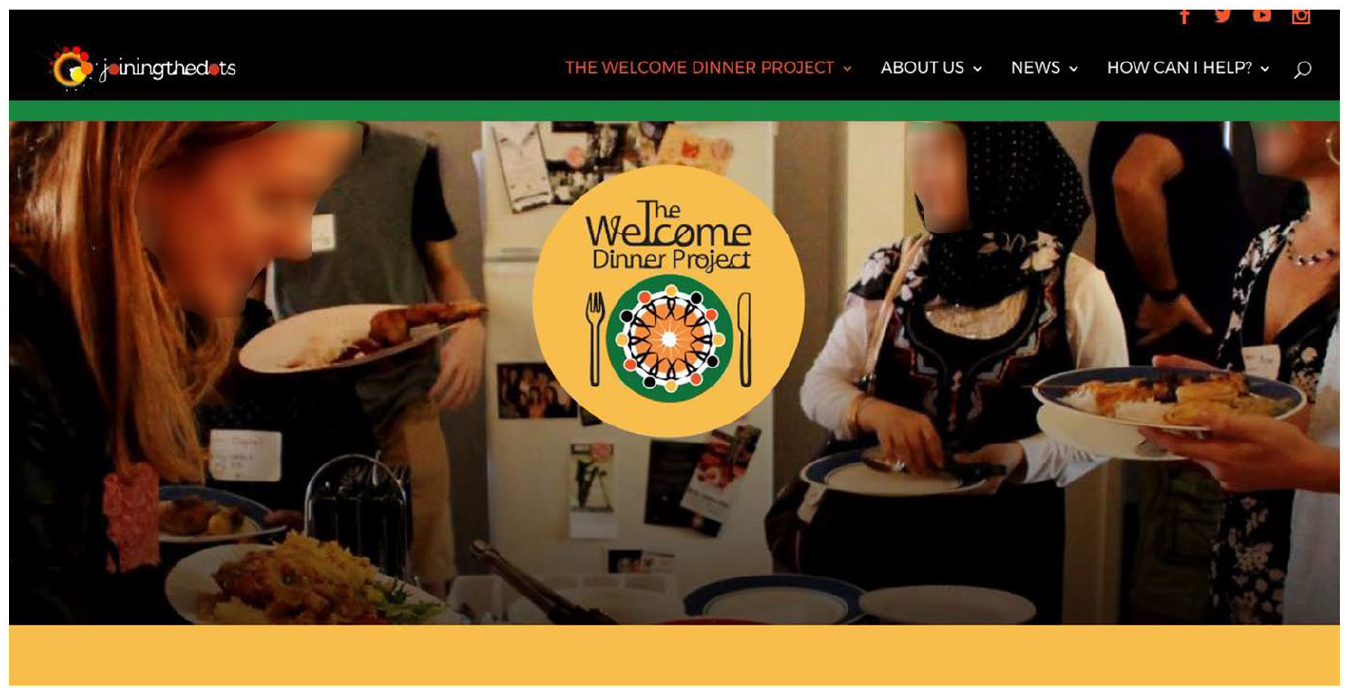
Photograph image used on WDP webpage as its banner.
The setting is a domestic kitchen, regarded in normative discourse as the site of the everyday and represented here as a place of conversing, serving and eating – relaxed potluck hospitality style. It is important to note that other versions of the image are less cropped and depict more of the domestic space, a wider array of dishes and plastic containers, and a larger group of guests around the table, including one black woman. The image I am discussing means that the branded icon and young white and Muslim women are made most salient and put in visual dialogue.
The young white woman is in the foreground, smiling as she hears an ongoing conversation, digging into the food. She is the epitome of normative femininity: white, slim, young and with blonde shiny long hair, embodying the discourse of ‘the life project of whiteness’ (Shome, 2014, cited in Wilkes, 2021). She evinces an appetite for the multicultural potluck. Although historically feminised appetites have been pathologised, social media now represents a new post-feminist identity associated with white middle-class women in which eating represents freedom and desire (Davidauskis, 2015). She is positioned quite at home, and as Sara Ahmed (2007) writes of the racial politics of ease, whiteness functions as a form of ‘public comfort’ because ‘white bodies are comfortable as they inhabit spaces that extend their shape; which ‘have already taken their shape’ through the histories and habits of whiteness (p. 158).
The young Muslim woman is in a hijab and modest dress, all of which racially mark her (Kress and van Leeuwen, 2006). In his discussion of the racialisation of the everyday, Smith (2015) writes that racialization often depends upon an alienation from that which is treated as given or normative; the racialized are constructed as aberrant or extraordinary in some respect. If women are treated as synonymous with the everyday, those who are racialized are treated as anomalous with regard to it. (p. 41)
This image shows a strong case of ‘otherness’ and visually renders the represented Muslim young women as anomalous to the homely in several ways: First, through the way that she is shot at some distance, looking away from the camera. Annabelle Estera and Riyad Shahjahan (2019) argue that such techniques can be racialised, because when white women are shown close-up, in contrast to women of colour in an image, they are rendered ‘relatable’ (p. 8). Indeed, dominant forms of white, middle-class femininity are often positioned as general and relatable (Wilkes, 2021).
Second, the Muslim woman is shown in the background, on the margins of the interactions, and although nearly everyone around her has food on their plates, she has yet to help herself to food. Her handbag is slung over her shoulder as if she hasn’t quite made herself at home. Racially minoritised people are often visually represented as ‘passivated’, subjected to processes and being affected by the actions of others in ways which contribute to depictions of power (van Leeuwen, 2008). Hage (1997) argues that in Australian multiculturalism’s discourse the ethnic other often appears as ‘an object of experience rather than an experiential subject’ (p. 136).
A third aspect of the Muslim young woman’s visual othering works through the signifier of the hijab, visually deployed as a form of cultural categorisation of an ‘oppressed Other’ in the Australian media, connoting the opposite associations attached of the white female subject. Since 9/11, the Australian media subjected the hijab to intense Islamophobia and stereotyped Muslim women as ‘sombre, backward, imperiled and exploited, exotic and oppressed’ by men and religion (Eltantawy, 2013: 389). Muslim women’s imagined hyper-oppression is deployed to evoke ‘benevolent emotions’ such as pity, compassion, outrage and sympathy from dominant groups, part of a longer history of portrayals of Muslim women as in need of ‘saving’, all part of the production of the Australian ‘female Muslim Other’ (Alsultany, 2012; Stratton, 2021 [2020]).
The resulting depiction of the Muslim woman underlines her difference and outsiderness, defined by the contrast to the positive values attached to idealised Australian white femininity. Indigenous Australians and Muslim people are seen as the least able to inhabit the long-established norm of Australianess, the former because they are a ‘special case’, and Muslims because they are not Christian and mostly not white (Stratton, 2021 [2020]). Not meant to be read as the Australian host, she is presented as not at home with the ‘whitely scripts’ of socialising and eating and hence the ‘not like us’ (Heinz, 2015; Smith, 2016). In the representational tradition of the ‘victimised Other’, the Muslim woman appears stripped of agency and offered to the implied viewer as the one to be ‘helped’. She is not the host but ‘the coloured migrant’ perennial guest (Caluya, 2011). Her function is to engage altruism and curiosity, and the image is designed to generate benevolent interest from the implied viewer as a potential host/guest who can enjoy multicultural commensality and be part of the fantasy of Australians as ‘exemplary hosts for all cultures’ (Elder, 2007: 135).
The remarkable everyday
The second type of photographic images is of an aestheticised domestic commensality and found in small numbers on WDP’s digital platforms but extensively across mainstream media reporting on WDP. The image screenshot was first uploaded by the WDP in 2013 to its national Facebook page as part of a series depicting one of its first home dinners. It was then reposted and repurposed by the WDP on its webpage and in Broadsheet, an online entertainment, lifestyle and city guide in 2014. The WDP then reposted the image to its Instagram in February 2016 and hyperlinked to the Broadsheet article on its webpage. In total, the Broadsheet report featured a series of seven images: the one featured below and a further six digital close-up, colour ‘food porn-style’ photographs which did not feature on the WDP media (Screenshot 2).
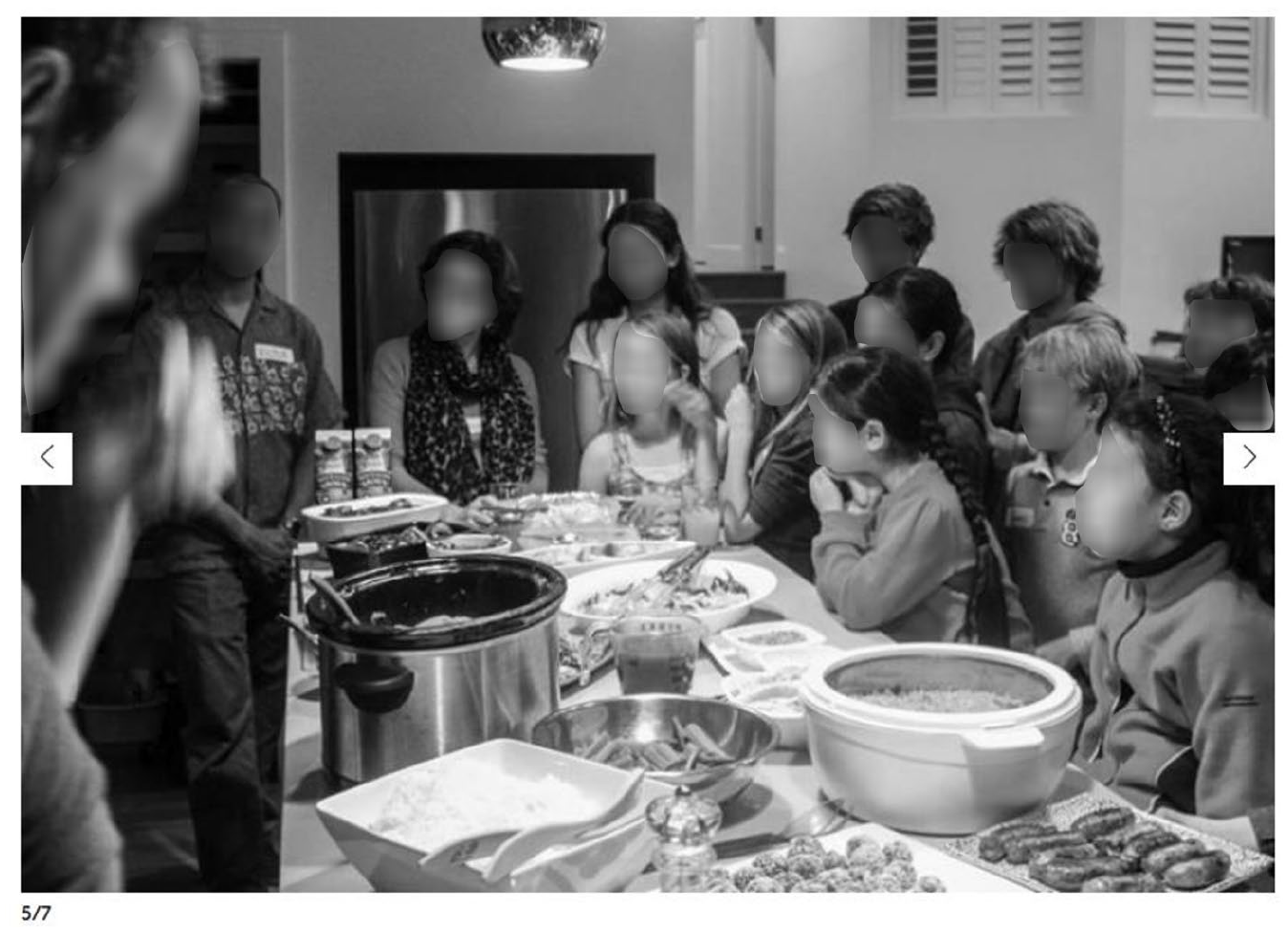
Image from WDP website, Facebook and online magazine, Broadsheet.
Clearly a ‘designed image’, the effect of the black and white photography on the webpage and in the wider media is quite striking (Barbour and Heise, 2019). It is not a common visual aesthetic in reporting the ‘everyday’. Black and white photographs are less naturalistic and obviously more stylised than colour photographs. The black and white colour acts as a sign, and adds a dramatic tone, removing any ‘colour noise’ (Paglamidis, 2013). The image aestheticises the WDP event being represented, giving it a sense of elegance, which aligns with the styling of the kitchen, food and implements on show, creating a sense of a dramatic everyday. Unlike many WDP formal and informal photographs, the image does not depict people eating or milling about. Food is clearly at the centre of the image, and everyone is gathered around the kitchen island, but the textures, sensuality and colours of the food are erased by the black and white aesthetic, and the image angle which foregrounds the serving dishes rather than their contents. Unlike the Instagram food styling of top-down bird’s eye view and close-up food porn images, the food sensory properties can’t be seen very well. Because of the eyeline of the depicted participants – or vector as van Leeuwen (2008) calls it – our eye is drawn to someone off picture, speaking and clearly enrapturing their audience. The depicted children – both white and Asian-looking – appear enthralled, hushed, still and attentive.
In the colour photographs of this event on Facebook, the kitchen and children look very different. There, the depicted children are eating, playing, laughing and being less controlled, and the kitchen reveals the messiness of commensality. Here, in contrast, the modernist kitchen space, surfaces and implements gleam bright white and the stainless steel sparkles. The light from the stainless steel, amplified by the black, throws light on the younger children’s faces. The attendees, apart from one little girl, appear to ignore the food and embody disciplined attentive listening, performing the comportment of middle-class whiteness and self-restraint. The image echoes lifestyle media’s aestheticisation of white middle-class everyday life, blending ‘ordinary, domestic scenes with extraordinariness in the form of impeccable styling . . . and a blemish-free version of home’ (Ryan, 2018: 4).
This image draws on a visual culture of whiteness and domestic imaginaries that stabilise and secure white middle-class domesticity. The ‘spectacle of clean’, modernist design and the colour white encode race and class and colonial associations of purity, order and control, which it has been argued can’t be separated from colonial, ‘eugenic, classist, and xenophobic histories’ and national imaginaries of ‘us and them’ (Bobrow-Strain, 2008; Connellan, 2006; Domosh, 2003; Glabau, 2019). The disciplined bodily practices display contemplative detachment and restraint in relation to eating associated with middle-class whiteness. The lighting operates as an aesthetic technology historically and culturally used to produce whiteness and a visual tradition associated with Christian ideologies of illumination and epiphany (Connellan, 2007; Dyer, 2017). Jon Stratton (2021 [2020]) argues that ‘Australian values’ are underpinned by ‘white Christianity, white English culture, white middle-class morality, and white Australia’ (p. 91). The light shines on the children’s face to suggest goodness and wonder at what they are hearing, consonant with Western Romantic views of children (Dyer, 2017; Olson and Rampaul, 2013).
What’s striking is that this image of people at a dinner event was singled out over other very different photographs for the webpage and repurposed in the Broadsheet article. The image stages an idealised middle-class white everyday in which the edification and transformation of the guests are foregrounded, displaying a sense of ‘good’ ‘everyday whiteness’ (Tascón, 2008). In selecting this image, with its cultural associations of cleanliness, privilege and social status, the WDP media suggest that it is the white middle class who have the right everyday ‘whitely scripts’ – domestic routines, values, disciplines, resources and moral economy – and the right habits of care and bodily capacities to be host to the Other and ‘civilise’ them into the nation and racialised citizenship (Harris, 2006; Heinz, forthcoming; Lees-Maffei, 2016). As Ahmed (2012) puts it, ‘whiteness is produced as host’, as that which is already in place or at home (p. 43). Their everyday practices as evidenced in the photograph represent the desired story of the ‘home’ of the good nation via the ‘microcosm’ of the good home and white goodness (Lees-Maffei, 2016: 205).
The non-epic everyday
The third type of visualisation is that of a non-epic everyday depicted by photographic images in a snapshot style of imagery taken by facilitators or guests at home dinners. These are uploaded to the main WDP Facebook page and regional Facebook pages, and some reposted to WDP’s Instagram and Twitter accounts. These numerically dominate the depiction of WDP on their social media and are starkly different to the previous two images’ representation of everyday domestic eating spaces.
What’s noticeable in these images is the depiction of a mix of racialised people against a backdrop of everyday commensal messiness and clutter – half-finished dishes, mismatched furniture, under-designed eating spaces, ‘insignificant domestic objects’, mixed up cutlery, clingfilm and foil – all part of the ‘non-epic everyday’ (Yaeger, 2009: 104). People of different racial and cultural background look self-conscious, smile awkwardly for the camera, eat, talk and mill.
Screenshot 3 is typical of these images in its lack of middle-class visual and domestic aesthetics and its depiction of racially minoritised migrant hospitality. On the Facebook image, the hosts’ ‘Middle-Eastern’ names are given. The WDP tells us that the image shows a home dinner in Parramatta in Western Sydney, ‘Sydney’s Other’, a region racially vilified in the media and maligned by the metropolitan elite for its banal everydayness (Elder, 2007). It’s difficult to tell what ethnicities people are – perhaps Lebanese, maybe Greeks, Asian and a few Anglo Celtic whites. Typical of this WDP genre of image, everyone looks at the camera, posing and in ‘a demand’ gaze, as if encouraging us to join in, and there is lots of colour and movement (Kress and van Leeuwen, 2006).
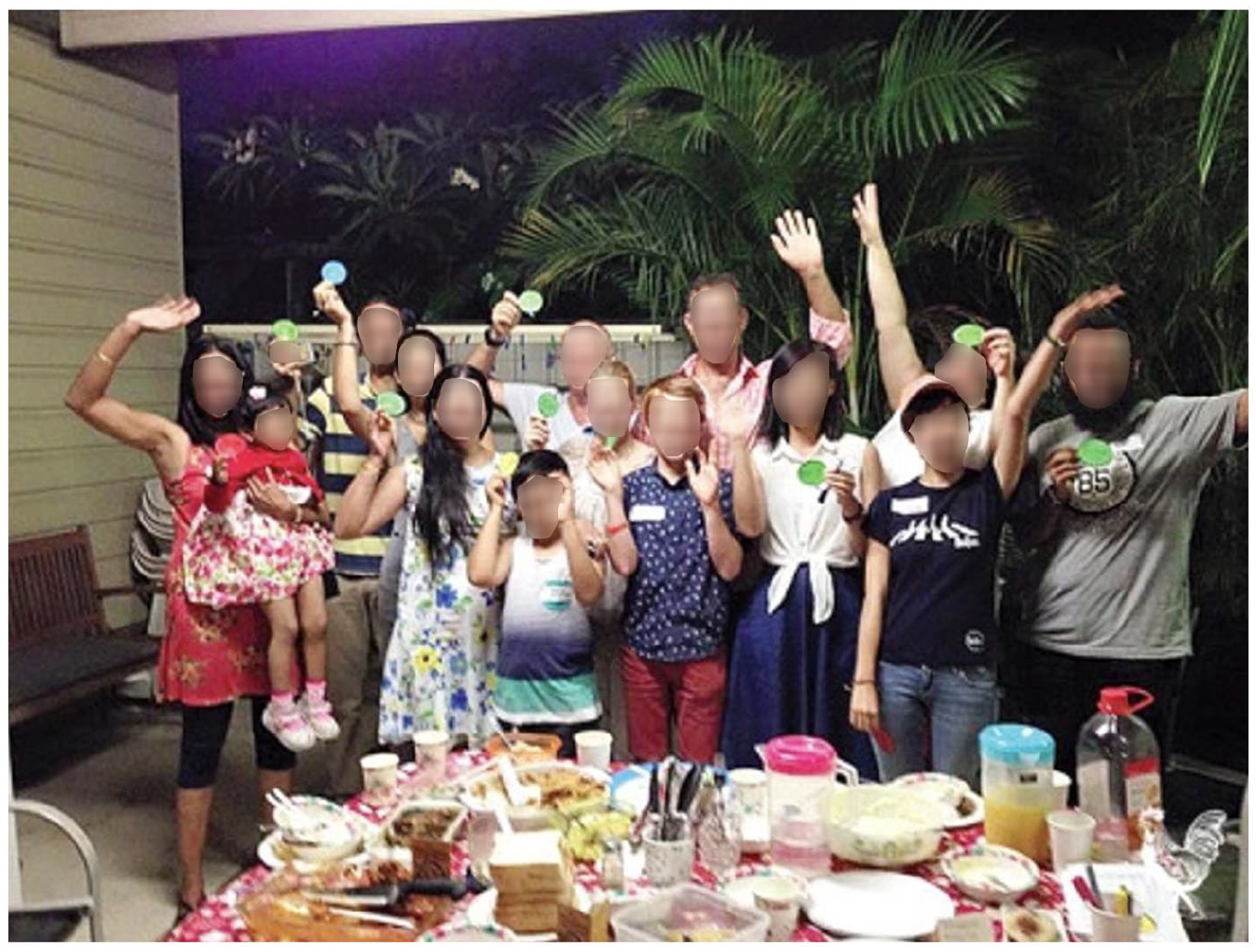
WDP Facebook image.
What is very noticeable is these types of WDP images are a lack of middle-class white aesthetics, notions of ‘good’ design and stylised foodie dishes. The image depicts a quintessential Australian functional setting, the ‘backyard’, a space used for recreation, washing and informal outdoor eating, rather than the middle-class kitchens in Screenshots 1 and 2. The image does not conform to widely observed foodie iconography with its representational strategies and styling tropes profiling the roundness, freshness and plumpness of food, to signify sensuality and indulgence (Taylor and Keating, 2018). Some of the food featured is also not associated with the middle class – a big pile of white bread and a large plastic bottle of drinking cordial. The table is cluttered with a mishmash of serving dishes, half-eaten food, dirty plates and open tubs revealing the messy realities of commensality. Even the bodies have a ‘messy’ exuberance.
In contrast to the dominant cultural association of clutter as lack of control and structured by a racialised and classed moral economy, this visualisation signifies a celebration of domestic and social mess as a sign of inter-cultural conviviality. Although posed, the image depicts a relaxed, lived-in domestic space. The image conveys a sense of space ‘overflowing with stuff, feelings and activities’, a depiction of the ‘“throwntogetherness” of everyday life’ (Löfgren, 2017: 2).
Along with the realistic mess of commensality and the lack of modernist design, what’s also noticeable is the preponderance of plastic on display, including clingfilm but most frequently, Tupperware-style food storage containers. Despite their ubiquity, Tupperware and other plastic food containers have rarely been studied (see Clarke, 1999; Vincent, 2003, for exceptions). Tupperware was marketed in postwar America as a ‘modern, beautiful, and glamorous object, the result of innovative technological development’, a ‘beacon of good taste’ and exhibited in galleries and museums (Clarke, 1999: 49). Today, Tupperware and its derivatives are associated with lower middle-class femininity and the suburbs – not nice ‘white things’. Unlike the other two images which cropped or edited out plastic, containers and messiness of hospitality, this image foregrounds them.
These types of WDP Facebook images are a digital form of ‘domestic realism’, defined by a sensibility that profiles ‘domestic detail and ordinariness, domestic chaos – messy interiors that symbolically present layers of lived-in-ness’ (Ward et al., 2010: 171). In these ways, the image and other WDP Facebook images like it challenge the white aesthetics of digital food and ‘purity politics’ within gastronomic discourse and dominant understandings of white people as exemplary hosts. Although such candid, snapshot-style images of homes dominate media platforms like Instagram, this visualisation disrupts notions of belonging through its depiction of non-white suburban migrant hospitality in the suburbs, so missing from Australian national storytelling (Barbour and Heise, 2019). In Australian media, ‘ethnic “Others” generally do not participate in the everyday settings, activities or social relations associated with representations of Australianness’ (Hogan, 2005: 202). What’s also of note is the repurposing of this image in the Perth Interactive, an online regional newspaper in a city on the west coast of Australia. This racialised image of ‘Westie’ non-white migrant hospitality became the face of the WDP over 3000 km from Melbourne and Sydney, deployed to depict Australian everyday welcoming and exemplary hosting.
Discussion and conclusion
Critical race theorists remind us that the everyday and everydayness are unevenly distributed by race materially, bodily and spatially, although to date, their work has not been taken up in digital or media studies of the represented everyday. Their work challenges us to de-stabilise the racialised ordinariness, routine and taken-for-granted in our understandings of the everyday. This argument means recognising the ways of whiteness as the common, familiar or mundane is often depicted in white media and scholarship as the norm or ordinary (Smith, 2015, 2016). If the everyday is a context in which the making of race ‘may be apprehended’ (Smith, 2016), then digital food cultures which reproduce practices and representations of everyday lives and habits of eating, cooking, shopping, growing, hospitality and family life are important sources of where and how race is constituted.
My focus in this article was how the WDP depicted the everyday spaces of the home and hospitality practices as part of their project of making the home into a civic space which challenges racial and refugee stereotypes, government and media racism, and national inhospitality by bringing established and new Australians together to share food and conversations in what I call food hospitality activism. Rather than the actual hospitality practices of the events, which were thoughtfully arranged around egalitarian principles, my article examines their representation through digital photographs. I argue that two of the visualisations – the formal images – re-consolidate notions of white homes and hosting as building good Australia, but that the third and most numerically dominant style – the Facebook ‘domestic realism’ images – challenges ‘multiculturalism founded on white people as the ‘national-spatial managers’ regulating and tolerating racialised others as the ‘managed national object’ (Hage, 1998).
My overall argument is that WDP representations and media representations of WDP are underscored by conflicting representations of race, diversity and privilege. Although the WDP tries to bring people together in practice, its formal images reproduce the racial status quo through the cultural production of an ‘everyday whiteness’ (Tascón, 2008). There, white people’s wealth, homes and privilege are not played down but rather positioned as good and generous.
Despite the good intentions of the WDP, the formal images it disseminates work to service the status quo by enacting and reinforcing dominant notions of middle-class whiteness in Australia, moderating the transgressive potential of its activism. In this way, whiteness is produced as host, as that which is at home; to be welcomed is to be positioned as the one who is not at home, welcomed on the condition that they return hospitality by integrating or by ‘being diverse’ (Ahmed, 2012: 43).
However, these processes are subverted by less formal and unruly images depicting people outside, in mess, in non-hierarchical groups and migrant hosting. The less formal Facebook photographs reveal a different image of the everyday as a space of food hospitality activism that challenges digital white foodie-ism, and purity politics and ideas about hostliness. They offer a challenge to images of the whiteness of hospitality and show an image of the racialised suburban everyday as the site of the civil politics for transforming the white inhospitable nation.
Of course, the WDP images are a drop in the ocean in remaking homeliness and everydayness in Australia. Everyday homes and streets for Indigenous and racialised minorities still generate ‘racial terror’ (hooks in Smith, 2015). But these domestic realism images bring into signification new stories and iconographies of the everyday. Writing about the Gezi Park protests and their use of social media to document everyday activities like eating, cleaning up, and exercising, McGarry et al. (2019) argue that In the depiction of everyday life there is an opportunity to communicate a vision of . . . a different society. . . the visualization of the everyday serves a performative function as a form of lived ‘world-making’ and the seemingly inconsequential images of everyday life. . . to bring attention to the ordinary as a crucial site of cultural politics. (p. 299)
The work of the WDP participants and activists such as those in Gezi Park suggests that there is potential for the visual to disrupt and recast even the most firmly embedded imaginaries, to use visual culture to create new ways to be seen and see the world differently (Burrell and Hörschelmann, 2019). As theorists argue, everyday diversity is about the struggle for recognition and how migrants’ lives remain mis- or under-represented (Burrell and Hörschelmann, 2019; Hage, 1998). Part of the work of charities specialising in food hospitality activism could be to produce visual activism which disrupts the iconographies of white racial power.
In this article, I start to address the relative neglect of digital whiteness and theorise the everyday as racialised in studies of digital food cultures. I have argued that digital food studies need to analyse the racial registers of home, domesticity and food practices, and identify the white racial construction in the seemingly banal and benign (Harris, 2013) to challenge proliferating whiteness on digital media (Zhang et al., 2012). As scholars insist, food-related and domestic food–related spaces and objects are ‘a constitutive agent’ in producing ‘race, class, and gender’ (Harris, 2013: xxiv). Whiteness is not given but a repeated performance, and as Moreton-Robinson (2015) and Allen (2020) make clear, whiteness and settler-colonialism are microprocesses that need to be remade through and in the everyday, one part of which is how whiteness accretes through digital media. To do this requires developing visual and digital methods of the iconographies of whiteness in digital food culture which have deep genealogical links to histories of colonialism and racism and normative ideals of race-neutral domesticity and everydayness. Whiteness’s ‘dominative power’ persists through its assertion that its historical peculiarity is universal, standard and neutral – in short, of the everyday (Smith, 2016).
Footnotes
Funding
The author(s) received no financial support for the research, authorship and/or publication of this article.
