




Abstract
The article uses the case of Melania Trump, the former First Lady of the United States, to analyse the discursive strategies through which the print media in Slovenia represented ‘Melania’ as an ethnically born Slovenian on a national scale. The article also demonstrates how patriotism, based on the love and feelings of belonging to the Slovenian nation-state, was nationalized in the case of ‘Melania’. The main argument is that numerous and repetitive media representations of ‘Melania’ aggressively put nationalism in the commercial context, and consequently transformed the nation into a commodity and an object of trade which can be sold and of which the Slovenians can make a profit. Consequently, the Slovenian press coverage of Melania Trump created her as a national brand meant to perform on the local, national market when merging emotional attitudes with commercial allure. The article concludes with the discursive strategies such as representing ‘Melania’ as ‘ours’, as a tool to accelerate the country’s economic growth and as a branding strategy to sell the Slovenian landscape and culture and produce the Slovenian nation as an imagined commodity. Furthermore, such branding of the nation is directed towards domestic rather than international audiences.
Keywords
‘Be Best!’
Introduction: First Lady and nation branding as a media practice
On 20 January 2017, the inauguration of the 45th President of the United States took place. Donald Trump swore on the Bible held by his wife, Melania Trump, who was born in the small Slovenian town of Sevnica 1 and who migrated to America in the 1990s. The Slovenian media reported that ‘Melania’ migrated to America as a photo model, met the American media mogul and millionaire Donald Trump, married him in 2005 and became ‘a naturalized American citizen’. The fact that she was the first First Lady to have been born outside the United States since 1829 was also emphasized on more than one occasion. In this manner, one of the stories in the Slovenian media recently cited a source from the Slovenian Foreign Ministry that highlighted the positive economic trends and gains, including ‘Melania Trump, in many public appearances before and after the election of Donald Trump as the President of the United States, emphasized her Slovenian origin and expressed her affection for the country, in which she was born and raised’ (Pust, 2019). So, it was not only the fact of the First Lady being born in Slovenia that was stressed initially in the media, but also the expectation that Slovenia was going to gain a lot economically with ‘Melania’.
Such media representations of ‘Melania’ are closely connected to nation-branding strategies aimed at presenting Melania Trump as a modest but very famous Slovenian, who can help Slovenia to raise itself from its smallness and anonymity. In this article, we interchangeably use Melania Trump’s full name and surname, as well as ‘Melania’ in quotation marks. With the latter, we refer to the construction of Melania Trump in the analysed media where she is addressed by her first name only most of the time. Tyler (2008: 18–19) uses the notion of ‘figure’ to describe the ways in which at different historical and cultural moments, specific ‘social types’ become over-determined and are publicly imagined in excessive, distorted and caricatured ways. More importantly, Tyler (2008) maintains that mediation should not be understood only as representational, but as a constitutive and generative process. Tyler (2008) further states that the movement of such figures across the media is propelled by emotional responses – in the case of ‘Melania’, the positive emotions of pride and enrapture ravishment are involved. 2 ‘Melania’ is thus constructed as a public figure in the Slovenian media, and we should make a clear distinction between her as the figure and the ‘real person’.
Castelló and Mihelj (2018) argue that the current revival of the national extends beyond the realm of politics, as it is more anchored in the logic of global capitalism and has become inextricably intertwined with the practices of promotion and consumption. Castelló and Mihelj (2018) draw on several debates that have appeared under different topics, ranging from ‘economic nationalism’, ‘nation branding’ and ‘consumer ethnocentrism’ to ‘commercial nationalism’. When discussing post-millennium nationalism as a cooperative idea whereby emotional attitudes merge with commercial allure, Vidmar Horvat (2019) talks about the morphing of the processes from modern ethnicization to contemporary late-modern marketization of the nation. In this respect, we propose the term ‘commodified nationalism’ for describing the Slovenian media’s creation of Melania Trump as a Slovenian national brand.
The aim of the article is to show the specifics of the Slovenian nation branding in the case of ‘Melania’, which is connected with celebrity nationalism on one side and with the commodification of the nation on the other. We presume that the entire branding of ‘Melania’ in the Slovenian media is first connected with the feelings of a small and unrecognizable nation. Media discourse functions as a nation-building discourse and constructs Melania Trump as a Slovenian brand through its own outpouring of patriotic expression. Such a construction of national identity in the media, following Anderson’s (1995) and Hall’s (1997) idea of nation building as purposeful and targeted, constructs a nation for commodification purposes. The media is thus a very important tool in contemporary nation-branding processes, as Bolin and Miazhevich (2018: 527–533) have already noted. We add that nationalism is a directive project and also that it is not orchestrated by one particular organization – rather it is purposefully constructed across a range of media texts. The sum of media representations together constructs a narrative of nation, which reflects broader understandings of Slovenia as a nation brand.
Bolin and Miazhevich (2018) demonstrate that the critical scholarship on nation branding has relied primarily on the sociological and anthropological theories of nationhood, identities and markets. By contrast, the role of the media as institutions, systems and societal storytellers has been under-theorized in relation to nation branding. In other words, the media ‘have been described as passive tools in the orchestration of nation-branding campaigns, lacking agency of their own’ (Bolin and Ståhlberg, 2015: 3066), although the media is an integral part of nation branding as it perpetuates nation-branding ideas, images, ideologies, discourses and practices. We argue that such nation branding is a contemporary form of nationalism, especially in the case of tourism, but it has rarely been discussed in the context of media narratives (see Dinnie, 2016; Fan, 2006; Frew and White, 2011; Pamment and Cassinger, 2018; Volčič, 2011).
In this study, we aim to discover these media-generated forms in order to understand what is happening with nationalism in mediatised consumer societies. The commodification of the nation in our case is twofold. First, the media represents ‘Melania’ as an authentic Slovenian, as ‘our’ modest, remarkable and very famous Slovenian. Second, ‘Melania’ is in this sense represented as the one who would help ‘us’ in economic terms or she is used to sell the Slovenian nation as a commodity. Our research shows, following Bolin and Ståhlberg (2020: 10), that in the case of the media reporting on ‘Melania’, the Slovenian nation has been imagined as a commodity. We believe it is not so much the process of nation building or the collective identification of readers with the nation that is at the backdrop of this cultural phenomenon of nation branding, but rather the less grandiose, banal fantasies. These fantasies build on the exaltation of a small nation from anonymity.
Literature review: nation as a commodity and deep feelings of patriotism
Due to a very competitive global economic environment, countries often use the media to present as brands. This calls for the rethinking of the concepts of nationalism and ethnocentrism. 3 Many authors have emphasized the link between nationalism and marketing. For example, Aronczyk (2013) maintains that nation branding is the process of the construction and communication of national identity using tools, techniques and expertise from the world of corporate brand management. Moreover, Hoefte and Veenendaal (2019) add that nation building and nation branding are closely intertwined in today’s world of the commercialization of everyday life, and the capitalist logic of the nation is put at the forefront. Thus, nation branding cannot be seen in isolation from nation building. Therefore, the nation branding of Slovenia through ‘Melania’s’ images always also involves the building of the Slovenian nation.
However, in Varga’s (2013) words, such a process of nation branding, which also includes the economic aspect, helps to maintain, legitimize and create a neoliberal social order, in which all cultural phenomena are seen through an economic perspective. Nation branding, in a way, supplants ethnonationalism with a new form of market-based, national image management (Bolin and Miazhevich, 2018). Such a marketing tool (i.e. nation branding) is especially vital in the territory of Eastern European countries. The tool is also vital in Slovenia as a part of the former Yugoslavia (see Jansen, 2008; Kania-Lundholm, 2012; Konečnik Ruzzier, 2012; Szondi, 2007; Vitic and Ringer, 2007; Volčič, 2008; Volčič and Andrejevic, 2011) since these countries needed to search for a coherent national identity of belonging, and in many cases employed, as Volčič (2008) says, ‘nation-branding projects’. It also seems that nation branding is more of a characteristic of small peripheral nations, which have to establish a position and role in comparison with big, superior nations. In this regard, this contemporary building of the nation differs from traditional modernist constructions of the nation, as Anderson (1995) presents in his work.
Drawing on these debates, we argue that ‘Melania’ is broadly constructed in the media as a Slovenian national brand. When representing Slovenian–American relations, such nation branding aims to promote the economic growth and the greater visibility of the small Slovenian nation, which would put Slovenia on the global map. According to Bolin and Miazhevich (2018: 527), such branding ‘campaigns’ tend to produce ahistorical and exclusionary representations of the nation and advance a form of ‘commercial nationalism’ that is quite problematic. Following Baudrillard, Kaneva (2018: 631) argues that we can see nation brands as simulacra, which exist within a transnational system for the creation, circulation and consumption of such commodity signs. ‘Melania’ as a national brand functions as a commodity sign. In this capacity, adds Kaneva (2018: 631), nation brands shed the representational burden of standing in for the nation as a whole.
In Volčič and Andrejevic’s (2011) terms, we can argue that ‘Melania’ is (ab)used by the Slovenian media to extend national interests and promote a sense of loyalty and belonging. In this regard, national branding is a citizen-evoking practice. It includes citizens as active consumers and producers of the brand, or to paraphrase Volčič and Andrejevic (2011), the Slovenian citizens ‘live’ ‘Melania’ as a national brand. This means the citizens identify with her and exhibit attitudes and behaviours compatible with this brand strategy: The nation as a crucial social category has been under-theorised in media studies of the global era. It has either been explicitly written out through terms such as ‘post-national’ or ‘de-nationalisation’, or has been forgotten/ignored in discussions about glocalisation as well as in large parts of the more general globalisation paradigm. (Roosvall and Salovaara-Moring, 2010: 9)
Yet, on the other side, many media and nation theorists have started discussing this relationship as much more complex as it was in the modern era, and they address this connection between the media and nation mostly in the specific present context of neoliberal, consumer societies. 4 In this regard, Bolin and Ståhlberg (2010) address the new ways in which nations are constructed today, culturally and ideologically, as a community as well as a commodity. Bolin and Ståhlberg (2010) stress that contemporary nation-states are increasingly acting in the same way as commercial enterprises, directing new nationalistic rhetoric towards an international audience of investors and tourists. We could argue that the branding practice in the case of ‘Melania’, from Bolin and Ståhlberg’s (2010) perspective, constitutes solidarity in relation to the nation as it is done in nationalism, and simultaneously nation branding applies cultural technologies to constitute the nation itself as a commodity (see also Kaneva, 2011). Moreover, Bolin and Ståhlberg (2020: 1) ask themselves ‘how have changes in media technologies, from mass media to digital and interactive personal media, impacted the national imaginaries over the past few decades’? Thus, the impact of media transformations on the imagining of a nation is crucial.
Various media produce a nation as neoliberal, while branding a nation qualitatively differs from the earlier forms of imagined communities. Thus, the nation is more and more transformed from a political concept into a commercial product, and it becomes a tool for marketing a commodity to potential customers (Ståhlberg and Bolin, 2016: 274). 5 In this way, nations are reduced to commodities and are commercialized in the media, from TV and print advertisements to touristic leaflets. Hence, the Slovenian nation would also become more recognizable. If we borrow from Anderson’s (1995) ideas of print media construction of the nation as an imagined community in modern societies, we can paraphrase his ideas in the context of new media settings in the 21st century and the neoliberal capitalist order that a nation is being more and more imagined as a commodity, as Bolin and Ståhlberg (2020: 9–10) maintain. They show that the convergences between capitalism and media technologies have changed the model of national imaginaries, whereby media technologies are nowadays adopted to produce the branding market for the old imaginaries, melding these and the rhetoric of nation building into the consumer form.
Moreover, the practice of branding ‘Melania’ as a nation brand in the media includes deep patriotic feelings about her being a Slovenian, and these feelings are used to construct the ties and feelings about Slovenianness. This is accomplished with the help of the media making her a national idol and selling the Slovenian nation as an attractive consumer product. Patriotism entails the feeling of a deep devotion and a sense of attachment to a national homeland, creating close ties among all national citizens who share the same sentiment about ‘Melania’ being a Slovenian. These deep ties and feelings of love of one’s homeland are related to ethnic roots, cultural heritage, historical aspects or political characteristics (see Bodnar, 1994; Nussbaum, 2010; Tan, 2004).
In some theoretical perspectives, patriotism is seen as innocent and harmless (see Skitka, 2005, who defines patriotism as love of a country and in-group solidarity and nationalism as uncritical acceptance of national, state and political authorities, in addition to out-group antipathy). However, we argue that patriotism also includes a set of characteristics and concepts that are closely related to nationalism (see also Li and Brewer, 2004; Pušnik, 2008; Viroli, 2003, for a detailed debate about the concepts of nationalism and patriotism). ‘Nationalism and patriotism are two of the most powerful forces shaping world history. Though seen by many as two sides of the same coin, they have developed widely different connotations’, Viroli (2003) argues. Viroli (2003) shows that nationalism is increasingly seen as destructive and negative, while patriotism is viewed as positive and constructive. Yet, we have to bear in mind that boundaries between both are very slippery, and consequently, patriotism easily and innocently slips into nationalistic speech. For example, Li and Brewer (2004: 727) argue that a pattern of interrelationships among the measures of patriotism, nationalism and, in turn, of tolerance for cultural diversity exists. However, Nussbaum (2010) contends that the emphasis ‘on patriotic pride is both morally dangerous and, ultimately, subversive of some of the worthy goals patriotism sets out to serve – for example, the goal of national unity in devotion to worthy moral ideals of justice and equality’ (p. 155). 6
We argue that a specific type of nationalist movement (Lahusen, 1993) and patriotic iconoclasm (Boime, 1998) are being constructed in the Slovenian media by representing ‘Melania’ as a true-born Slovenian, a prime representative of the Slovenian nation and as closely related to Slovenian soil. To paraphrase Ståhlberg and Bolin (2016), ‘Melania’ has two functions in the Slovenian media. First, she functions as a national signifier to control and discipline the country’s population and to strengthen a collective national sense of community among the citizens. Second, she simultaneously functions as a marketing tool for promoting the nation as an attractive commodity. We believe that the second function is much stronger when using ‘Melania’, especially for raising the Slovenian nation from its anonymity and smallness.
Balabanis et al. (2001) also argue that in contemporary consumer societies, a strong impact of patriotism and nationalism as antecedents to consumer ethnocentrism appears. This new kind of Slovenian nationalism, based on the representations of ‘Melania’s’ true Slovenianness, is cherishing the feeling of love, devotion and a sense of attachment to Slovenia. It is also building bonds among citizens who share the same sentiment – admiration of ‘Melania’ and, consequently, admiration of Slovenia. Patriotism thus serves as an element of the commodified nationalistic rhetoric. In the next section, we focus on the expansive journalistic strategies of branding ‘Melania’.
Method and sample
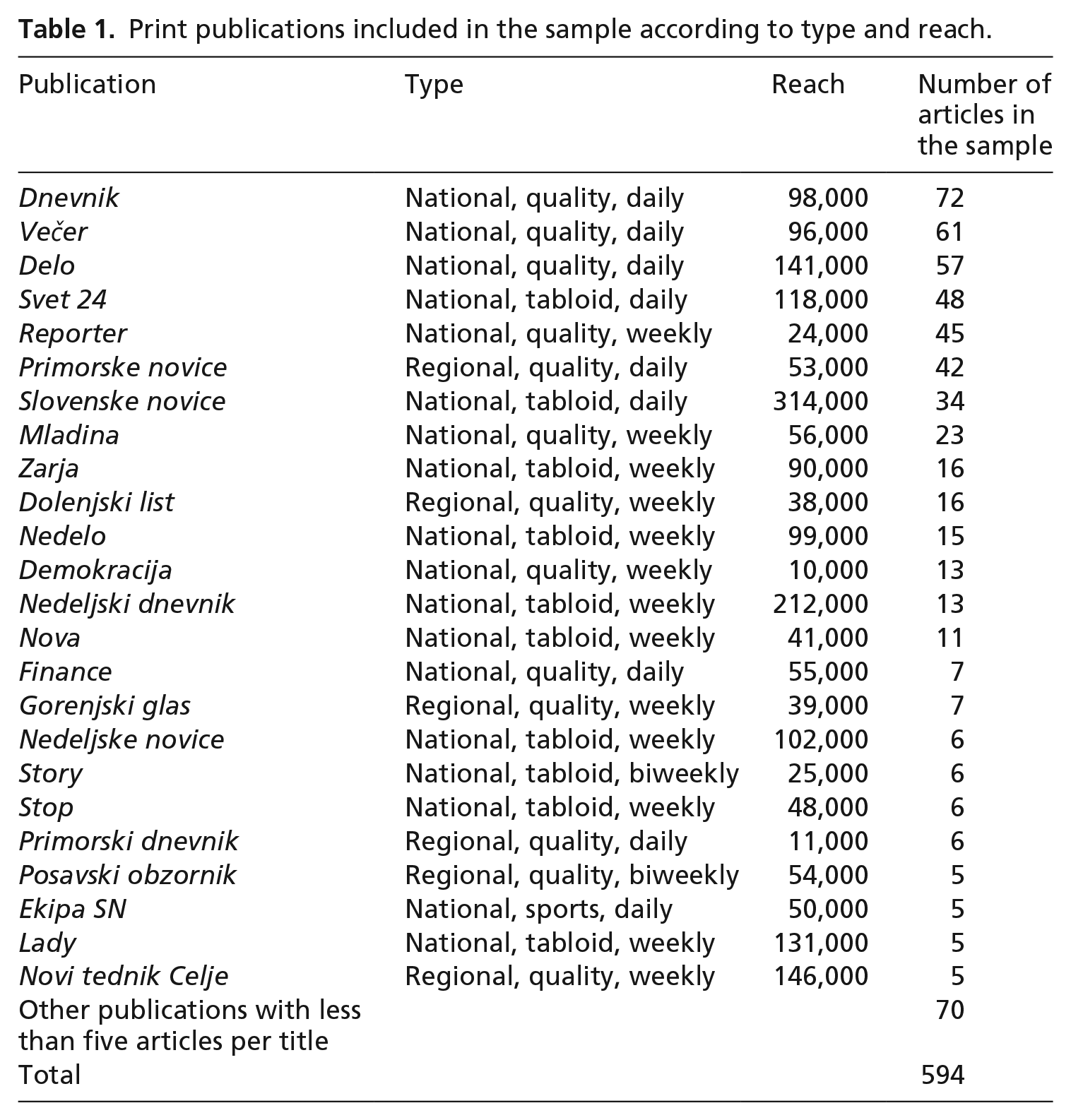
The study uses a textual analysis of 594 articles about Melania Trump, published in the Slovene mainstream print media over a 3-month period in 2016 and 2017 (see Table 1). Together, 42 national and regional newspapers and magazines of different genres and political orientations were included in the sample. The largest part of the articles from the sample (190) was published by three national quality dailies, followed by 82 articles published by two national tabloid dailies and 31 by two national tabloid weeklies with the highest reach.
Print publications included in the sample according to type and reach.
We focused on the print media only because of the dominance of traditional media in Slovenia, and we did not include websites or social media because the selected magazines mostly reproduced the same articles on respective websites and social media channels. For example, according to Luthar and Trdina (2015: 284), popular tabloid weeklies, which represent an important part of our sample, still remain central to the discourse of celebrification in Slovenia. However, celebrity culture is disseminated across such a broad range of popular culture and media genres in old and new media that its boundaries are difficult to define although there are no notable celebrity blogs with nationwide popularity in Slovenia. Still, we are well aware of the limitations of our sample that focuses only on print media, since other media content where celebrity discourse also appears (e.g. TV shows, social media) was not included. For this reason, we believe our study of the print media coverage of ‘Melania’ and the circulation of discourses we detected can present a strong starting point. It can also constitute an interesting focus for future research.
Sampling was further limited to two specific time periods. We included the journalistic texts, published between 15 October 2016 and 15 November 2016. The specific period was 3 weeks before and a week after the presidential election in the United States on 8 November 2016. We also included texts published between 20 January 2017 and 20 March 2017, which represented the period of 2 months after Donald Trump’s inauguration as the 45th president of the United States on 20 January 2017. During these two periods, a saturation of media texts about Melania Trump could be expected. Sampling was based on the keyword Melania Trump, with all of its variants, and was performed by the main Slovene press clipping agency of Kliping. Sampling was also later tested and vetted by the authors.
The study is exploratory and draws on a broad sample of texts from both selected periods. The differences in reporting between the two periods are one of our central concerns. We did not distinguish between opinion pieces and news articles in the selection process, and thus we included both in the analysis. The inductive approach to the data was adopted. Both authors read through all the texts and tried to identify the main informal journalistic mechanisms that create the Slovenian nation as a commodity through representations of ‘Melania’. The textual analysis enabled the identification, interpretation and contextualization of the patterns of meaning (see also Negra et al., 2019). In the next section, we identify three main discursive nation-branding strategies in Slovenian print media as it relates to ‘Melania’.
‘Melania’ as a true-born authentic Slovenian: patriotic love for the country
The most common practice of creating ‘Melania’ as a Slovenian national brand in print media is connected to the representations and constructions of her being an authentic Slovenian; someone who is a Slovenian-ethnic-born individual – that is, ‘Slovene in the White House’. It is continually repeated that with the help of Melania Trump, Slovenia is entering the White House. For instance, if it is true that a woman supports three corners of the house, then in two months a Slovene woman will support three corners of the most influential house in the world, that white one in Washington. On the back of Melanija Knavs from Styria region, Slovenia is riding among the world superpowers! (Utenkar, 2016: 9)
Such representations of ‘Melania’ emphasize her country of origin and, most importantly, her authentic Slovenian roots.
If we paraphrase Eade (1990), media discourses on local and global levels encourage the articulation of primordial, national solidarity, which forges a bond between Slovenians. Moreover, Slovenia is constantly equated with ‘Melania’, and the pride and feelings of sameness are put forward in a national ‘quest for authenticity’ (Eade, 1990: 493) when representing ‘Melania’s’ authentic Slovenianness through her Slovenian hometown, Slovenian ethnic roots and so on. Pride is often heavily emphasized: ‘The new First Lady of the USA was glamorous like a real lady on yesterday’s inauguration. Slovenia is proud of you, “Melania”!’ (Svet24, 2017). This is also seen in quotes like ‘with Trump, a Slovenian, “Melania” from Sevnica is coming to the White House as the First Lady. That is not a small thing, and we should be proud of that’ (Šurla, 2016: 3). In other words, the effect of such media reporting is ‘the prioritisation of a particular identity’. Media discourse, in this case, is closely connected with political discourse – that is, nationalist discourse. Thus, media discourse needs to be located ‘within political discourses and practices which construct links between people as members of “imagined communities”’ (Eade, 1990: 493). However, personal pride is transformed into national pride when readers can see their whole community in the media discourse about the Slovenian origin of ‘Melania’: If Slovenian handball players were not successful at getting on top of the world, a Slovenian beauty Melania Trump did just that. When her husband Donald swore in as the 45th President of the United States, she became the first Lady born outside of the US after 1829. /. . ./ From choosing a beautiful Ralph Lauren dress to her posture at the inauguration, it was obvious that she is fit for her new role for now, which was not so obvious during the election campaign. (Obrazi, 2017: 8)
In this sense, ‘Melania’ is also embodied as a Slovenian. Moreover, the parts of her body are also identified as Slovenian, and such a discourse has a power to arouse deep nationalist feelings: /. . ./ there is a chance that we will get a First Lady and that
Pamment and Cassinger (2018) would argue that such media strategies help to encourage citizen participation in promoting Slovenian values, partially for the purpose of showing the country’s authentic side and partially for generating publicity. In our sample, care for the mother tongue is also related to such a true and authentic national interest. In numerous articles, ‘Melania’ is pictured as the nation’s mother,
7
as she is represented in the Slovenian media not only as a good mother, but also as a good national mother. She is the one who cares not only for her descendants, but also for the whole Slovenian nation: Like some queen Esther, a young lady from Sevnica has become the First Lady in the White House, the home of the American president Trump. I respect ‘Melania’ because she taught her son how to speak Slovenian. (Turinek, 2016)
Sacrificing for her son and, meanwhile, also for the nation is a common strategy of picturing ‘Melania’ as the mother of the nation, or in Ramaswamy’s (2010) words, ‘the goddess of the nation’. ‘Melania’s’ patriotic feelings are emphasized when the media argues that, even in the United States, she did not forget her Slovenian roots. Such representations of ‘Melania’ are set as an example to Slovenian readers. ‘Melania’ is pictured as an example of a very good mother and a very beautiful woman. This is repeated continuously in the Slovenian media and creates ‘Melania’ as a special kind of celebrity: Months ago, when the dominant media tried to hurt Trump with publishing the half-naked pictures of his 20 years younger ‘Melania’, I argued that they have done him a favour.
As Luthar and Trdina (2015) have shown, in popular mediascapes the discourse of ethnic nationalism is closely connected with gender and the question of social distinction. Luthar and Trdina (2015) argue that the power of traditional national ceremonies and spectacular media events in the performance of a nation has been supplemented by popular cultural forms (p. 265). ‘Melania’ as a celebrity, a model, a caring mother and a First Lady – ‘The first real Slovenian First Lady’ (Nedelo, 2016: 5) – is pictured as a superwoman, and this is connected to her Slovenian roots. This is also evident in the example which talks about the ‘presents from homeland’ to ‘Melania’: ‘The Pergers have never met “Melania” but they are convinced that she is proud to be the Slovenian, as she values their products highly’ (Kotnik, 2016: 5).
Moreover, such spaces of celebrity, which are used for nationalistic purposes (see also O’Connor, 2012) in the Slovenian media, also construct ‘Melania’s’ Slovenianness through the use of specific traditional Slovenian rituals and practices. For instance, the national anthem was changed by a reader and then published in one of the right-wing political weeklies. The lyrics included ‘Melania’ and her birth town of Sevnica (Reporter, 2017: 58).
Traditional and official aspects of Slovenian nationhood are used for more popular purposes when the media patriotically presents ‘Melania’, in accordance with the greatest Slovenian poet, France Prešeren. Readers can easily identify with her as the humble Slovenian who comes from the small Slovenian village, Sevnica. According to Nussbaum (2010), we can argue that these poetic verses about ‘Melania’ being the Slovenian arouse deep feelings of love of one’s homeland. The feelings are related to ‘Melania’s’ ethnic roots, combined with Slovenian cultural heritage and historical aspects. Such patriotism is powered from popular discourses (such as celebrity discourse), mixed with traditional discourses (with the old Slovenian poet, the national anthem). The effect is that the readers can identify with such a celebrity as ‘Melania’ when she is ‘downgraded’ to ‘the beautiful girl from Sevnica’.
‘The “Melania” effect’: economic growth and mundane nationalism
Moreover, the above-mentioned discourses about ‘Melania’ are aggressively put into the economic context. To map the interface between nationalism and economic life (Castelló and Mihelj, 2018) in the case of ‘Melania’, we can argue that the print media in Slovenia also continuously reproduces consumer nationalism. The argument considers the use of consumer nationalism by Castelló and Mihelj (2018), based on consciously nationalist discourses and practices and on the more banal, everyday forms of nationalism. The most common journalistic discursive strategy is to combine Slovenian nationalistic discourses with the economic effects of ‘Melania’ as the Slovenian First Lady. That is to say, the potential growth of the Slovenian economy is due to ‘Melania’s’ position in US politics.
In the week after the election, almost all the media included in the sample published articles about possible economic gains for Slovenia. The phrase ‘Slovenian son-in-law’ was coined by the media for Donald Trump, and his business background was mentioned regularly in the context of possible investments of American companies in Slovenia. There were many reports in the print media which combine ethnocentrism and economic growth, particularly when stating that ‘Melania’s’ Slovenian roots and her strict national awareness affect the Slovenian economy and accelerate Slovenian–US relations. For instance, Jure Stojan, the director of research and development at the Institute for strategic solutions calculated that Slovenia has already profited from Melania Trump. /. . ./ The rise of the number of American tourists in Slovenia coincides with the start of American elections. The rise is 23%. Stojan, a former journalist at Večer,
Such a ‘Melania effect’ is an example of nationalism in the Slovenian print media, and according to Aronczyk (2013), it is a practice of nation branding, used to think about the nation as a valuable resource in the growing competition for global investment, trade and tourism. In our case, the practice of nation branding in the media is based on three basic strategies: symbolic unification of readers, internationalization of Slovenia and consumption of ‘Melania’. For example, ‘how will Slovenia use the fact that a Slovenian will become the First Lady of the USA?’ Boštjan Udovič, an expert from the Faculty of Social Sciences at the University of Ljubljana, adds, ‘with pragmatic foreign politics we can gain something. Maybe even investments’ (Božič, 2016: 2). If we use Wang’s (2006) words, we can argue that the print media and consumers/ readers rediscovered and evoked a strong nationalistic sentiment underlined by ‘Melania’s’ position in the White House. The role of the media is reduced to the sole promoter of ethnic ties on one, inner/national side and to the economic recognition on the other, outer/global side. For example, the Trump administration will deal less with Europe and more with the emerging markets. A special relationship with Slovenia is not to be expected, but
Based on this case, we argue that such consumer nationalism appearing in Slovenia’s print media is independent of any organized branding campaigns by the Slovenian state. It is mundane and banal nationalism reproduced by the media. It is a combination of the (re)production of Slovenian national tradition, of the construction of Slovenian identity and, as Li (Li, 2009) shows in the case of China, of the consumerist ethos in the context of globalization. First, ‘Melania’ is constructed as a Slovenian product. Second, it is marketed in the media as a Slovenian national brand. Third, it is sold to readers as a national-consumer artefact. Such a combination of consumerist and nationalist ethos enables readers to identify themselves with ‘Melania’ and the nation and to ‘feel a sense of empowerment’ (Li, 2009: 435). The effect of such media representations is that the media imagines the Slovenian nation as a commodity: Is Melania Trump really only a woman that clumsily stole Michelle Obama’s speech or does she represent an opportunity for Slovenia? /. . ./ Our country can use the fact that a former model came that far. If it also happens that she will move to the White House, a great possibility for the promotion of our country will arise – if only we do not ruin everything by criticizing everything. (Bajt, 2016: 31)
Some articles in our sample remain explicitly sceptical about the real effect of ‘Melania’ on Slovenian politics and economy. Yet, the articles implicitly suggest that ‘Melania’ can help brand Slovenia as a recognizable country. This media strategy still allows readers to daydream about their common roots with ‘Melania’, which is probably more like a media fantasy rather than a real media effect. The strategy also allows her to help improve Slovenia’s position on the global map: The fact that Melania Trump from Sevnica has already contributed to the recognisability of Slovenia more than anyone before her is evident in the rise of visits from American tourists. But any bigger expectations that Slovenia will become the promised land because of the Slovenian in the White House are quite naïve . . . (Reporter, 2017: 3)
Such venerable ethnonationalism that media discourse reproduces is tightly connected to consumerism. To paraphrase Edensor (2002), we can argue that ‘Melania’ as a cultural icon reproduces and transforms a sense of national identity in Slovenia, according to marketing discourses. The Slovenian national identity is represented, performed, spatialized and materialized through popular cultural icons like ‘Melania’. To use Edensor’s (2002) words, the Slovenian national identity is revealed to be inherent in the things we often take for granted – for instance, ‘Melania’s’ birth in Slovenia, as it is continually repeated in the media. This mediated construction of ethnocentrism is connected with the commercial aspects. In Prideaux’s (2009) words, we can call this consumer nationalism ‘mundane nationalism’, where an important part is played by the media’s purposeful marketing strategy that promotes Slovenia.
Selling landscape and culture: ‘Melania’ as a local and national tourist brand
The third most often used discursive strategy in our case is designating ‘Melania’ as a local and national tourist brand. The country is being commodified to become attractive for potential visitors; namely, tourists and investors. Here, Sevnica, Melania Trump’s hometown, plays a special role. The town becomes a local brand, but it also represents the whole Slovenian country. Moreover, the First Lady brands of local products, from wine, chocolate and slippers to traditional sausage all equipped with prestige packaging containing the gold letters of ‘First Lady’, were introduced by local entrepreneurs. The main Slovenian tabloid reported, In the time of the inauguration of Donald Trump, and when ‘Melania’ from Sevnica became the First Lady of the USA, multiple events were unfolding in Sevnica where the local brands, and the beauty of the landscape, where such beautiful (and successful) women grow, were presented to the journalists from all over the world. (Černič Cvetanovski, 2017: 10)
As a complex and emerging phenomenon, such popular, banal or mundane nationalism in the media also presents a serious challenge to international marketers, with no exception to the field of tourism (see also Cheng and Ipkin Wong, 2014). There are numerous titles and reports about a potential ‘invasion’ of tourists, such as ‘Foreign tourists will rush to Sevnica’ (Slovenske Novice, 2016: 2). Moreover, Sevnica is equated with ‘Melania’, as in ‘American morning in Melania’s Sevnica’ (Večer, 2016: 24). This banal media nationalism can serve for more organized tourist or state national-branding strategies, and the aim is to attract as many tourists and investors as possible. Moreover, when signifying ‘Melania’ as the Slovenian, a majestic plural is usually used to suggest the ‘ourness’ of ‘Melania’. For instance, It happened exactly as we predicted in our paper in December 1999. The title was: The naked Slovenian First Lady of the USA? In the article with this title, we wrote about Donald Trump who, after the breakup of his first two marriages, fell head over heels in love with
Fan (2006) contends that we have to ask ourselves what exactly is being branded when it involves the nation. In our case, ‘Melania’ herself becomes the national brand in the media. In this sense, representations of her help to promote Slovenian landscape and culture, from culinary traditions and history to other homemade products. During the inauguration of her husband, ‘Melania’ was used in the media as a brand that signifies localness and nationess. For example: ‘numerous Slovenes cannot hide the pride that their compatriot became the First Lady of the USA, and they are especially thrilled about that in their hometown Sevnica where they aim to benefit from this opportunity as much as possible’ (Eržen, 2017: 54). It is with no doubt that ‘Melania’ was created in the media as a Slovenian national symbol.
To paraphrase Bolin and Miazhevich (2018), such soft power of commercialized nationalism in the media connects readers with an imagined Slovenian community on one hand, and on the other hand, it represents and sells Slovenia and its localness, that is, Sevnica on the global map of the nation-states. The Slovenian nation has been imagined twice. First, as a community of Slovenian readers and, second (and more importantly), as a commodity which can be sold on the national and international markets. After the inauguration of Donald Trump, many foreign journalists came to Slovenia, which the print media proudly and uncritically reported: Foreign languages from international journalistic crews from all over the world could be heard in Sevnica and in the castle already in the afternoon. Never before has Sevnica experienced so much attention, and it probably never will again. /. . ./ We have to admit that all this just happened for the residents of Sevnica. ‘Oh, Melania was sent to us by God’, an old lady Pepca, who was born in Sevnica before the Second World War, told us. (Slovenske Novice, 2017)
In this regard, the local producers also used ‘Melania’ as the First Lady and created many products connected to ‘Melania’. For instance, slippers for ‘Melania’ and food recipes were published in the media. As reported by Nedelo (Kocmur, 2017: 24), the Sunday paper with the highest circulation, the local producers from Sevnica invented newly branded food, such as a strawberry dessert, an apple pie and a burger named after Melania. The purpose was to gather tourists from Slovenia and abroad, and the media reported about these products without criticism. Such reporting in the media did not have the aim to brand and create the Slovenian nation, but the implicit results of such reporting were twofold: it identified ‘Melania’ as a local and national brand, and it identified readers as national subjects through the mundane nationalism that it reproduced. For instance, ‘journalists from all over the world competed in visiting all these restaurants where they could taste Melania’s delicacies’ (Kocmur, 2017: 24).
The print media in Slovenia thus participates in the selling of the national and local landscape and culture, from history to culinary traditions, through the designation of ‘Melania’ as a national and local brand. Although the media only imitates local producers who invented new products, connected with ‘Melania’, the role in constructing and branding the nation is crucial. The media actively cooperates, to use Edensor’s (2002) words, in the operation of mundane and popular nationalism. The aim is to create the community as the nation and the nation as an imagined commodity through banal, everyday practices and things which we often take for granted, such as local landscapes and food. Moreover, these discourses of branding ‘Melania’ in the Slovenian print media are more oriented towards domestic audiences rather than international ones. The process of nation branding in the print media is meant primarily for creating Slovenia as a national brand and commodity among Slovenian readers.
Conclusion: the media as mundane agents of nation branding
To conclude, we would again like to draw on Anderson’s (1995) central work about the role of print media in the construction of the nation as an imagined community, as well as Bolin and Ståhlberg (2020: 9–10) who show how the model of national imaginaries has changed in the extremely mediatized and neoliberal consumer societies, when it has been narrowed to commodification processes. In line with Bolin and Ståhlberg, we would like to conclude that behind the representation of ‘Melania’ in Slovenian print media, the nation-branding project, which is particularly centred on domestic audiences, is at the front: What it does, however, is create a further imaginary, centred on the nation as an object of desire and on which anticipated value is projected, be it the value of the tourist experience or the economic value of return on investment. Far from being the nation as an imagined community, this is the nation as an ‘imagined commodity’. (Bolin and Ståhlberg 2020: 10)
By showing that ‘Melania’ is used as the national signifier in the nation-branding project, when both constructing the Slovenian nation as a commodity and telling readers that they all have the same ethnic roots, our case study of ‘Melania’ 8 thus helps to advance the existing theoretical debates on the media and nationalism. Moreover, we argue that nation branding can be directed at domestic rather than international audiences, which is a point rarely acknowledged in the existing literature.
Creating Slovenia as a national brand, through the presentation of the First Lady of the United States and Melania Trump as a Slovenian, is a widely dispersed practice in Slovenian media. That is to say, as a consequence of such reporting about ‘Melania’, Slovenia is constructed as a recognizable nation. We were able to identify three main discursive strategies of nation branding in Slovenian print media in the case of ‘Melania’. First, the country’s authenticity was created through patriotic feelings, that is, ‘Melania’ was represented as ‘ours’; as a modest authentic Slovenian. Second, ‘Melania’s’ Slovenian ethnic roots were used to justify and accelerate the country’s economic growth. Third, Slovenia’s landscape and culture were promoted and ‘sold’ through the branding of ‘Melania’. All these discursive strategies promote a specific type of nationalism, which the media closely tie to commercially oriented practices. In comparison with the traditional, modernist project of the ethnicization of the nation, this contemporary late-modern project of nation branding in Slovenian media is more oriented to the marketization of the nation and to the rise of the Slovenian nation from its anonymity and smallness than to nation-building processes or to the collective identification of readers with the nation.
We conclude that Slovenian print media plays an important role in nation-branding strategies. With the help of the images of ‘Melania’, the media reproduces mundane commodified nationalism when constructing Melania as a Slovenian national brand. Moreover, patriotic feelings are also commodified in the media’s discourse about ‘Melania’; they appear as a banal (Billig, 1995) or soft form of nationalism. Patriotic feelings towards ‘Melania’ permit readers a specific national intimacy. As ‘Melania’ is designated as a Slovenian national brand in the media, deep patriotic feelings of readers/consumers are also commodified. That is, the media tries to sell Slovenia and feelings towards it as a consumer product and this turns nationalism into a commercial practice.
In the literature about nation branding, the media were predominantly examined as mediators between other agents in branding campaigns. In our article, we tried to highlight the role of the media as agents of nation-branding campaigns in the case of Melania Trump. Consequently, we consider the conceptualization of nation branding as a practice of governments, businesses and public relations specialists to be too narrow. We also argue that it is not just large-scale international media organizations, such as the BBC, CNN and National Geographic, which are relevant in this respect. As Bolin and Ståhlberg (2015: 3077) seem to suggest, the smaller national media, from popular magazines to quality dailies, are also relevant. What is more, there were no significant differences between media genres and between both periods included in the analysis. That is, various branding strategies could be discerned in popular magazines, as well as in the quality daily press before the election and after the inauguration. ‘Melania’ remained the national signifier in both periods. She was the enduring signifier of national virility and belonging, and of economic growth. Thus, the print media in Slovenia used ‘Melania’ to build a brand image of a rich nation, which promotes Slovenia to different audiences.
Interestingly, according to one of the recent media reports, the branding of ‘Melania’ Trump in Slovenian media in recent years was not very successful in terms of economic gains. Namely, numerous tourist agencies tried to offer visits to ‘Melania’s’ home village, but did not manage to attract any significant number of tourists visiting Slovenia’s traditional attractions. These results testify to the fact that the creation of Melania as a Slovenian brand did not attract more visitors, nor did it address outer, global audiences. However, we can argue that the media’s portrayal of ‘Melania’ as the Slovenian addressed inner, national audiences more, especially when trying to raise patriotic feelings with the help of representations of ‘Melania’s’ ethnic roots. Imagining the common and united Slovenian nation, arousing deep patriotic feelings of pride and selling the nation to local audiences made up the backdrop of the media’s representations of ‘Melania’. Therefore, this backdrop remains as the foundation of the main role the media plays in the commodification and commercialization of Slovenian nationalism.
Footnotes
Funding
The author(s) disclosed receipt of the following financial support for the research, authorship and/or publication of this article: The research for this paper was conducted as a part of the national research programme, Social Contract in the 21st Century (P6-0400, 2015–2025), and was funded by the Slovenian Research Agency.
