




Abstract
The article focuses on media images and artistic discourses on refugees and migration. In both discourses, by the arts and media, stereotypical identities are constructed and reproduced, but are also at times modified or rejected. Theoretically, the article relates to the concept of media-constructed spaces of identity developed with reference to cultural studies. Analytically, three types of such places have been distinguished: geopolitical spaces, spaces of identification and spaces of in-between. We argue that the concept can be fruitfully extended to artistic representations. Following this, the article presents the results of an exemplary analysis of Austrian press photographs accompanying reports on flight and refugees in 2015. While geopolitical spaces and spaces of identification are clearly marked in the media images, spaces of in-between are rare. However, these abound in artistic productions on the subject. Finally, the article discusses media and contemporary art as distinct spaces of identity construction and formation.
Keywords
Introduction
Images of refugees in camps on the Hungarian or Slovenian border, at Austrian railway stations, in ‘tent cities’ or traveling on highways accompanied the public debates on flight and migration in Austria in 2015. That year, many European countries witnessed a sharp rise in the number of refugees entering or passing through their territory. This in turn led to extensive and controversial public debates on the social consequences involved. In their plight to escape from war, persecution and poverty, many people from the Near and Middle East, Africa, South and Central America and the Balkan States took considerable risks and invested large sums of money in order to enter the European Union via the Mediterranean Sea or South East Europe. As the Balkan Route was used intensively, Austria changed from a transit country to a country of destination. In 2015, 89,000 people applied for asylum in Austria (Statista, 2017). At the end of 2017, 2.6 million people had sought shelter in Europe (cf. UNO Flüchtlingshilfe, 2016).
The aim of this article is to demonstrate, based on the media coverage as well as artistic productions on the subject of flight, how in the discourses centering on flight and migration, identities are constructed and reproduced, but can also be modified or rejected. Media can design identities that mark the ‘own’, the culturally included and the ‘stranger’, the excluded. Images are significant in this context because they occupy an important position in print media and visual representations can develop a great suggestive power. From a theoretical standpoint, this contribution refers to the concept of media-constructed spaces of identity developed with reference to cultural studies. Methodologically, on the one hand, we present the results of an analysis of press photographs from the period from July to October 2015, which were published with reports on flight and refugees. Due to the heavy traffic on the so-called ‘Balkan route’, the issue of flight was well represented in the Austrian print media during this period. On the other hand, we situate this reporting in relation to visual artistic productions on the subject, which proliferated during the timeframe of the ‘summer of migration’ and which saw an expansion of the public image repertoire on migration. Our objective is to discuss critically how in visual representations of refugees and migration, which are to be understood as a part of social and cultural practices, spaces of identity can be produced and solidified or even reinterpreted.
Our contribution is structured as follows: first, we make a few theoretical remarks about the ‘spatial turn’ in communication studies and the concept of communication and media-constructed spaces of identity. We next give an overview of the recent studies and literature on visual representations in the media reporting as well as on artistic representations of refugees. We then present the sample and selected data from our survey of the photojournalism on flight and migration in four Austrian daily newspapers. We go on to investigate the identities that are evoked or excluded on the basis of a distinction between three types of media-constructed spaces of identity. Artistic productions in particular have the potential to expand, to change or even to counteract the dominant perspectives in public discourse. They open up further perspectives, which we present, before a short conclusion brings this contribution to a close.
Communication and media spaces: the concept of media-constructed spaces of identity
Building on ‘social geography’, a ‘spatial turn’ has taken place in the cultural and social sciences. After the mid-1990s, this reached communication studies as well. Spaces have a function for facilitating communication and are not an entirely new topos in communication studies. As early as 1951, the media scientist Harold Innis called for attention to be granted to the power structures in the historic and specific spaces in which media are produced and consumed. His goal was to derive possibilities from the results in order to develop new and different spaces in addition to the dominant media and communication forms and spaces (cf. Innis, 1986). The book ‘Spaces of Identity’ by David Morley and Kevin Robins (1995) is regarded as a standard work on the ‘spatial turn’ in communication studies: Morley and Robins assume that today boundaries of cultural communities are not so much erected by physical but, above all, by symbolic constraints. One of their research objects is the European space, which has been given mainly an ethnically White identity by the media with the result that other social groups (migrants, diasporic communities) have not found a place (cf. Hipfl, 2004; Massey, 1994).
The dialectics of belonging and alienation, and of self and system, are integral to the experience of media spaces (Couldry and McCarthy, 2004: 3). Issues of integration and disintegration, inclusion and exclusion, and conflict and consensus are negotiated through communicative practices, which include cultural interpretation disputes, and are decided in social negotiation processes. Like other social spaces, communication spaces are supplied with diverse constructions and representations. In communication processes – and thus also in and through the media – virtual, symbolic and non-material spaces emerge through the positioning of people and the negotiation and development of identity options and constructions. The media also produce, reproduce and modify such differentiations in mostly symbolic and imaginary spaces. Communication channels opened by social media can transform migrant networks by creating virtual spaces that offer knowledge about migration, provide assistance in processes of migration and strengthen ties between migrants, even over long distances (cf. Dekker and Engbersen, 2014). Couldry (2012) calls this ‘presencing’, which means that individuals can make themselves and their voices visible in social media spaces.
Newer approaches used in communication studies emphasize the mutability and the possibilities for change offered by space (cf. Couldry and McCarthy, 2004), meaning that spaces and their boundaries are part of an ongoing cultural, social and societal transformation, and that they do not have fixed meanings, but rather generate different interpretations and possibilities for use and awareness (cf. Hepp, 2008). Communicative processes are therefore part of processes of the social formation of identity and belonging.
Identities are offered through the media that break through partially hegemonic discourses. These identities not only provide more ready-made elements of the host culture for migrants to identify with, but also show more images and interpretations of identity and belonging that emphasize the incompleteness and diversity of these concepts.
Our distinction between three types of media-constructed spaces of identity largely follows Hipfl’s (2004) typology of three different forms of media spaces (cf. Drüeke et al., 2012):
Media constructed geopolitical spaces. They delimit territories, situate nations and identify landscapes in which specific identities find their place. 1 In what follows, we refer to ‘geopolitical spaces’ in reference to these spaces, after critical geopolitics.
The media content provides spaces for identification, in which people can be located and situated as Europeans, women/men, Austrians or Catholics.
Finally, in the circulation of media and the cultural production of meanings, especially in the appropriation of media by their recipients, spaces of in-between 2 arise, which can contradict hegemonic identity discourses.
Media images and artistic representations of refugees – a literature review
Studies on the visual representation in the media of the so-called ‘summer of migration’ and the contemporaneous reporting on refugees, forced migration and flight are increasingly being published. In the development of visual reporting, it is possible to observe, as Chouliaraki and Stolic (2017) argue, a ‘clear shift from children as victims to threatening adults, who are a “danger” for “our” safety’. This is evoked by images of young men with beards and by images of masses of refugees. These masses, according to Weber and Pickering (2012), have criminalizing effects. Such image politics can be found both in reporting in European countries, where refugees are mainly shown on the so-called Balkan route (cf. Chouliaraki and Stolic, 2017; Wilmott, 2017), and in the Australian press, where pictures of overcrowded boats predominate (cf. Lenette and Miskovic, 2018). The refugees themselves remain faceless and de-identified strangers (Banks, 2012: 293). Moreover, this form of visibility does not give them a voice or represent their position. The distance between those depicted and the viewers is reinforced by pictorial means such as long-distance shots and a lack of eye contact, which prevents any symbolic communication between the refugee and the viewer. This reinforces the dichotomy between ‘us’ and ‘the others’ (Wilmott, 2017). With regard to other groups of people shown in the pictures, Wilmott (2017), in his analysis of the pictorial reporting in the British press, concludes that the most common interactions are with military, police and coastguard personnel, which supports a framing of refugees as criminals.
In media reporting, images that show the refugees in relation to criminality and danger are numerically prevalent, such as those that show groups of migrants. Occasionally, there are pictures of individuals, especially of children, who sometimes take on an iconic character in the public debate. The image of the dead Syrian boy, Alan Kurdi, which was widely circulated in the media, initiated a discussion on how the misery of flight can and should be reported on visually. Papailias (2019) has elaborated on the function of this image in mediated witnessing and networked mourning. The variety of montages and collages with images of Kurdi’s corpse uploaded onto YouTube or other social media platforms ensured that the image is ‘constantly being augmented and transubstantiated’ (Papailias, 2019: 12). This ‘performative (and aggregative collective) mourning’ formed new social relations, sparked political debates and redirected the attention of many people. Based on the same photograph, Mortensen et al. (2017) argue that iconic images trigger reflections on the discursive traditions of press photography otherwise taken for granted. Published in diverse media and discussed extensively in digital media, visual icons can support the values of a new cosmopolitism, as they position Western media users as spectators of ‘distant suffering’, thus raising issues of their moral responsibility (Mortensen and Trenz, 2016). The ways in which individual images can achieve an iconic status are also shown in another study by Mortensen (2016), who analyzed the photographs of the 6-year-old Iranian refugee girl, Noor Al-Saedi, playing with a police officer on the motorway near the Danish–German border on 9 September 2015. These images gained immense press attention, with the photographs being spread all over the various social media networks. Mortensen (2016: 409) thus tags these images as ‘instant news icons’.
This survey of recent studies of the visual reporting on migration shows that only few image types predominate in the media, and thus in turn creates a certain view of migration in which similar images are used over and over again. At the same time, in the public discussion individual images are sometimes singled out and become part of public negotiation processes, thus going beyond the media representations. It becomes apparent how different images enter into the discourse on refugees and migration. The interactions of the media public, engagements in digital media and artistic forms of expression can be seen as constituent of the social production of meaning.
In the context of the ‘summer of migration’, a ‘fascination of cultural professionals with the theme of flight’ (Ziese and Gritschke, 2016: 26) was observed. In particular, theater projects and participatory works ‘for’ and ‘with’ refugees experienced a boom. In the scholarly engagements with this area, the question of representation relationships and of ‘who speaks?’ is central, and it turns out that the defining and decision-making power is often with White artists while projects that give refugees their own voice and self-representation hardly ever occur (cf. e.g. Ziese and Gritschke, 2016). The construction of (in-)visibility and the question of the role of images and representation politics are central issues in the academic engagements with migration and the arts, as is the fathoming of the potential of migration in terms of social transformation, cultural renewal and new artistic aesthetics (e.g. Bal and Hernández-Navarro, 2011; Bennett, 2011; Demos, 2013; Mercer, 2008; Meskimmon, 2011). Particularly since the beginning of the 21st century, artistic representations can be seen as giving heightened attention to forced migration, refugees and camps.
Critical artistic engagements aim to respond to the political realities of inhumane border regimes with complex narrations and counter stereotypical images that constitute refugees as passive victims, faceless masses in crowded boats, criminals and so on, with other images. Implicitly, it is always a matter of negotiating the question of whether and how viewers can be addressed in terms of their ethical awareness and political sense of responsibility. Numerous studies stress that the political potential of art lies in its specific aesthetics (e.g. Demos, 2013; Petersen, 2017; Tello, 2016). The central point of reference for these engagements is Jacques Rancière’s aesthetic theory, which gives art, as a conflictual practice, a fundamental political role in shifting the boundaries of the visible and the speakable in society (cf. Rancière, 2004). According to this, art does not become political by communicating political messages, but rather by intervening visually in the forms of communication. Based on this assumption, T. J. Demos (2013) deals with the question of how to ‘artistically’ document those who are deliberately denied access to political rights, such as refugees and sans papiers. On the basis of an analysis of film and photographic works by Emily Jacir, Ahlam Shibli and Hito Steyerl, he notes that visual art responds to the ‘global crises’ of the post-9/11 era by reinventing documentary practices. The resulting migrant images share as a commonality a great deal of insecurity regarding the truth claims of the documentary tradition, which manifests itself in various aesthetic strategies – such as the pictorial construction of fictional truths, blurring, opacity and montage. Demos (2013: xxi) stresses that, in the context of globalization, ‘truth must be reinvented on the grounds of uncertainty’.
Nanna Heidenreich (2015) pleads for the production of images from the perspective of migration. In doing so, she engages with the concept of ‘autonomy of migration’ (Mezzadra, 2005), which understands migration and flight, with its historical and transformative power, as a social movement that fundamentally reconfigures the political sphere. From this perspective, migration is not something to be imaged (artistically), but is always in the picture (Heidenreich, 2015: 140). It is a matter of reflecting on the connection between art and activism as well as the politicization of images. The field of art represents a space of thought in which images produced in activist contexts could be reflected upon, considered further and archived. Such an ‘art of migration’ makes the ‘resourcefulness of immigrant strategies recognizable as art (as artful) and in art’ (Heidenreich, 2015: 136).
In her book, Refugee Histories and the Politics of Contemporary Art, Verónica Tello (2016) develops the concept of ‘counter-memorial aesthetics’. She argues that most countries struggle to get into their histories of refugeedom, primarily because these histories create a challenge to the ‘homogenous notion of the national body: how this body is egalitarian and just, and indeed even adaptable to change’ (Tello, 2016: 4). For Tello, counter-memorial aesthetics transcends those artistic attempts to trace the appearance or disappearance of refugee stories in the social imaginary (Tello, 2016: 2). Rather, such aesthetics are characterized by aesthetic heterogeneity, which manifests itself particularly in the practice of assembling fragments of disparate geographical and temporal levels: Counter-memorial aesthetics elicits unrelenting shifts in perspectives to embed us in a multi-polar world picture that stays open to incompleteness. It assumes that the value of constructing images and memories of the world will lie in embracing its gaps, aporia and disjunctions rather than in smoothing over difference. (Tello, 2016: 180)
A similar argument is made by Ann Ring Petersen (2017: 185–215) with regard to artistic engagements with migrant geographies and the European politics of irregular migration. She reads Isaac Julien’s film installation Western Union: Small Boats, for example, as a complex survey of the image of refugees as victims, which appeals to the compassion of the viewers. Although these African Boat People are shown as purely passive figures, suffering, drowning, becoming lost at sea – and thus as literal victims – at the same time, they should be situated in a complex historically referenced setting and contrasted by spaces of extreme artificiality. This aesthetic should transport the viewers out of the narrow politico-historical context of contemporary Europe, so that they could see migration – and especially their own involvement in it – in a broader transhistorical perspective (Petersen, 2017: 211).
Nancy N. A. Demerdash (2016) examines the image production on the displacement and placelessness of the artists of the Maghrebi diaspora and explores the question of how they visually negotiate the figure and position of the migrant and the trauma of their – real and metaphysical – dislocation. The videos and photographs by Yto Barrada, Kader Attia, Zineb Sedira and others inscribe the personal experiences of existential in-betweenness and thus the paradox of place/placelessness, but also the transnational networks of empathy and solidarity. Demerdash (2016: 260) speaks of an aesthetics of placelessness, which is nevertheless grounded in and mediated through a politics of place. The works that make the authorial focus and agency of the migrant visible, as seen for example in Mapping Journey #1 by Bouchra Khalili (Demerdash, 2016: 259), have a special power. The agency of refugees is also visualized in the films of the harraga, 3 as Brigitta Kuster (2018) points out. She considers these films by ‘undocumented’ migrants of their dangerous crossings over the Mediterranean made with mobile phones and distributed via YouTube to be ‘experiments in contact with the real’ (Kuster, 2018: 15). In the cinematic fabric of the harraga ‘the right to self-determination, which at the same time has broken with the narratologically reconstructable coherence of story (origin, biography, travel history), person (identity) and their documentability (identity papers, identification), breaks free’ (Kuster, 2018: 15).
This overview of recent studies on artistic engagements with migration, flight and refugees shows that – despite the diversity of the artistic practices and arguments employed – the question of which perspectives are literally put into the picture with which aesthetics is central. With the knowledge of the constituent contribution of images in conjunction with the construction of migration and migration regimes, the subjects, and especially the effects of these images, as well as their addressing and ‘political force’, are of central interest.
Thus, both the media images and the artistic productions form the visual framework for the debates on the current migration movements and, as social and cultural practices, are part of the cultural production of meaning.
Methodological approach
To analyze the print media reporting on flight and refugees, we studied the Austrian newspapers Salzburger Nachrichten (an important regional paper), Kronen Zeitung (a tabloid with a very large circulation), Der Standard and die Presse (considered quality papers with a nationwide circulation) during the period from 1 August to 30 October 2015. Due to the large number of articles, we restricted the material corpus and formed two artificial weeks. Overall, our sample consisted of 1328 articles. In a further step, articles were selected that were illustrated with one or more images. As our analysis shows, pictures play an important role in print reporting on the subject of flight and refugees, as 62.4 percent of all contributions contained at least one picture. Our sample for visual analysis thus constituted a corpus of 829 images, which we analyzed both quantitatively and qualitatively. Our method involved three steps. First, we worked out the central patterns and structures of the images using a quantitative content analysis. The codebook of the quantitative analysis encompasses several different categories: type of image (photograph, caricature, collage), type of portrayal, image composition (including camera perspective), persons depicted in addition to the refugees, interactions between the persons depicted and the estimated age and gender of the persons depicted. Based on this, in the second step we carried out a qualitative visual analysis in order to determine the dominant image motifs. Visual images in particular play a central role in the production of meaning. In this visual analysis, we refer to Stuart Hall’s understanding of meaning as a representational system (Hall, 2007). Such representational systems emerge from the repetition of the same or similar images in the media, which frame issues in a particular way (Hall, 2007: 232; Lobinger, 2015: 95). Finally, the third step consisted of a visual context analysis in order to identify the interdependencies between images and figures of thought (cf. Müller, 2011: 47). This involves an interpretation of the motifs of the images with regard to the conventions of representation connected to the socio-political context and the cultural patterns of reproduction (Müller, 2007; Müller and Geise, 2015: 187). The primary results of our analyses are presented below.
In the analysis of artistic images – understood as part of a dispositive of visibility (Rancière, 2004) in which the presence as well as the absence of information about them decides the meaning – we also refer to visual context analysis. What is depicted is associated with figures of thought and social and political contexts. The central categories are material character, image composition, detail and image design, as well as pictorial representation and iconography. Here we proceed from three examples of fine art that – unlike Ai Weiwei’s reenactment of the iconic image of Alan Kurdi – were not created directly as a result of the 2015 refugee movements. Rather, we chose pieces that had already been created in 2014 but were very present in Austria from 2015 to 2016, significantly expanding the public image repertoire for refugees here. They were placarded extensively in the urban space of Salzburg (‘Escaping Cactus’ by Nilbar Güreş), presented and discussed at public events (‘The Untitled Images’ by Khaled Barakeh) and made readily available in the exhibition space as well as in newspaper announcements (‘The Unknown’ by Nicole Weniger). Although the artistic representations differ in terms of their degree of diffusion and the reception context of the images in the mass media, they nevertheless represent, like building blocks, the cultural order of knowledge or ‘visual knowledge’ about refugees and are analyzed and interpreted as such (Prinz and Reckwitz, 2012: 194). In this way, we orient ourselves to the representational and critical perspectives of visual studies, which situate visual products – as characterized by hierarchizations and asymmetrical conditions – within a system of social, cultural and visual orders.
Spatial analogies in media refugee imagery
In the following, we present the visual media coverage on refugees and migration in Austria. We use the conceptualization of media-constructed spaces of identity to examine the media images with regard to where refugees are located, what place is thus assigned to them in which communities and which border demarcations this involves.
Using open coding, which systematizes which images are predominant in the media coverage of forced migration, the quantitative analysis revealed the following main categories: refugees as groups or individuals; geographies such as landscapes, borders and shelters; and illustrations. The results made it clear that refugees were portrayed primarily as a group – and in a large number of pictures, only men are recognizable. For geographies, the mapping of the routes and the various accommodations on the journey in particular were typically chosen. The illustrations included a wider range of cartoons and drawings. Based on these results, we further analyzed the recurring image motifs with the help of a qualitative visual analysis. This evaluation showed that some recurring motifs are used that situate the refugees within certain geopolitical spaces and spaces for identification.
Geopolitical spaces
Through the ways in which they report on events in the world, media provide political-geographic and/or geopolitical spaces. This involves placing people in connection with cultural practices and in comparison with other territories, places or spaces, creating an imaginary geography, with images of landscapes and the people who populate them. Certain people are thus located in certain places and in certain regions. Furthermore, this enables the evaluation of one’s own socio-cultural identity and supports national identity constructions. For this reason, the image motif of border demarcations, both material and virtual, is the most prominent one in our sample.
Material boundaries
For a media recipient, the Mediterranean represents a familiar image type. Before the borders were closed in 2016, the sea between Turkey and Greece was the central obstacle that Syrian refugees had to cross to get to Europe. Europe is represented in these visualizations as a place of longing and happiness. Beyond lie the dangerous places and countries of the world.
As can be seen in Figure 1, boats and life vests play an important role. A man wearing a life vest can be seen in front of a dinghy holding a small child in his arms, whom he is kissing. The headline added to the picture aids in the interpretation: ‘Happy after Dangerous Crossing’. The people who escaped from the war-torn crisis regions across the dangerous sea are now saved. They have arrived in Europe, and in a region that promises security and a future. While these images hint at individual life stories, they do not position readers as ‘distant spectators’ in the sense of Mortensen und Trenz (2016), since ‘distant suffering’ is only hinted at but not displayed. Thus, the moral responsibility of Western people for what is happening in other countries is not an issue. The same holds true for the next type of image.
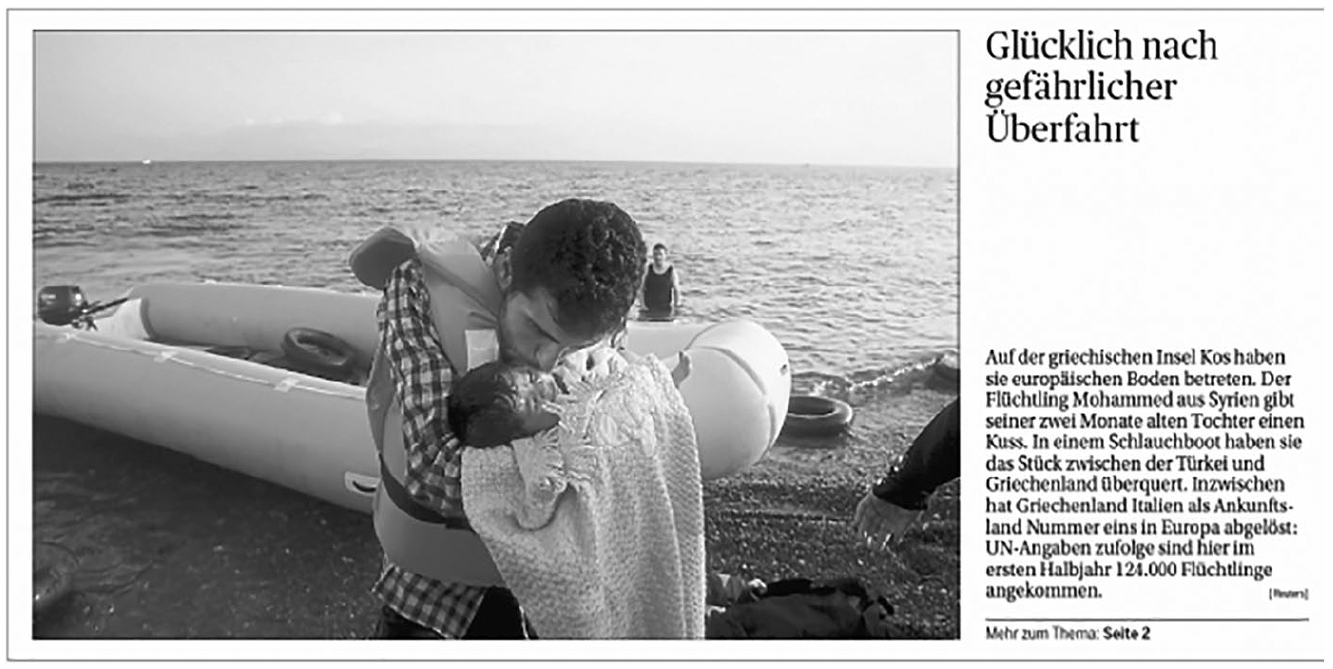
Die Presse, 10 August 2015, p. 1.
Another type of image shows groups of refugees at the moment they reach the European coast (see Figure 2). The people in the group cannot be recognized in detail. Their shapes stand out darkly against the red-colored evening sky. Their raised hands and fingers, some of which form the V-for-victory sign, are easier to identify. A rod protrudes from the image. The picture underlines the fact that they are Syrian refugees who have arrived in Greece and are taking a selfie. The fact that they have arrived ‘alive’ (lebend angekommen) underscores the dangers associated with the crossing. The luck of a successful sea crossing is thus documented twice, by the press photo as well as the selfie.
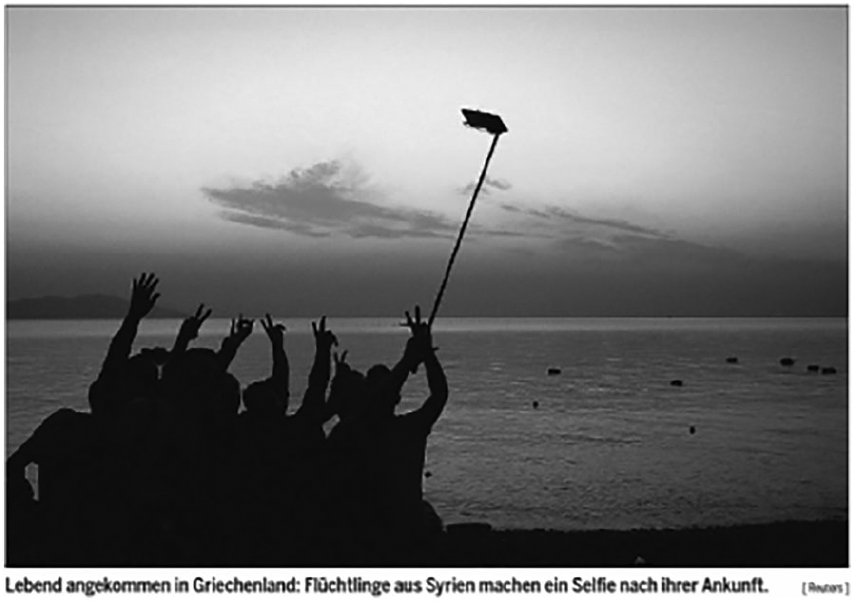
Die Presse, 10 August 2015, p. 2.
The boundary or regions that are associated with a lack of freedom, with war and oppression are marked in this type of image by the sea, the crossing of which is dangerous, thus referencing equally the despair and the courage of the fugitives. With all their might, they want to reach Europe, a geopolitical region that is constructed as granting human rights and in which security and a future are promised to an individual. The positive associations that are elicited with respect to the refugees apply above all to the construction of Europe, however. Since Austria has no borders with the sea, for the Austrian readers the refugees remain in the abstract in that they take up no physical presence in their own country.
Within Austria, different boundaries are constructed in the images, explicitly or implicitly separating the refugees from the native population (see Figures 3 and 4).
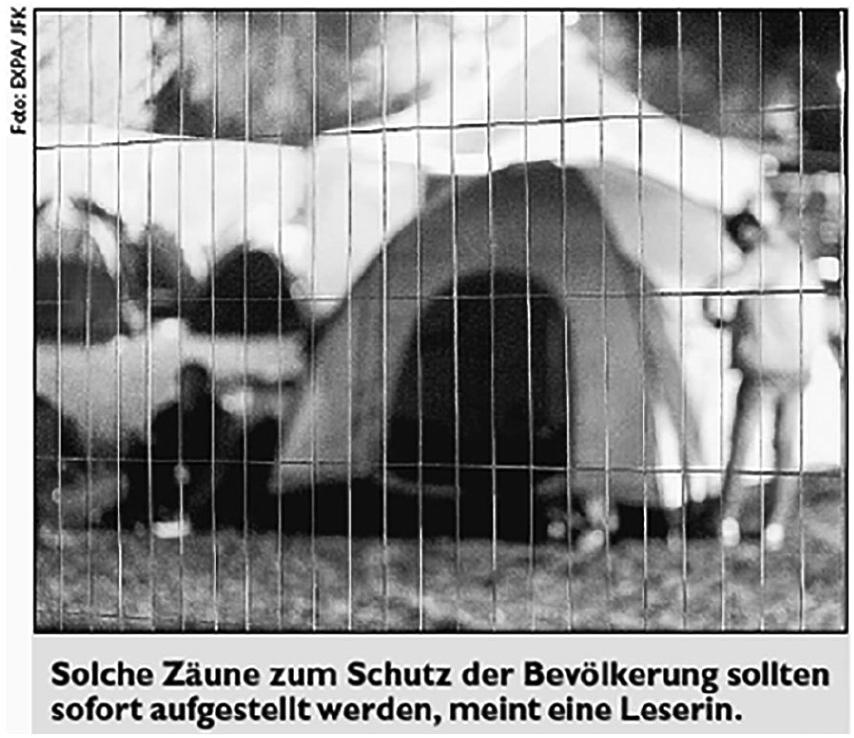
Kronen Zeitung, 15 November 2015, p. 16.
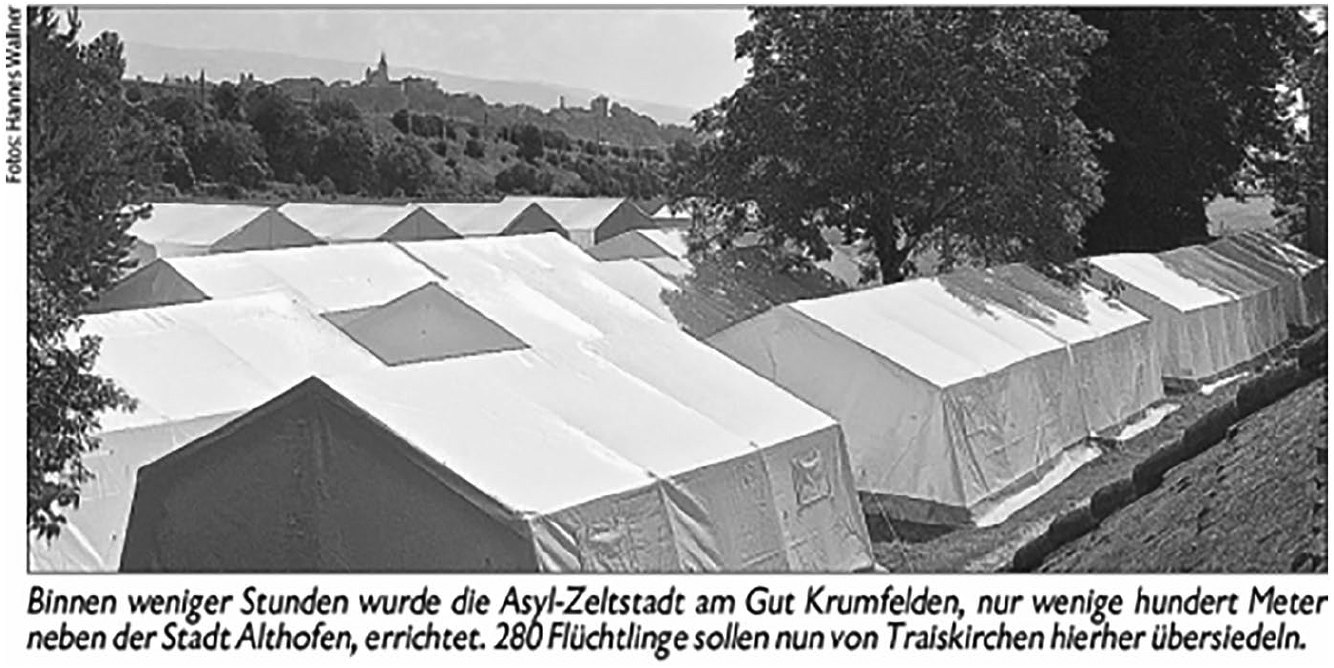
Kronen Zeitung, 9 August 2015, p. 18.
In Figure 3, several tents can be seen behind a fence; some people are also discernible at the edge of the picture. As observers, the newspaper readers are positioned on the other side of the fence; they see a camping site that is separated from them. Such high fences inevitably trigger an association with prisons or camps. The invisible ‘we’ remains not only separated from ‘the other’, but also protected from it.
Figure 4, which does not show any people, divides the landscape into two areas: in the foreground, a tent city is depicted, symbolizing the volatility of many non-sedentary people; in the background, the silhouette of a church tower and roofs of houses are shown, illustrating the familiar image of a long-established, never-changing town. In-between lies a forest area, which functions as a supposed natural border between the refugees and the population.
In both the pictures, two territories are distinctly defined: the territory inhabited by the invisible permanent population on the one hand, and the sometimes only dimly discernible area assigned to the refugees on the other.
Virtual border demarcations
Virtual borders are evoked in the images in which refugees are shown together with police officers or soldiers. In this way, physical spaces are assigned to the former, which are clearly delineated from other places where the ‘natives’ reside (see Figures 5 and 6).
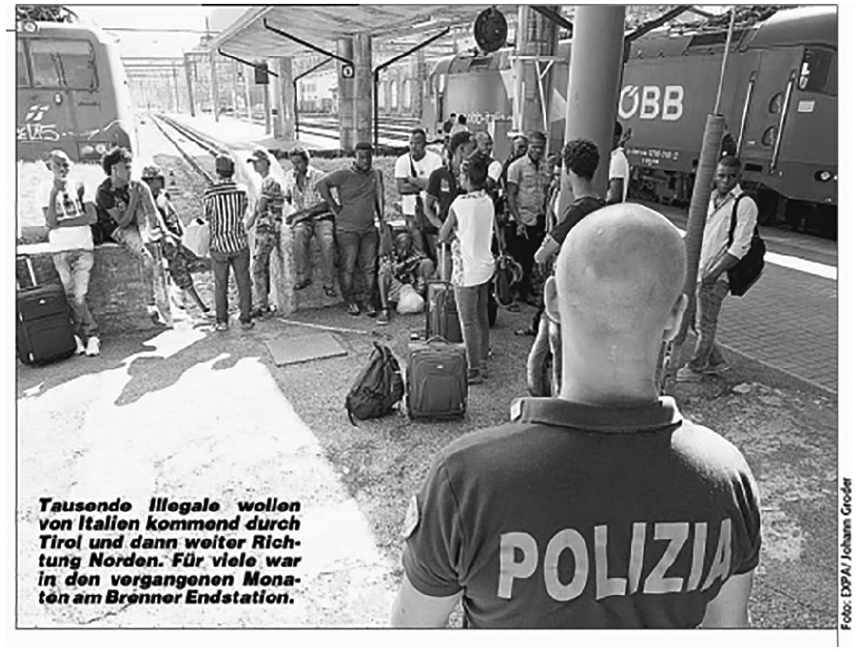
Kronen Zeitung, 10 August 2016, p. 16.
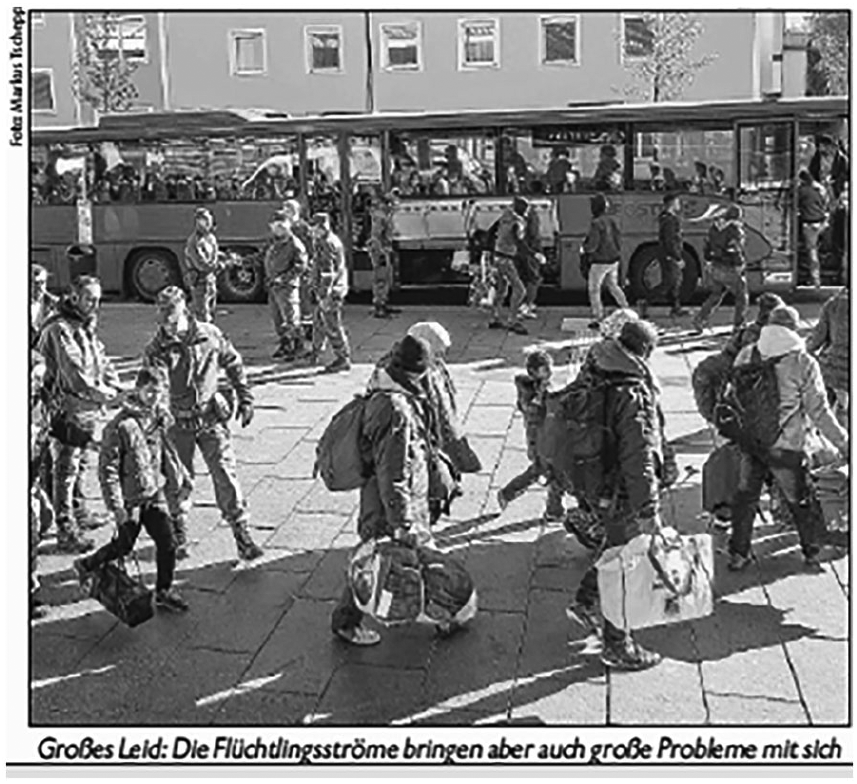
Kronen Zeitung, 16 November 2015, p. 17.
Figure 5 shows in the foreground a man with his back turned to the viewer. The large word Polizia can be seen on the shirt, identifying him as an Italian policeman. He watches a group of about 20 people waiting in the background. The locomotives of two trains can be seen, including an Austrian railway train (‘ÖBB’) on the right. The subtitle explains that ‘thousands of illegals’ want to go from Italy to Austria but are stopped at the Brenner Pass. Whether this image was indeed photographed at the Brenner Pass cannot be determined. As clearly as the physical fences, the policeman marks a border so that the visible refugees cannot cross over into the territory of the invisible population. As can be seen here, often there is also a clear spatial distance between the executive forces guarding the area and the refugees themselves (see Figure 6). A criminalizing effect of these images is thus not only due to the common interaction of refugees with military, police or coastguards found also in other studies (see Wilmott, 2017), but is reinforced by positioning these state representatives on a virtual demarcation line between ‘us’ and ‘the others’.
Thus, even in the early press photographs of the refugees, often clear borders between the ‘we’ of the population and the ‘others’ fleeing to Europe or Austria are defined. The refugees are overwhelmingly placed in ‘other’ territories and ‘other’ places from the mostly invisible observers and newspaper readers.
Spaces for identification
Media content also creates spaces for identification in which identities are established and negotiated (cf. Hipfl, 2004). The concept of media-constructed spaces of identity leads to a focus on social identities and bodies occurring in the media. Which identities are at all visible and imaginable at what locations and in which contexts? Furthermore, this concept allows to ask how membership within imagined communities is determined and what differentiations, boundaries and forms of exclusion are constructed. The photojournalism focusing on refugees as an indistinguishable group of people provides one example of the staging strategies of othering and exclusion, while the debate over ‘our’ values provides another.
An anonymous multitude
Pictures that evoke identity-political locations are invoked in our sample by a certain staging of groups of refugees. Figure 7 shows a group of people in which the individuals are sitting closely huddled together. In the center of the image, a man’s face is illuminated by his mobile phone. The context of the picture and the caption make it clear that they are refugees waiting for the ferry from Kos to Piraeus. The darkness prevents individual people from being recognizable in the picture. Apart from a child on the left, only men can be seen.
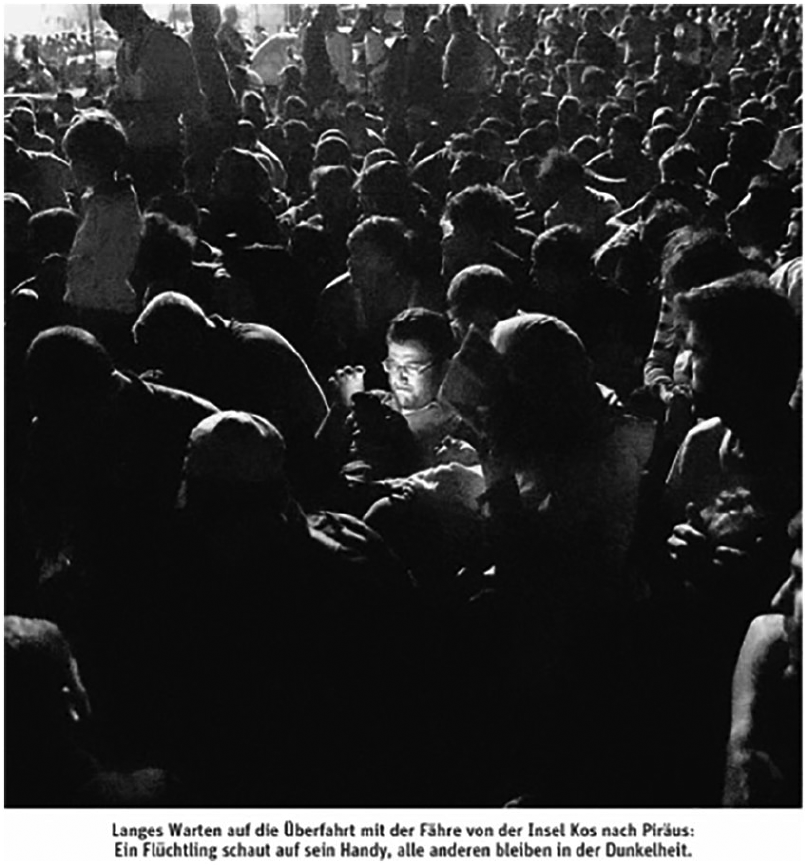
Der Standard, 26 August 2015, p. 24.
The representation of a dark crowd is often associated with a threat to an individual and can cause discomfort. The cumulative occurrence of this type of image early in the reporting suggests the metaphors that later have increasingly determined the discussion on the migration of refugees into Europe – namely, that the ‘flood’, the surging ‘current’ or the gigantic ‘wave’ threatens to deluge ‘us’. In addition, the image motif exemplified in Figure 7 underscores a discourse that played a major role in the media discussion – namely, that predominantly men had fled to Europe. These visual representations in our sample are in accordance with other findings discussed earlier as the refugees remain an anonymous and thus de-personalized and potentially threatening mass.
The values debate
Identity-political objectives have been formulated particularly clearly and directly in the so-called values debate, in which ‘European’ or ‘Christian’, more recently ‘Judeo-Christian’, values are evoked. Now, values are difficult to show photographically, so in such debates, the media rely more often on drawings, symbols or comics, which are numerous in our sample.
This type of image includes Figure 8, a drawing by the well-known Salzburg political cartoonist Wizany, which, at first glance, comments critically on the values debate under the title ‘Adaptation Pressure’. An overweight man, identifiable as an Austrian native by his lederhosen, and as a doctor by his white coat and stethoscope, confronts a frail man with a red-and-white – the colors of the Austrian flag – catalog of values. The smaller man can be recognized as a refugee by his lack of shoes, beard, tattered clothes and backpack with a Syrian flag emblem. The list caricatures the discussion on the presumed canon of values refugees should adopt, if they want to be accepted in Austria, by presenting different body measurements and standards, such as a high cholesterol level or blood-pressure indicators.
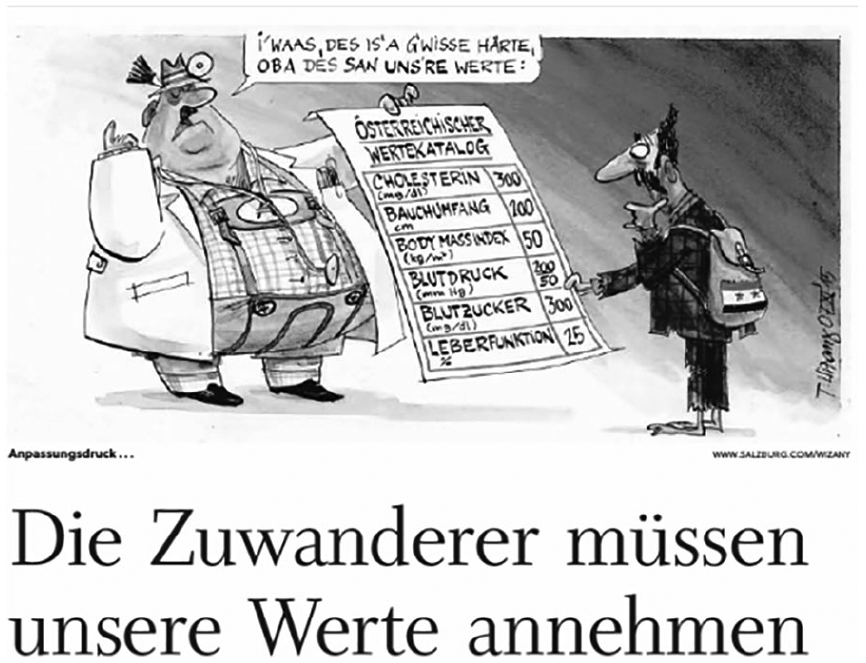
Salzburger Nachrichten, 7 November 2015, p. 1.
This caricature of the alleged canon of values and the obligation for refugees to accept it is contradicted, however, by the article placed immediately below it, entitled ‘Immigrants Must Accept Our Values’. Critical migration research has concluded years ago that the connotation of the word integration has moved from indicating a task of society to being almost exclusively understood now as the obligation of the individual migrant (cf. https://www.univie.ac.at/kritische-migrationsforschung/php/english.php, accessed 12 June 2017; see, for example, Gouma et al., 2010). This field of study has therefore advocated that the concept of integration should be replaced by the paired concepts of inclusion/exclusion. Since 2015, this shift in the political function and connotation of the term integration has emerged ever more clearly. This is connected with another problem, for when a community of values is spoken of, whether in the context of a country-specific or continent-specific location or within religious communities, a homogeneous society or group is always presupposed. As a consequence, values that have developed as an aspirational ideal in the era of enlightenment, such as human rights, are instead presented as a reality. The discursive positioning of those values in Western Europe, in Austria or within Christianity inevitably leads to an exclusion of others and their marginalization from the community of values thus constructed – and it provides identity-political objectives that not only complicate integration, in the sense of the elimination of exclusions, but by its very definition preclude it. We think that it would be worthwhile to investigate such images and contrast them with press photography as they seem to represent aspects of the debate that escape ‘documentation’, as is the case here with the value-debate.
In sum, on the level of media image production on the subject of flight in the Austrian newspapers under discussion, illustrations that question a hegemonic production of meaning are found only rarely in the media images that we have analyzed, even if the adoption of a wide range of positions remains a possibility in the use and appropriation of media texts by audiences. In our sample, we could not find any indications for the opening up of spaces of in-between on the manifest (image) level of media production. The sample also did not include visual icons, so that we could not test the assumption that public negotiations evolving around these images are closer to those presented by artistic and cultural representations. In artistic and cultural productions, we find numerous examples for alternative interpretations.
Spaces of in-between: artistic representations
As stated above, visual artworks in the context of forced migration are interpreted particularly in relation to their potential to produce ambivalences, ambiguous images and complex narrations. They are aimed at the deconstruction of stereotypical representations, the production of counter-hegemonic images and perspectives on migration and migrants, and thus on the creation of interspaces that enable ambivalent modes of reception and negotiate ambiguities beyond binary oppositions. Art, like media, supplies material for the creation of interspaces that open up at the moment of reception. In addition, artistic articulations are often sites for the unfolding of interspaces on the level of production (cf. Drüeke et al., 2012). The opening of spaces of in-between in the context of artistic productions has been discussed intensively in recent years, especially in postcolonial and performance-theoretical contexts. Spaces of in-between can be understood, following Homi K. Bhabha (1994), as postcolonial third spaces that enable hybrid cultural and identity constructions. The aesthetics of performativity, with reference to ritual theories, assumes that, at the moment of the reception of art, the aesthetic experience can be lived as a liminal experience with transformative force, since the standard everyday rules of perception and judgment temporarily lose their validity and norms, roles and symbols are subject to renegotiation (cf. Bachmann-Medick, 2006: 104–143; Fischer-Lichte, 2004). In such interspaces, familiar patterns of perception are deliberately shaken by means of aesthetic staging strategies and a reality is constructed ‘in which one can appear simultaneously as the other, a reality of instability, of blurring, ambiguities, transitions, limitations’ (Fischer-Lichte, 2004: 304). Aesthetic experience has, according to Juliane Rebentisch, an ethical and political potential insofar as it interrupts immediate understanding and real action ‘in favor of a reflective visualization of the cultural and social horizons in which our understanding and our actions are usually embedded’ (Laleg, 2012).
In what follows, we discuss three examples from contemporary art that relate to migration and flight and open up spaces of in-between in different ways.
Ambivalent disguises
The first example, ‘The Unknown’, comes from Nicole Weniger, an artist born in 1987 in Tyrol and currently living in Vienna, where she studied transmedia art at the University of Applied Art from 2007 to 2013 and art and communication practices from 2013 to 2016. Weniger’s work ranges from performances to installations to photographs and deals with such topics as the construction of identity and the related social inequalities and discrimination. The award-winning artist has been continuously represented nationally and internationally in individual and group exhibitions since 2009. In 2014, she was artist in residence at Stadt:Atelier of the city of Salzburg, where she realized her performance in a public space, Saisonale Integration, in which she reflects on the double standard of burka bans, particularly through on-site observations. Weniger then had a solo exhibition the Salzburg gallery periscope.
After her Salzburg residency, Weniger worked in 2014 and 2015 on the photo series, ‘The Unknown’, which was presented in numerous exhibitions in and outside of Austria. The work consists of five color photographs, which were taken in inhospitable and remote areas between Northern Ireland, South Africa and Austria. Like the first photograph in the series, taken in 2014 (Figure 9), all of the images show people covered in shimmering golden material. The staging location is a barren, inhospitable landscape on a foggy sea, which does not allow any conclusions to be drawn with regard to a concrete political or geographical space. The picture provides no clues to reveal what the group is doing in the area or how it got there. It is also unclear whether they are moving toward or coming from the water. Through this ambiguous movement of the group, the water or sea – in contrast to numerous media images – does not appear as a boundary to be overcome.
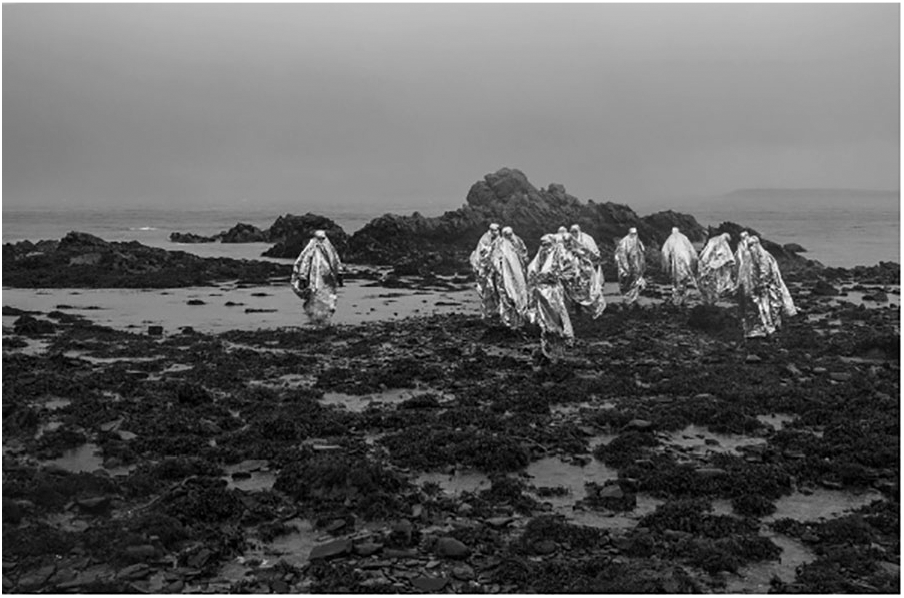
Nicole Weniger, ‘The Unknown’, 2014C-print, 100 cm × 70 cm (courtesy/copyright: Nicole Weniger).
In stark contrast to the landscape is the golden brilliance of the coverings, which turn out to be rescue blankets, which are constantly present in the context of flight in both the media and the artistic discourse. 4 They are primarily a symbol of distress and catastrophe, but they can also create associations with wealth or excess through their golden glitter, and thus appear very ambivalent. In Weniger’s work, the rescue blanket is used to conceal human bodies, becoming a sort of clothing through the draping of the fabric – thus, breaking the usual use and meaning of the material.
For almost 20 years there has been an extensive debate on the veil in Europe. As a result, some Western European countries have introduced a ban on headscarves in schools or kindergartens or on wearing a burka in public spaces. Given this context, the rescue blankets could be read as burkas. This kind of reading remains highly vague, however, since the picture does not reveal who the people are – whether they are women or men – and to which symbolic community they might belong. This brings an indeterminacy and ambiguity into the picture, which is often lacking in media images: There, the burka usually stands for backwardness and serves an important function in marking the boundary between the ‘inside’ and the ‘outside’ of society (cf. Drüeke et al., 2012). Another difference from the analyzed media images is that this group is not associated with a threat, even though it is distant and unapproachable. The title refers to ‘the unknown’, in which, through a positioning of subjects and a demarcation of boundaries – between ‘us’ viewers and the ‘strangers’ depicted – an accompanying exclusion of the ‘others’ is made, much as in the media images.
In her work, Nicole Weniger is concerned with addressing disorientation – a ‘lostness’ between arriving somewhere and locating oneself, ‘an arrival in the balance between uncertainty and searching’ (Moser, 2016). Associations with flight are present that are not consciously intended by the artist. She views disorientation as a global sign of the current conditions of human development independent of culture or gender. The photograph, taken in 2014 – like other works by Weniger – acquired new references and meanings in the context of the many media pictures of refugees that have appeared since autumn 2015. ‘The question of belonging, of where I am, where I situate myself or where I am going, has occupied me for years – on an abstract level’, says the artist. ‘But now the subject is powerfully visible in reality in a very tragic way’ (Moser, 2016).
Showing by not showing
‘The Untitled Images’ (Figure 10) is a work by the Syrian artist Khaled Barakeh, who currently resides in Berlin. Born in 1976 in a suburb of Damascus, Barakeh graduated from the Faculty of Fine Arts at Damascus University in 2005, then completed his MFA at Funen Art Academy in Odense, Denmark, in 2010, and finished his Meisterschüler at the Städelschule Art Academy in Frankfurt am Main, Germany, in 2013. The geographical shift in Barakeh’s life resulted in major changes in his approach toward his work. Originally trained as a painter, he works today in a variety of media, deliberately chosen for each project, and focuses on the current and pertinent issues revolving around power structures in contexts of identity, culture and history. ‘Drawing from his personal experiences – observations of both familiar and strange places, witnessing the repetitive and constantly unsolved social injustice through different points of view – Barakeh approaches creative practices as a tool of social changes’ (https://khaledbarakeh.com/biography.html (accessed 13 July 2018)). He has taken part in numerous exhibitions in and outside Germany, including at the Frankfurt Kunstverein, the Shanghai Biennale, and Salt Istanbul. In the spring of 2016, Barakeh was a guest at an event in Salzburg, 5 where we had the opportunity to get to know his work, ‘The Untitled Images’, and to speak with him in person.
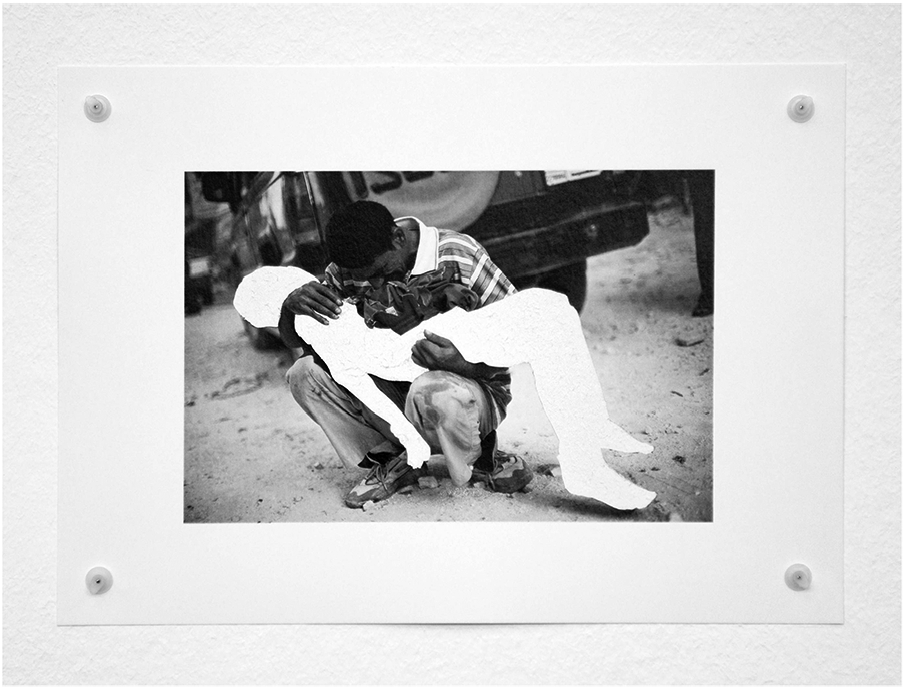
Khaled Barakeh, part of the photo series ‘The Untitled Images’, 2014, digital C-print, five photos, each 21 cm × 30 cm (courtesy/copyright: Khaled Barakeh).
This 2014 installation of five pictures shows street scenes with people who are holding other – seriously injured or killed – people. As a geopolitical space, the Near or Middle East is evoked, in part through clothing or Arabic letters. The photo series has a documentary character, depicting real warfare – in Syria, according to Barakeh. The documentary impression is radically broken by artistic interventions, however: the victims are cut out of the photographs; the photographic film has been removed and the bodies are only recognizable as white silhouettes. The artist describes his ‘intervention’ as a ‘productive deletion’, as an exclusion that is creative, violent, even surgical, allowing a continuum to emerge from what is left behind and what is taken away (cf. http://khaledbarakeh.com/selected-projects/untitledimages.html (accessed 12 June 2017)). This continuum is constitutive of any migration and refugee situation.
Barakeh reflects on the ‘dilemma of representation’ – in which reality is not only depicted but is always also co-constructed – by making representation as an intentional rendering of the visible and invisible the central theme of his work, in which he is constantly changing between the representation of people and their non-representation. The victims and/or the voids are accentuated by their contexts: the people who carry the victims – possibly relatives or friends – are recognizable by their expressions of despair, anxiety and grief. In addition, conclusions can be drawn about life-threatening circumstances, the extent of everyday atrocities in conflict areas and the associated radical destruction of human bonds. Thus, in the installation, the causes of flight are brought into the picture as everyday and intimate dramas, which remain largely hidden in the media discourse.
By staging the victims as voids, questions of religious, cultural or gender identity are shifted into the background and they become anonymous placeholders for many people and diverse situations – enabling the viewers to relate to the representation and no longer remain purely an outside observer.
Textile references
Finally, we turn our attention to ‘Escaping Cactus’ (Figure 11) by Nilbar Güreş, an artist born in 1977 in Istanbul and who currently lives and works in Vienna and Istanbul. She completed her studies in fine arts at Marmara University in Istanbul in 2000 and in painting and graphics at the Academy of Fine Arts in Vienna in 2002. Her works are molded around gender, the composition of conceptual space and narrative presentation, translated into such forms as photography, collage, drawing and video. Güreş explores the politics and construction of gender identity in relation to geography and ethnicity as well as the relationships between women and their domestic environments. Güreş was honored with the prestigious Otto Mauer Award in 2014 and the BC21 Art Award in 2015. Her work has been shown in national and international contexts continuously since 2003.
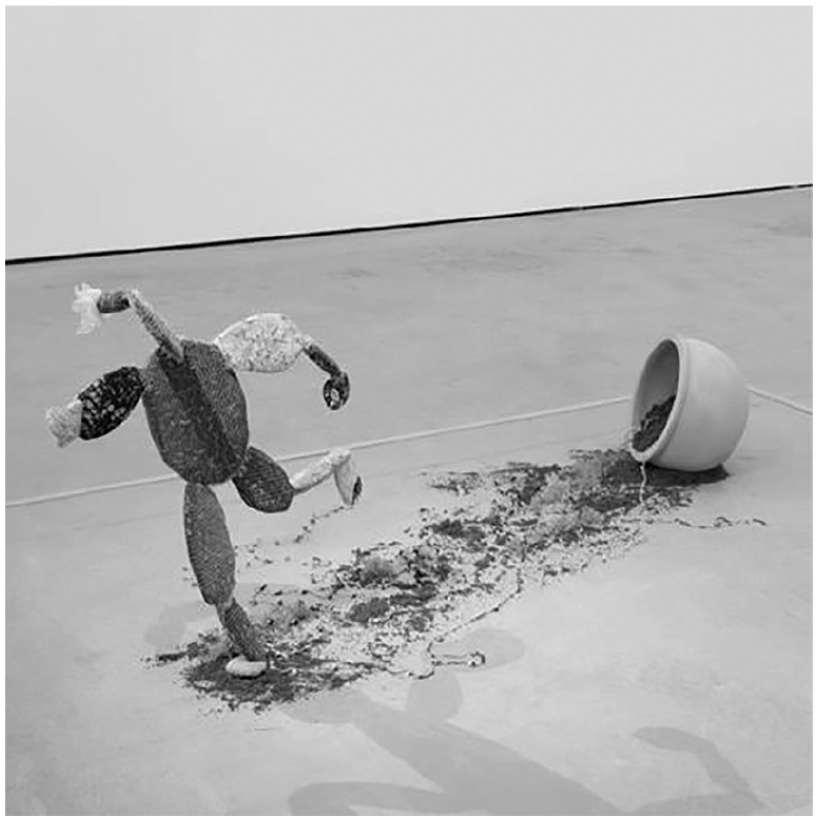
Nilbar Güreş, ‘Escaping Cactus’, 2014, metal construction, threads, textiles, flower pot, soil, crocheted textile objects (Museum der Moderne Salzburg©, Photo: Rainer Iglar).
The installation ‘Escaping Cactus’ – which, like the two works previously analyzed, also dates from 2014 – was presented from April to October 2016 as part of the exhibition Poetry of Change at the Salzburg Museum der Moderne. This thematic exhibition of works from the collection of the Museum der Moderne was dedicated to the poetic potential that artists discover in social, cultural and political change processes. ‘Escaping Cactus’ could also be seen on the large-format posters announcing the exhibition for several months throughout the city. Thus, it was possible to access this artwork in a traditional art space and also in the ‘low-threshold’ public space of Salzburg.
In order to circumvent the restaging of discriminatory stereotypes, one strategy can be to greatly reduce or completely eliminate body images in the representations and thereby create spaces for complex processes of imagination and reflection (cf. Haehnel, 2013: 127). Güreş avoids references to the representation of human bodies in her examination of flight. She uses textiles, which play an important role as an artistic medium in her work in general (Achola et al., 2010: 105–152) and transfers the subject to the realm of plants: Her installation ‘Escaping Cactus’ (2014) depicts a stuffed cactus that has freed itself from the flower pot and is running away.
Güreş problematizes borders and border crossings by overriding the logic of biology, which also implicitly gives the work an ironic touch. Giving plants – which, unlike animals, are usually rooted in the soil and immobile – the ability to uproot themselves is a brazen and witty absurdity in itself. The cactus’s self-determined act of liberation raises questions about possible reasons: How high must the level of suffering be that one accepts – or has to accept – a life possibly without soil, roots and water, or even non-survival? What do we know at all about the causes of flight? The installation opens up these and similar questions, disassociated from cultural or gender identities.
The work can be interpreted as a plea for freedom of movement and personal freedom as a universal right for all – and as a reinforcement to presume this right. It also emphasizes the multifaceted identity of refugees and changes the perspective from portraying only their sufferings but also showing their self-determination and strength. In this way, Güreş creates a perspective that counteracts the frequently criticized (cf. Bischoff et al., 2010; Haehnel, 2013; Hess, 2015) media discourse of victimization and catastrophe surrounding migration and flight. By focusing on the thorny, tenacious, genderless plant – which is capable of surviving under the harshest conditions – as a foil for her projection of strength and self-determination, Nilbar Güreş allows these characteristics to be interpreted as human qualities, independent of gender or culture.
Conclusion
In the media, geopolitical spaces are marked primarily by borders and specific identity spaces are created and assigned to refugees. Images of refugees are used to create imaginary and imagined communities that situate those refugees overwhelmingly on the outside of the country they have fled to for shelter. This is never done in a clear, uniform manner, however, because of the polysemy of media content. Modes of interpretation and positioning in the spaces for identification are rather dependent on the social contexts of reception, through which spaces of in-between can arise. While it is possible to accept a variety of positions in the process of media appropriation, on the level of media image production, representations that question a hegemonic production of meaning are rare.
By contrast, contemporary art already allows ambivalent and irritating representations to be produced on the manifest level, which can subsequently become effective as counter-hegemonic image discourses. Art can ‘infiltrate’ or emphasize content that remains hidden in media discourses, for example, by addressing the causes of flight, multifaceted identities, the emphasis on flight as a self-determined act or freedom of movement for all. At the moment of reception, art can open up spaces of in-between and trigger productive uncertainties that – at its best – set in motion differentiated processes of reflection on identities and their constructions.
Footnotes
Funding
The author(s) received no financial support for the research, authorship and/or publication of this article.
