




Abstract
Similar to the rest of Europe, multicultural programming in Finland has become risky for public broadcasting. Programs aimed at encouraging social inclusion may not attract sufficiently large audiences and may be attacked by ever louder anti-immigration voices. This article focuses on what seems to be an exception in this respect: Ali and Husu. Hosted by immigrants from Iran and Somalia – a stand-up comedian and a politician – this popular talk show aired on Finnish public radio between 2013 and 2016. Through interviews with the producers and the analysis of a selection of episodes, we examine Ali and Husu’s daring and unapologetic ethnic/racial humor as well as its combination of funny and serious talk. Our findings underscore specific ways in which multicultural programming can use humor strategically to engage relatively large and diverse audiences in discussions meant to humanize immigrants and challenge social prejudices, while minimizing right-wing criticism and unintended readings.
Keywords
I have followed the shenanigans of Ali and Husu on Yle Puhe (Yle Talk) this spring with great joy and amusement. Namely, because Ali and Husu do everything wrong. First of all, they are supposed to be immigrants, that is, a very serious problem. But they are laughing, making jokes with each other and with guests totally wantonly. Secondly, they are supposed to be innocent victims. But somehow, they don’t seem like victims at all. Without shame they call each other racists, criminals, and pretty much all types of losers, depending on the topic of the episode.
This is how well-known writer Matti Mäkelä described radio program Ali ja Husu (Ali and Husu) in Helsingin Sanomat (2013), Finland’s largest newspaper. Mäkelä was not alone in his amusement: Ali and Husu was one of the Finnish public broadcaster’s (Yle, 2015, 2016) most popular radio talk shows in the mid-2010s. In its website, Yle described the show’s successful formula as follows: ‘Ali is an Iran born stand-up comedian. Abdirahim “Husu” Hussein is a Somali born entrepreneur and interpreter […]. The plain-spoken duo examines Finnish society from the viewpoint of immigrants’. Notably, then, Ali and Husu was not simply about provoking and entertaining, but also about voicing immigrant viewpoints. In fact, in 2013–2014, it was Yle’s only program focused specifically on issues related to immigration, cultural diversity, racism and prejudice and which relied mostly on speakers with migrant backgrounds. In 2014, it received ‘The Media Act with the Most Attitude’ award from the Ministry of Justice’s Advisory Board for Ethnic Relations and, in 2016, the ‘Man’s Work’ award from the Council for Gender Equality for challenging prejudices related to manhood and immigrants.
In its humorous and unapologetic tone, Ali and Husu diverges from the much more serious portrayals of immigration and cultural diversity of Yle’s initial efforts of multicultural programming, as well as from how these issues are discussed today in Yle’s traditional talk shows (such as A2-Ilta (A2-Night) and A-Studio). While relatively unique in its use of ethnic humor within Finnish public broadcasting, Ali and Husu should be understood within an increasingly contested tradition of multicultural programming. Indeed, in this article we examine Ali and Husu’s specific uses of humor in relation to the challenges associated with this kind of programming in European public broadcasting service (PBS) today. Our analysis underscores key strategies through which the producers of the show used humor to engage relatively large and diverse audiences in discussions meant to humanize immigrants and challenge social prejudices, while minimizing right-wing criticism and unintended readings. In this way, the study contributes to our understanding of ethnic humor in general, as well as to its – until now largely neglected – critical potential for PBS.
We start with a brief overview of the history and challenges of multicultural programming in European PBS, focusing on the Finnish case. We then discuss strengths and risks of ethnic humor in fighting social inequality; we pay special attention to the dangers of polysemy and how it can be reduced. Our subsequent analysis of Ali and Husu, coupled with interviews with the producers, shows how the program made strategic use of ethnic humor, while minimizing bigoted readings. We conclude by underscoring Ali and Husu’s concrete lessons for European PBS’s efforts to encourage social inclusion.
PBS’s changing approaches to cultural diversity
Multicultural TV and radio programs are directed toward ethnic minorities and/or are about ethnic minorities and aimed at promoting the co-existence of diverse groups in society (Leurdijk, 2006). In various Western European countries, PBS started producing these kinds of programs in the 1960s and 1970s, as a response to the expansion of immigration and cultural diversity (Leurdijk, 2006). In Finland, this happened later given the country’s relatively short immigration history and the fact that only 6 percent of the population are ‘new minorities’ (a term used to differentiate them from national minorities, including Finnish-Swedes, Finnish-Romanies, and Sami) (Statistics Finland, 2016). Yle’s most prominent early multicultural program, Basaari (Bazar), began in 1996. It portrayed the lives and cultures of immigrants in Finland using storytelling and drama, experimented with different formats and relied significantly on media professionals of migrant background. During its 12 years on air, Basaari received various awards – including the ‘Great Journalist Award’ from the Swedish Bonnier Publishing Company – for promoting equality and educating the public about cultural diversity in Finland (Yle, 2007).
However, Basaari did not fit well with recent political changes – and thus, with the expectations imposed on PBS – in Finland, where, like in other European countries, a growing anti-immigrant sentiment has been linked to the rejection of multiculturalism (Horsti, 2014). ‘Multiculturalism has come, in this conjuncture, to stand for and symbolize the problematic excess of difference that must be disciplined by the turn to “integration”’ (Titley, 2014: 249). The emphasis on ‘integration’, neglects racism and discrimination, places the responsibility (to integrate) on individuals, and demands ‘minorities’ adaptation to the dominant culture as a condition for social inclusion’ (Awad, 2011: 6). In this context, PBS has been compelled to move away from traditional multicultural programs – criticized as ‘ghetto’ programs, as well as ‘“paternalistic” and “too educational”’ – and to replace them with more entertaining or ‘lighthearted’ products that can attract large audiences (Leurdijk, 2006: 31–34). In Yle, this so-called ‘mainstreaming of cultural diversity’ became visible in the mid-2000s, as the broadcaster tried to ‘balance its public position between the nationalist sentiments and its responsibility to serve, as its slogan says, “the whole people,” including ethnic minorities’ (Horsti, 2014: 170). Aiming at increasing the representation of ‘new minorities’ throughout programming, at the expense of special minority programs, Yle canceled Basaari in 2008. Eight years later, a parliamentary committee announced the official replacement of ‘multiculturalism’ with ‘cultural diversity’ in Yle’s law, a measure for which the populist Finns party has taken credit (Uusi Suomi, 2016).
Critical scholars have discussed the changes in PBS’s diversity policies – in Finland and elsewhere in Europe – as part of a broader set of strategies that reinforce dominant norms and depoliticize cultural differences (e.g. Engelbert and Awad, 2014; Horsti, 2014). However, European PBS remains in a complex position as it continues to stress its duty to serve ‘both minorities and majorities’ and to contribute to a ‘vibrant and inclusive society’ (EBU, 2016: 8, 3; for Finland, see Horsti, 2014; Yle, 2017). Moreover, like in the rest of Europe, Finnish PBS’s conflicting approaches toward cultural diversity fit within a wider ‘range of challenges’, that also include the need to attract larger audiences and secure new sources of funding (Horsti et al., 2014: 3; see also EBU, 2016). Caught between these multiple challenges, we explain below, PBS’s use of ethnic humor can be particularly promising, but also particularly risky.
Humor and cultural diversity: uses and risks
The literature identifies multiple (and largely complementary) uses of humor in relation to social differences. First, humor facilitates communication across social differences. Psychological approaches underscore its links to feelings of (comic) relief from tensions that may result from sociocultural disagreements and animosities; superiority, involved in ridiculing others; and incongruity resulting from engagement with incoherence and contradiction (Meyer, 2000). From a sociological perspective, Mulkay (1988) explains that ‘serious speech presupposes the existence of a single, organized, independent world’, while humor provides an alternative form of communication, especially useful when communicators’ experiences and social positions differ (p. 23).
Second, humor is arguably a strategic tool to persuade others about differences, by unifying social actors (through processes of identification) and dividing them (establishing and reinforcing boundaries) (Lynch, 2002; Meyer, 2000). Significantly, though, for persuasion to work, boundaries remain permeable: ‘If there were either absolute unification or absolute division, there would be no strife, and thus no need for rhetoric’ (Innocenti and Miller, 2016: 368). Crucial in this respect, is ‘the ambiguity of unification and division – the unspecifiability of where one ends and the other begins’ (Burke, cited in Innocenti and Miller, 2016: 368). This aspect is key for humor’s most critical persuasive potential in relation to cultural diversity: by stressing – and even exploiting – the permeability of social boundaries, humor can challenge the clear-cut and exclusionary divides that characterize racism. More specifically, a humorous treatment of social boundaries and identities can underscore their non-essentialist, that is, their socially constructed, character. ‘Spraying a diversity of targets with humorously disguised insults can be a potentially productive discursive strategy that draws attention to the stereotypes of many races and ethnicities, thus undermining all reductive representation’ (Perks, 2010: 277; see also Emig, 2010).
In the case of European PBS, humor is arguably at the core of the mainstreaming of cultural diversity. Leurdijk (2006) argues that humor has contributed to making PBS diversity programs more appealing to diverse audiences, but also acknowledges important limitations. She specifically cites Gillespie’s critique of the British Broadcasting Corporation’s (BBC) comedy series Goodness Gracious Me, focused on the British-Indian community: part of the series’ success, according to Gillespie, was that producers ‘did not want the show to be confrontational or guilt-inducing, otherwise they knew they would lose their white audience’ (cited in Leurdijk, 2006: 38; see also Emig, 2010). Similarly, Malik (2012) describes UK’s Channel 4’s reality comedy series The Family – and specifically, the 2009 season focused on the British-Punjabi family The Grewals – as a ‘low-risk solution’ with which PBS could claim ‘public value’ against a backdrop of post-multiculturalism (p. 524). The Grewals, Malik argues, give visibility to cultural differences and attract large audiences, but ‘never talk about structural inequalities or social issues of race that occur outside of the Indian community […] they symbolize an unproblematic and thriving cultural pluralism and, indeed, a depoliticized multiculturalism’ (p. 525). Likewise, the turn toward the ‘funny side of diversity’ in Dutch PBS has been criticized as superficial and apolitical (Awad and Engelbert, 2014).
Given the economic and political pressures described above, upsetting mainstream audiences is a critical risk for European PBS today, but not the only one. Another important risk of ethnic humor – and motivation to avoid outspoken uses of it – is that it ‘can also legitimate and exonerate a racist insult’ further marginalizing minority groups (Lockyer and Pickering, 2008: 811). Because jokes are so open to interpretation, Weaver (2010) explains, ethnic humor has ‘simultaneous, and paradoxical, racist and anti-racist potential’ (p. 33). His analysis of black comedians in the United States and the United Kingdom shows that humor can successfully appropriate and ‘reverse’ the meaning of racist discourses, but reversal can never be guaranteed (Weaver, 2010). Focusing on the specific case of Ali G, impersonated by British comedian Sacha Baron Cohen, Howells (2006) reaches a similar conclusion, namely that some viewers get away with laughing for ‘“politically” incorrect reasons’ (pp. 167–168). This danger is also suggested in Marx and Sienkiewicz’s (2009) study of the animated sitcom South Park: its harsh critique of ethnic prejudice in US society coexists with its ‘tendency to make things such as anti-Semitism and Islamophobia seem like a lot of fun’ (p. 17).
In sum, while the intended meaning of a text is never guaranteed, polysemy is particularly pronounced, and dangerous, in ethnic humor. Humor can be strategically deployed to enable ‘a diverse population [to] take pleasure in the text’ precisely because it can be read as an invitation, not an imposition (Perks, 2010: 270). ‘And therein lies the progressive sociopolitical power and weakness of humorous discourse: This charismatic, comfortable, and nonauthoritative form of persuasion can not only be readily received, but also easily ignored’ (Perks, 2010: 286). The critically intended work of African-American comedian Dave Chappelle, which Perks (2010) analyzes, is particularly revealing: not only were there African-Americans who allegedly thought that Chappelle’s jokes were racist (Bell-Jordan, 2007), but Chappelle himself quit the program worried that it could reinforce stereotypes he wanted to challenge (Perks, 2010). Chappelle explained this ‘moral dilemma’ in the Oprah Winfrey Show as ‘the difference of someone laughing with me and someone laughing at me’ (cited in Banjo, 2011: 138). Unwillingly giving people the opportunity to laugh at him (and, more broadly, at African-Americans) became a risk Chappelle was not willing to take anymore.
Ethnic humor: minimizing the risks
What alternative – other than quitting – did Chappelle have to strengthen the critical reading of his show and further encourage audiences to laugh with him? Authors who have studied this specific case (e.g. Bell-Jordan, 2007; Perks, 2010) do not touch explicitly on this question. However, the broader literature points to the importance of the interpretative context to safeguard the critical reading of a joke. Mulkay (1988) explains: ‘Unless we know who is speaking and why, and unless we can locate an utterance in some wider framework of discourse, the humorous epigram is doomed to remain inert except as a source of fleeting amusement’. (p. 175)
Studies specifically dealing with ethnic/racial humor validate Mulkay’s points. With respect to the importance of who speaks and why, we know that ‘[a]udience interpretation of ethnic humor has been shown to rely heavily – but not entirely – on knowledge or presumed knowledge of the source’ (Orbe et al., 1998: 127). Thus, for example, according to Perks (2010), Chappelle’s ‘multilayering of persona/person/pseudopersona’ make it especially difficult for the audience to pinpoint his intentions (p. 273). Likewise, Howells (2006) argues that polysemy in Ali G would be reduced if Cohen gave interviews, and thus, provided additional context for reading his character. Notably, this seemed particularly important given that Cohen was a white comedian impersonating a black character (Howells, 2006: 164). Howells (2006) and others (e.g. Orbe et al., 1998) argue that so-called in-group jokes (i.e. jokes about certain groups, voiced by members of that group) tend to be better received.
Mulkay’s argument about the importance of locating humorous utterances within wider frameworks resonates with Marx and Sienkiewicz’s (2009) criticism of purely literary analyses of animated humor. For these authors, humor in South Park works – and thus needs to be understood – in relation to (mediated) current events and discourses of/about ethnic prejudice. Similarly, Weaver (2010) argues that local interracial histories shape the reading of ethnic/racial jokes. Therefore, ethnic humor should always be critically considered with regard to how ‘specific readings of jokes can connect to historic discourses of race and racism’ (Weaver, 2010: 431).
Additional significant elements of humor’s interpretative context are the medium through and the format in which humor is displayed. With respect to the medium, most research on mediated ethnic humor focuses on television shows. In this article, in contrast, we deal with a radio program. As such, Ali and Husu lacks visual cues, a lack that radio scholars associate with particularly high levels of polysemy or ‘interpretative openness’ (Murray, 2002: 141; see also Havig, 1990). With respect to format, most TV comedy programs, including Chappelle’s Show, are structured as a series of independent sketches and monologs, interrupted by commercial breaks and with ‘few consistent narrative elements coursing throughout’, something that arguably contributed to the Chappelle’s Show’s absence of ‘ideological closure’ (Perks, 2010: 273). Furthermore, even though Chappelle made some serious references to racism, the intertwining of these references systematically privileged humor and its ambiguity. To explain this, Perks (2010) gives the example of a serious claim about racial discrimination in restaurants, accompanied by (or ‘clashed’ with) laughter from the cast, thus ‘leaving unstable textual fragments in its wake’. (p. 285). Ali and Husu, in contrast, was a continuous conversation, that sought to complement humor with serious talk in specific ways that arguably reduced risks of polysemy, as analyzed below.
Case study and analysis
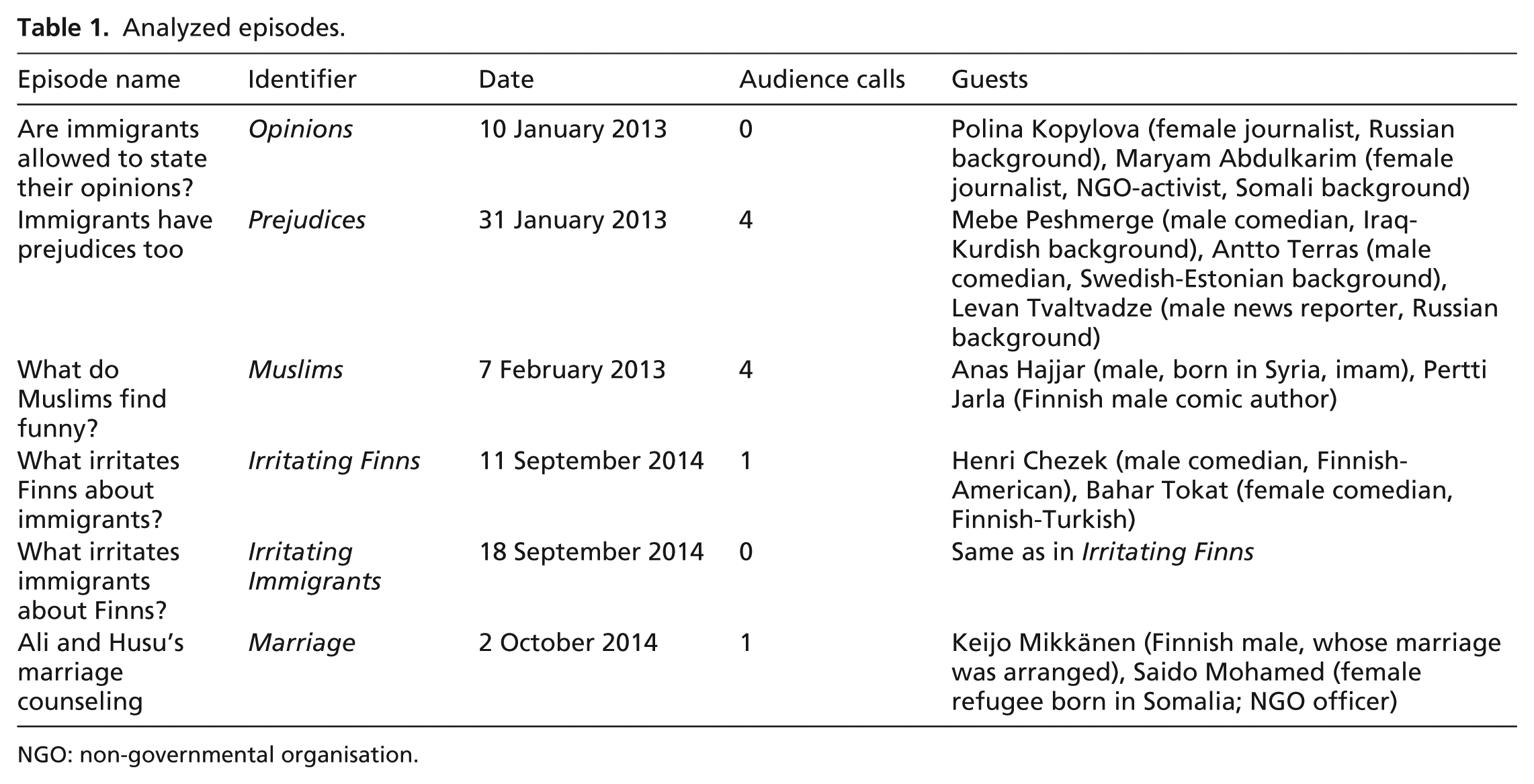
In order to examine Ali and Husu’s use of ethnic humor in relation to the challenges associated with multicultural programming in European PBS today, we adopt a rather unique multi-methodological approach. Our primary methodology is a qualitative textual analysis of a selection of episodes of Ali and Husu (see Table 1). However, given the importance of context both in case study research (Yin, 2013) and in anchoring ethnic humor, we also conducted supplementary interviews with the two hosts and with producer Kari Tervo. The first author’s conversations with them (in Finnish, in April 2015) offer important insights into the makers’ backgrounds and intentions in producing the show and in involving humor. While intentions cannot be directly translated into meaning, they are relevant to understand humor’s potential as a strategic device. The core of our analysis, however, lies in the content of the show itself. As suggested above, we are specifically interested in the use of humor to enable discussions that are meant to humanize immigrants and challenge social prejudices, attract relatively large and diverse audiences, and minimize right-wing criticism, while avoiding unintended readings.
Analyzed episodes.
NGO: non-governmental organisation.
Behind the scenes: producers’ intentions and strategies
The idea for Ali and Husu came from host Abdirahim Hussein (Husu) in 2011, the same year of the parliamentary elections that turned the populist Finns party into the third largest party in Finland (19.1% of the votes as opposed to 4.1% in 2007). Back then, Husu had a personal blog where people posted more questions than he could answer. A live radio show, he thought, could enable him to answer questions from listeners directly.
A practicing Muslim born in Somalia, Husu has worked as a taxi driver and as a translator and served in various Helsinki-based social organizations, including the city’s Equality Committee and Immigration and Integration Advisory Board. He also chaired Moniheli, a network of multicultural organizations and, in 2015, ran for a seat in the Finnish parliament. In 2017, he was elected into Helsinki’s City Council for the Social Democratic Party. In his interview for this study, Husu described the immigration debate in Finland as highly polarized: ‘There is nothing in-between, and specifically in this middle ground are immigrants, who are suffering from this’ (Husu). He saw the radio program as an alternative to both racist discourses and leftist views ‘pampering’ immigrants unconditionally. For this to work, he thought humor was crucial: I thought I was too humorless […] so I figured that the program would benefit from me having a partner, a person who also has an immigrant background, who would see things differently than me and would bring his own views, but who would also be a bit funnier than me […] I expected that there would be negative questions or comments [from the audience], and that, if I confronted all of those seriously, there would be an us-versus-them set-up. But if we would begin to dismantle even those hard accusations through humor, if those could be dismantled but at the same time made fun of … through that, the person [with prejudices towards immigrants] might begin to think: “okay I was thinking like this, but the guys have chopped it up like this, I can agree with this.” (Husu)
Husu thus invited Iranian-born stand-up comedian Ali Jahangiri (Ali) to co-host the program. Ali had been the host of a popular reality program on commercial television; he grew-up in a Muslim family, but is agnostic. Approached by Husu, both Ali and producer Kari Tervo had initial concerns about how to make such a program sufficiently attractive. Ali remembers someone’s warning that ‘the immigrant thing’ could ‘ruin’ his career (Ali). Tervo thought it was crucial to break with Yle’s earlier ‘kind of depressing, dark, boring programs that no one wanted to watch’, thinking mainly in Basaari (Tervo). Yet, humor alone would not guarantee success, Tervo thought. He had worked with Yle in the production of a low-budget TV sketch comedy program dealing with cultural diversity, which had failed to attract sufficient viewers and had thus been canceled after one season (Tervo). He only tried (and managed) to sell Ali and Husu to Yle once he saw the two hosts interact with each other and was convinced that their contrasting personalities and sense of humor would enable them to ‘show immigrants as humans, meaning familiar, to remove fears, prejudices, to see that they are laughing at similar things’ (Tervo). Furthermore, We were thinking: what is the most hated minority in Finland? Well, Somalis, okay [Husu is Somali]. And then, Ali as an Iranian scolds Husu about his manhood, fatherhood, religion […] all these sorts of things. He slams Husu, and Husu tries to respond back, and when a [native] Finnish person listens to this kind of program, [s/he would think] “oh, they are like this; this is how we are as well when we are having a few beers in the sauna.” (Tervo)
As a comedian, Ali was expected ‘to make people laugh […] to disrupt with outrageous jokes, teasing Husu’; then, as the program developed, Husu learned to ‘punch back’ and thus to contribute to the program’s humor (Tervo). Moreover, a significant number of the program’s guests were comedians or cartoonists themselves and, in general, all guests were encouraged to make jokes (Ali).
Ali and Husu was not scripted beforehand; the producers did not aim at a particularly clever kind of humor, but at the type of in-the-moment jokes, common among friends gathering in a private space, or as Ali described it: ‘coffee table discussions’. From the interviews, it is clear that, by design, the program was meant to discuss current affair issues in an improvised, playful and even scornful way. The hosts and their guests would laugh at themselves as well as at others. Through humor, they would criticize racist perspectives, but also immigrants and ‘flower-hat ladies’ (kukkahattutädit) (Tervo), a pejorative term used in Finland to describe people who defend immigrants uncritically. The producers saw this design as key to attract divergent audiences, including those strongly opposing immigrants, something they arguably achieved, at least based on the multiple threads discussing the program in the well-known anti-immigration discussion website Hommaforum.org.
Humor in practice: textual analysis
For the textual analysis, we considered Ali and Husu’s two first seasons (2013 and 2014). Throughout this period, 77 one-hour episodes were aired. At least 65 of them had a guest and, in most of those cases, at least one of the guests had a migrant background. Episodes were transmitted live and had no commercial breaks. They seldom included minor prerecorded sections and commonly, but not always, brief phone conversations with members of the audience. In their title, most episodes explicitly referred to immigrants, immigration, specific cultural traditions, Finnishness (as national identity), racism or social equality. In practically all episodes, however, a migrant perspective was used to discuss, for example, ‘Wannabe celebrities’ (29 May 2014), how ‘Ali and Husu want to get in shape for the summer’ (11 April 2013), ‘Motherhood’ (9 May 2013), or how ‘Ali is wooed into politics’ (26 September 2013).
We purposively sampled three episodes from each season. In total, we chose six episodes that were particularly attractive for audiences (based on the number of clicks on Yle’s online platform, Yle Areena); whose general description (title and online introduction) dealt explicitly with socio-cultural differences; and which, grouped together, included guests from multiple ethnic backgrounds (for details, see Table 1). The textual analysis is organized in two parts, focusing, respectively, on how humor enables communication across and about social differences and on the contextual strategies used to minimize unwanted readings.
Humor to speak about and across social differences
As discussed above, ethnic humor can facilitate communication across social differences and thus make a program attractive to large and diverse audiences, including people who hold anti-immigrant views. At the same time, humor can be used to persuade audiences, in this case, to consider more open attitudes toward immigrants and more inclusive notions of ‘Finnishness’. To assess the extent and ways in which these uses of humor are present in Ali and Husu we start by identifying the social groups that are humorously constructed and targeted and the social identities in which speakers place themselves and others as they joke.
Everybody gets a fair share of poking in the program. Most often, the butt of the joke are immigrants themselves. Without apparent constraints, they throw stereotypes against each other: Middle Eastern people are assumed to have their own pizzeria and to avoid taxes (Opinions, Prejudices and Irritating Finns); Africans are described as lazy and violent (Prejudices and Irritating Finns); Estonians and Russians, as thieves (Prejudices). Immigrants in general are said to use the ‘racist card’ to get away with anything (Irritating Finns). Significantly, stereotypes about ‘Finns’ are also turned into jokes that they are overly work-oriented and law-abiding (Irritating Immigrants), smell like laundry detergent (Irritating Finns), or, in the case of Finnish Swedes, are rich snobs (Irritating Immigrants). People with anti-immigrant sentiments are also made fun of, for calling themselves anti-extremists, while committing violent acts (Muslims); for accusing immigrants of taking the jobs from Finns and, at the same time, of being lazy and living on social benefits (Prejudices); or for being ashamed of their opinions and thus hiding them (Irritating Finns). A fourth target of jokes are so-called ‘Flower-hat ladies’, for being overly protective toward immigrants (Prejudices).
Arguably, by shooting in so many, and changing, directions, Ali and Husu is constantly switching between uniting and dividing uses of humor (Meyer, 2000). In this sense, minorities’ self-deprecating jokes – about themselves and each other – can let majority and specifically anti-immigration audiences feel identified with the show. This, in turn, would make those audiences more receptive to criticism, including jokes about the majority population and about anti-immigration views. In Meyer’s (2000) terms, humor here can ‘enforce [anti-racist] norms delicately by leveling criticism while maintaining some degree of identification with an audience’ (p. 320).
However, as discussed above in relation to Innocenti and Miller (2016), humor across social groups works persuasively only to the extent that boundaries between them are not fixed. Indeed, rather than ridiculing their own ethnicity or the ethnicity of others, participants in Ali and Husu seem to ridicule stereotypes themselves. Two episodes particularly suitable for illustrating this are ‘What irritates Finns about immigrants?’ (Irritating Finns) and ‘What irritates immigrants about Finns?’ (Irritating Immigrants). As suggested already in the titles, the episodes focus on negative stereotypes of local and immigrant groups. In each of them, hosts and guests humorously go through different culture-ascribed customs that immigrants and Finns find irritating about each other. Also here, the targets of the jokes keep switching, as shown in the following segment, where Ali addresses Husu, a Finnish-American, and a Finnish-Turkish guest:
I’m annoyed by how calm you guys are about your families. Like, my mom calls me like seven times a day. My dad calls me another seven times a day. My brother calls me like three times a day. That’s like hours taken away from my workday.
Yeah
And then they don’t even have anything to say, other than ‘hey, is everything alright?’ And then, when I meet my Finnish friends, like: ‘When have you last talked with your mom?’ ‘I don’t even know if she’s … I don’t know, sometime last week’. ‘But you guys live together?’ ‘Yeah, yeah, so what, I don’t see her’ (Irritating Immigrants).
In this example, one can interpret the references to Ali’s family and to his Finnish friend’s family as individual jokes: a self-deprecating joke, aimed at identification with the audience, followed by a case of dividing humor, where Ali criticizes Finnish culture. However, the juxtaposition of the two stereotypes suggests that Ali is not criticizing specific groups, as much as highlighting the absurdity of stereotyping itself. From this perspective, humor can challenge exclusionary group identities that are based on the negative stereotyping of others.
Ali and Husu’s humorous critique of exclusionary notions of identity is also achieved through complex processes of self-identification, which problematize simplistic immigrant versus Finnish divides. More concretely, Ali, Husu and their guests label themselves according to multiple and many times co-existing identities – as immigrants, Muslim, Iranian, Somali and/or Finnish – and make explicit the constructed and contested nature of such labels. Thus, for example, Ali calls himself and a guest ‘immigrant-lights’, compared with Husu and another guest who have darker skin (Opinions); Husu calls two guests – with migrant backgrounds, but, in his view, non-migrant looks – ‘ordinary kasu’, a nickname used in the program for so-called native Finns (Irritating Finns); one guest jokingly denies other guest’s ‘whiteness’, because ‘he is Russian’ (Prejudices); Ali complains about a guest who speaks Finnish ‘better than Kekkonen’ (iconic former president) because nobody will believe that she is from Somalia (Opinions); and Husu jokingly defines himself as a ‘New Finn’ as opposed to Ali, whom he calls an ‘immigrant‘ (Opinions).
Significantly, radio seems to play a key role in Ali and Husu’s possibilities to expose the contentious nature of given social categories and divisions and thus to challenge essentialist views. The lack of images arguably gives hosts and guests additional opportunities to play with social categorizations, by giving names to what the audience cannot see. At the same time, and as suggested in the literature, ‘misunderstanding’ may be even higher when the audience has no access to hosts’ and guests’ facial expressions, body gestures, and other visual cues. Thus, the risk of reinforcing divides that they want to dismantle remains significant in Ali and Husu. In order to address this issue, the next section moves away from the analysis of humor ‘in isolation’ (Mulkay, 1988) to explore two related ways in which the program minimizes these risks: the combination of humor and serious talk and the relatively distinct and complementary roles of the hosts.
Humor in context: minimizing risks
While constantly switching between humorous and serious talk can be expected in a talk show, this distinguishes Ali and Husu from Yle’s earlier multicultural comedy programs, as well as from the sitcoms, stand-up or other kinds of comedy programs examined in most empirical studies on racial/ethnic humor. In those programs, serious talk is either negligible or presented in ways that undermine its possibility to promote specific, anti-racist, readings, as discussed earlier in relation to Chappelle’s Show. In Ali and Husu, in turn, social commentary is intercalated within humorous exchanges, but it is treated seriously and thus preserves a strong capacity to guide the audience’s interpretation of jokes.
Humor and serious talk coexist differently in different episodes of Ali and Husu. Within our sample, serious talk is more prominent in Opinions, Marriage and Muslims than in Prejudices, Irritating Immigrants and Irritating Finns, something closely related to who is in the studio. In the more serious episodes, guests are experts or have relevant personal experiences on the topic; in predominantly humorous episodes, all but one guest are professional stand-up comedians.
Although both hosts joke frequently, their distinct roles in this respect are related to their personalities and background. As a professional standup comedian, Ali does not only often initiate humorous sections, but also frequently – and seamlessly – switches between humor and serious talk. In Muslims, for example, he first blames religious institutions for creating conflicts for which religious people are blamed; then, suddenly jokes comparing fear of Muslims with a man who tries to hide from his mother-in-law and finds out that there are a billion of them. Likewise, in concluding Prejudices, Ali goes from defending free speech in discussions about immigration to a final funny remark about a Formula 1 driver he had talked about at the beginning of the episode. By illustrating or interposing serious arguments with humorous stories, Ali arguably reduces built-up tension and facilitates identification with diverse audiences. With equal ease, he goes from funny to serious: in a discussion about immigrants tasting fruits in grocery stores, for example, he recalls eating a kilo of yet unpaid pick ‘n’ mix candies while doing shopping, then explains how the prevalence of small corner stores in other countries makes this behavior understandable (Irritating Finns).
In general, serious interventions provide valuable (even if not unequivocal) cues to read jokes in non-discriminatory terms. Even though Ali is sometimes responsible for them – like in his explanation about immigrants’ grocery-shopping behavior – Husu is the one who most commonly assumes a serious role. In Prejudices, when stand-up comedian guest Antto (Estonian background) rants against Somali people living on social benefits while being drug addicts and thieves, Husu argues that ‘these things absolutely have to be discussed, but the statistics tell a different story’. He then cites official records that place Somalis after Russians, Estonians and Swedish in terms of criminality and explains that most Finnish-Somali are relatively young (to work). He ends by lamenting how, in Helsinki, people with Russian and Somali backgrounds live close to each other and have common interests, but fail to acknowledge this.
Husu’s specific role in the program – as well as how his role complements Ali’s – is clearly visible in Irritating Immigrants. This episode was aired in September 2014, just a few days after Sweden’s anti-immigration right-wing populist party, the Sweden Democrats, had doubled its support in the national elections and had become the third-largest party in the country. Ali and Husu start the program by commenting on this. Husu refers to the Sweden Democrats as the Swedish equivalent of the populist Finns party (formally, the True Finns). Ali replies by parodying the Finns party’s own response to this comparison and to the claim that they are ‘anti-immigration’:
They are not the Finns party; these are completely different things. Don’t mix things up. They are Sweden Democrats, they got their own thing and then the Finns party got …
Tell me …
They are not the same.
I hear this all the time, that “we are not the same.” […] Both have dissed and berated people who have immigrated to their countries from elsewhere and that’s how they’ve received so many votes. Tell me.
The Finns party is immigration-critical; Swedish Democrats are anti-immigration.
Okay, hehe.
Those are two different things.
That’s correct, that’s correct.
Plus, we have to remember that it’s not me who they pick nits with. It’s precisely that [Husu’s] black skin color that irritates them. This [my] kind of brown color makes them just be like “whatever.” I look fairly Western, and then I have this baldhead. They’re not quite sure if I just arrived from a holiday in the South or if I am a Southerner myself.
Now, I must correct you. A couple years ago my Iraqi friend had been berated by being called “a nigger” and he was shocked and came to tell me “Husu, I was called a nigger.” I told him that “so what, I’m called that every day.” Then he said “but Husu, you are a nigger, not me.”
Hahahaha!
And you can imagine what kind of brawl that turned into. I mean the guy was mad that he was called “a nigger,” but he was ready to call me one. So, Ali, I tell you, for these guys [Sweden Democrats and Finns party] we are all the same.
We are all the same I understand that but don’t …
It’s all the same if you are a bit more yellow or a bit paler than me; it doesn’t matter. You have come from elsewhere…
In this fragment, as in the analyzed episodes more generally, Ali does most of the joking. Husu plays along, but he also continually switches back to serious talk: ‘Now, I must correct you’, he tells Ali and then recalls an anecdote that includes funny elements, but where he is pretty straightforward about his point: Jokes, aside, the Finns and Sweden Democrats parties discriminate against people coming ‘from elsewhere’.
The specific ways in which serious talk and ethnic humor are combined in Ali and Husu, including the role that each host assumes in this respect, we have argued, make the program more accessible to different kinds of audiences and, at the same time, make humor less risky, by steering interpretation. Although this claim can only be confirmed through audience research (and is thus beyond the scope of this article), the participation of callers provide additional grounds to support it. In total, our sample included 10 calls. In two of them, callers appeared to be joking. In the other 8, members of the audience brought up issues of racism and inter-cultural relations in Finland in serious ways. Among the later, ‘Markus’s’ call is particularly telling (Prejudices). He starts by greeting the hosts and, at the same time, distancing himself from immigrants: ‘Hey, first of all, I want to thank you, guys. I must say that if all the immigrants in Finland were as funny as you guys, nobody would have any problems’. At this point, one could imagine that Markus approaches the program as mere amusement. Yet, the rest of his conversation switches to the serious mode and points in a different direction. He says the hosts are critical about ‘foreigners’ in ways that a ‘Finnish person’ cannot be, and then refers to the radicalization of young Muslims in Europe and poses his question: ‘I would like to hear you comment on how you see [the] integration of Islam in Western society’. Ali says that this is a good question and that each person in the studio can answer it from a personal perspective. He asks Husu to give his. Husu acknowledges the problem, but says it is not limited to Muslims and emphasizes that young people in general are vulnerable to ‘brainwashing’, also, for example, by drug dealers. Then Ali intervenes again:
Umm, did this answer your question, Markus?
Yeah, pretty much, I mean we could talk about this the entire hour but …
Thanks.
But, indeed, pretty OK answer and continue on the same path.
Thank you, Markus.
That this caller celebrates Ali and Husu’s humor, while he eagerly engages in a serious conversation with the hosts about Muslim radicalization, even saying that they ‘could talk about this the entire hour’ and that Husu’s answer was ‘pretty OK’, illustrates Ali and Husu’s strengths as a multicultural program. Being funny, we can assume, brings the hosts (and their guests) closer not only to Markus, but also to other listeners who would otherwise think of immigrants (only) in terms of problems. Furthermore, these listeners may engage in conversations such as this one, where discriminatory assumptions related to the incompatibility between Islam and Western societies are questioned.
Conclusion
Ali and Husu’s last episode was in 2 June 2016. After 4 years on air, the hosts reflected on how their program had met a specific need in Finland at the time. Husu explained, Finland doesn’t need Ali and Husu anymore. At least not like this. Back then, it was 2011, the “Jytky” had just happened [term used by the Finns party to describe their massive victory in the parliamentary elections] so we needed these kinds of voices back then and we specifically filled some kind of hole.
In a different context, a different program was required, Husu and Ali suggested, underscoring the serious political intentions behind their show. Ali and Husu’s timeslot was allocated to another talk show, one hosted by two women of migrant background and produced by Ali. The apparent continuity between the programs arguably points to the relative success of the Ali and Husu formula.
In this article, we have used this formula as a case study to explore European PBS’s possibilities of doing multicultural programming in so-called post-multicultural times. Humor appears to offer a particularly promising alternative in contexts where there is increasing political pressure against immigrants and minority groups in general, as well as economic pressure to attract larger audiences and funding. Yet, humor can also be an additional source of risks for PBS: if used as a tool to purely entertain and engage broad audiences, it may end up neglecting inequalities and racism; if used in more daring and critical ways, it may lead to misunderstandings or racist readings. In both cases, inequalities and discrimination can be reinforced, instead of challenged.
We have shown how humor in Ali and Husu operated strategically to engage broad audiences and yet avoid these risks. Social critique, a key goal for those who produced the program (and decided to make it funny), is articulated in jokes that destabilize essentialist and exclusionary notions of identity. They underscore the underlying absurdity of stereotypes and prejudices such notions are based on. Moreover, the ‘correct’ (critical) reading of these jokes is enforced through serious talk and structural elements such as the relatively stable and complementary roles of the two hosts. Ali’s ability to find a funny angle to every topic and to effortlessly switch between humor and serious talk enabled ‘coffee table discussions’, where impromptu humor met with serious talk. Given his candid personality, Husu’s interventions tended to offer the audience clear cues on how to read particularly ambivalent messages.
In research about public media’s diversity efforts, it is (still) rare to find cases like Ali and Husu, where entertaining – and arguably commercial – means are used for political, and specifically anti-racist purposes. Our study thus points to the need to go beyond categorical celebrations of the turn toward entertainment in PBS’s multicultural programming, as much as critiques suggesting that funny programs should be dismissed as necessarily apolitical or superficial. Instead, it is necessary to pay attention to the conditions under which entertainment, humor and mainstreaming tools may enable social critique and even re-politicize questions of racism and discrimination.
While the decisions to start and to end Ali and Husu largely depended on the producers’ personal and political intentions, Yle should be credited for being receptive to external productions such as this. However, it is also important to underscore the vulnerability of non-structural solutions. Specifically, in the absence of a systematic, long-term vision, Yle has come to depend on the actions of a few (sometimes amateur) diversity-minded individuals and on their ability to reach large enough audiences to justify the existence of diversity programming. Thus, although Yle has managed to replace Ali and Husu, whether the broadcaster is also able to keep on air a similar kind of socio-political critique is uncertain.
Footnotes
Funding
The author(s) disclosed receipt of the following financial support for the research, authorship, and/or publication of this article: The first author’s work was partly funded by the Finnish Cultural Foundation’s South Ostrobothnia Regional Fund. The second author received no financial support for the research, authorship and/or publication of this article.