




Abstract
Irrigation as a bowel management approach has been reportedly used with children for more than 20 years. Parents managing their child’s chronic bowel problem have previously been shown to have increased emotional stress. The aim of this study was to explore professionals’ (n = 24) understanding and parents’ (n = 18) experiences of using transanal irrigation with children at home as a mid to longer term bowel management approach. This study was underpinned by action research methodology and used mixed methods determined by an action research group of parents, professionals, researchers, a voluntary sector worker, commercial representative and independent observer. Data informed the study outcome which was the development and evaluation of a shared health resource to support professionals in their holistic approach when prescribing transanal irrigation and guide parents in the areas of education, management, problem solving, support and goal setting. The resource includes constructed case studies from parents of their experiences to inform choice and decision-making between parents and professionals. The shared health resource provides an approach to initiating and evaluating transanal irrigation and is available in a paper format from key Internet sites across hospital, community and voluntary services.
Introduction
Children who are born with a neurogenic (or neuropathic) bowel or who develop this as a result of injury or illness are likely to experience bowel problems that can be difficult to manage and can place a heavy long-term care burden on their family (Verhoef et al., 2005). The management of neurogenic bowel initially includes dietary or pharmacological treatments (Crawshaw et al., 2004) with alternative interventions (transanal irrigation/rectal irrigation) being discussed when medication is not considered to be successful (Ausili et al., 2010). Although certain clinical guidance highlights the importance of different approaches to bowel management being commenced early in a child’s overall health management plan (Burke and Liptak, 2011), there are currently no national or international evidence-based guidelines to support the medical management of children with neurogenic bowel conditions, despite using irrigation for a number of years (Walker, 1989). There is relatively little known about how professionals caring for these children decide which bowel management intervention to recommend and how the parents of these children learn about, perceive and manage treatment options, such as transanal irrigation.
This article reports on how our action research study explored professionals’ and parents’ experiences. It also reports the outcome of the study including the design, development and evaluation of a shared health resource (SHR) for use by both professionals and parents.
Background
Establishing and then maintaining bowel movement and hygiene is an essential activity of daily living. Neurogenic bowel can result in children soiling many times a day or in the night with resultant emotional upset and embarrassment (Cavet, 2000; Pensabene and Nurko, 2007). These children can be grossly constipated which can result in pain, lethargy, loss of appetite (Emmanuel, 2010) and rectal prolapse (Mattsson and Gladh, 2006). Some management approaches can impact on children’s and young peoples’ ability to participate in social and peer-led activities due to the time needed to manage their bowel care (Cazemier et al., 2007).
Transanal irrigation aims to improve and subsequently maintain regular bowel emptying combined with an improvement in or resolution of faecal incontinence or constipation symptoms (López Pereira et al., 2009). Although transanal irrigation can be a successful treatment option, evidence of the longer term effectiveness is lacking (Tod et al., 2007). Irrigation is often started in children aged between 3 and 6 years and administered by parents (Emmanuel, 2010). In many countries (e.g., Saudi Arabia, Denmark, Canada) irrigation is taught to families in an outpatient setting by specialist nurses, urotherapists or doctors (Blair et al., 1992; Christensen et al., 2009; Neel, 2010); although older studies in Australia and the United Kingdom report children being admitted to hospital in order to learn how to use irrigation (Walker, 1989; Willis, 1989). Issues that are mentioned briefly in the literature as influencing children’s, young people’s and parents’ experiences of transanal irrigation include the first discussion of irrigation as a treatment (Marshall et al., 2009), being taught and becoming skilled at performing irrigation (Eire et al., 1998), parental motivation and ability to carry out the procedure (Scholler-Gyüre et al., 1996) and the ongoing impact it may have on young people’s future independence (López Pereira et al., 2009).
Clinical experience and a review of the studies reporting irrigation use with children highlight that training, guidance and advice shared between professionals and parents can be inconsistent. The lack of clear, easily accessible documentation to guide professionals and parents as to when to consider irrigation motivated the action research group to examine the practise and existing educational materials used within the United Kingdom. The group consensus was to explore the utility of developing a record that could facilitate choice, guide education and direct management in a format that could be shared between professionals, parents, voluntary organisations and commercial partners. This led the group to explore the use of patient or personal held records (PHRs) or SHR/shared health records in the care of children and young people. The use and evidence of effectiveness of patient health records has increased significantly over the last 5 years alongside an international interest in the sharing of health informatics (Kim et al., 2011). PHRs often focus on enhancing multi-agency communication and are usually created and maintained by health providers to assist in care delivery and quality improvement and to define accountability (Gaunt, 2009; RCN, 2012). PHRs exist in many forms and are established in several care contexts with patients who have chronic disease (Archer et al., 2011; Henry et al., 2010) such as stroke, diabetes or oncology (Ayana et al., 2001; Bridgford and Timothy, 2001) or childhood immunisation (Ko et al., 2010; McElligott and Darden, 2010). Comprehensive shared care documents (SHR) provide a joint architecture between professional and patient, aiming to facilitate greater patient engagement in care. An objective of using an SHR is that it is controlled, maintained and supplemented by those individuals (patient, parent or young person) who wish to have a greater ownership, choice and flexibility in the their care (Gaunt, 2009). SHRs aim to enhance communication, champion concordance and provide education (Williams et al., 2011), which can inform shared decision-making in health (Hampshire et al., 2004).
The purpose of this article is to report on aspects of multi-agency engagement in an action research study as well as the evaluation of the SHR for parents and professionals using transanal irrigation with children.
Ethics
This study explored the use of transanal irrigation in children across the United Kingdom, and the collaborating sites included a children’s hospital in England, one in Scotland and a Primary Care Trust in England. The study was approved by the Lead Hospital Trust Research and Development Committee and through the National Research Ethics Service in August 2010. Site-specific approval from the NRSCC (NHS Research Scotland Co-ordinating Centre) and their collaborating Trust Research and Development Committee were granted along with approval from the Primary Care Trust in England.
Aims of the study
The study was aimed to explore and understand the information, education and support needs of parents and professionals using transanal irrigation with children. A second aim was to apply this knowledge in the design, development and evaluation of a shared health transanal irrigation resource for parents and professionals to use with children.
Methodology
Action research is partnership orientated and was used on account of its emphasis on raising awareness in clinical practise of problem-focused, situation specific areas where limited evidence exists to direct care (Munten et al., 2010). Action research was chosen since it can study change and process while emphasising the value in collaboration (Hart and Bond, 1995), involvement of participants as co-researchers (Reason and Bradbury, 2008) and build new participative relationships (Arieli et al., 2009). Since a consensual approach towards investigating problems and developing plans to deal with them is informed by early identification and inclusion of the stakeholders (Tong et al., 2011), a multi-disciplinary, parent and inter-agency team were brought together by the clinical researcher (CR) similar to other, often social work led, studies (McVicar et al., 2012). The study was designed by the action research group working together. The subgroup (Table 1) was responsible for data collection, while the group jointly offered critical reflection and data analysis. The action research group formulated solutions to the problems of how best to support parents and professionals when caring for a child needing transanal irrigation (Table 1).
The participatory action research group.
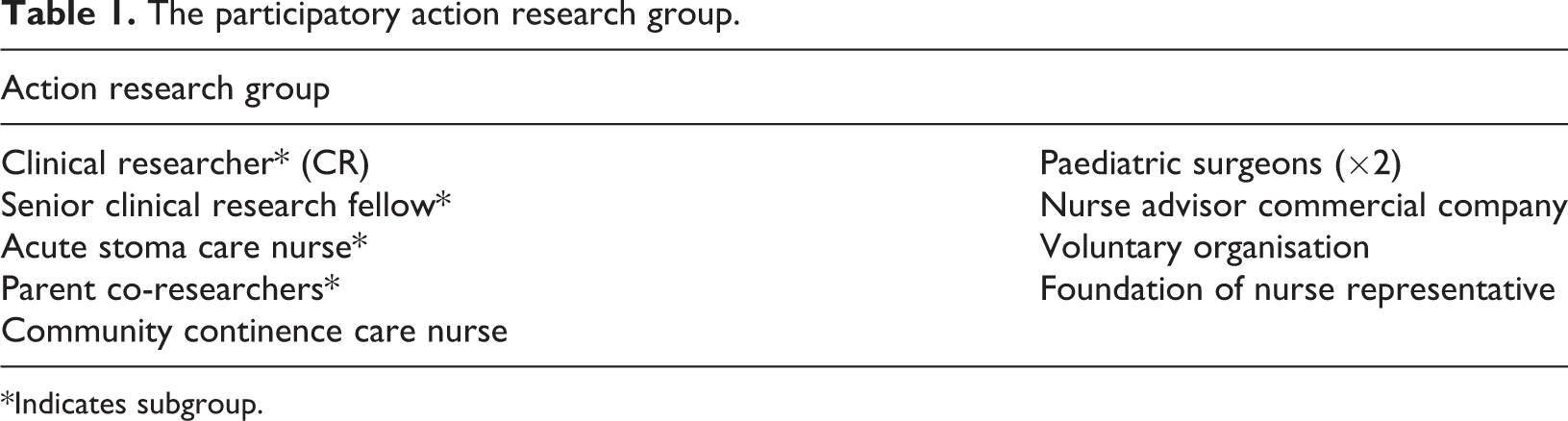
*Indicates subgroup.
The action research group met regularly, facilitated by the CR. The parent co-researchers had both expressed an interest in undertaking research based on their own and their child’s experiences. One of the parent co-researchers had experience in facilitating focus groups, while the second parent had no research experience. All those who accessed the hospital site had passed criminal record bureau checks and followed the local research and development guidelines for involvement in research studies.
Data collection and participant recruitment
Data were collected over a 10-month period between 2010 and 2011 using professional online questionnaires, parent telephone interviews, action research group evaluation cycles and professional and parent postal evaluation questionnaires.
Professional questionnaire
Working together, the action research team designed a short online questionnaire (Survey Monkey) to collect data about health professional’s current practise, irrigation training and education and the type and source of information they used in practise. Recruitment of the health professionals was via the action research group’s existing clinical contacts and networks from across the United Kingdom. A study introduction email was sent containing a secure link to a survey, with an open invitation to pass on the details of the questionnaire to other professionals, thus adopting a snowball sampling approach. Consent from professionals was assumed on completion of the online survey. Professionals were offered the opportunity to provide their contact details if they wished to participate further in the study.
Parent telephone interview
Semi-structured telephone interviews aimed to explore parents’ experiences of learning about irrigation, management at home, positive experiences, challenging experiences, how they judged the success of irrigation and hopes for the future. Telephone interviewing was chosen to collect data due to the nature of busy family lives and the geographical spread of the participants (across the United Kingdom) (Carr and Worth, 2001). The parent researchers felt that participants would talk more openly about their experiences to other parents rather than being interviewed by a professional, as previously reported in the literature (Rowe, 2006; Walmsley and Mannan, 2009). The parent researchers were given some research, communication and child protection training (delivered by the safeguarding team from the acute hospital) and undertook the telephone interviews using a fieldwork guide adapted from the work by Musselwhite et al. (2007), which included establishing contact, checking consent and checking whether the equipment is available and working.
Recruitment of the parent participants was via those clinical teams participating in the study. The inclusion criteria specified any parent or carer who was using transanal irrigation with the child or who had experience of using it but had stopped within the last 9 months. Those parents who had been using irrigation for less than 4 weeks were excluded.
Participants were asked to return a signed consent form to the research team, which included a statement from them to verify that they had sought permission from their child to discuss irrigation. One of the parent researchers conducted the telephone interviews from a quiet room on the host site with a researcher present in an adjacent room in the event of any difficulties or concerns being encountered. Debriefing and reflection were an integral part of the study for the parent researcher, and this was provided post interview and throughout the study. The telephone interviews were digitally recorded.
Professional and parent postal evaluation
The SHR was distributed through the post to the self-selected sample who volunteered to review and evaluate the design. Two short paper questionnaires (one for parents and one for professionals) developed by the action research group were posted with a copy of the SHR along with a stamped addressed envelope. Feedback from this stage was used to revise the SHR.
Analysis
For the professional online questionnaire and professional and parent postal evaluation, simple descriptive statistics were used to report the closed responses while the free text replies were grouped into themes.
The parent telephone interviews were transcribed verbatim and anonymised. The transcripts were independently analysed by all members of the action research group using qualitative content analysis, which is a systematic and objective means of describing and quantifying phenomena (Elo and Kyngas, 2008; Graneheim and Lundman, 2004). Codes and themes were discussed between action research group members, with any discrepancies leading to further analysis and re-evaluation (Graneheim and Lundman. 2004).
Findings
Online professionals’ questionnaire
Twenty-four professionals from a broad range of paediatric disciplines completed the online questionnaire; consultant surgeons (n = 2), urology nurses (n = 8), stoma nurses (n = 7), continence nurses (n = 4), outreach nurse (n = 1), community nurse (n = 1) and a voluntary organisation team lead (n = 1). Twenty professionals were currently involved in teaching parents and children how to use irrigation with the majority (90%, n = 18) having received some training. Most of the nurses delivering care (85%, n = 17) felt confident to undertake irrigation; however, an absence of guidelines and competencies (local, national or international) was cited as unhelpful by 70% (n = 14). The most common approach to information sharing with parents was reported as verbal (90%, n = 22). The written information produced by commercial companies was cited as helpful by the majority (95%, n = 23). Only one professional would direct parents to Web-based support sites, while 35% (n = 8) would, if asked, introduce them to another family who shared similar experiences.
Parent semi-structured telephone interviews
From the 46 parents approached to participate across the three sites, 20 parents agreed to participate in the telephone interviews. Two parents could not be contacted despite them being happy to take part. At the beginning of the interviews brief clinical details were collected to provide some context of the parents’ experiences of using irrigation. Four parents reported their child was no longer using irrigation; three of these had discontinued the use due to their child’s distress, whilst one child had managed to achieve reliable faecal continence without irrigation. The parents’ initial reactions to irrigation as a treatment choice were often one of uncertainty and anxiety, ‘it sound(ed) pretty horrific’ (Helen). Parents identified a need for information both at the beginning stages of using irrigation and when problems arose or the routine changed. They discussed initial difficulties in learning the irrigation procedure, and many felt that acute care settings were not conducive to skill acquisition, since they were false and lacked the everyday interruptions inherent in family homes. Several parents recalled having only a ‘very short initial instruction in hospital’ (Edith), which had the capacity to impact on their confidence. The parents’ data highlighted the variation in practises and experiences depending on the locality of where irrigation had been taught. These differences impacted on how the parents initially managed irrigation, from where they sought help and how quickly they developed a level of confidence and resourcefulness.
The findings from the professional questionnaires and the themes from parent interviews led the research team to devise an SHR as a study outcome. Findings from the parent interviews informed the design of the sections of the SHR these included: child assessment and physical challenges when undertaking irrigation, education for parents and children, need for initial support and ongoing input, learning to problem solve, concerns about transition and independence and ownership of goal setting. These were refined to four key areas including assessment, education, support and problem solving and resources. The SHR is both a paper and online resource (http://www.fons.org/resources/documents/Project%20Reports/RectalIrrigationToolkit2012.pdf) comprising four specific sections and three constructed case studies from several parents’ narrative accounts. Throughout the SHR, brief quotes from the parent interviews were used as exemplars under the four sections.
Professional and parent evaluation of the resource
Of the 20 professionals who volunteered to evaluate the SHR, 13 (65%) returned the questionnaire. All (100%) reported its appearance positively and stated that they would use it in their practise. The inclusion of parent perspectives was the most commonly cited positive aspect. Suggestions for improvement included making the resource A5 size and including space for individualised information families may need to record. Those professionals who used the resource in practise described its value in helping them explore social situations with families, and it gave them a better insight of the complexities of transition from child to adult services.
Of the 16 parents who had agreed to review the resource, 7 (44%) returned the postal questionnaire. All the parents commented positively on the resource design and appearance and reported it as useful. Feedback focused on the value in having case studies and quotes while still keeping the layout simple. The majority of these parents reported they ‘wished they had this resource’ when they were learning about irrigation. All agreed that they had learnt something new and would recommend it to other families that they knew through social networking and support group sites. One mother gave a feedback that after reviewing the SHR she recognised the need to encourage her son, now a young adolescent, to start taking ownership of his bowel management routine. Two of the parents wrote letters that they returned with the questionnaire, thanking the researcher for the opportunity to be involved in the study.
Discussion
For the parent co-researchers, their participation and engagement in this study was empowering, resulting in them feeling confident and able to present data at national conference. The study outcome of the SHR also empowered parents to open dialogues with professionals as well as feel confident in their abilities and actions. The process of development of any SHR for use by children, parents and health professionals appears to be a little researched area (Coyne, 2006). Much of the evidence surrounding the use of shared care resources stems from work with adult patients focusing on specific condition such as stroke and cancer (Ayana et al., 2001; Gysels et al., 2006). Parents in this study specifically identified the need for written and visual information orientated towards the initial stages of learning about irrigation and ongoing management. There is a lack of agreement between patients and health professionals regarding the function of SHRs (Gysels et al., 2006) which can result in low involvement and interest from health professionals. Some health professionals believed that such records involve more paperwork, duplicate of information and risk sharing of sensitive information without appropriate consent (Lecouturier et al., 2002). However, our findings suggest that by involving parents of younger children in decision making about when to use transanal irrigation, early intervention can result in better continence outcomes and increased family resourcefulness.
This study outcome culminated in the development of an SHR to provide clinical guidance, education and information for both parents and professionals and as such aimed to address the concern that professionals may fail to engage in using an SHR. The transanal irrigation resource is aimed to be more than just a record but provide an opportunity for professionals to discuss the holistic needs of children and parents when prescribing transanal irrigation. As the resource will remain with the family, professionals will still document their clinical interventions and encounters in the traditional medical notes or electronic systems and the parents write on the SHR, resulting in less duplication.
The resource development and design is aimed to provide accessible high-quality health information that is central to empowering children and their parents, in making treatment choices (Williams et al., 2011) and manage their condition at home. The resource is aimed to provide information that had an ongoing influence for parents and could be used as a platform for those who already use irrigation with their child to discuss long-term challenges such as promoting their child’s independence. The SHR provides parents with written advice about carrying out irrigation, problem solving when their child’s routine changes as well as information about support sites and parent groups. Many of the parents interviewed felt there was little written or actual support for them when learning and carrying out the procedure alongside a busy family life, away from the controlled and ordered clinical environment where they were frequently trained. The impact of irrigation on family life is given very little attention in the literature (Emmanuel, 2010), and the resource is aimed to address this deficit by acknowledging the wider issues that can be associated with transanal irrigation and bowel management by incorporating narratives as case studies. This was an aspect that was particularly well evaluated and was reported as creating a more engaging and meaningful resource through recognising professionals’ and parents’ attitudes, beliefs and expectations.
Dissemination and access to the SHR was a key discussion point within the action research group. We wanted, like others, to acknowledge the contribution of individuals and groups (Beringer and Fletcher, 2011; McVicar et al., 2012) and use all options to make the SHR accessible. Since our study identified that the literature provided by the voluntary sector and commercial company are valued by professionals when they teach and educate parents about transanal irrigation, we have made the SHR available to commercial, health provider and voluntary sites. Authorship on the SHR is very clear as evidenced by each group’s organisational logo being recorded in the footnote section. In making the SHR a free PDF, downloadable from several sites including the Foundation of Nursing Studies http://www.fons.org/resources/documents/Project%20Reports/RectalIrrigationToolkit2012.pdf the cost is kept low. This aims to address the reported difficulties in accessing health information (Williams et al., 2011) when costs are required for reproduction, distribution or printing of developed resources. In ensuring accessibility of the resource via several Internet sites, we hoped to address some of the challenges parents face when they live a distance away from the care provider’s environment (Swallow et al., 2008; Tuffrey and Finlay, 2002). We recognised, like others, that the changing trends in communication and information technology mean that some parents use computers to access the Internet to gather clinical information and seek support from parent forums or networking sites. Since only one professional in our study reported advising parents to use Internet groups for support, the inclusion of signposting as a specific section in the SHR may help parents access other forums. We agree with others in that networking sites and professionals need to be able to signposting parents to resources that could be helpful (Ellins and McIver, 2008). This resulted in one of our parent researchers also posting the SHR links and information on several sites that she is involved with.
Limitations
The authors recognise that a more comprehensive evaluation would be required to judge the influence the resource has on parent and professional information sharing, communication and decision-making regarding using transanal irrigation. To date, this study only provides data on the usefulness of the resource for a small number of professionals and parents. Further investigation needs to include the voices of children and young people, and there would be added value in developing the resource further to include information and education for children and young people. Further studies, preferably international, need to explore the effectiveness and durability of transanal irrigation as a lifelong management approach in children as they transition to adolescence and adulthood.
Conclusion
This action research study has demonstrated the need for improved information and education resources to facilitate a dialogue between parents and professionals when considering or using transanal irrigation with children. This study demonstrated that an SHR can be collaboratively designed, evaluated, refined and appraised to expand professionals’ and parents’ understanding, discussions, choice and decisions about using transanal irrigation with children.
Footnotes
Acknowledgements
Action Research Group. Parent researchers: Vicky Doswell (Parent & SCOPE project worker), Christine Anderson (Parent); nurse researchers: Brenda Hill (Stoma Nurse: Alder Hey Children’s NHS Foundation Trust), Deborah Ward (At the time of the study a Children’s Community Continence Advisor: Liverpool PCT); voluntary organisation member: Ms Angela Lansley (Regional advisor for SHINE previously Association of Spina Bifida and Hydrocephalus (ASBAH)); manufacturing representative: Lynne Hornby (Coloplast); consultant surgeons: Mr Rick Turnock (Alder Hey Children’s NHS Foundation Trust); Mr Chris Driver (Aberdeen Children’s Hospital); Foundation of Nursing Studies: Dr Theresa Shaw (Chief Executive, Foundation of Nursing Studies)
Conflict of Interest
The authors declared no conflicts of interest.
Financial Disclosure/Funding
Funding from Foundation of Nursing Studies and a small grant from Coloplast was provided to support research transcription and staff costs with the Intellectual Property Rights continuing to be held by the host site.