



Abstract
Aims and Objectives:
We investigate whether the cognate facilitation and gender congruency effects observed in previous bilingualism research extend to pronoun production. The aim is to examine these effects in bilinguals’ L1 as a function of L2 proficiency.
Design/Methodology/Approach:
Fifty late, unbalanced Polish-German bilinguals completed a pronoun production task, in which they produced third-person singular pronouns in their L1 Polish in response to visually presented Polish bare nouns. The stimulus set included 132 inanimate nouns, manipulated for cognateness and cross-linguistic gender congruency. Participants also completed a control gender assignment task and a background questionnaire. L2 proficiency was measured using the Dialang test.
Data and Analysis:
We analysed participants’ response times in L1 Polish using linear mixed-effects models. Trials involving nouns with unknown gender in L2 German were excluded from the analysis.
Findings/Conclusions:
Pronoun production in bilinguals’ L1 was not affected by cognateness with the L2. However, we found a significant gender congruency effect in the L1, with faster responses to nouns congruent in gender with L2 German than to incongruent ones. This effect was limited to masculine and feminine nouns and decreased with increasing L2 proficiency. In addition, we observed a main effect of gender, with facilitated pronoun production for the feminine gender relative to the masculine and neuter genders.
Originality:
The study is the first to explore whether lexical cognate and gender effects in bilingual language production extend beyond nouns to agreeing elements such as pronouns. It also contributes to the underexplored areas of bilinguals’ L1 production and L2 effects on L1.
Significance/Implications:
The findings provide novel evidence that pronoun production depends on the lexico-syntactic, but not the formal, properties of the antecedent noun. Moreover, the results demonstrate stronger cross-language activation in the L1 at lower L2 proficiency levels, offering support for parasitic models of the bilingual mental lexicon.
Keywords
Introduction
A hallmark of psycholinguistic research on bilingualism is that both languages of a bilingual always remain co-active to varying degrees (Dijkstra & Van Heuven, 2018). This language co-activation has been frequently assessed through the processing of cognates and grammatical gender, where between-language overlap offers facilitation reflected in decreased processing costs (Sá-Leite et al., 2020; Sunderman & Schwartz, 2008). However, most research has focused on the production and comprehension of nouns or noun phrases that bear the relevant semantic and formal or grammatical properties (cognates and grammatical gender, respectively). It remains unclear whether cognate and gender effects observed in bilinguals can extend to language processing beyond the nominal phrase – for instance, to processing pronouns. This question has theoretical relevance as it pertains to the longevity of language co-activation – whether it is restricted to noun processing or can carry over to other elements that agree with the noun. In addition, most of the previous research has considered the bilinguals’ L2, focusing on the effect of the L1 on various aspects of L2 lexical processing. In turn, the reverse influence – that is, from the L2 to the L1 – has received far less attention (but see Section 2). This calls for further research to gain a deeper understanding of the bilingual mental lexicon. Finally, research on the role of L2 proficiency has yielded mixed findings, with some studies attesting stronger co-activation in the L1 at high L2 proficiency levels (Blumenfeld & Marian, 2013), and others suggesting the opposite, i.e., stronger cross-language effects in the L1 among lower-proficiency bilinguals (Berghoff & Bylund, 2024).
This study aims to fill these research gaps by investigating language co-activation in the L1 of late, unbalanced Polish-German bilinguals. Specifically, we investigate the production of third-person singular pronouns in response to nouns manipulated for cognateness and grammatical gender congruency with the L2. We are also interested in how these two factors interact with L2 proficiency, and how grammatical gender knowledge in the L2 affects pronoun production in the L1.
Lexical Co-Activation in the L1
Compared to the wealth of research on bilingual language co-activation in the L2, fewer studies have examined L2 influence on L1 lexical processing. In comprehension, such L2-to-L1 effects have been observed as faster retrieval of cognates relative to non-cognates (e.g., Pelzl et al., 2024; Szubko-Sitarek, 2011; Van Hell & Dijkstra, 2002), increased competition between L1 and L2 non-cognates with phonetically overlapping onsets (e.g., Berghoff & Bylund, 2024; Bobb et al., 2020; Mishra & Singh, 2016), or facilitated access to non-cognate translation equivalents following masked priming (e.g., Duyck & Warlop, 2009; Nakayama et al., 2016). These findings demonstrate that the assumption of non-selective lexical access also holds true for the L1. However, reverse L2-to-L1 effects are generally less robust, often yielding smaller effect sizes (e.g., Wen & van Heuven, 2017), and only emerging under specific conditions such as longer prime durations (e.g., Lee et al., 2018).
The extent of L2 effects on L1 processing has frequently been linked to L2 proficiency. In their seminal study, Van Hell and Dijkstra (2002) tested Dutch-English-French trilinguals with different L3 proficiency levels. Highly proficient L2 English speakers with weaker L3 French showed shorter reaction times in response to Dutch-English cognates, but not to Dutch-French cognates. In contrast, trilinguals equally proficient in both English and French showed facilitation for both pairings, indicating that a certain level of proficiency is required before any weaker language effects become detectable in L1 processing. Similarly, Szubko-Sitarek (2011) found facilitation for Polish-English-German triple cognates, but not for Polish-German cognates. Since L2 English was the stronger foreign language for these trilinguals, L3 German likely did not contribute to the observed effects.
Evidence from the visual world eye-tracking paradigm also points in this direction – Blumenfeld and Marian (2013) showed that only higher-proficiency English-Spanish bilinguals, but not lower-proficiency ones, displayed L2 activation during L1 processing, as reflected in looks to a competitor object with an overlapping onset. Together, these findings support the view that, the stronger language (typically L1) has a more profound effect on the weaker language (typically L2) than vice versa, and processing in the L1 is only affected by the non-target L2 in bilinguals with relatively high levels of L2 proficiency. (Van Hell & Tanner, 2012, p. 163)
However, the role of proficiency in the L2-to-L1 direction is not always straightforward. For example, Dimitropoulou et al. (2011) tested Greek-English bilinguals with varying proficiency in a series of masked translation priming lexical decision tasks. While their results confirmed an overall trend of stronger L1-to-L2 rather than L2-to-L1 effects, they were present irrespective of L2 proficiency. In contrast, Berghoff and Bylund (2024) employed a spoken visual task with English-Afrikaans bilinguals and found that higher L2 proficiency was associated with weaker L2-to-L1 effects. This suggests that as the L2 lexical system becomes more established, lexical entries function more independently and are less parasitic on their L1 equivalents.
Specifically, models proposing that emerging L2 representations rely on and attach to established L1 lexical entries – often referred to as parasitic accounts (e.g., Cuppini et al., 2013; Ecke, 2015; Zhao & Li, 2010) – suggest that at lower levels of L2 proficiency, L2 items become activated during L1 processing precisely because they are anchored to their equivalent L1 representations.
Learners with lower L2 proficiency are therefore expected to exhibit stronger cross-language lexical effects. The existence of these conflicting theoretical perspectives underscores the need for further empirical work, and the present study is among the first to put these predictions to the test.
Lexical and Formal Activation in Pronoun Production
Psycholinguistic research on pronouns has been mainly concerned with their processing as anaphoric elements, focusing on constraints on coindexation and coreference within a syntactic domain (see Nicol & Swinney, 2003, for discussion). Regarding language production, research has centred on grammatical gender retrieval in the L1, using primarily the picture-word interference paradigm (PWI). In this paradigm, participants name pictures while ignoring superimposed written distractor words. The gender congruency effect refers to faster responses when the target and distractor have the same gender than when they differ in gender. The key issue in this line of research has been the nature of gender selection processes – that is, whether they result from facilitative priming, competition, or neither, instead reflecting automatic gender selection in language production (see Sá-Leite et al., 2022, for discussion).
Regarding Slavic languages, the gender congruency effect has been confirmed in many PWI studies targeting nominal phrases. Perhaps the only PWI study on pronoun production was conducted by Costa et al. (2003). The authors carried out three picture-word interference experiments. In Experiment 1, Croatian speakers produced utterances in which the noun’s gender influenced the choice of gender-marked pronouns, while ignoring distractor words that either matched or mismatched the noun’s gender. In Experiments 2 and 3, the same speakers named pictures using noun phrases in which gender appeared as an inflectional suffix. In the first experiment, different-gender distractors elicited a gender congruency effect, but this effect did not occur in Experiments 2 and 3. These findings were interpreted as suggesting that the gender congruency effect arises not during the selection of lexical-grammatical information, but rather during the selection of freestanding morphemes.
The gender congruency effect has been extensively studied in bilingual populations, targeting gender matches and mismatches between the L1 and L2 rather than within a single language. L2 production studies, using mainly picture naming and translation tasks, provide strong evidence for interactions between L1 and L2 gender systems (see Sá-Leite et al., 2020, for overview). However, this effect has only recently been considered in bilinguals’ L1 (Sá-Leite et al., 2023), showing greater effects with higher L1 L2 proficiency imbalance, but it has not been investigated beyond the nominal phrase.
The role of lexical factors, which are at the core of this study, has received less scholarly attention. Meyer and Bock (1999), for instance, explored how native speakers produce and interpret pronouns in Dutch, focusing on the relationship between pronouns and their antecedents. Their experiments demonstrated that pronoun production relies on grammatical gender information encoded in the lemmas of words rather than purely conceptual or surface-morphological cues. Specifically, when potential antecedents differed in grammatical gender, speakers produced more gender errors, indicating interference at the lexical-grammatical level. These findings underscore the influence of lexical factors on agreement processes and the link between pronouns and their referents.
Furthermore, Jescheniak et al. (2001) investigated how native speakers produce gender-marked pronouns in German through a series of four picture-word interference experiments. Their study addressed whether, during pronoun production, speakers access the lemma of the referent noun and whether this access extends to its phonological form. The findings showed that speakers retrieve the lemma containing the noun’s syntactic and semantic information when generating pronouns, but the phonological form of the referent noun is not substantially activated. This suggests that pronoun production involves lemma-level processing rather than full lexical access.
Taken together, L1 data suggest that pronoun production is primarily affected by grammatical gender information encoded at the lemma level, and to a lesser extent by the formal properties of the antecedent noun. Against this background, an important question is whether pronoun production in bilinguals would exhibit a similar pattern – that is, cross-language gender congruency effects in the absence of cognate facilitation effects in the L1.
The Current Study
We investigate the extent to which lexical knowledge in the L2 influences pronoun production in the L1, depending on L2 proficiency, through the lens of cross-language cognate and gender effects. We focus on third-person singular pronouns, which in Polish inflect for both gender and case. Because the study centres on gender, we use the nominative case, where the pronouns take the forms on (‘he’, masculine), ona (‘she’, feminine), and ono (‘it’, neuter). These forms clearly disambiguate the three grammatical genders. Third-person singular pronouns in German are similar to those in Polish, as they also inflect for gender and case and mark gender distinctions (see Brehmer et al., 2023, for a detailed discussion of subject pronouns in Polish and German). Our study concerns pronoun production in contexts where the antecedent is highly accessible and not regulated by pragmatic constraints. We address the following research questions:
Participants
Our participants were 50 late, unbalanced Polish-German bilinguals with a mean age of 22.1 years (SD = 3.3). The group included 41 females, 7 males, and 2 non-binary individuals. All participants were undergraduate or graduate students of German at a Polish university. According to the curriculum, their L2 proficiency ranged from intermediate to pre-advanced. On the German Dialang test (Alderson, 2005), participants scored an average of 58 out of 75 (range = 51–69; SD = 5.2). All were first exposed to German after the age of 7 (M = 12.5) in school settings. All participants also had knowledge of English to varying degrees, as is typical in the Polish education system.
Stimuli
The stimuli consisted of 132 inanimate Polish nouns, categorised into four conditions by crossing the factors of congruency and cognateness. There were more non-cognates (n = 84) than cognates (n = 48) due to frequency considerations. Half of the items were gender-congruent with their German equivalents, while the other half were not. Accordingly, among the non-cognates, there were 42 congruent items (e.g., lalka – Puppe, ‘doll’) and 42 incongruent items (e.g., gra – Spiel, ‘game’). Among the cognates, there were 24 congruent items (e.g., alarm – Alarm, ‘alarm’) and 24 incongruent items (e.g., region – Region, ‘region’).
Cognateness was established using the AWSM Tool (https://awsm-tools.com), which calculates textual similarity as a percentage based on the Levenshtein distance and the length of the source and target words. Mean cognateness was 87.9% (SD = .1; minimum = 70%) for cognates and 14.0% (SD = 15.3) for non-cognates.
The four conditions – congruent non-cognate, incongruent non-cognate, congruent cognate, and incongruent cognate – were matched for length in letters in Polish, Zipf frequency in Polish (SUBTLEX-PL; Mandera et al., 2015), and imageability in Polish (Imbir, 2016).
Arousal and valence were controlled using German norms (Köper & Schulte im Walde, 2016) as corresponding norms for Polish are unavailable; these affective dimensions are highly correlated across languages. All ps were > .16 (Kruskal–Wallis test).
The three grammatical genders (masculine, feminine, neuter) were equally distributed across the non-cognate items. However, due to limitations in stimulus selection, there was a gender imbalance among the cognate items: congruent cognates were masculine (n = 5), feminine (n = 10), or neuter (n = 8), while all incongruent cognates were masculine (n = 24). We return to this issue in the data analysis section. All nouns had gender-typical endings: masculine items ended in a consonant, feminine items in -a, and neuter items in -o or -e.
Procedure
Participants were tested individually in a sound-proof booth in a lab. They completed a background questionnaire, three other tasks (as a part of a larger research project), the Dialang placement test (Alderson, 2005), the pronoun production task, and the control gender assignment task, in that order.
Participants completed the pronoun production task in two blocks, separated by a short break: the first block included only non-cognates, and the second included cognates. On each trial, participants were presented with a capitalised Polish noun displayed at the centre of a computer screen and were instructed to produce the corresponding third-person singular pronoun – on, ona, or ono – as quickly as possible. Each trial began with a fixation cross shown for 500 ms. Immediately afterwards, a Polish noun appeared for up to 3,000 ms or until a response was detected by the voice key. The interstimulus interval was 1,000 ms.
In the control gender assignment task, all nouns from the pronoun production task were presented individually. Each trial involved choosing der/die/das via mouse click and providing a certainty rating on a coloured 0–100 slider.
All tasks were preceded by written instructions in Polish. Each block in the pronoun production task featured two warm-up items excluded from the analysis. Within each block, trial order was randomised.
At the beginning of the testing session, participants received information about the procedure and provided written informed consent before completing a background questionnaire. The study received approval from the Ethics Committee for Research Involving Human Participants at Adam Mickiewicz University, Poznań (no. KE/9/2024).
Data Analysis
We analysed the reaction time (RT) data using linear mixed-effects models (LMEMs) in R version 4.4.0 (R Core Team, 2024) with the lme4 package (Bates et al., 2015) and lmerTest (Kuznetsova et al., 2017). We excluded trials with missing assignment-certainty, verbal dysfluency or non-target productions, incorrect responses or incorrect gender assignment in L2 German, reaction times < 200 ms, and participant-level outliers beyond ± 2.5 SD. These exclusions removed 26.8% of trials. RTs were then log-transformed to approximate normality and reduce heteroscedasticity.
Categorical predictors included congruency (congruent vs. incongruent), cognateness (cognate vs. non-cognate), and gender (masculine, feminine, neuter). Continuous predictors included L2 proficiency and assignment certainty; both were standardised (z-scored). Assignment certainty was included as a control covariate, entered in interaction with congruency (unless specified otherwise), to account for the fact that interactions between L1 and L2 gender systems are very likely to depend on participants’ lexical gender knowledge, which is not categorical but rather shows different degrees of stability (Hopp, 2013). All categorical predictors were coded with sum contrasts so that model intercepts represented grand means and coefficients reflected deviations from those means. Multicollinearity, assessed via variance inflation factors (VIFs), was negligible.
We began with a maximal random-effects structure justified by the experimental design (Linck & Cunnings, 2015) and retained maximal models that converged without warnings or singular fits. P-values for fixed effects were obtained via Type III F-tests with Satterthwaite-approximated degrees of freedom (lmerTest). Post hoc comparisons and estimated marginal means (EMMs) were computed using emmeans (Lenth, 2024), with Tukey adjustment where appropriate. Interaction trends with continuous moderators were explored using emtrends.
The materials, scripts, and data that support the findings of this study are openly available in OSF at https://osf.io/r5wak/.
Results
Model 1
The first model tested the main effects and the following interactions: congruency × L2 proficiency, congruency × gender, congruency × assignment certainty, and cognateness × L2 proficiency. It included random intercepts for both participant and item as well as by-participant random slopes for gender and cognateness.
There was a robust main effect of gender, F(2, 101.6) = 22.05, p < .001. Post hoc Tukey comparisons indicated that responses to masculine items were significantly slower than to feminine items, β = .105, SE = .017, z = 6.17, p < .001, but did not differ from responses to neuter items, β = .000, SE = .014, p = .99, whereas responses to feminine items were faster than to neuter items, β = −.105, SE = .018, z = −5.92, p < .001. Higher L2 proficiency was associated with faster responses overall, β = −.062, SE = .029, t(48) = −2.12, p = .039, whereas greater assignment certainty was linked to slower responses, β = .007, SE = .003, t(4,672) = 2.18, p = .029. Neither congruency nor cognateness alone reached significance, F(1, 116) = .06, p = .81, and F(1, 82.4) = .81, p = .37, respectively.
The congruency × L2 proficiency interaction was significant, F(1, 4277) = 6.79, p = .009. Simple slopes across L2 proficiency levels were not individually significant; however, a trend test indicated that the incongruent slope became more negative with increasing L2 proficiency compared to the congruent slope (difference = −0.015, p = .018). The congruency × gender interaction was also significant, F(2, 116) = 4.77, p = .010, with a reversed congruency effect (faster for incongruent than congruent) only for neuter items, β = .047, SE = .020, p = .022, and no effects found for masculine and feminine items (ps > .11). The two interactions are visualised in Figures 1 and 2, respectively. Other interactions, including cognateness × L2 proficiency and congruency × assignment certainty, were not significant (ps > .24).
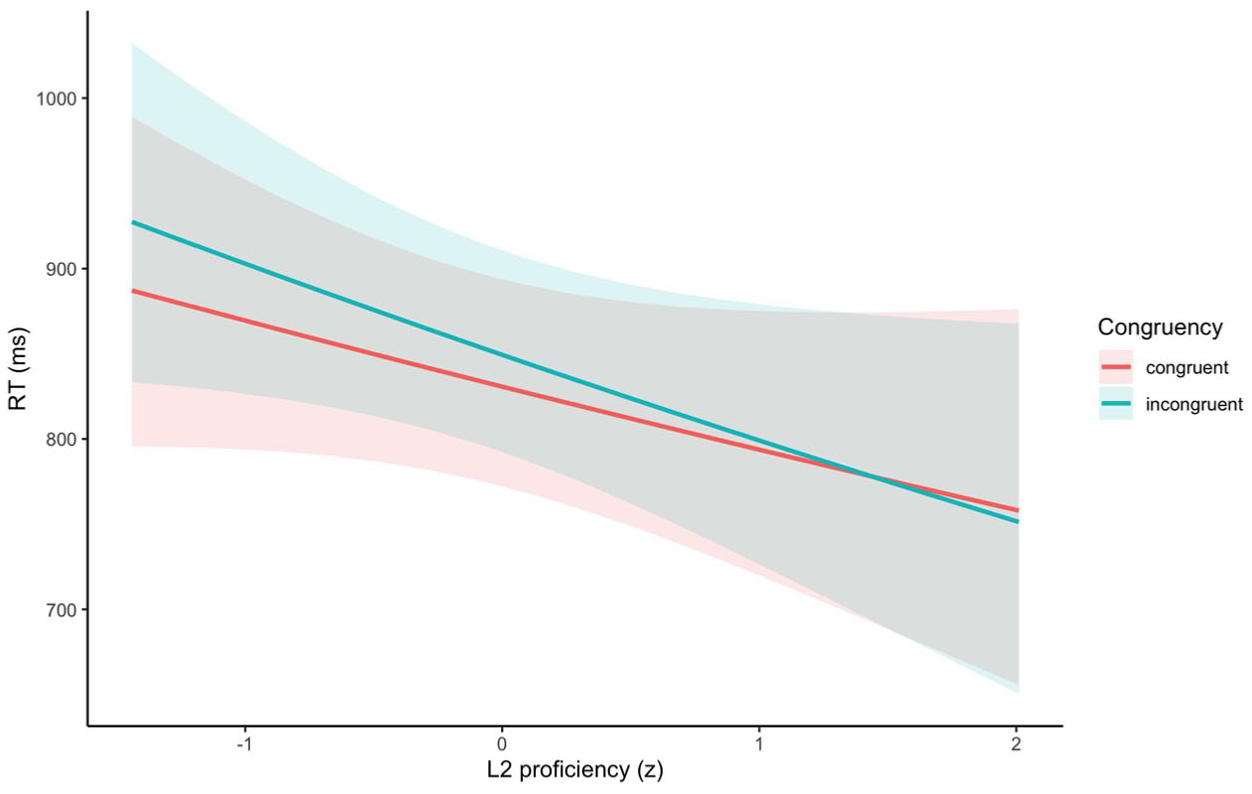
Predicted RT (ms) across L2 proficiency (z) by congruency.
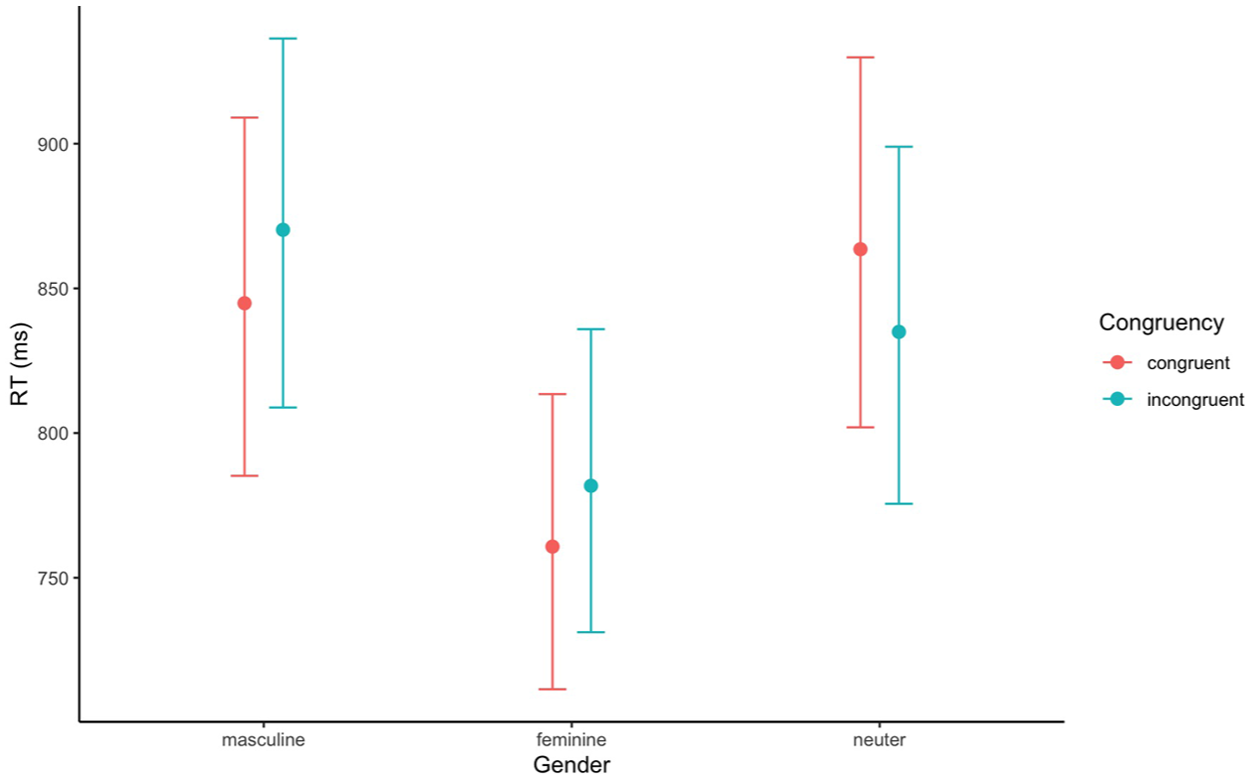
Predicted RT (ms) across genders by congruency (without cognates).
To investigate whether the reversed gender congruency effect was not a result of gender imbalance in the cognate stimulus set, we ran an additional model for non-cognates only, keeping the model structure constant. The congruency × gender interaction was only marginally significant, F(2, 76) = 2.66, p = .077. Post hoc Tukey comparisons showed no significant gender congruency effect for either gender (ps > .12), suggesting that the reversed gender congruency effect in the main model was indeed due to gender imbalance among cognate items. Although not significant, the direction of the effect remained consistent, with faster responses to gender-congruent feminine and masculine items than to incongruent counterparts, and slower responses to gender-congruent neuter items than to incongruent ones (see Figure 2).
Model 2
The first model, based on all items, revealed a significant congruency × gender interaction: congruency effects appeared for masculine and feminine nouns (visible as trends in the plots), whereas neuter nouns showed an opposite pattern, with faster responses to incongruent than congruent items. Because our focus was on the gender congruency effect and neuter items behaved differently, we excluded neuter nouns. We also removed cognates to avoid a strong imbalance: among cognates, all incongruent items were masculine, so including them would confound congruency with gender. The second model was therefore fit only to non-cognate masculine and feminine nouns. As fixed effects, it included congruency, gender, L2 proficiency, assignment certainty, as well as interactions involving the congruency factor: congruency × L2 proficiency, congruency × gender, congruency × assignment certainty. The model included random intercepts for both participants and items as well as a by-participant random slope for gender.
There was a significant main effect of gender, F(1, 65.6) = 34.86, p < .001, with slower responses to masculine items than to feminine items, β = .053, SE = .009, t(65.6) = 5.90, p < .001. A main effect of congruency was also present, F(1, 51.6) = 4.80, p = .033, such that congruent items elicited faster responses than incongruent items, β = −.014, SE = .007, t(51.6) = −2.19, p = .033. Higher L2 proficiency was associated with faster responses overall, β = −.067, SE = 0.032, t(47.8) = −2.13, p = .039, whereas greater assignment certainty was linked to slower responses, β = 0.011, SE = 0.005, t(2044) = 2.23, p = .026.
There was a significant congruency × L2 proficiency interaction, F(1, 1983.9) = 5.67, p = .017. Follow-up simple slopes showed that the congruency effect (congruent faster than incongruent) was strongest at lower L2 proficiency: at −1 SD proficiency, β = −.049, SE = .016, t(108) = −3.10, p = .003; at the mean, β = −.029, SE = .013, t(52) = −2.19, p = .033; but the effect attenuated and became non-significant at higher-proficiency levels (ps > .58 at + 1 SD and + 2 SD). Trend tests indicated that the incongruent slope decreased more steeply with increasing L2 proficiency than the congruent slope (difference = −0.020, p = .021). Neither the congruency × gender nor the congruency × assignment certainty interactions reached significance (ps > .91). Figures 3 and 4 illustrate the main effect of congruency and the interaction congruency × L2 proficiency, respectively.
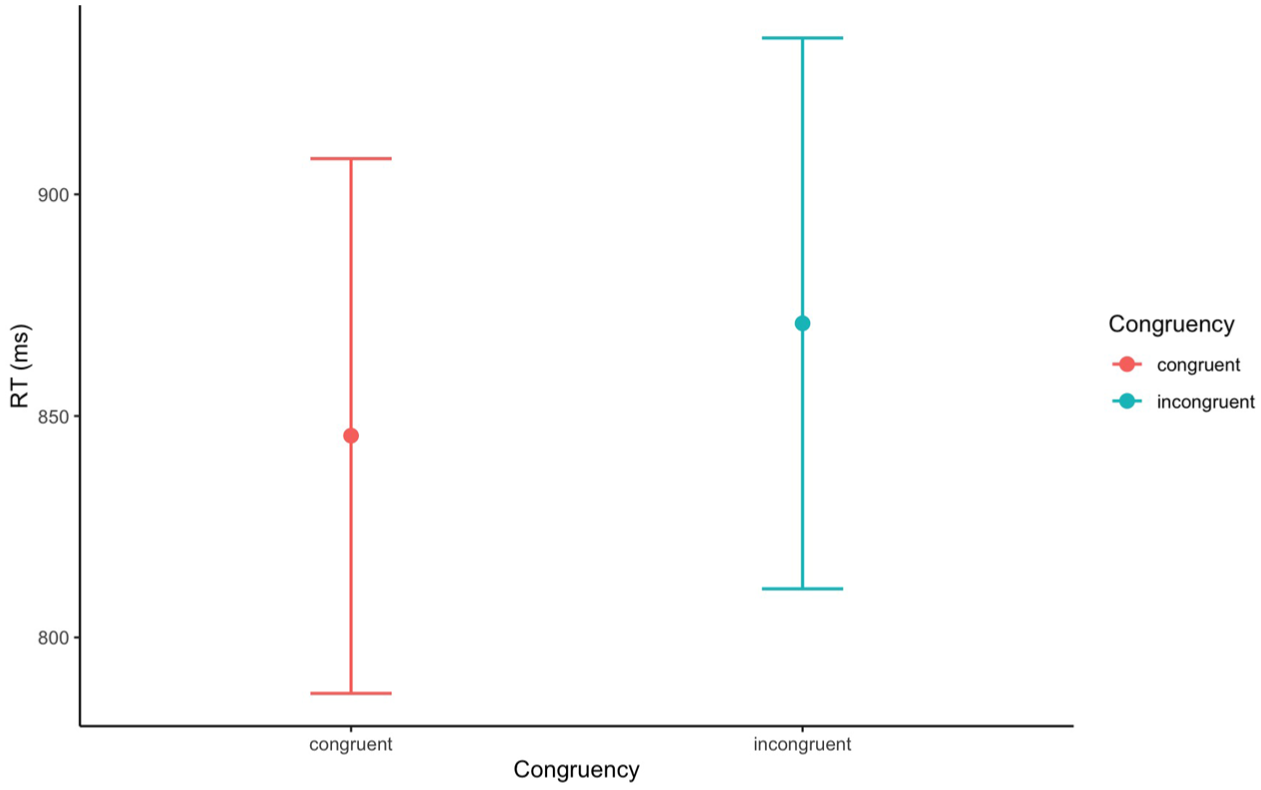
Predicted RT (ms) across genders by congruency (without cognates and neuter items).
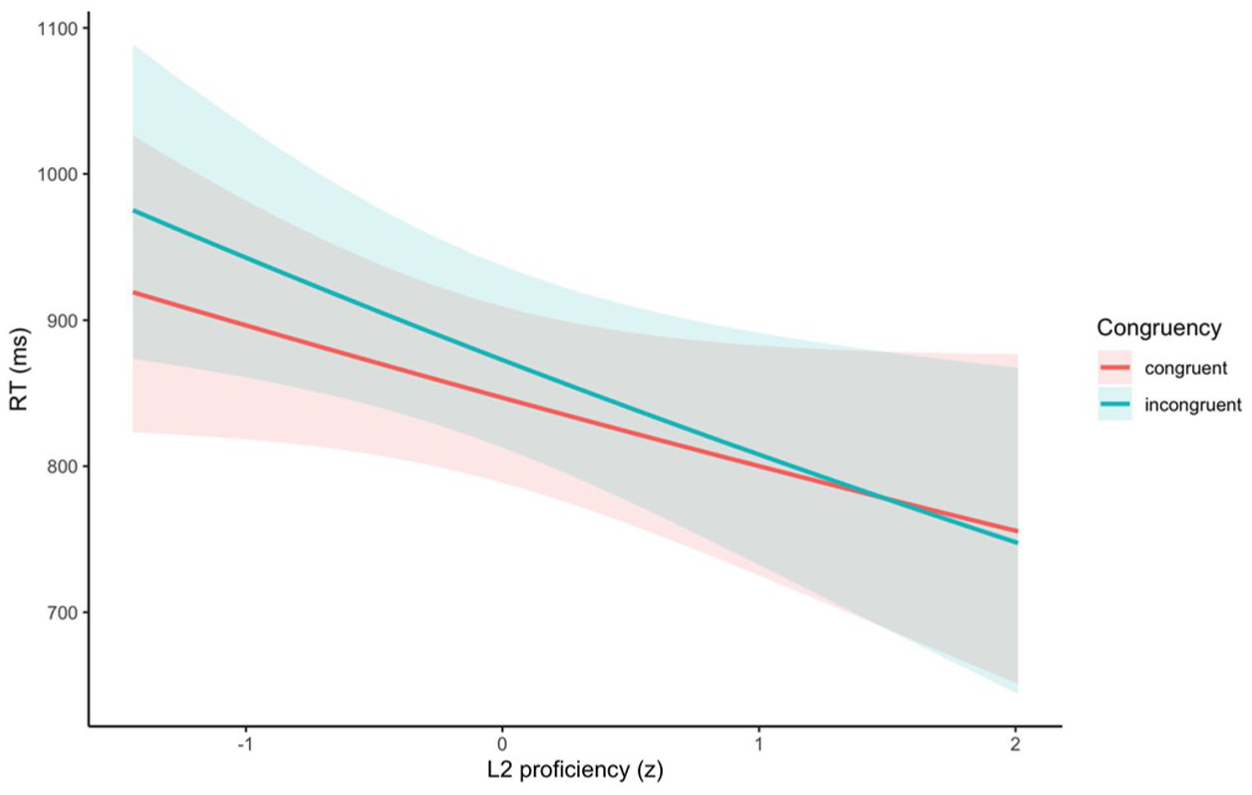
Predicted RT (ms) across L2 proficiency (z) by congruency (without cognates and neuter items).
Model 3
Due to constraints in stimulus selection, cognate items were unevenly distributed across gender and congruency conditions, with incongruent cognates occurring exclusively in the masculine gender. As a consequence, the interaction between congruency and cognateness is not independent of grammatical gender and cannot be interpreted separately from the congruency × gender interaction included in the main model. In addition, the limited number of cognate items reduces sensitivity to small cumulative effects involving cognateness. To address both the interpretability and power limitations inherent in the full factorial design, we conducted an additional analysis restricted to congruent items only. This subset holds congruency constant and provides a more balanced distribution of gender, allowing for a maximally informative test of the effect of cognateness given the present stimulus set.
As fixed effects, the model included cognateness, gender, L2 proficiency, and assignment certainty. The model further included random intercepts for both participants and items, as well as a by-participant random slope for cognateness.
The main effect of cognateness was not significant in this analysis, F(1, 77.0) = 0.32, p = .58. Estimated marginal mean RTs (geometric means) were highly similar for cognate (812 ms, 95% CI = [759, 870]) and non-cognate items (823 ms, 95% CI = [770, 879]), indicating that any descriptive difference was minimal.
We also conducted an additional model including trials with incorrect gender assignment in L2 German, previously excluded from the main analyses, thereby increasing statistical power. The main effect of cognateness remained non-significant, F(1, 76.1) = 0.26, p = .62.
Discussion
Addressing the first research question (Does the cognate facilitation effect extend to pronoun production in the L1? If so, is it modulated by L2 proficiency?), we found no evidence for cognate facilitation effects or for their interaction with L2 proficiency. This indicates that the processing advantage stemming from semantic and formal similarities between the L1 and L2 observed in previous research does not extend to L1 production beyond nouns. To explain this finding, it is necessary to take the task’s characteristics into account. Participants saw bare nouns visually and produced pronouns, not repetitions or translations. This encourages conceptual and syntactic encoding but discourages phonological activation of the L2 cognate form. Because our task required mapping the noun’s gender to a pronoun rather than producing the noun itself, form-level activation could have been suppressed. Furthermore, monolingual studies indicate that pronoun production does not involve retrieval of the full phonological form of the antecedent noun (as shown by Jescheniak et al., 2001), rendering phonological overlap across languages irrelevant. It is also noteworthy that in our task, the antecedent was immediately accessible from previous input, which means that no referential search took place. We entertain the possibility that cognateness could still facilitate pronoun production in the L1 in contexts involving anaphora resolution guided by discourse prominence and syntactic constraints (see Lauro & Schwartz, 2019, for evidence from bilingual language comprehension). Specifically, the system may engage in antecedent retrieval more easily if the antecedent is a cognate.
Addressing the second research question (Does the gender congruency effect extend to pronoun production in the L1? If so, is it modulated by L2 proficiency and the noun’s gender?), our study provided a confirmatory answer. We found that participants produced pronouns in their L1 faster in response to gender-congruent than to gender-incongruent nouns. Again, this finding should be considered in light of the nature of the task. When producing a pronoun, speakers must retrieve the grammatical gender feature of the antecedent noun at the lemma level (the level where syntactic features are stored), which enables interactions between the L1 and L2 gender systems. However, there are some important caveats to this finding. First, the L2 gender system influenced L1 pronoun production differently depending on the noun’s gender. The gender congruency effect only reached significance when neuter nouns – which showed a different pattern – were excluded from the analysis. This provides evidence for a different status of the masculine/feminine versus neuter genders in the mental lexicon of Polish speakers. There are several reasons for this.
First, neuter nouns are less frequent in Polish than masculine and feminine nouns. Lower token frequency may lead to weaker activation of gender features, reducing the likelihood of measurable effects. Second, gender overlaps between Polish and German differ depending on the specific gender. According to Długosz and Sobkowiak (2026), when translated from German into Polish, approximately 62% of masculine nouns, 62% of feminine nouns, and 22% of neuter nouns retain their gender in Polish. This disproportion can lead Polish-German bilinguals to treat neuter gender as largely incongruent between the two languages. Finally, masculine and feminine genders are conceptually more salient due to their association with natural gender and animacy. This holds true especially for pronoun production where the pronouns on (‘he’) and ona (‘she’) also denote human referents. Therefore, they are not purely grammatical but also semantically and socially loaded with associations to human gender. Even when the antecedent noun is inanimate, these pronouns can activate conceptual representations of maleness or femaleness, grounded in embodied experience and social categorisation. Neuter, by contrast, is semantically underspecified and largely grammaticalised, referring to non-human entities.
Moreover, the gender congruency effect in L1 Polish was modulated by proficiency in L2 German. The speed advantage with increasing L2 proficiency was larger for gender-incongruent items than for congruent ones, suggesting that processing gender-incongruent items benefits more from higher L2 proficiency. More importantly, the difference in response time between gender-congruent and incongruent items was significant at lower L2 proficiency levels and disappeared as participants advanced in their L2 German. This finding suggests that less proficient late bilinguals rely on grammatical gender in the non-target language not only in the L2 (Długosz & Olszewska, 2025), but also in the L1. Stronger language co-activation in the L1 at lower L2 proficiency provides support for parasitic accounts of the bilingual lexicon, which posit the parasitism of developing L2 lexical representations upon stable L1 host accounts (e.g., Cuppini et al., 2013; Ecke, 2015; Zhao & Li, 2010). In addition, this finding directly impacts theories of bilingual gender representation. Rather than positing that the two gender systems of a bilingual are integrated or autonomous in categorical terms, our study presents a more nuanced picture. Along with previous L2 findings (Długosz & Olszewska, 2025), the extent of gender system integration appears to depend on bilinguals’ proficiency or language balance (Sá-Leite et al., 2023). Specifically, with enough L2 exposure and use, the L2 gender system seems to become autonomous and operate largely independently from the L1 gender system.
Regarding the third research question (Do gender-congruent cognates provide greater facilitation in pronoun production in the L1 than gender-congruent nouns and cognates alone?), we did not observe any cumulative effects of cognateness and gender congruency. This means that the gender congruency effect in L1 pronoun production was not amplified by formal similarities between the L1 and L2. As discussed earlier, the absence of a significant interaction should be interpreted with the nature of the task in mind.
Apart from the study’s primary objectives, we found that pronoun production in L1 Polish was contingent on the antecedent’s gender. Specifically, feminine items were associated with faster responses compared to masculine and neuter ones. We attribute this finding to gender transparency reflected in the noun’s form. Previous research suggests that the feminine ending -a is the strongest gender cue that Polish speakers can rely on when assigning gender to nouns, arguably because it is the only noun ending that shows high availability and reliability at the same time (Długosz, 2023). Alternatively, the facilitated production of feminine pronouns may be linked to priming, as the noun’s ending -a directly corresponds to the pronoun’s form (ona).
Finally, we found two additional effects: L2 proficiency predicted faster responses, while gender assignment certainty was associated with longer responses. Regarding the former, faster pronoun production in the L1 among proficient bilinguals suggests more automatised language production processes. Note that this effect emerged for both gender-congruent and incongruent items, although it was stronger for the latter. Because the gender congruency effect appeared at lower rather than higher L2 proficiency levels, this facilitative influence of L2 proficiency should be interpreted more broadly. We propose that bilinguals’ cumulative experience with processing gender in their L2 accounts for this pattern. As higher L2 proficiency typically reflects greater exposure to the language, proficient bilinguals may have had more opportunities to compute and practice gender agreement, thereby automatising these processes.
In contrast, the negative relationship between gender assignment certainty and response time is more puzzling. Although relatively small (β = .011, SE = .005), the effect reached significance and warrants further consideration. We tentatively interpret this finding in terms of control and inhibition mechanisms. As bilinguals must suppress non-target language activation (Green, 1998), more stable and confidently accessed L2 gender representations may be more difficult to inhibit during L1 use. The increased cognitive effort required to suppress these highly activated L2 representations could manifest as longer response times in L1 production. The fact that the stability of L2 gender representations influences L1 processing is particularly noteworthy and merits further investigation.
In terms of limitations, although the present study was sufficiently powered to test the main effects of congruency and cognateness, the results involving cumulative effects should be interpreted with some caution. Due to constraints on stimulus selection, the number of cognate items was smaller than that of non-cognates and unevenly distributed across gender and congruency conditions, resulting in relatively sparse cells for certain interaction combinations. Future studies employing more balanced stimulus sets will be required to evaluate the interaction between congruency and cognateness with greater precision.
Conclusion
This study examined whether cognate facilitation and gender congruency effects extend to pronoun production in bilinguals’ L1. Using a pronoun production task with late, unbalanced Polish-German bilinguals, we found no evidence for cognate facilitation but observed a clear gender congruency effect: responses were faster for nouns whose grammatical gender matched between languages than for mismatched ones. This effect was restricted to masculine and feminine genders and diminished with increasing L2 proficiency. These findings suggest that pronoun production relies on lexico-syntactic rather than formal properties of the antecedent noun. The proficiency-related modulation of the effect further indicates that cross-language activation is stronger at lower L2 proficiency levels, providing support for parasitic accounts of the bilingual lexicon. Future studies should explore interactions between cognateness, gender congruency, and coreference processes to determine whether similar patterns emerge in anaphora resolution in sentence contexts.
Footnotes

Funding
The authors disclosed receipt of the following financial support for the research, authorship, and/or publication of this article: This work was supported by the National Science Centre, Poland (Narodowe Centrum Nauki) (grant number 2023/49/B/HS2/00173).
Declaration of conflicting interests
The authors declared no potential conflicts of interest with respect to the research, authorship, and/or publication of this article.