




Abstract
Aims and Objective:
Code-mixing is increasingly recognized as a resource for identity performance in digitally mediated language use. This study investigates how French-speaking learners of Bahasa Indonesia (BIPA) perform plurilingual identities through code-mixing on Instagram Reels. A qualitative digital discourse analysis was conducted on 30 publicly accessible videos posted by three French-speaking BIPA learners with active Indonesian audiences. Multimodal transcripts were examined using Muysken’s typology, Coupland’s stylization, and Silverstein’s indexicality to analyze linguistic alternation alongside captions, hashtags, and platform-specific affordances.
Findings/Conclusion:
The findings show that code-mixing is dominated by insertion practices strategically placed at humorous or emphatic moments. Indonesian consistently appears as the matrix code to index cultural alignment and legitimacy, while English and French support pragmatic clarity, cosmopolitan self-branding, and playful stance. Algorithmic visibility and interface features such as looping videos, animated subtitles, and trending audio shape how multilingual performances are curated and circulated, highlighting Instagram as an identity-producing environment rather than a neutral medium.
Significance:
This study contributes to emerging scholarship on learner-generated multilingualism in Global South media spaces by showing that L3/L4 learners deploy code-mixing not as linguistic compensation but as socially valued persona work. Pedagogically, the findings point to the potential of social media as a space for plurilingual meaning-making that supports affective confidence, audience-aware communication, and deeper participation in Indonesian-speaking communities.
Introduction
In contemporary globalized communication, language operates not only as a means of information exchange but as a symbolic resource through which individuals construct identities and position themselves socially and culturally (Androutsopoulos, 2015; Blommaert, 2010; Deumert, 2014). This identity-bearing function of language becomes particularly salient in digitally mediated environments, where linguistic choices are publicly visible, archived, and subject to ongoing evaluation by audiences. Within such spaces, practices of code-mixing, once framed as indicators of interference or linguistic deficiency (Poplack, 1980), have increasingly been reinterpreted as performative and indexical acts through which speakers display competence, stance, and intercultural affiliation (García & Wei, 2014; Sebba, 2012).
From a plurilingual perspective, language use is understood as the flexible and strategic mobilization of an integrated repertoire rather than the balanced mastery of separate, bounded language systems (Buschfeld et al., 2021). This orientation challenges structural models of multilingualism that privilege language separation, instead foregrounding adaptive practices that shift across modes, registers, and audiences (Canagarajah, 2013; Lee, 2017). Digital platforms further intensify these dynamics by providing affordances for linguistic experimentation, stylization, and audience-oriented self-presentation, making multilingual practices central to the construction of online personae (Danet & Herring, 2007; Tagg, 2015).
Within this broader theoretical landscape, Bahasa Indonesia offers a particularly productive site for examining how foreign language learners negotiate identity and legitimacy in public digital spaces. Recent studies have shown that English–Indonesian code-mixing is a widespread and normalized practice on platforms such as Instagram, reflecting broader patterns of hybrid language use in Indonesia’s online communication ecology (Nordin, 2023; Zebua, 2025). At the same time, Indonesian is increasingly encountered by foreign learners beyond formal classrooms through social media and other digitally mediated environments, where language use is shaped by visibility, audience engagement, and platform-specific norms (Androutsopoulos, 2015; Antoni, 2024; Tagg, 2015). Despite this growing visibility, however, existing research has paid limited attention to how learners of Indonesian as an additional language publicly deploy code-mixing as a semiotic resource for identity performance and socialpositioning in online contexts (Auer, 1998; Lee, 2020; Muysken, 2000). Within BIPA pedagogy itself, scholars have highlighted the importance of pluricultural competence in enabling learners to navigate Indonesian language use across diverse cultural contexts (Asteria et al., 2023). By 2023, more than 150,000 foreign learners had actively participated in Indonesian language programs worldwide, with around 7,000 learners annually in government-supported BIPA initiatives (Ministry of Education and Culture, 2023). The recognition of Indonesian as one of the official languages of UNESCO General Conference in 2023 (UNESCO, 2023). As the fourth-largest Instagram market globally with over 111 million actives users, Indonesia’s digital ecosystem amplifies the visibility of content in Indonesian, including hybrid linguistics performances by foreign learners (We Are Social, 2024).
Taken together, these strands of scholarship point to a critical gap at the intersection of digital sociolinguistics, plurilingualism, and language learner identity. While existing studies have extensively examined code-mixing in established bilingual communities and have explored multilingual practices in digital environments dominated by global languages, far less is known about how foreign language learners publicly mobilize code-mixing as a performative resource in non-Western, Global South contexts. In particular, research has rarely addressed how learners of Indonesian as an additional language engage in visible language alternation on social media platforms where identity, legitimacy, and audience engagement are continuously negotiated. Their participation in Instagram Reels represents a site of public identity negociation where Indonesian frequently functions as the base repertoire while French or English is inserted for humor, stance, emphasis, or audience allignment (Marwick & Boyd, 2011; Tagg & Seargeant, 2014). As a result, the role of code-mixing in shaping plurilingual identity performance among L3/L4 learners in platform-mediated environments remains underexplored.
Building on this gap, the present study examines the stylized plurilingual practices of French-speaking learners of Indonesian as a foreign language (BIPA) on Instagram Reels. Specifically, it addresses the following research questions:
RQ1. How do French-speaking BIPA learners use code-mixing on Instagram Reels to perform plurilingual identities in public digital spaces?
RQ2. What communicative and stylistic functions are realized through their code-mixing practices across spoken, written, and multimodal resources?
RQ3. How do Instagram’s platform affordances and audience dynamics shape the visibility and interpretation of these plurilingual performances?
Literature review
Code-mixing as a linguistic and social practice
Early research approached code-mixing primarily as a structural linguistic phenomenon, defined by the alternation of two or more languages within a single clause or stretch of discourse (Muysken, 2000; Poplack, 1980). This line of inquiry focused largely on categorizing patterns of mixing and identifying grammatical constraints. However, it often carried an implicit monolingual bias, framing hybrid language use as a form of interference or deficiency rather than recognizing it as a legitimate and purposeful communicative resource (Auer, 1998; Sebba, 2012).
More recent sociolinguistic work has shifted attention toward understanding code-mixing as a socially meaningful and culturally situated practice with rhetorical and, as well as an interactional resource that shapes meaning in real-time communication (Androutsopoulos, 2015; Rampton, 2006; Wang, 2025). Through code-mixing, speakers are able to express stance, negotiate social relationships, and signal solidarity or shared identity within mediated interactions (Cárdenas-Claros & Isharyanti, 2009; Lee, 2017; Putri & Sulistiyono, 2025). In digital environments, such practices frequently contribute to humor, intimacy, and the creative construction of online personae, playing an important role in shaping how individuals present themselves to public audiences.
Contemporary research on multilingualism also draws important distinctions between code-mixing and translanguaging. While translanguaging emphasizes the fluid and integrated use of a unified linguistic repertoire, as well as its role in identity construction in educational contexts (Creese & Blackledge, 2015) code-mixing remains a valuable analytical lens for examining visible language alternation that carries specific indexical meanings in public and evaluative contexts (García & Wei, 2014; Wei, 2018). On platforms such as Instagram, where language choices are highly visible and subject to audience interpretation, code-mixing functions as a performative resource through which users manage expectations and articulate identity claims. This move from a structural to a social understanding of code-mixing is central to explaining how French-speaking learners of Indonesian strategically employ hybrid language practices in digitally mediated public spaces to construct transnational identities.
Stylization and identity performativity in digital spaces
Stylization involves the creative and purposeful use of linguistic forms to construct recognizable social personae, where meaning arises not only from the choice of language, but from how those choices are arranged and performed within specific contexts (Coupland, 2007). Digital platforms intensify this process by rendering linguistic practices visible, archived, and open to public evaluation, allowing audiences to interpret cues of humor, stance, or sophistication in users’ self-presentation (Marwick & boyd, 2011). Within this environment, code-mixing emerges as a particularly prominent stylistic resource, enabling speakers to signal cosmopolitan orientation, cultural awareness, or playful linguistic experimentation.
On Instagram Reels, a range of multimodal affordances support plurilingual users in crafting coherent identities tailored to imagined audiences (Page et al., 2014). By alternating between Indonesian, French, and English, users engage in stance-taking and negotiate visibility and recognition within transnational digital spaces (Tagg & Seargeant, 2014). These linguistic shifts allow individuals to experiment with different identity positions and to index belonging across multiple linguistic communities, extending Rampton’s (2006) argument that stylized language play enables exploration beyond the constraints of one’s offline identity. Such practices are especially resonant in Southeast Asian contexts, where English often indexes global orientation, while Indonesian conveys affective closeness and local affiliation (Blommaert & Varis, 2011; Sultana & Dovchin, 2020).
Within short-form video cultures, stylization also operates as an engagement-oriented strategy. Platform metrics such as likes, comments, and views shape how users design linguistically appealing performances to maintain visibility and interaction. For French-speaking learners of Indonesian, code-mixing becomes a means of presenting themselves as competent, approachable, and confident, while simultaneously displaying their emerging plurilingual repertoires. In this way, stylization frames code-mixing not simply as a communicative choice, but as a performative resource through which learners negotiate legitimacy and active participation in Indonesia’s digital cultural landscape.
Plurilingual repertoires and L3/L4 learners in emerging language contexts
Plurilingualism foregrounds the flexible and adaptive use of linguistic and cultural resources as part of a single, integrated repertoire, rather than as separate and self-contained language systems (Council of Europe, 2020). In an era of heightened global mobility and digital connectivity, many individuals acquire additional languages beyond their second language, resulting in layered repertoires shaped by prior learning experiences and by the social and symbolic meanings attached to each linguistic code (Buschfeld et al., 2021). For L3 and L4 learners, language development involves not only building linguistic proficiency but also navigating the sociolinguistic norms, expectations, and value systems that operate across different communities and communicative contexts (Lee, 2020). In such environments, code-mixing is no longer just about meaning—it’s about visibility, style, and engagement. Androutsopoulos (2015) introduced the concept of networked multilingualism to capture how users switch languages not simply for clarity, but to reach across communities, attract algorithmic attention, or mark cultural sophistication. This aligns with Tagg and Seargeant’s (2014) insight that language choices online are guided as much by imagined audiences as by linguistic norms.
French-speaking learners of Indonesian illustrate this expanding demographic. They typically possess earlier fluency in French and English, two languages with strong global presence and cultural capital. Their use of Bahasa Indonesia, a language increasingly visible across Southeast Asia, signals emerging identity trajectories alongside a desire to connect and participate socially within the region. Each code in their repertoire performs distinct identity and interactional functions: English may facilitate comprehension and global alignment, French may express cultural authenticity, while Indonesian is crucial for establishing local legitimacy (Nguyen & Hamid, 2022).
Despite their growing visibility, L3 and L4 learners remain marginal in much of the scholarship on multilingualism, which continues to privilege English-dominant and Western-centric bilingual settings (Jaspers, 2018). The linguistic practices of these learners in Global South digital media spaces unsettle prevailing assumptions about linear language development, communicative competence, and the authority of native speakers. In this light, focusing on French-speaking learners of Indonesian offers valuable insights into how plurilingual subjectivities take shape in relation to power, mobility, and forms of participation within Indonesia’s evolving digital culture.
Platform affordances and multimodal styling on Instagram reels
Instagram Reels provides a multimodal environment where voice, text, gesture, music, and visual editing combine to construct meaning, making linguistic performance both aesthetic and strategic (Page et al., 2014). The integration of captions, hashtags, and overlays enables code-mixing to stand out as a designed stylistic choice that amplifies stance and appeal. A short phrase in Indonesian may be strategically inserted for humor or to signal cultural alignment, while a switch into English or French can help sharpen a punchline or ensure clarity for broader audiences (Tagg, 2015). These stylistic choices are also shaped by platform design. Instagram’s recommendation algorithms favor content that generates quick engagement, prompting users to craft performances that are emotionally resonant and visually appealing (Marwick & boyd, 2011). Within this environment, code-mixing functions as a means of capturing attention and distinguishing one’s online persona in an increasingly crowded media landscape (Herring, 2007; Thurlow & Mroczek, 2011).
Audience responses play a key role in how plurilingual identities are interpreted, negotiated, and gradually refined in public view. For French-speaking learners of Indonesian, the affordances of Instagram Reels provide a relatively low-risk space for experimenting with identity. Using Indonesian enables them to position themselves as participants in local digital culture, while English and French support expressive confidence and subtle emotional nuance. The persistence and visibility of posted content turn language mixing into a form of observable and evaluable identity work, revealing not only learners’ linguistic abilities but also how they wish to be seen and acknowledged by Indonesian-speaking audiences (Azlan et al., 2021). In this way, social media becomes a stage where linguistic creativity and plurilingual aspirations come together.
Analytical focus: code-mixing as stylized plurilingual identity work
Although translanguaging provides a valuable framework for understanding multilingual repertoires as fluid and interconnected, this study foregrounds code-mixing as its primary analytical focus. In highly visible digital spaces, the deliberate alternation between languages becomes an observable and interpretable stylistic practice—one that audiences may perceive as humorous, skillful, or at times awkward (García & Wei, 2014; Wei, 2018). Within the context of Instagram Reels, code-mixing extends beyond its role as a communicative technique and functions as an indexical resource through which users display confidence, creativity, and alignment with particular social and cultural groups.
This perspective allows the study to examine how French-speaking BIPA learners mobilize Indonesian, French, and English as semiotic tools to perform persona work and negotiate recognition within Indonesian digital culture. These shifts enable learners to display humor, stance, and cultural enthusiasm while actively constructing their legitimacy as emerging Indonesian speakers. Audience responses heighten the performative stakes of these practices, influencing how identity claims are affirmed, supported, or challenged as interactions unfold in real time.
By treating code-mixing as a form of identity work rather than as linguistic interference, this study extends multilingualism research into a largely underexplored domain: L3 and L4 learners operating within Global South digital media spaces. In this setting, Instagram Reels emerges as a performative arena where language choice intertwines with visibility, affective engagement, and social media ecology.
Methodology
Participants
This study employs a qualitative, interpretive approach grounded in digital discourse analysis to examine how French-speaking learners of Indonesian perform plurilingual identities through code-mixing on Instagram Reels. Following sociolinguistic ethnography in digitally mediated settings (Androutsopoulos, 2015; Herring, 2007), language is treated as a socially meaningful and platform-shaped practice. The dataset consists of 30 Instagram Reels created by three publicly accessible accounts run by French-speaking learners who consistently interact with Indonesian-speaking audiences. These accounts were selected for their regular use of multilingual content and the presence of visible audience engagement. All data are publicly accessible and were collected between January 2023 and February 2025.
Data collection
Data collection followed non-intrusive digital ethnographic procedures, including screen recording, transcription, and annotation of each Reel. The transcription process documented spoken Indonesian alongside multilingual elements appearing in captions, hashtags, subtitles, on-screen overlays, and emojis. Instances of code-mixing were identified using Muysken’s (2000) typology and were subsequently examined through the analytical lenses of stylization (Coupland, 2007) and indexicality (Silverstein, 2003). This approach allowed for an interpretation of how specific language choices convey stance, shape self-presentation, and signal cultural alignment. In addition, platform affordances such as trending audio, visual editing conventions, and algorithmic visibility were taken into account as factors influencing both the production and reception of multilingual performances.
Procedure
To strengthen analytical rigor, the study employed multimodal triangulation across speech, text, and visual elements, along with an intercoder reliability check conducted on 20% of the dataset by two independent coders experienced in multilingual digital discourse analysis. A Cohen’s Kappa score of 0.82 indicated a high level of agreement in identifying both types of code-mixing and their pragmatic functions. Data analysis proceeded through several stages: first, descriptive coding to identify and classify instances of language alternation; second, axial coding to interpret their communicative roles, such as humor, affective alignment, and stance-taking. Ethical reflexivity was maintained throughout the research process, with personal identifiers anonymized to reduce the risk of unintended exposure. As the study relied solely on publicly available content and did not involve direct personal data, it was considered exempt from formal institutional review.
This methodological design supports an analysis that is linguistically grounded, attentive to platform dynamics, and centered on identity, enabling a nuanced examination of how plurilingual learners strategically draw on multilingual repertoires to claim cultural visibility and social participation within Indonesia’s transnational digital landscape environments.
Results
Thematic patterns in code-mixing and identity performance
Analysis of the 30 Instagram Reels shows that French-speaking BIPA learners mix Indonesian with French and English in ways that reflect stylistic identity work. Rather than indicating deficiencies in proficiency, these language shifts function to project a warm, humorous, and socially flexible persona when engaging with Indonesian audiences. Bahasa Indonesia consistently serves as the primary language for greetings, everyday expressions, and moments of emotional connection, while French and English are strategically inserted to add humor, emphasis, or nuanced stance-taking. This pattern supports the view that code-mixing operates not as linguistic interference, but as a symbolic resource through which plurilingual learners present themselves as confident, culturally attuned multilingual speakers.
Across the dataset, code-mixing appears most prominently at key discourse moments, such as emotional reactions, punchlines, and transitional points. These linguistic shifts are often reinforced through visual design, with users animating subtitles or highlighting foreign language elements in distinct colors when switching codes. For instance, one creator captions a reel with “Aku suka banget sate kambing, mais mon estomac dit non!” (Reel #14) (I really like goat satay, but my stomach says no), while another playfully blends English into Indonesian: “Aku cinta sambal, but not too much, nanti perutku protest!” (Reel #17) (I love chili sauce, but not too much, or my stomach will protest). Such cues invite shared laughter and create a persona that Indonesian viewers see as endearing and relatable. Table 1 summary illustrates how these practices recur across the sample:
Dominant functions of code-mixing across 30 reels.
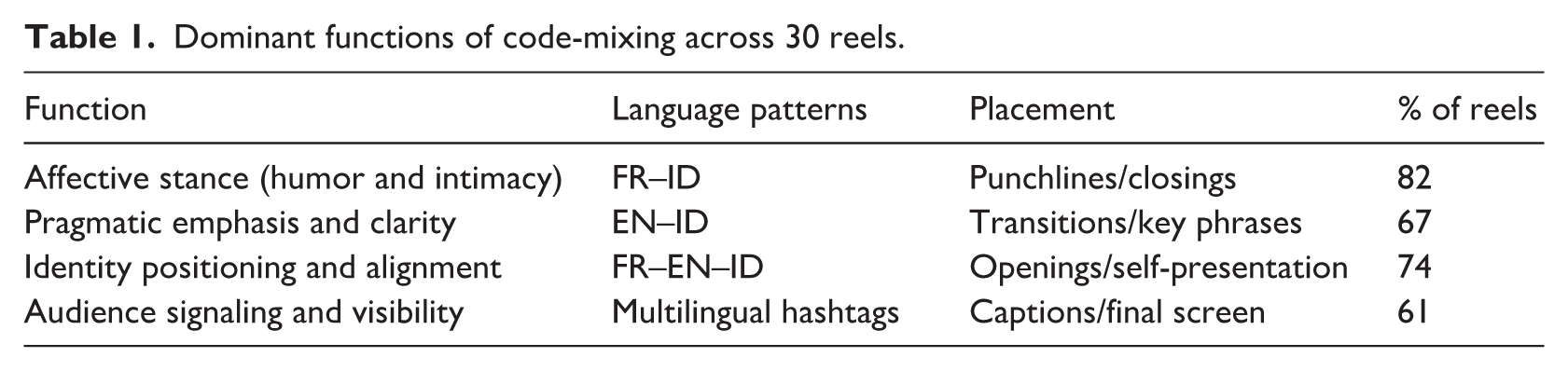
These patterns show that code-mixing is not random, but carefully staged to resonate with particular audiences and strengthen visibility within Indonesian digital culture. Humor frequently foregrounds the speaker’s foreignness in a lighthearted and inviting manner, while the use of Indonesian conveys cultural closeness and alignment. English brings a sense of global accessibility, and French introduces a personal dimension that resonates with co-nationals. Through the interplay of these linguistic resources, learners craft a cosmopolitan yet approachable persona that encourages audience engagement. In this way, code-mixing emerges as a central strategy through which they negotiate belonging, legitimacy, and agency within a public space shaped by both social norms and platform dynamics.
Communicative and pragmatic functions of code-mixing
In the Instagram Reels created by French-speaking BIPA learners, code-mixing fulfills distinct communicative and pragmatic functions that extend well beyond simple lexical substitution. Learners frequently alternate languages to convey humor, express nuanced emotional stances, or create a sense of interpersonal closeness that feels more natural in a particular language. For instance, in a Reel reflecting on difficulties with spicy food, one learner remarks, “Aku suka banget sambal, but my stomach bilang non!” (I really love chili sauce, but my stomach says no). Here, the shift into English sets up the contrast that drives the comedic timing, while the final use of French adds a playful twist that would be less effective if expressed solely in Bahasa Indonesia. Similar cases show that the alternation becomes a contextualization cue that marks shifts in tone and stance for the viewer.
Pragmatic enhancement also appears when learners attempt to manage clarity and interaction with mixed audiences. When reflecting on grammatical difficulties, one learner remarks, “Belajar bahasa Indonesia itu challenging, surtout quand il s’agit de grammaire” (Learning Indonesian is challenging, especially in grammar). In this example, the shift into French allows for greater precision and emotional nuance in expressing frustration, while the use of challenging in English indexes global literacy and aligns with audiences beyond the Francophone community. This pattern resonates with Bell’s (1984) audience design principle, whereby speakers adjust their linguistic choices to address multiple imagined audiences simultaneously, including Indonesian followers, fellow French speakers, and broader international viewers. Captions often reinforce this orientation, as in “Kalian ngerti nggak? Parce que moi je suis perdue!” (Do you understand? Because I am losing it) which invites interaction while foregrounding a sense of shared vulnerability.
Beyond humor and stance-taking, code-mixing also plays a role in building relational closeness. Many videos combine Indonesian forms of address or kinship terms (such as teman-teman or guys) with French expressions of warmth like bisous or à bientôt. Through this blending, learners position themselves as both participants in local digital culture and affectionate visitors, fostering a sense of intimacy within Indonesian online spaces. These affective blends help learners appear relatable and approachable despite their linguistic status as foreigners. The communicative and pragmatic value of code-mixing can thus be summarized in Table 2.
Communicative and pragmatic functions of code-mixing in Instagram reels by French-speaking BIPA learners.
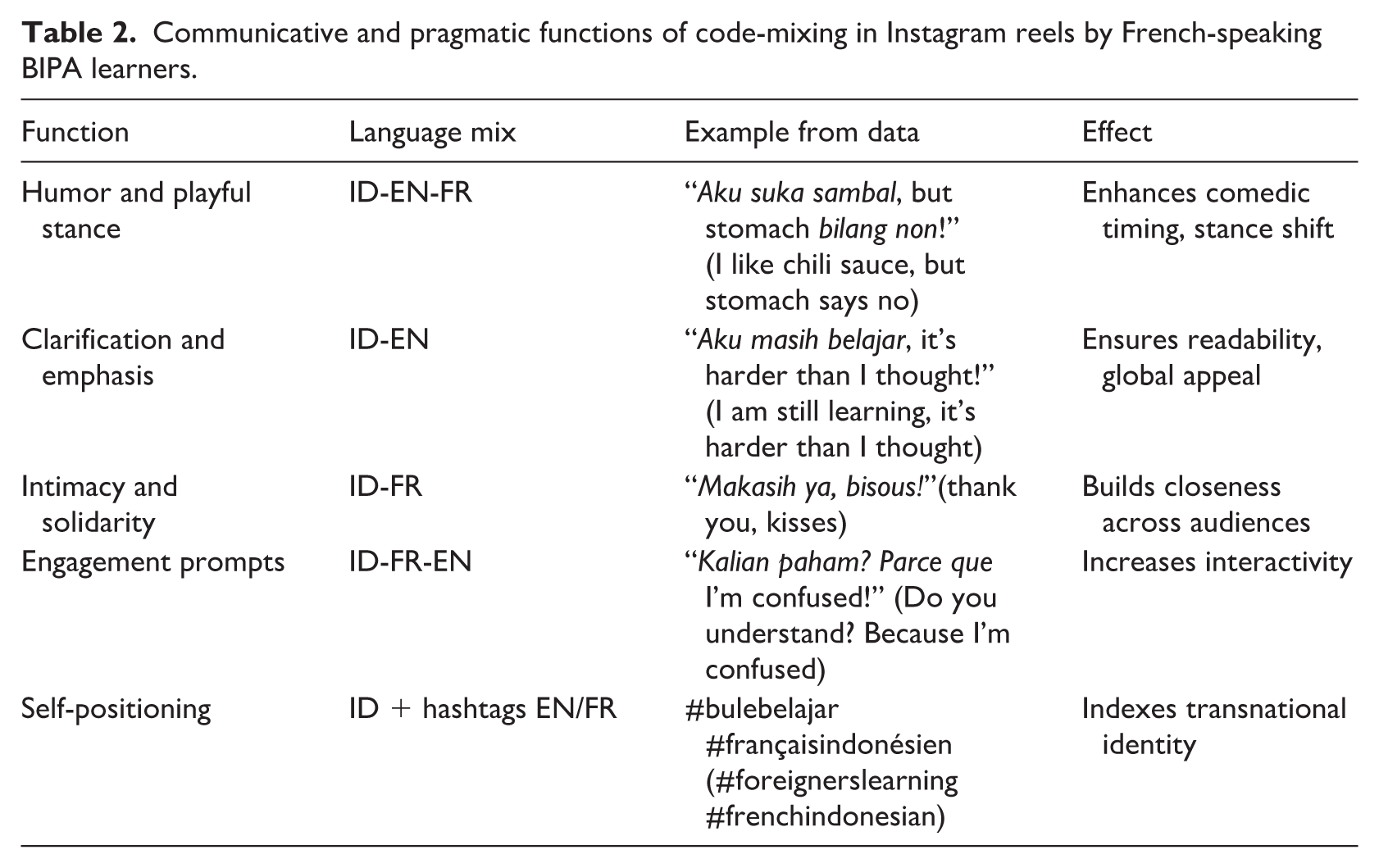
Collectively, these patterns indicate that learners do not mix languages due to linguistic incompetence; rather, they strategically deploy code-mixing as a rhetorical resource to enhance clarity, build relationships, and perform socially expressive identities in ways that suit Instagram’s performance-driven environment.
Platform affordances and algorithmic mediation of code-mixing
The plurilingual performances examined in this study are closely intertwined with the affordances and algorithmic dynamics of Instagram Reels, which play an active role in shaping how learners’ linguistic choices are produced, styled, and made visible. Unlike more static social media platforms, Reels foregrounds short-form, engagement-driven content through its vertically oriented, looped video format (typically 15–90 seconds). This format is supported by a range of features that together influence the form and circulation of multilingual performances. These features encourage not only multimodal creativity but also linguistic experimentation, allowing users to stylize code-mixing as a performative act optimized for virality. For example, in a Reel with over 45,000 views, one French-speaking learner overlays a humorous skit with the spoken line: “Aku harus belajar Bahasa Indonesia, but Instagram reels is too addictive, et je n’ai plus de temps!” (I have to learn Indonesian, but Instagram reels is too addictive, I don’t have much time). The code-mixed utterance is dynamically animated—each code switch appears in different font colors, synced to beats in the background audio. This multimodal layering reflects what Page et al. (2014) refer to as platformed discourse, where language is co-constructed not just by users, but also by interface design and algorithmic priorities.
Further analysis indicates that learners are strategically attuned to the affordances of algorithmic visibility. Code-mixed expressions frequently occur within the opening moments of a video, indicating learners’ awareness of Reels’ autoplay function and the need to capture viewers’ attention quickly. Hashtags such as #belajarbahasa, #bahasapemula, or even #bulebelajarindonesia (#learninglanguage, #beginnerlanguage, #foreignerslearningindonesian) are often combined with French or English ones (#françaisindonésien, #languagejourney), enhancing the content’s transnational discoverability. As seen across several Reels, learners at times refer to themselves as bule belajar (foreigners learning), a label that carries both humorous and relatable meanings within Indonesian digital culture. This form of self-positioning goes beyond playful self-description; it reflects a strategic construction of a digital persona designed for algorithmically mediated Indonesian publics. In doing so, it resonates with Marwick and boyd’s (2011) concept of context collapse, where content creators address diverse and overlapping audiences by combining accessibility, relatability, and elements of novelty. In doing so, language becomes a social currency in the attention economy, and code-mixing is a tactical means of navigating platform logic.
In some cases, algorithmic response further reinforces the use of code-mixing. For example, one learner noted in the comment section: “Pas pake campur bahasa, view-nya naik banget (When I mix languages, my views increased significantly). “Maybe because it feels funnier or more genuine?” This kind of anecdotal reflection echoes the arguments of Leppänen et al. (2014) and Androutsopoulos (2015), who suggest that translingual practices in online settings often come to be valued as markers of authenticity, particularly when they playfully foreground marginality, foreignness, or linguistic struggle. Given that Instagram’s algorithm prioritizes content that generates high levels of engagement, the playful blending of French, English, and Indonesian is frequently perceived by viewers as effortful, endearing, and deserving of social recognition through likes, shares, and comments. Such dynamics create a feedback loop in which learners internalize platform norms and gradually adapt their linguistic performances to meet audience and algorithmic expectations, thereby reinforcing digital code-mixing as a practice that is both ideologically charged and aesthetically appealing.
In this sense, the technological architecture of Instagram Reels does more than simply provide a space for plurilingual expression; it actively co-produces it. The platform’s affordances encourage particular semiotic styles, such as brevity, emotional and visual resonance, and stylized captioning, while its algorithmic logic rewards hybrid language practices that remain accessible yet distinctive. Consequently, learners’ plurilingual performances are shaped not only by linguistic ability or communicative intent, but also by their ongoing negotiation of platform-mediated conditions of visibility, affect, and perceived authenticity (Tagg, 2015; Thurlow & Mroczek, 2011). This highlights the need for sociolinguistic inquiry to account not only for speakers’ agency, but for the semiotic ideologies embedded in platform architectures that scaffold and constrain digital language use.
Discussion
This study demonstrates that code-mixing functions as a central performative resource through which French-speaking BIPA learners construct and negotiate plurilingual identities on Instagram Reels. Rather than signaling a linguistic deficit, code-mixing operates as a stylized practice that enables learners to manage stance, humor, and audience alignment in a highly visible, evaluative digital environment. This finding reinforces sociolinguistic perspectives that treat language use in digital media as a form of identity performance shaped by platform affordances and audience expectations (Androutsopoulos, 2015; Coupland, 2007).
From a performance and stylization perspective, learners’ patterned alternation between Indonesian, French, and English reflects deliberate persona construction rather than spontaneous linguistic fluctuation. Indonesian functions as the base code through which learners display cultural alignment and interactional legitimacy, while French and English are strategically inserted at key discourse moments such as punchlines, emotional reactions, or self-reflexive commentary. These stylized shifts heighten expressivity and index playfulness, allowing learners to present themselves as confident, humorous, and socially attuned participants in Indonesian digital culture. In line with Coupland’s notion of stylization, code-mixing here becomes a resource fordoing identity, not merely expressing linguistic competence. These practices also reflect translanguaging literacies, whereby multilingual users mobilize a broad range of semiotic resources – including written texts, audio overlays, gestures, and visual designs – to construct meaning and assert legitimate participation in social spaces (Garcia & Kleifgen, 2019). By centering Indonesian – an increasingly transnationnal language with growing symbolic value – these learners unsettle established sociolinguistic hierarchies that privilege dominant global languages (Moeliono, 2021).
This performative use of code-mixing is closely tied to processes of indexicality and legitimacy. Drawing on Silverstein’s (2003) concept of indexical order, the analysis shows that each language in the learners’ repertoire carries socially recognizable meanings: Indonesian indexes local affiliation and commitment, English signals global orientation and accessibility, and French foregrounds personal authenticity and foreignness. The repeated placement of code-mixed elements at key discourse moments reflects audience-design strategies optimized for algorithmic visibility, supporting claims that digital multilingualism is increasingly shaped by interaction between user creativity and platform economies (Tagg, 2015; Androutsopoulos, 2022). Through repeated public performances, these indexical associations are stabilized and become recognizable to audiences, enabling learners to claim symbolic legitimacy as emerging Indonesian speakers. This supports Blommaert’s (2010) argument that legitimacy in late-modern sociolinguistic contexts is not granted by proficiency alone, but is negotiated through visible participation and alignment with local norms.
Importantly, these indexical meanings are not produced in isolation but are shaped by the platform logic of Instagram Reels. Short-form video formats, algorithmic promotion, and multimodal affordances encourage linguistic creativity that is immediately interpretable and emotionally engaging. Learners’ consistent placement of code-mixed elements at discourse hotspots suggests an acute awareness of audience design and platform attention economies. In this sense, Instagram does not merely host multilingual practices but actively co-produces them, reinforcing certain styles of language use as authentic, entertaining, and worthy of engagement.
Within this sociotechnical environment, plurilingual identity emerges as relational and dynamic, particularly for L3 and L4 learners. The findings illustrate how learners simultaneously orient toward multiple linguistic and cultural audiences, negotiating belonging without fully abandoning prior identities. Rather than moving toward monolingual assimilation, learners maintain layered repertoires that allow them to position themselves as both insiders and playful outsiders. This aligns with recent work on plurilingualism that emphasizes identity as distributed across languages, contexts, and trajectories of mobility (Buschfeld et al., 2021; Lee, 2020). Code-mixing thus functions as a visible marker of this distributed identity work, making plurilingual development publicly observable in Global South digital spaces. By shifting from language separation to flexible bilingual practices shaped by sociocultural context, digital platforms like Instagram function as translanguaging spaces that promote equity, agency, and voice in multilingual learning (Lewis et al., 2012).
While analytically framed as code-mixing, these practices also resonate with broader translanguaging perspectives in that learners mobilize multiple semiotic resources to construct meaning across modes. However, maintaining code-mixing as the primary analytical lens allows this study to foreground the indexical visibility of language alternation and its role in public identity performance. This distinction is crucial in digital contexts where linguistic choices are evaluated, commented on, and algorithmically amplified, and where named languages retain social salience despite integrated repertoires.
Although this study is grounded in sociolinguistic analysis rather than classroom practice, the findings suggest that social media can function as an informal space for plurilingual development and identity exploration. Public, multimodal platforms such as Instagram allow language learners to experiment with voice, stance, and audience engagement beyond institutional settings. For language educators, this highlights the value of recognizing learners’ out-of-class digital practices as sites of meaningful language use, where confidence, investment, and cultural alignment are negotiated. Pedagogical engagement with such platforms should therefore prioritize reflection on identity and audience awareness rather than linguistic correction alone.
Conclusion and implications
Although this study is grounded in sociolinguistic analysis rather than classroom-based inquiry, the findings suggest that social media platforms such as Instagram can serve as informal spaces for plurilingual identity exploration and language-related engagement beyond institutional settings. Public, multimodal environments allow learners to experiment with voice, stance, and audience awareness while drawing on their full linguistic repertoires. For language educators, this highlights the importance of recognizing learners’ out-of-class digital practices as sites of meaningful language use and identity work. Pedagogical engagement with such practices should therefore prioritize reflection on identity positioning, audience design, and communicative intent, rather than treating multilingual alternation primarily as a deficit or error to be corrected.
Footnotes

Funding
The authors disclosed receipt of the following financial support for the research, authorship, and/or publication of this article: This study was funded by Faculty of Cultural Sciences Universitas Gadjah Mada under the contract number 2227/UN1/FIB.1.3/PT/PT.01.03/2025. We also gratefull to all of our collaborators for their assistance.
Declaration of conflicting interests
The authors declared no potential conflicts of interest with respect to the research, authorship, and/or publication of this article.