



Abstract
Aims and objectives:
This study aims to investigate differences in executive functions and cognitive reserve (CR) between bilingual and monolingual young adults.
Methodology, data, and analysis:
Participants included 32 bilinguals, who acquired both languages before age 10 and use them daily in various contexts, and 33 monolinguals matched for age, education, and gender. Executive functions were assessed through a comprehensive battery of tests measuring cognitive flexibility, inhibitory control, working memory, and abstract reasoning. CR was estimated using an irregular word reading test and the CR index questionnaire (CRIq).
Findings:
Results revealed that bilinguals outperformed monolinguals across tasks measuring different executive functions (cognitive flexibility, inhibitory control, and working memory), with these differences yielding medium effect sizes. Although no major significant differences between groups were observed in CR, except for the Education subscale of CRIq, where bilinguals showed higher scores, the impact of CR was not uniform. Notably, linear regression analyses revealed that CR was significantly associated with several subdomains of executive functions within the bilingual group, whereas these associations were circumscribed to working memory and inhibitory control in monolinguals.
Originality and implications:
These findings contribute to the growing body of evidence supporting the cognitive benefits of bilingualism, particularly in relation to executive functioning. The observed relationship between CR and executive function in bilinguals highlights a potential mechanism through which bilingualism might contribute to CR. Further research is needed to better understand the underlying mechanisms under which bilingualism contributes to the enhancement of CR.
Introduction
Bilingualism, the ability to use two or more languages in daily life, is a common phenomenon in an increasingly globalized world. With nearly half of the global population estimated to be bilingual (Grosjean, 2010), this linguistic ability has become a significant area of interest in research across disciplines (Bialystok & Craik, 2022). Beyond its practical and cultural implications, bilingualism represents a unique cognitive experience, requiring the constant management of multiple linguistic systems (Bialystok, 2017). This interplay between languages raises intriguing questions about its potential impact on the brain and on cognitive processing (Friederici, 2011). For example, bilingualism appears to affect brain development: compared to monolinguals, bilinguals exhibit greater gray matter volume, particularly in frontal and parietal regions, starting in late childhood and adolescence, as well as higher white matter integrity, especially in striatal-inferior frontal fibers, beginning in mid-to-late adolescence (Pliatsikas et al., 2020). These regions are known to be generally involved in language (Ullman, 2004) and cognitive control (Mohades et al., 2014; Shen et al., 2020). Beyond the structural differences observed in the brains of bilinguals, there is consistent evidence of superior performance in executive function (EF) (Adesope et al., 2010; Bialystok, 2009; Bialystok et al., 2004; van den Noort et al., 2019; Zhang et al., 2020), particularly in working memory (Grundy & & Timmer, 2016; Monnier et al., 2021). Although less consistent, some studies also suggest advantages in other cognitive domains, such as episodic (Ljungberg et al., 2013) and autobiographical (Javier et al., 1993) memories; attentional skills such as inverse efficiency, response time, and accuracy (Yang & Yang, 2016) and attentional control tasks (Arredondo et al., 2017).
The impact of bilingualism on brain regions and on cognitive functioning has been hypothesized to offer protection against the cognitive decline typically observed in aging. In older ages, bilingual individuals tend to experience a delayed onset of dementia symptoms and later-life cognition (Antoniou, 2019), suggesting that the bilingual brain may exhibit greater resilience to neurodegenerative processes (Anderson et al., 2020). In fact, bilingualism has been associated with enhanced cognitive reserve (CR) (Bialystok, 2021; Calvo et al., 2023, Stevens et al., 2023). CR is a property of the brain that allows for a cognitive performance that is better than expected given the degree of life-course-related brain changes and brain injury or disease. The reserve theory distinguishes two models: the cerebral reserve model, which posits that brain pathology accumulates until a critical threshold is reached, and the CR model, which emphasizes the brain’s capacity to adapt through compensatory mechanisms (Stern, 2002, 2009; Stern et al., 2019). According to this active model, individuals with higher CR perform better on cognitive tasks due to more efficient brain networks (Stern, 2002).
CR is often studied in older individuals, particularly in the context of aging and neurodegeneration (Stern, 2012). However, it begins to develop early in life and is shaped by lifelong experiences (Schwarz et al., 2024). Early cognitive stimulation and education play a crucial role in building reserve, influencing cognitive performance later in life (Wilson et al., 2019). Furthermore, neural mechanisms underlying CR differ across the lifespan. In younger individuals, higher reserve is linked to more efficient brain network activation, reflecting enhanced neuroplasticity (Anthony & Lin, 2018, Stevens et al., 2023). In contrast, older adults often engage compensatory networks to maintain cognitive function. This shift suggests that while CR supports cognition at all ages, the strategies used to sustain performance evolve over time (Mauti et al., 2024).
Despite its greater involvement in cognitive functioning, the objective measurement of CR remains one of the biggest challenges in the field (Calvo et al., 2016). This is mainly due to the complexity of the CR construct, which makes it difficult to be operationalized. However, proxies for CR—such as education, premorbid IQ, occupational complexity, and engagement in cognitively stimulating activities, offer valuable insight into an individual’s ability to adapt to brain changes and tolerate damage before clinical symptoms emerge (Barulli & Stern, 2013; Kartschmit et al., 2019; Stern, 2002, 2012).
Given these dynamics, bilingualism may contribute to CR by promoting more efficient brain networks, allowing bilingual individuals to maintain cognitive performance longer than monolinguals (Bialystok, 2017, 2021; Gallo & Abutalebi, 2024). This aligns with the broader understanding of CR, which is shaped by various life experiences, including education, mentally stimulating activities, and social engagement (Stern et al., 2019). The idea of bilingualism as a proxy for CR is well established, with studies showing its protective role in aging and neurodegeneration (Stevens et al., 2023; Gallo & Abutalebi, 2024). Lifelong bilingualism has been linked to a delayed onset of dementia by several years, even in individuals with significant neuropathology (Bialystok, 2021; Guzmán-Vélez et al., 2015; Perani et al., 2017). Neuroimaging findings further support this advantage, showing enhanced brain metabolism (Kowoll et al., 2016), greater neural efficiency (Stevens et al., 2023), and increased structural integrity in bilinguals (Gallo et al., 2020; Perani et al., 2017), thus helping to maintain cognitive performance despite neuroanatomical aging. Furthermore, recent evidence shows that active multilingualism is associated with similar levels of cognitive performance even in the presence of greater white matter deterioration (Solé-Padullés et al., 2025). These processes may also underlie bilingual individuals’ superior EF performance, as efficient cognitive networks supported by greater reserve may enable better handling of complex cognitive tasks (Stevens et al., 2023, Bialystok, 2021).
EFs, often referred to as the “CEO” of cognitive abilities, are essential for coordinating and managing higher-order cognitive processes. These functions are crucial for the execution of daily tasks, enabling individuals to adjust their behavior in pursuit of desired goals and fostering more adaptive social interactions (Diamond, 2013). EFs are typically divided into three core components: interference control and inhibition, cognitive flexibility, and working memory (Diamond, 2013). Inhibition refers to the ability to suppress inappropriate impulses or responses, allowing individuals to act thoughtfully rather than impulsively (Germano et al., 2017). Cognitive flexibility, on the contrary, is the capacity to adapt behavior to shifting demands or to switch between tasks, while simultaneously processing multiple concepts (Dias & Seabra, 2015). Working memory, often described as short-term memory, is the cognitive capacity that enables individuals to hold and manipulate the information necessary to complete tasks (Germano et al., 2017). In addition to these core EFs, there are higher-order cognitive processes that extend beyond the basic functions. Abstract reasoning, for example, is considered a high-order EF; known to be involved in critical thinking, problem-solving, and decision-making based on logical analysis (Wachholz & Yassuda, 2011).
Bilingualism may have a significant impact on EF, as the two languages of a bilingual individual are in constant interaction (Bialystok, 2018, 2024; Bialystok & Craik, 2022). One of the key advantages often attributed to bilingualism is the ability to selectively use one language at a time while suppressing interference from the other (van den Noort et al., 2019). This process of language selection and inhibition has been linked to superior performance on cognitive tasks, particularly in those requiring executive control, such as working memory (Anderson et al., 2020; Monnier et al., 2021), cognitive flexibility (Ward & Awani, 2024), and inhibition (Bialystok, 2002; Incera & McLennan, 2017; Torres et al., 2022). Bilingual individuals regularly engage in what is known as the “bilingual advantage,” where the constant exercise of managing two languages strengthens the brain’s ability to control and filter information, thereby improving overall cognitive efficiency (van den Noort et al., 2019).
The impact of bilingualism on EF has been particularly well documented in children and in older adults. In children, bilingualism has been associated with enhanced cognitive flexibility, improved problem-solving skills, and greater resilience to distractions (Bialystok et al., 2004, Giovannoli et al., 2020, Pliatsikas et al., 2020). In older adults, bilingualism appears to offer a protective effect against cognitive decline, with bilingual individuals often showing delayed onset of dementia symptoms compared to their monolingual peers (Craik et al., 2010). These findings suggest that bilingualism promotes brain plasticity, potentially helping the brain to maintain high-level cognitive functioning throughout life. However, the bilingual advantage in EF is not always observed in young adults. Research has shown that while bilingual young adults tend to perform similarly to their monolingual counterparts on many EF tasks (Antón et al., 2019, Lehtonen et al., 2018), they may still exhibit subtle advantages in specific tasks that involve multitasking or managing interference (Antoniou, 2019; Chung-Fat-Yim et al., 2017).
The debate about the bilingual advantage is still ongoing, and specifically, in what concerns the relation between bilingualism and CR, there are some contradictory findings and a recognized need to overcome several methodological caveats (Calvo et al., 2016). Although most studies point to a better performance on EF and CR tasks by bilingual individuals, when compared with monolinguals, there are still inconsistencies in the literature, especially regarding different age groups. This study aims to explore potential differences on executive functioning and CR between bilingual and monolingual young adults. In addition, we intend to explore the relationship between EF and CR measures. Specifically, we aim to investigate whether CR is associated with performance on EF tasks and whether these associations differ between bilingual and monolingual groups.
Methods
Participants
Participants included both bilingual and monolingual individuals aged between 18 and 31 years. Participant eligibility and group classification were based on self-report criteria, addressing the below inclusion standards, a practice consistent with previous investigations (Antón et al., 2019; Ward & Awani, 2024; Torres et al., 2022): bilinguals were operationally defined as individuals who are proficient in at least two languages, having acquired both languages before 10 years old and using both in different contexts (social, personal, and professional) in a daily basis; monolinguals were defined as individuals proficient in at least one language. If they spoke a second language, it should have been acquired after the age of 10 and not used regularly.
Groups were matched for demographic variables (age, education, and gender).
Eligibility criteria for both groups included: age ⩾ 18 years old, no visual or hearing concerns, no history of major neuropsychiatry disorders (e.g., schizophrenia, bipolar disease, major depressive disorder) or history of learning or neurodevelopment disorders. Although the first language acquired could differ among bilingual participants, fluency in Portuguese was a prerequisite for the cognitive assessment.
Measures
Sociodemographic questionnaire
The study included a structured sociodemographic questionnaire that gathered the following information: age, education, gender, native language (L1), number and type of languages spoken fluently, age of acquisition (AoA) of the second language (L2), frequency of language usage (frequency of use of each language—L1, L2), and current professional activity.
Cognitive assessment
The cognitive assessment included the following EF tasks:
Coding subtest (WAIS-III) as a measure of nonverbal working memory and processing speed, where the total score is determined by the number of correct symbols that an individual manages to reproduce within the limit of 120 seconds (Wechsler, 2008).
Letter Number Sequencing Test (WAIS-III) as a measure of auditory/verbal working memory and attention, in which the total score is the sum of trials correctly repeated according to the task rules (stating numbers in ascending order followed by letters in alphabetical order) (Wechsler, 2008).
The Stroop Color Word Test that evaluates selective attention and ability to inhibit external stimuli interference. Scores for each task, include number of words read, number of colors correctly named, and naming the font color in which the words (color names) are written, as quickly as possible (Golden & Freshwater, 2002; Portuguese version from Fernandes, 2013).
The verbal fluency test was used as a measure of cognitive flexibility. This test is composed of four trials, one for semantic verbal fluency where the individuals are asked to produce as many words as possible during 1 minute within the category of animals and the remaining for phonetic verbal fluency where individuals are asked to produce words starting with a specific letter within 1 minute. The letters sequence is M, R, and P. The raw scores are determined by recording the total words produced in each trial. For the phonetics verbal fluency test, the average (between the 3 letters M, P, R) was calculated (Cavaco et al., 2013).
To measure abstract reasoning ability, the Raven’s standard progressive matrices were used, consisting of 60 items divided in 5 sets (Raven, 1947).
To measure the level of Cognitive Reserve, two independent measures were used. As a proxy for CR (Kartschmit et al., 2019), the Irregular Word Reading Test (TeLPI) was used. This is an irregular word reading test designed for adults (age 18 +) and administered individually to estimate premorbid intellectual ability (Alves et al., 2012). To assess the global level of CR and the specific level of CR attributed to different life-experience domains, the Cognitive Reserve Index Questionnaire (CRIq) was employed (Nucci et al., 2012). This questionnaire includes 3 subscales that measure the level of education (CRI-Education), the number of years and the complexity of occupational activity (CRI-Working Activity) and data regarding frequent leisure activities (CRI-Leisure Time) (Nucci et al., 2012).
Procedures
Our local ethics committee reviewed and approved the study methods and protocols. Participants were considered only after providing written informed consent, and the study was carried out following the Declaration of Helsinki. The data was handled in compliance with international, EU, and national laws, including the EU General Data Protection Regulation.
Data analysis
JASP Team (2024), an open-source statistical analysis software built on R-package, was used to perform the statistical analysis. Graphics were generated using GraphPad Prism version 8. Kolmogorov-Smirnov’s and Levene’s tests were used to examine the normality of the distribution and evaluate the homogeneity of variances, respectively. Since the distribution was not normal in some variables, nonparametric tests were employed.
Descriptive statistics include median and interquartile range (IQR). The Mann–Whitney U test was used to compare sociodemographic and cognitive performance between bilingual and monolingual individuals. When needed, chi-square test was conducted to assess the significance between categorical variables.
A linear regression analysis was conducted to examine whether CR (premorbid IQ and CRIq) is associated with cognitive performance in both groups.
In all the analyses, results with an alpha-level (p) < .05 were considered statistically significant. Effect sizes for nonparametric comparisons were quantified using the rank-biserial correlation (rrb). The magnitude of the effect was interpreted based on the benchmarks proposed by Cohen: values around 0.10 indicate a small effect, 0.30 a medium effect, and 0.50 or greater a large effect.
Results
Descriptive statistics
The overall sample consisted of 65 participants. There were no significant differences between the bilingual (n = 32) and monolingual (n = 33) groups on sociodemographic characteristics (Table 1). Regarding the bilingual group, 84% of the participants acquired the L2 by the age of 5, with the remaining acquiring it between ages 6 and 10. The majority of the sample acquired the second language in contexts of strong immersion, either within the family environment (due to one parent being foreign) or throughout their academic path (schooled in international schools).
Sociodemographic characteristics and difference between both groups.
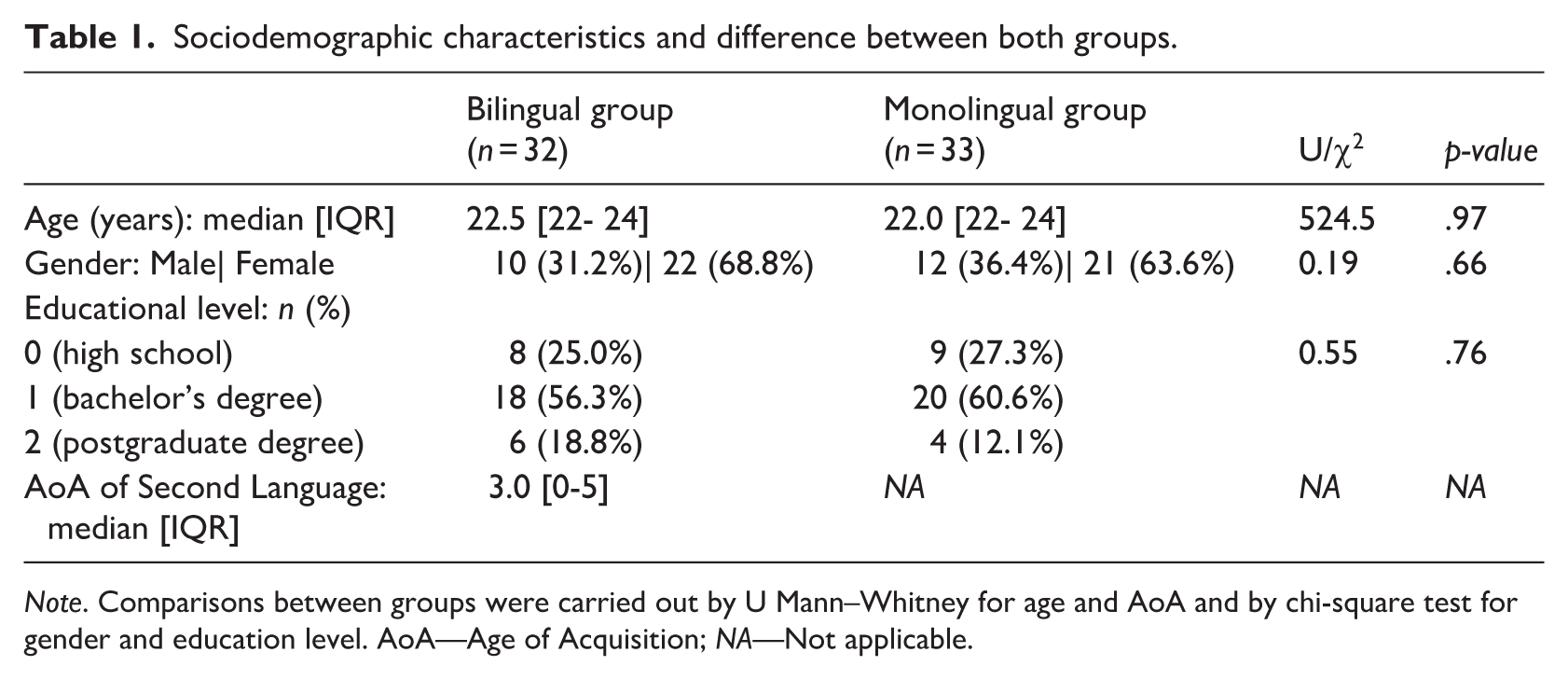
Note. Comparisons between groups were carried out by U Mann–Whitney for age and AoA and by chi-square test for gender and education level. AoA—Age of Acquisition; NA—Not applicable.
Cognitive performance
Significant differences were found, in most EF measures, between the two groups: (a) working memory (Coding and Letter-Number Sequencing subtests: U = 745.0, p = .004, r rb = 0.41; U = 686.5, p = .04, r rb = 0.30, respectively; (b) inhibitory control function (Stroop Color Word test: U = 696.5, p = .03, r rb = 0.31); and (c) cognitive flexibility (semantics verbal fluency test: U = 712.0, p = .01, r rb = 0.35). No differences were found on the verbal fluency phonetics (U = 483.5, p = .56, r rb = −0.08) or on the standard Raven matrices (U = 626.0, p = .20, r rb = 0.19). Table 2 shows the EF measures performance between the two groups (Table 2).
Differences in cognitive performance between bilinguals and monolinguals.
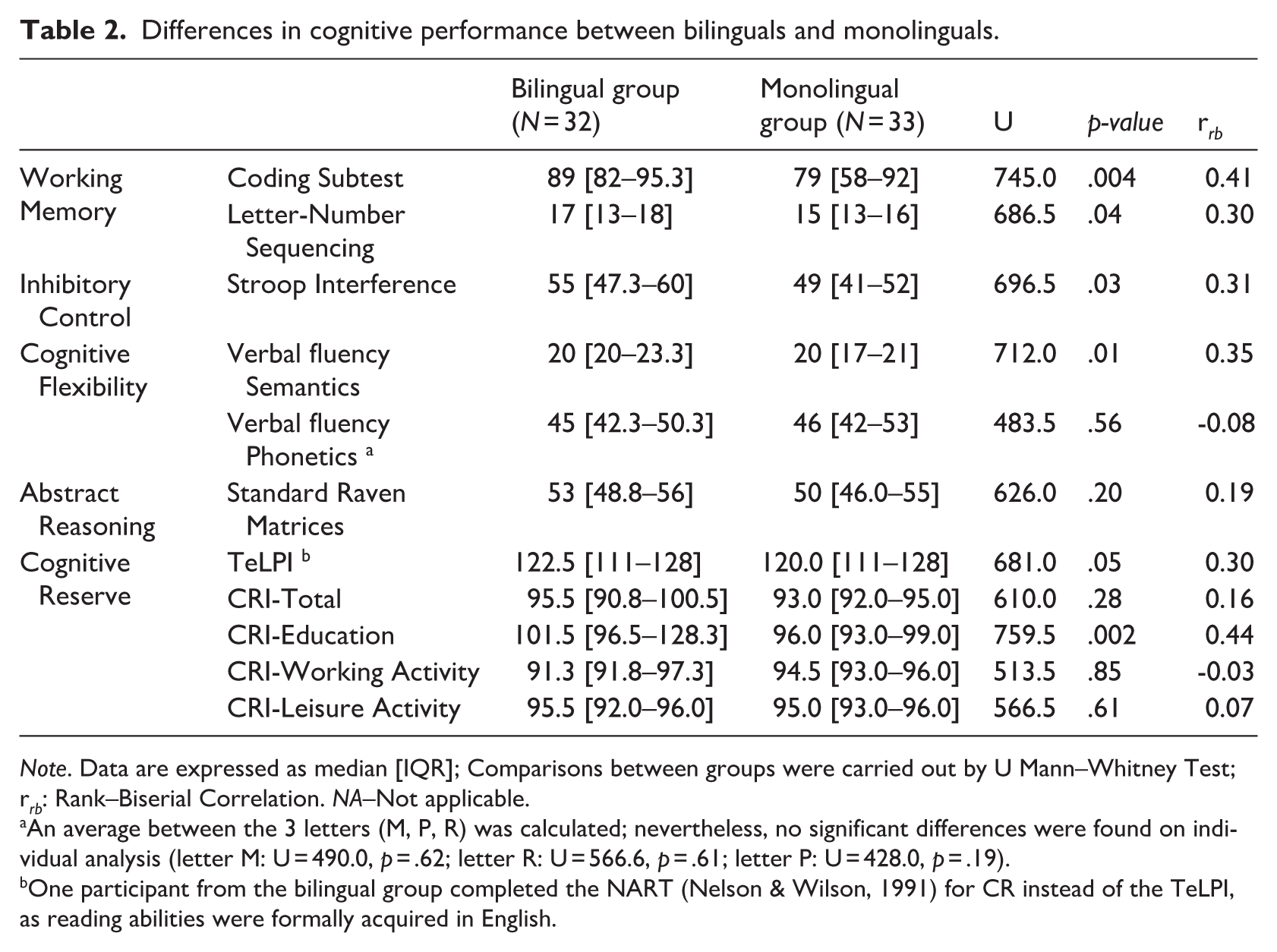
Note. Data are expressed as median [IQR]; Comparisons between groups were carried out by U Mann–Whitney Test; r rb : Rank–Biserial Correlation. NA–Not applicable.
An average between the 3 letters (M, P, R) was calculated; nevertheless, no significant differences were found on individual analysis (letter M: U = 490.0, p = .62; letter R: U = 566.6, p = .61; letter P: U = 428.0, p = .19).
One participant from the bilingual group completed the NART (Nelson & Wilson, 1991) for CR instead of the TeLPI, as reading abilities were formally acquired in English.
Cognitive reserve
The performance on the irregular word reading test (TeLPI) was similar between both groups (U = 681.0, p = .05, r rb = 0.30) (Table 2). In addition, CR was also globally measured with the CRIq. The level of total CRI, CRI-Working Activity, and CRI-Leisure is similar between groups (Table 2); however, the level of CRI-Education showed to be significantly different between bilinguals and monolinguals (U = 759.5, p = .002, r rb = 0.44).
Association between cognitive performance and CR
To explore the association between EF performance and CR in both groups, linear regression analyses were conducted using first premorbid IQ as a proxy of CR and after using the total and the subscores of the CRIq as independent variables.
For the bilingual group, analyses revealed that distinct CR metrics were robust predictors across multiple cognitive domains (see Supplementary Materials, Tables S1–S3, for full model statistics).
Regarding premorbid intelligence, a proxy of CR, TeLPI (Table 3) showed only a significant association with the Coding subtest (β = 0.37, p = .04) but with none of the other cognitive performance tests.
Relationship between premorbid IQ (TeLPI) and executive function tasks.
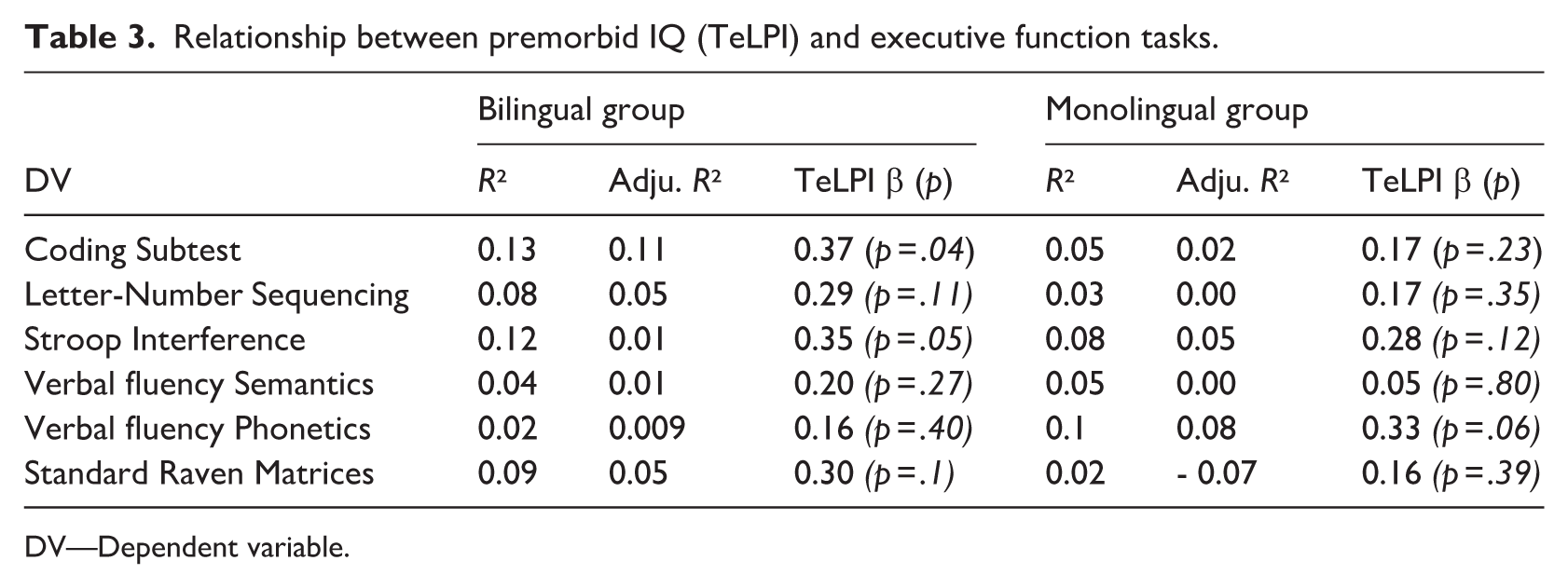
DV—Dependent variable.
Beyond premorbid IQ, the CRIq demonstrated a more widespread pattern of associations. The CRIq-Total score (Table 4) was significantly associated to the Coding Subtest (β = 0.68, p < .001), Letter and Number Sequencing (β = 0.79, p < .001), Stroop Interference (β = 0.55, p = .001), and Phonetics Verbal Fluency (β = 0.53, p = .002). When examining specific life-experience domains, CRI-Education demonstrated a more specific association exclusively with Semantics Verbal Fluency (β = 0.40, p = .02); CRI-Working Activity was significantly associated with performance in Coding Subtest (β = 0.47, p = .007), Letter and Number Sequencing (β = 0.74, p < .001), Stroop Interference (β = 0.45, p = .009), and Phonetics Verbal Fluency (β = 0.48, p = .006); and, finally, CRI-Leisure Time showed an extensive range of significant associations: Coding Subtest (β = 0.48, p < .001), Letter and Number Sequencing (β = 0.82, p < .001), Stroop Interference (β = 0.44, p = .01), and Phonetics Verbal Fluency (β = 0.49, p = .004).
Relationship between Cognitive Reserve Index questionnaire (CRIq) total score and executive function tasks.
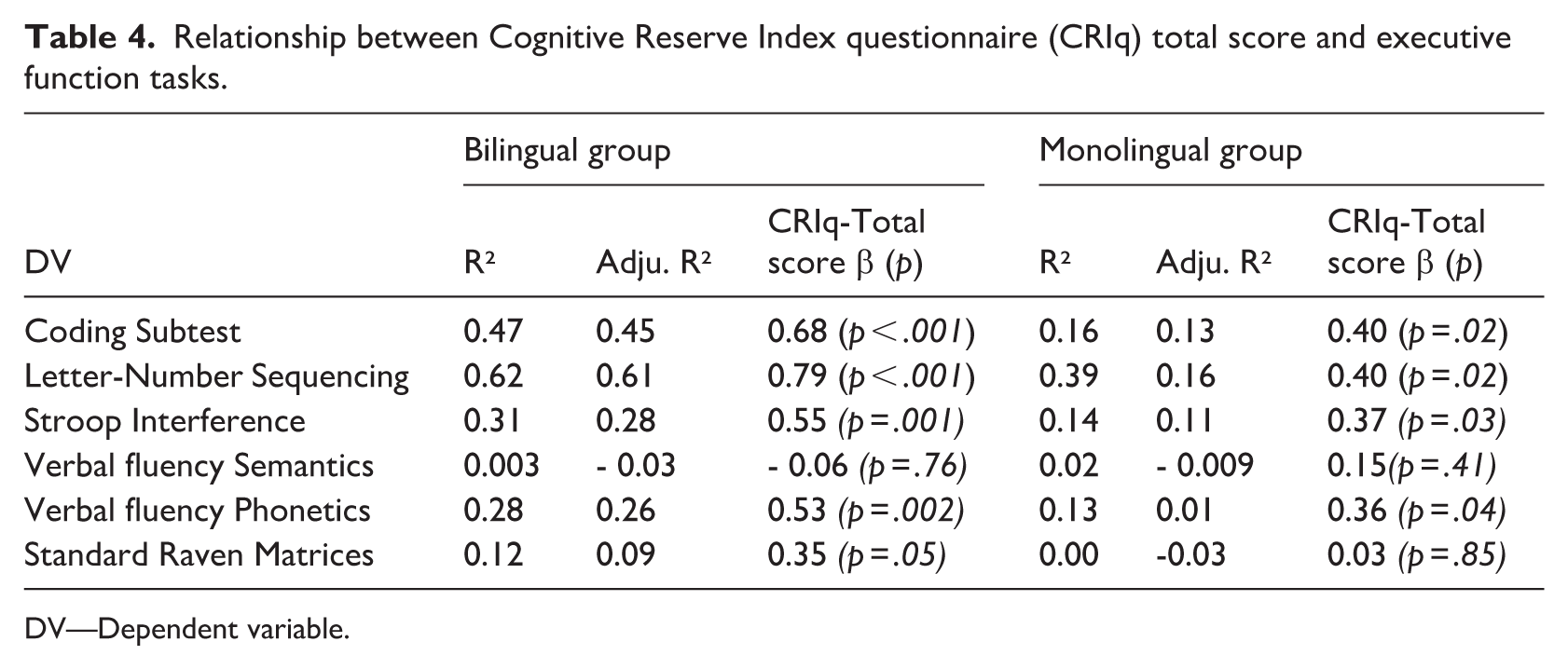
DV—Dependent variable.
In the monolingual group, the patterns of association between premorbid intelligence (TeLPI), cognitive reserve (CRIq), and neuropsychological performance showed common and distinct differences compared to the bilingual group (detailed statistics are provided in the Supplementary Materials, Tables S1–S3).
In this group, TeLPI (Table 3) did not show significant associations with the measured cognitive outcomes.
Regarding the CRIq-Total score (Table 4), it was significantly associated with the Coding Subtest (β = 0.40, p = .02), Letter and Number Sequencing (β = 0.40, p = .02), Stroop Interference (β = 0.37, p = .03), and Phonetics Verbal Fluency (β = 0.36 p = .04). When analyzing the specific domains of life experience, CRI-Education demonstrated a significant association exclusively with Letter and Number Sequencing (β = 0.38, p = .03), whereas CRI-Leisure Time was significantly associated with the Coding Subtest (β = 0.55, p < .001), and the Letter and Number Sequencing (β = 0.46, p = .008). CRI-Working Activity did not show any significant association with cognitive performance in this group.
Discussion
This study aimed to explore potential differences in EF performance and CR between bilingual and monolingual young adults, as well as the relations between those variables.
Our results reveal that bilingual young adults exhibited significant better performance over their monolingual peers in several key areas of EF, particularly working memory, inhibitory control, and cognitive flexibility. These findings are consistent with previous research suggesting a bilingual advantage in tasks measuring these specific subdomains of EF (Anderson et al., 2020; Ward & Awani, 2024; Torres et al., 2022). Crucially, the magnitude of these differences reached medium effect sizes, particularly in working memory and inhibitory control. These values indicate that the bilingual advantage in our sample is not merely statistically detectable but represents a substantial practical difference in the performance of key subdomains of EFs compared to monolingual peers. However, no group differences were observed in measures of abstract reasoning or phonemic verbal fluency. Regarding the comparable performance in phonemic verbal fluency between bilinguals and monolinguals, one possible explanation is the increased cognitive load bilinguals experience during these tasks. They must not only retrieve words beginning with a specific letter but also inhibit words from the nontarget language, effectively managing lexical access across both languages (Pathak et al., 2024, Wroblewski et al., 2017). In fact, although not statistically significant, the observed negative rank-biserial correlation suggests a small effect size favoring monolinguals in phonemic fluency. This trend supports the hypothesis that the additional linguistic management required by bilinguals may incur a slight processing cost in tasks strictly dependent on rapid lexical retrieval within a single language. Moreover, evidence suggests that the context of language use—whether languages are used separately or in an integrated manner—can impact cognitive flexibility and fluency performances (Gade et al., 2024; Raisman-Carlovich et al., 2024). Individuals who frequently switch between languages in daily life tend to develop stronger inhibitory control, which may mitigate potential disadvantages in phonemic fluency. In contrast, bilinguals who use their languages in more separate contexts might rely less on cross-linguistic control mechanisms, potentially leading to performance differences depending on task demands. However, as information on language use patterns was not collected in our study, we were unable to account for this factor in our analyses (Gade et al., 2024; Raisman-Carlovich et al., 2024). In the case of abstract reasoning (Standard Raven Matrices), the absence of differences between bilinguals and monolinguals was expected, as this is a measure of nonverbal reasoning. This type of reasoning is generally less influenced by linguistic experience and more dependent on domain-general cognitive processes.
Furthermore, the absence of significant differences between groups in abstract reasoning and phonemic verbal fluency aligns with a growing body of literature that has failed to replicate a generalized bilingual advantage in executive functioning (Gunnerud et al., 2020; Lehtonen et al., 2018; Nichols et al., 2020). Our results suggest that if such an advantage exists, it may not manifest as a global enhancement of executive functioning, but rather as a benefit restricted to specific subdomains. This finding suggests that the bilingual advantage is more pronounced in tasks requiring the management of multiple information (multitasking), cognitive flexibility, and inhibition, rather than tasks that depend on abstract or verbal reasoning (Antón et al., 2019; Bialystok et al., 2004).
Our results also align with research conducted in both child and older adult populations, where bilingualism has been linked to enhanced EF (Bialystok et al., 2004; Craik et al., 2010). However, when comparing our results with studies focusing on young adults, we observed a more positive outcome in the bilingual group. Previous studies have often found minimal or no bilingual advantage in EF among young adults (Antón et al., 2019; Lehtonen et al., 2018), yet our study reveals that bilinguals performed significantly better in several key EFs. This discrepancy may be attributed to two critical factors: our comprehensive battery of tests and the strict eligibility criteria we applied to the bilingual group. First, we used a comprehensive battery of EF tasks, which included measures of working memory, inhibition, cognitive flexibility, and abstract reasoning. Previous studies often employed more limited task paradigms (D’Souza & Dakhch, 2022; Monnier et al., 2021; Xie et al., 2022), which might not have captured the full extent of the bilingual advantage. By using a diverse set of EF measures, our study has been better equipped to detect cognitive benefits in bilinguals than studies which relied on narrower task sets may have overlooked. Second, our operational definition of bilingualism focused on individuals who acquired their second language before the age of 10 and regularly use both languages in various contexts. This strict criterion ensured that our bilingual participants had substantial experience managing two languages, which is likely to contribute to superior cognitive performance.
A second aim of our study was to explore the relationship between CR and EF in bilingual and monolingual young adults. Although no major significant group differences were observed across most CR domains, with the significant exception of CRI-Education, where bilinguals showed higher scores with a medium effect size, we found that CR was associated with the performance across several EF measures. This suggests that CR may significantly influence the ability to perform tasks requiring complex cognitive processing.
The role of CR in EF performance, particularly in more complex tasks, highlights the importance of CR beyond its function in delaying the onset of clinical symptoms (Stern, 2009). CR allows individuals to better perform on tasks that demand high levels of cognitive processing, potentially due to more efficient brain networks and compensatory mechanisms (Stern, 2002). Our findings reinforce this notion that CR is not only a protective factor against age-related cognitive decline, but also a primary contributor to daily cognitive efficiency and task performance throughout the lifespan.
Our results also underscore a potential “snowball effect” within the bilingual group. Bilingual individuals appear to exhibit better cognitive performance in specific subdomains of EF, which may facilitate engagement in more complex tasks, further strengthening their CR over time.
A central finding of this study is the distinct pattern of association between crystallized ability (premorbid IQ) and acquired lifestyle reserve. While TeLPI—a proxy of CR—showed very localized association with Coding subtest in bilinguals and no significant association in the monolingual group, the CRIq dimensions demonstrated a widespread impact. This suggests that lifestyle-based CR may play a more interesting role in modulating executive performance than premorbid intellectual capacity, reinforcing the view of CR as a dynamic experience-driven construct (Stern, 2012).
Finally, the breakdown of CRIq domains reveals the specialized nature of these associations. In the bilingual group, CRI-Leisure time and CRI-Working Activity showed significant associations across a wide array of EF tests. In contrast, in the monolingual group, the association between cognitive performance and CRI-Leisure Time was circumscribed to working memory and inhibitory control, while no associations were found for CRI-Working Activity. These results suggest that, for bilinguals, active engagement in professional and social environments may provide a more robust and diverse source of cognitive stimulation. The lack of association with CRI-Working Activity in monolinguals might indicate that bilingual individuals, perhaps due to their linguistic and cultural background, navigate more cognitively demanding professional contexts or utilize these environments more efficiently to bolster their CRs.
In this context, the results regarding CRI-Education were particularly revealing. In both groups, education emerged as the least pervasive associate of cognitive performance, being limited to semantic fluency in bilinguals and working memory in monolinguals. This aligns with more recent research (Fjell et al., 2025) suggesting that formal education may not be as dynamic or “interesting” a measure of CR as initially hypothesized in the literature. Moreover, this finding is further corroborated by the results for the TeLPI: as a measure primarily based on formal education and the reading of irregular words, the TeLPI similarly failed to show broad associations with executive performance. While schooling provides a foundational crystallized reserve, it appears to be less influential in modulating fluid executive processes in adulthood than the continuous, real-time cognitive engagement found in stimulating leisure and professional activities.
In summary, our findings indicate that bilingual-monolingual differences are domain-specific rather than global, appearing primarily in tasks requiring high levels of cognitive flexibility and inhibition. While premorbid IQ and education provide a foundational crystallized reserve, active lifestyle factors—specifically professional and leisure engagement—emerged as the most robust associates of executive efficiency. This suggests that CR is a dynamic, experience-driven construct, potentially shaped by the specific environmental and occupational demands associated with a bilingual life.
Despite the valuable insights provided by this study, there are several limitations. First, the relatively small sample size may limit the statistical power of our analyses and the generalizability of our findings. Larger-scale studies are needed to confirm these results and ensure their applicability across diverse populations. In addition, our study focused on young adults, and the findings may not be generalizable to other age groups or clinical populations. Longitudinal studies that track cognitive changes over time in bilingual and monolingual individuals would provide a more robust understanding of the long-term effects of bilingualism on CR and EF. Furthermore, while the current analysis identifies significant patterns of association, it focuses primarily on the presence of these relationships; future research would benefit from a more detailed characterization of effect magnitudes to better determine the relative practical impact of different linguistic factors. Finally, we did not collect information regarding socioeconomic status (SES), which is an important factor in CR. SES can influence access to educational and occupational opportunities, as well as engagement in cognitively stimulating activities, all of which contribute to CR development. Consequently, the observed associations between CR and executive performance should be interpreted with caution, as they may be partially mediated by broader environmental and socioeconomic variables.
This study provides important insights into the cognitive benefits of bilingualism on CR and EF performance among young adults. Our findings highlight a bilingual advantage in key domains of EF, including working memory, inhibitory control, and cognitive flexibility, while demonstrating no group differences in abstract reasoning or phonemic verbal fluency. These results align with prior research indicating that the bilingual advantage is most evident in tasks requiring complex cognitive control and flexibility. Furthermore, although no significant group differences in overall CR were observed, our results suggest that CR is associated with performance on specific EF tasks, such as working memory, emphasizing its relevance even in young, healthy populations. These findings underscore the importance of considering CR as a multifaceted construct, influenced by life experiences like bilingualism, and as a potential contributor to cognitive efficiency in demanding tasks. By employing a comprehensive EF battery and strict criteria for bilingualism, this study addresses limitations of previous research and offers a nuanced understanding of how bilingualism and CR interact to influence cognitive performance. Future studies should aim to replicate these findings in larger and more diverse samples, explore additional proxies for CR, and investigate the long-term implications of bilingualism for CR and brain health across the lifespan.
Footnotes
Acknowledgements
The authors would like to express their gratitude to all the participants of the study.

Ethical considerations
The Ethics Committee of Instituto Universitário de Ciências Psicológicas, Sociais e da Vida reviewed and approved the study methods and protocols.
Consent to Participate
Participants were considered only after providing written informed consent, and the study was carried out following the Declaration of Helsinki. The data was handled in compliance with international, EU, and national laws, including the EU General Data Protection Regulation.
Consent for publication
Not applicable.
Author contributions
RL and SPS conceived and designed the work. SPS and IM recruited participants with inputs from RL and MVSN. SPS and IM acquired, analyzed, and interpreted data, with supervision by MVSN and RL. IM, SPS, and RL drafted the manuscript, which was critically revised by the remaining authors for important intellectual content. RL supervised the research and acted as corresponding author. All authors contributed to the article and approved the submitted version.
Funding
The authors disclosed receipt of the following financial support for the research, authorship, and/or publication of this article: Both IM and RL receive funding from Fundação para a Ciência e Tecnologia (FCT), Portugal: IM under a PhD studentship (2024.02643.BD), and RL by the 2018 Scientific Employment Stimulus (CEECIND/04157/2018).
Declaration of conflicting interests
The authors declared no potential conflicts of interest with respect to the research, authorship, and/or publication of this article.
Data availability statement
Data are available from the authors upon reasonable request.
Supplemental material
Supplemental material for this article is available online.
Author biographies
References
Supplementary Material
Please find the following supplemental material available below.
For Open Access articles published under a Creative Commons License, all supplemental material carries the same license as the article it is associated with.
For non-Open Access articles published, all supplemental material carries a non-exclusive license, and permission requests for re-use of supplemental material or any part of supplemental material shall be sent directly to the copyright owner as specified in the copyright notice associated with the article.
