




Abstract
Multi-word units have only recently been systematically examined in linguistics. This also applies to the [N1 PREP N1] pattern analysed here. This article summarises the current state of linguistic research and aims to demonstrate the conditions under which schematic idioms of this type, which cannot be classified as either lexical or syntactic, can be effectively taught in foreign language instruction. Although these constructions demonstrate significant productive and expressive potential and function similarly across many languages, they remain largely absent from secondary school or university curricula, particularly in Germany.
First, the [N1 PREP N1] pattern is examined from a linguistic perspective. The value of multi-word units and usage-based approaches for language learning is then presented, showing that these paradigms are not yet sufficiently integrated into communicative foreign language teaching. To illustrate their great potential, a lesson sequence implemented at the upper secondary school level (Gymnasium) is presented.
The lesson sequence combines principles of communicative language teaching – such as orientation toward authentic texts and content-focused instruction – with usage-based approaches. The [N1 PREP N1] construction was taught using selected excerpts from contemporary political speeches, primarily from the US, in which the pattern frequently occurs. For instance, it can function as a stylistic device to emphasize utterances or to display linguistic creativity. Students are guided to master the construction formally, semantically and pragmatically and to use it with increasing flexibility. The usage-based framework proved particularly effective in fostering students’ metalinguistic awareness.
This study is original in that it combines contemporary linguistic and didactic perspectives to present an authentic lesson sequence that reflects both usage-based and communicative language teaching principles, highlighting the pedagogical potential of schematic multi-word units in foreign language education.
The study demonstrates the success of linking usage-based Construction Grammar with its application in (English) foreign language teaching. The principles of Construction Grammar, which incorporate all language levels including the pragmatic and discursive, are illustrated using a (semi-)abstract pattern that is also widespread in other languages.
Keywords
This article is based on two findings, which are presented as research desiderata: On one hand, in the course of the collaboration between the two linguistic disciplines of (usage-based) Construction Grammar and phraseology, it became clear that there are recurrent linguistic patterns which have been largely ignored by linguistics for a long time, although they show considerable productive and expressive potential and although they function in a similar way in many languages. On the other hand, it is precisely this potential that is not made available to foreign language learners because it is not present in the secondary school curricula and is generally not used in university language courses—both with reference to Germany. We are talking about reduplicative structures of the type miles upon miles in English, bêtise sur bêtise in French, libri su libri in Italian, error tras error in Spanish, or Chancen über Chancen in German, that is, roughly [noun + preposition + noun], where the first noun is identical to the second, which can be illustrated by the formula [N1 PREP N1].
In the first seven sections of this article (Section A), the pattern [N1 PREP N1] will be examined from a linguistic point of view, especially for English, and to a lesser extent for French. In Section B, the possibilities of using this construction in advanced teaching of English as a foreign language are discussed on the basis of the author’s own teaching experiences (sections “Usage-based approaches to foreign language teaching” and “Teaching [N1 PREP N1] in the communicative English language classroom”). To explore the latter, a teaching concept is presented that was implemented in a lesson sequence for English in the higher secondary school (Gymnasium). In a preliminary part, the value of multi-word units (henceforth MWUs) and usage-based approaches for foreign language teaching is first presented and the extent to which these paradigms have already been reflected in communicative foreign language teaching is briefly discussed (section “On the application of MWUs and usage-based approaches in English communicative language teaching at the Bavarian Gymnasium”). Section “The future of usage-based communicative language teaching” presents some suggestions for their better integration into foreign language teaching.
Section A: [N1 PREP N1] from a linguistic point of view
In the following, I will first describe the pattern [N1 PREP N1] in terms of linguistics, in particular phraseology. Then, the reasons for the late recognition of these expressions in linguistics will be outlined and explained, and it will be shown why these constructions should be attributed to phraseology (section “The lexicon-syntax continuum”). In addition, the function of corpus linguistics in the delineation of this MWU will be emphasized (Erman & Warren, 2000, p. 29). 1 The paper will demonstrate which pattern types of [N1 PREP N1] can be identified and which formal and semantic regularities can be exhibited. These are distinct (semantic and pragmatic) meanings, which are primarily related to the type of preposition (section “Meanings of [N1 PREP N1]”) and which, we believe, can also be dealt with in foreign language teaching. In section “Schematicity and productivity,” some of the relevant factors that need to be considered when looking at the schematicity and productivity of a construction are explained. This is done with reference to fundamental concepts of cognitive linguistics, Construction Grammar (CxG) and corpus linguistics. Subsequently, the results of a corpus-based analysis of the productivity and restrictions of the English pattern types are presented (section “Some features of [N1 PREP N1] in English resulting from corpus data analysis”). The intermediate position of [N1 PREP N1] between the lexicon and the grammar (here: syntax) of a language is the subject of section “The [N1 PREP N1] construction between lexicon and grammar and the importance of Construction Grammar.” In the section “A first conclusion”, an initial interim conclusion is drawn.”
The abstract pattern [N1 PREP N1] is a schematic idiom. 2 Thus, it is both a set phrase (or phraseme) 3 and a construction according to Construction Grammar (Ziem, 2018a). Schematic idioms are template-like form-meaning pairs in which some constituents are lexically fixed, while others occur as open slots and are only modified in language use (Mellado Blanco et al., 2022b, p. 1). Although the concrete meaning of the respective instantiations of the constructions can vary from context to context, a constant, more or less abstract meaning can be identified for each schematic idiom (see also Dobrovol’skij, 2011, 2022; Piunno, 2020; Schafroth, 2020a, 2024b; Ziem, 2018b).
Thus, schematic idioms, unlike other types of phrasemes, do not consist exclusively of lexemes and/or function words (as is the case, e.g., with by far, on and on, mum’s the word, to be all ears, to take advantage of) but contain (lexical) slots and and/or (argument) gaps that can be filled depending on the situation (e.g., conversation or narrative) and the speaker’s intention (cf. the concept of “typified semantics” in Černyševa, 1986, p. 216) or “must be filled as their selection is lexically free and subject only to certain restrictions” (Dobrovol’skij, 2011, p. 114; translation by E.S.). According to Ágel (2017, p. 187), phraseological templates are “partially lexified.” [N1 PREP N1], together with its (unfilled) slots and spaces, has in itself a (wholly or partially) non-compositional meaning, which Fleischer (1997, p. 131) calls a “festgeprägte Modellbedeutung” (“fixed pattern meaning”; translation by E.S.).
The idiosyncratic (and thus phraseological) nature of these expressions is characterized by the following features: For one thing, their formal structure is not governed by any conventional, rule-based syntax. For another, their meanings are anything but derivable or (entirely) compositional. They are idiomatic to a greater or lesser degree, depending on the type of pattern and the preposition involved. Their function can change according to the construction and the type of lexemes involved (lemma types). For example, the pattern [N1 to N1] can have at least two meanings, constituting two different subschemas: first, “close contact or juxtaposition of similar parts of similar objects, especially body parts” (shoulder to shoulder, bumper to bumper) and second, “iterated transitions or successions” ([from] day to day) (Jackendoff, 2008, pp. 11–14). The reduplicative structures are generally productive and part of both spoken and written language, and thus relevant to foreign language learning.
For English, reduplicative constructions have already been comprehensively described in detail by Jackendoff (2008), and for German by Ziem (2018b), in terms of their relevance for foreign language learners and their representation in learner’s lexicography by Schafroth (2024a). In the following, the [N1 PREP N1] pattern types will be described in more detail with regard to their semantic and pragmatic meaning and to their schematicity and productivity. The analysis of the English patterns is spread over two sections (meaning in section “Meanings of [N1 PREP N1]” and productivity in section “Some features of [N1 PREP N1] in English resulting from corpus data analysis”). For French, both aspects are summarized in section “Meanings of [N1 PREP N1].”
The lexicon-syntax continuum
The main reason why [N1 PREP N1] constructions have attracted the interest of linguists so late, and have only recently become the subject of foreign language research (see “The lexicon-syntax continuum”), is that they cannot be clearly categorized as either lexicon or grammar. At the interface of these two fundamental parts of our linguistic knowledge, there are not only schematic idioms but also other phraseological classes, for example, verbal idioms. While these are easily found in a dictionary, they are not just simple lexical units: Due to their valency potential, they have important syntactic properties and can therefore be located between lexicon and syntax (cf. Croft, 2010; Dobrovol’skij, 2011; Mollica & Schafroth, 2021; Schafroth, 2021a; Stathi, 2011).
This addresses an important principle of Construction Grammar: the
The interface located on this continuum is also called lexicogrammar
4
(also written lexicon grammar, lexicon-grammar): vocabulary and grammatical structures are interdependent; so much so that it is possible to say with some justification that words have their own grammar. This interdependency of lexis and grammar is evident everywhere in language (Pearce, 2007, p. 109).
Typical examples of lexicogrammar are valency patterns of lexical words (e.g., like V-ing/to INF, enjoy V-ing, *to INF), phrasal verbs (e.g., put up with, make up for), periphrases (e.g., Fr. persister à INF, finir de INF, finir par INF, It. stare per INF, continuare a INF), or, in the field of phraseology, light verb constructions (E. call into question, Fr. mettre en doute, It. mettere in dubbio, Sp. poner in duda, G. in Zweifel ziehen 5 ), conjunctional phrasemes (e.g., let alone, for/with the purpose of doing something), 6 or schematic idioms, like [N1 PREP N1], [X COPULA X], 7 the [the NUM of PRON], 8 or the [XYZ] construction. 9 Usually, neither dictionaries nor grammar books are particularly interested in these phraseme classes. This leads to the problem that there is still no directory, book or website that would list types of idiomatic idioms. Although schematic idioms have been studied in phraseology from time to time in the past few decades, linguistic interest in them has only been awakened in connection with Construction Grammar (cf. Ziem, 2018b, 2025).
Linguistics has either already abandoned this separation between lexicon and syntax (cf. Lexicon Grammar, 10 Pattern Grammar, and Construction Grammar) or is in the process of doing so (e.g. phraseology). This approach, which has only become possible through the analysis of large language corpora, could help to capture and systematically describe a considerable number of linguistic phenomena and is now also demanded by foreign language researchers (cf. Bürgel, 2021; Bürgel et al., 2021b; Herbst, 2020, 2021, 2024; Mellado Blanco, 2021b; Mellado Blanco et al., 2020, 2022a; Schafroth, 2021b; Simone & Piunno, 2017).
Meanings of [N1 PREP N1]
Having explained the theoretical background of schematic idioms, we now turn to a more precise linguistic description of the reduplicative construction of interest here. As will be discussed in more detail in Section B, the general meaning of [N1 PREP N1] constructions is intensification (emphasis). Depending on the pattern type, or more precisely depending on the preposition and the semantic nature of the noun, the specific meaning of each construction can be “continuous (spatial or temporal) sequence,” “large quantity,” or “gradual development.” The context and the Aktionsart expressed by the verbs with which the constructions are associated can also be important, as can stylistic effects and pragmatic meaning. Stylistic effects can produce a connotation (e.g., G. um in Stunde um Stunde), and the pragmatic potential allows speech acts to be realized, for example, in It. giorni su giorni, as well as in day after day, meaning “each day repeatedly, used especially when something is boring or annoying,” that is, a complaint.
Let us now have a look at some [N1 PREP N1] patterns in English and French, all of which have the general meaning of intensification. The specific pattern meanings are given in each case, partly with reference to Jackendoff (2008), Ziem (2018b), and Schafroth (2024a) (pattern types searched for in enTenTen21 and frTenTen20 11 ).
English 12
[N1 by N1] “some sort of succession”: 13 house by house, day by day, case by case, step by step, chapter by chapter, lie by lie.
[N1 for N1] “matching the members of two sets being compared or exchanged”: line for line; (they matched each other) insult for insult, word for word, dollar for dollar, point for point.
[N1 to N1] (1) “close contact or juxtaposition of similar parts of similar objects, particularly body parts”: shoulder to shoulder, bumper to bumper; some tokens show
[N1 after N1] and [N1 upon N1] (1) “a succession temporal or spatial”: day after (upon) day, generation after generation/generations upon generations, layer upon/after layer, 15 hamlet after hamlet, and staircase after staircase and (2) “another kind of succession”: misadventure after misadventure, crisis after/upon crisis, and topic after/upon topic. 16
[N1 upon N1] (with plural numerals and plural measure phrases) “unexpected large quantity”: hundreds upon hundreds of demonstrators; buckets upon buckets of paint, days upon days of routine, and years upon years of experience. 17
French
[N1 à N1] “succession, alternation” or “proximity, closeness”: tour à tour (“turn by turn”), mot à mot (“word by word”), goutte à goutte (“drip by drip”), corps à corps (“body to body”), coude à coude (“elbow to elbow”), porte à porte (“door to door”), productive (9,677 types in relation to 502,976, and many novel instances in frTenTen20). 18
[N1 après N1] “succession, iteration”: jour après jour “day by/after day,” pays après pays “country after/by country,” chapitre après chapitre “chapter by/after chapter”; productive (3,712 types in relation to 134,322 tokens, and many novel instances in frTenTen20).
[N1 par N1] “accumulation, progression”: cas sur cas “case by case, page par page page by page,” mot par mot “word by word,” centimètre par centimètre “centimeter by centimeter”; productive (5,628 types in relation to 243,832 tokens, and many new instances in frTenTen20).
[N1 sur N1] “(fast) repetition, sequence”: verre(s) sur verre(s) “glass after glass,” question(s) sur questions(s) “question(s) after/upon question(s)”; fully productive (5,303 types in relation to 52,607, and many novel instances in frTenTen20). 19
All four constructions (usually) denote a sequence or accumulation of actions, objects or units of time, whereby the [N1 à N1] construction can also express the meaning of alternating.
And all patterns have turned out to be (very) productive, so that for almost all prepositions we have a high level of type entrenchment, that is, the high number of different instances (i.e., lemma types) leads to a solidification of the schematic construction. Some types show a particularly high degree of token entrenchment, which has led to the development of an additional, idiomatic meaning, e.g., {rencontrer, tomber/se trouver (avec)} face à face (“face to face; together; suddenly and unexpectedly”), {combattre, marcher, travailler, vivre} côte à côte (“side by side; together; closely”), {recontrer, tomber/se trouver (avec)} nez à nez (“suddenly and unexpectedly”), and {habiter, vivre} porte à porte (“as neighbors”). The entrenchments are the result of a diachronic process involving the fusion of meaning and syntactic structure. Rey and Chantreau (1993, p. 346) cite the earliest recorded use of the lexicalized form face à face as 1306. The first edition of the Dictionnaire de l’Académie française, published in 1694, includes porte à porte with the above-mentioned lexicalized meaning; similarly, côte à côte and nez à nez appear in the second edition (1718) (cf. DAF, n.d.).
Schematicity and productivity
In Cognitive Construction Grammar, linguistic knowledge is represented as a “taxonomic network” (Langacker, 1987, pp. 63–76), “that forms a continuum from the fully concrete to the highly schematic” (Boas, 2013, p. 244), and each construction is a node in this network. In the usage-based model, the main requirements for schematic constructions are a sufficiently high degree of type frequency and morphosyntactic and semantic similarity. Specific (or substantive) constructions are also considered schematic idioms if they have a sufficiently high token frequency (Croft, 2013, p. 223). Thus, a
[N1 PREP N1] is, in its most abstract form, a fully schematic construction. At the operational level, from which a description of this construction in language use can be given, at least one slot must be lexically filled. In the [N1 PREP N1] pattern, the slot filler is the particular preposition. In this way, different semischematic patterns (subschemas) are activated (e.g., [N1 upon N1], [N1 après N1]), whose frequency, productivity, meaning, restrictions, and affinities to elements outside the construction (collocational tendencies) can be studied with the help of corpora.
We make a further distinction, following Jackendoff, between productive and semiproductive: A productive rule has a variable that can be filled freely by anything that meets its conditions, and so the rule can be applied to novel items, for instance amphibian for amphibian, or for that matter to brand-new nouns, for instance wug after wug. By contrast, with a semiproductive rule, one has to learn the acceptable cases such as hand to hand individually, and one recognizes novel cases, such as foot by foot, as relatively unusual (Jackendoff, 2008, p. 16).
It can be assumed that schematic idioms are subject to certain
According to Jackendoff (2008, p. 9), there are several constraints for the [N1 PREP N1] pattern: The construction is highly constrained. The nouns cannot be mass nouns (with certain exceptions [. . .]); they are not allowed to have determiners plurals [. . .] (again with exceptions). They are also not allowed to have postnominal modifiers [. . .], with one important exceptional case [. . .]. Some of the prepositions, however, permit prenominal adjectives on either the second noun or both [. . .] (Jackendoff, 2008, p. 9).
Prenominal adjectives found in our Sketch Engine analysis yielded the following example: [. . .] that user’s hour of experience will be duplicated tens of thousands of times by tens of thousands of other individual users. Indeed, writing was FUN—to actually see an entire book grow day by day, chapter by chapter, tens of thousands of words by tens of thousands of words. [. . .] sent out to tens of millions of people by tens of millions of other people.
Some features of [N1 PREP N1] in English resulting from corpus data analysis
[N1 by N1] is a fully productive schema. Not only because it licenses 13,205 items (lemma types) in relation to 908,777 tokens but also because it generates numerous new instances 21 within the subschema in question in enTenTen21; the three most common lemma types together account for about 50% of all tokens—these are side, step, and day. Again, the stronger the lemma-type entrenchment, the stronger the tendency to form idiomatic meanings: According to LDOCE, there are three meanings of side by side: “next to each other”; “(doing something) together to achieve something”; “(existing) in the same place or at the same time, even though this may seem difficult or surprising.” As for step by step, it is used in the following meanings: “moving one foot after the other continuously”; “figurative by successive degrees, by gradual and regular progress, with pauses at regular intervals” ( OED, 1989 ). For day by day, the dictionaries list the following meanings: “slowly and gradually” ( LDOCE, 2014 ), “all the time”; “a little at a time and gradually” (Oxford Advanced Learner’s Dictionary [OALD], 2020); “on each successive day”; “every day, daily” (OED). Only the Oxford English Dictionary still lists the literal meaning of day by day here.
The syntactic categories of the [N1 by N1] phrase are mainly limited to adjuncts, usually in an adjectival or adverbial function, for example, “frame by frame animations” (adnominal adjectival adjunct), “the web grew, thread by thread, inch by inch” (adverbial adjunct). Only a tiny percentage of nouns (0.7%) are plural (e.g., libraries, students, women, filmmakers); all the others are singular. As for the semantic classes of nouns, concrete nouns dominate (e.g., square, brick, kiss, play, chapter). Within these many nouns express time (e.g., minute, week, year, age) or refer to length or size (e.g., meter, 50 m, 10 km, bit, little, piece, drop). Occasionally, abstract nouns also appear as slot fillers (“You cannot destroy anger by anger, cruelty by cruelty, hatred by hatred”).
[N1 for N1] is a productive construction, but it should be noted that the high total number of hits (201,780) is also due to the fact that many tokens are part of another syntactic structure: for example, “written by kids for kids,” “managed by students for students”; often they are also part of the [for N’s sake] construction (e.g., “this is not an exercise in number for number’s sake”), or they make up a fixed sequence [N1 for N1] (e.g., Measure for Measure as the title of a Shakespearean comedy (see “The Complete Works of William Skahespeare, 1993”)). The Sketch Engine tool “Frequency, first word to the left/right, lemmas” can be used to identify lexemes or function words to the left and right of a given pattern. Examples include tokens like “(created) by readers for readers,” “(a Cabinet) of millionaires for millionaires,” and “philosophy for philosophy’s sake.” However, the subschema is productive in terms of its actual meaning (see “Meanings of [N1 PREP N1]”): for example, “I’ve surmised theories for theories” (token frequency for the type theories for theories equal to 3). 22
[N1 to N1]: When the pattern expresses close contact or juxtaposition, it is only semiproductive, 23 according to Jackendoff (2008), but when it refers to the sequence of two time periods, it is fully productive. As a result, we have a high degree of type entrenchment, that is, the high number of different instances leads to a solidification of the schematic construction. Some types show a particularly high degree of token entrenchment, which, as we have seen, has led to the development of an additional, idiomatic meaning (e.g., face to face, shoulder to shoulder).
[N1 after N1] and [N1 upon N1]: Both constructions are productive in each of the two senses (“a succession temporal or spatial,” “another kind of succession”). 24 As far as the noun’s number is concerned, the singular is about 78 times as frequent as the plural (in terms of tokens) in the [N1 after N1] construction (all meanings); in the lemma types (items), there are about five times as many. 25
[N1 upon N1] (with plural numerals and plural measure phrases): “unexpected large quantity” productive. The reduplicative sequence [N1 upon N1 of] produces about half of all tokens 26 (61,033 out of 109,062 in enTenTen21). 27 By far the most frequent pattern is [thousands upon thousands of], which yields 13,903 tokens (most frequent nouns after of: {people, dollars, years, hours}), [hundreds upon hundreds of N] 28 3,074 (most frequent nouns after of: {people, hours, years, dollars}).
Also noteworthy is the tendency to repeat the preposition:
after (22,247 out of 659,912 instances): e.g., “year after year after year, “We’d knock on door after door after door”;
upon (2,296 out of 109,602 instances): e.g., “City upon city upon city,” “thousands upon thousands upon thousands of people”;
by (1,616 out of 908,777 instances): e.g., “We live day by day by day,” “It’s going step by step by step”;
to (2,261 out of 2,655,150 instances): e.g., “its people from community to community to community,” “from lawyer to lawyer to lawyer”;
for (248 out of 201,780 instances): e.g., “investments dollar for dollar for dollar,” “Avoid word for word for word translations.”
The [N1 PREP N1] construction between lexicon and grammar and the importance of Construction Grammar
Let us return to the question of to which instance the schematic MWU [N1 PREP N1] should be delegated: to the lexicon (dictionary) or to the grammar? And how is this pattern cognitively encoded in our linguistic knowledge? It goes without saying that tokens that have acquired an idiomatic meaning must be described in the dictionary. However, this does not explain how the [N1 PREP N1] construction works to generate countless non-idiomatic instances and how we learn them, both as native speakers and as foreign language learners.
The more productive cases, such as [N1 by N1], present even greater challenges. Within formal frameworks like Phrase Structure Grammar (cf. Müller, 2013; van Valin, 2001), these cases require two things: first, a general method for generating [N PREP N] phrases that takes into account all constraints on their internal structure, and second, a specific interpretation of the preposition by, that is, a sequential relation that can only occur in a structure in which it is flanked by identical nouns.
Construction Grammar seems to be the most appropriate model to describe cases like the schematic idiom in question. Lexical and grammatical units differ only in terms of their complexity and degree of abstraction, ranging from “filled (prefabricated) constructions” (e.g., kick the bucket) via “partially filled [. . .] constructions” (e.g., [any number of Npl]) to “unfilled, schematic constructions” (e.g., the [N1 PREP N1] construction) (Liu & Nelson, 2016, p. 415). The assumption is that all construction types have a (socially conventionalized) meaning that is linked to their form (Liu & Nelson, 2016, pp. 413–415). 29 This means that languages can also contain many unconventional syntactic structures with idiosyncratic meanings, such as the Incredulity Response Construction (cf. Fillmore et al., 1988; Lambrecht, 1990; Schafroth, 2020a), e.g., Me hide from you?, Him write a novel?, or the [N1 PREP N1] pattern. Some of these constructions have indeed already been discovered by phraseology, but have only been described in more detail by Construction Grammar. However, they have not yet found their way into a dictionary or grammar, although their schematic nature and productivity would be an asset to learners’ foreign language skills (see Section B).
The schematic idiom [N1 PREP N1] provides compelling support for a theory suggesting that all linguistic knowledge consists of stored structural units arranged within an inheritance hierarchy that seamlessly integrates lexicon and grammar rather than treating them as separate entities. Such a hierarchy begins with the most abstract pattern [N PREP N], then descends to more specific patterns such as [N1 PREP N1], and from these to constructions that are filled with concrete prepositions, to those whose noun slot fillers are idiomatic.
A first conclusion
The reduplicative construction [N1 PREP N1] expressing intensification is ubiquitous in literature, newspapers, speeches, and internet texts. Its primary function is expressiveness, to attract the attention of the reader or listener. In addition, it also fulfills the purpose of an “ornatus” (in the sense of rhetoric), with the aim of delectare and movere. These functions are important in text production, both in writing and in speech, especially with regard to storytelling. The [N1 PREP N1] pattern is therefore also of interest for advanced English classes in schools and universities.
The corpus linguistic analyses of [N1 PREP N1] have revealed a number of characteristics of this construction that shed light on its frequency, but also on how it “works” in language use. Besides the description of its semantic and pragmatic meaning (depending on the respective preposition), information about the number and semantic nature of the nouns (N1), their preferred syntactic functions (and positions), as well as their usual lexical and grammatical connections to following or preceding language material, are also of interest.
Section B: [N1 PREP N1] in (usage-based) communicative foreign language teaching
In the previous section, [N1 PREP N1] was presented from a constructional and phraseological perspective. The focus of Section B is the implementation of the construction into communicative foreign language teaching (henceforth CLT).
Usage-based approaches to foreign language teaching
To gain a better understanding of how schematic idioms such as [N1 PREP N1] can be introduced into foreign language teaching, it is first important to explore the main reasons why these constructions have not yet been integrated into CLT. This requires an overview of the basic conceptual and curricular foundations of contemporary CLT, which will show that MWUs and constructions are not given the significance attributed to them by so-called usage-based approaches, which will be briefly presented (cf. section “On the application of MWUs and usage-based approaches in English communicative language teaching at the Bavarian Gymnasium.”). Therefore, some basic recommendations for usage-based instruction are proposed in section “The future of usage-based communicative language teaching”, prior to their application to [N1 PREP N1] in the context of a lesson sequence realized in a Year 10 English class (section “Teaching [N1 PREP N1] in the communicative English language classroom”). Finally, a conclusion regarding the practical part will be drawn.
On the application of MWUs and usage-based approaches in English communicative language teaching at the Bavarian Gymnasium
Still today, it is often observed in foreign language classroom settings that students attempt to construct utterances word by word, based on their native language. However, even if such an utterance is grammatically correct, this does not necessarily mean that native speakers would produce it. For instance, based on the German equivalents, German learners of English could say sentences such as You are important to me or Set yourself higher goals. While these utterances may be grammatically correct, native speakers would more naturally say I care about you and Think bigger, respectively, to express the same ideas. This tendency is hardly surprising, given that native speakers often have preferred ways of expressing certain ideas. Contrary to what is often assumed, L1 speakers are far less creative in language production according to the open-choice principle (cf. Pawley & Syder, 1983, p. 193; Sinclair, 1991). Rather, they tend to follow the idiom principle, combining linguistic items in conventional patterns.
The importance of MWUs also manifests itself quantitatively: They constitute the majority of a language (up to 80%, depending on the exact study consulted; cf. Bürgel, 2020, p. 209). Knowledge of MWUs is considered a prerequisite for the development of proficient reading and listening comprehension skills and lexico-grammatical accuracy (Bürgel, 2021, p. 12). It should therefore be possible for L2 learners, to a certain extent, to develop the ability to make native-like selections by learning natural and idiomatic chunks, and thus to come close to native-like fluency (Pawley & Syder, 1983). Furthermore, MWUs possess significant pragmatic potential, often serving to articulate points in indirect ways (cf. Schafroth, 2013, p. 186). 30 They are also of intercultural value since they are “familiar to the hearer as well as to the speaker [. . .] [and] provide convenient ways of referring to those concepts that happen to be salient in a particular culture” (Pawley & Syder, 1983, p. 218). The use of MWUs thus enhances the speaker’s intercultural pragmatic confidence and sensitivity (Bürgel, 2021, p. 12; Müller-Hartmann & Schocker, 2016). For these reasons, foreign language teaching should aim to optimize the processing of language input through chunking (Handwerker, 2008) and make the development of learning units “oberhalb der Wortebene” (“above the word level,” translation by J.S. 31 ) (Siepmann, 2007, p. 70) a central tenet of instruction.
The dichotomy between single-word versus multi-word orientation finds its theoretical linguistic footing in the challenging of Chomskyan (e.g., Chomsky, 1980) notions to language acquisition by usage-based approaches. Over the last decades, usage-based approaches, of which Construction Grammar is a prime example, have increasingly been critical of the generative view. The different strands of CxG propagate “a usage-based theory [. . .] committed to the study of authentic language use” based on constructions and focusing on both “[. . .] collocation and phraseology” (both Patten & Perek, 2022, p. 181). As explained in Section A, usage-based approaches conceptualize linguistic knowledge within a steadily updated construction network, the constructicon (cf. Herbst, 2019, p. 150) 32 and along a lexico-grammatical continuum.
These L1-based assumptions of construction learning have been applied to L2 research and foreign language teaching. While the exact representativity of the findings remains inconclusive (cf. Gilquin & De Knop, 2016, pp. 7–9), studies have demonstrated that “constructions have a ‘psychological reality’ for both native and non-native speakers” (Patten & Perek, 2022, p. 181). According to Herbst (2016, p. 41), the time has therefore come for “Pedagogical Construction Grammar” which asserts that constructions are the fundamental learning units for foreign language learners. All construction types are seen as relevant, including those situated at the lexicon-grammar-interface (e.g., schematic idioms such as [N1 PREP N1]), which have traditionally been overlooked in lexicography and L2 research (cf. Herbst, 2017, p. 123; Schafroth, 2021b, pp. 116–117). A true foreign language teaching approach to construction needs thus be based on the selection and teaching of constructions (cf. Bürgel et al., 2021a, p. 12) and MWUs. 33
In which ways has communicative language teaching already incorporated insights into the importance of MWUs and ideas from usage-based approaches? First, both CLT and pedagogical CxG emphasize the importance of embedding language in meaningful (inter)cultural communicative context(s). After all, the concept of communicative competence (CC) has become the goal of foreign language teaching. It can be seen as “the ability to interact in meaningful ways and to express one’s intentions in a socially appropriate form in specific situations as well as within a framework of cultural norms” (Meyer et al., 2022, p. 66). CC has been expanded to the concept of intercultural communicative competence, which is also reflected in educational documents. In Germany, these include the Bildungsstandards (educational standards) (e.g. Kultusministerkonferenz [KMK], 2012, 2023), which represent a nation-wide agreement on the competences required for the different school-leaving examinations in the various school subjects (cf. Rossa & Wilden, 2024, p. 5), and regional curricula, which are based on the educational standards. 34 In addition, both approaches consider the use of authentic texts 35 to be crucial. Finally, in line with constructionist form-function-mapping, modern foreign language teaching (MLT) manuals have begun to establish correlations between linguistic means and their pragmatic impact, for example, when lexical items are presented within typical contexts (cf. Herbst, 2019, p. 152 f.).
However, the two paradigms seem to give precedence to different aspects of communication. In contrast to the usage-based perspective, which is oriented toward the use of idiomatic language, for CLT, “[f]luency and comprehensibility are more important than accuracy” (Meyer et al., 2022, p. 66). What is often pivotal is the (content-related) “accomplish[ment] [of] tasks of different natures” (Council of Europe, 2020, p. 29) in the sense of communicating successfully, that is, negotiating your communicative goals in interaction. In CLT, despite efforts to equip students with contextually relevant linguistic means, the concrete language output is often only of secondary importance, so that the risk of idiomaticity and “accuracy fall[ing] behind” (Meyer et al., 2022, p. 69) is inherently present. Recent studies (e.g., Bürgel et al., 2016, p. 9) have shown that, on average, German modern foreign language (MFL) learners exhibit poor lexical skills and thus cannot be in good conscience referred to as interculturally proficient speakers.
One manifestation of this is that studies investigating the language items presented in MFL teaching manuals in Germany have shown that they do not sufficiently include MWUs and that they are too much oriented on single words, despite a general turn toward collocations (cf. Siepmann, 2014). If not enough MWUs are actively mastered, it is no wonder that students may fail to achieve CLT’s goal of fluency. Unsurprisingly, in the Bavarian curriculum, direct references to MWUs are rare, and the word “idiomatic” is not at all used in the profile for MFL (Staatsinstitut für Schulqualität und Bildungsforschung [ISB], 2025a). The various MWUs are not systematically sub-categorized, and no concrete quantitative indication of which items should be acquired is available (cf. Plikat, 2020, p. 119). Moreover, in the Bavarian MFL curriculum (ISB, 2025a), a clear framework for lexico-grammatical competence is missing (cf. Targońska & Stork, 2013, p. 73). Following Chomskyan tradition, lexis and grammar are still seen as two separate entities, and they are relegated to their “serving function” (cf. Kötter & Gießler, 2024, p. 56).
To sum up, although some usage-based insights have found their way into CLT, it does not prioritize idiomatic language work or generally acknowledge the lexicon-syntax continuum. This accounts for the lack of attention to MWUs, on one hand, and the absence of explicit treatment of schematic idioms such as [N1 PREP N1], on the other hand (cf. section “[N1 PREP N1] as a lexico-grammatical MWU in language teaching”).
The future of usage-based communicative language teaching
Despite the shortcomings mentioned, there is good reason to believe that constructionist ideas will be considered more in future CLT. In the newest edition of the educational standards (KMK, 2023, p. 18), the term “Lexiko-Grammatik” appears for the first time, whereas lexis and grammar are subsumed under one concept. The Bildungsstandards also opt for a prioritization of a communicative progression for the selection of linguistic means (p. 18) and see mastering a repertoire of frequently used expressions, constructions, and phrases as relevant (p. 19).
Beyond that, specifications for the selection of linguistic units, as well as more elaborate competence descriptions, are now needed (cf. Kötter & Gießler, 2024, p. 63 ff.). Lexical and phraseological competence should take over a more prominent role in curricular competence structure models which should account for the fact that without a sufficient level of lexical and phraseological skills, other competences, including intercultural competences, cannot be adequately developed (cf. Plikat, 2020, p. 114). 36 If the interest in promoting language skills is genuine, competence descriptions mirroring usage-based language acquisition are required, for instance, the finding that linguistic utterances often emerge holistically as prefabricated items (i.e., MWUs) rather than analytically (cf. Schmale, 2014, p. 6). 37 Constructions and MWUs, selected according to frequency, difficulty, and communicative utility need to be at the center (cf. Bürgel, 2020, p. 229). 38 Curricula and teaching materials should “introduce any and all useful and relevant linguistic forms [. . .] that will help learners to become effective communicators regarding the topic at hand” (Gemmell Hudson, 2022, p. 268).
Some fundamental teaching principles can be deduced from the above-mentioned aspects. 39 First, foreign language teaching must consider the study and use of MWUs more than it currently does. This cannot (exclusively) happen implicitly, but teachers should cultivate an idiomaticity-oriented language learning environment and actually teach constructions in connection with the communicative contexts that are currently discussed 40 (cf. Siepmann, 2007, pp. 75–77). Ideally, a student understands how an MWU is used (i.e., with which constraints), on which occasion and with which intention (Ettinger, 2019, p. 87). Teachers and students should not content themselves with producing merely acceptable utterances but should strive for the most idiomatic output possible (cf. Siepmann, 2007, pp. 75–77).
Moreover, a lexico-grammatical, metalinguistic awareness needs to be fostered, allowing learners to extend their constructionist “radar” in a progressively autonomous manner and to recognize patterns across constructions and different languages (cf. Bürgel, 2021, p. 13). Talking about how languages verbalize extralinguistic concepts, that is, grasping “motivation in the language system” (Patten & Perek, 2022, p. 184, emphasis in the original) and illustrating that languages have preferred ways of saying things can be immensely enriching (cf. Herbst, 2017, p. 130). At the same time, a balance must be found between phases of automatization and phases of reflection, that is, linguistic phenomena should be approached analytically if that is useful, and otherwise—at least in a first step—be introduced as chunks (cf. Müller-Hartmann & Schocker, 2016). Usage-based CLT should alternate between language- and content-focused phases while allocating greater space to the main study of language teaching, namely language.
To sum up, as Herbst (2019, pp. 152–153) points out, modern CLT is in many ways compatible with a usage-based paradigm and might just have to continue along this path more consistently. This would include greater involvement of the lexico-grammatical continuum, MWUs, and metalinguistic awareness, while at the same time not losing sight of a communicative and intercultural orientation. The following section will demonstrate that schematic idioms such as [N1 PREP N1] are particularly well-suited to supporting this approach.
Teaching [N1 PREP N1] in the communicative English language classroom
In this section, the previous claims will be put to the practical test by presenting a lesson sequence in which the schematic construction [N1 PREP N1] was taught to Gymnasium students in Munich at Level 10. In section “[N1 PREP N1] as a lexico-grammatical MWU in language teaching”, the suitability of [N1 PREP N1] as a lexico-grammatical MWU for CLT is considered. The following section will then present the principles, methodology, and goals, including the selection of an appropriate communicative context. The final section “Lesson sequence” will outline the lesson sequence, as carried out in the classroom.
[N1 PREP N1] as a lexico-grammatical MWU in language teaching
In contemporary CLT, as already explained, the potential of schematic idioms such as [N1 PREP N1] is seldom realized, a phenomenon that can be attributed to several factors. First, CLT’s emphasis on comprehensibility can result in an under-recognition of the communicative use of semantically—at least partly—compositional constructions (cf. Mellado Blanco, 2021a, p. 6). Indeed, the different general semantic meanings of [N1 PREP N1], which include “expression of (large) quantity” (e.g., [N1 upon N1] as in hours upon hours), “some sort of succession or gradual (temporal) development” ([N1 by N1] as in block by block), “a temporal (or spatial) succession” as in [N1 after N1] (e.g., year after year), “comparison or exchange of members of two sets” ([N1 for N1] as in eye for [an] eye), or “close contact or juxtaposition of similar parts of similar objects, particularly body parts” ([N1 to N1] as in shoulder to shoulder) (cf. Schafroth, 2024a, 2021b, p. 110 f., and Section A of this article), are not all fully non-compositional and may thus be deducible from context. 41 In this sense, it could be argued that there is no necessity to make explicit instructional efforts to foster an active mastery. However, studies have shown that such an en passant approach without a conscious focus can lead to a low level of linguistic material retention (Vidal, 2011; quoted in Siepmann, 2019, pp. 200–201).
Another reason for the assumed negligence of [N1 PREP N1] could be the structural similarity of the construction to other languages, which contributes to the impression of compositionality one could get from the construction. 42 However, the most decisive factor in the low-profile role of schematic idioms such as [N1 PREP N1] is perhaps the separation of grammar and lexis in CLT. Schematic idioms, as “the prototype of phraseological structures that can be mapped on the lexicon-syntax continuum” (Schafroth, 2024a, p. 161, emphasis in the original), are neither clearly grammatical nor lexical structures and since their use cannot be defined as a general syntactic rule (Schafroth, 2024a, p. 176), it is unsurprising that [N1 PREP N1] does not appear as a learning unit deemed worthy to present to foreign language learners in teaching manuals. 43 They are not in the right place when put in an isolated vocabulary or grammar section.
In summary, CLT has multiple rationales for not considering [N1 PREP N1]. However, to ascertain the extent to which it is indeed a suitable learning unit for language teaching, usage-based criteria for the selection of constructions must be taken into account. The most straightforward principle is that “the most common (frequent) and versatile 44 [. . .] items should be included at the earliest levels of instruction, with a gradual expansion toward somewhat less frequent items as learners progress” (Gemmell Hudson, 2022, p. 275). Less frequent constructions tend to be less communicatively useful for everyday discourse. The difficulty of a construction is influenced by various factors, including the number of different linguistic components. In addition, learners’ familiarity with the structure of the construction is a contributing factor (cf. Gemmell Hudson, 2022, p. 270 f.). It is hypothesized that structures similar to one’s own language “pass into the students’ conceptualization of the target language without much effort” (Gemmell Hudson, 2022, p. 274). In contrast, structures that differ from L2 may pose challenges for learners. In light of this, scholars contend that a language curriculum should prioritize allocating explicit instructional effort to challenging linguistic units, as opposed to those that are semantically transparent (cf. Loenheim et al., 2016, p. 349).
Where does this leave the implementation of [N1 PREP N1] in CLT? First, a Sketch Engine (enTenTen21) query shows that, although the frequencies for the [N1 PREP N1] types vary, the construction can be considered a relevant linguistic unit for pedagogical purposes: [N1 upon N1] appears with a frequency of 1,77 pmt, [N1 after N1] with 10,72 pmt and [N1 by N1] with 14,76 pmt. In comparison, the very prominent enjoy V-ing construction has a frequency only slightly higher than [N1 by N1] (20.49 pmt), whereas the formula in a nutshell (1,93 pmt) and the verbal idiom spill the beans (0,28 pmt) are less (or even far less) frequent than some [N1 PREP N1] types. The fact that [N1 PREP N1] appears well behind highly frequent constructions such as the like to INF construction (123.2 pmt) suggests its implementation in more advanced levels. The structure of the construction, however, can be seen as not highly complex since it is composed of only two different components, which would suggest its earlier introduction.
Furthermore, as previously outlined in Section A, the pragmatic and communicative potential of [N1 PREP N1] should also be taken into consideration. As a schematic, lexically unspecified MWU, [N1 PREP N1] can be regarded as an “illustrative exampl[e] of the idiom principle” (Schafroth, 2024a, p. 161). In this regard, while learners may receptively understand [N1 PREP N1] in context, the “conversational force quite distinct from [the] literal meaning” (Pawley & Syder, 1983, p. 212) that idiomatic expressions often have should be argument enough for explicitly discussing the construction in CLT. From an MFL teaching perspective, the most significant pragmatic function of [N1 PREP N1], which is favored by the reduplicative pattern, is the emphasis or intensification of a point. These are operations that a foreign language learner can readily exploit for conversational purposes in a variety of contexts, thereby rendering [N1 PREP N1] a communicatively versatile construction.
45
In many cases,—at least implicitly—the illocutionary act of evaluating the subject matter or a person’s actions (including one’s own) is involved. The evaluation of the emphasis can be positive (e.g., a display of persistence, determination, or patience), as in “Mark had [. . .] spent
However, despite the communicative potential of [N1 PREP N1], it should also be noted that the majority of [N1 PREP N1] uses can probably be assigned to monological speech production and expressive narration, while a smaller proportion can probably be attributed to everyday dialogic interactions. Moreover, emphasis, intensification, and evaluation are linguistic operations that can be expressed by a multitude of other linguistic means (e.g., adverbial intensifiers, lexical means, etc.), among which [N1 PREP N1] may not appear as the most prominent representative. It is therefore the contention of the present study that the even greater merits of [N1 PREP N1] for foreign language teaching lie elsewhere: in its capacity to foster a central goal of Pedagogical Construction Grammar, namely metalinguistic awareness. As Siepmann (2007, p. 73) points out, when treating constructions with lexically unspecified slots, the main focus should be on the generalizability of patterns. In Tomasello’s (2003) view, a child’s capacity to form schemas or patterns is a prerequisite for acquiring constructions (cf. Ziem & Lasch, 2013, p. 202). The same can be postulated for L2: From a usage-based perspective, the value of guiding students to identify linguistic regularities in the different instantiations of the [N1 PREP N1] construction cannot be praised enough. In accordance with Lüger (2023, p. 53) who posits that MWUs should be taught in an exemplary manner, the treatment of the MWU [N1 PREP N1] in CLT can be regarded as a paradigmatic illustration of the systemic perspective of languages as a motivated network that assigns specific meanings to linguistic forms. It must be acknowledged, however, that these learning processes tend to be rather complex and of a cognitive nature so that an explicit discussion of the construction should be reserved to higher grades. Another advantage of schematic idioms is that, with their position “in the centre of the lexico-grammatical continuum” (Herbst, 2016, p. 35), they can demonstrate to students the limits of separating lexis and grammar and the need to take a holistic stance to language learning. 46
In conclusion, [N1 PREP N1] is a schematic idiom that is not included in CLT despite its communicative potential, which is especially evident in the enrichment of monological speech production, and its capacity to foster metalinguistic awareness of the constructive character of languages. Despite its structural simplicity, [N1 PREP N1] is arguably more suitable for advanced learners due to its intermediary frequency status, and its schematic nature.
Teaching [N1 PREP N1] in CLT: contextualization, goals, and principles
Following the demonstration of the potential of [N1 PREP N1] for CLT, the communicative frame of the lesson sequence must now be given greater consideration. For this, a principle that has been emphasized by usage-based approaches, phraseodidactics and CLT alike can be exploited: orientation on authentic texts (cf. Lüger, 2023, p. 36). This ensures that the construction can be regarded within prototypical contexts. It is therefore necessary to identify a text type in which the pragmatic functions realized by [N1 PREP N1] appear in an accessible way. However, no single overarching text type immediately imposes itself for the realization of emphasis, intensification, and evaluation, which are often expressed by [N1 PREP N1]. This is due to expressive language use, which these pragmatic functions are typical of, playing an important role in a variety of text types. This encompasses (but is not limited to) appellative text types, in which convincing an audience or recipient is paramount (e.g., advertisements, legal arguments, or political discourse) but also informative texts (e.g., newspaper reports) and narrative texts (i.e., storytelling).
A more thorough examination of the use of [N1 PREP N1] can provide further insights. It can be employed to express praise and criticism. Moreover, the use of [N1 PREP N1] often resembles the use of stylistic devices (cf. Section A). The reduplicative pattern invariably involves repetition, and it is often used as an anaphora or parallelism. In certain instances, the construction (e.g., side by side) is also used metaphorically. As rhetorical devices often emerge in political discourse, it can be hypothesized that [N1 PREP N1] frequently occurs in these text types. Based on this hypothesis, several instances of [N1 PREP N1] could be identified in political speeches and interviews on English-speaking news outlets and government websites:
Barack Obama, Victory Speech (05/11/2008): “And, above all, I will ask you join in the work of remaking this nation the only way it’s been done in America for 221 years —
Kamala Harris, interview (29/08/2024): “And I have spent
Kamala Harris, campaign speech in Las Vegas (10/08/2024): “I went after transnational gangs, drug cartels, and human traffickers who came into our country illegally. I prosecuted them in
Keir Starmer, first speech as Labor prime minister (05/07/2024): “And,
Donald Trump, campaign speech in Pennsylvania (19/08/2024): “We will put more money into your pockets and create
Donald Trump, speech at campaign event in Arizona (22/08/2024): “On her [Kamala Harris’] orders, Border Patrol is being forced to free tens of thousands of illegal aliens from custody
Donald Trump, inaugural address (20/01/2025): “After
In these excerpts from various political contexts, spanning different parties, the versatility of [N1 PREP N1] becomes apparent. 47 In every case, the construction is used for repetition. Sometimes it is employed anaphorically (or epiphorically) (e.g., 1) or even metaphorically (cf. e.g., 1 or 4). In numerous instances, the construction is used in a self-referential manner to accentuate the positive attributes of the orator, a fundamental component of delivering political speeches. This includes perseverance or determination (e.g., in 3, Harris emphasizes her rigidity in the prosecution of criminals in case after case, and in 5, Trump illustrates his plan to create new jobs), thoroughness, accuracy (e.g., in 1) or credibility (e.g., in 3). In 2 the use of hours upon hours emphasizes Harris’ authority to provide reliable information about Biden’s character. Further utilization of [N1 PREP N1] pertains to the criticism of political opponents, as evidenced by Excerpts 6 and 7. Trump criticizes Harris, on the grounds that, in his opinion, she has been too accommodating of criminals entering the US illegally. The perceived repetitive and deliberate nature of this policy is emphasized by [N1 PREP N1] (week after week after week).
From a CLT perspective, the discussion of [N1 PREP N1] in the context of political speeches can enhance insights into rhetorical strategies used by politicians to convince their audience, and the pattern can be used to enhance the rhetorical power of one’s own speech. The construction should also be presented in a range of other contexts and students should be led to actively use it. However, as a first step, other aspects about speeches such as the role of structure, stylistic devices, and delivery (e.g., body language, use of voice) should be introduced (cf. section “Lesson sequence”). Moreover, the focus of speeches on current affairs aligns with CLT’s emphasis on interculturality. Accordingly, the 2024 U.S. presidential campaign was chosen as a thematic framework.
To determine the student group in which the construction is taught, the following aspects must be considered. While a discussion of the text type “political speech” is conceivable in many different grades (e.g., Year 10, cf. ISB, 2025b), in the daily teaching practice, it is not always straightforward to seamlessly integrate a new text type from one day to another, let alone to focus on one single linguistic structure. Consequently, a course in which teachers have greater flexibility with regard to the content they select for class was chosen. One such example is the so-called ILV (“Individuelle Lernzeitverkürzung”: “individual reduction of learning time”) course, which can be taken by students who want to skip the 11th grade (in Bavaria). To make this possible, students have to complete 2 years of ILV courses in a foreign language, German, mathematics and another subject. During these 2 years, they acquire skills that are relevant in Years 12 and 13. 48 These students tend to perform above average and are often more interested in demanding and intellectually challenging topics. For this reason, the implementation of [N1 PREP N1] lends itself to ILV. 49 Furthermore, the political speech is presented as a possible text type for ILV 10 (ISB, 2021, p. 3), for instance, with regard to the use of linguistic devices, which [N1 PREP N1] can be seen as an example of.
Following the determination of the student group, the subsequent stage is to consider the competence goals of the lesson sequence, which are a synthesis of CLT-based concepts (namely, working on content-, structure- and language-related aspects of the text type “political speech”) and the usage-based perspective (e.g. the analysis of formal, semantic and pragmatic aspects of [N1 PREP N1] as an example of a linguistic device used in political speeches).
Over the course of the lesson sequence, students:
learn about relevant intercultural topics in U.S. political discourse and understand central aspects of the delivery of political speeches, their persuasive structure and the use of language, especially stylistic devices, in this text type.
identify [N1 PREP N1] across different instantiations, learn its important lexical fillings (in comparison to German) and restrictions in English and link its form to its semantic and pragmatic meanings. They realize benefits of the lexico-grammatical continuum, and the constructive character of language, which fosters their metalinguistic awareness.
analyze, practice and apply [N1 PREP N1] in different communicative contexts, especially its function as a stylistic device for the realization of speech intentions in political speeches. In the final task, they integrate [N1 PREP N1] into their own speech.
Finally, the main principles that guide the implementation of these objectives are presented. In general terms, a combination of deductive—e.g., the presentation of restrictions and variants—and inductive approaches—e.g., the identification of semantic-pragmatic regularities of [N1 PREP N1]—is employed in the lesson sequence. After an introduction to the text type “political speech,” the focus is laid on [N1 PREP N1] as an example of a construction that can serve as multiple stylistic devices. As suggested by the research gathered on teaching constructions, the teaching plan generally follows the three steps discovering—practicing—applying (Bürgel, 2021, p. 12: “Entdecken—Üben—Anwenden”). In the discovering phase, various “authentic and varying instantiations of the construction (as containing different lexical items)” (Patten & Perek, 2022, p. 182) uttered by anglophone politicians are presented to learners in a way that they can detect the pattern-based nature of [N1 PREP N1]. In this regard, learners integrate the construction into their construction by extrapolating generalizations from the presented exemplars (cf. Bürgel, 2021, p. 13). As previously discussed, explicit instruction aimed at noticing recurrent patterns in the various instances of the construction is seen as essential to foster metalinguistic awareness (cf. Handwerker, 2008, p. 56). 50
Students then establish a connection between the form of [N1 PREP N1] and its semantic and pragmatic meaning. First, the focus is on the inductive identification of similarities of different types and then on their single meanings (cf. Bürgel, 2021, p. 13). In addition, comparisons are drawn with German and major morphosyntactic restrictions are presented for the types. For reasons of didaktische Reduktion (literally: “didactic reduction,” adaptation to the student level), no claim to completeness can be made, which also applies to indications of the productivity of different types of the construction. Instead, only some relevant lexical fillings are presented (e.g., layer upon layer as the second most frequent [N1 upon N1], enTenTen21).
As language learning “requires adequate input and output in meaningful communication” (Liu & Nelson, 2016, p. 415), it is vital that the construction is practiced in an increasingly autonomous manner to “make explicit knowledge available for fluent use” (Ranta & Lyster, 2018, p. 47), that is, to foster fluency development (cf. Henk, 2021, pp. 152–153). Ideally, settings different from the context selected for the initial presentation of the construction should be considered (cf. Gemmell Hudson, 2022, p. 274), and enough space should be allocated to (increasingly more openly designed) practicing for students to be able to consolidate their understanding of the construction. In the final applying phase, students employ [N1 PREP N1] independently when they write their own speech (cf. Henk, 2021, pp. 153–154). For this task, they are required to apply all the knowledge and competences they have acquired during the sequence.
One particular model that can accommodate the aforementioned aspects is Lyster’s (2016) model of “instructional sequence integrating language and content in CBLT” (Content-based language teaching) (p. 58, quoted in Ranta & Lyster, 2018, p. 50). In this model, an initial focus on content, in this case the political speech, is followed by a noticing activity in “a meaningful context related to content” (p. 49). In this case, these are the different instances of [N1 PREP N1] from political discourse. This is also where the “predominant focus on language” phase sets in. In the “awareness phase,” students are prompted to “reflect on [. . .] the target forms in a way that helps them to develop [. . .] their explicit knowledge representations, [. . .] [e.g.] by means of rule-discovery tasks [. . .]” (p. 49). This is followed by the “guided practice phase,” “engag[ing] students’ metalinguistic awareness by pushing them to use the target features in a meaningful yet controlled context to develop automaticity and accuracy” (p. 49–50). The “autonomous practice” phase sees a “retur[n] to the content area” (p. 50). Here, “[the] target language features [are used] in a [. . .] thematic context with fewer constraints” (p. 50). 51 In this lesson sequence, this is the speech that the students write, and in which they use [N1 PREP N1].
Lesson sequence
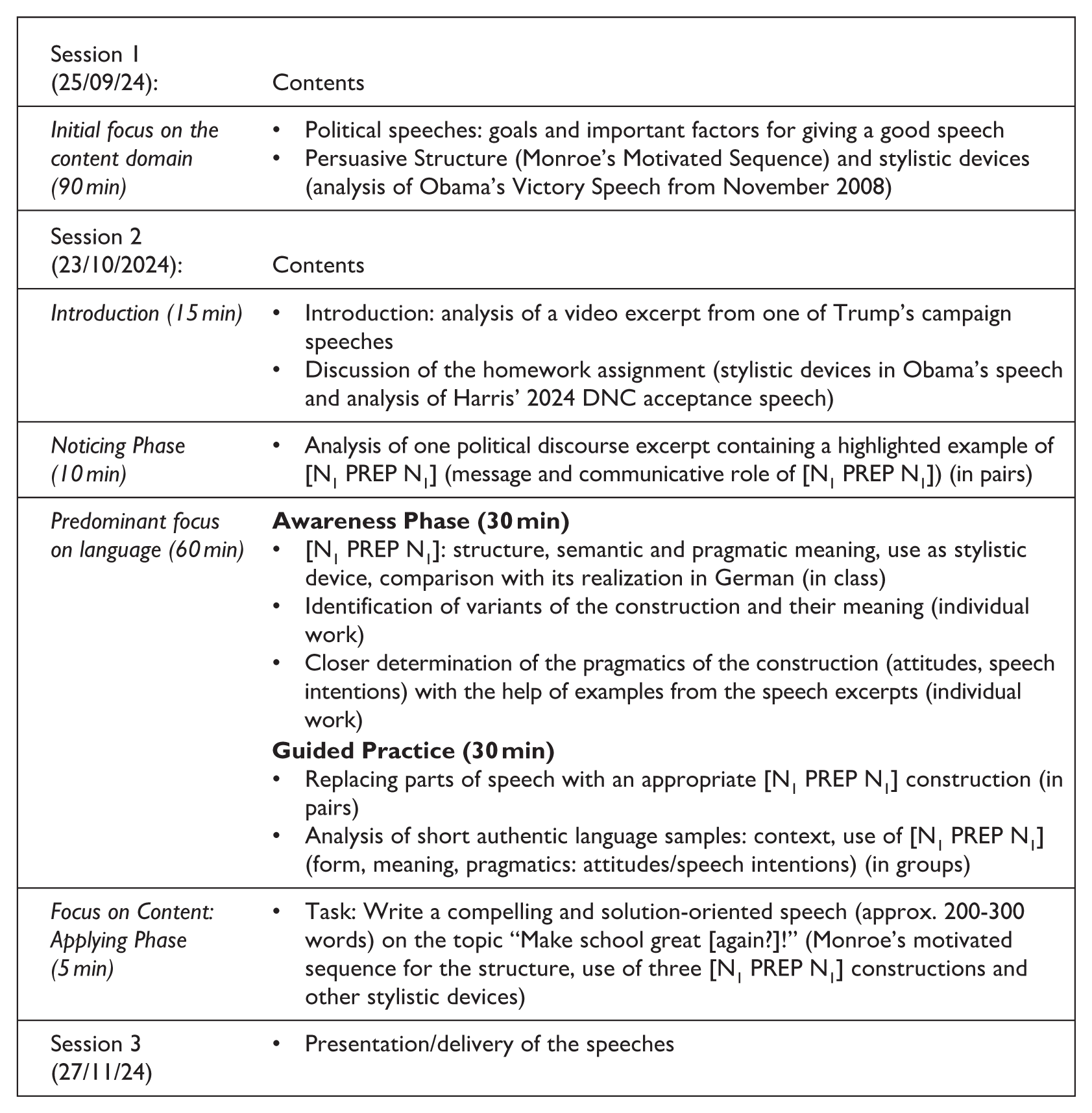
Overall, the lesson sequence on [N1 PREP N1] can be represented as follows:
Initial focus on the content domain
In the first session, held on September 25, 2024, students were acquainted with the text type “political speech.” 52 At the beginning, they were tasked with identifying the primary objectives of speeches, such as persuasion, information, entertainment, or inspiration. The beginning of Obama’s victory speech from November 2008 (CNN, 2012) was then played, during which students were asked to pay attention to Obama’s language use, his ideas, his presentation style, and his interaction with the audience. The subsequent stage involved an examination of the persuasive structure of a speech, utilizing Monroe’s motivated sequence (Monroe, 1943), which “describe[s] ways in which speakers can inspire or motivate any audience in a persuasive or political speech” (Green Line Oberstufe Bayern, 2024, p. 182). 53 Following the distribution of the transcript (NPR, 2008b), students then applied the speech to Monroe’s sequence.
The focus then shifted to the use of relevant stylistic devices (e.g., alliteration, anaphora, metaphor, repetition, hyperbole, irony). Students were asked to identify them in select examples and articulate their effects (e.g., including the audience, emphasizing personal accomplishments, etc.). The homework assignment was then presented. It comprised an analysis of eight stylistic devices in Obama’s speech and of Harris’ acceptance speech (CNN, 2024a) at the Democratic National Convention with regard to delivery, topics, persuasive structure, and stylistic devices.
Introduction
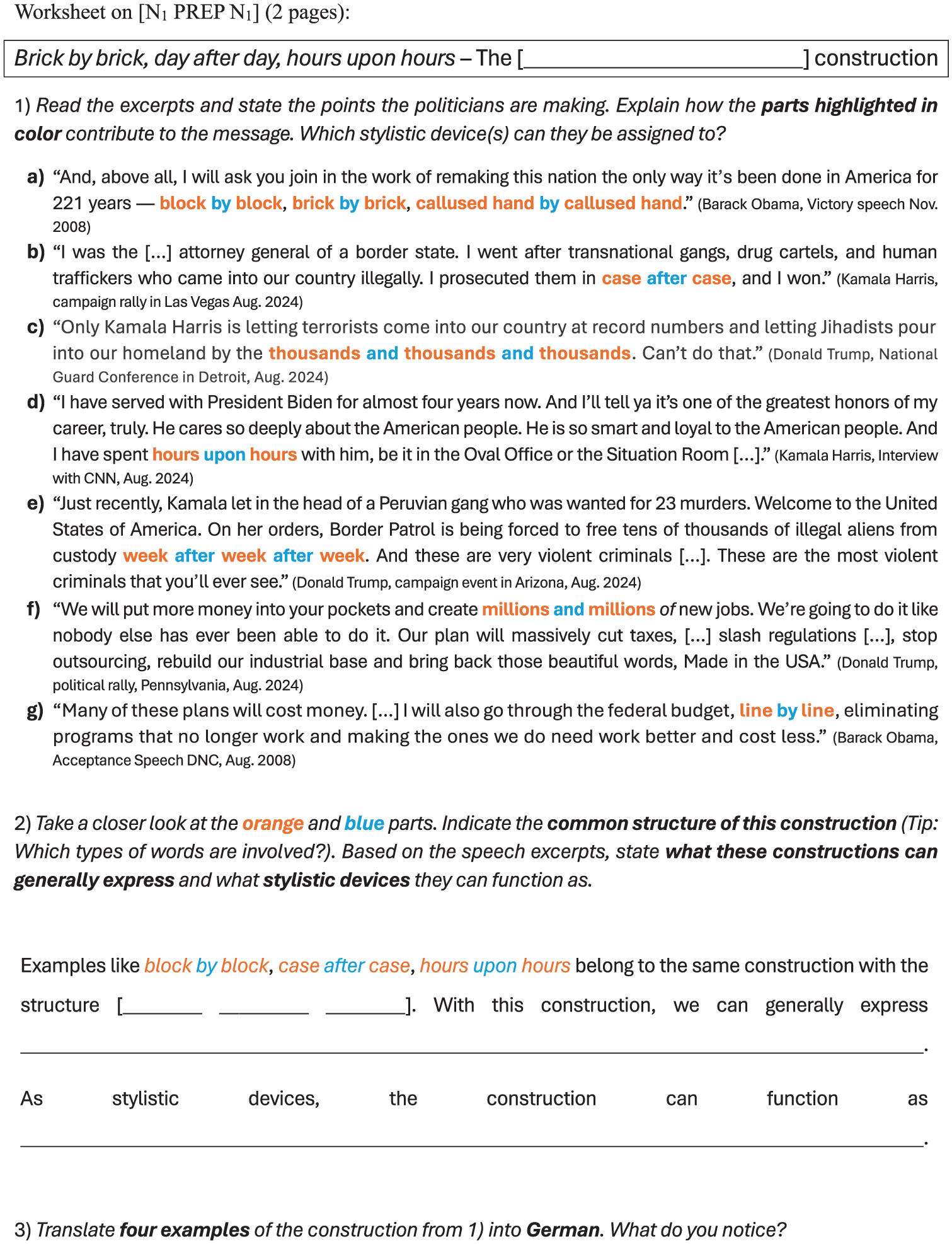
At the beginning of the subsequent session, which took place 4 weeks after the initial one (October 23, 2024), students were presented with a 2-min segment from Trump’s campaign speech in Greenville, North Carolina (Washington Post, 2024) to reacquaint them with the context of political discourse. Students were instructed to once again focus on aspects of speech delivery, the messages, and the use of language. In the presentation of the homework task, one student highlighted the multiple [N1 PREP N1] instantiations (block by block, brick by brick, callused hand by callused hand) 54 in Obama’s speech, which he correctly attributed to the stylistic devices parallelism, repetition, and metaphor and brought the “step-by-step” meaning of [N1 by N1] into play, expressing that the “remaking” (NPR, 2008b) of the nation needs continuous and repeated efforts. The discussion of this stylistic device served as a transition toward [N1 PREP N1]. The following worksheet was employed:
Noticing phase
The worksheet’s title presents two prototypical instances of [N1 PREP N1], namely hours upon hours and day after day, and, beyond that, the pattern brick by brick which the students had previously encountered during their analysis of the Obama speech. 55 Prior to the distribution of the worksheet, the “noticing phase” was initiated, during which the Excerpts (b) to (g) (see Task 1 on the worksheet) 56 were distributed as paper shreds. Two students received one excerpt each, with the aim of enabling them to focus exclusively on their utterance. These excerpts were taken from political speeches or interviews by or with Trump, Harris, and Obama. 57 The students were asked to state the point made by the politician and explain how the “highlighted parts” (i.e., [N1 PREP N1]) contribute to this point and what stylistic device they can be assigned to. To this end, a wide array of subtypes of [N1 PREP N1] were considered, including [N1 by N1], [N1 after N1], [N1 upon N1], and [N1 and N1 of N2]. 58 Each excerpt contained either self-praise [e.g., Obama advocating his thoroughness in budget planning in (g), NPR, 2008a] or a criticism of the other [e.g., Trump scolding Harris for letting terrorists into the country in (e)]. To facilitate the detection of the pattern, an important technique of pedagogical CxG (and an example of proactive form-focused instruction) was employed, the (visually enhanced) input enhancement, “draw[ing] learners’ attention to a targeted form or rule, usually by increasing its salience through typographical devices” (Ranta & Lyster, 2018, p. 43). In this instance, this was achieved through the use of bolding and color coding (orange for the nouns and blue for the preposition or conjunction), a technique that is effective for the comparison of different instances of a construction (cf. Henk 2021, p. 152). In the “noticing phase,” the emphasis was placed on the commonalities of all [N1 PREP N1] types, namely their utilization for emphasis, intensification, and evaluation and their capacity to function as stylistic devices. At this stage, there was no aspiration for fine-grained differentiation of different uses yet, and it was acknowledged that semantic components are combined by students with pragmatic aspects.
All pairs of students exhibited a sophisticated comprehension of the context of the speech excerpt, as well as the contribution of [N1 PREP N1] to the overall point articulated by the politician: Responses to the question “What can generally be expressed by the construction” (worksheet Task 2) encompassed a range of ideas, including “quantity,” “intensification,” “succession,” “a process,” “emphasis,” and “sincerity.” In terms of stylistic devices, students identified “repetition,” “parallelism,” “hyperbole,” “alliteration,” and “metaphor.” These responses were recorded on the worksheet. In a way, they can be regarded as metalinguistic explanations, that is, as actualizations of students’ explicit knowledge about the construction, which is another technique employed in proactive form-focused instruction (cf. Ranta & Lyster, 2018, p. 44).
Predominant focus on language
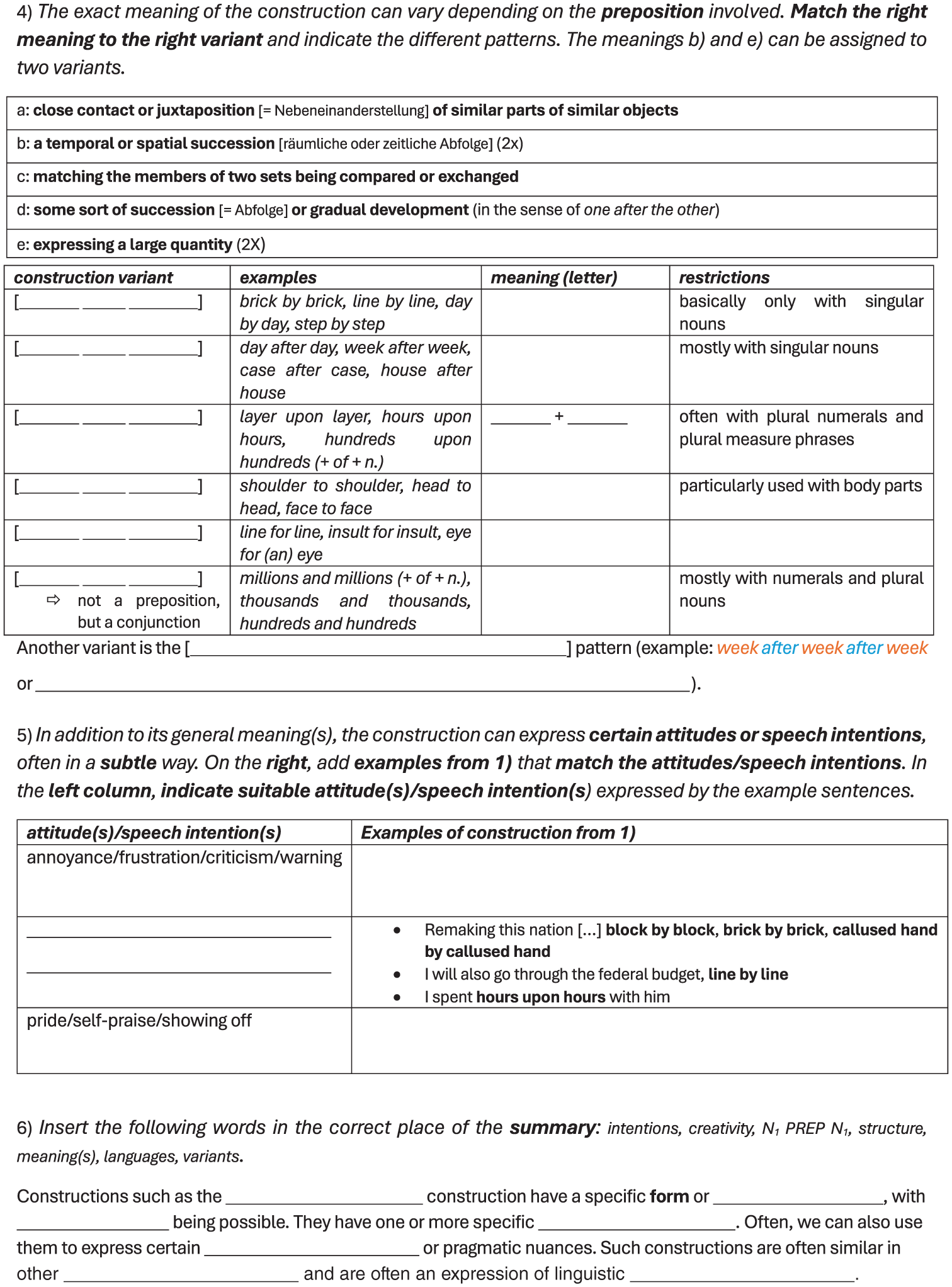
This also constituted the beginning of the “predominant focus on language” phase, during which students were explicitly made aware of [N1 PREP N1] for the first time. They correctly identified the common structure 59 of the given examples and provided adequate translations in German (Task 3), for instance, the observation that [N1 after N1], as in case after case, is probably best translated with Fall um Fall (and not Fall nach Fall). 60 Once the general semantic and pragmatic capacities of the construction had been determined, the focus shifted to the (semantic) meanings of the different [N1 PREP N1] types as well as on variants (Task 4). Utilizing both prototypical instances and exemplars from Task 1, students were tasked with assigning the appropriate meaning (a) to (e) to the designated construction variant while also providing its structure. Students were able to complete this task in less than 2 min without encountering any difficulties. 61 The pattern variant [N1 PREP N1 PREP N1] was introduced by having students compare week after week after week (utterance e) with thousands and thousands and thousands (c), Rev.com (2024) and indicate its function of enhanced emphasis. It was pointed out that and in [N1 and N1] is not a preposition, but a conjunction, and that this construction can be complemented by of +N2. In addition, the most significant restrictions on each type (e.g., [N1 after N1] is mostly used with singular nouns) were discussed, and students were asked to refer to this list during later stages of the sequence if necessary.
In the final stage of the awareness phase, the pragmatic potential of [N1 PREP N1] was emphasized. In Task 5 of the worksheet, a combination of two approaches was adopted. On one hand, students were tasked with assigning specific [N1 PREP N1] examples from the political discourse excerpts to particular, already indicated speech intentions or evaluations, such as “annoyance, frustration, criticism, warning” and “pride, self-praise, showing off.” Second, they were asked to indicate speech intentions for a selection of pre-determined excerpts from the political discourse examples. The objective of this exercise was to facilitate the recognition that [N1 PREP N1] can be employed to evaluate the actions of others and one’s own actions. Following a 5-min individual working phase, the results were presented in class. For “annoyance, frustration, criticism, warning,” students identified Trump’s use of week after week after week and by the thousands and thousands. In the case of “pride, self-praise, showing off,” they mentioned case after case and millions and millions of new jobs. For block by block [. . .]; line by line and hours upon hours, students listed “sincerity,” “persistence,” “honesty and human connection,” and “patience.”
Following a familiarization of students with the form and meaning of [N1 PREP N1], including an understanding of variants and restrictions, and the pragmatic utility of the construction, the “guided practice” phase aimed at fostering “automatized” (Ranta & Lyster, 2018, p. 43) explicit knowledge. As the MWU had been regarded within the context of political discourse, a range of different contexts were selected for the practice phase to ensure comprehensive processing. The first exercise was conducted in plenary. The students were presented with the following sentences in succession and were prompted to substitute the underlined parts with a suitable [N1 PREP N1] construction (appropriate answers are indicated in brackets):
a. She spent
b. She spent
c. When I was young, I was a really curious kid. I read
d. Peter: It’s ridiculous how much homework Mr. Miller gave us today. How am I supposed to finish all this by Friday?
Mary: We’ve got six days! Let’s take it easy and do
e. As the fog lifted, the two rivals stood
The exercise tested students’ comprehension of different semantic meanings of [N1 PREP N1] and raised their awareness of the nuances of meaning conveyed by each type depending on the preposition. The sentences were self-designed to encompass the monologic (and expressive) component of [N1 PREP N1], while also accounting for its utility in dialogues (d). For the vast majority of the examples, students provided at least one appropriate response, although, in some cases, they required prompting to indicate alternatives, for instance, hour after hour in (a).
The second practice task was designed in a slightly less guided manner. In groups of three, students were provided with one language sample, each extracted from authentic sources, predominantly from the COCA database (Davies, 2008). Students were asked to analyze it with regard to the context and [N1 PREP N1]. This involved the identification of its form, meaning, and the speech intention it conveys. This exercise served to deepen the metalinguistic perspective, requiring students to talk about the construction. The objective was to introduce them to a range of authentic speech contexts, which were different from the political discourse frame, thereby enabling them to recognize the variability of [N1 PREP N1]. Furthermore, the expression of evaluations (i.e., the pragmatic side) was emphasized once again, as evidenced in the following table:
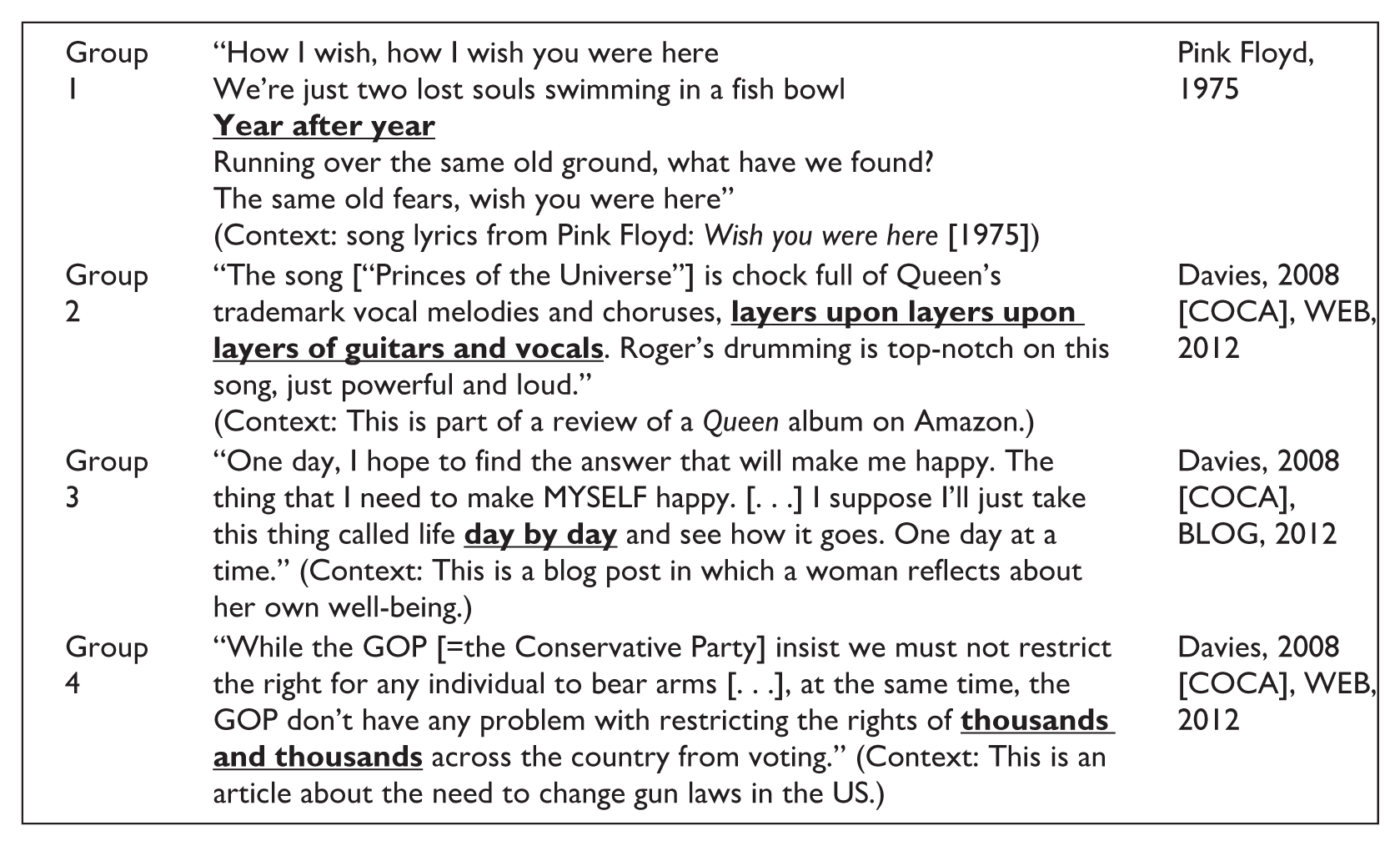
During the presentation of the results, most groups were able to provide a comprehensive explanation of the context and the use of [N1 PREP N1] with a commendable degree of precision. Group 2 observed that the use of layers upon layers of guitars and vocals contributes to an expression of the reviewer’s admiration for the complexity of the Queen song. Group 3 asserted that day by day conveys a sense of optimism or (cautious) hopefulness. Group 4 explained that thousands and thousands is used to emphasize the widespread impact of the GOP’s infringement on voting rights, thus highlighting a sense of hypocrisy in their actions. Group 1 was the only group unable to complete the task, which may be ascribed to the fact that the context (Wish You Were Here by Pink Floyd) provided the most extensive scope for interpretation. It was determined in plenary that the use of year after year emphasizes a feeling of nostalgia, a longing for change, and potentially even frustration over being “trapped.”
Finally, a gap-based summary about [N1 PREP N1] was completed (Task 6). This text focuses on the importance of regarding such constructions (without labeling them “schematic idioms”) as form-meaning pairs of great pragmatic potential for expressing linguistic creativity, emphasizing the status of [N1 PREP N1] as a valuable representative of the usage-based paradigm.
Focus on Content: Applying Phase
In the final minutes of the session, the homework assignment was presented, which was synonymous with a re-focus on the content domain. Students were tasked with the composition of their own speech on the topic “Make school great [again].” The structure of the speech was to be informed by Monroe’s motivated sequence, and at least three [N1 PREP N1] constructions needed to be incorporated (alongside other stylistic devices). To complete this task, students were required to apply all the knowledge and skills they had acquired about speeches (persuasive structure, the use of stylistic devices, and [N1 PREP N1]). While not all students incorporated [N1 PREP N1], the results of those two did are impressive overall: You ask a child what do you like about going to school and they grimace, looking at you like you’ve gone mad. You can say kids will be kids, try asking a teenager and they will act the same. And why is that? It’s because school has been and is associated with the tireless days where you feel like you’re being dragged In the current school system, we, the students, have to deal with a lot of demands and expectations. But there are also problems, that prevent us from reaching our full potential. Too much pressure on time and grades. Unsatisfying technical equipment. Success, depending on family background. Lack of motivation. These points, all of them, are the reason why more than ten percent of all students have a mental illness. More than 40 percent of all students suffer from extreme stress. These are the reasons why [. . .] [. . .] [. . .]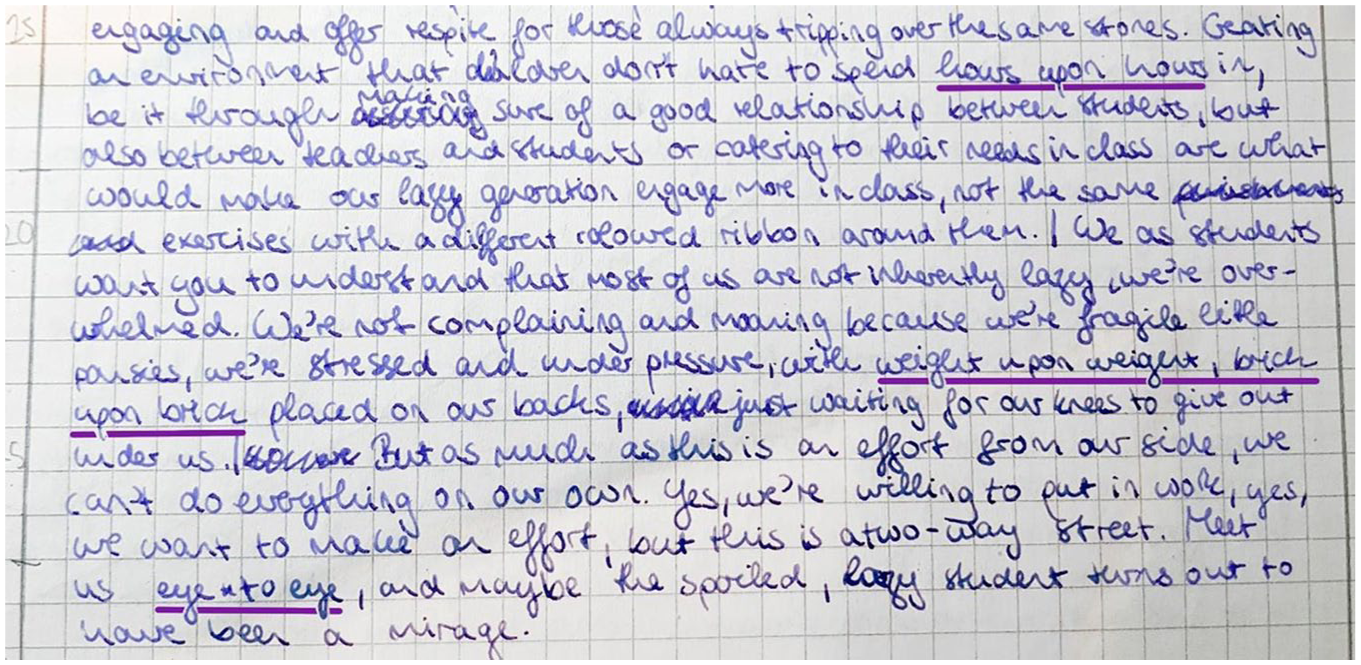
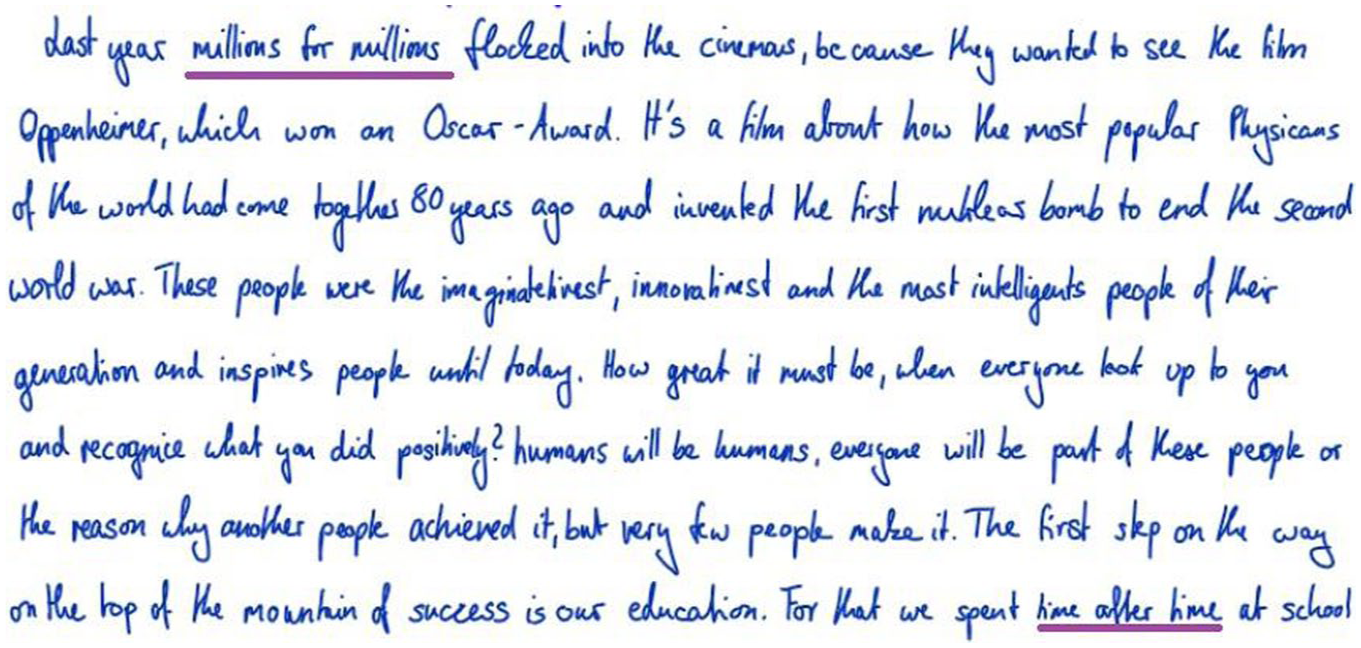
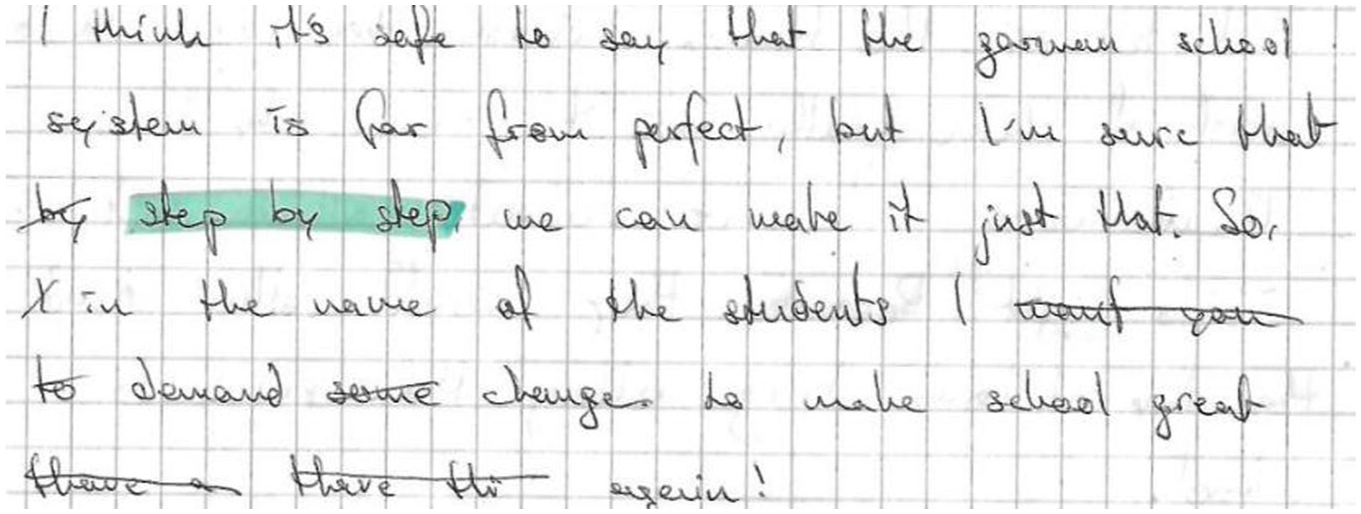



As the texts show, the students were all able to personally relate to the context of “making school great again” because it has direct relevance to their lives. In addition to adhering to a persuasive structure 62 (e.g., Student 4 employed a creative anecdote in the attention phase), the students demonstrated a high level of language proficiency in total, employing [N1 PREP N1] correctly and idiomatically, with the exception of Student 4 who incorrectly used *millions for millions. The preponderance of [N1 PREP N1] usages can be ascribed to tokens that had been instantiated during the session (e.g., hours upon hours, thousands and thousands, day after day, week after week), which underscores their role as prototypical representatives from the skewed input (cf. footnote 55). Furthermore, it is evident that all students exploited the pragmatic potential of [N1 PREP N1]. With the exception of Student 5 who used [N1 PREP N1] in a “positive” way (“I’m sure that step by step we can make it [perfect]”), all other students employed the construction to help convey a negative emphasis or evaluation of what they perceive as repetitive and incessant grievances at school, including expressions such as “hours upon hours of algebra”; “week after week, day after day, children come home crying,” “being dragged from classroom to classroom,” “weight upon weight,” and “time after time.” Moreover, the utilization of the syntactic (and lexical!) variability of the [N1 PREP N1] construction in the texts can be regarded as an indication of learning success. In some cases, students went beyond what was discussed in class, e.g., by using [N1 upon N1 of N2] as in hours upon hours of algebra or by creating new tokens (e.g., weight upon weight), even in a metaphorical sense (cf. also eye to eye). In their texts, the students thus demonstrated a thorough understanding of [N1 PREP N1]. In order for the texts to be acknowledged sufficiently, the students had the possibility of delivering their speech at the beginning of the next session on November 27, 2024, which some of them did.
Conclusion
It can be concluded with confidence that the teaching objectives of this teaching unit were successfully met. First, the students were familiarized with the text type “political speech,” in which [N1 PREP N1] frequently appears, to a varying degree. This encompassed aspects of speech delivery, structural aspects, and the use of language, particularly stylistic devices. [N1 PREP N1] was introduced in this context as a “multiple” stylistic device that can be used to emphasize, intensify, and evaluate actions. The most salient constraints and lexical elements of [N1 PREP N1] were introduced while providing opportunities for students to practice its semantic and pragmatic intricacies. The requirements stipulated by Ettinger (2019, p. 87) were met, namely students’ comprehension of how the MWU is used, in which situations and with which intentions. The final task demonstrated students’ understanding of the expressive potential of [N1 PREP N1] for the rhetorical design of their own speech.
In addition, it became evident that schematic idioms such as [N1 PREP N1] can facilitate the realization that linguistic devices can offer insights into the “motivation” of languages, a perspective that has hitherto received insufficient attention in CLT. Furthermore, in the sense of Construction Grammar, the formal characteristics of a linguistic phenomenon can be directly connected with aspects of meaning. The students found this novel perspective on language and the emphasis on a linguistic device that cannot be unequivocally classified as either grammar or lexis and its communicative use to be invigorating. Consequently, metalinguistic awareness was elevated, a competence that merits greater consideration in curricular competence models.
The most significant contribution of this article is the synthesis of the usage-based perspective on MWUs with the teaching practice of CLT. Despite the recognition in linguistics of the postulate that language learning should be based on idiomatic language use and construction learning along the lexico-grammatical continuum, such an undertaking is still not as prevalent in CLT as it should be. As discussed in the initial sections of this article, this can be attributed to various factors, including curricular adherence to a generative lexicon-grammar separation and a teaching approach that is predominantly focused on effective communication rather than idiomaticity. However, it has been demonstrated that this rigid separation may be relaxed in the future, as evidenced by the new educational standards of 2023 (KMK). However, it remains uncertain whether this will really result in the exploitation of the constructionist spectrum to a greater extent, particularly in terms of incorporating schematic constructions, such as [N1 PREP N1], into CLT. The fact that these structures are neither clearly grammatical nor lexical has hitherto prevented their treatment in class. Transforming the vocabulary part of textbooks into “Focusing on language” sections that more consistently consider chunks as lexico-grammatical form-meaning units could represent an important step toward addressing this limitation (cf. Herbst, 2016, p. 42).
However, it must also be acknowledged that there are aspects of the teaching project on [N1 PREP N1] that could be enhanced. First, the unit can be critiqued for its comparatively limited degree of fostering automatization, that is, implicit practice of the construction. 63 The aspect of “fluency development” is somewhat underrepresented in relation to the other strands of language learning, as defined by Nation (2007, p. 11, quoted in Plikat, 2020, p. 126), namely “meaning-focused input,” “meaning-focused output,” and “language-focused learning.” Moreover, students could have been allowed to work more independently. The unit’s design could have been more inductive, with restrictions and variants of the construction being discovered through corpus entries rather than being provided to the students. However, a central inductive component was the “rule-finding phase,” that is, the form-meaning assignment. 64 The representativeness of the study is somewhat compromised by the fact that [N1 PREP N1] was worked on with a small group of well-performing students. Liu and Nelson (2016, p. 425) are right in saying that potential conflict of usage-based approaches in CLT can be found in reconciling “creative use of the target language constructions being taught while simultaneously helping students understand the constructions.” Working this intensely on language may not only be too complex for some students if approached too “cognitively”, but can also be expected to be a time-consuming matter, time that tends to be scarce in a CLT classroom busy covering a whole variety of topics and competences (cf. Gemmell Hudson, 2022, pp. 268–269). Therefore, in a regular class of 30 students, it might also have been necessary to address more creative learners.
The temporal aspect is also pertinent to the process of lesson planning in general. A considerable part of the teaching unit was not explicitly about [N1 PREP N1] because the construction needed to be embedded within a communicatively meaningful context in which it frequently occurs and in which its pragmatic potential can be exploited. In this case, this was the text type “political speech” which needed to be sufficiently discussed on its own first to adequately address CLT’s content focus. Lyster’s (2016) model of integrating language and content proved to be an effective framework for structuring the unit. During the planning stage, it became evident that the usage-based perspective can be connected with CLT, as an orientation toward texts and communicative contexts is fundamental for both paradigms.
However, it must be clearly stated that the usage-based planning and teaching of lexico-grammatical constructions which have so far received little attention in CLT is very time-consuming and therefore cannot be consistently applied by teachers in their everyday teaching. This finding underlines the need for a collaborative effort by all those involved in foreign language teaching, including linguists, didacticians, curriculum and textbook designers, and teachers, to thoroughly examine the constructica of the respective languages, with the objective of assessing the pedagogical and communicative suitability of linguistic devices. This joint effort will encompass the creation of frequency lists customized to specific grade levels, taking into account the pragmatic aspects of linguistic devices and their underlying semantic frames, and applying these findings to teaching materials as well. This will ensure that the daily foreign language teaching business will be based on idiomatic language use more than it currently is. A more systematic orientation toward MWUs would liberate students from the pressure of producing language according to the principles of their L1. This approach not only mitigates the risk of errors being made but also enables students to “channel [their] energies into other activities [. . .] [such as] attend[ing] to matching the timing, tone and rhythm of [their] utterance to [the] conversational discourse” (Pawley & Syder, 1983, p. 208). In this manner, students can evolve toward the ideal of a pragmatically sensitive intercultural speaker. Moreover, fostering a sense among students that learning languages as motivated systems is a worthwhile endeavor is crucial. As this article has shown from both a linguistic and a foreign language teaching perspective, schematic idioms such as [N1 PREP N1] are particularly well-suited to contribute to the realization of this goal.
Footnotes

Funding
The authors received no financial support for the research, authorship, and/or publication of this article.
Declaration of conflicting interests
The authors declared no potential conflicts of interest with respect to the research, authorship, and/or publication of this article.