




Abstract
Aims and Objectives:
This study examines how differential object marking manifests across different adolescent acquisition settings: (1) German foreign language learners of Spanish, (2) heritage speakers (L1 Spanish and German), (3) L1 acquisition with a geographical component (Spain vs. Argentina).
Approach:
a-marking rates are examined mainly in the variable non-human animate domain by comparing two referents in direct object position with distinct degrees of animacy (dog and frog) across all participant groups. In addition, a-marking patterns for frequent verbs occurring with the frog in direct object position are analyzed, considering its changing animacy throughout the task as it acquires human-like attributes.
Data and Analysis:
This study is based on a dataset comprising written productions from 99 participants, totaling approx. 70,500 words and 1,629 direct objects available for analysis.
Conclusions:
The findings support the validity of the school grammar rule, as taught in grammar books for German learners of Spanish, which mandates a-marking for all animate direct objects, as evidenced by the productions of L1 speakers from Spain and Argentina.
Originality:
The learner productions are compared not only with an abstract Castilian standard norm, as is usually the case, but also with productions from peer bilingual L1 (heritage) speakers and monolingual L1 speakers from both Peninsular and Hispano-American (Argentine) Spanish (L1 control groups).
Significance:
The data suggest that heritage speakers are strong representatives of the Castilian standard. In contrast, monolingual L1 speakers are surprisingly strong representatives of the grammar rule taught in schools within the context of foreign language didactics, which mandates a-marking for all animate direct objects (both human and non-human). These findings challenge critiques that argue the school grammar rule is overly simplistic and impedes learners from fully acquiring differential object marking.
Keywords
Introduction
Spanish exhibits differential object marking (DOM; Bossong, 1982), a phenomenon whereby direct objects (DOs) are overtly marked only under specific semantic and discourse-pragmatic conditions. In such cases, the DO is preceded by the object marker a, as illustrated in Veo a Lucía. “I see Lucía.”. DOM in Spanish is a well-documented phenomenon in linguistics. However, little research has examined how DOM manifests in German learners of Spanish as a foreign language and in heritage speakers of Spanish in German-speaking environments, considering that German is a non-DOM language. This study aims to contribute to filling this gap by examining how DOM patterns emerge across distinct acquisition settings. Specifically, DOM is analyzed in the following groups: German (L3 and L4) adolescent learners of Spanish, adolescent heritage speakers of Spanish whose dominant language is German, and adolescent L1 Spanish speakers of Peninsular and Hispano-American (Argentine) Spanish. In addition, the participants’ productions are analyzed in relation to the expectations of the Castilian standard, based on the normative guidelines established by the Real Academia Española (RAE). By comparing these groups, the study aims to uncover acquisition patterns and variation in DOM use across the different acquisition settings.
To achieve this, chapter Theoretical framework will explore the theoretical foundations of DOM within the fields of linguistics and language acquisition. Chapter Method will introduce the corpus and outline the methodological framework of the study. The results will be presented in chapter Results, followed by a discussion in chapter Discussion and conclusion, where they will be examined in the context of existing research. Finally, the study will conclude with a reflection on potential directions for future research.
Theoretical framework
DOM in linguistics
In Spanish, animacy is the primary factor triggering DOM, with referentiality (specificity and definiteness) also playing a role (García García, 2007). Both animacy and referentiality operate on scalar continua that shape DOM cross-linguistically, with the animacy scale (human > non-human animate > inanimate; Silverstein, 1976) and the referentiality scale (personal pronoun > proper name > definite NP > indefinite specific NP > non-specific NP; Aissen, 2003) interacting to determine DOM patterns.
The focus of this study is on specific reference in Spanish, as non-specific reference is not relevant to the method employed, namely the description of the picture story Frog, Where Are You? (so-called Frog Story; Mayer, 1969). In Spanish, specific human animate DOs are generally a-marked (see Table 1). Exceptions include the non-marking of human animate DOs with haber “there is” (e.g., Hay una niña. “There is a girl.”), where a-marking is ungrammatical, and with tener “to have,” which permits a-marking only when the DO is modified by an adjective or prepositional phrase (e.g., Tengo a un hijo enfermo/en el hospital. “I have a sick child”/“I have a child in the hospital.”) but remains unmarked otherwise (Tengo un hijo. “I have a child.”; Fábregas, 2013; examples from Caro Reina, 2022). In addition, alguien and nadie obligatorily take a despite their non-specific reading (Leonetti, 2004).
a-marking with specific reference.
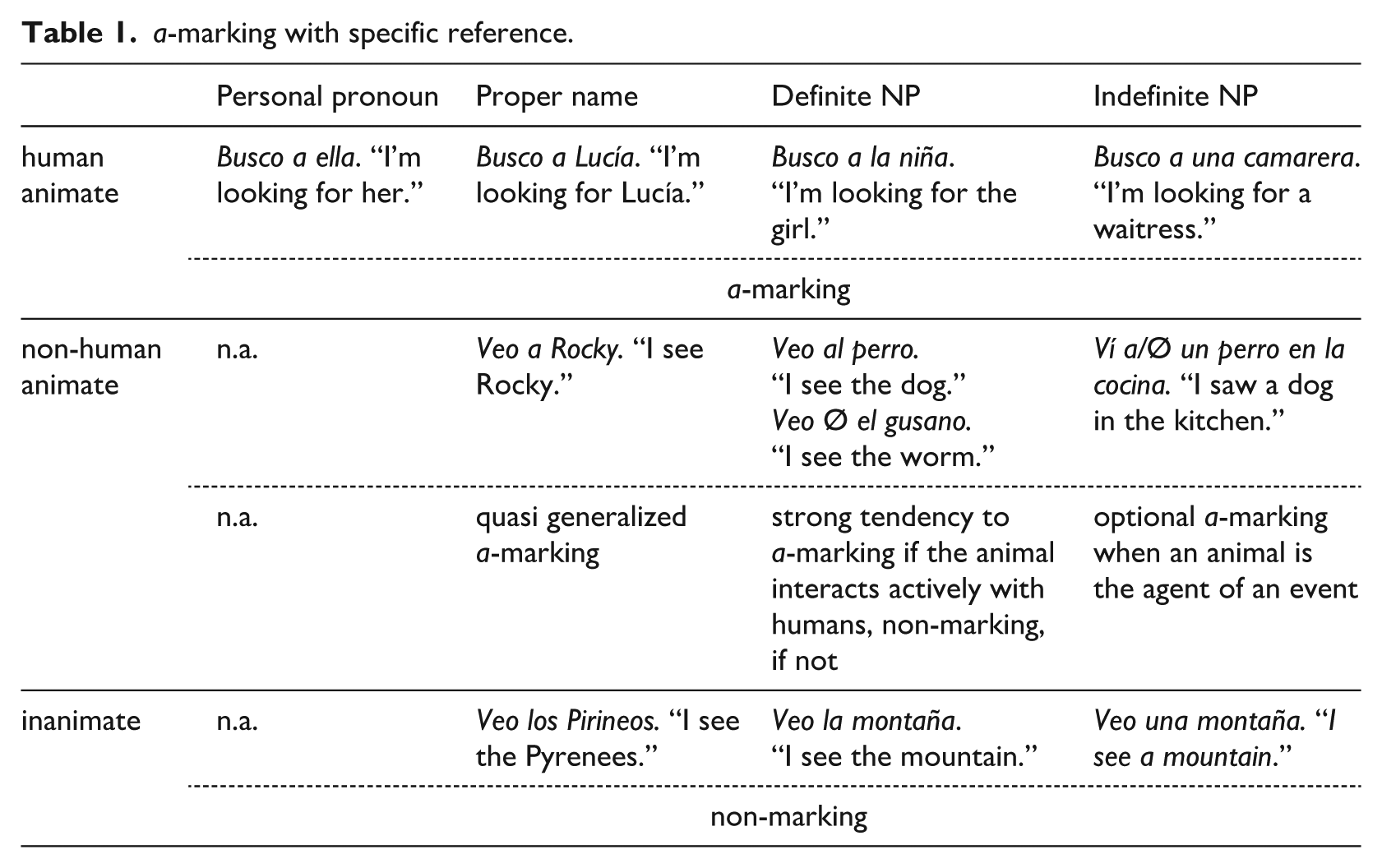
The middle of the animacy scale, the non-human animate domain, is where most variation occurs: a-marking is nearly general for proper names, particularly referring to pets (e.g., dogs, cats) or farm animals (e.g., horses, donkeys, cows, chickens), which are more likely to receive proper names due to their capacity for interaction with humans (Fábregas, 2013) and/or the affective relationship they elicit (Real Academia Española [RAE] & Asociación de Academias de la Lengua Española [ASALE], 2023). Among definite NPs, animals capable of interaction with humans (cf. for example the just mentioned dogs and cats) tend to be a-marked, while those perceived as less interactive (e.g., worms, fish, frogs) remain unmarked (Veo al perro. “I see the dog.” vs. Veo el gusano. “I see the worm.”; Fábregas, 2013). Indefinite specific NPs may take a if the animal’s agentivity is emphasized (Vi a un perro en la cocina. “I saw a dog in the kitchen.” implying it caused a mess; Pesqué a un pez enorme. “I caught a huge fish.” highlighting a struggle; Fábregas, 2013). Overall, animals such as pets, which may be perceived as human-like, are more likely to receive a-marking, whereas smaller, less noticeable animals tend to be classified as inanimate (see Table 1).
Inanimate DOs are typically non-marked (see Table 1), though exceptions exist. In many cases, metaphoric and metonymic use seems to be a good explanation (for metaphoric use see already Molho, 1958, 1980; Bossong, 1998; for metonymic use see García García, 2014; de Crignis, 2025): The commonly mentioned verbs of temporal order (e.g., preceder “to precede,” anteceder “to precede,” seguir “to follow,” etc.; cf. for example El invierno precede a la primavera. “Winter precedes spring.”; example from Delbecque, 2002, p. 87; see also Fábregas, 2013; García García, 2007, 2014) seem to be a prime example of the conceptual metaphor
DOM operates within the relationship between subject and DO. It is assumed, that a-marking in general increases the more similar a DO is to a prototypical subject (e.g., animate and definite), aiding in the disambiguation of subject and subject like DO (Ambiguity Thesis; von Heusinger & Kaiser, 2007). Agentivity competition most probably influences a-marking, with three ways in which the subject and DO may interact in this regard. First, the DO inherently possesses strong actantial value, such as in María busca a Lucía. “María is searching for Lucía.,” where the human animate DO triggers a-marking. Second, the DO has weaker actantial value (e.g., non-human animate or inanimate), but the verb can assign varying degrees of agentivity. For instance, in El niño llama a la rana. “The boy calls the frog.” (de Crignis, 2025), the verb llamar typically takes human animate DOs, assigning actantial value to the frog and favoring a-marking. Verbs that assign weaker agentivity, such as ver “to see,” tend to show lower rates of a-marking. This contrast is evident in oír “to hear” versus ver “to see”: the DOs of oír must be more agentive since they actively produce noise rather than merely being perceived, which likely accounts for the higher frequency of a-marking (von Heusinger & Kaiser, 2011). Finally, even when a DO has inherently low agentivity and the verb does not assign strong actantial value, a-marking can still introduce an agentive interpretation. This is illustrated in (1), where an inanimate DO appears with ver in two different constructions (non-marking vs. a-marking; examples from Isenberg, 1968, p. 113, as cited in Delbecque, 2002, p. 92):
1. (a) Pedro vio de repente Ø la motocicleta y se decidió a comprarla.
(b) Pedro vio de repente a la motocicleta y se decidió a comprarla.
“Pedro suddenly saw the motorcycle and decided to buy it.”
In (1a), Pedro simply perceives the motorcycle, while in (1b), a-marking implies that the motorcycle caught his attention, assigning it an actantial role (Delbecque, 2002).
Prototype effects (Rosch, 1978) seem to emerge from the patterns described above: The prototypical DO is maximally distinct from the subject (i.e., inanimate) and unmarked. The prototypical a-marked DO is human animate (“best example”), with a-marking being general throughout the human animate domain. The non-human animate domain occupies a less central position within the a-marking category, but some representatives share characteristics (family resemblances; Rosch & Mervis, 1975; Wittgenstein, 1953) that bring them closer to the human animate representatives, such as the ability to interact with humans (e.g., dogs), making them more likely to receive a-marking. Other representatives that do not possess this characteristic and may differ greatly in shape and size are less representative (such as frogs and worms). The proximity to the human animate prototype can be reinforced through various factors: Proper names assigned to pets or farm animals (e.g., Veo a Rocky. “I see Rocky.”) increase their similarity to human animate representatives, as proper names are typically associated with humans. Definite NPs in DO position (e.g., Veo al perro. “I see the dog.”) maintain a strong tendency toward a-marking, particularly when the referent is capable of interaction with humans. Cultural and professional factors may also influence which animals are more likely to approach human animate representatives. In Europe, these are likely to be pets such as dogs and cats, as well as farm animals such as donkeys, horses, chickens or cows. Other animals, such as the frogs just mentioned, or worms etc., are less likely to come close to the human animate representatives and approach the inanimate domain (Hence, Veo al gusano. “I see the worm.,” is less central.). Furthermore, verb choice can bring a non-human animate DO closer to the human animate representatives. Verbs typically associated with human animate referents (e.g., matar “to kill”; Pomino, 2012) strengthen the resemblance to human animate representatives. Finally, it is even possible to draw inanimate referents into the a-marking category by applying a-marking, as in the example of the aforementioned inanimate motorcycle, indicating that it is not a prototypical inanimate DO, but that features of the a-marking category, such as a certain degree of animacy and actantial value, are present in the DO (see Figure 1).
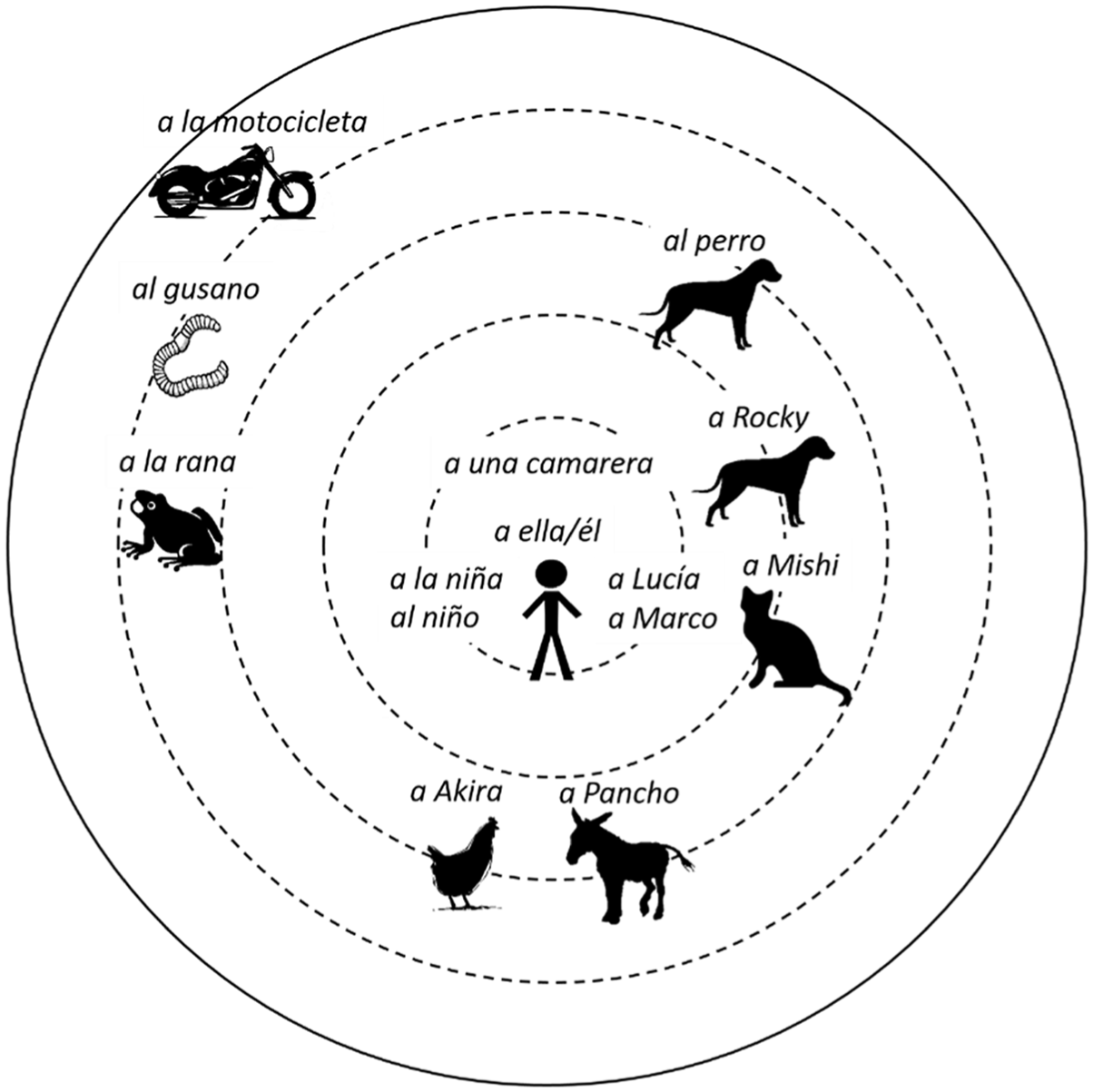
Prototype effects in a-marking (own representation).
Human animate DOs with non-specific reference optionally take a-marking. Consequently, a non-marked human animate DO signals non-specific reference (Fábregas, 2013; Pomino, 2012; Radatz, 2021; von Heusinger & Kaiser, 2007). Although a-marking of bare nouns is generally considered ungrammatical (Leonetti, 2004), a grammaticality judgment study found that L1 speakers from Spain did not reject a-marked bare nouns in approximately half of the cases (Nedinger et al., 2016). Non-specific non-human animate DOs are generally not a-marked (Fábregas, 2013).
From a historical perspective, the DOM marker a (< Lat. ad) developed from the preposition of place a, which continues to function in that capacity in modern Spanish (e.g., La chica corre a la puerta. “The girl runs to the door.”; see Table 2). In addition, a serves several other functions in Spanish, the most important of which—each involving a predicative complement—are likely the following (see Table 2; see also Radatz, 2021).
Functions of Spanish a.
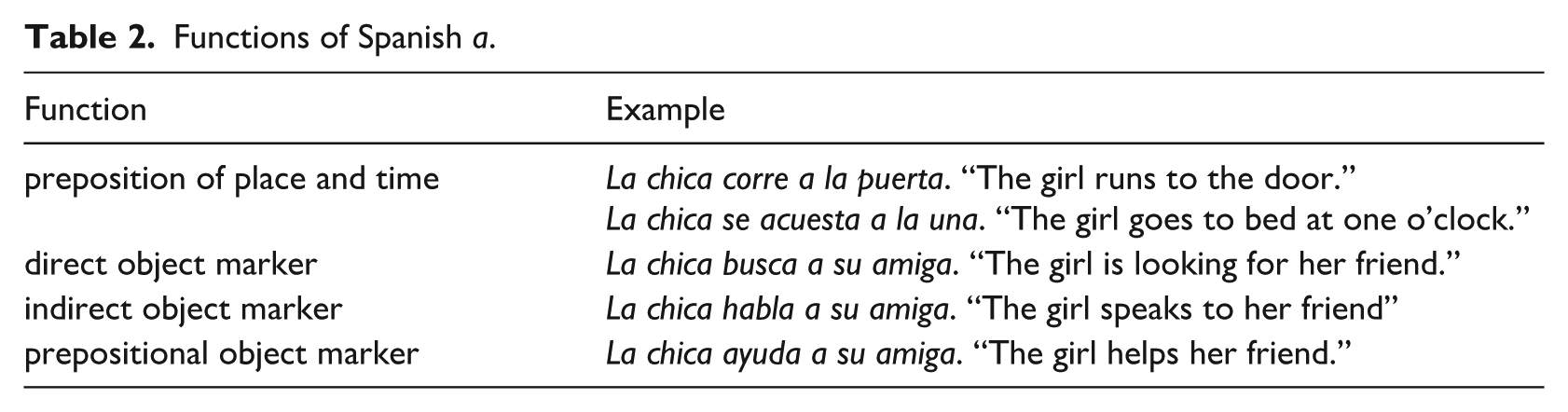
These functions are connected insofar as the use as a temporal preposition and the uses as object markers are the result of grammaticalization of metaphorical transfer from the preposition of place. The metaphorical use consists in the fact that it is not concrete objects that move to a goal (like the girl running to the door, when using the preposition of place), but abstracta, such as time (temporal preposition) or energy (as when looking for someone or speaking to someone, when using the direct or indirect object marker; Langacker, 1995).
Acquisition of DOM by learners and heritage speakers
DOM poses challenges in various bilingual settings involving non-DOM languages such as German and English. Several factors can be identified as responsible for this, including negative transfer from L1 non-DOM languages, the complexity of DOM due to its dependence on grammatical, semantic, and discourse-pragmatic features, the ambiguity of a in Spanish grammar, and insufficient exposure to DOM structures in classroom instruction in the German-speaking learning context:
As far as the negative transfer hypothesis is concerned, the scarce research on the acquisition of DOM by German learners of Spanish suggests that a-omission in animate DOs may be a persistent error. The studies indicate that a-omission in animate DOs is not only very frequent at basic and independent levels (de Crignis, 2025; Di Biase and Hinger, 2015), but continues into advanced learner levels (Adolf, 2024; Vázquez, 1991). An acceptability study comparing Spanish monolinguals, heritage speakers (L1 Spanish and German), and German L2 learners show that heritage speakers align more closely with monolinguals, whereas L2 learners deviate more frequently from the RAE norm (Pomino et al., 2018). Similar findings emerged from studies on English-Spanish teenage bilingual heritage speakers in the UK, who performed comparably to monolingual peers from Spain in production and acceptability tasks, despite slightly more frequent deviations (Guijarro-Fuentes et al., 2017; Guijarro-Fuentes & Marinis, 2011). However, studies on English-Spanish bilingual heritage speakers in the U.S. suggest that heritage speakers behave more like L2 learners, likely due to stronger English monolingual tendencies (Guijarro-Fuentes & Marinis, 2011).
For English learners of Spanish in the U.S., DOM remains challenging at all proficiency levels. Montrul (2010) found that L2 learners omitted a-marking in 46.9% of animate DOs in a narrative oral task, with rates decreasing as proficiency increased (low: 76.1%, intermediate: 43.2%, advanced: 26.6%). Heritage speakers showed a similar pattern, with a-omission rates decreasing from 50% (low) to 26.9% (intermediate) to 10.5% (advanced). Interestingly, intermediate heritage speakers (26.9%) thus paralleled advanced L2 learners (26.6%). Overgeneralization of a-marking to inanimate DOs was uncommon among learners (3.9% overall) but became more frequent at higher proficiency levels, indicating learning progress. In contrast, among heritage speakers, the highest rates of a-marking in inanimate contexts were observed in low-level heritage speakers (1.9% overall). Arechabaleta Regulez and Montrul (2023) confirmed these trends, finding even higher a-omission rates (61.3%) among English L2 learners in a narrative oral task, three times those of heritage speakers (19.6%). Eye-tracking data indicated that both groups processed DOM, showing longer reading times for non-marked animate and a-marked inanimate DOs. However, L2 learners showed no sensitivity to DOM in non-canonical (VSO) word order, unlike heritage speakers.
Overall, DOM acquisition remains a persistent challenge for bilinguals whose L1 is a non-DOM language like German or English. Heritage speakers struggle to fully acquire DOM, and U.S. heritage speakers exhibit signs of attrition. Advanced L2 learners show progress but mainly master prototypical human animate context due to fossilization and negative transfer. In contrast, speakers of DOM languages, such as Romanian, demonstrate positive transfer and successfully acquire Spanish DOM at advanced levels (Montrul, 2019).
Beyond the hypothesis of negative transfer, successful comprehension and production of DOM require mastery of various grammatical, semantic, and discourse-pragmatic features. Learners must not only distinguish between subjects and objects but also differentiate between direct and indirect objects, as well as between animate and inanimate direct objects (Di Biase & Hinger, 2015). Acquiring the referentiality component of DOM, when explicitly taught, is particularly challenging, as it requires integrating linguistic knowledge with “language external” discourse-pragmatic information (Pomino et al., 2018).
In addition, a, operating as DOM marker, is not only very frequent in Spanish, it also fulfills the most functions in Spanish among the grammatical elements that are usually listed under prepositions (RAE & ASALE 2024). Regarding the comprehension and production of DOM, the functions of a already mentioned in chapter DOM in linguistics—as a preposition of place and time, a direct object marker, an indirect object marker, and a marker introducing prepositional objects, each involving a predicative complement—may pose difficulties for learners. This functional complexity makes Spanish a highly ambiguous, preventing learners from establishing a reliable form-function relationship (for form-function relationships, see Wulff & Ellis, 2018). Learners may also perceive that DOM is realized by more than one form, since a before the masculine article becomes the portemanteau morph al (e.g., Veo a la niña. “I see the girl.” but Veo al perro. “I see the dog.”). At least, however, awareness of this process must be present for successful comprehension and production. In addition to the ambiguity of a, it is probably of low perceptual salience (for perceptual salience see Wulff and Ellis, 2018) due to its poor phonetic substance, unaccentedness and comment position in the sentence in canonical word order.
Finally, the kind of classroom input was discussed as a reason for the difficulties in acquiring DOM. This is because in foreign language didactics, it is usually explained that animacy is the only feature of DOs that determines DOM in Spanish: While animate DOs should be a-marked, inanimate DOs should remain non-marked (Caro Reina, 2022; Gómez Torrego, 2011; Radatz, 2021). This principle is introduced early in A1-level grammar materials designed for German learners of Spanish (Caro Reina, 2022). While linguistic (see chapter DOM in linguistics) and statistical analysis (Adolf, 2024) has shown that animacy is indeed by far the most important predictor for DOM, this animacy-focused approach has been criticized as a didactic oversimplification, leading to incomplete acquisition of DOM. In addition, DOM is predominantly addressed at the A1 level, with little emphasis at advanced stages, and there is no cyclical progression in which DOM is explained and deepened successively. Textbooks often illustrate animacy using human DO examples, with few instances of non-human animate DOs (Caro Reina, 2022). However, as linguistic research has shown, the a-marking of non-human animate DOs is more complex than the a-marking of human animate DOs (see chapter DOM in linguistics). In addition, studies have shown that input frequency plays a crucial role in foreign language learners’ ability to reproduce multiword units (Erman et al., 2016). When describing the Frog Story, it was observed that German learners of Spanish who applied DOM (approx. 22%) were more consistent in a-marking human animate DOs than non-human animate DOs (see Table 3; see de Crignis, 2025). This contrasts with the prescriptive grammar rule taught in schools, which dictates a-marking for all animate DOs, as well as with empirical findings indicating that L1 Spanish speakers exhibit a strong tendency to apply a-marking to non-human animate DOs−a pattern that does not align with the rules of the RAE standard norm (de Crignis, 2025).
a-marking of human animate and non-human animate DOs in German learners of Spanish (de Crignis, 2025).

Furthermore, DOM is rarely integrated into syntactic contexts critical for understanding its usage. For instance, non-marking with the verb tener “to have” in human animate contexts is only addressed in select grammar resources (Caro Reina, 2022). At the same time, the majority of non-markings in human animate DOs in L1 speakers of Spanish describing the Frog Story are precisely due to constructions with the verbs tener “to have” and haber “there is” (de Crignis, 2025). Haber, like tener, also blocks a-marking (see chapter DOM in linguistics).
Method
Research questions and hypothesis
In this study I ask, how DOM manifests across the different acquisition settings involved, specifically in (1) L1 acquisition with a geographical component (Spain vs. Argentina), (2) heritage speakers, who acquired Spanish in early childhood within their families as L1 but experience transfer from dominant L1 German, the language of their surrounding speech community, and (3) German foreign language learners of Spanish, who experience transfer from their German L1 to non-native Spanish. Accordingly, I pose the question of what patterns emerge regarding the distribution of DOM across these groups. The analysis focuses on the non-human animate domain, partly due to the nature of the picture story Frog, Where Are You? (Mayer, 1969) used in the study for data elicitation, where the frog is the most frequent referent in the DO position and assumes an ambiguous role—evolving from an ordinary frog into a fairy-tale-like creature with human attributes. Moreover, the non-human animate domain exhibits the greatest variation (see chapter DOM in linguistics), making it particularly insightful for understanding the mechanisms of DOM.
I assume that the L1 speakers from Spain (L1 speakers ES) and from Argentina (L1 speakers AR) exhibit similar patterns, as the research data indicate no geographical variation in the domain of DOM under investigation, excluding left dislocation and clitic doubling (see chapter DOM in linguistics). Furthermore, I expect both groups to diverge from the prescriptive norms of the Castilian standard by displaying a stronger tendency toward a-marking in the non-human animate domain (see chapter Acquisition of DOM by learners and heritage speakers). In the performance of German learners of Spanish, I expect a lack of awareness of variability of DOM, particularly within the non-human animate domain, given the generally high rates of a-omission among learners and the absence of variability input in formal classroom instruction. Finally, I expect that heritage speakers will occupy an intermediate position between L1 learners and monolingual L1 groups (L1 speakers ES and AR). However, I expect their productions to closely resemble those of the monolingual L1 groups, as significant language attrition is unlikely given their explicit exposure to Spanish through attendance at the ALCE school, which aims to maintain and develop language skills (see chapters Acquisition of DOM by learners and heritage speakers and Participants).
Data collection
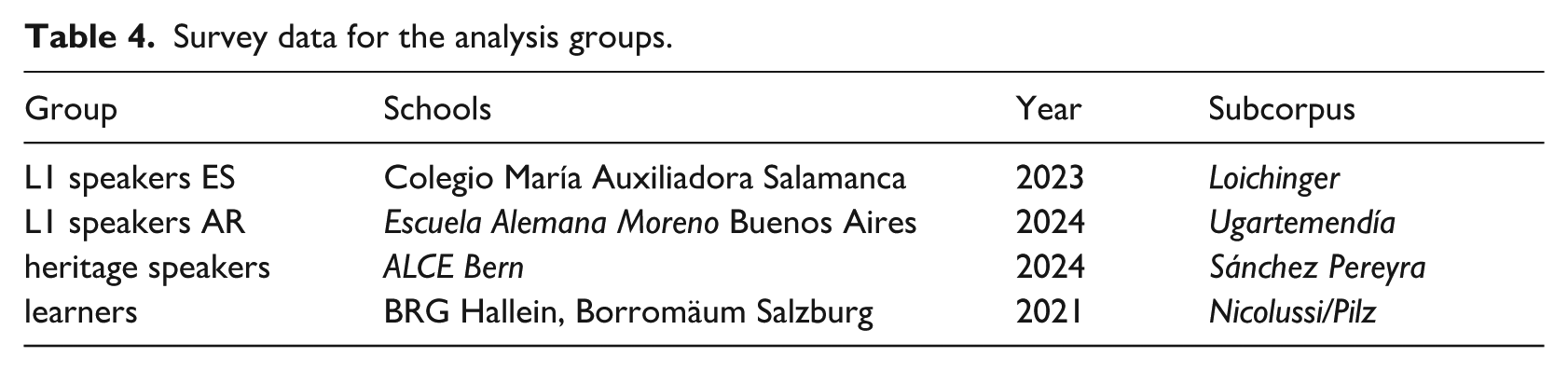
Data collection was conducted by students as part of their final theses or as student assistants within the Munich Learner Corpus Project (Wolf & de Crignis, 2023; Lücke, et al., 2025; see Table 4). The process took place in schools located in Spain, Argentina, Switzerland, and Austria. In 2023, the data for the L1 speakers ES was gathered at Colegio María Auxiliadora in Salamanca, located in the autonomous community of Castile and León, where students pursue the Spanish Baccalaureate (Loichinger subcorpus). The L1 speakers AR were recorded in 2024 at Escuela Alemana Moreno in Buenos Aires Province (Ugartemendía subcorpus), an institution offering an Argentine Baccalaureate with specializations in economics and administration or electromechanical engineering. The data for the heritage speakers (Sánchez-Pereyra subcorpus) was collected in 2024 at the ALCE school in Bern, Switzerland. ALCE (Agrupación de Lengua y Cultura Españolas) is a Spanish Ministry of Education program offering three hours of weekly Supplementary Spanish language and culture instruction to children of Spanish citizens abroad. The learner data (Nicolussi/Pilz subcorpus) was gathered in 2021 in Austria, specifically at BRG Hallein in Hallein (Salzburg province) and Borromäum in Salzburg. Both schools qualify for the Matura 1 and offer Spanish as a second (L3; BRG Hallein) or third foreign language (L4; Borromäum) with a teaching load of three hours per week. Of the 37 learners, 12 (level A2) took part in the data collection at Borromäum and 25 (levels A2 and B1) at BRG Hallein (see Table 4).
Survey data for the analysis groups.
The data was collected using the picture story Frog, Where Are You? (Mayer, 1969), a 29-image wordless narrative widely used in language acquisition research (e.g., CHILDES; Berman & Slobin, 1994). The story follows a boy and his dog searching for a lost frog, encountering various animals before finding it in a pond with a family of frogs. Picture stories facilitate language elicitation by aligning with familiar discourse traditions (Oesterreicher, 1997) while ensuring both data comparability and participants’ expressive freedom. Vocabulary items−particularly nouns (e.g., la rana “the frog”), verbs (e.g., observar “to observe”), and adjectives (e.g., cansado/a “tired”)−were provided beneath each picture to facilitate cognitive processing (Göpferich, 2019), prevent descriptive difficulties due to lexical gaps in the learner group, and enhance data comparability. For instance, the inclusion of observar and la rana under the first image was intended to elicit a construction featuring this verb and la rana as the DO. Compared to shorter narratives like the Dog Story (Heaton, 1966) or the Horse Story (Hickman, 2002), the Frog Story offers a more extensive dataset for analysis. The Frog Story is well-suited for studying DOM in Spanish, as it features human, non-human animate, and inanimate referents in the DO position. The boy and dog frequently act upon the frog and other animals and objects (e.g., searching, calling, carrying), while some animals also interact with them (e.g., lifting, throwing off). The three main protagonists differ in animacy: the boy is human, whereas the dog and frog, both non-human, vary in their interaction capacity with humans, influencing a-marking in Spanish (see chapter DOM in linguistics). The frog’s role is particularly noteworthy, as it evolves into a fable-like character with human-like emotional traits. Specificity−another key factor influencing DOM in Spanish−remains constant in the picture story. While non-specific reference is theoretically possible (e.g., in moralizing clauses like Cuando se buscan ranas. . . “When people search for frogs. . .”), no such instances were found in the corpus. This study therefore examines DOM in specific referents, focusing on variation in animacy.
As most participants were minors, written consent was obtained from their legal guardians. The data collection process was introduced, including an explanation that students would describe the Frog Story in handwriting, using provided vocabulary, and that data would be anonymized and used solely for linguistic research and publication. Data collection took place in schools, with teachers allocating one lesson for this purpose. Before starting, students received written instructions and completed a questionnaire for metadata, anonymizing themselves with initials. The time limit for the task was 40 minutes.
Participants
The productions of a total of 99 participants were analyzed in this study. The data from 29 L1 speakers of (Castilian) Spanish and from 37 German learners of Spanish (second or third foreign language; L3/L4), already used in de Crignis (2025), were supplemented by additional data from 23 L1 speakers of Argentine Spanish and 10 heritage speakers with L1 (Castilian) Spanish and German.
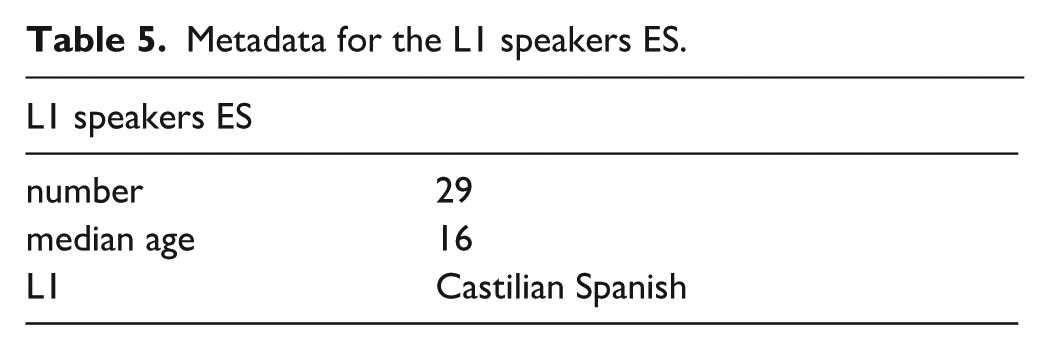
The group of L1 speakers ES consisted of 29 students who were completing the Spanish Baccalaureate and had a median age of 16 at the time of data collection. With the exception of one student born in Béjar (province of Salamanca), all were born in Salamanca and spoke Spanish as their L1. Two students were bilingual in Catalan, one in Chinese, and all had learned English as their first foreign language at school. In addition, 16 students had studied French as a second foreign language (see Table 5).
Metadata for the L1 speakers ES.
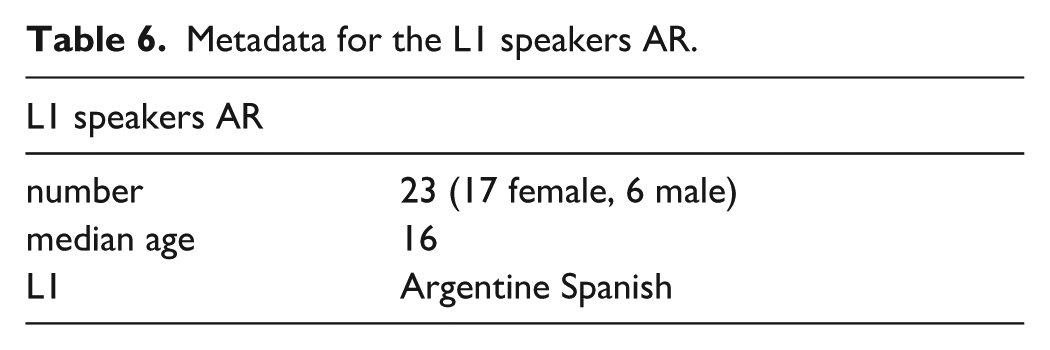
The group of 23 L1 speakers AR, with a median age of 16 at the time of data collection (2024), comprised 23 students from the German School Moreno (Escuela Alemana Moreno) in Buenos Aires Province (see Table 6). In collaboration with the Goethe-Institut, the school provides foreign language instruction, with English as the first foreign language (L2) and German as the second (L3) across early childhood, primary, and secondary education. All participants were born and continued to reside in Buenos Aires Province.
Metadata for the L1 speakers AR.
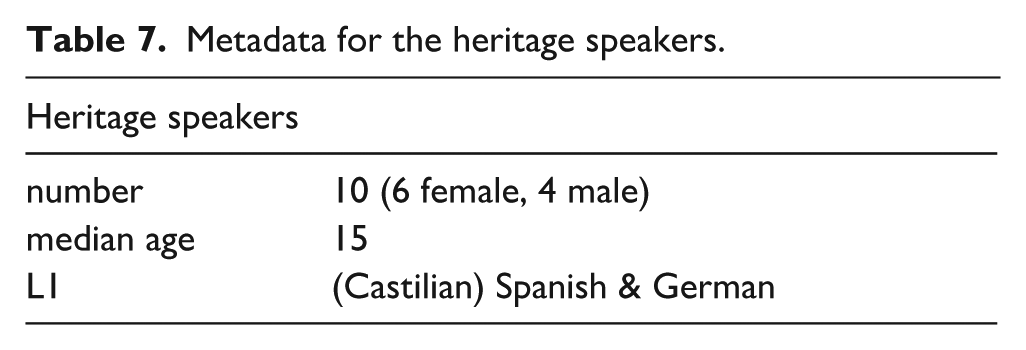
A group of 10 heritage speakers of Castilian Spanish, born and raised in German-speaking Switzerland, was also examined. These speakers acquired Spanish as an L1 from one parent, while German was acquired either as an L1 from the other parent or through exposure to the surrounding German-speaking majority. At the time of data collection (2024), the heritage speakers had a median age of 15 years and were enrolled in the ALCE school in Bern. ALCE (Agrupación de Lengua y Cultura Españolas, “Association of Spanish Language and Culture”) is an educational institution supported by the Spanish Ministry of Education that provides Supplementary instruction in Spanish language and culture for children of Spanish citizens residing abroad. Classes are held outside regular school hours, with a weekly teaching load of three hours. The students were in the 8th or 9th grade at ALCE and mostley in their eighth year of Spanish instruction (see Table 7).
Metadata for the heritage speakers.
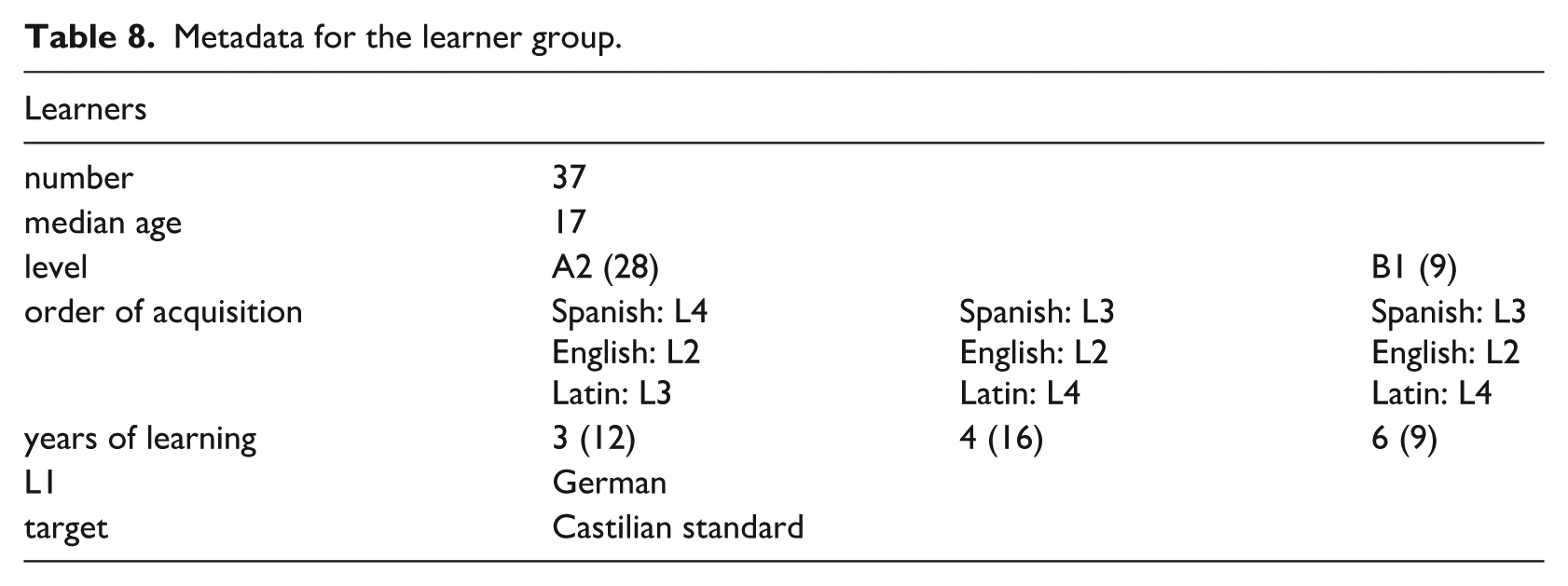
The learner group consisted of 37 participants with a median age of 17 at the time of data collection (2021), all of whom were born and raised in the vicinity of Salzburg and Hallein. Basic (A2) and independent (B1) users are included in the study but analyzed together, as they showed little difference in competence (de Crignis, 2025). Due to a teacher’s cancelation during data collection, the groups were unevenly distributed, with 28 learners in A2−nearly three times the 9 in B1. The learners at the A2 level had been studying Spanish for either three years (12 learners) or four years (16 learners), whereas those at the B1 level were in their sixth year of learning. All participants were L1 German speakers, with English as their first foreign language (L2). The order of subsequent language acquisition varied depending on the school: for the 25 learners from BRG Hallein, Spanish was the second foreign language (L3) and Latin the third (L4), whereas for the 12 learners from Borromäum, this order was reversed, with Latin as L3 and Spanish as L4. Since all languages in the participants’ linguistic repertoire−German (L1), English (L2) and Latin (L3 or L4)−are non-DOM languages, analogical transfer (Morales-Front & Sanz, 2023) to Spanish in terms of DOM acquisition is unlikely. All learners received three hours of Spanish instruction per week, with Castilian Spanish as the target norm in the classroom (see Table 8).
Metadata for the learner group.
An additional analysis group, referred to as the Castilian standard, was derived from the learner data based on error annotation of their DO productions (for details, see chapter Data preparation and analysis). This procedure is based on the assumption that error annotation, conducted according to the norms of the Real Academia Española (RAE), can be used to infer what standard-conforming realizations of the DOs would look like in the context of the Frog Story. The standard-conforming form is determined by examining each DO realization in the learner data (with or without a-marking) and evaluating it based on RAE guidelines. For instance, if a learner produces the sentence *El topo muerde el niño. “The mole bites the boy.,” an error would be annotated, since the RAE prescribes a-marking for human animate definite NPs—thus, the correct form would be El topo muerde al niño. In this case, a-marking is recorded in the Castilian standard group and linked to the relevant DO feature human animate. A master’s graduate in Spanish linguistics and native speaker of Argentine Spanish error-annotated the data following the norms of the Castilian standard. The annotation was based on the guidelines outlined in the Diccionario panhispánico de dudas of the Real Academia Española (RAE & ASALE, 2023), identifying two types of errors:
a-marking was omitted (e.g., *Un topo muerde Ø Pedro. “A mole bites Pedro.”).
a-marking was mistakenly used (error of commission; e.g., *El niño vio a la madriguera “The boy saw the burrow”)
Error annotation was used in this study because errors offer valuable insights into learners’ underlying linguistic knowledge and acquisition processes (Corder, 1975; Ellis, 2006; Thewissen, 2013). As an established method in second language acquisition research, error analysis allows researchers to identify systematic patterns in learner language and to make inferences about developmental stages, which are often marked by the gradual reduction of rule violations in areas such as inflection or agreement (Perdue & Klein, 1992). Despite well-founded criticism of error-based approaches—particularly the assumption of an ideal speaker as a normative benchmark (Bley-Vroman, 1983)— this study addresses such concerns by incorporating data from control groups of monolingual and bilingual L1 speakers. These control groups are treated not as uniform standards but as internally varied, thereby enabling a more differentiated and realistic comparison of learner productions (cf. Granger, 2015; Hasselgård & Ebeling, 2018; Shadrova et al., 2021). Thus, error annotation in this context serves not as a tool of deficit comparison, but as a window into learners’ interlanguage development and a means of capturing variation in both learner and L1 speaker data (see also de Crignis, 2025).
This study allows for multiple comparative perspectives. First, the productions of German learners of Spanish can be analyzed in relation to three distinct L1 groups: heritage speakers, who speak the non-DOM language German as a second L1, and two L1 groups from Spain and Argentina, introducing a diatopic dimension. In addition, both learner and L1 productions can be examined in relation of the normative patterns described in the Castilian standard. The learner productions can thus be analyzed not only in relation to an abstract standard but also in comparison with empirically established explicit norms. In addition, the comparable age of L1 speakers and learners ensures similar cognitive development, minimizing, for example, the potential influence of advanced writing skills that older participants might possess (Gilquin, 2022).
The participants analyzed have produced a corpus comprising approximately 70,500 words and 1,629 DOs available for analysis. As shown in Table 9, the proportions of produced DOs vary, which reflects the differing number of participants across the groups.
Corpus size.
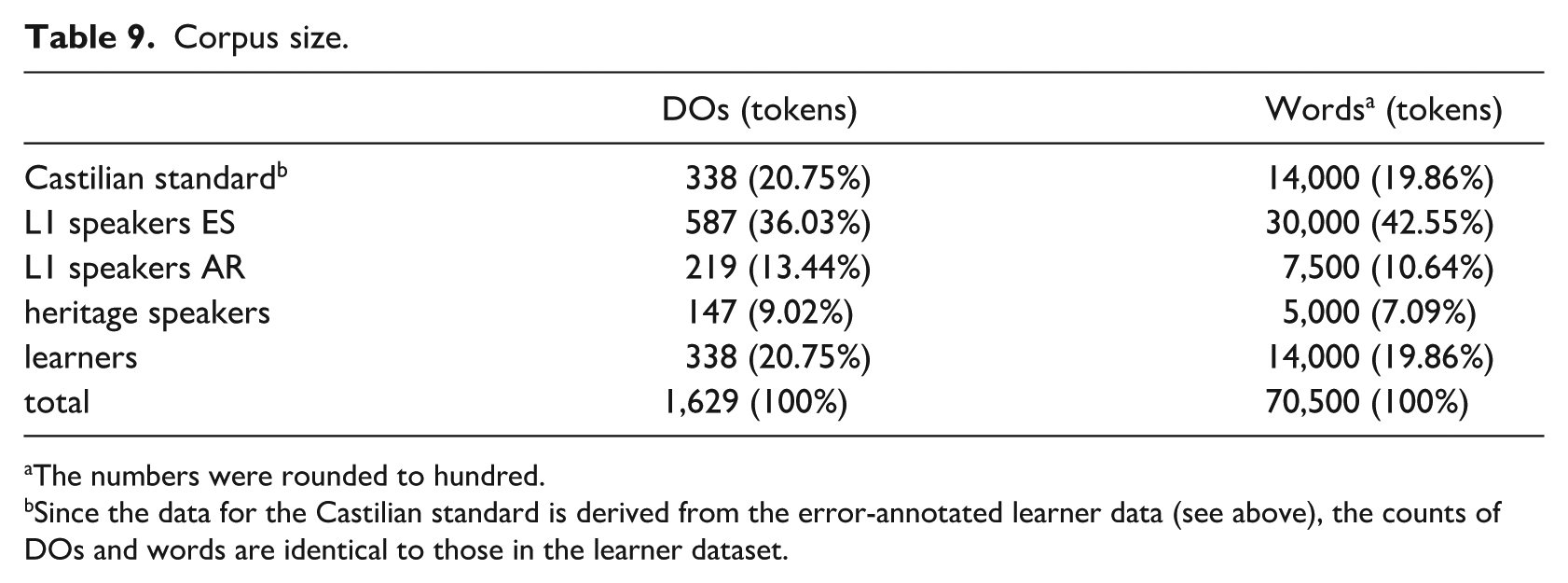
The numbers were rounded to hundred.
Since the data for the Castilian standard is derived from the error-annotated learner data (see above), the counts of DOs and words are identical to those in the learner dataset.
The representativeness of the dataset is limited, particularly due to the fact that data collection was conducted within individual school classes. In addition, the varying group sizes may influence the generalizability of the findings, as some groups are more strongly represented (L1 speakers ES, learners) than others (L1 speakers AR, heritage speakers).
Data preparation and analysis
All participants had anonymized themselves by generating an abbreviation composed of the first letter of their first and last name (e.g., Jane Doe → JD; see also chapter Data collection). During data preparation, each participant was additionally assigned a randomly generated number (e.g., JD1). The students’ handwritten productions were transcribed into digital form by student assistants using a text editor. The transcription process maintained the original form of the handwritten data, with no corrections to grammar or spelling. I manually examined the transcribed productions for constructions containing a DO, excluding prepositional objects introduced by the preposition a (e.g., ladrar a la colmena “to bark at the beehive”). All identified DO constructions were listed in an Excel sheet, where the following categories were coded (see Table 10):
Coding of variables and values.
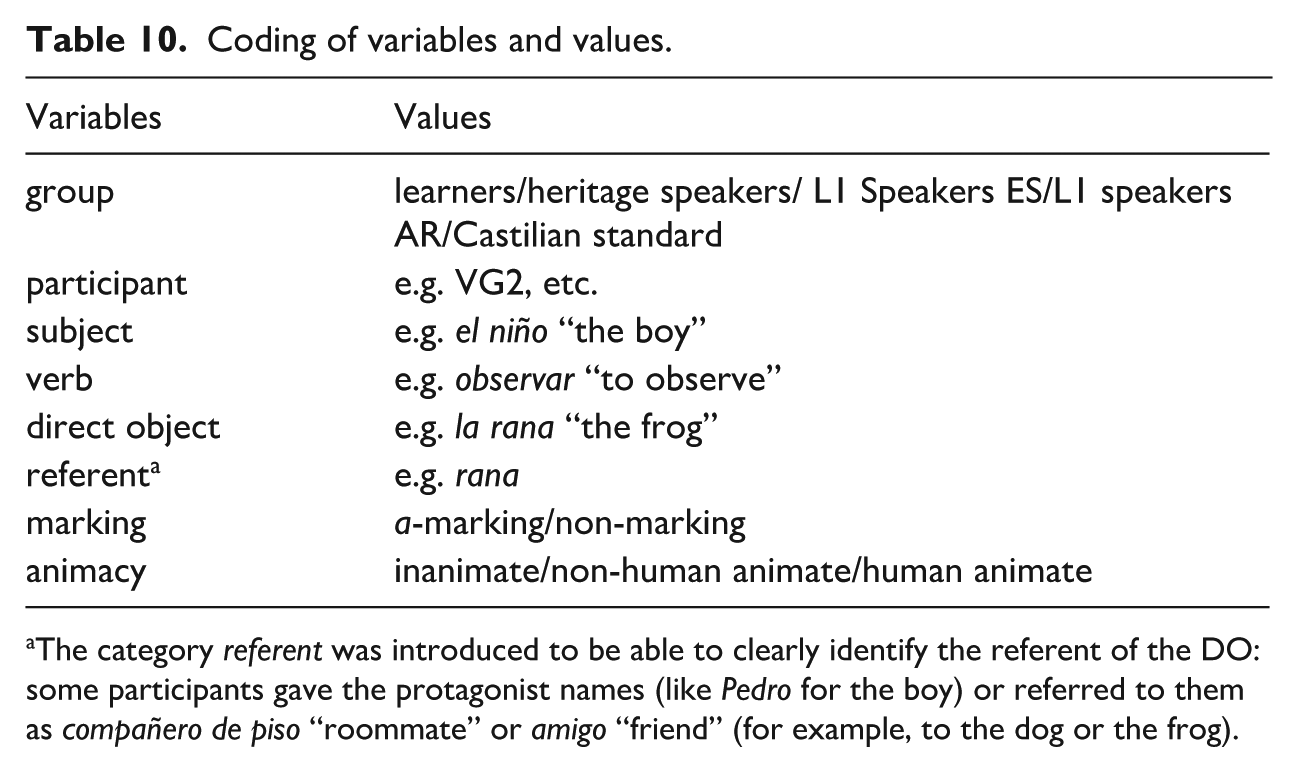
The category referent was introduced to be able to clearly identify the referent of the DO: some participants gave the protagonist names (like Pedro for the boy) or referred to them as compañero de piso “roommate” or amigo “friend” (for example, to the dog or the frog).
In the learner group, language proficiency level (A2/B1) was additionally coded, along with the presence (yes) or absence (no) of a standard error annotation. The standard error annotation had been previously conducted by a master’s graduate in Spanish linguistics and native speaker of Argentine Spanish, in accordance with the rules outlined in the Diccionario panhispánico de dudas of the Real Academia Española (RAE & ASALE, 2023; see also chapter Participants). The Castilian standard analysis group comprises the learner productions (see chapter Participants) and the coding of the variable marking as either a-marking or non-marking. Standard-conforming instances of a-marking and non-marking were determined from the learner data and the aforementioned standard error annotation as follows:
– a-marking in the Castilian standard analysis group:
o a-marking in the learners’ data + standard error annotation = no
o non-marking in the learners’ data + standard error annotation = yes
– non-marking in the Castilian standard analysis group:
o non-marking in the learners’ data + standard error annotation = no
o a-marking in the learners’ data + standard error annotation = yes
Thus, the data for the analysis groups learners, heritage speakers, L1 speakers ES and L1 speakers AR were prepared and analyzed according to the same set of criteria. The Castilian standard analysis group, while derived from the learner data through RAE-based error annotation, was likewise analyzed using the same criteria as the other groups.
The data analysis was performed in R (R Core Team, 2024) using the tidyverse collection of packages (Wickham et al., 2019). For data visualization, the ggplot2 package (Wickham, 2016) was used.
Results
In this chapter, I will first provide a brief discussion of the a-marking of inanimate (chapter a-marking of inanimate DOs: metonymy) and human animate DOs (chapter non-marking of human animate DOs: constructions with haber and tener) across the analyzed speaker groups, before offering a more detailed analysis of the a-marking of non-human animate DOs (chapter a-marking of non-human animate DOs: prototype effects). The innovative aspect of the analyses in chapters a-marking of inanimate DOs: metonymy and non-marking of human animate DOs: constructions with haber and tener lies primarily in the comparison between learner data and the productions of L1 speakers ES (de Crignis, 2025) with those of heritage speakers and L1 speakers AR. The analysis presented in chapter a-marking of non-human animate DOs: prototype effects is entirely novel.
a-marking of inanimate DOs: metonymy
a-marking of inanimate DOs is absent from the Castilian standard and rare across all L1 groups and the learner group (Castilian standard: 0%, L1 speakers ES: 2%, L1 speakers AR: 4.35%, heritage speakers: 1.32%, learners: 0.74%; see Figure 2), and when it occurs, it typically involves metonymic use in L1 productions.
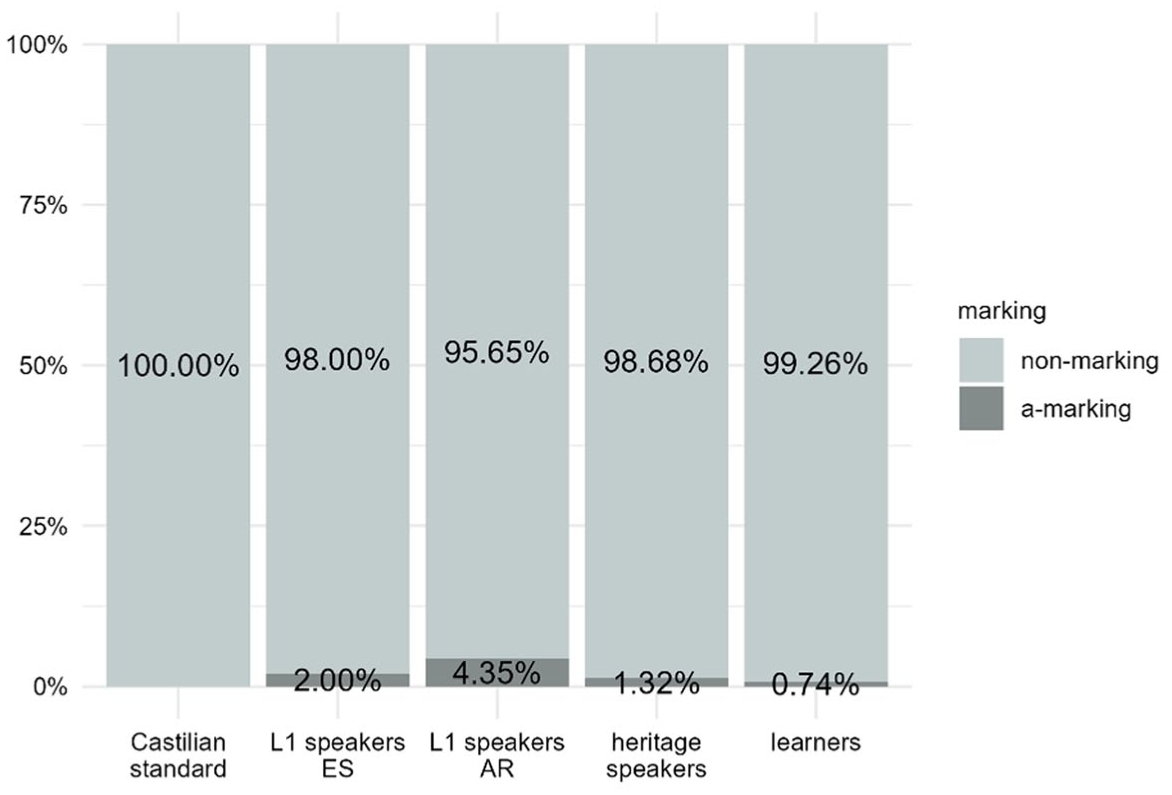
a-marking of inanimate DOs.
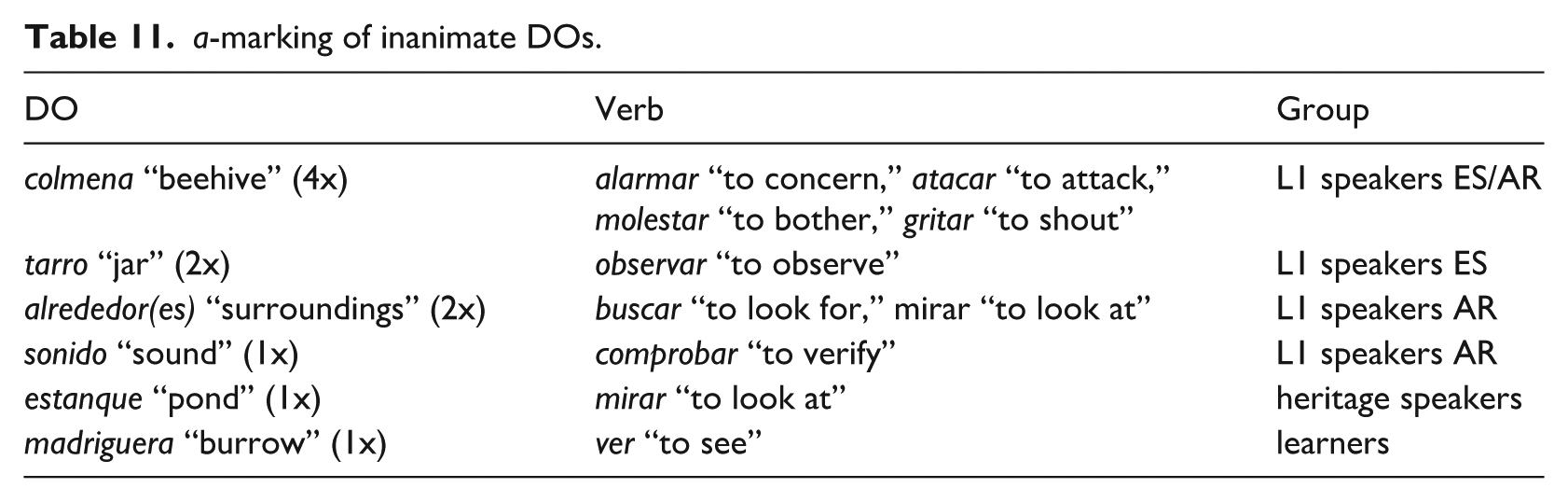
The most frequent instance is the inanimate beehive, la colmena (L1 speakers ES: 3 occurrences, L1 speakers AR: 1 occurrence), which appears as the DO in conjunction with verbs semantically associated with (human) animate DOs, such as alarmar (“to concern”), atacar (“to attack”), molestar (“to bother”), and gritar (“to shout”). In these cases, the beehive metonymically represents the animate swarm of bees inside it.
In two instances among L1 speakers ES, the inanimate jar is used metonymically to represent the animate frog inside, which is being observed by the boy. In both cases, the verb used is observar (“to observe”; see already de Crignis, 2025: p. 7). Similarly, the sequences comprobar al sonido (“to verify the sound,” where the sound refers to the frog’s croaking; L1 speakers AR) and mirar al estanque (“to look at the pond”; heritage speakers) also seem to be metonymic: the inanimate croaking of the frog can be interpreted as standing metonymically for the animate frog, and the inanimate pond can be seen as symbolizing the boy and the dog that had fallen into it. A more complex case involves two occurrences from L1 speakers AR, where alrededor(es) (“surroundings”) is used as the DO in buscar a su alrededor and mirar a sus alrededores. Upon reconsidering these sequences, I concluded that they may reflect variation in the use of the prepositions a (“to”) and en (“in”), 2 making their translations more likely “to seek out in his/their surroundings,” with no DO involved. When these two cases are excluded from the analysis, the rate of a-marking for inanimate DOs among L1 speakers AR decreases to 2.17%, aligning it with the rate observed in L1 speakers ES (2%) and being close to that of the heritage speakers with 1.32%. Finally, the sequence ver a la madriguera (“to see the burrow”) within the learner group must be considered an error of commission, as no metonymic (or even metaphorical) use can be identified (see Table 11).
a-marking of inanimate DOs.
Non-marking of human animate DOs: constructions with haber and tener
The a-marking rates for human animate DOs are approximately 90% across all L1 groups and the Castilian standard, making non-marking an exceptional occurrence. In contrast, the learner group exhibits the opposite pattern, with an a-omission rate of nearly 90%. This reflects a low level of proficiency as already pointed out in de Crignis (2025), as the grammar rule taught in school prescribes a 100% a-marking of animate DOs in general (see Figure 3; see chapter Acquisition of DOM by learners and heritage speakers).
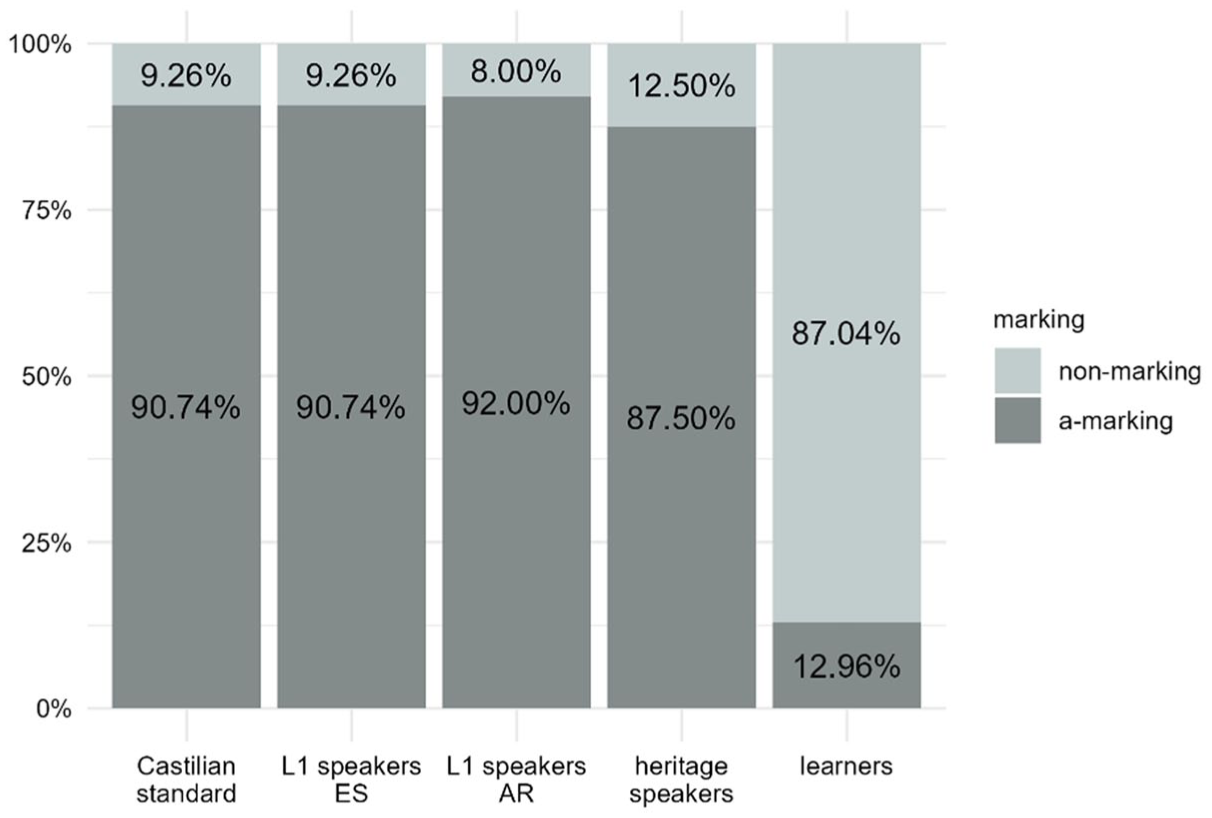
a-marking of human animate DOs.
The Castilian standard aligns with all L1 speaker productions in its consistent non-marking of human animate DOs when they appear with the verbs haber “there is” and tener “to have” (see also de Crignis, 2025). These cases account for 50% of the instances of non-marking of human animate DOs in the corpus. Another example occurs in the sequence encontrar una familia (“to find a family”; L1 speakers ES). The verb encontrar is polysemous, meaning either “to find” or “to meet,” and it normally inhibits a-marking when used in the sense of “to find” (Delbecque, 2002), as is the case here. The three remaining instances represent rather atypical cases of non-marking of human animate DOs: perseguir el niño (“to chase the boy”; L1 speakers ES), observar el niño (“to observe the boy”; L1 speakers AR), and atrapar la niña (“to catch the girl”; heritage speakers). The sequence observar el niño can probably be explained by the fact that in the original sentence, the verb is followed by a DO with two coordinated constituents: El perro observa la colmena y el niño. “The dog observes the beehive and the child.” The first constituent, la colmena “the beehive,” is inanimate and unmarked, which probably caused the second one (el niño “the boy”) to be unmarked as well (within-speaker syntactic priming). The cases of perseguir el niño and atrapar la niña could be explained possibly from the perspective of Delbecque’s (2002) construction analysis: It could be assumed that the speakers intended to downgrade the agentivity of the respective DOs by using constructions with non-marking. Indeed, in both described scenes, the child is depicted as helpless and in a position of inferiority−being pursued by the owl in the first case and lifted by the deer’s antlers in the second.
a-marking of non-human animate DOs: prototype effects
Surprisingly, there are differences between the native speaker groups regarding the a-marking of non-human animate DOs: While the L1 speakers ES and AR behave very similarly, the heritage speakers deviate considerably from them and show similar results as expected by the Castilian standard. As can be seen in Figure 4, the L1 speakers ES and AR both have high a-marking rates of approximately 83% and 86% respectively, approaching their rates for human animate DOs (91% and 92%). In contrast, while heritage speakers demonstrated a comparable a-marking rate of approximately 88% for human animate DOs−similar to that of the monolingual L1 speaker groups−their rate for non-human animate DOs dropped to around 45%. This represents a nearly 50% decrease and approximates the rate in the Castilian standard, which stands at approximately 39%. The learner group exhibits an a-marking rate of only approximately 9%, which is substantially lower than the 100% prescribed by the school grammar rule (see chapter Acquisition of DOM by learners and heritage speakers), once again indicating a low proficiency level. Surprisingly, however, the L1 speakers ES and AR closely align with this expected norm! Even when compared to the expected rates of the Castilian standard, the a-marking rates should be nearly four times higher than those observed among the learners.
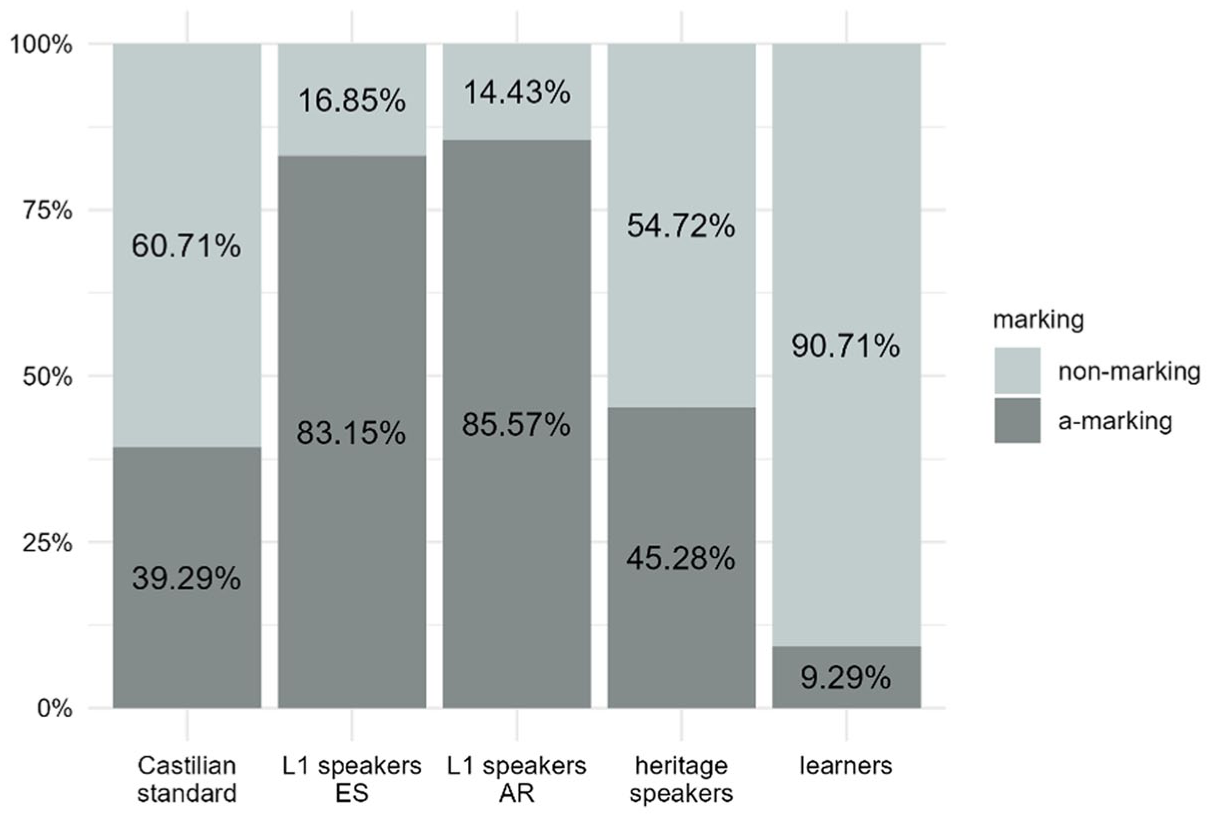
a-marking of non-human animate DOs.
This pattern also repeats in the a-marking of the frog and the dog, which appear by far most frequently as non-human animate DO in the overall corpus (frog: 64.13%, dog: 26.83%) 3 and in the individual speaker groups (see Table 12).
Frog and dog as most frequent DOs.
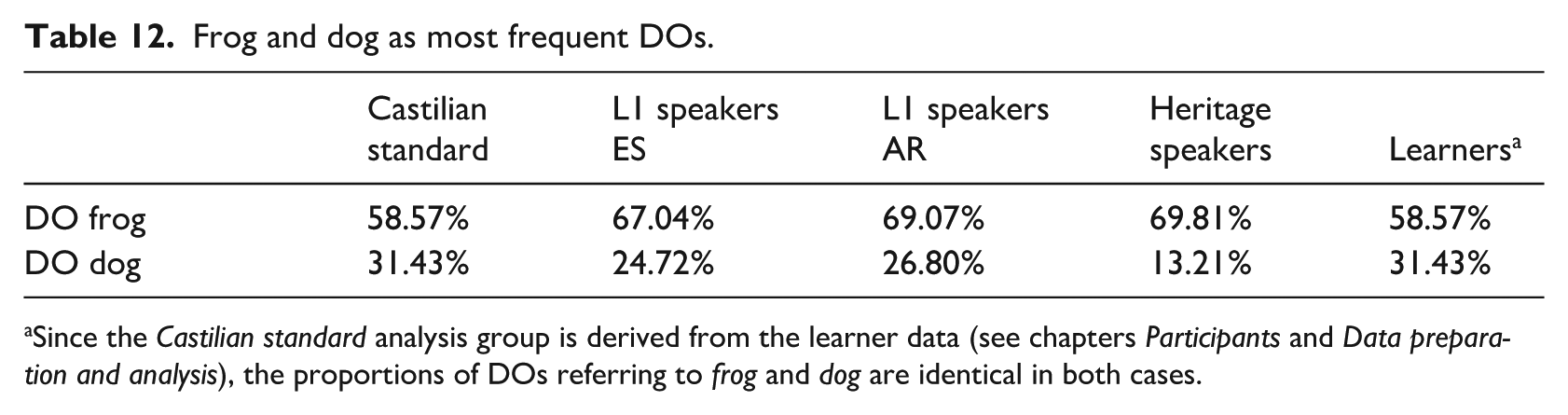
Since the Castilian standard analysis group is derived from the learner data (see chapters Participants and Data preparation and analysis), the proportions of DOs referring to frog and dog are identical in both cases.
As can be seen in Figure 5, a-marking of the dog is almost generalized among the L1 speakers ES and AR, with a-marking rates of approximately 91% and 89%, respectively. In contrast, the heritage speakers exhibit an a-marking rate that is about 20 percentage points lower (approx. 71%), aligning closely with the expectations of the Castilian standard (around 73%). Similarly, the L1 speakers ES and AR demonstrate comparable a-marking rates for the frog (approx. 83% and 85%, respectively), although these figures are slightly lower than those observed for the dog. Among the heritage speakers, however, the a-marking rate for the frog drops to approximately 38%, which is nearly half of that found in the monolingual L1 speaker groups and much closer to the rate of the Castilian standard (around 26%). The learner group, in turn, exhibits consistently low a-marking rates for both the dog and the frog (approx. 7% and 9%, respectively), reflecting their overall low a-marking rates for non-human animate DOs.
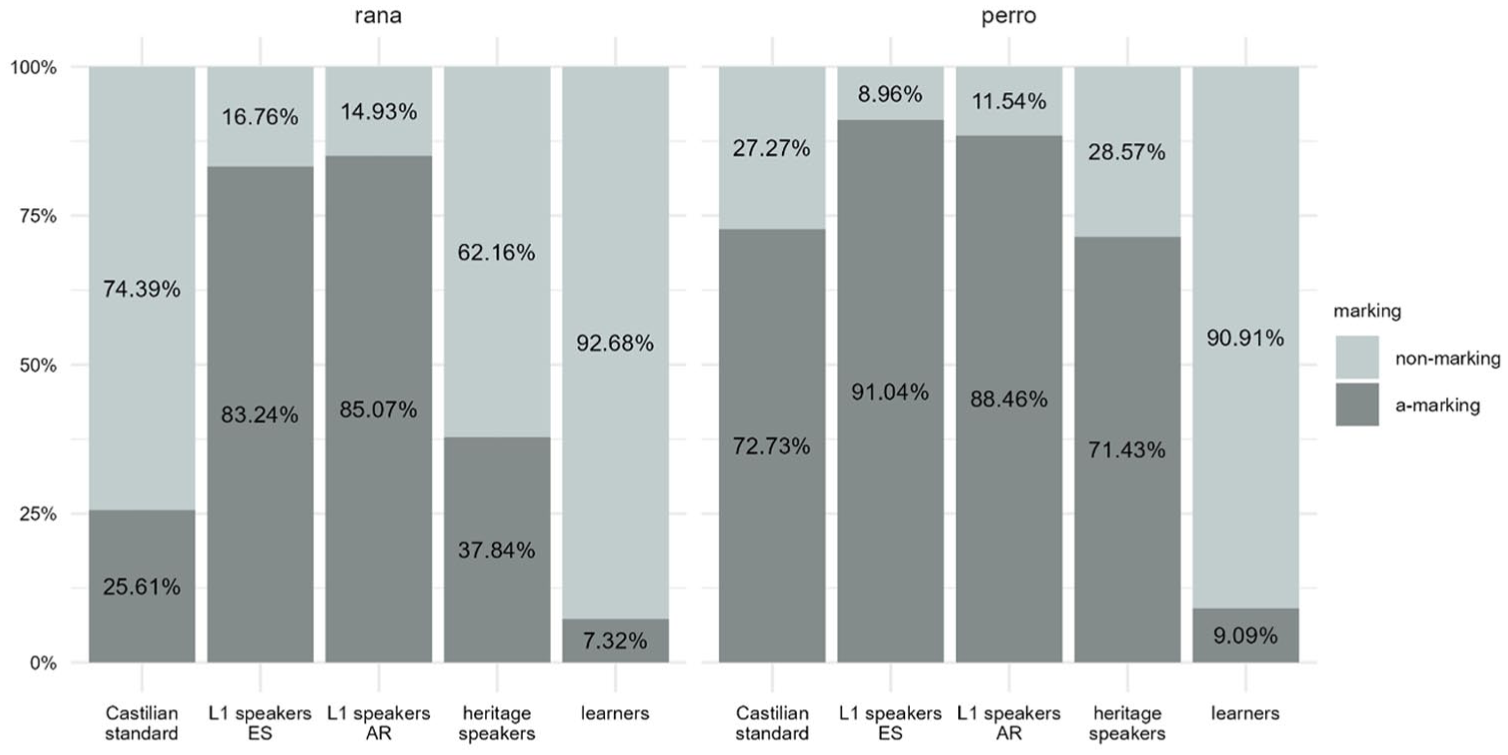
a-marking of frog (“rana”) and dog (“perro”).
The overall pattern observed here suggests that heritage speakers, in line with the expectations of the Castilian standard, exhibit a high degree of sensitivity to animacy differences within the non-human animate domain, differentiating between referents that are far apart in the hierarchy (dog and frog). In contrast, the monolingual L1 speaker groups demonstrate lower sensitivity in this regard, as they tend to generalize a-marking, at least for the two referents in DO positions observed here. A similarly low level of sensitivity is also evident in the learner group; however, in their case, this manifests as consistently high a-omission rates rather than a tendency to generalize a-marking.
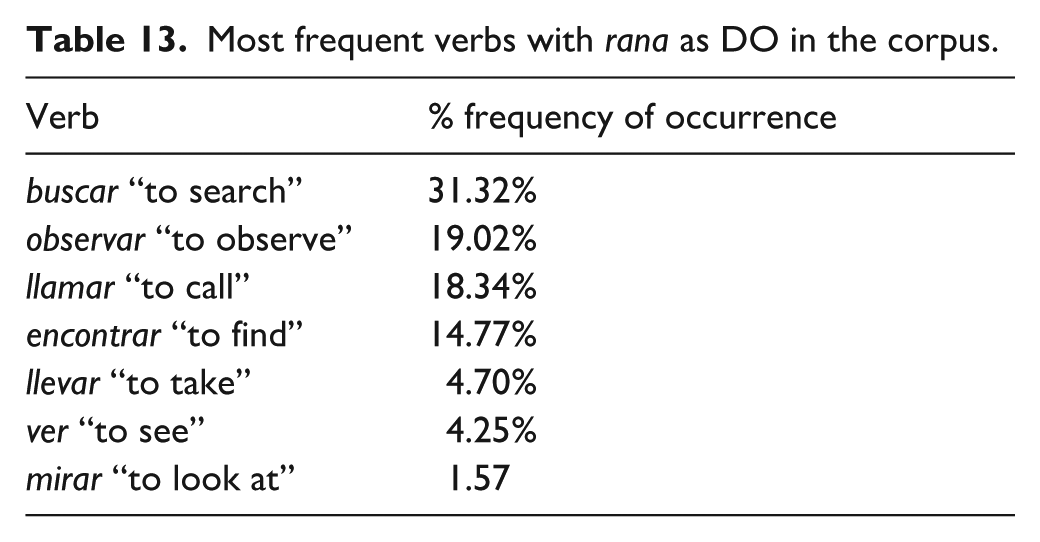
Since the frog is the most frequent non-human animate DO across all speaker groups (see above), I maintained it as a stable DO in the next step and examined the most frequent verbs occurring with it. As shown in Tables 13 and 14, the verbs buscar “to search,” observar “to observe,” llamar “to call” and encontrar “to find” occur most frequently with the frog as DO in the corpus, together accounting for approximately 80%. This pattern holds true across the individual speaker groups, with buscar being the most frequent verb in all of them, though with variations in the ranking of the other verbs.
Most frequent verbs with rana as DO in the corpus.
Most frequent verbs with rana as DO by speaker group.
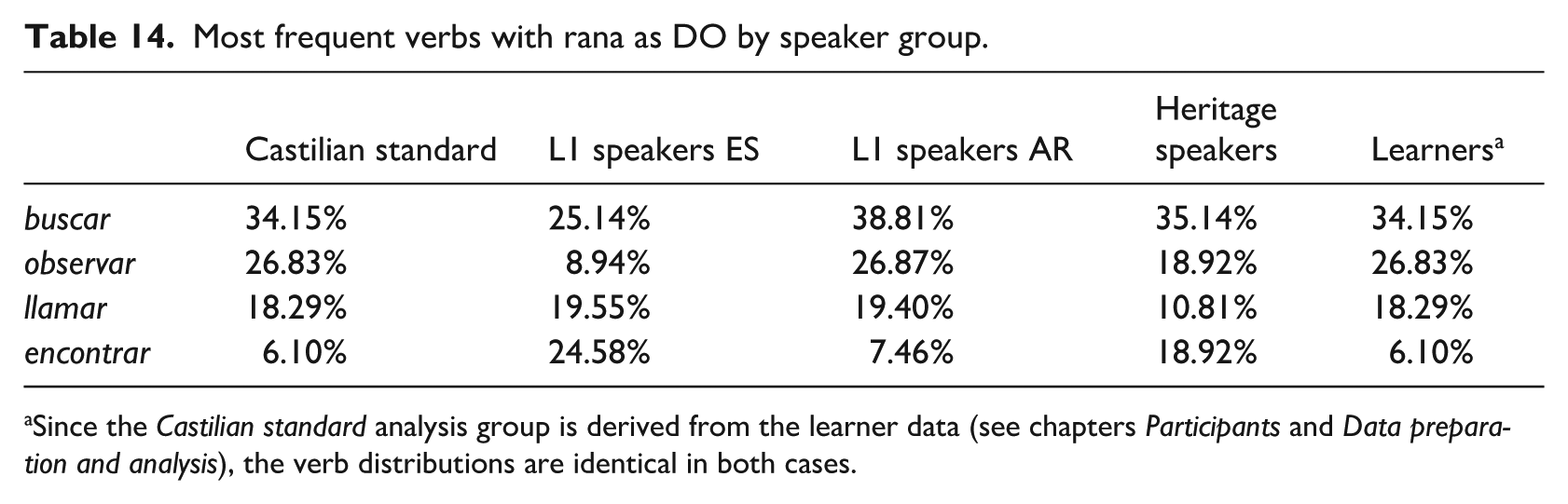
Since the Castilian standard analysis group is derived from the learner data (see chapters Participants and Data preparation and analysis), the verb distributions are identical in both cases.
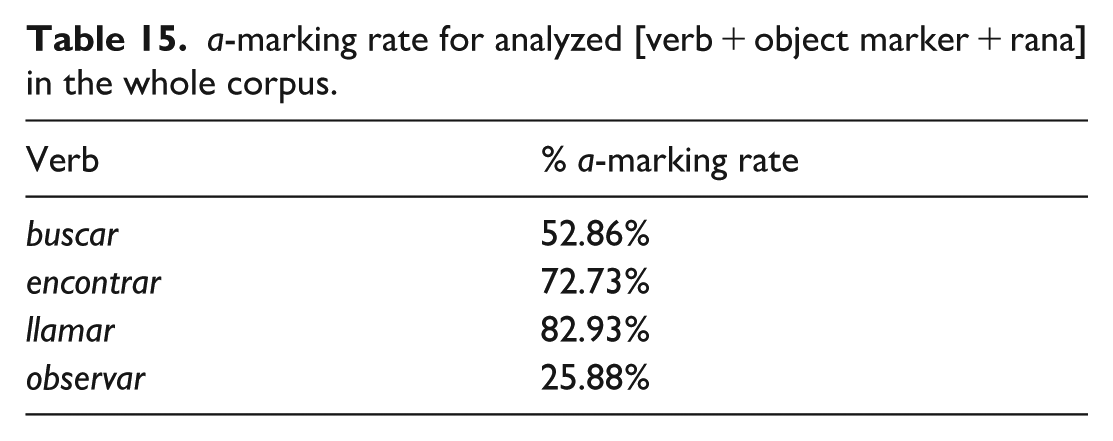
The corpus as a whole shows interesting differences in the a-marking with the four verbs: the verbs llamar and encontrar are followed by a-marked DOs in a relatively high proportion of cases (approx. 83% and 73% respectively), buscar shows a-marking in about half of all cases (approx. 53%), and observar in only about a quarter of cases (approx. 26%; see Table 15).
a-marking rate for analyzed [verb + object marker + rana] in the whole corpus.
The a-marking rates for llamar are 100% or almost so in all L1 groups (L1 speakers ES and AR, heritage speakers), and the rate is also high in Castilian standard at around 87%. Even in the learner group, there seems to be an intuition for a-marking with the verb llamar, as the rate here is the highest among the four verbs studied. For the other three verbs, however, the pattern already observed for the a-marking of non-human animate DOs in general is repeated: the L1 speakers ES and AR always have higher and comparable a-marking rates than the heritage speakers, who are closer to the rates of the Castilian standard. However, the rates are highest for the verb encontrar, fall for buscar, and are lowest for observar, where the rates for the heritage speakers and the Castilian standard are zero (see Figure 6).
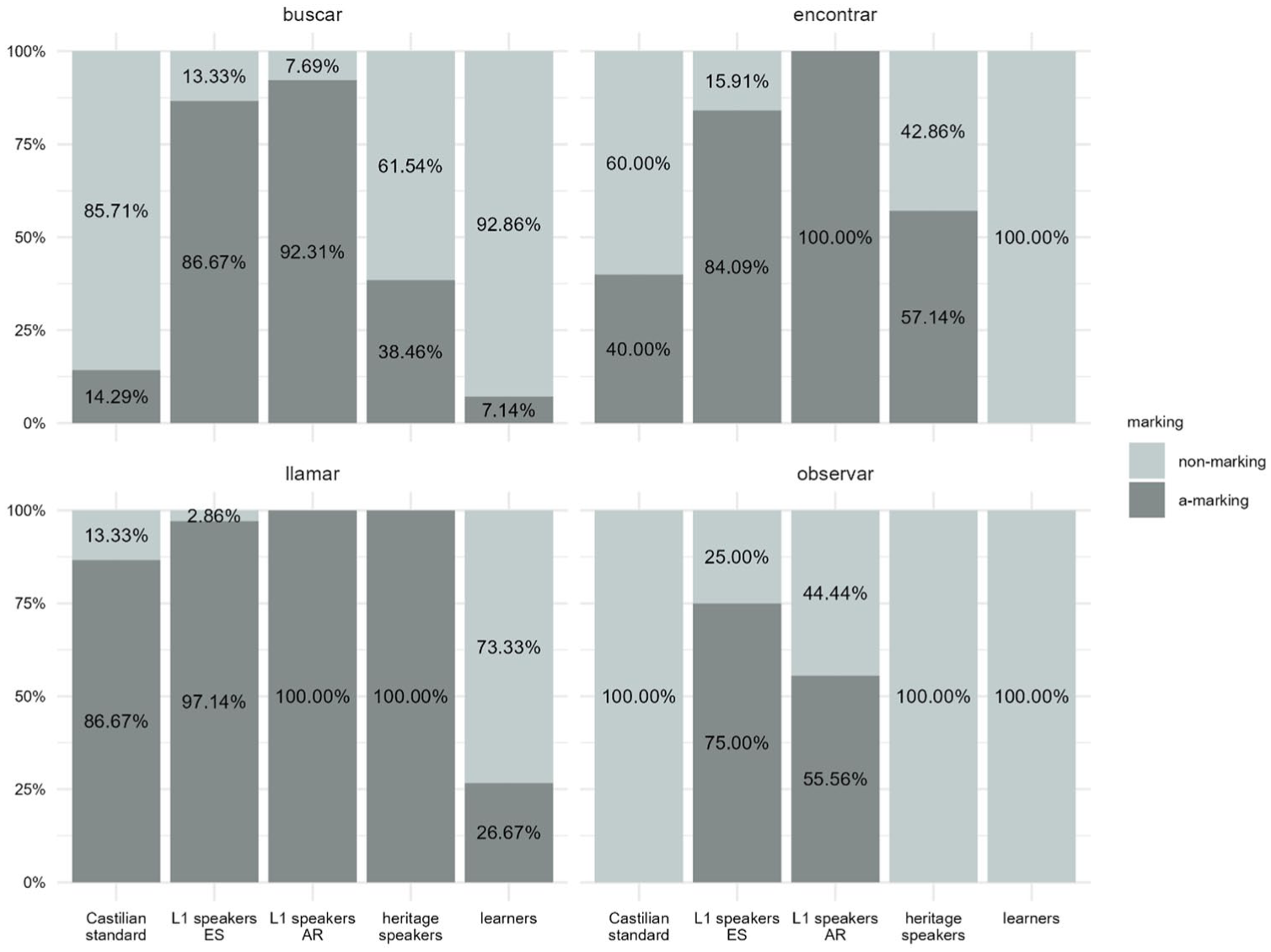
a-marking rates for analyzed [verb + object marker + rana] by group.
These differences could be related to the semantic profile of the verbs: Central to the verb llamar is that someone, typically verbally, tries to get the attention of another person (RAE, 2024). In our case, we have a non-typical use of llamar, in which an animal, the frog, is attributed the human-like ability to interact with other humans as it is being called and the attempt is made to attract its attention. As already mentioned in chapter DOM in linguistics, only some animals have the ability to interact with humans to some extent, for example some pets such as dogs, but frogs do not have it. In the picture story, however, the frog progressively acquires human-like characteristics (see chapter Data collection), as it is portrayed as capable of interacting with humans, making it eligible to be addressed (i.e., called) directly.
The verb llamar is distinct from the other three verbs (buscar, encontrar, observar) due to its typically human animate DO, while the other verbs can occur with both animate (human and non-human) and inanimate DOs. It is equally possible to search for, find, and observe both animate and inanimate referents (RAE, 2024). In the case of observar, another factor may account for the lower a-marking rates. Approximately 90% of its occurrences are concentrated at the very beginning of the story, specifically in sentences 1 and 2 (with about 71% in sentence 1% and 19% in sentence 2). After these initial occurrences, observar appears only sporadically. In contrast, llamar also appears somewhat more frequently at the beginning of the story, but its occurrences are more evenly distributed throughout the section in which it appears (see Figure 7).
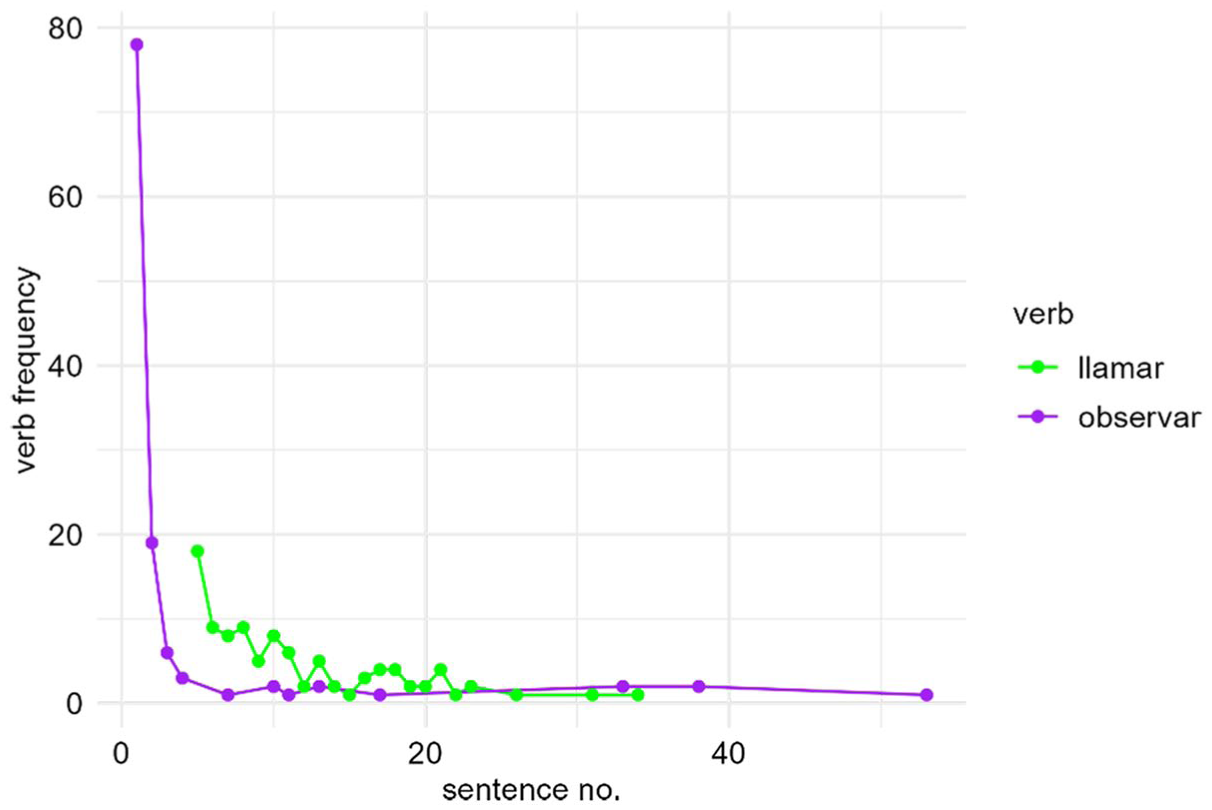
Frequency of the verbs llamar and observar by sentence number.
At the beginning of the story, the frog does not yet have any human-like characteristics; these develop slowly over the course of the story and culminate at the end of the story, when the frog has a family and shows human feelings (e.g., happiness and being in love). The lower a-marking rates could therefore also be related to the fact that, at the beginning of the story, the frog is perceived more as an ordinary frog, placing it closer to the inanimate domain, where non-marking is the general pattern (see chapter DOM in linguistics). A comparison of the a-marking rates for rana with the verb observar in sentences 1% and 2 (50% a-marking) versus the remaining contexts (75% a-marking) across all L1 groups appears to support this assumption. However, given the low number of occurrences of observar in the other contexts (4 instances compared to 37 in sentences 1 and 2), this result should be interpreted with caution. Further subdivision by individual L1 groups is not feasible due to the limited number of tokens.
The verbs buscar and encontrar exhibit a reverse semantic relation: buscar (“to search”) is an action aimed at achieving the result of encontrar (“to find”), which is the outcome of the search. The differing rates of a-marking for these verbs (approx. 53% for buscar and 73% for encontrar) thus require an explanation. While buscar (similar to observar) appears frequently at the beginning of the story but then declines sharply, disappearing entirely after sentence 36, encontrar is more evenly distributed throughout the text, exhibiting only local peaks (see Figure 8).
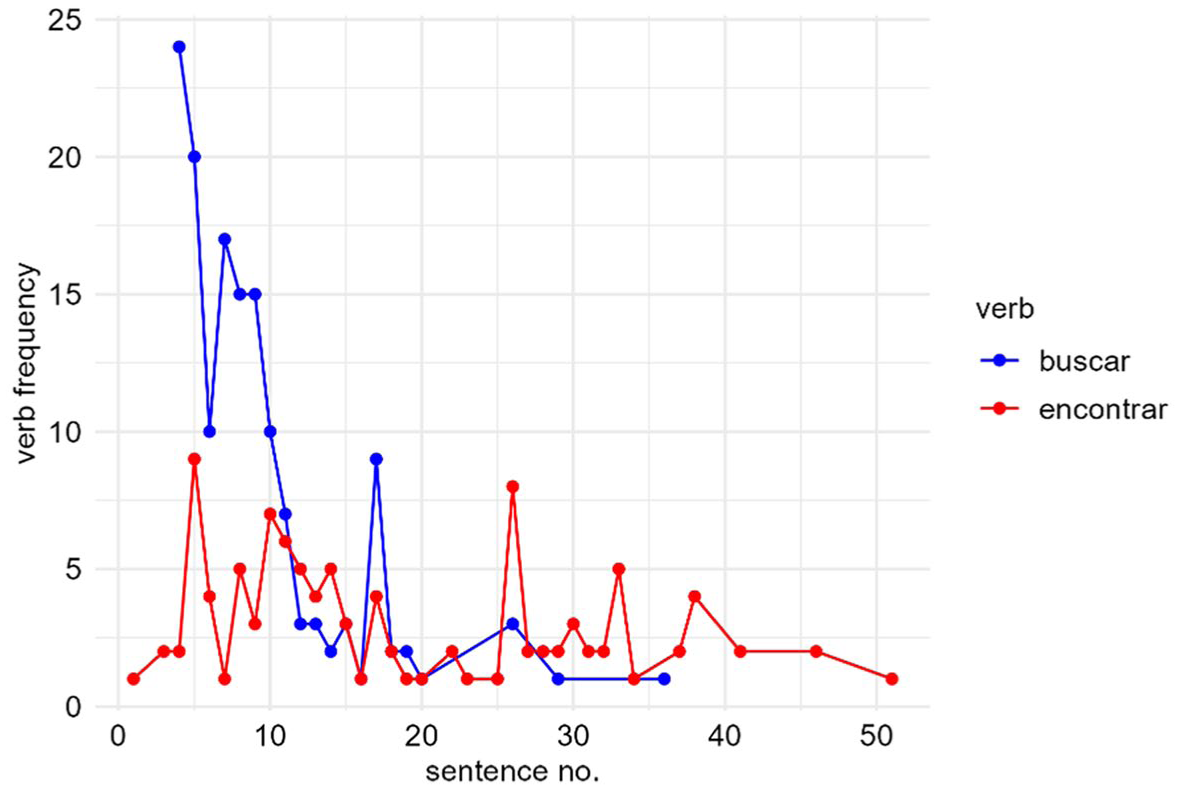
Frequency of the verbs buscar and encontrar by sentence number.
I propose a similar explanation for the pattern observed in buscar as in observar: its concentration at the beginning of the story, when the frog behaves as an ordinary frog, may account for the lower a-marking rates.
Furthermore, Figure 6 shows that L1 speakers ES and AR exhibit similar behavior for both buscar and encontrar, with consistently high a-marking rates (approximately 87% and 92% for buscar, and 84% and 100% for encontrar, respectively). In contrast, a-marking rates for buscar are considerably lower among heritage speakers and, especially, in the Castilian standard, compared to encontrar (buscar: approximately 57% and 40%; encontrar: 39% and 14%). This suggests that while L1 speakers ES and AR follow a more conventionalized pattern for both verbs, heritage speakers and the Castilian standard may be more sensitive to the evolving role of the frog within the narrative—from an ordinary frog at the beginning of the story to one that acquires human-like characteristics over time. This shift could be reflected in the lower a-marking rates for buscar compared to encontrar. This sensitivity is especially pronounced in the case of the aforementioned verb observar, where a-marking rates among heritage speakers and in the Castilian standard are as low as 0%.
Overall, while L1 speakers ES and AR are approaching conventionalized a-marking in this dataset, particularly for the verbs buscar, encontrar, and llamar, heritage speakers exhibit greater variability in a-marking and heightened sensitivity to the exemplified prototype effects in chapter DOM in linguistics, resembling the pattern observed in the Castilian standard. The higher a-marking rate for llamar among learners may suggest an emerging intuition for prototype effects in Spanish DOM.
Discussion and conclusion
No differences were observed among the three L1 groups in the a-marking of inanimate DOs. A rare strategy across all L1 groups for incorporating inanimate DOs into the a-marking category involves metonymic use, sometimes in combination with verbs that are semantically associated with (human) animate DOs. In the learner group, a-marking of inanimate DOs is also an exceptional case; however, unlike in the L1 groups, it cannot be classified as a competence but rather as an error of commission. The three L1 groups also exhibited similar patterns in the a-marking of human animate DOs. Non-marking of human animate DOs is rare across all L1 groups and the Castilian standard. When it does occur, it is often found in constructions with haber and tener. In addition, non-marking can sometimes appear in L1 speaker groups to possibly convey subtle distinctions in the agentivity of the DO. In contrast, the high rate of a-omission among learners reflects their low DOM proficiency. Interesting differences between the L1 speaker groups emerged from the analysis of non-human animate DOs: While all L1 speaker groups showed comparable high a-marking rates for the human animate DOs at around 90%, the a-marking rate of the heritage speakers dropped down to approximately the half for the non-human animate DOs being in line with the rates of the Castilian standard, but the L1 speakers ES and AR were approaching the a-marking rates of the human animate DOs when a-marking the non-human animate DOs. Whereas the low a-marking rate at around 9% in the learner group contrasts sharply with 100% prescribed by the school grammar, the L1 speakers ES and AR closely align with this expected rule! Furthermore, it could be seen that heritage speakers, consistent with the Castilian standard, show high sensitivity to animacy differences among non-human animate DOs, distinguishing between referents like dog and frog. In contrast, monolingual L1 speakers tend to generalize a-marking, showing low sensitivity; learners display low sensitivity through consistently high a-omission rates. L1 speakers ES and AR demonstrate near conventionalized a-marking for buscar, encontrar, and llamar, while heritage speakers show greater variability and heightened sensitivity to animacy differences, aligning with the Castilian standard. The relatively elevated a-marking rate for llamar among learners suggests an emerging intuition for prototype effects in Spanish DOM.
It has thus been confirmed that L1 speakers ES and AR show similar a-marking patterns throughout the animacy spectrum in this dataset. Their stronger tendency toward a-marking in the non-human animate domain, compared to the Castilian standard, has also been confirmed. The learner group exhibits limited sensitivity to the variability of DOM in the non-human animate domain, although there are indications of intuitive recognition of animacy differences when verbs typically associated with human animate DOs are involved. While heritage speakers occupy an intermediate position between learners and monolingual L1 speakers, this does not imply that they experience attrition. The data suggest that they are fairly proficient in the Castilian standard, likely due to strong exposure to the standard norm in the classroom at the ALCE school. In contrast, monolingual L1 speakers are strong representatives of the grammar rules taught in schools in the context of foreign language didactics, whereas the learners, with their very high omission rates, are poor representatives of this norm for this dataset.
Based on this dataset, the rare instances of metonymic use in inanimate contexts and sporadic cases of non-marking in human animate contexts appear negligible in the context of foreign language learning. In contrast, the systematic non-marking with the verbs haber and tener across all L1 speaker groups highlights the need to explicitly address this exception in the classroom, as previously suggested by Caro Reina (2022). Furthermore, the findings support the validity of the school grammar rule mandating a-marking for all animate DOs, when considering the productions of L1 speakers ES and AR. This stands in contrast to critiques arguing that the school grammar rule is overly simplistic and hinders learners from fully acquiring DOM. This study, however, excludes non-specific reference due to the nature of the task (picture story description). Non-specific reference adds an additional layer of complexity to the acquisition process. Nevertheless, it might be worth questioning to what extent non-specific reference plays a role in the actual language use of foreign language learners.
The comparison between the Castilian standard and the monolingual L1 speakers reveals substantial differences in the use of a-marking in this corpus. Most strikingly, L1 speakers show a marked tendency to generalize a-marking in the non-human animate domain: their a-marking rates for non-human animates (83% for L1 speakers ES, 86% for L1 speakers AR) approach those for human animates (91% and 92%, respectively). In contrast, the Castilian standard maintains a much lower a-marking rate for non-human animates (approx. 39%), thereby clearly distinguishing them from human animates, which receive a-marking in approximately 91% of cases. The case of the frog is especially illustrative—despite its low position on the animacy hierarchy and its small size, it receives high a-marking rates from L1 speakers (91% for ES and 88% for AR), nearly matching those of the dog (83% and 85%, respectively). In contrast, the Castilian standard adheres more strictly to animacy hierarchies and prototype effects in the non-human animate domain, clearly distinguishing, for instance, between the dog and the frog by applying a-marking in 73% of cases when the dog appears in DO position, but in only 26% of cases when the frog does. This pattern follows the description provided by the RAE, which states that a-marking is very frequent with nouns denoting domestic animals (e.g., the dog), but infrequent with those referring to non-domestic animals (e.g., the frog; RAE & ASALE, 2023).
While the findings presented here are preliminary, they offer valuable insights and a promising foundation for further investigation. It should be noted that the study is based on data of individual school classes, and that the heritage speaker group is somewhat unbalanced in comparison to the other participant groups, which may limit the generalizability of the results. In addition, the German learners of Spanish included in this study exhibit relatively low proficiency (CEFR levels A2 and B1), which calls for cautious interpretation when comparing them to heritage speakers and monolingual L1 speakers. Future research would benefit from incorporating a more diverse sample of heritage speakers across a broader range of proficiency levels, as well as advanced German learners of Spanish whose linguistic competence more closely approximates that of heritage speakers. This would enable a more fine-grained analysis of the extent of group differences. Moreover, expanding the dataset to include a greater variety of text types and spontaneous speech samples would reduce potential task effects and provide a more comprehensive view of the mechanisms DOM.
Footnotes

Ethical considerations
Ethical approval was not required for the conduct of this study, as it adheres to institutional and legal guidelines for research involving human participants.
Consent to participate
All participants took part in the study voluntarily and were informed in writing about the nature of the research. For participants under the age of 18, written parental consent was obtained prior to their inclusion in the study.
Consent for publication
All participants were informed in writing that the data would be anonymized and used exclusively for research purposes and academic publication. For participants under the age of 18, written consent was obtained from their legal guardians.
Funding
The authors received no financial support for the research, authorship, and/or publication of this article.
Declaration of conflicting interests
The authors declared no potential conflicts of interest with respect to the research, authorship, and/or publication of this article.