




Abstract
Aims and objectives/purpose/research questions:
The main aim of this paper is to propose suggestions for redesigning and refining the current instructional approach to the Spanish copular verbs ser and estar in second and third language acquisition, as these verbs pose particular challenges for learners.
Design/methodology/approach:
This article presents a textbook analysis of the constructions [ser + preposition + nominal phrase] and [estar + preposition + nominal phrase] in two current Spanish language textbooks, along with a concrete didactic usage-based approach for introducing these target constructions through micro-learning units implemented during the initial stages of Spanish instruction.
Data and analysis:
A textbook analysis of the target constructions in Encuentros hoy 1 and Puente al español 1, the two permitted Spanish textbooks for use in Grade 8 in the federal state of Bavaria in Germany is the key element of the contribution.
Findings/conclusions:
The textbook contains a number of constructions (micro-constructions) that are associated with various partially lexically filled meso-constructions. They are occasionally accompanied by exercises designed to raise learners’ implicit awareness of lexico-grammatical patterns. However, constructions appear with different frequencies in textbooks, and there is hardly any explicit instruction to raise learners’ awareness of lexico-grammatical patterns. These findings could provide a basis for adopting principles of usage-based instruction in current textbooks, making it easier for teachers to introduce the approach in their classes, as it would align with the material they are currently teaching.
Originality:
This study offers an original contribution by applying usage-based construction grammar to early Spanish instruction, proposing a theory-driven yet practical teaching unit for the meso-constructions [ser + preposition + nominal phrase] and [estar + preposition + nominal phrase] in L2/Ln contexts.
Significance/implications:
The presented unit may serve as the starting point for a larger randomized controlled trial (RCT), aimed at investigating whether this approach contributes to reducing interlanguage phenomena.
Keywords
Introduction—ser and estar as sources of errors for Spanish learners
The distinction between ser (“to be”) and estar (“to be”) is one of the most difficult grammar issues for Spanish learners (e.g., Barros Díez, 2006, p. 83). German learners of Spanish tend to use in their written productions ser instead of estar or hay (“there is”), and estar instead of hay and ser (Rakaseder & Schmidhofer, 2014). This can also be seen in the following excerpts from the text productions of German learners of Spanish at level A2 from the Munich Learner Corpus (MuLeCo) (Version 5) (Wolf et al., 2025). The first verb that appears after the hashtag shows what the student has written. The verb following the plus sign is the expected verb in this context from a normative perspective.
In the following phrase, the student uses estar twice. In the first case the normative verb would be the unspecific form hay (“there is”), whereas in the relative phrase, the frog is characterized, so ser (“to be”) would be expected.
#Estaba+Hay# [. . .] un niño, que #tenga+tiene# [. . .] una rana , que #esta+es# [. . .] muy pequeña. (DEUNESA2FSW0165) (“There is a child that has a frog that is very small.”)
The usage of estar instead of ser (“to be”) to characterize something or somebody can occur even at the level C1: La piedra #estaba+era# [. . .] alta. (DEUYESC1FSW0311) (“The stone was high.”)
Confusion can also occur in locative constructions, where the student should have used estar instead of ser to express where exactly a specific person is located, as this example from an A2-level student shows: Un día #0+,# [. . .] un chico pequeño #era+estaba# [. . .] en su #salón+habitación# [. . .]. (DEUNESA2FSW0155) (“One day a small boy was in his room.”)
The named examples illustrate that the acquisition of even highly frequent copular verbs is challenging, but the reasons for these interlanguage phenomena are multifactorial. “Although constructions with ser and estar are highly frequent in the input, they are grammatically quite intricate, straddling between the levels of morphology, syntax, semantics and pragmatics” (Montrul, 2008, p. 327). Linguistic peculiarities of ser and estar have been studied from different perspectives in recent decades: From a diachronic point of view, several studies have analyzed the evolution of the copular verbs ser/estar that emerge from different verbal paradigms (e.g., Díaz, 2016). Others try to explain the constructions from a synchronic point of view attributing “[. . .] semantic features associated with each copular verb in Spanish, i.e., [± perfectivity], [± susceptibility to change], [± animacy], [± semantic transparency], [± specificity], [± eventiveness], to name a few” (Perpiñán et al., 2020, p. 36). So far, the main focus has been on the constructions [ser / estar + adjective], while locative events have been mostly neglected in the current literature (Perpiñán et al., 2020, p. 37) except for a paper by Fábregas et al. (2023). Moreover, the acquisition of these copular verbs has been studied in first language acquisition (e.g., Espinosa-Ochoa, 2019; Sera, 1992), in the acquisition of bi- and trilingual raised children (e.g., Arnaus Gil et al., 2018), adult heritage speakers (e.g., Mañas Navarrete et al., 2023), as well as in second language acquisition (e.g., Perpiñán et al., 2020; VanPatten, 2010). The main differences between ser and estar are presented in the next section.
This contribution begins by outlining some of the reasons why ser and estar might cause difficulties for L2/Ln learners. After a brief review of current practices around the usage-based approach to foreign language acquisition (e.g., Boas, 2022; De Knop & Gilquin, 2016; Herbst, 2016; Tyler et al., 2018) and the particular role of multiword units (e.g., Hennecke et al., 2023), this paper continues with an analysis of two current Spanish textbooks to show which constructions students encounter in their first year of learning Spanish. It then shows how the principles of usage-based teaching of constructions can be applied in the creation of some additional teaching materials to acquire these constructions. Short 15-minute packages inspired by “task-based learning” (Ellis et al., 2019) in the unit Estar de intercambio en España (“Being on exchange in Spain”) will be presented for this purpose. Finally, this paper ends with a discussion of the main results and potential further studies.
The current state of the art in addressing challenges with teaching ser and estar
Jurado Salinas (2021) summarizes several key reasons why these constructions present challenges for learners. First, the Spanish verbs ser and estar (“to be”) serve multiple grammatical functions. They are considered copular verbs, primarily used to link a subject with a predicative element, such as an adjectival attribute in Las torres son altas (“The towers are high”), a prepositional phrase in El vino que bebes es de la Rioja (“The wine you are drinking is from Rioja”), or a purposive expression as in El plato está para servir (“The dish is ready to be served”). In addition, both verbs can function as auxiliaries, notably in passive constructions or verbal periphrases, as seen in Iván está escribiendo la carta (“Iván is writing the letter”). Furthermore, estar can occur intransitively, as in Los heridos ya están en el hospital (“The injured are already in the hospital”) (Real Academia Española y Asociación de Academias de la Lengua Española [RAE], 2025).
The wide range of functions associated with these verbs, depending on the constructions they appear in, requires learners to associate a single form with multiple meanings, resulting in low form-meaning contingency. This factor makes acquiring these constructions particularly difficult (Wulff & Ellis, 2018, pp. 39–41). In contrast, many other languages express these functions with a single verb, such as sein in German, to be in English, or être in French. This discrepancy may lead to “crosslinguistic influence,” traditionally referred to as “negative transfer” (Odlin, 2022), or more neutrally framed as “crosslinguistic interaction” (Jessner, 2023).
A growing body of second language acquisition research has examined transfer effects in the acquisition of ser and estar. Recent studies have focused on adult heritage speakers (e.g., Cuza et al., 2021; Mañas Navarrete et al., 2023) and learners whose first language is English (e.g., Perpiñán et al., 2020; VanPatten, 2010). More recently, researchers have explored potential L1 effects from French and Portuguese in written production data from the Corpus de Aprendices de Español (CAES) (Guijarro-Fuentes et al., 2023), and in oral data from Korean learners, specifically regarding the [estar + adjective] construction (Long, 2022). However, findings remain inconclusive regarding the extent of L1 influence on the L2 acquisition process, highlighting the need for further empirical research (Perpiñán et al., 2020, p. 52).
Crosslinguistic interaction may not be the only cause of confusion between ser and estar. The way these copular verbs are currently taught could also be a contributing factor. Although Spanish instructors often report placing instructional emphasis on the distinctive features of estar while giving less attention to ser (Perpiñán et al., 2020, p. 44), studies focusing on location-based events have found that learners—even at advanced levels—struggle more with the appropriate use of ser in such contexts (e.g., Dussias et al., 2014; Perpiñán et al., 2020, p. 52): (1) El concierto es/*está {a las tres /en el parque}. EVENT The concert SER/*ESTAR at the three /in the park ‘The concert is {at three/in the park}.’ (Perpiñán et al., 2020, p. 38)
This observation aligns with findings from first language acquisition research on simultaneous bilingual and trilingual children (e.g., Arnaus Gil et al., 2018; Silva-Corvalán & Montanari, 2008), where an overuse of estar is often reported in contexts where ser would be more appropriate.
A substantial body of linguistic literature has concentrated on the constructions [ser / estar + adjective], emphasizing the aspectual distinctions between the two verbs (e.g., Luján, 1981; Marín, 2004). Scholars generally characterize estar as having a perfective aspect, in contrast to the non-perfective nature of ser (Maienborn, 2005), a distinction that may be rooted in their different diachronic developments. This perspective provides an adequate explanation for the [ser / estar + adjective] construction. In contrast, locative constructions exhibit a reversed pattern: ser is employed in contexts that emphasize aspectual properties, such as fixed dates, durations, or the specific location of events (Fábregas et al., 2023, p. 682; Perpiñán et al., 2020, pp. 37–38). Therefore, focusing solely on the distinctive features of estar, without considering the entire construction, may result in its overuse.
More recent descriptions adopt cognitive linguistic frameworks, such as the profile/base distinction, which underscore the semantic grounding of grammatical forms (e.g., Castañeda Castro, 2018; Delbecque, 1997). According to this view, the base represents the background knowledge involved in processing an utterance, while the profile denotes the salient information being foregrounded. As Castañeda Castro (2018, p. 17) notes: “Unlike ser, with estar we locate or situate the subject in the abstract space of the attribute.” A detailed description can be found in Castañeda Castro (2018).
Finally, Perpiñán et al. (2020, p. 55) emphasize that “[…] the L2 acquisition of ser/estar is influenced to a certain extent by frequency effects of subjects, copular verbs, and probably also the type of complement that anchors the predicate (spatial, temporal, physical).” These frequency effects contribute to a degree of conventionalization and idiomaticity in the resulting constructions (collostructional analysis, e.g., Gilquin & Gries, 2026). In light of this, it may be beneficial to adopt a usage-based and constructionist approach to teaching these copular verbs in Spanish classes, considering the constructions in which they commonly appear. The following chapter provides an overview of current principles of usage-based construction grammar in L2/Ln acquisition.
Usage-based approaches to L2/Ln acquisition
Multiword units, or formulaic language, play a crucial role not only in first language acquisition (Tomasello, 2003) but also in second language acquisition (e.g., Ellis et al., 2015; Gries & Wulff, 2005). These units are referred to by various terms, and over the past decades, multiple definitions have been proposed to describe fixed, conventionalized sequences of words that are processed holistically and refer to specific concepts (Hennecke et al., 2023, pp. 2–5). The term ‘chunk’ is probably the most widely used in the fields of didactics and foreign language teaching. Such sequences facilitate fluent communication and reduce cognitive load, as evidenced by psycholinguistic experiments demonstrating that frequently occurring multiword units are processed more quickly than less frequent ones (e.g., Hernández et al., 2016). Nevertheless, it is questionable whether it is enough to focus on chunks in foreign language teaching, which is already proposed by the lexical approach (Lewis, 1993) and has a long tradition in second language acquisition (e.g., Aguado, 2016). Although they may help especially beginning learners to communicate quickly, there is a risk that chunks will be overgeneralised (e.g., Amorocho & Pfeiffer, 2023, p. 6).
In contrast to traditional definitions that emphasize fixedness, usage-based construction grammar also accounts for partially and fully schematic constructions with open slots. According to Goldberg (2006), linguistic knowledge consists of constructions, so-called form-meaning pairs, that vary in schematicity and complexity, organized in a so-called constructicon (Goldberg, 2006, p. 5). As Bybee (2013, p. 57) explains, A schematic slot in a construction might consist of a list of all the items that have occurred in that slot (as predicted by an exemplar model), or it might be considered a set of abstract semantic features that constrains the slot, as usually proposed.
Although neurolinguistic studies suggest that the conceptualization of language may lie somewhere between generative and usage-based models (Pulvermüller et al., 2013), the idea that linguistic knowledge constists of a continuum of constructions, ranging from fixed to highly schematic, may be particularly useful for teaching items with low form-meaning contingency, such as the copular verbs ser and estar, within constructions. From this usage-based perspective, second language acquisition “[. . .] involves processes of construction and reconstruction” (Ellis & Cadierno, 2009, p. 129).
In the classroom, this theoretical approach implies that learners should be encouraged to attend to constructions of varying degrees of schematicity and to strengthen associative links between them. Madlener-Charpentier and Behrens (2022, p. 58) outline several strategies for raising learners’ awareness of constructions in the input [noticing hypothesis (Schmidt, 1990; Wen, 2023)]. On the one hand, this can be done implicitly by manipulating the frequency of occurrence of the constructions in the input (Henk, 2019; Madlener, 2015; Schulz, 2024). The teaching material features a prototypical construction with a high token frequency, followed by different types of constructions that appear less frequently. On the other hand, attention can be drawn to the constructions in an explicit way, for example, by highlighting the constructions in the input [(input enhancement, Sharwood Smith, 1993)]. For instance, Bürgel (2021, pp. 16–17) suggests presenting corpus-based examples of sentences containing ser and estar, with each component highlighted in a different color. This enables learners to recognise (semi)schematic constructions and derive them as formulae.
In addition, embodied learning offers further potential for the acquisition of constructions. Usage-based theories assume that language is grounded in embodied experience from early childhood. Several psycholinguistic (e.g., Barsalou, 2008) and neuroscientific experiments (e.g., Hauk & Pulvermüller, 2004) have provided empirical evidence for embodied cognition. Thus, learning activities which incorporate bodily movement can help students to understand the conceptual grounding of linguistic structures. Embodied learning can involve low levels of activation (e.g., through images and animations) or high levels (e.g., through enactment or dance) (De Knop, 2025, pp. 610–612; Kanli, 2024, 2025; Skulmowski & Rey, 2018; Suñer et al., 2023).
The choice between implicit and explicit approaches depends on the characteristics of the construction in question: “The learnability of a construction is affected by (i) salience, (ii) contingency of form-function association, and (iii) learned attention” (Wulff & Ellis, 2018, p. 43). In the case of difficult constructions with a low form-meaning contingency (Wulff & Ellis, 2018, pp. 45–47), as is the case with ser and estar, a mixture of explicit and implicit attention to form-meaning-pairs might be helpful (Ellis et al., 2016, p. 67; Littlemore, 2023, p. 259).
Regardless of the approach we choose to teach constructions, the overarching goal remains to view language as a communicative resource acquired through meaningful interaction (Madlener-Charpentier & Pagonis, 2022, p. 16).Given the importance of input in SLA and the variability of usage events (McManus, 2024, p. 19), language learning is a dynamic process, and each construction may exhibit distinct semantic and pragmatic features to be addressed in foreign language teaching. It is therefore worthwhile to create communicative tasks or at least communicative-focused exercises in which constructions can be noticed and used [focus-on-form (Long, 1991)]). This aligns with task-based language teaching (TBLT) (Ellis et al., 2019; Michel, 2023), as discussed by Amorocho & Pfeiffer (2023, pp. 36–37). In this approach, language skills are practised in meaningful contexts to prepare students for mastering communicative tasks. Verspoor and Schmid (2024, p. 99) go one step further and suggest creating a series of similar communicative tasks to allow constructions to become entrenched in the language repertoire through repetition in these tasks.
Before proposing a concrete methodology for teaching constructions with ser and estar, a textbook analysis will be conducted to determine which constructions learners typically encounter during their first year of Spanish instruction and how frequently these occur.
Constructions with ser and estar in two textbooks for first-year learners (Grade 8)
A major tenet of the usage-based approach is the analysis of the input that students encounter in foreign language classrooms: A repeated finding from this line of L2 research indicates very close relationships between features of the language input and the types of language that learners produce, thus reinforcing the understanding that the amounts, types, and functions of language available to learners can play an essential role in shaping the routes and rates of L2 learning. (McManus, 2024, p. 6)
In addition, teachers are likelier to adopt new approaches when textbooks cover the content. Thus, the aim is to supplement the content provided in textbooks with a usage-based approach rather than reinventing the wheel. To this end, a detailed analysis of the Spanish textbooks Encuentros hoy (EH) 1 (Steveker, 2020, pp. 1–143) and Puente al Español 1 (PAE) (Feist & Fernández, 2020, pp. 1–149), the only textbooks approved for use in Grade 8 in public schools in the federal state of Bavaria (Bayerisches Staatsministerium für Unterricht und Kultus, 2025), was conducted. All constructions of the form [ser + preposition + nominal phrase] and [estar + preposition + nominal phrase] occurring throughout the textbook were systematically extracted and categorized. Additional pages for upward and downward differentiation by achievement level were not evaluated in either book, since only certain students were exposed to them.
Table 1 illustrates different meso-constructions, “sets of similarly-behaving specific constructions” (Traugott, 2008, p. 236). 1 The concrete constructs, tokens extracted from the textbook, are counted and listed alongside the meso-constructions. Only meso-constructions with at least three constructs in the textbook are indicated here. 2
Distribution of Spanish estar + PP + NP and ser + PP + NP across two Spanish textbooks used in Bavaria.
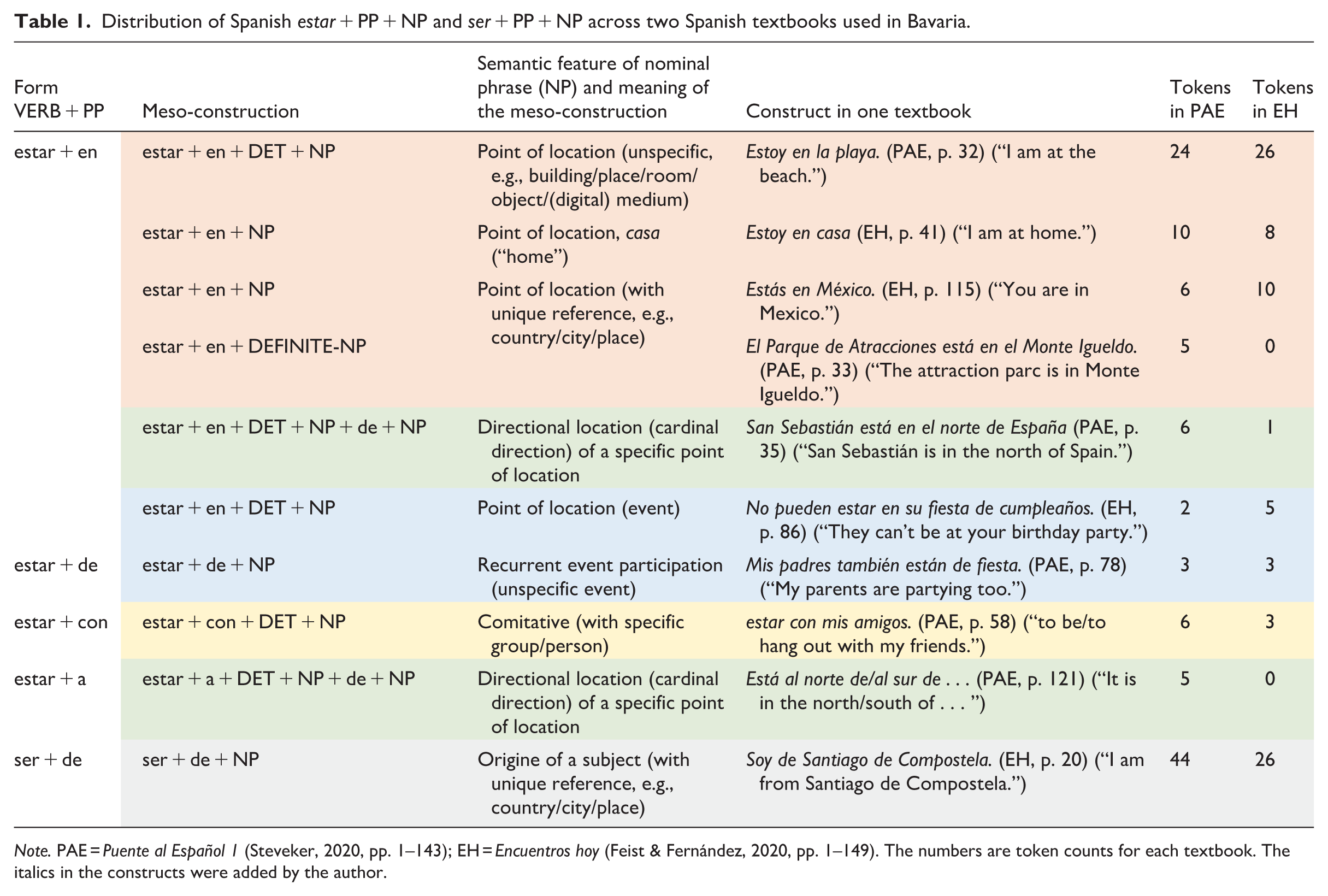
Note. PAE = Puente al Español 1 (Steveker, 2020, pp. 1–143); EH = Encuentros hoy (Feist & Fernández, 2020, pp. 1–149). The numbers are token counts for each textbook. The italics in the constructs were added by the author.
As the table shows, similar meso-constructions appear in both textbooks in the first year of studying Spanish, except the meso-constructions containing cardinal directions (south, north, etc.), which appear scarcely in EH. The analysis indicates differences in frequency and distribution across the textbooks. For example, the [ser + de + nominal phrase] construction, which indicates the origin of a person or an object, appears less frequently in PAE than in EH. The constructions occur with high frequency in the unit in which they first appear, with only sporadic instances thereafter throughout both textbooks. Students encounter, for example, in Unit 1 34 of 44 instances of [ser + de + nominal phrase] in PAE and 19 of 26 in EH. In this unit, they are embedded occasionally in tasks designed to raise awareness of their semi-schematic nature. For instance, in one activity, learners manipulate the [ser + de + nominal phrase] construction by rolling dice to change both the subject (e.g., yo, tú) and the location (de Madrid, de Santiago de Compostela) (Steveker, 2020, p. 13). Moreover, whereas the locative construction [estar + en + determinant + nominal phrase] appears frequently in both textbooks, there are no instances of the challenging construction [event noun + ser + en + determinant + nominal phrase], as outlined in section “The current state of the art in addressing challenges with teaching ser and estar.”
In summary, the textbooks show initial efforts to integrate lexico-grammatical units in exercises. However, it lacks a clear specification of open slots and form-meaning-pairs, as well as input enhancement techniques, such as highlighting constructions in texts to direct learners’ attention to them. Moreover, a concrete strategy for manipulating the frequency of constructions in the textbooks is missing. Certain constructions appear frequently, such as locative constructions with estar, whereas others are scarcely provided. This textbook analysis can serve as a starting point for creating additional material that draws learners’ attention to constructions. The following section proposes a teaching approach for [ser + preposition + nominal phrase] and [estar + preposition + nominal phrase] in early Spanish instruction, grounded in the principles outlined in section “Usage-based approaches to L2/Ln acquisition.”
Teaching ser and estar in the first lessons of Spanish with a usage-based inspired approach
Now that the constructions found in the textbooks and their frequencies in the textbooks are known, a concrete pedagogical approach to teaching ser and estar is proposed. This approach integrates the usage-based principles outlined in section “Usage-based approach for the acquisition of ser and estar” and is framed as a short instructional series titled Estar de intercambio en Barcelona (“Doing an exchange in Barcelona”). The series begins with a short video featuring María, an exchange student in Barcelona, and her friends. In this video, a prototypical construction is introduced—one that is either highly frequent in Spanish corpora such as EsTenTen23 (Sketch Engine, 2023), and relevant for learners. The number of slot fillers presented during the instructional sequence is limited to seven to align with cognitive load considerations, as people can typically retain five to seven items in short-term memory (Miller, 1956). A selection of frequent and relevant constructs for use in the individual sequences is available in Appendix 1.
The meso-construction is presented as a formula, filling the NP-slot with nouns from one semantic field. It is highlighted in a color pattern, which students see in each encounter in order to internalize the form-meaning pairs during the lesson. Immediately following the video, students engage in a brief oral activity designed to anchor the construction in spoken communication. These tasks employ varied methodologies and interaction formats, encouraging flexible and increasingly varied use of the constructions (cf., Kanli, 2024).
1. ¿De dónde eres?—Soy de + país. (“Where are you from?—I am from + country.”)
In the video, two young people ask each other about their home country. To reinforce the prototypical construction Soy de Alemania (“I am from Germany”), the teacher initiates an interactive classroom activity: a ball is tossed to a student while the teacher asks ¿De dónde eres? (“Where are you from?”). The student answers and then throws the ball to a peer, repeating the question. As some students may come from different countries, new country names may naturally emerge, which the teacher can note on the board.
Following this, students watch a short video in which seven exchange students state their country of origin, using phrases such as Soy de Francia (“I am from France”). Afterwards, students receive cards with different country names. They circulate in the classroom, asking one another ¿De dónde eres? and responding according to the country written on the card. After each exchange, they swap cards and partners, fostering repeated exposure and varied practice of the target construction. 3
2. ¿Dónde estás?—Estoy en + país. (“Where are you?—I am in + country.”)
The exchange students are on holiday now. In a short video, they explain where exactly they are Estoy en España. (“I am in Spain”). The teacher places cards with different country names on the floor in order to create a big world map. Students move from one country to another, asking each other where they are. This activity reinforces the use of estar for locating people and links the linguistic construction to physical movement, supporting embodied learning (e.g., Skulmowski & Rey, 2018). The sequence could be finished with a video from María who says Estoy en Barcelona. Estoy en casa. Os espero (“I am in Barcelona. I am at home. I am waiting for you.”)
3. ¿María está + en + article + punto de ubicación?—María (no) está + en + article + punto de ubicación. (“Is María in + article + point of location? María is (not) + in + article + point of location.”)
The exchange students arrived in Barcelona. But where is María? Everyone is looking for her. In the video, the exchange students name various locations where María could be, marking each on a postcard (e.g., María está en el centro—“María is at the city center”). Afterwards, the students are given two versions of an analogue or virtual map of Barcelona. By asking each other questions of whether María is at various locations in Barcelona, they find out her current location. María is at the beach.
4. ¿Dónde es + article + evento?—Evento + es + article + punto de ubicación. (“Where is + article + event? Event + is + article + point of location.”)
María está en la playa (“Maria is at the beach”) but La fiesta es en la playa (“The party is at the beach”). In the video, these two phrases appear, and students are asked to identify the main difference. María is a person, whereas la fiesta is an event, and its location is indicated by using ser instead of estar. The teacher gives some examples of authentic events taking place in Barcelona. Students then have to research online where exactly the event takes place. For example, El concierto de Shakira es en el Estadio Camp Nou (“Shakiras concert in the stade Camp Nou.”)
This is a selection of intervention packages. Further meso-constructions from Table 1 can be introduced in upcoming classes following this approach. In addition, to help students regularly practice the constructions, the Caja de las Preguntas (“Question Box”) method can be used. At the beginning of each Spanish lesson, students get a small question card for a partner warm-up. They ask each other questions using the constructions introduced during the micro-units. The reverse side of the card shows the formula of the meso-construction in color and includes a corpus example, enabling self-correction.
Conclusion
Ser and estar pose challenges for learners due to their low form-meaning contingency and their varied functions depending on the construction in which they appear. After reviewing the current research on these copular verbs, this paper presented an analysis of textbook content, demonstrating that these constructions appear in the first year of Spanish instruction. However, the frequency of different construction types varies in the analyzed textbooks, and systematic presentations of lexico-grammatical units are only occasionally visible in the textbooks.
This paper proposes teaching these constructions through 15-minute communicative-oriented units, such as Estar de intercambio en Barcelona (“To be on exchange in Barcelona”). Drawing on usage-based construction grammar principles, the approach encourages students to identify constructions in the input and perceive them as formulae, highlighted using color. A prototypical construction is introduced first, followed by activities that encourage productive use with increased variability. Some activities integrate embodied learning to reinforce the construction’s meaning through physical activity, thereby enhancing retention.
To assess the effectiveness of this approach in addressing the interlanguage phenomena identified in the introduction, a randomized controlled trial (RCT) (Connolly et al., 2017) could be established following the model of an ongoing RCT experiment on Pedagogical Construction Grammar and Didactics of Plurilingualism, aimed at teaching Spanish prepositions like a (“to/at/on”) and de (“from/of”) after motion verbs to beginners (Kanli et al., 2025). In addition, further exploration is needed on the optimal frequency (Henk, 2019, p. 104) and interval of construction repetitions (Suzuki, 2024, pp. 159–161). The frequency-based selection of micro-constructions from corpora can be further consolidated by a collostructional analysis (Gilquin & Gries, 2026) and a more fine-grained analysis of the corresponding meso-constructions, by analyzing, for example, the type of event noun (Fábregas, 2010), which appears in locative constructions with ser. While usage-based instruction is still developing, future projects are already planned.
Footnotes
Appendix 1
Acknowledgements
I would like to thank Prof. Dr. Evelyn Wiesinger, Prof. Dr. Johanna Wolf, and Prof. Dr. Maria Selig for their support, valuable input, constructive feedback, and the many fruitful discussions related to the textbook analysis. I would also like to thank Prof. Dr. Johanna Wolf and Prof. Dr. Teresa Gruber for organizing the workshop “Multi-word Units in Multilingual Learners: How to Use Our Knowledge of Chunks, Formulaic Language, and More in Learning and Teaching Contexts” (December 2023), which provided an exceptionally stimulating and productive forum for discussion. I am also grateful to Louise Didlock for her careful language editing and to the anonymous reviewers of this article for their insightful comments, which significantly contributed to improving this work.
Author’s note
ChatGPT 5 and DeepL Text Correction have been used to address proofreading issues and improve the readability of the text in academic English.

Ethical approval
N/A.
Informed consent
N/A.
Funding
The authors disclosed receipt of the following financial support for the research, authorship, and/or publication of this article: The textbook analysis took place in 2021, when Eleni Kanli was a research assistant at the Department of Romance languages at the University of Regensburg in Germany.
Declaration of conflicting interests
The author declared no potential conflicts of interest with respect to the research, authorship, and/or publication of this article.
Data availability statement
The row data are available on demand.