




Abstract
Aims and objectives:
This study investigates gender assignment strategies in mixed Spanish–Chinese noun phrases (NPs) among early Spanish–Chinese bilinguals in Barcelona, Spain. It explores whether bilinguals rely on a default masculine or use the gender of Spanish translation equivalents across production and comprehension tasks.
Design/methodology/approach:
A multitask approach was employed, including a director-matcher task, a sentence repetition task, and a two-alternative forced-choice judgment task. Forty-two early sequential Spanish–Chinese bilinguals participated in the study.
Data and analysis:
The analysis focused on the use of masculine and feminine Spanish determiners with Chinese nouns, categorized according to the gender of their Spanish translation equivalents. One-way repeated analysis of variance (ANOVA) was conducted to examine whether gender choices significantly differed when Chinese nouns, either with feminine or masculine Spanish equivalents, were paired with different Spanish determiners in each task. Paired-samples t-tests and nonparametric Wilcoxon signed-rank tests were conducted to determine whether masculine gender is significantly preferred over feminine gender in the three tasks.
Findings/conclusions:
Results revealed task-dependent variability in gender assignment. In production, bilinguals used both masculine and feminine determiners for Chinese nouns with feminine equivalents, reflecting both default masculine and translation equivalent strategies. For nouns with masculine equivalents, masculine determiners predominated. In comprehension, participants favored the translation equivalent strategy, using determiners that matched the gender of Spanish translation equivalents.
Originality:
This study is the first to examine gender assignment in mixed Spanish–Chinese NPs.
Significance/implications:
The study highlights the flexible nature of bilingual language processing, demonstrating that gender assignment strategies can change in response to different task demands. It emphasizes the importance of capturing the range of bilingual behaviors in both production and comprehension.
Limitations and future research:
The study focuses on a specific bilingual community, limiting generalizability. Future studies should examine gender assignment over time and in other Spanish–Chinese bilingual populations with different sociolinguistic backgrounds.
Keywords
Introduction
Code-switching (CS) is commonly described as the practice of switching back and forth between languages within an utterance (Deuchar, 2012; Poplack, 1980). CS data can provide valuable insights that extend our understanding of language beyond monolingual perspectives (López, 2020). For example, in the study of CS, researchers have examined grammatical gender assignment in mixed noun phrases (NPs), where a determiner from one language is paired with a noun from another (cf. Bellamy & Parafita Couto, 2022). This interest arises from frequent occurrences of mixed NPs (Jake et al., 2002) and differences in how languages mark gender. A mixed NP typically consists of at least two elements: a gender-marked determiner from one language and a noun, either gender-marked or non-gender-marked, from another (e.g., la house “theFEM house,” Spanish–English; el gürtel “theMASC beltMASC,” Spanish–German in López, 2020), or a non-gender-marked determiner from one language with a gender-marked noun from another (e.g., the casa “the houseFEM,” English–Spanish in Blokzijl et al., 2017). In gender-marked languages such as Romance and Germanic languages, grammatical gender is morphosyntactically represented by the agreement between gender-marked nouns and other elements (determiner, adjective) in the NPs (e.g., Spanish: la camisa blanca “theFEM shirtFEM whiteFEM”) (Corbett, 2012). In contrast, languages such as Chinese and English have no grammatical gender distinction for nouns.
To set the stage for this investigation, we first outline the structure of the NP in Spanish and Chinese, followed by an examination of the distinctive characteristics that emerge in mixed Spanish–Chinese NPs.
Spanish NPs
In Spanish, NPs typically consist of a determiner followed by a noun, which may or may not be accompanied by an adjective (determiner + noun +/− adjective). All nouns in Spanish have an inherent grammatical gender, either masculine or feminine (Harris, 1991; Roca, 1989). Determiners and adjectives do not have inherent gender themselves, but they must agree in gender with nouns they modify (Harris, 1991) (see 1a, 1b).
the.FEM coat.FEM red.FEM “the red coat” b. the.MASC egg.MASC broken.MASC “the broken egg”
Agreement in Spanish is easily observed because nouns typically feature morphologically or phonologically transparent suffixes, although this is not always the case. Nouns ending in -o are predominantly masculine (99.9%), while those ending in -a are often feminine (96.3%) (Teschner & Russell, 1984). A subset of nouns ending in -e can be either gender (see 2a, 2b), and those ending in consonants (e.g., -l, -n, -z) are opaque and less predictable. Spanish has roughly twice as many transparent nouns as opaque ones (Harris, 1991), making endings reliable predictors of grammatical gender.
the.MASC foot.MASC “the foot” b. the.FEM classroom.FEM “the classroom”
Masculine gender is considered the unmarked default, while feminine is marked and exclusive in Spanish (Harris, 1991; Roca, 1989). Spanish speakers often assign masculine gender to unknown nouns or those with irregular endings, like consonants, partly because masculine nouns generally allow more varied phonological endings (Beatty-Martínez & Dussias, 2019).
Chinese NPs
Unlike Spanish, Chinese lacks grammatical gender and employs a nominal classifier system. In Mandarin Chinese, NPs may contain a demonstrative, numeral, or quantifier, followed by a classifier and a noun (e.g., 一张桌子, /yi1zhang1zhuo1zi0 1 / [one + classifier-zhang1 + table], “one table”), in which not all are required but classifiers are obligatory and cannot be omitted (Li & Thompson, 1981). In Chinese NPs, the choice of classifiers is largely based on the semantic properties of nouns, such as animacy, shape, function, and size (Myers & Tsay, 2000). Unlike Spanish, which uses an alphabetic writing system based on the Latin script, where each letter generally corresponds to a specific sound, Mandarin Chinese employs a logographic writing system, where each character typically represents a syllable and a unit of meaning, rather than a single sound (Wang, 1973). Chinese characters represent morphemes and correspond to Pinyin syllables, which reflect the language’s phonology (Wang, 1973). A Pinyin syllable consists of an initial consonant and a final vowel or an optional nasal consonant (/n/ or /ng/) (Li & Thompson, 1981). Final vowels are usually compound (e.g., /ai/, /ei/, /ao/) but sometimes simple (e.g., /a/, /o/, /e/). In writing, Chinese is typically presented using only characters without accompanying Pinyin, which marks a significant distinction from alphabetic Spanish.
Mixed Spanish–Chinese NPs
Mixed Spanish–Chinese NPs contain at least two elements, a gender-marked Spanish determiner and a non-gender-marked Chinese noun (e.g., el/un 太阳, “theMASC/aMASC sun”). The question that arises is: what grammatical gender will Spanish–Chinese bilinguals assign to Chinese nouns in mixed NPs? This issue is interesting given that Spanish requires gender agreement for determiners and adjectives, while Chinese lacks grammatical gender altogether. Research on other mixed-language contexts, such as Spanish–English, has identified several strategies for gender assignment, including using the gender of the Spanish translation equivalent, relying on the morphological shape of the noun, or defaulting to masculine gender (see section “Research background”). However, it remains to be seen which strategy Spanish–Chinese bilinguals will prefer, given the linguistic differences between Spanish and Chinese. Understanding the structure of mixed Spanish–Chinese NPs sets the stage for exploring how bilinguals assign grammatical gender in such contexts. The following section reviews relevant research on gender assignment strategies in mixed NPs across different language pairs.
Research background
Gender assignment strategies in mixed NPs
In the context of CS, three primary gender assignment strategies have been documented in mixed NPs across various language combinations, including the translation equivalent strategy, the default strategy, and the shape-based strategy (see Bellamy & Parafita Couto, 2022). These strategies are observed in two types of language combinations: those where only one language has grammatical gender and those where both languages have gender. Spanish–Chinese mixed NPs fall into the first category, as Spanish has grammatical gender while Chinese does not. Building on this background, we now turn to the specific strategies that have been documented for gender assignment in mixed NPs, with particular attention to language pairs where only one language marks grammatical gender, as is the case for Spanish–Chinese.
Translation equivalent strategy
The translation equivalent strategy, also referred to as the analogical gender criterion (Jake et al., 2002; Montes-Alcalá & Lapidus Shin, 2011), involves assigning gender to the inserted noun based on the gender of its translation equivalent in the recipient language (Bellamy & Parafita Couto, 2022). For example, in Spanish–English mixed NPs, bilinguals have been observed to pair a Spanish feminine determiner with an English noun if its Spanish translation is feminine (Liceras et al., 2008). This strategy has also been reported in other bilingual contexts, such as Tsova-Tush–Georgian (Bellamy & Wichers Schreur, 2022) and Spanish–Basque (Munarriz-Ibarrola et al., 2022), particularly among speakers who learned the gender-marked language earlier. In the Spanish–Chinese context, this strategy would involve assigning the gender of the Spanish translation equivalent to the Chinese noun (e.g., la 吉他, “theFEM guitar,” following the feminine gender of guitarra in Spanish).
Default strategy
Regarding the default strategy, speakers tend to default to one gender for most inserted nouns, regardless of their semantic and morpho-phonological properties or translation equivalents (Bellamy & Parafita Couto, 2022). This approach is prevalent in Spanish–English bilingual speech, particularly in communities with frequent CS (e.g., Balam, 2016; see Bellamy & Parafita Couto, 2022). For instance, Spanish–English bilinguals in Belize assigned masculine gender to 99.6% of English nouns in mixed DPs (Balam, 2016). Likewise, Balam et al. (2021) reported a strong preference for masculine gender among Spanish–English bilingual children in the Miami corpus, with Valdés Kroff (2016) noting 93.7% of English nouns paired with Spanish masculine determiners in the Bangor Miami corpus, independently of their translation equivalent, in the same community. In addition, Spanish–English bilinguals with habitual CS practices in Southern Arizona (USA) favored masculine gender for English inanimate nouns in a forced-choice elicitation task (Cruz, 2023) and the Corpus del Español en el Sur de Arizona (CESA) corpus (Cruz, 2021).
In addition to the masculine default, Parafita Couto et al. (2016) reported a preference for the feminine default among Spanish–Basque bilinguals in an auditory judgment task. The default strategy is particularly prevalent among frequent code-switchers and simultaneous bilinguals (Bellamy & Parafita Couto, 2022).
Shape-based strategy
The shape-based strategy, also referred to as “phonological gender criterion” (Poplack et al., 1982) or “phonological strategy” (Munarriz-Ibarrola et al., 2022), involves assigning gender based on the morpho-phonological properties of the inserted noun, such as its final sound or letter. This strategy is more common in language pairs with similar alphabetic systems and overlapping morpho-phonological patterns, as observed among Spanish–Basque and Purepecha–Spanish bilinguals (Bellamy et al., 2018; Parafita Couto et al., 2016). Bilinguals, such as Purepecha–Spanish or Spanish–Basque, tend to associate the phonological shape or morpho-phonological cues from words in the donor language with gender markers in the recipient language when assigning gender to donor language nouns (cf. Bellamy & Parafita Couto, 2022). For instance, Spanish–Basque bilinguals prefer to pair the Spanish feminine determiner la with Basque nouns ending in -a (Basque lacks gender), such as la arrautza “theFEM egg,” where huevo “eggMASC” is masculine in Spanish (Parafita Couto et al., 2016). Similarly, Purepecha–Spanish bilinguals preferred matching Purepecha nouns ending in -a (Purepecha lacks gender) with the feminine determiner la in a forced-choice acceptability judgment task, even when their Spanish equivalents were masculine (Bellamy et al., 2018).
Similarly, Montes-Alcalá and Lapidus Shin (2011) tested Spanish–English mixed NPs in written and oral corpora, and they concluded that orthographic similarities, which largely reflect the phonological shape of words in many languages, influence gender assignment in written CS. In addition, Rekun and Meir (2024) found that Russian–Hebrew bilinguals, where Russian features three genders and Hebrew possesses two genders, used the shape-based strategy in adjective–noun phrases during online acceptability judgment tasks. Both heritage speakers and immigrant speakers preferred this strategy, although other strategies were also observed.
However, due to the logographic nature of Chinese characters and the limited correspondence between Pinyin endings and Spanish gender markers, the shape-based strategy is unlikely to influence gender assignment in this population. Thus, testing this strategy is reserved for future research, once the roles of other strategies are better understood.
To investigate these strategies empirically, researchers have employed a range of experimental methodologies. The next section reviews the main production and comprehension tasks used to study gender assignment in mixed NPs.
Production and comprehension tasks
Studies on gender assignment in mixed NPs have used production and comprehension tasks. Production tasks often involve corpus-based analyses of spontaneous speech and naturalistic data, reflecting actual language use (Gullberg et al., 2009). However, these methods are resource-intensive with limited evidence for specific questions (Gullberg et al., 2009). To mitigate these challenges, researchers have also used semi-structured interviews (Otheguy & Lapidus, 2003), interactive tasks like director-matcher and map tasks (Beatty-Martínez & Dussias, 2017; Gullberg et al., 2009), and sentence repetition tasks. Comprehension tasks, such as Likert-type scale evaluations (Liceras et al., 2008; Parafita Couto & Stadthagen-González, 2019) and forced-choice judgment tasks (Bellamy et al., 2018, Stadthagen-González et al. 2018), assess responses to written or auditory stimuli. Together, these methods effectively elicit speakers’ grammatical knowledge (Bellamy & Parafita Couto, 2022).
While these methodological approaches provide important insights, it is also crucial to consider how extra-linguistic factors, such as task type, bilingual profile, and community context, influence gender assignment strategies. The following subsections address these variables in greater detail.
Extra-linguistic factors in gender assignment strategies
Task type
Previous studies reveal variations in gender assignment strategies across task types, even within the same bilingual group. For instance, Bellamy et al. (2018) found that early Purepecha–Spanish bilinguals favored the masculine default strategy in a director-matcher task. However, they used mixed strategies in a forced-choice judgment task, assigning feminine gender to Purepecha nouns ending in -a and masculine to those ending in -i/-u. Such variation may stem from orthographic or morpho-phonological similarities between languages, which may amplify the influence of phonological and orthographic cues in written tasks, as observed in Basque–Spanish bilinguals, where noun endings influenced gender assignment in mixed NPs (Parafita Couto et al., 2016).
Bilingual profile
Bilingual profiles and language experience influence gender assignment strategies. Munarriz-Ibarrola et al. (2022) found that Spanish–Basque bilinguals with distinct bilingual profiles used different strategies in a forced-switch director-matcher task. Bilinguals who first acquired Spanish (a gender-marked language) preferred the analogical criterion (translation equivalent strategy), while those who first learned Basque (a non-gender-marked language) primarily used a phonological criterion (shape-based strategy).
Community characteristics
The characteristics of bilingual communities also affect gender assignment strategies among bilinguals. For example, in the well-established Spanish–English community in Miami, bilinguals prefer the masculine default (Balam et al., 2021). Conversely, in communities where speakers are more exposed to monolingual Spanish than in Miami, like EL Paso and Granada, Spanish–English bilinguals use both masculine and feminine determiners for English nouns with feminine equivalents, although masculine determiners dominate overall (Królikowska et al., 2019). Similarly, in New Mexico, Spanish–English bilinguals show a mix of masculine default and translation equivalent strategies (Cisneros et al., 2023). These findings highlight the impact of community characteristics and social network diversity on gender assignment in mixed NPs.
In sum, gender assignment strategies in mixed NPs vary based on task type, bilingual profile, and community characteristics (see Supplemental Appendix A). Taken together, these findings highlight the complexity and variability of gender assignment in mixed NPs. Building on this foundation, the present study investigates gender assignment strategies among early Spanish–Chinese bilinguals in Barcelona, employing a multitask approach to capture the influence of both linguistic and extra-linguistic factors.
The current study
Research question and hypothesis
This study examines how early Spanish–Chinese bilinguals, heritage Chinese speakers in Barcelona, Spain, assign gender in mixed NPs across various tasks. Drawing on research suggesting task type influences gender assignment (e.g., Bellamy et al., 2018), we use a multitask approach: a director-matcher task, a judgment task, and a repetition task. The study addresses a main question:
RQ1: Which gender assignment strategies (default or translation equivalent) do early Spanish–Chinese bilinguals use when assigning gender to Chinese nouns in mixed Spanish–Chinese NPs in production and comprehension tasks, and to what extent will gender assignment be consistent across tasks?
H1: Building on prior research showing that gender assignment strategies in mixed NPs vary depending on linguistic, cognitive, and sociolinguistic factors, we hypothesize that early Spanish–Chinese bilinguals in Barcelona will not rely exclusively on a single gender assignment strategy. Instead, we expect their choices to vary across production and comprehension tasks, reflecting the combined influence of task type, individual bilingual experience, and community characteristics. Specifically, we predict greater use of the translation equivalent strategy in comprehension tasks, where metalinguistic awareness is heightened, and more balanced or default-masculine use in production tasks, where cognitive demands differ. Moreover, we anticipate that the diverse and relatively young Spanish–Chinese bilingual community in Barcelona, characterized by social network variability and exposure to multiple language norms (monolingual Spanish and bilingual Spanish–Catalan interactions are common in the community), will contribute to flexible and mixed gender assignment patterns. These patterns may differ from those observed in more established or homogeneous bilingual communities.
Materials and methods
Participants
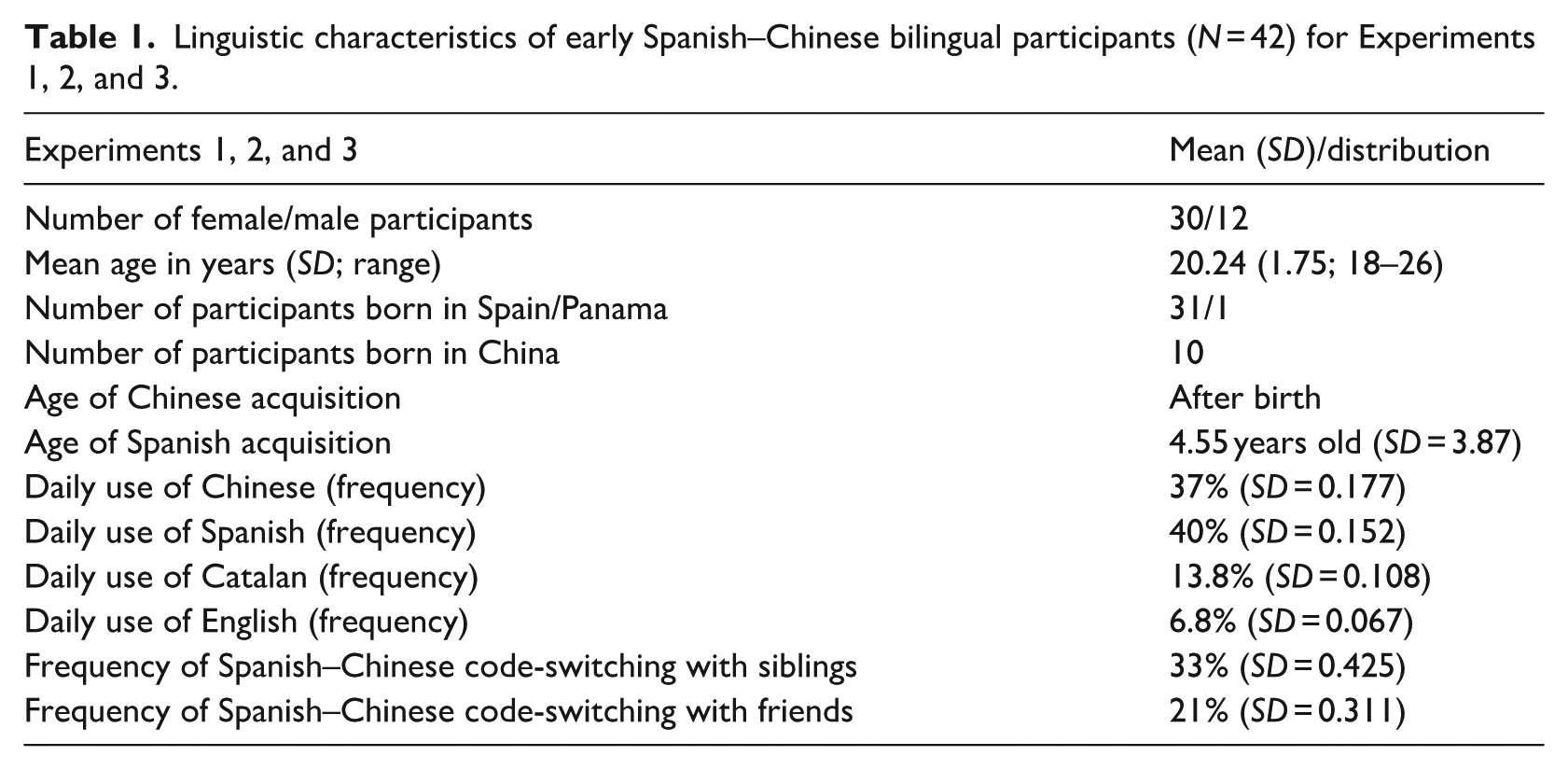
Forty-two early Spanish–Chinese bilinguals (Mage = 20.24 years and SDage = 1.74, 12 males) participated in three tasks. Participants completed a background questionnaire based on the Bilingual Code-Switching Profile (BCSP) (Olson, 2022) to assess their language profiles. Based on the results of BCSP, participants reported that they were all raised in Barcelona, Spain, with most of them born in Spanish-speaking countries (31 in Spain, 1 in Panama) and the rest in China (10, see Table 1). They are early sequential bilinguals, acquiring Chinese first after birth in Chinese-speaking households and Spanish later through formal educational settings in Spain (Mage = 4.55 years, SD = 3.87). Of the 31 participants born in Spain, 20 were sent to China at birth and returned to Spain during childhood (Mage = 5.2 years, SDage = 3.33). The 10 participants born in China moved to Spain at a young age (Mage = 7.7 years, SDage = 2.06). Moreover, they reported their proficiency of Spanish and Chinese (see Figure 1) and frequency use of Chinese (Mfrequency = 37%, SDfrequency = 0.177) and Spanish (Mfrequency = 40%, SDfrequency = 0.152) on a daily basis, as well as their attitudes toward mixing languages (see Figure 2). Specifically, most participants felt confident in extended conversation in Chinese (71%, n = 30) and Spanish (76%, n = 32), whereas only a small number of them felt confident in basic conversation in Chinese (10%, n = 4) and Spanish (2%, n = 1). Regarding their attitudes toward mixing Chinese and Spanish within the same conversation, most of them (62%, n = 26) believed that language mixing should not be avoided, whereas only a small number of them (12%, n = 5) felt it should be. In addition, most participants (62%, n = 26) reported that they do not keep Chinese and Spanish separate in their daily conversation, indicating a natural and frequent integration of both languages in everyday use. However, participants’ responses regarding Spanish–Chinese CS frequency were inconsistent across different but related questions in BCSP, leading to variability and limited reliability. As a result, we did not report a specific or quantified measure of their overall daily CS frequency. Instead, we provided more stable indicators based on reported CS with friends (Mfrequency = 21%, SDfrequency = 0.311) and siblings (Mfrequency = 33%, SDfrequency = 0.425), although these figures should be interpreted with caution, as they are not fully representative of broader language use. Participants were compensated for their participation upon task completion. All relevant materials, including the questionnaires, target pictures, sentences, and task results, are available on the Open Science Framework at https://osf.io/5c4se/?view_only=d67944cc3fa9413eb2bfcf819f5c3f0e.
Linguistic characteristics of early Spanish–Chinese bilingual participants (N = 42) for Experiments 1, 2, and 3.
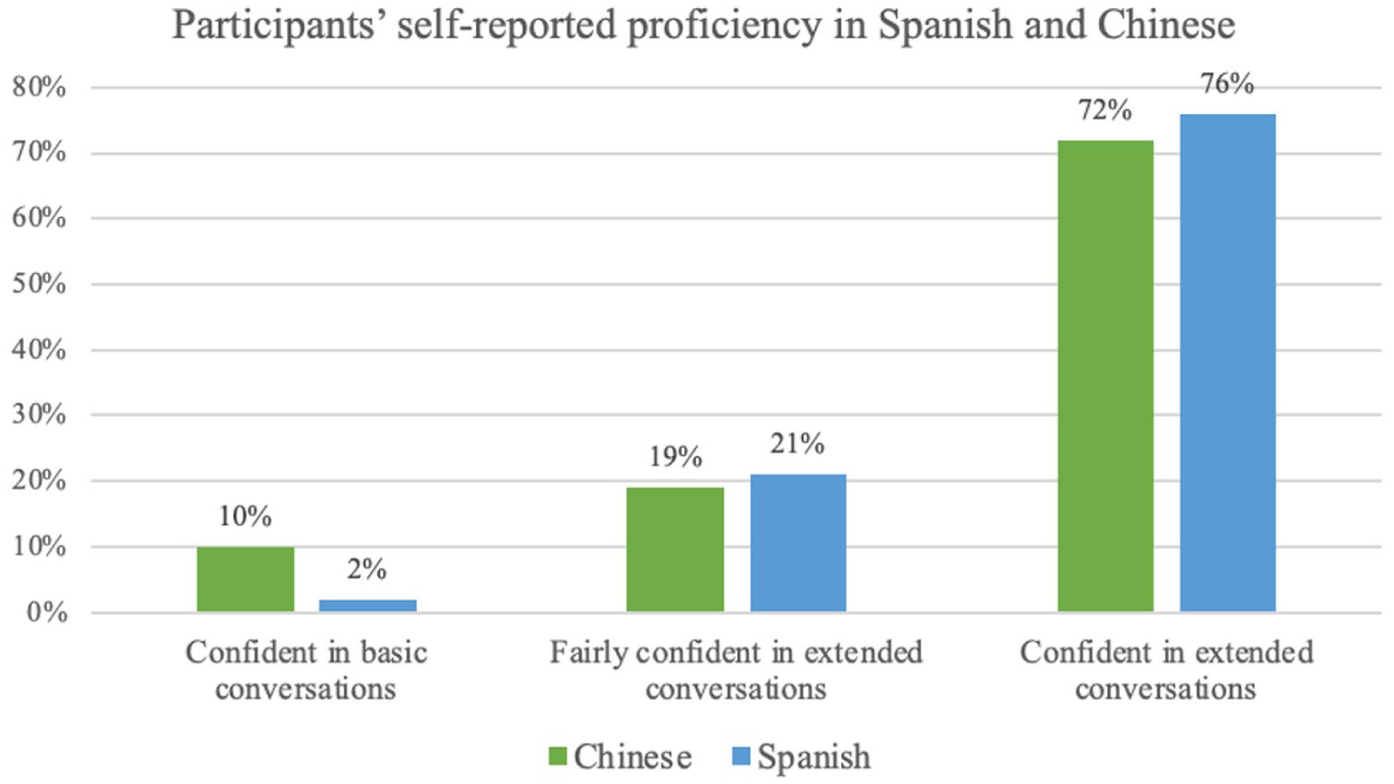
Participants’ self-reported proficiency in Spanish and Chinese.
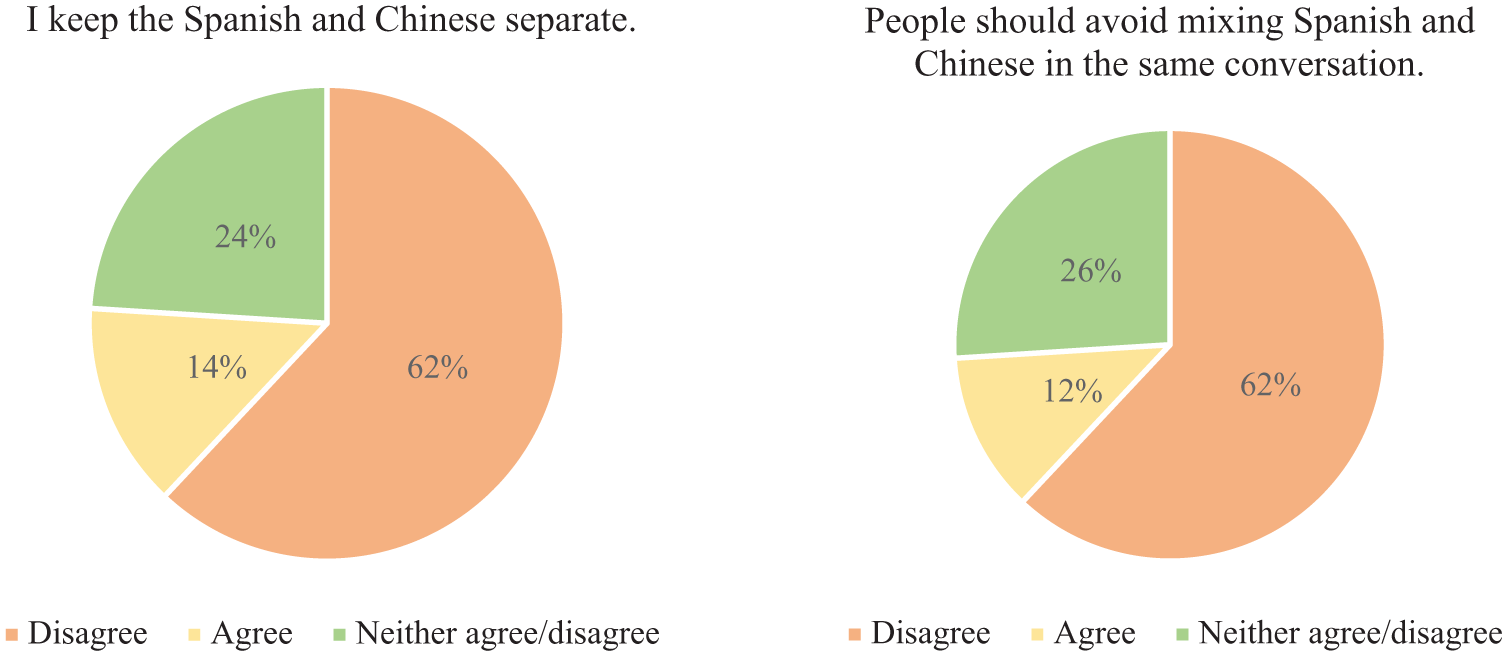
Participants’ attitudes toward mixing Spanish and Chinese languages (should be avoided).
Spanish–Chinese bilingual community in Spain
Data from the Instituto Nacional de Estadística (INE) (2016) shows that Spain is home to 171,508 Chinese nationals, making them the second-largest non-European Union (EU) immigrant group (Robles-Llana, 2018). About 70% of these migrants come from Qingtian, Zhejiang, a region with a history of overseas migration (Beltrán Antolín, 2006). Many first-generation migrants have limited education, work in family businesses (e.g., restaurants), and maintain traditional Chinese cultural values, remaining socially and culturally separate from broader Spanish society (Beltrán Antolín, 2008). Consequently, second-generation heritage speakers often act as translators and mediators between the Chinese community and the local population (Robles-Llana, 2018).
In Barcelona, the Chinese population grew from 13,416 in 2003 to 56,017 in 2020, with children under 16 increasing from 2,412 to 12,285 (He, 2024). This rapid increase contributed to the emergence of Spanish–Chinese bilingual communities, which are relatively young compared to more established bilingual groups, such as the Spanish–English communities in Miami. Moreover, most second-generation immigrants acquired Chinese from birth in the home environment and learned Spanish through immersion in the broader Spain society, resulting in high proficiency in Chinese and Spanish. In addition, they were raised in a multilingual environment and interacted with various linguistic groups, including Spanish and Chinese monolinguals, Spanish–Catalan bilinguals, and Spanish–English bilinguals. Research (e.g., Bellamy & Parafita Couto, 2022) suggests that such community characteristics likely influence gender assignment strategies in mixed NPs, a factor considered in our hypotheses.
Production tasks
Experiment 1: director-matcher task
Materials
Thirty-two colored line drawings were selected from the Multipic database (Duñabeitia et al., 2018) based on the following criteria: pictures represented familiar, concrete concepts with easily recognizable features; each picture had one corresponding noun in both Spanish and Chinese; and a low proportion of animate items was included to avoid potential influence of biological gender on gender assignment (Balam, 2016). Finally, 16 pictures corresponding to masculine nouns and 16 to feminine nouns in Spanish were selected, ensuring balance for Spanish grammatical gender (target pictures are available at https://osf.io/5c4se/?view_only=d67944cc3fa9413eb2bfcf819f5c3f0e).
Procedure
The experiment consisted of two sessions: familiarization and experimental. During familiarization, participants learned the Spanish and Chinese names of each picture (3,000 ms). After viewing 32 pictures, participants were paired for a forced-switching director-matcher task (“toy task”). In this task, participant “A” (the director) described each picture to participant “B” (the matcher), who then placed pictures on a grid. A hardboard separated the grids to prevent participants from seeing each other’s boards (see Figure 3). Both participants worked with the same grid of 32 blank spaces and the same set of 32 pictures.
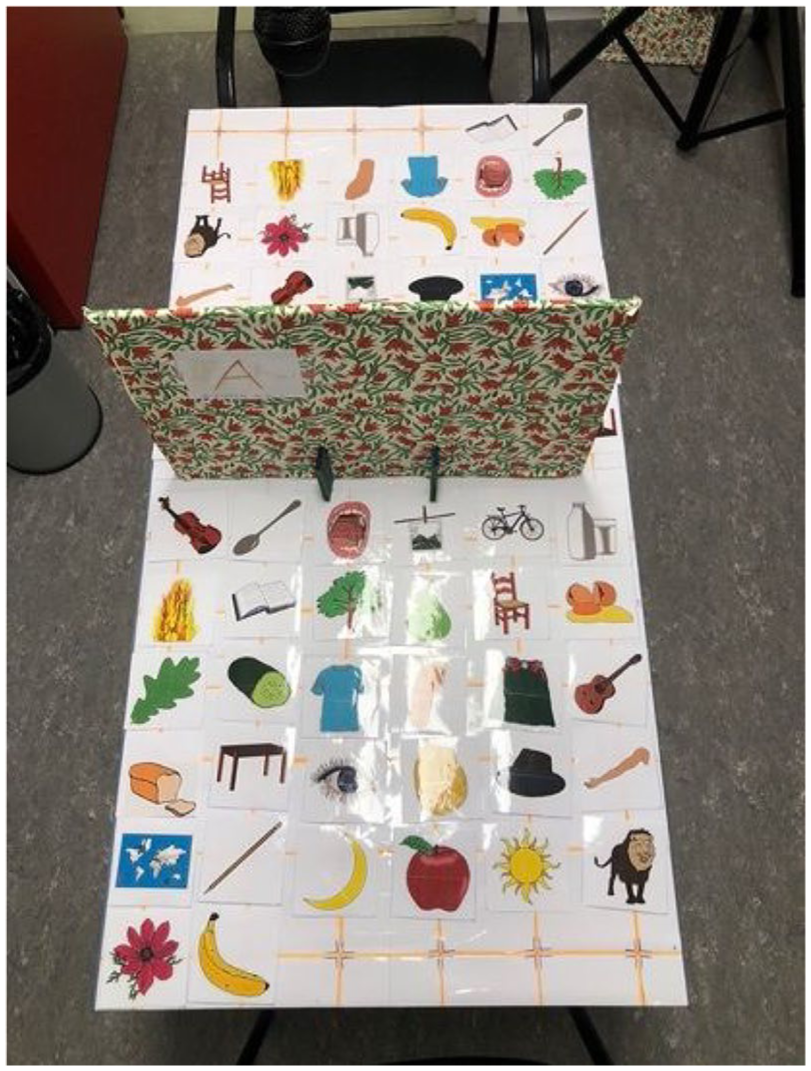
Illustration of the director-matcher task.
This task began with auditory instructions in CS mode. Participants described picture details (name, color, position) in Spanish while naming the objects in Chinese. This required participants to code-switch and assign grammatical gender to Chinese nouns (Bellamy et al., 2018). In this procedure, the director described each picture and its location on the grid to the matcher, who then placed the pictures accordingly. After all pictures were placed, the matcher confirmed their positions with the director. Sample constructions are as follows, with Chinese nouns in italics.
ART.INDEF/DEF.MASC/FEM milk white.FEM/MASC “A/The white milk” (cf. la/una leche) ART.INDEF/DEF.MASC/FEM sun yellow.MASC/FEM “A/The yellow sun” (cf. el/un sol)
Experiment 2: repetition task
Materials
In this task, 32 pairs of code-switched sentences were created, each containing a mixed NPs (Spanish determiner + Chinese noun) based on the Chinese names of the 32 pictures from Experiment 1. First, 32 Spanish sentences with unilingual Spanish NPs were selected. The Spanish nouns were then replaced with their Chinese equivalents to create 32 code-switched sentences. Each mixed NP was constructed in two versions: one with gender match (i.e., where the Spanish determiner and the Spanish equivalent of the Chinese noun matched in gender) and one with gender mismatch. This generated 32 pairs of sentences contrasting the gender of determiners in mixed NPs.
In total, 64 trials were created: half with Spanish determiners gender-matched with Spanish equivalents of Chinese nouns, and the other half with gender mismatch. Four singular Spanish determiners (elMASC, laFEM, unMASC, unaFEM) were used, as Mandarin Chinese, a noninflectional language, lacks the plural inflectional morphology on nouns and appears in bare form without plural markers (Yang, 1998). Mixed NPs were placed at the beginning (3), middle (4), and end (5) of sentences to control for position effects, with the number of masculine and feminine determiners counterbalanced (see Supplemental Appendix B). Sample sentences with mixed NPs in italics and bold:
“ “The bottles of wine that I saw on “In the corner, one youngster sat alone, softly playing
Procedure
The repetition task, programmed in E-prime 2.0 (Schneider et al., 2002), used a by-subject order design to randomize orders of sentences across participants. Each participant, seated in a soundproof booth, listened to and repeated 64 code-switched sentences. Sentences were played once, and participants reproduced the content of sentences as accurately as possible. A 15-second delay with an intervening counting task was introduced between each sentence and its repetition. This delay helped elicit responses based on participants’ underlying grammar if the repetition exceeded the capacity of their short-term memory (Bullock & Toribio, 2009; Gullberg et al., 2009). In this task, participants were required to repeat sentences as accurately as possible after hearing them. The underlying rationale is that when input sentences exceed listeners’ capacity of short-term memory, they rely on their internal grammatical knowledge to reconstruct the sentence (Gullberg et al., 2009). If a particular grammatical element is not represented in participants’ internal grammar, it is likely to be modified or replaced during repetition (Vinther, 2002). Consequently, participants may either produce accurate repetitions or introduce changes to sentences that reflect their own underlying grammar (Gullberg et al., 2009).
Each trial followed this procedure: a fixation cross appeared at the center of the screen (300 ms), followed by the play of a code-switched sentence. After the sentence ended, another fixation cross appeared (500 ms). Participants then counted in their preferred language (Chinese or Spanish, 15 seconds) within a given range (e.g., one to ten or ten to one). A 500 ms beep prompted them to repeat the sentences (7,000–13,000 ms), with their vocal responses recorded automatically (see Figure 4).
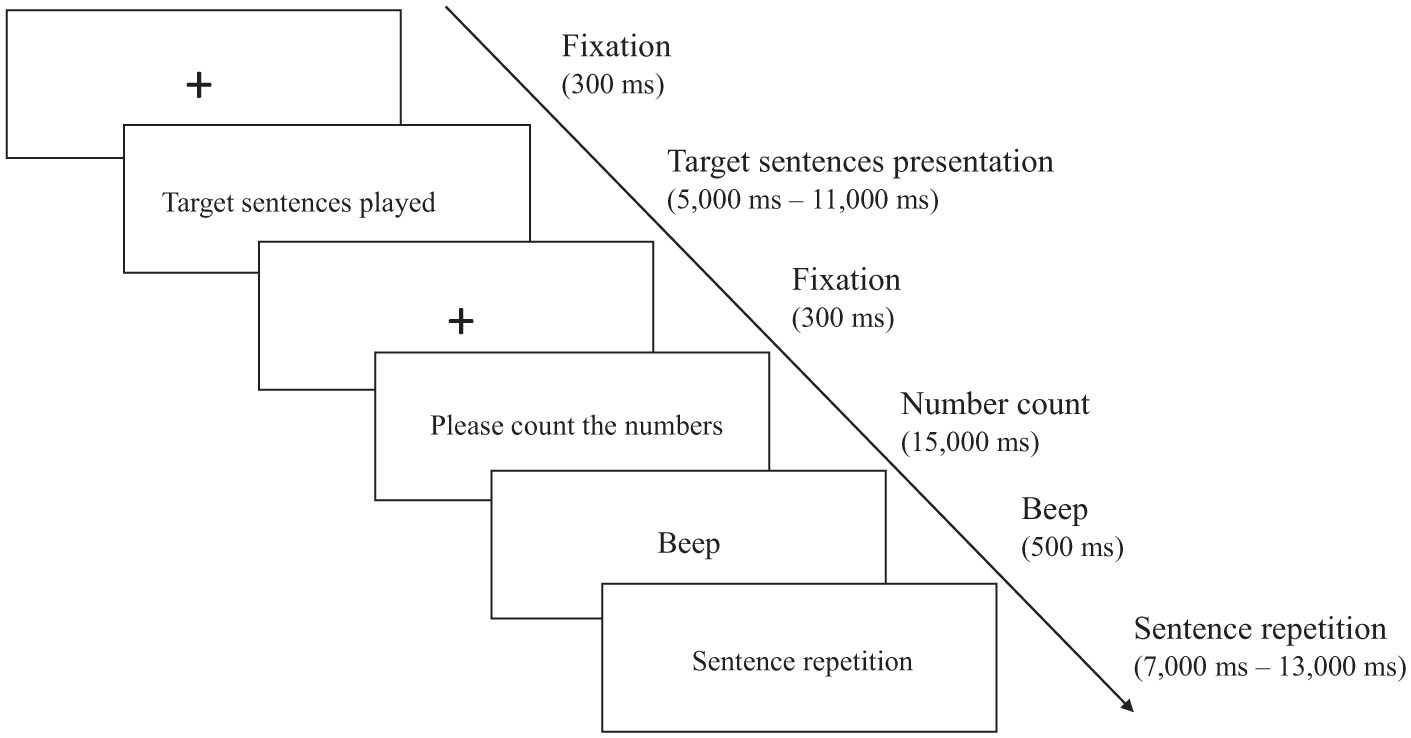
Illustration of the experimental session in the repetition task.
Comprehension task
Experiment 3: two-alternative forced-choice judgment task
Materials
Critical sentences: Following procedures similar to Experiment 2, 64 critical sentences were generated, forming 32 pairs of comparison sentences. Each pair differed based on whether the gender of Spanish determiners matched the gender of the Spanish equivalents of Chinese nouns. Four Spanish singular determiners (elMASC, laFEM, unMASC, unaFEM) were used. Half of the mixed NPs had gender-matched determiners, and half were mismatched. The position of mixed NPs within sentences (beginning, middle, end) and the proportions of each determiner (el/un/la/una) were counterbalanced across sentences (see Supplemental Appendix C).
Filler sentences: 64 filler sentence pairs were created, each differing in adjectives, verbs, or Chinese classifiers, resulting in 128 filler trials.
Procedure
This task was administered online via Qualtrics (Qualtrics, LLC, Provo, UT, USA) using a by-subjects order design. A total of 192 trials were randomized for each participant, including 64 critical (contrasting determiners) and 128 filler trials (contrasting adjectives, verbs, or classifiers). Participants read each pair and chose the sentence they found more natural when speaking to other bilinguals. Choices should be made before proceeding to the next, and previous trials could not be revisited.
Results and analysis
Data from the production tasks were transcribed, and mixed NPs with a Spanish determiner and a Chinese noun/adjective were extracted. Data from two production tasks and the comprehension task were analyzed descriptively and statistically using one-way repeated measures analysis of variance (ANOVA) in RStudio (v4.2.2; R Core Team, 2020). This analysis examined whether the structure of mixed NPs, specifically in terms of gender congruency, significantly influenced gender assignment choices in each task. The structure of mixed NPs, the independent variable (IV), had four levels: feminine determiners with Chinese nouns having feminine or masculine equivalents and masculine determiners with Chinese nouns having masculine or feminine equivalents. The dependent variable (DV) was the number of gender assignment responses for each NP structure. Results showed the structure of mixed NPs significantly affected gender assignment in all three tasks: director-matcher task (F(3, 123) = 81.73, p < .001, η2 = 0.656), repetition task (F(3, 123) = 61.55, p < .001, η2 = 0.57) and judgment task (F(3, 123) = 85.47, p < .001, η2 = 0.676). These findings highlight significant differences in gender assignment choices across NP structures.
Production tasks
Director-matcher task
In the director-matcher task, 1,344 trials were generated. Of these, 91 trials (6.77%) were excluded due to the production of single nouns, like 黄瓜 “cucumber,” or monolingual Spanish or Chinese NPs. This left 1,253 trials for further analysis. Example (6) illustrates the sentence that participants produced in the director-matcher task, where the Spanish determiner or adjective was used with a Chinese noun.
And then the second row start by “And then the second row starts with an egg that is open.” (participant 9) Example (7) shows the use of the masculine default strategy, even when the Spanish equivalent is feminine. ART.DEF.MASC mouth open.MASC “The open mouth” (cf. la boca abierta) (participant 26)
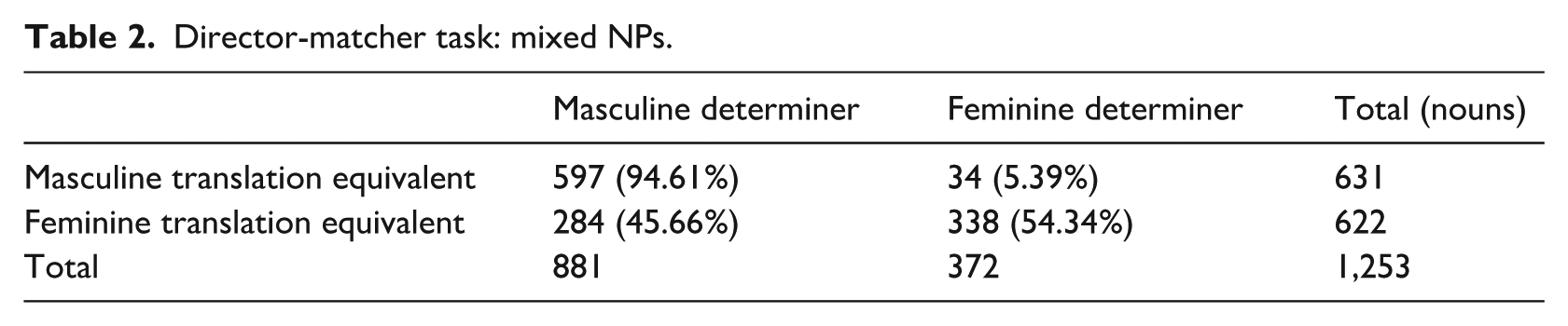
Table 2 presents the distribution of mixed NPs. Participants preferred to use masculine determiners to nouns with masculine equivalents (597 tokens, 94.61%), compared to feminine determiners (34 tokens, 5.39%) (p < .001, t = −29.51). Conversely, for feminine equivalents, feminine determiners (338 trials/54.34%) were similar to masculine determiners (284 trials/45.66%) (p = 1, t = 0.91).
Director-matcher task: mixed NPs.
Repetition task
In the repetition task, 2,411 trials were obtained, with 277 (10.30%) excluded for the same reason as in the director-matcher task. Examples (8–11) in Supplementary Materials illustrate how participants revised mixed NPs during their repetitions. Table 3 provides the distribution of revised and unrevised mixed NPs. Out of 794 revised trials, 583 (73.42%) originally had feminine gender, which was changed to masculine, regardless of nouns’ gender equivalents. Only 211 (26.58%) with masculine gender were revised to feminine. For unrevised trials (1,617), most (997 trials, 61.66%) had masculine gender, while 620 (38.34%) had feminine gender.
Repetition task: revised and unrevised mixed NPs.
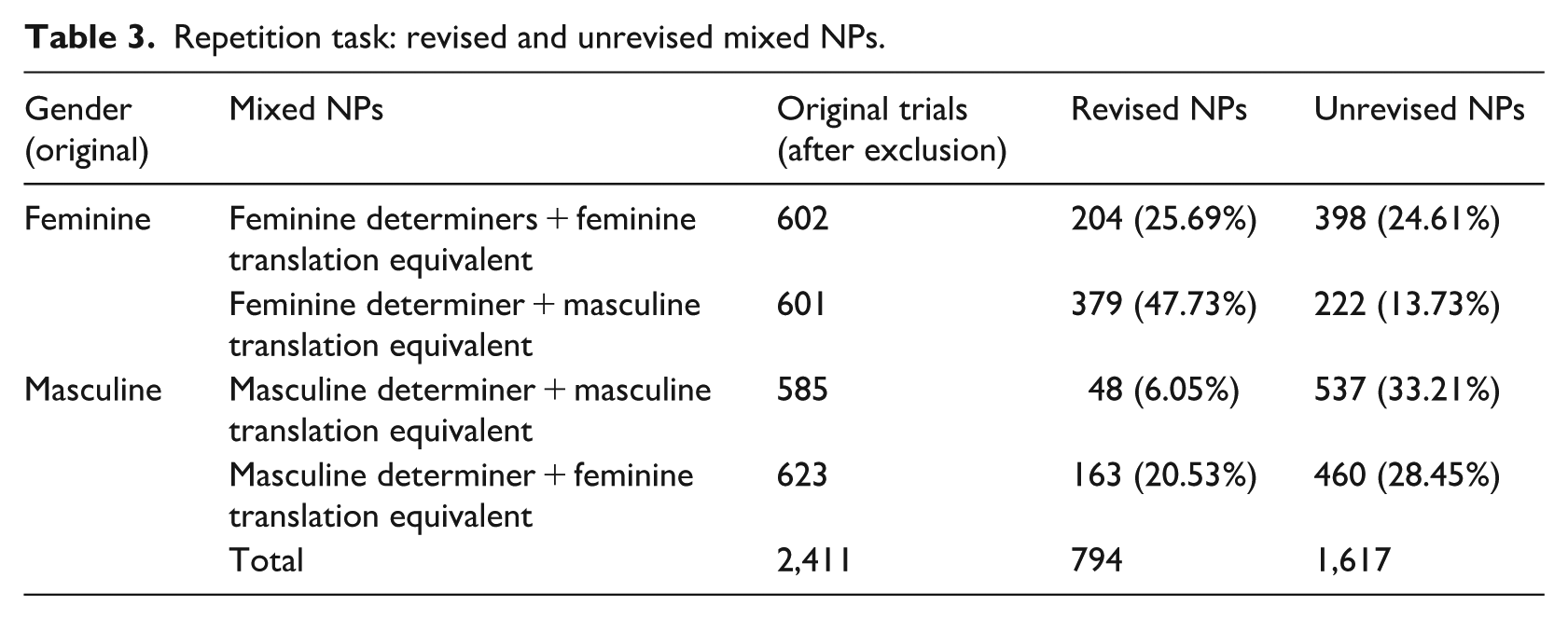
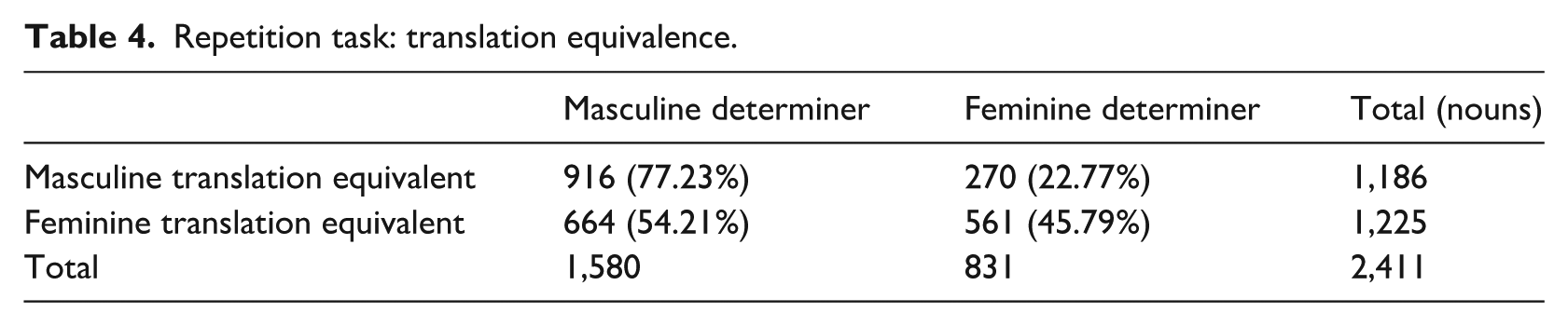
Table 4 shows that participants preferred to use masculine determiners with nouns having masculine equivalents (77.23%) over feminine determiners (22.77%) (p < .001, t = −13.50). For feminine equivalents, masculine determiners (664 trials/54.21%) were similar to feminine determiners (561 trials, 45.79%) (p = .81, t = −1.52).
Repetition task: translation equivalence.
Comprehension task: two-alternative forced-choice judgment task
In the judgment task, participants selected the more natural-sounding sentence from pairs differing in the gender of determiners, resulting in 1,344 responses. Table 5 provides an overview of the distribution of gender preferences.
Judgment task: distribution of gender preferences.
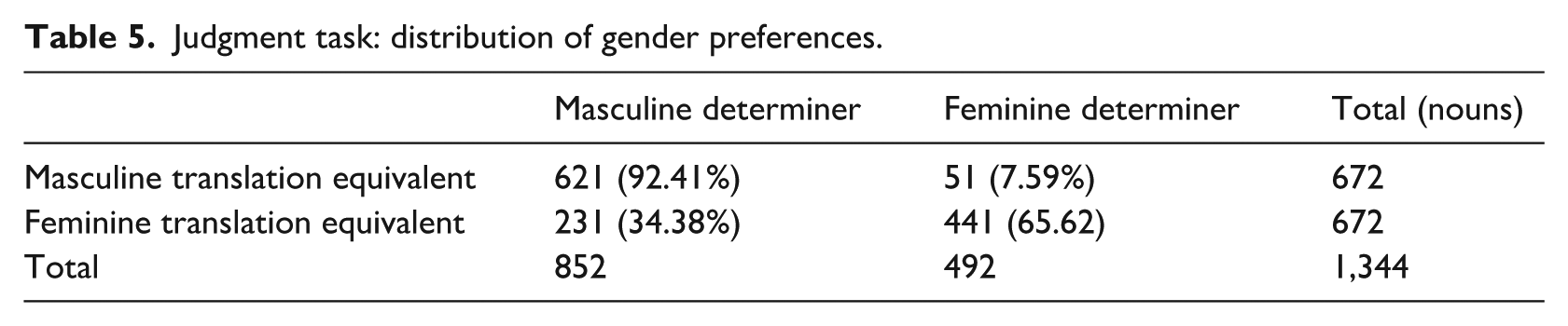
Table 5 shows that participants preferred masculine determiners (92.41%) for nouns with masculine equivalents, compared to feminine determiners (7.59%) (p < .001, t = −29.51). For nouns with feminine equivalents, feminine determiners (65.62%) were favored over masculine determiners (34.38%) (p = .011, t = 3.34).
Overall, bilinguals preferred the masculine gender for masculine equivalents across three tasks. Conversely, the choice of feminine or masculine gender was similar for feminine equivalents, especially in the director-matcher and repetition tasks (see Figure 5). Moreover, participants showed a significant preference for the masculine determiner compared to the feminine determiner in the director-matcher task with V = 694.5, p < .001 2 ; the repetition task with t(41) = 7.21, p < .001, 95% CI = [12.66, 22.52]; and the judgment task with V = 649, p < .001. Overall, a paired-samples t-test revealed that participants produced significantly more masculine than feminine determiners overall in the three tasks, t(41) = 9.77, p < .001, 95% CI = [30.20, 45.94].
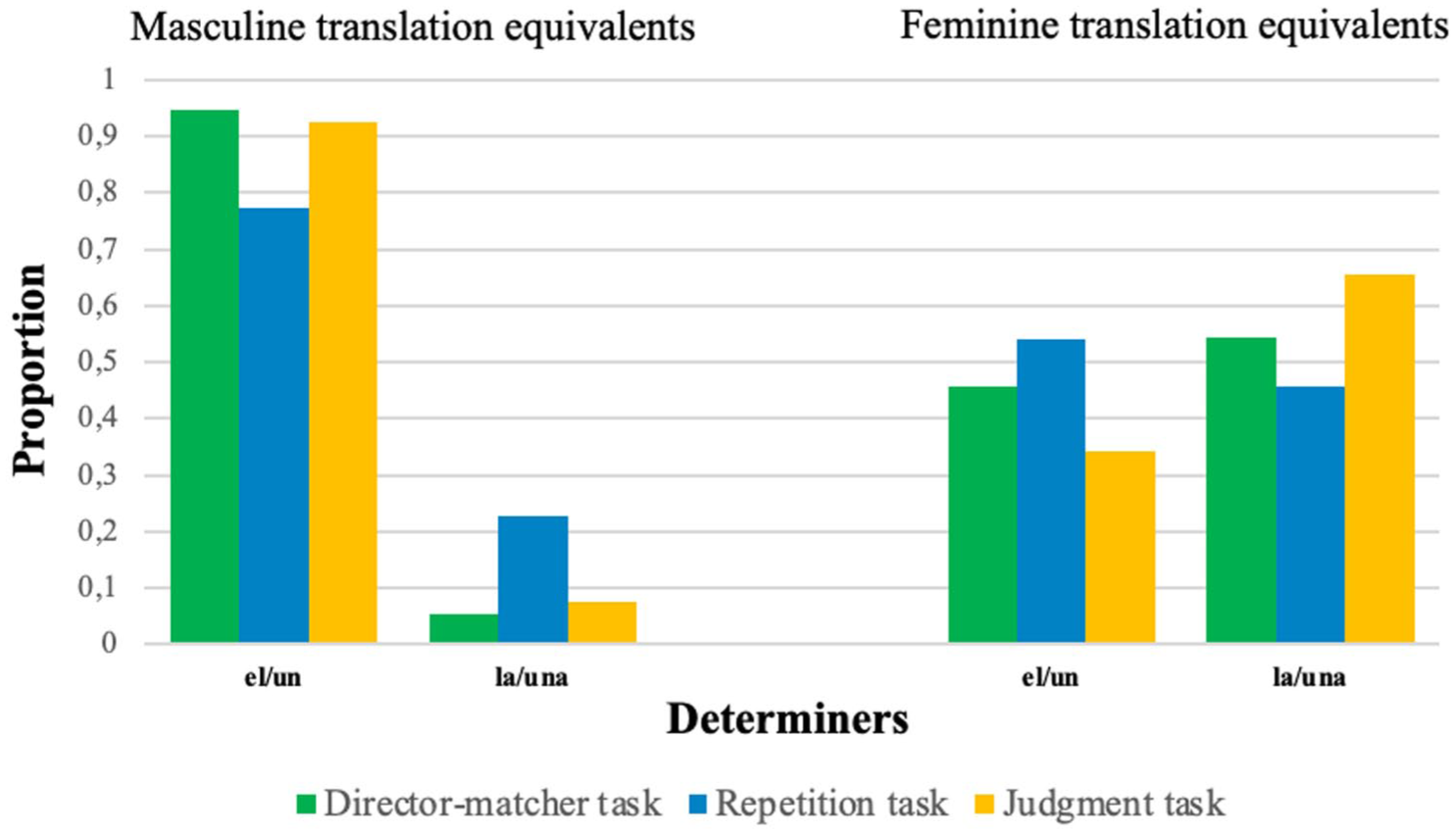
Distribution of mixed NPs across three tasks.
Discussion
This study provides the first systematic investigation of gender assignment strategies in mixed Spanish–Chinese NPs among early Spanish–Chinese bilinguals in Barcelona. By employing a multitask design, including director-matcher, sentence repetition, and forced-choice judgment tasks, we were able to capture both production and comprehension processes, revealing nuanced patterns in bilingual gender assignment. Findings highlight the interplay between task type and gender assignment strategies, as well as the role of community diversity in shaping these bilingual practices.
Variation in gender assignment strategies across tasks
Our findings illustrate how gender assignment in mixed NPs is highly sensitive to task demands. In the production tasks (director-matcher, sentence repetition), participants alternated between the default masculine and the translation equivalent strategy, particularly when assigning gender to Chinese nouns with feminine Spanish equivalents. This variability suggests that, in spontaneous or less monitored language use, bilinguals do not rigidly adhere to a single strategy but flexibly draw on both the default gender and the semantic associations provided by translation equivalents. For Chinese nouns whose Spanish equivalents are masculine, the masculine determiner overwhelmingly predominated, aligning also with the unmarked status of masculine gender in Spanish and consistent with previous research in other bilingual contexts.
In comprehension (judgment task), however, participants showed a stronger preference for the translation equivalent strategy, more consistently matching the gender of the Spanish determiner to that of the Spanish translation of the Chinese noun. This pattern indicates that when bilinguals are prompted to reflect on grammaticality or make explicit judgments, they are more likely to draw on metalinguistic knowledge and analogical reasoning rather than defaulting to the unmarked masculine. Notably, the design of the comprehension task, which presented bilinguals with sentence pairs contrasting Spanish determiners (gender-matched and gender-mismatched) alongside Chinese nouns, could have amplified participants’ metalinguistic awareness and focus on ensuring gender equivalence. This heightened attention facilitated the consistent application of the translation equivalent strategy, resulting in a strong preference for gender-matched mixed NPs in the comprehension task (see Bellamy et al., 2018 for similar findings). The contrast between production and comprehension tasks highlights the importance of methodological triangulation: relying on a single task type would have obscured the full range of bilingual behavior observed in this community. The task-dependent variability observed here supports dynamic models of bilingual language processing, which posit that bilinguals flexibly deploy grammatical strategies based on contextual and cognitive demands (Beatty-Martínez & Dussias, 2019). The interplay between default and translation equivalent strategies underscores the adaptability of bilinguals.
Influence of diversity of social network in the community
The varied gender assignment strategies observed among Spanish–Chinese bilinguals in Barcelona contrast with the more uniform patterns documented in other bilingual communities, such as Spanish–English bilinguals in Belize and Miami (Balam, 2016; Valdés Kroff, 2016). In those well-established communities, a strong preference for the masculine default is evident, likely reflecting the shared linguistic norms of a large, stable, and relatively homogeneous bilingual population. In contrast, the Spanish–Chinese bilinguals in Barcelona exhibit greater variability, alternating between the default masculine and translation equivalent strategies. This pattern mirrors findings from Królikowska et al. (2019) and Cisneros et al. (2023), who documented similar variability among Spanish–English bilinguals in El Paso, Granada, and New Mexico. These studies attribute such flexibility to the diverse social networks present in these communities, where not everybody speaks the same language.
Indeed, the Spanish–Chinese bilinguals tested in Barcelona interact with a linguistically diverse environment, including Spanish and Chinese monolinguals, Catalan–Spanish bilinguals, Chinese–Catalan–Spanish multilinguals, and others with different language backgrounds (e.g., English). Although they reported using unilingual Spanish (40%) and Chinese (37%) in daily conversation, the remainder of their daily used languages (23%) may involve various languages (e.g., Catalan or English) or Spanish–Chinese CS with peers and siblings. Such exposure to varied language practices likely fosters a high degree of adaptability in their linguistic behavior. Specifically, this diversity seems to play a crucial role in shaping the observed flexibility in gender assignment strategies, as individuals navigate and accommodate multiple linguistic systems and norms. While both Spanish–English bilinguals in El Paso, Granada, and New Mexico and Spanish–Chinese bilinguals in Barcelona show an overall preference for masculine gender, the variability in strategy use underscores the significant role of community diversity and sociolinguistic context in shaping bilingual language behavior.
However, we refrain from drawing definitive conclusions about the direct impact of community diversity on the observed gender assignment strategies, primarily due to the absence of a systematic and reliable corpus of CS data specifically targeting Spanish determiner-Chinese noun contexts within this community. While our experimental findings suggest that social network diversity may foster flexibility in gender assignment, the lack of naturalistic, corpus-based evidence limits our ability to generalize these results to everyday language use. As highlighted by Beatty-Martínez et al. (2018), the structure and dynamics of bilingual communities play a crucial role in shaping CS patterns. Without a dedicated corpus capturing spontaneous interactions and mixed NP constructions, it remains challenging to fully evaluate how community-level linguistic diversity influences real-world CS and gender assignment. Therefore, future research should prioritize the development of such corpora to provide more systematic and ecologically valid insights into the interplay between social context and grammatical choices in bilingual communities.
Moreover, the relatively recent establishment of the Spanish–Chinese bilingual community in Barcelona, comprised largely of second-generation migrants with an average age of 21 years, likely shapes the observed patterns of gender assignment. As a young and still-evolving community, its linguistic norms are not yet as entrenched as those found in more established bilingual populations. This developmental stage may contribute to the greater variability and flexibility seen in gender assignment strategies, as individuals navigate and negotiate linguistic practices within a dynamic and heterogeneous environment. As the community continues to grow and its social networks become more stable, it is plausible that shared linguistic conventions will emerge and solidify over time. With increased intergenerational transmission and the gradual formation of community-wide norms, gender assignment strategies may begin to converge toward the more uniform patterns observed in older, well-established bilingual communities, such as the Spanish–English bilinguals in Miami. However, without a longitudinal corpus documenting naturalistic CS and mixed NP usage as the community matures, it remains difficult to predict the trajectory of these linguistic patterns with certainty. The absence of such a corpus underscores the importance of future research that systematically tracks language use and CS practices in this community over time. Doing so would not only clarify how community age and stability influence grammatical choices but also provide valuable insights into the processes by which new bilingual norms are established and maintained.
Task design and cognitive processing
The task design critically shaped gender assignment strategies. In comprehension, the written mode eliminated the influence of phonological and orthographic cues, which are factors known to affect gender assignment in other bilingual contexts, such as Basque–Spanish (Parafita Couto et al., 2016). However, given the absence of grammatical gender and the logographic nature of Chinese, Chinese characters were not supposed to provide any grammatical gender cues or cross-linguistic influences on gender assignment in mixed NPs. As such, we predicted that no shape-based strategies were expected to be observed. This prediction was supported by the findings: no evidence of shape-based strategies, involving phonological or morphological cues from Chinese characters or Pinyin endings, was observed. For instance, Chinese Pinyin endings such as gua in 黄瓜 (/huanggua/ “cucumber”) do not align with Spanish feminine gender-marker -a, when its translation equivalent, pepino, is masculine. These findings suggest that shape-based strategies are irrelevant in this specific Spanish–Chinese bilingual context, likely due to limited overlap in the phonological and orthographic systems of the two languages.
When bilinguals produce mixed Spanish–Chinese NPs, the target noun activates lexical and syntactic features from both languages. This activation enables three primary gender assignment strategies: (1) adopting the gender of the Spanish equivalent; (2) defaulting to masculine; or (3) using morpho-phonological cues. For nouns with feminine translation equivalents, bilinguals alternated between assigning feminine gender (translation equivalent strategy) and masculine gender (default strategy). For nouns with masculine translation equivalents, the alignment of default and translation-equivalent gender consistently led to masculine assignment.
Limitations and future research
While the current study offers novel insights into gender assignment strategies among Spanish–Chinese bilinguals, several limitations should be acknowledged. First, the study focuses on a specific bilingual population in Barcelona, which may limit the generalizability of the findings to other Spanish–Chinese bilingual communities. Sociolinguistic factors such as frequency of CS, community norms, and exposure patterns may vary across regions, and future studies should explore whether similar patterns emerge in other contexts. Second, the study relies primarily on (semi-)experimental tasks, which, while controlled, may not fully capture spontaneous language use. The absence of naturalistic data limits our ability to assess how these gender assignment strategies unfold in everyday bilingual interactions. Third, variability in participants’ self-reported CS behaviors, partly due to differing interpretations of what constitutes CS, may have introduced inconsistencies in our analysis of bilingual language practices. Future research would benefit from incorporating longitudinal and corpus-based methods to track gender assignment over time and across more diverse sociolinguistic settings. Such data would not only enhance the ecological validity of research in this area but also shed light on how community dynamics and linguistic norms evolve as bilingual communities mature. In sum, addressing these limitations will be crucial for advancing our understanding of grammatical gender assignment in mixed-language contexts and for uncovering the broader mechanisms underlying bilingual language processing.
Conclusion
In this study, we examined gender assignment strategies in mixed NPs among 42 early Spanish–Chinese bilinguals in Barcelona, Spain, focusing on gender assignment strategies used by bilinguals when assigning gender to Chinese nouns. Using a multitask approach, we found that participants frequently assigned both masculine and feminine gender to nouns with feminine equivalents in production tasks. These patterns align with findings from other bilingual communities with similar sociolinguistic characteristics, such as reduced opportunities for CS and heterogeneous social interactions. The Spanish–Chinese bilingual community in Barcelona exemplifies how diversity in individual language strategies can foster shared norms of flexibility and adaptability, suggesting that linguistic variability itself may serve as a unifying feature within the community. This highlights a unique aspect of bilingualism, where diversity in language use is not merely tolerated but actively shapes community cohesion and linguistic practice. Overall, our findings advance the understanding of gender assignment in bilingual contexts by highlighting the importance of investigating communities with diverse linguistic and social experiences. The results demonstrate how language systems adapt to both social and cognitive demands, offering valuable insights into the mechanisms underlying bilingual language processing. While the scope and context of this study necessarily limit the breadth of our evidence, these findings lay important groundwork for future research, planting the seed for a deeper exploration of how community diversity and linguistic variability shape bilingual language use.
Supplemental Material
sj-docx-1-ijb-10.1177_13670069251363811 – Supplemental material for Variation in gender assignment strategies in mixed Spanish–Chinese noun phrases: Insights from a multilingual community in Barcelona
Supplemental material, sj-docx-1-ijb-10.1177_13670069251363811 for Variation in gender assignment strategies in mixed Spanish–Chinese noun phrases: Insights from a multilingual community in Barcelona by Ruixue Wu, M. Carmen Parafita Couto and Niels O. Schiller in International Journal of Bilingualism
Footnotes
Acknowledgements
We are grateful to the participants of this study for their time and commitment to completing the experiments. We especially thank Núria Sebastián Gallés, the director of the Speech Acquisition and Perception (SAP) research group at Pompeu Fabra University (UPF), for her warm welcome and generous help in making this research possible. We appreciate Francesc Xavier Mayoral Terron, the Secretary of the Department of Technology (UPF), and Silvia Blanch Rabat, the Research Support of the Department of Technology (UPF), for their help with the setup of experimental equipment and continuous guidance during data collection. Finally, we thank SAP group members, and the participants of the Sixth Variation and Language Processing Conference (VALP6) held in June 2024 in Vigo, Spain, for their valuable feedback and suggestions.

Ethical approval and informed consent statements
The study was approved by the Ethics Committee in Humanities of Leiden University, and informed consent was obtained from all participants.
Funding
The author(s) disclosed receipt of the following financial support for the research, authorship, and/or publication of this article: This work is partly funded by the China Scholarship Council (CSC) (No. 202107720015). Niels O. Schiller is supported by CityUHK startup grant no. 9380177 from City University of Hong Kong.
Declaration of conflicting interests
The author(s) declared no potential conflicts of interest with respect to the research, authorship, and/or publication of this article.
Data availability statement
Supplemental material
Supplemental material for this article is available online.
Notes
Author biographies
References
Supplementary Material
Please find the following supplemental material available below.
For Open Access articles published under a Creative Commons License, all supplemental material carries the same license as the article it is associated with.
For non-Open Access articles published, all supplemental material carries a non-exclusive license, and permission requests for re-use of supplemental material or any part of supplemental material shall be sent directly to the copyright owner as specified in the copyright notice associated with the article.
