




Abstract
Aims and objectives:
L2 learners who speak a null subject (L1 Spanish) and a non-null subject language (L2 English) may experience cross-linguistic interference from the L2 on L1 pronoun interpretation. In this study, we test pronoun interpretation in the L1 and L2 of adult learners, in comparison with two groups of monolingual speakers, to assess if L1 pronoun interpretation can change as a result of L2 acquisition at intermediate-advanced levels of L2 proficiency and in the absence of long L2 immersion.
Methodology:
A group of L2 English speakers (L1 Spanish) participated in two offline sentence comprehension tasks where they interpreted pronouns in the L1 and L2. The results are compared with English and Spanish monolingual speakers.
Data and analysis:
We find that adult English learners comprehend pronouns in their L1 (Spanish) differently than Spanish monolingual speakers, demonstrating a strong subject bias for interpreting null and overt pronouns. In addition, we show that pronoun interpretation patterns acquired in the L2 explain the changes to L1 interpretation biases.
Conclusions:
The results of this study significantly advance the understanding of the factors that contribute to bilingual language comprehension, showing the permeability of the L1 comprehension system at the discourse level as soon as the L2 sets in.
Pronoun resolution in English and Spanish
Pronoun resolution is the process of interpreting a pronoun toward a referent. Different languages have different types of pronouns and interpretation biases. Researchers have been interested in understanding the acquisition of pronoun interpretation biases in bilingual speakers, because bilinguals have shown variability across different language pairs and age groups (e.g., Sorace, 2011 for a review). This study aims at contributing to this literature, by investigating the effects of the second language (L2) on the first language (L1) in pronoun resolution in a group of L2 learners of English whose L1 is Spanish.
In a non-null subject language like English, comprehenders have a tendency to refer an ambiguous pronoun to the first-mentioned/subject antecedent, a preference known as the first-mentioned/subject bias (e.g., Arnold et al., 2000). For example, in a sentence like (1), the pronoun “he” could refer to either the subject (John) or the object antecedent (Karl). In this context, English speakers have a preference for interpreting “he” as referring to John, which is the first-mentioned antecedent and grammatical subject, and thus the most accessible entity in the previous context.
(1) Johni met Karl when hei was traveling.
Individual differences in the strength of the first-mention/subject bias have been reported in previous research (Arnold et al., 2018; Langlois & Arnold, 2020). For example, in Arnold et al. (2018), monolingual English speakers with higher language experience (measured as reading exposure) demonstrated a stronger use of the first-mention/subject bias, in comparison to English speakers with lower language experience. Speakers of English can also change their first-mention/subject bias if they are exposed to non-subject pronoun interpretations during the course of an experimental session (e.g., Contemori, 2021; Johnson & Arnold, 2023). For example, Contemori (2021) tested the interpretation of potentially ambiguous pronouns in sentences like (1). Half of the experimental sentences were preceded by a prime sentence where a pronoun unambiguously referred to the second/non-subject antecedent (e.g., Tom liked Mary because she was an interesting woman). Contemori (2021) found that English speakers were more likely to interpret the ambiguous pronoun as referring to the second/non-subject antecedent (i.e., Karl in [1]) after encountering the prime sentence than after encountering a non-prime sentence that did not contain a pronoun (see also Johnson & Arnold, 2023). This research suggests that speakers demonstrate some flexibility in the use of the first-mentioned/subject bias, and they adapt their choices about likely referents based on the statistical environment.
Spanish is a null subject language that allows the use of null and overt pronouns, as exemplified in (2) and (3). Differences in pronoun interpretation have been reported across speakers of different varieties of Spanish (e.g., Carvalho et al., 2015). For the variety of Spanish under investigation here (north Mexican Spanish), speakers have demonstrated a preference to interpret a null pronoun (ø in [2]) toward the preceding subject antecedent (e.g., Juan, in [2]), signaling topic continuity. In contrast, an overt pronoun (él in [3]) is more likely to signal a shift in topic, and is preferably interpreted toward a non-subject antecedent, the preceding object (Carlos) in example (3) (e.g., Contemori & Di Domenico, 2021; Keating et al., 2016).
(2) Juani conoció a Carlos cuando øi estaba de viaje.
(3) Juan conoció a Carlosi cuando éli estaba de viaje.
Even in null subject languages, comprehenders can adapt their null/overt pronoun interpretations based on the statistical environment (e.g., Fernandes et al., 2018). For example, Fernandes et al. (2018) investigated the interpretation of null and overt pronouns in European and Brazilian Portuguese, two null subject languages that differ in the frequency of use of overt pronouns (Brazilian Portuguese of 56% vs. European Portuguese 22%; see Barbosa et al., 2005). Fernandes et al. tested the interpretation of potentially ambiguous null and overt pronouns in sentences similar to (2) and (3), where a subject and an object antecedent share a similar gender. The authors created two versions of a sentence comprehension task: one version where the subject null and overt pronouns were counterbalanced across the experimental sentences, and one version that included fewer overt pronouns than null pronouns. Fernandes et al. found that Brazilian and European Portuguese speakers were more likely to interpret an overt pronoun toward an object antecedent when fewer overt pronouns were included in the experimental sentences, in comparison with the task with an equal number of null and overt pronouns. The effect emerged more strongly in Brazilian Portuguese, the variety where overt pronouns are more frequently used. Fernandes et al. demonstrated that comprehenders integrate existing statistical knowledge with new statistics about the frequency of occurrence of pronouns. Thus, even speakers of null subject languages use pronoun resolution biases with some flexibility, demonstrating adaptation to the frequency of occurrence of pronouns in the statistical environment.
L2 to L1 cross-linguistic effects in pronoun interpretation
Bilingual speakers may show more variability than monolingual speakers when interpreting subject pronouns (e.g., Sorace, 2011 for a review). When the language tested is a null subject language, bilingual speakers may diverge from monolinguals in their interpretation of overt pronouns, showing a tendency to associate an overt pronoun to a subject antecedent more often than monolingual speakers. These effects have emerged in different bilingual groups who speak a null subject language (child bilinguals: Sorace et al., 2009; heritage speakers: Keating et al., 2016; L1 attriters: Chamorro et al., 2016; Gϋrel, 2004; Kaltsa et al., 2015; Tsimpli et al., 2004; L2 learners: Sorace & Filiaci, 2006). Some researchers have explained bilinguals’ variability as resulting from the interaction of different factors, including lack of exposure to pronoun uses in the non-dominant language, cross-linguistic interference, and an increased need for cognitive resources when processing referential expressions in a non-dominant language (Sorace, 2011). Recent research has attempted to disentangle the relative contribution of these factors, demonstrating that language experience and cross-language influence may have an impact on the use of pronoun interpretation biases in bilingual speakers (e.g., Contemori et al., 2023, 2024; Contemori & Minjarez-Oppenheimer, 2023).
Concerning the effects of language experience, a recent study has investigated the offline interpretation of null and overt pronouns in Spanish in a group of Spanish–English bilinguals (Contemori et al., 2024). The results revealed that bilinguals chose the subject antecedent for null and overt pronouns in their L1 (Spanish) significantly more than a group of Spanish monolingual speakers. Contemori et al. (2024) calculated an index of language experience, using proficiency and measures of language exposure/use, and found a tendency for Spanish–English bilinguals with higher Spanish experience to prefer pronoun interpretations that were more similar to monolingual speakers. The effect of language experience was more pronounced for overt than null pronouns.
Effects of cross-language interaction at the discourse level have recently been reported, demonstrating that pronoun interpretation in one language can be affected by the interpretation of pronouns in the other language of bilingual speakers (Contemori & Minjarez-Oppenheimer, 2023). Specifically, Contemori and Minjarez-Oppenheimer (2023) used a sentence comprehension task where Spanish sentences included an unambiguous null/overt pronoun that referred to an object antecedent like “Ana invitó a Alvaro al cine porque ø/ él era un buen chavo. Ana invited Alvaro to the movies because ø /he was a good-masculine kid-masculine.” The Spanish sentences preceded English sentences where an overt pronoun was potentially ambiguous, like “John met Karl while he was travelling.” The task aimed at attenuating the first-mentioned/subject pronoun interpretations in English sentences by exposing bilinguals to Spanish second-mentioned interpretations. Contemori and Minjarez-Oppenheimer (2023) tested a group of adult Spanish–English bilinguals and found that (null and overt) pronoun interpretations in Spanish had an influence on the interpretation of ambiguous pronouns in English. Contemori and Minjarez-Oppenheimer’s results demonstrate that cross-language activation and shared abstract representations may exist in bilingual discourse. In addition, Contemori and Minjarez-Oppenheimer showed that pronoun preferences can sway based on the frequency of use in the other language during an experimental session.
In this study, we focus on adult speakers of an L2 who may experience cross-linguistic influence on the L1. Previous research has looked at the influence of the L1 on the acquisition of L2 pronoun comprehension biases, showing that L1 to L2 cross-linguistic interference may occur (e.g., Sorace, 2011 for a review). Research on L2 to L1 influence is more limited and has focused on attrition of referential expression use and comprehension. The term attrition refers to the loss of a previously acquired linguistic skill in a bilingual environment. This line of research has looked at first-generation immigrants, demonstrating susceptibility of the native language to be influenced by a late acquired L2 (L1 Turkish: Gϋrel, 2004; L1 Greek: Kaltsa et al., 2015; Tsimpli et al., 2004; L1 Spanish: Chamorro et al., 2016). For example, Chamorro et al. (2016) used an online eye-tracking task during reading to test the preferences for interpreting null and overt pronouns in Peninsular Spanish in three groups of speakers: monolinguals, L1 attriters, and re-exposed attriters who had just spent a period of time re-immersed in an L1 environment. The authors used stimuli where a main sentence including a subject and an object antecedent is followed by a subordinate clause including an unambiguous null or overt pronoun. The pronoun either referred to the subject or object antecedent based on agreement disambiguation. By examining the eye-tracking results, Chamorro et al. (2016) found that none of the three groups had a clear preference for interpreting null pronouns toward the subject antecedent. For overt pronouns, while L1 attriters had different interpretation preferences than monolingual Spanish speakers in the online reading task, the re-exposed group was indistinguishable from monolingual speakers. When the three groups of participants were asked to give a naturalness judgment about sentences where either a null or an overt pronoun referred to a subject/object antecedent, no differences were found, indicating that attrition only affected online processing but not offline preferences (but see Gϋrel, 2004; Tsimpli et al., 2004 for effects of attrition on offline interpretation). Notice that L1 attriters tested in previous studies were L2 near-native speakers and were immersed for a minimum of 5 years in an environment where the L2 is spoken (at least 5 years: Chamorro et al., 2016; at least 6 years: Tsimpli et al., 2004; at least 10 years: Gϋrel, 2004; at least 25 years: Kaltsa et al., 2015). Based on previous results, L2 near-nativeness and long L2 immersion are necessary conditions to observe the attrition of pronoun interpretation biases. This study addresses the question of whether L2 to L1 influence may take place at the intermediate-advanced stage of L2 acquisition, by exploring the permeability of the L1 comprehension system. As existing studies have either considered L1 to L2 cross-linguistic effects or L2 to L1 influence in a context of L1 attrition, a question remains open concerning cross-linguistic effects on the L1 in populations of L2 speakers with lower proficiency and lower immersion experience. Effects of language co-activation are well-known, and research has demonstrated that as the L2 develops, interaction between linguistic systems may exist at many levels (phonology, lexicon, syntax; e.g., Kroll et al., 2014 for a review). Thus, it is not excluded that a late acquired L2 may change L1’s comprehension preferences at the discourse level in a population of speakers who have achieved intermediate/advanced levels of proficiency in the L2. Notice that differently from other linguistic phenomena that pertain to the domain of phonology, lexicon, and syntax, pronoun interpretation is based on preferences, and variability across speakers is often reported. As such, these biases may be susceptible to language exposure and frequency of use, even in monolingual adults (Arnold, 2015; Arnold et al., 2018; Langlois & Arnold, 2020). While recent studies demonstrate flexibility in the use of pronoun interpretation biases in monolinguals (e.g., Contemori, 2021; Fernandes et al., 2018; Johnson & Arnold, 2023), more evidence is needed to understand how the two linguistic systems affect each other in different language acquisition contexts and which factors contribute to the occurrence of cross-linguistic effects when speakers have to establish relations between referential expressions and potential antecedents.
This study
In this study, we recruited a group of L2 speakers of English (L1 Spanish) to investigate the role of L2 acquisition on pronoun interpretation biases in the native language. Their proficiency in the L2 is intermediate-advanced, as measured with a test assessing grammar and vocabulary (Michigan English Language Institute College English Test [MELICET]). First, we will measure the interpretation biases of L2 English speakers in the L1 (Spanish) in comparison with a group of monolingual Spanish speakers. Then, we will include in the analysis an individual measure of language experience and a measure of individual performance on English pronoun interpretation. To measure language experience, we calculate an index based on participants’ proficiency and measures of listening, reading, and speaking in Spanish and English (e.g., Torregrossa et al., 2021).
When L2 English speakers are tested on the interpretation of subject pronouns in English, they typically show similar preferences to monolingual speakers, even at intermediate levels of proficiency (e.g., for English L2 speakers with L1 Spanish: Contemori, 2021; for English L2 speakers with L1 Greek: Cunnings et al., 2017). While the first-mention/subject bias is early-acquired by L2 speakers, it is unclear if the acquisition of this new discourse pattern in the L2 (a non-null subject language) may contribute to changing the interpretation biases in the L1 (Spanish, a null subject language). If L2 speakers have successfully acquired the first-mention/subject bias, their discourse statistics include a high likelihood that pronouns refer to a preceding first-mentioned/subject referent (Arnold, 1998). As some degree of permeability exists in the statistics that bilingual speakers calculate in their languages (e.g., Contemori & Minjarez-Oppenheimer, 2023), it is possible that L2 speakers may show an increase in first-mentioned/subject referent choices in the L1 (Spanish), when interpreting null and overt pronouns. Previous research using an offline sentence comprehension task has shown that heritage speakers of Spanish (L2 English) tend to choose a subject antecedent more often than Spanish monolinguals to interpret both null and overt pronouns in Spanish (Contemori et al., 2024). Notice that participants tested in Contemori et al. (2024) were recruited from the same border region as participants in this study, demonstrating that in the variety of Mexican Spanish tested here, some flexibility can be observed in the interpretation of both null and overt pronouns. If similar results were found with late L2 learners, our results would demonstrate that acquisition of the L2 discourse statistics determines cross-linguistic interference in L1 pronoun interpretation biases. On the contrary, if long-term immersion and/or near-native proficiency in the L2 are needed to observe changes in L1 pronoun comprehension biases, as shown by previous studies on L1 attrition (Chamorro et al., 2016; Gϋrel, 2004; Kaltsa et al., 2015; Tsimpli et al., 2004), we expect that English L2 learners will perform similarly to monolingual speakers in the L1 (Spanish).
To summarize, in this study, we address the following research question: do L2 speakers of English show any sign of L2 cross-linguistic influence on L1 pronoun interpretation, which may suggest L2 to L1 influence at the discourse level when L2 speakers have not yet achieved near-native proficiency and have lived in a context of immersion for a long time?
Participants
Forty-two L2 English speakers whose L1 is Spanish participated in a sentence comprehension experiment (27 females and 15 males; mean age: 18; SD: 0.8). Participants were recruited in intermediate and advanced English as a Second Language (ESOL) classes at the University of Texas at El Paso, located in a bilingual community at the border between the United States and Mexico. Participants did not report early exposure to English in the family. Participants received exposure to English in school, as it is common in the Mexican school system. However, they were required to enroll in ESOL courses because their standardized English scores indicated that they were proficient enough to enroll in the university but that they still needed additional English language support.
A group of 43 monolingual Spanish speakers was recruited at the Universidad Autónoma de Ciudad Juárez, located in a Mexican city at the border with the United States (30 females and 13 males; mean age: 21; SD: 3). Monolingual participants are speakers of the same variety of Mexican Spanish as the L2 speakers, which can be considered a contact variety.
A group of 28 monolingual English speakers was recruited on Amazon Mechanical Turk (10 females and 18 males; mean age: 30; SD: 3.5). Participants were not fluent in any language other than English.
L2 participants’ completed a language history questionnaire (adapted from the LEAP-Q: Marian et al., 2007). L2 speakers’ language background information is shown in Table 1. The language history questionnaire was adapted to reflect language use in the 17 months prior to the study. The data collection took place in 2021–2022 when students returned to in-person classes after the COVID-19 pandemic. The adaptation of the language history questionnaire was implemented because students’ routine border-crossing and living arrangements were largely affected by the COVID-19 pandemic. As shown in Table 1, in the 17 months prior to the study, the ESOL students had resided both in the United States and in Mexico and reported high use of Spanish, thus reflecting a more Spanish-immersed context than in normal circumstances, where the participants would have only resided in (or commuted to) the United States to participate in face-to-face classes.
L2 speakers’ information in the 17 months prior to the study based on the language history questionnaire: Mean (SD).
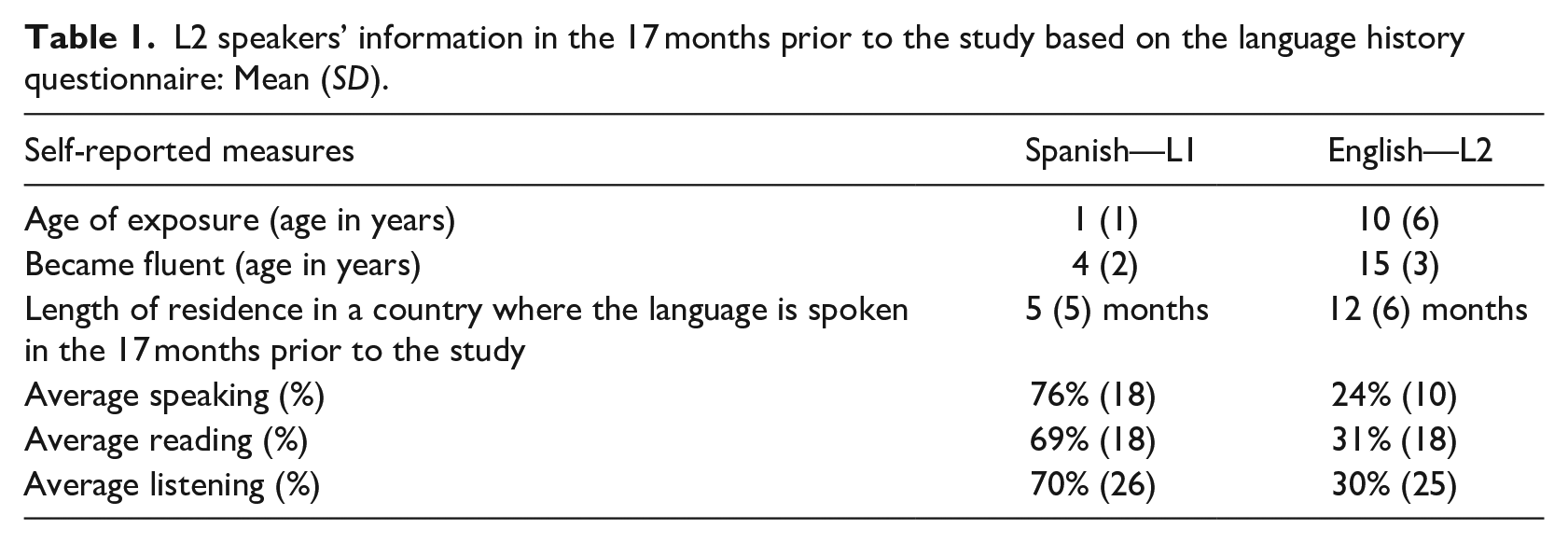
Spanish monolinguals and L2 speakers completed the MELICET, assessing English proficiency, and the Diplomas de Español Como Lengua Extranjera (DELE), assessing Spanish proficiency. The MELICET and DELE include 50 questions divided between grammar and vocabulary. An independent-sample t-test was used to compare the MELICET and DELE scores in the L2 speakers and Spanish monolingual group. The results showed that L2 speakers were significantly more accurate in the MELICET than Spanish monolingual speakers, L2 speakers: M = 28/50; SD = 8; Spanish monolinguals: M = 18/50, SD = 5; t(83) = 6.878, t < 0.0001, while the two groups did not differ significantly on the DELE proficiency scores, L2: M = 38/50, SD = 6; monolinguals: M = 39/50, SD = 4; t(83) = 1.121, t = 0.1. 1
Materials and procedure
In the Spanish task, we tested the comprehension of null and overt anaphoric pronouns, using an offline sentence comprehension task in Spanish. The task was an adaptation of the comprehension task created by Contemori and Di Domenico (2021). Thirty-two sentences included two same-gender referents, one in subject position and one in object position. In half of the sentences, the referents were stereotypically masculine proper names and in half of the sentences, they were stereotypically feminine proper names. A main clause was followed by a subordinate clause that included a null or an overt pronoun. The main clause did not contain any semantic bias, creating ambiguity in the pronoun interpretation, that is, making the pronoun as likely to refer to the subject or the object antecedent. An example of the two experimental conditions is presented in (4) and (5).
(4) Anaphora—null pronoun: Pedro saludó a Carlos cuando
Pedro greeted Carlos when (he) crossed the street.
(5) Anaphora—overt pronoun: Pedro saludó a Carlos cuando
Pedro greeted Carlos when he crossed the street.
Participants read the sentences at their own pace and answered a three-choice comprehension question that targeted the interpretation of the pronoun, as shown in (6). The three choices included the subject referent interpretation for the pronoun (a), the object referent interpretation (b), and an external referent interpretation (c). Notice that external referent interpretation is possible in null subject languages in certain contexts (Contemori & Di Domenico, 2021). Here, the external referent choice was included as a distractor. The position of the subject, object, and external referent antecedent in the comprehension questions was counterbalanced across items.
(6) Who was crossing the street?
(a) Pedro
(b) Carlos
(c) Alguien más (Someone else)
Sixty-two filler sentences were created that did not include a pronoun and had a variable number of referents, as shown in (7):
(7) Alberto was in love with Stacey, but Stacey was in a relationship with Mario.
Who was in love with Stacey?
(a) Mario
(b) Alberto
(c) Alguien más (Someone else)
The experimental sentences were divided into two lists, each containing 32 experimental sentences and the fillers. Two more lists were created by inverting the order of the items. Confidence scoring was included in experimental and filler questions, where participants had to choose on a scale of 1–5 how confident they were about their answer, with 1 indicating “not confident at all” and 5 indicating “very confident.” The confidence ratings were used to assess if L2 and monolingual speakers showed any difference in self-reports of felt confidence in their own performance.
In the English task, we investigated the interpretation of potentially ambiguous pronouns in English. The task was an offline sentence comprehension test adapted from Contemori (2021). Twelve sentences were created that had a similar structure to the Spanish sentences, as shown in (8). A main clause introduced a subject and an object referent that shared a similar gender (two prototypically male proper nouns and two prototypically female proper nouns), and a subordinate clause introduced by “when” included a potentially ambiguous pronoun. The sentences did not include any semantic biases, such as the use of implicit causality verbs.
(8) Adam chatted with Nick when he was watching TV.
Twenty-four filler sentences were included in the task that did not contain a pronoun and had a variable number of referents (one to three). An example of a filler sentence is given in (9):
(9) Chloe cooked dinner last night. Steve joined for dinner and brought an expensive bottle of wine.
Who brought a bottle of wine?
(a) Chloe
(b) Steve
(c) Someone else
One list was created that included the 12 experimental sentences and the filler sentences. One more list was created by inverting the order of the items. Participants completed a confidence scoring for experimental and filler questions, choosing on a scale of 1–5 how confident they were about their answer (1 =“not confident at all”; 5 =“very confident”).
Procedure and coding
The comprehension tasks were administered as two separate Question Pro surveys. The order of the Spanish and English sentence comprehension tasks was counterbalanced across participants. English speakers only completed the English task. Spanish monolingual speakers and English L2 learners completed the Spanish and English tasks. Spanish monolingual speakers and L2 speakers also completed an online version of the language history questionnaire, MELICET, and DELE between the English and Spanish sentence comprehension tasks.
Monolingual and L2 speakers who did not score at least 80% correct responses on fillers were discarded (four L2 participants; four monolingual speakers). Accuracy scores on filler sentences were high (Spanish: monolinguals, M = 96%; L2 speakers, M = 96%; English: monolinguals, M = 96%; L2 speakers, M = 95%), indicating that all participants were paying attention to the task.
For the Spanish task, subject and object interpretation were scored as 1 or 0 per subject and item and analyzed using glmer (lme4 library, Bates & Sarkar, 2007). The analysis included pronoun Type (null vs. overt, coded as 0.5 and −0.5, respectively) and Group (Spanish monolinguals vs. L2 speakers, coded as 0.5 and −0.5, respectively) as fixed factors. For the English task, subject interpretations were analyzed, including Group (English monolinguals vs. L2 speakers, coded as 0.5 and −0.5, respectively) as a fixed factor. For both glmer analyses, we used a stepwise backward inclusion procedure and tested first-level effects and interactions between the fixed-effect factors. One additional analysis explores the results of the Spanish task in L2 speakers, including an index of language experience and English pronoun interpretation as fixed factors.
Results
Spanish
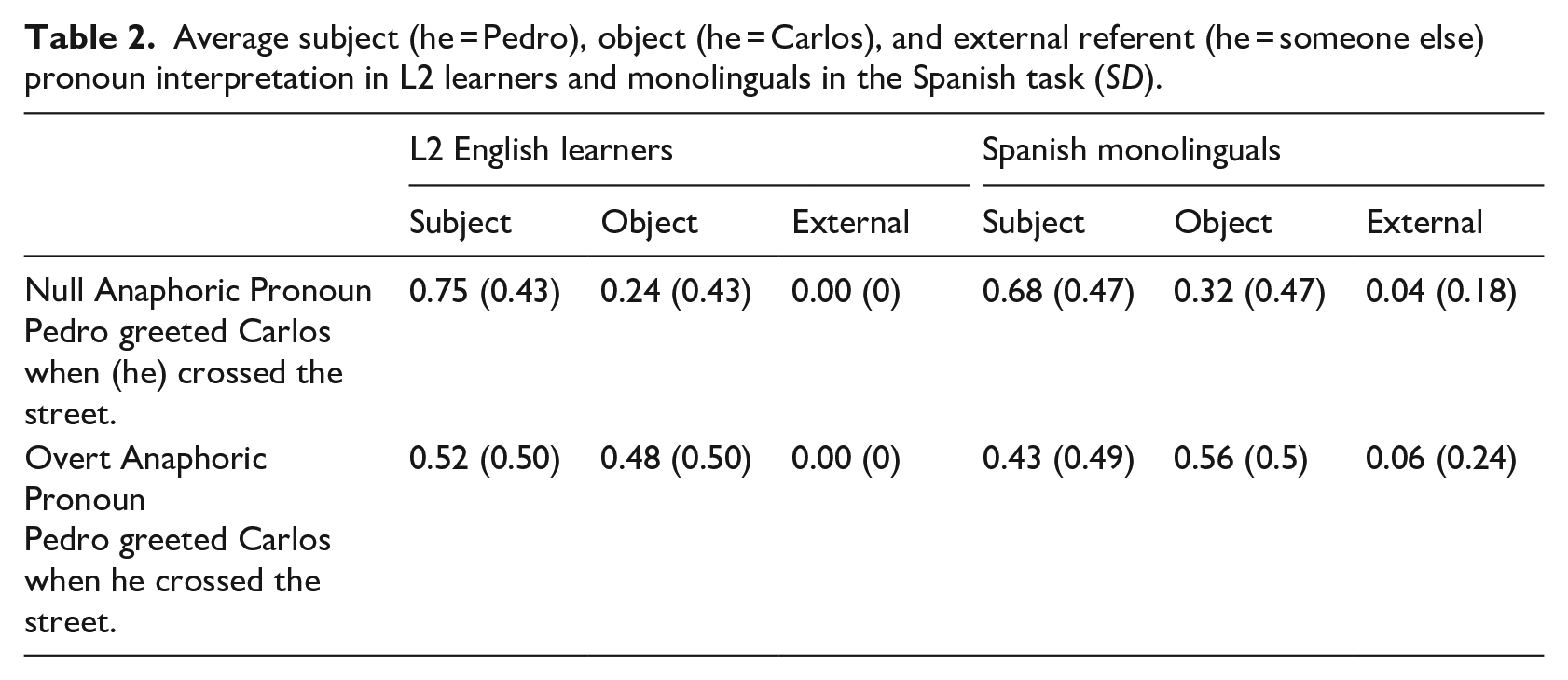
Table 2 illustrates the proportion of subject, object, and external referent interpretation for null and overt anaphoric pronouns. Table 3 shows the confidence ratings for null and overt subject interpretations in L2 learners and Spanish monolinguals.
Average subject (he = Pedro), object (he = Carlos), and external referent (he = someone else) pronoun interpretation in L2 learners and monolinguals in the Spanish task (SD).
Average confidence ratings for null and overt subject interpretations in L2 speakers and monolinguals in the Spanish Task (SD).
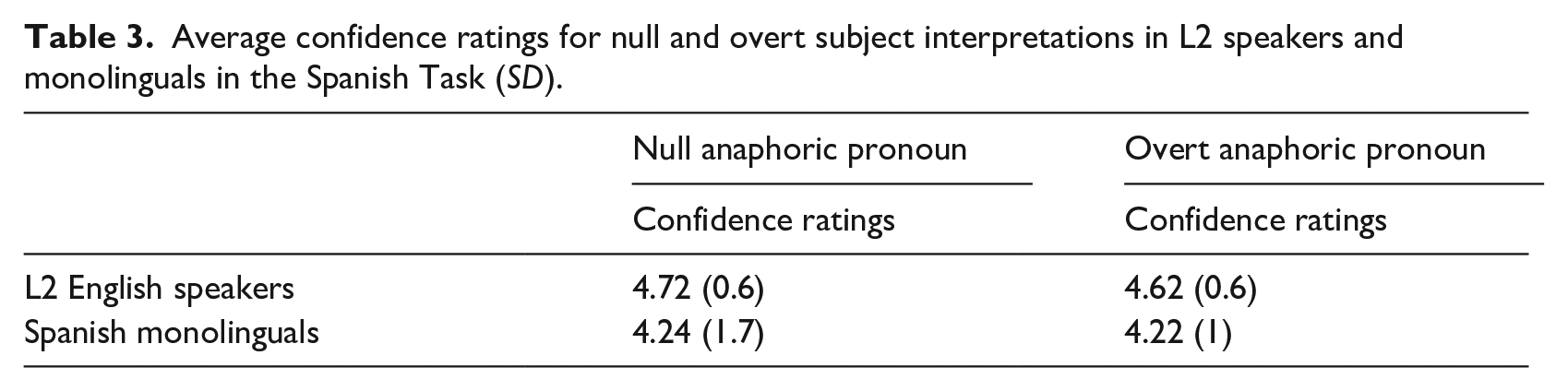
Table 4 shows the results of the models where subject and object interpretations were used as dependent variables. External referent choices were very low and were not analyzed. Table 4 also includes the results of the model where confidence ratings were used as a dependent variable.
Full models comparing subject and object pronoun interpretations and confidence ratings in the Spanish task (L2 learners vs. Spanish monolinguals) (SD).
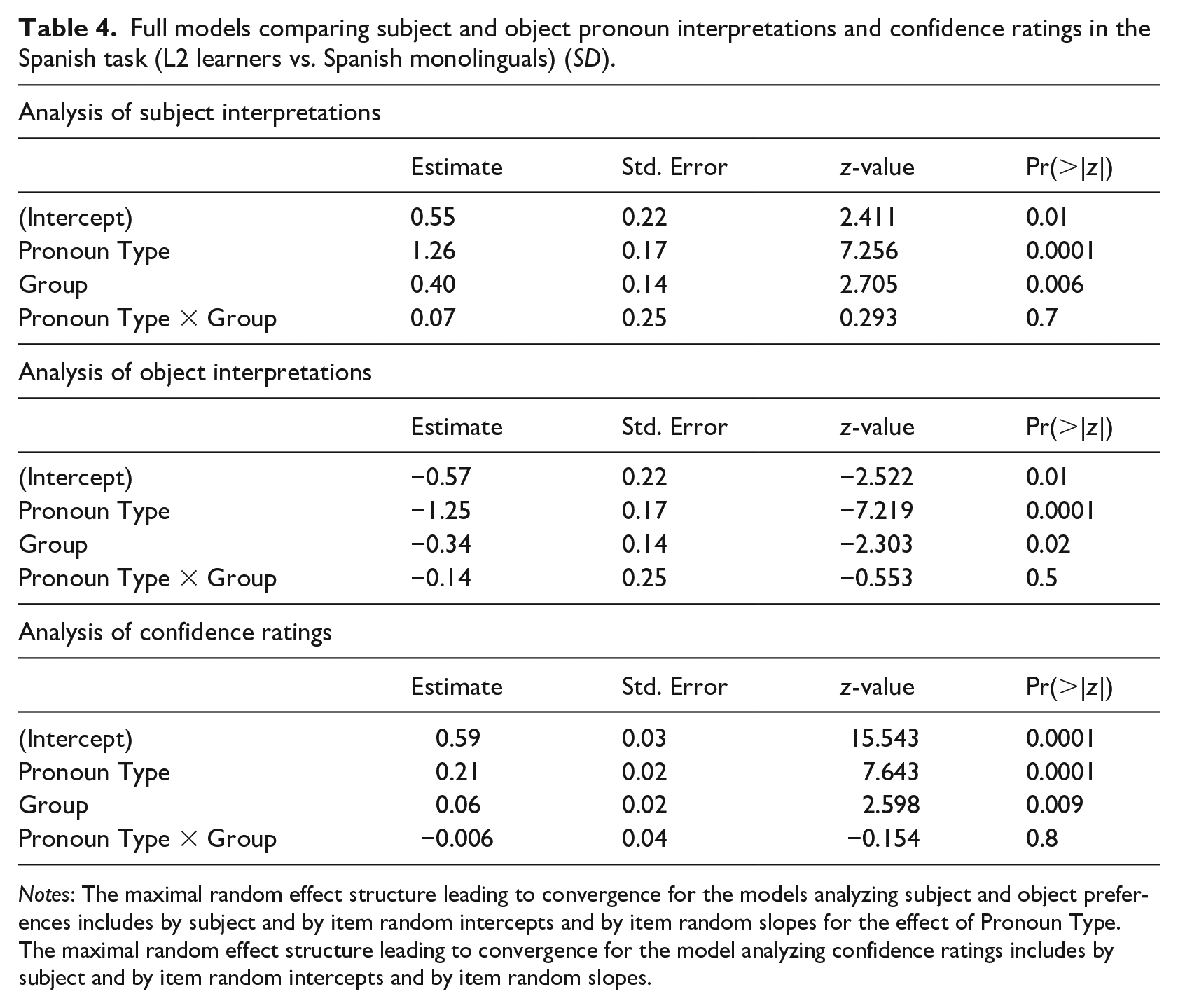
Notes: The maximal random effect structure leading to convergence for the models analyzing subject and object preferences includes by subject and by item random intercepts and by item random slopes for the effect of Pronoun Type. The maximal random effect structure leading to convergence for the model analyzing confidence ratings includes by subject and by item random intercepts and by item random slopes.
We found a main effect of Pronoun type in the analysis of subject and object antecedent interpretations, suggesting that all participants chose significantly more subject interpretations for null pronoun than overt pronouns (0.71 vs. 0.47) and significantly more object interpretations for overt pronouns compared with null pronouns (0.28 vs. 0.52). A main effect of Group demonstrates that L2 speakers gave more subject interpretations and significantly fewer object interpretations to null and overt anaphoric pronouns than monolingual Spanish speakers (null pronoun: 0.75 vs. 0.67; overt pronoun: 0.48 vs. 0.56).
In the analysis of the confidence ratings, we found that monolinguals were significantly less confident about their answers than L2 speakers (4.6/5 vs. 4.2/5), as demonstrated by the main effect of Group. A main effect of Pronoun Type was also significant, indicating that participants were overall more confident about the interpretation of null pronouns (4.5/5) than overt pronouns (4.4/5).
English
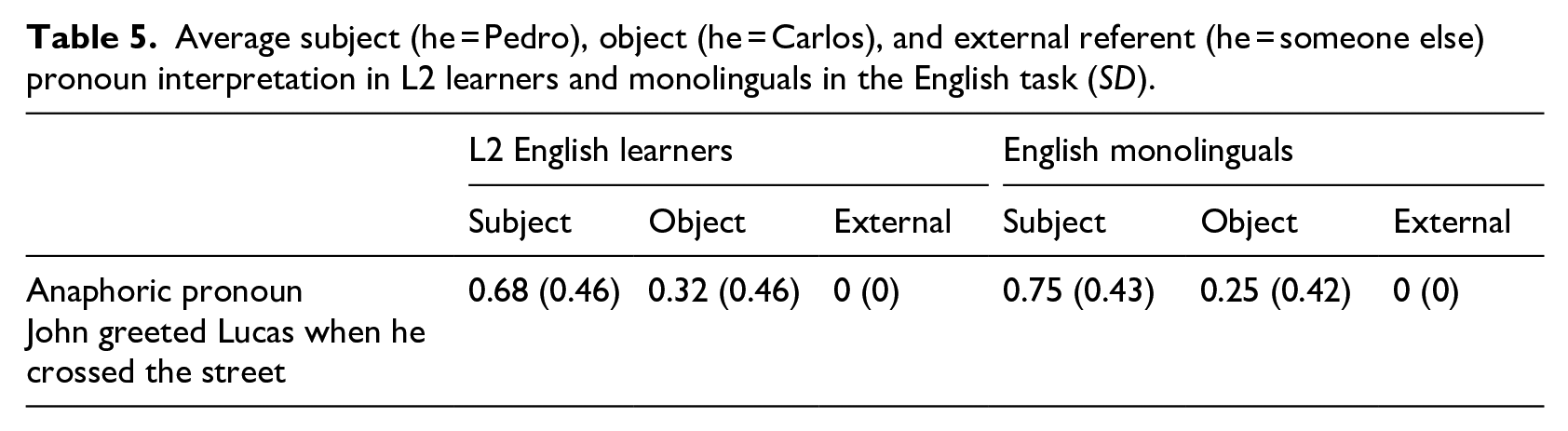
Table 5 illustrates the proportion of subject, object, and external referent interpretations for anaphoric pronouns in English. Table 6 shows the confidence ratings for pronoun interpretations in L2 learners and English monolinguals.
Average subject (he = Pedro), object (he = Carlos), and external referent (he = someone else) pronoun interpretation in L2 learners and monolinguals in the English task (SD).
Average confidence ratings for pronoun interpretations in L2 learners and English monolinguals in the English Task (SD).
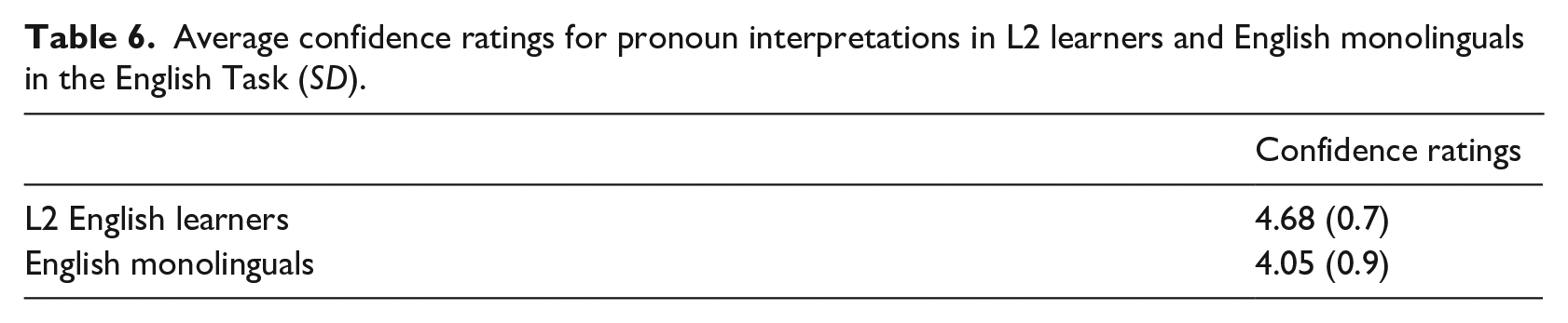
Table 7 shows the results of the model where subject interpretations were used as a dependent variable for the analysis of pronoun in English and the analysis of the confidence ratings.
Full model comparing subject interpretations for English pronouns and confidence ratings (L2 learners vs. monolinguals) (SD).
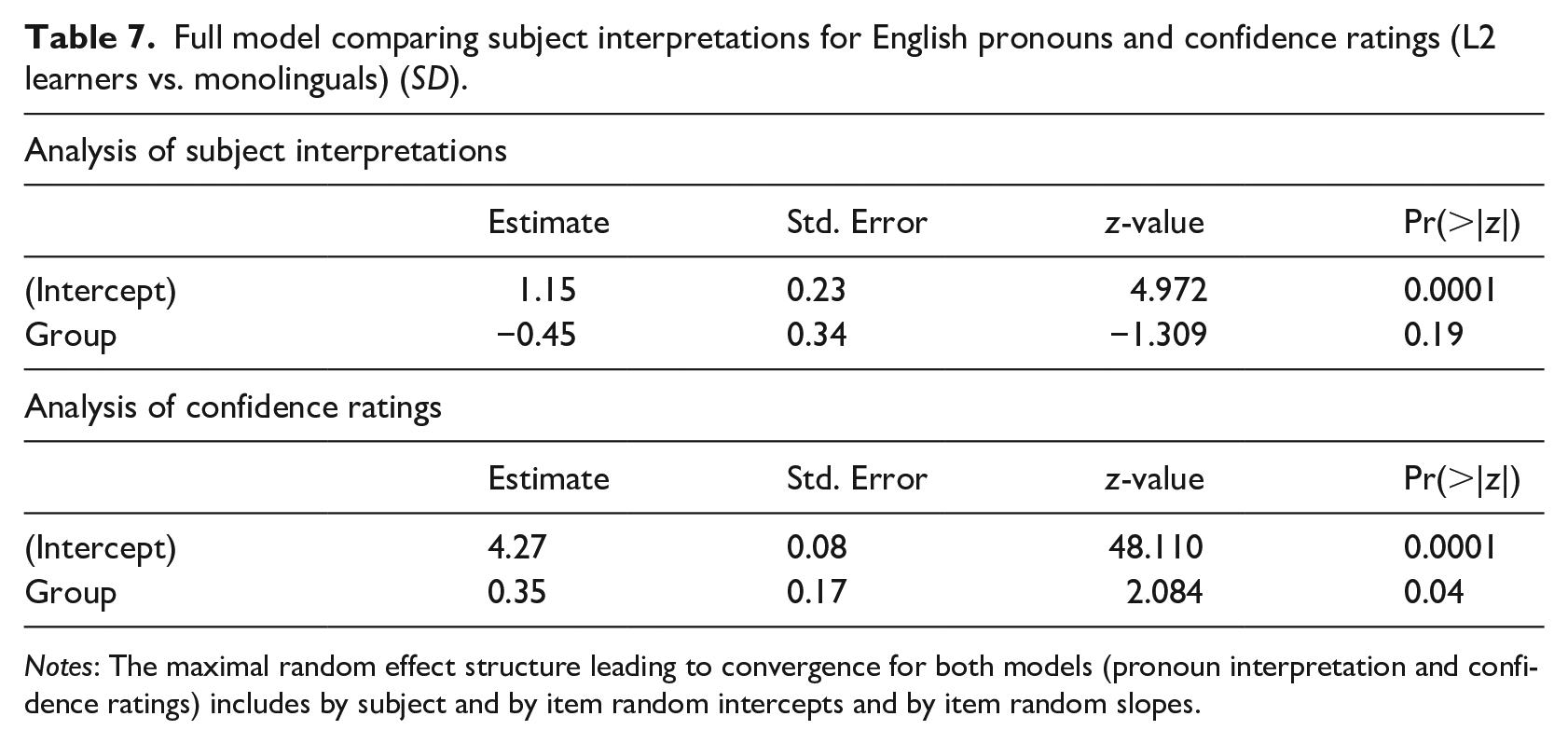
Notes: The maximal random effect structure leading to convergence for both models (pronoun interpretation and confidence ratings) includes by subject and by item random intercepts and by item random slopes.
In the analysis of subject interpretations, a main effect of Group did not reach significance, suggesting that L2 English speakers and English monolinguals chose the subject interpretation for English pronouns to a comparable extent (L2 speakers: 0.68; English monolinguals: 0.75).
The analysis of the confidence ratings revealed a significant main effect of Group, demonstrating that monolingual speakers have significantly lower confidence (4.05/5) than L2 learners (4.68/5) when choosing a referent for a potentially ambiguous pronoun. 2
Individual factors analysis
The analysis of individual factors focused on pronoun interpretation in Spanish only in the L2 group. The analysis included (a) a language exposure index, calculated using the procedure illustrated in Torregrossa et al. (2021), and (b) L2 speakers’ performance on the English pronoun interpretation task.
The language experience index consists of individual language proficiency, measured with the DELE and MELICET tests, and measures of language use, measured with the language background questionnaire (average daily speaking, average daily reading, and average daily listening to English and Spanish). For each L2 speaker, the DELE z-score was subtracted from the MELICET z-score and used as a dependent variable in a regression model, including the three measures extracted from the language background questionnaire as independent variables (average daily speaking, average daily reading, and average daily listening). Speaking, reading, and listening percentages provided by each participant were converted into proportions, and each measure for Spanish was subtracted from the same measure reported for English. The value calculated per each participant was then included in the model as independent variable. The results of the regression model are illustrated in Table 8.
Full model including the language background variables.
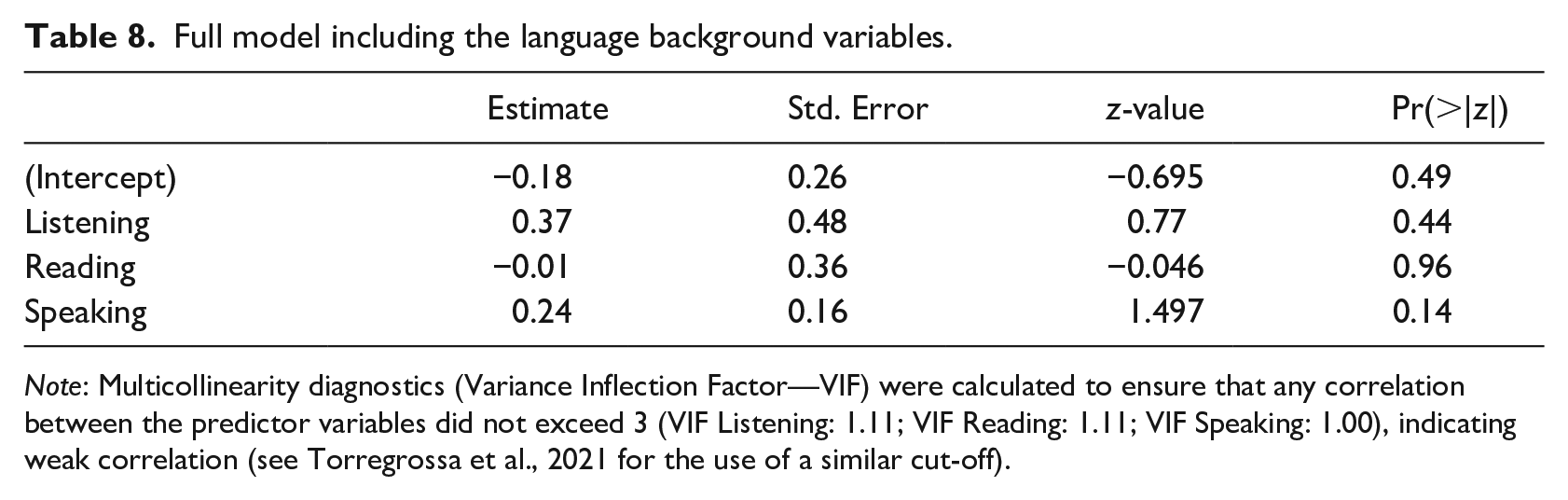
Note: Multicollinearity diagnostics (Variance Inflection Factor—VIF) were calculated to ensure that any correlation between the predictor variables did not exceed 3 (VIF Listening: 1.11; VIF Reading: 1.11; VIF Speaking: 1.00), indicating weak correlation (see Torregrossa et al., 2021 for the use of a similar cut-off).
The following formula was adapted from Torregrossa et al. (2021) to calculate the index of language experience for each participant. W indicates the weight (i.e., the standardized ß-coefficients for each independent variable in the multiple linear regression model in Table 8), and N indicates the score calculated for listening, reading, and speaking by subtracting the Spanish proportion from the English proportion.
Index of Language Experience = (Wlistening ・ Nlistening) + (Wreading ・ Nreading) + (Wspeaking ・ Nspeaking)
The index of language experience was included in a model analyzing Spanish pronoun interpretation in L2 English speakers, reported in Table 9. In addition, to assess the impact of the first-mentioned/subject bias on the interpretation of Spanish pronouns, we included the performance on the English task as an independent variable in the model, measured as the proportion of subject pronoun interpretations chosen for English pronouns by each participant.
Full models comparing subject pronoun interpretations in Spanish, based on accuracy of English pronoun interpretation and language experience.
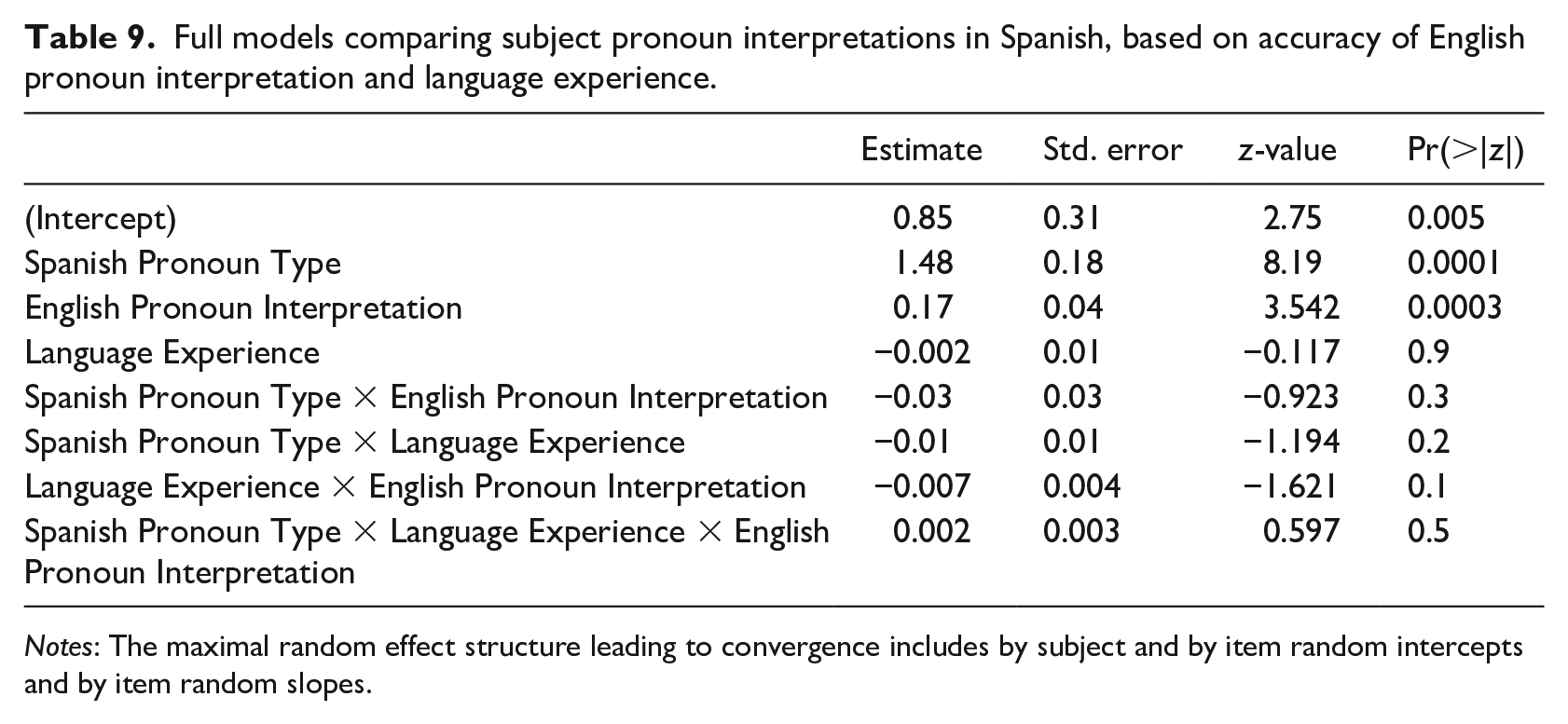
Notes: The maximal random effect structure leading to convergence includes by subject and by item random intercepts and by item random slopes.
In the model, a significant main effect of English Pronoun Interpretation emerged (p < .0003). The effect is plotted in Figure 1, illustrating the proportion of subject interpretations for null and overt pronouns in Spanish (y-axis) as a function of the proportion of subject interpretations for English pronouns (x-axis). Figure 1 shows that as the strength of the first-mentioned/subject bias in English increases, so does the preference for interpreting null and overt Spanish pronouns toward a subject antecedent. Notice that the majority of L2 participants are represented in the rightmost end of the x-axis in Figure 1 (5%–100%), as only 10/42 participants chose the subject interpretation in English less than 50% of the times.
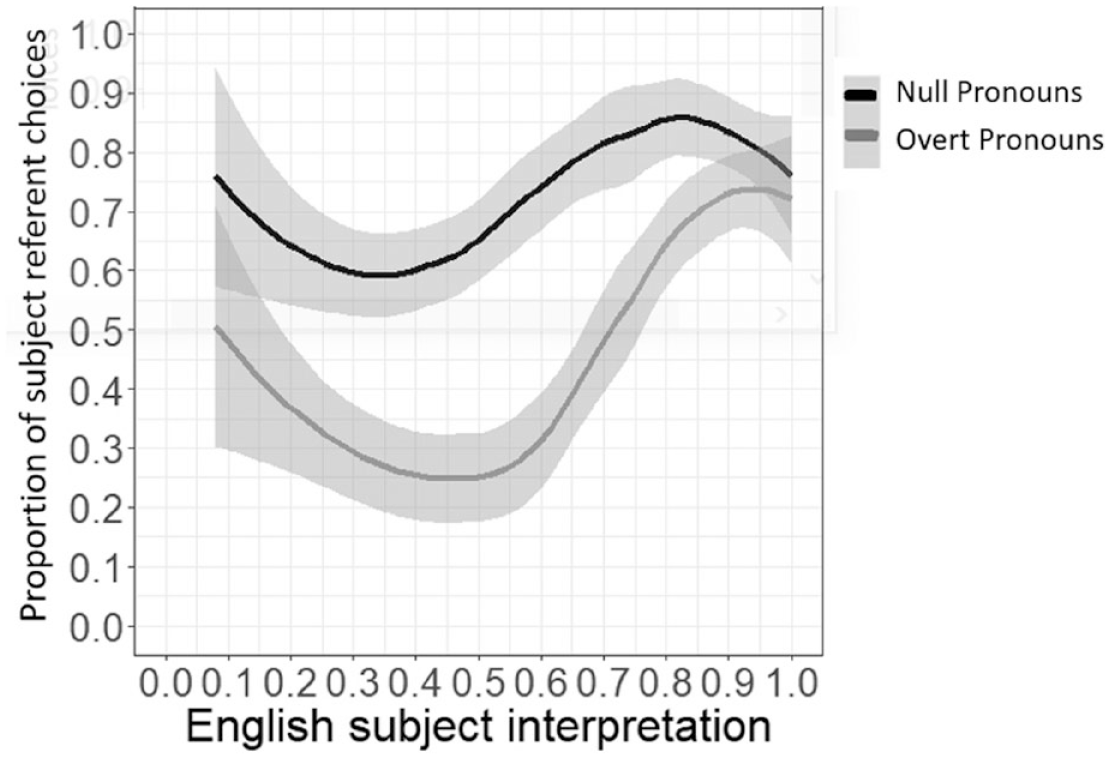
Proportion of subject interpretation for Spanish null and overt pronouns based on the proportion of subject choices in the English task.
Discussion
The results of the Spanish pronoun interpretation task show that L2 speakers choose the subject interpretation for null and overt anaphoric pronouns significantly more often than monolingual Spanish speakers. In addition, the results show significantly fewer object interpretations for null and overt pronouns in L2 speakers compared with Spanish monolingual speakers.
The analysis of the English data demonstrates that L2 English speakers prefer to interpret ambiguous anaphoric pronouns toward a subject antecedent. In line with previous studies, L2 speakers’ pronoun interpretation is comparable with English monolingual speakers, suggesting that L2 learners have successfully acquired the first-mentioned/subject bias in English (e.g., Contemori, 2021; Cunnings et al., 2017). The analysis of the confidence ratings demonstrates that L2 speakers feel more confident about the interpretation of ambiguous anaphoric pronouns in Spanish and English in comparison with monolingual speakers of either language. The results suggest that the monolingual groups may be more aware of the pronoun ambiguity in the sentence materials, while L2 speakers may perceive the ambiguity to a lesser degree. Future studies should confirm these results and clarify the nature of this difference.
Altogether, our results indicate that Spanish pronoun interpretation may be susceptible to L2 influence even in the absence of native-like proficiency and long immersion. The analysis of individual differences confirmed this hypothesis, demonstrating that a higher subject preference for null/overt pronouns in Spanish is associated with a stronger use of the first-mentioned/subject bias in English. 3 This result seems to indicate that the frequent use of subjects as antecedents of pronouns in English, has an effect on the preference for interpreting ambiguous (null and overt) pronouns in Spanish. This result adds to a body of research showing that the frequency of occurrence of discourse patterns may shape the use of pronoun resolution biases in comprehension and that the probability of occurrence of pronouns affects comprehension (e.g., Arnold et al., 2018; Fernandes et al., 2018). Thus, our findings provide support for theoretical accounts of reference based on probabilistic inferences (e.g., Arnold, 1998; Kehler et al., 2008). In addition, this result is in line with language experience accounts to L2 acquisition that highlight the similarity between L1 and L2 processing (e.g., Ellis, 2002 for a review).
In the analysis of individual differences, we did not find a significant effect of language experience, including proficiency and language use measures. Notice that the L2 speakers who participated in our study are students recruited in ESOL courses, who have achieved intermediate-advanced L2 proficiency. The L2 participants report higher use of Spanish in their daily lives than English, and their proficiency in the L1 and L2 is quite homogeneous. Thus, a lack of variability in the L2 sample may explain why language experience did not contribute significantly to L1 performance in our group. In addition, we note that the language experience measure did not include scores from multiple proficiency tests, which may have limited its descriptive power.
Our study shows that L1 pronoun interpretation is susceptible to cross-linguistic influence from a late-learned language even in a context where prolonged L2 exposure due to immersion has not recently occurred. Notice that our L2 speakers report relatively scarce use of the L2 in the 17 months prior to the study when L2 immersion had been partially interrupted by the COVID-19 pandemic. This suggests that changes in pronoun biases may not only occur in prolonged L1 L2 contact or in individuals with near-native L2 proficiency. One non-mutually exclusive explanation for our results is that the co-existence of the two linguistic systems in L2 speakers may determine increased demands for cognitive abilities, resulting in non-monolingual comprehension patterns (e.g., Sorace, 2011). While our study cannot exclude this interpretation of the results, we point out that previous research has failed to find effects of cognitive abilities in adult bilingual referential choice in the presence of non-monolingual patterns of production (e.g., adult Spanish–English bilinguals: Contemori & Ivanova, 2020). In contrast, an increasing number of studies have reported effects of language experience/dominance (e.g., for production: Torregrossa et al., 2021; for comprehension: Contemori, 2021) and cross-linguistic effects on referential choice and pronoun resolution (e.g., Contemori et al., 2023; Contemori & Minjarez-Oppenheimer, 2023).
Our data may seem to contradict the effects of re-exposure reported by Chamorro et al. (2016) for a group of attrited Spanish speakers residing in the United Kingdom who were tested after spending a minimum of a week in Spain. However, differently from our study, Chamorro et al. (2016) did not find a statistically significant subject preference for the interpretation of null pronouns in the three groups of participants (see also Chamorro, 2018 for similar results). For overt pronouns, Chamorro et al. (2016) found that in online reading, attrited speakers were not as sensitive at identifying the appropriate use of the overt pronoun, while the re-exposed group was indistinguishable from the monolingual group. Similarly to the attrited speakers in Chamorro et al., in our results we found a tendency of L2 speakers to deviate from monolingual’s interpretation, demonstrating a stronger preference for a subject referent interpretation for overt pronouns. However, we have to be cautious about comparing our study to Chamorro et al. because the population and immersion context present some important differences. In addition, the task and the variety of Spanish tested in Chamorro et al. are different than in our study.
To conclude, the results of the present research suggest that cross-linguistic interference can occur when the first-mentioned/subject bias has been acquired by L2 English learners. This, in turn, can determine a change in the use of pronoun interpretation biases in the L1, resulting in divergence from Spanish monolingual speakers’ biases. Future research should investigate the individual variables that can account for variability in learners’ pronoun interpretation biases (e.g., reading exposure, theory of mind, executive functions) and include in the language history questionnaire information about language use prior to the 17 months preceding the testing. One limitation of this study is that comprehension was tested with an offline task, which taps into the conscious process of resolving an ambiguity. Future research should use an online task to confirm if the unconscious processing of null and overt pronouns is comparable in other bilingual speakers. Finally, given the flexibility of pronoun interpretation biases in monolingual and bilingual speakers, future research should explore how changes in language experience affect pronoun interpretation over time in the same bilingual individuals. Such research could contribute to understanding how dynamic are the discourse representations of bilingual speakers.
Footnotes
Declaration of conflicting interests
The author(s) declared no potential conflicts of interest with respect to the research, authorship, and/or publication of this article.
Funding
The author(s) received no financial support for the research, authorship, and/or publication of this article.
