



Abstract
Aims and Objectives:
While research has focused on effects of language exposure within the family, evidence for the role of the quality and quantity of language exposure within peer contexts for the acquisition of both majority language (ML) and heritage language (HL) skills is still limited. Against this background, the present contribution investigates the patterns in which language exposure within family and peer contexts relate to different bilingual reading outcomes of migrant adolescents.
Design:
The data used for this contribution provide a unique opportunity to fill in this research gap as it contains standardized reading assessments in the ML and HL as well as questionnaires on language exposure within peer and family contexts.
Data and Analysis:
Using multinomial regression models with a sample of n = 803 adolescents with German–Russian and German–Turkish language backgrounds, we investigate the role of adolescents’ bests friends’ language backgrounds and language skills as well as adolescents’ language use with parents for the prediction of different bilingual reading outcomes (i.e., skilled bilingual readers, skilled ML readers, skilled HL readers, and low-skilled bilingual readers).
Findings:
The results indicate that dual inclusion into best friendships with both monolingual German as well as HL peers might be a favorable friendship pattern as it is positively related to both the skilled bilingual reading and the skilled ML reading outcome. Furthermore, we observe a tendency that skilled bilingual readers benefit from having a high-skilled HL speaking best friend. In addition, HL use with parents is an important predictor for HL skills, but not a hindrance for high ML proficiency. Effects of the peer group predictors are rather small, nevertheless they add value for explaining bilingual language outcomes controlling for relevant predictors.
Keywords
Introduction
In many countries all over the world, student bodies have become increasingly linguistically, socially, and culturally diverse. Language skills are considered a key qualification for social participation and educational success. While competencies in the majority language (ML) have been identified as being crucial for academic achievement (Kempert et al., 2016), the role of heritage languages (HLs) has been discussed controversially (Gogolin & Neumann, 2009). Speaking a HL has often been interpreted as a major cause of performance disadvantages and a hindrance of structural integration of immigrants (Esser, 2006; OECD, 2019). From an additive research perspective, on the contrary, multilingualism is viewed as a potential asset, that positively affects certain executive functions (see Giovannoli et al., 2020), allows to transfer linguistic skills and concepts between languages (Cummins, 1979), and provides access to family- and community-based resources that may support educational performance (Portes & Hao, 2002). The present contribution considers language skills (linguistic capital) in both the ML and HL as forms of (incorporated) cultural capital, which may contribute to educational success (see Bourdieu, 1986).
Human capital theories of language acquisition highlight the fact that languages are learned in social contexts (Chiswick & Miller, 2001; Esser, 2006). In this respect, studies have focused on effects of language exposure within the family on the acquisition of language competencies in the ML of the host society of immigrants as well as the maintenance of HL language skills (Hollebeke et al., 2020; Leseman et al., 2010; Scheele et al., 2010; Strobel & Kristen, 2015). Even though peers become more important during adolescence due to an increase of time spent outside the family (Zander et al., 2017), evidence for the role of the quality and quantity of language exposure within peer contexts is still limited.
Using Student’s test performance in reading comprehension as an indicator of receptive language skills, the present contribution examines bilingual language skills of adolescents with Russian or Turkish as an HL growing up in Germany. We consider differences in bilingual reading proficiency to be an outcome of learning that is shaped by social contexts and examine how language exposure within groups of best friends (including friends’ language backgrounds and skills in the ML and HL) and language use with parents determine different bilingual reading outcomes with a special interest for effects that relate to high reading skills in the ML and the HL.
Theoretical background and empirical evidence
Theory: bilingualism and its socio-contextual determinants
Recent definitions of bi- and multilingualism recognize that a bi- or multilingual persons’ knowledge in each language and its linguistic domains (e.g., vocabulary, stylistic level, reading, and writing) may vary considerably depending on the amount, the situations, and contexts in which these languages are used (Grosjean, 2022). Thus, the social environment plays a key role in providing opportunities for language learning (Unsworth, 2016). Human capital models of language acquisition state that proficiency in a language is mainly determined by three sets of factors (Chiswick & Miller, 2001; Esser, 2006; van Tubergen, 2010): (1) Exposure relates to factors that influence the extent to which a language is heard and used (e.g., contact to speakers of the respective languages, schooling in these languages, time spent in countries where these languages are spoken). (2) Language learning is further described as a consequence of individual investments that are determined by the evaluation of costs and benefits, that is, the anticipated incentives of language learning (e.g., perceived chances of higher wages, potential social recognition). (3) The efficiency of the learning process may vary due to individual factors (e.g., cognitive abilities, age of onset) and contextual factors, such as the quality of language input. Although human capital models of language acquisition are designed and mostly applied to explain immigrants’ acquisition of the ML of the receiving society, they can be easily transferred to the context of HL maintenance (Kristen et al., 2019).
HL learning of immigrant children in ML contexts is largely dependent on the language input provided by the family. In this respect, both the quality of language input (e.g., shared language stimulating activities) as well as the relative amount of language input are found to predict language development. Applying Spolsky’s (2004) language policy framework to the family domain, Hollebeke et al. (2020) conclude in their systematic literature review that parental language practices (e.g., language use) and parental language management efforts (e.g., increasing language input within and outside the family) influence children’s language outcomes (e.g., proficiency, use, maintenance, or shift) and that increased HL exposure is especially crucial for children’s HL acquisition and proficiency.
For ML learning, on the contrary, opportunities mostly arise from contexts outside the family. Especially everyday contact under the condition of status equality and cooperative problem-solving is regarded as a very effective condition for language learning as it provides informal exposure, motivation, and incentives (Esser, 2006). This is what characterizes peer relationships, which are increasingly acknowledged to influence (language) learning processes: Studies among children have identified role-play with peers as an important motor for language learning and suggest that the cognitive and linguistic abilities of peers predict children’s language development (Gámez et al., 2019; Licandro & Lüdtke, 2013; Mashburn et al., 2009). As children grow up, they spend more time outside the family and a considerable shift toward ML use is observed for most immigrant children and adolescents (Gathercole & Thomas, 2009; Giguere & Hoff, 2020). According to Pearson (2007), more HL input is needed in order for children and adolescents to maintain or further develop their HL skills: “a greater amount of input leads to greater proficiency, which leads to more use, which invites more input” (Pearson, 2007, p. 400ff.). Friendship formation with similar others with respect to the ethno-lingual background is a very common phenomenon in adolescence (Sabatier et al., 2016). Thus, while interethnic peer relationships are considered important for ML learning of immigrants, intraethnic relationships outside the family can facilitate additional opportunities for HL input and motivation for HL maintenance (Esser, 2006)
Previous findings: peer and family influence on language proficiency of bilingual students
Previous studies on the role of language exposure within and outside the family on language proficiency tend to focus either on children’s or adolescents’ performance in the ML or on HL retention; only few studies concentrate on language outcomes in both the ML and HL. So far, research has focused on language exposure within the family, while very little is known about the role of the quantity and quality of language exposure within peer groups for bilinguals’ language development in adolescence.
Factors influencing multilingual students’ ML skills
Results from large-scale assessment studies have drawn attention to performance disparities in ML reading achievement between migrant and non-migrant students, leading to the interpretation that not speaking the language of instruction at home “represents an additional barrier to attaining high proficiency in [ML] reading” (OECD, 2019, p. 185). However, studies have shown that adolescents’ HL use with parents does not predict ML achievement when student and school characteristics were held constant (Agirdag & Vanlaar, 2016; Hannover et al., 2013; Rauch, 2019) and that the quality of language input may be more important (Duarte et al., 2014; Leseman et al., 2010; Zhang et al., 2018).
Moreover, the ML acquisition of migrant students depends on language exposure outside the family. Migrant children who have more ML-speaking peers or spend more time speaking the ML with peers are more likely to improve their language skills (Beisenherz, 2006; Carhill et al., 2008). Similarly, studies among adolescents indicate that using the ML with friends and classmates at school is associated with higher ML reading achievement (Agirdag & Vanlaar, 2016; Hannover et al., 2013; Rauch, 2019), and that especially those immigrant students, who predominantly use the HL at home benefit from exposure to the ML in peer contexts (Strobel & Seuring, 2016). A study by Dünkel (2022) indicates that the ethno-linguistic composition of peer networks is a predictor of bilingual adolescents’ ML reading skills: Students with a high proportion of HL speaking friends or mixed ethno-lingual peer networks scored significantly lower in a reading comprehension task in German (as a ML), whereas bilinguals with a high proportion of ML friends did not differ in their reading performance from the reference group of monolingual German students.
Research on the role of ethnic and linguistic classroom composition suggests that negative effects of higher proportions of students with a migrant background on immigrant students’ average performance in the ML disappear when other aspects of classroom composition (e.g., cognitive abilities, socio-economic background) are held constant, or remain significant only in classrooms with very high proportions of same-ethnic peers and higher levels of minority language use among classmates (Seuring et al., 2020; Stanat, 2006; van Ewijk & Sleegers, 2010). Thus, negative effects of ethnic composition on migrant students’ average proficiency in the ML may stem from a generally more disadvantaged composition of schools in combination with reduced opportunities to use the ML with peers.
Furthermore, there is empirical support for the assumption that the quality of language exposure within peer contexts matters for ML development: Research with preschool children suggests that peers’ average vocabulary size and syntactic complexity in the ML are positively related to children’s receptive and expressive ML skills (Gámez et al., 2019; Mashburn et al., 2009; Schmerse, 2021), and that particularly bilingual children showed greater gains in their receptive and expressive skills in classrooms with higher peer levels of language proficiency (Schmerse, 2021).
Factors influencing multilingual students’ HL skills
Research with a focus on factors that influence immigrant children’s acquisition and maintenance of HLs indicate a positive role of the quantity of HL input within the family (especially that of parents) and the language proficiency of parents (Duarte et al., 2014; Hollebeke et al., 2020; Scheele et al., 2010; Strobel & Kristen, 2015; van Tubergen & Mentjox, 2014). Yet, early exposure does not guarantee HL acquisition nor maintenance through adulthood. Rather, a continuous HL input and use in a wider range of contexts within and outside the family appears to be beneficial (De Houwer, 2007; Giguere & Hoff, 2020; Zhang et al., 2018).
Knowledge about the role of peer relationships for bilinguals’ HL proficiency is still scarce. Biedinger et al. (2015) found that HL exposure in the family was the most important predictor for preschoolers’ HL proficiency, but the effect decreased slightly over time. In addition, the proportion of preschool peers with the same language background and HL friends had a small but significant effect on HL proficiency (ibid.). Portes and Hao (1998) found positive effects of having a close friend speaking the same HL on HL performance of adolescents. In the German context, these findings were supported for adolescent students from Turkish descent, for whom speaking the HL with peers and the proportion of Turkish-speaking classmates were associated with higher oral skills in Turkish (Kristen et al., 2019; Seuring et al., 2020). Similarly, Dünkel (2022) found that German–Turkish bilinguals with a higher proportion of HL friends and HL use with best friends achieved higher levels of HL reading proficiency.
A combined view: language proficiency in the ML and the HL
We are not aware of any study that distinguishes between different levels of bilingualism and examines their determinants, taking into account exposure within the family and peer contexts in adolescence. The results of studies that analyze effects of exposure within family and/or peer contexts and include measures of both ML and HL proficiency in a separate analysis for each language have been reported above (Duarte et al., 2014; Dünkel, 2022; Seuring et al., 2020; Zhang et al., 2018). Studies that conceptualize measures of bilingual proficiency are usually interested in describing language profiles of different immigrant groups or interrelationships between language proficiencies, rather than their social determinants. A consistent finding of such studies is that most students with exposure to both languages in ML contexts are more proficient in the ML than in the HL (Ardila et al., 2017; Giguere & Hoff, 2020; Usanova & Schnoor, 2021).
The small number of studies that have examined HL and ML skills simultaneously have focused on preschool children and their exposure to the respective languages either at home or in peer groups: Scheele et al. (2010) reported that the relative exposure to each language with parents was related to children’s receptive vocabulary in each language, and that communicative activities in one language competed with activities in the other. Ertanir et al. (2018) used an aggregate score of children’s skills (receptive and expressive vocabulary and grammar) in the HL (Turkish) and the ML (German). They found that a balanced use of both languages with mother and siblings (compared to more exclusive use of either language) was unrelated to the combined language score achieved by the children. In turn, early childcare entry was predictive of higher combined scores. However, this was mainly due to childcare attendance positively effecting ML skills. Focusing on peer effects, Atkins-Burnett et al. (2017) used a composite score for bilinguals’ conceptual expressive vocabulary (combined vocabulary in HL and ML) and found that bilinguals’ conceptual vocabulary was positively related to the average score of their peers in the preschool classroom. The analysis also showed that, compared to monolinguals, bilinguals benefited more from exposure to more proficient peers and that gains in their conceptual vocabulary were mainly driven by gains in their ML vocabulary.
Previous research suggests that the quantity and quality of language input is related to language and literacy development, and that bilingual children who lag behind in their ML skills due to a limited ML input at home usually catch up quickly, when exposure to the ML is extended through daycare or schooling (Gathercole, 2016; Hammer et al., 2014). In this context, HL proficiency is very vulnerable to reduced input and “the extent of language retention in older children depends on whether they continue to have some exposure and use of the first language” (Montrul, 2016, p. 157). The highest language proficiency in the ML and the HL is usually found in children who were either born in the country of immigration or immigrated themselves before the age of five (higher ML proficiency) and whose families predominantly used the HL at home (higher HL proficiency; Pearson, 2007).
This study
To sum up, peers and family are among the most proximal socialization contexts that are likely to affect patterns of migrant adolescents’ bilingual competencies. Yet, previous studies have mainly analyzed effects of language exposure in different contexts on either ML or HL skills. Some studies have applied combined measures of children’s bilingual skills to acknowledge the fact that bilinguals’ vocabulary is distributed over two languages, and give valuable insights into language development (Atkins-Burnett et al., 2017; Ertanir et al., 2018). A limitation of this approach is that a high composite score may be the result of medium skills in both languages or strong skills in one language only. Considering the potential that mastering the HL and ML may entail for certain executive functions and socio-emotional well-being (Cummins, 1979; Giovannoli et al., 2020; Liu et al., 2009; Portes & Hao, 2002; Tannenbaum, 2005), it would be necessary to learn more about the conditions that promote (relatively) higher levels of skills in both languages. Due to a strong focus on parental language input, evidence for peer group effects on migrant students’ ML and HL proficiency in adolescence is still scarce. Preliminary findings suggest that peers have a stronger influence on ML development, while the family is the primary context for HL development. The few existing studies that address peer effects on language outcomes tend to examine effects of language use with one friend, classmates, or the ethno-lingual classroom composition on ML performance. Especially in the German context, there is a lack of research on how the quality of language input from peers influences bilinguals’ language outcomes. We are not aware of any study examining the effects of the language backgrounds and language skills of the most influential peers (i.e., best friends), in both the HL and ML, on bilinguals’ language outcomes. Incorporating measures that capture language exposure in both the family and relevant peer relationships (i.e., friends), and including measures of these peers’ ML and HL skills, is therefore a promising approach to investigate factors that contribute to bilingual development.
Research questions
Against this background, the aim of our study is to gain a better understanding of the role of language exposure within best friend networks (including friends’ language backgrounds and their HL and ML skills) and language use with parents for different bilingual reading outcomes of German–Russian and German–Turkish adolescents. We are especially interested in learning about conditions that are related to higher levels of performance in both languages. The following research questions (RQs) will be addressed:
(RQ1) Which conditions of language exposure within peer and family contexts relate to high levels of reading performance in both German and the HL of bilingual adolescents?
(RQ2) Which patterns of friends’ language backgrounds and skills, and language use with parents predict high reading outcomes in one language only?
Data and participants
To empirically address the research questions, we used data from the research project “Multilingual Development: A longitudinal Perspective” (Brandt et al., 2017). The project followed two parallel cohorts of students (starting in grades 7 and 9) from 78 secondary schools in eight German federal states over a period of 3 years. The participation in the study was voluntary and anonymous. The participants received monetary incentives for taking part in the study. The operational sample consisted of approximately 2,000 students with German–Russian, German–Turkish, and monolingual German language backgrounds. The bilingual participants in the sample were either born in Germany or had immigrated to Germany during primary school at the latest. Therefore, most of the participants had learned both the HL and German from an early age on. The study included language assessments in German and the HLs Russian and Turkish as well as student questionnaires asking about the students’ language exposure within family and peer contexts (for further details on the study and sampling procedures see Klinger et al., 2022).
For the present contribution, we used a sample derived from the third wave consisting of 803 bilinguals with German–Russian (n = 299) and German–Turkish (n = 504) language backgrounds. At the time of data collection (spring 2017), 51% of the students were in grade 8 and 49% in grade 10; 59% attended a Gymnasium (secondary school which leads to the qualification that provides access to higher education), 41% other school forms and almost two-thirds (61%) were female. The mean age of the participants was 15.6 years.
Measures
Dependent variable: bilingual reading profiles
The identification of bilingual reading profiles is based on a reading speed and comprehension test [Lesegeschwindigkeits- und Verständnistest, LGVT 5–12+] developed by Schneider et al. (2017). The test—a narrative text—included 47 critical text passages, where students had to identify one out of three alternative answers that fits the context best (Schlagmüller et al., 2022). We used the sum score for reading comprehension in which each correct solution is rewarded with two points; wrong solution resulted in a reduction of one point; no answer equaled zero points. To avoid memory effects, different texts have been used for the German and HL reading assessment.
Acknowledging that the competencies of bilinguals vary in each language (Grosjean, 2022), we performed a median split according to cohort-specific reading performance in German and the HL (Russian or Turkish; see Appendix 1 for test score distributions). After multiple imputation of missing values (see the section ‘Statistical analysis’), the participants were classified according to their German and HL reading performance above or below the cohort-specific median into (Profile A) skilled bilingual readers (high performance in both languages) ≙26%, (Profile B) skilled German language readers (high performance in German and low performance in the HL) ≙22%, (Profile C) skilled HL readers (high performance in the HL and low performance in German) ≙21%, and (Profile D) low-skilled bilingual readers (low performance in both languages) ≙32% (see Appendix 2).
Peer group variables
To assess language exposure within peer contexts we used data derived from a questionnaire asking for information on the students’ three best friends (see Dünkel & Knigge, 2019 for further details).
Students were asked to rate their friends’ skills in German and the HL Russian or Turkish for the domains of reading, writing, and vocabulary on a scale ranging from 1 to 6 (1—deficient, 2—poor, 3—sufficient, 4—satisfactory, 5—good, 6—very good). For each friend, the mean score was calculated over the three items for German and the HL, respectively. Friends who did not speak the respective language at all were coded as zero. Subsequently, each score was dummy coded to identify whether students had rated at least one of their best friends as high skilled (mean score ⩾ 5, i.e., good to very good) in German and/or the HL. The final variable “best friends’ language skills” (see Appendix 1) distinguishes between students who have rated their best friend(s) as:
High-skilled in German and the HL (32%);
High-skilled in German only (46%);
High-skilled in the HL only (5%);
Low-skilled in German and the HL (17%).
The participants were also asked to indicate which languages each of their three best friends used within their families to classify each friends’ language background as either (1) monolingual German, (2) Turkish, (3) Russian, or (4) other language background. The classification was used to identify four types of “peer group inclusion” (following the terminology of Esser, 2006 to describe the social integration of immigrants):
Multiple inclusion (32%)—at least one best friend with a monolingual German and one with the same HL background,
Assimilation (17%)—monolingual German best friend(s) but no one with the same HL background,
Segmentation (47%)—best friend(s) with the same HL background, but no monolingual German friend(s),
Marginality (3.5%)—no best friends with a monolingual German or the same HL background (but best friends with a different language background).
Because the marginality peer group inclusion pattern was only identified for 26 students (see Appendix 1), it was combined for the analysis with the segmentation pattern, as students in both groups do not have monolingual German best friends.
Language use with parents
Language use of students with their parents was measured on a five-point scale describing a continuum between HL use and German language use (1—Russian/Turkish only, 2—mostly Russian/Turkish, 3—both languages equally, 4—mostly German, 5—German only). The proportion of students’ reporting an exclusive HL (Category 1) or German language use (Category 5) was very small. Consequently, categories 1 and 2 and categories 4 and 5 were merged. The final variable “language use with parents” thus distinguishes students, who use (1) only or mostly the HL (43%), (2) only or mostly German (28%), or (3) both languages equally often (29%) with their parents (see Appendix 1).
Control variables
In the multivariate analysis, we control for students’ gender (female vs male), school track (Gymnasium [academic track] vs other school tracks) and nonverbal cognitive abilities (N2-nonverbal subtest for grade 4 to 12+, see Heller & Perleth, 2000).
Statistical analysis
To predict the relationship between peer and family language exposure and the bilingual reading profiles of German–Russian and German–Turkish adolescents, we calculated multinomial logistic regression models (Field, 2018, pp. 916–931). Multinomial logistic regression allows the prediction of a categorical outcome with more than two categories based on a set of independent predictor variables using maximum likelihood estimation. We used bilingual reading profile D (low-skilled bilingual readers) as a baseline outcome category to which the other bilingual reading profiles (profiles A, B, and C) are each compared.
Missing values (see Appendix 1 for percentages of missing values) were imputed using multiple imputation (Dong & Peng, 2013). We proceeded stepwise: First, HL reading skills for Wave 3 were imputed by using HL reading comprehension scores form waves 1, 2, and 4 and further auxiliary variables (including reading comprehension in German, socioeconomic status, cohort, school track, sex, nonverbal cognitive abilities, and language use with parents). After imputing these values, a final imputation model was specified to impute missing data for German language reading comprehension and all predictor variables, again using axillary variables. For each imputation step, we used 20 imputations that were pooled for the analysis. 1
Results
Table 1 shows the results of the multinomial regression models using pooled data from 20 imputations. Variable estimates are shown separately for profiles A (skilled bilingual readers), B (skilled German language readers), and C (skilled HL readers) with profile D (low-skilled bilingual readers) being the reference category in each case. Odds ratios (ORs) above 1 indicate that a predictor variable is associated with an increased likelihood of the respective bilingual reading outcome, whereas values below 1 indicate decreased odds of an outcome.
Multinomial logistic regression models predicting bilingual reading profiles.
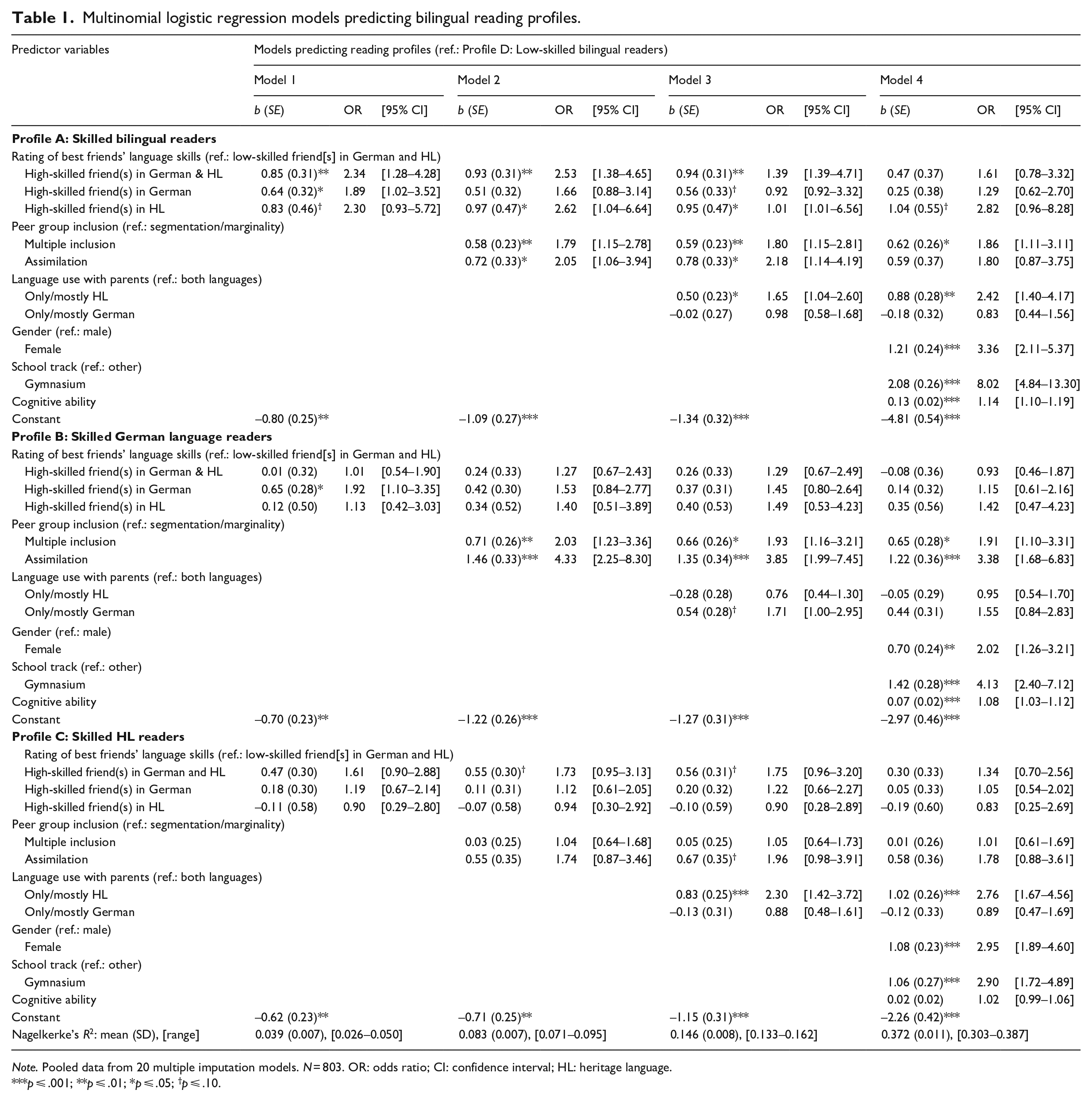
Note. Pooled data from 20 multiple imputation models. N = 803. OR: odds ratio; CI: confidence interval; HL: heritage language.
p ⩽ .001; **p ⩽ .01; *p ⩽ .05; †p ⩽ .10.
Model 1 shows the effects of best friend’s language skills (as reported by the students) on profile membership. Compared to students with low-skilled friends in both German and the HL, students who have high-skilled friends in both German and the HL are 2.3-times more likely to be among the skilled bilingual readers than the reference category of low-skilled bilingual readers (see upper horizontal section of Table 1). A significant positive relation was also found between students who have high-skilled friends in German only, which was associated with a 1.9-times higher likelihood to be a skilled bilingual reader. The increased odds of being in Profile A for students having (a) high-skilled HL friend(s) yielded only marginal statistical significance (p ⩽ .10). Best friend’s (rated) language skills further predicted reading Profile B (skilled German language readers), indicating that those who rated their friends as proficient in German only had a significantly higher probability of being among the above median achievers in German language reading (see middle horizontal section of Table 1). The odds of being a skilled HL reader (Profile C) were not affected by the ratings of the best friends’ language skills (see lower horizontal section of Table 1).
In Model 2, the peer group inclusion variable was included. It contributed significantly to the prediction of profiles A and B, but did not show a significant association with Profile C. Compared to students who indicated having no monolingual German peer among their three best friends (segmentation and marginality), the likelihood of belonging to the group of skilled bilingual readers (Profile A) was two times higher for those with monolingual German best friends only (assimilation), and 1.8-times higher for those who had both monolingual German and HL best friends. The skilled German language reading profile was also significantly predicted by the assimilation (OR = 4.33) and the multiple inclusion (OR = 2.03) peer group pattern. The peer group variables together contributed to the prediction of the reading outcomes with a Nagelkerke’s R2 ranging from .071 to .095 over the 20 imputations.
Language use with parents was included in Model 3. Compared to students who used both languages with their parents, bilinguals who predominantly used the HL were more likely to be skilled bilingual readers (Profile A, OR = 1.65) or to be skilled HL readers (Profile C, OR = 2.30). More exclusive use of German with parents, on the contrary, was associated with an increase in the odds of being among the skilled German readers, but only on a 10%-significance level. The two peer group variables remained significant for predicting the skilled bilingual reading outcome, as did peer group inclusion for predicting Profile B in Model 3. The addition of language use with parents improved the model fit, as indicated by an average Nagelkerke’s R2 of .146.
The model fit improved further when gender, school track, and cognitive abilities were included in Model 4, resulting in an average Nagelkerke’s R2 of .372. Except for nonverbal cognitive abilities, which were not related to the skilled HL reading outcome, the control variables yielded statistical significance in predicting the bilingual reading profiles. Bilinguals who were enrolled in the academic school track (Gymnasium) were eight times more likely to be skilled bilingual readers than low-skilled readers in both languages, four times more likely to be among the skilled German language readers, and had a 2.9-times higher likelihood to belong to the skilled HL reader group. Gender was significantly related to all reading outcomes: Compared to boys, girls had a higher chance of performing above average in either one or both languages. Furthermore, higher nonverbal cognitive abilities significantly predicted group membership in the skilled bilingual reading profile and the skilled German reading profile. Holding all the control variables constant, being best friends with both monolingual German and HL-speaking peers (multiple inclusion), was still associated with a 1.86 higher chance of being in the skilled bilingual reader group. A small additive effect of being friends with a high-skilled HL speaker could still be observed at the 10% significance level. In addition, HL use with parents remained a significant predictor of the skilled bilingual reading outcome, even after controlling for background variables in Model 4. The skilled German language reading outcome was positively predicted by the multiple inclusion and assimilation peer group pattern, whereas peers’ language skills and language use with parents were not significantly related to this outcome. HL use with parents remained the only language exposure variable significantly predicting the skilled HL reading profile.
Discussion
The goal of our study was to identify different patterns in which adolescents’ best friends’ language backgrounds and skills, as well as adolescents’ language use with parents relate to bilingual reading outcomes. A special interest of the study was to investigate social conditions under which bilingual adolescents achieve high levels of reading performance in both the ML and the HL (RQ1). In this regard, we found that students with high levels of reading performance in both German and the HL (skilled bilingual readers) were more likely to use the HL predominantly with their parents and to engage in best friendships with both monolingual German as well as HL-speaking peers. Because the quality of language input is important, we expected to find additive effects when adolescents’ best friends were rated as high-skilled in German and/or the HL. Our analysis provided tentative support for this hypothesis: After controlling for other background variables (including students’ school track, gender, and cognitive abilities), a positive effect of having a high-skilled HL-speaking best friend remained significant on the 10%-significance level, whereas positive effects of higher rated German skills of best friends seemed to be confounded with school track and disappeared when controlling for this variable.
In terms of patterns related to the other bilingual reading outcomes (RQ2), we found that dual inclusion and assimilation friendship patterns positively predicted membership in the skilled German language reading profile, but the association was more pronounced for assimilative peer group inclusion. In line with previous studies, HL use with parents significantly predicted the two language profiles with higher performance in the HL (i.e., skilled bilingual readers, skilled HL readers) and was unrelated to the skilled German language reading profile after the inclusion of control variables. Our assumption that adolescents might benefit from additional HL exposure to (skilled) HL best friends was not supported for the group of skilled HL readers. Neither the language backgrounds of the best friends nor their HL skills predicted the skilled HL reading profile when controlling for other background variables.
On the one hand, our findings seem to support previous research indicating that higher bilingual proficiency is associated with (early) exposure to the ML outside the family (e.g., through peers) and retention of the HL at home (Pearson, 2007), as friendships with monolingual German peers were associated with profiles with higher German languages skills (A and B) and HL use with parents predicted those with higher skills in the HL (A and C). On the other hand, it was multiple inclusion and friendships with higher HL-skilled peers, but not assimilation, which predicted the skilled bilingual reading outcome after the addition of control variables. Furthermore, multiple inclusion was also positively associated with the skilled German reading outcome. Thus, language exposure within friendships with both monolingual German and HL peers seems to be beneficial for developing higher levels of bilingualism. The results also suggest that HL peers are likely to be a source of ML learning. The latter is supported by previous research showing that the ML serves as a lingua franca in peer contexts and is used relatively frequently even among peers who share the same HL (Boos-Nünning & Karakaşoğlu, 2004; Rauch, 2019; Strobel & Seuring, 2016). Using the same scale for language use within the family and peer contexts in future research could provide better information about the role of these two dimensions in language acquisition.
Scientific significance and implications of the study
In our study, we went beyond existing research by incorporating objective assessments of reading achievement in the ML (German) and the HLs (Russian or Turkish) and focusing on language exposure within family and peer contexts. In addition, information on the language backgrounds and ratings of language skills of students’ three best friends allowed for the investigation of effects of inclusion into friendships with both monolingual ML speaking and HL speaking peers as well as potential effects of the quality of language exposure within these. Comparing the results across the different bilingual reading outcomes allowed to assess the patterns in which exposure to the HL and ML within peer and family contexts is associated with the bilinguals’ reading profiles.
Our results point to the fact that exposure to the ML in peer contexts is important. Close bonds with monolingual ML-speaking best friends were positively related to higher reading achievement in the ML. However, forming best friendships with HL-speaking peers did not come along with negative effects on ML performance (as long as monolingual ML speakers are not completely excluded from the group of close friends). On the contrary, we observed (1) an increased likelihood of bilinguals who form friendships with both monolingual German and HL peers (multiple inclusion) to belong to the group of skilled bilingual readers or skilled German language readers and (2) a tendency toward a positive effect of exposure to a high-skilled HL-speaking best friend for the group of skilled bilingual readers. Thus, multiple inclusion may be the favorable friendship pattern because it provides opportunities and motivation for both ML learning and HL maintenance. However, the variance explained by the peer group variables is rather small compared to the variance explained by adding indicators such as school track and cognitive ability to the models. Nevertheless, the fact that the peer group predictors remain significant despite controlling for the latter variables suggests, that language exposure in peer contexts adds value, particularly in explaining language profiles that encompass higher proficiency in the ML.
In line with other studies, our findings indicate that using the HL with parents does not hinder being high-skilled in the ML (Agirdag & Vanlaar, 2016; Bylund et al., 2012). Using the HL more exclusively with parents was positively related to the skilled bilingual reading profile and unrelated to the skilled German language reading profile. A more exclusive use of the German language with parents did not predict membership in the skilled German language profile. 2 These results contradict the OECD interpretation that speaking a HL at home is a barrier to high proficiency in the ML (OECD, 2019, p. 185)—as long as sufficient exposure to the ML is provided by other contexts, for example, peers and school. Despite growing evidence that HL use at home does not per se hinder children’s ML development (Hollebeke et al., 2020), and the negative socio-emotional consequences that HL loss can have for children and their families (Liu et al., 2009; Tannenbaum, 2005), multilingual students and families still face considerable pressure to avoid HL use, and experience a devaluation of their HL in various contexts (Agirdag, 2010; Cummins, 2017; Moffitt et al., 2019). The potential of multilingualism that students develop by maintaining the HL is thus mainly due to the private investment of their families, and—as it seems—the retention of some close bonds with HL peers. Thus, environments that promote positive intergroup contact without imposing monolingual ideologies that stigmatize ethnic ties and the language practices within them (e.g., within family and peer relationships) are likely to enable migrant students to further exploit the potential of their bilingualism (including transfer across languages; see Cummins, 2017) and promote social cohesion (Pettigrew & Tropp, 2006). Edele and Stanat (2016) found that oral HL skills positively predicted reading skills in the ML for adolescents from Russian and Turkish language backgrounds in Germany. However, emergent bilingual students may need additional support to develop skills beyond their functional bilingualism to communicate with different interlocutors and to expand their HL literacy skills—as indicated by the relatively low HL reading scores in our data.
Limitations and further research
Some limitations of this study should be borne in mind when interpreting the results. The first one relates to the dependent variable: In our study, we generated bilingual reading profiles using cohort-specific median splits. It is important to note, for example, that the students are competent in relative terms, that is, the majority of those classified as skilled bilingual readers are far more competent in reading in the ML than in the HL (see Appendix 1). The median-split approach also bears the risk of limited replicability and reduced statistical power; members may be placed in different profiles despite being quite similar in terms of their language proficiency in one language (Kremin & Byers-Heinlein, 2021). The effects of the predictors in our study may, therefore, be underestimated because they are calculated with reference to the profile with below-average performance in the HL and ML. However, other approaches to defining group membership (e.g., latent class or cluster analysis) would have other disadvantages, such as difficulties in interpreting groups and small group sizes (see ibid.). Some researchers have used aggregate measures of performance in the HL and ML (Atkins-Burnett et al., 2017; Ertanir et al., 2018), but in this case high performance may result from intermediate performance in both languages or from excellent performance in only one language. This would make it difficult to disentangle which conditions promote (relatively) high proficiency in both languages, which is the focus of this study.
In addition, it may be interesting to replicate the analysis with measures of other language domains, as peer effects on language proficiency are likely to be more strongly related to conversational language skills (speaking and listening) than to reading proficiency: It is quite possible that HLs serve primarily as a means of social communication within the family and (to a smaller extent) with friends, but that their importance in terms of career development in Germany, and thus the need to master more formal registers in the HL, may vary considerably. The reading tests used in our study were designed to align with the language demands prevalent in formal settings, which are necessary for academic and professional success. The potential heterogeneity among HL speakers regarding the need for a more “formal” register of the HL is a noteworthy aspect to consider, and further exploration of this variation may shed light on the complex interplay between language use patterns and bilingual development among adolescents.
It should also be noted that the ratings of best friends’ language skills are rather rough indicators of actual language competence (see Dünkel et al., 2020). Hence, the effects of peers’ language skills in our models may be underestimated. In addition, disentangling the effects of language exposure (peer group inclusion) and the quality of language input (friends’ language skills) may prove difficult, as each may capture some of the influence of the other. Nevertheless, both aspects are important and have been largely neglected in previous research, which is a major contribution of this study.
Furthermore, our cross-sectional analyses do not allow for the interpretation of causalities. Although it is highly likely that peer group characteristics influence adolescents’ language skills over time, it is also possible that they are partly a result of selection effects due to adolescents’ previous language performance. Longitudinal analyses could shed light on peer selection and influence effects on language performance. In addition, by using larger samples, future research could investigate potential interactions between the exposure to each language within peer contexts and the quality of language input (i.e., peers’ language skills), as effects of exposure might be more salient when the quality of the input is high.
Previous empirical findings point to peer effects on HL skills being particularly pronounced for German–Turkish bilinguals, while the effects for German–Russian students were no longer significant when controlling for additional background variables (Dünkel, 2022; Kristen et al., 2019; Seuring et al., 2020). Our sample size of the German–Russian students was too small to meaningfully investigate factors predicting the different language outcomes for Turkish and Russian students separately. Thus, the possibility that language exposure within peer contexts may differ between groups of migrant students in terms of the conditions that promote high bilingual reading skills should be analyzed in greater detail in future research.
Finally, the mechanisms that contribute to peer relationships influencing ML and HL performance through the opportunities they provide for language input and output merit further investigation. The variables included in our analyses represent potential opportunities arising from language exposure within peer contexts. However, whether and how bilingual language repertoires are used depends on a variety of factors (e.g., the situation, the topic, and the attitudes of interaction partners toward the respective languages; Grosjean, 2022). Research suggests that the HL is most likely to be used—in addition to the ML—when HL friends are present (Boos-Nünning & Karakaşoğlu, 2004; Seuring et al., 2020). Which modes of HL use with friends promote HL maintenance and proficiency beyond effects of exposure to the HL within the family remains an open research question.
Supplemental Material
sj-docx-1-ijb-10.1177_13670069231221103 – Supplemental material for Language exposure within peer and family contexts and bilingual reading profiles of German–Russian and German–Turkish adolescents in Germany
Supplemental material, sj-docx-1-ijb-10.1177_13670069231221103 for Language exposure within peer and family contexts and bilingual reading profiles of German–Russian and German–Turkish adolescents in Germany by Nora Dünkel, Michel Knigge and Hanne Brandt in International Journal of Bilingualism
Footnotes
Declaration of conflicting interests
The author(s) declared no potential conflicts of interest with respect to the research, authorship, and/or publication of this article.
Funding
The author(s) disclosed receipt of the following financial support for the research, authorship, and/or publication of this article: This work was supported by the German Federal Ministry of Education and Research under Grant MEZ (01JM1406).

Supplemental material
Supplemental material for this article is available online.
Notes
Author biographies
References
Supplementary Material
Please find the following supplemental material available below.
For Open Access articles published under a Creative Commons License, all supplemental material carries the same license as the article it is associated with.
For non-Open Access articles published, all supplemental material carries a non-exclusive license, and permission requests for re-use of supplemental material or any part of supplemental material shall be sent directly to the copyright owner as specified in the copyright notice associated with the article.
