




Abstract
Aims and objectives:
The aim of this study is to investigate language contact from a usage-based perspective. In particular, we test the explanatory power of a schematicity continuum, one of the central assumptions within usage-based approaches, in regard to these contact effects. In doing so, we aim to better understand how schematicity influences language transfer as well as learn more about the cognitive mechanism of schematicity itself.
Design:
The empirical focus of this study is on native German speakers living in the Netherlands who tend to experience a lot of language transfer from their second language Dutch to their native language German. The experiment consists of a production task containing constructions that differ in regard to their potential level of schematicity (i.e., lexically specific, partially schematic, fully schematic) and in the type of transfer that they might trigger (i.e., covert and overt transfer).
Data and analysis:
We compare production data of native German speakers living in the Netherlands (N = 60) with those of a control group of speakers not in contact with Dutch (N = 60), to establish whether the language use of these two groups differs. In addition, we analyze both speaker and item variation for the different constructions.
Findings/conclusions:
The speakers with Dutch contact show a number of contact effects, such as covert and overt transfer as well as hypercorrection regarding the use of certain constructions.
Originality:
The variation analysis reveals individual differences in how speakers use the different constructions. Some of these differences can be attributed to their mental levels of schematicity.
Significance/implications:
The study shows that transfer depends on schematicity. In doing so, it provides direct evidence for different levels of schematicity in speakers’ mental representations, demonstrating the usefulness of studying cognitive mechanisms within a language contact setting.
Keywords
Introduction
Research in the field of language contact has documented a vast variety of language contact settings and phenomena. In regard to the settings, researchers have, for instance, looked at languages that have been in contact for hundreds of years (e.g., Heine & Kuteva, 2003, 2005) as well as languages that have just come into contact (e.g., M. S. Schmid & Köpke, 2017), contact languages with varying degrees of typological closeness, different reasons for the emergence of contact such as migration or colonization (see Appel & Muysken, 2006, pp. 5–6 for an overview), language contact among first-generation immigrants (e.g., Ribbert & Kuiken, 2010), later generation immigrants (e.g., Backus et al., 2011), and even returnees (Flores, 2010), and many, many, more factors that can all shape their respective contact settings. In regard to the contact phenomena, they have investigated changes at a lexical level such as words or fixed collocations (e.g., Treffers-Daller, 2012) and structural changes such as the emergence of new word order patterns that are shared across the contact languages (e.g., Clyne, 2003). They have looked at differences between overt and covert change (i.e., changes that result in a frequency increase of an existing pattern versus changes that result in a new pattern; Mougeon et al., 2005) and changes that result in increased convergence like the examples so far as well as changes that instead result in more divergence across the contact languages as speakers actively try to differentiate between them (see Kühl & Braunmüller, 2014 for an overview).
This variety of contact settings and contact phenomena is both one of the field’s greatest opportunities and one of its greatest challenges. It is an opportunity because it makes it possible to tease apart which settings result in which contact phenomena, and thereby helps us understand why and how languages change in situations of language contact; it is a challenge because there are so many factors to account for when trying to integrate the insights from the different contact settings and phenomena. Clearly, what is needed is an account that allows us to combine research findings and to identify general patterns, while also allowing for enough room to account for the idiosyncrasies of each individual contact setting. In their book Cognitive Contact Linguistics, Zenner et al. (2019) argue that Cognitive Linguistics, in particular the usage-based approach, might be able to provide such a unifying account.
In short, the usage-based approach assumes that different linguistic phenomena — for example, the way people acquire language, the way they process and store language, the way language changes and evolves — are all based on actual language usage. For instance, Bybee (2006, p. 711) defines grammar as the “cognitive organization of one’s experiences with language” and Tomasello (2000, p. 62) argues that our linguistic skills are “the result of accumulated experiences with language across the totality of usage events.” These usage events are assumed to be processed and stored using general cognitive principles, that is, principles that do not only apply to language but are used in other cognitive domains as well, such as entrenchment, categorization, and generalization (e.g., Bybee, 2011; Ibbotson, 2013; Tomasello, 2000; see section “Schematicity continuum” for a more detailed description of these principles). When looking at contact phenomena from such a usage-based perspective, many phenomena that have previously been investigated in separate strands within the research on language contact can now be integrated (Zenner et al., 2019), demonstrating the unifying potential of this approach.
For example, from a usage-based perspective, it becomes possible to directly relate lexical and structural language change. This is because instead of treating the lexicon and syntax as two separate modules, the usage-based approach assumes them to form a schematicity continuum (see section “Schematicity continuum”) ranging from lexically specific items to partially schematic constructions to fully schematic patterns. In this study, we aim to test the explanatory power of this conceptualization in regard to language contact phenomena. To do that, we collect and analyze data on language transfer regarding a variety of different constructions that (1) potentially fall on different stages of the usage-based schematicity continuum (i.e., lexically specific, partially schematic, fully schematic) and (2) also differ in regard to the distinction between covert and overt transfer, which is an important distinction in research on language contact (see section “Covert and overt transfer”). This combination allows us to investigate transfer patterns in a wide variety of constructions. The empirical focus of this study is on native German speakers living in the Netherlands, who have been shown to experience extensive transfer from their second language Dutch to their native language German (Brons-Albert, 1992, 1994; Ribbert & Kuiken, 2010), making this group well-suited for the comparison of transfer patterns across different construction types that we propose here. Besides, this setting allows us to shift the focus of research on language transfer, which predominantly looks at language transfer from speakers’ first to their second language, to also include other language contact situations in which this transfer occurs from speakers’ second to their first language.
Importantly, the overall aim of this study is to investigate language transfer from a usage-based perspective and thereby, hopefully, to learn more about both language transfer and the usage-based principles. This is in line with Zenner et al. (2019, p. 4), who define the aim of Cognitive Contact Linguistics as follows: to explore how the guiding principles of Cognitive Linguistics apply to the bi- or multilingual mind in its dynamic bi- and multilingual environment, how this feeds back to our general understanding of these guiding principles, and how we can as a result better grasp how the interaction between cognition and context results in contact-induced variation and change.
In regard to this study, this means that we do not only want to test to what extent the usage-based principles are able to account for the transfer patterns across the different construction types, but that we also want to turn this around and reflect on what these transfer patterns in turn can tell us about the usage-based principles and how that can ultimately help us better understand contact-induced language change.
Schematicity continuum
According to the usage-based approach, lexicon and syntax do not represent separate modules, but rather form a so-called schematicity continuum. This continuum is assumed to be the result of a number of cognitive principles: first, speakers entrench words and constructions that they encounter, with words and constructions that they encounter frequently becoming more and more entrenched. This means that speakers can easily activate them (Blumenthal-Dramé, 2016; Bybee, 2011; H.-J. Schmid, 2016) and therefore are also more likely to select them in subsequent language production (Bybee, 2011; De Smet, 2016; Langacker, 1987, 2016). When storing these linguistic exemplars, speakers store exemplars that they perceive as similar closely together (Bybee, 2011; Croft, 2000; Goldberg, 1995; Langacker, 1987, 2016), resulting in categories that speakers might start to generalize over (Bybee, 2011; Ibbotson, 2013; H.-J. Schmid, 2016; Tomasello, 2000b). This results in constructions with varying degrees of schematicity, ranging from lexically specific constructions (e.g., I don’t know, I don’t think, do you want, and and I said; Biber et al., 1999) to partially schematic constructions (e.g., the X is that as in the thing/fact/point is that; H.-J. Schmid, 2007) to fully schematic constructions (e.g., the SVO [subject-verb-object] word order in English main clauses; Tomasello, 2000b).
To capture these different levels of schematicity and study their effects on language transfer, this study uses a two-step approach: first, we selected constructions that we think are likely to be mentally stored as lexically specific items (i.e., light verb constructions [
Covert and overt transfer
For all construction types, we further distinguished between constructions whose transfer results in covert transfer and whose transfer results in overt transfer. This is a distinction that is commonly made in research on contact-induced language change (e.g., Mougeon et al., 2005; Treffers-Daller, 2012; Treffers-Daller & Sakel, 2012; also referred to as system-preserving and system-altering transfer, Aikhenvald, 2003). In the case of covert transfer, there are two competing constructions in language A, one of which has a parallel form in the contact language B. As a result, transfer from language B might result in speakers using the construction with a parallel form rather than the other one in language A, which, if the transfer occurs frequently enough, results in speakers over-using that construction at the expense of the alternative construction (Heine & Kuteva, 2003; Mougeon et al., 2005; Treffers-Daller & Mougeon, 2005). For example, in German it is possible to use both the light verb construction Einfluss nehmen “to take influence” and Einfluss ausüben “to practice influence”. The corresponding construction in Dutch is invloed uitoefenen “to practice influence”. Transfer from Dutch to German might therefore lead native German speakers living in the Netherlands to use the combination Einfluss ausüben more frequently than Einfluss nehmen compared to speakers not in contact with Dutch. In the case of overt transfer, transfer leads to speakers using a new, previously unattested construction (Mougeon et al., 2005), for instance, using the combination *Wecker setzen “to set an alarm” instead of Wecker stellen “to put an alarm” in German due to transfer of the Dutch combination wekker zetten “to set an alarm”. This distinction between covert and overt transfer can also be applied to more schematic constructions (see sections “Partially schematic
Method
Design
The study consists of a production task in which participants are asked to produce instances of a number of different constructions that they might transfer from their Dutch to their German. These constructions differ in their potential level of schematicity (lexically specific, partially schematic, fully schematic) and in the type of transfer that they might trigger (covert transfer, overt transfer). To analyze the results, we first compared the production patterns of native German speakers living in the Netherlands to those of a control group of native German speakers not in contact with Dutch. This comparison can show to what extent usage patterns are different between the two groups, likely due to their contact with Dutch for the speakers living in the Netherlands. In a second step, we focused on both speaker and item variation as a way to learn more about the transfer patterns for the different construction types, especially in regard to what these patterns can reveal about the constructions’ mental levels of schematicity (see section “Schematicity Continuum”). The study was approved by the Research Ethics and Data Management Committee of Tilburg School of Humanities and Digital Sciences. The study was preregistered at https://osf.io/92ngu.
Participants
In total, 120 participants (16.7% male) took part in the experiment. They were either native German speakers living in the Netherlands or native German speakers without any contact with Dutch. On average, they were 36.17 years old (SD = 14.05), ranging from 19 to 73 years. The speakers without Dutch contact (N = 60) were living in Germany at the moment of the study. They were not raised bilingually and did not speak Dutch, so any potential influence from Dutch on their German was highly unlikely. The speakers with Dutch contact (N = 60) were living in the Netherlands. They were not raised bilingually, had immigrated to the Netherlands as adults (mean age of immigration: 27.00 years, SD = 6.18, ranging from 19 to 48 years), and had been living in the Netherlands for at least 5 years (M = 18.02, SD = 10.78, ranging from 5 to 49 years).
Stimuli
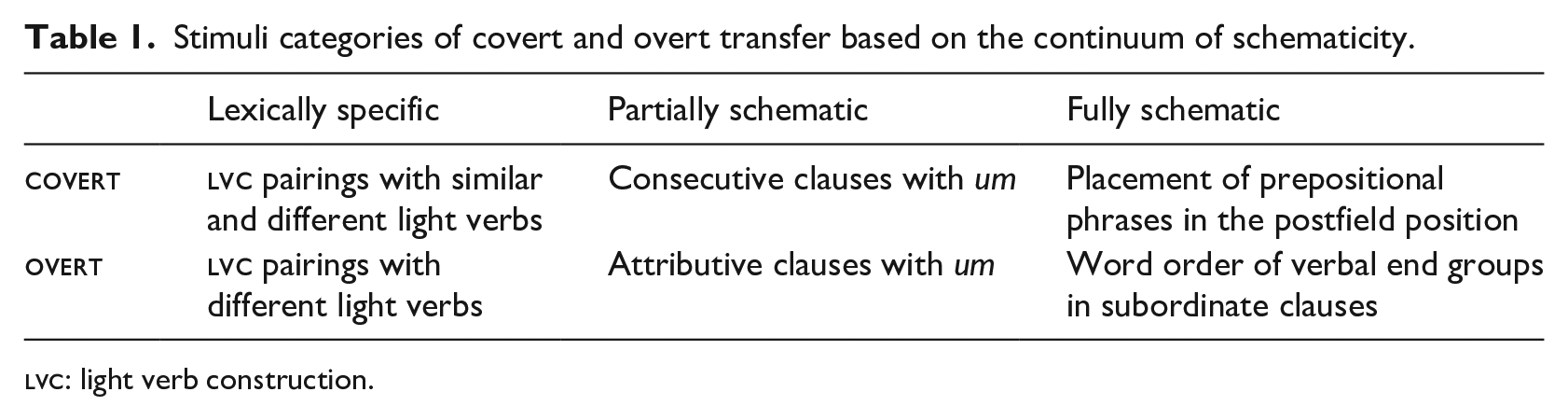
Table 1 presents an overview of the selected stimuli. In total, we selected 90 stimuli (30 stimuli per construction type divided into 15 stimuli that might trigger covert transfer and 15 stimuli that might trigger overt transfer; see Appendix 1). 2 The stimuli were split into two lists, which participants were randomly assigned to. The construction types are explained in more detail in the following sections.
Stimuli categories of covert and overt transfer based on the continuum of schematicity.
Lexically specific lvc s
Transfer of
Partially schematic um -constructions
The partially schematic constructions (
(1) Attributive clause
(2) Consecutive clause
In these sentences, the complementizer om is used in Dutch, but the sentences differ in regard to whether the German equivalent um is used in the German sentences. In the case of the attributive clauses as in (1), the use of um is ungrammatical in German (DudenOnline, n.d.; Ribbert & Kuiken, 2010). Transfer from Dutch, which results in speakers using um in these sentences, thus leads to a new construction that is not used in standard German. We therefore use these attributive clauses as stimuli in the overt transfer condition. In the covert transfer condition, we selected consecutive sentences as stimuli. These sentences as in (2) follow a main clause containing an expression of degree (enough X, too much X, not enough X, too little X) and express the direct consequence of this main clause (Ten Cate et al., 1998). Consecutive clauses start with the complementizer om in Dutch (e-ANS, n.d.) and it is also possible—but not obligatory—to use this complementizer in German (DudenOnline, n.d.). This means that there are two possible German constructions, one (i.e., the construction with um) shares the form with the Dutch equivalent, the other one (i.e., the construction without um) does not. Transfer from Dutch might therefore lead to speakers using the construction with um more frequently than speakers not in contact with Dutch.
Fully schematic word order patterns
The constructions that were selected as the fully schematic construction type (
In the overt transfer condition, we selected the word order patterns in verbal end groups in Dutch and German subordinate clauses, because these patterns differ in Dutch and German (Coussé, 2003; Swerts & van Wijk, 2005). When there are two verbal elements in the clause (as in (3) the auxiliary have and the verb read), both the word order [verb + auxiliary] and [auxiliary + verb] are possible in Dutch, but only the first word order is possible in German. Transfer from Dutch to German therefore may lead to speakers using the order [auxiliary verb] (e.g., *hat gelesen) in German, even though that is a word order not used in standard German.
(3) Nachdem Anna den Brief gelesen hat
Nadat Anna de letter gelezen/heeft heeft/gelezen
After Anna the letter read/had had/read [Conjunction] [Subject] [Object] [verb participle]/[finite verb] [finite verb]/[verb participle] “After Anna had read the letter”
The word order pattern in the covert transfer condition is the placement of prepositional phrases in the main clause. Prepositional phrases can be placed before the verb particle as in sentence (4), which is referred to as the middlefield position, or after the verb as in sentence (5), which is referred to as the postfield position. Both middlefield and postfield position are used in Dutch and German, but research has shown that prepositional phrases in Dutch occur more often in the postfield than in German (De Sutter & Van de Velde, 2007; Van Oost et al., 2016). Transfer of this pattern from Dutch to German (i.e., the use of the postfield position) therefore does not lead to a new construction in German, but rather to an increase of the construction with parallel Dutch form, in this case, an increase in the use of the postfield position.
(4) Ich habe den Mann in der Stadt gesehen. (Fitch, 2011, p. 372) I have the man in the city seen [Subject] [finite verb] [Object] middlefield PP [verb participle] “I saw the man in the city.” (5) Ich habe den Mann gesehen in der Stadt. (Fitch, 2011, p. 372) I have the man seen in the city [Subject][finite verb] [Object] [verb participle] postfield PP “I saw the man in the city.”
Procedure
Participants first signed a consent form and provided demographic information (i.e., age, gender, native language[s]). They then participated in the production task, which took around 25 minutes to complete. For the
(6) Anna hat Peter das Versprechen (7) Was hat Peter versucht? Anna anrufen. Peter hat versucht, (8) Anna liest den Brief. Danach geht sie einkaufen. Nachdem
Data analysis
Data exclusion
In line with our preregistration, we excluded constructions that (a) had a percentage of alternative responses higher than 25% (
There were three possible responses in the production task: the Dutch-like construction (e.g., Wecker stellen), the non-Dutch-like construction (e.g., *Wecker setzen), or an alternative response. For the purpose of the analyses, we excluded all alternative responses, resulting in a binary variable (Dutch-like construction used, Dutch-like construction not used). 5
Analysis extent of transfer
The first analysis focused on potential differences between conditions (i.e., the between-participant variable speaker group: participants
Analysis speaker and item variation
Further inference trees were built to explore both speaker and item variation within each condition. To do that, the speaker and item variance was calculated as the squared difference between the average percentage of using the Dutch-like construction (e.g., *Wecker setzen) for each condition and the percentage of each individual speaker/item. As such, the speaker/item variance provides a measure of the overall variance: the more speakers/items deviated from each other regarding their use of the Dutch-like constructions, the higher the speaker/item variance for that construction. In addition, we plotted the results for the individual speakers and items to explore their variation.
Results
Analysis extent of transfer
Figure 1 plots the extent of speakers using the Dutch-like construction based on the speaker group (participants
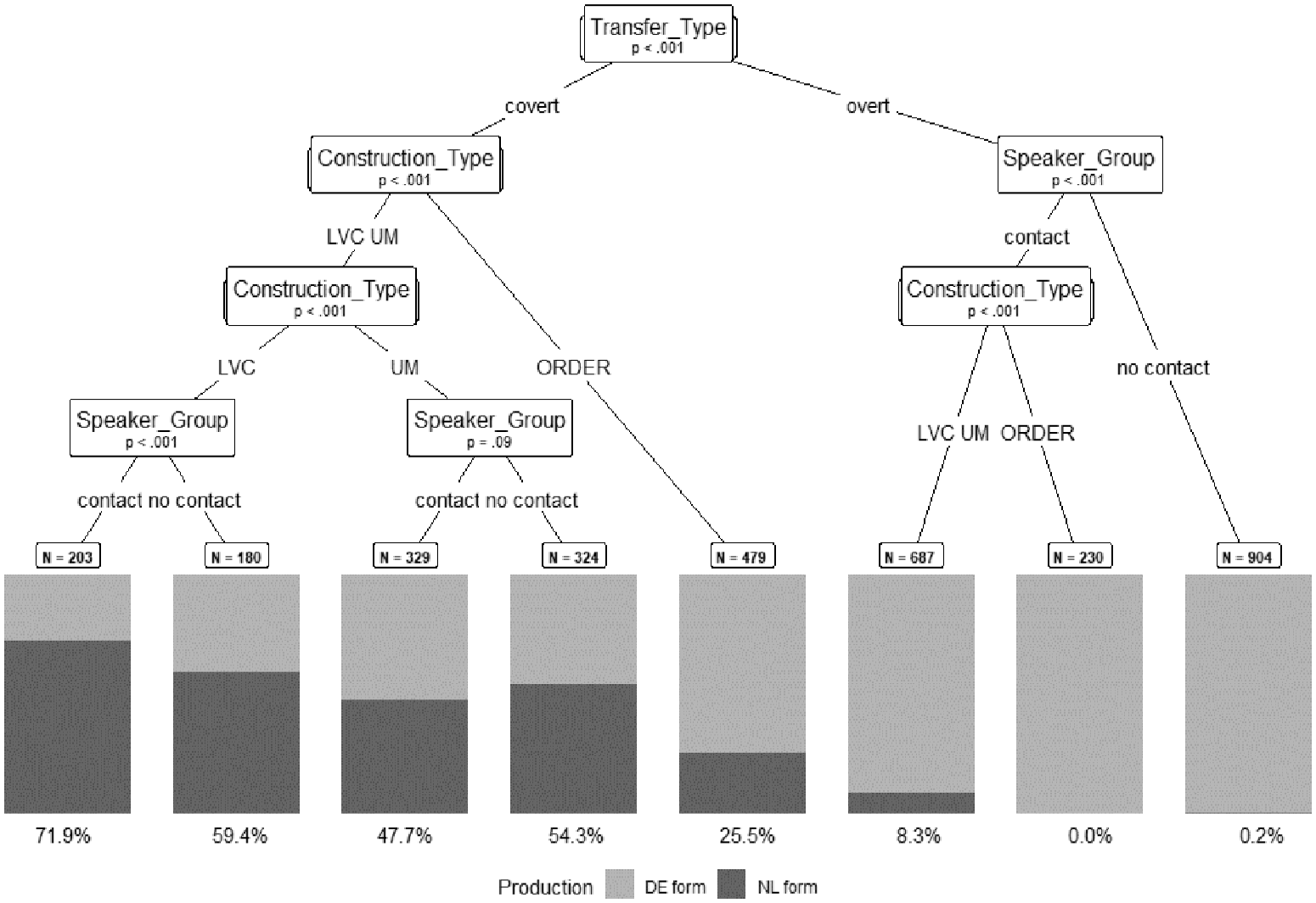
Production choices across the different conditions. The inferential tree predicts the speakers’ production choices (Dutch-like construction used, Dutch-like construction not used) based on the speaker group (participants
Within the
Within the
Analysis speaker and item variation
Figure 2 plots the extent of speaker variation within the different constructions, Figure 3 plots the corresponding item variation. For both speaker and item variation, there was more variation in the
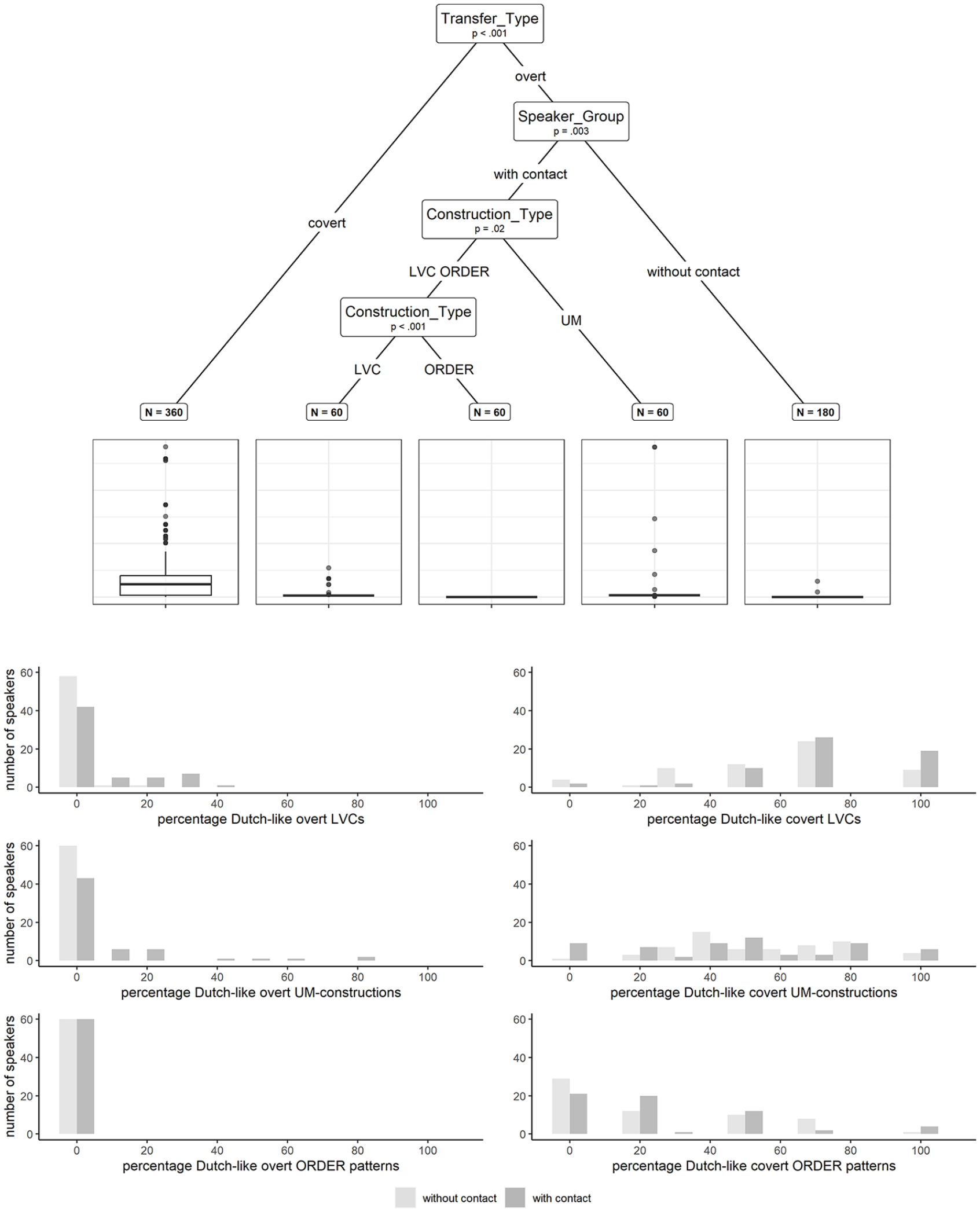
Speaker variation across the different conditions. The inferential tree predicts the speaker variance based on the speaker group (participants
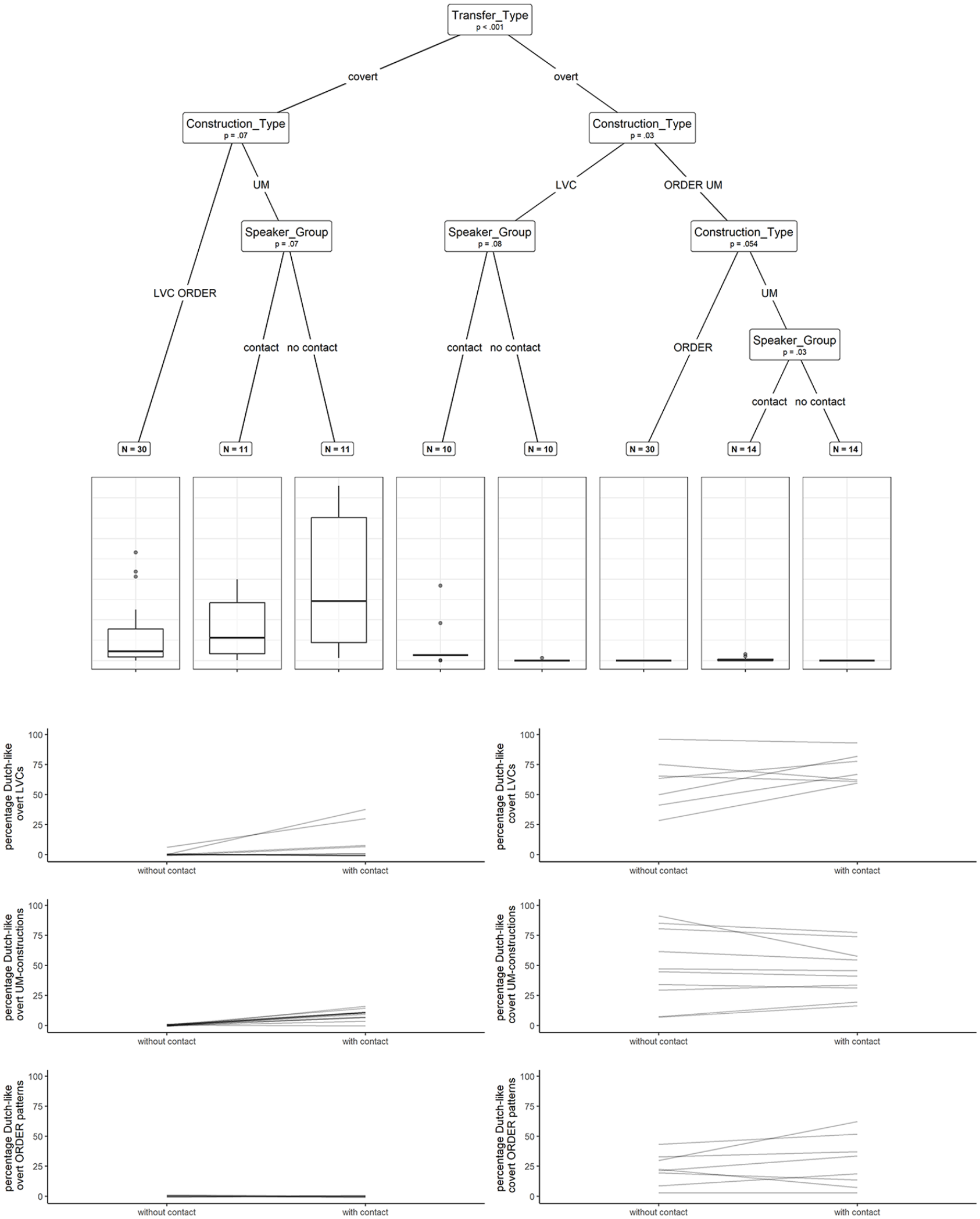
Item variation across the different conditions. The inferential tree predicts the item variance based on the speaker group (participants
Regarding the
This pattern (i.e., avoidance in all cases, usage in the majority of the cases) also has consequences regarding the
Regarding the
Discussion
In this study, we compared different constructions (i.e., lexically specific
Regarding the first aim, that is, to learn more about language transfer by studying it from a usage-based perspective, our results strongly suggest that transfer does indeed depend on a construction’s level of schematicity. To illustrate this, we first focus on the results in the overt transfer condition, which revealed interesting differences across construction types that might be attributed to schematicity. For the
In the covert transfer condition, we observe a similar pattern, in that there are differences between the speakers with Dutch contact and without Dutch contact regarding the
When it comes to the second aim of the study — reflecting on the question what the transfer patterns can tell us about the usage-based principles — the results of this study show the importance of individual variation as a way to both clarify patterns and to reveal new patterns regarding speakers’ language processing. They also show that, when investigating the concept of schematicity, it is necessary to view the different levels of schematicity as a continuum and to account for individual variation regarding these levels. The following paragraphs discuss each of these three points.
First, our results showed that individual variation can be used to clarify patterns. In particular, there were several cases in which the overall usage pattern of a construction and the usage pattern for the individual speakers and items clearly differed from each other. For example, in the overt transfer condition, there was no difference in the overall extent of transfer between the
Second, this study demonstrates how individual variation can be used as a tool to reveal new patterns regarding speakers’ language processing and production. Specifically, in this study, we used individual variation as a way to investigate a construction’s level of schematicity. To do that, we first selected constructions that were likely to differ in regard to their schematicity level and then verified this initial classification by looking at both speaker and item variation in the constructions’ transfer patterns. Overall, using this approach revealed interesting differences regarding how constructions are stored and therefore also transferred (e.g.,
Third, our analysis illustrates the need for a continuous view of schematicity, as proposed by the usage-based approach. For example, as argued above, the patterns in the data showed that the
Interestingly, this mismatch between a construction’s general level of schematicity and its representation in each individual speaker’s mental representation also seems to be happening the other way around: as argued above, transfer patterns suggest that the
Conclusion
Our results demonstrate that usage-based concepts such as the schematicity continuum as the result of a number of basic cognitive mechanisms (e.g., entrenchment, categorization, generalization, see section “Schematicity Continuum”) can account for a wide range of contact phenomena, for example, covert and overt language transfer (e.g., the over-use of Dutch-like existing and non-existing
Footnotes
Appendix 1
Authors’ note
One of the authors of this article is a member of the Editorial board of the journal and did not participate in the peer-review process.
Declaration of conflicting interests
The author(s) declared no potential conflicts of interest with respect to the research, authorship, and/or publication of this article.
Funding
The author(s) disclosed receipt of the following financial support for the research, authorship, and/or publication of this article: This publication is part of the project “Two Languages in One Mind” (with project number PGW.18.019) which is financed by the Dutch Research Council (NWO).
